Archive for the 'Monetarism' Category

Hetzel Withholds Credit from Hawtrey for his Monetary Explanation of the Great Depression

In my previous post, I explained how the real-bills doctrine originally espoused by Adam Smith was later misunderstood and misapplied as a policy guide for central banking, not, as Smith understood it, as a guide for individual fractional-reserve banks. In his recent book on the history of the Federal Reserve, Robert Hetzel recounts how the Federal Reserve was founded, and to a large extent guided in its early years, by believers in the real-bills doctrine. On top of their misunderstanding of what the real-bills doctrine really meant, they also misunderstood the transformation of the international monetary system from the classical gold standard that had been in effect as an international system from the early 1870s to the outbreak of World War I. Before World War I, no central bank, even the Bank of England, dominant central bank at the time, could determine the international price level shared by all countries on the gold standard. But by the early 1920s, the Federal Reserve System, after huge wartime and postwar gold inflows, held almost half of the world’s gold reserves. Its gold holdings empowered the Fed to control the value of gold, and thereby the price level, not only for itself but for all the other countries rejoining the restored gold standard during the 1920s.

All of this was understood by Hawtrey in 1919 when he first warned that restoring the gold standard after the war could cause catastrophic deflation unless the countries restoring the gold standard agreed to restrain their demands for gold. The cooperation, while informal and imperfect, did moderate the increased demand for gold as over 30 countries rejoined the gold standard in the 1920s until the cooperation broke down in 1928.

Unlike most other Monetarists, especially Milton Friedman and his followers, whose explanatory focus was almost entirely on the US quantity of money rather than on the international monetary conditions resulting from the fraught attempt to restore the international gold standard, Hetzel acknowledges Hawtrey’s contributions and his understanding of the confluence of forces that led to a downturn in the summer of 1929 followed by a stock-market crash in October.

Recounting events during the 1920s and the early stages of the Great Depression, Hetzel mentions or quotes Hawtrey a number of times, for example, crediting (p. 100) both Hawtrey and Gustav Cassel, for “predicting that a return to the gold standard as it existed prior to World War I would destabilize Europe through deflation.” Discussing the Fed’s exaggerated concerns about the inflationary consequences of stock-market spectulation, Hetzel (p. 136) quotes Hawtrey’s remark that the Fed’s dear-money policy, aiming to curb stock-market speculation “stopped speculation by stopping prosperity.” Hetzel (p. 142) also quotes Hawtrey approvingly about the importance of keeping value of money stable and the futility of urging monetary authorities to stabilize the value of money if they believe themselves incapable of doing so. Later (p. 156), Hetzel, calling Hawtrey a lone voice (thereby ignoring Cassel), quotes Hawtrey’s scathing criticism of the monetary authorities for their slow response to the sudden onset of rapid deflation in late 1929 and early 1930, including his remark: “Deflation may become so intense that it is difficult to induce traders to borrow on any terms, and that in that event the only remedy is the purchase of securities by the central bank with a view to directly increase the supply of money.”

In Chapter 9 (entitled “The Great Contraction” in a nod to the corresponding chapter in A Monetary History of the United States by Friedman and Schwartz), Hetzel understandably focuses on Federal Reserve policy. Friedman insisted that the Great Contraction started as a normal business-cycle downturn caused by Fed tightening to quell stock-market speculation that was needlessly exacerbated by the Fed’s failure to stop a collapse of the US money stock precipitated by a series of bank failures in 1930, and was then transmitted to the rest of the world through the fixed-exchange-rate regime of the restored gold standard. Unlike Friedman Hetzel acknowledges the essential role of the gold standard in not only propagating, but in causing, the Great Depression.

But Hetzel leaves the seriously mistaken impression that the international causes and dimensions of the Great Depression (as opposed to the US-centered account advanced by Friedman) was neither known nor understood until the recent research undertaken by such economists as Barry Eichengreen, Peter Temin, Douglas Irwin, Clark Johnson, and Scott Sumner, decades after publication of the Monetary History. What Hetzel leaves unsaid is that the recent work he cites largely rediscoveed the contemporaneous work of Hawtrey and Cassel. While recent research provides further, and perhaps more sophisticated, quantitative confirmation of the Hawtrey-Cassel monetary explanation of the Great Depression, it adds little, if anything, to their broad and deep analytical and historical account of the downward deflationary spiral from 1929 to 1933 and its causes.

In section 9.11 (with the heading “Why Did Learning Prove Impossible?”) Hetzel (p. 187) actually quotes a lengthy passage from Hawtrey (1932, pp. 204-05) describing the widely held view that the stock-market crash and subsequent downturn were the result of a bursting speculative bubble that had been encouraged and sustained by easy-money policies of the Fed and the loose lending practices of the banking system. It was of course a view that Hawtrey rejected, but was quoted by Hetzel to show that contemporary opinion during the Great Depression viewed easy monetary policy as both the cause of the crash and Great Depression, and as powerless to prevent or reverse the downward spiral that followed the bust.

Although Hetzel is familiar enough with Hawtrey’s writings to know that he believed that the Great Depression had been caused by misguided monetary stringency, Hetzel is perplexed by the long failure to recognize that the Great Depression was caused by mistaken monetary policy. Hetzel (p. 189) quotes Friedman’s solution to the puzzle:

It was believed [in the Depression] . . . that monetary policy had been tried and had been found wanting. In part that view reflected the natural tendency for the monetary authorities to blame other forces for the terrible economic events that were occurring. The people who run monetary policy are human beings, even as you and I, and a common human characteristic is that if anything bad happens it is somebody else’s fault.

Friedman, The Counter-revolution in Monetary Theory. London: Institute for Economic Affairs, p. 12.

To which Hetzel, as if totally unaware of Hawtrey and Cassel, adds: “Nevertheless, no one even outside the Fed [my emphasis] mounted a sustained, effective attack on monetary policy as uniformly contractionary in the Depression.”

Apparently further searching for a solution, Hetzel in Chapter twelve (“Contemporary Critics in the Depression”), provides a general overview of contemporary opinion about the causes of the Depression, focusing on 14 economists—all Americans, except for Joseph Schumpeter (arriving at Harvard in 1932), Gottfried Haberler (arriving at Harvard in 1936), Hawtrey and Cassel. Although acknowledging the difficulty of applying the quantity theory to a gold-standard monetary regime, especially when international in scope, Hetzel classifies them either as proponents or opponents of the quantity theory. Remarkably, Hetzel includes Hawtrey among those quantity theorists who “lacked a theory attributing money to the behavior of the Fed rather than to the commercial banking system” and who “lacked a monetary explanation of the Depression highlighting the role of the Fed as opposed to the maladjustment of relative prices.” Only one economist, Laughlin Currie, did not, in Hetzel’s view, lack those two theories.

Hetzel then briefly describes the views of each of the 14 economists: first opponents and then proponents of the quantity theory. He begins his summary of Hawtrey’s views with a favorable assessment of Hawtrey’s repeated warnings as early as 1919 that, unless the gold standard were restored in a way that did not substantially increase the demand for gold, a severe deflation would result.

Despite having already included Hawtrey among those lacking “a theory attributing money to the behavior of the Fed rather than to the commercial banking system,” Hetzel (p. 281-82) credits Hawtrey with having “almost alone among his contemporaries advanced the idea that central banks can create money,” quoting from Hawtrey’s The Art of Central Banking.

Now the central bank has the power of creating money. If it chooses to buy assets of any kind, it assumes corresponding liabilities and its liabilities, whether notes or deposits, are money. . . . When they [central banks] buy, they create money, and place it in the hands of the sellers. There must ultimately be a limit to the amount of money that the sellers will hold idle, and it follows that by this process the vicious cycle of deflation can always be broken, however great the stagnation of business and the reluctance of borrowers may be.

Hawtrey, The Art of Central Banking: London: Frank Cass, 1932 [1962], p. 172

Having already quoted Hawtrey’s explicit assertion that central banks can create money, Hetzel struggles to justify classifying Hawtrey among those denying that central banks can do so, by quoting later statements that, according to Hetzel, show that Hawtrey doubted that central banks could cause a recovery from depression, and “accepted the . . . view that central banks had tried to stimulate the economy, and . . . no longer mentioned the idea of central banks creating money.”

Efforts have been made over and over again to induce that expansion of demand which is the essential condition of a revival of activity. In the United States, particularly, cheap money, open-market purchases, mounting cash reserves, public works, budget deficits . . . in fact the whole apparatus of inflation has been applied, and inflation has not supervened.

Hawtrey, “The Credit Deadlock” in A. D. Gayer, ed., The Lessons of Monetary Experience, New York: Farrar & Rhinehart, p. 141.

Hetzel here confuses the two distinct and different deficiencies supposedly shared by quantity theorists other than Laughlin Currie: “[lack] of a theory attributing money to the . . . Fed rather than to the commercial banking system” and “[lack] of a monetary explanation of the Depression highlighting the role of the Fed as opposed to the maladjustment of relative prices.” Explicitly mentioning open-market purchases, Hawtrey obviously did not withdraw the attribution of money to the behavior of the Fed. It’s true that he questioned whether the increase in the money stock resulting from open-market purchases had been effective, but that would relate only to Hetzel’s second criterion–lack of a monetary explanation of the Depression highlighting the role of the Fed as opposed to the maladjustment of relative prices—not the first.

But even the relevance of the second criterion to Hawtrey is dubious, because Hawtrey explained both the monetary origins of the Depression and the ineffectiveness of the monetary response to the downturn, namely the monetary response having been delayed until the onset of a credit deadlock. The possibility of a credit deadlock doesn’t negate the underlying monetary theory of the Depression; it only suggests an explanation of why the delayed monetary expansion didn’t trigger a recovery as strong as a prompt expansion would have.

Turning to Hawtrey’s discussion of the brief, but powerful, revival that began almost immediately after FDR suspended the gold standard and raised the dollar gold price (i.e., direct monetary stimulus) upon taking office, Hetzel (Id.) misrepresents Hawtrey as saying that the problem was pessimism not contractionary monetary policy; Hawtrey actually attributed the weakening of the recovery to “an all-round increase of costs” following enactment of the National Industrial Recovery Act, that dissipated “expectations of profit on which the movement had been built.” In modern terminology it would be described as a negative supply-side shock.

In a further misrepresentation, Hetzel writes (p. 282), “despite the isolated reference above to ‘creating money,’ Hawtrey understood the central bank as operating through its influence on financial intermediation, with the corollary that in depression a lack of demand for funds would limit the ability of the central bank to stimulate the economy.” Insofar as that reference was isolated, the isolation was due to Hetzel’s selectivity, not Hawtrey’s understanding of the capacity of a central bank. Hawtrey undoubtedly wrote more extensively about the intermediation channel of monetary policy than about open-market purchases, inasmuch as it was through the intermediation channel that, historically, monetary policy had operated. But as early as 1925, Hawtrey wrote in his paper “Public Expenditure and the Demand for Labour”:

It is conceivable that . . . a low bank rate by itself might be found to be an insufficient restorative. But the effect of a low bank rate can be reinforced by purchase of securities on the part of the central bank in the open market.

Although Hawtrey was pessimistic that a low bank rate could counter a credit deadlock, he never denied the efficacy of open-market purchases. Hetzel cites the first (1931) edition of Hawtrey’s Trade Depression and the Way Out, to support his contention that “Hawtrey (1931, 24) believed that in the Depression ‘cheap money’ failed to revive the economy.” In the cited passage, Hawtrey observed that between 1844 and 1924 Bank rate had never fallen below 2% while in 1930 the New York Fed discount rate fell to 2.5% in June 1930, to 2% in December and to 1.5% in May 1931.

Apparently, Hetzel neglected to read the passage (pp. 30-31) (though he later quotes a passage on p. 32) in the next chapter (entitled “Deadlock in the Credit Market”), or he would not have cited the passage on p. 24 to show that Hawtrey denied that monetary policy could counter the Depression.

A moderate trade depression can be cured by cheap money. The cure will be prompter if a low Bank rate is reinforced by purchases of securities in the open market by the Central Bank. But so long as the depression is moderate, low rates will of themselves suffice to stimulate borrowing.

On the other hand, if the depression is very severe, enterprise will be killed. It is possible that no rate of interest, however low, will tempt dealers to buy goods. Even lending money without interest would not help if the borrower anticipated a loss on every conceivable use . . . of the money. In that case the purchase of securities by the Central Bank, which is otherwise no more than a useful reinforcement of the low Bank rate, hastening the progress of revival, becomes an essential condition of the revival beginning at all. By buying securities the Central Bank creates money [my emphasis], which appears in the form of deposits credited to the banks whose customers have sold the securities. The banks can thus be flooded with idle money, and given . . . powerful inducement to find additional borrowers.

Something like this situation occurred in the years 1894-96. The trade reaction which began after 1891 was disastrously aggravated by the American crisis of 1893. Enterprise seemed . . . absolutely dead. Bank rate was reduced to 2% in February 1894, and remained continuously at that rate for 2.5 years.

The Bank of England received unprecedented quantities of gold, and yet added to its holdings of Government securities. Its deposits rose to a substantially higher total than was ever reached either before or after, till the outbreak of war in 1914. Nevertheless, revival was slow. The fall of prices was not stopped till 1896. But by that time the unemployment percentage, which had exceeded 10% in the winter of 1893, had fallen to 3.3%.

Hawtrey, Trade Depression and the Way Out. London: Longmans, Green and Company, 1931.

This passage was likely written in mid-1931, the first edition having been published in September 1931. In the second edition published two years later, Hawtrey elaborated on the conditions in 1931 discussed in the first edition. Describing the context of the monetary policy of the Bank of England in 1930, Hawtrey wrote:

For some time the gold situation had been a source of anxiety in London. The inflow of “distress gold” was only a stop-gap defence against the apparently limitless demands of France and the United States. When it failed, and the country lost £20,000,000 of gold in three months, the Bank resorted to restrictive measures.

Bank rate was not raised, but the Government securities in the Banking Department were reduced from £52,000,000 in the middle of January 1931 to £28,000,000 at the end of March. That was the lowest figure since August 1928. The 3% bank rate became “effective,” the market rate on 3-months bills rising above 2.5%. Here was a restrictive open market policy, designed to curtail the amount of idle money in the banking system.

Between May 1930 and January 1931, the drain of gold to France and the United States had not caused any active measures of credit restriction. Even in that period credit relaxation had been less consistent and whole-hearted than it might have been. In the years 1894-96 the 2% bank rate was almost continuously ineffective, the market rate in 1895 averaging less than 1%. In 1930 the market rate never fell below 2%.

So, notwithstanding Hetzel’s suggestion to contrary, Hawtrey clearly did not believe that the failure of easy-money policy to promote a recovery in 1930-31 showed that monetary policy is necessarily ineffective in a deep depression; it showed that the open-market purchases of central banks had been too timid. Hawtrey made this point explicitly in the second edition (1933, p. 141) of Trade Depression and the Way Out:

When . . . expanding currency and expanding bank deposits do not bring revival, it is sometimes contended that it is no use creating additional credit, because it will not circulate, but will merely be added to the idle balances. And without doubt it ought not to be taken for granted that every addition to the volume of bank balances will necessarily and automatically be accompanied by a proportional addition to demand.

But people do not have an unlimited desire to hold idle balances. Because they already hold more than usual, it does not follow that they are willing to hold more still. And if in the first instance a credit expansion seems to do no more than swell balances without increasing demand, further expansion is bound ultimately to reach a point at which demand responds.

Trying to bolster his argument that Hawtrey conceded the inability of monetary policy to promote recovery from the Depression, Hetzel quotes from Hawtrey’s writings in 1937 and 1938. In his 1937 paper on “The Credit Deadlock,” Hawtrey considered the Fisher equation breaking down the nominal rate of interest into a real rate of interest (corresponding to the expected real rate of return on capital) and expected inflation. Hawtrey explored the theoretical possibility that agents’ expectations could become so pessimistic that the expected rate of deflation would exceed the expected rate of return on capital, so that holding money became more profitable than any capital investment; no investments would be forthcoming in such an economy, which would then descend into the downward deflationary spiral that Hawtrey called a credit deadlock.

In those circumstances, monetary policy couldn’t break the credit deadlock unless the pessimistic expectations preventing capital investments from being made were dispelled. In his gloss on the Fisher equation, a foundational proposition of monetary theory, Hawtrey didn’t deny that a central bank could increase the quantity of money via open-market operations; he questioned whether increasing the quantity of money could sufficiently increase spending and output to restore full employment if pessimistic expectations were not dispelled. Hawtrey’s argument was purely theoretical, but he believed it at least possible that the weak recovery from the Great Depression in the 1930s, even after abandonment of the gold standard and the widespread shift to easy money, had been dampened by entrepreneurial pessimism.

Hetzel also quotes two passages from Hawtrey’s 1938 volume A Century of Bank Rate to show that Hawtrey believed easy money was incapable of inducing increased investment spending and expanded output by business once pessimism and credit deadlock took hold. But those passages refer only to the inefficacy of reductions in bank rate, not of open-market purchases.

Hetzel (p. 283-84) then turns to a broad summary criticism of Hawtrey’s view of the Great Depression.

With no conception of the price system as the organizing principle behind the behavior of the economy, economists invented disequilibrium theories in which the psychology of businessmen and investors (herd behavior) powered cyclical fluctuations. The concept of the central bank causing recessions by interfering with the price system lay only in the future. Initially, Hawtrey found encouraging the Fed’s experiment in the 1920s with open market operations and economic stabilization. By the time Hawtrey wrote in 1938, it appeared evident that the experiment had failed.

Hetzel again mischaracterizes Hawtrey who certainly did not lack a conception of the price system as the organizing principle behind the behavior of the economy, and, unless Hetzel is prepared to repudiate the Fisher equation and the critical role it assigns to expectations of future prices as an explanation of macroeconomic fluctuations, it is hard to understand how the pejorative references psychology and herd behavior have any relevance to Hawtrey. And Hetzel’s suggestion that Hawtrey did not hold central banks responsible for recessions after Hetzel had earlier (p. 136) quoted Hawtrey’s statement that dear money had stopped speculation by stopping prosperity seems puzzling indeed.

Offering faint praise to Hawtrey, Hetzel calls him “especially interesting because of his deep and sophisticated knowledge of central banking,” whose “failure to understand the Great Depression as caused by an unremittingly contractionary monetary policy [is also] especially interesting.” Unfortunately, the only failure of understanding I can find in that sentence is Hetzel’s.

Hetzel concludes his summary of Hawtrey’s contribution to the understanding of the Great Depression with the observation that correction of the misperception that, in the Great Depression, a policy of easy money by the Fed had failed lay in the distant monetarist future. That dismissive observation about Hawtrey’s contribution is a misperception whose corretion I hope does not lie in the distant future.
Wherein I Try to Calm Professor Blanchard’s Nerves

Olivier Blanchard is rightly counted among the most eminent macroeconomists of our time, and his pronouncements on macroeconomic matters should not be dismissed casually. So his commentary yesterday for the Peterson Institute of International Economics, responding to a previous policy brief, by David Reifschneider and David Wilcox, arguing that the recent burst of inflation is likely to recede, bears close attention.

Blanchard does not reject the analysis of Reifschneider and Wilcox outright, but he argues that they overlook factors that could cause inflation to remain high unless policy makers take more aggressive action to bring inflation down than is recommended by Reifschneider and Wilcox. Rather than go through the details of Blanchard’s argument, I address the two primary concerns he identifies: (1) the potential for inflation expectations to become unanchored, as they were in the 1970s and early 1980s, by persistent high inflation, and (2) the potential inflationary implications of wage catchup after the erosion of real wages by the recent burst of inflation.

Unanchored Inflation Expectations and the Added Cost of a Delayed Response to Inflation

Blanchard cites a forthcoming book by Alan Blinder on soft and hard landings from inflation in which Blinder examines nine Fed tightening episodes in which tightening was the primary cause of a slowdown or a recession. Based on the historical record, Blinder is optimistic that the Fed can manage a soft landing if it needs to reduce inflation. Blanchard doesn’t share Blinder’s confidence.

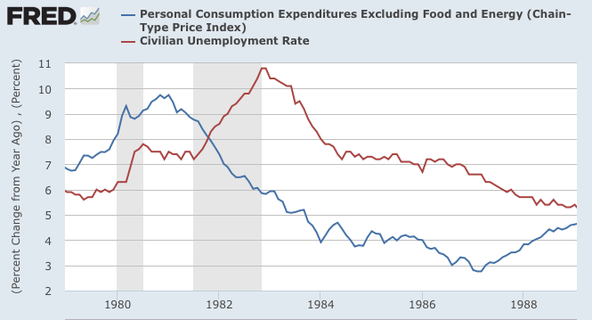
[I]n most of the episodes Blinder has identified, the movements in inflation to which the Fed reacted were too small to be of direct relevance to the current situation, and the only comparable episode to today, if any, is the episode that ended with the Volcker disinflation of the early 1980s.

I find that a scary comparison. . . .

[I]t shows what happened when the Fed got seriously “behind the curve” in 1974–75. . . . It then took 8 years, from 1975 to 1983, to reduce inflation to 4 percent.

And I find Blanchard’s comparison of the 1975-1983 period with the current situation problematic. First, he ignores the fact that the 1975-1983 episode did not display a steady rate of inflation or a uniform increase in inflation from 1975 until Volcker finally tamed it by way of the brutal 1981-82 recession. As I’ve explained previously in posts on the 1970s and 1980s (here, here, and here), and in chapters 7 and 8 of my book Studies in the History of Monetary Theory the 1970s inflation was the product of a series of inflationary demand-side and supply-shocks and misguided policy responses by the Fed, guided by politically motivated misconceptions, with little comprehension of the consequences of its actions.

It would be unwise to assume that the Fed will never embark on a similar march of folly, but it would be at least as unwise to adopt a proposed policy on the assumption that the alternative to that policy would be a repetition of the earlier march. What commentary on the 1970s largely overlooks is that there was an enormous expansion of the US labor force in that period as baby boomers came of age and as women began seeking and finding employment in steadily increasing numbers. The labor-force participation rate in the 1950s and 1960s fluctuated between about 58% to about 60%, mirroring fluctuations in the unemployment rate. Between 1970 and 1980 the labor force participation rate rose from just over 60% to just over 64% even as the unemployment rate rose from about 5% to over 7%. The 1970s were not, for the most part, a period of stagflation, but a period of inflation and strong growth interrupted by one deep recession (1974-75) and bookended by two minor recessions (1969-70) and (1979-80). But the rising trend of unemployment during the decade was largely attributable not to stagnation but to a rapidly expanding labor force and a rising labor participation rate.

The rapid increase in inflation in 1973 was largely a policy-driven error of the Nixon/Burns collaboration to ensure Nixon’s reelection in 1972 without bothering to taper the stimulus in 1973 after full employment was restored just in time for Nixon’s 1972 re-election. The oil shock of 1973-74 would have justified allowing a transitory period of increased inflation to cushion the negative effect of the increase in energy prices and to dilute the real magnitude of the nominal increase in oil prices. But the combined effect of excess aggregate demand and a negative supply shock led to an exaggerated compensatory tightening of monetary policy that led to the unnecessarily deep and prolonged recession in 1974-75.

A strong recovery ensued after the recession which, not surprisingly, was associated with declining inflation that fell below 5% in 1976. However, owing to the historically high rate of unemployment, only partially attributable to the previous recession, the incoming Carter administration promoted expansionary fiscal and monetary policies, which Arthur Burns, hoping to be reappointed by Carter to another term as Fed Chairman, willingly implemented. Rather than continue on the downward inflationary trend inherited from the previous administration, inflation resumed its upward trend in 1977.

Burns’s hopes to be reappointed by Carter were disappointed, but his replacement G. William Miller made no effort to tighten monetary policy to reverse the upward trend in inflation. A second oil shock in 1979 associated with the Iranian Revolution and the taking of US hostages in Iran caused crude oil prices over the course in 1979 to more than double. Again, the appropriate monetary-policy response was not to tighten monetary policy but to accommodate the price increase without causing a recession.

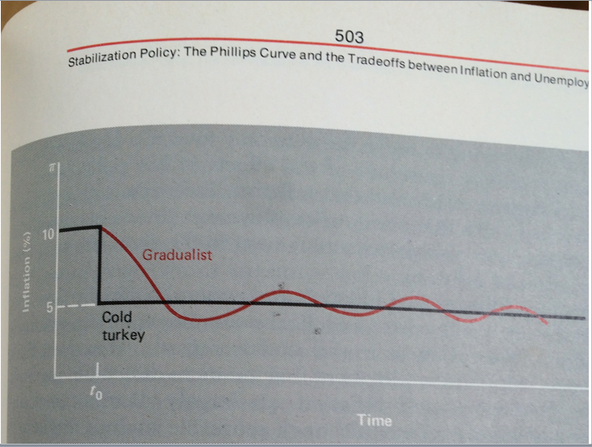
However, by the time of the second oil shock in 1979, inflation was already in the high single digits. The second oil shock, combined with the disastrous effects of the controls on petroleum prices carried over from the Nixon administration, created a crisis atmosphere that allowed the Reagan administration, with the cooperation of Paul Volcker, to implement a radical Monetarist anti-inflation policy. The policy was based on the misguided presumption that keeping the rate of growth of some measure of the money stock below a 5% annual rate would cure inflation with little effect on the overall economy if it were credibly implemented.

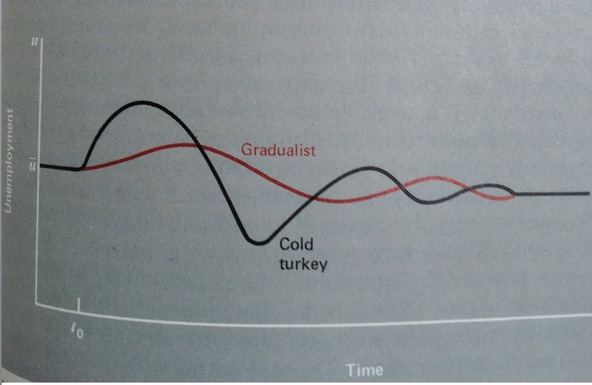
Volcker’s reputation was such that it was thought by supporters of the policy that his commitment would be relied upon by the public, so that a smooth transition to a lower rate of inflation would follow, and any downturn would be mild and short-lived. But the result was an unexpectedly deep and long-lasting recession.

The recession was needlessly prolonged by the grave misunderstanding of the causal relationship between the monetary aggregates and macroeconomic performance that had been perpetrated by Milton Friedman’s anti-Keynesian Monetarist counterrevolution. After triggering the sharpest downturn of the postwar era, the Monetarist anti-inflation strategy adopted by Volcker was, in the summer of 1982, on the verge of causing a financial crisis before Volcker announced that the Fed would no longer try to target any of the monetary aggregates, an announcement that triggered an immediate stock-market boom and, within a few months, the start of an economic recovery.

Thus, Blanchard is wrong to compare our current situation to the entire 1975-1983 period. The current situation, rather, is similar to the situation in 1973, when an economy, in the late stages of a recovery with rising inflation, was subjected to a severe supply shock. The appropriate response to that supply shock was not to tighten monetary policy, but merely to draw down the monetary stimulus of the previous two years. However, the Fed, perhaps shamed by the excessive, and politically motivated, monetary expansion of the previous two years, overcompensated by tightening monetary policy to counter the combined inflationary impact of its own previous policy and the recent oil price increase, immediately triggering the sharpest downturn of the postwar era. That is the lesson to draw from the 1970s, and it’s a mistake that the Fed ought not repeat now.

The Catch-Up Problem: Are Rapidly Rising Wages a Ticking Time-Bomb

Blanchard is worried that, because price increases exceeded wage increases in 2021, causing real wages to fall in 2021, workers will rationally assume, and demand, that their nominal wages will rise in 2022 to compensate for the decline in real wages, thereby fueling a further increase in inflation. This is a familiar argument based on the famous short-run Phillips-Curve trade-off between inflation and unemployment. Reduced unemployment resulting from the real-wage reduction associated with inflation will cause inflation to increase.

This argument is problematic on at least two levels. First, it presumes that the Phillips Curve represents a structural relationship, when it is merely a reduced form, just as an observed relationship between the price of a commodity and sales of that commodity is a reduced form, not a demand curve. Inferences cannot be made from a reduced form about the effect of a price change, nor can inferences about the effect of inflation be made from the Phillips Curve.

But one needn’t resort to a somewhat sophisticated argument to see why Blanchard’s fears that wage catchup will lead to a further round of inflation are not well-grounded. Blanchard argues that business firms, having pocketed windfall profits from rising prices that have outpaced wage increases, will grant workers compensatory wage increases to restore workers’ real wages, while also increasing prices to compensate themselves for the increased wages that they have agreed to pay their workers.

I’m sorry, but with all due respect to Professor Blanchard, that argument makes no sense. Evidently, firms have generally enjoyed a windfall when market conditions allowed them to raise prices without raising wages. Why, if wages finally catch up to prices, will they raise prices again? Either firms can choose, at will, how much profit to make when they set prices or their prices are constrained by market forces. If Professor Blanchard believes that firms can simply choose how much profit they make when they set prices, then he seems to be subscribing to Senator Warren’s theory of inflation: that inflation is caused by corporate greed. If he believes that, in setting prices, firms are constrained by market forces, then the mere fact that market conditions allowed them to increase prices faster than wages rose in 2021 does not mean that, if market conditions cause wages to rise at a faster rate than they did in 2022, firms, after absorbing those wage increases, will automatically be able to maintain their elevated profit margins in 2022 by raising prices in 2022 correspondingly.

The market conditions facing firms in 2022 will be determined by, among other things, the monetary policy of the Fed. Whether firms are able to raise prices in 2022 as fast as wages rise in 2022 will depend on the monetary policy adopted by the Fed. If the Fed’s monetary policy aims at gradually slowing down the rate of increase in nominal GDP in 2022 from the 2021 rate of increase, firms overall will not easily be able to raise prices as fast as wages rise in 2022. But why should anyone expect that firms that enjoyed windfall profits from inflation in 2021 will be able to continue enjoying those elevated profits in perpetuity?

Professor Blanchard posits simple sectoral equations for the determination of the rate of wage increases and for the rate of price increases given the rate of wage increases. This sort of one-way causality is much too simplified and ignores the fundamental fact all prices and wages and expectations of future prices and wages are mutually determined in a simultaneous system. One can’t reason from a change in a single variable and extrapolate from that change how the rest of the system will adjust.

The Rises and Falls of Keynesianism and Monetarism

The following is extracted from a paper on the history of macroeconomics that I’m now writing. I don’t know yet where or when it will be published and there may or may not be further installments, but I would be interested in any comments or suggestions that readers might have. Regular readers, if there are any, will probably recognize some familiar themes that I’ve been writing about in a number of my posts over the past several months. So despite the diminished frequency of my posting, I haven’t been entirely idle.

Recognizing the cognitive dissonance between the vision of the optimal equilibrium of a competitive market economy described by Marshallian economic theory and the massive unemployment of the Great Depression, Keynes offered an alternative, and, in his view, more general, theory, the optimal neoclassical equilibrium being a special case.[1] The explanatory barrier that Keynes struggled, not quite successfully, to overcome in the dire circumstances of the 1930s, was why market-price adjustments do not have the equilibrating tendencies attributed to them by Marshallian theory. The power of Keynes’s analysis, enhanced by his rhetorical gifts, enabled him to persuade much of the economics profession, especially many of the most gifted younger economists at the time, that he was right. But his argument, failing to expose the key weakness in the neoclassical orthodoxy, was incomplete.

The full title of Keynes’s book, The General Theory of Employment, Interest and Money identifies the key elements of his revision of neoclassical theory. First, contrary to a simplistic application of Marshallian theory, the mass unemployment of the Great Depression would not be substantially reduced by cutting wages to “clear” the labor market. The reason, according to Keynes, is that the levels of output and unemployment depend not on money wages, but on planned total spending (aggregate demand). Mass unemployment is the result of too little spending not excessive wages. Reducing wages would simply cause a corresponding decline in total spending, without increasing output or employment.

If wage cuts do not increase output and employment, the ensuing high unemployment, Keynes argued, is involuntary, not the outcome of optimizing choices made by workers and employers. Ever since, the notion that unemployment can be involuntary has remained a contested issue between Keynesians and neoclassicists, a contest requiring resolution in favor of one or the other theory or some reconciliation of the two.

Besides rejecting the neoclassical theory of employment, Keynes also famously disputed the neoclassical theory of interest by arguing that the rate of interest is not, as in the neoclassical theory, a reward for saving, but a reward for sacrificing liquidity. In Keynes’s view, rather than equilibrate savings and investment, interest equilibrates the demand to hold the money issued by the monetary authority with the amount issued by the monetary authority. Under the neoclassical theory, it is the price level that adjusts to equilibrate the demand for money with the quantity issued.

Had Keynes been more attuned to the Walrasian paradigm, he might have recast his argument that cutting wages would not eliminate unemployment by noting the inapplicability of a Marshallian supply-demand analysis of the labor market (accounting for over 50 percent of national income), because wage cuts would shift demand and supply curves in almost every other input and output market, grossly violating the ceteris-paribus assumption underlying Marshallian supply-demand paradigm. When every change in the wage shifts supply and demand curves in all markets for good and services, which in turn causes the labor-demand and labor-supply curves to shift, a supply-demand analysis of aggregate unemployment becomes a futile exercise.

Keynes’s work had two immediate effects on economics and economists. First, it immediately opened up a new field of research – macroeconomics – based on his theory that total output and employment are determined by aggregate demand. Representing only one element of Keynes’s argument, the simplified Keynesian model, on which macroeconomic theory was founded, seemed disconnected from either the Marshallian or Walrasian versions of neoclassical theory.

Second, the apparent disconnect between the simple Keynesian macro-model and neoclassical theory provoked an ongoing debate about the extent to which Keynesian theory could be deduced, or even reconciled, with the premises of neoclassical theory. Initial steps toward a reconciliation were provided when a model incorporating the quantity of money and the interest rate into the Keynesian analysis was introduced, soon becoming the canonical macroeconomic model of undergraduate and graduate textbooks.

Critics of Keynesian theory, usually those opposed to its support for deficit spending as a tool of aggregate demand management, its supposed inflationary bias, and its encouragement or toleration of government intervention in the free-market economy, tried to debunk Keynesianism by pointing out its inconsistencies with the neoclassical doctrine of a self-regulating market economy. But proponents of Keynesian precepts were also trying to reconcile Keynesian analysis with neoclassical theory. Future Nobel Prize winners like J. R. Hicks, J. E. Meade, Paul Samuelson, Franco Modigliani, James Tobin, and Lawrence Klein all derived various Keynesian propositions from neoclassical assumptions, usually by resorting to the un-Keynesian assumption of rigid or sticky prices and wages.

What both Keynesian and neoclassical economists failed to see is that, notwithstanding the optimality of an economy with equilibrium market prices, in either the Walrasian or the Marshallian versions, cannot explain either how that set of equilibrium prices is, or can be, found, or how it results automatically from the routine operation of free markets.

The assumption made implicitly by both Keynesians and neoclassicals was that, in an ideal perfectly competitive free-market economy, prices would adjust, if not instantaneously, at least eventually, to their equilibrium, market-clearing, levels so that the economy would achieve an equilibrium state. Not all Keynesians, of course, agreed that a perfectly competitive economy would reach that outcome, even in the long-run. But, according to neoclassical theory, equilibrium is the state toward which a competitive economy is drawn.

Keynesian policy could therefore be rationalized as an instrument for reversing departures from equilibrium and ensuring that such departures are relatively small and transitory. Notwithstanding Keynes’s explicit argument that wage cuts cannot eliminate involuntary unemployment, the sticky-prices-and-wages story was too convenient not to be adopted as a rationalization of Keynesian policy while also reconciling that policy with the neoclassical orthodoxy associated with the postwar ascendancy of the Walrasian paradigm.

The Walrasian ascendancy in neoclassical theory was the culmination of a silent revolution beginning in the late 1920s when the work of Walras and his successors was taken up by a younger generation of mathematically trained economists. The revolution proceeded along many fronts, of which the most important was proving the existence of a solution of the system of equations describing a general equilibrium for a competitive economy — a proof that Walras himself had not provided. The sophisticated mathematics used to describe the relevant general-equilibrium models and derive mathematically rigorous proofs encouraged the process of rapid development, adoption and application of mathematical techniques by subsequent generations of economists.

Despite the early success of the Walrasian paradigm, Kenneth Arrow, perhaps the most important Walrasian theorist of the second half of the twentieth century, drew attention to the explanatory gap within the paradigm: how the adjustment of disequilibrium prices is possible in a model of perfect competition in which every transactor takes market price as given. The Walrasian theory shows that a competitive equilibrium ensuring the consistency of agents’ plans to buy and sell results from an equilibrium set of prices for all goods and services. But the theory is silent about how those equilibrium prices are found and communicated to the agents of the model, the Walrasian tâtonnement process being an empirically empty heuristic artifact.

In fact, the explanatory gap identified by Arrow was even wider than he had suggested or realized, for another aspect of the Walrasian revolution of the late 1920s and 1930s was the extension of the equilibrium concept from a single-period equilibrium to an intertemporal equilibrium. Although earlier works by Irving Fisher and Frank Knight laid a foundation for this extension, the explicit articulation of intertemporal-equilibrium analysis was the nearly simultaneous contribution of three young economists, two Swedes (Myrdal and Lindahl) and an Austrian (Hayek) whose significance, despite being partially incorporated into the canonical Arrow-Debreu-McKenzie version of the Walrasian model, remains insufficiently recognized.

These three economists transformed the concept of equilibrium from an unchanging static economic system at rest to a dynamic system changing from period to period. While Walras and Marshall had conceived of a single-period equilibrium with no tendency to change barring an exogenous change in underlying conditions, Myrdal, Lindahl and Hayek conceived of an equilibrium unfolding through time, defined by the mutual consistency of the optimal plans of disparate agents to buy and sell in the present and in the future.

In formulating optimal plans that extend through time, agents consider both the current prices at which they can buy and sell, and the prices at which they will (or expect to) be able to buy and sell in the future. Although it may sometimes be possible to buy or sell forward at a currently quoted price for future delivery, agents planning to buy and sell goods or services rely, for the most part, on their expectations of future prices. Those expectations, of course, need not always turn out to have been accurate.

The dynamic equilibrium described by Myrdal, Lindahl and Hayek is a contingent event in which all agents have correctly anticipated the future prices on which they have based their plans. In the event that some, if not all, agents have incorrectly anticipated future prices, those agents whose plans were based on incorrect expectations may have to revise their plans or be unable to execute them. But unless all agents share the same expectations of future prices, their expectations cannot all be correct, and some of those plans may not be realized.

The impossibility of an intertemporal equilibrium of optimal plans if agents do not share the same expectations of future prices implies that the adjustment of perfectly flexible market prices is not sufficient an optimal equilibrium to be achieved. I shall have more to say about this point below, but for now I want to note that the growing interest in the quiet Walrasian revolution in neoclassical theory that occurred almost simultaneously with the Keynesian revolution made it inevitable that Keynesian models would be recast in explicitly Walrasian terms.

What emerged from the Walrasian reformulation of Keynesian analysis was the neoclassical synthesis that became the textbook version of macroeconomics in the 1960s and 1970s. But the seemingly anomalous conjunction of both inflation and unemployment during the 1970s led to a reconsideration and widespread rejection of the Keynesian proposition that output and employment are directly related to aggregate demand.

Indeed, supporters of the Monetarist views of Milton Friedman argued that the high inflation and unemployment of the 1970s amounted to an empirical refutation of the Keynesian system. But Friedman’s political conservatism, free-market ideology, and his acerbic criticism of Keynesian policies obscured the extent to which his largely atheoretical monetary thinking was influenced by Keynesian and Marshallian concepts that rendered his version of Monetarism an unattractive alternative for younger monetary theorists, schooled in the Walrasian version of neoclassicism, who were seeking a clear theoretical contrast with the Keynesian macro model.

The brief Monetarist ascendancy following 1970s inflation conveniently collapsed in the early 1980s, after Friedman’s Monetarist policy advice for controlling the quantity of money proved unworkable, when central banks, foolishly trying to implement the advice, prolonged a needlessly deep recession while central banks consistently overshot their monetary targets, thereby provoking a long series of embarrassing warnings from Friedman about the imminent return of double-digit inflation.


[1] Hayek, both a friend and a foe of Keynes, would chide Keynes decades after Keynes’s death for calling his theory a general theory when, in Hayek’s view, it was a special theory relevant only in periods of substantially less than full employment when increasing aggregate demand could increase total output. But in making this criticism, Hayek, himself, implicitly assumed that which he had himself admitted in his theory of intertemporal equilibrium that there is no automatic equilibration mechanism that ensures that general equilibrium obtains.

Sic Transit Inflatio Mundi

Larry Summers continues to lead the charge for a quick, decisive tightening of monetary policy by the Federal Reserve to head off an inflationary surge that, he believes, is about to overtake us. Undoubtedly one of the most capable economists of his generation, Summers also had a long career as a policy maker at the highest levels, so his advice cannot be casually dismissed. Even aside from Summers’s warning, the current economic environment fully justifies heightened concern caused by the recent uptick in inflation.

I am, nevertheless, not inclined to share Summers’s confidence in his oft-repeated predictions of resurgent inflation unless monetary policy is substantially tightened soon to prevent current inflation from being entrenched into the expectations of households and businesses. Summers’s’ latest warning came in a Washington Post op-ed following the statement by the FOMC and by Chairman Jay Powell that Fed policy would shift to give priority to maintaining price stability.

After welcoming the FOMC statement, Summers immediately segued into a critique of the Fed position on every substantive point.

There have been few, if any, instances in which inflation has been successfully stabilized without recession. Every U.S. economic expansion between the Korean War and Paul A. Volcker’s slaying of inflation after 1979 ended as the Federal Reserve tried to put the brakes on inflation and the economy skidded into recession. Since Volcker’s victory, there have been no major outbreaks of inflation until this year, and so no need for monetary policy to engineer a soft landing of the kind that the Fed hopes for over the next several years.

The not-very-encouraging history of disinflation efforts suggests that the Fed will need to be both skillful and lucky as it seeks to apply sufficient restraint to cause inflation to come down to its 2 percent target without pushing the economy into recession. Unfortunately, several aspects of the Open Market Committee statement and Powell’s news conference suggest that the Fed may not yet fully grasp either the current economic situation or the implications of current monetary policy.

Summers cites the recessions between the Korean War and the 1979-82 Volcker Monetarist experiment to support his anti-inflationary diagnosis and remedy. But none of the three recessions in the 1950s during the Eisenhower Presidency was needed to cope with any significant inflationary threat. There was no substantial inflation in the US during the 1950s, never reaching 3% in any year between 1953 and 1960, and rarely exceeding 2%.

Inflation during the late 1960 and 1970s was caused by a combination of factors, including both excess demand fueled by Vietnam War spending and politically motivated monetary expansion, plus two oil shocks in 1973-74 and 1979-80, an economic environment with only modest similarity to the current economic situation.

But the important lesson from the disastrous Volcker-Friedman recession is that most of the reduction in inflation following Volcker’s decisive move to tighten monetary policy in early 1981 did not come until a year and a half later, when with the US unemployment rate above 10%, Volcker finally abandoned the futile and counterproductive Monetarist policy of making the monetary aggregates policy instruments. Had it not been for the Monetarist obsession with controlling the monetary aggregates, a recovery could have started six months to a year earlier than it did, with inflation continuing on the downward trajectory as output and employment expanded.

The key point is that falling output, in and of itself, tends to cause rising, not falling, prices, so that postponing the start of a recovery actually delays, rather than hastens, the reduction of inflation. As I explained in another post, rather than focusing onthe monetary aggregates, monetary policy ought to have aimed to reduce the rate of growth of total nominal spending from well over 12% in 1980-81 to a rate of about 7%, which would have been consistent with the informal 4% inflation target that Volcker and Reagan had set for themselves.

The appropriate lesson to take away from the Volcker-Friedman recession of 1981-82 is therefore that a central bank can meet its inflation target by reducing the rate of increase in total nominal spending and income to the rate, given anticipated real expansion of capacity and productivity, consistent with its inflation target. The rate of growth in nominal spending and income cannot be controlled with a degree of accuracy, but rates of increase in spending above or below the target rate of increase provide the central bank with real time indications of whether policy needs to be tightened or loosened to meet the inflation target. That approach would avoid the inordinate cost of reducing inflation associated with the Volcker-Friedman episode.

A further aggravating factor in the 1981-82 recession was that interest rates had risen to double-digit levels even before Volcker embarked on his Monetarist anti-inflation strategy, showing how deeply embedded inflation expectations had become in the plans of households and businesses. By contrast, interest rates have actually been falling for months, suggesting that Summers’s warnings about inflation expectations becoming entrenched are overstated.

The Fed forecast calls for inflation to significantly subside even as the economy sustains 3.5 percent unemployment — a development without precedent in U.S. economic history. The Fed believes this even though it regards the sustainable level of unemployment as 4 percent. This only makes sense if the Fed is clinging to the idea that current inflation is transitory and expects it to subside of its own accord.

Summers’s factual assertion that the US unemployment rate has never fallen, without inflationary stimulus, to 3.5%, an argument predicated on the assumption that the natural (or non-accelerating- inflation rate of unemployment) is firmly fixed at 4% is not well supported by the data. In 2019 and early 2020, the unemployment rate dropped to 3.5% without evident inflationary pressure. In the late 1990s unemployment also dropped below 4% without inflationary pressure. So, the expectation that a 3.5% unemployment rate could be restored without inflationary pressure may be optimistic, but it’s hardly unprecedented.

Summers suggests that the Fed is confused because it expects the unemployment rate to fall back to the 3.5% rate of 2019 even while supposedly regarding a 4%, not a 3.5%, rate of unemployment as sustainable. According to Summers, reaching a 3.5% rate of unemployment would be possible only if the current increase in the inflation rate is temporary. But the bond market seems to share that view with the Fed given the recent decreases in the yields on Treasury bonds of 5 to 30 years duration. But Summers takes a different view.

In fact, there is solid reason to think inflation may accelerate. The consumer price index’s shelter component, which represents one-third of the index, has gone up by less than 4 percent, even as private calculations without exception suggest increases of 10 to 20 percent in rent and home prices. Catch-up is likely. More fundamentally, job vacancies are at record levels and the labor market is still heating up, according to the Fed forecast. This portends acceleration rather than deceleration in labor costs — by far the largest cost for the business sector.

Projecting how increases in rent and home prices that have already occurred will affect reported inflation in the future is a tricky exercise. It is certain that those effects will show up in the future, but those effects are already baked into those future inflation reports, so they provide an uneasy basis on which to conduct monetary policy. Insofar as inflation is a problem, it is a problem not because of short-term fluctuations in prices in specific goods, even home prices and rents, or whole sectors of the economy, but because of generalized and potentially continuing long-term trends affecting the whole structure of prices.

The current number of job vacancies reflects both the demand for, and the supply of, labor. The labor-force participation rate is still well below the pre-pandemic level, reflecting the effect of withdrawal from the labor force by workers afraid of contracting the COVID virus, or unable to find day care for children, or deterred from seeking by other pandemic-related concerns from seeking or accepting employment. Under such circumstances, the re-allocations associated with high job-vacancy rates are likely to enhance the efficiency and productivity of the workers that are re-employed, and need not exacerbate inflationary pressures.

Presumably, the Fed has judged that current aggregate-demand increases have less to do with observed inflation than labor-supply constraints or other supply-side bottlenecks whose effects on prices are likely self-limiting. This judgment is neither obviously right nor obviously wrong. But, for now at least, it is not unreasonable for the Fed to remain cautious before making a drastic policy change, neither committing itself to an immediate tightening, as Summers is proposing, nor doubling down on a commitment to its current accommodative stance.

Meanwhile, the pandemic-related bottlenecks central to the transitory argument are exaggerated. Prices for more than 80 percent of goods in the CPI have increased more than 3 percent in the past year.With the economy’s capacity growing 2 percent a year and the Fed’s own forecast calling for 4 percent growth in 2022, price pressures seem more likely to grow than to abate.

This argument makes no sense. We have, to be sure, gone through a period of actual broad-based inflation, so pointing out that 80% of goods in the CPI have increased in price by more than 3% in the past year is unsurprising. The bottleneck point is that supply constraints have prevented the real economy from growing as fast as nominal spending has grown. As I’ve pointed out recently, there’s an overhang of cash and liquid assets, accumulated rather than spent during the pandemic, which has amplified aggregate-demand growth since the economy began to recover from the pandemic, opening up previously closed opportunities for spending. The mismatch between the growth of demand and the growth of supply has been manifested in rising inflation. If the bottleneck theory of inflation is true, then the short-term growth potential of the economy is greater than the 2% rate posited by Summers. As bottlenecks are removed and workers that withdrew from the labor force during the pandemic are re-employed, the economy could easily grow faster than Summers is willing to acknowledge. Summers simply assumes, but doesn’t demonstrate, his conclusion.

This all suggests that policy will need to restrain demand to restore price stability.

No, it does not suggest that at all. It only suggests the possibility that demand may have to be restrained to keep prices stable. Recent inflation may have been a delayed response to an expansive monetary policy designed to prevent a contraction of demand during the pandemic. A temporary increase in inflation does not necessarily call for an immediate contractionary response. It’s too early to tell with confidence whether preventing future inflation requires, as Summers asserts, monetary policy to be tightened immediately. That option shouldn’t be taken off the table, but the Fed clearly hasn’t done so.

How much tightening is required? No one knows, and the Fed is right to insist that it will monitor the economy and adjust. We do know, however, that monetary policy is far looser today — in a high-inflation, low-unemployment economy — than it was about a year ago when inflation was below the Fed’s target and unemployment was around 8 percent. With relatively constant nominal interest rates, higher inflation and the expectation of future inflation have led to dramatic reductions in real interest rates over the past year. This is why bubbles are increasingly pervasive in asset markets ranging from crypto to beachfront properties and meme stocks to tech start-ups.

Summers, again, is just assuming, not demonstrating, his own preferred conclusion. A year ago, high unemployment was caused by the unique confluence of essentially simultaneous negative demand and supply shocks. The unprecedented coincidence of two simultaneous shocks posed a unique policy challenge to which the Fed has so far responded with remarkable skill. But the unfamiliar and challenging economic environment remains murky, and premature responses to unclear conditions may not yield the anticipated results. Undaunted by any doubt in his own reading of an opaque situation, Summers self-assurance is characteristic and impressive, but his argument is less than compelling.

The implication is that restoring monetary policy to a normal posture, let alone to applying restraint to the economy, will require far more than the three quarter-point rate increases the Fed has predicted for next year. This point takes on particular force once it is recognized that, contrary to Powell’s assertion, almost all economists believe there is a lag of about a year between the application of a rate change and its effect. Failure to restore policy neutrality next year means allowing two more years of highly inflationary monetary policy.

All of this suggests that even with its actions this week, the Fed remains well behind the curve in its commitment to fighting inflation. If its statements reflect its convictions, this is a matter of serious concern.

The idea that there is a one-year lag between applying a policy and its effect is hardly credible. The problem is not the length of the lag, but the uncertain effects of policy in a given set of circumstances. The effects of a change in the money stock or a change in the policy rate may not be apparent if they are offset by other changes. The ceteris-paribus proviso that qualifies every analysis of the effects of monetary policy is rarely satisfied in the real world; almost every policy action by the central bank is an uncertain bet. Under current circumstances, the Fed response to the recent increase in inflation seems eminently sensible: signal that the Fed is anticipating the likelihood that monetary policy will have to be tightened if the current rate of increase in nominal spending remains substantially above the rate consistent with the Fed’s average inflation target of 2%, but wait for further evidence before deciding about the magnitude of any changes in the Fed’s policy instruments.

Welcome to Uneasy Money, aka the Hawtreyblog

UPDATE: I’m re-upping my introductory blog post, which I posted ten years ago toady. It’s been a great run for me, and I hope for many of you, whose interest and responses have motivated to keep it going. So thanks to all of you who have read and responded to my posts. I’m adding a few retrospective comments and making some slight revisions along the way. In addition to new posts, I will be re-upping some of my old posts that still seem to have relevance to the current state of our world.

What the world needs now, with apologies to the great Burt Bachrach and Hal David, is, well, another blog.  But inspired by the great Ralph Hawtrey and the near great Scott Sumner, I decided — just in time for Scott’s return to active blogging — to raise another voice on behalf of a monetary policy actively seeking to promote recovery from what I call the Little Depression, instead of the monetary policy we have now:  waiting for recovery to arrive on its own.  Just like the Great Depression, our Little Depression was caused mainly by overly tight money in an environment of over-indebtedness and financial fragility, and was then allowed to deepen and become entrenched by monetary authorities unwilling to commit themselves to a monetary expansion aimed at raising prices enough to make business expansion profitable.

That was the lesson of the Great Depression.  Unfortunately that lesson, for reasons too complicated to go into now, was never properly understood, because neither Keynesians nor Monetarists had a fully coherent understanding of what happened in the Great Depression.  Although Ralph Hawtrey — called by none other than Keynes “his grandparent in the paths of errancy,” and an early, but unacknowledged, progenitor of Chicago School Monetarism — had such an understanding,  Hawtrey’s contributions were overshadowed and largely ignored, because of often irrelevant and misguided polemics between Keynesians and Monetarists and Austrians.  One of my goals for this blog is to bring to light the many insights of this perhaps most underrated — though competition for that title is pretty stiff — economist of the twentieth century.  I have discussed Hawtrey’s contributions in my book on free banking and in a paper published years ago in Encounter and available here.  Patrick Deutscher has written a biography of Hawtrey.

What deters businesses from expanding output and employment in a depression is lack of demand; they fear that if they do expand, they won’t be able to sell the added output at prices high enough to cover their costs, winding up with redundant workers and having to engage in costly layoffs.  Thus, an expectation of low demand tends to be self-fulfilling.  But so is an expectation of rising prices, because the additional output and employment induced by expectations of rising prices will generate the demand that will validate the initial increase in output and employment, creating a virtuous cycle of rising income, expenditure, output, and employment.

The insight that “the inactivity of all is the cause of the inactivity of each” is hardly new.  It was not the discovery of Keynes or Keynesian economics; it is the 1922 formulation of Frederick Lavington, another great, but underrated, pre-Keynesian economist in the Cambridge tradition, who, in his modesty and self-effacement, would have been shocked and embarrassed to be credited with the slightest originality for that statement.  Indeed, Lavington’s dictum might even be understood as a restatement of Say’s Law, the bugbear of Keynes and object of his most withering scorn.  Keynesian economics skillfully repackaged the well-known and long-accepted idea that when an economy is operating with idle capacity and high unemployment, any increase in output tends to be self-reinforcing and cumulative, just as, on the way down, each reduction in output is self-reinforcing and cumulative.

But at least Keynesians get the point that, in a depression or deep recession, individual incentives may not be enough to induce a healthy expansion of output and employment. Aggregate demand can be too low for an expansion to get started on its own. Even though aggregate demand is nothing but the flip side of aggregate supply (as Say’s Law teaches), if resources are idle for whatever reason, perceived effective demand is deficient, diluting incentives to increase production so much that the potential output expansion does not materialize, because expected prices are too low for businesses to want to expand. But if businesses can be induced to expand output, more than likely, they will sell it, because (as Say’s Law teaches) supply usually does create its own demand.

[Comment after 10 years: In a comment, Rowe asked why I wrote that Say’s Law teaches that supply “usually” creates its own demand. At that time, I responded that I was just using “usually” as a weasel word. But I subsequently realized (and showed in a post last year) that the standard proofs of both Walras’s Law and Say’s Law are defective for economies with incomplete forward and state-contingent markets. We actually know less than we once thought we did!] 

Keynesians mistakenly denied that, by creating price-level expectations consistent with full employment, monetary policy could induce an expansion of output even in a depression. But at least they understood that the private economy can reach an impasse with price-level expectations too low to sustain full employment. Fiscal policy may play a role in remedying a mismatch between expectations and full employment, but fiscal policy can only be as effective as monetary policy allows it to be. Unfortunately, since the downturn of December 2007, monetary policy, except possibly during QE1 and QE2, has consistently erred on the side of uneasiness.

With some unfortunate exceptions, however, few Keynesians have actually argued against monetary easing. Rather, with some honorable exceptions, it has been conservatives who, by condemning a monetary policy designed to provide incentives conducive to business expansion, have helped to hobble a recovery led by the private sector rather than the government which  they profess to want. It is not my habit to attribute ill motives or bad faith to people whom I disagree with. One of the finest compliments ever paid to F. A. Hayek was by Joseph Schumpeter in his review of The Road to Serfdom who chided Hayek for “politeness to a fault in hardly ever attributing to his opponents anything but intellectual error.” But it is a challenge to come up with a plausible explanation for right-wing opposition to monetary easing.

[Comment after 10 years: By 2011 when this post was written, right-wing bad faith had already become too obvious to ignore, but who could then have imagined where the willingness to resort to bad faith arguments without the slightest trace of compunction would lead them and lead us.] 

In condemning monetary easing, right-wing opponents claim to be following the good old conservative tradition of supporting sound money and resisting the inflationary proclivities of Democrats and liberals. But how can claims of principled opposition to inflation be taken seriously when inflation, by every measure, is at its lowest ebb since the 1950s and early 1960s? With prices today barely higher than they were three years ago before the crash, scare talk about currency debasement and future hyperinflation reminds me of Ralph Hawtrey’s famous remark that warnings that leaving the gold standard during the Great Depression would cause runaway inflation were like crying “fire, fire” in Noah’s flood.

The groundlessness of right-wing opposition to monetary easing becomes even plainer when one recalls the attacks on Paul Volcker during the first Reagan administration. In that episode President Reagan and Volcker, previously appointed by Jimmy Carter to replace the feckless G. William Miller as Fed Chairman, agreed to make bringing double-digit inflation under control their top priority, whatever the short-term economic and political costs. Reagan, indeed, courageously endured a sharp decline in popularity before the first signs of a recovery became visible late in the summer of 1982, too late to save Reagan and the Republicans from a drubbing in the mid-term elections, despite the drop in inflation to 3-4 percent. By early 1983, with recovery was in full swing, the Fed, having abandoned its earlier attempt to impose strict Monetarist controls on monetary expansion, allowed the monetary aggregates to grow at unusually rapid rates.

However, in 1984 (a Presidential election year) after several consecutive quarters of GDP growth at annual rates above 7 percent, the Fed, fearing a resurgence of inflation, began limiting the rate of growth in the monetary aggregates. Reagan’s secretary of the Treasury, Donald Regan, as well as a variety of outside Administration supporters like Arthur Laffer, Larry Kudlow, and the editorial page of the Wall Street Journal, began to complain bitterly that the Fed, in its preoccupation with fighting inflation, was deliberately sabotaging the recovery. The argument against the Fed’s tightening of monetary policy in 1984 was not without merit. But regardless of the wisdom of the Fed tightening in 1984 (when inflation was significantly higher than it is now), holding up the 1983-84 Reagan recovery as the model for us to follow now, while excoriating Obama and Bernanke for driving inflation all the way up to 1 percent, supposedly leading to currency debauchment and hyperinflation, is just a bit rich. What, I wonder, would Hawtrey have said about that?

In my next posting I will look a little more closely at some recent comparisons between the current non-recovery and recoveries from previous recessions, especially that of 1983-84.

Monetarism v. Hawtrey and Cassel

The following is an updated and revised version of the penultimate section of my paper with Ron Batchelder “Pre-Keynesian Theories of the Great Depressison: What Ever Happened to Hawtrey and Cassel?” which I am now preparing for publication. The previous version is available on SSRN.

In the 1950s and early 1960s, empirical studies of the effects of money and monetary policy by Milton Friedman, his students and followers, rehabilitated the idea that monetary policy had significant macroeconomic effects. Most importantly, in research with Anna Schwartz Friedman advanced the seemingly remarkable claim that the chief cause of the Great Depression had been a series of policy mistakes by the Federal Reserve. Although Hawtrey and Cassel, had also implicated the Federal Reserve in their explanation of the Great Depression, they were unmentioned by Friedman and Schwartz or by other Monetarists.[1]

The chief difference between the Monetarist and the Hawtrey-Cassel explanations of the Great Depression is that Monetarists posited a monetary shock (bank failures) specific to the U.S. as the primary, if not sole, cause of the Depression, while Hawtrey and Cassel considered the Depression a global phenomenon reflecting a rapidly increasing international demand for gold, bank failures being merely an incidental and aggravating symptom, specific to the U.S., of a more general monetary disorder.

Arguing that the Great Depression originated in the United States following a typical business-cycle downturn, Friedman and Schwartz (1963) attributed the depth of the downturn not to the unexplained initial shock, but to the contraction of the U.S. money stock caused by the bank failures. Dismissing any causal role for the gold standard in the Depression, Friedman and Schwartz (359-60) acknowledged only its role in propagating, via PSFM, an exogenous, policy-driven, contraction of the U.S. money stock to other gold-standard countries. According to Friedman and Schwartz, the monetary contraction was the cause, and deflation the effect.

But the causation posited by Friedman and Schwartz is the exact opposite of the true causation. Under the gold standard, deflation (i.e., gold appreciation) was the cause and the decline in the quantity of money the effect. Deflation in an international gold standard is not a local phenomenon originating in any single country; it occurs simultaneously in all gold standard countries.

To be sure the banking collapse in the U.S. exacerbated the catastrophe. But the collapse was the localized effect of a more general cause: deflation. Without deflation, neither the unexplained 1929 downturn nor the subsequent banking collapse would have occurred. Nor was an investment boom in the most advanced and most productive economy in the world unsustainable as posited, with no evidence of unsustainability other than the subsequent economic collapse, by the Austrian malinvestment hypothesis.

Friedman and Schwartz based their assertion that the monetary disturbance that caused the Great Depression occurred in the U.S. on the observation that, from 1929 to 1931, gold flowed into, not out of, the U.S. Had the disturbance occurred elsewhere, they argued, gold would have flowed out of, not into, the U. S.

Table 1 shows the half-year changes in U.S., French, and world gold reserves starting in June 1928, when the French monetary law re-establishing the gold standard was enacted.

TABLE 1: Gold Reserves in US, France, and the World June 1928-December 1931 (measured in dollars)
Date World ReservesUS ReservesUS Share (percent)French ReservesFrench Share (percent)
June 19289,7493,73238.31,13611.7
Dec. 192810,0573,74637.21,25412.4
2nd half 1928 change31214-1.11180.7
June 192910,1263,95639.11,43614.2
1st half 1929 change692101.91821.8
Dec. 192910,3363,90037.71,63315.8
2nd half 1929 change210-56-1.41971.6
June 193010,6714,17839.21,72716.2
1st half 1930 change3352781.5940.4
Dec. 193010,9444,22538.72,10019.2
2nd half 1930 change 27347-0.53733.0
June 193111,264459340.82,21219.6
1st half 1931 change3203682.11120.4
Dec. 193111,3234,05135.82,69923.8
2nd half 1931 change59-542-5.04874.2
June 1928-Dec. 1931 change1,574319-2.51,56312.1
Source: H. C. Johnson, Gold, France and the Great Depression

In the three-and-a-half years from June 1928 (when gold convertibility of the franc was restored) to December 1931, gold inflows into France exceeded gold inflows into the United States. The total gold inflow into France during the June 1928 to December 1931 period was $1.563 billion compared to only $319 billion into the United States.

However, much of the difference in the totals stems from the gold outflow from the U.S. into France in the second half of 1931, reflecting fears of a possible U.S. devaluation or suspension of convertibility after Great Britain and other countries suspended the gold standard in September 1931 (Hamilton 2012). From June 1928 through June 1931, the total gold inflow into the U.S. was $861 billion and the total gold inflow into France was $1.076 billion, the U.S. share of total reserves increasing from 38.3 percent to 40.6 percent, while the total French share increased from 11.7 percent to 19.6 percent.[2]

In the first half of 1931, when the first two waves of U.S. bank failures occurred, the increase in U.S. gold reserves exceeded the increase in world gold reserves. The shift by the public from holding bank deposits to holding currency increased reserve requirements, an increase reflected in the gold reserves held by the U.S. The increased U.S. demand for gold likely exacerbated the deflationary pressures affecting all gold-standard countries, perhaps contributing to the failure of the Credit-Anstalt in May 1931 that intensified the European crisis that forced Britain off the gold standard in September.

The combined increase in U.S. and French gold reserves was $1.937 billion compared to an increase of only $1.515 billion in total world reserves, indicating that the U.S. and France were drawing reserves either from other central banks or from privately held gold stocks. Clearly, both the U.S. and France were exerting powerful deflationary pressure on the world economy, before and during the downward spiral of the Great Depression.[3]

Deflationary forces were operating directly on prices before the quantity of money adjusted to the decline in prices. In some countries the adjustment of the quantity of money was relatively smooth; in the U.S. it was exceptionally difficult, but, not even in the U.S., was it the source of the disturbance. Hawtrey and Cassel understood that; Friedman did not.

In explaining the sources of his interest in monetary theory and the role of monetary policy, Friedman (1970) pointedly distinguished between the monetary tradition from which his work emerged and the dominant tradition in London circa 1930, citing Robbins’s (1934) Austrian-deflationist book on the Great Depression, while ignoring Hawtrey and Cassel. Friedman linked his work to the Chicago oral tradition, citing a lecture by Jacob Viner (1933) as foreshadowing his own explanation of the Great Depression, attributing the loss of interest in monetary theory and policy by the wider profession to the deflationism of LSE monetary economists. Friedman went on to suggest that the anti-deflationism of the Chicago monetary tradition immunized it against the broader reaction against monetary theory and policy, that the Austro-London pro-deflation bias provoked against monetary theory and policy.

Though perhaps superficially plausible, Friedman’s argument ignores, as he did throughout a half-century of scholarship and research, the contributions of Hawtrey and Cassel and especially their explanation of the Great Depression. Unfortunately, Friedman’s outsized influence on economists trained after the Keynesian Revolution distracted their attention from contributions outside the crude Keynesian-Monetarist dichotomy that shaped his approach to monetary economics.

Eclectics like Hawtrey and Cassel were neither natural sources of authority, nor obvious ideological foils for Friedman to focus upon. Already forgotten, providing neither convenient targets, nor ideological support, Hawtrey and Cassel, could be easily and conveniently ignored.


[1] Meltzer (2001) did mention Hawtrey, but the reference was perfunctory and did not address the substance of his and Cassel’s explanation of the Great Depression.

[2] By far the largest six-month increase in U.S. gold reserves was in the June-December 1931 period coinciding with the two waves of bank failures at the end of 1930 and in March 1931 causing a substantial shift from deposits to currency which required an increase in gold reserves owing to the higher ratio of required gold reserves against currency than against bank deposits.

[3] Fremling (1985) noted that, even during the 1929-31 period, the U.S. share of world gold reserves actually declined. However, her calculation includes the extraordinary outflow of gold from the U.S. in the second half of 1931. The U.S. share of global gold reserves rose from June 1928 to June 1931.

What’s Wrong with Monetarism?

UPDATE: (05/06): In an email Richard Lipsey has chided me for seeming to endorse the notion that 1970s stagflation refuted Keynesian economics. Lipsey rightly points out that by introducing inflation expectations into the Phillips Curve or the Aggregate Supply Curve, a standard Keynesian model is perfectly capable of explaining stagflation, so that it is simply wrong to suggest that 1970s stagflation constituted an empirical refutation of Keynesian theory. So my statement in the penultimate paragraph that the k-percent rule

was empirically demolished in the 1980s in a failure even more embarrassing than the stagflation failure of Keynesian economics.

should be amended to read “the supposed stagflation failure of Keynesian economics.”

Brad DeLong recently did a post (“The Disappearance of Monetarism”) referencing an old (apparently unpublished) paper of his following up his 2000 article (“The Triumph of Monetarism”) in the Journal of Economic Perspectives. Paul Krugman added his own gloss on DeLong on Friedman in a post called “Why Monetarism Failed.” In the JEP paper, DeLong argued that the New Keynesian policy consensus of the 1990s was built on the foundation of what DeLong called “classic monetarism,” the analytical core of the doctrine developed by Friedman in the 1950s and 1960s, a core that survived the demise of what he called “political monetarism,” the set of factual assumptions and policy preferences required to justify Friedman’s k-percent rule as the holy grail of monetary policy.

In his follow-up paper, DeLong balanced his enthusiasm for Friedman with a bow toward Keynes, noting the influence of Keynes on both classic and political monetarism, arguing that, unlike earlier adherents of the quantity theory, Friedman believed that a passive monetary policy was not the appropriate policy stance during the Great Depression; Friedman famously held the Fed responsible for the depth and duration of what he called the Great Contraction, because it had allowed the US money supply to drop by a third between 1929 and 1933. This was in sharp contrast to hard-core laissez-faire opponents of Fed policy, who regarded even the mild and largely ineffectual steps taken by the Fed – increasing the monetary base by 15% – as illegitimate interventionism to obstruct the salutary liquidation of bad investments, thereby postponing the necessary reallocation of real resources to more valuable uses. So, according to DeLong, Friedman, no less than Keynes, was battling against the hard-core laissez-faire opponents of any positive action to speed recovery from the Depression. While Keynes believed that in a deep depression only fiscal policy would be effective, Friedman believed that, even in a deep depression, monetary policy would be effective. But both agreed that there was no structural reason why stimulus would necessarily counterproductive; both rejected the idea that only if the increased output generated during the recovery was of a particular composition would recovery be sustainable.

Indeed, that’s why Friedman has always been regarded with suspicion by laissez-faire dogmatists who correctly judged him to be soft in his criticism of Keynesian doctrines, never having disputed the possibility that “artificially” increasing demand – either by government spending or by money creation — in a deep depression could lead to sustainable economic growth. From the point of view of laissez-faire dogmatists that concession to Keynesianism constituted a total sellout of fundamental free-market principles.

Friedman parried such attacks on the purity of his free-market dogmatism with a counterattack against his free-market dogmatist opponents, arguing that the gold standard to which they were attached so fervently was itself inconsistent with free-market principles, because, in virtually all historical instances of the gold standard, the monetary authorities charged with overseeing or administering the gold standard retained discretionary authority allowing them to set interest rates and exercise control over the quantity of money. Because monetary authorities retained substantial discretionary latitude under the gold standard, Friedman argued that a gold standard was institutionally inadequate and incapable of constraining the behavior of the monetary authorities responsible for its operation.

The point of a gold standard, in Friedman’s view, was that it makes it costly to increase the quantity of money. That might once have been true, but advances in banking technology eventually made it easy for banks to increase the quantity of money without any increase in the quantity of gold, making inflation possible even under a gold standard. True, eventually the inflation would have to be reversed to maintain the gold standard, but that simply made alternative periods of boom and bust inevitable. Thus, the gold standard, i.e., a mere obligation to convert banknotes or deposits into gold, was an inadequate constraint on the quantity of money, and an inadequate systemic assurance of stability.

In other words, if the point of a gold standard is to prevent the quantity of money from growing excessively, then, why not just eliminate the middleman, and simply establish a monetary rule constraining the growth in the quantity of money. That was why Friedman believed that his k-percent rule – please pardon the expression – trumped the gold standard, accomplishing directly what the gold standard could not accomplish, even indirectly: a gradual steady increase in the quantity of money that would prevent monetary-induced booms and busts.

Moreover, the k-percent rule made the monetary authority responsible for one thing, and one thing alone, imposing a rule on the monetary authority prescribing the time path of a targeted instrument – the quantity of money – over which the monetary authority has direct control: the quantity of money. The belief that the monetary authority in a modern banking system has direct control over the quantity of money was, of course, an obvious mistake. That the mistake could have persisted as long as it did was the result of the analytical distraction of the money multiplier: one of the leading fallacies of twentieth-century monetary thought, a fallacy that introductory textbooks unfortunately continue even now to foist upon unsuspecting students.

The money multiplier is not a structural supply-side variable, it is a reduced-form variable incorporating both supply-side and demand-side parameters, but Friedman and other Monetarists insisted on treating it as if it were a structural — and a deep structural variable at that – supply variable, so that it no less vulnerable to the Lucas Critique than, say, the Phillips Curve. Nevertheless, for at least a decade and a half after his refutation of the structural Phillips Curve, demonstrating its dangers as a guide to policy making, Friedman continued treating the money multiplier as if it were a deep structural variable, leading to the Monetarist forecasting debacle of the 1980s when Friedman and his acolytes were confidently predicting – over and over again — the return of double-digit inflation because the quantity of money was increasing for most of the 1980s at double-digit rates.

So once the k-percent rule collapsed under an avalanche of contradictory evidence, the Monetarist alternative to the gold standard that Friedman had persuasively, though fallaciously, argued was, on strictly libertarian grounds, preferable to the gold standard, the gold standard once again became the default position of laissez-faire dogmatists. There was to be sure some consideration given to free banking as an alternative to the gold standard. In his old age, after winning the Nobel Prize, F. A. Hayek introduced a proposal for direct currency competition — the elimination of legal tender laws and the like – which he later developed into a proposal for the denationalization of money. Hayek’s proposals suggested that convertibility into a real commodity was not necessary for a non-legal tender currency to have value – a proposition which I have argued is fallacious. So Hayek can be regarded as the grandfather of crypto currencies like the bitcoin. On the other hand, advocates of free banking, with a few exceptions like Earl Thompson and me, have generally gravitated back to the gold standard.

So while I agree with DeLong and Krugman (and for that matter with his many laissez-faire dogmatist critics) that Friedman had Keynesian inclinations which, depending on his audience, he sometimes emphasized, and sometimes suppressed, the most important reason that he was unable to retain his hold on right-wing monetary-economics thinking is that his key monetary-policy proposal – the k-percent rule – was empirically demolished in a failure even more embarrassing than the stagflation failure of Keynesian economics. With the k-percent rule no longer available as an alternative, what’s a right-wing ideologue to do?

Anyone for nominal gross domestic product level targeting (or NGDPLT for short)?

Milton Friedman, Monetarism, and the Great and Little Depressions

Brad Delong has a nice little piece bashing Milton Friedman, an activity that, within reasonable limits, I consider altogether commendable and like to engage in myself from time to time (see here, here, here, here, here , here, here, here, here and here). Citing Barry Eichengreen’s recent book Hall of Mirrors, Delong tries to lay the blame for our long-lasting Little Depression (aka Great Recession) on Milton Friedman and his disciples whose purely monetary explanation for the Great Depression caused the rest of us to neglect or ignore the work of Keynes and Minsky and their followers in explaining the Great Depression.

According to Eichengreen, the Great Depression and the Great Recession are related. The inadequate response to our current troubles can be traced to the triumph of the monetarist disciples of Milton Friedman over their Keynesian and Minskyite peers in describing the history of the Great Depression.

In A Monetary History of the United States, published in 1963, Friedman and Anna Jacobson Schwartz famously argued that the Great Depression was due solely and completely to the failure of the US Federal Reserve to expand the country’s monetary base and thereby keep the economy on a path of stable growth. Had there been no decline in the money stock, their argument goes, there would have been no Great Depression.

This interpretation makes a certain kind of sense, but it relies on a critical assumption. Friedman and Schwartz’s prescription would have worked only if interest rates and what economists call the “velocity of money” – the rate at which money changes hands – were largely independent of one another.

What is more likely, however, is that the drop in interest rates resulting from the interventions needed to expand the country’s supply of money would have put a brake on the velocity of money, undermining the proposed cure. In that case, ending the Great Depression would have also required the fiscal expansion called for by John Maynard Keynes and the supportive credit-market policies prescribed by Hyman Minsky.

I’m sorry, but I find this criticism of Friedman and his followers just a bit annoying. Why? Well, there are a number of reasons, but I will focus on one: it perpetuates the myth that a purely monetary explanation of the Great Depression originated with Friedman.

Why is it a myth? Because it wasn’t Friedman who first propounded a purely monetary theory of the Great Depression. Nor did the few precursors, like Clark Warburton, that Friedman ever acknowledged. Ralph Hawtrey and Gustav Cassel did — 10 years before the start of the Great Depression in 1919, when they independently warned that going back on the gold standard at the post-World War I price level (in terms of gold) — about twice the pre-War price level — would cause a disastrous deflation unless the world’s monetary authorities took concerted action to reduce the international monetary demand for gold as countries went back on the gold standard to a level consistent with the elevated post-War price level. The Genoa Monetary Conference of 1922, inspired by the work of Hawtrey and Cassel, resulted in an agreement (unfortunately voluntary and non-binding) that, as countries returned to the gold standard, they would neither reintroduce gold coinage nor keep their monetary reserves in the form of physical gold, but instead would hold reserves in dollar or (once the gold convertibility of sterling was restored) pound-denominated assets. (Ron Batchelder and I have a paper discussing the work of Hawtrey and Casssel on the Great Depression; Doug Irwin has a paper discussing Cassel.)

After the short, but fierce, deflation of 1920-21 (see here and here), when the US (about the only country in the world then on the gold standard) led the world in reducing the price level by about a third, but still about two-thirds higher than the pre-War price level, the Genoa system worked moderately well until 1928 when the Bank of France, totally defying the Genoa Agreement, launched its insane policy of converting its monetary reserves into physical gold. As long as the US was prepared to accommodate the insane French gold-lust by permitting a sufficient efflux of gold from its own immense holdings, the Genoa system continued to function. But in late 1928 and 1929, the Fed, responding to domestic fears about a possible stock-market bubble, kept raising interest rates to levels not seen since the deflationary disaster of 1920-21. And sure enough, a 6.5% discount rate (just shy of the calamitous 7% rate set in 1920) reversed the flow of gold out of the US, and soon the US was accumulating gold almost as rapidly as the insane Bank of France was.

This was exactly the scenario against which Hawtrey and Cassel had been warning since 1919. They saw it happening, and watched in horror while their warnings were disregarded as virtually the whole world plunged blindly into a deflationary abyss. Keynes had some inkling of what was going on – he was an old friend and admirer of Hawtrey and had considerable regard for Cassel – but, for reasons I don’t really understand, Keynes was intent on explaining the downturn in terms of his own evolving theoretical vision of how the economy works, even though just about everything that was happening had already been foreseen by Hawtrey and Cassel.

More than a quarter of a century after the fact, and after the Keynesian Revolution in macroeconomics was well established, along came Friedman, woefully ignorant of pre-Keynesian monetary theory, but determined to show that the Keynesian explanation for the Great Depression was wrong and unnecessary. So Friedman came up with his own explanation of the Great Depression that did not even begin until December 1930 when the Fed allowed the Bank of United States to fail, triggering, in Friedman’s telling, a wave of bank failures that caused the US money supply to decline by a third by 1933. Rather than see the Great Depression as a global phenomenon caused by a massive increase in the world’s monetary demand for gold, Friedman portrayed it as a largely domestic phenomenon, though somehow linked to contemporaneous downturns elsewhere, for which the primary explanation was the Fed’s passivity in the face of contagious bank failures. Friedman, mistaking the epiphenomenon for the phenomenon itself, ignorantly disregarded the monetary theory of the Great Depression that had already been worked out by Hawtrey and Cassel and substituted in its place a simplistic, dumbed-down version of the quantity theory. So Friedman reinvented the wheel, but did a really miserable job of it.

A. C. Pigou, Alfred Marshall’s student and successor at Cambridge, was a brilliant and prolific economic theorist in his own right. In his modesty and reverence for his teacher, Pigou was given to say “It’s all in Marshall.” When it comes to explaining the Great Depression, one might say as well “it’s all in Hawtrey.”

So I agree that Delong is totally justified in criticizing Friedman and his followers for giving such a silly explanation of the Great Depression, as if it were, for all intents and purposes, made in the US, and as if the Great Depression didn’t really start until 1931. But the problem with Friedman is not, as Delong suggests, that he distracted us from the superior insights of Keynes and Minsky into the causes of the Great Depression. The problem is that Friedman botched the monetary theory, even though the monetary theory had already been worked out for him if only he had bothered to read it. But Friedman’s interest in the history of monetary theory did not extend very far, if at all, beyond an overrated book by his teacher Lloyd Mints A History of Banking Theory.

As for whether fiscal expansion called for by Keynes was necessary to end the Great Depression, we do know that the key factor explaining recovery from the Great Depression was leaving the gold standard. And the most important example of the importance of leaving the gold standard is the remarkable explosion of output in the US beginning in April 1933 (surely before expansionary fiscal policy could take effect) following the suspension of the gold standard by FDR and an effective 40% devaluation of the dollar in terms of gold. Between April and July 1933, industrial production in the US increased by 70%, stock prices nearly doubled, employment rose by 25%, while wholesale prices rose by 14%. All that is directly attributable to FDR’s decision to take the US off gold, and devalue the dollar (see here). Unfortunately, in July 1933, FDR snatched defeat from the jaws of victory (or depression from the jaws of recovery) by starting the National Recovery Administration, whose stated goal was (OMG!) to raise prices by cartelizing industries and restricting output, while imposing a 30% increase in nominal wages. That was enough to bring the recovery to a virtual standstill, prolonging the Great Depression for years.

I don’t say that the fiscal expansion under FDR had no stimulative effect in the Great Depression or that the fiscal expansion under Obama in the Little Depression had no stimulative effect, but you can’t prove that monetary policy is useless just by reminding us that Friedman liked to assume (as if it were a fact) that the demand for money is highly insensitive to changes in the rate of interest. The difference between the rapid recovery from the Great Depression when countries left the gold standard and the weak recovery from the Little Depression is that leaving the gold standard had an immediate effect on price-level expectations, while monetary expansion during the Little Depression was undertaken with explicit assurances by the monetary authorities that the 2% inflation target – in the upper direction, at any rate — was, and would forever more remain, sacred and inviolable.

Krugman on the Volcker Disinflation

Earlier in the week, Paul Krugman wrote about the Volcker disinflation of the 1980s. Krugman’s annoyance at Stephen Moore (whom Krugman flatters by calling him an economist) and John Cochrane (whom Krugman disflatters by comparing him to Stephen Moore) is understandable, but he has less excuse for letting himself get carried away in an outburst of Keynesian triumphalism.

Right-wing economists like Stephen Moore and John Cochrane — it’s becoming ever harder to tell the difference — have some curious beliefs about history. One of those beliefs is that the experience of disinflation in the 1980s was a huge shock to Keynesians, refuting everything they believed. What makes this belief curious is that it’s the exact opposite of the truth. Keynesians came into the Volcker disinflation — yes, it was mainly the Fed’s doing, not Reagan’s — with a standard, indeed textbook, model of what should happen. And events matched their expectations almost precisely.

I’ve been cleaning out my library, and just unearthed my copy of Dornbusch and Fischer’s Macroeconomics, first edition, copyright 1978. Quite a lot of that book was concerned with inflation and disinflation, using an adaptive-expectations Phillips curve — that is, an assumed relationship in which the current inflation rate depends on the unemployment rate and on lagged inflation. Using that approach, they laid out at some length various scenarios for a strategy of reducing the rate of money growth, and hence eventually reducing inflation. Here’s one of their charts, with the top half showing inflation and the bottom half showing unemployment:


Not the cleanest dynamics in the world, but the basic point should be clear: cutting inflation would require a temporary surge in unemployment. Eventually, however, unemployment could come back down to more or less its original level; this temporary surge in unemployment would deliver a permanent reduction in the inflation rate, because it would change expectations.

And here’s what the Volcker disinflation actually looked like:


A temporary but huge surge in unemployment, with inflation coming down to a sustained lower level.

So were Keynesian economists feeling amazed and dismayed by the events of the 1980s? On the contrary, they were feeling pretty smug: disinflation had played out exactly the way the models in their textbooks said it should.

Well, this is true, but only up to a point. What Krugman neglects to mention, which is why the Volcker disinflation is not widely viewed as having enhanced the Keynesian forecasting record, is that most Keynesians had opposed the Reagan tax cuts, and one of their main arguments was that the tax cuts would be inflationary. However, in the Reagan-Volcker combination of loose fiscal policy and tight money, it was tight money that dominated. Score one for the Monetarists. The rapid drop in inflation, though accompanied by high unemployment, was viewed as a vindication of the Monetarist view that inflation is always and everywhere a monetary phenomenon, a view which now seems pretty commonplace, but in the 1970s and 1980s was hotly contested, including by Keynesians.

However, the (Friedmanian) Monetarist view was only partially vindicated, because the Volcker disinflation was achieved by way of high interest rates not by tightly controlling the money supply. As I have written before on this blog (here and here) and in chapter 10 of my book on free banking (especially, pp. 214-21), Volcker actually tried very hard to slow down the rate of growth in the money supply, but the attempt to implement a k-percent rule induced perverse dynamics, creating a precautionary demand for money whenever monetary growth overshot the target range, the anticipation of an imminent future tightening causing people, fearful that cash would soon be unavailable, to hoard cash by liquidating assets before the tightening. The scenario played itself out repeatedly in the 1981-82 period, when the most closely watched economic or financial statistic in the world was the Fed’s weekly report of growth in the money supply, with growth rates over the target range being associated with falling stock and commodities prices. Finally, in the summer of 1982, Volcker announced that the Fed would stop trying to achieve its money growth targets, and the great stock market rally of the 1980s took off, and economic recovery quickly followed.

So neither the old-line Keynesian dismissal of monetary policy as irrelevant to the control of inflation, nor the Monetarist obsession with controlling the monetary aggregates fared very well in the aftermath of the Volcker disinflation. The result was the New Keynesian focus on monetary policy as the key tool for macroeconomic stabilization, except that monetary policy no longer meant controlling a targeted monetary aggregate, but controlling a targeted interest rate (as in the Taylor rule).

But Krugman doesn’t mention any of this, focusing instead on the conflicts among  non-Keynesians.

Indeed, it was the other side of the macro divide that was left scrambling for answers. The models Chicago was promoting in the 1970s, based on the work of Robert Lucas and company, said that unemployment should have come down quickly, as soon as people realized that the Fed really was bringing down inflation.

Lucas came to Chicago in 1975, and he was the wave of the future at Chicago, but it’s not as if Friedman disappeared; after all, he did win the Nobel Prize in 1976. And although Friedman did not explicitly attack Lucas, it’s clear that, to his credit, Friedman never bought into the rational-expectations revolution. So although Friedman may have been surprised at the depth of the 1981-82 recession – in part attributable to the perverse effects of the money-supply targeting he had convinced the Fed to adopt – the adaptive-expectations model in the Dornbusch-Fischer macro textbook is as much Friedmanian as Keynesian. And by the way, Dornbush and Fischer were both at Chicago in the mid 1970s when the first edition of their macro text was written.

By a few years into the 80s it was obvious that those models were unsustainable in the face of the data. But rather than admit that their dismissal of Keynes was premature, most of those guys went into real business cycle theory — basically, denying that the Fed had anything to do with recessions. And from there they just kept digging ever deeper into the rabbit hole.

But anyway, what you need to know is that the 80s were actually a decade of Keynesian analysis triumphant.

I am just as appalled as Krugman by the real-business-cycle episode, but it was as much a rejection of Friedman, and of all other non-Keynesian monetary theory, as of Keynes. So the inspiring morality tale spun by Krugman in which the hardy band of true-blue Keynesians prevail against those nasty new classical barbarians is a bit overdone and vastly oversimplified.

The Nearly Forgotten Dearly Beloved 1920-21 Depression Yet Again; Or, Never Reason from a Quantity Change

The industrious James Grant recently published a book about the 1920-21 Depression. It has received enthusiastic reviews in the Wall Street Journal and Barron’s, was the subject of an admiring column by Washington Post columnist Robert J. Samuelson, and was celebrated at a Cato Institute panel discussion, luncheon, and book-signing event. The Cato extravaganza elicited a dismissive blog post by Barkley Rosser which was linked to by Paul Krugman on his blog. The Rosser/Krugman tandem provoked an unhappy reply on the Free Banking blog from George Selgin who chaired the Cato panel discussion. And the 1920-21 Depression is now the latest hot topic in the econblogosphere.

I am afraid that there are multiple layers of errors and confusion that are being mixed up and compounded in this discussion, errors and confusion derived from basic misunderstandings about how the gold standard operated that have been plaguing the economics profession and the financial world for about two and a half centuries. If you want to understand how the gold standard worked, what you have to read is the book by Ralph Hawtrey entitled – drum roll, please – The Gold Standard.

Here are the basic things you need to know about the gold standard.

1 The gold standard operates by creating an equivalence between a currency unit and a fixed amount of gold.

2 The gold standard does not require gold to circulate as money in the form of coins. That was historically the case, but a gold standard can function with no gold coins or even gold certificates.

3 The value of a currency unit and the value of a corresponding weight of gold are necessarily equalized by arbitrage.

4 Equality between a currency unit and a corresponding weight of gold does not necessarily show the direction of causality; the currency unit may determine the value of gold, not the other way around. In other words, making gold the standard of value for currency affects the demand for gold which affects the value of gold. Decisions made by monetary authorities under the gold standard necessarily affect the value of gold, so a gold standard does not somehow make the value of money independent of monetary policy.

5 When more than one country is on a gold standard, the countries share a common price level, because the value of gold is determined in an international market.

Keeping those basics in mind, let’s quickly try to understand what was going on in 1920 when the Fed decided to raise its discount rate to the then unprecedented level of 7 percent. But the situation in 1920 was the outcome of the previous six years of World War I that effectively destroyed the gold standard as a functioning institution, even though its existence was in some sense still legally recognized.

Under the gold standard, gold was the ultimate way of discharging international debts. In World War I, belligerents had to pay for imports with gold, thus governments amassed all available gold with which to pay for the imports required to support the war effort. Gold coins were melted down and converted to bullion so the gold could be exported. For a private citizen in a belligerent country to demand that the national currency unit be converted to gold would be considered an unpatriotic if not a treasonous act. So the gold standard ceased to function in belligerent countries. In non-belligerent countries, which were busy exporting to the belligerents, the result was a massive inflow of gold, causing a spectacular increase in the amount of gold held by the US Treasury between 1914 and 1917. Other non-belligerents like Sweden and Switzerland experienced similar inflows.

Quantity theorists and Monetarists like Milton Friedman habitually misinterpret the wartime inflation, and attributing the inflation to an inflow of gold that increased the money supply, thereby perpetrating the price-specie-flow-mechanism fallacy. What actually happened was that the huge demonetization of gold coins by the belligerents and their export of large quantities of gold to non-belligerent countries in which a free market in gold continued to operate drove down the value of gold. A falling value of gold under a gold standard logically implies rising prices for all other goods and services. Rising prices increased the nominal demand for money, which more or less automatically caused a corresponding adjustment in the quantity of money. A rising price level caused the quantity of money to increase, not the other way around.

In 1917, just before the US entered the war, the US, still effectively on a gold standard as gold flowed into the Treasury, had experienced a drastic inflation, like all other gold standard countries, because gold was rapidly losing value, as it was being demonetized and exported by the belligerent countries. But when the US entered the war in 1917, the US, like other belligerents, suspended operation of the gold standard, thereby accelerating the depreciation of gold, forcing the few remaining countries on the gold standard to suspend the gold standard to avoid runaway inflation. Inflationary pressure in the US did increase after entry into the war, but the war-induced fiat inflation, to some extent suppressed or disguised by price controls, was actually slower than inflation in terms of gold.

When the war ended, the US went back on the gold standard by again making the dollar convertible into gold at the legal parity. Doing so meant that the US price level in terms of dollars was below the notional (no currency any longer being convertible into gold) world price level in terms of gold. In other belligerent countries, notably Britain, France and Germany, inflation in terms of their national currencies exceeded gold inflation, requiring them to deflate even to restore the legal parity in terms of gold.  Thus, the US was the only country in the world that was both willing and able to return to the gold standard at the prewar parity. Sweden and Switzerland could have done so, but preferred to avoid the inflationary consequences of a return to the gold standard.

Once the dollar convertibility into gold was restored, arbitrage forced the US price level to rise to so that it would equal the gold price level. The excess of the gold price level over the US price level level explains the anomalous post-war inflation – everyone knows that prices are supposed to fall, not rise, when a war ends — in the US. The rest of the world, then, had to choose between accepting US inflation, by keeping their currencies pegged to the dollar, or allowing their currencies to appreciate against the dollar. The anomalous post-war inflation was caused by the reequilibration of the US price level to the gold price levels, not, as commonly supposed, by Fed inexperience or incompetence.

To stop the post-war inflation, the Fed could have simply abandoned the gold standard, or it could have revalued the dollar in terms of gold, by reducing the official dollar price of gold. (I ignore the minor detail that the official dollar price of gold was then determined by statute.) Instead, the Fed — whether knowingly or not I can’t say – chose to increase the value of gold. The method by which it did so was to raise its discount rate, thereby making it easier to obtain dollars by selling gold to the Treasury than to borrow from the Fed. The flood of gold into the Treasury in 1920-21 succeeded in taking a huge amount of gold out of private and public hands, thus driving up the real value of gold, and forcing down the gold price level. That’s when the brutal deflation of 1920-21 started. At some point, the Fed and the Treasury decided that they had had enough, having amassed about 40% of the world’s gold reserves, and began reducing the discount rate, thereby slowing the inflow of gold into the US, and stopping its appreciation. And that’s when and how the dearly beloved, but quite dreadful, depression of 1920-21 came to an end.


About Me

David Glasner
Washington, DC

I am an economist in the Washington DC area. My research and writing has been mostly on monetary economics and policy and the history of economics. In my book Free Banking and Monetary Reform, I argued for a non-Monetarist non-Keynesian approach to monetary policy, based on a theory of a competitive supply of money. Over the years, I have become increasingly impressed by the similarities between my approach and that of R. G. Hawtrey and hope to bring Hawtrey’s unduly neglected contributions to the attention of a wider audience.

My new book Studies in the History of Monetary Theory: Controversies and Clarifications has been published by Palgrave Macmillan

Follow me on Twitter @david_glasner

Archives

Enter your email address to follow this blog and receive notifications of new posts by email.

Join 665 other subscribers
Follow Uneasy Money on WordPress.com