Archive for the 'intertemporal equilibrium' Category

Hicks on Temporary Equilibrium

J. R. Hicks, who introduced the concept of intertemporal equilibrium to English-speaking economists in Value and Capital, was an admirer of Carl Menger, one of the three original Marginal Revolutionaries, crediting Menger in particular for having created an economic theory in time (see his “Time in Economics” in Collected Essays on Economic Theory, vol. II). The goal of grounding economic theory in time inspired many of Hicks’s theoretical contributions, including his exposition of intertemporal equilibrium in Value and Capital which was based on the idea of temporary equilibrium.

Recognizing that (full) intertemporal equilibrium requires all current markets to clear and all agents to share correct expectations of the future prices on which their plans depend, Hicks used temporary equilibrium to describe a sequence of intermediate positions of an economy moving toward or away from (full) intertemporal equilibrium. This was done by positing discrete weekly time periods in which economic activity–production, consumption, buying and selling–occurs during the week at equilibrium prices, prices being set on Monday followed by economic activity at Monday’s prices until start of a new week. This modeling strategy allowed Hicks to embed a quasi-static supply and demand analysis within his intertemporal equilibrium model, the week serving as a time period short enough to allow a conditions, including agents’ expectations, to be plausibly held constant until the following week. Demarcating a short period in which conditions remain constant simplifies the analysis by allowing changes conditions to change once a week. A static weekly analysis is transformed into a dynamic analysis by way of goods and assets held from week to week and by recognizing that agents’ plans to buy and sell depend not only on current prices but on expected future prices.

Weekly price determination assumes that all desired purchases and sales, at Monday’s prices, can be executed, i.e., that markets clear. But market-clearing in temporary equilibrium, involves an ambiguity not present in static equilibrium in which agents’ decision depend only on current prices. Unlike a static model. in which changes in demand and supply are permanent, and no intertemporal substitution occurs, intertemporal substitution both in supply and in demand do occur in a temporary-equilibrium model, so that transitory changes in the demand for, and supply of, goods and assets held from week to week do occur. Distinguishing between desired and undesired (unplanned, involuntary) inventory changes is difficult without knowledge of agents’ plans and the expectations on which their plans depend. Because Monday prices may differ from the prices that agents had expected, some agents may be unable to execute their prior plans to buy and sell.

Some agents may make only minor plan adjustments; others may have to make significant adjustments, and some even scrapping plans that became unviable. The disappointment of expectations likely also causes some or all previously held expectations to be revised. The interaction between expected and realized prices in a temporary-equilibrium model clearly resembles how, according to Menger, the current values of higher-order goods are imputed from the expected prices of the lower-order goods into which those higher-order goods will be transformed.

Hicks never fully developed his temporary equilibrium method (See DeVroey, 2006, “The Temporary Equilibrium Method: Hicks against Hicks”), eventually replacing the market-clearing assumption of what he called a flex-price model for a fix-price disequilibrium model. Hicks had two objections to his temporary-equilibrium method: a) that changes in industrial organization, e.g., the vertical integration of large industrial firms into distribution and retailing, rendered flex-price models increasingly irrelevant to modern economies, and b) that in many markets (especially the labor market) a week is too short for the adjustments necessary for markets to clear. Hicks’s dissatisfaction with temporary equilibrium was reinforced by the apparent inconsistency between flex-price models and the Keynesian model to which, despite his criticisms, he remained attached.

DeVroey rejected Hicks’s second reason for dissatisfaction with his creation, showing it to involve a confusions between logical time (i.e., a sequence of temporal events of unspecified duration) and real time (i.e, the temporal duration of those events). The temporary-equilibrium model pertains to both logical and real time. The function of “Mondays” was to telescope flexible market-clearing price adjustments into a discrete logical time period wherein all the information relevant to price determination is brought to bear. Calling that period a “day” serves no purpose other than to impart the fictitious appearance of realism to an artifact. Whether price determination is telescoped into an instant or a day does not matter.

As for the first reason, DeVroey observed that Hicks’s judgment that flex-price models became irrelevant owing to changes in industrial organization are neither empirically compelling, the stickiness of some prices having always been recognized, nor theoretically necessary. The temporary equilibrium analysis was not meant to be a realistic description of price determination, but as a framework for understanding how a competitive economic system responds to displacements from equilibrium. Hicks seemed to conclude that the assumption of market-clearing rendered temporary-equilibrium models unable to account for high unemployment and other stylized facts related to macroeconomic cycles. But, as noted above, market-clearing in temporary equilibrium does preclude unplanned (aka involuntary) inventory accumulation and unplanned intertemporal labor substitution (aka involuntary unemployment).

Hicks’s seeming confusion about his own idea is hard to understand. In criticizing temporary equilibrium as an explanation of how a competitive economic system operates, he lost sight of the distinction that he had made between disequilibrium as markets failing to clear at a given time and disequilibrium as the absence of intertemporal equilibrium in which mutually consistent optimized plans can be executed by independent agents.

But beyond DeVroey’s criticisms of Hicks’s reasons for dissatisfaction with his temporary-equilibrium model, a more serious problem with Hicks’s own understanding of the temporary-equilibrium model is that he treated agents’ expectations as exogenous parameters within the model rather than as equilibrating variables. Here is how Hicks described the parametric nature of agents’ price expectations.

The effect of actual prices on price expectations is capable of further analysis; but even here we can give no simple rule. Even if autonomous variations are left out of account, there are still two things to consider: the influence of present prices and influence of past prices. These act in very different ways, and so it makes a great deal of difference which influence is the stronger.

Since past prices are past, they are, with respect to the current situation, simply data; if their influence is completely dominant, price-expectations can be treated as data too. This is the case we began by considering; the change in the current price does not disturb price-expectations, it is treated as quite temporary. But as soon as past prices cease to be completely dominant, we have to allow for some influence of current prices on expectations. Even so, that influence may have some various degrees of intensity, and work in various different ways.

It does not seem possible to carry general economic analysis of this matter any further; all we can do here is to list a number of possible cases. A list will be more useful if it is systematic; let us therefore introduce a measure for the reaction we are studying. If we neglect the possibility that a change in the current price of X may affect to a different extent the price of X expected to rule at different future dates, and if we also neglect the possibility that it may affect the expected future prices of other commodities or factors (both of which are serious omissions), then we may classify cases according to the elasticity of expectations. (Value and Capital. 2d ed., pp. 204-05).

When Hicks wrote Value and Capital, and for more than three decades thereafter, treating expectations as exogenous variables was routine, except when economists indulged the admittedly fanciful assumption of perfect foresight. It was not until the rational-expectations revolution that expectations came to be viewed as equilibrating. In almost all of Milton Friedman’s theorizing about expectations, for example, his assumption was that expectations are adaptive, Even in his famous explication of the natural-rate hypothesis, Friedman (1968: “The Role of Monetary Policy”) assumed that expectations are adaptive to prior experience, which corresponds to the elasticity of expectations being less than unity. Hicks failed to understand that expectations are formed endogenously by agents, not parametrically by the model, and that endogenous process may sometimes bring the system closer to, and sometimes further from, equilibrium.

Consider Hicks’s analysis of a change in the price of one commodity, given a fixed interest rate, an endogenous money supply and unit-elastic price expectations, .

Suppose that the rate of interest . . . is taken as given, while the price of one commodity (X) rises by 5 per cent. If the system is to be perfectly stable, this rise should induce an excess supply of X, however many . . . repercussions through other markets we allow for. Now what are the changes in prices which will restore equality between supply and demand in the markets for other commodities? If we consider some other markets only, we get results which do not differ very much from those to which we have been accustomed; the stability of the system survives these tests without difficulty. But when we consider the repercussions on all other markets . . . then we seem to move into a different world. Equilibrium can only be restored  in the other commodity markets if the prices of the other commodities are unchanged, and the price ratios between all current prices and all expected prices are unchanged (since elasticities of expectations are unity), and (ex hypothesi) rates of interest are unchanged—then there is no opportunity for substitution anywhere. The demands and supplies for all goods and services will be unchanged. Being equal before, they will be equal still. It is a general proportional rise in prices which restores equilibrium in the other commodity markets; but it fails to produce an excess supply over demand in the market for the first commodity X. So far as the commodity markets taken alone are concerned, the system behaves like Wicksell’s system. It is in ‘neutral equilibrium’; that is to say, it can be in equilibrium at any level of money prices. [Hicks’s footnote here is as follows: The reader will have noticed that this argument depends upon the assumption that the system of relative prices is uniquely determined. I do not feel many qualms about this assumption myself. If it is  not justified anything may happen.]

If elasticities of expectations are generally greater than unity, so that people interpret a change in prices, not merely as an indication that they will go on changing in the same direction, then a rise in all prices by so much per cent (with constant rate of interest) will make demands generally greater than supplies, so that the rise in prices will continue. A system with elasticities of expectations greater than unity, and constant rate of interest, is definitely unstable. 

Technically, then, the case where elasticities of expectations ae equal to unity marks the dividing line between stability and instability. But its own stability is of a very questionable sort. A slight disturbance will be sufficient to make it pass over into instability.1 (Id., pp. 254-55).

Of course, to view price expectations as equilibrating variables does not imply that price expectations do equilibrate; it means that expectations adjust endogenously as agents obtain new information and that, if agents’ expectations are correct, intertemporal equilibrium will result. Current prices are also equilibrating variables, but, contrary to the rational-expectations postulate, expectations are only potentially, not necessarily, equilibrating. Whether expectations equilibrate or disequilibrate is an empirical question that does not admit of an a priori answer.

Hicks was correct that, owing to the variability of expectations, the outcomes of a temporary-equilibrium model are indeterminate and that unstable outcomes tend to follow from unstable expectations. What he did not do was identify the role of disappointed expectations in the coordination failures that cause severe macroeconomic downturns. Disappointed expectations likely lead to or coincide with monetary disturbances, but contrary to Clower (1965: “The Keynesian Counterrevolution: A Theoretical Appraisal”), monetary exchange is not the only, or even the primary, cause of disruptive expectational disappointments.

In the complex trading networks unerlying modern economies susceptible to macroeconomic disturbances, credit is an essential element of commercial relationships. Most commerce is conducted by way of credit; only small amounts of legal commerce is by immediate transfer of legal-tender cash or currency. In the imaginary world described by the ADM model, no credit is needed or used, because transactions are validated by the Walrasian auctioneer before trading starts.

But in the real world, trades are not validated in advance, agents relying instead on the credit-worthiness of counterparties. Establishing the creditworthiness of counterparties is costly, so specialists (financial intermediaries) emerge to guage traders’ creditworthiness. It is the possibility of expectational disappointment, which are excluded a priori from the ADM general-equilibrium model, that creates both a demand for, and a supply of, credit money, not vice versa. At times, this had been done directly, but it is overwhelmingly done by intermediaries whose credit worthiness is well and widely recognized. Intermediaries exchange their highly credible debt for the less well or less widely recognized debts of individual agents. The debt of some these financial intermediaries may then circulate as generally acceptable media of exchange.

But what constitutes creditworthiness depends on the expectations of those that judge the creditworthiness of an individual or a firm. The creditworthiness of agents depends on the value of assets that they hold, their liabilities, and their expected income streams and cash flows. Loss of income or depreciation of assets reduces agents’ creditworthiness.

Expectational disappointments always impair the creditworthiness of agents whose expectations have been disappointed, their expected income streams having been reduced or their assets depreciated. Insofar as financial intermediaries have accepted the liabilities of individuals or businesses suffering expectational disappointment, those financial intermediaries may find that their own creditworthiness has been impaired. Because the foundation of the profitability of a financial intermediary is its creditworthiness in the eyes of the general public, the impairment of creditworthiness is a potentially catastrophic event for a financial intermediary.

The interconnectedness of economic and especially financial networks implies that impairments of creditworthiness in any substantial part of an economic system may be transmitted quickly to other parts of the system. Such expectational shocks are common, but, under some circumstances, the shocks may not only be transmitted, they may be amplified, leading to a systemic crisis.

Because expectational disappointments and disturbances are ruled out by hypothesis in the ADM model, we cannot hope to gain insight into such events from the standard ADM model. It was precisely Hicks’s temporary equilibrium model that provided the tools for such an analysis, but, unfortunately those tools remain underemployed.

——————————————————————————————————————–

1 To be clear, the assumption of unit elasticity of expectations means that agents conclude that any observed price change is permanent. If agents believe that an observed price change is permanent, they must conclude that, to restore equilibrium relative prices, all other prices must change proportionately. Hicks therefore posited that, rather than use their understanding, given their information, of the causes of the price change, agents automatically extrapolate any observed price change to all other prices. Such mechanistic expectations are hard to rationalize, but Hicks’s reasoning entails that inference.
Lucas and Sargent on Optimization and Equilibrium in Macroeconomics

In a famous contribution to a conference sponsored by the Federal Reserve Bank of Boston, Robert Lucas and Thomas Sargent (1978) harshly attacked Keynes and Keynesian macroeconomics for shortcomings both theoretical and econometric. The econometric criticisms, drawing on the famous Lucas Critique (Lucas 1976), were focused on technical identification issues and on the dependence of estimated regression coefficients of econometric models on agents’ expectations conditional on the macroeconomic policies actually in effect, rendering those econometric models an unreliable basis for policymaking. But Lucas and Sargent reserved their harshest criticism for abandoning what they called the classical postulates.

Economists prior to the 1930s did not recognize a need for a special branch of economics, with its own special postulates, designed to explain the business cycle. Keynes founded that subdiscipline, called macroeconomics, because he thought that it was impossible to explain the characteristics of business cycles within the discipline imposed by classical economic theory, a discipline imposed by its insistence on . . . two postulates (a) that markets . . . clear, and (b) that agents . . . act in their own self-interest [optimize]. The outstanding fact that seemed impossible to reconcile with these two postulates was the length and severity of business depressions and the large scale unemployment which they entailed. . . . After freeing himself of the straight-jacket (or discipline) imposed by the classical postulates, Keynes described a model in which rules of thumb, such as the consumption function and liquidity preference schedule, took the place of decision functions that a classical economist would insist be derived from the theory of choice. And rather than require that wages and prices be determined by the postulate that markets clear — which for the labor market seemed patently contradicted by the severity of business depressions — Keynes took as an unexamined postulate that money wages are “sticky,” meaning that they are set at a level or by a process that could be taken as uninfluenced by the macroeconomic forces he proposed to analyze[1]. . . .

In recent years, the meaning of the term “equilibrium” has undergone such dramatic development that a theorist of the 1930s would not recognize it. It is now routine to describe an economy following a multivariate stochastic process as being “in equilibrium,” by which is meant nothing more than that at each point in time, postulates (a) and (b) above are satisfied. This development, which stemmed mainly from work by K. J. Arrow and G. Debreu, implies that simply to look at any economic time series and conclude that it is a “disequilibrium phenomenon” is a meaningless observation. Indeed, a more likely conjecture, on the basis of recent work by Hugo Sonnenschein, is that the general hypothesis that a collection of time series describes an economy in competitive equilibrium is without content. (pp. 58-59)

Lucas and Sargent maintain that ‘classical” (by which they obviously mean “neoclassical”) economics is based on the twin postulates of (a) market clearing and (b) optimization. But optimization is a postulate about individual conduct or decision making under ideal conditions in which individuals can choose costlessly among alternatives that they can rank. Market clearing is not a postulate about individuals, it is the outcome of a process that neoclassical theory did not, and has not, described in any detail.

Instead of describing the process by which markets clear, neoclassical economic theory provides a set of not too realistic stories about how markets might clear, of which the two best-known stories are the Walrasian auctioneer/tâtonnement story, widely regarded as merely heuristic, if not fantastical, and the clearly heuristic and not-well-developed Marshallian partial-equilibrium story of a “long-run” equilibrium price for each good correctly anticipated by market participants corresponding to the long-run cost of production. However, the cost of production on which the Marhsallian long-run equilibrium price depends itself presumes that a general equilibrium of all other input and output prices has been reached, so it is not an alternative to, but must be subsumed under, the Walrasian general equilibrium paradigm.

Thus, in invoking the neoclassical postulates of market-clearing and optimization, Lucas and Sargent unwittingly, or perhaps wittingly, begged the question how market clearing, which requires that the plans of individual optimizing agents to buy and sell reconciled in such a way that each agent can carry out his/her/their plan as intended, comes about. Rather than explain how market clearing is achieved, they simply assert – and rather loudly – that we must postulate that market clearing is achieved, and thereby submit to the virtuous discipline of equilibrium.

Because they could provide neither empirical evidence that equilibrium is continuously achieved nor a plausible explanation of the process whereby it might, or could be, achieved, Lucas and Sargent try to normalize their insistence that equilibrium is an obligatory postulate that must be accepted by economists by calling it “routine to describe an economy following a multivariate stochastic process as being ‘in equilibrium,’ by which is meant nothing more than that at each point in time, postulates (a) and (b) above are satisfied,” as if the routine adoption of any theoretical or methodological assumption becomes ipso facto justified once adopted routinely. That justification was unacceptable to Lucas and Sargent when made on behalf of “sticky wages” or Keynesian “rules of thumb, but somehow became compelling when invoked on behalf of perpetual “equilibrium” and neoclassical discipline.

Using the authority of Arrow and Debreu to support the normalcy of the assumption that equilibrium is a necessary and continuous property of reality, Lucas and Sargent maintained that it is “meaningless” to conclude that any economic time series is a disequilibrium phenomenon. A proposition ismeaningless if and only if neither the proposition nor its negation is true. So, in effect, Lucas and Sargent are asserting that it is nonsensical to say that an economic time either reflects or does not reflect an equilibrium, but that it is, nevertheless, methodologically obligatory to for any economic model to make that nonsensical assumption.

It is curious that, in making such an outlandish claim, Lucas and Sargent would seek to invoke the authority of Arrow and Debreu. Leave aside the fact that Arrow (1959) himself identified the lack of a theory of disequilibrium pricing as an explanatory gap in neoclassical general-equilibrium theory. But if equilibrium is a necessary and continuous property of reality, why did Arrow and Debreu, not to mention Wald and McKenzie, devoted so much time and prodigious intellectual effort to proving that an equilibrium solution to a system of equations exists. If, as Lucas and Sargent assert (nonsensically), it makes no sense to entertain the possibility that an economy is, or could be, in a disequilibrium state, why did Wald, Arrow, Debreu and McKenzie bother to prove that the only possible state of the world actually exists?

Having invoked the authority of Arrow and Debreu, Lucas and Sargent next invoke the seminal contribution of Sonnenschein (1973), though without mentioning the similar and almost simultaneous contributions of Mantel (1974) and Debreu (1974), to argue that it is empirically empty to argue that any collection of economic time series is either in equilibrium or out of equilibrium. This property has subsequently been described as an “Anything Goes Theorem” (Mas-Colell, Whinston, and Green, 1995).

Presumably, Lucas and Sargent believe the empirically empty hypothesis that a collection of economic time series is, or, alternatively is not, in equilibrium is an argument supporting the methodological imperative of maintaining the assumption that the economy absolutely and necessarily is in a continuous state of equilibrium. But what Sonnenschein (and Mantel and Debreu) showed was that even if the excess demands of all individual agents are continuous, are homogeneous of degree zero, and even if Walras’s Law is satisfied, aggregating the excess demands of all agents would not necessarily cause the aggregate excess demand functions to behave in such a way that a unique or a stable equilibrium. But if we have no good argument to explain why a unique or at least a stable neoclassical general-economic equilibrium exists, on what methodological ground is it possible to insist that no deviation from the admittedly empirically empty and meaningless postulate of necessary and continuous equilibrium may be tolerated by conscientious economic theorists? Or that the gatekeepers of reputable neoclassical economics must enforce appropriate standards of professional practice?

As Franklin Fisher (1989) showed, inability to prove that there is a stable equilibrium leaves neoclassical economics unmoored, because the bread and butter of neoclassical price theory (microeconomics), comparative statics exercises, is conditional on the assumption that there is at least one stable general equilibrium solution for a competitive economy.

But it’s not correct to say that general equilibrium theory in its Arrow-Debreu-McKenzie version is empirically empty. Indeed, it has some very strong implications. There is no money, no banks, no stock market, and no missing markets; there is no advertising, no unsold inventories, no search, no private information, and no price discrimination. There are no surprises and there are no regrets, no mistakes and no learning. I could go on, but you get the idea. As a theory of reality, the ADM general-equilibrium model is simply preposterous. And, yet, this is the model of economic reality on the basis of which Lucas and Sargent proposed to build a useful and relevant theory of macroeconomic fluctuations. OMG!

Lucas, in various writings, has actually disclaimed any interest in providing an explanation of reality, insisting that his only aim is to devise mathematical models capable of accounting for the observed values of the relevant time series of macroeconomic variables. In Lucas’s conception of science, the only criterion for scientific knowledge is the capacity of a theory – an algorithm for generating numerical values to be measured against observed time series – to generate predicted values approximating the observed values of the time series. The only constraint on the algorithm is Lucas’s methodological preference that the algorithm be derived from what he conceives to be an acceptable microfounded version of neoclassical theory: a set of predictions corresponding to the solution of a dynamic optimization problem for a “representative agent.”

In advancing his conception of the role of science, Lucas has reverted to the approach of ancient astronomers who, for methodological reasons of their own, believed that the celestial bodies revolved around the earth in circular orbits. To ensure that their predictions matched the time series of the observed celestial positions of the planets, ancient astronomers, following Ptolemy, relied on epicycles or second-order circular movements of planets while traversing their circular orbits around the earth to account for their observed motions.

Kepler and later Galileo conceived of the solar system in a radically different way from the ancients, placing the sun, not the earth, at the fixed center of the solar system and proposing that the orbits of the planets were elliptical, not circular. For a long time, however, the actual time series of geocentric predictions outperformed the new heliocentric predictions. But even before the heliocentric predictions started to outperform the geocentric predictions, the greater simplicity and greater realism of the heliocentric theory attracted an increasing number of followers, forcing methodological supporters of the geocentric theory to take active measures to suppress the heliocentric theory.

I hold no particular attachment to the pre-Lucasian versions of macroeconomic theory, whether Keynesian, Monetarist, or heterodox. Macroeconomic theory required a grounding in an explicit intertemporal setting that had been lacking in most earlier theories. But the ruthless enforcement, based on a preposterous methodological imperative, lacking scientific or philosophical justification, of formal intertemporal optimization models as the only acceptable form of macroeconomic theorizing has sidetracked macroeconomics from a more relevant inquiry into the nature and causes of intertemporal coordination failures that Keynes, along with many some of his predecessors and contemporaries, had initiated.

Just as the dispute about whether planetary motion is geocentric or heliocentric was a dispute about what the world is like, not just about the capacity of models to generate accurate predictions of time series variables, current macroeconomic disputes are real disputes about what the world is like and whether aggregate economic fluctuations are the result of optimizing equilibrium choices by economic agents or about coordination failures that cause economic agents to be surprised and disappointed and rendered unable to carry out their plans in the manner in which they had hoped and expected to be able to do. It’s long past time for this dispute about reality to be joined openly with the seriousness that it deserves, instead of being suppressed by a spurious pseudo-scientific methodology.

HT: Arash Molavi Vasséi, Brian Albrecht, and Chris Edmonds


[1] Lucas and Sargent are guilty of at least two misrepresentations in this paragraph. First, Keynes did not “found” macroeconomics, though he certainly influenced its development decisively. Keynes used the term “macroeconomics,” and his work, though crucial, explicitly drew upon earlier work by Marshall, Wicksell, Fisher, Pigou, Hawtrey, and Robertson, among others. See Laidler (1999). Second, having explicitly denied and argued at length that his results did not depend on the assumption of sticky wages, Keynes certainly never introduced the assumption of sticky wages himself. See Leijonhufvud (1968)

Hayek and the Lucas Critique

In March I wrote a blog post, “Robert Lucas and the Pretense of Science,” which was a draft proposal for a paper for a conference on Coordination Issues in Historical Perspectives to be held in September. My proposal having been accepted I’m going to post sections of the paper on the blog in hopes of getting some feedback as a write the paper. What follows is the first of several anticipated draft sections.

Just 31 years old, F. A. Hayek rose rapidly to stardom after giving four lectures at the London School of Economics at the invitation of his almost exact contemporary, and soon to be best friend, Lionel Robbins. Hayek had already published several important works, of which Hayek ([1928], 1984) laying out basic conceptualization of an intertemporal equilibrium almost simultaneously with the similar conceptualizations of two young Swedish economists, Gunnar Myrdal (1927) and Erik Lindahl [1929] 1939), was the most important.

Hayek’s (1931a) LSE lectures aimed to provide a policy-relevant version of a specific theoretical model of the business cycle that drew upon but was a just a particular instantiation of the general conceptualization developed in his 1928 contribution. Delivered less than two years after the start of the Great Depression, Hayek’s lectures gave a historical overview of the monetary theory of business-cycles, an account of how monetary disturbances cause real effects, and a skeptical discussion of how monetary policy might, or more likely might not, counteract or mitigate the downturn then underway. It was Hayek’s skepticism about countercyclical policy that helped make those lectures so compelling but also elicited such a hostile reaction during the unfolding crisis.

The extraordinary success of his lectures established Hayek’s reputation as a preeminent monetary theorist alongside established figures like Irving Fisher, A. C. Pigou, D. H. Robertson, R. G. Hawtrey, and of course J. M. Keynes. Hayek’s (1931b) critical review of Keynes’s just published Treatise on Money (1930), published soon after his LSE lectures, provoking a heated exchange with Keynes, himself, showed him to be a skilled debater and a powerful polemicist.

Hayek’s meteoric rise was, however, followed by a rapid fall from the briefly held pinnacle of his early career. Aside from the imperfections and weaknesses of his own theoretical framework (Glasner and Zimmerman 2021), his diagnosis of the causes of the Great Depression (Glasner and Batchelder [1994] 2021a, 2021b) and his policy advice (Glasner 2021) were theoretically misguided and inappropriate to the deflationary conditions underlying the Great Depression).

Nevertheless, Hayek’s conceptualization of intertemporal equilibrium provided insight into the role not only of prices, but also of price expectations, in accounting for cyclical fluctuations. In Hayek’s 1931 version of his cycle theory, the upturn results from bank-financed investment spending enabled by monetary expansion that fuels an economic boom characterized by increased total spending, output and employment. However, owing to resource constraints, misalignments between demand and supply, and drains of bank reserves, the optimistic expectations engendered by the boom are doomed to eventual disappointment, whereupon a downturn begins.

I need not engage here with the substance of Hayek’s cycle theory which I have criticized elsewhere (see references above). But I would like to consider his 1934 explanation, responding to Hansen and Tout (1933), of why a permanent monetary expansion would be impossible. Hansen and Tout disputed Hayek’s contention that monetary expansion would inevitably lead to a recession, because an unconstrained monetary authority would not be forced by a reserve drain to halt a monetary expansion, allowing a boom to continue indefinitely, permanently maintaining an excess of investment over saving.

Hayek (1934) responded as follows:

[A] constant rate of forced saving (i.e., investment in excess of voluntary saving) a rate of credit expansion which will enable the producers of intermediate products, during each successive unit of time, to compete successfully with the producers of consumers’ goods for constant additional quantities of the original factors of production. But as the competing demand from the producers of consumers’ goods rises (in terms of money) in consequence of, and in proportion to, the preceding increase of expenditure on the factors of production (income), an increase of credit which is to enable the producers of intermediate products to attract additional original factors, will have to be, not only absolutely but even relatively, greater than the last increase which is now reflected in the increased demand for consumers’ goods. Even in order to attract only as great a proportion of the original factors, i.e., in order merely to maintain the already existing capital, every new increase would have to be proportional to the last increase, i.e., credit would have to expand progressively at a constant rate. But in order to bring about constant additions to capital, it would have to do more: it would have to increase at a constantly increasing rate. The rate at which this rate of increase must increase would be dependent upon the time lag between the first expenditure of the additional money on the factors of production and the re-expenditure of the income so created on consumers’ goods. . . .

But I think it can be shown . . . that . . . such a policy would . . . inevitably lead to a rapid and progressive rise in prices which, in addition to its other undesirable effects, would set up movements which would soon counteract, and finally more than offset, the “forced saving.” That it is impossible, either for a simple progressive increase of credit which only helps to maintain, and does not add to, the already existing “forced saving,” or for an increase in credit at an increasing rate, to continue for a considerable time without causing a rise in prices, results from the fact that in neither case have we reason to assume that the increase in the supply of consumers’ goods will keep pace with the increase in the flow of money coming on to the market for consumers’ goods. Insofar as, in the second case, the credit expansion leads to an ultimate increase in the output of consumers’ goods, this increase will lag considerably and increasingly (as the period of production increases) behind the increase in the demand for them. But whether the prices of consumers’ goods will rise faster or slower, all other prices, and particularly the prices of the original factors of production, will rise even faster. It is only a question of time when this general and progressive rise of prices becomes very rapid. My argument is not that such a development is inevitable once a policy of credit expansion is embarked upon, but that it has to be carried to that point if a certain result—a constant rate of forced saving, or maintenance without the help of voluntary saving of capital accumulated by forced saving—is to be achieved.

Friedman’s (1968) argument why monetary expansion could not permanently reduce unemployment below its “natural rate” closely mirrors (though he almost certainly never read) Hayek’s argument that monetary expansion could not permanently maintain a rate of investment spending above the rate of voluntary saving. Generalizing Friedman’s logic, Lucas (1976) transformed it into a critique of using econometric estimates of relationships like the Phillips Curve, the specific target of Friedman’s argument, as a basis for predicting the effects of policy changes, such estimates being conditional on implicit expectational assumptions which aren’t invariant to the policy changes derived from those estimates.

Restated differently, such econometric estimates are reduced forms that, without identifying restrictions, do not allow the estimated regression coefficients to be used to predict the effects of a policy change.

Only by specifying, and estimating, the deep structural relationships governing the response to a policy change could the effect of a potential policy change be predicted with some confidence that the prediction would not prove erroneous because of changes in the econometrically estimated relationships once agents altered their behavior in response to the policy change.

In his 1974 Nobel Lecture, Hayek offered a similar explanation of why an observed correlation between aggregate demand and employment provides no basis for predicting the effect of policies aimed at increasing aggregate demand and reducing unemployment if the likely changes in structural relationships caused by those policies are not taken into account.

[T]he very measures which the dominant “macro-economic” theory has recommended as a remedy for unemployment, namely the increase of aggregate demand, have become a cause of a very extensive misallocation of resources which is likely to make later large-scale unemployment inevitable. The continuous injection . . . money at points of the economic system where it creates a temporary demand which must cease when the increase of the quantity of money stops or slows down, together with the expectation of a continuing rise of prices, draws labour . . . into employments which can last only so long as the increase of the quantity of money continues at the same rate – or perhaps even only so long as it continues to accelerate at a given rate. What this policy has produced is not so much a level of employment that could not have been brought about in other ways, as a distribution of employment which cannot be indefinitely maintained . . . The fact is that by a mistaken theoretical view we have been led into a precarious position in which we cannot prevent substantial unemployment from re-appearing; not because . . . this unemployment is deliberately brought about as a means to combat inflation, but because it is now bound to occur as a deeply regrettable but inescapable consequence of the mistaken policies of the past as soon as inflation ceases to accelerate.

Hayek’s point that an observed correlation between the rate of inflation (a proxy for aggregate demand) and unemployment cannot be relied on in making economic policy was articulated succinctly and abstractly by Lucas as follows:

In short, one can imagine situations in which empirical Phillips curves exhibit long lags and situations in which there are no lagged effects. In either case, the “long-run” output inflation relationship as calculated or simulated in the conventional way has no bearing on the actual consequences of pursing a policy of inflation.

[T]he ability . . . to forecast consequences of a change in policy rests crucially on the assumption that the parameters describing the new policy . . . are known by agents. Over periods for which this assumption is not approximately valid . . . empirical Phillips curves will appear subject to “parameter drift,” describable over the sample period, but unpredictable for all but the very near future.

The lesson inferred by both Hayek and Lucas was that Keynesian macroeconomic models of aggregate demand, inflation and employment can’t reliably guide economic policy and should be discarded in favor of models more securely grounded in the microeconomic theories of supply and demand that emerged from the Marginal Revolution of the 1870s and eventually becoming the neoclassical economic theory that describes the characteristics of an efficient, decentralized and self-regulating economic system. This was the microeconomic basis on which Hayek and Lucas believed macroeconomic theory ought to be based instead of the Keynesian system that they were criticizing. But that superficial similarity obscures the profound methodological and substantive differences between them.

Those differences will be considered in future posts.

References

Friedman, M. 1968. “The Role of Monetary Policy.” American Economic Review 58(1):1-17.

Glasner, D. 2021. “Hayek, Deflation, Gold and Nihilism.” Ch. 16 in D. Glasner Studies in the History of Monetary Theory: Controversies and Clarifications. London: Palgrave Macmillan.

Glasner, D. and Batchelder, R. W. [1994] 2021. “Debt, Deflation, the Gold Standard and the Great Depression.” Ch. 13 in D. Glasner Studies in the History of Monetary Theory: Controversies and Clarifications. London: Palgrave Macmillan.

Glasner, D. and Batchelder, R. W. 2021. “Pre-Keynesian Monetary Theories of the Great Depression: Whatever Happened to Hawtrey and Cassel?” Ch. 14 in D. Glasner Studies in the History of Monetary Theory: Controversies and Clarifications. London: Palgrave Macmillan.

Glasner, D. and Zimmerman, P. 2021.  “The Sraffa-Hayek Debate on the Natural Rate of Interest.” Ch. 15 in D. Glasner Studies in the History of Monetary Theory: Controversies and Clarifications. London: Palgrave Macmillan.

Hansen, A. and Tout, H. 1933. “Annual Survey of Business Cycle Theory: Investment and Saving in Business Cycle Theory,” Econometrica 1(2): 119-47.

Hayek, F. A. [1928] 1984. “Intertemporal Price Equilibrium and Movements in the Value of Money.” In R. McCloughry (Ed.), Money, Capital and Fluctuations: Early Essays (pp. 171–215). Routledge.

Hayek, F. A. 1931a. Prices and Produciton. London: Macmillan.

Hayek, F. A. 1931b. “Reflections on the Pure Theory of Money of Mr. Keynes.” Economica 33:270-95.

Hayek, F. A. 1934. “Capital and Industrial Fluctuations.” Econometrica 2(2): 152-67.

Keynes, J. M. 1930. A Treatise on Money. 2 vols. London: Macmillan.

Lindahl. E. [1929] 1939. “The Place of Capital in the Theory of Price.” In E. Lindahl, Studies in the Theory of Money and Capital. George, Allen & Unwin.

Lucas, R. E. [1976] 1985. “Econometric Policy Evaluation: A Critique.” In R. E. Lucas, Studies in Business-Cycle Theory. Cambridge: MIT Press.

Myrdal, G. 1927. Prisbildningsproblemet och Foranderligheten (Price Formation and the Change Factor). Almqvist & Wicksell.

Robert Lucas and the Pretense of Science

F. A. Hayek entitled his 1974 Nobel Lecture whose principal theme was to attack the simple notion that the long-observed correlation between aggregate demand and employment was a reliable basis for conducting macroeconomic policy, “The Pretence of Knowledge.” Reiterating an argument that he had made over 40 years earlier about the transitory stimulus provided to profits and production by monetary expansion, Hayek was informally anticipating the argument that Robert Lucas famously repackaged two years later in his famous critique of econometric policy evaluation. Hayek’s argument hinged on a distinction between “phenomena of unorganized complexity” and phenomena of organized complexity.” Statistical relationships or correlations between phenomena of disorganized complexity may be relied upon to persist, but observed statistical correlations displayed by phenomena of organized complexity cannot be relied upon without detailed knowledge of the individual elements that constitute the system. It was the facile assumption that observed statistical correlations in systems of organized complexity can be uncritically relied upon in making policy decisions that Hayek dismissed as merely the pretense of knowledge.

Adopting many of Hayek’s complaints about macroeconomic theory, Lucas founded his New Classical approach to macroeconomics on a methodological principle that all macroeconomic models be grounded in the axioms of neoclassical economic theory as articulated in the canonical Arrow-Debreu-McKenzie models of general equilibrium models. Without such grounding in neoclassical axioms and explicit formal derivations of theorems from those axioms, Lucas maintained that macroeconomics could not be considered truly scientific. Forty years of Keynesian macroeconomics were, in Lucas’s view, largely pre-scientific or pseudo-scientific, because they lacked satisfactory microfoundations.

Lucas’s methodological program for macroeconomics was thus based on two basic principles: reductionism and formalism. First, all macroeconomic models not only had to be consistent with rational individual decisions, they had to be reduced to those choices. Second, all the propositions of macroeconomic models had to be explicitly derived from the formal definitions and axioms of neoclassical theory. Lucas demanded nothing less than the explicit assumption individual rationality in every macroeconomic model and that all decisions by agents in a macroeconomic model be individually rational.

In practice, implementing Lucasian methodological principles required that in any macroeconomic model all agents’ decisions be derived within an explicit optimization problem. However, as Hayek had himself shown in his early studies of business cycles and intertemporal equilibrium, individual optimization in the standard Walrasian framework, within which Lucas wished to embed macroeconomic theory, is possible only if all agents are optimizing simultaneously, all individual decisions being conditional on the decisions of other agents. Individual optimization can only be solved simultaneously for all agents, not individually in isolation.

The difficulty of solving a macroeconomic equilibrium model for the simultaneous optimal decisions of all the agents in the model led Lucas and his associates and followers to a strategic simplification: reducing the entire model to a representative agent. The optimal choices of a single agent would then embody the consumption and production decisions of all agents in the model.

The staggering simplification involved in reducing a purported macroeconomic model to a representative agent is obvious on its face, but the sleight of hand being performed deserves explicit attention. The existence of an equilibrium solution to the neoclassical system of equations was assumed, based on faulty reasoning by Walras, Fisher and Pareto who simply counted equations and unknowns. A rigorous proof of existence was only provided by Abraham Wald in 1936 and subsequently in more general form by Arrow, Debreu and McKenzie, working independently, in the 1950s. But proving the existence of a solution to the system of equations does not establish that an actual neoclassical economy would, in fact, converge on such an equilibrium.

Neoclassical theory was and remains silent about the process whereby equilibrium is, or could be, reached. The Marshallian branch of neoclassical theory, focusing on equilibrium in individual markets rather than the systemic equilibrium, is often thought to provide an account of how equilibrium is arrived at, but the Marshallian partial-equilibrium analysis presumes that all markets and prices except the price in the single market under analysis, are in a state of equilibrium. So the Marshallian approach provides no more explanation of a process by which a set of equilibrium prices for an entire economy is, or could be, reached than the Walrasian approach.

Lucasian methodology has thus led to substituting a single-agent model for an actual macroeconomic model. It does so on the premise that an economic system operates as if it were in a state of general equilibrium. The factual basis for this premise apparently that it is possible, using versions of a suitable model with calibrated coefficients, to account for observed aggregate time series of consumption, investment, national income, and employment. But the time series derived from these models are derived by attributing all observed variations in national income to unexplained shocks in productivity, so that the explanation provided is in fact an ex-post rationalization of the observed variations not an explanation of those variations.

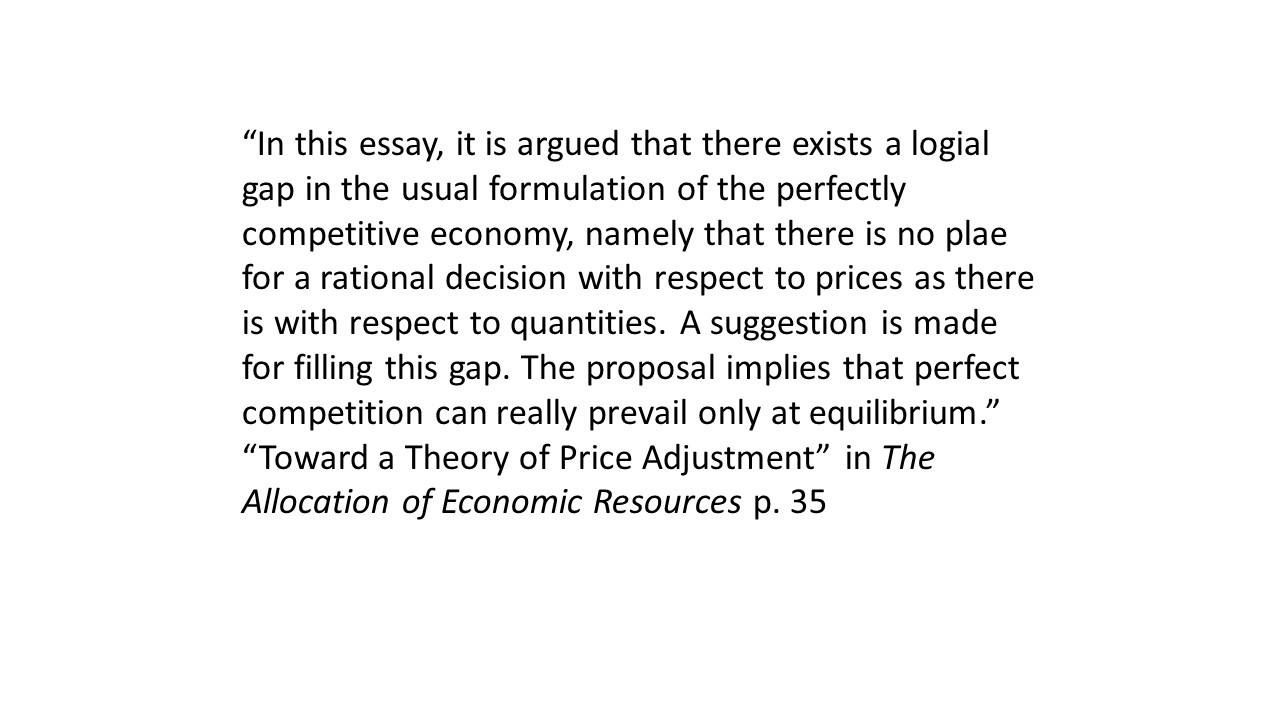
Nor did Lucasian methodology have a theoretical basis in received neoclassical theory. In a famous 1960 paper “Towards a Theory of Price Adjustment,” Kenneth Arrow identified the explanatory gap in neoclassical theory: the absence of a theory of price change in competitive markets in which every agent is a price taker. The existence of an equilibrium does not entail that the equilibrium will be, or is even likely to be, found. The notion that price flexibility is somehow a guarantee that market adjustments reliably lead to an equilibrium outcome is a presumption or a preconception, not the result of rigorous analysis.

However, Lucas used the concept of rational expectations, which originally meant no more than that agents try to use all available information to anticipate future prices, to make the concept of equilibrium, notwithstanding its inherent implausibility, a methodological necessity. A rational-expectations equilibrium was methodologically necessary and ruthlessly enforced on researchers, because it was presumed to be entailed by the neoclassical assumption of rationality. Lucasian methodology transformed rational expectations into the proposition that all agents form identical, and correct, expectations of future prices based on the same available information (common knowledge). Because all agents reach the same, correct expectations of future prices, general equilibrium is continuously achieved, except at intermittent moments when new information arrives and is used by agents to revise their expectations.

In his Nobel Lecture, Hayek decried a pretense of knowledge about correlations between macroeconomic time series that lack a foundation in the deeper structural relationships between those related time series. Without an understanding of the deeper structural relationships between those time series, observed correlations cannot be relied on when formulating economic policies. Lucas’s own famous critique echoed the message of Hayek’s lecture.

The search for microfoundations was always a natural and commendable endeavor. Scientists naturally try to reduce higher-level theories to deeper and more fundamental principles. But the endeavor ought to be conducted as a theoretical and empirical endeavor. If successful, the reduction of the higher-level theory to a deeper theory will provide insight and disclose new empirical implications to both the higher-level and the deeper theories. But reduction by methodological fiat accomplishes neither and discourages the research that might actually achieve a theoretical reduction of a higher-level theory to a deeper one. Similarly, formalism can provide important insights into the structure of theories and disclose gaps or mistakes the reasoning underlying the theories. But most important theories, even in pure mathematics, start out as informal theories that only gradually become axiomatized as logical gaps and ambiguities in the theories are discovered and filled or refined.

The resort to the reductionist and formalist methodological imperatives with which Lucas and his followers have justified their pretentions to scientific prestige and authority, and have used that authority to compel compliance with those imperatives, only belie their pretensions.

A Tale of Two Syntheses

I recently finished reading a slender, but weighty, collection of essays, Microfoundtions Reconsidered: The Relationship of Micro and Macroeconomics in Historical Perspective, edited by Pedro Duarte and Gilberto Lima; it contains in addition to a brief introductory essay by the editors, and contributions by Kevin Hoover, Robert Leonard, Wade Hands, Phil Mirowski, Michel De Vroey, and Pedro Duarte. The volume is both informative and stimulating, helping me to crystalize ideas about which I have been ruminating and writing for a long time, but especially in some of my more recent posts (e.g., here, here, and here) and my recent paper “Hayek, Hicks, Radner and Four Equilibrium Concepts.”

Hoover’s essay provides a historical account of the microfoundations, making clear that the search for microfoundations long preceded the Lucasian microfoundations movement of the 1970s and 1980s that would revolutionize macroeconomics in the late 1980s and early 1990s. I have been writing about the differences between varieties of microfoundations for quite a while (here and here), and Hoover provides valuable detail about early discussions of microfoundations and about their relationship to the now regnant Lucasian microfoundations dogma. But for my purposes here, Hoover’s key contribution is his deconstruction of the concept of microfoundations, showing that the idea of microfoundations depends crucially on the notion that agents in a macroeconomic model be explicit optimizers, meaning that they maximize an explicit function subject to explicit constraints.

What Hoover clarifies is vacuity of the Lucasian optimization dogma. Until Lucas, optimization by agents had been merely a necessary condition for a model to be microfounded. But there was also another condition: that the optimizing choices of agents be mutually consistent. Establishing that the optimizing choices of agents are mutually consistent is not necessarily easy or even possible, so often the consistency of optimizing plans can only be suggested by some sort of heuristic argument. But Lucas and his cohorts, followed by their acolytes, unable to explain, even informally or heuristically, how the optimizing choices of individual agents are rendered mutually consistent, instead resorted to question-begging and question-dodging techniques to avoid addressing the consistency issue, of which one — the most egregious, but not the only — is the representative agent. In so doing, Lucas et al. transformed the optimization problem from the coordination of multiple independent choices into the optimal plan of a single decision maker. Heckuva job!

The second essay by Robert Leonard, though not directly addressing the question of microfoundations, helps clarify and underscore the misrepresentation perpetrated by the Lucasian microfoundational dogma in disregarding and evading the need to describe a mechanism whereby the optimal choices of individual agents are, or could be, reconciled. Leonard focuses on a particular economist, Oskar Morgenstern, who began his career in Vienna as a not untypical adherent of the Austrian school of economics, a member of the Mises seminar and successor of F. A. Hayek as director of the Austrian Institute for Business Cycle Research upon Hayek’s 1931 departure to take a position at the London School of Economics. However, Morgenstern soon began to question the economic orthodoxy of neoclassical economic theory and its emphasis on the tendency of economic forces to reach a state of equilibrium.

In his famous early critique of the foundations of equilibrium theory, Morgenstern tried to show that the concept of perfect foresight, upon which, he alleged, the concept of equilibrium rests, is incoherent. To do so, Morgenstern used the example of the Holmes-Moriarity interaction in which Holmes and Moriarty are caught in a dilemma in which neither can predict whether the other will get off or stay on the train on which they are both passengers, because the optimal choice of each depends on the choice of the other. The unresolvable conflict between Holmes and Moriarty, in Morgenstern’s view, showed that the incoherence of the idea of perfect foresight.

As his disillusionment with orthodox economic theory deepened, Morgenstern became increasingly interested in the potential of mathematics to serve as a tool of economic analysis. Through his acquaintance with the mathematician Karl Menger, the son of Carl Menger, founder of the Austrian School of economics. Morgenstern became close to Menger’s student, Abraham Wald, a pure mathematician of exceptional ability, who, to support himself, was working on statistical and mathematical problems for the Austrian Institute for Business Cycle Resarch, and tutoring Morgenstern in mathematics and its applications to economic theory. Wald, himself, went on to make seminal contributions to mathematical economics and statistical analysis.

Moregenstern also became acquainted with another student of Menger, John von Neumnn, with an interest in applying advanced mathematics to economic theory. Von Neumann and Morgenstern would later collaborate in writing The Theory of Games and Economic Behavior, as a result of which Morgenstern came to reconsider his early view of the Holmes-Moriarty paradox inasmuch as it could be shown that an equilibrium solution of their interaction could be found if payoffs to their joint choices were specified, thereby enabling Holmes and Moriarty to choose optimal probablistic strategies.

I don’t think that the game-theoretic solution to the Holmes Moriarty game is as straightforward as Morgenstern eventually agreed, but the critical point in the microfoundations discussion is that the mathematical solution to the Holmes-Moriarty paradox acknowledges the necessity for the choices made by two or more agents in an economic or game-theoretic equilibrium to be reconciled – i.e., rendered mutually consistent — in equilibrium. Under Lucasian microfoundations dogma, the problem is either annihilated by positing an optimizing representative agent having no need to coordinate his decision with other agents (I leave the question who, in the Holmes-Moriarty interaction, is the representative agent as an exercise for the reader) or it is assumed away by positing the existence of a magical equilibrium with no explanation of how the mutually consistent choices are arrived at.

The third essay (“The Rise and Fall of Walrasian Economics: The Keynes Effect”) by Wade Hands considers the first of the two syntheses – the neoclassical synthesis — that are alluded to in the title of this post. Hands gives a learned account of the mutually reinforcing co-development of Walrasian general equilibrium theory and Keynesian economics in the 25 years or so following World War II. Although Hands agrees that there is no necessary connection between Walrasian GE theory and Keynesian theory, he argues that there was enough common ground between Keynesians and Walrasians, as famously explained by Hicks in summarizing Keynesian theory by way of his IS-LM model, to allow the two disparate research programs to nourish each other in a kind of symbiotic relationship as the two research programs came to dominate postwar economics.

The task for Keynesian macroeconomists following the lead of Samuelson, Solow and Modigliani at MIT, Alvin Hansen at Harvard and James Tobin at Yale was to elaborate the Hicksian IS-LM approach by embedding it in a more general Walrasian framework. In so doing, they helped to shape a research agenda for Walrasian general-equilibrium theorists working out the details of the newly developed Arrow-Debreu model, deriving conditions for the uniqueness and stability of the equilibrium of that model. The neoclassical synthesis followed from those efforts, achieving an uneasy reconciliation between Walrasian general equilibrium theory and Keynesian theory. It received its most complete articulation in the impressive treatise of Don Patinkin which attempted to derive or at least evaluate key Keyensian propositions in the context of a full general equilibrium model. At an even higher level of theoretical sophistication, the 1971 summation of general equilibrium theory by Arrow and Hahn, gave disproportionate attention to Keynesian ideas which were presented and analyzed using the tools of state-of-the art Walrasian analysis.

Hands sums up the coexistence of Walrasian and Keynesian ideas in the Arrow-Hahn volume as follows:

Arrow and Hahn’s General Competitive Analysis – the canonical summary of the literature – dedicated far more pages to stability than to any other topic. The book had fourteen chapters (and a number of mathematical appendices); there was one chapter on consumer choice, one chapter on production theory, and one chapter on existence [of equilibrium], but there were three chapters on stability analysis, (two on the traditional tatonnement and one on alternative ways of modeling general equilibrium dynamics). Add to this the fact that there was an important chapter on “The Keynesian Model’; and it becomes clear how important stability analysis and its connection to Keynesian economics was for Walrasian microeconomics during this period. The purpose of this section has been to show that that would not have been the case if the Walrasian economics of the day had not been a product of co-evolution with Keynesian economic theory. (p. 108)

What seems most unfortunate about the neoclassical synthesis is that it elevated and reinforced the least relevant and least fruitful features of both the Walrasian and the Keynesian research programs. The Hicksian IS-LM setup abstracted from the dynamic and forward-looking aspects of Keynesian theory, modeling a static one-period model, not easily deployed as a tool of dynamic analysis. Walrasian GE analysis, which, following the pathbreaking GE existence proofs of Arrow and Debreu, then proceeded to a disappointing search for the conditions for a unique and stable general equilibrium.

It was Paul Samuelson who, building on Hicks’s pioneering foray into stability analysis, argued that the stability question could be answered by investigating whether a system of Lyapounov differential equations could describe market price adjustments as functions of market excess demands that would converge on an equilibrium price vector. But Samuelson’s approach to establishing stability required the mechanism of a fictional tatonnement process. Even with that unsatisfactory assumption, the stability results were disappointing.

Although for Walrasian theorists the results hardly repaid the effort expended, for those Keynesians who interpreted Keynes as an instability theorist, the weak Walrasian stability results might have been viewed as encouraging. But that was not any easy route to take either, because Keynes had also argued that a persistent unemployment equilibrium might be the norm.

It’s also hard to understand how the stability of equilibrium in an imaginary tatonnement process could ever have been considered relevant to the operation of an actual economy in real time – a leap of faith almost as extraordinary as imagining an economy represented by a single agent. Any conventional comparative-statics exercise – the bread and butter of microeconomic analysis – involves comparing two equilibria, corresponding to a specified parametric change in the conditions of the economy. The comparison presumes that, starting from an equilibrium position, the parametric change leads from an initial to a new equilibrium. If the economy isn’t stable, a disturbance causing an economy to depart from an initial equilibrium need not result in an adjustment to a new equilibrium comparable to the old one.

If conventional comparative statics hinges on an implicit stability assumption, it’s hard to see how a stability analysis of tatonnement has any bearing on the comparative-statics routinely relied upon by economists. No actual economy ever adjusts to a parametric change by way of tatonnement. Whether a parametric change displacing an economy from its equilibrium time path would lead the economy toward another equilibrium time path is another interesting and relevant question, but it’s difficult to see what insight would be gained by proving the stability of equilibrium under a tatonnement process.

Moreover, there is a distinct question about the endogenous stability of an economy: are there endogenous tendencies within an economy that lead it away from its equilibrium time path. But questions of endogenous stability can only be posed in a dynamic, rather than a static, model. While extending the Walrasian model to include an infinity of time periods, Arrow and Debreu telescoped determination of the intertemporal-equilibrium price vector into a preliminary time period before time, production, exchange and consumption begin. So, even in the formally intertemporal Arrow-Debreu model, the equilibrium price vector, once determined, is fixed and not subject to revision. Standard stability analysis was concerned with the response over time to changing circumstances only insofar as changes are foreseen at time zero, before time begins, so that they can be and are taken fully into account when the equilibrium price vector is determined.

Though not entirely uninteresting, the intertemporal analysis had little relevance to the stability of an actual economy operating in real time. Thus, neither the standard Keyensian (IS-LM) model nor the standard Walrasian Arrow-Debreu model provided an intertemporal framework within which to address the dynamic stability that Keynes (and contemporaries like Hayek, Myrdal, Lindahl and Hicks) had developed in the 1930s. In particular, Hicks’s analytical device of temporary equilibrium might have facilitated such an analysis. But, having introduced his IS-LM model two years before publishing his temporary equilibrium analysis in Value and Capital, Hicks concentrated his attention primarily on Keynesian analysis and did not return to the temporary equilibrium model until 1965 in Capital and Growth. And it was IS-LM that became, for a generation or two, the preferred analytical framework for macroeconomic analysis, while temproary equilibrium remained overlooked until the 1970s just as the neoclassical synthesis started coming apart.

The fourth essay by Phil Mirowski investigates the role of the Cowles Commission, based at the University of Chicago from 1939 to 1955, in undermining Keynesian macroeconomics. While Hands argues that Walrasians and Keynesians came together in a non-hostile spirit of tacit cooperation, Mirowski believes that owing to their Walrasian sympathies, the Cowles Committee had an implicit anti-Keynesian orientation and was therefore at best unsympathetic if not overtly hostile to Keynesian theorizing, which was incompatible the Walrasian optimization paradigm endorsed by the Cowles economists. (Another layer of unexplored complexity is the tension between the Walrasianism of the Cowles economists and the Marshallianism of the Chicago School economists, especially Knight and Friedman, which made Chicago an inhospitable home for the Cowles Commission and led to its eventual departure to Yale.)

Whatever differences, both the Mirowski and the Hands essays support the conclusion that the uneasy relationship between Walrasianism and Keynesianism was inherently problematic and unltimately unsustainable. But to me the tragedy is that before the fall, in the 1950s and 1960s, when the neoclassical synthesis bestrode economics like a colossus, the static orientation of both the Walrasian and the Keynesian research programs combined to distract economists from a more promising research program. Such a program, instead of treating expectations either as parametric constants or as merely adaptive, based on an assumed distributed lag function, might have considered whether expectations could perform a potentially equilibrating role in a general equilibrium model.

The equilibrating role of expectations, though implicit in various contributions by Hayek, Myrdal, Lindahl, Irving Fisher, and even Keynes, is contingent so that equilibrium is not inevitable, only a possibility. Instead, the introduction of expectations as an equilibrating variable did not occur until the mid-1970s when Robert Lucas, Tom Sargent and Neil Wallace, borrowing from John Muth’s work in applied microeconomics, introduced the idea of rational expectations into macroeconomics. But in introducing rational expectations, Lucas et al. made rational expectations not the condition of a contingent equilibrium but an indisputable postulate guaranteeing the realization of equilibrium without offering any theoretical account of a mechanism whereby the rationality of expectations is achieved.

The fifth essay by Michel DeVroey (“Microfoundations: a decisive dividing line between Keynesian and new classical macroeconomics?”) is a philosophically sophisticated analysis of Lucasian microfoundations methodological principles. DeVroey begins by crediting Lucas with the revolution in macroeconomics that displaced a Keynesian orthodoxy already discredited in the eyes of many economists after its failure to account for simultaneously rising inflation and unemployment.

The apparent theoretical disorder characterizing the Keynesian orthodoxy and its Monetarist opposition left a void for Lucas to fill by providing a seemingly rigorous microfounded alternative to the confused state of macroeconomics. And microfoundations became the methodological weapon by which Lucas and his associates and followers imposed an iron discipline on the unruly community of macroeconomists. “In Lucas’s eyes,” DeVroey aptly writes,“ the mere intention to produce a theory of involuntary unemployment constitutes an infringement of the equilibrium discipline.” Showing that his description of Lucas is hardly overstated, DeVroey quotes from the famous 1978 joint declaration of war issued by Lucas and Sargent against Keynesian macroeconomics:

After freeing himself of the straightjacket (or discipline) imposed by the classical postulates, Keynes described a model in which rules of thumb, such as the consumption function and liquidity preference schedule, took the place of decision functions that a classical economist would insist be derived from the theory of choice. And rather than require that wages and prices be determined by the postulate that markets clear – which for the labor market seemed patently contradicted by the severity of business depressions – Keynes took as an unexamined postulate that money wages are sticky, meaning that they are set at a level or by a process that could be taken as uninfluenced by the macroeconomic forces he proposed to analyze.

Echoing Keynes’s famous description of the sway of Ricardian doctrines over England in the nineteenth century, DeVroey remarks that the microfoundations requirement “conquered macroeconomics as quickly and thoroughly as the Holy Inquisition conquered Spain,” noting, even more tellingly, that the conquest was achieved without providing any justification. Ricardo had, at least, provided a substantive analysis that could be debated; Lucas offered only an undisputable methodological imperative about the sole acceptable mode of macroeconomic reasoning. Just as optimization is a necessary component of the equilibrium discipline that had to be ruthlessly imposed on pain of excommunication from the macroeconomic community, so, too, did the correlate principle of market-clearing. To deviate from the market-clearing postulate was ipso facto evidence of an impure and heretical state of mind. DeVroey further quotes from the war declaration of Lucas and Sargent.

Cleared markets is simply a principle, not verifiable by direct observation, which may or may not be useful in constructing successful hypotheses about the behavior of these [time] series.

What was only implicit in the war declaration became evident later after right-thinking was enforced, and woe unto him that dared deviate from the right way of thinking.

But, as DeVroey skillfully shows, what is most remarkable is that, having declared market clearing an indisputable methodological principle, Lucas, contrary to his own demand for theoretical discipline, used the market-clearing postulate to free himself from the very equilibrium discipline he claimed to be imposing. How did the market-clearing postulate liberate Lucas from equilibrium discipline? To show how the sleight-of-hand was accomplished, DeVroey, in an argument parallel to that of Hoover in chapter one and that suggested by Leonard in chapter two, contrasts Lucas’s conception of microfoundations with a different microfoundations conception espoused by Hayek and Patinkin. Unlike Lucas, Hayek and Patinkin recognized that the optimization of individual economic agents is conditional on the optimization of other agents. Lucas assumes that if all agents optimize, then their individual optimization ensures that a social optimum is achieved, the whole being the sum of its parts. But that assumption ignores that the choices made interacting agents are themelves interdependent.

To capture the distinction between independent and interdependent optimization, DeVroey distinguishes between optimal plans and optimal behavior. Behavior is optimal only if an optimal plan can be executed. All agents can optimize individually in making their plans, but the optimality of their behavior depends on their capacity to carry those plans out. And the capacity of each to carry out his plan is contingent on the optimal choices of all other agents.

Optimizing plans refers to agents’ intentions before the opening of trading, the solution to the choice-theoretical problem with which they are faced. Optimizing behavior refers to what is observable after trading has started. Thus optimal behavior implies that the optimal plan has been realized. . . . [O]ptmizing plans and optimizing behavior need to be logically separated – there is a difference between finding a solution to a choice problem and implementing the solution. In contrast, whenever optimizing behavior is the sole concept used, the possibility of there being a difference between them is discarded by definition. This is the standpoint takenby Lucas and Sargent. Once it is adopted, it becomes misleading to claim . . .that the microfoundations requirement is based on two criteria, optimizing behavior and market clearing. A single criterion is needed, and it is irrelevant whether this is called generalized optimizing behavior or market clearing. (De Vroey, p. 176)

Each agent is free to optimize his plan, but no agent can execute his optimal plan unless the plan coincides with the complementary plans of other agents. So, the execution of an optimal plan is not within the unilateral control of an agent formulating his own plan. One can readily assume that agents optimize their plans, but one cannot just assume that those plans can be executed as planned. The optimality of interdependent plans is not self-evident; it is a proposition that must be demonstrated. Assuming that agents optimize, Lucas simply asserts that, because agents optimize, markets must clear.

That is a remarkable non-sequitur. And from that non-sequitur, Lucas jumps to a further non-sequitur: that an optimizing representative agent is all that’s required for a macroeconomic model. The logical straightjacket (or discipline) of demonstrating that interdependent optimal plans are consistent is thus discarded (or trampled upon). Lucas’s insistence on a market-clearing principle turns out to be subterfuge by which the pretense of its upholding conceals its violation in practice.

My own view is that the assumption that agents formulate optimizing plans cannot be maintained without further analysis unless the agents are operating in isolation. If the agents interacting with each other, the assumption that they optimize requires a theory of their interaction. If the focus is on equilibrium interactions, then one can have a theory of equilibrium, but then the possibility of non-equilibrium states must also be acknowledged.

That is what John Nash did in developing his equilibrium theory of positive-sum games. He defined conditions for the existence of equilibrium, but he offered no theory of how equilibrium is achieved. Lacking such a theory, he acknowledged that non-equilibrium solutions might occur, e.g., in some variant of the Holmes-Moriarty game. To simply assert that because interdependent agents try to optimize, they must, as a matter of principle, succeed in optimizing is to engage in question-begging on a truly grand scale. To insist, as a matter of methodological principle, that everyone else must also engage in question-begging on equally grand scale is what I have previously called methodological arrogance, though an even harsher description might be appropriate.

In the sixth essay (“Not Going Away: Microfoundations in the making of a new consensus in macroeconomics”), Pedro Duarte considers the current state of apparent macroeconomic consensus in the wake of the sweeping triumph of the Lucasian micorfoundtions methodological imperative. In its current state, mainstream macroeconomists from a variety of backgrounds have reconciled themselves and adjusted to the methodological absolutism Lucas and his associates and followers have imposed on macroeconomic theorizing. Leading proponents of the current consensus are pleased to announce, in unseemly self-satisfaction, that macroeconomics is now – but presumably not previously – “firmly grounded in the principles of economic [presumably neoclassical] theory.” But the underlying conception of neoclassical economic theory motivating such a statement is almost laughably narrow, and, as I have just shown, strictly false even if, for argument’s sake, that narrow conception is accepted.

Duarte provides an informative historical account of the process whereby most mainstream Keynesians and former old-line Monetarists, who had, in fact, adopted much of the underlying Keynesian theoretical framework themselves, became reconciled to the non-negotiable methodological microfoundational demands upon which Lucas and his New Classical followers and Real-Business-Cycle fellow-travelers insisted. While Lucas was willing to tolerate differences of opinion about the importance of monetary factors in accounting for business-cycle fluctuations in real output and employment, and even willing to countenance a role for countercyclical monetary policy, such differences of opinion could be tolerated only if they could be derived from an acceptable microfounded model in which the agent(s) form rational expectations. If New Keynesians were able to produce results rationalizing countercyclical policies in such microfounded models with rational expectations, Lucas was satisfied. Presumably, Lucas felt the price of conceding the theoretical legitimacy of countercyclical policy was worth paying in order to achieve methodological hegemony over macroeconomic theory.

And no doubt, for Lucas, the price was worth paying, because it led to what Marvin Goodfriend and Robert King called the New Neoclassical Synthesis in their 1997 article ushering in the new era of good feelings, a synthesis based on “the systematic application of intertemporal optimization and rational expectations” while embodying “the insights of monetarists . . . regarding the theory and practice of monetary policy.”

While the first synthesis brought about a convergence of sorts between the disparate Walrasian and Keynesian theoretical frameworks, the convergence proved unstable because the inherent theoretical weaknesses of both paradigms were unable to withstand criticisms of the theoretical apparatus and of the policy recommendations emerging from that synthesis, particularly an inability to provide a straightforward analysis of inflation when it became a serious policy problem in the late 1960s and 1970s. But neither the Keynesian nor the Walrasian paradigms were developing in a way that addressed the points of most serious weakness.

On the Keynesian side, the defects included the static nature of the workhorse IS-LM model, the absence of a market for real capital and of a market for endogenous money. On the Walrasian side, the defects were the lack of any theory of actual price determination or of dynamic adjustment. The Hicksian temporary equilibrium paradigm might have provided a viable way forward, and for a very different kind of synthesis, but not even Hicks himself realized the potential of his own creation.

While the first synthesis was a product of convenience and misplaced optimism, the second synthesis is a product of methodological hubris and misplaced complacency derived from an elementary misunderstanding of the distinction between optimization by a single agent and the simultaneous optimization of two or more independent, yet interdependent, agents. The equilibrium of each is the result of the equilibrium of all, and a theory of optimization involving two or more agents requires a theory of how two or more interdependent agents can optimize simultaneously. The New neoclassical synthesis rests on the demand for a macroeconomic theory of individual optimization that refuses even to ask, let along provide an answer to, the question whether the optimization that it demands is actually achieved in practice or what happens if it is not. This is not a synthesis that will last, or that deserves to. And the sooner it collapses, the better off macroeconomics will be.

What the answer is I don’t know, but if I had to offer a suggestion, the one offered by my teacher Axel Leijonhufvud towards the end of his great book, written more than half a century ago, strikes me as not bad at all:

One cannot assume that what went wrong was simply that Keynes slipped up here and there in his adaptation of standard tool, and that consequently, if we go back and tinker a little more with the Marshallian toolbox his purposes will be realized. What is required, I believe, is a systematic investigation, form the standpoint of the information problems stressed in this study, of what elements of the static theory of resource allocation can without further ado be utilized in the analysis of dynamic and historical systems. This, of course, would be merely a first-step: the gap yawns very wide between the systematic and rigorous modern analysis of the stability of “featureless,” pure exchange systems and Keynes’ inspired sketch of the income-constrained process in a monetary-exchange-cum-production system. But even for such a first step, the prescription cannot be to “go back to Keynes.” If one must retrace some steps of past developments in order to get on the right track—and that is probably advisable—my own preference is to go back to Hayek. Hayek’s Gestalt-conception of what happens during business cycles, it has been generally agreed, was much less sound than Keynes’. As an unhappy consequence, his far superior work on the fundamentals of the problem has not received the attention it deserves. (p. 401)

I agree with all that, but would also recommend Roy Radner’s development of an alternative to the Arrow-Debreu version of Walrasian general equilibrium theory that can accommodate Hicksian temporary equilibrium, and Hawtrey’s important contributions to our understanding of monetary theory and the role and potential instability of endogenous bank money. On top of that, Franklin Fisher in his important work, The Disequilibrium Foundations of Equilibrium Economics, has given us further valuable guidance in how to improve the current sorry state of macroeconomics.


Filling the Arrow Explanatory Gap

The following (with some minor revisions) is a Twitter thread I posted yesterday. Unfortunately, because it was my first attempt at threading the thread wound up being split into three sub-threads and rather than try to reconnect them all, I will just post the complete thread here as a blogpost.

1. Here’s an outline of an unwritten paper developing some ideas from my paper “Hayek Hicks Radner and Four Equilibrium Concepts” (see here for an earlier ungated version) and some from previous blog posts, in particular Phillips Curve Musings

2. Standard supply-demand analysis is a form of partial-equilibrium (PE) analysis, which means that it is contingent on a ceteris paribus (CP) assumption, an assumption largely incompatible with realistic dynamic macroeconomic analysis.

3. Macroeconomic analysis is necessarily situated a in general-equilibrium (GE) context that precludes any CP assumption, because there are no variables that are held constant in GE analysis.

4. In the General Theory, Keynes criticized the argument based on supply-demand analysis that cutting nominal wages would cure unemployment. Instead, despite his Marshallian training (upbringing) in PE analysis, Keynes argued that PE (AKA supply-demand) analysis is unsuited for understanding the problem of aggregate (involuntary) unemployment.

5. The comparative-statics method described by Samuelson in the Foundations of Econ Analysis formalized PE analysis under the maintained assumption that a unique GE obtains and deriving a “meaningful theorem” from the 1st- and 2nd-order conditions for a local optimum.

6. PE analysis, as formalized by Samuelson, is conditioned on the assumption that GE obtains. It is focused on the effect of changing a single parameter in a single market small enough for the effects on other markets of the parameter change to be made negligible.

7. Thus, PE analysis, the essence of micro-economics is predicated on the macrofoundation that all, but one, markets are in equilibrium.

8. Samuelson’s meaningful theorems were a misnomer reflecting mid-20th-century operationalism. They can now be understood as empirically refutable propositions implied by theorems augmented with a CP assumption that interactions b/w markets are small enough to be neglected.

9. If a PE model is appropriately specified, and if the market under consideration is small or only minimally related to other markets, then differences between predictions and observations will be statistically insignificant.

10. So PE analysis uses comparative-statics to compare two alternative general equilibria that differ only in respect of a small parameter change.

11. The difference allows an inference about the causal effect of a small change in that parameter, but says nothing about how an economy would actually adjust to a parameter change.

12. PE analysis is conditioned on the CP assumption that the analyzed market and the parameter change are small enough to allow any interaction between the parameter change and markets other than the market under consideration to be disregarded.

13. However, the process whereby one equilibrium transitions to another is left undetermined; the difference between the two equilibria with and without the parameter change is computed but no account of an adjustment process leading from one equilibrium to the other is provided.

14. Hence, the term “comparative statics.”

15. The only suggestion of an adjustment process is an assumption that the price-adjustment in any market is an increasing function of excess demand in the market.

16. In his seminal account of GE, Walras posited the device of an auctioneer who announces prices–one for each market–computes desired purchases and sales at those prices, and sets, under an adjustment algorithm, new prices at which desired purchases and sales are recomputed.

17. The process continues until a set of equilibrium prices is found at which excess demands in all markets are zero. In Walras’s heuristic account of what he called the tatonnement process, trading is allowed only after the equilibrium price vector is found by the auctioneer.

18. Walras and his successors assumed, but did not prove, that, if an equilibrium price vector exists, the tatonnement process would eventually, through trial and error, converge on that price vector.

19. However, contributions by Sonnenschein, Mantel and Debreu (hereinafter referred to as the SMD Theorem) show that no price-adjustment rule necessarily converges on a unique equilibrium price vector even if one exists.

20. The possibility that there are multiple equilibria with distinct equilibrium price vectors may or may not be worth explicit attention, but for purposes of this discussion, I confine myself to the case in which a unique equilibrium exists.

21. The SMD Theorem underscores the lack of any explanatory account of a mechanism whereby changes in market prices, responding to excess demands or supplies, guide a decentralized system of competitive markets toward an equilibrium state, even if a unique equilibrium exists.

22. The Walrasian tatonnement process has been replaced by the Arrow-Debreu-McKenzie (ADM) model in an economy of infinite duration consisting of an infinite number of generations of agents with given resources and technology.

23. The equilibrium of the model involves all agents populating the economy over all time periods meeting before trading starts, and, based on initial endowments and common knowledge, making plans given an announced equilibrium price vector for all time in all markets.

24. Uncertainty is accommodated by the mechanism of contingent trading in alternative states of the world. Given assumptions about technology and preferences, the ADM equilibrium determines the set prices for all contingent states of the world in all time periods.

25. Given equilibrium prices, all agents enter into optimal transactions in advance, conditioned on those prices. Time unfolds according to the equilibrium set of plans and associated transactions agreed upon at the outset and executed without fail over the course of time.

26. At the ADM equilibrium price vector all agents can execute their chosen optimal transactions at those prices in all markets (certain or contingent) in all time periods. In other words, at that price vector, excess demands in all markets with positive prices are zero.

27. The ADM model makes no pretense of identifying a process that discovers the equilibrium price vector. All that can be said about that price vector is that if it exists and trading occurs at equilibrium prices, then excess demands will be zero if prices are positive.

28. Arrow himself drew attention to the gap in the ADM model, writing in 1959:

29. In addition to the explanatory gap identified by Arrow, another shortcoming of the ADM model was discussed by Radner: the dependence of the ADM model on a complete set of forward and state-contingent markets at time zero when equilibrium prices are determined.

30. Not only is the complete-market assumption a backdoor reintroduction of perfect foresight, it excludes many features of the greatest interest in modern market economies: the existence of money, stock markets, and money-crating commercial banks.

31. Radner showed that for full equilibrium to obtain, not only must excess demands in current markets be zero, but whenever current markets and current prices for future delivery are missing, agents must correctly expect those future prices.

32. But there is no plausible account of an equilibrating mechanism whereby price expectations become consistent with GE. Although PE analysis suggests that price adjustments do clear markets, no analogous analysis explains how future price expectations are equilibrated.

33. But if both price expectations and actual prices must be equilibrated for GE to obtain, the notion that “market-clearing” price adjustments are sufficient to achieve macroeconomic “equilibrium” is untenable.

34. Nevertheless, the idea that individual price expectations are rational (correct), so that, except for random shocks, continuous equilibrium is maintained, became the bedrock for New Classical macroeconomics and its New Keynesian and real-business cycle offshoots.

35. Macroeconomic theory has become a theory of dynamic intertemporal optimization subject to stochastic disturbances and market frictions that prevent or delay optimal adjustment to the disturbances, potentially allowing scope for countercyclical monetary or fiscal policies.

36. Given incomplete markets, the assumption of nearly continuous intertemporal equilibrium implies that agents correctly foresee future prices except when random shocks occur, whereupon agents revise expectations in line with the new information communicated by the shocks.
37. Modern macroeconomics replaced the Walrasian auctioneer with agents able to forecast the time path of all prices indefinitely into the future, except for intermittent unforeseen shocks that require agents to optimally their revise previous forecasts.
38. When new information or random events, requiring revision of previous expectations, occur, the new information becomes common knowledge and is processed and interpreted in the same way by all agents. Agents with rational expectations always share the same expectations.
39. So in modern macro, Arrow’s explanatory gap is filled by assuming that all agents, given their common knowledge, correctly anticipate current and future equilibrium prices subject to unpredictable forecast errors that change their expectations of future prices to change.
40. Equilibrium prices aren’t determined by an economic process or idealized market interactions of Walrasian tatonnement. Equilibrium prices are anticipated by agents, except after random changes in common knowledge. Semi-omniscient agents replace the Walrasian auctioneer.
41. Modern macro assumes that agents’ common knowledge enables them to form expectations that, until superseded by new knowledge, will be validated. The assumption is wrong, and the mistake is deeper than just the unrealism of perfect competition singled out by Arrow.
42. Assuming perfect competition, like assuming zero friction in physics, may be a reasonable simplification for some problems in economics, because the simplification renders an otherwise intractable problem tractable.
43. But to assume that agents’ common knowledge enables them to forecast future prices correctly transforms a model of decentralized decision-making into a model of central planning with each agent possessing the knowledge only possessed by an omniscient central planner.
44. The rational-expectations assumption fills Arrow’s explanatory gap, but in a deeply unsatisfactory way. A better approach to filling the gap would be to acknowledge that agents have private knowledge (and theories) that they rely on in forming their expectations.
45. Agents’ expectations are – at least potentially, if not inevitably – inconsistent. Because expectations differ, it’s the expectations of market specialists, who are better-informed than non-specialists, that determine the prices at which most transactions occur.
46. Because price expectations differ even among specialists, prices, even in competitive markets, need not be uniform, so that observed price differences reflect expectational differences among specialists.
47. When market specialists have similar expectations about future prices, current prices will converge on the common expectation, with arbitrage tending to force transactions prices to converge toward notwithstanding the existence of expectational differences.
48. However, the knowledge advantage of market specialists over non-specialists is largely limited to their knowledge of the workings of, at most, a small number of related markets.
49. The perspective of specialists whose expectations govern the actual transactions prices in most markets is almost always a PE perspective from which potentially relevant developments in other markets and in macroeconomic conditions are largely excluded.
50. The interrelationships between markets that, according to the SMD theorem, preclude any price-adjustment algorithm, from converging on the equilibrium price vector may also preclude market specialists from converging, even roughly, on the equilibrium price vector.
51. A strict equilibrium approach to business cycles, either real-business cycle or New Keynesian, requires outlandish assumptions about agents’ common knowledge and their capacity to anticipate the future prices upon which optimal production and consumption plans are based.
52. It is hard to imagine how, without those outlandish assumptions, the theoretical superstructure of real-business cycle theory, New Keynesian theory, or any other version of New Classical economics founded on the rational-expectations postulate can be salvaged.
53. The dominance of an untenable macroeconomic paradigm has tragically led modern macroeconomics into a theoretical dead end.

My Paper “Hayek, Hicks, Radner and Four Equilibrium Concepts” Is Now Available Online.

The paper, forthcoming in The Review of Austrian Economics, can be read online.

Here is the abstract:

Hayek was among the first to realize that for intertemporal equilibrium to obtain all agents must have correct expectations of future prices. Before comparing four categories of intertemporal, the paper explains Hayek’s distinction between correct expectations and perfect foresight. The four equilibrium concepts considered are: (1) Perfect foresight equilibrium of which the Arrow-Debreu-McKenzie (ADM) model of equilibrium with complete markets is an alternative version, (2) Radner’s sequential equilibrium with incomplete markets, (3) Hicks’s temporary equilibrium, as extended by Bliss; (4) the Muth rational-expectations equilibrium as extended by Lucas into macroeconomics. While Hayek’s understanding closely resembles Radner’s sequential equilibrium, described by Radner as an equilibrium of plans, prices, and price expectations, Hicks’s temporary equilibrium seems to have been the natural extension of Hayek’s approach. The now dominant Lucas rational-expectations equilibrium misconceives intertemporal equilibrium, suppressing Hayek’s insights thereby retreating to a sterile perfect-foresight equilibrium.

And here is my concluding paragraph:

Four score and three years after Hayek explained how challenging the subtleties of the notion of intertemporal equilibrium and the elusiveness of any theoretical account of an empirical tendency toward intertemporal equilibrium, modern macroeconomics has now built a formidable theoretical apparatus founded on a methodological principle that rejects all the concerns that Hayek found so vexing denies that all those difficulties even exist. Many macroeconomists feel proud of what modern macroeconomics has achieved, but there is reason to think that the path trod by Hayek, Hicks and Radner could have led macroeconomics in a more fruitful direction than the one on which it has been led by Lucas and his associates.

On Equilibrium in Economic Theory

Here is the introduction to a new version of my paper, “Hayek and Three Concepts of Intertemporal Equilibrium” which I presented last June at the History of Economics Society meeting in Toronto, and which I presented piecemeal in a series of posts last May and June. This post corresponds to the first part of this post from last May 21.

Equilibrium is an essential concept in economics. While equilibrium is an essential concept in other sciences as well, and was probably imported into economics from physics, its meaning in economics cannot be straightforwardly transferred from physics into economics. The dissonance between the physical meaning of equilibrium and its economic interpretation required a lengthy process of explication and clarification, before the concept and its essential, though limited, role in economic theory could be coherently explained.

The concept of equilibrium having originally been imported from physics at some point in the nineteenth century, economists probably thought it natural to think of an economic system in equilibrium as analogous to a physical system at rest, in the sense of a system in which there was no movement or in the sense of all movements being repetitive. But what would it mean for an economic system to be at rest? The obvious answer was to say that prices of goods and the quantities produced, exchanged and consumed would not change. If supply equals demand in every market, and if there no exogenous disturbance displaces the system, e.g., in population, technology, tastes, etc., then there would seem to be no reason for the prices paid and quantities produced to change in that system. But that conception of an economic system at rest was understood to be overly restrictive, given the large, and perhaps causally important, share of economic activity – savings and investment – that is predicated on the assumption and expectation that prices and quantities not remain constant.

The model of a stationary economy at rest in which all economic activity simply repeats what has already happened before did not seem very satisfying or informative to economists, but that view of equilibrium remained dominant in the nineteenth century and for perhaps the first quarter of the twentieth. Equilibrium was not an actual state that an economy could achieve, it was just an end state that economic processes would move toward if given sufficient time to play themselves out with no disturbing influences. This idea of a stationary timeless equilibrium is found in the writings of the classical economists, especially Ricardo and Mill who used the idea of a stationary state as the end-state towards which natural economic processes were driving an an economic system.

This, not very satisfactory, concept of equilibrium was undermined when Jevons, Menger, Walras, and their followers began to develop the idea of optimizing decisions by rational consumers and producers. The notion of optimality provided the key insight that made it possible to refashion the earlier classical equilibrium concept into a new, more fruitful and robust, version.

If each economic agent (household or business firm) is viewed as making optimal choices, based on some scale of preferences, and subject to limitations or constraints imposed by their capacities, endowments, technologies, and the legal system, then the equilibrium of an economy can be understood as a state in which each agent, given his subjective ranking of the feasible alternatives, is making an optimal decision, and each optimal decision is both consistent with, and contingent upon, those of all other agents. The optimal decisions of each agent must simultaneously be optimal from the point of view of that agent while being consistent, or compatible, with the optimal decisions of every other agent. In other words, the decisions of all buyers of how much to purchase must be consistent with the decisions of all sellers of how much to sell. But every decision, just like every piece in a jig-saw puzzle, must fit perfectly with every other decision. If any decision is suboptimal, none of the other decisions contingent upon that decision can be optimal.

The idea of an equilibrium as a set of independently conceived, mutually consistent, optimal plans was latent in the earlier notions of equilibrium, but it could only be coherently articulated on the basis of a notion of optimality. Originally framed in terms of utility maximization, the notion was gradually extended to encompass the ideas of cost minimization and profit maximization. The general concept of an optimal plan having been grasped, it then became possible to formulate a generically economic idea of equilibrium, not in terms of a system at rest, but in terms of the mutual consistency of optimal plans. Once equilibrium was conceived as the mutual consistency of optimal plans, the needlessly restrictiveness of defining equilibrium as a system at rest became readily apparent, though it remained little noticed and its significance overlooked for quite some time.

Because the defining characteristics of economic equilibrium are optimality and mutual consistency, change, even non-repetitive change, is not logically excluded from the concept of equilibrium as it was from the idea of an equilibrium as a stationary state. An optimal plan may be carried out, not just at a single moment, but over a period of time. Indeed, the idea of an optimal plan is, at the very least, suggestive of a future that need not simply repeat the present. So, once the idea of equilibrium as a set of mutually consistent optimal plans was grasped, it was to be expected that the concept of equilibrium could be formulated in a manner that accommodates the existence of change and development over time.

But the manner in which change and development could be incorporated into an equilibrium framework of optimality was not entirely straightforward, and it required an extended process of further intellectual reflection to formulate the idea of equilibrium in a way that gives meaning and relevance to the processes of change and development that make the passage of time something more than merely a name assigned to one of the n dimensions in vector space.

This paper examines the slow process by which the concept of equilibrium was transformed from a timeless or static concept into an intertemporal one by focusing on the pathbreaking contribution of F. A. Hayek who first articulated the concept, and exploring the connection between his articulation and three noteworthy, but very different, versions of intertemporal equilibrium: (1) an equilibrium of plans, prices, and expectations, (2) temporary equilibrium, and (3) rational-expectations equilibrium.

But before discussing these three versions of intertemporal equilibrium, I summarize in section two Hayek’s seminal 1937 contribution clarifying the necessary conditions for the existence of an intertemporal equilibrium. Then, in section three, I elaborate on an important, and often neglected, distinction, first stated and clarified by Hayek in his 1937 paper, between perfect foresight and what I call contingently correct foresight. That distinction is essential for an understanding of the distinction between the canonical Arrow-Debreu-McKenzie (ADM) model of general equilibrium, and Roy Radner’s 1972 generalization of that model as an equilibrium of plans, prices and price expectations, which I describe in section four.

Radner’s important generalization of the ADM model captured the spirit and formalized Hayek’s insights about the nature and empirical relevance of intertemporal equilibrium. But to be able to prove the existence of an equilibrium of plans, prices and price expectations, Radner had to make assumptions about agents that Hayek, in his philosophically parsimonious view of human knowledge and reason, had been unwilling to accept. In section five, I explore how J. R. Hicks’s concept of temporary equilibrium, clearly inspired by Hayek, though credited by Hicks to Erik Lindahl, provides an important bridge connecting the pure hypothetical equilibrium of correct expectations and perfect consistency of plans with the messy real world in which expectations are inevitably disappointed and plans routinely – and sometimes radically – revised. The advantage of the temporary-equilibrium framework is to provide the conceptual tools with which to understand how financial crises can occur and how such crises can be propagated and transformed into economic depressions, thereby making possible the kind of business-cycle model that Hayek tried unsuccessfully to create. But just as Hicks unaccountably failed to credit Hayek for the insights that inspired his temporary-equilibrium approach, Hayek failed to see the potential of temporary equilibrium as a modeling strategy that combines the theoretical discipline of the equilibrium method with the reality of expectational inconsistency across individual agents.

In section six, I discuss the Lucasian idea of rational expectations in macroeconomic models, mainly to point out that, in many ways, it simply assumes away the problem of plan expectational consistency with which Hayek, Hicks and Radner and others who developed the idea of intertemporal equilibrium were so profoundly concerned.

The 2017 History of Economics Society Conference in Toronto

I arrived in Toronto last Thursday for the History of Economics Society Meeting at the University of Toronto (Trinity College to be exact) to give talks on Friday about two papers, one of which (“Hayek and Three Equilibrium Concepts: Sequential, Temporary and Rational Expectations”) I have been posting over the past few weeks on this blog (here, here, here, here, and here). I want to thank those of you who have posted your comments, which have been very helpful, and apologize for not responding to the more recent comments. The other paper about which I gave a talk was based on a post from three of years ago (“Real and Pseudo Gold Standards: Did Friedman Know the Difference?”) on which one of the sections of that paper was based.

Here I am talking about Friedman.

Here are the abstracts of the two papers:

“Hayek and Three Equilibrium Concepts: Sequential, Temporary, and Rational Expectations”

Almost 40 years ago, Murray Milgate (1979) drew attention to the neglected contribution of F. A. Hayek to the concept of intertemporal equilibrium, which had previously been associated with Erik Lindahl and J. R. Hicks. Milgate showed that although Lindahl had developed the concept of intertemporal equilibrium independently, Hayek’s original 1928 contribution was published before Lindahl’s and that, curiously, Hicks in Value and Capital had credited Lindahl with having developed the concept despite having been Hayek’s colleague at LSE in the early 1930s and having previously credited Hayek for the idea of intertemporal equilibrium. Aside from Milgate’s contribution, few developments of the idea of intertemporal equilibrium have adequately credited Hayek’s contribution. This paper attempts to compare three important subsequent developments of that idea with Hayek’s 1937 refinement of the key idea of his 1928 paper. In non-chronological order, the three developments of interest are: 1) Radner’s model of sequential equilibrium with incomplete markets as an alternative to the Arrow-Debreu-McKenzie model of full equilibrium with complete markets; 2) Hicks’s temporary equilibrium model, and 3) the Muth-Lucas rational expectations model. While Hayek’s 1937 treatment most closely resembles Radner’s sequential equilibrium model, which Radner, echoing Hayek, describes as an equilibrium of plans, prices, and price expectations, Hicks’s temporary equilibrium model seems to be the natural development of Hayek’s approach. The Muth-Lucas rational-expectations model, however, develops the concept of intertemporal equilibrium in a way that runs counter to the fundamental Hayekian insight about the nature of intertemporal equilibrium

“Milton Friedman and the Gold Standard”

Milton Friedman discussed the gold standard in a number of works. His two main discussions of the gold standard appear in a 1951 paper on commodity-reserve currencies and in a 1961 paper on real and pseudo gold standards. In the 1951 paper, he distinguished between a gold standard in which only gold or warehouse certificates to equivalent amounts of gold circulated as a medium of exchange and one in which mere fiduciary claims to gold also circulated as media of exchange. Friedman called the former a strict gold standard and the latter as a partial gold standard. In the later paper, he distinguished between a gold standard in which gold is used as money, and a gold standard in which the government merely fixes the price of gold, dismissing the latter as a “pseudo” gold standard. In this paper, I first discuss the origin for the real/partial distinction, an analytical error, derived from David Hume via the nineteenth-century Currency School, about the incentives of banks to overissue convertible claims to base money, which inspired the Chicago plan for 100-percent reserve banking. I then discuss the real/pseudo distinction and argue that it was primarily motivated by the ideological objective of persuading libertarian and classical-liberal supporters of the gold standard to support a fiat standard supplemented by the k-percent quantity rule that Friedman was about to propose.

And here is my concluding section from the Friedman paper:

Milton Friedman’s view of the gold standard was derived from his mentors at the University Chicago, an inheritance that, in a different context, he misleadingly described as the Chicago oral tradition. The Chicago view of the gold standard was, in turn, derived from the English Currency School of the mid-nineteenth century, which successfully promoted the enactment of the Bank Charter Act of 1844, imposing a 100-percent marginal reserve requirement on the banknotes issued by the Bank of England, and served as a model for the Chicago Plan for 100-percent-reserve banking. The Currency School, in turn, based its proposals for reform on the price-specie-flow analysis of David Hume (1742).

The pure quantity-theoretic lineage of Friedman’s views of the gold standard and the intellectual debt that he owed to the Currency School and the Bank Charter Act disposed him to view the gold standard as nothing more than a mechanism for limiting the quantity of money. If the really compelling purpose and justification of the gold standard was to provide a limitation on the capacity of a government or a monetary authority to increase the quantity of money, then there was nothing special or exceptional about the gold standard.

I have no interest in exploring the reasons why supporters of, and true believers in, the gold standard feel a strong ideological or emotional attachment to that institution, and even if I had such an interest, this would not be the place to enter into such an exploration, but I conjecture that the sources of that attachment to the gold standard go deeper than merely to provide a constraint on the power of the government to increase the quantity of money.

But from Friedman’s quantity-theoretical perspective, if the primary virtue of the gold standard was that it served to limit the ability of the government to increase the quantity of money, if another institution could perform that service, it would serve just as well as the gold standard. The lesson that Friedman took from the efforts of the Currency School to enact the Bank Charter Act was that the gold standard, on its own, did not provide a sufficient constraint on the ability of private banks to increase the quantity of money. Otherwise, the 100-percent marginal reserve requirement of the Bank Charter Act would have been unnecessary.

Now if the gold standard could not function well without additional constraints on the quantity of money, then obviously the constraint on the quantity of money that really matters is not the gold standard itself, but the 100-percent marginal reserve requirement imposed on the banking system. But if the relevant constraint on the quantity of money is the 100 percent marginal reserve requirement, then the gold standard is really just excess baggage.

That was the view of Henry Simons and the other authors of the Chicago Plan. For a long time, Friedman accepted the Chicago Plan as the best prescription for monetary stability, but at about the time that he was writing his paper on real and pseudo gold standards, Friedman was frcoming to position that a k-percent rule would be a superior alternative to the old Chicago Plan. His paper on Pseudo gold standards for the Mont Pelerin Society was his initial attempt to persuade his libertarian and classical-liberal friends and colleagues to reconsider their support for the gold standard and prepare the ground for the k-percent rule that he was about to offer. But in his ideological enthusiasm he, in effect, denied the reality of the historical gold standard.

Aside from the getting to talk about my papers, the other highlights of the HES meeting for me included the opportunity to renew a very old acquaintance with the eminent Samuel Hollander whom I met about 35 years ago at the first History of Economics Society meeting that I ever attended and making the acquaintance for the first time with the eminent Deidre McCloskey who was at both of my sessions and with the eminent E. Roy Weintraub who has been doing important research on my illustrious cousin Abraham Wald, the first one to prove the existence of a competitive equilibrium almost 20 years before Arrow, Debreu and McKenzie came up with their proofs. Doing impressive and painstaking historical research Weintraub found a paper, long thought to have been lost in which Wald, using the fixed-point theorem that Arrow, Debreu and McKenzie had independently used in their proofs, gave a more general existence proof than he had provided in his published existence proofs, clearly establishing Wald’s priority over Arrow, Debreu and McKenzie in proving the existence of general equilibrium.

HT: Rebeca Betancourt


Hayek and Rational Expectations

In this, my final, installment on Hayek and intertemporal equilibrium, I want to focus on a particular kind of intertemporal equilibrium: rational-expectations equilibrium. In his discussions of intertemporal equilibrium, Roy Radner assigns a meaning to the term “rational-expectations equilibrium” very different from the meaning normally associated with that term. Radner describes a rational-expectations equilibrium as the equilibrium that results when some agents are able to make inferences about the beliefs held by other agents when observed prices differ from what they had expected prices to be. Agents attribute the differences between observed and expected prices to information held by agents better informed than themselves, and revise their own expectations accordingly in light of the information that would have justified the observed prices.

In the early 1950s, one very rational agent, Armen Alchian, was able to figure out what chemicals were being used in making the newly developed hydrogen bomb by identifying companies whose stock prices had risen too rapidly to be explained otherwise. Alchian, who spent almost his entire career at UCLA while also moonlighting at the nearby Rand Corporation, wrote a paper for Rand in which he listed the chemicals used in making the hydrogen bomb. When people at the Defense Department heard about the paper – the Rand Corporation was started as a think tank largely funded by the Department of Defense to do research that the Defense Department was interested in – they went to Alchian, confiscated and destroyed the paper. Joseph Newhard recently wrote a paper about this episode in the Journal of Corporate Finance. Here’s the abstract:

At RAND in 1954, Armen A. Alchian conducted the world’s first event study to infer the fuel material used in the manufacturing of the newly-developed hydrogen bomb. Successfully identifying lithium as the fusion fuel using only publicly available financial data, the paper was seen as a threat to national security and was immediately confiscated and destroyed. The bomb’s construction being secret at the time but having since been partially declassified, the nuclear tests of the early 1950s provide an opportunity to observe market efficiency through the dissemination of private information as it becomes public. I replicate Alchian’s event study of capital market reactions to the Operation Castle series of nuclear detonations in the Marshall Islands, beginning with the Bravo shot on March 1, 1954 at Bikini Atoll which remains the largest nuclear detonation in US history, confirming Alchian’s results. The Operation Castle tests pioneered the use of lithium deuteride dry fuel which paved the way for the development of high yield nuclear weapons deliverable by aircraft. I find significant upward movement in the price of Lithium Corp. relative to the other corporations and to DJIA in March 1954; within three weeks of Castle Bravo the stock was up 48% before settling down to a monthly return of 28% despite secrecy, scientific uncertainty, and public confusion surrounding the test; the company saw a return of 461% for the year.

Radner also showed that the ability of some agents to infer the information on which other agents are causing prices to differ from the prices that had been expected does not necessarily lead to an equilibrium. The process of revising expectations in light of observed prices may not converge on a shared set of expectations of the future based on commonly shared knowledge.

So rather than pursue Radner’s conception of rational expectations, I will focus here on the conventional understanding of “rational expectations” in modern macroeconomics, which is that the price expectations formed by the agents in a model should be consistent with what the model itself predicts that those future prices will be. In this very restricted sense, I believe rational expectations is a very important property that any model ought to have. It simply says that a model ought to have the property that if one assumes that the agents in a model expect the equilibrium predicted by the model, then, given those expectations, the solution of the model will turn out to be the equilibrium of the model. This property is a consistency and coherence property that any model, regardless of its substantive predictions, ought to have. If a model lacks this property, there is something wrong with the model.

But there is a huge difference between saying that a model should have the property that correct expectations are self-fulfilling and saying that agents are in fact capable of predicting the equilibrium of the model. Assuming the former does not entail the latter. What kind of crazy model would have the property that correct expectations are not self-fulfilling? I mean think about: a model in which correct expectations are not self-fulfilling is a nonsense model.

But demanding that a model not spout out jibberish is very different from insisting that the agents in the model necessarily have the capacity to predict what the equilibrium of the model will be. Rational expectations in the first sense is a minimal consistency property of an economic model; rational expectations in the latter sense is an empirical assertion about the real world. You can make such an assumption if you want, but you can’t claim that it is a property of the real world. Whether it is a property of the real world is a matter of fact, not a matter of methodological fiat. But methodological fiat is what rational expectations has become in macroeconomics.

In his 1937 paper on intertemporal equilibrium, Hayek was very clear that correct expectations are logically implied by the concept of an equilibrium of plans extending through time. But correct expectations are not a necessary, or even descriptively valid, characteristic of reality. Hayek also conceded that we don’t even have an explanation in theory of how correct expectations come into existence. He merely alluded to the empirical observation – perhaps not the most accurate description of empirical reality in 1937 – that there is an observed general tendency for markets to move toward equilibrium, implying that over time expectations do tend to become more accurate.

It is worth pointing out that when the idea of rational expectations was introduced by John Muth in the early 1960s, he did so in the context of partial-equilibrium models in which the rational expectation in the model was the rational expectation of the equilibrium price in a paraticular market. The motivation for Muth to introduce the idea of a rational expectation was idea of a cobweb cycle in which producers simply assume that the current price will remain at whatever level currently prevails. If there is a time lag between production, as in agricultural markets between the initial application of inputs and the final yield of output, it is easy to generate an alternating sequence of boom and bust, with current high prices inducing increased output in the following period, driving prices down, thereby inducing low output and high prices in the next period and so on.

Muth argued that rational producers would not respond to price signals in a way that led to consistently mistaken expectations, but would base their price expectations on more realistic expectations of what future prices would turn out to be. In his microeconomic work on rational expectations, Muth showed that the rational-expectation assumption was a better predictor of observed prices than the assumption of static expectations underlying the traditional cobweb-cycle model. So Muth’s rational-expectations assumption was based on a realistic conjecture of how real-world agents would actually form expectations. In that sense, Muth’s assumption was consistent with Hayek’s conjecture that there is an empirical tendency for markets to move toward equilibrium.

So while Muth’s introduction of the rational-expectations hypothesis was an empirically progressive theoretical innovation, extending rational-expectations into the domain of macroeconomics has not been empirically progressive, rational expectations models having consistently failed to generate better predictions than macro-models using other expectational assumptions. Instead, a rational-expectations axiom has been imposed as part of a spurious methodological demand that all macroeconomic models be “micro-founded.” But the deeper point – a point that Hayek understood better than perhaps anyone else — is that there is a huge difference in kind between forming rational expectations about a single market price and forming rational expectations about the vector of n prices on the basis of which agents are choosing or revising their optimal intertemporal consumption and production plans.

It is one thing to assume that agents have some expert knowledge about the course of future prices in the particular markets in which they participate regularly; it is another thing entirely to assume that they have knowledge sufficient to forecast the course of all future prices and in particular to understand the subtle interactions between prices in one market and the apparently unrelated prices in another market. The former kind of knowledge is knowledge that expert traders might be expected to have; the latter kind of knowledge is knowledge that would be possessed by no one but a nearly omniscient central planner, whose existence was shown by Hayek to be a practical impossibility.

Standard macroeconomic models are typically so highly aggregated that the extreme nature of the rational-expectations assumption is effectively suppressed. To treat all output as a single good (which involves treating the single output as both a consumption good and a productive asset generating a flow of productive services) effectively imposes the assumption that the only relative price that can ever change is the wage, so that all but one future relative prices are known in advance. That assumption effectively assumes away the problem of incorrect expectations except for two variables: the future price level and the future productivity of labor (owing to the productivity shocks so beloved of Real Business Cycle theorists). Having eliminated all complexity from their models, modern macroeconomists, purporting to solve micro-founded macromodels, simply assume that there is but one or at most two variables about which agents have to form their rational expectations.

Four score years since Hayek explained how challenging the notion of intertemporal equilibrium really is and the difficulties inherent in explaining any empirical tendency toward intertempral equilibrium, modern macroeconomics has succeeded in assuming all those difficulties out of existence. Many macroeconomists feel rather proud of what modern macroeconomics has achieved. I am not quite as impressed as they are.


About Me

David Glasner
Washington, DC

I am an economist in the Washington DC area. My research and writing has been mostly on monetary economics and policy and the history of economics. In my book Free Banking and Monetary Reform, I argued for a non-Monetarist non-Keynesian approach to monetary policy, based on a theory of a competitive supply of money. Over the years, I have become increasingly impressed by the similarities between my approach and that of R. G. Hawtrey and hope to bring Hawtrey’s unduly neglected contributions to the attention of a wider audience.

My new book Studies in the History of Monetary Theory: Controversies and Clarifications has been published by Palgrave Macmillan

Follow me on Twitter @david_glasner

Archives

Enter your email address to follow this blog and receive notifications of new posts by email.

Join 665 other subscribers
Follow Uneasy Money on WordPress.com