Archive for the 'monetary policy' Category

Hetzel Withholds Credit from Hawtrey for his Monetary Explanation of the Great Depression

In my previous post, I explained how the real-bills doctrine originally espoused by Adam Smith was later misunderstood and misapplied as a policy guide for central banking, not, as Smith understood it, as a guide for individual fractional-reserve banks. In his recent book on the history of the Federal Reserve, Robert Hetzel recounts how the Federal Reserve was founded, and to a large extent guided in its early years, by believers in the real-bills doctrine. On top of their misunderstanding of what the real-bills doctrine really meant, they also misunderstood the transformation of the international monetary system from the classical gold standard that had been in effect as an international system from the early 1870s to the outbreak of World War I. Before World War I, no central bank, even the Bank of England, dominant central bank at the time, could determine the international price level shared by all countries on the gold standard. But by the early 1920s, the Federal Reserve System, after huge wartime and postwar gold inflows, held almost half of the world’s gold reserves. Its gold holdings empowered the Fed to control the value of gold, and thereby the price level, not only for itself but for all the other countries rejoining the restored gold standard during the 1920s.

All of this was understood by Hawtrey in 1919 when he first warned that restoring the gold standard after the war could cause catastrophic deflation unless the countries restoring the gold standard agreed to restrain their demands for gold. The cooperation, while informal and imperfect, did moderate the increased demand for gold as over 30 countries rejoined the gold standard in the 1920s until the cooperation broke down in 1928.

Unlike most other Monetarists, especially Milton Friedman and his followers, whose explanatory focus was almost entirely on the US quantity of money rather than on the international monetary conditions resulting from the fraught attempt to restore the international gold standard, Hetzel acknowledges Hawtrey’s contributions and his understanding of the confluence of forces that led to a downturn in the summer of 1929 followed by a stock-market crash in October.

Recounting events during the 1920s and the early stages of the Great Depression, Hetzel mentions or quotes Hawtrey a number of times, for example, crediting (p. 100) both Hawtrey and Gustav Cassel, for “predicting that a return to the gold standard as it existed prior to World War I would destabilize Europe through deflation.” Discussing the Fed’s exaggerated concerns about the inflationary consequences of stock-market spectulation, Hetzel (p. 136) quotes Hawtrey’s remark that the Fed’s dear-money policy, aiming to curb stock-market speculation “stopped speculation by stopping prosperity.” Hetzel (p. 142) also quotes Hawtrey approvingly about the importance of keeping value of money stable and the futility of urging monetary authorities to stabilize the value of money if they believe themselves incapable of doing so. Later (p. 156), Hetzel, calling Hawtrey a lone voice (thereby ignoring Cassel), quotes Hawtrey’s scathing criticism of the monetary authorities for their slow response to the sudden onset of rapid deflation in late 1929 and early 1930, including his remark: “Deflation may become so intense that it is difficult to induce traders to borrow on any terms, and that in that event the only remedy is the purchase of securities by the central bank with a view to directly increase the supply of money.”

In Chapter 9 (entitled “The Great Contraction” in a nod to the corresponding chapter in A Monetary History of the United States by Friedman and Schwartz), Hetzel understandably focuses on Federal Reserve policy. Friedman insisted that the Great Contraction started as a normal business-cycle downturn caused by Fed tightening to quell stock-market speculation that was needlessly exacerbated by the Fed’s failure to stop a collapse of the US money stock precipitated by a series of bank failures in 1930, and was then transmitted to the rest of the world through the fixed-exchange-rate regime of the restored gold standard. Unlike Friedman Hetzel acknowledges the essential role of the gold standard in not only propagating, but in causing, the Great Depression.

But Hetzel leaves the seriously mistaken impression that the international causes and dimensions of the Great Depression (as opposed to the US-centered account advanced by Friedman) was neither known nor understood until the recent research undertaken by such economists as Barry Eichengreen, Peter Temin, Douglas Irwin, Clark Johnson, and Scott Sumner, decades after publication of the Monetary History. What Hetzel leaves unsaid is that the recent work he cites largely rediscoveed the contemporaneous work of Hawtrey and Cassel. While recent research provides further, and perhaps more sophisticated, quantitative confirmation of the Hawtrey-Cassel monetary explanation of the Great Depression, it adds little, if anything, to their broad and deep analytical and historical account of the downward deflationary spiral from 1929 to 1933 and its causes.

In section 9.11 (with the heading “Why Did Learning Prove Impossible?”) Hetzel (p. 187) actually quotes a lengthy passage from Hawtrey (1932, pp. 204-05) describing the widely held view that the stock-market crash and subsequent downturn were the result of a bursting speculative bubble that had been encouraged and sustained by easy-money policies of the Fed and the loose lending practices of the banking system. It was of course a view that Hawtrey rejected, but was quoted by Hetzel to show that contemporary opinion during the Great Depression viewed easy monetary policy as both the cause of the crash and Great Depression, and as powerless to prevent or reverse the downward spiral that followed the bust.

Although Hetzel is familiar enough with Hawtrey’s writings to know that he believed that the Great Depression had been caused by misguided monetary stringency, Hetzel is perplexed by the long failure to recognize that the Great Depression was caused by mistaken monetary policy. Hetzel (p. 189) quotes Friedman’s solution to the puzzle:

It was believed [in the Depression] . . . that monetary policy had been tried and had been found wanting. In part that view reflected the natural tendency for the monetary authorities to blame other forces for the terrible economic events that were occurring. The people who run monetary policy are human beings, even as you and I, and a common human characteristic is that if anything bad happens it is somebody else’s fault.

Friedman, The Counter-revolution in Monetary Theory. London: Institute for Economic Affairs, p. 12.

To which Hetzel, as if totally unaware of Hawtrey and Cassel, adds: “Nevertheless, no one even outside the Fed [my emphasis] mounted a sustained, effective attack on monetary policy as uniformly contractionary in the Depression.”

Apparently further searching for a solution, Hetzel in Chapter twelve (“Contemporary Critics in the Depression”), provides a general overview of contemporary opinion about the causes of the Depression, focusing on 14 economists—all Americans, except for Joseph Schumpeter (arriving at Harvard in 1932), Gottfried Haberler (arriving at Harvard in 1936), Hawtrey and Cassel. Although acknowledging the difficulty of applying the quantity theory to a gold-standard monetary regime, especially when international in scope, Hetzel classifies them either as proponents or opponents of the quantity theory. Remarkably, Hetzel includes Hawtrey among those quantity theorists who “lacked a theory attributing money to the behavior of the Fed rather than to the commercial banking system” and who “lacked a monetary explanation of the Depression highlighting the role of the Fed as opposed to the maladjustment of relative prices.” Only one economist, Laughlin Currie, did not, in Hetzel’s view, lack those two theories.

Hetzel then briefly describes the views of each of the 14 economists: first opponents and then proponents of the quantity theory. He begins his summary of Hawtrey’s views with a favorable assessment of Hawtrey’s repeated warnings as early as 1919 that, unless the gold standard were restored in a way that did not substantially increase the demand for gold, a severe deflation would result.

Despite having already included Hawtrey among those lacking “a theory attributing money to the behavior of the Fed rather than to the commercial banking system,” Hetzel (p. 281-82) credits Hawtrey with having “almost alone among his contemporaries advanced the idea that central banks can create money,” quoting from Hawtrey’s The Art of Central Banking.

Now the central bank has the power of creating money. If it chooses to buy assets of any kind, it assumes corresponding liabilities and its liabilities, whether notes or deposits, are money. . . . When they [central banks] buy, they create money, and place it in the hands of the sellers. There must ultimately be a limit to the amount of money that the sellers will hold idle, and it follows that by this process the vicious cycle of deflation can always be broken, however great the stagnation of business and the reluctance of borrowers may be.

Hawtrey, The Art of Central Banking: London: Frank Cass, 1932 [1962], p. 172

Having already quoted Hawtrey’s explicit assertion that central banks can create money, Hetzel struggles to justify classifying Hawtrey among those denying that central banks can do so, by quoting later statements that, according to Hetzel, show that Hawtrey doubted that central banks could cause a recovery from depression, and “accepted the . . . view that central banks had tried to stimulate the economy, and . . . no longer mentioned the idea of central banks creating money.”

Efforts have been made over and over again to induce that expansion of demand which is the essential condition of a revival of activity. In the United States, particularly, cheap money, open-market purchases, mounting cash reserves, public works, budget deficits . . . in fact the whole apparatus of inflation has been applied, and inflation has not supervened.

Hawtrey, “The Credit Deadlock” in A. D. Gayer, ed., The Lessons of Monetary Experience, New York: Farrar & Rhinehart, p. 141.

Hetzel here confuses the two distinct and different deficiencies supposedly shared by quantity theorists other than Laughlin Currie: “[lack] of a theory attributing money to the . . . Fed rather than to the commercial banking system” and “[lack] of a monetary explanation of the Depression highlighting the role of the Fed as opposed to the maladjustment of relative prices.” Explicitly mentioning open-market purchases, Hawtrey obviously did not withdraw the attribution of money to the behavior of the Fed. It’s true that he questioned whether the increase in the money stock resulting from open-market purchases had been effective, but that would relate only to Hetzel’s second criterion–lack of a monetary explanation of the Depression highlighting the role of the Fed as opposed to the maladjustment of relative prices—not the first.

But even the relevance of the second criterion to Hawtrey is dubious, because Hawtrey explained both the monetary origins of the Depression and the ineffectiveness of the monetary response to the downturn, namely the monetary response having been delayed until the onset of a credit deadlock. The possibility of a credit deadlock doesn’t negate the underlying monetary theory of the Depression; it only suggests an explanation of why the delayed monetary expansion didn’t trigger a recovery as strong as a prompt expansion would have.

Turning to Hawtrey’s discussion of the brief, but powerful, revival that began almost immediately after FDR suspended the gold standard and raised the dollar gold price (i.e., direct monetary stimulus) upon taking office, Hetzel (Id.) misrepresents Hawtrey as saying that the problem was pessimism not contractionary monetary policy; Hawtrey actually attributed the weakening of the recovery to “an all-round increase of costs” following enactment of the National Industrial Recovery Act, that dissipated “expectations of profit on which the movement had been built.” In modern terminology it would be described as a negative supply-side shock.

In a further misrepresentation, Hetzel writes (p. 282), “despite the isolated reference above to ‘creating money,’ Hawtrey understood the central bank as operating through its influence on financial intermediation, with the corollary that in depression a lack of demand for funds would limit the ability of the central bank to stimulate the economy.” Insofar as that reference was isolated, the isolation was due to Hetzel’s selectivity, not Hawtrey’s understanding of the capacity of a central bank. Hawtrey undoubtedly wrote more extensively about the intermediation channel of monetary policy than about open-market purchases, inasmuch as it was through the intermediation channel that, historically, monetary policy had operated. But as early as 1925, Hawtrey wrote in his paper “Public Expenditure and the Demand for Labour”:

It is conceivable that . . . a low bank rate by itself might be found to be an insufficient restorative. But the effect of a low bank rate can be reinforced by purchase of securities on the part of the central bank in the open market.

Although Hawtrey was pessimistic that a low bank rate could counter a credit deadlock, he never denied the efficacy of open-market purchases. Hetzel cites the first (1931) edition of Hawtrey’s Trade Depression and the Way Out, to support his contention that “Hawtrey (1931, 24) believed that in the Depression ‘cheap money’ failed to revive the economy.” In the cited passage, Hawtrey observed that between 1844 and 1924 Bank rate had never fallen below 2% while in 1930 the New York Fed discount rate fell to 2.5% in June 1930, to 2% in December and to 1.5% in May 1931.

Apparently, Hetzel neglected to read the passage (pp. 30-31) (though he later quotes a passage on p. 32) in the next chapter (entitled “Deadlock in the Credit Market”), or he would not have cited the passage on p. 24 to show that Hawtrey denied that monetary policy could counter the Depression.

A moderate trade depression can be cured by cheap money. The cure will be prompter if a low Bank rate is reinforced by purchases of securities in the open market by the Central Bank. But so long as the depression is moderate, low rates will of themselves suffice to stimulate borrowing.

On the other hand, if the depression is very severe, enterprise will be killed. It is possible that no rate of interest, however low, will tempt dealers to buy goods. Even lending money without interest would not help if the borrower anticipated a loss on every conceivable use . . . of the money. In that case the purchase of securities by the Central Bank, which is otherwise no more than a useful reinforcement of the low Bank rate, hastening the progress of revival, becomes an essential condition of the revival beginning at all. By buying securities the Central Bank creates money [my emphasis], which appears in the form of deposits credited to the banks whose customers have sold the securities. The banks can thus be flooded with idle money, and given . . . powerful inducement to find additional borrowers.

Something like this situation occurred in the years 1894-96. The trade reaction which began after 1891 was disastrously aggravated by the American crisis of 1893. Enterprise seemed . . . absolutely dead. Bank rate was reduced to 2% in February 1894, and remained continuously at that rate for 2.5 years.

The Bank of England received unprecedented quantities of gold, and yet added to its holdings of Government securities. Its deposits rose to a substantially higher total than was ever reached either before or after, till the outbreak of war in 1914. Nevertheless, revival was slow. The fall of prices was not stopped till 1896. But by that time the unemployment percentage, which had exceeded 10% in the winter of 1893, had fallen to 3.3%.

Hawtrey, Trade Depression and the Way Out. London: Longmans, Green and Company, 1931.

This passage was likely written in mid-1931, the first edition having been published in September 1931. In the second edition published two years later, Hawtrey elaborated on the conditions in 1931 discussed in the first edition. Describing the context of the monetary policy of the Bank of England in 1930, Hawtrey wrote:

For some time the gold situation had been a source of anxiety in London. The inflow of “distress gold” was only a stop-gap defence against the apparently limitless demands of France and the United States. When it failed, and the country lost £20,000,000 of gold in three months, the Bank resorted to restrictive measures.

Bank rate was not raised, but the Government securities in the Banking Department were reduced from £52,000,000 in the middle of January 1931 to £28,000,000 at the end of March. That was the lowest figure since August 1928. The 3% bank rate became “effective,” the market rate on 3-months bills rising above 2.5%. Here was a restrictive open market policy, designed to curtail the amount of idle money in the banking system.

Between May 1930 and January 1931, the drain of gold to France and the United States had not caused any active measures of credit restriction. Even in that period credit relaxation had been less consistent and whole-hearted than it might have been. In the years 1894-96 the 2% bank rate was almost continuously ineffective, the market rate in 1895 averaging less than 1%. In 1930 the market rate never fell below 2%.

So, notwithstanding Hetzel’s suggestion to contrary, Hawtrey clearly did not believe that the failure of easy-money policy to promote a recovery in 1930-31 showed that monetary policy is necessarily ineffective in a deep depression; it showed that the open-market purchases of central banks had been too timid. Hawtrey made this point explicitly in the second edition (1933, p. 141) of Trade Depression and the Way Out:

When . . . expanding currency and expanding bank deposits do not bring revival, it is sometimes contended that it is no use creating additional credit, because it will not circulate, but will merely be added to the idle balances. And without doubt it ought not to be taken for granted that every addition to the volume of bank balances will necessarily and automatically be accompanied by a proportional addition to demand.

But people do not have an unlimited desire to hold idle balances. Because they already hold more than usual, it does not follow that they are willing to hold more still. And if in the first instance a credit expansion seems to do no more than swell balances without increasing demand, further expansion is bound ultimately to reach a point at which demand responds.

Trying to bolster his argument that Hawtrey conceded the inability of monetary policy to promote recovery from the Depression, Hetzel quotes from Hawtrey’s writings in 1937 and 1938. In his 1937 paper on “The Credit Deadlock,” Hawtrey considered the Fisher equation breaking down the nominal rate of interest into a real rate of interest (corresponding to the expected real rate of return on capital) and expected inflation. Hawtrey explored the theoretical possibility that agents’ expectations could become so pessimistic that the expected rate of deflation would exceed the expected rate of return on capital, so that holding money became more profitable than any capital investment; no investments would be forthcoming in such an economy, which would then descend into the downward deflationary spiral that Hawtrey called a credit deadlock.

In those circumstances, monetary policy couldn’t break the credit deadlock unless the pessimistic expectations preventing capital investments from being made were dispelled. In his gloss on the Fisher equation, a foundational proposition of monetary theory, Hawtrey didn’t deny that a central bank could increase the quantity of money via open-market operations; he questioned whether increasing the quantity of money could sufficiently increase spending and output to restore full employment if pessimistic expectations were not dispelled. Hawtrey’s argument was purely theoretical, but he believed it at least possible that the weak recovery from the Great Depression in the 1930s, even after abandonment of the gold standard and the widespread shift to easy money, had been dampened by entrepreneurial pessimism.

Hetzel also quotes two passages from Hawtrey’s 1938 volume A Century of Bank Rate to show that Hawtrey believed easy money was incapable of inducing increased investment spending and expanded output by business once pessimism and credit deadlock took hold. But those passages refer only to the inefficacy of reductions in bank rate, not of open-market purchases.

Hetzel (p. 283-84) then turns to a broad summary criticism of Hawtrey’s view of the Great Depression.

With no conception of the price system as the organizing principle behind the behavior of the economy, economists invented disequilibrium theories in which the psychology of businessmen and investors (herd behavior) powered cyclical fluctuations. The concept of the central bank causing recessions by interfering with the price system lay only in the future. Initially, Hawtrey found encouraging the Fed’s experiment in the 1920s with open market operations and economic stabilization. By the time Hawtrey wrote in 1938, it appeared evident that the experiment had failed.

Hetzel again mischaracterizes Hawtrey who certainly did not lack a conception of the price system as the organizing principle behind the behavior of the economy, and, unless Hetzel is prepared to repudiate the Fisher equation and the critical role it assigns to expectations of future prices as an explanation of macroeconomic fluctuations, it is hard to understand how the pejorative references psychology and herd behavior have any relevance to Hawtrey. And Hetzel’s suggestion that Hawtrey did not hold central banks responsible for recessions after Hetzel had earlier (p. 136) quoted Hawtrey’s statement that dear money had stopped speculation by stopping prosperity seems puzzling indeed.

Offering faint praise to Hawtrey, Hetzel calls him “especially interesting because of his deep and sophisticated knowledge of central banking,” whose “failure to understand the Great Depression as caused by an unremittingly contractionary monetary policy [is also] especially interesting.” Unfortunately, the only failure of understanding I can find in that sentence is Hetzel’s.

Hetzel concludes his summary of Hawtrey’s contribution to the understanding of the Great Depression with the observation that correction of the misperception that, in the Great Depression, a policy of easy money by the Fed had failed lay in the distant monetarist future. That dismissive observation about Hawtrey’s contribution is a misperception whose corretion I hope does not lie in the distant future.
There They Go Again (And Now They’re Back!)

Note: On August 5, 2011, one month after I started blogging, I wrote the following post responding to an op-ed in the Wall Street Journal by David Malpass, an op-ed remarkable for its garbled syntax, analytical incoherence, and factual misrepresentations. All in all, quite a performance. Today, exactly seven and a half years later, we learn that the estimable Mr. Malpass, currently serving as Undersecretary for International Affairs in the U.S. Treasury Department, is about to be nominated to become the next President of the World Bank.

In today’s Wall Street Journal, David Malpass, who, according to the bio, used to be a deputy assistant undersecretary of the Treasury in the Reagan administration, and is now President of something called Encima Global LLC (his position as Chief Economist at Bear Stearns was somehow omitted) carries on about the terrible damage inflicted by the Fed on the American economy.

The U.S. is practically alone in the world in pursuing a near-zero interest rate and letting its central bank leverage to the hilt to buy up the national debt. By choosing to pay savers nearly nothing, the Fed’s policy discourages thrift and is directly connected to the weakness in personal income.

Where Mr. Malpass gets his information, I haven’t a clue, but looking at the table of financial and trade statistics on the back page of the July 16 edition of the Economist, I see that in addition to the United States, Japan, Switzerland, Hong Kong, and Singapore, had 3-month rates less than 0.5%.  Britain, Canada, and Saudi Arabia had rates between 0.5 and 1%.  The official rate of the Swedish Riksbank is now 2.5%, but it held the rate at 0.5% until economic conditions improved.

As for Malpass’s next sentence, where to begin?  I won’t dwell on the garbled syntax, but, even if that were its intention, the Fed is obviously not succeeding in discouraging thrift, as private indebtedness has been falling consistently over the past three years.  The question is whether it would be good for the economy if people were saving even more than they are now, and the answer to that, clearly, is:  not unless there was a great deal more demand by private business to invest than there is now.  Why is business not investing?  Despite repeated declamations about the regulatory overkill and anti-business rhetoric of the Obama administration, no serious observer doubts that the main obstacle to increased business investment is that expected demand does not warrant investments aimed at increasing capacity when existing capacity is not being fully utilized.  And for the life of me I cannot tell what it is that Mr. Malpass thinks is connected to the weakness in personal income.  Nor am I am so sure that I know what “weakness in personal income” even means.

From here Malpass meanders into the main theme of his tirade which is how terrible it is that we have a weak dollar.

One of the fastest, most decisive ways to restart U.S. private-sector job growth would be to end the Fed’s near-zero interest rate and the Bush-Obama weak-dollar policy. As Presidents Reagan and Clinton showed, sound money is a core growth strategy—the fastest and most effective way to tell world capital that the U.S. is back in business.

Mr. Malpass served in the Reagan administration, so I would have expected him to know something about what happened in that administration.  Obviously, my expectations were too high.  According to the Federal Reserve’s index of trade weighted dollar exchange rate, the dollar exchange rate stood at 95.66 when Reagan took office in January 1981 and at 90.82 when Reagan left office 8 years later.  Now it is true that the dollar rose rapidly in Reagan’s first term reaching about 141 in May 1985, but it fell even faster for the remainder of Reagan’s second term.  So what exactly is the lesson that Mr. Malpass thinks that the Reagan administration taught us?  Certainly the reduction in dollar exchange rate in Reagan’s second term was much greater than the reduction in the exchange rate so far under Mr. Obama, from about 83 to 68.

Then going in for the kill, Mr. Malpass warns us not to repeat Japan’s mistakes.

Only Japan, after the bursting of its real-estate bubble in 1990, has tried anything similar to U.S. policy. For close to a decade, Tokyo pursued a policy of amped-up government spending, high tax rates, zero-interest rates and mega-trillion yen central-bank buying of government debt. The weak recovery became a deep malaise, with Japan’s own monetary officials warning the U.S. not to follow their lead.

Funny, Mr. Malpass seems to forget that Japan also pursued the sound money policy that he extols.  Consider the foreign exchange value of the yen.   In April 1990, the yen stood at 159 to the dollar.  Last week it was at 77 to the dollar.  Sounds like a strong yen policy to me.  Is that the example Mr. Malpass wants us to follow?

Actually the Wall Street Journal in its editorial today summed up its approach to economic policy making rather well.

The Keynesians have fired all their ammo, and here we are, going south.  Maybe now President Obama should consider everything he’s done to revive the American economy — and do the opposite.

That’s what it comes down to for the Journal.  If Obama is for it, we’re against it.  Simple as that.  Leave your brain at the door.

The Sky Is Not Falling . . . Yet

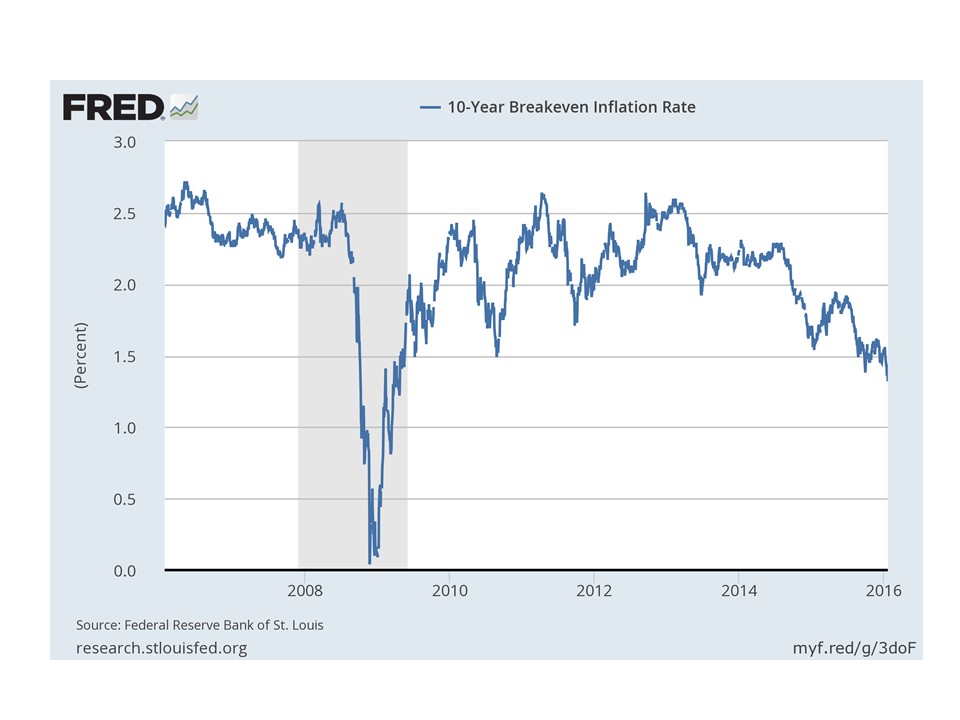
Possibly responding to hints by ECB president Mario Draghi of monetary stimulus, stocks around the world are up today; the S&P 500 over 1900 (about 2% above yesterday’s close). Anyone who wants to understand why stock markets have been swooning since the end of 2015 should take a look at this chart showing TIPS_FREDthe breakeven TIPS spread on 10-year Treasuries over the past 10 years.

Let’s look at the peak spread (2.56%) reached in early July 2008, a couple of months before the onset of the financial crisis in September. Despite mounting evidence that the economy was contracting and unemployment rising, the Fed, transfixed by the threat of Inflation (manifested in rising energy prices) and a supposed loss of Fed credibility (manifested in rising inflation expectations), refused to continue reducing its interest-rate target lest the markets conclude that the Fed was not serious about fighting inflation. That’s when all hell started to break loose. By September 14, the Friday before the Lehman bankruptcy, the breakeven TIPS spread had fallen to 1.95%. It was not till October that the Fed finally relented and reduced its target rate, but nullified whatever stimulus the lower target rate might have provided by initiating the payment of interest on reserves. As you can see the breakeven spread continued to fall almost without interruption till reaching lows of about 0.10% by the end of 2008.

There were three other episodes of falling inflation expectations which are evident on the graph, in 2010, 2011 and 2012, each episode precipitating a monetary response (so-called quantitative easing) by the Fed to reverse the fall in inflation expectations, thereby avoiding an untimely end to the weak recovery from the financial crisis and the subsequent Little Depression.

Despite falling inflation expectations during the second half of 2014, the lackluster expansion continued, a possible sign of normalization insofar as the momentum of recovery was sustained despite falling inflation expectations (due in part to a positive oil-supply shock). But after a brief pickup in the first half of 2015, inflation expectations have been falling further in the second half of 2015, and the drop has steepened over the past month, with the breakeven TIPS spread falling from 1.56% on January 5 to 1.28% yesterday, a steeper decline than in July 2008, when the TIPS spread on July 3 stood at 2.56% and did not fall to 2.30% until August 5.

I am not saying that the market turmoil of the past three weeks is totally attributable to falling inflation expectations; it seems very plausible that the bursting of the oil bubble has been a major factor in the decline of stock prices. Falling oil prices could affect stock prices in at least two different ways: 1) the decline in energy prices itself being deflationary – at least if monetary policy is not specifically aimed at reversing those deflationary effects – and 2) oil and energy assets being on the books of many financial institutions, a decline in their value may impair the solvency of those institutions, causing a deflationary increase in the demand for currency and reserves. But even if falling oil prices are an independent cause of market turmoil, they interact with and reinforce deflationary pressures; the only way to counteract those deflationary pressures is monetary expansion.

And with inflation expectations now lower than they have been since early 2009, further reductions in inflation expectations could put us back into a situation in which the expected yield from holding cash exceeds the expected yield from holding real capital. In such situations, with nominal interest rates at or near the zero lower bound, a perverse Fisher effect takes hold and asset prices have to fall sufficiently to make people willing to hold assets rather than cash. (I explained this perverse adjustment process in this paper, and used it to explain the 2008 financial crisis and its aftermath.) The result is a crash in asset prices. We haven’t reached that point yet, but I am afraid that we are getting too close for comfort.

The 2008 crisis. was caused by an FOMC that was so focused on the threat of inflation that they ignored ample and obvious signs of a rapidly deteriorating economy and falling inflation expectations, foolishly interpreting the plunge in TIPS spreads and the appreciation of the dollar relative to other currencies as an expression by the markets of confidence in Fed policy rather than as a cry for help.

In 2008, the Fed at least had the excuse of rising energy prices and headline inflation above its then informal 2% target for not cutting interest rates to provide serious monetary stimulus to a collapsing economy. This time, despite failing for over three years to meet its now official 2% inflation target, Dr. Yellen and her FOMC colleagues show no sign of thinking about anything other than when they can show their mettle as central bankers by raising interest rates again. Now is not the time to worry about raising interest rates. Dr. Yellen’s problem is now to show that her top – indeed her only – priority is to ensure that the Fed’s 2% inflation target will be met, or, if need be, exceeded, in 2016 and that the growth in nominal income in 2016 will be at least as large as it was in 2015. Those are goals that are eminently achievable, and if the FOMC has any credibility left after its recent failures, providing such assurance will prevent another unnecessary and destructive financial crisis.

The 2008 financial crisis ensured the election of Barak Obama as President. I shudder to think of who might be elected if we have another crisis this year.

The Well-Defined, but Nearly Useless, Natural Rate of Interest

Tyler Cowen recently posted a diatribe against the idea monetary policy should be conducted by setting the interest rate target of the central bank at or near the natural rate of interest. Tyler’s post elicited critical responses from Brad DeLong and Paul Krugman among others. I sympathize with Tyler’s impatience with the natural rate of interest as a guide to policy, but I think the scattershot approach he took in listing, seemingly at random, seven complaints against the natural rate of interest was not the best way to register dissatisfaction with the natural rate. Here’s Tyler’s list of seven complaints.

1 Knut Wicksell, inventor of the term “natural rate of interest,” argued that if the central bank set its target rate equal to the natural rate, it would avoid inflation and deflation and tame the business cycle. Wicksell’s argument was criticized by his friend and countryman David Davidson who pointed out that, with rising productivity, price stability would not result without monetary expansion, which would require the monetary authority to reduce its target rate of interest below the natural rate to induce enough investment to be financed by monetary expansion. Thus, when productivity is rising, setting the target rate of interest equal to the natural rate leads not to price stability, but to deflation.

2 Keynes rejected the natural rate as a criterion for monetary policy, because the natural rate is not unique. The natural rate varies with the level of income and employment.

3 Early Keynesians like Hicks, Hansen, and Modigliani rejected the natural rate as well.

4 The meaning of the natural rate has changed; it was once the rate that would result in a stable price level; now it’s the rate that results in a stable rate of inflation.

5 Friedman also rejected the natural rate because there is no guarantee that setting the target rate equal to the natural rate will result in the rate of money growth that Freidman believed was desirable.

6 Sraffa debunked the natural rate in his 1932 review of Hayek’s Prices and Production.

7 It seems implausible that the natural rate is now negative, as many exponents of the natural rate concept now claim, even though the economy is growing and the marginal productivity of capital is positive.

Let me try to tidy all this up a bit.

The first thing you need to know when thinking about the natural rate is that, like so much else in economics, you will become hopelessly confused if you don’t keep the Fisher equation, which decomposes the nominal rate of interest into the real rate of interest and the expected rate of inflation, in clear sight. Once you begin thinking about the natural rate in the context of the Fisher equation, it becomes obvious that the natural rate can be thought of coherently as either a real rate or a nominal rate, but the moment you are unclear about whether you are talking about a real natural rate or a nominal natural rate, you’re finished.

Thus, Wicksell was implicitly thinking about a situation in which expected inflation is zero so that the real and nominal natural rates coincide. If the rate of inflation is correctly expected to be zero, and the increase in productivity is also correctly expected, the increase in the quantity of money required to sustain a constant price level can be induced by the payment of interest on cash balances. Alternatively, if the payment of interest on cash balances is ruled out, the rate of capital accumulation (forced savings) could be increased sufficiently to cause the real natural interest rate under a constant price level to fall below the real natural interest rate under deflation.

In the Sraffa-Hayek episode, as Paul Zimmerman and I have shown in our paper on that topic, Sraffa failed to understand that the multiplicity of own rates of interest in a pure barter economy did not mean that there was not a unique real natural rate toward which arbitrage would force all the individual own rates to converge. At any moment, therefore, there is a unique real natural rate in a barter economy if arbitrage is operating to equalize the cost of borrowing in terms of every commodity. Moreover, even Sraffa did not dispute that, under Wicksell’s definition of the natural rate as the rate consistent with a stable price level, there is a unique natural rate. Sraffa’s quarrel was only with Hayek’s use of the natural rate, inasmuch as Hayek maintained that the natural rate did not imply a stable price level. Of course, Hayek was caught in a contradiction that Sraffa overlooked, because he identified the real natural rate with an equal nominal rate, so that he was implicitly assuming a constant expected price level even as he was arguing that the neutral monetary policy corresponding to setting the market interest rate equal to the natural rate would imply deflation when productivity was increasing.

I am inclined to be critical Milton Friedman about many aspects of his monetary thought, but one of his virtues as a monetary economist was that he consistently emphasized Fisher’s  distinction between real and nominal interest rates. The point that Friedman was making in the passage quoted by Tyler was that the monetary authority is able to peg nominal variables, prices, inflation, exchange rates, but not real variables, like employment, output, or interest rates. Even pegging the nominal natural rate is impossible, because inasmuch as the goal of targeting a nominal natural rate is to stabilize the rate of inflation, targeting the nominal natural rate also means targeting the real natural rate. But targeting the real natural rate is not possible, and trying to do so will just get you into trouble.

So Tyler should not be complaining about the change in the meaning of the natural rate; that change simply reflects the gradual penetration of the Fisher equation into the consciousness of the economics profession. We now realize that, given the real natural rate, there is, for every expected rate of inflation, a corresponding nominal natural rate.

Keynes made a very different contribution to our understanding of the natural rate. He was that there is no reason to assume that the real natural rate of interest is unique. True, at any moment there is some real natural rate toward which arbitrage is forcing all nominal rates to converge. But that real natural rate is a function of the prevailing economic conditions. Keynes believed that there are multiple equilibria, each corresponding to a different level of employment, and that associated with each of those equilibria there could be a different real natural rate. Nowadays, we are less inclined than was Keynes to call an underemployment situation an equilibrium, but there is still no reason to assume that the real natural rate that serves as an attractor for all nominal rates is independent of the state of the economy. If the real natural rate for an underperforming economy is less than the real natural rate that would be associated with the economy if it were in the neighborhood of an optimal equilibrium, there is no reason why either the real natural rate corresponding to an optimal equilibrium or the real natural rate corresponding to the current sub-optimal state of economy should be the policy rate that the monetary authority chooses as its target.

Finally, what can be said about Tyler’s point that it is implausible to suggest that the real natural rate is negative when the economy is growing (even slowly) and the marginal productivity of capital is positive? Two points.

First, the marginal productivity of gold is very close to zero. If gold is held as bullion, it is being held for expected appreciation over and above the cost of storage. So the ratio of the future price of gold to the spot price of gold should equal one plus the real rate of interest. If you look at futures prices for gold you will see that they are virtually the same as the spot price. However, storing gold is not costless. According to this article on Bloomberg.com, storage costs for gold range between 0.5 to 1% of the value of gold, implying that expected rate of return to holding gold is now less than -0.5% a year, which means that the marginal productivity of real capital is negative. Sure there are plenty of investments out there that are generating positive returns, but those are inframarginal investments. Those inframarginal investments are generating some net gain in productivity, and overall economic growth is positive, but that doesn’t mean that the return on investment at the margin is positive. At the margin, the yield on real capital seems to be negative.

If, as appears likely, our economy is underperforming, estimates of the real natural rate of interest are not necessarily an appropriate guide for the monetary authority in choosing its target rate of interest. If the aim of monetary policy is to nudge the economy onto a feasible growth path that is above the sub-optimal path along which it is currently moving, it might well be that the appropriate interest-rate target, as long as the economy remains below its optimal growth path, would be less than the natural rate corresponding to the current sub-optimal growth path.

More Economic Prejudice and High-Minded Sloganeering

I wasn’t planning to post today, but I just saw (courtesy of the New York Times) a classic example of the economic prejudice wrapped in high-minded sloganeering that I talked about yesterday. David Rocker, founder and former managing general partner of the hedge fund Rocker Partners, proclaims that he is in favor of a free market.

The worldwide turbulence of recent days is a strong indication that government intervention alone cannot restore the economy and offers a glimpse of the risk of completely depending on it. It is time to give the free market a chance. Since the crash of 2008, governments have tried to stimulate their economies by a variety of means but have relied heavily on manipulating interest rates lower through one form or other of quantitative easing or simply printing money. The immediate rescue of the collapsing economy was necessary at the time, but the manipulation has now gone on for nearly seven years and has produced many unwanted consequences.

In what sense is the market less free than it was before the crash of 2008? It’s not as if the Fed before 2008 wasn’t doing the sorts of things that are so upsetting to Mr. Rucker now. The Fed was setting an interest rate target for short-term rates and it was conducting open market purchases (printing money) to ensure that its target was achieved. There are to be sure some people, like, say, Ron Paul, that regard such action by the Fed as an intolerable example of government intervention in the market, but it’s not something that, as Mr. Rucker suggests, the Fed just started to do after 2008. And at a deeper level, there is a very basic difference between the Fed targeting an interest rate by engaging in open-market operations (repeat open-market operations) and imposing price controls that prevent transactors from engaging in transactions on mutually agreeable terms. Aside from libertarian ideologues, most people are capable of understanding the difference between monetary policy and government interference with the free market.

So what really bothers Mr. Rucker is not that the absence of a free market, but that he disagrees with the policy that the Fed is implementing. He has every right to disagree with the policy, but it is misleading to suggest that he is the one defending the free market against the Fed’s intervention into an otherwise free market.

When Mr. Rucker tries to explain what’s wrong with the Fed’s policy, his explanations continue to reflect prejudices expressed in high-minded sloganeering. First he plays the income inequality card.

The Federal Reserve, waiting for signs of inflation to change its policies, seems to be looking at the wrong data. . . .

Low interest rates have hugely lifted assets largely owned by the very rich, and inflation in these areas is clearly apparent. Stocks have tripled and real estate prices in the major cities where the wealthy live have been soaring, as have the prices of artwork and the conspicuous consumption of luxury goods.

Now it may be true that certain assets like real estate in Manhattan and San Francisco, works of art, and yachts have been rising rapidly in price, but there is no meaningful price index in which these assets account for a large enough share of purchases to generate a significant inflation. So this claim by Mr. Rucker is just an empty rhetorical gesture to show how good-hearted he is and how callous and unfeeling Janet Yellen and her ilk are. He goes on.

Cheap financing has led to a boom in speculative activity, and mergers and acquisitions. Most acquisitions are justified by “efficiencies” which is usually a euphemism for layoffs. Valeant Pharmaceuticals International, one of the nation’s most active acquirers, routinely fires “redundant” workers after each acquisition to enhance reported earnings. This elevates its stock, with which it makes the next acquisition. With money cheap, corporate executives have used cash flow to buy back stock, enhancing the value of their options, instead of investing for the future. This pattern, and the fear it engenders, has added to downward pressure on employment and wages.

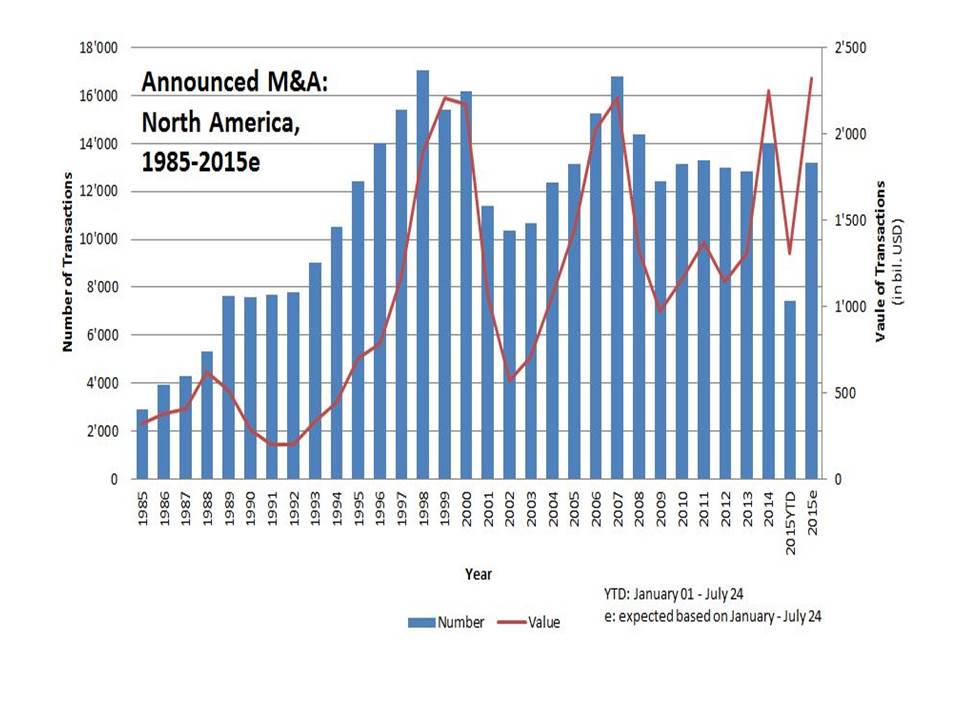
Actually, according to data reported by the Institute for Mergers and Acquisitions and Alliances displayed in the accompanying chart, the level of mergers and acquisitions since 2008 has been consistently below what it was in the late 1990s when interest rates were over 5 percent and in 2007 when interest rates were also above 5 percent.

M&A1985-2015And if corporate executives are using cash flow to buy back stock to enhance the value of their stock options instead of making profitable investments that would enhance share-holder value, there is a serious problem in how corporate executives are discharging their responsibilities to shareholders. Violations of management responsibility to their shareholders should be disciplined and the legal environment that allows executives to disregard shareholder interests should be reformed. To blame the bad behavior of corporate executives on the Fed is a total distraction.

Having just attributed a supposed boom in speculative activity and mergers and acquisitions to the Fed’s low-interest rate policy, Mr. Rucker, without batting an eye, flatly denies that an increase in interest rates would have any negative effect on investment.

The Fed should raise rates in September. The focus on a quarter-point change in short rates and its precise date of imposition is foolishness. Expected rates of return on new investments are typically well above 10 percent. No sensible businessman would defer a sound investment because short-term rates are slightly higher for a few months. They either have a sound investment or they don’t.

Let me repeat that. “Expected rates of return on new investment are typically well above 10 percent.” I wonder what Mr. Rucker thinks the expected rate of return on speculative activity and mergers and acquisitions is.

But, almost despite himself, Mr. Rucker is on to something. Some long-term investment surely is sensitive to the rate of interest, but – and I know that this will come as a rude shock to adherents of Austrian Business Cycle Theory – most investment by business in plant and equipment depends on expected future sales, not the rate of interest. So the way to increase investment is really not by manipulating the rate of interest; the way to increase investment is to increase aggregate demand, and the best way to do that would be to increase inflation and expected inflation (aka nominal GDP and expected nominal GDP).

Forget the Monetary Base and Just Pay Attention to the Price Level

Kudos to David Beckworth for eliciting a welcome concession or clarification from Paul Krugman that monetary policy is not necessarily ineffectual at the zero lower bound. The clarification is welcome because Krugman and Simon Wren Lewis seemed to be making a big deal about insisting that monetary policy at the zero lower bound is useless if it affects only the current, but not the future, money supply, and touting the discovery as if it were a point that was not already well understood.

Now it’s true that Krugman is entitled to take credit for having come up with an elegant way of showing the difference between a permanent and a temporary increase in the monetary base, but it’s a point that, WADR, was understood even before Krugman. See, for example, the discussion in chapter 5 of Jack Hirshleifer’s textbook on capital theory (published in 1970), Investment, Interest and Capital, showing that the Fisher equation follows straightforwardly in an intertemporal equilibrium model, so that the nominal interest rate can be decomposed into a real component and an expected-inflation component. If holding money is costless, then the nominal rate of interest cannot be negative, and expected deflation cannot exceed the equilibrium real rate of interest. This implies that, at the zero lower bound, the current price level cannot be raised without raising the future price level proportionately. That is all Krugman was saying in asserting that monetary policy is ineffective at the zero lower bound, even though he couched the analysis in terms of the current and future money supplies rather than in terms of the current and future price levels. But the entire argument is implicit in the Fisher equation. And contrary to Krugman, the IS-LM model (with which I am certainly willing to coexist) offers no unique insight into this proposition; it would be remarkable if it did, because the IS-LM model in essence is a static model that has to be re-engineered to be used in an intertemporal setting.

Here is how Hirshleifer concludes his discussion:

The simple two-period model of choice between dated consumptive goods and dated real liquidities has been shown to be sufficiently comprehensive as to display both the quantity theorists’ and the Keynesian theorists’ predicted results consequent upon “changes in the money supply.” The seeming contradiction is resolved by noting that one result or the other follows, or possibly some mixture of the two, depending upon the precise meaning of the phrase “changes in the quantity of money.” More exactly, the result follows from the assumption made about changes in the time-distributed endowments of money and consumption goods.  pp. 150-51

Another passage from Hirshleifer is also worth quoting:

Imagine a financial “panic.” Current money is very scarce relative to future money – and so monetary interest rates are very high. The monetary authorities might then provide an increment [to the money stock] while announcing that an equal aggregate amount of money would be retired at some date thereafter. Such a change making current money relatively more plentiful (or less scarce) than before in comparison with future money, would clearly tend to reduce the monetary rate of interest. (p. 149)

In this passage Hirshleifer accurately describes the objective of Fed policy since the crisis: provide as much liquidity as needed to prevent a panic, but without even trying to generate a substantial increase in aggregate demand by increasing inflation or expected inflation. The refusal to increase aggregate demand was implicit in the Fed’s refusal to increase its inflation target.

However, I do want to make explicit a point of disagreement between me and Hirshleifer, Krugman and Beckworth. The point is more conceptual than analytical, by which I mean that although the analysis of monetary policy can formally be carried out either in terms of current and future money supplies, as Hirshleifer, Krugman and Beckworth do, or in terms of price levels, as I prefer to do so in terms of price levels. For one thing, reasoning in terms of price levels immediately puts you in the framework of the Fisher equation, while thinking in terms of current and future money supplies puts you in the framework of the quantity theory, which I always prefer to avoid.

The problem with the quantity theory framework is that it assumes that quantity of money is a policy variable over which a monetary authority can exercise effective control, a mistake — imprinted in our economic intuition by two or three centuries of quantity-theorizing, regrettably reinforced in the second-half of the twentieth century by the preposterous theoretical detour of monomaniacal Friedmanian Monetarism, as if there were no such thing as an identification problem. Thus, to analyze monetary policy by doing thought experiments that change the quantity of money is likely to mislead or confuse.

I can’t think of an effective monetary policy that was ever implemented by targeting a monetary aggregate. The optimal time path of a monetary aggregate can never be specified in advance, so that trying to target any monetary aggregate will inevitably fail, thereby undermining the credibility of the monetary authority. Effective monetary policies have instead tried to target some nominal price while allowing monetary aggregates to adjust automatically given that price. Sometimes the price being targeted has been the conversion price of money into a real asset, as was the case under the gold standard, or an exchange rate between one currency and another, as the Swiss National Bank is now doing with the franc/euro exchange rate. Monetary policies aimed at stabilizing a single price are easy to implement and can therefore be highly credible, but they are vulnerable to sudden changes with highly deflationary or inflationary implications. Nineteenth century bimetallism was an attempt to avoid or at least mitigate such risks. We now prefer inflation targeting, but we have learned (or at least we should have) from the Fed’s focus on inflation in 2008 that inflation targeting can also lead to disastrous consequences.

I emphasize the distinction between targeting monetary aggregates and targeting the price level, because David Beckworth in his post is so focused on showing 1) that the expansion of the Fed’s balance sheet under QE has been temoprary and 2) that to have been effective in raising aggregate demand at the zero lower bound, the increase in the monetary base needed to be permanent. And I say: both of the facts cited by David are implied by the fact that the Fed did not raise its inflation target or, preferably, replace its inflation target with a sufficiently high price-level target. With a higher inflation target or a suitable price-level target, the monetary base would have taken care of itself.

PS If your name is Scott Sumner, you have my permission to insert “NGDP” wherever “price level” appears in this post.

The Nearly Forgotten Dearly Beloved 1920-21 Depression Yet Again; Or, Never Reason from a Quantity Change

The industrious James Grant recently published a book about the 1920-21 Depression. It has received enthusiastic reviews in the Wall Street Journal and Barron’s, was the subject of an admiring column by Washington Post columnist Robert J. Samuelson, and was celebrated at a Cato Institute panel discussion, luncheon, and book-signing event. The Cato extravaganza elicited a dismissive blog post by Barkley Rosser which was linked to by Paul Krugman on his blog. The Rosser/Krugman tandem provoked an unhappy reply on the Free Banking blog from George Selgin who chaired the Cato panel discussion. And the 1920-21 Depression is now the latest hot topic in the econblogosphere.

I am afraid that there are multiple layers of errors and confusion that are being mixed up and compounded in this discussion, errors and confusion derived from basic misunderstandings about how the gold standard operated that have been plaguing the economics profession and the financial world for about two and a half centuries. If you want to understand how the gold standard worked, what you have to read is the book by Ralph Hawtrey entitled – drum roll, please – The Gold Standard.

Here are the basic things you need to know about the gold standard.

1 The gold standard operates by creating an equivalence between a currency unit and a fixed amount of gold.

2 The gold standard does not require gold to circulate as money in the form of coins. That was historically the case, but a gold standard can function with no gold coins or even gold certificates.

3 The value of a currency unit and the value of a corresponding weight of gold are necessarily equalized by arbitrage.

4 Equality between a currency unit and a corresponding weight of gold does not necessarily show the direction of causality; the currency unit may determine the value of gold, not the other way around. In other words, making gold the standard of value for currency affects the demand for gold which affects the value of gold. Decisions made by monetary authorities under the gold standard necessarily affect the value of gold, so a gold standard does not somehow make the value of money independent of monetary policy.

5 When more than one country is on a gold standard, the countries share a common price level, because the value of gold is determined in an international market.

Keeping those basics in mind, let’s quickly try to understand what was going on in 1920 when the Fed decided to raise its discount rate to the then unprecedented level of 7 percent. But the situation in 1920 was the outcome of the previous six years of World War I that effectively destroyed the gold standard as a functioning institution, even though its existence was in some sense still legally recognized.

Under the gold standard, gold was the ultimate way of discharging international debts. In World War I, belligerents had to pay for imports with gold, thus governments amassed all available gold with which to pay for the imports required to support the war effort. Gold coins were melted down and converted to bullion so the gold could be exported. For a private citizen in a belligerent country to demand that the national currency unit be converted to gold would be considered an unpatriotic if not a treasonous act. So the gold standard ceased to function in belligerent countries. In non-belligerent countries, which were busy exporting to the belligerents, the result was a massive inflow of gold, causing a spectacular increase in the amount of gold held by the US Treasury between 1914 and 1917. Other non-belligerents like Sweden and Switzerland experienced similar inflows.

Quantity theorists and Monetarists like Milton Friedman habitually misinterpret the wartime inflation, and attributing the inflation to an inflow of gold that increased the money supply, thereby perpetrating the price-specie-flow-mechanism fallacy. What actually happened was that the huge demonetization of gold coins by the belligerents and their export of large quantities of gold to non-belligerent countries in which a free market in gold continued to operate drove down the value of gold. A falling value of gold under a gold standard logically implies rising prices for all other goods and services. Rising prices increased the nominal demand for money, which more or less automatically caused a corresponding adjustment in the quantity of money. A rising price level caused the quantity of money to increase, not the other way around.

In 1917, just before the US entered the war, the US, still effectively on a gold standard as gold flowed into the Treasury, had experienced a drastic inflation, like all other gold standard countries, because gold was rapidly losing value, as it was being demonetized and exported by the belligerent countries. But when the US entered the war in 1917, the US, like other belligerents, suspended operation of the gold standard, thereby accelerating the depreciation of gold, forcing the few remaining countries on the gold standard to suspend the gold standard to avoid runaway inflation. Inflationary pressure in the US did increase after entry into the war, but the war-induced fiat inflation, to some extent suppressed or disguised by price controls, was actually slower than inflation in terms of gold.

When the war ended, the US went back on the gold standard by again making the dollar convertible into gold at the legal parity. Doing so meant that the US price level in terms of dollars was below the notional (no currency any longer being convertible into gold) world price level in terms of gold. In other belligerent countries, notably Britain, France and Germany, inflation in terms of their national currencies exceeded gold inflation, requiring them to deflate even to restore the legal parity in terms of gold.  Thus, the US was the only country in the world that was both willing and able to return to the gold standard at the prewar parity. Sweden and Switzerland could have done so, but preferred to avoid the inflationary consequences of a return to the gold standard.

Once the dollar convertibility into gold was restored, arbitrage forced the US price level to rise to so that it would equal the gold price level. The excess of the gold price level over the US price level level explains the anomalous post-war inflation – everyone knows that prices are supposed to fall, not rise, when a war ends — in the US. The rest of the world, then, had to choose between accepting US inflation, by keeping their currencies pegged to the dollar, or allowing their currencies to appreciate against the dollar. The anomalous post-war inflation was caused by the reequilibration of the US price level to the gold price levels, not, as commonly supposed, by Fed inexperience or incompetence.

To stop the post-war inflation, the Fed could have simply abandoned the gold standard, or it could have revalued the dollar in terms of gold, by reducing the official dollar price of gold. (I ignore the minor detail that the official dollar price of gold was then determined by statute.) Instead, the Fed — whether knowingly or not I can’t say – chose to increase the value of gold. The method by which it did so was to raise its discount rate, thereby making it easier to obtain dollars by selling gold to the Treasury than to borrow from the Fed. The flood of gold into the Treasury in 1920-21 succeeded in taking a huge amount of gold out of private and public hands, thus driving up the real value of gold, and forcing down the gold price level. That’s when the brutal deflation of 1920-21 started. At some point, the Fed and the Treasury decided that they had had enough, having amassed about 40% of the world’s gold reserves, and began reducing the discount rate, thereby slowing the inflow of gold into the US, and stopping its appreciation. And that’s when and how the dearly beloved, but quite dreadful, depression of 1920-21 came to an end.

John Cochrane Explains Neo-Fisherism

In a recent post, John Cochrane, responding to an earlier post by Nick Rowe about Neo-Fisherism, has tried to explain why raising interest rates could plausibly cause inflation to rise and reducing interest rates could plausibly cause inflation to fall, even though almost everyone, including central bankers, seems to think that when central banks raise interest rates, inflation falls, and when they reduce interest rates, inflation goes up.

In his explanation, Cochrane concedes that there is an immediate short-term tendency for increased interest rates to reduce inflation and for reduced interest rates to raise inflation, but he also argues that these effects (liquidity effects in Keynesian terminology) are transitory and would be dominated by the Fisher effects if the central bank committed itself to a permanent change in its interest-rate target. Of course, the proviso that the central bank commit itself to a permanent interest-rate peg is a pretty important qualification to the Neo-Fisherian position, because few central banks have ever committed themselves to a permanent interest-rate peg, the most famous attempt (by the Fed after World War II) to peg an interest rate having led to accelerating inflation during the Korean War, thereby forcing the peg to be abandoned, in apparent contradiction of the Neo-Fisherian view.

However, Cochrane does try to reconcile the Neo-Fisherian view with the standard view that raising interest rates reduces inflation and reducing interest rates increases inflation. He suggests that the standard view is strictly a short-run relationship and that the way to target inflation over the long-run is simply to target an interest rate consistent with the desired rate of inflation, and to rely on the Fisher equation to generate the actual and expected rate of inflation corresponding to that nominal rate. Here’s how Cochrane puts it:

We can put the issue more generally as, if the central bank does nothing to interest rates, is the economy stable or unstable following a shock to inflation?

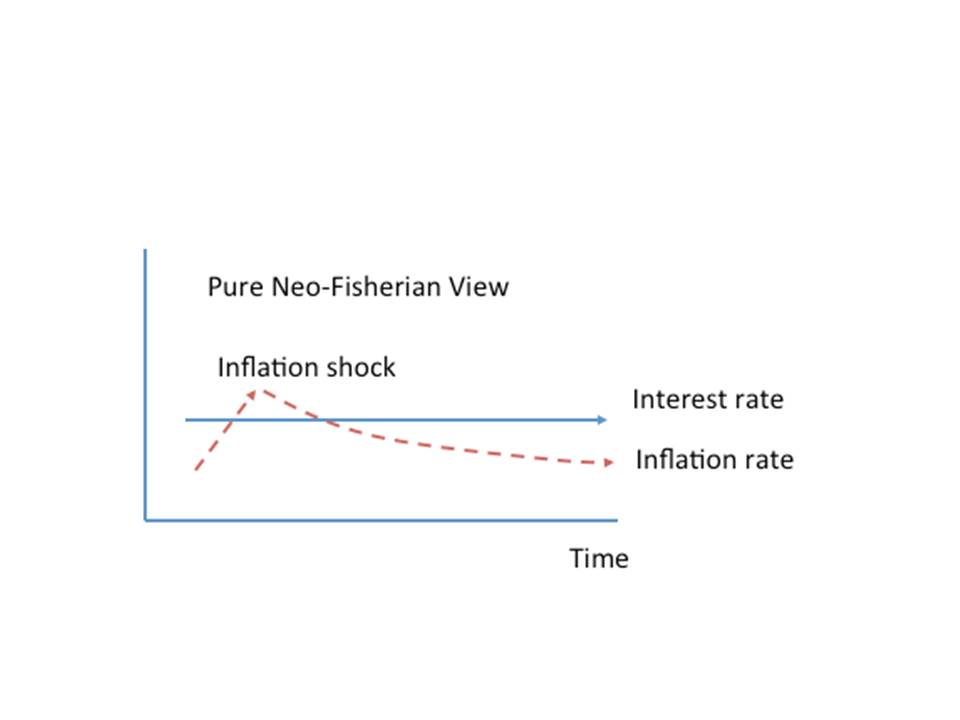
For the next set of graphs, I imagine a shock to inflation, illustrated as the little upward sloping arrow on the left. Usually, the Fed responds by raising interest rates. What if it doesn’t?  A pure neo-Fisherian view would say inflation will come back on its own.

cochrane1

Again, we don’t have to be that pure.

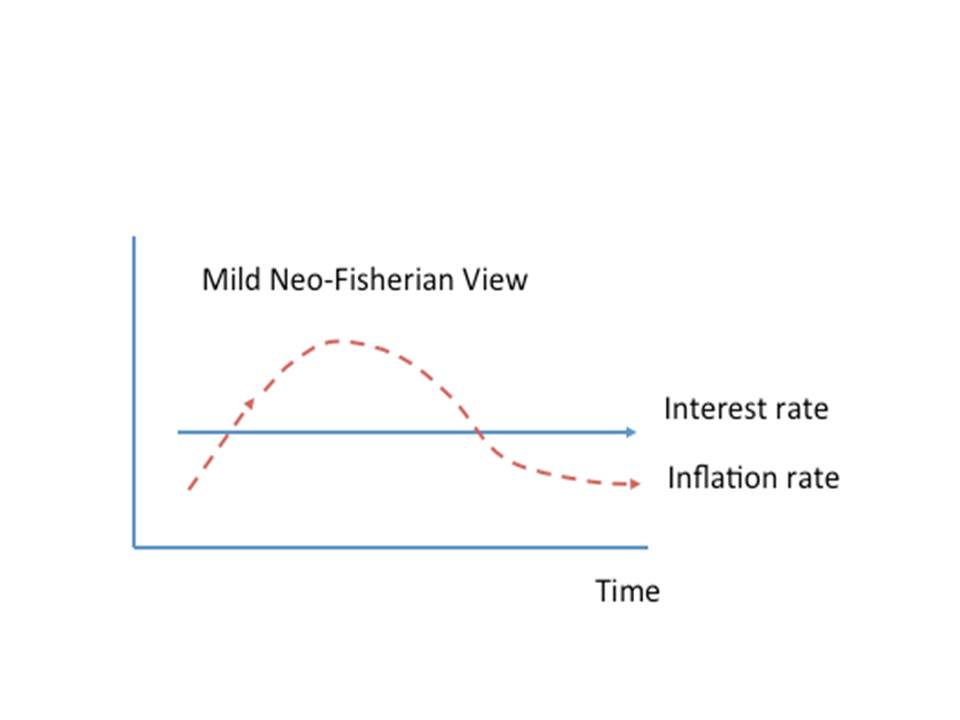
The milder view allows there may be some short run dynamics; the lower real rates might lead to some persistence in inflation. But even if the Fed does nothing, eventually real interest rates have to settle down to their “natural” level, and inflation will come back. Mabye not as fast as it would if the Fed had aggressively tamed it, but eventually.

cochrane2

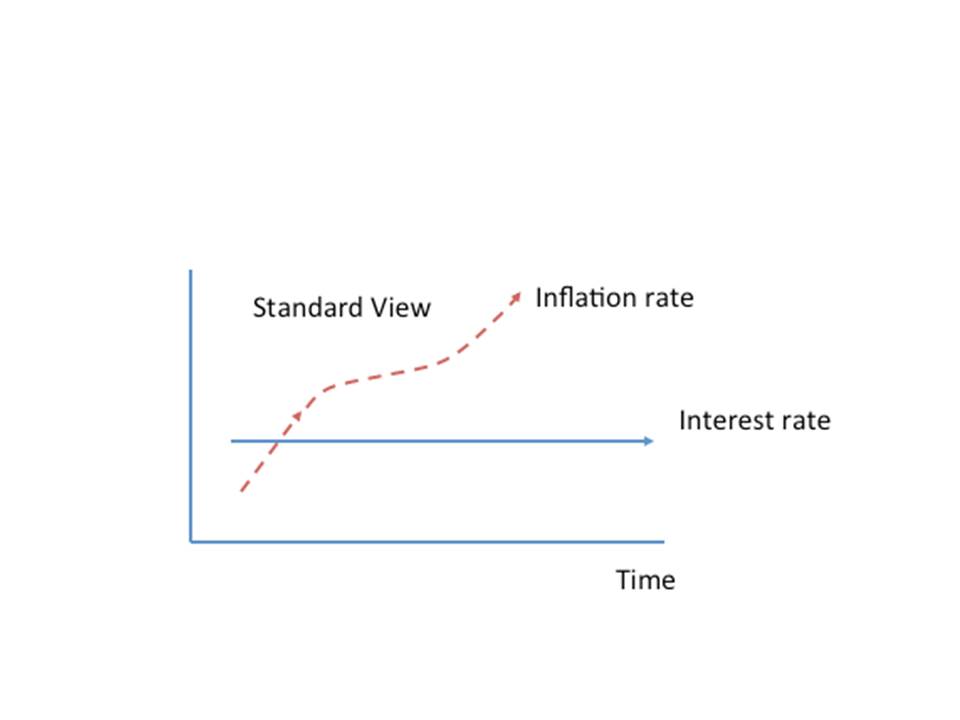
By contrast, the standard view says that inflation is unstable. If the Fed does not raise rates, inflation will eventually careen off following the shock.

cochrane3

Now this really confuses me. What does a shock to inflation mean? From the context, Cochrane seems to be thinking that something happens to raise the rate of inflation in the short run, but the persistence of increased inflation somehow depends on an underlying assumption about whether the economy is stable or unstable. Cochrane doesn’t tell us what kind of shock to inflation he is talking about, and I can imagine only two possibilities, either a nominal shock or a real shock.

Let’s say it’s a nominal shock. What kind of nominal shock might Cochrane have in mind? An increase in the money supply? Well, presumably an increase in the money supply would cause an increase in the price level, and a temporary increase in the rate of inflation, but if the increase in the money supply is a once-and-for-all increase, the system must revert, after a temporary increase, back to the old rate of inflation. Or maybe, Cochrane is thinking of a permanent increase in the rate of growth in the money supply. But in that case, why would the rate of inflation come back on its own as Cochrane suggests it would? Well, maybe it’s not the money supply but money demand that’s changing. But again, one would normally assume that an appropriate change in central-bank policy could cope with such a scenario and stabilize the rate of inflation.

Alright, then, let’s say it’s a real shock. Suppose some real event happens that raises the rate of inflation. Well, like what? A supply shock? That raises the rate of inflation, but since when is the standard view that the appropriate response by the central bank to a negative supply shock is to raise the interest-rate target? Perhaps Cochrane is talking about a real shock that reduces the real rate of interest. Well, in that case, the rate of inflation would certainly rise if the central bank maintained its nominal-interest-rate target, but the increase in inflation would not be temporary unless the real shock was temporary. If the real shock is temporary, it is not clear why the standard view would recommend that the central bank raise its target rate of interest. So, I am sorry, but I am still confused.

Now, the standard view that Cochrane is disputing is actually derived from Wicksell, and Wicksell’s cycle theory is in fact based on the assumption that the central bank keeps its target interest rate fixed while the natural rate fluctuates. (This, by the way, was also Hayek’s assumption in his first exposition of his theory in Monetary Theory and the Trade Cycle.) When the natural rate rises above the central bank’s target rate, a cumulative inflationary process starts, because borrowing from the banking system to finance investment is profitable as long as the expected return on investment exceeds the interest rate on loans charged by the banks. (This is where Hayek departed from Wicksell, focusing on Cantillon Effects instead of price-level effects.) Cochrane avoids that messy scenario, as far as I can tell, by assuming that the initial position is one in which the Fisher equation holds with the nominal rate equal to the real plus the expected rate of inflation and with expected inflation equal to actual inflation, and then positing an (as far as I can tell) unexplained inflation shock, with no change to the real rate (meaning, in Cochrane’s terminology, that the economy is stable). If the unexplained inflation shock goes away, the system must return to its initial equilibrium with expected inflation equal to actual inflation and the nominal rate equal to the real rate plus inflation.

In contrast, the Wicksellian assumption is that the real rate fluctuates with the nominal rate and expected inflation unchanged. Unless the central bank raises the nominal rate, the difference between the profit rate anticipated by entrepreneurs and the rate at which they can borrow causes the rate of inflation to increase. So it does not seem to me that Cochrane has in any way reconciled the Neo-Fisherian view with the standard view (or at least the Wicksellian version of the standard view).

PS I would just note that I have explained in my paper on Ricardo and Thornton why the Wicksellian analysis (anticipated almost a century before Wicksell by Henry Thornton) is defective (basically because he failed to take into account the law of reflux), but Cochrane, as far as I can tell, seems to be making a completely different point in his discussion.

Just How Infamous Was that Infamous Open Letter to Bernanke?

There’s been a lot of comment recently about the infamous 2010 open letter to Ben Bernanke penned by an assorted group of economists, journalists, and financiers warning that the Fed’s quantitative easing policy would cause inflation and currency debasement.

Critics of that letter (e.g., Paul Krugman and Brad Delong) have been having fun with the signatories, ridiculing them for what now seems like a chicken-little forecast of disaster. Those signatories who have responded to inquiries about how they now feel about that letter, notably Cliff Asness and Nial Ferguson, have made two arguments: 1) the letter was just a warning that QE was creating a risk of inflation, and 2) despite the historically low levels of inflation since the letter was written, the risk that inflation could increase as a result of QE still exists.

For the most part, critics of the open letter have focused on the absence of inflation since the Fed adopted QE, the critics characterizing the absence of inflation despite QE as an easily predictable outcome, a straightforward implication of basic macroeconomics, which it was ignorant or foolish of the signatories to have ignored. In particular, the signatories should have known that, once interest rates fall to the zero lower bound, the demand for money becoming highly elastic so that the public willingly holds any amount of money that is created, monetary policy is rendered ineffective. Just as a semantic point, I would observe that the term “liquidity trap” used to describe such a situation is actually a slight misnomer inasmuch as the term was coined to describe a situation posited by Keynes in which the demand for money becomes elastic above the zero lower bound. So the assertion that monetary policy is ineffective at the zero lower bound is actually a weaker claim than the one Keynes made about the liquidity trap. As I have suggested previously, the current zero-lower-bound argument is better described as a Hawtreyan credit deadlock than a Keynesian liquidity trap.

Sorry, but I couldn’t resist the parenthetical history-of-thought digression; let’s get back to that infamous open letter.

Those now heaping scorn on signatories to the open letter are claiming that it was obvious that quantitative easing would not increase inflation. I must confess that I did not think that that was the case; I believed that quantitative easing by the Fed could indeed produce inflation. And that’s why I was in favor of quantitative easing. I was hoping for a repeat of what I have called the short but sweat recovery of 1933, when, in the depths of the Great Depression, almost immediately following the worst financial crisis in American history capped by a one-week bank holiday announced by FDR upon being inaugurated President in March 1933, the US economy, propelled by a 14% rise in wholesale prices in the aftermath of FDR’s suspension of the gold standard and 40% devaluation of the dollar, began the fastest expansion it ever had, industrial production leaping by 70% from April to July, and the Dow Jones average more than doubling. Unfortunately, FDR spoiled it all by getting Congress to pass the monumentally stupid National Industrial Recovery Act, thereby strangling the recovery with mandatory wage increases, cost increases, and regulatory ceilings on output as a way to raise prices. Talk about snatching defeat from the jaws of victory!

Inflation having worked splendidly as a recovery strategy during the Great Depression, I have believed all along that we could quickly recover from the Little Depression if only we would give inflation a chance. In the Great Depression, too, there were those that argued either that monetary policy is ineffective – “you can’t push on a string” — or that it would be calamitous — causing inflation and currency debasement – or, even both. But the undeniable fact is that inflation worked; countries that left the gold standard recovered, because once currencies were detached from gold, prices could rise sufficiently to make production profitable again, thereby stimulating multiplier effects (aka supply-side increases in resource utilization) that fueled further economic expansion. And oh yes, don’t forget providing badly needed relief to debtors, relief that actually served the interests of creditors as well.

So my problem with the open letter to Bernanke is not that the letter failed to recognize the existence of a Keynesian liquidity trap or a Hawtreyan credit deadlock, but that the open letter viewed inflation as the problem when, in my estimation at any rate, inflation is the solution.

Now, it is certainly possible that, as critics of the open letter maintain, monetary policy at the zero lower bound is ineffective. However, there is evidence that QE announcements, at least initially, did raise inflation expectations as reflected in TIPS spreads. And we also know (see my paper) that for a considerable period of time (from 2008 through at least 2012) stock prices were positively correlated with inflation expectations, a correlation that one would not expect to observe under normal circumstances.

So why did the huge increase in the monetary base during the Little Depression not cause significant inflation even though monetary policy during the Great Depression clearly did raise the price level in the US and in the other countries that left the gold standard? Well, perhaps the success of monetary policy in ending the Great Depression could not be repeated under modern conditions when all currencies are already fiat currencies. It may be that, starting from an interwar gold standard inherently biased toward deflation, abandoning the gold standard created, more or less automatically, inflationary expectations that allowed prices to rise rapidly toward levels consistent with a restoration of macroeconomic equilibrium. However, in the current fiat money system in which inflation expectations have become anchored to an inflation target of 2 percent or less, no amount of money creation can budge inflation off its expected path, especially at the zero lower bound, and especially when the Fed is paying higher interest on reserves than yielded by short-term Treasuries.

Under our current inflation-targeting monetary regime, the expectation of low inflation seems to have become self-fulfilling. Without an explicit increase in the inflation target or the price-level target (or the NGDP target), the Fed cannot deliver the inflation that could provide a significant economic stimulus. So the problem, it seems to me, is not that we are stuck in a liquidity trap; the problem is that we are stuck in an inflation-targeting monetary regime.


Misunderstanding (Totally!) Competitive Currency Devaluations

Before becoming Governor of the Resesrve Bank of India, Raghuram Rajan professor was Professor of Finance at the University of Chicago Business School. Winner of the Fischer Black Prize in 2003, he is the author numerous articles in leading academic journals in economics and finance, and co-author (with Luigi Zingales) of a well-regarded book Saving Capitalism from the Capitalists that had some valuable insights about financial-market dysfunction. He is obviously no slouch.

Unfortunately, based on recent reports, Goverenor Rajan is, despite his impressive resume and academic credentials, as Marcus Nunes pointed out on his blog, totally clueless about the role of monetary policy and the art of central banking in combating depressions. Here is the evidence provided by none other than the Wall Street Journal, a newspaper whose editorial page espouses roughly the same view as Rajan, summarizing Rajan’s remarks.

Reserve Bank of India Governor Raghuram Rajan warned Wednesday that the global economy bears an increasing resemblance to its condition in the 1930s, with advanced economies trying to pull out of the Great Recession at each other’s expense.

The difference: competitive monetary policy easing has now taken the place of competitive currency devaluations as the favored tool for playing a zero-sum game that is bound to end in disaster. Now, as then, “demand shifting” has taken the place of “demand creation,” the Indian policymaker said.

A clear symptom of the major imbalances crippling the world’s financial market is the over valuation of the euro, Mr. Rajan said.

The euro-zone economy faces problems similar to those faced by developing economies, with the European Central Bank’s “very, very accommodative stance” having a reduced impact due to the ultra-loose monetary policies being pursued by other central banks, including the Federal Reserve, the Bank of Japan and the Bank of England.

The notion that competitive currency devaluations in the Great Depression were a zero-sum game is fallacy, an influential fallacy to be sure, but a fallacy nonetheless. And because it is – and was — so influential, it is a highly dangerous fallacy. There is indeed a similarity between the current situation and the 1930s, but the similarity is not that monetary ease is a zero-sum game that merely “shifts,” but does not “create,” demand; the similarity is that the fallacious notion that monetary ease does not create demand is still so prevalent.

The classic refutation of the fallacy that monetary ease only shifts, but does not create, demand was provided on numerous occasions by R. G. Hawtrey. Almost two and a half years ago, I quoted a particularly cogent passage from Hawtrey’s Trade Depression and the Way Out (2nd edition, 1933) in which he addressed the demand-shift fallacy. Hawtrey refuted the fallacy in responding to those who were arguing that Britain’s abandonment of the gold standard in September 1931 had failed to stimulate the British economy, and had damaged the world economy, because prices continued falling after Britain left the gold standard. Hawtrey first discussed the reasons for the drop in the world price level after Britain gave up the gold standard.

When Great Britain left the gold standard, deflationary measures were everywhere resorted to. Not only did the Bank of England raise its rate, but the tremendous withdrawals of gold from the United States involved an increase of rediscounts and a rise of rates there, and the gold that reached Europe was immobilized or hoarded. . . .

In other words, Britain’s departure from the gold standard led to speculation that the US would follow Britain off the gold standard, implying an increase in the demand to hoard gold before the anticipated increase in its dollar price. That is a typical reaction under the gold standard when the probability of a devaluation is perceived to have risen. By leaving gold, Britain increased the perceived probability that other countries, and especially the US, would also leave the gold standard.

The consequence was that the fall in the price level continued [because an increase in the demand to hold gold (for any reason including speculation on a future increase in the nominal price of gold) must raise the current value of gold relative to all other commodities which means that the price of other commodities in terms of gold must fall — DG]. The British price level rose in the first few weeks after the suspension of the gold standard [because the value of the pound was falling relative to gold, implying that prices in terms of pounds rose immediately after Britain left gold — DG], but then accompanied the gold price level in its downward trend [because after the initial fall in the value of the pound relative to gold, the pound stabilized while the real value of gold continued to rise — DG]. This fall of prices calls for no other explanation than the deflationary measures which had been imposed [alarmed at the rapid fall in the value of gold, the Bank of England raised interest rates to prevent further depreciation in sterling — DG]. Indeed what does demand explanation is the moderation of the fall, which was on the whole not so steep after September 1931 as before.

Yet when the commercial and financial world saw that gold prices were falling rather than sterling prices rising, they evolved the purely empirical conclusion that a depreciation of the pound had no effect in raising the price level, but that it caused the price level in terms of gold and of those currencies in relation to which the pound depreciated to fall.

Here Hawtrey identified precisely the demand-shift fallacy evidently now subscribed to by Governor Rajan. In other words, when Britain left the gold standard, Britain did nothing to raise the international level of prices, which, under the gold standard, is the level of prices measured in terms of gold. Britain may have achieved a slight increase in its own domestic price level, but only by imposing a corresponding reduction in the price level measured in terms of gold. Let’s see how Hawtrey demolishes the fallacy.

For any such conclusion there was no foundation. Whenever the gold price level tended to fall, the tendency would make itself felt in a fall in the pound concurrently with the fall in commodities. [Hawtrey is saying that if the gold price level fell, while the sterling price level remained constant, the value of sterling would also fall in terms of gold.DG] But it would be quite unwarrantable to infer that the fall in the pound was the cause of the fall in commodities.

On the other hand, there is no doubt that the depreciation of any currency, by reducing the cost of manufacture in the country concerned in terms of gold, tends to lower the gold prices of manufactured goods. . . . [In other words, the cost of production of manufactured goods, which include both raw materials – raw materials often being imported — and capital equipment and labor, which generally are not mobile, is unlikely to rise as much in percentage terms as the percentage depreciation in the currency. — DG]

But that is quite a different thing from lowering the price level. For the fall in manufacturing costs results in a greater demand for manufactured goods, and therefore the derivative demand for primary products is increased. [That is to say, if manufactured products become relatively cheaper as the currency depreciates, the real quantity of manufactured goods demanded will increase, and the real quantity of inputs used to produce the increased quantity of manufactured goods must also increase. — DG] While the prices of finished goods fall, the prices of primary products rise. Whether the price level as a whole would rise or fall it is not possible to say a priori, but the tendency is toward correcting the disparity between the price levels of finished products and primary products. That is a step towards equilibrium. And there is on the whole an increase of productive activity. The competition of the country which depreciates its currency will result in some reduction of output from the manufacturing industry of other countries. But this reduction will be less than the increase in the country’s output, for if there were no net increase in the world’s output there would be no fall of prices. [Thus, even though there is some demand shifting toward the country that depreciates its currency because its products become relatively cheaper than the products of non-depreciating currencies, the cost reduction favoring the output of the country with a depreciating currency could not cause an overall reduction in prices elsewhere if total output had not increased. — DG]

Hawtrey then articulates the policy implication of the demand-shift fallacy.

In consequence of the competitive advantage gained by a country’s manufacturers from a depreciation of its currency, any such depreciation is only too likely to meet with recriminations and even retaliation from its competitors. . . . Fears are even expressed that if one country starts depreciation, and others follow suit, there may result “a competitive depreciation” to which no end can be seen.

This competitive depreciation is an entirely imaginary danger. The benefit that a country derives from the depreciation of its currency is in the rise of its price level relative to its wage level, and does not depend on its competitive advantage. [There is a slight ambiguity here, because Hawtrey admitted above that there is a demand shift. But there is also an increase in demand, and it is the increase in demand, associated with a rise of its price level relative to its wage level, which does not depend on a competitive advantage associated with a demand shift. — DG] If other countries depreciate their currencies, its competitive advantage is destroyed, but the advantage of the price level remains both to it and to them. They in turn may carry the depreciation further, and gain a competitive advantage. But this race in depreciation reaches a natural limit when the fall in wages and in the prices of manufactured goods in terms of gold has gone so far in all the countries concerned as to regain the normal relation with the prices of primary products. When that occurs, the depression is over, and industry is everywhere remunerative and fully employed. Any countries that lag behind in the race will suffer from unemployment in their manufacturing industry. But the remedy lies in their own hands; all they have to do is to depreciate their currencies to the extent necessary to make the price level remunerative to their industry. Their tardiness does not benefit their competitors, once these latter are employed up to capacity. Indeed, if the countries that hang back are an important part of the world’s economic system, the result must be to leave the disparity of price levels partly uncorrected, with undesirable consequences to everybody. . . .

The picture of an endless competition in currency depreciation is completely misleading. The race of depreciation is towards a definite goal; it is a competitive return to equilibrium. The situation is like that of a fishing fleet threatened with a storm; no harm is done if their return to a harbor of refuge is “competitive.” Let them race; the sooner they get there the better. (pp. 154-57)

Hawtrey’s analysis of competitive depreciation can be further elucidated by reconsidering it in the light of Max Corden’s classic analysis of exchange-rate protection, which I have discussed several times on this blog (here, here, and here). Corden provided a deep analysis of the conditions under which exchange-rate depreciation confers a competitive advantage. For internationally traded commodities, it is hard to see how any advantage can be derived from currency manipulation. A change in the exchange rate would be rapidly offset by corresponding changes in the prices of the relevant products. However, factors of production like labor, land, and capital equipment, tend to be immobile so their prices in the local currency don’t necessarily adjust immediately to changes in exchange rate of the local currency. Hawtrey was clearly assuming that labor and capital are not tradable so that international arbitrage does not induce immediate adjusments in their prices. Also, Hawtrey’s analysis begins from a state of disequilibrirum, while Corden’s starts from equilibrium, a very important difference.

However, even if prices of non-tradable commodities and factors of production don’t immediately adjust to exchange-rate changes, there is another mechanism operating to eliminate any competitive advantage, which is that the inflow of foreign-exchange reserves into a country with an undervalued currency (and, thus, a competitive advantage) will normally induce monetary expansion in that country, thereby raising the prices of non-tradables and factors of production. What Corden showed was that a central bank willing to tolerate a sufficiently large expansion in its foreign-reserve holdings could keep its currency undervalued, thereby maintaining a competitive advantage for its country in world markets.

But the corollary to Corden’s analysis is that to gain competitive advantage from currency depreciation requires the central bank to maintain monetary stringency (a chronic excess demand for money thus requiring a corresponding export surplus) and a continuing accumulation of foreign exchange reserves. If central banks are pursuing competitive monetary easing, which Governor Rajan likens to competitive exchange-rate depreciation aimed at shifting, not expanding, total demand, he is obviously getting worked up over nothing, because Corden demonstrated 30 years ago that a necessary condition for competitive exchange-rate depreciation is monetary tightness, not monetary ease.


About Me

David Glasner
Washington, DC

I am an economist in the Washington DC area. My research and writing has been mostly on monetary economics and policy and the history of economics. In my book Free Banking and Monetary Reform, I argued for a non-Monetarist non-Keynesian approach to monetary policy, based on a theory of a competitive supply of money. Over the years, I have become increasingly impressed by the similarities between my approach and that of R. G. Hawtrey and hope to bring Hawtrey’s unduly neglected contributions to the attention of a wider audience.

My new book Studies in the History of Monetary Theory: Controversies and Clarifications has been published by Palgrave Macmillan

Follow me on Twitter @david_glasner

Archives

Enter your email address to follow this blog and receive notifications of new posts by email.

Join 665 other subscribers
Follow Uneasy Money on WordPress.com