Archive Page 35

The Microfoundations Wars Continue

I see belatedly that the battle over microfoundations continues on the blogosphere, with Paul Krugman, Noah Smith, Adam Posen, and Nick Rowe all challenging the microfoundations position, while Tony Yates and Stephen Williamson defend it with Simon Wren-Lewis trying to serve as a peacemaker of sorts. I agree with most of the criticisms, but what I found most striking was the defense of microfoundations offered by Tony Yates, who expresses the mentality of the microfoundations school so well that I thought that some further commentary on his post would be worthwhile.

Yates’s post was prompted by a Twitter exchange between Yates and Adam Posen after Posen tweeted that microfoundations have no merit, an exaggeration no doubt, but not an unreasonable one. Noah Smith chimed in with a challenge to Yates to defend the proposition that microfoundations do have merit. Hence, the title (“Why Microfoundations Have Merit.”) of Yates’s post. What really caught my attention in Yates’s post is that, in trying to defend the proposition that microfounded models do have merit, Yates offers the following methodological, or perhaps aesthetic, pronouncement .

The merit in any economic thinking or knowledge must lie in it at some point producing an insight, a prediction, a prediction of the consequence of a policy action, that helps someone, or a government, or a society to make their lives better.

Microfounded models are models which tell an explicit story about what the people, firms, and large agents in a model do, and why.  What do they want to achieve, what constraints do they face in going about it?  My own position is that these are the ONLY models that have anything genuinely economic to say about anything.  It’s contestable whether they have any merit or not.

Paraphrasing, I would say that Yates defines merit as a useful insight or prediction into the way the world works. Fair enough. He then defines microfounded models as those models that tell an explicit story about what the agents populating the model are trying to do and the resulting outcomes of their efforts. This strikes me as a definition that includes more than just microfounded models, but let that pass, at least for the moment. Then comes the key point. These models “are the ONLY models that have anything genuinely economic to say about anything.” A breathtaking claim.

In other words, Yates believes that unless an insight, a proposition, or a conjecture, can be logically deduced from microfoundations, it is not economics. So whatever the merits of microfounded models, a non-microfounded model is not, as a matter of principle, an economic model. Talk about methodological authoritarianism.

Having established, to his own satisfaction at any rate, that only microfounded models have a legitimate claim to be considered economic, Yates defends the claim that microfounded models have merit by citing the Lucas critique as an early example of a meritorious insight derived from the “microfoundations project.” Now there is something a bit odd about this claim, because Yates neglects to mention that the Lucas critique, as Lucas himself acknowledged, had been anticipated by earlier economists, including both Keynes and Tinbergen. So if the microfoundations project does indeed have merit, the example chosen to illustrate that merit does nothing to show that the merit is in any way peculiar to the microfoundations project. It is also bears repeating (see my earlier post on the Lucas critique) that the Lucas critique only tells us about steady states, so it provides no useful information, insight, prediction or guidance about using monetary policy to speed up the recovery to a new steady state. So we should be careful not to attribute more merit to the Lucas critique than it actually possesses.

To be sure, in his Twitter exchange with Adam Posen, Yates mentioned several other meritorious contributions from the microfoundations project, each of which Posen rejected because the merit of those contributions lies in the intuition behind the one line idea. To which Yates responded:

This statement is highly perplexing to me.  Economic ideas are claims about what people and firms and governments do, and why, and what unfolds as a consequence.  The models are the ideas.  ‘Intuition’, the verbal counterpart to the models, are not separate things, the origins of the models.  They are utterances to ourselves that arise from us comprehending the logical object of the model, in the same way that our account to ourselves of an equation arises from the model.  One could make an argument for the separateness of ‘intuition’ at best, I think, as classifying it in some cases to be a conjecture about what a possible economic world [a microfounded model] would look like.  Intuition as story-telling to oneself can sometimes be a good check on whether what we have done is nonsense.  But not always.  Lots of results are not immediately intuitive.  That’s not a reason to dismiss it.  (Just like most of modern physics is not intuitive.)  Just a reason to have another think and read through your code carefully.

And Yates’s response is highly perplexing to me. An economic model is usually the product of some thought process intended to construct a coherent model from some mental raw materials (ideas) and resources (knowledge and techniques). The thought process is an attempt to embody some idea or ideas about a posited causal mechanism or about a posited mutual interdependency among variables of interest. The intuition is the idea or insight that some such causal mechanism or mutual interdependency exists. A model is one particular implementation (out of many other possible implementations) of the idea in a way that allows further implications of the idea to be deduced, thereby achieving an enhanced and deeper understanding of the original insight. The “microfoundations project” does not directly determine what kinds of ideas can be modeled, but it does require that models have certain properties to be considered acceptable implementations of any idea. In particular the model must incorporate a dynamic stochastic general equilibrium system with rational expectations and a unique equilibrium. Ideas not tractable given those modeling constraints are excluded. Posen’s point, it seems to me, is not that no worthwhile, meritorious ideas have been modeled within the modeling constraints imposed by the microfoundations project, but that the microfoundations project has done nothing to create or propagate those ideas; it has just forced those ideas to be implemented within the template of the microfoundations project.

None of the characteristic properties of the microfoundations project are assumptions for which there is compelling empirical or theoretical justification. We know how to prove the existence of a general equilibrium for economic models populated by agents satisfying certain rationality assumptions (assumptions for which there is no compelling a priori argument and whose primary justifications are tractability and the accuracy of the empirical implications deduced from them), but the conditions for a unique general equilibrium are way more stringent than the standard convexity assumptions required to prove existence. Moreover, even given the existence of a unique general equilibrium, there is no proof that an economy not in general equilibrium will reach the general equilibrium under the standard rules of price adjustment. Nor is there any empirical evidence to suggest that actual economies are in any sense in a general equilibrium, though one might reasonably suppose that actual economies are from time to time in the neighborhood of a general equilibrium. The rationality of expectations is in one sense an entirely ad hoc assumption, though an inconsistency between the predictions of a model, under the assumption of rational expectations, with the rationally expectations of the agents in the model is surely a sign that there is a problem in the structure of the model. But just because rational expectations can be used to check for latent design flaws in a model, it does not follow that assuming rational expectations leads to empirical implications that are generally, or even occasionally, empirically valid.

Thus, the key assumptions of microfounded models are not logically entailed by any deep axioms; they are imposed by methodological fiat, a philosophically and pragmatically unfounded insistence that certain modeling conventions be adhered to in order to count as “scientific.” Now it would be one thing if these modeling conventions were generating new, previously unknown, empirical relationships or generating more accurate predictions than those generated by non-microfounded models, but evidence that the predictions of microfounded models are better than the predictions of non-microfounded models is notably lacking. Indeed, Carlaw and Lipsey have shown that micro-founded models generate predictions that are less accurate than those generated by non-micofounded models. If microfounded theories represent scientific progress, they ought to be producing an increase, not a decrease, in explanatory power.

The microfoundations project is predicated on a gigantic leap of faith that the existing economy has an underlying structure that corresponds closely enough to the assumptions of the Arrow-Debreu model, suitably adjusted for stochastic elements and a variety of frictions (e.g., Calvo pricing) that may be introduced into the models depending on the modeler’s judgment about what constitutes an allowable friction. This is classic question-begging with a vengeance: arriving at a conclusion by assuming what needs to be proved. Such question begging is not necessarily illegitimate; every research program is based on some degree of faith or optimism that results not yet in hand will justify the effort required to generate those results. What is not legitimate is the claim that ONLY the models based on such question-begging assumptions are genuinely scientific.

This question-begging mentality masquerading as science is actually not unique to the microfoundations school. It is not uncommon among those with an exaggerated belief in the powers of science, a mentality that Hayek called scientism. It is akin to physicalism, the philosophical doctrine that all phenomena are physical. According to physicalism, there are no mental phenomena. What we perceive as mental phenomena, e.g., consciousness, is not real, but an illusion. Our mental states are really nothing but physical states. I do not say that physicalism is false, just that it is a philosophical position, not a proposition derived from science, and certainly not a fact that is, or can be, established by the currently available tools of science. It is a faith that some day — some day probably very, very far off into the future — science will demonstrate that our mental processes can be reduced to, and derived from, the laws of physics. Similarly, given the inability to account for observed fluctuations of output and employment in terms of microfoundations, the assertion that only microfounded models are scientific is simply an expression of faith in some, as yet unknown, future discovery, not a claim supported by any available scientific proof or evidence.
Never Mistake a Change in Quantity Demanded for a Change in Demand

We are all in Scott Sumner’s debt for teaching (or reminding) us never, ever to reason from a price change. The reason is simple. You can’t just posit a price change and then start making inferences from the price change, because price changes don’t just happen spontaneously. If there’s a price change, it’s because something else has caused price to change. Maybe demand has increased; maybe supply has decreased; maybe neither supply nor demand has changed, but the market was in disequilibrium before and is in equilibrium now at the new price; maybe neither supply nor demand has changed, but the market was in equilibrium before and is in disequilibrium now. There could be other scenarios as well, but unless you specify at least one of them, you can’t reason sensibly about the implications of the price change.

There’s another important piece of advice for anyone trying to do economics: never mistake a change in quantity demanded for a change in demand. A change in demand means that the willingness of people to pay for something has changed, so that, everything else held constant, the price has to change. If for some reason, the price of something goes up, the willingness of people to pay for not having changed, then the quantity of the thing that they demand will go down. But here’s the important point: their demand for that something – their willingness to pay for it – has not gone down; the change in the amount demanded is simply a response to the increased price of that something. In other words, a change in the price of something cannot be the cause of a change in the demand for that something; it can only cause a change in the quantity demanded. A change in demand can be caused only by change in something other than price – maybe a change in wealth, or in fashion, or in taste, or in the season, or in the weather.

Why am I engaging in this bit of pedantry? Well, in a recent post, Scott responded to the following question from Dustin in the comment section to one of his posts.

An elementary question on the topic of interest rates that I’ve been unable to resolve via google:

Regarding Fed actions, I understand that reduced interest rates are thought to be expansionary because the resulting decrease in cost of capital induces greater investment. But I also understand that reduced interest rates are thought to be contractionary because the resulting decrease in opportunity cost of holding money increases demand for money.

To which Scott responded as follows:

It’s not at all clear that lower interest rates boost investment (never reason from a price change.)  And even if they did boost investment it is not at all clear that they would boost GDP.

Scott is correct to question the relationship between interest rates and investment. The relationship in the Keynesian model is based on the idea that a reduced interest rate, by reducing the rate at which expected future cash flows are discounted, increases the value of durable assets, so that the optimal size of the capital stock increases, implying a speed up in the rate of capital accumulation (investment). There are a couple of steps missing in the chain of reasoning that goes from a reduced rate of discount to a speed up in the rate of accumulation, but, in the olden days at any rate, economists have usually been willing to rely on their intuition that an increase in the size of the optimal capital stock would translate into an increased rate of capital accumulation.

Alternatively, in the Hawtreyan scheme of things, a reduced rate of interest would increase the optimal size of inventories held by traders and middlemen, causing an increase in orders to manufacturers, and a cycle of rising output and income generated by the attempt to increase inventories. Notice that in the Hawtreyan view, the reduced short-term interest is, in part, a positive supply shock (reducing the costs borne by middlemen and traders of holding inventories financed by short-term borrowing) as long as there are unused resources that can be employed if desired inventories increase in size.

That said, I’m not sure what Scott, in questioning whether a reduction in interesting rates raises investment, meant by his parenthetical remark about reasoning from a price change. Scott was asked about the effect of a Fed policy to reduce interest rates. Why is that reasoning from a price change? And furthermore, if we do posit that investment rises, why is it unclear whether GDP would rise?

Scott continues:

However it’s surprisingly hard to explain why OMPs boost NGDP using the mechanism of interest rates. Dustin is right that lower interest rates increase the demand for money.  They also reduce velocity. Higher money demand and lower velocity will, ceteris paribus, reduce NGDP.  So why does everyone think that a cut in interest rates increases NGDP?  Is it possible that Steve Williamson is right after all?

Sorry, Scott. Lower interest rates don’t increase the demand for money; lower interest rates increase the amount of money demanded. What’s the difference? If an interest-rate reduction increased the demand for money, it would mean that the demand curve had shifted, and the size of that shift would be theoretically unspecified. If that were the case, we would be comparing an unknown increase in investment on the one hand to an unknown increase in money demand on the other hand, the net effect being indeterminate. That’s the argument that Scott seems to be making.

But that’s not, repeat not, what’s going on here. What we have is an interest-rate reduction that triggers an increase investment and also in the amount of money demanded. But there is no shift in the demand curve for money, just a movement along an unchanging demand curve. That imposes a limit on the range of possibilities. What is the limit? It’s the extreme case of a demand curve for money that is perfectly elastic at the current rate of interest — in other words a liquidity trap — so that the slightest reduction in interest rates causes an unlimited increase in the amount of money demanded. But that means that the rate of interest can’t fall, so that investment can’t rise. If the demand for money is less than perfectly elastic, then the rate of interest can in fact be reduced, implying that investment, and therefore NGDP, will increase. The quantity of money demanded increases as well — velocity goes down — but not enough to prevent investment and NGDP from increasing.

So, there’s no ambiguity about the correct answer to Dustin’s question. If Steve Williamson is right, it’s because he has introduced some new analytical element not contained in the old-fashioned macroeconomic analysis. (Note that I use the term “old-fashioned” only as an identifier, not as an expression of preference in either direction.) A policy-induced reduction in the rate of interest must, under standard assumption in the old-fashioned macroeconomics, increase nominal GDP, though the size of the increase depends on specific assumptions about empirical magnitudes. I don’t disagree with Scott’s analysis in terms of the monetary base, I just don’t see a substantive difference between that analysis and the one that I just went through in terms of the interest-rate policy instrument.

Just to offer a non-controversial example, it is possible to reason through the effect of a restriction on imports in terms of a per unit tariff on imports or in terms of a numerical quota on imports. For any per unit tariff, there is a corresponding quota on imports that gives you the same solution. MMT guys often fail to see the symmetry between setting the quantity and the price of bank reserves; in this instance Scott seems to have overlooked the symmetry between the quantity and price of base money.

Milton Friedman’s Dumb Rule

Josh Hendrickson discusses Milton Friedman’s famous k-percent rule on his blog, using Friedman’s rule as a vehicle for an enlightening discussion of the time-inconsistency problem so brilliantly described by Fynn Kydland and Edward Prescott in a classic paper published 36 years ago. Josh recognizes that Friedman’s rule is imperfect. At any given time, the k-percent rule is likely to involve either an excess demand for cash or an excess supply of cash, so that the economy would constantly be adjusting to a policy induced macroeconomic disturbance. Obviously a less restrictive rule would allow the monetary authorities to achieve a better outcome. But Josh has an answer to that objection.

The k-percent rule has often been derided as a sub-optimal policy. Suppose, for example, that there was an increase in money demand. Without a corresponding increase in the money supply, there would be excess money demand that even Friedman believed would cause a reduction in both nominal income and real economic activity. So why would Friedman advocate such a policy?

The reason Friedman advocated the k-percent rule was not because he believed that it was the optimal policy in the modern sense of phrase, but rather that it limited the damage done by activist monetary policy. In Friedman’s view, shaped by his empirical work on monetary history, central banks tended to be a greater source of business cycle fluctuations than they were a source of stability. Thus, the k-percent rule would eliminate recessions caused by bad monetary policy.

That’s a fair statement of why Friedman advocated the k-percent rule. One of Friedman’s favorite epigrams was that one shouldn’t allow the best to be the enemy of the good, meaning that the pursuit of perfection is usually not worth it. Perfection is costly, and usually merely good is good enough. That’s generally good advice. Friedman thought that allowing the money supply to expand at a moderate rate (say 3%) would avoid severe deflationary pressure and avoid significant inflation, allowing the economy to muddle through without serious problems.

But behind that common-sense argument, there were deeper, more ideological, reasons for the k-percent rule. The k-percent rule was also part of Friedman’s attempt to provide a libertarian/conservative alternative to the gold standard, which Friedman believed was both politically impractical and economically undesirable. However, the gold standard for over a century had been viewed by supporters of free-market liberalism as a necessary check on government power and as a bulwark of liberty. Friedman, desiring to offer a modern version of the case for classical liberalism (which has somehow been renamed neo-liberalism), felt that the k-percent rule, importantly combined with a regime of flexible exchange rates, could serve as an ideological substitute for the gold standard.

To provide a rationale for why the k-percent rule was preferable to simply trying to stabilize the price level, Friedman had to draw on a distinction between the aims of monetary policy and the instruments of monetary policy. Friedman argued that a rule specifying that the monetary authority should stabilize the price level was too flexible, granting the monetary authority too much discretion in its decision making.

The price level is not a variable over which the monetary authority has any direct control. It is a target not an instrument. Specifying a price-level target allows the monetary authority discretion in its choice of instruments to achieve the target. Friedman actually made a similar argument about the gold standard in a paper called “Real and Pseudo Gold Standards.” The price of gold is a target, not an instrument. The monetary authority can achieve its target price of gold with more than one policy. Unless you define the rule in terms of the instruments of the central bank, you have not taken away the discretionary power of the monetary authority. In his anti-discretionary zeal, Friedman believed that he had discovered an argument that trumped advocates of the gold standard .

Of course there was a huge problem with this argument, though Friedman was rarely called on it. The money supply, under any definition that Friedman ever entertained, is no more an instrument of the monetary authority than the price level. Most of the money instruments included in any of the various definitions of money Friedman entertained for purposes of his k-percent rule are privately issued. So Friedman’s claim that his rule would eliminate the discretion of the monetary authority in its use of instrument was clearly false. Now, one might claim that when Friedman originally advanced the rule in his Program for Monetary Stability, the rule was formulated the context of a proposal for 100-percent reserves. However, the proposal for 100-percent reserves would inevitably have to identify those deposits subject to the 100-percent requirement and those exempt from the requirement. Once it is possible to convert the covered deposits into higher yielding uncovered deposits, monetary policy would not be effective if it controlled only the growth of deposits subject to a 100-percent reserve requirement.

In his chapter on monetary policy in The Constitution of Liberty, F. A. Hayek effectively punctured Friedman’s argument that a monetary authority could operate effectively without some discretion in its use of instruments to execute a policy aimed at some agreed upon policy goal. It is a category error to equate the discretion of the monetary authority in the choice of its policy instruments with the discretion of the government in applying coercive sanctions against the persons and property of private individuals. It is true that Hayek later modified his views about central banks, but that change in his views was at least in part attributable to a misunderstanding. Hayek erroneoulsy believed that his discovery that competition in the supply of money is possible without driving the value of money down to zero meant that competitive banks would compete to create an alternative monetary standard that would be superior to the existing standard legally established by the monetary authority. His conclusion did not follow from his premise.

In a previous post, I discussed how Hayek also memorably demolished Friedman’s argument that, although the k-percent rule might not be the theoretically best rule, it would at least be a good rule that would avoid the worst consequences of misguided monetary policies producing either deflation or inflation. John Taylor, accepting the Hayek Prize from the Manhattan Institute, totally embarrassed himself by flagarantly misunderstanding what Hayek was talking about. Here are the two relevant passages from Hayek. The first from his pamphlet, Full Employment at any Price?

I wish I could share the confidence of my friend Milton Friedman who thinks that one could deprive the monetary authorities, in order to prevent the abuse of their powers for political purposes, of all discretionary powers by prescribing the amount of money they may and should add to circulation in any one year. It seems to me that he regards this as practicable because he has become used for statistical purposes to draw a sharp distinction between what is to be regarded as money and what is not. This distinction does not exist in the real world. I believe that, to ensure the convertibility of all kinds of near-money into real money, which is necessary if we are to avoid severe liquidity crises or panics, the monetary authorities must be given some discretion. But I agree with Friedman that we will have to try and get back to a more or less automatic system for regulating the quantity of money in ordinary times. The necessity of “suspending” Sir Robert Peel’s Bank Act of 1844 three times within 25 years after it was passed ought to have taught us this once and for all.

Hayek in the Denationalization of Money, Hayek was more direct:

As regards Professor Friedman’s proposal of a legal limit on the rate at which a monopolistic issuer of money was to be allowed to increase the quantity in circulation, I can only say that I would not like to see what would happen if it ever became known that the amount of cash in circulation was approaching the upper limit and that therefore a need for increased liquidity could not be met.

And in a footnote, Hayek added.

To such a situation the classic account of Walter Bagehot . . . would apply: “In a sensitive state of the English money market the near approach to the legal limit of reserve would be a sure incentive to panic; if one-third were fixed by law, the moment the banks were close to one-third, alarm would begin and would run like magic.

So Friedman’s k-percent rule was dumb, really dumb. It was dumb, because it induced expectations that made it unsustainable. As Hayek observed, not only was the theory clear, but it was confirmed by the historical evidence from the nineteenth century. Unfortunately, it had to be reconfirmed one more time in 1982 before the Fed abandoned its own misguided attempt to implement a modified version of the Friedman rule.

My Paper on Hawtrey’s Good and Bad Trade

I have just posted my paper “Hawtrey’s Good and Bad Trade: A Centenary Retrospective” based on a series of blog posts this fall on SSRN. Here is a link to download the paper.

http://papers.ssrn.com/sol3/papers.cfm?abstract_id=2369028

Comments on the paper will be gratefully accepted either as comments to this post or via email at uneasymoney@hotmail.com

Does Macroeconomics Need Financial Foundations?

One of the little instances of collateral damage occasioned by the hue and cry following upon Stephen Williamson’s post arguing that quantitative easing has been deflationary was the dustup between Scott Sumner and financial journalist and blogger Izabella Kaminska. I am not going to comment on the specifics of their exchange except to say that the misunderstanding and hard feelings between them seem to have been resolved more or less amicably. However, in quickly skimming the exchange between them, I was rather struck by the condescending tone of Kaminska’s (perhaps understandable coming from the aggrieved party) comment about the lack of comprehension by Scott and Market Monetarists more generally of the basics of finance.

First I’d just like to say I feel much of the misunderstanding comes from the fact that market monetarists tend to ignore the influence of shadow banking and market plumbing in the monetary world. I also think (especially from my conversation with Lars Christensen) that they ignore technological disruption, and the influence this has on wealth distribution and purchasing decisions amongst the wealthy, banks and corporates. Also, as I outlined in the post, my view is slightly different to Williamson’s, it’s based mostly on the scarcity of safe assets and how this can magnify hoarding instincts and fragment store-of-value markets, in a Gresham’s law kind of way. Expectations obviously factor into it, and I think Williamson is absolutely right on that front. But personally I don’t think it’s anything to do with temporary or permanent money expansion expectations. IMO It’s much more about risk expectations, which can — if momentum builds — shift very very quickly, making something deflationary, inflationary very quickly. Though, that doesn’t mean I am worried about inflation (largely because I suspect we may have reached an important productivity inflection point).

This remark was followed up with several comments blasting Market Monetarists for their ignorance of the basics of finance and commending Kaminska for the depth of her understanding to which Kaminska warmly responded adding a few additional jibes at Sumner and Market Monetarists. Here is one.

Market monetarists are getting testy because now that everybody started scrutinizing QE they will be exposed as ignorant. The mechanisms they originally advocated QE would work through will be seen as hopelessly naive. For them the money is like glass beads squirting out of the Federal Reserve, you start talking about stuff like collateral, liquid assets, balance sheets and shadow banking and they are out of their depth.

For laughs: Sumner once tried to defend the childish textbook model of banks lending out reserves and it ended in a colossal embarrassment in the comments section http://www.themoneyillusion.com/?p=5893

For you to defend your credentials in front of such “experts” is absurd. There is a lot more depth to your understanding than to their sandbox vision of the monetary system. And yes, it *is* crazy that journalists and bloggers can talk about these things with more sense than academics. But this [is] the world we live in.

To which Kaminska graciously replied:

Thanks as well! And I tend to agree with your assessment of the market monetarist view of the world.

So what is the Market Monetarist view of the world of which Kaminska tends to have such a low opinion? Well, from reading Kaminska’s comments and those of her commenters, it seems to be that Market Monetarists have an insufficiently detailed and inaccurate view of financial intermediaries, especially of banks and shadow banks, and that Market Monetarists don’t properly understand the role of safe assets and collateral in the economy. But the question is why, and how, does any of this matter to a useful description of how the economy works?

Well, this whole episode started when Stephen Williamson had a blog post arguing that QE was deflationary, and the reason it’s deflationary is that creating more high powered money provides the economy with more safe assets and thereby reduces the liquidity premium associated with safe assets like short-term Treasuries and cash. By reducing the liquidity premium, QE causes the real interest rate to fall, which implies a lower rate of inflation.

Kaminska thinks that this argument, which Market Monetarists find hard to digest, makes sense, though she can’t quite bring herself to endorse it either. But she finds the emphasis on collateral and safety and market plumbing very much to her taste. In my previous post, I raised what I thought were some problems with Williamson’s argument.

First, what is the actual evidence that there is a substantial liquidity premium on short-term Treasuries? If I compare the rates on short-term Treasuries with the rates on commercial paper issued by non-Financial institutions, I don’t find much difference. If there is a substantial unmet demand for good collateral, and there is only a small difference in yield between commercial paper and short-term Treasuries, one would think that non-financial firms could make a killing by issuing a lot more commercial paper. When I wrote the post, I was wondering whether I, a financial novice, might be misreading the data or mismeasuring the liquidity premium on short-term Treasuries. So far, no one has said anything about that, but If I am wrong, I am happy to be enlightened.

Here’s something else I don’t get. What’s so special about so-called safe assets? Suppose, as Williamson claims, that there’s a shortage of safe assets. Why does that imply a liquidity premium? One could still compensate for the lack of safety by over-collateralizing the loan using an inferior asset. If that is a possibility, why is the size of the liquidity premium not constrained?

I also pointed out in my previous post that a declining liquidity premium would be associated with a shift out of money and into real assets, which would cause an increase in asset prices. An increase in asset prices would tend to be associated with an increase in the value of the underlying service flows embodied in the assets, in other words in an increase in current prices, so that, if Williamson is right, QE should have caused measured inflation to rise even as it caused inflation expectations to fall. Of course Williamson believes that the decrease in liquidity premium is associated with a decline in real interest rates, but it is not clear that a decline in real interest rates has any implications for the current price level. So Williamson’s claim that his model explains the decline in observed inflation since QE was instituted does not seem all that compelling.

Now, as one who has written a bit about banking and shadow banking, and as one who shares the low opinion of the above-mentioned commenter on Kaminska’s blog about the textbook model (which Sumner does not defend, by the way) of the money supply via a “money multiplier,” I am in favor of changing how the money supply is incorporated into macromodels. Nevertheless, it is far from clear that changing the way that the money supply is modeled would significantly change any important policy implications of Market Monetarism. Perhaps it would, but if so, that is a proposition to be proved (or at least argued), not a self-evident truth to be asserted.

I don’t say that finance and banking are not important. Current spreads between borrowing and lending rates, may not provide a sufficient margin for banks to provide the intermediation services that they once provided to a wide range of customers. Businesses have a wider range of options in obtaining financing than they used to, so instead of holding bank accounts with banks and foregoing interest on deposits to be able to have a credit line with their banker, they park their money with a money market fund and obtain financing by issuing commercial paper. This works well for firms large enough to have direct access to lenders, but smaller businesses can’t borrow directly from the market and can only borrow from banks at much higher rates or by absorbing higher costs on their bank accounts than they would bear on a money market fund.

At any rate, when market interest rates are low, and when perceived credit risks are high, there is very little margin for banks to earn a profit from intermediation. If so, the money multiplier — a crude measure of how much intermediation banks are engaging in goes down — it is up to the monetary authority to provide the public with the liquidity they demand by increasing the amount of bank reserves available to the banking system. Otherwise, total spending would contract sharply as the public tried to build up their cash balances by reducing their own spending – not a pretty picture.

So finance is certainly important, and I really ought to know more about market plumbing and counterparty risk  and all that than I do, but the most important thing to know about finance is that the financial system tends to break down when the jointly held expectations of borrowers and lenders that the loans that they agreed to would be repaid on schedule by the borrowers are disappointed. There are all kinds of reasons why, in a given case, those jointly held expectations might be disappointed. But financial crises are associated with a very large cluster of disappointed expectations, and try as they might, the finance guys have not provided a better explanation for that clustering of disappointed expectations than a sharp decline in aggregate demand. That’s what happened in the Great Depression, as Ralph Hawtrey and Gustav Cassel and Irving Fisher and Maynard Keynes understood, and that’s what happened in the Little Depression, as Market Monetarists, especially Scott Sumner, understand. Everything else is just commentary.

Stephen Williamson Gets Stuck at the Zero Lower Bound

Stephen Williamson started quite a ruckus on the econblogosphere with his recent posts arguing that, contrary to the express intentions of the FOMC, Quantitative Easing has actually caused inflation to go down. Whether Williamson’s discovery will have any practical effect remains to be seen, but in the meantime, there has been a lot head-scratching by Williamson’s readers trying to figure out how he reached such a counterintuitive conclusion. I apologize for getting to this discussion so late, but I have been trying off and on, amid a number of distractions, including travel to Switzerland where I am now visiting, to think my way through this discussion for the past several days. Let’s see if I have come up with anything enlightening to contribute.

The key ideas that Williamson relies on to derive his result are the standard ones of a real and a nominal interest rate that are related to each other by way of the expected rate of inflation (though Williamson does not distinguish between expected and annual inflation, that distinction perhaps not existing in his rational-expectations universe). The nominal rate must equal the real rate plus the expected rate of inflation. One way to think of the real rate is as the expected net pecuniary return (adjusted for inflation) from holding a real asset expressed as a percentage of the asset’s value, exclusive of any non-pecuniary benefits that it might provide (e.g., the aesthetic services provided by an art object to its owner). Insofar as an asset provides such services, the anticipated real return of the asset would be correspondingly reduced, and its current value enhanced compared to assets providing no non-pecuniary services. The value of assets providing additional non-pecuniary services includes a premium reflecting those services. The non-pecuniary benefit on which Williamson is focused is liquidity — the ease of buying or selling the asset at a price near its actual value — and the value enhancement accruing to assets providing such liquidity services is the liquidity premium.

Suppose that there are just two kinds of assets: real assets that generate (or are expected to do so) real pecuniary returns and money. Money provides liquidity services more effectively than any other asset. Now in any equilibrium in which both money and non-money assets are held, the expected net return from holding each asset must equal the expected net return from holding the other. If money, at the margin, is providing net liquidity services provided by no other asset, the expected pecuniary yield from holding money must be correspondingly less than the expected yield on the alternative real asset. Otherwise people would just hold money rather than the real asset (equivalently, the value of real assets would have to fall before people would be willing to hold those assets).

Here’s how I understand what Williamson is trying to do. I am not confident in my understanding, because Williamson’s first post was very difficult to follow. He started off with a series of propositions derived from Milton Friedman’s argument about the optimality of deflation at the real rate of interest, which implies a zero nominal interest rate, making it costless to hold money. Liquidity would be free, and the liquidity premium would be zero.

From this Friedmanian analysis of the optimality of expected deflation at a rate equal to the real rate of interest, Williamson transitions to a very different argument in which the zero lower bound does not eliminate the liquidity premium. Williamson posits a liquidity premium on bonds, the motivation for which being that bonds are useful by being readily acceptable as collateral. Williamson posits this liquidity premium as a fact, but without providing evidence, just an argument that the financial crisis destroyed or rendered unusable lots of assets that previously were, or could have been, used as collateral, thereby making Treasury bonds of short duration highly liquid and imparting to them a liquidity premium. If both bonds and money are held, and both offer the same zero nominal pecuniary return, then an equal liquidity premium must accrue to both bonds and money.

But something weird seems to have happened. We are supposed to be at the zero lower bound, and bonds and money are earning a liquidity premium, which means that the real pecuniary yield on bonds and money is negative, which contradicts Friedman’s proposition that a zero nominal interest rate implies that holding money is costless and that there is no liquidity premium. As best as I can figure this out, Williamson seems to be assuming that the real yield on real (illiquid) capital is positive, so that the zero lower bound is really an illusion, a mirage created by the atypical demand for government bonds for use as collateral.

As I suggested before, this is an empirical claim, and it should be possible to provide empirical support for the proposition that there is an unusual liquidity premium attaching to government debt of short duration in virtue of its superior acceptability as collateral. One test of the proposition would be to compare the yields on government debt of short duration versus non-government debt of short duration. A quick check here indicates that the yields on 90-day commercial paper issued by non-financial firms are very close to zero, suggesting to me that government debt of short duration is not providing any liquidity premium. If so, then the expected short-term yield on real capital may not be significantly greater than the yield on government debt, so that we really are at the zero lower bound rather than at a pseudo-zero lower bound as Williamson seems to be suggesting.

Given his assumption that there is a significant liquidity premium attaching to money and short-term government debt, I understand Williamson to be making the following argument about Quantitative Easing. There is a shortage of government debt in the sense that the public would like to hold more government debt than is being supplied. Since the federal budget deficit is rapidly shrinking, leaving the demand for short-term government debt unsatisfied, quantitative easing at least provides the public with the opportunity to exchange their relatively illiquid long-term government debt for highly liquid bank reserves created by the Fed. By so doing, the Fed is reducing the liquidity premium. But at the pseudo-zero-lower bound, a reduction in the liquidity premium implies a reduced rate of inflation, because it is the expected rate of inflation that reduces the expected return on holding money to offset the liquidity yield provided by money.

Williamson argues that by reducing the liquidity premium on holding money, QE has been the cause of the steadily declining rate of inflation over the past three years. This is a very tricky claim, because, even if we accept Williamson’s premises, he is leaving something important out of the analysis. Williamson’s argument is really about the effect of QE on expected inflation in equilibrium. But he pays no attention to the immediate effect of a change in the liquidity premium. If people reduce their valuation of money, because it is providing a reduced level of liquidity services, that change must be reflected in an immediate reduction in the demand to hold money, which would imply an immediate shift out of money into other assets. In other words, the value of money must fall. Conceptually, this would be an instantaneous, once and for all change, but if Williamson’s analysis is correct, the immediate once and for all changes should have been reflected in increased measured rates of inflation even though inflation expectations were falling. So it seems to me that the empirical fact of observed declines in the rate of inflation that motivates Williamson’s analysis turns out to be inconsistent with the implications of his analysis.

George Selgin Relives the Sixties

Just two days before the 50th anniversary of the assassination of John Kennedy, George Selgin offered an ironic endorsement of raising the inflation target, as happened during the Kennedy Administration, in order to reduce unemployment.

[T]his isn’t the first time that we’ve been in a situation like the present one. There was at least one other occasion when the U.S. economy, having been humming along nicely with the inflation rate of 2% and an unemployment rate between 5% and 6%, slid into a recession. Eventually the unemployment rate was 7%, the inflation rate was only 1%, and the federal funds rate was within a percentage point of the zero lower bound. Fortunately for the American public, some well-placed (mostly Keynesian) economists came to the rescue, by arguing that the way to get unemployment back down was to aim for a higher inflation rate: a rate of about 4% a year, they figured, should suffice to get the unemployment rate down to 4%–a much lower rate than anyone dares to hope for today.

I’m puzzled and frustrated because, that time around, the Fed took the experts’ advice and it worked like a charm. The federal funds rate quickly achieved lift-off (within a year it had risen almost 100 basis points, from 1.17% to 2.15%). Before you could say “investment multiplier” the inflation and unemployment numbers were improving steadily. Within a few years inflation had reached 4%, and unemployment had declined to 4%–just as those (mostly Keynesian) experts had predicted.

So why are these crazy inflation hawks trying to prevent us from resorting again to a policy that worked such wonders in the past? Do they just love seeing all those millions of workers without jobs? Or is it simply that they don’t care about job

Oh: I forgot to say what past recession I’ve been referring to. It was the recession of 1960-61. The desired numbers were achieved by 1967. I can’t remember exactly what happened after that, though I’m sure it all went exactly as those clever theorists intended.

George has the general trajectory of the story more or less right, but the details and the timing are a bit off. Unemployment rose to 7% in the first half of 1961, and inflation was 1% or less. So reducing the Fed funds rate certainly worked, real GDP rising at not less than a 6.8% annual rate for four consecutive quarters starting with the second quarter of 1961, unemployment falling to 5.5 in the first quarter of 1962. In the following 11 quarters till the end of 1964, there were only three quarters in which the annual growth of GDP was less than 3.9%. The unemployment rate at the end of 1964 had fallen just below 5 percent and inflation was still well below 2%. It was only in 1965, that we see the beginings of an inflationary boom, real GDP growing at about a 10% annual rate in three of the next five quarters, and 8.4% and 5.6% in the other two quarters, unemployment falling to 3.8% by the second quarter of 1966, and inflation reaching 3% in 1966. Real GDP growth did not exceed 4% in any quarter after the first quarter of 1966, which suggests that the US economy had reached or exceeded its potential output, and unemployment had fallen below its natural rate.

In fact, recognizing the inflationary implications of the situation, the Fed shifted toward tighter money late in 1965, the Fed funds rate rising from 4% in late 1965 to nearly 6% in the summer of 1966. But the combination of tighter money and regulation-Q ceilings on deposit interest rates caused banks to lose deposits, producing a credit crunch in August 1966 and a slowdown in both real GDP growth in the second half of 1966 and the first half of 1967. With the economy already operating at capacity, subsequent increases in aggregate demand were reflected in rising inflation, which reached 5% in the annus horribilis 1968.

Cleverly suggesting that the decision to use monetary expansion, and an implied higher tolerance for inflation, to reduce unemployment from the 7% rate to which it had risen in 1961 was the ultimate cause of the high inflation of the late 1960s and early 1970s, and, presumably, the stagflation of the mid- and late-1970s, George is inviting his readers to conclude that raising the inflation target today would have similarly disastrous results.

Well, that strikes me as quite an overreach. Certainly one should not ignore the history to which George is drawing our attention, but I think it is possible (and plausible) to imagine a far more benign course of events than the one that played itself out in the 1960s and 1970s. The key difference is that the ceilings on deposit interest rates that caused a tightening of monetary policy in 1966 to produce a mini-financial crisis, forcing the 1966 Fed to abandon its sensible monetary tightening to counter inflationary pressure, are no longer in place.

Nor should we forget that some of the inflation of the 1970s was the result of supply-side shocks for which some monetary expansion (and some incremental price inflation) was an optimal policy response. The disastrous long-term consequences of Nixon’s wage and price controls should not be attributed to the expansionary monetary policy of the early 1960s.

As Mark Twain put it so well:

We should be careful to get out of an experience only the wisdom that is in it and stop there lest we be like the cat that sits down on a hot stove lid. She will never sit down on a hot stove lid again and that is well but also she will never sit down on a cold one anymore.

What Makes Deflation Good?

Earlier this week, there was a piece in the Financial Times by Michael Heise, chief economist at Allianz SE, arguing that the recent dip in Eurozone inflation to near zero is not a sign of economic weakness, but a sign of recovery reflecting increased competitiveness in the Eurozone periphery. Scott Sumner identified a systematic confusion on Heise’s part between aggregate demand and aggregate supply, so that without any signs that rapidly falling Eurozone inflation has been accompanied by an acceleration of anemic growth in Eurozone real GDP, it is absurd to attribute falling inflation to a strengthening economy. There’s not really much more left to say about Heise’s piece after Scott’s demolition, but, nevertheless, sifting through the rubble, I still want to pick up on the distinction that Heise makes between good deflation and bad deflation.

Nonetheless, bank lending has been on the retreat, bankruptcies have soared and disposable incomes have fallen. This is the kind of demand shock that fosters bad deflation: a financial crisis causes aggregate demand to shrink faster than supply, resulting in falling prices.

However, looking through the lens of aggregate supply, the difficulties of the eurozone’s periphery bear only a superficial resemblance to those plaguing Japan. In this case, falling prices are the result of a supply shock, through improved productivity or real wage reduction.

Low inflation or even deflation is testament to the fact that (painful) adjustment through structural reforms is finally working.

In other words, deflation associated with a financial crisis, causing liquidation of assets and forced sales of inventories, thereby driving down prices and engendering expectations of continuing price declines, is bad. However, the subsequent response to that deflationary shock – the elimination of production inefficiencies and the reduction of wages — is not bad, but good. Both responses to the initial deflationary contraction in aggregate demand correspond to a rightward shift of the aggregate supply curve, thereby tending to raise aggregate output and employment even while tending to causes a further reduction in the price level or the inflation rate.

It is also interesting to take note of the peculiar euphemism for cutting money wages adopted by Heise: internal devaluation. As he puts it:

The eurozone periphery is regaining competitiveness via internal devaluation. This could even be called “good deflation.”

Now in ordinary usage, the term “devaluation” signifies a reduction in the pegged value of one currency in terms of another. When a country devalues its currency, it is usually because that country is running a trade deficit for which foreign lenders are unwilling to provide financing. The cause of the trade deficit is that the country’s tradable-goods sector is not profitable enough to expand to the point that the trade deficit is brought into balance, or close enough to balance to be willingly financed by foreigners. To make expansion of its tradable-goods sector profitable, the country may resort to currency devaluation, raising the prices of exports and imports in terms of the domestic currency. With unchanged money wages, the increase in the prices of exports and imports makes expansion of the country’s tradable-goods sector profitable, thereby reducing or eliminating the trade deficit. What Heise means by “internal devaluation” in contrast to normal devaluation is a reduction in money wages, export and import prices being held constant at the fixed exchange.

There is something strange, even bizarre, about Heise’s formulation, because what he is saying amounts to this: a deflation is good insofar as it reduces money wages. So Heise’s message, delivered in an obscure language, apparently of his own creation, is that the high and rising unemployment of the past five years in the Eurozone is finally causing money wages to fall. Therefore, don’t do anything — like shift to an easier monetary policy — that would stop those blessed reductions in money wages. Give this much to Herr Heise, unlike American critics of quantitative easing who pretend to blame it for causing real-wage reductions by way of the resulting inflation, he at least is honest enough to criticize monetary expansion for preventing money (and real) wages from falling, though he has contrived a language in which to say this without being easily understood.

Actually there is a historical precedent for the kind of good deflation Heise appears to favor. It was undertaken by Heinrich Bruning, Chancellor of the Weimar Republic from 1930 to 1932, when, desperate to demonstrate Germany’s financial rectitude (less than a decade after the hyperinflation of 1923) he imposed, by emergency decree, draconian wage reductions aimed at increasing Germany’s international competitiveness, while remaining on the gold standard. The evidence does not suggest that the good deflation and internal devaluation adopted by Bruning’s policy of money-wage cuts succeeded in ending the depression. And internal devaluation was certainly not successful enough to keep Bruning’s government in office, its principal effect being to increase support for Adolph Hitler, who became Chancellor within less than nine months after Bruning’s government fell.

This is not to say that nominal wages should never be reduced, but the idea that nominal wage cuts could serve as the means to reverse an economic contraction has little, if any, empirical evidence to support it. A famous economist who supported deflation in the early 1930s believing that it would facilitate labor market efficiencies and necessary cuts in real wages, subsequently retracted his policy advice, admitting that he had been wrong to think that deflation would be an effective instrument to overcome rigidities in labor markets. His name? F. A. Hayek.

So there is nothing good about the signs of deflation that Heise sees. They are simply predictable follow-on effects of the aggregate demand shock that hit the Eurozone after the 2008 financial crisis, subsequently reinforced by the monetary policy of the European Central Bank, reflecting the inflation-phobia of the current German political establishment. Those effects, delayed responses to the original demand shock, do not signal a recovery.

What, then, would distinguish good deflation from bad deflation? Simple. If observed deflation were accompanied by a significant increase in output, associated with significant growth in labor productivity and increasing employment (indicating increasing efficiency or technological progress), we could be confident that the deflation was benign, reflecting endogenous economic growth rather than macroeconomic dysfunction. Whenever output prices are falling without any obvious signs of real economic growth, falling prices are a clear sign of economic dysfunction. If prices are falling without output rising, something is wrong — very wrong — and it needs fixing.

The Internal Contradiction of Quantitative Easing

Last week I was struggling to cut and paste my 11-part series on Hawtrey’s Good and Bad Trade into the paper on that topic that I am scheduled to present next week at the Southern Economic Association meetings in Tampa Florida, completing the task just before coming down with a cold which has kept me from doing anything useful since last Thursday. But I was at least sufficiently aware of my surroundings to notice another flurry of interest in quantitative easing, presumably coinciding with Janet Yellen’s testimony at the hearings conducted by the Senate Banking Committee about her nomination to succeed Ben Bernanke as Chairman of Federal Reserve Board.

In my cursory reading of the latest discussions, I didn’t find a lot that has not already been said, so I will take that as an opportunity to restate some points that I have previously made on this blog. But before I do that, I can’t help observing (not for the first time either) that the two main arguments made by critics of QE do not exactly coexist harmoniously with each other. First, QE is ineffective; second it is dangerous. To be sure, the tension between these two claims about QE does not prove that both can’t be true, and certainly doesn’t prove that both are wrong. But the tension might at least have given a moment’s pause to those crying that Quantitative Easing, having failed for five years to accomplish anything besides enriching Wall Street and taking bread from the mouths of struggling retirees, is going to cause the sky to fall any minute.

Nor, come to think of it, does the faux populism of the attack on a rising stock market and of the crocodile tears for helpless retirees living off the interest on their CDs coexist harmoniously with the support by many of the same characters opposing QE (e.g., Freedomworks, CATO, the Heritage Foundation, and the Wall Street Journal editorial page) for privatizing social security via private investment accounts to be invested in the stock market, the argument being that the rate of return on investing in stocks has historically been greater than the rate of return on payments into the social security system. I am also waiting for an explanation of why abused pensioners unhappy with the returns on their CDs can’t cash in the CDs and buy dividend-paying-stocks? In which charter of the inalienable rights of Americans, I wonder, does one find it written that a perfectly secure real rate of interest of not less than 2% on any debt instrument issued by the US government shall always be guaranteed?

Now there is no denying that what is characterized as a massive program of asset purchases by the Federal Reserve System has failed to stimulate a recovery comparable in strength to almost every recovery since World War II. However, not even the opponents of QE are suggesting that the recovery has been weak as a direct result of QE — that would be a bridge too far even for the hard money caucus — only that whatever benefits may have been generated by QE are too paltry to justify its supposedly bad side-effects (present or future inflation, reduced real wages, asset bubbles, harm to savers, enabling of deficit-spending, among others). But to draw any conclusion about the effects of QE, you need some kind of a baseline of comparison. QE opponents therefore like to use previous US recoveries, without the benefit of QE, as their baseline.

But that is not the only baseline available for purposes of comparison. There is also the Eurozone, which has avoided QE and until recently kept interest rates higher than in the US, though to be sure not as high as US opponents of QE (and defenders of the natural rights of savers) would have liked. Compared to the Eurozone, where nominal GDP has barely risen since 2010, and real GDP and employment have shrunk, QE, which has been associated with nearly 4% annual growth in US nominal GDP and slightly more than 2% annual growth in US real GDP, has clearly outperformed the eurozone.

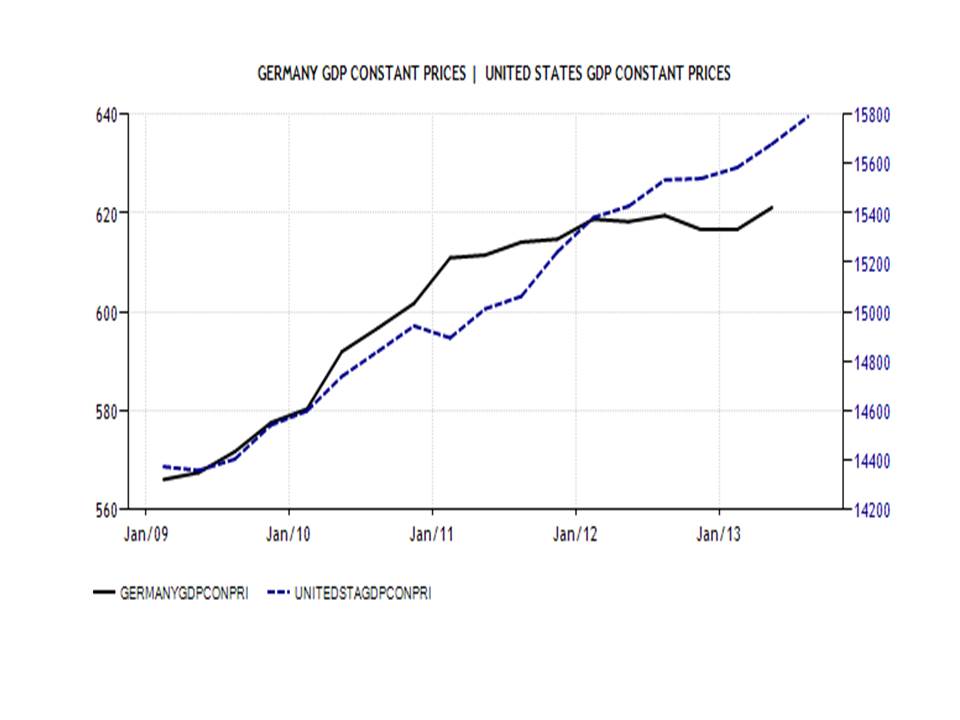
Now maybe you don’t like the Eurozone, as it includes all those dysfunctional debt-ridden southern European countries, as a baseline for comparison. OK, then let’s just do a straight, head-to-head matchup between the inflation-addicted US and solid, budget-balancing, inflation-hating Germany. Well that comparison shows (see the chart below) that since 2011 US real GDP has increased by about 5% while German real GDP has increased by less than 2%.

US_Germany_RGDP

So it does seem possible that, after all, QE and low interest rates may well have made things measurably better than they would have otherwise been. But don’t expect to opponents of QE to acknowledge that possibility.

Of course that still leaves the question on the table, why has this recovery been so weak? Well, Paul Krugman, channeling Larry Summers, offered a demographic hypothesis in his column Monday: that with declining population growth, there have been diminishing investment opportunities, which, together with an aging population, trying to save enough to support themselves in their old age, causes the supply of savings to outstrip the available investment opportunities, driving the real interest rate down to zero. As real interest rates fall, the ability of the economy to tolerate deflation — or even very low inflation — declines. That is a straightforward, and inescapable, implication of the Fisher equation (see my paper “The Fisher Effect Under Deflationary Expectations”).

So, if Summers and Krugman are right – and the trend of real interest rates for the past three decades is not inconsistent with their position – then we need to rethink revise upwards our estimates of what rate of inflation is too low. I will note parenthetically, that Samuel Brittan, who has been for decades just about the most sensible economic journalist in the world, needs to figure out that too little inflation may indeed be a bad thing.

But this brings me back to the puzzling question that causes so many people to assume that monetary policy is useless. Why have trillions of dollars of asset purchases not generated the inflation that other monetary expansions have generated? And if all those assets now on the Fed balance sheet haven’t generated inflation, what reason is there to think that the Fed could increase the rate of inflation if that is what is necessary to avoid chronic (secular) stagnation?

The answer, it seems to me is the following. If everyone believes that the Fed is committed to its inflation target — and not even the supposedly dovish Janet Yellen, bless her heart, has given the slightest indication that she favors raising the Fed’s inflation target, a target that, recent experience shows, the Fed is far more willing to undershoot than to overshoot – then Fed purchases of assets with currency are not going to stimulate additional private spending. Private spending, at or near the zero lower bound, are determined largely by expectations of future income and prices. The quantity of money in private hands, being almost costless to hold, is no longer a hot potato. So if there is no desire to reduce excess cash holdings, the only mechanism by which monetary policy can affect private spending is through expectations. But the Fed, having succeeded in anchoring inflation expectations at 2%, has succeeded in unilaterally disarming itself. So economic expansion is constrained by the combination of a zero real interest rate and expected inflation held at or below 2% by a political consensus that the Fed, even if it were inclined to, is effectively powerless to challenge.

Scott Sumner calls this monetary offset. I don’t think that we disagree much on the economic analysis, but it seems to me that he overestimates the amount of discretion that the Fed can actually exercise over monetary policy. Except at the margins, the Fed is completely boxed in by a political consensus it dares not question. FDR came into office in 1933, and was able to effect a revolution in monetary policy within his first month in office, thereby saving the country and Western Civilization. Perhaps Obama had an opportunity to do something similar early in his first term, but not any more. We are stuck at 2%, but it is no solution.

Hawtrey’s Good and Bad Trade, Part XI: Conclusion

For many readers, I am afraid that the reaction to the title of this post will be something like: “and not a moment too soon.” When I started this series two months ago, I didn’t expect it to drag out quite this long, but I have actually enjoyed the process of reading Hawtrey’s Good and Bad Trade carefully enough to be able to explain (or at least try to explain) it to an audience of attentive readers. In the course of the past ten posts, I have actually learned a fair amount about Hawtrey that I had not known before, and a number of questions have arisen that will require further investigation and research. More stuff to keep me busy.

My previous post about financial crises and asset crashes was mainly about chapter 16, which is the final substantive discussion of Hawtrey’s business-cycle theory in the volume. Four more chapters follow, the first three are given over to questions about how government policy affects the business cycle, and finally in the last chapter a discussion about whether changes in the existing monetary system (i.e., the gold standard) might eliminate, or at least reduce, the fluctuations of the business cycle.

Chapter 17 (“Banking and Currency Legislation in Relation to the State of Trade”) actually has little to do with banking and is mainly a discussion of how the international monetary system evolved over the course of the second half of the nineteenth century from a collection of mostly bimetallic standards before 1870 to a nearly universal gold standard, the catalyst for the evolution being the 1870 decision by newly formed German Empire to adopt a gold standard and then proceeded to convert its existing coinage to a gold basis, thereby driving up the world value of gold. As a result, all the countries with bimetallic standards (usually tied to a 15.5 to 1 ratio of silver to gold) to choose between adopting the gold standard and curtailing the unlimited free coinage of silver or tolerating the inflationary effects of Gresham’s Law as overvalued and depreciating silver drove gold out of circulation.

At the end of the chapter, Hawtrey speculates about the possibility that secular inflation might have some tendency to mitigate the effects of the business cycle, comparing the period from 1870 to 1896, characterized by deflation of about 1 to 2% a year, with the period from 1896 to 1913, when inflation was roughly about 1 to 2% a year.

Experience suggests that a scarcity of new gold prolongs the periods of depression and an abundance of new gold shortens them, so that the whole period of a fluctuation is somewhat shorter in the latter circumstances than is the former. (p. 227)

Hawtrey also noted the fact that, despite unlikelihood that long-term price level movements had been correctly foreseen, the period of falling prices from 1870 to 1896 was associated with low long-term interest rates while the period from 1896 to 1913 when prices were rising was associated with high interest rates, thereby anticipating by ten years the famous empirical observation made by the British economist A. W. Gibson of the positive correlation between long-term interest rates and the price level, an observation Keynes called the Gibson’s paradox, which he expounded upon at length in his Treatise on Money.

[T]he price was affected by the experience of investments during the long gold famine when profits had been low for almost a generation, and indeed it may be regarded as the outcome of the experience. In the same way the low prices of securities at the present time are the product of the contrary experience, the great output of gold in the last twenty years having been accompanied by inflated profits. (p. 229)

Chapter 18 (“Taxation in Relation to the State of Trade”) is almost exclusively concerned not with taxation as such but with protective tariffs. The question that Hawtrey considers is whether protective tariffs can reduce the severity of the business cycle. His answer is that unless tariffs are changed during the course of a cycle, there is no reason why they should have any cyclical effect. He then asks whether an increase in the tariff would have any effect on employment during a downturn. His answer is that imposing tariffs or raising existing tariffs, by inducing a gold inflow, and thus permitting a reduction in interest rates, would tend to reduce the adverse effect of a cyclical downturn, but he stops short of advocating such a policy, because of the other adverse effects of the protective tariff, both on the country imposing the tariff and on its neighbors.

Chapter 19 (“Public Finance in Relation to the State of Trade”) is mainly concerned with the effects of the requirements of the government for banking services in making payments to and accepting payments from the public.

Finally, Chapter 20 (“Can Fluctuations Be Prevented?”) addresses a number of proposals for mitigating the effects of the business cycle by means of policy or changes institutional reform. Hawtrey devotes an extended discussion to Irving Fisher’s proposal for a compensated dollar. Hawtrey is sympathetic, in principle, to the proposal, but expressed doubts about its practicality, a) because it did not seem in 1913 that replacing the gold standard was politically possible, b) because Hawtrey doubted that a satisfactory price index could be constructed, and c) because the plan would, at best, only mitigate, not eliminate, cyclical fluctuations.

Hawtrey next turns to the question whether government spending could be timed to coincide with business cycle downturns so that it would offset the reduction in private spending, thereby preventing the overall demand for labor from falling as much as it otherwise would during the downturn. Hawtrey emphatically rejects this idea because any spending by the government on projects would simply displace an equal amount of private spending, leaving total expenditure unchanged.

The underlying principle of this proposal is that the Government should add to the effective demand for labour at the time when the effective private demand of private traders falls off. But [the proposal] appears to have overlooked the fact that the Government by the very fact of borrowing for this expenditure is withdrawing from the investment market savings which would otherwise be applied to the creation of capital. (p. 260)

Thus, already in 1913, Hawtrey formulated the argument later advanced in his famous 1925 paper on “Public Expenditure and the Demand for Labour,” an argument which eventually came to be known as the Treasury view. The Treasury view has been widely condemned, and, indeed, it did overlook the possibility that government expenditure might induce private funds that were being hoarded as cash to be released for spending on investment. This tendency, implied by the interest-elasticity of the demand for money, would prevent government spending completely displacing private spending, as the Treasury view asserted. But as I have observed previously, despite the logical gap in Hawtrey’s argument, the mistake was not as bad as it is reputed to be, because, according to Hawtrey, the decline in private spending was attributable to a high rate of interest, so that the remedy for unemployment is to be found in a reduction in the rate of interest rather than an increase in government spending.

And with that, I think I will give Good and Bad Trade and myself a rest.


About Me

David Glasner
Washington, DC

I am an economist in the Washington DC area. My research and writing has been mostly on monetary economics and policy and the history of economics. In my book Free Banking and Monetary Reform, I argued for a non-Monetarist non-Keynesian approach to monetary policy, based on a theory of a competitive supply of money. Over the years, I have become increasingly impressed by the similarities between my approach and that of R. G. Hawtrey and hope to bring Hawtrey’s unduly neglected contributions to the attention of a wider audience.

My new book Studies in the History of Monetary Theory: Controversies and Clarifications has been published by Palgrave Macmillan

Follow me on Twitter @david_glasner

Archives

Enter your email address to follow this blog and receive notifications of new posts by email.

Join 665 other subscribers
Follow Uneasy Money on WordPress.com