Archive for the 'Federal Reserve' Category


Eureka! Paul Krugman Discovers the Bank of France

Trying hard, but not entirely successfully, to contain his astonishment, Paul Krugman has a very good post (“France 1930, Germany 2013) inspired by Doug Irwin’s “very good” paper (see also this shorter version) “Did France Cause the Great Depression?” Here’s Krugman take away from Irwin’s paper.

[Irwin] points out that France, with its undervalued currency, soaked up a huge proportion of the world’s gold reserves in 1930-31, and suggests that France was responsible for about half the global deflation that took place over that period.

The thing is, France itself didn’t do that badly in the early stages of the Great Depression — again thanks to that undervalued currency. In fact, it was less affected than most other advanced countries (pdf) in 1929-31:

Krugman is on the right track here — certainly a hopeful sign — but he misses the distinction between an undervalued French franc, which, despite temporary adverse effects on other countries, would normally be self-correcting under the gold standard, and the explosive increase in demand for gold by the insane Bank of France after the franc was pegged at an undervalued parity against the dollar. Undervaluation of the franc began in December 1926 when Premier Raymond Poincare stabilized its value at about 25 francs to the dollar, the franc having fallen to 50 francs to the dollar in July when Poincare, a former prime minister, had been returned to office to deal with a worsening currency crisis. Undervaluation of the franc would have done no permanent damage to the world economy if the Bank of France had not used the resulting inflow of foreign exchange to accumulate gold, cashing in sterling- and dollar-denominated financial assets for gold. This was a step beyond classic exchange-rate protection (currency manipulation) whereby a country uses a combination of an undervalued exchange rate and a tight monetary policy to keep accumulating foreign-exchange reserves as a way of favoring its export and import-competing industries. Exchange-rate protection may have been one motivation for the French policy, but that objective did not require gold accumulation; it could have been achieved by accumulating foreign exchange reserves without demanding redemption of those reserves in terms of gold, as the Bank of France began doing aggressively in 1927. A more likely motivation for gold accumulation policy of the Bank of France seems to have been French resentment against a monetary system that, from the French perspective, granted a privileged status to the dollar and to sterling, allowing central banks to treat dollar- and sterling-denominated financial assets as official exchange reserves, thereby enabling issuers of dollar and sterling-denominated assets the ability to obtain funds on more favorable terms than issuers of instruments denominated in other currencies.

The world economy was able to withstand the French gold-accumulation policy in 1927-28, because the Federal Reserve was tolerating an outflow of gold, thereby accommodating to some degree the French demand for gold. But after the Fed raised its discount rate to 5% in 1928 and 6% in February 1929, gold began flowing into the US as well, causing gold to start appreciating (in other words, prices to start falling) in world markets by the summer of 1929. But rather than reverse course, the Bank of France and the Fed, despite reductions in their official lending rates, continued pursuing policies that caused huge amounts of gold to flow into the French and US vaults in 1930 and 1931. Hawtrey and Cassel, of course, had warned against such a scenario as early as 1919, and proposed measures to prevent or reverse the looming catastrophe before it took place and after it started, but with little success. For a more complete account of this sad story, and the failure of the economics profession, with a very few notable exceptions, to figure out what happened, see my paper with Ron Batchelder “Pre-Keynesian Monetary Theories of the Great Depression: Whatever Happened to Hawtrey and Cassel?”

As Krugman observes, the French economy did not do so badly in 1929-31, because it was viewed as the most stable, thrifty, and dynamic economy in Europe. But France looked good only because Britain and Germany were in even worse shape. Because France was better off the Britain and Germany, and because its currency was understood to be undervalued, the French franc was considered to be stable, and, thus, unlikely to be devalued. So, unlike sterling, the reichsmark, and the dollar, the franc was not subjected to speculative attacks, becoming instead a haven for capital seeking safety.

Interestingly, Krugman even shows some sympathetic understanding for the plight of the French:

Notice, by the way, that the French weren’t evil or malicious here — they were just adhering to their hard-money ideology in an environment where that had terrible adverse effects on other countries.

Just wondering, would Krugman ever invoke adherence to a hard-money ideology as a mitigating factor in passing judgment on a Republican?

Krugman concludes by comparing Germany today with France in 1930.

Obviously the details are different, but I would argue that Germany is playing a somewhat similar role today — not as drastic, but with less excuse. For Germany is an economic hegemon in a way France never was; it has responsibilities, which it isn’t meeting.

Indeed, there are similarities, but there is a crucial difference in the mechanism by which damage is being inflicted: the world price level in 1930, under the gold standard, was determined by the value of gold. An increase in the demand for gold by central banks necessarily raised the value of gold, causing deflation for all countries either on the gold standard or maintaining a fixed exchange rate against a gold-standard currency. By accumulating gold, nearly quadrupling its gold reserves between 1926 and 1932, the Bank of France was a mighty deflationary force, inflicting immense damage on the international economy. Today, the Eurozone price level does not depend on the independent policy actions of any national central bank, including that of Germany. The Eurozone price level is rather determined by the policy choices of a nominally independent European Central Bank. But the ECB is clearly unable to any adopt policy not approved by the German government and its leader Mrs. Merkel, and Mrs. Merkel has rejected any policy that would raise prices in the Eurozone to a level consistent with full employment. Though the mechanism by which Mrs. Merkel and her government are now inflicting damage on the Eurozone is different from the mechanism by which the insane Bank of France inflicted damage during the Great Depression, the damage is just as pointless and just as inexcusable. But as the damage caused by Mrs. Merkel, in relative terms at any rate, seems somewhat smaller in magnitude than that caused by the insane Bank of France, I would not judge her more harshly than I would the Bank of France — insanity being, in matters of monetary policy, no defense.

HT: ChargerCarl
A New Paper Shows Just How Right Hawtrey and Cassel Were

I was pleasantly surprised to receive an email a couple of weeks ago from someone I don’t know, a graduate student in economics at George Mason University, James Caton. He sent me a link to a paper (“Good as Gold?: A Quantitative Analysis of Hawtrey and Cassel’s Theory of Gold Demand and the Gold Price Level During the Interwar Period”) that he recently posted on SSRN. Caton was kind enough to credit me and my co-author Ron Batchelder, as well as Doug Irwin (here and here) and Scott Sumner, for reviving interest in the seminal work of Ralph Hawtrey and Gustav Cassel on the interwar gold standard and the key role in causing the Great Depression played by the process of restoring the gold standard after it had been effectively suspended after World War I began.

The thesis independently, but cooperatively, advanced by Hawtrey and Cassel was that under a gold standard, fluctuations in the gold price level were sensitive to variations in the demand for gold reserves by the central banks. The main contribution of Caton’s paper is to provide econometric evidence of the tight correlation between variations in the total gold holdings of the world’s central banks and the gold price level in the period between the end of World War I (1918) to the start of Great Depression (1930-32). Caton uses a variation on a model used by Scott Sumner in his empirical work on the Great Depression to predict changes in the value of gold, and, hence, changes in the gold price level of commodities. If central banks in the aggregate are adding to their gold reserves at a faster rate than the rate at which the total world stock of gold is growing, then gold would be likely to appreciate, and if central banks are adding to their gold reserves at a slower rate than that at which the world stock is growing, then gold would be likely to depreciate.

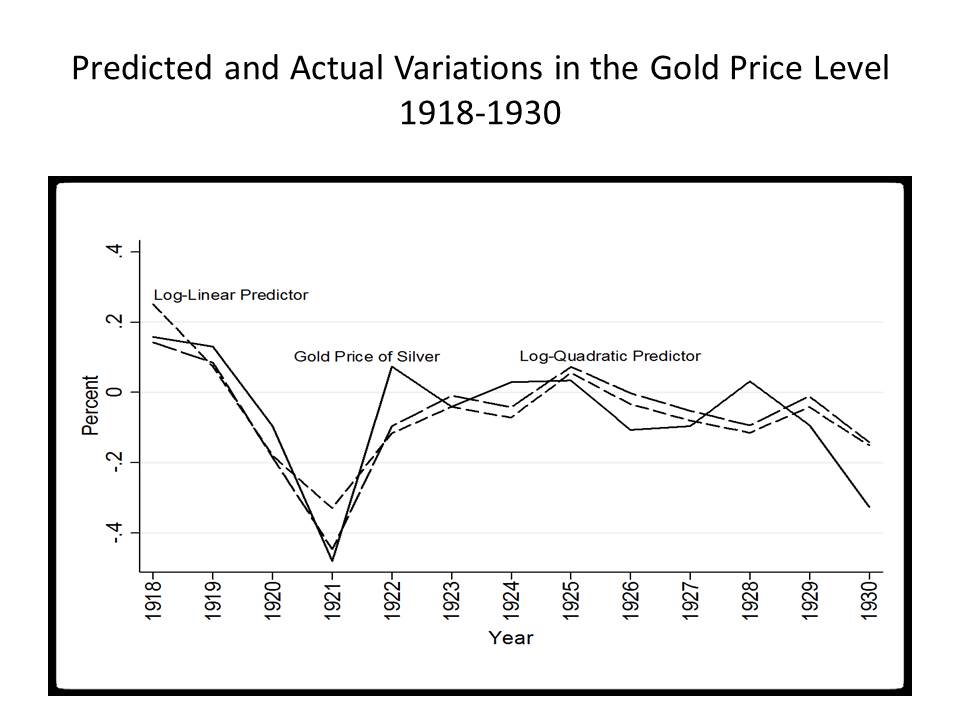
So from the published sources, Caton constructed a time series of international monetary gold holdings and the total world stock of gold from 1918 to 1932 and regressed the international gold price level on the international gold reserve ratio (the ratio of monetary gold reserves to the total world stock of gold). He used two different measures of the world gold price level, the Sauerback-Statist price index and the gold price of silver. Based on his regressions (calculated in both log-linear and log-quadratic forms and separately for the periods 1918-30, 1918-31, 1918-32), he compared the predicted gold price level against both the Sauerback-Statist price index and the gold price of silver. The chart below shows his result for the log-linear regression estimated over the period 1918-30.

Caton_Regressions

Pretty impressive, if you ask me. Have a look yourself.

Let me also mention that Caton’s results also shed important light on the puzzling behavior of the world price level immediately after the end of World War I. Unlike most wars in which the wartime inflation comes to an abrupt end after the end of the war, inflation actually accelerated after the end of the war. The inflation did not actually stop for almost two years after the end of the war, when a huge deflation set in. Caton shows that the behavior of the price level was largely determined by the declining gold holdings of the Federal Reserve after the war ended. Unnerved by the rapid inflation, the Fed finally changed policy, and began accumulating gold rapidly in 1920 by raising the discount rate to an all-time high of 7 percent. Although no other countries were then on the gold standard, other countries, unwilling, for the most part, to allow their currencies to depreciate too much against the dollar, imported US deflation.

Jim is also a blogger. Check out his blog here.

Update: Thanks to commenter Blue Aurora for pointing out that I neglected to provide a link to Jim Caton’s paper.  Sorry about that. The link is now embedded.

Who Sets the Real Rate of Interest?

Understanding economics requires, among other things, understanding the distinction between real and nominal variables. Confusion between real and nominal variables is pervasive, constantly presenting barriers to clear thinking, and snares and delusions for the mentally lazy. In this post, I want to talk about the distinction between the real rate of interest and the nominal rate of interest. That distinction has been recognized for at least a couple of centuries, Henry Thornton having mentioned it early in the nineteenth century. But the importance of the distinction wasn’t really fully understood until Irving Fisher made the distinction between the real and nominal rates of interest a key element of his theory of interest and his theory of money, expressing the relationship in algebraic form — what we now call the Fisher equation. Notation varies, but the Fisher equation can be written more or less as follows:

i = r + dP/dt,

where i is the nominal rate, r is the real rate, and dP/dt is the rate of inflation. It is important to bear in mind that the Fisher equation can be understood in two very different ways. It can either represent an ex ante relationship, with dP/dt referring to expected inflation, or it can represent an ex post relationship, with dP/dt referring to actual inflation.

What I want to discuss in this post is the tacit assumption that usually underlies our understanding, and our application, of the ex ante version of the Fisher equation. There are three distinct variables in the Fisher equation: the real and the nominal rates of interest and the rate of inflation. If we think of the Fisher equation as an ex post relationship, it holds identically, because the unobservable ex post real rate is defined as the difference between the nominal rate and the inflation rate. The ex post, or the realized, real rate has no independent existence; it is merely a semantic convention. But if we consider the more interesting interpretation of the Fisher equation as an ex ante relationship, the real interest rate, though still unobservable, is not just a semantic convention. It becomes the theoretically fundamental interest rate of capital theory — the market rate of intertemporal exchange, reflecting, as Fisher masterfully explained in his canonical renderings of the theory of capital and interest, the “fundamental” forces of time preference and the productivity of capital. Because it is determined by economic “fundamentals,” economists of a certain mindset naturally assume that the real interest rate is independent of monetary forces, except insofar as monetary factors are incorporated in inflation expectations. But if money is neutral, at least in the long run, then the real rate has to be independent of monetary factors, at least in the long run. So in most expositions of the Fisher equation, it is tacitly assumed that the real rate can be treated as a parameter determined, outside the model, by the “fundamentals.” With r determined exogenously, fluctuations in i are correlated with, and reflect, changes in expected inflation.

Now there’s an obvious problem with the Fisher equation, which is that in many, if not most, monetary models, going back to Thornton and Wicksell in the nineteenth century, and to Hawtrey and Keynes in the twentieth, and in today’s modern New Keynesian models, it is precisely by way of changes in its lending rate to the banking system that the central bank controls the rate of inflation. And in this framework, the nominal interest rate is negatively correlated with inflation, not positively correlated, as implied by the usual understanding of the Fisher equation. Raising the nominal interest rate reduces inflation, and reducing the nominal interest rate raises inflation. The conventional resolution of this anomaly is that the change in the nominal interest rate is just temporary, so that, after the economy adjusts to the policy of the central bank, the nominal interest rate also adjusts to a level consistent with the exogenous real rate and to the rate of inflation implied by the policy of the central bank. The Fisher equation is thus an equilibrium relationship, while central-bank policy operates by creating a short-term disequilibrium. But the short-term disequilibrium imposed by the central bank cannot be sustained, because the economy inevitably begins an adjustment process that restores the equilibrium real interest rate, a rate determined by fundamental forces that eventually override any nominal interest rate set by the central bank if that rate is inconsistent with the equilibrium real interest rate and the expected rate of inflation.

It was just this analogy between the powerlessness of the central bank to hold the nominal interest rate below the sum of the exogenously determined equilibrium real rate and the expected rate of inflation that led Milton Friedman to the idea of a “natural rate of unemployment” when he argued that monetary policy could not keep the unemployment rate below the “natural rate ground out by the Walrasian system of general equilibrium equations.” Having been used by Wicksell as a synonym for the Fisherian equilibrium real rate, the term “natural rate” was undoubtedly adopted by Friedman, because monetarily induced deviations between the actual rate of unemployment and the natural rate of unemployment set in motion an adjustment process that restores unemployment to its “natural” level, just as any deviation between the nominal interest rate and the sum of the equilibrium real rate and expected inflation triggers an adjustment process that restores equality between the nominal rate and the sum of the equilibrium real rate and expected inflation.

So, if the ability of the central bank to use its power over the nominal rate to control the real rate of interest is as limited as the conventional interpretation of the Fisher equation suggests, here’s my question: When critics of monetary stimulus accuse the Fed of rigging interest rates, using the Fed’s power to keep interest rates “artificially low,” taking bread out of the mouths of widows, orphans and millionaires, what exactly are they talking about? The Fed has no legal power to set interest rates; it can only announce what interest rate it will lend at, and it can buy and sell assets in the market. It has an advantage because it can create the money with which to buy assets. But if you believe that the Fed cannot reduce the rate of unemployment below the “natural rate of unemployment” by printing money, why would you believe that the Fed can reduce the real rate of interest below the “natural rate of interest” by printing money? Martin Feldstein and the Wall Street Journal believe that the Fed is unable to do one, but perfectly able to do the other. Sorry, but I just don’t get it.

Look at the accompanying chart. It tracks the three variables in the Fisher equation (the nominal interest rate, the real interest rate, and expected inflation) from October 1, 2007 to July 2, 2013. To measure the nominal interest rate, I use the yield on 10-year Treasury bonds; to measure the real interest rate, I use the yield on 10-year TIPS; to measure expected inflation, I use the 10-year breakeven TIPS spread. The yield on the 10-year TIPS is an imperfect measure of the real rate, and the 10-year TIPS spread is an imperfect measure of inflation expectations, especially during financial crises, when the rates on TIPS are distorted by illiquidity in the TIPS market. Those aren’t the only problems with identifying the TIPS yield with the real rate and the TIPS spread with inflation expectations, but those variables usually do provide a decent approximation of what is happening to real rates and to inflation expectations over time.

real_and_nominal_interest_rates

Before getting to the main point, I want to make a couple of preliminary observations about the behavior of the real rate over time. First, notice that the real rate declined steadily, with a few small blips, from October 2007 to March 2008, when the Fed was reducing the Fed Funds target rate from 4.75 to 3% as the economy was sliding into a recession that officially began in December 2007. The Fed reduced the Fed Funds target to 2% at the end of April, but real interest rates had already started climbing in early March, so the failure of the FOMC to reduce the Fed Funds target again till October 2008, three weeks after the onset of the financial crisis, clearly meant that there was at least a passive tightening of monetary policy throughout the second and third quarters, helping create the conditions that precipitated the crisis in September. The rapid reduction in the Fed Funds target from 2% in October to 0.25% in December 2008 brought real interest rates down, but, despite the low Fed Funds rate, a lack of liquidity caused a severe tightening of monetary conditions in early 2009, forcing real interest rates to rise sharply until the Fed announced its first QE program in March 2009.

I won’t go into more detail about ups and downs in the real rate since March 2009. Let’s just focus on the overall trend. From that time forward, what we see is a steady decline in real interest rates from over 2% at the start of the initial QE program till real rates bottomed out in early 2012 at just over -1%. So, over a period of three years, there was a steady 3% decline in real interest rates. This was no temporary phenomenon; it was a sustained trend. I have yet to hear anyone explain how the Fed could have single-handedly produced a steady downward trend in real interest rates by way of monetary expansion over a period of three years. To claim that decline in real interest rates was caused by monetary expansion on the part of the Fed flatly contradicts everything that we think we know about the determination of real interest rates. Maybe what we think we know is all wrong. But if it is, people who blame the Fed for a three-year decline in real interest rates that few reputable economists – and certainly no economists that Fed critics pay any attention to — ever thought was achievable by monetary policy ought to provide an explanation for how the Fed suddenly got new and unimagined powers to determine real interest rates. Until they come forward with such an explanation, Fed critics have a major credibility problem.

So please – pleaseWall Street Journal editorial page, Martin Feldstein, John Taylor, et al., enlighten us. We’re waiting.

PS Of course, there is a perfectly obvious explanation for the three-year long decline in real interest rates, but not one very attractive to critics of QE. Either the equilibrium real interest rate has been falling since 2009, or the equilibrium real interest rate fell before 2009, but nominal rates adjusted slowly to the reduced real rate. The real interest rate might have adjusted more rapidly to the reduced equilibrium rate, but that would have required expected inflation to have risen. What that means is that sometimes it is the real interest rate, not, as is usually assumed, the nominal rate, that adjusts to the expected rate of inflation. My next post will discuss that alternative understanding of the implicit dynamics of the Fisher equation.

Watch out for that Fed Reaction Function

Scott Sumner had a terrific post today. The title said it all, but the rest of it wasn’t bad either.

The stock market wants fast economic growth, and they want the Fed to think economic growth is slow

Eureka!  Today we found out that NGDP (which the Fed looks at) grew at a 2.19% rate over the past 6 months and the more accurate NGDI grew by 5.06%.

Stocks soared on the news.

And shhhh!  Don’t anyone tell the Fed about NGDI!

Scott hit it right on the nose with that one.

It reminded me of something, so I went an looked it up in a book I happen to have at home.

Here’s what it says about Fed policy coming out of the 1981-82 recession.

The renewed stringency forced interest rates to rise slightly while driving the dollare ever higher and commodities prices ever lower. Yet the recovery, once under way, was too powerful to be slowed down perceptibly by the monetary pressure. . . .

The recovery continued in the first half of 1984. But the amazing strength of the recovery pulled the growth of M-1 above its targets, reviving fears that the Fed would have to tighten. Instead of being welcomed, each bit of favorable economic news – strong growth in real GNP, reduced unemployment, higher factory orders – was greeted with fear and trepidation in the financial markets, because such reports were viewed as portents of future tightening by the Fed. Those fears generated continuing increases in interest rates, appreciation of the dollar, and falling commodities prices. In the summer of 1984, monetary stringency and fears that the Fed would clamp down even more tightly to bring the growth of M-1 back within its targets were threatening to produce a credit crunch and abort the recovery.

With interest rates and the dollar’s exchange rate again starting to rise rapidly, and with commodity prices losing the modest gains they had made in the previous year, the recovery was indeed threatened. In late July of 1984, two years after the Fed had given up its earlier effort to meet its monetary targets, the conditions for a credit crunch, if not a full scale panic, were again developing. The most widely reported monetary aggregate, M-1, was above the upper limit of the Fed’s growth target, and economic growth in the second quarter of 1984 was reported to have been an unexpectedly strong 7.5%. Commodities prices were practically in free fall and the dollar was soaring.

Once again, however, a timely intervention by Mr. Volcker calmed the markets and put to rest fears that the Fed would strive to keep monetary growth within the announced target ranges. Appearing before Congress, he announced that he expected inflation to remain low [around 4%!!!] and that the Fed would maintain its policy without seeking any further tightening to bring monetary growth within the target range. This assurance stopped, at least for a brief spell, the dollar’s rise in foreign exchange markets and permitted a slight rebound in commodities prices. Mr. Volcker’s assurance that monetary policy would not be tightened encouraged the public to stop trying to build up precautionary balances. As a consequence, M-1 growth leveled off even as interest rates fell back somewhat.

All the while Monetarist were loudly protesting the conduct of monetary policy. Before the Fed abandoned its attempt to target M-1, Monetarists criticized the Fed for not keeping monetary growth steady enough. For a time, they even attributed the failure of interest rates to fall as rapidly as the rate of inflation in 1981, or to fall at all in the first half of 1982, to uncertainty created by too much variability in the rate of monetary growth. Later, when the Fed abandoned, at any rate deemphasized, monetary targets, they warned that inflation would soon start to rise again. In late 1982, just as the economy was hitting bottom, Milton Friedman was predicting the return of double-digit inflation [sound familiar?] before the next election.

What book did I get that from? OK, I admit it. It’s from my book Free Banking and Monetary Reform, pp. 220-21. So we’ve been through this before. When the Fed adopts a crazy reaction function in which it won’t tolerate real growth above a certain threshold, which is what the Fed seems to have done, with the threshold at 3% or less, funny things start to happen.

How come no one is laughing?

PS I apologize again for not replying to comments lately. I am still trying to cope with my workload.

Bernanke Gives the Markets a Scare

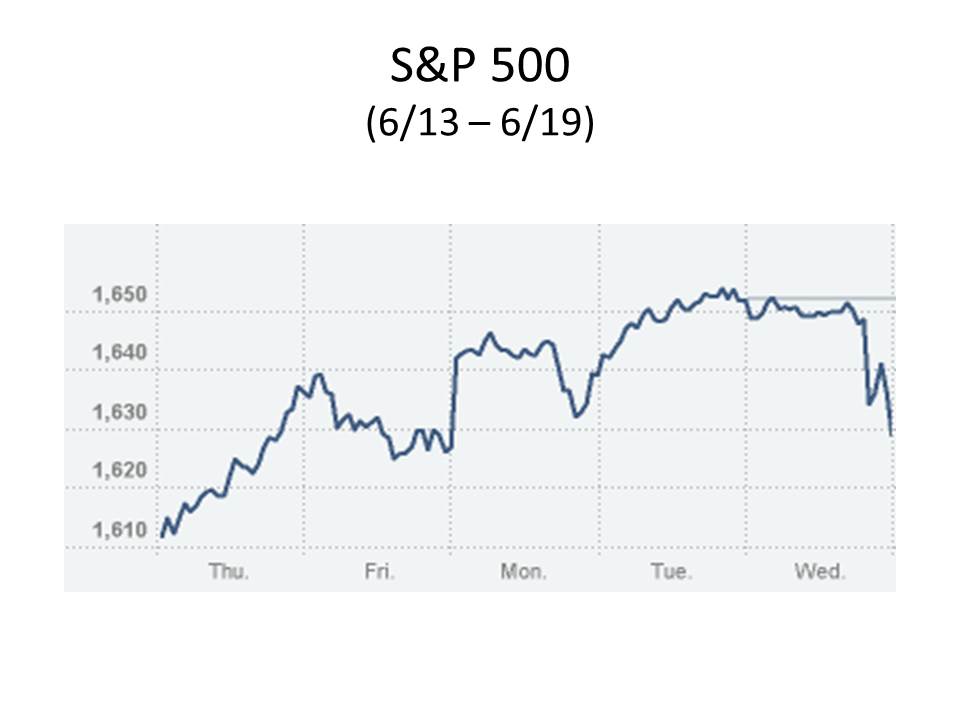
Ben Bernanke held a press conference today at the conclusion of the FOMC meeting held yesterday and today. The stock market had risen by almost 2 percent on Monday and Tuesday, apparently in hopes that Bernanke would have something encouraging to say about Fed policy. They were obviously disappointed. The accompanying chart shows how the S&P 500 has fluctuated since last Thursday, the sharp drop today coincided with Bernanke’s press conference.

S&P500_6-13_6-19 S&P500_6-13_6-19

What was so disturbing to the markets? Well, Bernanke’s press conference triggered some sharp movements in the bond markets. The yield on the 10-year Treasury jumped by 13 basis points to 2.33%. I don’t have a chart of the intra-day fluctuation, but I am pretty sure almost all of the movement occurred after the press conference started. Meanwhile the yield on the 10-year TIPS jumped 15 basis points, from 0.14% to 0.29%, implying a 2-basis-point drop in the breakeven TIPS spread, to 2.04%. A two-basis-point change in inflation expectations is not very remarkable. So it seems that what drove the increase in yield was the increase in the real rate. But one has to be careful in identifying the TIPS spread with the real rate of interest, especially when one sees sudden changes in the market, changes that could reflect factors other than the real rate of interest, such as illiquidity in the TIPS market or increasing uncertainty about future inflation, even though expected inflation is not changing much.

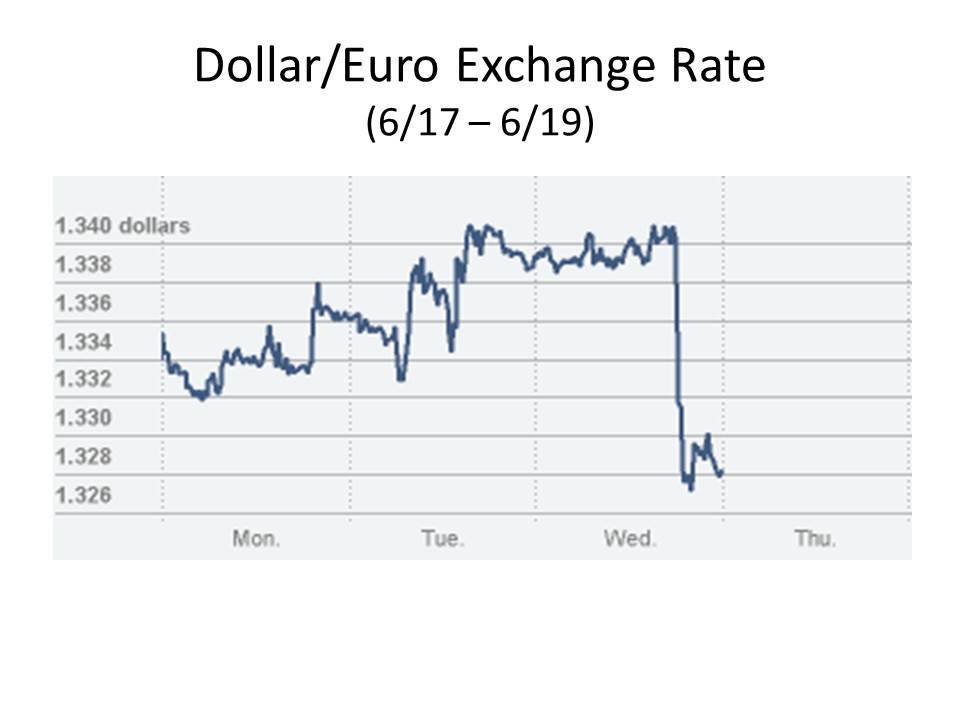
Let’s look at two other markets that moved sharply after Bernanke started talking this afternoon. The chart below shows the movement of dollar/euro exchange rate since Monday. The dollar weakened slightly on Monday and Tuesday and Wednesday morning, but as soon as Bernanke got started the dollar shot up against the euro.

dollar_euro_exchange_rate

That should not necessarily be construed as a vote of confidence in Bernanke, even though it apparently pleased Bernanke et al. to think that the sharp run-up in the value of the dollar in August 2008 was a sign of confidence that Fed policy to keep inflation expectations anchored was working. It is hard to interpret today’s sharp increase in the value of the dollar as anything but an expectation of future tightening of monetary policy by the Fed. But then why did inflation expectations fall by only 2 basis points?

Another market that is supposed to be sensitive to inflation expectations is gold, though in my view the demand for gold is too irrational to provide any usable information about expectations. But I will suspend my disbelief in the rationality of gold traders for the time being to note that the price of gold has just fallen to a new low for the year, dropping below $1340 an ounce or almost 3% since yesterday. A fall in the value of gold is consistent with an increase in real interest rates or with a decline in inflation expectations, so take your pick.

Some people have suggested that declining inflation expectations and rising real interest rates are manifestations of a positive supply shock, also reflected in declining commodity prices. A positive supply shock would have provided the Fed with an opportunity to relax monetary policy further without risk of raising inflation or inflation expectations from current levels, which already are well below the Fed’s announced 2% target. If continued Fed easing was what the markets had been anticipating earlier in the week, reflected in a gently falling dollar exchange rate, even with inflation expectations stable or falling, then Bernanke’s announcement today constituted a tightening of policy relative to expectations. The tightening drove up the dollar and caused a further, albeit small, decline in inflation expectations. (But I should note that this interpretation depends on what may be an oversimplified identification of the TIPS spread with inflation expectations.)

At any rate, I don’t think that we have a clear understanding of what is driving markets at this point. Markets still seem to be in confusion. Today’s movements in the markets were sudden and sharp, but they were also fairly modest. A one or two percent movement in markets is hardly a major event. Nevertheless, by displaying an unseemly haste to withdraw the very modest monetary stimulus that the Fed has begrudgingly provided, Bernanke may have given the markets a bit of scare, reminding them how indifferent central bankers have been to the ongoing disaster of the Little Depression. The markets did not panic, but we may be flying into turbulence. Keep your seat belts fastened.

What’s a Central Banker To Do?

The FOMC is meeting tomorrow and Wednesday, and it seems as if everyone is weighing in with advice for Ben Bernanke and company. But you can always count on the Wall Street Journal editorial page to dish up something especially fatuous when the topic turns to monetary policy and the Fed. This time the Journal turns to George Melloan, a former editor and columnist at the Journal, to explain why the market has recently turned “skittish” in anticipation that the Fed may be about to taper off from its latest venture into monetary easing.

Some of us have been arguing that recent Fed signals that it will taper off from quantitative easing have scared the markets, which are now anticipating rising real interest rates and declining inflation. Inflation expectations have been declining since March, but, until the latter part of May, that was probably a positive development, reflecting expectations of increased real output under the steady, if less than adequate, policy announced last fall. But the expectation that quantitative easing may soon be tapered off seems to have caused a further decline in inflation expectations and a further increase in real interest rates.

But Melloan sees it differently

We are in an age where the eight male and four female members of the FOMC are responsible for whether securities markets float or sink. Traders around the world who in better times considered a range of variables now focus on a single one, Federal Reserve policy. . . .

In the bygone days of free markets, stocks tended to move counter to bonds as investors switched from one to the other to maximize yield. But in the new world of government rigging, they often head in the same direction. That’s not good for investors.

Oh dear, where to begin? Who cares how many males and females are on the FOMC? Was the all-male Federal Reserve Board that determined monetary during the Great Depression more to Mr. Melloan’s liking? I discovered about three years ago that since early in 2008 there has been a clear correlation between inflation expectations and stock prices. (See my paper “The Fisher Effect Under Deflationary Expectations.“) That correlation was not created, as Melloan and his colleagues at the Journal seem to think, by the Fed’s various half-hearted attempts at quantitative-easing; it is caused by a dangerous conjuncture between low real rates of interest and low or negative rates of expected inflation. Real rates of interest are largely, but not exclusively, determined by entrepreneurial expectations of future economic conditions, and inflation expectations are largely, but not exclusively, determined by the Fed policy.

So the cure for a recession will generally require inflation expectations to increase relative to real interest rates. Either real rates must fall or inflation expectations (again largely under the control of the Fed) must rise. Thus, an increase in inflation expectations, when real interest rates are too high, can cause stock prices to rise without causing bond prices to fall. It is certainly true that it is not good for investors when the economy happens to be in a situation such that an increase in expected inflation raises stock prices. But that’s no reason not to reduce real interest rates. Using monetary policy to raise real interest rates, as Mr. Melloan would like the Fed to do, in a recession is a prescription for perpetuating joblessness.

Melloan accuses the Fed of abandoning free markets and rigging interest rates. But he can’t have it both ways. The Fed did not suddenly lose the power to rig markets last month when interest rates on long-term bonds rose sharply. Bernanke only hinted at the possibility of a tapering off from quantitative easing. The Fed’s control over the market is supported by nothing but the expectations of millions of market participants. If the expectations of traders are inconsistent with the Fed’s policy, the Fed has no power to prevent market prices from adjusting to the expectations of traders.

Melloan closes with the further accusation that Bernanke et al. hold “the grandiose belief . . . that the Fed is capable of superhuman feats, like running the global economy.” That’s nonsense. The Fed is not running the global economy. In its own muddled fashion, the Fed is trying to create market expectations about the future value of the dollar that will support an economic expansion. Unfortunately, the Fed seems not to have figured out that a rapid recovery is highly unlikely to occur unless something is done to sharply raise the near term expected rate of inflation relative to the real rate of interest.

How Did Bernanke Scare the Markets?

On Wednesday Ben Bernanke appeared before the Joint Economic Committee of the US Congress to give his semi-annual report to Congress on the Economic Outlook. The S&P 500 opened the day about 1% higher than at Tuesday’s close, but by early afternoon had already given back all their gains, before closing 1% lower than the day before, an interday swing of 2%, pretty clearly caused by Bernanke’s testimony. The Nikkei average fell by 7%. Bernanke announced no major change in monetary policy, but he did hint that the FOMC was considering scaling back its asset purchases “in light of incoming information.” So what was it that Bernanke said that was so scary?

Let’s have a look.

Bernanke began with a summary of economic conditions, giving himself two cheers for recent improvements in the job market. He continued by explaining how, despite some minimal and painfully slow improvements, the job market remains in bad shape:

Despite this improvement, the job market remains weak overall: The unemployment rate is still well above its longer-run normal level, rates of long-term unemployment are historically high, and the labor force participation rate has continued to move down. Moreover, nearly 8 million people are working part time even though they would prefer full-time work. High rates of unemployment and underemployment are extraordinarily costly: Not only do they impose hardships on the affected individuals and their families, they also damage the productive potential of the economy as a whole by eroding workers’ skills and–particularly relevant during this commencement season–by preventing many young people from gaining workplace skills and experience in the first place. The loss of output and earnings associated with high unemployment also reduces government revenues and increases spending on income-support programs, thereby leading to larger budget deficits and higher levels of public debt than would otherwise occur.

Bernanke then shifted to the inflation situation:

Consumer price inflation has been low. The price index for personal consumption expenditures rose only 1 percent over the 12 months ending in March, down from about 2-1/4 percent during the previous 12 months. This slow rate of inflation partly reflects recent declines in consumer energy prices, but price inflation for other consumer goods and services has also been subdued. Nevertheless, measures of longer-term inflation expectations have remained stable and continue to run in the narrow ranges seen over the past several years. Over the next few years, inflation appears likely to run at or below the 2 percent rate that the Federal Open Market Committee (FOMC) judges to be most consistent with the Federal Reserve’s statutory mandate to foster maximum employment and stable prices.

In other words, the job market, despite minimal improvements, is a disaster, and inflation is below target, and inflation expectations “continue to in the narrow ranges seen over the past several years.” What does that mean? It means that since the financial crisis of 2008, inflation expectations have consistently remained at their lowest levels in a half century. Why is any increase in inflation expectations above today’s abnormally low levels unacceptable? Bernanke then says that inflation appears likely to run at or below the 2% rate that FOMC believes is most consistent with the Fed’s mandate to foster maximum employment and stable prices. Actually it appears likely that inflation is likely to run below the 2% rate, perhaps by 50 to 100 basis points. For Bernanke to disguise the likelihood that inflation will persistently fail to reach the Fed’s own nominal 2% target, by artfully saying that inflation is likely to run “at or below” the 2% target, is a deliberate deception. Thus, although he is unwilling to say so explicitly, Bernanke makes it clear that he and the FOMC are expecting, whether happily or not is irrelevant, inflation to continue indefinitely at less than the 2% annual target, and will do nothing to increase it.

You get the picture? The job market, five and a half years after the economy started its downturn, is in a shambles. Inflation is running well below the nominal 2% target, and is expected to remain there for as far as the eye can see. And what is the FOMC preoccupied with? Winding down its asset purchases “in light of incoming information.” The incoming information is clearly saying – no it’s shouting – that the asset purchases ought to be stepped up, not wound down. Does Bernanke believe that, under the current circumstances, an increased rate of inflation would not promote a faster recovery in the job market? If so, on the basis of what economic theory has he arrived at that belief? With inflation persistently below the Fed’s own target, he owes Congress and the American people an explanation of why he believes that faster inflation would not hasten the recovery in employment, and why he and the FOMC are not manifestly in violation of their mandate to promote maximum employment consistent with price stability. But he is obviously unwilling or unable to provide one.

Why did Bernanke scare the markets? Well, maybe, just maybe, it was because his testimony was so obviously incoherent.

The Vampire Theory of Inflation

The FOMC issued an opaque statement yesterday observing that the economy is continuing to expand at “a moderate pace,” though unemployment remains too high while inflation is falling. The statement attributes the weakness of the recovery, at least in part, to fiscal tightening, perhaps suggesting that the Fed would not, under these circumstances, tighten monetary policy if fiscal policy were eased.

Information received since the Federal Open Market Committee met in March suggests that economic activity has been expanding at a moderate pace. Labor market conditions have shown some improvement in recent months, on balance, but the unemployment rate remains elevated. Household spending and business fixed investment advanced, and the housing sector has strengthened further, but fiscal policy is restraining economic growth. Inflation has been running somewhat below the Committee’s longer-run objective, apart from temporary variations that largely reflect fluctuations in energy prices. Longer-term inflation expectations have remained stable.

Notice despite the neutral, matter-of-fact tone of the statement, there are two factually inaccurate, or at least misleading, assertions about inflation. First, while the assertion “inflation has been running somewhat below the Committee’s longer-run objective,” is not objectively false, the assertion ignores the steady downward trend in inflation for the past year, while sewing confusion with a gratuitous diversionary reference to “temporary variations that largely reflect fluctuations in energy prices.” By almost any measure, inflation is now running closer to 1% than to the Fed’s own 2% target.

Second, the statement asserts that longer-term inflation expectations have remained stable. Oh really? If we take the 10-year TIPS spread as a proxy for long-term inflation expectations, inflation expectations have been falling steadily since the mid-January to mid-March time frame, when the breakeven rate fluctuated in a narrow range between 2.5% and 2.6%, to a spread of 2.3% yesterday, the lowest since early September of last year.

The FOMC continues:

Consistent with its statutory mandate, the Committee seeks to foster maximum employment and price stability. The Committee expects that, with appropriate policy accommodation, economic growth will proceed at a moderate pace and the unemployment rate will gradually decline toward levels the Committee judges consistent with its dual mandate. The Committee continues to see downside risks to the economic outlook. The Committee also anticipates that inflation over the medium term likely will run at or below its 2% objective.

Well, here is my question.  If the FOMC “seeks to foster maximum employment and price stability,” and the FOMC itself anticipates that inflation over the medium term will likely be less than 2%, why, under the FOMC’s own definition of price stability as 2% inflation, is the FOMC proposing to do nothing — not a single wretched thing — to hit its own inflation target?

Under both elements of its dual mandate, the FOMC is unambiguously obligated to increase the rate of monetary accommodation now being provided. The FOMC asserts that unemployment is elevated; it also asserts, notwithstanding a pathetic attempt to disguise  that obvious fact, that inflation is below its target. Both conditions require increased monetary expansion. There is now no trade-off between inflation and unemployment, and no conflict between the Fed’s two mandates. So why can’t the Fed do what it is plainly obligated to do by current legislation? Pointing a finger at the President and Congress cannot absolve the Fed of its own legal obligation not to tolerate an inflation rate below that consistent with price stability when unemployment is elevated. Is there no one capable of extracting from the Chairman of the Federal Reserve Board an explanation of this dereliction of duty?

Interestingly enough, I happened to catch a piece (“Should we bring inflation back from the dead?”) on American Public Radio’s “Marketplace” last evening. After asking David Blanchflower of Dartmouth College and Kevin Jacques of Baldwin Wallace University about the potential benefits of moderate inflation in the current environment, reporter David Gura turned to Marvin Goodfriend, formerly of the Richmond Fed, and now at Carnegie-Mellon, for a contrary view. Here is how Goodfriend explained why more inflation would not be a good thing.

Of course, resurrecting inflation is not risk-free. Economist Marvin Goodfriend says this kind of thinking could lead the economy to overheat: “If a little inflation is good, maybe a little more inflation is better.” It is something that is hard to control.

Goodfriend tells his students at Carnegie Mellon University to remember something.

“Inflation doesn’t die,” he says. “It’s like a vampire.”

You can vanquish it with “determined policy,” Goodfriend explains. Inflation will creep back into its coffin. And then, when you least expect it, it can come back with a vengeance.

Whew! Talk about sophisticated economic analysis. But then again, Goodfriend’s students at Carnegie-Mellon are super bright, aren’t they? Could this be what Bernanke and his colleagues are thinking? The vampire theory of inflation? Say it ain’t so, Ben.


About Me

David Glasner
Washington, DC

I am an economist in the Washington DC area. My research and writing has been mostly on monetary economics and policy and the history of economics. In my book Free Banking and Monetary Reform, I argued for a non-Monetarist non-Keynesian approach to monetary policy, based on a theory of a competitive supply of money. Over the years, I have become increasingly impressed by the similarities between my approach and that of R. G. Hawtrey and hope to bring Hawtrey’s unduly neglected contributions to the attention of a wider audience.

My new book Studies in the History of Monetary Theory: Controversies and Clarifications has been published by Palgrave Macmillan

Follow me on Twitter @david_glasner

Archives

Enter your email address to follow this blog and receive notifications of new posts by email.

Join 665 other subscribers
Follow Uneasy Money on WordPress.com