Archive Page 41

The Golden Constant My Eye

John Tamny, whose economic commentary I usually take with multiple grains of salt, writes an op-ed about the price of gold in today’s Wall Street Journal, a publication where the probability of reading nonsense is dangerously high. Amazingly, Tamny writes that the falling price of gold is a good sign for the US economy. “The recent decline in the price of gold, ” Tamny informs us, “is cause for cautious optimism.” What’s this? A sign that creeping sanity is infiltrating the editorial page of the Wall Street Journal? Is the Age of Enlightenment perhaps dawning in America?

Um, not so fast. After all, we are talking about the Wall Street Journal editorial page. Yep, it turns out that Tamny is indeed up to his old tricks again.

The precious metal has long been referred to as “the golden constant” for its steady value. An example is the skyrocketing price of gold in the 1970s, which didn’t so much signal a spike in gold’s value as it showed the decline of the dollar in which it was priced. If gold’s constancy as a measure of value is doubted, consider oil: In 1971 an ounce of gold at $35 bought 15 barrels, in 1981 an ounce of gold at $480 similarly bought 15 barrels, and today an ounce once again buys a shade above 15.

OMG! The golden constant! Gold was selling for about $35 an ounce in 1970 rose to nearly $900 an ounce in 1980, fell to about $250 an ounce in about 2001, rose back up to almost $1900 in 2011 and is now below $1400, and Mr. Tamny thinks that the value of gold is constant. Give me a break. Evidently, Mr. Tamny attaches deep significance to the fact that the value of gold relative to the value of a barrel of oil was roughly 15 barrels of oil per ounce in 1971, and again in 1981, and now, once again, is at roughly 15 barrels per ounce, though he neglects to inform us whether the significance is economic or mystical.

So I thought that I would test the constancy of this so-called relationship by computing the implied exchange rate between oil and gold since April 1968 when the gold price series maintained by the Federal Reserve Bank of St. Louis begins. The chart below, derived from the St. Louis Fed, plots the monthly average of the number of barrels of oil per ounce of gold from April 1968 (when it was a bit over 12) through March 2013 (when it was about 17). But as the graph makes clear the relative price  of gold to oil has been fluctuating wildly over the past 45 years, hitting a low of 6.6 barrels of oil per ounce of gold in June 2008, and a high of 33.8 barrels of oil per ounce of gold in July 1973. And this graph is based on monthly averages; plotting the daily fluctuations would show an even greater amplitude.

barrels_of_oil_per_ounce_of_goldDo Mr. Tamny and his buddies at the Wall Street Journal really expect people to buy this nonsense? This is what happens to your brain when you are obsessed with gold. If you think that the US and the world economies have been on a wild ride these past five years, imagine what it would have been like if the US or the world price level had been fluctuating as the relative price of gold in terms of oil has been fluctuating over the same time period. And don’t even think about what would have happened over the past 45 years under Mr. Tamny’s ideal, constant, gold-based monetary standard.

Let’s get this straight. The value of gold is entirely determined by speculation. The current value of gold has no relationship — none — to the value of the miniscule current services gold now provides. It is totally dependent on the obviously not very well-informed expectations of people like Mr. Tamny.

Gold indeed had a relatively stable value over long periods of time when there was a gold standard, but that was largely due to fortuitous circumstances, not the least of which was the behavior of national central banks that would accumulate gold or give up gold as needed to prevent the value of gold from fluctuating as wildly as it otherwise would have. When, as a result of the First World War, gold was largely demonetized, prices were no longer tied to gold. Then, in the 1920s, when the world tried to restore the gold standard, it was beyond the capacity of the world’s central banks to recreate the gold standard in such a way that their actions smoothed the inevitable fluctuations in the value of gold. Instead, their actions amplified fluctuations in the value of the gold, and the result was the greatest economic catastrophe the world had seen since the Black Death. To suggest another restoration of the gold standard in the face of such an experience is sheer lunacy. But, as members of at least one of our political parties can inform you, just in case you have been asleep for the past decade or so, the lunatic fringe can sometimes transform itself . . . into the lunatic mainstream.

David Laidler on Hawtrey and the Treasury View

My recent post on Hawtrey and the Treasury View occasioned an exchange of emails with David Laidler about Hawtrey, the Treasury View. and the gold standard. As usual, David made some important points that I thought would be worth sharing. I will try to come back to some of his points in future posts, but for now I will just refer to his comments about Hawtrey and the Treasury View.

David drew my attention to his own discussion of Hawtrey and the Treasury View in his excellent book Fabricating the Keynesian Revolution (especially pp. 112-28). Here are some excerpts.

It is well known that Hawtrey was a firm advocate of using the central bank’s discount rate – bank rate, as it is called in British terminology – as the principal instrument of monetary policy, and this might at first sight seem to place him in the tradition of Walter Bagehot. However, Hawtrey’s conception of the appropriate target for policy was very different from Bagehot’s, and he was well aware of the this difference. Bagehot had regarded the maintenance of gold convertibility as the sine qua non of monetary policy, and as Hawtrey told reader of his Art of Central Banking, “a central bank working the gold standard must rectify an outflow of gold by a restriction of credit and an inflow of gold by a relaxation of credit. Under Hawtrey’s preferred scheme, on the other hand,

substantially the plan embodied in the currency resolution adopted at the Genoa Conference of 1922, . . . the contral banks of the world [would[ regulated credit with a view to preventing undue fluctuations in the purchasing power of gold.

More generally he saw the task of central banking as being to mitigate that inherent instability of credit which was the driving force of economic fluctuations, by ensuring, as far as possible, that cumulative expansions and contractions of bank deposits were eliminated, or, failing that, when faced by depression, to bring about whatever degree of monetary expansion might be required to restore economic activity to a satisfactory level. (pp. 122-23)

Laidler links Hawtrey’s position about the efficacy of central bank policy in moderating economic fluctuations to Hawtrey’s 1925 paper on public-works spending and employment, the classic statement of the Treasury View.

Unlike the majority of his English . . . contemporaries, Hawtrey thus had few doubts about the ultimate powers of conventional monetary policy to stimulate the economy, even in the most depressed circumstances. In parallel with that belief . . . he was skeptical about the powers of government-expenditure programs to have any aggregate effects on income and employment, except to the extent that they were financed by money creation. Hawtrey was, in fact, the originator of the particular version of “the Treasury view” of those matters that Hicks . . . characterized in terms of a vertical-LM-curve version of the IS-LM framework.

Hawtrey had presented at least the bare bones of that doctrine in Good and Bad Trade (1913), but his definitive exposition is to be found in his 1925 Economica paper. . . . [T]hat exposition was cast in terms of a system in which, given the levels of money wages and prices, the levels of output and employment were determined by the aggregate rate of low of expenditure on public works can be shown to imply an increase in the overall level of effective demand, the consequences must be an equal reduction in the expenditure of some other sector. . . .

That argument by Hawtrey deserves more respect than it is usually given. His conclusions do indeed follow from the money-growth-driven income-expenditure system with which he analysed the cycle. They follow from an IS-LM model when the economy is operating where the interest sensitivity of the demand for money in negligible, so that what Hicks would later call “the classical theory” is relevant. If, with the benefit of hindsight, Hawtrey might be convicted of over-generalizing from a special case, his analysis nevertheless made a significant contribution in demonstrating the dangers inherent in Pigou’s practice of going “behind the distorting veil of money” in order to deal with such matters. Hawtrey’s view, that the influence of public-works expenditures on the economy’s overall rate of flow of money expenditures was crucial to their effects on employment was surely valid. (pp.125-26)

Laidler then observes that no one else writing at the time had identified the interest-sensitivity of the demand for money as the relevant factor in judging whether public-works expenditure could increase employment.

It is true that the idea of a systematic interest sensitivity of the demand for money had been worked out by Lavington in the early 1920s, but it is also true that none of Hawtrey’s critics . . . saw its critical relevance to this matter during that decade and into the next. Indeed, Hawtrey himself came as close as any of them did before 1936 to developing a more general, not to say correct, argument about thte influence of the monetary system on the efficacy of public-works expenditure. . . . And he argued that once an expansion got under way, increased velocity would indeed accompany it. However, and crucially, he also insisted that “if no expansion of credit at all is allowed, the conditions which produce increased rapidity of circulation cannot begin to develop.”

Hindsight, illuminated by an IS-LM diagram with an upward-sloping LM curve, shows that the last step of his argument was erroneous, but Hawtrey was not alone in holding such a position. The fact is that in the 1920s and early 1930s, many advocates of public-works expenditures were careful to note that their success would be contingent upon their being accommodated by appropriate monetary measures. For example, when Richard Kahn addressed that issue in his classic article on the employment multiplier, he argued as follows:

It is, however, important to realize that the intelligent co-operation of the banking system is being taken for granted. . . . If the increased circulation of notes and the increased demand for working capital that may result from increased employment are made the occasion for a restriction of credit, then any attempt to increase employment . . . may be rendered nugatory. (pp. 126-27)

Thus, Laidler shows that Hawtrey’s position on the conditions in which public-works spending could increase employment was practically indistinguishable from Richard Kahn’s position on the same question in 1931. And I would emphasize once again that, inasmuch as Hawtrey’s 1925 position was taken when the Bank of England policy was setting its lending rate at the historically high level of 5% to encourage an inflow of gold and allow England to restore the gold standard at the prewar parity, Hawtrey was correct, notwithstanding any tendency of public-works spending to increase velocity, to dismiss public-works spending as a remedy for unemployment as long as bank rate was not reduced.

The Gold Bubble Is Bursting: Who’s To Blame?

The New York Times finally caught on today that the gold bubble is bursting, months after I had alerted the blogosphere. But even though I haven’t received much credit for scooping the Times, I am still happy to see that word that the bubble has burst is spreading.

Gold, pride of Croesus and store of wealth since time immemorial, has turned out to be a very bad investment of late. A mere two years after its price raced to a nominal high, gold is sinking — fast. Its price has fallen 17 percent since late 2011. Wednesday was another bad day for gold: the price of bullion dropped $28 to $1,558 an ounce.

It is a remarkable turnabout for an investment that many have long regarded as one of the safest of all. The decline has been so swift that some Wall Street analysts are declaring the end of a golden age of gold. The stakes are high: the last time the metal went through a patch like this, in the 1980s, its price took 30 years to recover.

What went wrong? The answer, in part, lies in what went right. Analysts say gold is losing its allure after an astonishing 650 percent rally from August 1999 to August 2011. Fast-money hedge fund managers and ordinary savers alike flocked to gold, that haven of havens, when the world economy teetered on the brink in 2009. Now, the worst of the Great Recession has passed. Things are looking up for the economy and, as a result, down for gold. On top of that, concern that the loose monetary policy at Federal Reserve might set off inflation — a prospect that drove investors to gold — have so far proved to be unfounded.

And so Wall Street is growing increasingly bearish on gold, an investment that banks and others had deftly marketed to the masses only a few years ago. On Wednesday, Goldman Sachs became the latest big bank to predict further declines, forecasting that the price of gold would sink to $1,390 within a year, down 11 percent from where it traded on Wednesday. Société Générale of France last week issued a report titled, “The End of the Gold Era,” which said the price should fall to $1,375 by the end of the year and could keep falling for years.

Granted, gold has gone through booms and busts before, including at least two from its peak in 1980, when it traded at $835, to its high in 2011. And anyone who bought gold in 1999 and held on has done far better than the average stock market investor. Even after the recent decline, gold is still up 515 percent.

But for a generation of investors, the golden decade created the illusion that the metal would keep rising forever. The financial industry seized on such hopes to market a growing range of gold investments, making the current downturn in gold felt more widely than previous ones. That triumph of marketing gold was apparent in an April 2011 poll by Gallup, which found that 34 percent of Americans thought that gold was the best long-term investment, more than another other investment category, including real estate and mutual funds.

It is hard to know just how much money ordinary Americans plowed into gold, given the array of investment vehicles, including government-minted coins, publicly traded commodity funds, mining company stocks and physical bullion. But $5 billion that flowed into gold-focused mutual funds in 2009 and 2010, according to Morningstar, helped the funds reach a peak value of $26.3 billion. Since hitting a peak in April 2011, those funds have lost half of their value.

“Gold is very much a psychological market,” said William O’Neill, a co-founder of the research firm Logic Advisors, which told its investors to get out of all gold positions in December after recommending the investment for years. “Unless there is some unforeseen development, I think the market is going lower.”

The smart money is getting out fast.

Investment professionals, who have focused many of their bets on gold exchange-traded funds, or E.T.F.’s, have been faster than retail investors to catch wind of gold’s changing fortune. The outflow at the most popular E.T.F., the SPDR Gold Shares, was the biggest of any E.T.F. in the first quarter of this year as hedge funds and traders pulled out $6.6 billion, according to the data firm IndexUniverse. Two prominent hedge fund managers who had taken big positions in gold E.T.F.’s, George Soros and Louis M. Bacon, sold in the last quarter of 2012, according to recent regulatory filings.

“Gold was destroyed as a safe haven, proved to be unsafe,” Mr. Soros said in an interview last week with The South China Morning Post of Hong Kong. “Because of the disappointment, most people are reducing their holdings of gold.”

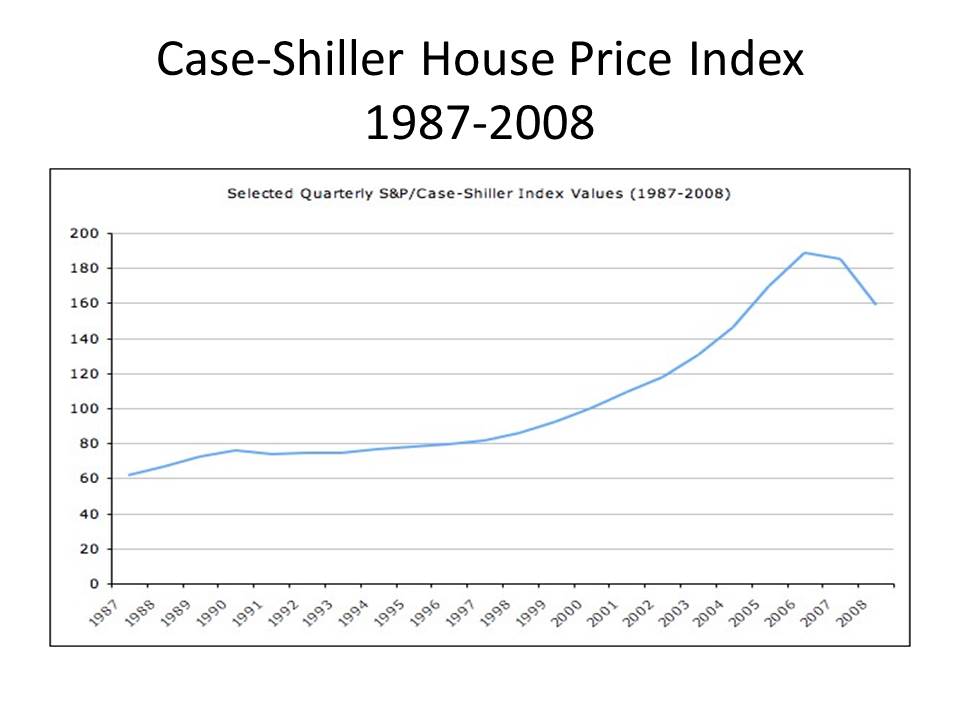
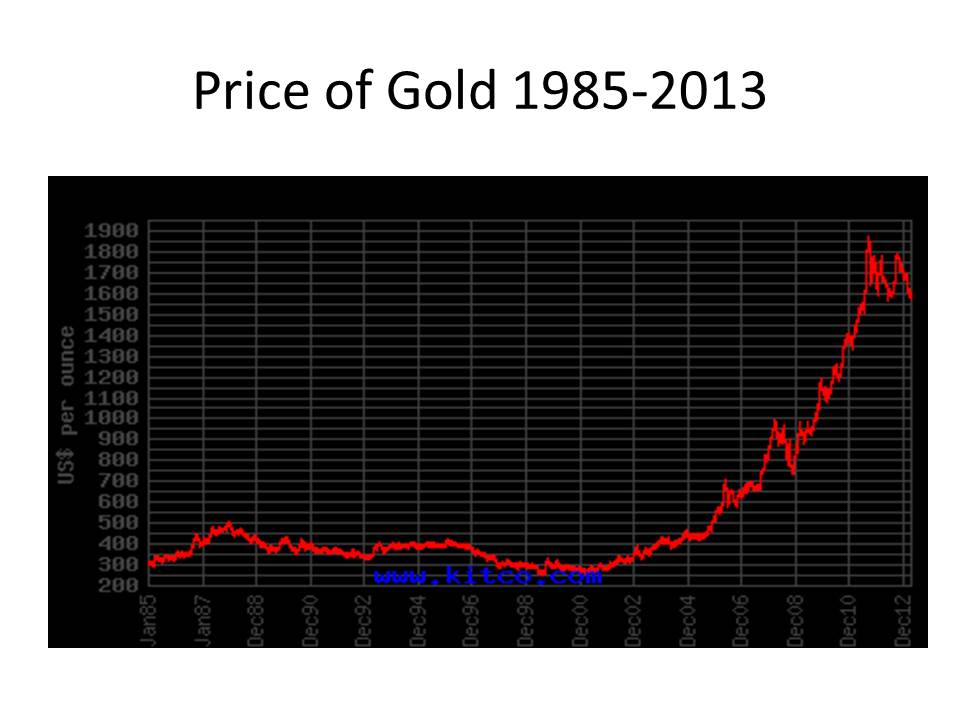
And if you happen to think that the nearly $400 an ounce drop in the price of gold since it peaked in 2011 is no big deal, have a look at these two graphs. The first is the Case-Shiller house price index from 1987 to 2008. The second is the price of gold from 1985 to 2013.

Case-Shiller_1987-2008

gold_1985-2013

Of course now that it is semi-official that the gold bubble has burst, isn’t it time to start looking for someone to blame it on? I mean we blamed Greenspan and Bernanke for the housing bubble, right. There must be someone (or two, or three) to blame for the gold bubble.

Juliet Lapidos, on the editorial page editor’s blog of  the Times, points an accusing finger at Ron Paul, dredging up quotes like this from the sagacious Congressman.

As the fiat money pyramid crumbles, gold retains its luster.  Rather than being the barbarous relic Keynesians have tried to lead us to believe it is, gold is, as the Bundesbank president put it, ‘a timeless classic.’  The defamation of gold wrought by central banks and governments is because gold exposes the devaluation of fiat currencies and the flawed policies of government.  Governments hate gold because the people cannot be fooled by it.

Fooled by gold? No way.

But the honorable Mr. Paul is surely not alone in beating the drums for gold. If he were still alive, it would have been nice to question Murray Rothbard about his role in feeding gold mania. But we still have Rothbard’s partner Lew Rockwell with us, maybe we should ask him for his take on the gold bubble. Indeed, inquiring minds want to know: what is the Austrian explanation for the gold bubble?

Hawtrey and the “Treasury View”

Mention the name Ralph Hawtrey to most economists, even, I daresay to most monetary economists, and you are unlikely to get much more than a blank stare. Some might recognize the name because of it is associated with Keynes, but few are likely to be able to cite any particular achievement or contribution for which he is remembered or worth remembering. Actually, your best chance of eliciting a response about Hawtrey might be to pose your query to an acolyte of Austrian Business Cycle theory, for whom Hawtrey frequently serves as a foil, because of his belief that central banks ought to implement a policy of price-level (actually wage-level) stabilization to dampen the business cycle, Murray Rothbard having described him as “one of the evil genius of the 1920s” (right up there, no doubt, with the likes of Lenin, Trotsky, Stalin and Mussolini). But if, despite the odds, you found someone who knew something about Hawtrey, there’s a good chance that it would be for his articulation of what has come to be known as the “Treasury View.”

The Treasury View was a position articulated in 1929 by Winston Churchill, then Chancellor of the Exchequer in the Conservative government headed by Stanley Baldwin, in a speech to the House of Commons opposing proposals by Lloyd George and the Liberals, supported notably by Keynes, to increase government spending on public-works projects as a way of re-employing the unemployed. Churchill invoked the “orthodox Treasury View” that spending on public works would simply divert an equal amount of private spending on other investment projects or consumption. Spending on public-works projects was justified if and only if the rate of return over cost from those projects was judged to be greater than the rate of return over cost from alternative private spending; public works spending could not be justified as a means by which to put the unemployed back to work. The theoretical basis for this position was an article published by Hawtrey in 1925 “Public Expenditure and the Demand for Labour.”

Exactly how Hawtrey’s position first articulated in a professional economics journal four years earlier became the orthodox Treasury View in March 1929 is far from clear. Alan Gaukroger in his doctoral dissertation on Hawtrey’s career at the Treasury provides much helpful background information. Apparently, Hawtrey’s position was elevated into the “orthodox Treasury View” because Churchill required some authority on which to rely in opposing Liberal agitation for public-works spending which the Conservative government and Churchill’s top Treasury advisers and the Bank of England did not want to adopt for a variety of reason. The “orthodox Treasury View” provided a convenient and respectable doctrinal cover with which to clothe their largely political opposition to public-works spending. This is not to say that Churchill and his advisers were insincere in taking the position that they did, merely that Churchill’s position emerged from on-the-spot political improvisation in the course of which Hawtrey’s paper was dredged up from obscurity rather than from applying any long-standing, well-established, Treasury doctrine. For an illuminating discussion of all this, see chapter 5 (pp. 234-75) of Gaukroger’s dissertation.

I have seen references to the Treasury View for a very long time, probably no later than my first year in graduate school, but until a week or two ago, I had never actually read Hawtrey’s 1925 paper. Brad Delong, who has waged a bit of a campaign against the Treasury View on his blog as part of his larger war against opponents of President Obama’s stimulus program, once left a comment on a post of mine about Hawtrey’s explanation of the Great Depression, asking whether I would defend Hawtrey’s position that public-works spending would not increase employment. I think I responded by pleading ignorance of what Hawtrey had actually said in his 1925 article, but that Hawtrey’s explanation of the Great Depression was theoretically independent of his position about whether public-works spending could increase employment. So in a sense, this post is partly belated reply to Delong’s query.

The first thing to say about Hawtrey’s paper is that it’s hard to understand. Hawtrey is usually a very clear expositor of his ideas, but sometimes I just can’t figure out what he means. His introductory discussion of A. C. Pigou’s position on the wisdom of concentrating spending on public works in years of trade depression was largely incomprehensible to me, but it is worth reading, nevertheless, for the following commentary on a passage from Pigou’s Wealth and Welfare in which Pigou proposed to “pass behind the distorting veil of money.”

Perhaps if Professsor Pigou had carried the argument so far, he would have become convinced that the distorting veil of money cannot be put aside. As well might he play lawn tennis without the distorting veil of the net. All the skill and all the energy emanate from the players and are transmitted through the racket to the balls. The net does nothing; it is a mere limiting condition. So is money.

Employment is given by producers. They produce in response to an effective demand for products. Effective demand means ultimately money, offered by consumers in the market.

A wonderful insight, marvelously phrased, but I can’t really tell, beyond Pigou’s desire to ignore the “distorting veil of money,” how it relates to anything Pigou wrote. At any rate, from here Hawtrey proceeds to his substantive argument, positing “a community in which there is unemployment.” In other words, “at the existing level of prices and wages, the consumers’ outlay [Hawtrey’s term for total spending] is sufficient only to employ a part of the productive resources of the country.” Beyond the bare statement that spending is insufficient to employ all resources at current prices, no deeper cause of unemployment is provided. The problem Hawtrey is going to address is what happens if the government borrows money to spend on new public works?

Hawtrey starts by assuming that the government borrows from private individuals (rather than from the central bank), allowing Hawtrey to take the quantity of money to be constant through the entire exercise, a crucial assumption. The funds that the government borrows therefore come either from that portion of consumer income that would have been saved, in which case they are not available to be spent on whatever private investment projects they would otherwise have financed, or they are taken from idle balances held by the public (the “unspent margin” in Hawtrey’s terminology). If the borrowed funds are obtained from cash held by the public, Hawtrey argues that the public will gradually reduce spending in order to restore their cash holdings to their normal level. Thus, either way, increased government spending financed by borrowing must be offset by a corresponding reduction in private spending. Nor does Hawtrey concede that there will necessarily be a temporary increase in spending, because the public may curtail expenditures to build up their cash balances in anticipation of lending to the government. Moreover, there is always an immediate effect on income from any form of spending (Hawtrey understood the idea of a multiplier effect, having relied on it in his explanation of how an increase in the stock of inventories held by traders in response to a cut in interest rates would produce a cumulative increase in total income and spending), so if government spending on public works reduces spending elsewhere, there is no necessary net increase in total spending even in the short run. Here is how Hawtrey sums up the crux of his argument.

To show why this does not happen, we must go back to consider the hypothesis with which we started. We assumed that no additional bank credits are created. It follows that there is no increase in the supply of the means of payment. As soon as the people employed on the new public works begin to receive payment, they will begin to accumulate cash balances and bank balances. Their balances can only be provided at the expense of the people already receiving incomes. These latter will therefore become short of ready cash and will curtail their expenditures with a view to restoring their balances. An individual can increase his balance by curtailing his expenditure, but if the unspent margin (that is to say, the total of all cash balances and bank balances) remains unchanged, he can only increase his balance at the expense of those of his neighbours. If all simultaneously try to increase their balances, they try in vain. The effect can only be that sales of goods are diminished, and the consumers’ income is reduced as much as the consumers’ outlay. In the end the normal proportion between the consumers’ income and the unspent margin is restored, not by an increase in balances, but by a decrease in incomes. It is this limitation of the unspent margin that really prevents the new Government expenditure from creating employment. (pp. 41-42)

Stated in these terms, the argument suggests another possible mechanism by which government expenditure could increase total income and employment: an increase in velocity. And Hawtrey explicitly recognized it.

There is, however, one possibility which would in certain conditions make the Government operations the means of a real increase in the rapidity of circulation. In a period of depression the rapidity of circulation is low, because people cannot find profitable outlets for their surplus funds and they accumulate idle balances. If the Government comes forward with an attractive gild-edged loan, it may raise money, not merely by taking the place of other possible capital issues, but by securing money that would otherwise have remained idle in balances. (pp. 42-43)

In other words, Hawtrey did indeed recognize the problem of a zero lower bound (in later works he called it a “credit deadlock”) in which the return to holding money exceeds the expected return from holding real capital assets, and that, in such circumstances, government spending could cause aggregate spending and income to increase.

Having established that, absent any increase in cash balances, government spending would have stimulative effects only at the zero lower bound, Hawtrey proceeded to analyze the case in which government spending increased along with an increase in cash balances.

In the simple case where the Government finances its operations by the creation of bank credits, there is no diminution in the consumers’ outlay to set against the new expenditure. It is not necessary for the whole of the expenditure to be so financed. All that is required is a sufficient increase in bank credits to supply balances of cash and credit for those engaged in the new enterprise, without diminishing the balances held by the rest of the community. . . . If the new works are financed by the creation of bank credits, they will give additional employment. (p. 43)

After making this concession, however, Hawtrey added a qualification, which has provoked the outrage of many Keynesians.

What has been shown is that expenditure on public works, if accompanied by a creation of credit, will give employment. But then the same reasoning shows that a creation of credit unaccompanied by any expenditure on public works would be equally effective in giving employment.

The public works are merely a piece of ritual, convenient to people who want to be able to say that they are doing something, but otherwise irrelevant. To stimulate an expansion of credit is usually only too easy. To resort for the purpose to the construction of expensive public works is to burn down the house for the sake of the roast pig.

That applies to the case where the works are financed by credit creation. In the practical application of the policy, however, this part of the programme is omitted. The works are started by the Government at the very moment when the central bank is doing all it can to prevent credit from expanding. The Chinaman burns down his house in emulation of his neighbour’s meal of roast pork, but omits the pig.

Keynesians are no doubt offended by the dismissive reference to public-works spending as “a piece of ritual.” But it is worth recalling the context in which Hawtrey published his paper in 1925 (read to the Economics Club on February 10). Britain was then in the final stages of restoring the prewar dollar-sterling parity in anticipation of formally reestablishing gold convertibility and the gold standard. In order to accomplish this goal, the Bank of England raised its bank rate to 5%, even though unemployment was still over 10%. Indeed, Hawtrey did favor going back on the gold standard, but not at any cost. His view was that the central position of London in international trade meant that the Bank of England had leeway to set its bank rate, and other central banks would adjust their rates to the bank rate in London. Hawtrey may or may not have been correct in assessing the extent of the discretionary power of the Bank of England to set its bank rate. But given his expansive view of the power of the Bank of England, it made no sense to Hawtrey that the Bank of England was setting its bank rate at 5% (historically a rate characterizing periods of “dear money” as Hawtrey demonstrated subsequently in his Century of Bank Rate) in order to reduce total spending, thereby inducing an inflow of gold, while the Government simultaneously initiated public-works spending to reduce unemployment. The unemployment was attributable to the restriction of spending caused by the high bank rate, so the obvious, and most effective, remedy for unemployment was a reduced bank rate, thereby inducing an automatic increase in spending. Given his view of the powers of the Bank of England, Hawtrey felt that the gold standard would take care of itself. But even if he was wrong, he did not feel that restoring the gold standard was worth the required contraction of spending and employment.

From the standpoint of pure monetary analysis, notwithstanding all the bad press that the “Treasury View” has received, there is very little on which to fault the paper that gave birth to the “Treasury View.”

Margaret Thatcher and the Non-Existence of Society

Margaret Thatcher was a great lady, and a great political leader, reversing, by the strength of her character, a ruinous cycle of increasing state control of the British economy imposed in semi-collaboration with the British trade unions. That achievement required not just a change of policy, but a change in the way that the British people thought about the role of the state in organizing and directing economic activity. Mrs. Thatcher’s greatest achievement was not to change this or that policy, but to change the thinking of her countrymen. Leaders who can get others to change their thinking in fundamental ways rarely do so by being subtle; Mrs. Thatcher was not subtle.

Mrs. Thatcher had the great merit of admiring the writings of F. A. Hayek. How well she understood them, I am not in a position to say. But Hayek was a subtle thinker, and I think it is worth considering one instance — a somewhat notorious instance — in which Mrs. Thatcher failed to grasp Hayek’s subtlety. But just to give Mrs. Thatcher her due, it is also worth noting that, though Mrs. Thatcher admired Hayek enormously, she was not at all slavish in her admiration. And so it is only fair to recall that Mrs. Thatcher properly administered a stinging rebuke to Hayek, when he once dared to suggest to her that she could learn from General Pinochet about how to implement pro-market economic reforms.

However, I am sure you will agree that, in Britain with our democratic institutions and the need for a high degree of consent, some of the measures adopted in Chile are quite unacceptable. Our reform must be in line with our traditions and our Constitution. At times the process may seem painfully slow. But I am certain we shall achieve our reforms in our own way and in our own time. Then they will endure.

But Mrs. Thatcher did made the egregious mistake of asserting “there is no such thing as society, just individuals.” Here are two quotations in which the assertion was made.

And, you know, there is no such thing as society. There are individual men and women, and there are families. And no government can do anything except through people, and people must look to themselves first. It’s our duty to look after ourselves and then, also to look after our neighbour. People have got the entitlements too much in mind, without the obligations, because there is no such thing as an entitlement unless someone has first met an obligation.

And,

There is no such thing as society. There is living tapestry of men and women and people and the beauty of that tapestry and the quality of our lives will depend upon how much each of us is prepared to take responsibility for ourselves and each of us prepared to turn round and help by our own efforts those who are unfortunate.

In making that assertion, Mrs. Thatcher may have been inspired by Hayek, who wrote at length about the meaninglessness of the concept of “social justice.” But Hayek’s point was not that “social justice” is meaningless, because there is no such thing as society, but that justice, like democracy, is a concept that has no meaning except as it relates to society, so that adding “social” as a modifier to “justice” or to “democracy” can hardly impart any additional meaning to the concept it is supposed to modify. But the subtlety of Hayek’s reasoning was evidently beyond Mrs. Thatcher’s grasp.

Here’s a wonderful example of Hayek talking about society.

In the last resort we find ourselves constrained to repudiate the ideal of the social concept because it has become the ideal of those who, on principle, deny the existence of a true society and whose longing is for the artificially constructed and the rationally controlled. In this context, it seems to me that a great deal of what today professes to be social is, in the deeper and truer sense of the word, thoroughly and completely anti-social.

Nevertheless, while Mrs. Thatcher undoubtedly made her share of mistakes, on some really important decisions, decisions that really counted for the future of her country, she got things basically right.

Remembering Armen Alchian

On March 23, a memorial service celebrating the life of Armen Alchian was held at UCLA. David Henderson was there and shared some vignettes from the service.

Here is a webpage with pictures from the memorial.

Here is a tribute to Alchian by one of his finest students, Stephen N. S. Cheung. I found this passage especially moving, but follow the link and read the entire eulogy by Cheung.

Back in the old days at UCLA, it was not easy for graduate students to discuss research ideas with Alchian in person.  Most students harbored the impression that he was aloof and not very approachable.  I shared the same view initially, but discovered the contrary later.  The following is a true story.

In early 1967, after finishing the first lengthy chapter of my thesis, I received news from Hong Kong that my elder brother (who was a year older) had passed away.  Understanding that my mother must be shattered by the death of her favorite son, I thought about giving up at UCLA and returning to Hong Kong to be near her.  At that time I was already an assistant professor at the California State University at Long Beach.  I drove back to LA to tell Jack Hirshleifer the sad news and my intention to quit.  Hirshleifer thought that it would be a pity to abandon my dissertation, on which I had already made very good progress.  He then said he would discuss with other members of my thesis committee the possibility of granting me a PhD on the strength of the first long chapter alone.

That afternoon I went to see Alchian, planning to tell him what I told Hirshleifer.  Alchian obviously knew what I had in mind.  But before I had a chance to say anything, he said, “Don’t tell me anything about your personal matters.”  So I left without a word.  One day later in Long Beach, I received a letter from Alchian with a $500 check enclosed and simply two lines: “You can buy candies with this $500 or you can hire a typist to help you finish your dissertation as quickly as possible.”  This $500 was equivalent to my one month’s gross salary, so it was not a small amount.  What other alternatives did I have?  In less than two months I wrapped up my dissertation.  Alchian said it was a miracle.  In retrospect, I regret cashing that check and spending that $500.  If I had kept the check, I could now show it to my children, grandchildren, and students while telling them this proud story.  I know Armen would say, “Steve, put that check up for auction and see how much it would fare now.”

Here is another eulogy from the same website, and another eulogy from that website — in Chinese!

Here are remembrances from some of Alchian’s UCLA colleagues, including David Levine, John Riley and Harold Demsetz.

Here is the obituary about Alchian from the Los Angeles Times.

And finally (for now), here is a video clip of Alchian speaking about property rights.

Hawtrey v. Keynes on the Rate of Interest that Matters

In my previous post, I quoted Keynes’s remark about the “stimulus and useful suggestion” he had received from Hawtrey and the “fundamental sympathy and agreement” that he felt with Hawtrey even though he nearly always disagreed with Hawtrey in detail. One important instance of such simultaneous agreement about principle and disagreement about detail involves their conflicting views about whether it is the short-run rate of interest (bank rate) or the long-run rate of interest (bond rate) that is mainly responsible for the fluctuations in investment that characterize business cycles, the fluctuations that monetary policy should therefore attempt to control.

Already in 1913 in his first work on monetary theory, Good and Bad Trade, Hawtrey had identified the short-term interest rate as the key causal variable in the business cycle, inasmuch as the holdings of inventories that traders want to hold are highly sensitive to the short-term interest rates at which traders borrow to finance those holdings. Increases in the desired inventories induce output increases by manufacturers, thereby generating increased incomes for workers and increased spending by consumers, further increasing the desired holding of stocks by traders. Reduced short-term interest rates, according to Hawtrey, initiated a cumulative process leading to a permanently higher level of nominal income and output. But Keynes disputed whether adjustments in the desired stocks held by traders were of sufficient size to account for the observed fluctuations in income and employment. Instead, Keynes argued, it was fluctuations in fixed-capital investment that accounted for the fluctuations in income and employment characteristic of business cycles. In his retrospective (1969) on the differences between Hawtrey and Keynes, J. R. Hicks observed that “there are large parts of the Treatise [on Money] which are a reply to Currency and Credit Hawtrey’s 1919 book on monetary theory and business cycles. But despite their differences, Hicks emphasized that Hawtrey and Keynes

started from common ground, not only on the need for policy, but in agreement that the instrument of policy was the rate of interest, or “terms of credit,” to be determined, directly or indirectly, by a Central Bank. But what rate of interest? It was Hawtrey’s doctrine that the terms of bank lending had a direct eSect on the activity of trade and industry; traders, having more to pay for credit, would seek to reduce their stocks, being therefore less willing to buy and more willing to sell. Keynes, from the start (or at least from the time of the Treatise 1930) rejected this in his opinion too simple view. He substituted for it (or began by substituting for it) an alternative mechanism through the long rate of interest. A change in the terms of bank lending affected the long rate of interest, the terms on which business could raise long-term capital; only in this roundabout way would a change in the terms of bank lending affect the activity of industry.

I think we can now see, after all that has happened, and has been said, since 1930, that the trouble with both of these views (as they were presented, or at least as they were got over) was that the forces they purported to identify were not strong enough to bear the weight that was put upon them. This is what Keynes said about Hawtrey (I quote from the Treatise):

The whole emphasis is placed on one particular kind of investment, namely, investment by dealers and middlemen in liquid goods-to which a degree of sensitivity to changes in Bank Rate is attributed which certainly does not exist in fact…. [Hawtrey] relies exclusively on the increased costs of business resulting from dearer money. [He] admits that these additional costs will be too small materially to affect the manufacturer, but assumes without investigation that they do materially affect the trader…. Yet probably the question whether he is paying S or 6 per cent for the accommodation he receives from his banker influences the mind of the dealer very little more than it influences the mind of the manufacturer as compared with the current and prospective rate of take-off for the goods he deals in and his expectations as to their prospective price-movements. [Treatise on Money, v. I, pp. 193-95.]

Although Hicks did not do so, it is worth quoting the rest of Keynes’s criticism of Hawtrey

The classical refutation of Hawtrey was given by Tooke in his examination of an argument very similar to Hawtrey’s, put forward nearly a hundred years ago by Joseph Hume. Before the crisis of 1836-37 the partisans of the “currency theory” . . . considered the influence of the Bank of England on the price level only operated through the amount of its circulation; but in 1839 the new-fangled notion was invented that Bank-rate also had an independent influence through its effect on “speculation.”

Keynes then quoted the following passage from Tooke:

There are, doubtless, persons, who, upon imperfect information, and upon insufficient grounds, or with too sanguine a view of contingencies in their favour, speculate improvidently; but their motive or inducement so to speculate is the opinion which, whether well or ill-founded, or whether upon their own view or upon the authority or example of other persons, they entertain the probability of an advance of price. It is not the mere facility of borrowing, or the difference between borrowing at 3 or at 6 percent that supplies the motive for purchasing, or even for selling. Few persons of the description here mentioned ever speculate but upon the confident expectation of an advance of price of at least 10 percent.

In his review of the Treatise, published in The Art of Central Banking, Hawtrey took note of this passage and Keynes’s invocation of Tooke’s comment on Joseph Hume.

This quotation from Tooke is entirely beside the point. My argument relates not to speculators . . . but to regular dealers or merchants. And as to these there is no evidence, in the following passage, that Tooke’s view of the effects of a rise in the rate of interest did not differ very widely from that which I have advocated. In volume v. of his History of Prices (p. 584) he wrote:

Inasmuch as a higher than ordinary rate of interest supposes a contraction of credit, such goods as are held by means of a large proportion of borrowed capital may be forced for sale by a difficulty in obtaining banking accommodation, the measure of which difficulty is in the rate of discount and perhaps in the insufficiency of security. In this view, and in this view only, a rate of interest higher than ordinary may be said to have an influence in depressing prices.

Tooke here concentrates on the effect of a high rate of interest in hastening sales. I should lay more emphasis on delaying purchases. But at any rate he clearly recognizes the susceptibility to credit conditions of the regular dealers in commodities.

And Hicks, after quoting Keynes’s criticism of Hawtrey’s focus on the short-term interest, followed up with following observation about Keynes:

Granted, but could not very much the same be said of Keynes’s own alternative mechanism? One has a feeling that in the years when he was designing the General Theory he was still clinging to it, for it is deeply embedded in the structure of his theory; yet one suspects that before the book left his hands it was already beginning to pass out. It has left a deep mark on the teaching of Keynesian economics, but a much less deep mark upon its practical influence. In the fight that ensued after the publication of the General Theory, it was quite clearly a casualty.

In other words, although Keynes in the Treatise believed that variation in the long-term interest rate could moderate business-cycle fluctuations by increasing or decreasing the amount of capital expenditure by business firms, Keynes in the General Theory was already advocating the direct control of spending through fiscal policy and minimizing the likely effectiveness of trying to control spending via the effect of monetary policy on the long-term interest rate. Hicks then goes on to observe that the most effective response to Keynes’s view that monetary policy operates by way of its effect on the long-term rate of interest came from none other than Hawtrey.

It had taken him some time to mount his attack on Keynes’s “modus operandi of Bank Rate” but when it came it was formidable. The empirical data which Keynes had used to support his thesis were derived from a short period only-the 1920’s; and Hawtrey was able to show that it was only in the first half of that decade (when, in the immediate aftermath of the War, the long rate in England was for that time unusually volatile) that an effect of monetary policy on the long rate, sufficient to give substantial support yo Keynes’s case, was at all readily detectable. Hawtrey took a much longer period. In A Century of Bank Rate which, in spite of the narrowness of its subject, seems to me to be one of his best books, he ploughed through the whole of the British experience from 1844 to the date of writing; and of any effect of Bank Rate (or of any short rate) upon the long rate of interest, sufficient to carry the weight of Keynes’s argument, he found little trace.

On the whole I think that we may infer that Bank Rate and measures of credit restriction taken together rarely, if ever, affected the price of Consols by more than two or three points; whereas a variation of }4 percent in the long-term rate of interest would correspond to about four points in the price of a 3 percent stock.

Now a variation of even less than 1/8 per cent in the long-term rate of interest ought, theoretically and in the long run, to have a definite effect for what it is worth on the volume of capital outlay…. But there is in reality no close adjustment of prospective yield to the rate of interest. Most of the industrial projects offered for exploitation at any time promise yields ever so far above the rate of interest…. [They will not be adopted until] promoters are satisfied that the projects they take up will yield a commensurate profit, and the rate of interest calculated on money raised will probably be no more than a very moderate deduction from this profit. [A Century of Bank Rate pp. 170-71]

Hicks concludes that, as regards the effect of the rate of interest on investment and aggregate spending, Keynes and Hawtrey cancelled each other out, thereby clearing the path for fiscal policy to take over as the key policy instrument for macroeconomic stabilization, a conclusion that Hawtrey never accepted. But Hicks adds an interesting and very modern-sounding (even 40 years on) twist to his argument.

When I reviewed the General Theory, the explicit introduction of expectations was one of the things which I praised; but I have since come to feel that what Keynes gave with one hand, he took away with the other. Expectations do appear in the General Theory, but (in the main) they appear as data; as autonomous influences that come in from outside, not as elements that are moulded in the course of the process that is being analysed. . . .

I would maintain that in this respect Hawtrey is distinctly superior. In his analysis of the “psychological effect” of Bank Rate — it is not just a vague indication, it is analysis — he identifies an element which ought to come into any monetary theory, whether the mechanism with which it is concerned is Hawtrey’s, or any other. . . .

What is essential, on Hawtrey’s analysis, is that it should be possible (and should look as if it were possible) for the Central Bank to take decisive action. There is a world of difference . . . between action which is determinedly directed to imposing restraint, so that it gives the impression that if not effective in itself, it will be followed by further doses of the same medicine; and identically the same action which does not engender the same expectations. Identically the same action may be indecisive, if it appears to be no more than an adjustment to existing market conditions; or if the impression is given that it is the most that is politically possible. If conditions are such that gentle pressure can be exerted in a decisive manner, no more than gentle pressure will, as a rule, be required. But as soon as there is doubt about decisiveness, gentle pressure is useless; even what would otherwise be regarded as violent action may then be ineffective.  [p. 313]

There is a term which was invented, and then spoiled, by Pigou . . . on which I am itching to get my hand; it is the term announcement effect. . . . I want to use the announcement effect of an act of policy to mean the change which takes place in people’s minds, the change in the prospect which they think to be before them, before there is any change which expresses itself in transactions of any kind. It is the same as what Hawtrey calls “psychological effect”; but that is a bad term, for it suggests something irrational, and this is entirely rational. Expectations of the future (entirely rational expectations) [note Hicks’s use of the term “rational expectations before Lucas or Sargent] are based upon the data that are available in the present. An act of policy (if it is what I have called a decisive action) is a significant addition to the data that are available; it should result, and should almost immediately result, in a shift in expectations. This is what I mean by an announcement effect.

What I learn from Hawtrey’s analysis is that the “classical” Bank Rate system was strong, or could be strong, in its announcement effects. Fiscal policy, at least as so far practised, gets from this point of view much worse marks. It is not simply that it is slow, being subject to all sorts of parliamentary and administrative delays; made indecisive, merely because the gap between announcement and effective operation is liable to be so long. This is by no means its only defect. Its announcement effect is poor, for the very reason which is often claimed to be one of its merits its selectivity; for selectivity implies complexity and an instrument which is to have a strong announcement effect should, above all, be simple. [p. 315]

Just to conclude this rather long and perhaps rambling selection of quotes with a tangentially related observation, I will note that Hawtrey’s criticism of Keynes’s identification of the long-term interest rate as the key causal and policy variable for the analysis of business cycles applies with equal force to Austrian business-cycle theory, which, as far as I can tell, rarely, if ever, distinguishes between the effects of changes in short-term and long-term rates caused by monetary policy.

HT: Alan Gaukroger

Keynes v. Hawtrey on British Monetary Policy after Rejoining the Gold Standard

The close, but not always cozy, relationship between Keynes and Hawtrey was summed up beautifully by Keynes in 1929 when, commenting on a paper by Hawtrey, “Money and Index Numbers,” presented to the Royal Statistical Society, Keynes began as follows.

There are very few writers on monetary subjects from whom one receives more stimulus and useful suggestion . . . and I think there are few writers on these subjects with whom I personally feel more fundamental sympathy and agreement. The paradox is that in spite of that, I nearly always disagree in detail with what he says! Yet truly and sincerely he is one of the writers who seems to me to be most nearly on the right track!

The tension between these two friendly rivals was dramatically displayed in April 1930, when Hawtrey gave testimony before the Macmillan Committee (The Committee on Finance and Industry) established after the stock-market crash in 1929 to investigate the causes of depressed economic conditions and chronically high unemployment in Britain. The Committee, chaired by Hugh Pattison Macmillan, included an impressive roster of prominent economists, financiers, civil servants, and politicians, but its dominant figure was undoubtedly Keynes, who was a relentless interrogator of witnesses and principal author of the Committee’s final report. Keynes’s position was that, having mistakenly rejoined the gold standard at the prewar parity in 1925, Britain had no alternative but to follow a policy of high interest rates to protect the dollar-sterling exchange rate that had been so imprudently adopted. Under those circumstances, reducing unemployment required a different kind of policy intervention from reducing the bank rate, which is what Hawtrey had been advocating continuously since 1925.

In chapter 5 of his outstanding doctoral dissertation on Hawtrey’s career at the Treasury, which for me has been a gold mine (no pun intended) of information, Alan Gaukroger discusses the work of the Macmillan Committee, focusing particularly on Hawtrey’s testimony in April 1930 and the reaction to that testimony by the Committee. Especially interesting are the excerpts from Hawtrey’s responses to questions asked by the Committee, mostly by Keynes. Hawtrey’s argument was that despite the overvaluation of sterling, the Bank of England could have reduced British unemployment had it dared to cut the bank rate rather than raise it to 5% in 1925 before rejoining the gold standard and keeping it there, with only very brief reductions to 4 or 4.5% subsequently. Although reducing bank rate would likely have caused an outflow of gold, Hawtrey believed that the gold standard was not worth the game if it could only be sustained at the cost of the chronically high unemployment that was the necessary consequence of dear money. But more than that, Hawtrey believed that, because of London’s importance as the principal center for financing international trade, cutting interest rates in London would have led to a fall in interest rates in the rest of the world, thereby moderating the loss of gold and reducing the risk of being forced off the gold standard. It was on that point that Hawtrey faced the toughest questioning.

After Hawtrey’s first day of his testimony, in which he argued to a skeptical committee that the Bank of England, if it were willing to take the lead in reducing interest rates, could induce a world-wide reduction in interest rates, Hawtrey was confronted by the chairman of the Committee, Hugh Macmillan. Summarizing Hawtrey’s position, Macmillan entered into the following exchange with Hawtrey

MACMILLAN. Suppose . . . without restricting credit . . . that gold had gone out to a very considerable extent, would that not have had very serious consequences on the international position of London?

HAWTREY. I do not think the credit of London depends on any particular figure of gold holding. . . . The harm began to be done in March and April of 1925 [when] the fall in American prices started. There was no reason why the Bank of England should have taken ny action at that time so far as the question of loss of gold is concerned. . . . I believed at the time and I still think that the right treatment would have been to restore the gold standard de facto before it was restored de jure. That is what all the other countries have done. . . . I would have suggested that we should have adopted the practice of always selling gold to a sufficient extent to prevent the exchange depreciating. There would have been no legal obligation to continue convertibility into gold . . . If that course had been adopted, the Bank of England would never have been anxious about the gold holding, they would have been able to see it ebb away to quite a considerable extent with perfect equanimity, and might have continued with a 4 percent Bank Rate.

MACMILLAN. . . . the course you suggest would not have been consistent with what one may call orthodox Central Banking, would it?

HAWTREY. I do not know what orthodox Central Banking is.

MACMILLAN. . . . when gold ebbs away you must restrict credit as a general principle?

HAWTREY. . . . that kind of orthodoxy is like conventions at bridge; you have to break them when the circumstances call for it. I think that a gold reserve exists to be used. . . . Perhaps once in a century the time comes when you can use your gold reserve for the governing purpose, provided you have the courage to use practically all of it. I think it is possible that the situation arose in the interval between the return to the gold standard . . . and the early part of 1927 . . . That was the period at which the greater part of the fall in the [international] price level took place. [Gaukroger, p. 298]

Somewhat later, Keynes began his questioning.

KEYNES. When we returned to the gold standard we tried to restore equilibrium by trying to lower prices here, whereas we could have used our influence much more effectively by trying to raise prices elsewhere?

HAWTREY. Yes.

KEYNES . . . I should like to take the argument a little further . . . . the reason the method adopted has not been successful, as I understand you, is partly . . . the intrinsic difficulty of . . . [reducing] wages?

HAWTREY. Yes.

KEYNES. . . . and partly the fact that the effort to reduce [prices] causes a sympathetic movement abroad . . .?

HAWTREY. Yes.

KEYNES. . . . you assume a low Bank Rate [here] would have raised prices elsewhere?

HAWTREY. Yes.

KEYNES. But it would also, presumably, have raised [prices] here?

HAWTREY. . . . what I have been saying . . . is aimed primarily at avoiding the fall in prices both here and abroad. . . .it is possible there might have been an actual rise in prices here . . .

KEYNES. One would have expected our Bank Rate to have more effect on our own price level than on the price level of the rest of the world?

HAWTREY. Yes.

KEYNES. So, in that case . . . wouldn’t dear money have been more efficacious . . . in restoring equilibrium between home and foreign price . . .?

HAWTREY. . . .the export of gold itself would have tended to produce equilibrium. It depends very much at what stage you suppose the process to be applied.

KEYNES. . . . so cheap money here affects the outside world more than it affects us, but dear money here affects us more than it affects the outside world.

HAWTREY. No. My suggestion is that through cheap money here, the export of gold encourages credit expansion elsewhere, but the loss of gold tends to have some restrictive effect on credit here.

KEYNES. But this can only happen if the loss of gold causes a reversal of the cheap money policy?

HAWTREY. No, I think that the export of gold has some effect consistent with cheap money.

In his questioning, Keynes focused on an apparent asymmetry in Hawtrey’s argument. Hawtrey had argued that allowing an efflux of gold would encourage credit expansion in the rest of the world, which would make it easier for British prices to adjust to a rising international price level rather than having to fall all the way to a stable or declining international price level. Keynes countered that, even if the rest of the world adjusted its policy to the easier British policy, it was not plausible to assume that the effect of British policy would be greater on the international price level than on the internal British price level. Thus, for British monetary policy to facilitate the adjustment of the internal British price level to the international price level, cheap money would tend to be self-defeating, inasmuch as cheap money would tend to raise British prices faster than it raised the international price level. Thus, according to Keynes, for monetary policy to close the gap between the elevated internal British price level and the international price level, a dear-money policy was necessary, because dear money would reduce British internal prices faster than it reduced international prices.

Hawtrey’s response was that the export of gold would induce a policy change by other central banks. What Keynes called a dear-money policy was the status quo policy in which the Bank of England was aiming to maintain its current gold reserve. Under Hawtrey’s implicit central-bank reaction function, dear money (i.e., holding Bank of England gold reserves constant) would induce no reaction by other central banks. However, an easy-money policy (i.e., exporting Bank of England gold reserves) would induce a “sympathetic” easing of policy by other central banks. Thus, the asymmetry in Hawtrey’s argument was not really an asymmetry, because, in the context of the exchange between Keynes and Hawtrey, dear money meant keeping Bank of England gold reserves constant, while easy money meant allowing the export of gold. Thus, only easy money would induce a sympathetic response from other central banks. Unfortunately, Hawtrey’s response did not explain that the asymmetry identified by Keynes was a property not of Hawtrey’s central-bank reaction function, but of Keynes’s implicit definitions of cheap and dear money. Instead, Hawtrey offered a cryptic response about “the loss of gold tend[ing] to have some restrictive effect on credit” in Britain.

The larger point is that, regardless of the validity of Hawtrey’s central-bank reaction function as a representation of the role of the Bank of England in the international monetary system under the interwar gold standard, Hawtrey’s model of how the gold standard operated was not called into question by this exchange. It is not clear from the exchange whether Keynes was actually trying to challenge Hawtrey on his model of the international monetary system or was just trying to cast doubt on Hawtrey’s position that monetary policy was, on its own, a powerful enough instrument to have eliminated unemployment in Britain without adopting any other remedial policies, especially Keynes’s preferred policy of public works. As the theoretical source of the Treasury View that public works were incapable of increasing employment without monetary expansion, it is entirely possible that that was Keynes’s ultimate objective. However, with the passage of time, Keynes drifted farther and farther away from the monetary model that, in large measure, he shared with Hawtrey in the 1920s and the early 1930s.

Keynes and Hawtrey: The General Theory

Before pausing for an interlude about the dueling reviews of Hayek and Hawtrey on each other’s works in the February 1932 issue of Economica, I had taken my discussion of the long personal and professional relationship between Hawtrey and Keynes through Hawtrey’s review of Keynes’s Treatise on Money. The review was originally written as a Treasury document for Hawtrey’s superiors at the Treasury (and eventually published in slightly revised form as chapter six of The Art of Central Banking), but Hawtrey sent it almost immediately to Keynes. Although Hawtrey subjected Keynes’s key analytical result in the Treatise — his fundamental equations, relating changes in the price level to the difference between savings and investment — to sharp criticism, Keynes responded to Hawtrey’s criticisms with (possibly uncharacteristic) good grace, writing back to Hawtrey: “it is very seldom indeed that an author can expect to get as a criticism anything so tremendously useful to himself,” adding that he was “working it out all over again.” What Keynes was working out all over again of course eventually evolved into his General Theory.

Probably because Keynes had benefited so much from Hawtrey’s comments on and criticisms of the Treatise, which he received only shortly before delivering the final draft to the publisher, Keynes began sending Hawtrey early drafts of the General Theory instead of waiting, as he had when writing the Treatise, till the book was almost done. There was thus a protracted period of debate and argument between Keynes and Hawtrey over the General Theory, a process that clearly frustrated and annoyed Keynes, though he never actually terminated the discussion with Hawtrey. “Hawtrey,” Keynes wrote to his wife in 1933, “was very sweet to the last but quite mad. One can argue with him a long time on a perfectly sane and interesting basis and then, suddenly, one is in a madhouse.” On the accuracy of that characterization, I cannot comment, but clearly the two Cambridge Apostles were failing to communicate.

The General Theory was published in February 1936, and hardly a month had passed before Hawtrey shared his thoughts about the General Theory with his Treasury colleagues. (Hawtrey subsequently published the review in his collection of essays Capital and Employment.) Hawtrey began by expressing his doubts about Keynes’s attempt to formulate an alternative theory of interest based on liquidity preference in place of the classical theory based on time preference and productivity.

According to [Keynes], the rate of interest is to be regarded not as the reward of abstaining from consumption or of “waiting”, but as the reward of forgoing liquidity. By tying up their savings in investments people forgo liquidity, and the extent to which they are willing to do so will depend on the rate of interest. Anyone’s “liquidity preference” is a function relating the amount of his resources which he will wish ot retain in the form of money to different sets of circumstances, and among those circumstances will be the rate of interest. . . . The supply of money determines the rate of interest, and the rate of interest so determined governs the volume of capital outlay.

As in his criticism of the fundamental equations of the Treatise, Hawtrey was again sharply critical of Keynes’s tendency to argue from definitions rather than from causal relationships.

[A]n essential step in [Keynes’s] train of reasoning is the proposition that investment an saving are necessarily equal. That proposition Mr. Keynes never really establishes; he evades the necessity doing so by defining investment and saving as different names for the same thing. He so defines income to be the same thing as output, and therefore, if investment is the excess of output over consumption, and saving is the excess of income over consumption, the two are identical. Identity so established cannot prove anything. The idea that a tendency for investment and saving to become different has to be counteracted by an expansion or contraction of the total of incomes is an absurdity; such a tendency cannot strain the economic system, it can only strain Mr. Keynes’s vocabulary. [quoted by Alan Gaukroger “The Director of Financial Enquiries A Study of the Treasury Career of R. G. Hawtrey, 1919-1939.” pp. 507-08]

But despite the verbal difference between them, Keynes and Hawtrey held a common view that the rate of interest might be too high to allow full employment. Keynes argued that liquidity preference could prevent monetary policy from reducing the rate of interest to a level at which there would be enough private investment spending to generate full employment. Hawtrey held a similar view, except that, according to Hawtrey, the barrier to a sufficient reduction in the rate of interest to allow full employment was not liquidity preference, but a malfunctioning international monetary system under a gold-standard, or fixed-exchange rate, regime. For any country operating under a fixed-exchange-rate or balance-of-payments constraint, the interest rate has to be held at a level consistent with maintaining the gold-standard parity. But that interest rate depends on the interest rates that other countries are setting. Thus, a country may find itself in a situation in which the interest rate consistent with full employment is inconsistent with maintaining its gold-standard parity. Indeed all countries on a gold standard or a fixed exchange rate regime may have interest rates too high for full employment, but each one may feel that it can’t reduce its own interest rate without endangering its exchange-rate parity.

Under the gold standard in the 1920s and 1930s, Hawtrey argued, interest rates were chronically too high to allow full employment, and no country was willing to risk unilaterally reducing its own interest rates, lest it provoke a balance-of-payments crisis. After the 1929 crash, even though interest rates came down, they came down too slowly to stimulate a recovery, because no country would cut interest rates as much and as fast as necessary out of fear doing so would trigger a currency crisis. From 1925, when Britain rejoined the gold standard, to 1931 when Britain left the gold standard, Hawtrey never stopped arguing for lower interest rates, because he was convinced that credit expansion was the only way to increase output and employment. The Bank of England would lose gold, but Hawtrey argued that the point of a gold reserve was to use it when it was necessary. By emitting gold, the Bank of England would encourage other countries to ease their monetary policies and follow England in reducing their interest rates. That, at any rate, is what Hawtrey hoped would happen. Perhaps he was wrong in that hope; we will never know. But even if he was, the outcome would certainly not have been any worse than what resulted from the policy that Hawtrey opposed.

To the contemporary observer, the sense of déjà vu is palpable.

Hayek v. Hawtrey on the Trade Cycle

While searching for material on the close and multi-faceted relationship between Keynes and Hawtrey which I am now studying and writing about, I came across a remarkable juxtaposition of two reviews in the British economics journal Economica, published by the London School of Economics. Economica was, after the Economic Journal published at Cambridge (and edited for many years by Keynes), probably the most important economics journal published in Britain in the early 1930s. Having just arrived in Britain in 1931 to a spectacularly successful debut with his four lectures at LSE, which were soon published as Prices and Production, and having accepted the offer of a professorship at LSE, Hayek began an intense period of teaching and publishing, almost immediately becoming the chief rival of Keynes. The rivalry had been more or less officially inaugurated when Hayek published the first of his two-part review-essay of Keynes’s recently published Treatise on Money in the August 1931 issue of Economica, followed by Keynes’s ill-tempered reply and Hayek’s rejoinder in the November 1931 issue, with the second part of Hayek’s review appearing in the February 1932 issue.

But interestingly in the same February issue containing the second installment of Hayek’s lengthy review essay, Hayek also published a short (2 pages, 3 paragraphs) review of Hawtrey’s Trade Depression and the Way Out immediately following Hawtrey’s review of Hayek’s Prices and Production in the same issue. So not only was Hayek engaging in controversy with Keynes, he was arguing with Hawtrey as well. The points at issue were similar in the two exchanges, but there may well be more to learn from the lower-key, less polemical, exchange between Hayek and Hawtrey than from the overheated exchange between Hayek and Keynes.

So here is my summary (in reverse order) of the two reviews:

Hayek on Trade Depression and the Way Out.

Hayek, in his usual polite fashion, begins by praising Hawtrey’s theoretical eminence and skill as a clear expositor of his position. (“the rare clarity and painstaking precision of his theoretical exposition and his very exceptional knowledge of facts making anything that comes from his pen well worth reading.”) However, noting that Hawtrey’s book was aimed at a popular rather than a professional audience, Hayek accuses Hawtrey of oversimplification in attributing the depression to a lack of monetary stimulus.

Hayek proceeds in his second paragraph to explain what he means by oversimplification. Hayek agrees that the origin of the depression was monetary, but he disputes Hawtrey’s belief that the deflationary shocks were crucial.

[Hawtrey’s] insistence upon the relation between “consumers’ income” and “consumers’ outlay” as the only relevant factor prevents him from seeing the highly important effects of monetary causes upon the capitalistic structure of production and leads him along the paths of the “purchasing power theorists” who see the source of all evil in the insufficiency of demand for consumers goods. . . . Against all empirical evidence, he insists that “the first symptom of contracting demand is a decline in sales to the consumer or final purchaser.” In fact, of course, depression has always begun with a decline in demand, not for consumers’ goods but for capital goods, and the one marked phenomenon of the present depression was that the demand for consumers’ goods was very well maintained for a long while after the crisis occurred.

Hayek’s comment seems to me to misinterpret Hawtrey slightly. Hawtrey wrote “a decline in sales to the consumer or final purchaser,” which could refer to a decline in the sales of capital equipment as well as the sales of consumption goods, so Hawtrey’s assertion was not necessarily inconsistent with Hayek’s representation about the stability of consumption expenditure immediately following a cyclical downturn. It would also not be hard to modify Hawtrey’s statement slightly; in an accelerator model, with which Hawtrey was certainly familiar, investment depends on the growth of consumption expenditures, so that a leveling off of consumption, rather than an actual downturn in consumption, would suffice to trigger the downturn in investment which, according to Hayek, was a generally accepted stylized fact characterizing the cyclical downturn.

Hayek continues:

[W]hat Mr. Hawtrey, in common with many other English economists [I wonder whom Hayek could be thinking of], lacks is an adequate basic theory of the factors which affect [the] capitalistic structure of production.

Because of Hawtrey’s preoccupation with the movements of the overall price level, Hayek accuses Hawtrey of attributing the depression solely “to a process of deflation” for which the remedy is credit expansion by the central banks. [Sound familiar?]

[Hawtrey] seems to extend [blame for the depression] on the policy of the Bank of England even to the period before 1929, though according to his own criterion – the rise in the prices of the original factors of production [i.e., wages] – it is clear that, in that period, the trouble was too much credit expansion. “In 1929,” Mr. Hawtrey writes, “when productive activity was at its highest in the United States, wages were 120 percent higher than in 1913, while commodity prices were only 50 percent higher.” Even if we take into account the fact that the greater part of this rise in wages took place before 1921, it is clear that we had much more credit expansion before 1929 than would have been necessary to maintain the world-wage-level. It is not difficult to imagine what would have been the consequences if, during that period, the Bank of England had followed Mr. Hawtrey’s advice and had shown still less reluctance to let go. But perhaps, this would have exposed the dangers of such frankly inflationist advice quicker than will now be the case.

A remarkable passage indeed! To accuse Hawtrey of toleration of inflation, he insinuates that the 50% rise in wages from 1913 to 1929, was at least in part attributable to the inflationary policies Hawtrey was advocating. In fact, I believe that it is clear, though I don’t have easy access to the best data source C. H. Feinstein’s “Changes in Nominal Wages, the Cost of Living, and Real Wages in the United Kingdom over Two Centuries, 1780-1990,” in Labour’s Reward edited by P. Schoillers and V. Zamagni (1995). From 1922 to 1929 the overall trend of nominal wages in Britain was actually negative. Hayek’s reference to “frankly inflationist advice” was not just wrong, but wrong-headed.

Hawtrey on Prices and Production

Hawtrey spends the first two or three pages or so of his review giving a summary of Hayek’s theory, explaining the underlying connection between Hayek and the Bohm-Bawerkian theory of production as a process in time, with the length of time from beginning to end of the production process being a function of the rate of interest. Thus, reducing the rate of interest leads to a lengthening of the production process (average period of production). Credit expansion financed by bank lending is the key cyclical variable, lengthening the period of production, but only temporarily.

The lengthening of the period of production can only take place as long as inflation is increasing, but inflation cannot increase indefinitely. When inflation stops increasing, the period of production starts to contract. Hawtrey explains:

Some intermediate products (“non-specific”) can readily be transferred from one process to another, but others (“specific”) cannot. These latter will no longer be needed. Those who have been using them, and still more those who have producing them, will be thrown out of employment. And here is the “explanation of how it comes about at certain times that some of the existing resources cannot be used.” . . .

The originating cause of the disturbance would therefore be the artificially enhanced demand for producers’ goods arising when the creation of credit in favour of producers supplements the normal flow savings out of income. It is only because the latter cannot last for ever that the reaction which results in under-employment occurs.

But Hawtrey observes that only a small part of the annual capital outlay is applied to lengthening the period of production, capital outlay being devoted mostly to increasing output within the existing period of production, or to enhancing productivity through the addition of new plant and equipment embodying technical progress and new inventions. Thus, most capital spending, even when financed by credit creation, is not associated with any alteration in the period of production. Hawtrey would later introduce the terms capital widening and capital deepening to describe investments that do not affect the period of production and those that do affect it. Nor, in general, are capital-deepening investments the most likely to be adopted in response to a change in the rate of interest.

Similarly, If the rate of interest were to rise, making the most roundabout processes unprofitable, it does not follow that such processes will have to be scrapped.

A piece of equipment may have been installed, of which the yield, in terms of labour saved, is 4 percent on its cost. If the market rate of interest rises to 5 percent, it would no longer be profitable to install a similar piece. But that does not mean that, once installed, it will be left idle. The yield of 4 percent is better than nothing. . . .

When the scrapping of plant is hastened on account of the discovery of some technically improved process, there is a loss not only of interest but of the residue of depreciation allowance that would otherwise have accumulated during its life of usefulness. It is only when the new process promises a very suitable gain in efficiency that premature scrapping is worthwhile. A mere rise in the rate of interest could never have that effect.

But though a rise in the rate of interest is not likely to cause the scrapping of plant, it may prevent the installation of new plant of the kind affected. Those who produce such plant would be thrown out of employment, and it is this effect which is, I think, the main part of Dr. Hayek’s explanation of trade depressions.

But what is the possible magnitude of the effect? The transition from activity to depression is accompanied by a rise in the rate of interest. But the rise in the long-term rate is very slight, and moreover, once depression has set in, the long-term rate is usually lower than ever.

Changes are in any case perpetually occurring in the character of the plant and instrumental goods produced for use in industry. Such changes are apt to throw out of employment any highly specialized capital and labour engaged in the production of plant which becomes obsolete. But among the causes of obsolescence a rise in the rate of interest is certainly one of the least important and over short periods it may safely be said to be quite negligible.

Hawtrey goes on to question Hayek’s implicit assumption that the effects of the depression were an inevitable result of stopping the expansion of credit, an assumption that Hayek disavowed much later, but it was not unreasonable for Hawtrey to challenge Hayek on this point.

It is remarkable that Dr. Hayek does not entertain the possibility of a contraction of credit; he is content to deal with the cessation of further expansion. He maintains that at a time of depression a credit expansion cannot provide a remedy, because if the proportion between the demand for consumers’ goods and the demand for producers’ goods “is distorted by the creation of artificial demand, it must mean that part of the available resources is again led into a wrong direction and a definite and lasting adjustment is again postponed.” But if credit being contracted, the proportion is being distorted by an artificial restriction of demand.

The expansion of credit is assumed to start by chance, or at any rate no cause is suggested. It is maintained because the rise of prices offers temporary extra profits to entrepreneurs. A contraction of credit might equally well be assumed to start, and then to be maintained because the fall of prices inflicts temporary losses on entrepreneurs, and deters them from borrowing. Is not this to be corrected by credit expansion?

Dr. Hayek recognizes no cause of under-employment of the factors of production except a change in the structure of production, a “shortening of the period.” He does not consider the possibility that if, through a credit contraction or for any other reason, less money altogether is spent on intermediate products (capital goods), the factors of production engaged in producing these products will be under-employed.

Hawtrey then discusses the tension between Hayek’s recognition that the sense in which the quantity of money should be kept constant is the maintenance of a constant stream of money expenditure, so that in fact an ideal monetary policy would adjust the quantity of money to compensate for changes in velocity. Nevertheless, Hayek did not feel that it was within the capacity of monetary policy to adjust the quantity of money in such a way as to keep total monetary expenditure constant over the course of the business cycle.

Here are the concluding two paragraphs of Hawtrey’s review:

In conclusion, I feel bound to say that Dr. Hayek has spoiled an original piece of work which might have been an important contribution to monetary theory, by entangling his argument with the intolerably cumbersome theory of capital derived from Jevons and Bohm-Bawerk. This theory, when it was enunciated, was a noteworthy new departure in the metaphysics of political economy. But it is singularly ill-adapted for use in monetary theory, or indeed in any practical treatment of the capital market.

The result has been to make Dr. Hayek’s work so difficult and obscure that it is impossible to understand his little book of 112 pages except at the cost of many hours of hard work. And at the end we are left with the impression, not only that this is not a necessary consequence of the difficulty of the subject, but that he himself has been led by so ill-chosen a method of analysis to conclusions which he would hardly have accepted if given a more straightforward form of expression.
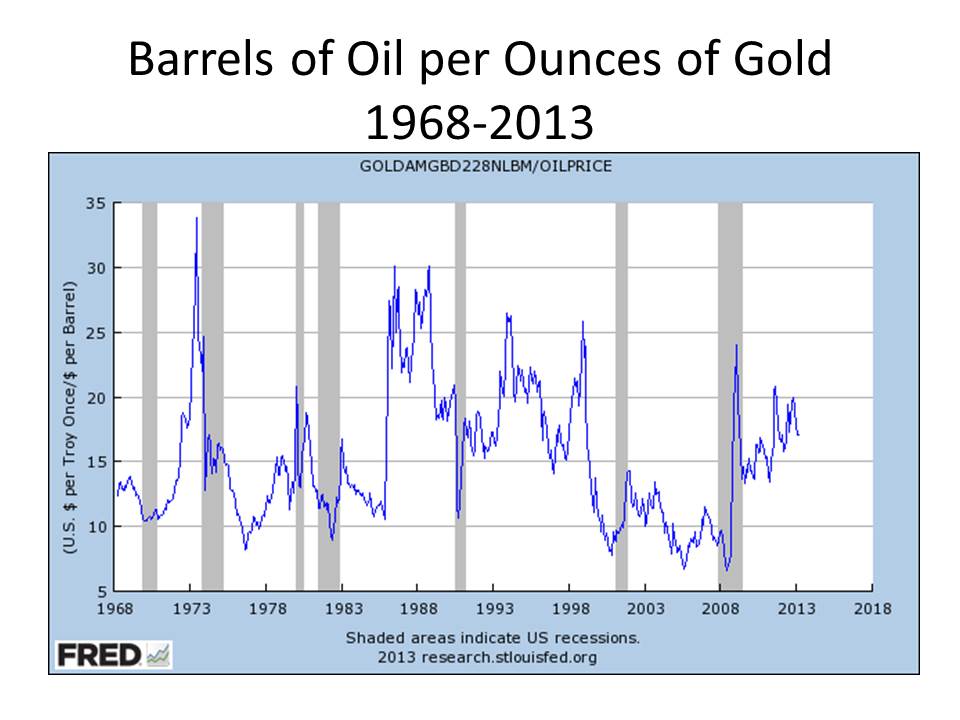

About Me

David Glasner
Washington, DC

I am an economist in the Washington DC area. My research and writing has been mostly on monetary economics and policy and the history of economics. In my book Free Banking and Monetary Reform, I argued for a non-Monetarist non-Keynesian approach to monetary policy, based on a theory of a competitive supply of money. Over the years, I have become increasingly impressed by the similarities between my approach and that of R. G. Hawtrey and hope to bring Hawtrey’s unduly neglected contributions to the attention of a wider audience.

My new book Studies in the History of Monetary Theory: Controversies and Clarifications has been published by Palgrave Macmillan

Follow me on Twitter @david_glasner

Archives

Enter your email address to follow this blog and receive notifications of new posts by email.

Join 665 other subscribers
Follow Uneasy Money on WordPress.com