Archive Page 33

Can There Really Be an Excess Supply of Commercial Bank Money?

Nick Rowe has answered the question in the affirmative. Nick mistakenly believes that I have argued that there cannot be an excess supply of commercial bank money. In fact, I agree with him that there can be an excess supply of commercial bank money, and, for that matter, that there can be an excess demand for commercial bank money. Our disagreement concerns a slightly different, but nonetheless important, question: is there a market mechanism whereby an excess supply of commercial bank money can be withdrawn from circulation, or is the money destined to remain forever in circulation, because, commercial bank money, once created, must ultimately be held, however unwillingly, by someone? That’s the issue. I claim that there is a market mechanism that tends to equilibrate the quantity of bank money created with the amount demanded, so that if too much bank money is created, the excess will tend to be withdrawn from circulation without generating an increase in total expenditure. Nick denies that there is any such mechanism.

Nick and I have been discussing this point for about two and a half years, and every time I think we inch a bit closer to agreement, it seems that the divide separating us seems unbridgeable. But I’m not ready to give up yet. On the other hand, James Tobin explained it all over 50 years ago (when the idea seemed so radical it was called the New View) in his wonderful, classic (I don’t have enough adjectives superlatives to do it justice) paper “Commercial Banks and Creators of Money.” And how can I hope to improve on Tobin’s performance? (Actually there was a flaw in Tobin’s argument, which was not to recognize a key distinction between the inside (beta) money created by banks and the outside (alpha) money created by the monetary authority, but that has nothing to do with the logic of Tobin’s argument about commercial banks.)

Message to Nick: You need to write an article (a simple blog post won’t do, but it would be a start) explaining what you think is wrong with Tobin’s argument. I think that’s a hopeless task, but I’m sorry that’s the challenge you’ve chosen for yourself. Good luck, you’ll need it.

With that introduction out of the way, let me comment directly on Nick’s post. Nick has a subsequent post defending both the Keynesian multiplier and the money multiplier. I reserve the right (but don’t promise) to respond to that post at a later date; I have my hands full with this post. Here’s Nick:

Commercial banks are typically beta banks, and central banks are typically alpha banks. Beta banks promise to convert their money into the money of alpha banks at a fixed exchange rate. Alpha banks make no such promise the other way. It’s asymmetric redeemability. This means there cannot be an excess supply of beta money in terms of alpha money. (Nor can there be an excess demand for alpha money in terms of beta money.) Because people would convert their beta money into alpha money if there were. But there can be an excess supply of beta money in terms of goods, just as there can be an excess supply of alpha money in terms of goods. If beta money is in excess supply in terms of goods, so is alpha money, and vice versa. If commercial and central bank monies are perfect or imperfect substitutes, an increased supply of commercial bank money will create an excess supply of both monies against goods. The Law of Reflux will not prevent this.

The primary duty of a central bank is not to make a profit. It is possible to analyze and understand its motivations and its actions in terms of policy objectives that do not reflect the economic interests of its immediate owners. On the other hand, commercial banks are primarily in business to make a profit, and it should be possible to explain their actions in terms of their profit-enhancing effects. As I follow Nick’s argument, I will try to point where I think Nick fails to keep this distinction in mind. Back to Nick:

Money, the medium of exchange, is not like other goods, because if there are n goods plus one money, there are n markets in which money is traded, and n different excess supplies of money. Money might be in excess supply in the apple market, and in excess demand in the banana market.

If there are two monies, and n other goods, there are n markets in which money is traded against goods, plus one market in which the two monies are traded for each other. If beta money is convertible into alpha money, there can never be an excess supply of beta money in the one market where beta money is traded for alpha money. But there can be an excess supply of both beta and alpha money in each or all of the other n markets.

Sorry, I don’t understand this at all. First of all, to be sure, there can be n different excess demands for money; some will be positive, some negative. But it is entirely possible that the sum of those n different excess demands is zero. Second, even if we assume that the n money excess demands don’t sum to zero, there is still another market, the (n+1)st market in which the public exchanges assets that provide money-backing services with the banking system. If there is an excess demand for money, the public can provide the banks with additional assets (IOUs) in exchange for money, and if there is an excess supply of money the public can exchange their excess holding of money with the banks in return for assets providing money-backing services. The process is equilibrated by adjustments in the spreads between interests on loans and deposits governing the profitability of the banks loans and deposits. This is what I meant in the first paragraph when I said that I agree that it is possible for there to an excess demand for or supply of beta money. But the existence of that excess demand or excess supply can be equilibrated via the equilibration of market for beta money and the market for assets (IOUs) providing money-backing services. If there is a market process equilibrating the quantity of beta money, the adjustment can take place independently of the n markets for real goods and services that Nick is concerned with. On the other hand, if there is an excess demand for or supply of alpha money, it is not so clear that there are any market forces that cause that excess demand or supply to be equilibrated without impinging on the n real markets for goods and services.

Nick goes on to pose the following question:

Start in equilibrium, where the existing stocks of both alpha and beta money are willingly held. Hold constant the stock of alpha money. Now suppose the issuers of beta money create more beta money. Could this cause an excess supply of money and an increase in the price level?

That’s a great question. Just the question that I would ask. Here’s how Nick looks at it:

If alpha and beta money were perfect substitutes for each other, people would be indifferent about the proportions of alpha to beta monies they held. The desired share or ratio of alpha/beta money would be indeterminate, but the desired total of alpha+beta money would still be well-defined. If beta banks issued more beta money, holding constant the stock of alpha money, the total stock of money would be higher than desired, and there would be an excess supply of both monies against all other goods. But no individual would choose to go to the beta bank to convert his beta money into alpha money, because, by assumption, he doesn’t care about the share of alpha/beta money he holds. The Law of Reflux will not work to eliminate the excess supply of alpha+beta money against all other goods.

The assumption of perfect substitutability doesn’t seem right, as Nick himself indicates, inasmuch as people don’t seem to be indifferent between holding currency (alpha money) and holding deposits (beta money). And Nick focuses mainly on the imperfect-substitutes case. But, aside from that point, I have another problem with Nick’s discussion of perfect substitutes, which is that he seems to be conflate the assumption that alpha and beta moneys are perfect substitutes with the assumption that they are indistinguishable. I may be indifferent between holding currency and deposits, but if I have more deposits than I would like to hold, and I can tell the difference between a unit of currency and a deposit and there is a direct mechanism whereby I can reduce my holdings of deposits – by exchanging the deposit at the bank for another asset – it would seem that there is a mechanism whereby the excess supply of deposits can be eliminated without any change in overall spending. Now let’s look at Nick’s discussion of the more relevant case in which currency and deposits are imperfect substitutes.

Now suppose that alpha and beta money are close but imperfect substitutes. If beta banks want to prevent the Law of Reflux from reducing the stock of beta money, they would need to make beta money slightly more attractive to hold relative to alpha money. Suppose they do that, by paying slightly higher interest on beta money. This ensures that the desired share of alpha/beta money equals the actual share. No individual wants to reduce his share of beta/alpha money. But there will be an excess supply of both alpha and beta monies against all other goods. If apples and pears are substitutes, an increased supply of pears reduces the demand for apples.

What does it mean for “beta banks to want to prevent the Law of Reflux from reducing the stock of beta money?” Why would beta banks want to do such a foolish thing? Banks want to make profits for their owners. Does Nick think that by “prevent[ing] the Law of Reflux from reducing the stock of beta money” beta banks are increasing their profitability? The method by which he suggests that they could do this is to increase the interest they pay on deposits? That does not seem to me an obvious way of increasing the profits of beta banks. So starting from what he called an equilibrium, which sounds like a position in which beta banks were maximizing their profits, Nick is apparently positing that they increased the amount of deposits beyond the profit-maximizing level and, then, to keep that amount of deposits outstanding, he assumes that the banks increase the interest that they are paying on deposits.

What does this mean? Is Nick saying something other than that if banks collectively decide on a course of action that is not profit-maximizing either individually or collectively that the outcome will be different from the outcome that would have resulted had they acted with a view to maximize profits? Why should anyone be interested in that observation? At any rate, Nick concludes that because the public would switch from holding currency to deposits, the result would be an increase in total spending, as people tried to reduce their holdings of currency. It is not clear to me that people would be trying to increase their spending by reducing their holdings of deposits, but I can see that there is a certain ambiguity in trying to determine whether there is an excess supply of deposits or not in this case. But the case seems very contrived to say the least.

A more plausible way to look at the case Nick has in mind might be the following. Suppose banks perceive that their (marginal) costs of intermediation have fallen. Intermediation costs are very hard to measure, and banks aren’t necessarily very good at estimating those costs either. That may be one reason for the inherent instability of credit, but that’s a whole other discussion. At any rate, under the assumption that marginal intermediation costs have fallen, one could posit that the profit-maximizing response of beta banks would be to increase their interest payments on deposits to support an increase in their, suddenly more profitable than heretofore, lending. With bank deposits now yielding higher interest than before, the public would switch some of their holdings of currency to deposits. The shift form holding currency to holding deposits would initially involve an excess demand for deposits and an excess supply of currency. If the alpha bank was determined not to allow the quantity of currency to fall, then the excess supply of currency could be eliminated only through an increase in spending that would raise prices sufficiently to increase the demand to hold currency. But Nick would apparently want to say that even in this case there was also an excess supply of deposits, even though we saw that initially there was an excess demand for deposits when banks increased the interest paid on deposits, and it was only because the alpha bank insisted on not allowing the quantity of currency to fall that there was any increase in total spending.

So, my conclusion remains what it was before. The Law of Reflux works to eliminate excess supplies of bank money, without impinging on spending for real goods and services. To prove otherwise, you have to find a flaw in the logic of Tobin’s 1963 paper. I think that that is very unlikely. On the other hand, if you do find such a flaw, you just might win the Nobel Prize.
The Uselessness of the Money Multiplier as Brilliantly Elucidated by Nick Rowe

Not long after I started blogging over two and a half years ago, Nick Rowe and I started a friendly argument about the money multiplier. He likes it; I don’t. In his latest post (“Alpha banks, beta banks, fixed exchange rates, market shares, and the money multiplier”), Nick attempts (well, sort of) to defend the money multiplier. Nick has indeed figured out an ingenious way of making sense out of the concept, but in doing so, he has finally and definitively demonstrated its total uselessness.

How did Nick accomplish this remarkable feat? By explaining that there is no significant difference between a commercial bank that denominates its deposits in terms of a central bank currency, thereby committing itself to make its deposits redeemable on demand into a corresponding amount of central bank currency, and a central bank that commits to maintain a fixed exchange rate between its currency and the currency of another central bank — the commitment to a fixed exchange rate being unilateral and one-sided, so that only one of the central banks (the beta bank) is constrained by its unilateral commitment to a fixed exchange rate, while the other central bank (the alpha bank) is free from commitment to an exchange-rate peg.

Just suppose the US Fed, for reasons unknown, pegged the exchange rate of the US dollar to the Canadian dollar. The Fed makes a promise to ensure the US dollar will always be directly or indirectly convertible into Canadian dollars at par. The Bank of Canada makes no commitment the other way. The Bank of Canada does whatever it wants to do. The Fed has to do whatever it needs to do to keep the exchange rate fixed.

For example, just suppose, for reasons unknown, the Bank of Canada decided to double the Canadian price level, then go back to targeting 2% inflation. If it wanted to keep the exchange rate fixed at par, the Fed would need to follow along, and double the US price level too, otherwise the US dollar would appreciate against the Canadian dollar. The Fed’s promise to fix the exchange rate makes the Bank of Canada the alpha bank and the Fed the beta bank. Both Canadian and US monetary policy would be decided in Ottawa. It’s asymmetric redeemability that gives the Bank of Canada its power over the Fed.

Absolutely right! Under these assumptions, the amount of money created by the Fed would be governed, among other things, by its commitment to maintain the exchange-rate peg between the US dollar and the Canadian dollar. However, the numerical relationship between the quantity of US dollars and quantity of Canadian dollars would depend on the demand of US (and possibly Canadian) citizens and residents to hold US dollars. The more US dollars people want to hold, the more dollars the Fed can create.

Nick then goes on to make the following astonishing (for him) assertion.

Doubling the Canadian price level would mean approximately doubling the supplies of all Canadian monies, including the money issued by the Bank of Canada. Doubling the US price level would mean approximately doubling the supplies of all US monies, including the money issued by the Fed. Because the demand for money is proportional to the price level.

In other words, given the price level, the quantity of money adjusts to whatever is the demand for it, the price level being determined unilaterally by the unconstrained (aka “alpha”) central bank.

To see how astonishing (for Nick) this assertion is, consider the following passage from Perry Mehrling’s superb biography of Fischer Black. Mehrling devotes an entire chapter (“The Money Wars”) to the relationship between Black and Milton Friedman. Black came to Chicago as a professor in the Business School, and tried to get Friedman interested in his idea the quantity of money supplied by the banking system adjusted passively to the amount demanded. Friedman dismissed the idea as preposterous, a repetition of the discredited “real bills doctrine,” considered by Friedman to be fallacy long since refuted (definitively) by his teacher Lloyd Mints in his book A History of Banking Theory. Friedman dismissed Black and told him to read Mints, and when Black, newly arrived at Chicago in 1971, presented a paper at the Money Workshop at Chicago, Friedman introduced Black as follows:

Fischer Black will be presenting his paper today on money in a two-sector model. We all know that the paper is wrong. We have two hours to work out why it is wrong.

Mehrling describes the nub of the disagreement between Friedman and Black this way:

“But, Fischer, there is a ton of evidence that money causes prices!” Friedman would insist. “Name one piece,” Fischer would respond.The fact that the measured money supply moves in tandem with nominal income and the price level could mean that an increase in money casues prices to rise, as Friedman insisted, but it could also mean that an increase in prices casues the quantity of money to rise, as Fischer thought more reasonable. Empirical evidence could not decide the case. (p. 160)

Well, we now see that Nick Rowe has come down squarely on the side of, gasp, Fischer Black against Milton Friedman. “Wonder of wonders, miracle of miracles!”

But despite making that break with his Monetarist roots, Nick isn’t yet quite ready to let go, lapsing once again into money-multiplier talk.

The money issued by the Bank of Canada (mostly currency, with a very small quantity of reserves) is a very small share of the total Canadian+US money supply. What exactly that share would be would depend on how exactly you define “money”. Let’s say it’s 1% of the total. The total Canadian+US money supply would increase by 100 times the amount of new money issued by the Bank of Canada. The money multiplier would be the reciprocal of the Bank of Canada’s share in the total Canadian+US money supply. 1/1%=100.

Maybe the US Fed keeps reserves of Bank of Canada dollars, to help it keep the exchange rate fixed. Or maybe it doesn’t. But it doesn’t matter.

Do loans create deposits, or do deposits create loans? Yes. Neither. But it doesn’t matter.

The only thing that does matter is the Bank of Canada’s market share, and whether it stays constant. And which bank is the alpha bank and which bank is the beta bank.

So in Nick’s world, the money multiplier is just the reciprocal of the market share. In other words, the money multiplier simply reflects the relative quantities demanded of different monies. That’s not the money multiplier that I was taught in econ 2, and that’s not the money multiplier propounded by Monetarists for the past century. The point of the money multiplier is to take the equation of exchange, MV=PQ, underlying the quantity theory of money in which M stands for some measure of the aggregate quantity of money that supposedly determines what P is. The Monetarists then say that the monetary authority controls P because it controls M. True, since the rise of modern banking, most of the money actually used is not produced by the monetary authority, but by private banks, but the money multiplier allows all the privately produced money to be attributed to the monetary authority, the broad money supply being mechanically related to the monetary base so that M = kB, where M is the M in the equation of exchange and B is the monetary base. Since the monetary authority unquestionably controls B, it therefore controls M and therefore controls P.

The point of the money multiplier is to provide a rationale for saying: “sure, we know that banks create a lot of money, and we don’t really understand what governs the amount of money banks create, but whatever amount of money banks create, that amount is ultimately under the control of the monetary authority, the amount being some multiple of the monetary base. So it’s still as if the central bank decides what M is, so that it really is OK to say that the central bank can control the price level even though M in the quantity equation is not really produced by the central bank. M is exogenously determined, because there is a money multiplier that relates M to B. If that is unclear, I’m sorry, but that’s what the Monetarists have been saying all these years.

Who cares, anyway? Well, all the people that fell for Friedman’s notion (traceable to the General Theory by the way) that monetary policy works by controlling the quantity of money produced by the banking system. Somehow Monetarists like Friedman who was pushing his dumb k% rule for monetary growth thought that it was important to be able to show that the quantity of money could be controlled by the monetary authority. Otherwise, the whole rationale for the k% rule would be manifestly based based on a faulty — actually vacuous — premise. The post-Keynesian exogenous endogenous-money movement was an equally misguided reaction to Friedman’s Monetarist nonsense, taking for granted that if they could show that the money multiplier and the idea that the central bank could control the quantity of money were unfounded, it would follow that inflation is not a monetary phenomenon and is beyond the power of a central bank to control. The two propositions are completely independent of one another, and all the sturm und drang of the last 40 years about endogenous money has been a complete waste of time, an argument about a non-issue. Whether the central bank can control the price level has nothing to do with whether there is or isn’t a multiplier. Get over it.

Nick recognizes this:

The simple money multiplier story is a story about market shares, and about beta banks fixing their exchange rates to the alpha bank. If all banks expand together, their market shares stay the same. But if one bank expands alone, it must persuade the market to be willing to hold an increased share of its money and a reduced share of some other banks’ monies, otherwise it will be forced to redeem its money for other banks’ monies, or else suffer a depreciation of its exchange rate. Unless that bank is the alpha bank, to which all the beta banks fix their exchange rates. It is the beta banks’ responsibility to keep their exchange rates fixed to the alpha bank. The Law of Reflux ensures that an individual beta bank cannot overissue its money beyond the share the market desires to hold. The alpha bank can do whatever it likes, because it makes no promise to keep its exchange rate fixed.

It’s all about the public’s demand for money, and their relative preferences for holding one money or another. The alpha central bank may or may not be able to achieve some targeted value for its money, but whether it can or can not has nothing to do with its ability to control the quantity of money created by the beta banks that are committed to an exchange rate peg against  the money of the alpha bank. In other words, the money multiplier is a completely useless concept, as useless as a multiplier between, say, the quantity of white Corvettes the total quantity of Corvettes. From now on, I’m going to call this Rowe’s Theorem. Nick, you’re the man!

The Irrelevance of QE as Explained by Three Bank of England Economists

An article by Michael McLeay, Amara Radia and Ryland Thomas (“Money Creation in the Modern Economy”) published in the Bank of England Quarterly Bulletin has gotten a lot of attention recently. JKH, who liked it a lot, highlighting it on his blog, and prompting critical responses from, among others, Nick Rowe and Scott Sumner.

Let’s look at the overview of the article provided by the authors.

In the modern economy, most money takes the form of bank deposits. But how those bank deposits are created is often misunderstood: the principal way is through commercial banks making loans. Whenever a bank makes a loan, it simultaneously creates a matching deposit in the borrower’s bank account, thereby creating new money.

The reality of how money is created today differs from the description found in some economics textbooks:

• Rather than banks receiving deposits when households save and then lending them out, bank lending creates deposits.

• In normal times, the central bank does not fix the amount of money in circulation, nor is central bank money ‘multiplied up’ into more loans and deposits.

I start with a small point. What the authors mean by a “modern economy” is unclear, but presumably when they speak about the money created in a modern economy they are referring to the fact that the money held by the non-bank public has increasingly been held in the form of deposits rather than currency or coins (either tokens or precious metals). Thus, Scott Sumner’s complaint that the authors’ usage of “modern” flies in the face of the huge increase in the ratio of base money to broad money is off-target. The relevant ratio is that between currency and the stock of some measure of broad money held by the public, which is not the same as the ratio of base money to the stock of broad money.

I agree that the reality of how money is created differs from the textbook money-multiplier description. See my book on free banking and various posts I have written about the money multiplier and endogenous money. There is no meaningful distinction between “normal times” and “exceptional circumstances” for purposes of understanding how money is created.

Although commercial banks create money through lending, they cannot do so freely without limit. Banks are limited in how much they can lend if they are to remain profitable in a competitive banking system. Prudential regulation also acts as a constraint on banks’ activities in order to maintain the resilience of the financial system. And the households and companies who receive the money created by new lending may take actions that affect the stock of money — they could quickly ‘destroy’ money by using it to repay their existing debt, for instance.

I agree that commercial banks cannot create money without limit. They are constrained by the willingness of the public to hold their liabilities. Not all monies are the same, despite being convertible into each other at par. The ability of a bank to lend is constrained by the willingness of the public to hold the deposits of that bank rather than currency or the deposits of another bank.

Monetary policy acts as the ultimate limit on money creation. The Bank of England aims to make sure the amount of money creation in the economy is consistent with low and stable inflation. In normal times, the Bank of England implements monetary policy by setting the interest rate on central bank reserves. This then influences a range of interest rates in the economy, including those on bank loans.

Monetary policy is certainly a constraint on money creation, but I don’t understand why it is somehow more important (the constraint of last resort?) than the demand of the public to hold money. Monetary policy, in the framework suggested by this article, affects the costs borne by banks in creating deposits. Adopting Marshallian terminology, we could speak of the two blades of a scissors. Which bade is the ultimate blade? I don’t think there is an ultimate blade. In this context, the term “normal times” refers to periods in which interest rates are above the effective zero lower bound (see the following paragraph). But the underlying confusion here is that the authors seem to think that the amount of money created by the banking system actually matters. In fact, it doesn’t matter, because (at least in the theoretical framework being described) the banks create no more and no less money that the amount that the public willingly holds. Thus the amount of bank money created has zero macroeconomic significance.

In exceptional circumstances, when interest rates are at their effective lower bound, money creation and spending in the economy may still be too low to be consistent with the central bank’s monetary policy objectives. One possible response is to undertake a series of asset purchases, or ‘quantitative easing’ (QE). QE is intended to boost the amount of money in the economy directly by purchasing assets, mainly from non-bank financial companies.

Again the underlying problem with this argument is the presumption that the amount of money created by banks – money convertible into the base money created by the central bank – is a magnitude with macroeconomic significance. In the framework being described, there is no macroeconomic significance to that magnitude, because the value of bank money is determined by its convertibility into central bank money and the banking system creates exactly as much money as is willingly held. If the central bank wants to affect the price level, it has to do so by creating an excess demand or excess supply of the money that it — the central bank — creates, not the money created by the banking system.

QE initially increases the amount of bank deposits those companies hold (in place of the assets they sell). Those companies will then wish to rebalance their portfolios of assets by buying higher-yielding assets, raising the price of those assets and stimulating spending in the economy.

If the amount of bank deposits in the economy is the amount that the public wants to hold, QE cannot affect anything by increasing the amount of bank deposits; any unwanted bank deposits are returned to the banking system. It is only an excess of central-bank money that can possibly affect spending.

As a by-product of QE, new central bank reserves are created. But these are not an important part of the transmission mechanism. This article explains how, just as in normal times, these reserves cannot be multiplied into more loans and deposits and how these reserves do not represent ‘free money’ for banks.

The problem with the creation of new central-bank reserves by QE at the zero lower bound is that, central-bank reserves earn a higher return than alternative assets that might be held by banks, so any and all reserves created by the central bank are held willingly by the banking system. The demand of the banking for central bank reserves is unbounded at the zero-lower bound when the central bank pays a higher rate of interest than the yield on the next best alternative asset the bank could hold. If the central bank wants to increase spending, it can only do so by creating reserves that are not willingly held. Thus, in the theortetical framework described by the authors, QE cannot possibly have any effect on any macroeconomic variable. Now that’s a problem.

Hawtrey v. Keynes on the General Theory and the Rate of Interest

Almost a year ago, I wrote a post briefly discussing Hawtrey’s 1936 review of the General Theory, originally circulated as a memorandum to Hawtrey’s Treasury colleagues, but included a year later in a volume of Hawtrey’s essays Capital and Employment. My post covered only the initial part of Hawtrey’s review criticizing Keynes’s argument that the rate of interest is a payment for the sacrifice of liquidity, not a reward for postponing consumption – the liquidity-preference theory of the rate of interest. After briefly quoting from Hawtrey’s criticism of Keynes, the post veered off in another direction, discussing the common view of Keynes and Hawtrey that an economy might suffer from high unemployment because the prevailing interest rate might be too high. In the General Theory Keynes theorized that the reason that the interest rate was too high to allow full employment might be that liquidity preference was so intense that the interest rate could not fall below a certain floor (liquidity trap). Hawtrey also believe that unemployment might result from an interest rate that was too high, but Hawtrey maintained that the most likely reason for such a situation was that the monetary authority was committed to an exchange-rate peg that, absent international cooperation, required an interest higher than the rate consistent with full employment. In this post I want to come back and look more closely at Hawtrey’s review of the General Theory and also at Keynes’s response to Hawtrey in a 1937 paper (“Alternative Theories of the Rate of Interest”) and at Hawtrey’s rejoinder to that response.

Keynes’s argument for his liquidity-preference theory of interest was a strange one. It had two parts. First, in contrast to the old orthodox theory, the saving-investment equilibrium is achieved by variations of income, not by variations in the rate of interest. Second – and this is where the strangeness really comes in — the rate of interest has an essential nature or meaning. That essential meaning, according to Keynes, is not a rate of exchange between cash in the present and cash in the future, but the sacrifice of liquidity accepted by a lender in forgoing money in the present in exchange for money in the future. For Keynes the existence of a margin between the liquidity of cash and the rate of interest is the essence of what interest is all about. Although Hawtrey thought that the idea of liquidity preference was an important contribution to monetary theory, he rejected the idea that liquidity preference is the essence of interest. Instead, he viewed liquidity preference as an independent constraint that might prevent the interest rate, determined, in part, by other forces, from falling to a level as low as it might otherwise.

Let’s have a look at Keynes’s argument that liquidity preference is what determines the rate of interest. Keynes begins Chapter 7 of the General Theory with the following statement:

In the previous chapter saving and investment have been so defined that they are necessarily equal in amount, being, for the community as a whole, merely different aspect of the same thing.

Because savings and investment (in the aggregate) are merely different names for the same thing, both equaling the unconsumed portion of total income, Keynes argued that any theory of interest — in particular what Keynes called the classical or orthodox theory of interest — in which the rate of interest is that rate at which savings and investment are equal is futile and circular. How can the rate of interest be said to equilibrate savings and investment, when savings and investment are necessarily equal? The function of the rate of interest, Keynes concluded, must be determined by something other than equilibrating savings and investment.

To find what it is that the rate of interest is equilibrating, Keynes undertook a brilliant analysis of own rates of interest in chapter 13 of the General Theory. Corresponding to every commodity or asset that can be held into the future, there is an own rate of interest which corresponds to the rate at which a unit of the asset can be exchanged today for a unit in the future. The money rate of interest is simply the own rate of interest in terms of money. In equilibrium, the expected net rate of return, including the service flow or the physical yield of the asset, storage costs, and expected appreciation or depreciation, must be equalized. Keynes believed that money, because it provides liquidity services, must be associated with a liquidity premium, and that this liquidity premium implied that the rate of return from holding money (exclusive of its liquidity services) had to be correspondingly less than the expected net rate of return on holding other assets. For some reason, Keynes concluded that it was the liquidity premium that explained why the own rate of interest on real assets had to be positive. The rate of interest, Keynes asserted, was not the reward for foregoing consumption, i.e., carrying an asset forward from the current period to the next period; it is the reward for foregoing liquidity. But that is clearly false. The liquidity premium explains why there is a difference between the rate of return from holding a real asset that provides no liquidity services and the rate of return from holding money. It does not explain what the equilibrium expected net rate of return from holding any asset is what it is. Somehow Keynes missed that obvious distinction.

Equally as puzzling is that Keynes also argued that there is an economic mechanism operating to ensure the equality of savings and investment, just as there is an economic mechanism (namely price adjustment) operating to ensure the equality of aggregate purchases and sales. Just as price adjusts to equilibrate purchases and sales, income adjusts to equilibrate savings and investment.

Keynes argued himself into a corner, and in his review of the General Theory, Hawtrey caught him there and pummeled him.

The identity of saving and investment may be compared to the identity of two sides of an account.

Identity so established does not prove anything. The idea that a tendency for saving and investment so defined to become different has to be counteracted by an expansion or contraction of the total of incomes is an absurdity; such a tendency cannot strain the economic system; it can only strain Keynes’s vocabulary.

Thus, Keynes’s premise that it is income, not the rate of interest, which equilibrates saving and investment was based on a logical misconception. Now to be sure, Keynes was correct in pointing out that variations in income also affect saving and investment. But that just means that income, savings, investment, the demand for money and the supply of money and the rate of interest are simultaneously determined in a macroeconomic model, a model that cannot be partitioned in such a way investment and saving depend exclusively on income and are completely independent of the rate of interest. Whatever the shortcomings of the Hicksian IS-LM model, it at least recognized that the variables in the model are simultaneously, not sequentially, determined. That Keynes, who was a highly competent and skilled mathematician, author of one of the most important works ever written on probability theory, seems to have been oblivious to this simple distinction is hugely perplexing.

In 1937, a year after publishing the General Theory, Keynes wrote an article “Alternative Theories of the Rate of Interest” in which he defended his liquidity-preference theory of interest against the alternative theories of interest of Ohlin, Robertson, and Hawtrey in which the rate of interest was conceived as the price of credit. Responding to Hawtrey’s criticism of his attempt to define aggregate investment and aggregate savings as different aspects of the same thing while also using their equality as an equilibrium condition that determines what the equilibrium level of income is, Keynes returned again to a comparison between the identity of investment and savings and the identity of purchases and sales:

Aggregate saving and aggregate investment . . . are necessarily equal in the same way in which the aggregate purchases of anything on the market are equal to the aggregate sales. But this does not mean that “buying” and “selling” are identical terms, and that the laws of supply and demand are meaningless.

Keynes went on to explain the relationship between his view that saving and investment are equilibrated by income and his view of what determines the rate of interest.

[T]he . . . novelty lies in my maintaining that it is not the rate of interest, but the level of incomes which ensures equality between saving and investment. The arguments which lead up to this initial conclusion are independent of my subsequent theory of the rate of interest, and in fact I reached it before I had reached the latter theory. But the result of it was to leave the rate of interest in the air. If the rate of interest in not determined by saving and investment in the same way in which price is determined by supply and demand, how is it determined? One naturally began by supposing that the rate of interest must be determined in some sense by productivity – that it was, perhaps, simply the monetary equivalent of the marginal efficiency of capital, the latter being independently fixed by physical and technical considerations in conjunction with expected demand. It was only when this line of approach led repeatedly to what seemed to be circular reasoning, that I hit on what I now think to be the true explanation. The resulting theory, whether right or wrong, is exceedingly simply – namely, that the rate of interest on a loan of given quality and maturity has to be established at the level which, in the opinion of those who have the opportunity of choice – i.e., of wealth-holders – equalises the attractions of holding idle cash and of holding the loan. It would be true to say that this by itself does not carry us very far. But it gives us firm and intelligible ground from which to proceed.

The concluding sentence seems to convey some intuition on Keynes’s part of how inadequate his liquidity-preference theory is as a theory of the rate of interest. But if he had thought the matter through to the bottom, he could not have claimed even that much for it.

Here is Hawtrey’s response to Keynes’s attempt to defend his position.

The part of Mr. Keynes’ article . . . which refers to my book Capital and Employment is concerned mainly with questions of terminology. He finds fault with my statement that he has defined saving and investment as “two different names for the same thing.” He himself describes them as being “for the community as a whole, merely different aspects of the same thing ” . . . . If, as I suppose, we both mean the same thing by the same thing, the distinction is rather a fine one. In Capital and Employment . . . I point out that the identity of . . . saving and investment . . . “is not a purely verbal proposition: it is an arithmetical identity, comparable to two sides of an account.”

Something very like that seems to be in Mr. Keynes’ mind when he compares the relation between saving and investment to that between purchases and sales. Purchases and sales are necessarily equal, but “this does not mean that buying and selling are identical terms, and that the laws of supply and demand are meaningless.”

Purchases and sales are also “different aspects of the same thing.” And surely, if demand were defined to mean purchases and supply to mean sales, any proposition about economic forces tending to make demand and supply equal, or about their equality being a condition of equilibrium, or indeed a condition of anything whatever, would be nonsense.

“The theory of the rate of interest which prevailed before 1914,” Mr. Keynes writes, “regarded it as the factor which ensured equality between saving and investment,” and he claims therefore that, “in maintaining the equality of saving and investment,” he is “returning to old-fashioned orthodoxy.” That is not so. Old-fashioned orthodoxy never held that saving and investment could not be unequal; it held that their inequality, when it did occur, was inconsistent with equilibrium. If they are defined as “different aspects of the same thing,” how can it possibly be “the level of incomes which ensures equality between saving and investment”? Whatever the level of incomes may be, and however great the disequilibrium, the condition that saving and investment must be equal is always identically satisfied.

While it is widely recognized that Hawtrey showed that Keynes’s attempt to define investment and savings as different aspects of the same thing and as a condition of equilibrium was untenable (a criticism made by others like Haberler and Robertson as well), the fallacy committed by Keynes was not a fatal one, though the fallacy has not been entirely extirpated from textbook expositions of the basic Keynesian model. Unfortunately, the related fallacy underlying Keynes’s attempt to transform his liquidity-preference theory of the demand for money into a full-fledged theory of the rate of interest was not as easily exposed. In his review, Hawtrey discussed various limitations of Keynes’s own-rate analysis, but, unless I have missed it, he failed to see the fallacy in supposing that liquidity premium on money explains the equilibrium net return from holding assets, which is what the real (or natural) rate of interest corresponds to in the analytical framework of chapter 13 of the General Theory.

Stephen Williamson Defends the FOMC

Publication of the transcripts of the FOMC meetings in 2008 has triggered a wave of criticism of the FOMC for the decisions it took in 2008. Since the transcripts were released I have written two posts (here and here) charging that the inflation-phobia of the FOMC was a key (though not the sole) cause of the financial crisis in September 2008. Many other bloggers, Matt Yglesias, Scott Sumner, Brad Delong and Paul Krugman, just to name a few, were also sharply critical of the FOMC, though Paul Krugman at any rate seemed to think that the Fed’s inflation obsession was merely weird rather than catastrophic.

Stephen Williamson, however, has a different take on all this. In a post last week, just after the release of the transcripts, Williamson chastised Matt Yglesias for chastising Ben Bernanke and the FOMC for not reducing the Federal Funds target at the September 16 FOMC meeting, the day after Lehman went into bankruptcy. Williamson quotes this passage from Yglesias’s post.

New documents released last week by the Federal Reserve shed important new light on one of the most consequential and underdiscussed moments of recent American history: the decision to hold interest rates flat on Sept. 16, 2008. At the time, the meeting at which the decision was made was overshadowed by the ongoing presidential campaign and Lehman Brothers’ bankruptcy filing the previous day. Political reporters were focused on the campaign, economic reporters on Lehman, and since the news from the Fed was that nothing was changing, it didn’t make for much of a story. But in retrospect, it looks to have been a major policy blunder—one that was harmful on its own terms and that set a precedent for a series of later disasters.

To which Williamson responds acidly:

So, it’s like there was a fire at City Hall, and five years later a reporter for the local rag is complaining that the floor wasn’t swept while the fire was in progress.

Now, in a way, I agree with Williamson’s point here; I think it’s a mistake to overemphasize the September 16 meeting. By September 16, the damage had been done. The significance of the decision not to cut the Fed Funds target is not that the Fed might have prevented a panic that was already developing (though I don’t rule out the possibility that a strong enough statement by the FOMC might have provided enough reassurance to the markets to keep the crisis from spiraling out of control), but what the decision tells us about the mindset of the FOMC. Just read the statement that the Fed issued after its meeting.

The Federal Open Market Committee decided today to keep its target for the federal funds rate at 2 percent.

Strains in financial markets have increased significantly and labor markets have weakened further. Economic growth appears to have slowed recently, partly reflecting a softening of household spending. Tight credit conditions, the ongoing housing contraction, and some slowing in export growth are likely to weigh on economic growth over the next few quarters. Over time, the substantial easing of monetary policy, combined with ongoing measures to foster market liquidity, should help to promote moderate economic growth.

Inflation has been high, spurred by the earlier increases in the prices of energy and some other commodities. The Committee expects inflation to moderate later this year and next year, but the inflation outlook remains highly uncertain.

The downside risks to growth and the upside risks to inflation are both of significant concern to the Committee. The Committee will monitor economic and financial developments carefully and will act as needed to promote sustainable economic growth and price stability.

What planet were they living on? “The downside risks to growth and the upside risks to inflation are both of significant concern to the Committee.” OMG!

Williamson, however, sees it differently.

[T]he FOMC agreed to keep the fed funds rate target constant at 2%. Seems like this was pretty dim-witted of the committee, given what was going on in financial markets that very day, right? Wrong. At that point, the fed funds market target rate had become completely irrelevant.

Williamson goes on to point out that although the FOMC did not change the Fed Funds target, borrowings from the Fed increased sharply in September, so that the Fed was effectively easing its policy even though the target – a meaningless target in Williamson’s view – had not changed.

Thus, by September 16, 2008, it seems the Fed was effectively already at the zero lower bound. At that time the fed funds target was irrelevant, as there were excess reserves in the system, and the effective fed funds rate was irrelevant, as it reflected risk.

I want to make two comments on Williamson’s argument. First, the argument is certainly at odds with Bernanke’s own statement in the transcript, towards the end of the September 16 meeting, giving his own recommendation about what policy action the FOMC should take:

Overall I believe that our current funds rate setting is appropriate, and I don’t really see any reason to change…. Cutting rates would be a very big step that would send a very strong signal about our views on the economy and about our intentions going forward, and I think we should view that step as a very discrete thing rather than as a 25 basis point kind of thing. We should be very certain about that change before we undertake it because I would be concerned, for example, about the implications for the dollar, commodity prices, and the like.

So Bernanke clearly states that his view is that the current fed funds target was “appropriate.” He did not say that the fed funds rate is at the lower bound. Instead, he explains why he does not want to cut the fed funds rate, implying that he believed that cutting the rate was an option. He didn’t want to exercise that option, because he did not like the “very strong signal about our views on the economy and about our intentions going forward” that a rate cut would send. Indeed, he intimates that a rate cut of 25 basis points would be meaningless under the circumstances, suggesting an awareness, however vague, that a crisis was brewing, so that a cut in the target rate would have to be substantial to calm, rather than scare, the markets. (The next cut, three weeks later, was 50 basis points, and things only got worse.)

Second, suppose for argument’s sake, that Williamson is right and Bernanke (and almost everyone else) was wrong, that the fed funds target was meaningless. Does that mean that the Fed’s inflation obsession in 2008 is just an optical illusion with no significance — that the Fed was powerless to have done anything that would have increased expenditure and income, thereby avoiding or alleviating the crisis?

I don’t think so, and the reason is that, as I pointed out in my previous post, the dollar began appreciating rapidly in forex markets in mid-July 2009, the dollar euro exchange rate appreciating by about 12% and the trade-weighted value of the dollar appreciating by about 10% between mid-July and the week before the Lehman collapse. An appreciating that rapid was a clear sign that there was a shortage of dollar liquidity which was causing spending to drop all through the economy, as later confirmed by the sharp drop in third-quarter GDP. The dollar fell briefly in the days just before and after the Lehman collapse, then resuming its sharp ascent as the financial crisis worsened in September and October, appreciating by another 10-15%.

So even if the fed funds target was ineffectual, the Fed, along with the Treasury, still had it within their power to intervene in forex markets, selling dollars for euros and other currencies, thereby preventing the dollar from rising further in value. Unfortunately, as is clear from the transcripts, the FOMC thought that the rising dollar was a favorable development that would reduce the inflation about which it was so obsessively concerned. So the FOMC happily watched the dollar rise by 25% against other currencies between July and November as the economy tanked, because, as the September 16 statement of the FOMC so eloquently put it, “upside risks to inflation are . . . of significant concern to the Committee.” The FOMC gave us the monetary policy it wanted us to have.

Why Fed Inflation-Phobia Mattered

Last week I posted an item summarizing Matthew O’Brien’s article about the just-released transcripts of FOMC meetings in June, August and September of 2008. I spiced up my summary by quoting from and commenting on some of the more outrageous quotes that O’Brien culled from the transcripts, quotes showing that most of the FOMC, including Ben Bernanke, were obsessing about inflation while unemployment was rising rapidly and the economy contracting sharply. I especially singled out what I called the Gang of Four — Charles Plosser, Jeffrey Lacker, Richard Fisher, and Thomas Hoenig, the most militant inflation hawks on the FOMC — noting that despite their comprehensive misjudgments of the 2008 economic situation and spectacularly wrongheaded policy recommendations, which they have yet to acknowledge, much less apologize for, three of them (Plosser, Lacker, and Fisher) continue to serve in their Fed positions, displaying the same irrational inflation-phobia by which they were possessed in 2008. Paul Krugman also noticed O’Brien’s piece and remarked on the disturbing fact that three of the Gang of Four remain in their policy-making positions at the Fed, doing their best to keep the Fed from taking any steps that could increase output and employment.

However, Krugman went on to question the idea — suggested by, among others, me — that it was the Fed’s inflation phobia that produced the crash of 2008. Krugman has two arguments for why the Fed’s inflation phobia in 2008, however silly, did not the cause of the crash.

First, preventing the financial crisis would have taken a lot more than cutting the Fed funds rate to zero in September 2008 rather than December. We were in the midst of an epic housing bust, which was in turn causing a collapse in the value of mortgage-backed securities, which in turn was causing a collapse of confidence in financial firms. Cutting rates from very low to extremely low a few months earlier wouldn’t have stopped that collapse.

What was needed to end the run on Wall Street was a bailout — both the actual funds disbursed and the reassurance that the authorities would step in if necessary. And that wasn’t in the cards until, as Rick Mishkin observed in the transcripts, “something hit the fan.”

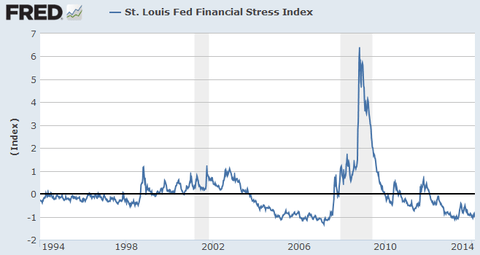
Second, even avoiding the financial panic almost surely wouldn’t have meant avoiding a prolonged economic slump. How do we know this? Well, what we actually know is that the panic was in fact fairly short-lived, ending in the spring of 2009. It doesn’t really matter which measure of financial stress you use, they all look like this:

Yet the economy didn’t come roaring back, and in fact still hasn’t. Why? Because the housing bust and the overhang of household debt are huge drags on demand, even if there isn’t a panic in the financial market.

Sorry, but, WADR, I have to disagree with Professor Krugman.

The first argument is not in my view very compelling, because the Fed’s inflation-phobia did not suddenly appear at the September 2008 FOMC meeting, or even at the June meeting, though, to be sure, its pathological nature at those meetings does have a certain breathtaking quality; it had already been operating for a long time before that. If you look at the St. Louis Fed’s statistics on the monetary base, you will find that the previous recession in 2001 had been preceded in 2000 by a drop of 3.6% in the monetary base. To promote recovery, the Fed increased the monetary base in 2001 (partly accommodating the increased demand for money characteristic of recessions) by 8.5%. The monetary base subsequently grew by 7% in 2002, 5.2% in 2003, 4.4% in 2004, 3.2% in 2005, 2.6% in 2006, and a mere 1.2% in 2007.

The housing bubble burst in 2006, but the Fed was evidently determined to squeeze inflation out of the system, as if trying to atone for its sins in allowing the housing bubble in the first place. From January to September 10, 2008, the monetary base increased by 3.3%. Again, because the demand for money typically increases in recessions, one cannot infer from the slight increase in the rate of growth of the monetary base in 2008 over 2006 and 2007 that the Fed was easing its policy stance. (On this issue, see my concluding paragraph.) The point is that for at least three years before the crash, the Fed, in its anti-inflationary zelotry, had been gradually tightening the monetary-policy screws. So it is simply incorrect to suggest that there was no link between the policy stance of the Fed and the state of the economy. If the Fed had moderated its stance in 2008 in response to ample evidence that the economy was slowing, there is good reason to think that the economy would not have contracted as rapidly as it did, starting, even before the Lehman collapse, in the third quarter of 2008, when, we now know, the economy had already begun one of the sharpest contractions of the entire post World War II era.

As for Krugman’s second argument, I believe it is a mistake to confuse a financial panic with a recession. A financial panic is an acute breakdown of the financial system, always associated with a period of monetary stringency when demands for liquidity cannot be satisfied owing to a contagious loss of confidence in the solvency of borrowers and lenders. The crisis is typically precipitated by a too aggressive tightening of monetary conditions by the monetary authority seeking to rein in inflationary pressures. The loss of confidence is thus not a feature of every business-cycle downturn, and its restoration no guarantee of a recovery. (See my post on Hawtrey and financial crises.) A recovery requires an increase aggregate demand, which is the responsibility of those in charge of monetary policy and fiscal policy. I confess to a measure of surprise that the author of End This Depression Now would require a reminder about that from me.

A final point. Although the macroeconomic conditions for an asset crash and financial panic had been gradually and systematically created by the Fed ever since 2006, the egregious Fed policy in the summer of 2008 was undoubtedly a major contributing cause in its own right. The magnitude of the policy error is evident in this graph from the St. Louis Fed, showing the dollar/euro exchange rate.

dollar_euro_exchange_rateFrom April to July, the exchange rate was fluctuating between $1.50 and $1.60 per euro. In mid-July, the dollar began appreciating rapidly against the euro, rising in value to about $1.40/euro just before the Lehman collapse, an appreciation of about 12.5% in less than two months. The only comparable period of appreciation in the dollar/euro exchange rate was in the 1999-2000 period during the monetary tightening prior to the 2001 recession. But the 2008 appreciation was clearly greater and steeper than the appreciation in 1999-2000. Under the circumstances, such a sharp appreciation in the dollar should have alerted the FOMC that there was a liquidity shortage (also evidenced in a sharp increase in borrowings from the Fed) that required extraordinary countermeasures by the Fed. But the transcript of the September 2008 meeting shows that the appreciation of the dollar was interpreted by members of the FOMC as evidence that the current policy was working as intended! Now how scary is that?

HT: Matt O’Brien

Exposed: Irrational Inflation-Phobia at the Fed Caused the Panic of 2008

Matthew O’Brien at The Atlantic has written a marvelous account of the bizarre deliberations of the Federal Open Market Committee at its meetings (June 25 and August 5) before the Lehman debacle on September 15 2008 and its meeting the next day on September 16. A few weeks ago, I wrote in half-seriousness a post attributing the 2008 financial crisis to ethanol because of the runup in corn and other grain prices in 2008 owing to the ethanol mandate and the restrictions on imported ethanol products. But ethanol, as several commenters pointed out, was only a part, probably a relatively small part, of the spike in commodities prices in the summer of 2008. Thanks to O’Brien’s careful reading of the recently released transcripts of the 2008 meetings of the FOMC, we now have a clear picture of how obsessed the FOMC was about inflation, especially the gang of four regional bank presidents, Charles Plosser, Richard Fisher, James Lacker, and Thomas Hoenig, supported to a greater or lesser extent by James Bullard and Kevin Warsh.

On the other hand, O’Brien does point out that two members of the FOMC, Eric Rosengren, President of the Boston Fed, and Fredric Mishkin of the Board of Governors, consistently warned of the dangers of a financial crisis, and consistently objected to and cogently punctured the hysterical inflation fears of the gang of four. It is somewhat, but only somewhat, reassuring that Janet Yellen was slightly more sensitive to the dangers of a financial crisis and less concerned about inflation than Ben Bernanke. Perhaps because he was still getting his feet wet as chairman, Bernanke seems to have been trying to articulate a position that could balance the opposing concerns of the FOMC membership, rather than leading the FOMC in the direction he thought best. While Yellen did not indulge the inflation phobia of the gang of four, she did not strongly support Rosengren and Mishkin in calling for aggressive action to avert the crisis that they clearly saw looming on the horizon.

Here are some highlights from O’Brien’s brilliant piece:

[FOMC Meeting] June 24-25, 2008: 468 mentions of inflation, 44 of unemployment, and 35 of systemic risks/crises

Those numbers pretty much tell you everything you need to know about what happened during the disastrous summer of 2008 at the Fed

Rosengren wasn’t nearly as concerned with 5 percent headline inflation—and with good reason. He reminded his colleagues that “monetary policy is unlikely to have much effect on food and energy prices,” that “total [inflation] has tended to converge to core, and not the opposite,” and that there was a “lack of an upward trend of wages and salaries.”

In short, inflation was high today, but it wouldn’t be tomorrow. They should ignore it. A few agreed. Most didn’t.

Mishkin, Fed Governor Donald Kohn, and then-San Francisco Fed chief Janet Yellen comprised Team: Ignore Inflation. They pointed out that core inflation hadn’t actually risen, and that “inflation expectations remain reasonably well-anchored.” The rest of the Fed, though, was eager to raise rates soon, if not right away. Philadelphia Fed president Charles Plosser recognized that core inflation was flat, but still thought they needed to get ready to tighten “or our credibility could soon vanish.” Fed Governor Kevin Warsh said that “inflation risks, in my view, continue to predominate as the greater risk to the economy,” because he thought headline would get passed into core inflation.

And let us not forget Richard Fisher of the Dallas Fed who provided badly needed comic relief.

And then there was Dallas Fed chief Richard Fisher, who had a singular talent for seeing inflation that nobody else could—a sixth sense, if you will. He was allergic to data. He preferred talking to CEOs instead. But, in Fisher’s case, the plural of anecdote wasn’t data. It was nonsense. He was worried about Frito-Lays increasing prices 9 percent, Budweiser increasing them 3.5 percent, and a small dry-cleaning chain in Dallas increasing them, well, an undisclosed amount. He even half-joked that the Fed was giving out smaller bottles of water, presumably to hide creeping inflation?

By the way, I notice that these little bottles of water have gotten smaller—this will be a Visine bottle at the next meeting. [Laughter]

But it was another member of the Gang of Four who warned ominously:

Richmond Fed president Jeffrey Lacker suggested, that “at some point we’re going to choose to let something disruptive happen.”

Now to the August meeting:

[FOMC Meeting] August 5, 2008: 322 mentions of inflation, 28 of unemployment, and 19 of systemic risks/crises.

Despite evidence that the inflationary blip of spring and summer was winding down, and the real economy was weakening, the Gang of Four continued to press their case for tougher anti-inflation measures. But only Rosengren and Mishkin spoke out against them.

But even though inflation was falling, it was a lonesome time to be a dove. As the Fed’s resident Cassandra, Rosengren tried to convince his colleagues that high headline inflation numbers “appear to be transitory responses to supply shocks that are not flowing through to labor markets.” In other words, inflation would come down on its own, and the Fed should focus on the credit crunch instead. Mishkin worried that “really bad things could happen” if “a shoe drops” and there was a “nasty, vicious spiral” between weak banks and a weak economy. Given this, he wanted to wait to tighten until inflation expectations “actually indicate there is a problem,” and not before.

But Richard Fisher was in no mood to worry about horror stories unless they were about runaway inflation:

The hawks didn’t want to wait. Lacker admitted that wages hadn’t gone up, but thought that “if we wait until wage rates accelerate or TIPS measures spike, we will have waited too long.” He wanted the Fed to “be prepared to raise rates even if growth is not back to potential, and even if financial markets are not yet tranquil.” In other words, to fight nonexistent wage inflation today to prevent possible wage inflation tomorrow, never mind the crumbling economy. Warsh, for his part, kept insisting that “inflation risks are very real, and I believe that these are higher than growth risks.” And Fisher had more”chilling anecdotes”—as Bernanke jokingly called them—about inflation. This time, the culprit was Disney World and its 5 percent price increase for single-day tickets.

The FOMC was divided, but the inflation-phobes held the upper hand. Unwilling to challenge them, Bernanke appeased them by promising that his statement about future monetary policy after the meeting would be “be slightly hawkish—to indicate a slight uplift in policy.”

Frightened by what he was hearing, Mishkin reminded his colleagues of some unpleasant monetary history:

Remember that in the Great Depression, when—I can’t use the expression because it would be in the transcripts, but you know what I’m thinking—something hit the fan, [laughter] it actually occurred close to a year after the initial negative shock.

Mishkin also reminded his colleagues that the stance of monetary policy cannot be directly inferred from the federal funds rate.

I just very much hope that this Committee does not make this mistake because I have to tell you that the situation is scary to me. I’m holding two houses right now. I’m very nervous.

And now to the September meeting, the day after Lehman collapsed:

[FOMC meeting] September 16, 2008: 129 mentions of inflation, 26 of unemployment, and 4 of systemic risks/crises

Chillingly, Lacker and Hoenig did a kind of victory dance about the collapse of Lehman Brothers.

Lacker had gotten the “disruptive” event he had wanted, and he was pretty pleased about it. “What we did with Lehman I obviously think was good,” he said, because it would “enhance the credibility of any commitment that we make in the future to be willing to let an institution fail.” Hoenig concurred that it was the “right thing,” because it would suck moral hazard out of the market.

The rest of the Gang of Four and their allies remained focused like a laser on inflation.

Even though commodity prices and inflation expectations were both falling fast, Hoenig wanted the Fed to “look beyond the immediate crisis,” and recognize that “we also have an inflation issue.” Bullard thought that “an inflation problem is brewing.” Plosser was heartened by falling commodity prices, but said, “I remain concerned about the inflation outlook going forward,” because “I do not see the ongoing slowdown in economic activity is entirely demand driven.” And Fisher half-jokingly complained that the bakery he’d been going to for 30 years—”the best maker of not only bagels, but anything with Crisco in it”—had just increased prices. All of them wanted to leave rates unchanged at 2 percent.

Again, only Eric Rosengren seemed to be in touch with reality, but no was listening:

[Rosengren] was afraid that exactly what did end up happening would happen. That all the financial chaos “would have a significant impact on the real economy,” that “individuals and firms will be become risk averse, with reluctance to consume or invest,” that “credit spreads are rising, and the cost and availability of financing is becoming more difficult,” and that “deleveraging is likely to occur with a vengeance.” More than that, he thought that the “calculated bet” they took in letting Lehman fail would look particularly bad “if we have a run on the money market funds or if the nongovernment tri-party repo market shuts down.” He wanted to cut rates immediately to do what they could to offset the worsening credit crunch. Nobody else did.

Like Bernanke for instance. Here is his take on the situation:

Overall I believe that our current funds rate setting is appropriate, and I don’t really see any reason to change…. Cutting rates would be a very big step that would send a very strong signal about our views on the economy and about our intentions going forward, and I think we should view that step as a very discrete thing rather than as a 25 basis point kind of thing. We should be very certain about that change before we undertake it because I would be concerned, for example, about the implications for the dollar, commodity prices, and the like.

OMG!

O’Brien uses one of my favorite Hawtrey quotes to describe the insanity of the FOMC deliberations:

In other words, the Fed was just as worried about an inflation scare that was already passing as it was about a once-in-three-generations crisis.

It brought to mind what economist R. G. Hawtrey had said about the Great Depression. Back then, central bankers had worried more about the possibility of inflation than the grim reality of deflation. It was, Hawtrey said, like “crying Fire! Fire! in Noah’s flood.”

In any non-dysfunctional institution, the perpetrators of this outrage would have been sacked. But three of Gang of Four (Hoenig having become a director of the FDIC in 2012) remain safely ensconced in their exalted positions, blithely continuing, without the slightest acknowledgment of their catastrophic past misjudgments, to exert a malign influence on monetary policy. For shame!

Methodological Arrogance

A few weeks ago, I posted a somewhat critical review of Kartik Athreya’s new book Big Ideas in Macroeconomics. In quoting a passage from chapter 4 in which Kartik defended the rational-expectations axiom on the grounds that it protects the public from economists who, if left unconstrained by the discipline of rational expectations, could use expectational assumptions to generate whatever results they wanted, I suggested that this sort of reasoning in defense of the rational-expectations axiom betrayed what I called the “methodological arrogance” of modern macroeconomics which has, to a large extent, succeeded in imposing that axiom on all macroeconomic models. In his comment responding to my criticisms, Kartik made good-natured reference in passing to my charge of “methodological arrogance,” without substantively engaging with the charge. And in a post about the early reviews of Kartik’s book, Steve Williamson, while crediting me for at least reading the book before commenting on it, registered puzzlement at what I meant by “methodological arrogance.”

Actually, I realized when writing that post that I was not being entirely clear about what “methodological arrogance” meant, but I thought that my somewhat tongue-in-cheek reference to the duty of modern macroeconomists “to ban such models from polite discourse — certainly from the leading economics journals — lest the public be tainted by economists who might otherwise dare to abuse their models by making illicit assumptions about expectations formation and equilibrium concepts” was sufficiently suggestive not to require elaboration, especially after having devoted several earlier posts to criticisms of the methodology of modern macroeconomics (e.g., here, here, and here). That was a misjudgment.

So let me try to explain what I mean by methodological arrogance, which is not the quite the same as, but is closely related to, methodological authoritarianism. I will do so by referring to the long introductory essay (“A Realist View of Logic, Physics, and History”) that Karl Popper contributed to a book The Self and Its Brain co-authored with neuroscientist John Eccles. The chief aim of the essay was to argue that the universe is not fully determined, but evolves, producing new, emergent, phenomena not originally extant in the universe, such as the higher elements, life, consciousness, language, science and all other products of human creativity, which in turn interact with the universe, in fundamentally unpredictable ways. Popper regards consciousness as a real phenomenon that cannot be reduced to or explained by purely physical causes. Though he makes only brief passing reference to the social sciences, Popper’s criticisms of reductionism are directly applicable to the microfoundations program of modern macroeconomics, and so I think it will be useful to quote what he wrote at some length.

Against the acceptance of the view of emergent evolution there is a strong intuitive prejudice. It is the intuition that, if the universe consists of atoms or elementary particles, so that all things are structures of such particles, then every event in the universe ought to be explicable, and in principle predictable, in terms of particle structure and of particle interaction.

Notice how easy it would be rephrase this statement as a statement about microfoundations:

Against the acceptance of the view that there are macroeconomic phenomena, there is a strong intuitive prejudice. It is the intuition that, if the macroeconomy consists of independent agents, so that all macroeconomic phenomena are the result of decisions made by independent agents, then every macreconomic event ought to be explicable, and in principle predictable, in terms of the decisions of individual agents and their interactions.

Popper continues:

Thus we are led to what has been called the programme of reductionism [microfoundations]. In order to discuss it I shall make use of the following Table

(12) Level of ecosystems

(11) Level of populations of metazoan and plants

(10) Level of metezoa and multicellular plants

(9) Level of tissues and organs (and of sponges?)

(8) Level of populations of unicellular organisms

(7) Level of cells and of unicellular organisms

(6) Level of organelles (and perhaps of viruses)

(5) Liquids and solids (crystals)

(4) Molecules

(3) Atoms

(2) Elementary particles

(1) Sub-elementary particles

(0) Unknown sub-sub-elementary particles?

The reductionist idea behind this table is that the events or things on each level should be explained in terms of the lower levels. . . .

This reductionist idea is interesting and important; and whenever we can explain entities and events on a higher level by those of a lower level, we can speak of a great scientific success, and can say that we have added much to our understanding of the higher level. As a research programme, reductionism is not only important, but it is part of the programme of science whose aim is to explain and to understand.

So far so good. Reductionism certainly has its place. So do microfoundations. Whenever we can take an observation and explain it in terms of its constituent elements, we have accomplished something important. We have made scientific progress.

But Popper goes on to voice a cautionary note. There may be, and probably are, strict, perhaps insuperable, limits to how far higher-level phenomena can be reduced to (explained by) lower-level phenomena.

[E]ven the often referred to reduction of chemistry to physics, important as it is, is far from complete, and very possibly incompletable. . . . [W]e are far removed indeed from being able to claim that all, or most, properties of chemical compounds can be reduced to atomic theory. . . . In fact, the five lower levels of [our] Table . . . can be used to show that we have reason to regard this kind of intuitive reduction programme as clashing with some results of modern physics.

For what [our] Table suggests may be characterized as the principle of “upward causation.” This is the principle that causation can be traced in our Table . . . . from a lower level to a higher level, but not vice versa; that what happens on a higher level can be explained in terms of the next lower level, and ultimately in terms of elementary particles and the relevant physical laws. It appears at first that the higher levels cannot act on the lower ones.

But the idea of particle-to-particle or atom-to-atom interaction has been superseded by physics itself. A diffraction grating or a crystal (belonging to level (5) of our Table . . .) is a spatially very extended complex (and periodic) structure of billions of molecules; but it interacts as a whole extended periodic structure with the photons or the particles of a beam of photons or particles. Thus we have here an important example of “downward causation“. . . . That is to say, the whole, the macro structure, may, qua whole, act upon a photon or an elementary particle or an atom. . . .

Other physical examples of downward causation – of macroscopic structures on level (5) acting upon elementary particles or photons on level (1) – are lasers, masers, and holograms. And there are also many other macro structures which are examples of downward causation: every simple arrangement of negative feedback, such as a steam engine governor, is a macroscopic structure that regulates lower level events, such as the flow of the molecules that constitute the steam. Downward causation is of course important in all tools and machines which are designed for sompe purpose. When we use a wedge, for example, we do not arrange for the action of its elementary particles, but we use a structure, relying on it ot guide the actions of its constituent elementary particles to act, in concert, so as to achieve the desired result.

Stars are undersigned, but one may look at them as undersigned “machines” for putting the atoms and elementary particles in their central region under terrific gravitational pressure, with the (undersigned) result that some atomic nuclei fuse and form the nuclei of heavier elements; an excellent example of downward causation,of the action of the whole structure upon its constituent particles.

(Stars, incidentally, are good examples of the general rule that things are processes. Also, they illustrate the mistake of distinguishing between “wholes” – which are “more than the sums of their parts” – and “mere heaps”: a star is, in a sense, a “mere” accumulation, a “mere heap” of its constituent atoms. Yet it is a process – a dynamic structure. Its stability depends upon the dynamic equilibrium between its gravitational pressure, due to its sheer bulk, and the repulsive forces between its closely packed elementary particles. If the latter are excessive, the star explodes, If they are smaller than the gravitational pressure, it collapses into a “black hole.”

The most interesting examples of downward causation are to be found in organisms and in their ecological systems, and in societies of organisms [my emphasis]. A society may continue to function even though many of its members die; but a strike in an essential industry, such as the supply of electricity, may cause great suffering to many individual people. .. . I believe that these examples make the existence of downward causation obvious; and they make the complete success of any reductionist programme at least problematic.

I was very glad when I recently found this discussion of reductionism by Popper in a book that I had not opened for maybe 40 years, because it supports an argument that I have been making on this blog against the microfoundations program in macroeconomics: that as much as macroeconomics requires microfoundations, microeconomics also requires macrofoundations. Here is how I put a little over a year ago:

In fact, the standard comparative-statics propositions of microeconomics are also based on the assumption of the existence of a unique stable general equilibrium. Those comparative-statics propositions about the signs of the derivatives of various endogenous variables (price, quantity demanded, quantity supplied, etc.) with respect to various parameters of a microeconomic model involve comparisons between equilibrium values of the relevant variables before and after the posited parametric changes. All such comparative-statics results involve a ceteris-paribus assumption, conditional on the existence of a unique stable general equilibrium which serves as the starting and ending point (after adjustment to the parameter change) of the exercise, thereby isolating the purely hypothetical effect of a parameter change. Thus, as much as macroeconomics may require microfoundations, microeconomics is no less in need of macrofoundations, i.e., the existence of a unique stable general equilibrium, absent which a comparative-statics exercise would be meaningless, because the ceteris-paribus assumption could not otherwise be maintained. To assert that macroeconomics is impossible without microfoundations is therefore to reason in a circle, the empirically relevant propositions of microeconomics being predicated on the existence of a unique stable general equilibrium. But it is precisely the putative failure of a unique stable intertemporal general equilibrium to be attained, or to serve as a powerful attractor to economic variables, that provides the rationale for the existence of a field called macroeconomics.

And more recently, I put it this way:

The microeconomic theory of price adjustment is a theory of price adjustment in a single market. It is a theory in which, implicitly, all prices and quantities, but a single price-quantity pair are in equilibrium. Equilibrium in that single market is rapidly restored by price and quantity adjustment in that single market. That is why I have said that microeconomics rests on a macroeconomic foundation, and that is why it is illusory to imagine that macroeconomics can be logically derived from microfoundations. Microfoundations, insofar as they explain how prices adjust, are themselves founded on the existence of a macroeconomic equilibrium. Founding macroeconomics on microfoundations is just a form of bootstrapping.

So I think that my criticism of the microfoundations project exactly captures the gist of Popper’s criticism of reductionism. Popper extended his criticism of a certain form of reductionism, which he called “radical materialism or radical physicalism” in later passage in the same essay that is also worth quoting:

Radical materialism or radical physicalism is certainly a selfconsistent position. Fir it is a view of the universe which, as far as we know, was adequate once; that is, before the emergence of life and consciousness. . . .

What speaks in favour of radical materialism or radical physicalism is, of course, that it offers us a simple vision of a simple universe, and this looks attractive just because, in science, we search for simple theories. However, I think that it is important that we note that there are two different ways by which we can search for simplicity. They may be called, briefly, philosophical reduction and scientific reduction. The former is characterized by an attempt to provide bold and testable theories of high explanatory power. I believe that the latter is an extremely valuable and worthwhile method; while the former is of value only if we have good reasons to assume that it corresponds to the facts about the universe.

Indeed, the demand for simplicity in the sense of philosophical rather than scientific reduction may actually be damaging. For even in order to attempt scientific reduction, it is necessary for us to get a full grasp of the problem to be solved, and it is therefore vitally important that interesting problems are not “explained away” by philosophical analysis. If, say, more than one factor is responsible for some effect, it is important that we do not pre-empt the scientific judgment: there is always the danger that we might refuse to admit any ideas other than the ones we appear to have at hand: explaining away, or belittling the problem. The danger is increased if we try to settle the matter in advance by philosophical reduction. Philosophical reduction also makes us blind to the significance of scientific reduction.

Popper adds the following footnote about the difference between philosophic and scientific reduction.

Consider, for example, what a dogmatic philosophical reductionist of a mechanistic disposition (or even a quantum-mechanistic disposition) might have done in the face of the problem of the chemical bond. The actual reduction, so far as it goes, of the theory of the hydrogen bond to quantum mechanics is far more interesting than the philosophical assertion that such a reduction will one be achieved.

What modern macroeconomics now offers is largely an array of models simplified sufficiently so that they are solvable using the techniques of dynamic optimization. Dynamic optimization by individual agents — the microfoundations of modern macro — makes sense only in the context of an intertemporal equilibrium. But it is just the possibility that intertemporal equilibrium may not obtain that, to some of us at least, makes macroeconomics interesting and relevant. As the great Cambridge economist, Frederick Lavington, anticipating Popper in grasping the possibility of downward causation, put it so well, “the inactivity of all is the cause of the inactivity of each.”

So what do I mean by methodological arrogance? I mean an attitude that invokes microfoundations as a methodological principle — philosophical reductionism in Popper’s terminology — while dismissing non-microfounded macromodels as unscientific. To be sure, the progress of science may enable us to reformulate (and perhaps improve) explanations of certain higher-level phenomena by expressing those relationships in terms of lower-level concepts. That is what Popper calls scientific reduction. But scientific reduction is very different from rejecting, on methodological principle, any explanation not expressed in terms of more basic concepts.

And whenever macrotheory seems inconsistent with microtheory, the inconsistency poses a problem to be solved. Solving the problem will advance our understanding. But simply to reject the macrotheory on methodological principle without evidence that the microfounded theory gives a better explanation of the observed phenomena than the non-microfounded macrotheory (and especially when the evidence strongly indicates the opposite) is arrogant. Microfoundations for macroeconomics should result from progress in economic theory, not from a dubious methodological precept.

Let me quote Popper again (this time from his book Objective Knowledge) about the difference between scientific and philosophical reduction, addressing the denial by physicalists that that there is such a thing as consciousness, a denial based on their belief that all supposedly mental phenomena can and will ultimately be reduced to purely physical phenomena

[P]hilosophical speculations of a materialistic or physicalistic character are very interesting, and may even be able to point the way to a successful scientific reduction. But they should be frankly tentative theories. . . . Some physicalists do not, however, consider their theories as tentative, but as proposals to express everything in physicalist language; and they think these proposals have much in their favour because they are undoubtedly convenient: inconvenient problems such as the body-mind problem do indeed, most conveniently, disappear. So these physicalists think that there can be no doubt that these problems should be eliminated as pseudo-problems. (p. 293)

One could easily substitute “methodological speculations about macroeconomics” for “philosophical speculations of a materialistic or physicalistic character” in the first sentence. And in the third sentence one could substitute “advocates of microfounding all macroeconomic theories” for “physicalists,” “microeconomic” for “physicalist,” and “Phillips Curve” or “involuntary unemployment” for “body-mind problem.”

So, yes, I think it is arrogant to think that you can settle an argument by forcing the other side to use only those terms that you approve of.

Who’s Afraid of Say’s Law?

There’s been a lot of discussion about Say’s Law in the blogosphere lately, some of it finding its way into the comments section of my recent post “What Does Keynesisan Mean,” in which I made passing reference to Keynes’s misdirected tirade against Say’s Law in the General Theory. Keynes wasn’t the first economist to make a fuss over Say’s Law. It was a big deal in the nineteenth century when Say advanced what was then called the Law of the Markets, pointing out that the object of all production is, in the end, consumption, so that all productive activity ultimately constitutes a demand for other products. There were extended debates about whether Say’s Law was really true, with Say, Ricardo, James and John Stuart Mill all weighing on in favor of the Law, and Malthus and the French economist J. C. L. de Sismondi arguing against it. A bit later, Karl Marx also wrote at length about Say’s Law, heaping his ample supply of scorn upon Say and his Law. Thomas Sowell’s first book, I believe drawn from the doctoral dissertation he wrote under George Stigler, was about the classical debates about Say’s Law.

The literature about Say’s Law is too vast to summarize in a blog post. Here’s my own selective take on it.

Say was trying to refute a certain kind of explanation of economic crises, and what we now would call cyclical or involuntary unemployment, an explanation attributing such unemployment to excess production for which income earners don’t have enough purchasing power in their pockets to buy. Say responded that the reason why income earners had supplied the services necessary to produce the available output was to earn enough income to purchase the output. This is the basic insight behind the famous paraphrase (I don’t know if it was Keynes’s paraphrase or someone else’s) of Say’s Law — supply creates its own demand. If it were instead stated as products or services are supplied only because the suppliers want to buy other products or services, I think that it would be more in sync than the standard formulation with Say’s intent. Another way to think about Say’s Law is as a kind of conservation law.

There were two famous objections made to Say’s Law: first, current supply might be offered in order to save for future consumption, and, second, current supply might be offered in order to add to holdings of cash. In either case, there could be current supply that is not matched by current demand for output, so that total current demand would be insufficient to generate full employment. Both these objections are associated with Keynes, but he wasn’t the first to make either of them. The savings argument goes back to the nineteenth century, and the typical response was that if there was insufficient current demand, because the desire to save had increased, the public deciding to reduce current expenditures on consumption, the shortfall in consumption demand would lead to an increase in investment demand driven by falling interest rates and rising asset prices. In the General Theory, Keynes proposed an argument about liquidity preference and a potential liquidity trap, suggesting a reason why the necessary adjustment in the rate of interest would not necessarily occur.

Keynes’s argument about a liquidity trap was and remains controversial, but the argument that the existence of money implies that Say’s Law can be violated was widely accepted. Indeed, in his early works on business-cycle theory, F. A. Hayek made the point, seemingly without embarrassment or feeling any need to justify it at length, that the existence of money implied a disconnect between overall supply and overall demand, describing money as a kind of loose joint in the economic system. This argument, apparently viewed as so trivial or commonplace by Hayek that he didn’t bother proving it or citing authority for it, was eventually formalized by the famous market-socialist economist (who, for a number of years was a tenured professor at that famous bastion of left-wing economics the University of Chicago) Oskar Lange who introduced a distinction between Walras’s Law and Say’s Law (“Say’s Law: A Restatement and Criticism”).

Walras’s Law says that the sum of all excess demands and excess supplies, evaluated at any given price vector, must identically equal zero. The existence of a budget constraint makes this true for each individual, and so, by the laws of arithmetic, it must be true for the entire economy. Essentially, this was a formalization of the logic of Say’s Law. However, Lange showed that Walras’s Law reduces to Say’s Law only in an economy without money. In an economy with money, Walras’s Law means that there could be an aggregate excess supply of all goods at some price vector, and the excess supply of goods would be matched by an equal excess demand for money. Aggregate demand would be deficient, and the result would be involuntary unemployment. Thus, according to Lange’s analysis, Say’s Law holds, as a matter of necessity, only in a barter economy. But in an economy with money, an excess supply of all real commodities was a logical possibility, which means that there could be a role for some type – the choice is yours — of stabilization policy to ensure that aggregate demand is sufficient to generate full employment. One of my regular commenters, Tom Brown, asked me recently whether I agreed with Nick Rowe’s statement: “the goal of good monetary policy is to try to make Say’s Law true.” I said that I wasn’t sure what the statement meant, thereby avoiding the need to go into a lengthy explanation about why I am not quite satisfied with that way of describing the goal of monetary policy.

There are at least two problems with Lange’s formulation of Say’s Law. The first was pointed out by Clower and Leijonhufvud in their wonderful paper (“Say’s Principle: What It Means and Doesn’t Mean” reprinted here and here) on what they called Say’s Principle in which they accepted Lange’s definition of Say’s Law, while introducing the alternative concept of Say’s Principle as the supply-side analogue of the Keynesian multiplier. The key point was to note that Lange’s analysis was based on the absence of trading at disequilibrium prices. If there is no trading at disequilibrium prices, because the Walrasian auctioneer or clearinghouse only processes information in a trial-and-error exercise aimed at discovering the equilibrium price vector, no trades being executed until the equilibrium price vector has been discovered (a discovery which, even if an equilibrium price vector exists, may not be made under any price-adjustment rule adopted by the auctioneer, rational expectations being required to “guarantee” that an equilibrium price vector is actually arrived at, sans auctioneer), then, indeed, Say’s Law need not obtain in notional disequilibrium states (corresponding to trial price vectors announced by the Walrasian auctioneer or clearinghouse). The insight of Clower and Leijonhufvud was that in a real-time economy in which trading is routinely executed at disequilibrium prices, transactors may be unable to execute the trades that they planned to execute at the prevailing prices. But when planned trades cannot be executed, trading and output contract, because the volume of trade is constrained by the lesser of the amount supplied and the amount demanded.

This is where Say’s Principle kicks in; If transactors do not succeed in supplying as much as they planned to supply at prevailing prices, then, depending on the condition of their balances sheets, and the condition of credit markets, transactors may have to curtail their demands in subsequent periods; a failure to supply as much as had been planned last period will tend reduce demand in this period. If the “distance” from equilibrium is large enough, the demand failure may even be amplified in subsequent periods, rather than damped. Thus, Clower and Leijonhufvud showed that the Keynesian multiplier was, at a deep level, really just another way of expressing the insight embodied in Say’s Law (or Say’s Principle, if you insist on distinguishing what Say meant from Lange’s reformulation of it in terms of Walrasian equilibrium).

I should add that, as I have mentioned in an earlier post, W. H. Hutt, in a remarkable little book, clarified and elaborated on the Clower-Leijonhufvud analysis, explaining how Say’s Principle was really implicit in many earlier treatments of business-cycle phenomena. The only reservation I have about Hutt’s book is that he used it to wage an unnecessary polemical battle against Keynes.

At about the same time that Clower and Leijonhufvud were expounding their enlarged view of the meaning and significance of Say’s Law, Earl Thompson showed that under “classical” conditions, i.e., a competitive supply of privately produced bank money (notes and deposits) convertible into gold, Say’s Law in Lange’s narrow sense, could also be derived in a straightforward fashion. The demonstration followed from the insight that when bank money is competitively issued, it is accomplished by an exchange of assets and liabilities between the bank and the bank’s customer. In contrast to the naïve assumption of Lange (adopted as well by his student Don Patinkin in a number of important articles and a classic treatise) that there is just one market in the monetary sector, there are really two markets in the monetary sector: a market for money supplied by banks and a market for money-backing assets. Thus, any excess demand for money would be offset not, as in the Lange schema, by an excess supply of goods, but by an excess supply of money-backing services. In other words, the public can increase their holdings of cash by giving their IOUs to banks in exchange for the IOUs of the banks, the difference being that the IOUs of the banks are money and the IOUs of customers are not money, but do provide backing for the money created by banks. The market is equilibrated by adjustments in the quantity of bank money and the interest paid on bank money, with no spillover on the real sector. With no spillover from the monetary sector onto the real sector, Say’s Law holds by necessity, just as it would in a barter economy.

A full exposition can be found in Thompson’s original article. I summarized and restated its analysis of Say’s Law in my 1978 1985 article on classical monetary theory and in my book Free Banking and Monetary Reform. Regrettably, I did not incorporate the analysis of Clower and Leijonhufvud and Hutt into my discussion of Say’s Law either in my article or in my book. But in a world of temporary equilibrium, in which future prices are not correctly foreseen by all transactors, there are no strict intertemporal budget constraints that force excess demands and excess supplies to add up to zero. In short, in such a world, things can get really messy, which is where the Clower-Leijonhufvud-Hutt analysis can be really helpful in sorting things out.

What Does “Keynesian” Mean?

Last week Simon Wren-Lewis wrote a really interesting post on his blog trying to find the right labels with which to identify macroeconomists. Simon, rather disarmingly, starts by admitting the ultimate futility of assigning people labels; reality is just too complicated to conform to the labels that we invent to help ourselves make sense of reality. A good label can provide us with a handle with which to gain a better grasp on a messy set of observations, but it is not the reality. And if you come up with one label, I may counter with a different one. Who’s to say which label is better?

At any rate, as I read through Simon’s post I found myself alternately nodding my head in agreement and shaking my head in disagreement. So staying in the spirit of fun in which Simon wrote his post, I will provide a commentary on his labels and other pronouncements. If the comments are weighted on the side of disagreement, well, that’s what makes blogging fun, n’est-ce pas?

Simon divides academic researchers into two groups (mainstream and heterodox) and macroeconomic policy into two approaches (Keynesian and anti-Keynesian). He then offers the following comment on the meaning of the label Keynesian.

Just think about the label Keynesian. Any sensible definition would involve the words sticky prices and aggregate demand. Yet there are still some economists (generally not academics) who think Keynesian means believing fiscal rather than monetary policy should be used to stabilise demand. Fifty years ago maybe, but no longer. Even worse are non-economists who think being a Keynesian means believing in market imperfections, government intervention in general and a mixed economy. (If you do not believe this happens, look at the definition in Wikipedia.)

Well, as I pointed out in a recent post, there is nothing peculiarly Keynesian about the assumption of sticky prices, especially not as a necessary condition for an output gap and involuntary unemployment. So if Simon is going to have to work harder to justify his distinction between Keynesian and anti-Keynesian. In a comment on Simon’s blog, Nick Rowe pointed out just this problem, asking in particular why Simon could not substitute a Monetarist/anti-Monetarist dichotomy for the Keynesian/anti-Keynesian one.

The story gets more complicated in Simon’s next paragraph in which he describes his dichotomy of academic research into mainstream and heterodox.

Thanks to the microfoundations revolution in macro, mainstream macroeconomists speak the same language. I can go to a seminar that involves an RBC model with flexible prices and no involuntary unemployment and still contribute and possibly learn something. Equally an economist like John Cochrane can and does engage in meaningful discussions of New Keynesian theory (pdf).

In other words, the range of acceptable macroeconomic models has been drastically narrowed. Unless it is microfounded in a dynamic stochastic general equilibrium model, a model does not qualify as “mainstream.” This notion of microfoundation is certainly not what Edmund Phelps meant by “microeconomic foundations” when he edited his famous volume Microeconomic Foundations of Employment and Inflation Theory, which contained, among others, Alchian’s classic paper on search costs and unemployment and a paper by the then not so well-known Robert Lucas and his early collaborator Leonard Rapping. Nevertheless, in the current consensus, it is apparently the New Classicals that determine what kind of model is acceptable, while New Keynesians are allowed to make whatever adjustments, mainly sticky wages, they need to derive Keynesian policy recommendations. Anyone who doesn’t go along with this bargain is excluded from the mainstream. Simon may not be happy with this state of affairs, but he seems to have made peace with it without undue discomfort.

Now many mainstream macroeconomists, myself included, can be pretty critical of the limitations that this programme can place on economic thinking, particularly if it is taken too literally by microfoundations purists. But like it or not, that is how most macro research is done nowadays in the mainstream, and I see no sign of this changing anytime soon. (Paul Krugman discusses some reasons why here.) My own view is that I would like to see more tolerance and a greater variety of modelling approaches, but a pragmatic microfoundations macro will and should remain the major academic research paradigm.

Thus, within the mainstream, there is no basic difference in how to create a macroeconomic model. The difference is just in how to tweak the model in order to derive the desired policy implication.

When it comes to macroeconomic policy, and keeping to the different language idea, the only significant division I see is between the mainstream macro practiced by most economists, including those in most central banks, and anti-Keynesians. By anti-Keynesian I mean those who deny the potential for aggregate demand to influence output and unemployment in the short term.

So, even though New Keynesians have learned how to speak the language of New Classicals, New Keynesians can console themselves in retaining the upper hand in policy discussions. Which is why in policy terms, Simon chooses a label that is at least suggestive of a certain Keynesian primacy, the other side being defined in terms of their opposition to Keynesian policy. Half apologetically, Simon then asks: “Why do I use the term anti-Keynesian rather than, say, New Classical?” After all, it’s the New Classical model that’s being tweaked. Simon responds:

Partly because New Keynesian economics essentially just augments New Classical macroeconomics with sticky prices. But also because as far as I can see what holds anti-Keynesians together isn’t some coherent and realistic view of the world, but instead a dislike of what taking aggregate demand seriously implies.

This explanation really annoyed Steve Williamson who commented on Simon’s blog as follows:

Part of what defines a Keynesian (new or old), is that a Keynesian thinks that his or her views are “mainstream,” and that the rest of macroeconomic thought is defined relative to what Keynesians think – Keynesians reside at the center of the universe, and everything else revolves around them.

Simon goes on to explain what he means by the incoherence of the anti-Keynesian view of the world, pointing out that the Pigou Effect, which supposedly invalidated Keynes’s argument that perfect wage and price flexibility would not eventually restore full employment to an economy operating at less than full employment, has itself been shown not to be valid. And then Simon invokes that old standby Say’s Law.

Second, the evidence that prices are not flexible is so overwhelming that you need something else to drive you to ignore this evidence. Or to put it another way, you need something pretty strong for politicians or economists to make the ‘schoolboy error’ that is Says Law, which is why I think the basis of the anti-Keynesian view is essentially ideological.

Here, I think, Simon is missing something important. It was a mistake on Keynes’s part to focus on Say’s Law as the epitome of everything wrong with “classical economics.” Actually Say’s Law is a description of what happens in an economy when trading takes place at disequilibrium prices. At disequilibrium prices, potential gains from trade are left on the table. Not only are they left on the table, but the effects can be cumulative, because the failure to supply implies a further failure to demand. The Keynesian spending multiplier is the other side of the coin of the supply-side contraction envisioned by Say. Even infinite wage and price flexibility may not help an economy in which a lot of trade is occurring at disequilibrium prices.

The microeconomic theory of price adjustment is a theory of price adjustment in a single market. It is a theory in which, implicitly, all prices and quantities, but a single price-quantity pair are in equilibrium. Equilibrium in that single market is rapidly restored by price and quantity adjustment in that single market. That is why I have said that microeconomics rests on a macroeconomic foundation, and that is why it is illusory to imagine that macroeconomics can be logically derived from microfoundations. Microfoundations, insofar as they explain how prices adjust, are themselves founded on the existence of a macroeconomic equilibrium. Founding macroeconomics on microfoundations is just a form of bootstrapping.

If there is widespread unemployment, it may indeed be that wages are too high, and that a reduction in wages would restore equilibrium. But there is no general presumption that unemployment will be cured by a reduction in wages. Unemployment may be the result of a more general dysfunction in which all prices are away from their equilibrium levels, in which case no adjustment of the wage would solve the problem, so that there is no presumption that the current wage exceeds the full-equilibrium wage. This, by the way, seems to me to be nothing more than a straightforward implication of the Lipsey-Lancaster theory of second best.


About Me

David Glasner
Washington, DC

I am an economist in the Washington DC area. My research and writing has been mostly on monetary economics and policy and the history of economics. In my book Free Banking and Monetary Reform, I argued for a non-Monetarist non-Keynesian approach to monetary policy, based on a theory of a competitive supply of money. Over the years, I have become increasingly impressed by the similarities between my approach and that of R. G. Hawtrey and hope to bring Hawtrey’s unduly neglected contributions to the attention of a wider audience.

My new book Studies in the History of Monetary Theory: Controversies and Clarifications has been published by Palgrave Macmillan

Follow me on Twitter @david_glasner

Archives

Enter your email address to follow this blog and receive notifications of new posts by email.

Join 665 other subscribers
Follow Uneasy Money on WordPress.com