Archive for the 'Uncategorized' Category


Hawtrey’s Good and Bad Trade, Part IV: The Inherent Instability of Credit

I don’t have a particularly good memory for specific facts or of books and articles that I have read, even ones that I really enjoyed or thought were very important. If I am lucky, I can remember on or two highlights or retain some general idea of what the book or article was about. So I often find myself surprised when reading something for the second time when I come across a passage that I had forgotten and experience the shock and awe of discovery while knowing, and perhaps even remembering, that I had read this all before once upon a time. That is just the experience I had when reading chapter 7 (“Origination of Monetary Disturbances in an Isolated Community”) of Good and Bad Trade. I think that I read Good and Bad Trade for the first time in the spring of 2009. On the whole, I would say that I was less impressed with it than I was with some other books of his that I had read (especially The Art of Central Banking and The Gold Standard in Theory and Practice), but reading chapter 7 a second time really enhanced my appreciation for how insightful Hawtrey was and how well he explained the underlying causes for what he called, in one of his great phrases “the inherent instability of credit.” He starts of chapter 7 with the following deceptively modest introductory paragraphs.

In the last two chapters we have postulated a perfectly arbitrary change in the quantity of legal tender currency in circulation. However closely the consequences traced from such an arbitrary change may correspond with the phenomena we have set out to explain, we have accomplished nothing till we have shown that causes which will lead to those consequences actually occur. . . .

At the present stage, however it is already possible to make a preliminary survey of the causes of fluctuations with the advantage of an artificial simplification of the problem. And at the outset it must be recognized that arbitrary changes in the quantity of legal tender currency in circulation cannot be of much practical importance. Such changes rarely occur. . . .

But what we are looking for is the origination of changes not necessarily in the quantity of legal tender currency but in the quantity of purchasing power, which is based on the quantity of credit money. . . . For example, if the banker suddenly came to the conclusion that the proportion of reserves to liabilities previously maintained was too low, and decided to increase, this would necessitate a reduction in deposits exactly similar to the reduction which in the last chapter we supposed them to make in consequence of a reduction in the actual stock of legal tender currency. Or there might casual variations in their reserves. These reserves simply consist of that portion of the existing supply of cash [i.e., currency] which happens for the moment not to be in the pockets, tills, cashboxes, etc., of the public. The amount of money which any individual carries about with him at any time is largely a matter of chance, and consequently there may very well be variations in the cash in circulation and therefore contrary variations in the reserves, which are really in the nature of casual variations . . . (pp. 73-74)

After explaining that the amount of cash (i.e., currency) held by the public tends to fluctuate cyclically because increasing employment and increasing wage payments involve an increasing demand for currency (most workers having been paid with currency not by check, and certainly not by electronic transfer, in the nineteenth and early twentieth centuries), so that banks would generally tend to experience declining reserves over the course of the business cycle, Hawtrey offered another reason why banks would be subject to cyclical disturbances affecting their reserve position.

[W]henever the prevailing rate of profit deviates from the rate of interest charged on loans the discrepancy between them at once tends to be enlarged. If trade is for the moment stable and the market rate of interest is equal to the profit rate, and if we suppose that by any cause the profit rate is slightly increased, there will be an increased demand for loans at the existing market rate. But this increased demand for loans leads to an increase in the aggregate amount of purchasing power, which in turn still further increases the profit rate. This process will continue with ever accelerated force until the bankers intervene to save their reserves by raising the rate of interest up to and above the now enhanced profit rate. A parallel phenomenon occurs when the profit rate, through some chance cause, drops below the market rate; the consequent curtailment of loans and so of purchasing power leads at once to a greater and growing fall in profits, until the bankers intervene by reducing the rate of interest. It appears, therefore, that the equilibrium which the bankers have to maintain in fixing the rate of interest is essentially “unstable,” in the sense that if the rate of interest deviates from its proper value by any amount, however small, the deviation will tend to grow greater and greater until steps are taken to correct it. This of itself shows that the money market must be subject to fluctuations. A flag in a steady breeze could theoretically remain in equilibrium if it were spread out perfectly flat in the exact direction of the breeze. But it can be shown mathematically that that position is “unstable,” that if the flag deviates from it to any extent, however small, it will tend to deviate further. Consequently the flag flaps. (pp. 76-77)

Hawtrey also mentions other economic forces tending to amplify fluctuations, forces implicated in the general phenomenon of credit.

Credit money is composed of the obligations of bankers, and if a banker cannot meet his obligations the credit money dependent upon him is wholly or partly destroyed. Again, against his obligations the banker holds equivalent assets, together with a margin. These assets are composed chiefly of two items, legal tender currency and loans to traders. The solvency of the banker will depend largely on the reality of these assets, and the value of the loans will depend in turn on the solvency of the borrowers. (p. 77)

Hawtrey describes one of the principal assets held by English commercial banks in his day, the mercantile bill, with which a dealer or wholesaler making an order from a manufacturer obligates himself to pay for the ordered merchandise upon delivery at some fixed time, say 120 days, after the order is placed. The IOU of the dealer, the bill, can be immediately presented by the manufacturer to his banker who will then advance the funds to the manufacturer with which to cover the costs of producing the order for the dealer. When the order is filled four months hence, the dealer will pay for the order and the manufacturer will then be able to discharge his obligation to his banker.

The whole value of the manufacturer’s efforts in producing the goods depends upon there being an effective demand for them when they are completed. It is only because the dealer anticipates that this effective demand for them will be forthcoming that he gives the manufacturer the order. The dealer, in fact, is taking the responsibility of saying how £10,000 worth of the productive capacity of the country shall be employed. The manufacturer, in accepting the order, and the banker in discounting the bill, are both endorsing the opinion of the dealer. The whole transaction is based ultimately on an expectation of a future demand, which must be more or less speculative. But the banker is doubly insured against the risk. Both the dealer and the manufacturer are men of substance. If the dealer cannot dispose of the goods for £10,000, he is prepared to bear the loss himself. He expects some of his ventures to fail, and others to bring him more than he counted on. Take the rough with the smooth he will probably make a profit. . . . And if the dealer becomes insolvent, there is still the manufacturer to save the banker from loss. . . . Where bills are not used a banker may lend on the sole credit of a dealer or manufacturer, relying on the value of the business to which he lends as the ultimate security for the loan.

Now if a contraction of credit money occurs, the consequent slackening of demand, and fall in the prices of commodities, will lead to a widespread disappointment of dealers’ expectations. At such a time the weakest dealers are likely to be impaired. An individual or company in starting a manufacturing business would usually add to the capital they can provide themselves, further sums borrowed in the form of debentures secured on the business and yielding a fixed rate of interest. . . . But when the general level of prices is falling, the value of the entire business will be falling also, while the debenture and other liabilities, being expressed in money, will remain unchanged. . . . [D]uring the period of falling prices, the expenses of production resist the downward tendency, and the profits are temporarily diminished and may be entirely obliterated or turned into an actual loss. A weak business cannot bear the strain, and being unable to pay its debenture interest and having no further assets on which to borrow, it will fail. If it is not reconstructed but ceases operations altogether, that will of course contribute to the general diminution of output. Its inability to meet its engagements will at the same time inflict loss on the banks. But at present we are considering credit, and credit depends on the expectation of future solvency. A business which is believed to be weak will have difficulty in borrowing, because bankers fear that it may fail. At a time of contracting trade the probability of any given business failing will be increased. At the same time the probability of any particular venture for which it may desire to borrow resulting in a loss instead of a profit will likewise be increased. Consequently at such a time credit will be impaired, but this will be the consequence, not the cause of the contracting trade. (pp. 79-80)

Finally, Hawtrey directs our attention to the credit of bankers.

We have already seen that the banker’s estimate of the proper proportion of his reserve to his liabilities is almost entirely empirical, and that an arbitrary change in the proportion which he thinks fit to maintain between them will carry with it an increase or decrease, as the case may be, in the available amount of purchasing power in the community. If a banker really underestimates the proper amount of reserve, and does not correct his estimate, he may find himself at a moment of strain with his reserve rapidly melting away and no prospect of the process coming to an end before the reserve is exhausted. His natural remedy is to borrow from other banks; but this he can only do if they believe his position to be sound. If they will not lend, he must try to curtail his loans. But if has been lending imprudently, he will find that on his refusing to renew loans the borrowers will in some cases become bankrupt and his money will be lost. It is just when a banker has been lending imprudently that his fellow-bankers will refuse to lend to him, and thus the same mistake cuts him off simultaneously from the two possible remedies. (pp. 81-82)

Interestingly, though he explains how it is possible that credit may become unstable, leading to cumulative fluctuations in economic activity, Hawtrey concludes this chapter by arguing that without changes in aggregate purchasing power (which, in Hawtrey’s terminology, means the total quantity of fiat and credit money). The problem with that formulation is that what Hawtrey has just shown is that the quantity of credit money fluctuates with the state of credit, so to say that economic activity will not fluctuate much if aggregate purchasing power is held stable is to beg the question. The quantity of credit money will not remain stable unless credit remains stable, and if credit is unstable, which is what Hawtrey has just shown, the quantity of credit money will not remain stable.

Keynes on the Fisher Equation and Real Interest Rates

Almost two months ago, I wrote a post (“Who Sets the Real Rate of Interest?”) about the Fisher equation, questioning the idea that the Fed can, at will, reduce the real rate of interest by printing money, an idea espoused by a lot of people who also deny that the Fed has the power to reduce the rate of unemployment by printing money. A few weeks later, I wrote another post (“On a Difficult Passage in the General Theory“) in which I pointed out the inconsistency between Keynes’s attack on the Fisher equation in chapter 11 of the General Theory and his analysis in chapter 17 of the liquidity premium and the conditions for asset-market equilibrium, an analysis that led Keynes to write down what is actually a generalized version of the Fisher equation. In both of those posts I promised a future post about how to understand the dynamic implications of the Fisher equation and the relationship between Fisher equation and the Keynesian analysis. This post is an attempt to make good on those promises.

As I observed in my earlier post, the Fisher equation is best understood as a property of equilibrium. If the Fisher equation does not hold, then it is reasonable to attribute the failure to some sort of disequilibrium. The most obvious, but not the only, source of disequilibrium is incorrectly expected inflation. Other sources of disequilibrium could be a general economic disorder, the entire economic system being (seriously) out of equilibrium, implying that the real rate of interest is somehow different from the “equilibrium” rate, or, as Milton Friedman might put it, that the real rate is different from the rate that would be ground out by the system of Walrasian (or Casselian or Paretian or Fisherian) equations.

Still a third possibility is that there is more than one equilibrium (i.e., more than one solution to whichever system of equations we are trying to solve). If so, as an economy moves from one equilibrium path to another through time, the nominal (and hence the real) rate of that economy could be changing independently of changes in expected inflation, thereby nullifying the empirical relationship implied (under the assumption of a unique equilibrium) by the Fisher equation.

Now in the canonical Fisherian theory of interest, there is, at any moment of time, a unique equilibrium rate of interest (actually a unique structure of equilibrium rates for all possible combinations of time periods), increasing thrift tending to reduce rates and increasing productivity of capital tending to raise them. While uniqueness of the interest rate cannot easily be derived outside a one-commodity model, the assumption did not seem all that implausible in the context of the canonical Fisherian model with a given technology and given endowments of present and future resources. In the real world, however, the future is unknown, so the future exists now only in our imagination, which means that, fundamentally, the determination of real interest rates cannot be independent of our expectations of the future. There is no unique set of expectations that is consistent with “fundamentals.” Fundamentals and expectations interact to create the future; expectations can be self-fulfilling. One of the reasons why expectations can be self-fulfilling is that often it is the case that individual expectations can only be realized if they are congruent with the expectations of others; expectations are subject to network effects. That was the valid insight in Keynes’s “beauty contest” theory of the stock market in chapter 12 of the GT.

There simply is no reason why there would be only one possible equilibrium time path. Actually, the idea that there is just one possible equilibrium time path seems incredible to me. It seems infinitely more likely that there are many potential equilibrium time paths, each path conditional on a corresponding set of individual expectations. To be sure, not all expectations can be realized. Expectations that can’t be realized produce bubbles. But just because expectations are not realized doesn’t mean that the observed price paths were bubbles; as long as it was possible, under conditions that could possibly have obtained, that the expectations could have been realized, the observed price paths were not bubbles.

Keynes was not the first economist to attribute economic fluctuations to shifts in expectations; J. S. Mill, Stanley Jevons, and A. C. Pigou, among others, emphasized recurrent waves of optimism and pessimism as the key source of cyclical fluctuations. The concept of the marginal efficiency of capital was used by Keynes to show the dependence of the desired capital stock, and hence the amount of investment, on the state of entrepreneurial expectations, but Keynes, just before criticizing the Fisher equation, explicitly identified the MEC with the Fisherian concept of “the rate of return over cost.” At a formal level, at any rate, Keynes was not attacking the Fisherian theory of interest.

So what I want to suggest is that, in attacking the Fisher equation, Keynes was really questioning the idea that a change in inflation expectations operates strictly on the nominal rate of interest without affecting the real rate. In a world in which there is a unique equilibrium real rate, and in which the world is moving along a time-path in the neighborhood of that equilibrium, a change in inflation expectations may operate strictly on the nominal rate and leave the real rate unchanged. In chapter 11, Keynes tried to argue the opposite: that the entire adjustment to a change in expected inflation is concentrated on real rate with the nominal rate unchanged. This idea seems completely unfounded. However, if the equilibrium real rate is not unique, why assume, as the standard renditions of the Fisher equation usually do, that a change in expected inflation affects only the nominal rate? Indeed, even if there is a unique real rate – remember that “unique real rate” in this context refers to a unique yield curve – the assumption that the real rate is invariant with respect to expected inflation may not be true in an appropriate comparative-statics exercise, such as the 1950s-1960s literature on inflation and growth, which recognized the possibility that inflation could induce a shift from holding cash to holding real assets, thereby increasing the rate of capital accumulation and growth, and, consequently, reducing the equilibrium real rate. That literature was flawed, or at least incomplete, in its analysis of inflation, but it was motivated by a valid insight.

In chapter 17, after deriving his generalized version of the Fisher equation, Keynes came back to this point when explaining why he had now abandoned the Wicksellian natural-rate analysis of the Treatise on Money. The natural-rate analysis, Keynes pointed out, presumes the existence of a unique natural rate of interest, but having come to believe that there could be an equilibrium associated with any level of employment, Keynes now concluded that there is actually a natural rate of interest corresponding to each level of employment. What Keynes failed to do in this discussion was to specify the relationship between natural rates of interest and levels of employment, leaving a major gap in his theoretical structure. Had he specified the relationship, we would have an explicit Keynesian IS curve, which might well differ from the downward-sloping Hicksian IS curve. As Earl Thompson, and perhaps others, pointed out about 40 years ago, the Hicksian IS curve is inconsistent with the standard neoclassical theory of production, which Keynes seems (provisionally at least) to have accepted when arguing that, with a given technology and capital stock, increased employment is possible only at a reduced real wage.

But if the Keynesian IS curve is upward-sloping, then Keynes’s criticism of the Fisher equation in chapter 11 is even harder to make sense of than it seems at first sight, because an increase in expected inflation would tend to raise, not (as Keynes implicitly assumed) reduce, the real rate of interest. In other words, for an economy operating at less than full employment, with all expectations except the rate of expected inflation held constant, an increase in the expected rate of inflation, by raising the marginal efficiency of capital, and thereby increasing the expected return on investment, ought to be associated with increased nominal and real rates of interest. If we further assume that entrepreneurial expectations are positively related to the state of the economy, then the positive correlation between inflation expectations and real interest rates would be enhanced. On this interpretation, Keynes’s criticism of the Fisher equation in chapter 11 seems indefensible.

That is one way of looking at the relationship between inflation expectations and the real rate of interest. But there is also another way.

The Fisher equation tells us that, in equilibrium, the nominal rate equals the sum of the prospective real rate and the expected rate of inflation. Usually that’s not a problem, because the prospective real rate tends to be positive, and inflation (at least since about 1938) is almost always positive. That’s the normal case. But there’s also an abnormal (even pathological) case, where the sum of expected inflation and the prospective real rate of interest is less than zero. We know right away that such a situation is abnormal, because it is incompatible with equilibrium. Who would lend money at a negative rate when it’s possible to hold the money and get a zero return? The nominal rate of interest can’t be negative. So if the sum of the prospective real rate (the expected yield on real capital) and the expected inflation rate (the negative of the expected yield on money with a zero nominal interest rate) is negative, then the return to holding money exceeds the yield on real capital, and the Fisher equation breaks down.

In other words, if r + dP/dt < 0, where r is the real rate of interest and dP/dt is the expected rate of inflation, then r < –dP/dt. But since i, the nominal rate of interest, cannot be less than zero, the Fisher equation does not hold, and must be replaced by the Fisher inequality

i > r + dP/dt.

If the Fisher equation can’t be satisfied, all hell breaks loose. Asset prices start crashing as asset owners try to unload their real assets for cash. (Note that I have not specified the time period over which the sum of expected inflation and the prospective yield on real capital are negative. Presumably the duration of that period is not indefinitely long. If it were, the system might implode.)

That’s what was happening in the autumn of 2008, when short-term inflation expectations turned negative in a contracting economy in which the short-term prospects for investment were really lousy and getting worse. The prices of real assets had to fall enough to raise the prospective yield on real assets above the expected yield from holding cash. However, falling asset prices don’t necessary restore equilibrium, because, once a panic starts it can become contagious, with falling asset prices reinforcing the expectation that asset prices will fall, depressing the prospective yield on real capital, so that, rather than bottoming out, the downward spiral feeds on itself.

Thus, for an economy at the zero lower bound, with the expected yield from holding money greater than the prospective yield on real capital, a crash in asset prices may not stabilize itself. If so, something else has to happen to stop the crash: the expected yield from holding money must be forced below the prospective yield on real capital. With the prospective yield on real capital already negative, forcing down the expected yield on money below the prospective yield on capital requires raising expected inflation above the absolute value of the prospective yield on real capital. Thus, if the prospective yield on real capital is -5%, then, to stop the crash, expected inflation would have to be raised to over 5%.

But there is a further practical problem. At the zero lower bound, not only is the prospective real rate not observable, it can’t even be inferred from the Fisher equation, the Fisher equation having become an inequality. All that can be said is that r < –dP/dt.

So, at the zero lower bound, achieving a recovery requires raising expected inflation. But how does raising expected inflation affect the nominal rate of interest? If r + dP/dt < 0, then increasing expected inflation will not increase the nominal rate of interest unless dP/dt increases enough to make r + dP/dt greater than zero. That’s what Keynes seemed to be saying in chapter 11, raising expected inflation won’t affect the nominal rate of interest, just the real rate. So Keynes’s criticism of the Fisher equation seems valid only in the pathological case when the Fisher equation is replaced by the Fisher inequality.

In my paper “The Fisher Effect Under Deflationary Expectations,” I found that a strongly positive correlation between inflation expectations (approximated by the breakeven TIPS spread on 10-year Treasuries) and asset prices (approximated by S&P 500) over the time period from spring 2008 through the end of 2010, while finding no such correlation over the period from 2003 to 2008. (Extending the data set through 2012 showed the relationship persisted through 2012 but may have broken down in 2013.) This empirical finding seems consistent with the notion that there has been something pathological about the period since 2008. Perhaps one way to think about the nature of the pathology is that the Fisher equation has been replaced by the Fisher inequality, a world in which changes in inflation expectations are reflected in changes in real interest rates instead of changes in nominal rates, the most peculiar kind of world described by Keynes in chapter 11 of the General Theory.

Friedman’s Dictum

In his gallant, but in my opinion futile, attempts to defend Milton Friedman against the scandalous charge that Friedman was, gasp, a Keynesian, if not in his policy prescriptions, at least in his theoretical orientation, Scott Sumner has several times referred to the contrast between the implication of the IS-LM model that expansionary monetary policy implies a reduced interest rate, and Friedman’s oft-repeated dictum that high interest rates are a sign of easy money, and low interest rates a sign of tight money. This was a very clever strategic and rhetorical move by Scott, because it did highlight a key difference between Keynesian and Monetarist ideas while distracting attention from the overlap between Friedman and Keynesians on the basic analytics of nominal-income determination.

Alghough I agree with Scott that Friedman’s dictum that high interest rates distinguishes him from Keynes and Keynesian economists, I think that Scott leaves out an important detail: Friedman’s dictum also distinguishes him from just about all pre-Keynesian monetary economists. Keynes did not invent the terms “dear money” and “cheap money.” Those terms were around for over a century before Keynes came on the scene, so Keynes and the Keynesians were merely reflecting the common understanding of all (or nearly all) economists that high interest rates were a sign of “dear” or “tight” money, and low interest rates a sign of “cheap” or “easy” money. For example, in his magisterial A Century of Bank Rate, Hawtrey actually provided numerical bounds on what constituted cheap or dear money in the period he examined, from 1844 to 1938. Cheap money corresponded to a bank rate less than 3.5% and dear money to a bank rate over 4.5%, 3.5 to 4.5% being the intermediate range.

Take the period just leading up to the Great Depression, when Britain returned to the gold standard in 1925. The Bank of England kept its bank rate over 5% almost continuously until well into 1930. Meanwhile the discount rate of the Federal Reserve System from 1925 to late 1928 was between 3.5 and 5%, the increase in the discount rate in 1928 to 5% representing a decisive shift toward tight money that helped drive the world economy into the Great Depression. We all know – and certainly no one better than Scott – that, in the late 1920s, the bank rate was an absolutely reliable indicator of the stance of monetary policy. So what are we to make of Friedman’s dictum?

I think that the key point is that traditional notions of central banking – the idea of “cheap” or “dear” money – were arrived at during the nineteenth century when almost all central banks were operating either in terms of a convertible (gold or silver or bimetallic) standard or with reference to such a standard, so that the effect of monetary policy on prices could be monitored by observing the discount of the currency relative to gold or silver. In other words, there was an international price level in terms of gold (or silver), and the price level of every country could be observed by looking at the relationship of its currency to gold (or silver). As long as convertibility was maintained between a currency and gold (or silver), the price level in terms of that currency was fixed.

If a central bank changed its bank rate, as long as convertibility was maintained (and obviously most changes in bank rate occurred with no change in convertibility), the effect of the change in bank rate was not reflected in the country’s price level (which was determined by convertibility). So what was the point of a change in bank rate under those circumstances? Simply for the central bank to increase or decrease its holding of reserves (usually gold or silver). By increasing bank rate, the central bank would accumulate additional reserves, and, by decreasing bank rate, it would reduce its reserves. A “dear money” policy was the means by which a central bank could add to its reserve and an “easy money” policy was the means by which it could disgorge reserves.

So the idea that a central bank operating under a convertible standard could control its price level was based on a misapprehension — a widely held misapprehension to be sure — but still a mistaken application of the naive quantity theory of money to a convertible monetary standard. Nevertheless, although the irrelevance of bank rate to the domestic price level was not always properly understood in the nineteenth century – economists associated with the Currency School were especially confused on this point — the practical association between interest rates and the stance of monetary policy was well understood, which is why all monetary theorists in the nineteenth and early twentieth centuries agreed that high interest rates were a sign of dear money and low interest rates a sign of cheap money. Keynes and the Keynesians were simply reflecting the conventional wisdom.

Now after World War II, when convertibility was no longer a real constraint on the price level (despite the sham convertibility of the Bretton Woods system), it was a true innovation of Friedman to point out that the old association between dear (cheap) money and high (low) interest rates was no longer a reliable indicator of the stance of monetary policy. However, as a knee-jerk follower of the Currency School – the 3% rule being Friedman’s attempt to adapt the Bank Charter Act of 1844 to a fiat currency, and with equally (and predictably) lousy results – Friedman never understood that under the gold standard, it is the price level which is fixed and the money supply that is endogenously determined, which is why much of the Monetary History, especially the part about the Great Depression (not, as Friedman called it, “Contraction,” erroneously implying that the change in the quantity of money was the cause, rather than the effect, of the deflation that characterized the Great Depression) is fundamentally misguided owing to its comprehensive misunderstanding of the monetary adjustment mechanism under a convertible standard.

PS This is written in haste, so there may be some errors insofar as I relying on my memory without checking my sources. I am sure that readers will correct my lapses of memory

PPS I also apologize for not responding to recent comments, I will try to rectify that transgression over the next few days.

My Milton Friedman Problem

In my previous post , I discussed Keynes’s perplexing and problematic criticism of the Fisher equation in chapter 11 of the General Theory, perplexing because it is difficult to understand what Keynes is trying to say in the passage, and problematic because it is not only inconsistent with Keynes’s reasoning in earlier writings in which he essentially reproduced Fisher’s argument, it is also inconsistent with Keynes’s reasoning in chapter 17 of the General Theory in his exposition of own rates of interest and their equilibrium relationship. Scott Sumner honored me with a whole post on his blog which he entitled “Glasner on Keynes and the Fisher Effect,” quite a nice little ego boost.

After paraphrasing some of what I had written in his own terminology, Scott quoted me in responding to a dismissive comment that Krugman recently made about Milton Friedman, of whom Scott tends to be highly protective. Here’s the passage I am referring to.

PPS.  Paul Krugman recently wrote the following:

Just stabilize the money supply, declared Milton Friedman, and we don’t need any of this Keynesian stuff (even though Friedman, when pressured into providing an underlying framework, basically acknowledged that he believed in IS-LM).

Actually Friedman hated IS-LM.  I don’t doubt that one could write down a set of equilibria in the money market and goods market, as a function of interest rates and real output, for almost any model.  But does this sound like a guy who “believed in” the IS-LM model as a useful way of thinking about macro policy?

Low interest rates are generally a sign that money has been tight, as in Japan; high interest rates, that money has been easy.

It turns out that IS-LM curves will look very different if one moves away from the interest rate transmission mechanism of the Keynesians.  Again, here’s David:

Before closing, I will just make two side comments. First, my interpretation of Keynes’s take on the Fisher equation is similar to that of Allin Cottrell in his 1994 paper “Keynes and the Keynesians on the Fisher Effect.” Second, I would point out that the Keynesian analysis violates the standard neoclassical assumption that, in a two-factor production function, the factors are complementary, which implies that an increase in employment raises the MEC schedule. The IS curve is not downward-sloping, but upward sloping. This is point, as I have explained previously (here and here), was made a long time ago by Earl Thompson, and it has been made recently by Nick Rowe and Miles Kimball.I hope in a future post to work out in more detail the relationship between the Keynesian and the Fisherian analyses of real and nominal interest rates.

Please do.  Krugman reads Glasner’s blog, and if David keeps posting on this stuff then Krugman will eventually realize that hearing a few wisecracks from older Keynesians about various non-Keynesian traditions doesn’t make one an expert on the history of monetary thought.

I wrote a comment on Scott’s blog responding to this post in which, after thanking him for mentioning me in the same breath as Keynes and Fisher, I observed that I didn’t find Krugman’s characterization of Friedman as someone who basically believed in IS-LM as being in any way implausible.

Then, about Friedman, I don’t think he believed in IS-LM, but it’s not as if he had an alternative macromodel. He didn’t have a macromodel, so he was stuck with something like an IS-LM model by default, as was made painfully clear by his attempt to spell out his framework for monetary analysis in the early 1970s. Basically he just tinkered with the IS-LM to allow the price level to be determined, rather than leaving it undetermined as in the original Hicksian formulation. Of course in his policy analysis and historical work he was not constained by any formal macromodel, so he followed his instincts which were often reliable, but sometimes not so.

So I am afraid that my take may on Friedman may be a little closer to Krugman’s than to yours. But the real point is that IS-LM is just a framework that can be adjusted to suit the purposes of the modeler. For Friedman the important thing was to deny that that there is a liquidity trap, and introduce an explicit money-supply-money-demand relation to determine the absolute price level. It’s not just Krugman who says that, it’s also Don Patinkin and Harry Johnson. Whether Krugman knows the history of thought, I don’t know, but surely Patinkin and Johnson did.

Scott responded:

I’m afraid I strongly disagree regarding Friedman. The IS-LM “model” is much more than just the IS-LM graph, or even an assumption about the interest elasticity of money demand. For instance, suppose a shift in LM also causes IS to shift. Is that still the IS-LM model? If so, then I’d say it should be called the “IS-LM tautology” as literally anything would be possible.

When I read Friedman’s work it comes across as a sort of sustained assault on IS-LM type thinking.

To which I replied:

I think that if you look at Friedman’s responses to his critics the volume Milton Friedman’s Monetary Framework: A Debate with his Critics, he said explicitly that he didn’t think that the main differences among Keynesians and Monetarists were about theory, but about empirical estimates of the relevant elasticities. So I think that in this argument Friedman’s on my side.

And finally Scott:

This would probably be easier if you provided some examples of monetary ideas that are in conflict with IS-LM. Or indeed any ideas that are in conflict with IS-LM. I worry that people are interpreting IS-LM too broadly.

For instance, do Keynesians “believe” in MV=PY? Obviously yes. Do they think it’s useful? No.

Everyone agrees there are a set of points where the money market is in equilibrium. People don’t agree on whether easy money raises interest rates or lowers interest rates. In my view the term “believing in IS-LM” implies a belief that easy money lowers rates, which boosts investment, which boosts RGDP. (At least when not at the zero bound.) Friedman may agree that easy money boosts RGDP, but may not agree on the transmission mechanism.

People used IS-LM to argue against the Friedman and Schwartz view that tight money caused the Depression. They’d say; “How could tight money have caused the Depression? Interest rates fell sharply in 1930?”

I think that Friedman meant that economists agreed on some of the theoretical building blocks of IS-LM, but not on how the entire picture fit together.

Oddly, your critique of Keynes reminds me a lot of Friedman’s critiques of Keynes.

Actually, this was not the first time that I provoked a negative response by writing critically about Friedman. Almost a year and a half ago, I wrote a post (“Was Milton Friedman a Closet Keynesian?”) which drew some critical comments from such reliably supportive commenters as Marcus Nunes, W. Peden, and Luis Arroyo. I guess Scott must have been otherwise occupied, because I didn’t hear a word from him. Here’s what I said:

Commenting on a supremely silly and embarrassingly uninformed (no, Ms. Shlaes, A Monetary History of the United States was not Friedman’s first great work, Essays in Positive Economics, Studies in the Quantity Theory of Money, A Theory of the Consumption Function, A Program for Monetary Stability, and Capitalism and Freedom were all published before A Monetary History of the US was published) column by Amity Shlaes, accusing Ben Bernanke of betraying the teachings of Milton Friedman, teachings that Bernanke had once promised would guide the Fed for ever more, Paul Krugman turned the tables and accused Friedman of having been a crypto-Keynesian.

The truth, although nobody on the right will ever admit it, is that Friedman was basically a Keynesian — or, if you like, a Hicksian. His framework was just IS-LM coupled with an assertion that the LM curve was close enough to vertical — and money demand sufficiently stable — that steady growth in the money supply would do the job of economic stabilization. These were empirical propositions, not basic differences in analysis; and if they turn out to be wrong (as they have), monetarism dissolves back into Keynesianism.

Krugman is being unkind, but he is at least partly right.  In his famous introduction to Studies in the Quantity Theory of Money, which he called “The Quantity Theory of Money:  A Restatement,” Friedman gave the game away when he called the quantity theory of money a theory of the demand for money, an almost shockingly absurd characterization of what anyone had ever thought the quantity theory of money was.  At best one might have said that the quantity theory of money was a non-theory of the demand for money, but Friedman somehow got it into his head that he could get away with repackaging the Cambridge theory of the demand for money — the basis on which Keynes built his theory of liquidity preference — and calling that theory the quantity theory of money, while ascribing it not to Cambridge, but to a largely imaginary oral tradition at the University of Chicago.  Friedman was eventually called on this bit of scholarly legerdemain by his old friend from graduate school at Chicago Don Patinkin, and, subsequently, in an increasingly vitriolic series of essays and lectures by his then Chicago colleague Harry Johnson.  Friedman never repeated his references to the Chicago oral tradition in his later writings about the quantity theory. . . . But the simple fact is that Friedman was never able to set down a monetary or a macroeconomic model that wasn’t grounded in the conventional macroeconomics of his time.

As further evidence of Friedman’s very conventional theoretical conception of monetary theory, I could also cite Friedman’s famous (or, if you prefer, infamous) comment (often mistakenly attributed to Richard Nixon) “we are all Keynesians now” and the not so famous second half of the comment “and none of us are Keynesians anymore.” That was simply Friedman’s way of signaling his basic assent to the neoclassical synthesis which was built on the foundation of Hicksian IS-LM model augmented with a real balance effect and the assumption that prices and wages are sticky in the short run and flexible in the long run. So Friedman meant that we are all Keynesians now in the sense that the IS-LM model derived by Hicks from the General Theory was more or less universally accepted, but that none of us are Keynesians anymore in the sense that this framework was reconciled with the supposed neoclassical principle of the monetary neutrality of a unique full-employment equilibrium that can, in principle, be achieved by market forces, a principle that Keynes claimed to have disproved.

But to be fair, I should also observe that missing from Krugman’s take down of Friedman was any mention that in the original HIcksian IS-LM model, the price level was left undetermined, so that as late as 1970, most Keynesians were still in denial that inflation was a monetary phenomenon, arguing instead that inflation was essentially a cost-push phenomenon determined by the rate of increase in wages. Control of inflation was thus not primarily under the control of the central bank, but required some sort of “incomes policy” (wage-price guidelines, guideposts, controls or what have you) which opened the door for Nixon to cynically outflank his Democratic (Keynesian) opponents by coopting their proposals for price controls when he imposed a wage-price freeze (almost 42 years ago on August 15, 1971) to his everlasting shame and discredit.

Scott asked me to list some monetary ideas that I believe are in conflict with IS-LM. I have done so in my earlier posts (here, here, here and here) on Earl Thompson’s paper “A Reformulation of Macroeconomic Theory” (not that I am totally satisfied with Thompson’s model either, but that’s a topic for another post). Three of the main messages from Thompson’s work are that IS-LM mischaracterizes the monetary sector, because in a modern monetary economy the money supply is endogenous, not exogenous as Keynes and Friedman assumed. Second, the IS curve (or something corresponding to it) is not negatively sloped as Keynesians generally assume, but upward-sloping. I don’t think Friedman ever said a word about an upward-sloping IS curve. Third, the IS-LM model is essentially a one-period model which makes it difficult to carry out a dynamic analysis that incorporates expectations into that framework. Analysis of inflation, expectations, and the distinction between nominal and real interest rates requires a richer model than the HIcksian IS-LM apparatus. But Friedman didn’t scrap IS-LM, he expanded it to accommodate expectations, inflation, and the distinction between real and nominal interest rates.

Scott’s complaint about IS-LM seems to be that it implies that easy money reduces interest rates and that tight money raises rates, but, in reality, it’s the opposite. But I don’t think that you need a macro-model to understand that low inflation implies low interest rates and that high inflation implies high interest rates. There is nothing in IS-LM that contradicts that insight; it just requires augmenting the model with a term for expectations. But there’s nothing in the model that prevents you from seeing the distinction between real and nominal interest rates. Similarly, there is nothing in MV = PY that prevented Friedman from seeing that increasing the quantity of money by 3% a year was not likely to stabilize the economy. If you are committed to a particular result, you can always torture a model in such a way that the desired result can be deduced from it. Friedman did it to MV = PY to get his 3% rule; Keynesians (or some of them) did it to IS-LM to argue that low interest rates always indicate easy money (and it’s not only Keynesians who do that, as Scott knows only too well). So what? Those are examples of the universal tendency to forget that there is an identification problem. I blame the modeler, not the model.

OK, so why am I not a fan of Friedman’s? Here are some reasons. But before I list them, I will state for the record that he was a great economist, and deserved the professional accolades that he received in his long and amazingly productive career. I just don’t think that he was that great a monetary theorist, but his accomplishments far exceeded his contributions to monetary theory. The accomplishments mainly stemmed from his great understanding of price theory, and his skill in applying it to economic problems, and his great skill as a mathematical statistician.

1 His knowledge of the history of monetary theory was very inadequate. He had an inordinately high opinion of Lloyd Mints’s History of Banking Theory which was obsessed with proving that the real bills doctrine was a fallacy, uncritically adopting its pro-currency-school and anti-banking-school bias.

2 He covered up his lack of knowledge of the history of monetary theory by inventing a non-existent Chicago oral tradition and using it as a disguise for his repackaging the Cambridge theory of the demand for money and aspects of the Keynesian theory of liquidity preference as the quantity theory of money, while deliberately obfuscating the role of the interest rate as the opportunity cost of holding money.

3 His theory of international monetary adjustment was a naïve version of the Humean Price-Specie-Flow mechanism, ignoring the tendency of commodity arbitrage to equalize price levels under the gold standard even without gold shipments, thereby misinterpreting the significance of gold shipments under the gold standard.

4 In trying to find a respectable alternative to Keynesian theory, he completely ignored all pre-Keynesian monetary theories other than what he regarded as the discredited Austrian theory, overlooking or suppressing the fact that Hawtrey and Cassel had 40 years before he published the Monetary History of the United States provided (before the fact) a monetary explanation for the Great Depression, which he claimed to have discovered. And in every important respect, Friedman’s explanation was inferior to and retrogression from Hawtrey and Cassel explanation.

5 For example, his theory provided no explanation for the beginning of the downturn in 1929, treating it as if it were simply routine business-cycle downturn, while ignoring the international dimensions, and especially the critical role played by the insane Bank of France.

6 His 3% rule was predicated on the implicit assumption that the demand for money (or velocity of circulation) is highly stable, a proposition for which there was, at best, weak empirical support. Moreover, it was completely at variance with experience during the nineteenth century when the model for his 3% rule — Peel’s Bank Charter Act of 1844 — had to be suspended three times in the next 22 years as a result of financial crises largely induced, as Walter Bagehot explained, by the restriction on creation of banknotes imposed by the Bank Charter Act. However, despite its obvious shortcomings, the 3% rule did serve as an ideological shield with which Friedman could defend his libertarian credentials against criticism for his opposition to the gold standard (so beloved of libertarians) and to free banking (the theory of which Friedman did not comprehend until late in his career).

7 Despite his professed libertarianism, he was an intellectual bully who abused underlings (students and junior professors) who dared to disagree with him, as documented in Perry Mehrling’s biography of Fischer Black, and confirmed to me by others who attended his lectures. Black was made so uncomfortable by Friedman that Black fled Chicago to seek refuge among the Keynesians at MIT.

Who Sets the Real Rate of Interest?

Understanding economics requires, among other things, understanding the distinction between real and nominal variables. Confusion between real and nominal variables is pervasive, constantly presenting barriers to clear thinking, and snares and delusions for the mentally lazy. In this post, I want to talk about the distinction between the real rate of interest and the nominal rate of interest. That distinction has been recognized for at least a couple of centuries, Henry Thornton having mentioned it early in the nineteenth century. But the importance of the distinction wasn’t really fully understood until Irving Fisher made the distinction between the real and nominal rates of interest a key element of his theory of interest and his theory of money, expressing the relationship in algebraic form — what we now call the Fisher equation. Notation varies, but the Fisher equation can be written more or less as follows:

i = r + dP/dt,

where i is the nominal rate, r is the real rate, and dP/dt is the rate of inflation. It is important to bear in mind that the Fisher equation can be understood in two very different ways. It can either represent an ex ante relationship, with dP/dt referring to expected inflation, or it can represent an ex post relationship, with dP/dt referring to actual inflation.

What I want to discuss in this post is the tacit assumption that usually underlies our understanding, and our application, of the ex ante version of the Fisher equation. There are three distinct variables in the Fisher equation: the real and the nominal rates of interest and the rate of inflation. If we think of the Fisher equation as an ex post relationship, it holds identically, because the unobservable ex post real rate is defined as the difference between the nominal rate and the inflation rate. The ex post, or the realized, real rate has no independent existence; it is merely a semantic convention. But if we consider the more interesting interpretation of the Fisher equation as an ex ante relationship, the real interest rate, though still unobservable, is not just a semantic convention. It becomes the theoretically fundamental interest rate of capital theory — the market rate of intertemporal exchange, reflecting, as Fisher masterfully explained in his canonical renderings of the theory of capital and interest, the “fundamental” forces of time preference and the productivity of capital. Because it is determined by economic “fundamentals,” economists of a certain mindset naturally assume that the real interest rate is independent of monetary forces, except insofar as monetary factors are incorporated in inflation expectations. But if money is neutral, at least in the long run, then the real rate has to be independent of monetary factors, at least in the long run. So in most expositions of the Fisher equation, it is tacitly assumed that the real rate can be treated as a parameter determined, outside the model, by the “fundamentals.” With r determined exogenously, fluctuations in i are correlated with, and reflect, changes in expected inflation.

Now there’s an obvious problem with the Fisher equation, which is that in many, if not most, monetary models, going back to Thornton and Wicksell in the nineteenth century, and to Hawtrey and Keynes in the twentieth, and in today’s modern New Keynesian models, it is precisely by way of changes in its lending rate to the banking system that the central bank controls the rate of inflation. And in this framework, the nominal interest rate is negatively correlated with inflation, not positively correlated, as implied by the usual understanding of the Fisher equation. Raising the nominal interest rate reduces inflation, and reducing the nominal interest rate raises inflation. The conventional resolution of this anomaly is that the change in the nominal interest rate is just temporary, so that, after the economy adjusts to the policy of the central bank, the nominal interest rate also adjusts to a level consistent with the exogenous real rate and to the rate of inflation implied by the policy of the central bank. The Fisher equation is thus an equilibrium relationship, while central-bank policy operates by creating a short-term disequilibrium. But the short-term disequilibrium imposed by the central bank cannot be sustained, because the economy inevitably begins an adjustment process that restores the equilibrium real interest rate, a rate determined by fundamental forces that eventually override any nominal interest rate set by the central bank if that rate is inconsistent with the equilibrium real interest rate and the expected rate of inflation.

It was just this analogy between the powerlessness of the central bank to hold the nominal interest rate below the sum of the exogenously determined equilibrium real rate and the expected rate of inflation that led Milton Friedman to the idea of a “natural rate of unemployment” when he argued that monetary policy could not keep the unemployment rate below the “natural rate ground out by the Walrasian system of general equilibrium equations.” Having been used by Wicksell as a synonym for the Fisherian equilibrium real rate, the term “natural rate” was undoubtedly adopted by Friedman, because monetarily induced deviations between the actual rate of unemployment and the natural rate of unemployment set in motion an adjustment process that restores unemployment to its “natural” level, just as any deviation between the nominal interest rate and the sum of the equilibrium real rate and expected inflation triggers an adjustment process that restores equality between the nominal rate and the sum of the equilibrium real rate and expected inflation.

So, if the ability of the central bank to use its power over the nominal rate to control the real rate of interest is as limited as the conventional interpretation of the Fisher equation suggests, here’s my question: When critics of monetary stimulus accuse the Fed of rigging interest rates, using the Fed’s power to keep interest rates “artificially low,” taking bread out of the mouths of widows, orphans and millionaires, what exactly are they talking about? The Fed has no legal power to set interest rates; it can only announce what interest rate it will lend at, and it can buy and sell assets in the market. It has an advantage because it can create the money with which to buy assets. But if you believe that the Fed cannot reduce the rate of unemployment below the “natural rate of unemployment” by printing money, why would you believe that the Fed can reduce the real rate of interest below the “natural rate of interest” by printing money? Martin Feldstein and the Wall Street Journal believe that the Fed is unable to do one, but perfectly able to do the other. Sorry, but I just don’t get it.

Look at the accompanying chart. It tracks the three variables in the Fisher equation (the nominal interest rate, the real interest rate, and expected inflation) from October 1, 2007 to July 2, 2013. To measure the nominal interest rate, I use the yield on 10-year Treasury bonds; to measure the real interest rate, I use the yield on 10-year TIPS; to measure expected inflation, I use the 10-year breakeven TIPS spread. The yield on the 10-year TIPS is an imperfect measure of the real rate, and the 10-year TIPS spread is an imperfect measure of inflation expectations, especially during financial crises, when the rates on TIPS are distorted by illiquidity in the TIPS market. Those aren’t the only problems with identifying the TIPS yield with the real rate and the TIPS spread with inflation expectations, but those variables usually do provide a decent approximation of what is happening to real rates and to inflation expectations over time.

real_and_nominal_interest_rates

Before getting to the main point, I want to make a couple of preliminary observations about the behavior of the real rate over time. First, notice that the real rate declined steadily, with a few small blips, from October 2007 to March 2008, when the Fed was reducing the Fed Funds target rate from 4.75 to 3% as the economy was sliding into a recession that officially began in December 2007. The Fed reduced the Fed Funds target to 2% at the end of April, but real interest rates had already started climbing in early March, so the failure of the FOMC to reduce the Fed Funds target again till October 2008, three weeks after the onset of the financial crisis, clearly meant that there was at least a passive tightening of monetary policy throughout the second and third quarters, helping create the conditions that precipitated the crisis in September. The rapid reduction in the Fed Funds target from 2% in October to 0.25% in December 2008 brought real interest rates down, but, despite the low Fed Funds rate, a lack of liquidity caused a severe tightening of monetary conditions in early 2009, forcing real interest rates to rise sharply until the Fed announced its first QE program in March 2009.

I won’t go into more detail about ups and downs in the real rate since March 2009. Let’s just focus on the overall trend. From that time forward, what we see is a steady decline in real interest rates from over 2% at the start of the initial QE program till real rates bottomed out in early 2012 at just over -1%. So, over a period of three years, there was a steady 3% decline in real interest rates. This was no temporary phenomenon; it was a sustained trend. I have yet to hear anyone explain how the Fed could have single-handedly produced a steady downward trend in real interest rates by way of monetary expansion over a period of three years. To claim that decline in real interest rates was caused by monetary expansion on the part of the Fed flatly contradicts everything that we think we know about the determination of real interest rates. Maybe what we think we know is all wrong. But if it is, people who blame the Fed for a three-year decline in real interest rates that few reputable economists – and certainly no economists that Fed critics pay any attention to — ever thought was achievable by monetary policy ought to provide an explanation for how the Fed suddenly got new and unimagined powers to determine real interest rates. Until they come forward with such an explanation, Fed critics have a major credibility problem.

So please – pleaseWall Street Journal editorial page, Martin Feldstein, John Taylor, et al., enlighten us. We’re waiting.

PS Of course, there is a perfectly obvious explanation for the three-year long decline in real interest rates, but not one very attractive to critics of QE. Either the equilibrium real interest rate has been falling since 2009, or the equilibrium real interest rate fell before 2009, but nominal rates adjusted slowly to the reduced real rate. The real interest rate might have adjusted more rapidly to the reduced equilibrium rate, but that would have required expected inflation to have risen. What that means is that sometimes it is the real interest rate, not, as is usually assumed, the nominal rate, that adjusts to the expected rate of inflation. My next post will discuss that alternative understanding of the implicit dynamics of the Fisher equation.

What’s with Japan?

In my previous post, I pointed out that Ben Bernanke’s incoherent testimony on the US economy and Fed policy last Wednesday was followed, perhaps not coincidentally, by a 2% intraday drop in the S&P 500 and by a 7% drop in the Nikkei average. The drop in the Nikkei was also accompanied by a big drop in long-term bond prices, and by a big jump in the yen against all major currencies (almost 2% against the dollar).

For the past six months or so, ever since it became clear that Shinzo Abe and his Liberal Democratic party would, after two decades of deflation, win the December elections on a platform of monetary expansion and a 2% inflation target, the Nikkei average has risen by over 50% while the yen has depreciated by 25% against the dollar. The Japanese stock-market boom also seems to have been accompanied by tangible evidence of increased output, as real Japanese GDP increased at a 3.5% annual rate in the first quarter.

The aggressive program of monetary expansion combined with an increased inflation target has made Japan the poster child for Market Monetarists, so it is not surprising that the tumble in the Nikkei average and in the Japanese long-term bonds were pointed to as warning signs that the incipient boom in the Japanese economy might turn out to be a flop. Scott Sumner and Lars Christensen, among others, effectively demolished some of the nonsensical claims made about the simultaneous drop in the Japanese stock and bond markets, the main point being that rising interest rates in Japan are a sign not of the failure of monetary policy, but its success. By looking at changes in interest rates as if they occurred in vacuum, without any consideration of the underlying forces accounting for those changes – either increased expected inflation or an increased rate of return on investment – critics of monetary expansion stumble into all sorts of fallacies and absurdities.

Nevertheless, neither Scott nor Lars addresses a basic problem: what exactly was happening on Black Thursday in Japan when stock prices fell by 7% while bond prices also fell? If bond prices fell, it could be either because expectations of inflation rose or because real interest rates rose. But why would either of those be associated with falling stock prices? Increased expected inflation would not tend to reduce the value of assets, because the future nominal value of cash flows would increase along with discount rates corresponding to the expected loss in the purchasing power of yen. Now there might be some second-order losses associated with increased expected inflation, but it is hard to imagine that they could come anywhere close to accounting for a 7% drop in stock prices. On the other hand, if the increase in interest rates reflects an increased real rate of return on investment, one would normally assume that the increased rate of return on investment would correspond to increased real future cash flows, so it is also hard to understand why a steep fall in asset values would coincide with a sharp fall in bond prices.

Moreover, the puzzle is made even more perplexing if one considers that the yen was appreciating sharply against the dollar on Black Thursday, reversing the steady depreciation of the previous six months. Now what does it mean for the yen to be appreciating against the dollar? Well, basically it means that expectations of Japanese inflation relative to US inflation were going down not up, so it is hard to see how the drop in bond prices could be attributed to inflation expectations in any event.

But let’s just suppose that the Japanese, having experienced the positive effects of monetary expansion and an increased inflation target over the past six months, woke up on Black Thursday to news of Bernanke’s incoherent testimony to Congress suggesting that the Fed is looking for an excuse to withdraw from its own half-hearted attempts at monetary expansion. And perhaps — just perhaps — the Japanese were afraid that a reduced rate of monetary expansion in the US would make it more difficult for the Japan to continue its own program of monetary expansion, because a reduced rate of US monetary expansion, with no change in the rate of Japanese monetary expansion, would lead to US pressure on Japan to prevent further depreciation of the yen against the dollar, or even pressure to reverse the yen depreciation of the last six months. Well, if that’s the case, I would guess that the Japanese would view their ability to engage in monetary expansion as being constrained by the willingness of the US to tolerate yen depreciation, a willingness that in turn would depend on the stance of US monetary policy.

In short, from the Japanese perspective, the easier US monetary policy is, the more space is available to the Japanese to loosen their monetary policy. Now if you think that this may be a bit far-fetched, you obviously haven’t been reading the Wall Street Journal editorial page, which periodically runs screeds about how easy US monetary policy is forcing other countries to adopt easy monetary policies.

That’s why Bernanke’s incoherent policy statement last Wednesday may have led to an expectation of a yen appreciation against the dollar, and why it also led to an expectation of reduced future Japanese cash flows. Reduced expectations of US monetary expansion and US economic growth imply a reduced demand for Japanese exports. In addition, the expectation of US pressure on Japan to reverse yen depreciation would imply a further contraction of Japanese domestic demand, further reducing expected cash flows and, consequently, Japanese asset prices. But how does this account for the drop in Japanese bond prices? Simple. To force an increase in the value of the yen against the dollar, the Bank of Japan would have to tighten money by raising Japanese interest rates.

PS Lars Christensen kindly informs me that he has a further discussion of Japanese monetary policy and the Nikkei sell-off here.

They Come not to Praise Market Monetarism, but to Bury It

For some reason – maybe he is still annoyed with Scott Sumner – Paul Krugman decided to channel a post by Mike Konczal purporting to show that Market Monetarism has been refuted by the preliminary first quarter GDP numbers showing NGDP increasing at a 3.7% rate and real GDP increasing at a 2.5% rate in Q1. To Konczal and Krugman (hereinafter K&K) this shows that fiscal policy, not monetary policy, is what matters most for macroeconomic performance. Why is that? Because the Fed, since embarking on its latest splurge of bond purchasing last September, has failed to stimulate economic activity in the face of the increasingly contractionary stance of fiscal policy since them (the fiscal 2013 budget deficit recently being projected to be $775 billion, a mere 4.8% of GDP).

So can we get this straight? GDP is now rising at about the same rate it has been rising since the start of the “recovery” from the 2007-09 downturn. Since September monetary policy has become easier and fiscal policy tighter. And that proves what? Sorry, I still don’t get it. But then again, I was always a little slow on the uptake.

Marcus Nunes, the Economist, Scott Sumner, and David Beckworth all weigh in on the not very devastating K&K onslaught. (Also see this post by Evan Soltas written before the fact.) But let me try to cool things down a bit.

If we posit that we are still in something akin to a zero-lower-bound situation, there are perfectly respectable theoretical grounds on which to recommend both fiscal and monetary stimulus. It is true that monetary policy, in principle, could stimulate a recovery even without fiscal stimulus — and even in the face of fiscal contraction — but for monetary policy to be able to be that effective, it would have to operate through the expectations channel, raising price-level expectations sufficiently to induce private spending. However, for good or ill, monetary policy is not aiming at more than a marginal change in inflation expectations. In that kind of policy environment, the potential effect of monetary policy is sharply constrained. Hence, the monetary theoretical case for fiscal stimulus. This is classic Hawtreyan credit deadlock (see here and here).

If monetary policy can’t do all the work by itself, then the question is whether fiscal policy can help. In principle it could if the Fed is willing to monetize the added debt generated by the fiscal stimulus. But there’s the rub. If the Fed has to monetize the added debt created by the fiscal stimulus — which, for argument’s sake, let us assume is more stimulative than equivalent monetary expansion without the fiscal stimulus — what are we supposed to assume will happen to inflation and inflation expectations?

Here is the internal contradiction – the Sumner critique, if you will – implicit in the Keynesian fiscal-policy prescription. Can fiscal policy work without increasing the rate of inflation or inflation expectations? If monetary policy alone cannot work, because it cannot break through the inflation targeting regime that traps us at the 2 percent inflation ceiling, how is fiscal policy supposed to work its way around the 2% inflation ceiling, except by absolving monetary policy of the obligation to keep inflation at or below the ceiling? But if we can allow the ceiling to be pierced by fiscal policy, why can’t we allow it to be pierced by monetary policy?

Perhaps K&K can explain that one to us.

Mrs. Merkel Lives in a World of Her Own

I woke up today to read the following on the front page of the Financial Times (“Merkel highlights Eurozone divisions with observations on interest rates”).

Angela Merkel underlined the gulf at the heart of the eurozone when she waded into interest-rate policy, arguing that, taken in isolation, Germany would need higher rates, in contrast to southern states that are crying out for looser monetary policy.

The German chancellor’s highly unusual intervention on Thursday, a week before many economists expect the independent European Central Bank to cut its main interest rate, highlights how the economies of the prosperous north and austerity-hit south remain far apart.

What could Mrs. Merkel possibly have meant by this remark? Presumably she means that inflation in Germany is higher than she would like it to be, so that her preference would be that the ECB raise its lending rate, thereby tightening monetary policy for the entire Eurozone in order to bring down the German rate of inflation (which is now less than 2 percent under every measure). The question is why did she bother to say this? My guess is that she is trying to make herself look as if she is being solicitous of the poor unfortunates who constitute the rest of the Eurozone, those now suffering from a widening and deepening recession.

Her message is: “Look, if I had my way, I would raise interest rates, forcing an even deeper recession and even more pain on the rest of you moochers. But, tender-hearted softy that I am, I am not going to do that. I will settle for keeping the ECB lending rate at its current level, or maybe, if you bow and scrape enough, I might, just might, allow the ECB to cut the rate by a quarter of a percent. But don’t think for even a minute that I am going to allow the ECB to follow the Fed and the Bank of Japan in adopting any kind of radical, inflationist quantitative easing.”

So the current German rate of inflation of 1-2% is too high for Mrs. Merkel. The adjustment in relative prices between Germany and the rest of Eurozone requires that prices and wages in the rest of the Eurozone fall relative to prices and wages in Germany. Mrs. Merkel says that she will not allow inflation in Germany to go above 1-2%. What does that say about what must happen to prices and wages in the rest of the Eurozone? Do the math. So if Mrs. Merkel has her way — and she clearly speaks with what Mark Twain once called “the calm confidence of a Christian holding four aces” – things will continue to get worse, probably a lot worse, in the Eurozone before they get any better. Get used to it.

The Gold Bubble Is Bursting: Who’s To Blame?

The New York Times finally caught on today that the gold bubble is bursting, months after I had alerted the blogosphere. But even though I haven’t received much credit for scooping the Times, I am still happy to see that word that the bubble has burst is spreading.

Gold, pride of Croesus and store of wealth since time immemorial, has turned out to be a very bad investment of late. A mere two years after its price raced to a nominal high, gold is sinking — fast. Its price has fallen 17 percent since late 2011. Wednesday was another bad day for gold: the price of bullion dropped $28 to $1,558 an ounce.

It is a remarkable turnabout for an investment that many have long regarded as one of the safest of all. The decline has been so swift that some Wall Street analysts are declaring the end of a golden age of gold. The stakes are high: the last time the metal went through a patch like this, in the 1980s, its price took 30 years to recover.

What went wrong? The answer, in part, lies in what went right. Analysts say gold is losing its allure after an astonishing 650 percent rally from August 1999 to August 2011. Fast-money hedge fund managers and ordinary savers alike flocked to gold, that haven of havens, when the world economy teetered on the brink in 2009. Now, the worst of the Great Recession has passed. Things are looking up for the economy and, as a result, down for gold. On top of that, concern that the loose monetary policy at Federal Reserve might set off inflation — a prospect that drove investors to gold — have so far proved to be unfounded.

And so Wall Street is growing increasingly bearish on gold, an investment that banks and others had deftly marketed to the masses only a few years ago. On Wednesday, Goldman Sachs became the latest big bank to predict further declines, forecasting that the price of gold would sink to $1,390 within a year, down 11 percent from where it traded on Wednesday. Société Générale of France last week issued a report titled, “The End of the Gold Era,” which said the price should fall to $1,375 by the end of the year and could keep falling for years.

Granted, gold has gone through booms and busts before, including at least two from its peak in 1980, when it traded at $835, to its high in 2011. And anyone who bought gold in 1999 and held on has done far better than the average stock market investor. Even after the recent decline, gold is still up 515 percent.

But for a generation of investors, the golden decade created the illusion that the metal would keep rising forever. The financial industry seized on such hopes to market a growing range of gold investments, making the current downturn in gold felt more widely than previous ones. That triumph of marketing gold was apparent in an April 2011 poll by Gallup, which found that 34 percent of Americans thought that gold was the best long-term investment, more than another other investment category, including real estate and mutual funds.

It is hard to know just how much money ordinary Americans plowed into gold, given the array of investment vehicles, including government-minted coins, publicly traded commodity funds, mining company stocks and physical bullion. But $5 billion that flowed into gold-focused mutual funds in 2009 and 2010, according to Morningstar, helped the funds reach a peak value of $26.3 billion. Since hitting a peak in April 2011, those funds have lost half of their value.

“Gold is very much a psychological market,” said William O’Neill, a co-founder of the research firm Logic Advisors, which told its investors to get out of all gold positions in December after recommending the investment for years. “Unless there is some unforeseen development, I think the market is going lower.”

The smart money is getting out fast.

Investment professionals, who have focused many of their bets on gold exchange-traded funds, or E.T.F.’s, have been faster than retail investors to catch wind of gold’s changing fortune. The outflow at the most popular E.T.F., the SPDR Gold Shares, was the biggest of any E.T.F. in the first quarter of this year as hedge funds and traders pulled out $6.6 billion, according to the data firm IndexUniverse. Two prominent hedge fund managers who had taken big positions in gold E.T.F.’s, George Soros and Louis M. Bacon, sold in the last quarter of 2012, according to recent regulatory filings.

“Gold was destroyed as a safe haven, proved to be unsafe,” Mr. Soros said in an interview last week with The South China Morning Post of Hong Kong. “Because of the disappointment, most people are reducing their holdings of gold.”

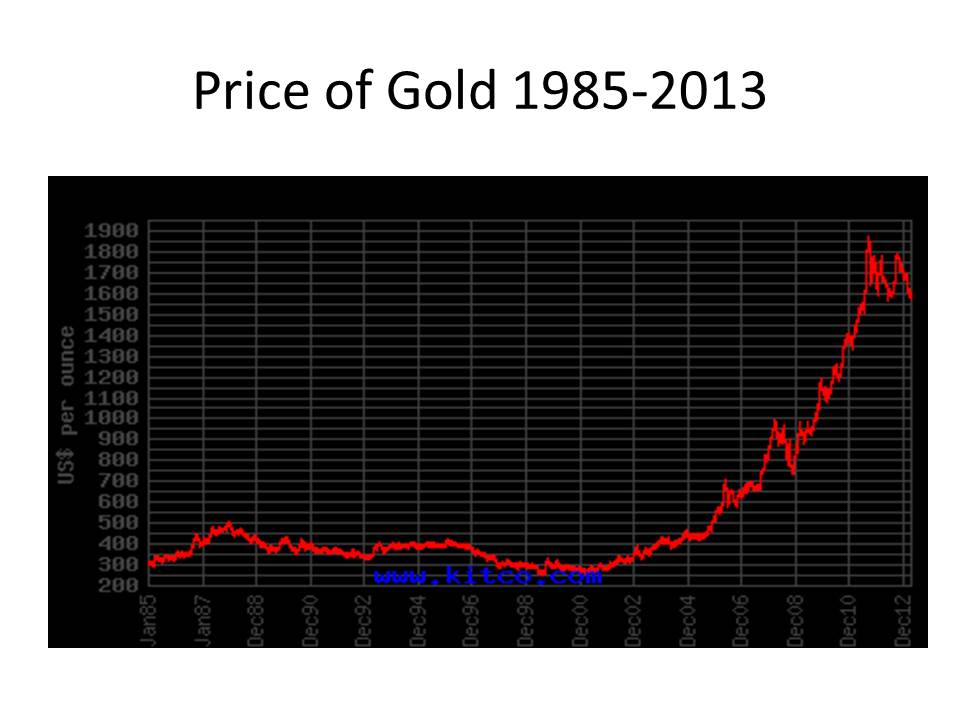
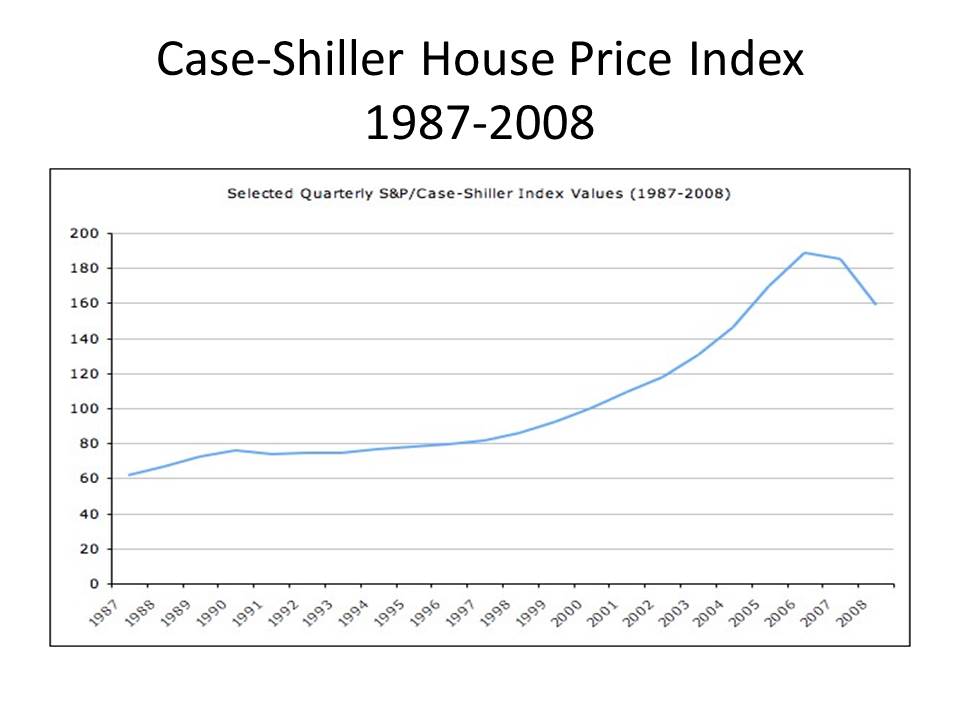
And if you happen to think that the nearly $400 an ounce drop in the price of gold since it peaked in 2011 is no big deal, have a look at these two graphs. The first is the Case-Shiller house price index from 1987 to 2008. The second is the price of gold from 1985 to 2013.

Case-Shiller_1987-2008

gold_1985-2013

Of course now that it is semi-official that the gold bubble has burst, isn’t it time to start looking for someone to blame it on? I mean we blamed Greenspan and Bernanke for the housing bubble, right. There must be someone (or two, or three) to blame for the gold bubble.

Juliet Lapidos, on the editorial page editor’s blog of  the Times, points an accusing finger at Ron Paul, dredging up quotes like this from the sagacious Congressman.

As the fiat money pyramid crumbles, gold retains its luster.  Rather than being the barbarous relic Keynesians have tried to lead us to believe it is, gold is, as the Bundesbank president put it, ‘a timeless classic.’  The defamation of gold wrought by central banks and governments is because gold exposes the devaluation of fiat currencies and the flawed policies of government.  Governments hate gold because the people cannot be fooled by it.

Fooled by gold? No way.

But the honorable Mr. Paul is surely not alone in beating the drums for gold. If he were still alive, it would have been nice to question Murray Rothbard about his role in feeding gold mania. But we still have Rothbard’s partner Lew Rockwell with us, maybe we should ask him for his take on the gold bubble. Indeed, inquiring minds want to know: what is the Austrian explanation for the gold bubble?

Margaret Thatcher and the Non-Existence of Society

Margaret Thatcher was a great lady, and a great political leader, reversing, by the strength of her character, a ruinous cycle of increasing state control of the British economy imposed in semi-collaboration with the British trade unions. That achievement required not just a change of policy, but a change in the way that the British people thought about the role of the state in organizing and directing economic activity. Mrs. Thatcher’s greatest achievement was not to change this or that policy, but to change the thinking of her countrymen. Leaders who can get others to change their thinking in fundamental ways rarely do so by being subtle; Mrs. Thatcher was not subtle.

Mrs. Thatcher had the great merit of admiring the writings of F. A. Hayek. How well she understood them, I am not in a position to say. But Hayek was a subtle thinker, and I think it is worth considering one instance — a somewhat notorious instance — in which Mrs. Thatcher failed to grasp Hayek’s subtlety. But just to give Mrs. Thatcher her due, it is also worth noting that, though Mrs. Thatcher admired Hayek enormously, she was not at all slavish in her admiration. And so it is only fair to recall that Mrs. Thatcher properly administered a stinging rebuke to Hayek, when he once dared to suggest to her that she could learn from General Pinochet about how to implement pro-market economic reforms.

However, I am sure you will agree that, in Britain with our democratic institutions and the need for a high degree of consent, some of the measures adopted in Chile are quite unacceptable. Our reform must be in line with our traditions and our Constitution. At times the process may seem painfully slow. But I am certain we shall achieve our reforms in our own way and in our own time. Then they will endure.

But Mrs. Thatcher did made the egregious mistake of asserting “there is no such thing as society, just individuals.” Here are two quotations in which the assertion was made.

And, you know, there is no such thing as society. There are individual men and women, and there are families. And no government can do anything except through people, and people must look to themselves first. It’s our duty to look after ourselves and then, also to look after our neighbour. People have got the entitlements too much in mind, without the obligations, because there is no such thing as an entitlement unless someone has first met an obligation.

And,

There is no such thing as society. There is living tapestry of men and women and people and the beauty of that tapestry and the quality of our lives will depend upon how much each of us is prepared to take responsibility for ourselves and each of us prepared to turn round and help by our own efforts those who are unfortunate.

In making that assertion, Mrs. Thatcher may have been inspired by Hayek, who wrote at length about the meaninglessness of the concept of “social justice.” But Hayek’s point was not that “social justice” is meaningless, because there is no such thing as society, but that justice, like democracy, is a concept that has no meaning except as it relates to society, so that adding “social” as a modifier to “justice” or to “democracy” can hardly impart any additional meaning to the concept it is supposed to modify. But the subtlety of Hayek’s reasoning was evidently beyond Mrs. Thatcher’s grasp.

Here’s a wonderful example of Hayek talking about society.

In the last resort we find ourselves constrained to repudiate the ideal of the social concept because it has become the ideal of those who, on principle, deny the existence of a true society and whose longing is for the artificially constructed and the rationally controlled. In this context, it seems to me that a great deal of what today professes to be social is, in the deeper and truer sense of the word, thoroughly and completely anti-social.

Nevertheless, while Mrs. Thatcher undoubtedly made her share of mistakes, on some really important decisions, decisions that really counted for the future of her country, she got things basically right.


About Me

David Glasner
Washington, DC

I am an economist in the Washington DC area. My research and writing has been mostly on monetary economics and policy and the history of economics. In my book Free Banking and Monetary Reform, I argued for a non-Monetarist non-Keynesian approach to monetary policy, based on a theory of a competitive supply of money. Over the years, I have become increasingly impressed by the similarities between my approach and that of R. G. Hawtrey and hope to bring Hawtrey’s unduly neglected contributions to the attention of a wider audience.

My new book Studies in the History of Monetary Theory: Controversies and Clarifications has been published by Palgrave Macmillan

Follow me on Twitter @david_glasner

Archives

Enter your email address to follow this blog and receive notifications of new posts by email.

Join 665 other subscribers
Follow Uneasy Money on WordPress.com