Archive for the 'Federal Reserve' Category


Exposed: Milton Friedman’s Cluelessness about the Insane Bank of France

About a month ago, I started a series of posts about monetary policy in the 1920s, (about the Bank of France, Benjamin Strong, the difference between a gold-exchange standard and a gold standard, and Ludwig von Mises’s unwitting affirmation of the Hawtrey-Cassel explanation of the Great Depression). The series was not planned, each post being written as new ideas occurred to me or as I found interesting tidbits (about Strong and Mises) in reading stuff I was reading about the Bank of France or the gold-exchange standard.

Another idea that occurred to me was to look at the 1991 English translation of the memoirs of Emile Moreau, Governor of the Bank of France from 1926 to 1930; I managed to find a used copy for sale on Amazon, which I got in the mail over the weekend. I have only read snatches here and there, by looking up names in the index, and we’ll see when I get around to reading the book from cover to cover. One of the more interesting things about the book is the foreward to the English translation by Milton Friedman (and one by Charles Kindleberger as well) to go along with the preface to the 1954 French edition by Jacques Rueff (about which I may have something to say in a future post — we’ll see about that, too).

Friedman’s foreward to Moreau’s memoir is sometimes cited as evidence that he backtracked from his denial in the Monetary History that the Great Depression had been caused by international forces, Friedman insisting that there was actually nothing special about the initial 1929 downturn and that the situation only got out of hand in December 1930 when the Fed foolishly (or maliciously) allowed the Bank of United States to fail, triggering a wave of bank runs and bank failures that caused a sharp decline in the US money stock. According to Friedman it was only at that point that what had been a typical business-cycle downturn degenerated into what Friedman like to call the Great Contraction.

Friedman based his claim that domestic US forces, not an international disturbance, had caused the Great Depression on the empirical observation that US gold reserves increased in 1929; that’s called reasoning from a quantity change. From that fact, Friedman inferred that international forces could not have caused the 1929 downturn, because an international disturbance would have meant that the demand for gold would have increased in the international centers associated with the disturbance, in which case gold would have been flowing out of, not into, the US. In a 1985 article in AER, Gertrude Fremling pointed out an obvious problem with Friedman’s argument which was that gold was being produced every year, and some of the newly produced gold was going into the reserves of central banks. An absolute increase in US gold reserves did not necessarily signify a monetary disturbance in the US. In fact, Fremling showed that US gold reserves actually increased proportionately less than total gold reserves. Unfortunately, Fremling failed to point out that there was a flood of gold pouring into France in 1929, making it easier for Friedman to ignore the problem with his misidentification of the US as the source of the Great Depression.

With that introduction out of the way, let me now quote Friedman’s 1991 acknowledgment that the Bank of France played some role in causing the Great Depression.

Rereading the memoirs of this splendid translation . . . has impressed me with important subtleties that I missed when I read the memoirs in a language not my own and in which I am far from completely fluent. Had I fully appreciated those subtleties when Anna Schwartz and I were writing our A Monetary History of the United States, we would likely have assessed responsibility for the international character of the Great Depression somewhat differently. We attributed responsibility for the initiation of a worldwide contraction to the United States and I would not alter that judgment now. However, we also remarked, “The international effects were severe and the transmission rapid, not only because the gold-exchange standard had rendered the international financial system more vulnerable to disturbances, but also because the United States did not follow gold-standard rules.” Were I writing that sentence today, I would say “because the United States and France did not follow gold-standard rules.”

I find this minimal adjustment by Friedman of his earlier position in the Monetary History totally unsatisfactory. Why do I find it unsatisfactory? To begin with, Friedman makes vague references to unnamed but “important subtleties” in Moreau’s memoir that he was unable to appreciate before reading the 1991 translation. There was nothing subtle about the gold accumulation being undertaken by the Bank of France; it was massive and relentless. The table below is constructed from data on official holdings of monetary gold reserves from December 1926 to June 1932 provided by Clark Johnson in his important book Gold, France, and the Great Depression, pp. 190-93. In December 1926 France held $711 million in gold or 7.7% of the world total of official gold reserves; in June 1932, French gold holdings were $3.218 billion or 28.4% of the world total.
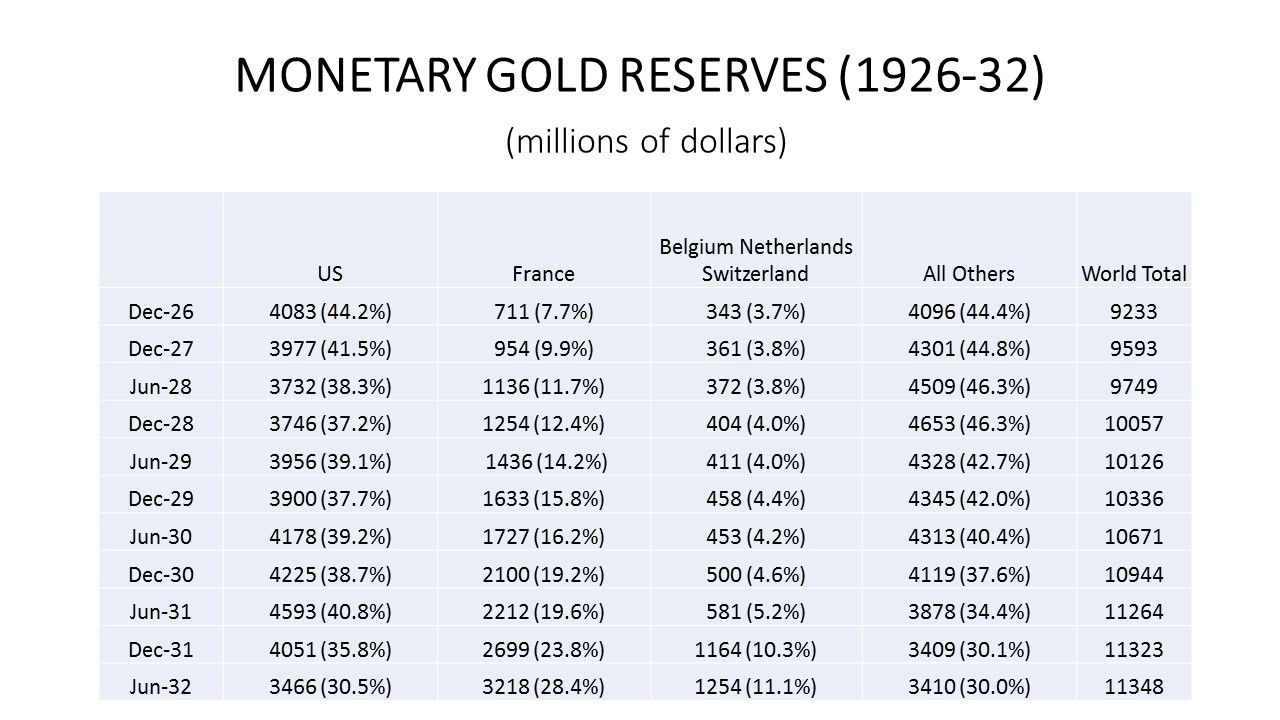
monetary_gold_reservesWhat was it about that policy that Friedman didn’t get? He doesn’t say. What he does say is that he would not alter his previous judgment that the US was responsible “for the initiation of a worldwide contraction.” The only change he would make would be to say that France, as well as the US, contributed to the vulnerability of the international financial system to unspecified disturbances, because of a failure to follow “gold-standard rules.” I will just note that, as I have mentioned many times on this blog, references to alleged “gold standard rules” are generally not only unhelpful, but confusing, because there were never any rules as such to the gold standard, and what are termed “gold-standard rules” are largely based on a misconception, derived from the price-specie-flow fallacy, of how the gold standard actually worked.

My goal in this post was not to engage in more Friedman bashing. What I wanted to do was to clarify the underlying causes of Friedman’s misunderstanding of what caused the Great Depression. But I have to admit that sometimes Friedman makes it hard not to engage in Friedman bashing. So let’s examine another passage from Friedman’s foreward, and see where that takes us.

Another feature of Moreau’s book that is most fascinating . . . is the story it tells of the changing relations between the French and British central banks. At the beginning, with France in desperate straits seeking to stabilize its currency, [Montagu] Norman [Governor of the Bank of England] was contemptuous of France and regarded it as very much of a junior partner. Through the accident that the French currency was revalued at a level that stimulated gold imports, France started to accumulate gold reserves and sterling reserves and gradually came into the position where at any time Moreau could have forced the British off gold by withdrawing the funds he had on deposit at the Bank of England. The result was that Norman changed from being a proud boss and very much the senior partner to being almost a supplicant at the mercy of Moreau.

What’s wrong with this passage? Well, Friedman was correct about the change in the relative positions of Norman and Moreau from 1926 to 1928, but to say that it was an accident that the French currency was revalued at a level that stimulated gold imports is completely — and in this case embarrassingly — wrong, and wrong in two different senses: one strictly factual, and the other theoretical. First, and most obviously, the level at which the French franc was stabilized — 125 francs per pound — was hardly an accident. Indeed, it was precisely the choice of the rate at which to stabilize the franc that was a central point of Moreau’s narrative in his memoir, a central drama of the tale told by Moreau, more central than the relationship between Norman and Moreau, being the struggle between Moreau and his boss, the French Premier, Raymond Poincaré, over whether the franc would be stabilized at that rate, the rate insisted upon by Moreau, or the prewar parity of 25 francs per pound. So inquiring minds can’t help but wonder what exactly did Friedman think he was reading?

The second sense in which Friedman’s statement was wrong is that the amount of gold that France was importing depended on a lot more than just its exchange rate; it was also a function of a) the monetary policy chosen by the Bank of France, which determined the total foreign-exchange holdings held by the Bank of France, and b) the portfolio decisions of the Bank of France about how, given the exchange rate of the franc and given the monetary policy it adopted, the resulting quantity of foreign-exchange reserves would be held.

Let’s follow Friedman a bit further in his foreward as he quotes from his own essay “Should There Be an Independent Monetary Authority?” contrasting the personal weakness of W. P. G. Harding, Governor of the Federal Reserve in 1919-20, with the personal strength of Moreau:

Almost every student of the period is agreed that the great mistake of the Reserve System in postwar monetary policy was to permit the money stock to expand very rapidly in 1919 and then to step very hard on the brakes in 1920. This policy was almost surely responsible for both the sharp postwar rise in prices and the sharp subsequent decline. It is amusing to read Harding’s answer in his memoirs to criticism that was later made of the policies followed. He does not question that alternative policies might well have been preferable for the economy as a whole, but emphasizes the treasury’s desire to float securities at a reasonable rate of interest, and calls attention to a then-existing law under which the treasury could replace the head of the Reserve System. Essentially he was saying the same thing that I heard another member of the Reserve Board say shortly after World War II when the bond-support program was in question. In response to the view expressed by some of my colleagues and myself that the bond-support program should be dropped, he largely agreed but said ‘Do you want us to lose our jobs?’

The importance of personality is strikingly revealed by the contrast between Harding’s behavior and that of Emile Moreau in France under much more difficult circumstances. Moreau formally had no independence whatsoever from the central government. He was named by the premier, and could be discharged at any time by the premier. But when he was asked by the premier to provide the treasury with funds in a manner that he considered inappropriate and undesirable, he flatly refused to do so. Of course, what happened was that Moreau was not discharged, that he did not do what the premier had asked him to, and that stabilization was rather more successful.

Now, if you didn’t read this passage carefully, in particular the part about Moreau’s threat to resign, as I did not the first three or four times that I read it, you might not have noticed what a peculiar description Friedman gives of the incident in which Moreau threatened to resign following a request “by the premier to provide the treasury with funds in a manner that he considered inappropriate and undesirable.” That sounds like a very strange request for the premier to make to the Governor of the Bank of France. The Bank of France doesn’t just “provide funds” to the Treasury. What exactly was the request? And what exactly was “inappropriate and undesirable” about that request?

I have to say again that I have not read Moreau’s memoir, so I can’t state flatly that there is no incident in Moreau’s memoir corresponding to Friedman’s strange account. However, Jacques Rueff, in his preface to the 1954 French edition (translated as well in the 1991 English edition), quotes from Moreau’s own journal entries how the final decision to stabilize the French franc at the new official parity of 125 per pound was reached. And Friedman actually refers to Rueff’s preface in his foreward! Let’s read what Rueff has to say:

The page for May 30, 1928, on which Mr. Moreau set out the problem of legal stabilization, is an admirable lesson in financial wisdom and political courage. I reproduce it here in its entirety with the hope that it will be constantly present in the minds of those who will be obliged in the future to cope with French monetary problems.

“The word drama may sound surprising when it is applied to an event which was inevitable, given the financial and monetary recovery achieved in the past two years. Since July 1926 a balanced budget has been assured, the National Treasury has achieved a surplus and the cleaning up of the balance sheet of the Bank of France has been completed. The April 1928 elections have confirmed the triumph of Mr. Poincaré and the wisdom of the ideas which he represents. The political situation has been stabilized. Under such conditions there is nothing more natural than to stabilize the currency, which has in fact already been pegged at the same level for the last eighteen months.

“But things are not quite that simple. The 1926-28 recovery from restored confidence to those who had actually begun to give up hope for their country and its capacity to recover from the dark hours of July 1926. . . . perhaps too much confidence.

“Distinguished minds maintained that it was possible to return the franc to its prewar parity, in the same way as was done with the pound sterling. And how tempting it would be to thereby cancel the effects of the war and postwar periods and to pay back in the same currency those who had lent the state funds which for them often represented an entire lifetime of unremitting labor.

“International speculation seemed to prove them right, because it kept changing its dollars and pounds for francs, hoping that the franc would be finally revalued.

“Raymond Poincaré, who was honesty itself and who, unlike most politicians, was truly devoted to the public interest and the glory of France, did, deep in his heart, agree with those awaiting a revaluation.

“But I myself had to play the ungrateful role of representative of the technicians who knew that after the financial bloodletting of the past years it was impossible to regain the original parity of the franc.

“I was aware, as had already been determined by the Committee of Experts in 1926, that it was impossible to revalue the franc beyond certain limits without subjecting the national economy to a particularly painful readaptation. If we were to sacrifice the vital force of the nation to its acquired wealth, we would put at risk the recovery we had already accomplished. We would be, in effect, preparing a counterspeculation against our currency that would come within a rather short time.

“Since the parity of 125 francs to one pound has held for long months and the national economy seems to have adapted itself to it, it should be at this rate that we stabilize without further delay.

“This is what I had to tell Mr. Poincaré at the beginning of June 1928, tipping the scales of his judgment with the threat of my resignation.” [my emphasis]

So what this tells me is that the very act of personal strength that so impressed Friedman about Moreau was not about some imaginary “inappropriate” request made by Poincaré (“who was honesty itself”) for the Bank to provide funds to the treasury, but about whether the franc should be stabilized at 125 francs per pound, a peg that Friedman asserts was “accidental.” Obviously, it was not “accidental” at all, but it was based on the judgment of Moreau and his advisers (including two economists of considerable repute, Charles Rist and his student Pierre Quesnay) as attested to by Rueff in his preface, of which we know that Friedman was aware.

Just to avoid misunderstanding, I would just say here that I am not suggesting that Friedman was intentionally misrepresenting any facts. I think that he was just being very sloppy in assuming that the facts actually were what he rather cluelessly imagined them to be.

Before concluding, I will quote again from Friedman’s foreword:

Benjamin Strong and Emile Moreau were admirable characters of personal force and integrity. But in my view, the common policies they followed were misguided and contributed to the severity and rapidity of transmission of the U.S. shock to the international community. We stressed that the U.S. “did not permit the inflow of gold to expand the U.S. money stock. We not only sterilized it, we went much further. Our money stock moved perversely, going down as the gold stock went up” from 1929 to 1931. France did the same, both before and after 1929.

Strong and Moreau tried to reconcile two ultimately incompatible objectives: fixed exchange rates and internal price stability. Thanks to the level at which Britain returned to gold in 1925, the U.S. dollar was undervalued, and thanks to the level at which France returned to gold at the end of 1926, so was the French franc. Both countries as a result experienced substantial gold inflows. Gold-standard rules called for letting the stock of money rise in response to the gold inflows and for price inflation in the U.S. and France, and deflation in Britain, to end the over-and under-valuations. But both Strong and Moreau were determined to preven t inflation and accordingly both sterilized the gold inflows, preventing them from providing the required increase in the quantity of money. The result was to drain the other central banks of the world of their gold reserves, so that they became excessively vulnerable to reserve drains. France’s contribution to this process was, I now realize, much greater than we treated it as being in our History.

These two paragraphs are full of misconceptions; I will try to clarify and correct them. First Friedman refers to “the U.S. shock to the international community.” What is he talking about? I don’t know. Is he talking about the crash of 1929, which he dismissed as being of little consequence for the subsequent course of the Great Depression, whose importance in Friedman’s view was certainly far less than that of the failure of the Bank of United States? But from December 1926 to December 1929, total monetary gold holdings in the world increased by about $1 billion; while US gold holdings declined by nearly $200 million, French holdings increased by $922 million over 90% of the increase in total world official gold reserves. So for Friedman to have even suggested that the shock to the system came from the US and not from France is simply astonishing.

Friedman’s discussion of sterilization lacks any coherent theoretical foundation, because, working with the most naïve version of the price-specie-flow mechanism, he imagines that flows of gold are entirely passive, and that the job of the monetary authority under a gold standard was to ensure that the domestic money stock would vary proportionately with the total stock of gold. But that view of the world ignores the possibility that the demand to hold money in any country could change. Thus, Friedman, in asserting that the US money stock moved perversely from 1929 to 1931, going down as the gold stock went up, misunderstands the dynamic operating in that period. The gold stock went up because, with the banking system faltering, the public was shifting their holdings of money balances from demand deposits to currency. Legal reserves were required against currency, but not against demand deposits, so the shift from deposits to currency necessitated an increase in gold reserves. To be sure the US increase in the demand for gold, driving up its value, was an amplifying factor in the worldwide deflation, but total US holdings of gold from December 1929 to December 1931 rose by $150 million compared with an increase of $1.06 billion in French holdings of gold over the same period. So the US contribution to world deflation at that stage of the Depression was small relative to that of France.

Friedman is correct that fixed exchange rates and internal price stability are incompatible, but he contradicts himself a few sentences later by asserting that Strong and Moreau violated gold-standard rules in order to stabilize their domestic price levels, as if it were the gold-standard rules rather than market forces that would force domestic price levels into correspondence with a common international level. Friedman asserts that the US dollar was undervalued after 1925 because the British pound was overvalued, presuming with no apparent basis that the US balance of payments was determined entirely by its trade with Great Britain. As I observed above, the exchange rate is just one of the determinants of the direction and magnitude of gold flows under the gold standard, and, as also pointed out above, gold was generally flowing out of the US after 1926 until the ferocious tightening of Fed policy at the end of 1928 and in 1929 caused a sizable inflow of gold into the US in 1929.

In thrall to the crude price-specie-flow fallacy, Friedman erroneously assumes that inflation rates under the gold standard are governed by the direction and size of gold flows, inflows being inflationary and outflows deflationary. That is just wrong; national inflation rates were governed by a common international price level in terms of gold (and any positive or negative inflation in terms of gold) and whether prices in the local currency were above or below their gold equivalents, market forces operating to equalize the prices of tradable goods. Domestic monetary policies, whether or not they conformed to supposed gold standard rules, had negligible effect on national inflation rates. If the pound was overvalued, there was deflationary pressure in Britain regardless of whether British monetary policy was tight or easy, and if the franc was undervalued there was inflationary pressure in France regardless of whether French monetary policy was tight or easy. Tightness or ease of monetary policy under the gold standard affects not the rate of inflation, but the rate at which the central bank gained or lost foreign exchange reserves.

However, when, in the aggregate, central banks were tightening their policies, thereby tending to accumulate gold, the international gold market would come under pressure, driving up the value of gold relative goods, thereby causing deflationary pressure among all the gold standard countries. That is what happened in 1929, when the US started to accumulate gold even as the insane Bank of France was acting as a giant international vacuum cleaner sucking in gold from everywhere else in the world. Friedman, even as he was acknowledging that he had underestimated the importance of the Bank of France in the Monetary History, never figured this out. He was obsessed, instead with relatively trivial effects of overvaluation of the pound, and undervaluation of the franc and the dollar. Talk about missing the forest for the trees.

Of course, Friedman was not alone in his cluelessness about the Bank of France. F. A. Hayek, with whom, apart from their common belief in the price-specie-flow fallacy, Friedman shared almost no opinions about monetary theory and policy, infamously defended the Bank of France in 1932.

France did not prevent her monetary circulation from increasing by the very same amount as that of the gold inflow – and this alone is necessary for the gold standard to function.

Thus, like Friedman, Hayek completely ignored the effect that the monumental accumulation of gold by the Bank of France had on the international value of gold. That Friedman accused the Bank of France of violating the “gold-standard rules” while Hayek denied the accusation simply shows, notwithstanding the citations by the Swedish Central Bank of the work that both did on the Great Depression when awarding them their Nobel Memorial Prizes, how far away they both were from an understanding of what was actually going on during that catastrophic period.

Mises’s Unwitting Affirmation of the Hawtrey-Cassel Explanation of the Great Depression

In looking up some sources for my previous post on the gold-exchange standard, I checked, as I like to do from time to time, my old copy of The Theory of Money and Credit by Ludwig von Mises. Mises published The Theory of Money and Credit in 1912 (in German of course) when he was about 31 years old, a significant achievement. In 1924 he published a second enlarged edition addressing many issues that became relevant in the aftermath the World War and the attempts then underway to restore the gold standard. So one finds in the 1934 English translation of the 1924 German edition a whole section of Part III, chapter 6 devoted to the Gold-Exchange Standard. I noticed that I had dog-eared the section, which presumably means that when I first read the book I found the section interesting in some way, but I did not write any notes in the margin, so I am not sure what it was that I found interesting. I can’t even remember when I read the book, but there are many passages underlined throughout the book, so I am guessing that I did read it from cover to cover. Luckily, I wrote my name and the year (1971) in which I bought the book on the inside of the front cover, so I am also guessing that I read the book before I became aware of the Hawtrey Cassel explanation of the Great Depression. But it seems clear to me that whatever it was that I found interesting about the section on the gold-exchange standard, it didn’t make a lasting impression on me, because I don’t think that I ever reread that section until earlier this week. So let’s go through Mises’s discussion and see what we find.

Wherever inflation has thrown the monetary system into confusion, the primary aim of currency policy has been to bring the printing presses to a standstill. Once that is done, once it has at last been learned that even the policy of raising the objective exchange-value of money has undesirable consequences, and once it is seen that the chief thing is to stabilize the value of money, then attempts are made to establish a gold-exchange standard as quickly as possible.

This seems to be reference to the World War I inflation and the somewhat surprising post-war inflation of 1919, which caused most countries to want to peg their currencies against the dollar, then the only major country with a currency convertible into gold. Mises continues:

This, for example, is what occurred in Austria at the end of 1922 and since then, at least for the time being, the dollar rate in that country has been fixed. But in existing circumstances, invariability of the dollar rate means invariability of the price of gold also. Thus Austria has a dollar-exchange standard and so, indirectly, a gold-exchange standard. That is the currency system that seems to be the immediate aim in Germany, Poland, Hungary, and many other European countries. Nowadays, European aspirations in the sphere of currency policy are limited to a return to the gold standard. This is quite understandable, for the gold standard previously functioned on the whole satisfactorily; it is true that it did not secure the unattainable ideal of a money with an invariable objective exchange value, but it did preserve the monetary system from the influence of governments and changing policies.

Yet the gold-standard system was already undermined before the war. The first step was the abolition of the physical use of gold in individual payments and the accumulation of the stocks of gold in the vaults of the great banks-of-issue. The next step was the adoption of the practice by a series of States of holding the gold reserves of the central banks-of-issue (or the redemption funds that took their place), not in actual gold, but in various sorts of foreign claims to gold. Thus it came about that the greater part of the stock of gold that was used for monetary purposes was gradually accumulated in a few large banks-of-issue; and so these banks became the central reserve-banks of the world, as previously the central banks-of-issue had become central reserve-banks for individual countries.

Mises is leaving out a lot here. Many countries were joining gold standard in the last quarter of the 19th century, when the gold standard became an international system. The countries adopting the gold standard did not have a gold coinage; for them to introduce a gold coinage, as Mises apparently would have been wanted, was then prohibitively costly. But gold reserves were still piling up in many central banks because of laws and regulations requiring central banks to hold gold reserves against banknotes. If gold coinages would have been introduced in addition to the gold gold reserves being accumulated as reserves against banknotes, the spread of gold standard through much of the world in the last quarter of the 19th century would have drastically accentuated the deflationary trends that marked most of the period from 1872 to 1896.

The War did not create this development; it merely hastened it a little.

Actually a lot. But we now come to the key passage.

Neither has the development yet reached the stage when all the newly-produced gold that is not absorbed into industrial use flows to a single centre. The Bank of England and the central banks-of-issue of some other States still control large stocks of gold; there are still several of them that take up part of the annual output of gold. Yet fluctuations in the price of gold are nowadays essentially dependent on the policy followed by the Federal Reserve Board. If the United States did not absorb gold to the extent to which it does, the price of gold would fall and the gold-prices of commodities would rise. Since, so long as the dollar represents a fixed quantity of gold, the United States admits the surplus gold and surrenders commodities for gold to an unlimited extent, a rapid fall in the value of gold has hitherto been avoided.

Mises’s explanation here is rather confused, because he neglects to point out that the extent to which gold was flowing into the Federal Reserve was a function, among other things, of the credit policy adopted by the Fed. The higher the interest rate, the more gold would flow into the Fed and, thus, the lower the international price level. Mises makes it sound as if there was a fixed demand for gold by the rest of the world and the US simply took whatever was left over. That was a remarkable misunderstanding on Mises’s part.

But this policy of the United States, which involves considerable sacrifices, might one day be changed. Variations in the price of gold would then occur and this would be bound to give rise in other gold countries to the question of whether it would not be better in order to avoid further rises in prices to dissociate the currency standard from gold.

Note the ambiguous use of the term “price of gold.” The nominal price of gold was fixed by convertibility, so what Mises meant was the real price of gold, with a fixed nominal price. It would have been less ambiguous if the term “value of gold” had been used here and in the rest of the passage instead of “price of gold.” I don’t know if Mises or his translator was at fault.

Just as Sweden attempted for a time to raise the krone above its old gold parity by closing the Mint to gold, so other countries that are now still on the gold standard or intend to return to it might act similarly. This would mean a further drop in the price of gold and a further reduction of the usefulness of gold for monetary purposes. If we disregard the Asiatic demand for money, we might even now without undue exaggeration say that gold has ceased to be a commodity the fluctuations in the price of which are independent of government influence. Fluctuations in the price of gold are nowadays substantially dependent on the behaviour of one government, viz. that of the United States of America.

By George, he’s got it! The value of gold depends mainly on the Fed! Or, to be a bit more exact, on how much gold is being held by the Fed and by the other central banks. The more gold they hold, the more valuable in real terms gold becomes, which means that, with a fixed nominal price of gold, the lower are the prices of all other commodities. The point of the gold-exchange standard was thus to reduce the world’s monetary demand for gold, thereby limiting the tendency of gold to appreciate and for prices in terms of gold to fall. Indeed, Mises here cites in a footnote none other than the villainous John Maynard Keynes himself (Tract on Monetary Reform) where he also argued that after World War I, the value of gold was determined by government policy, especially that of the Federal Reserve. Mises goes on to explain:

All that could not have been foreseen in this result of a long process of development is the circumstance that the fluctuations in the price of gold should have become dependent upon the policy of one government only. That the United States should have achieved such an economic predominance over other countries as it now has, and that it alone of all the countries of great economic importance should have retained the gold standard while the others (England, France, Germany, Russia, and the rest) have at least temporarily abandoned it – that is a consequence of what took place during the War. Yet the matter would not be essentially different if the price of gold was dependent not on the policy of the United States alone, but on those of four or five other governments as well. Those protagonists of the gold-exchange standard who have recommended it as a general monetary system and not merely as an expedient for poor countries, have overlooked this fact. They have not observed that the gold-exchange standard must at last mean depriving gold of that characteristic which is the most important from the point of view of monetary policy – its independence of government influence upon fluctuations in its value. The gold-exchange standard has not been recommended or adopted with the object of dethroning gold. All that Ricardo wanted was to reduce the cost of the monetary system. In many countries which from the last decade of the nineteenth century onward have wished to abandon the silver or credit-money standard, the gold-exchange standard rather than a gold standard with an actual gold currency has been adopted in order to prevent the growth of a new demand for gold from causing a rise in its price and a fall in the gold-prices of commodities. But whatever the motives may have been by which the protagonists of the gold-exchange standard have been led, there can be no doubt concerning the results of its increasing popularity.

If the gold-exchange standard is retained, the question must sooner or later arise as to whether it would not be better to substitute for it a credit-money standard whose fluctuations were more susceptible to control than those of gold. For if fluctuations in the price of gold are substantially dependent on political intervention, it is inconceivable why government policy should still be restricted at all and not given a free hand altogether, since the amount of this restriction is not enough to confine arbitrariness in price policy within narrow limits. The cost of additional gold for monetary purposes that is borne by the whole world might well be saved, for it no longer secures the result of making the monetary system independent of government intervention. If this complete government control is not desired, there remains one alternative only: an attempt must be made to get back from the gold-exchange standard to the actual use of gold again.

Thus, we see that in 1924 none other than the legendary Ludwig von Mises was explaining that the value of gold had come to depend primarily on the policy decisions of the Federal Reserve and the other leading central banks. He also understood that a process of deflation could have terrible consequences if free-market forces were not operating to bring about an adjustment of market prices to the rising value of gold. Recognizing the potentially disastrous consequences of a scramble for gold by the world’s central banks as they rejoined the gold standard, Hawtrey and Cassel called for central-bank cooperation to limit the increase in the demand for gold and to keep the value of gold stable. In 1924, at any rate, Mises, too, recognized that there could be a destabilizing deflationary increase in the demand for gold by central banks. But when the destabilizing deflationary increase actually started to happen in 1927 when the Bank of France began cashing in its foreign-exchange reserves for gold, triggering similar demands by other central banks in the process of adopting the gold standard, the gold standard started collapsing under the weight  of deflation. But, as far as I know, Mises never said a word about the relationship between gold demand and the Great Depression.

Instead, in the mythology of Austrian business-cycle theory, it was all the fault of the demonic Benjamin Strong for reducing the Fed’s discount rate from 5% to 3.5% in 1927 (and back to only 4% in 1928) and of the duplicitous Montagu Norman for reducing Bank Rate from 5% to 4.5% in 1927-28 rather than follow the virtuous example of the Bank of France in abandoning the cursed abomination of the gold-exchange standard.

Sterilizing Gold Inflows: The Anatomy of a Misconception

In my previous post about Milton Friedman’s problematic distinction between real and pseudo-gold standards, I mentioned that one of the signs that Friedman pointed to in asserting that the Federal Reserve Board in the 1920s was managing a pseudo gold standard was the “sterilization” of gold inflows to the Fed. What Friedman meant by sterilization is that the incremental gold reserves flowing into the Fed did not lead to a commensurate increase in the stock of money held by the public, the failure of the stock of money to increase commensurately with an inflow of gold being the standard understanding of sterilization in the context of the gold standard.

Of course “commensurateness” is in the eye of the beholder. Because Friedman felt that, given the size of the gold inflow, the US money stock did not increase “enough,” he argued that the gold standard in the 1920s did not function as a “real” gold standard would have functioned. Now Friedman’s denial that a gold standard in which gold inflows are sterilized is a “real” gold standard may have been uniquely his own, but his understanding of sterilization was hardly unique; it was widely shared. In fact it was so widely shared that I myself have had to engage in a bit of an intellectual struggle to free myself from its implicit reversal of the causation between money creation and the holding of reserves. For direct evidence of my struggles, see some of my earlier posts on currency manipulation (here, here and here), in which I began by using the concept of sterilization as if it actually made sense in the context of international adjustment, and did not fully grasp that the concept leads only to confusion. In an earlier post about Hayek’s 1932 defense of the insane Bank of France, I did not explicitly refer to sterilization, and got the essential analysis right. Of course Hayek, in his 1932 defense of the Bank of France, was using — whether implicitly or explicitly I don’t recall — the idea of sterilization to defend the Bank of France against critics by showing that the Bank of France was not guilty of sterilization, but Hayek’s criterion for what qualifies as sterilization was stricter than Friedman’s. In any event, it would be fair to say that Friedman’s conception of how the gold standard works was broadly consistent with the general understanding at the time of how the gold standard operates, though, even under the orthodox understanding, he had no basis for asserting that the 1920s gold standard was fraudulent and bogus.

To sort out the multiple layers of confusion operating here, it helps to go back to the classic discussion of international monetary adjustment under a pure gold currency, which was the basis for later discussions of international monetary adjustment under a gold standard (i.e, a paper currency convertible into gold at a fixed exchange rate). I refer to David Hume’s essay “Of the Balance of Trade” in which he argued that there is an equilibrium distribution of gold across different countries, working through a famous thought experiment in which four-fifths of the gold held in Great Britain was annihilated to show that an automatic adjustment process would redistribute the international stock of gold to restore Britain’s equilibrium share of the total world stock of gold.

The adjustment process, which came to be known as the price-specie flow mechanism (PSFM), is widely considered one of Hume’s greatest contributions to economics and to monetary theory. Applying the simple quantity theory of money, Hume argued that the loss of 80% of Britain’s gold stock would mean that prices and wages in Britain would fall by 80%. But with British prices 80% lower than prices elsewhere, Britain would stop importing goods that could now be obtained more cheaply at home than they could be obtained abroad, while foreigners would begin exporting all they could from Britain to take advantage of low British prices. British exports would rise and imports fall, causing an inflow of gold into Britain. But, as gold flowed into Britain, British prices would rise, thereby reducing the British competitive advantage, causing imports to increase and exports to decrease, and consequently reducing the inflow of gold. The adjustment process would continue until British prices and wages had risen to a level equal to that in other countries, thus eliminating the British balance-of-trade surplus and terminating the inflow of gold.

This was a very nice argument, and Hume, a consummate literary stylist, expressed it beautifully. There is only one problem: Hume ignored that the prices of tradable goods (those that can be imported or exported or those that compete with imports and exports) are determined not in isolated domestic markets, but in international markets, so the premise that all British prices, like the British stock of gold, would fall by 80% was clearly wrong. Nevertheless, the disconnect between the simple quantity theory and the idea that the prices of tradable goods are determined in international markets was widely ignored by subsequent writers. Although Adam Smith, David Ricardo, and J. S. Mill avoided the fallacy, but without explicit criticism of Hume, while Henry Thornton, in his great work The Paper Credit of Great Britain, alternately embraced it and rejected it, the Humean analysis, by the end of the nineteenth century, if not earlier, had become the established orthodoxy.

Towards the middle of the nineteenth century, there was a famous series of controversies over the Bank Charter Act of 1844, in which two groups of economists the Currency School in support and the Banking School in opposition argued about the key provisions of the Act: to centralize the issue of Banknotes in Great Britain within the Bank of England and to prohibit the Bank of England from issuing additional banknotes, beyond the fixed quantity of “unbacked” notes (i.e. without gold cover) already in circulation, unless the additional banknotes were issued in exchange for a corresponding amount of gold coin or bullion. In other words, the Bank Charter Act imposed a 100% marginal reserve requirement on the issue of additional banknotes by the Bank of England, thereby codifying what was then known as the Currency Principle, the idea being that the fluctuation in the total quantity of Banknotes ought to track exactly the Humean mechanism in which the quantity of money in circulation changes pound for pound with the import or export of gold.

The doctrinal history of the controversies about the Bank Charter Act are very confused, and I have written about them at length in several papers (this, this, and this) and in my book on free banking, so I don’t want to go over that ground again here. But until the advent of the monetary approach to the balance of payments in the late 1960s and early 1970s, the thinking of the economics profession about monetary adjustment under the gold standard was largely in a state of confusion, the underlying fallacy of PSFM having remained largely unrecognized. One of the few who avoided the confusion was R. G. Hawtrey, who had anticipated all the important elements of the monetary approach to the balance of payments, but whose work had been largely forgotten in the wake of the General Theory.

Two important papers changed the landscape. The first was a 1976 paper by Donald McCloskey and Richard Zecher “How the Gold Standard Really Worked” which explained that a whole slew of supposed anomalies in the empirical literature on the gold standard were easily explained if the Humean PSFM was disregarded. The second was Paul Samuelson’s 1980 paper “A Corrected Version of Hume’s Equilibrating Mechanisms for International Trade,” showing that the change in relative price levels — the mechanism whereby international monetary equilibrium is supposedly restored according to PSFM — is irrelevant to the adjustment process when arbitrage constraints on tradable goods are effective. The burden of the adjustment is carried by changes in spending patterns that restore desired asset holdings to their equilibrium levels, independently of relative-price-level effects. Samuelson further showed that even when, owing to the existence of non-tradable goods, there are relative-price-level effects, those effects are irrelevant to the adjustment process that restores equilibrium.

What was missing from Hume’s analysis was the concept of a demand to hold money (or gold). The difference between desired and actual holdings of cash imply corresponding changes in expenditure, and those changes in expenditure restore equilibrium in money (gold) holdings independent of any price effects. Lacking any theory of the demand to hold money (or gold), Hume had to rely on a price-level adjustment to explain how equilibrium is restored after a change in the quantity of gold in one country. Hume’s misstep set monetary economics off on a two-century detour, avoided by only a relative handful of economists, in explaining the process of international adjustment.

So historically there have been two paradigms of international adjustment under the gold standard: 1) the better-known, but incorrect, Humean PSFM based on relative-price-level differences which induce self-correcting gold flows that, in turn, are supposed to eliminate the price-level differences, and 2) the not-so-well-known, but correct, arbitrage-monetary-adjustment theory. Under the PSFM, the adjustment can occur only if gold flows give rise to relative-price-level adjustments. But, under PSFM, for those relative-price-level adjustments to occur, gold flows have to change the domestic money stock, because it is the quantity of domestic money that governs the domestic price level.

That is why if you believe, as Milton Friedman did, in PSFM, sterilization is such a big deal. Relative domestic price levels are correlated with relative domestic money stocks, so if a gold inflow into a country does not change its domestic money stock, the necessary increase in the relative price level of the country receiving the gold inflow cannot occur. The “automatic” adjustment mechanism under the gold standard has been blocked, implying that if there is sterilization, the gold standard is rendered fraudulent.

But we now know that that is not how the gold standard works. The point of gold flows was not to change relative price levels. International adjustment required changes in domestic money supplies to be sure, but, under the gold standard, changes in domestic money supplies are essentially unavoidable. Thus, in his 1932 defense of the insane Bank of France, Hayek pointed out that the domestic quantity of money had in fact increased in France along with French gold holdings. To Hayek, this meant that the Bank of France was not sterilizing the gold inflow. Friedman would have said that, given the gold inflow, the French money stock ought to have increased by a far larger amount than it actually did.

Neither Hayek nor Friedman understood what was happening. The French public wanted to increase their holdings of money. Because the French government imposed high gold reserve requirements (but less than 100%) on the creation of French banknotes and deposits, increasing holdings of money required the French to restrict their spending sufficiently to create a balance-of-trade surplus large enough to induce the inflow of gold needed to satisfy the reserve requirements on the desired increase in cash holdings. The direction of causation was exactly the opposite of what Friedman thought. It was the desired increase in the amount of francs that the French wanted to hold that (given the level of gold reserve requirements) induced the increase in French gold holdings.

But this doesn’t mean, as Hayek argued, that the insane Bank of France was not wreaking havoc on the international monetary system. By advocating a banking law that imposed very high gold reserve requirements and by insisting on redeeming almost all of its non-gold foreign exchange reserves into gold bullion, the insane Bank of France, along with the clueless Federal Reserve, generated a huge increase in the international monetary demand for gold, which was the proximate cause of the worldwide deflation that began in 1929 and continued till 1933. The problem was not a misalignment between relative price levels, which is sterilization supposedly causes; the problem was a worldwide deflation that afflicted all countries on the gold standard, and was avoidable only by escaping from the gold standard.

At any rate, the concept of sterilization does nothing to enhance our understanding of that deflationary process. And whatever defects there were in the way that central banks were operating under the gold standard in the 1920s, the concept of sterilization averts attention from the critical problem which was the increasing demand of the world’s central banks, especially the Bank of France and the Federal Reserve, for gold reserves.

Real and Pseudo Gold Standards: Could Friedman Tell the Difference?

One of the first academic papers by Milton Friedman that I read was “Real and Pseudo Gold Standards.” It’s an interesting paper presented to the Mont Pelerin Society in September 1961 and published in the Journal of Law and Economics in October 1961. That it was published in the Journal of Law and Economics, then edited by Friedman’s colleague at Chicago (and fellow Mont Pelerin member) Ronald Coase, is itself interesting, that estimable journal hardly being an obvious place to publish research on monetary economics. But the point of the paper was not to advance new theoretical insights about monetary theory, though he did provide a short preview of his critique of Fed policy in the 1920-21 Depression and in the Great Depression that he and Anna Schwartz would make in their soon to be published Monetary History of the United States, but to defend Friedman’s pro-fiat money position as a respectable alternative among the libertarians and classical liberals with whom Friedman had allied himself in the Mont Pelerin Society.

Although many members of the Mont Pelerin Society, including Hayek himself, as well as Friedman, Fritz Machlup and Lionel Robbins no longer supported the gold standard, their reasons for doing so were largely pragmatic, believing that whatever its virtues, the gold standard was no longer a realistic or even a desirable option as a national or an international monetary system. But there was another, perhaps more numerous, faction within the Mont Pelerin Society and the wider libertarian/ classical-liberal community, that disdained any monetary system other than the gold standard. The intellectual leader of this group was of course the soul of intransigence, the unyieldingly stubborn Ludwig von Mises, notably supported by the almost equally intransigent French economist Jacques Rueff, whose attachment to gold was so intense that Charles de Gaulle, another in a long line of French politicians enchanted by the yellow metal, had chosen Rueff as his personal economic adviser.

What Friedman did in this essay was not to engage with von Mises on the question of the gold standard; Friedman was realistic enough to understand that one could not reason with von Mises, who anyway regarded Friedman, as he probably did most of the members of the Mont Pelerin Society, as hardly better than a socialist. Instead, his strategy was to say that there is only one kind of real gold standard – presumably the kind favored by von Mises, whose name went unmentioned by Friedman, anything else being a pseudo-gold standard — in reality, nothing but a form of price fixing in which the government sets the price of gold and manages the gold market to prevent the demand for gold from outstripping the supply. While Friedman acknowledged that a real gold standard could be defended on strictly libertarian grounds, he argued that a pseudo-gold standard could not, inasmuch as it requires all sorts of market interventions, especially restrictions on the private ownership of gold that were then in place. What Friedman was saying, in effect, to the middle group in the Mont Pelerin Society was the only alternatives for liberals and libertarians were a gold standard of the Mises type or his preference: a fiat standard with flexible exchange rates.

Here is how he put it:

It is vitally important for the preservation and promotion of a free society that we recognize the difference between a real and pseudo gold standard. War aside, nothing that has occurred in the past half-century has, in my view, done more weaken and undermine the public’s faith in liberal principles than the pseudo gold standard that has intermittently prevailed and the actions that have been taken in its name. I believe that those of us who support it in the belief that it either is or will tend to be a real gold standard are mistakenly fostering trends the outcome of which they will be among the first to deplore.

This is a sweeping charge, so let me document it by a few examples which will incidentally illustrate the difference between a real and a pseudo gold standard before turning to an explicit discussion of the difference.

So what were Friedman’s examples of a pseudo gold standard? He offered five. First, US monetary policy after World War I, in particular the rapid inflation of 1919 and the depression of 1920-21. Second, US monetary policy in the 1920s and the British return to gold. Third, US monetary policy in the 1931-33 period. Fourth the U.S. nationalization of gold in 1934. And fifth, the International Monetary Fund and post-World War II exchange-rate policy.

Just to digress for a moment, I will admit that when I first read this paper as an undergraduate I was deeply impressed by his introductory statement, but found much of the rest of the paper incomprehensible. Still awestruck by Friedman, who, I then believed, was the greatest economist alive, I attributed my inability to follow what he was saying to my own intellectual shortcomings. So I have to admit to taking a bit of satisfaction in now being able to demonstrate that Friedman literally did not know what he was talking about.

US Monetary Policy after World War I

Friedman’s discussion of monetary policy after WWI begins strangely as if he were cutting and pasting from another source without providing any background to the discussion. I suspected that he might have cut and pasted from the Monetary History, but that turned out not to be the case. However, I did find that this paragraph (and probably a lot more] was included in testimony he gave to the Joint Economic Committee.

Nearly half of the monetary expansion in the United States came after the end of the war, thanks to the acquiescence of the Federal Reserve System in the Treasury’s desire to avoid a fall in the price of government securities. This expansion, with its accompanying price inflation, led to an outflow of gold despite the great demand for United States goods from a war-ravaged world and despite the departure of most countries from any fixed parity between their currencies and either gold or the dollar.

Friedman, usually a very careful writer, refers to “half of the monetary expansion” without identifying in any way “the monetary expansion” that he is referring to, leaving it to the reader to conjecture whether he is talking about the monetary expansion that began with the start of World War I in 1914 or the monetary expansion that began with US entry into the war in 1917 or the monetary expansion associated with some other time period. Friedman then goes on to describe the transition from inflation to deflation.

Beginning in late 1919, then more sharply in January 1920 and May 1920, the Federal Reserve System took vigorous deflationary steps that produced first a slackening of the growth of money and then a sharp decline. These brought in their train a collapse in wholesale prices and a severe economic contraction. The near halving of wholesale prices in a twelve month period was by all odds the most rapid price decline ever experienced in the United States before or since. It was not of course confined to the United States but spread to all countries whose money was linked to the dollar either by having a fixed price in terms of gold or by central bank policies directed at maintaining rigid or nearly rigid exchange rates.

That is a fair description of what happened after the Fed took vigorous deflationary steps, notably raising its discount rate to 6%. What Friedman neglects to point out is that there was no international gold standard (real or pseudo) immediately after the war, because only the United States was buying and selling gold at a legally established gold parity. Friedman then goes on to compare the pseudo gold standard under which the US was then operating with what would have happened under a real gold standard.

Under a real gold standard, the large inflow of gold up to the entry of the United States into the war would have produced a price rise to the end of the war similar to that actually experienced.

Now, aside from asserting that under a real gold standard, gold is used as money, and that under a pseudo gold standard, government is engaged in fixing the price of gold, Friedman has not told us how to distinguish between a real and a pseudo gold standard. So it is certainly fair to ask whether in the passage just quoted Friedman meant that the gold standard under which the US was operating when there was a large inflow of gold before entering the war was real or pseudo. His use of the subjunctive verb “would have produced” suggests that he believed that the gold standard was pseudo, not real. But then he immediately says that, under the real gold standard, the “price rise to the end of the war” would have been “similar to that actually experienced.” So take your pick.

Evidently, the difference between a real and a pseudo gold standard became relevant only after the war was over.

But neither the postwar rise nor the subsequent collapse would have occurred. Instead, there would have been an earlier and milder price decline as the belligerent nations returned to a peacetime economy. The postwar increase in the stock of money occurred only because the Reserve System had been given discretionary power to “manage” the stock of money, and the subsequent collapse occurred only because this power to manage the money had been accompanied by gold reserve requirements as one among several masters the System was instructed to serve.

That’s nice, but Friedman has not even suggested, much less demonstrated in any way, how all of this is related to the difference between a real and a pseudo gold standard. Was there any postwar restriction on the buying or selling of gold by private individuals? Friedman doesn’t say. All he can come up with is the idea that the Fed had been given “discretionary power to ‘manage’ the stock of money.” Who gave the Fed this power? And how was this power exercised? He refers to gold reserve requirements, but gold reserve requirements – whether they were a good idea or not is not my concern here — existed before the Fed came into existence.

If the Fed had unusual powers after World War I, those powers were not magically conferred by some unidentified entity, but by the circumstance that the US had accumulated about 40% of the world’s monetary gold reserves during World War I, and was the only country, after the war, that was buying and selling gold freely at a fixed price ($20.67 an ounce). The US was therefore in a position to determine the value of gold either by accumulating more gold or by allowing an efflux of gold from its reserves. Whether the US was emitting or accumulating gold depended on the  interest-rate policy of the Federal Reserve. It is true that the enormous control the US then had over the value of gold was a unique circumstance in world history, but the artificial and tendentious distinction between a real and a pseudo gold standard has absolutely nothing to do with the inflation in 1919 or the deflation in 1920-21.

US Monetary Policy in the 1920s and Britain’s Return to Gold

In the next section Friedman continues his critical review of Fed policy in the 1920s, defending the Fed against the charge (a staple of Austrian Business Cycle Theory and other ill-informed and misguided critics) that it fueled a credit boom during the 1920s. On the contrary, Friedman shows that Fed policy was generally on the restrictive side.

I do not myself believe that the 1929-33 contraction was an inevitable result of the monetary policy of the 1920s or even owed much to it. What was wrong was the policy followed from 1929 to 1933. . . . But internationally, the policy was little short of catastrophic. Much has been made of Britain’s mistake in returning to gold in 1925 at a parity that overvalued the pound. I do not doubt that this was a mistake – but only because the United States was maintaining a pseudo gold standard. Had the United States been maintaining a real gold standard, the stock of money would have risen more in the United States than it did, prices would have been stable or rising instead of declining, the United States would have gained less gold or lost some, and the pressure on the pound would have been enormously eased. As it was by sterilizing gold, the United States forced the whole burden of adapting to gold movements on other countries. When, in addition, France adopted a pseudo gold standard at a parity that undervalued the franc and proceeded also to follow a gold sterilization policy, the combined effect was to make Britain’s position untenable.

This is actually a largely coherent paragraph, more or less correctly diagnosing the adverse consequences of an overly restrictive policy adopted by the Fed for most of the 1920s. What is not coherent is the attempt to attribute policy choices of which Friedman (and I) disapprove to the unrealness of the gold standard. There was nothing unreal about the gold standard as it was operated by the Fed in the 1920s. The Fed stood ready to buy and sell gold at the official price, and Friedman does not even suggest that there was any lapse in that commitment.

So what was the basis for Friedman’s charge that the 1920s gold standard was fake or fraudulent? Friedman says that if there had been a real, not a pseudo, gold standard, “the stock of money would have risen more in the United States than it did, prices would have been stable or rising instead of declining,” and the US “would have gained less gold or lost some.” That this did not happen, Friedman attributes to a “gold sterilization policy” followed by the US. Friedman is confused on two levels. First, he seems to believe that the quantity of money in the US was determined by the Fed. However, under a fixed-exchange-rate regime, the US money supply was determined endogenously via the balance of payments. What the Fed could determine by setting its interest rate was simply whether gold would flow into or out of US reserves. The level of US prices was determined by the internationally determined value of gold. Whether gold was flowing into or out of US reserves, in turn, determined the value of gold was rising or falling, and, correspondingly, whether prices in terms of gold were falling or rising. If the Fed had set interest rates somewhat lower than they did, gold would have flowed out of US reserves, the value of gold would have declined and prices in terms of gold would have risen, thereby easing deflationary pressure on Great Britain occasioned by an overvalued sterling-dollar exchange rate. I have no doubt that the Fed was keeping its interest rate too high for most of the 1920s, but why a mistaken interest-rate policy implies a fraudulent gold standard is not explained. Friedman, like his nemesis von Mises, simply asserted his conclusion or his definition, and expected his listeners and readers to nod in agreement.

US Monetary Policy in the 1931-33 Period

In this section Friedman undertakes his now familiar excoriation of Fed inaction to alleviate the banking crises that began in September 1931 and continued till March 1933. Much, if not all, of Friedman’s condemnation of the Fed is justified, though his failure to understand the international nature of the crisis caused him to assume that the Fed could have prevented a deflation caused by a rising value of gold simply by preventing bank failures. There are a number of logical gaps in that argument, and Friedman failed to address them, simply assuming that US prices were determined by the US money stock even though the US was still operating on the gold standard and the internationally determined value of gold was rising.

But in condemning the Fed’s policy in failing to accommodate an internal drain at the first outbreak of domestic banking crises in September 1931, Friedman observes:

Prior to September 1931, the System had been gaining gold, the monetary gold stock was at an all-time high, and the System’s gold reserve ratio was far above its legal minimum – a reflection of course of its not having operated in accordance with a real gold standard.

Again Friedman is saying that the criterion for identifying whether the gold standard is real or fraudulent is whether policy makers make the correct policy decision, if they make a mistake, it means that the gold standard in operation is no longer a real gold standard; it has become a pseudo gold standard.

The System had ample reserves to meet the gold outflow without difficulty and without resort to deflationary measures. And both its own earlier policy and the classical gold-standard rules as enshrined by Bagehot called for its doing so: the gold outflow was strictly speculative and motivated by fear that the United States would go off gold; the outflow had no basis in any trade imbalance; it would have exhausted itself promptly if all demands had been met.

Thus, Friedman, who just three pages earlier had asserted that the gold standard became a pseudo gold standard when the managers of the Federal Reserve System were given discretionary powers to manage the stock of money, now suggests that a gold standard can also be made a pseudo gold standard if the monetary authority fails to exercise its discretionary powers.

US Nationalization of Gold in 1934

The nationalization of gold by FDR effectively ended the gold standard in the US. Nevertheless, Friedman was so enamored of the distinction between real and pseudo gold standards that he tried to portray US monetary arrangements after the nationalization of gold as a pseudo gold standard even though the gold standard had been effectively nullified. But at least, the distinction between what is real and what is fraudulent about the gold standard is now based on an objective legal and institutional fact: the general right to buy gold from (or sell gold to) the government at a fixed price whenever government offices are open for business. Similarly after World War II, only the US government had any legal obligation to sell gold at the official price, but there was only a very select group of individuals and governments who were entitled to buy gold from the US government. Even to call such an arrangement a pseudo gold standard seems like a big stretch, but there is nothing seriously wrong with calling it a pseudo gold standard. But I have no real problem with Friedman’s denial that there was a true gold standard in operation after the nationalization of gold in 1934.

I would also agree that there really was not a gold standard in operation after the US entered World War I, because the US stopped selling gold after the War started. In fact, a pseudo gold standard is a good way to characterize the status of the gold standard during World War I, because the legal price of gold was not changed in any of the belligerent countries, but it was understood that for a private citizen to try to redeem currency for gold at the official price would be considered a reprehensible act, something almost no one was willing to do. But to assert, as Friedman did, that even when the basic right to buy gold at the official price was routinely exercised, a real gold standard was not necessarily in operation, is simply incoherent, or sophistical. Take your pick.

Monetarism and the Great Depression

Last Friday, Scott Sumner posted a diatribe against the IS-LM triggered by a set of slides by Chris Foote of Harvard and the Boston Fed explaining how the effects of monetary policy can be analyzed using the IS-LM framework. What really annoys Scott is the following slide in which Foote compares the “spending (aka Keynesian) hypothesis” and the “money (aka Monetarist) hypothesis” as explanations for the Great Depression. I am also annoyed; whether more annoyed or less annoyed than Scott I can’t say, interpersonal comparisons of annoyance, like interpersonal comparisons of utility, being beyond the ken of economists. But our reasons for annoyance are a little different, so let me try to explore those reasons. But first, let’s look briefly at the source of our common annoyance.

foote_81The “spending hypothesis” attributes the Great Depression to a sudden collapse of spending which, in turn, is attributed to a collapse of consumer confidence resulting from the 1929 stock-market crash and a collapse of investment spending occasioned by a collapse of business confidence. The cause of the collapse in consumer and business confidence is not really specified, but somehow it has to do with the unstable economic and financial situation that characterized the developed world in the wake of World War I. In addition there was, at least according to some accounts, a perverse fiscal response: cuts in government spending and increases in taxes to keep the budget in balance. The latter notion that fiscal policy was contractionary evokes a contemptuous response from Scott, more or less justified, because nominal government spending actually rose in 1930 and 1931 and spending in real terms continued to rise in 1932. But the key point is that government spending in those days was too meager to have made much difference; the spending hypothesis rises or falls on the notion that the trigger for the Great Depression was an autonomous collapse in private spending.

But what really gets Scott all bent out of shape is Foote’s commentary on the “money hypothesis.” In his first bullet point, Foote refers to the 25% decline in M1 between 1929 and 1933, suggesting that monetary policy was really, really tight, but in the next bullet point, Foote points out that if monetary policy was tight, implying a leftward shift in the LM curve, interest rates should have risen. Instead they fell. Moreover, Foote points out that, inasmuch as the price level fell by more than 25% between 1929 and 1933, the real value of the money supply actually increased, so it’s not even clear that there was a leftward shift in the LM curve. You can just feel Scott’s blood boiling:

What interests me is the suggestion that the “money hypothesis” is contradicted by various stylized facts. Interest rates fell.  The real quantity of money rose.  In fact, these two stylized facts are exactly what you’d expect from tight money.  The fact that they seem to contradict the tight money hypothesis does not reflect poorly on the tight money hypothesis, but rather the IS-LM model that says tight money leads to a smaller level of real cash balances and a higher level of interest rates.

To see the absurdity of IS-LM, just consider a monetary policy shock that no one could question—hyperinflation.  Wheelbarrows full of billion mark currency notes. Can we all agree that that would be “easy money?”  Good.  We also know that hyperinflation leads to extremely high interest rates and extremely low real cash balances, just the opposite of the prediction of the IS-LM model.  In contrast, Milton Friedman would tell you that really tight money leads to low interest rates and large real cash balances, exactly what we do see.

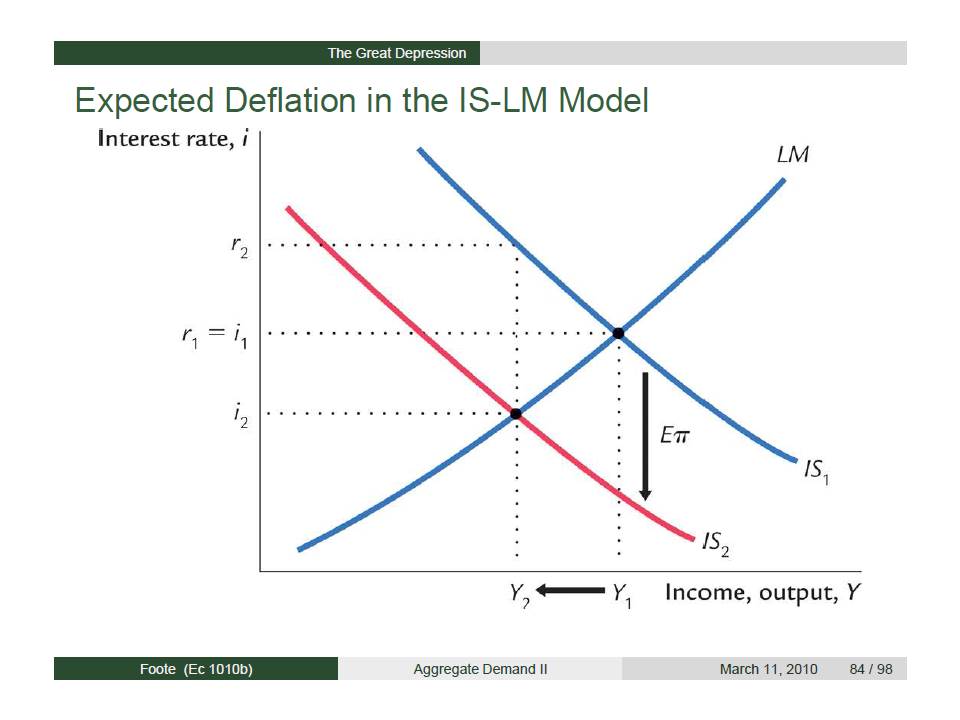
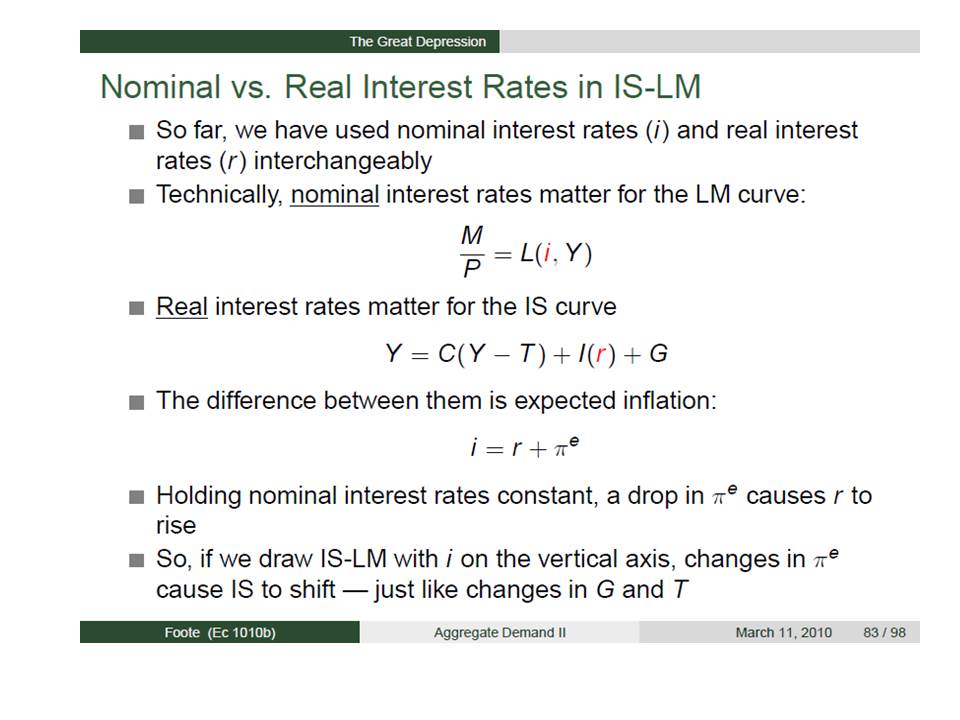
Scott is totally right, of course, to point out that the fall in interest rates and the increase in the real quantity of money do not contradict the “money hypothesis.” However, he is also being selective and unfair in making that criticism, because, in two slides following almost immediately after the one to which Scott takes such offense, Foote actually explains that the simple IS-LM analysis presented in the previous slide requires modification to take into account expected deflation, because the demand for money depends on the nominal rate of interest while the amount of investment spending depends on the real rate of interest, and shows how to do the modification. Here are the slides:

foote_83

foote_84Thus, expected deflation raises the real rate of interest thereby shifting the IS curve to the left while leaving the LM curve where it was. Expected deflation therefore explains a fall in both nominal and real income as well as in the nominal rate of interest; it also explains an increase in the real rate of interest. Scott seems to be emotionally committed to the notion that the IS-LM model must lead to a misunderstanding of the effects of monetary policy, holding Foote up as an example of this confusion on the basis of the first of the slides, but Foote actually shows that IS-LM can be tweaked to accommodate a correct understanding of the dominant role of monetary policy in the Great Depression.

The Great Depression was triggered by a deflationary scramble for gold associated with the uncoordinated restoration of the gold standard by the major European countries in the late 1920s, especially France and its insane central bank. On top of this, the Federal Reserve, succumbing to political pressure to stop “excessive” stock-market speculation, raised its discount rate to a near record 6.5% in early 1929, greatly amplifying the pressure on gold reserves, thereby driving up the value of gold, and causing expectations of the future price level to start dropping. It was thus a rise (both actual and expected) in the value of gold, not a reduction in the money supply, which was the source of the monetary shock that produced the Great Depression. The shock was administered without a reduction in the money supply, so there was no shift in the LM curve. IS-LM is not necessarily the best model with which to describe this monetary shock, but the basic story can be expressed in terms of the IS-LM model.

So, you ask, if I don’t think that Foote’s exposition of the IS-LM model seriously misrepresents what happened in the Great Depression, why did I say at beginning of this post that Foote’s slides really annoy me? Well, the reason is simply that Foote seems to think that the only monetary explanation of the Great Depression is the Monetarist explanation of Milton Friedman: that the Great Depression was caused by an exogenous contraction in the US money supply. That explanation is wrong, theoretically and empirically.

What caused the Great Depression was an international disturbance to the value of gold, caused by the independent actions of a number of central banks, most notably the insane Bank of France, maniacally trying to convert all its foreign exchange reserves into gold, and the Federal Reserve, obsessed with suppressing a non-existent stock-market bubble on Wall Street. It only seems like a bubble with mistaken hindsight, because the collapse of prices was not the result of any inherent overvaluation in stock prices in October 1929, but because the combined policies of the insane Bank of France and the Fed wrecked the world economy. The decline in the nominal quantity of money in the US, the great bugaboo of Milton Friedman, was merely an epiphenomenon.

As Ron Batchelder and I have shown, Gustav Cassel and Ralph Hawtrey had diagnosed and explained the causes of the Great Depression fully a decade before it happened. Unfortunately, whenever people think of a monetary explanation of the Great Depression, they think of Milton Friedman, not Hawtrey and Cassel. Scott Sumner understands all this, he’s even written a book – a wonderful (but unfortunately still unpublished) book – about it. But he gets all worked up about IS-LM.

I, on the other hand, could not care less about IS-LM; it’s the idea that the monetary cause of the Great Depression was discovered by Milton Friedman that annoys the [redacted] out of me.

UPDATE: I posted this post prematurely before I finished editing it, so I apologize for any mistakes or omissions or confusing statements that appeared previously or that I haven’t found yet.

Stephen Williamson Defends the FOMC

Publication of the transcripts of the FOMC meetings in 2008 has triggered a wave of criticism of the FOMC for the decisions it took in 2008. Since the transcripts were released I have written two posts (here and here) charging that the inflation-phobia of the FOMC was a key (though not the sole) cause of the financial crisis in September 2008. Many other bloggers, Matt Yglesias, Scott Sumner, Brad Delong and Paul Krugman, just to name a few, were also sharply critical of the FOMC, though Paul Krugman at any rate seemed to think that the Fed’s inflation obsession was merely weird rather than catastrophic.

Stephen Williamson, however, has a different take on all this. In a post last week, just after the release of the transcripts, Williamson chastised Matt Yglesias for chastising Ben Bernanke and the FOMC for not reducing the Federal Funds target at the September 16 FOMC meeting, the day after Lehman went into bankruptcy. Williamson quotes this passage from Yglesias’s post.

New documents released last week by the Federal Reserve shed important new light on one of the most consequential and underdiscussed moments of recent American history: the decision to hold interest rates flat on Sept. 16, 2008. At the time, the meeting at which the decision was made was overshadowed by the ongoing presidential campaign and Lehman Brothers’ bankruptcy filing the previous day. Political reporters were focused on the campaign, economic reporters on Lehman, and since the news from the Fed was that nothing was changing, it didn’t make for much of a story. But in retrospect, it looks to have been a major policy blunder—one that was harmful on its own terms and that set a precedent for a series of later disasters.

To which Williamson responds acidly:

So, it’s like there was a fire at City Hall, and five years later a reporter for the local rag is complaining that the floor wasn’t swept while the fire was in progress.

Now, in a way, I agree with Williamson’s point here; I think it’s a mistake to overemphasize the September 16 meeting. By September 16, the damage had been done. The significance of the decision not to cut the Fed Funds target is not that the Fed might have prevented a panic that was already developing (though I don’t rule out the possibility that a strong enough statement by the FOMC might have provided enough reassurance to the markets to keep the crisis from spiraling out of control), but what the decision tells us about the mindset of the FOMC. Just read the statement that the Fed issued after its meeting.

The Federal Open Market Committee decided today to keep its target for the federal funds rate at 2 percent.

Strains in financial markets have increased significantly and labor markets have weakened further. Economic growth appears to have slowed recently, partly reflecting a softening of household spending. Tight credit conditions, the ongoing housing contraction, and some slowing in export growth are likely to weigh on economic growth over the next few quarters. Over time, the substantial easing of monetary policy, combined with ongoing measures to foster market liquidity, should help to promote moderate economic growth.

Inflation has been high, spurred by the earlier increases in the prices of energy and some other commodities. The Committee expects inflation to moderate later this year and next year, but the inflation outlook remains highly uncertain.

The downside risks to growth and the upside risks to inflation are both of significant concern to the Committee. The Committee will monitor economic and financial developments carefully and will act as needed to promote sustainable economic growth and price stability.

What planet were they living on? “The downside risks to growth and the upside risks to inflation are both of significant concern to the Committee.” OMG!

Williamson, however, sees it differently.

[T]he FOMC agreed to keep the fed funds rate target constant at 2%. Seems like this was pretty dim-witted of the committee, given what was going on in financial markets that very day, right? Wrong. At that point, the fed funds market target rate had become completely irrelevant.

Williamson goes on to point out that although the FOMC did not change the Fed Funds target, borrowings from the Fed increased sharply in September, so that the Fed was effectively easing its policy even though the target – a meaningless target in Williamson’s view – had not changed.

Thus, by September 16, 2008, it seems the Fed was effectively already at the zero lower bound. At that time the fed funds target was irrelevant, as there were excess reserves in the system, and the effective fed funds rate was irrelevant, as it reflected risk.

I want to make two comments on Williamson’s argument. First, the argument is certainly at odds with Bernanke’s own statement in the transcript, towards the end of the September 16 meeting, giving his own recommendation about what policy action the FOMC should take:

Overall I believe that our current funds rate setting is appropriate, and I don’t really see any reason to change…. Cutting rates would be a very big step that would send a very strong signal about our views on the economy and about our intentions going forward, and I think we should view that step as a very discrete thing rather than as a 25 basis point kind of thing. We should be very certain about that change before we undertake it because I would be concerned, for example, about the implications for the dollar, commodity prices, and the like.

So Bernanke clearly states that his view is that the current fed funds target was “appropriate.” He did not say that the fed funds rate is at the lower bound. Instead, he explains why he does not want to cut the fed funds rate, implying that he believed that cutting the rate was an option. He didn’t want to exercise that option, because he did not like the “very strong signal about our views on the economy and about our intentions going forward” that a rate cut would send. Indeed, he intimates that a rate cut of 25 basis points would be meaningless under the circumstances, suggesting an awareness, however vague, that a crisis was brewing, so that a cut in the target rate would have to be substantial to calm, rather than scare, the markets. (The next cut, three weeks later, was 50 basis points, and things only got worse.)

Second, suppose for argument’s sake, that Williamson is right and Bernanke (and almost everyone else) was wrong, that the fed funds target was meaningless. Does that mean that the Fed’s inflation obsession in 2008 is just an optical illusion with no significance — that the Fed was powerless to have done anything that would have increased expenditure and income, thereby avoiding or alleviating the crisis?

I don’t think so, and the reason is that, as I pointed out in my previous post, the dollar began appreciating rapidly in forex markets in mid-July 2009, the dollar euro exchange rate appreciating by about 12% and the trade-weighted value of the dollar appreciating by about 10% between mid-July and the week before the Lehman collapse. An appreciating that rapid was a clear sign that there was a shortage of dollar liquidity which was causing spending to drop all through the economy, as later confirmed by the sharp drop in third-quarter GDP. The dollar fell briefly in the days just before and after the Lehman collapse, then resuming its sharp ascent as the financial crisis worsened in September and October, appreciating by another 10-15%.

So even if the fed funds target was ineffectual, the Fed, along with the Treasury, still had it within their power to intervene in forex markets, selling dollars for euros and other currencies, thereby preventing the dollar from rising further in value. Unfortunately, as is clear from the transcripts, the FOMC thought that the rising dollar was a favorable development that would reduce the inflation about which it was so obsessively concerned. So the FOMC happily watched the dollar rise by 25% against other currencies between July and November as the economy tanked, because, as the September 16 statement of the FOMC so eloquently put it, “upside risks to inflation are . . . of significant concern to the Committee.” The FOMC gave us the monetary policy it wanted us to have.

Why Fed Inflation-Phobia Mattered

Last week I posted an item summarizing Matthew O’Brien’s article about the just-released transcripts of FOMC meetings in June, August and September of 2008. I spiced up my summary by quoting from and commenting on some of the more outrageous quotes that O’Brien culled from the transcripts, quotes showing that most of the FOMC, including Ben Bernanke, were obsessing about inflation while unemployment was rising rapidly and the economy contracting sharply. I especially singled out what I called the Gang of Four — Charles Plosser, Jeffrey Lacker, Richard Fisher, and Thomas Hoenig, the most militant inflation hawks on the FOMC — noting that despite their comprehensive misjudgments of the 2008 economic situation and spectacularly wrongheaded policy recommendations, which they have yet to acknowledge, much less apologize for, three of them (Plosser, Lacker, and Fisher) continue to serve in their Fed positions, displaying the same irrational inflation-phobia by which they were possessed in 2008. Paul Krugman also noticed O’Brien’s piece and remarked on the disturbing fact that three of the Gang of Four remain in their policy-making positions at the Fed, doing their best to keep the Fed from taking any steps that could increase output and employment.

However, Krugman went on to question the idea — suggested by, among others, me — that it was the Fed’s inflation phobia that produced the crash of 2008. Krugman has two arguments for why the Fed’s inflation phobia in 2008, however silly, did not the cause of the crash.

First, preventing the financial crisis would have taken a lot more than cutting the Fed funds rate to zero in September 2008 rather than December. We were in the midst of an epic housing bust, which was in turn causing a collapse in the value of mortgage-backed securities, which in turn was causing a collapse of confidence in financial firms. Cutting rates from very low to extremely low a few months earlier wouldn’t have stopped that collapse.

What was needed to end the run on Wall Street was a bailout — both the actual funds disbursed and the reassurance that the authorities would step in if necessary. And that wasn’t in the cards until, as Rick Mishkin observed in the transcripts, “something hit the fan.”

Second, even avoiding the financial panic almost surely wouldn’t have meant avoiding a prolonged economic slump. How do we know this? Well, what we actually know is that the panic was in fact fairly short-lived, ending in the spring of 2009. It doesn’t really matter which measure of financial stress you use, they all look like this:

Yet the economy didn’t come roaring back, and in fact still hasn’t. Why? Because the housing bust and the overhang of household debt are huge drags on demand, even if there isn’t a panic in the financial market.

Sorry, but, WADR, I have to disagree with Professor Krugman.

The first argument is not in my view very compelling, because the Fed’s inflation-phobia did not suddenly appear at the September 2008 FOMC meeting, or even at the June meeting, though, to be sure, its pathological nature at those meetings does have a certain breathtaking quality; it had already been operating for a long time before that. If you look at the St. Louis Fed’s statistics on the monetary base, you will find that the previous recession in 2001 had been preceded in 2000 by a drop of 3.6% in the monetary base. To promote recovery, the Fed increased the monetary base in 2001 (partly accommodating the increased demand for money characteristic of recessions) by 8.5%. The monetary base subsequently grew by 7% in 2002, 5.2% in 2003, 4.4% in 2004, 3.2% in 2005, 2.6% in 2006, and a mere 1.2% in 2007.

The housing bubble burst in 2006, but the Fed was evidently determined to squeeze inflation out of the system, as if trying to atone for its sins in allowing the housing bubble in the first place. From January to September 10, 2008, the monetary base increased by 3.3%. Again, because the demand for money typically increases in recessions, one cannot infer from the slight increase in the rate of growth of the monetary base in 2008 over 2006 and 2007 that the Fed was easing its policy stance. (On this issue, see my concluding paragraph.) The point is that for at least three years before the crash, the Fed, in its anti-inflationary zelotry, had been gradually tightening the monetary-policy screws. So it is simply incorrect to suggest that there was no link between the policy stance of the Fed and the state of the economy. If the Fed had moderated its stance in 2008 in response to ample evidence that the economy was slowing, there is good reason to think that the economy would not have contracted as rapidly as it did, starting, even before the Lehman collapse, in the third quarter of 2008, when, we now know, the economy had already begun one of the sharpest contractions of the entire post World War II era.

As for Krugman’s second argument, I believe it is a mistake to confuse a financial panic with a recession. A financial panic is an acute breakdown of the financial system, always associated with a period of monetary stringency when demands for liquidity cannot be satisfied owing to a contagious loss of confidence in the solvency of borrowers and lenders. The crisis is typically precipitated by a too aggressive tightening of monetary conditions by the monetary authority seeking to rein in inflationary pressures. The loss of confidence is thus not a feature of every business-cycle downturn, and its restoration no guarantee of a recovery. (See my post on Hawtrey and financial crises.) A recovery requires an increase aggregate demand, which is the responsibility of those in charge of monetary policy and fiscal policy. I confess to a measure of surprise that the author of End This Depression Now would require a reminder about that from me.

A final point. Although the macroeconomic conditions for an asset crash and financial panic had been gradually and systematically created by the Fed ever since 2006, the egregious Fed policy in the summer of 2008 was undoubtedly a major contributing cause in its own right. The magnitude of the policy error is evident in this graph from the St. Louis Fed, showing the dollar/euro exchange rate.

dollar_euro_exchange_rateFrom April to July, the exchange rate was fluctuating between $1.50 and $1.60 per euro. In mid-July, the dollar began appreciating rapidly against the euro, rising in value to about $1.40/euro just before the Lehman collapse, an appreciation of about 12.5% in less than two months. The only comparable period of appreciation in the dollar/euro exchange rate was in the 1999-2000 period during the monetary tightening prior to the 2001 recession. But the 2008 appreciation was clearly greater and steeper than the appreciation in 1999-2000. Under the circumstances, such a sharp appreciation in the dollar should have alerted the FOMC that there was a liquidity shortage (also evidenced in a sharp increase in borrowings from the Fed) that required extraordinary countermeasures by the Fed. But the transcript of the September 2008 meeting shows that the appreciation of the dollar was interpreted by members of the FOMC as evidence that the current policy was working as intended! Now how scary is that?

HT: Matt O’Brien

Exposed: Irrational Inflation-Phobia at the Fed Caused the Panic of 2008

Matthew O’Brien at The Atlantic has written a marvelous account of the bizarre deliberations of the Federal Open Market Committee at its meetings (June 25 and August 5) before the Lehman debacle on September 15 2008 and its meeting the next day on September 16. A few weeks ago, I wrote in half-seriousness a post attributing the 2008 financial crisis to ethanol because of the runup in corn and other grain prices in 2008 owing to the ethanol mandate and the restrictions on imported ethanol products. But ethanol, as several commenters pointed out, was only a part, probably a relatively small part, of the spike in commodities prices in the summer of 2008. Thanks to O’Brien’s careful reading of the recently released transcripts of the 2008 meetings of the FOMC, we now have a clear picture of how obsessed the FOMC was about inflation, especially the gang of four regional bank presidents, Charles Plosser, Richard Fisher, James Lacker, and Thomas Hoenig, supported to a greater or lesser extent by James Bullard and Kevin Warsh.

On the other hand, O’Brien does point out that two members of the FOMC, Eric Rosengren, President of the Boston Fed, and Fredric Mishkin of the Board of Governors, consistently warned of the dangers of a financial crisis, and consistently objected to and cogently punctured the hysterical inflation fears of the gang of four. It is somewhat, but only somewhat, reassuring that Janet Yellen was slightly more sensitive to the dangers of a financial crisis and less concerned about inflation than Ben Bernanke. Perhaps because he was still getting his feet wet as chairman, Bernanke seems to have been trying to articulate a position that could balance the opposing concerns of the FOMC membership, rather than leading the FOMC in the direction he thought best. While Yellen did not indulge the inflation phobia of the gang of four, she did not strongly support Rosengren and Mishkin in calling for aggressive action to avert the crisis that they clearly saw looming on the horizon.

Here are some highlights from O’Brien’s brilliant piece:

[FOMC Meeting] June 24-25, 2008: 468 mentions of inflation, 44 of unemployment, and 35 of systemic risks/crises

Those numbers pretty much tell you everything you need to know about what happened during the disastrous summer of 2008 at the Fed

Rosengren wasn’t nearly as concerned with 5 percent headline inflation—and with good reason. He reminded his colleagues that “monetary policy is unlikely to have much effect on food and energy prices,” that “total [inflation] has tended to converge to core, and not the opposite,” and that there was a “lack of an upward trend of wages and salaries.”

In short, inflation was high today, but it wouldn’t be tomorrow. They should ignore it. A few agreed. Most didn’t.

Mishkin, Fed Governor Donald Kohn, and then-San Francisco Fed chief Janet Yellen comprised Team: Ignore Inflation. They pointed out that core inflation hadn’t actually risen, and that “inflation expectations remain reasonably well-anchored.” The rest of the Fed, though, was eager to raise rates soon, if not right away. Philadelphia Fed president Charles Plosser recognized that core inflation was flat, but still thought they needed to get ready to tighten “or our credibility could soon vanish.” Fed Governor Kevin Warsh said that “inflation risks, in my view, continue to predominate as the greater risk to the economy,” because he thought headline would get passed into core inflation.

And let us not forget Richard Fisher of the Dallas Fed who provided badly needed comic relief.

And then there was Dallas Fed chief Richard Fisher, who had a singular talent for seeing inflation that nobody else could—a sixth sense, if you will. He was allergic to data. He preferred talking to CEOs instead. But, in Fisher’s case, the plural of anecdote wasn’t data. It was nonsense. He was worried about Frito-Lays increasing prices 9 percent, Budweiser increasing them 3.5 percent, and a small dry-cleaning chain in Dallas increasing them, well, an undisclosed amount. He even half-joked that the Fed was giving out smaller bottles of water, presumably to hide creeping inflation?

By the way, I notice that these little bottles of water have gotten smaller—this will be a Visine bottle at the next meeting. [Laughter]

But it was another member of the Gang of Four who warned ominously:

Richmond Fed president Jeffrey Lacker suggested, that “at some point we’re going to choose to let something disruptive happen.”

Now to the August meeting:

[FOMC Meeting] August 5, 2008: 322 mentions of inflation, 28 of unemployment, and 19 of systemic risks/crises.

Despite evidence that the inflationary blip of spring and summer was winding down, and the real economy was weakening, the Gang of Four continued to press their case for tougher anti-inflation measures. But only Rosengren and Mishkin spoke out against them.

But even though inflation was falling, it was a lonesome time to be a dove. As the Fed’s resident Cassandra, Rosengren tried to convince his colleagues that high headline inflation numbers “appear to be transitory responses to supply shocks that are not flowing through to labor markets.” In other words, inflation would come down on its own, and the Fed should focus on the credit crunch instead. Mishkin worried that “really bad things could happen” if “a shoe drops” and there was a “nasty, vicious spiral” between weak banks and a weak economy. Given this, he wanted to wait to tighten until inflation expectations “actually indicate there is a problem,” and not before.

But Richard Fisher was in no mood to worry about horror stories unless they were about runaway inflation:

The hawks didn’t want to wait. Lacker admitted that wages hadn’t gone up, but thought that “if we wait until wage rates accelerate or TIPS measures spike, we will have waited too long.” He wanted the Fed to “be prepared to raise rates even if growth is not back to potential, and even if financial markets are not yet tranquil.” In other words, to fight nonexistent wage inflation today to prevent possible wage inflation tomorrow, never mind the crumbling economy. Warsh, for his part, kept insisting that “inflation risks are very real, and I believe that these are higher than growth risks.” And Fisher had more”chilling anecdotes”—as Bernanke jokingly called them—about inflation. This time, the culprit was Disney World and its 5 percent price increase for single-day tickets.

The FOMC was divided, but the inflation-phobes held the upper hand. Unwilling to challenge them, Bernanke appeased them by promising that his statement about future monetary policy after the meeting would be “be slightly hawkish—to indicate a slight uplift in policy.”

Frightened by what he was hearing, Mishkin reminded his colleagues of some unpleasant monetary history:

Remember that in the Great Depression, when—I can’t use the expression because it would be in the transcripts, but you know what I’m thinking—something hit the fan, [laughter] it actually occurred close to a year after the initial negative shock.

Mishkin also reminded his colleagues that the stance of monetary policy cannot be directly inferred from the federal funds rate.

I just very much hope that this Committee does not make this mistake because I have to tell you that the situation is scary to me. I’m holding two houses right now. I’m very nervous.

And now to the September meeting, the day after Lehman collapsed:

[FOMC meeting] September 16, 2008: 129 mentions of inflation, 26 of unemployment, and 4 of systemic risks/crises

Chillingly, Lacker and Hoenig did a kind of victory dance about the collapse of Lehman Brothers.

Lacker had gotten the “disruptive” event he had wanted, and he was pretty pleased about it. “What we did with Lehman I obviously think was good,” he said, because it would “enhance the credibility of any commitment that we make in the future to be willing to let an institution fail.” Hoenig concurred that it was the “right thing,” because it would suck moral hazard out of the market.

The rest of the Gang of Four and their allies remained focused like a laser on inflation.

Even though commodity prices and inflation expectations were both falling fast, Hoenig wanted the Fed to “look beyond the immediate crisis,” and recognize that “we also have an inflation issue.” Bullard thought that “an inflation problem is brewing.” Plosser was heartened by falling commodity prices, but said, “I remain concerned about the inflation outlook going forward,” because “I do not see the ongoing slowdown in economic activity is entirely demand driven.” And Fisher half-jokingly complained that the bakery he’d been going to for 30 years—”the best maker of not only bagels, but anything with Crisco in it”—had just increased prices. All of them wanted to leave rates unchanged at 2 percent.

Again, only Eric Rosengren seemed to be in touch with reality, but no was listening:

[Rosengren] was afraid that exactly what did end up happening would happen. That all the financial chaos “would have a significant impact on the real economy,” that “individuals and firms will be become risk averse, with reluctance to consume or invest,” that “credit spreads are rising, and the cost and availability of financing is becoming more difficult,” and that “deleveraging is likely to occur with a vengeance.” More than that, he thought that the “calculated bet” they took in letting Lehman fail would look particularly bad “if we have a run on the money market funds or if the nongovernment tri-party repo market shuts down.” He wanted to cut rates immediately to do what they could to offset the worsening credit crunch. Nobody else did.

Like Bernanke for instance. Here is his take on the situation:

Overall I believe that our current funds rate setting is appropriate, and I don’t really see any reason to change…. Cutting rates would be a very big step that would send a very strong signal about our views on the economy and about our intentions going forward, and I think we should view that step as a very discrete thing rather than as a 25 basis point kind of thing. We should be very certain about that change before we undertake it because I would be concerned, for example, about the implications for the dollar, commodity prices, and the like.

OMG!

O’Brien uses one of my favorite Hawtrey quotes to describe the insanity of the FOMC deliberations:

In other words, the Fed was just as worried about an inflation scare that was already passing as it was about a once-in-three-generations crisis.

It brought to mind what economist R. G. Hawtrey had said about the Great Depression. Back then, central bankers had worried more about the possibility of inflation than the grim reality of deflation. It was, Hawtrey said, like “crying Fire! Fire! in Noah’s flood.”

In any non-dysfunctional institution, the perpetrators of this outrage would have been sacked. But three of Gang of Four (Hoenig having become a director of the FDIC in 2012) remain safely ensconced in their exalted positions, blithely continuing, without the slightest acknowledgment of their catastrophic past misjudgments, to exert a malign influence on monetary policy. For shame!

George Selgin Relives the Sixties

Just two days before the 50th anniversary of the assassination of John Kennedy, George Selgin offered an ironic endorsement of raising the inflation target, as happened during the Kennedy Administration, in order to reduce unemployment.

[T]his isn’t the first time that we’ve been in a situation like the present one. There was at least one other occasion when the U.S. economy, having been humming along nicely with the inflation rate of 2% and an unemployment rate between 5% and 6%, slid into a recession. Eventually the unemployment rate was 7%, the inflation rate was only 1%, and the federal funds rate was within a percentage point of the zero lower bound. Fortunately for the American public, some well-placed (mostly Keynesian) economists came to the rescue, by arguing that the way to get unemployment back down was to aim for a higher inflation rate: a rate of about 4% a year, they figured, should suffice to get the unemployment rate down to 4%–a much lower rate than anyone dares to hope for today.

I’m puzzled and frustrated because, that time around, the Fed took the experts’ advice and it worked like a charm. The federal funds rate quickly achieved lift-off (within a year it had risen almost 100 basis points, from 1.17% to 2.15%). Before you could say “investment multiplier” the inflation and unemployment numbers were improving steadily. Within a few years inflation had reached 4%, and unemployment had declined to 4%–just as those (mostly Keynesian) experts had predicted.

So why are these crazy inflation hawks trying to prevent us from resorting again to a policy that worked such wonders in the past? Do they just love seeing all those millions of workers without jobs? Or is it simply that they don’t care about job

Oh: I forgot to say what past recession I’ve been referring to. It was the recession of 1960-61. The desired numbers were achieved by 1967. I can’t remember exactly what happened after that, though I’m sure it all went exactly as those clever theorists intended.

George has the general trajectory of the story more or less right, but the details and the timing are a bit off. Unemployment rose to 7% in the first half of 1961, and inflation was 1% or less. So reducing the Fed funds rate certainly worked, real GDP rising at not less than a 6.8% annual rate for four consecutive quarters starting with the second quarter of 1961, unemployment falling to 5.5 in the first quarter of 1962. In the following 11 quarters till the end of 1964, there were only three quarters in which the annual growth of GDP was less than 3.9%. The unemployment rate at the end of 1964 had fallen just below 5 percent and inflation was still well below 2%. It was only in 1965, that we see the beginings of an inflationary boom, real GDP growing at about a 10% annual rate in three of the next five quarters, and 8.4% and 5.6% in the other two quarters, unemployment falling to 3.8% by the second quarter of 1966, and inflation reaching 3% in 1966. Real GDP growth did not exceed 4% in any quarter after the first quarter of 1966, which suggests that the US economy had reached or exceeded its potential output, and unemployment had fallen below its natural rate.

In fact, recognizing the inflationary implications of the situation, the Fed shifted toward tighter money late in 1965, the Fed funds rate rising from 4% in late 1965 to nearly 6% in the summer of 1966. But the combination of tighter money and regulation-Q ceilings on deposit interest rates caused banks to lose deposits, producing a credit crunch in August 1966 and a slowdown in both real GDP growth in the second half of 1966 and the first half of 1967. With the economy already operating at capacity, subsequent increases in aggregate demand were reflected in rising inflation, which reached 5% in the annus horribilis 1968.

Cleverly suggesting that the decision to use monetary expansion, and an implied higher tolerance for inflation, to reduce unemployment from the 7% rate to which it had risen in 1961 was the ultimate cause of the high inflation of the late 1960s and early 1970s, and, presumably, the stagflation of the mid- and late-1970s, George is inviting his readers to conclude that raising the inflation target today would have similarly disastrous results.

Well, that strikes me as quite an overreach. Certainly one should not ignore the history to which George is drawing our attention, but I think it is possible (and plausible) to imagine a far more benign course of events than the one that played itself out in the 1960s and 1970s. The key difference is that the ceilings on deposit interest rates that caused a tightening of monetary policy in 1966 to produce a mini-financial crisis, forcing the 1966 Fed to abandon its sensible monetary tightening to counter inflationary pressure, are no longer in place.

Nor should we forget that some of the inflation of the 1970s was the result of supply-side shocks for which some monetary expansion (and some incremental price inflation) was an optimal policy response. The disastrous long-term consequences of Nixon’s wage and price controls should not be attributed to the expansionary monetary policy of the early 1960s.

As Mark Twain put it so well:

We should be careful to get out of an experience only the wisdom that is in it and stop there lest we be like the cat that sits down on a hot stove lid. She will never sit down on a hot stove lid again and that is well but also she will never sit down on a cold one anymore.

The Internal Contradiction of Quantitative Easing

Last week I was struggling to cut and paste my 11-part series on Hawtrey’s Good and Bad Trade into the paper on that topic that I am scheduled to present next week at the Southern Economic Association meetings in Tampa Florida, completing the task just before coming down with a cold which has kept me from doing anything useful since last Thursday. But I was at least sufficiently aware of my surroundings to notice another flurry of interest in quantitative easing, presumably coinciding with Janet Yellen’s testimony at the hearings conducted by the Senate Banking Committee about her nomination to succeed Ben Bernanke as Chairman of Federal Reserve Board.

In my cursory reading of the latest discussions, I didn’t find a lot that has not already been said, so I will take that as an opportunity to restate some points that I have previously made on this blog. But before I do that, I can’t help observing (not for the first time either) that the two main arguments made by critics of QE do not exactly coexist harmoniously with each other. First, QE is ineffective; second it is dangerous. To be sure, the tension between these two claims about QE does not prove that both can’t be true, and certainly doesn’t prove that both are wrong. But the tension might at least have given a moment’s pause to those crying that Quantitative Easing, having failed for five years to accomplish anything besides enriching Wall Street and taking bread from the mouths of struggling retirees, is going to cause the sky to fall any minute.

Nor, come to think of it, does the faux populism of the attack on a rising stock market and of the crocodile tears for helpless retirees living off the interest on their CDs coexist harmoniously with the support by many of the same characters opposing QE (e.g., Freedomworks, CATO, the Heritage Foundation, and the Wall Street Journal editorial page) for privatizing social security via private investment accounts to be invested in the stock market, the argument being that the rate of return on investing in stocks has historically been greater than the rate of return on payments into the social security system. I am also waiting for an explanation of why abused pensioners unhappy with the returns on their CDs can’t cash in the CDs and buy dividend-paying-stocks? In which charter of the inalienable rights of Americans, I wonder, does one find it written that a perfectly secure real rate of interest of not less than 2% on any debt instrument issued by the US government shall always be guaranteed?

Now there is no denying that what is characterized as a massive program of asset purchases by the Federal Reserve System has failed to stimulate a recovery comparable in strength to almost every recovery since World War II. However, not even the opponents of QE are suggesting that the recovery has been weak as a direct result of QE — that would be a bridge too far even for the hard money caucus — only that whatever benefits may have been generated by QE are too paltry to justify its supposedly bad side-effects (present or future inflation, reduced real wages, asset bubbles, harm to savers, enabling of deficit-spending, among others). But to draw any conclusion about the effects of QE, you need some kind of a baseline of comparison. QE opponents therefore like to use previous US recoveries, without the benefit of QE, as their baseline.

But that is not the only baseline available for purposes of comparison. There is also the Eurozone, which has avoided QE and until recently kept interest rates higher than in the US, though to be sure not as high as US opponents of QE (and defenders of the natural rights of savers) would have liked. Compared to the Eurozone, where nominal GDP has barely risen since 2010, and real GDP and employment have shrunk, QE, which has been associated with nearly 4% annual growth in US nominal GDP and slightly more than 2% annual growth in US real GDP, has clearly outperformed the eurozone.

Now maybe you don’t like the Eurozone, as it includes all those dysfunctional debt-ridden southern European countries, as a baseline for comparison. OK, then let’s just do a straight, head-to-head matchup between the inflation-addicted US and solid, budget-balancing, inflation-hating Germany. Well that comparison shows (see the chart below) that since 2011 US real GDP has increased by about 5% while German real GDP has increased by less than 2%.

US_Germany_RGDP

So it does seem possible that, after all, QE and low interest rates may well have made things measurably better than they would have otherwise been. But don’t expect to opponents of QE to acknowledge that possibility.

Of course that still leaves the question on the table, why has this recovery been so weak? Well, Paul Krugman, channeling Larry Summers, offered a demographic hypothesis in his column Monday: that with declining population growth, there have been diminishing investment opportunities, which, together with an aging population, trying to save enough to support themselves in their old age, causes the supply of savings to outstrip the available investment opportunities, driving the real interest rate down to zero. As real interest rates fall, the ability of the economy to tolerate deflation — or even very low inflation — declines. That is a straightforward, and inescapable, implication of the Fisher equation (see my paper “The Fisher Effect Under Deflationary Expectations”).

So, if Summers and Krugman are right – and the trend of real interest rates for the past three decades is not inconsistent with their position – then we need to rethink revise upwards our estimates of what rate of inflation is too low. I will note parenthetically, that Samuel Brittan, who has been for decades just about the most sensible economic journalist in the world, needs to figure out that too little inflation may indeed be a bad thing.

But this brings me back to the puzzling question that causes so many people to assume that monetary policy is useless. Why have trillions of dollars of asset purchases not generated the inflation that other monetary expansions have generated? And if all those assets now on the Fed balance sheet haven’t generated inflation, what reason is there to think that the Fed could increase the rate of inflation if that is what is necessary to avoid chronic (secular) stagnation?

The answer, it seems to me is the following. If everyone believes that the Fed is committed to its inflation target — and not even the supposedly dovish Janet Yellen, bless her heart, has given the slightest indication that she favors raising the Fed’s inflation target, a target that, recent experience shows, the Fed is far more willing to undershoot than to overshoot – then Fed purchases of assets with currency are not going to stimulate additional private spending. Private spending, at or near the zero lower bound, are determined largely by expectations of future income and prices. The quantity of money in private hands, being almost costless to hold, is no longer a hot potato. So if there is no desire to reduce excess cash holdings, the only mechanism by which monetary policy can affect private spending is through expectations. But the Fed, having succeeded in anchoring inflation expectations at 2%, has succeeded in unilaterally disarming itself. So economic expansion is constrained by the combination of a zero real interest rate and expected inflation held at or below 2% by a political consensus that the Fed, even if it were inclined to, is effectively powerless to challenge.

Scott Sumner calls this monetary offset. I don’t think that we disagree much on the economic analysis, but it seems to me that he overestimates the amount of discretion that the Fed can actually exercise over monetary policy. Except at the margins, the Fed is completely boxed in by a political consensus it dares not question. FDR came into office in 1933, and was able to effect a revolution in monetary policy within his first month in office, thereby saving the country and Western Civilization. Perhaps Obama had an opportunity to do something similar early in his first term, but not any more. We are stuck at 2%, but it is no solution.


About Me

David Glasner
Washington, DC

I am an economist in the Washington DC area. My research and writing has been mostly on monetary economics and policy and the history of economics. In my book Free Banking and Monetary Reform, I argued for a non-Monetarist non-Keynesian approach to monetary policy, based on a theory of a competitive supply of money. Over the years, I have become increasingly impressed by the similarities between my approach and that of R. G. Hawtrey and hope to bring Hawtrey’s unduly neglected contributions to the attention of a wider audience.

My new book Studies in the History of Monetary Theory: Controversies and Clarifications has been published by Palgrave Macmillan

Follow me on Twitter @david_glasner

Archives

Enter your email address to follow this blog and receive notifications of new posts by email.

Join 665 other subscribers
Follow Uneasy Money on WordPress.com