Posts Tagged 'temporary equilibrium'

Hicks on Temporary Equilibrium

J. R. Hicks, who introduced the concept of intertemporal equilibrium to English-speaking economists in Value and Capital, was an admirer of Carl Menger, one of the three original Marginal Revolutionaries, crediting Menger in particular for having created an economic theory in time (see his “Time in Economics” in Collected Essays on Economic Theory, vol. II). The goal of grounding economic theory in time inspired many of Hicks’s theoretical contributions, including his exposition of intertemporal equilibrium in Value and Capital which was based on the idea of temporary equilibrium.

Recognizing that (full) intertemporal equilibrium requires all current markets to clear and all agents to share correct expectations of the future prices on which their plans depend, Hicks used temporary equilibrium to describe a sequence of intermediate positions of an economy moving toward or away from (full) intertemporal equilibrium. This was done by positing discrete weekly time periods in which economic activity–production, consumption, buying and selling–occurs during the week at equilibrium prices, prices being set on Monday followed by economic activity at Monday’s prices until start of a new week. This modeling strategy allowed Hicks to embed a quasi-static supply and demand analysis within his intertemporal equilibrium model, the week serving as a time period short enough to allow a conditions, including agents’ expectations, to be plausibly held constant until the following week. Demarcating a short period in which conditions remain constant simplifies the analysis by allowing changes conditions to change once a week. A static weekly analysis is transformed into a dynamic analysis by way of goods and assets held from week to week and by recognizing that agents’ plans to buy and sell depend not only on current prices but on expected future prices.

Weekly price determination assumes that all desired purchases and sales, at Monday’s prices, can be executed, i.e., that markets clear. But market-clearing in temporary equilibrium, involves an ambiguity not present in static equilibrium in which agents’ decision depend only on current prices. Unlike a static model. in which changes in demand and supply are permanent, and no intertemporal substitution occurs, intertemporal substitution both in supply and in demand do occur in a temporary-equilibrium model, so that transitory changes in the demand for, and supply of, goods and assets held from week to week do occur. Distinguishing between desired and undesired (unplanned, involuntary) inventory changes is difficult without knowledge of agents’ plans and the expectations on which their plans depend. Because Monday prices may differ from the prices that agents had expected, some agents may be unable to execute their prior plans to buy and sell.

Some agents may make only minor plan adjustments; others may have to make significant adjustments, and some even scrapping plans that became unviable. The disappointment of expectations likely also causes some or all previously held expectations to be revised. The interaction between expected and realized prices in a temporary-equilibrium model clearly resembles how, according to Menger, the current values of higher-order goods are imputed from the expected prices of the lower-order goods into which those higher-order goods will be transformed.

Hicks never fully developed his temporary equilibrium method (See DeVroey, 2006, “The Temporary Equilibrium Method: Hicks against Hicks”), eventually replacing the market-clearing assumption of what he called a flex-price model for a fix-price disequilibrium model. Hicks had two objections to his temporary-equilibrium method: a) that changes in industrial organization, e.g., the vertical integration of large industrial firms into distribution and retailing, rendered flex-price models increasingly irrelevant to modern economies, and b) that in many markets (especially the labor market) a week is too short for the adjustments necessary for markets to clear. Hicks’s dissatisfaction with temporary equilibrium was reinforced by the apparent inconsistency between flex-price models and the Keynesian model to which, despite his criticisms, he remained attached.

DeVroey rejected Hicks’s second reason for dissatisfaction with his creation, showing it to involve a confusions between logical time (i.e., a sequence of temporal events of unspecified duration) and real time (i.e, the temporal duration of those events). The temporary-equilibrium model pertains to both logical and real time. The function of “Mondays” was to telescope flexible market-clearing price adjustments into a discrete logical time period wherein all the information relevant to price determination is brought to bear. Calling that period a “day” serves no purpose other than to impart the fictitious appearance of realism to an artifact. Whether price determination is telescoped into an instant or a day does not matter.

As for the first reason, DeVroey observed that Hicks’s judgment that flex-price models became irrelevant owing to changes in industrial organization are neither empirically compelling, the stickiness of some prices having always been recognized, nor theoretically necessary. The temporary equilibrium analysis was not meant to be a realistic description of price determination, but as a framework for understanding how a competitive economic system responds to displacements from equilibrium. Hicks seemed to conclude that the assumption of market-clearing rendered temporary-equilibrium models unable to account for high unemployment and other stylized facts related to macroeconomic cycles. But, as noted above, market-clearing in temporary equilibrium does preclude unplanned (aka involuntary) inventory accumulation and unplanned intertemporal labor substitution (aka involuntary unemployment).

Hicks’s seeming confusion about his own idea is hard to understand. In criticizing temporary equilibrium as an explanation of how a competitive economic system operates, he lost sight of the distinction that he had made between disequilibrium as markets failing to clear at a given time and disequilibrium as the absence of intertemporal equilibrium in which mutually consistent optimized plans can be executed by independent agents.

But beyond DeVroey’s criticisms of Hicks’s reasons for dissatisfaction with his temporary-equilibrium model, a more serious problem with Hicks’s own understanding of the temporary-equilibrium model is that he treated agents’ expectations as exogenous parameters within the model rather than as equilibrating variables. Here is how Hicks described the parametric nature of agents’ price expectations.

The effect of actual prices on price expectations is capable of further analysis; but even here we can give no simple rule. Even if autonomous variations are left out of account, there are still two things to consider: the influence of present prices and influence of past prices. These act in very different ways, and so it makes a great deal of difference which influence is the stronger.

Since past prices are past, they are, with respect to the current situation, simply data; if their influence is completely dominant, price-expectations can be treated as data too. This is the case we began by considering; the change in the current price does not disturb price-expectations, it is treated as quite temporary. But as soon as past prices cease to be completely dominant, we have to allow for some influence of current prices on expectations. Even so, that influence may have some various degrees of intensity, and work in various different ways.

It does not seem possible to carry general economic analysis of this matter any further; all we can do here is to list a number of possible cases. A list will be more useful if it is systematic; let us therefore introduce a measure for the reaction we are studying. If we neglect the possibility that a change in the current price of X may affect to a different extent the price of X expected to rule at different future dates, and if we also neglect the possibility that it may affect the expected future prices of other commodities or factors (both of which are serious omissions), then we may classify cases according to the elasticity of expectations. (Value and Capital. 2d ed., pp. 204-05).

When Hicks wrote Value and Capital, and for more than three decades thereafter, treating expectations as exogenous variables was routine, except when economists indulged the admittedly fanciful assumption of perfect foresight. It was not until the rational-expectations revolution that expectations came to be viewed as equilibrating. In almost all of Milton Friedman’s theorizing about expectations, for example, his assumption was that expectations are adaptive, Even in his famous explication of the natural-rate hypothesis, Friedman (1968: “The Role of Monetary Policy”) assumed that expectations are adaptive to prior experience, which corresponds to the elasticity of expectations being less than unity. Hicks failed to understand that expectations are formed endogenously by agents, not parametrically by the model, and that endogenous process may sometimes bring the system closer to, and sometimes further from, equilibrium.

Consider Hicks’s analysis of a change in the price of one commodity, given a fixed interest rate, an endogenous money supply and unit-elastic price expectations, .

Suppose that the rate of interest . . . is taken as given, while the price of one commodity (X) rises by 5 per cent. If the system is to be perfectly stable, this rise should induce an excess supply of X, however many . . . repercussions through other markets we allow for. Now what are the changes in prices which will restore equality between supply and demand in the markets for other commodities? If we consider some other markets only, we get results which do not differ very much from those to which we have been accustomed; the stability of the system survives these tests without difficulty. But when we consider the repercussions on all other markets . . . then we seem to move into a different world. Equilibrium can only be restored  in the other commodity markets if the prices of the other commodities are unchanged, and the price ratios between all current prices and all expected prices are unchanged (since elasticities of expectations are unity), and (ex hypothesi) rates of interest are unchanged—then there is no opportunity for substitution anywhere. The demands and supplies for all goods and services will be unchanged. Being equal before, they will be equal still. It is a general proportional rise in prices which restores equilibrium in the other commodity markets; but it fails to produce an excess supply over demand in the market for the first commodity X. So far as the commodity markets taken alone are concerned, the system behaves like Wicksell’s system. It is in ‘neutral equilibrium’; that is to say, it can be in equilibrium at any level of money prices. [Hicks’s footnote here is as follows: The reader will have noticed that this argument depends upon the assumption that the system of relative prices is uniquely determined. I do not feel many qualms about this assumption myself. If it is  not justified anything may happen.]

If elasticities of expectations are generally greater than unity, so that people interpret a change in prices, not merely as an indication that they will go on changing in the same direction, then a rise in all prices by so much per cent (with constant rate of interest) will make demands generally greater than supplies, so that the rise in prices will continue. A system with elasticities of expectations greater than unity, and constant rate of interest, is definitely unstable. 

Technically, then, the case where elasticities of expectations ae equal to unity marks the dividing line between stability and instability. But its own stability is of a very questionable sort. A slight disturbance will be sufficient to make it pass over into instability.1 (Id., pp. 254-55).

Of course, to view price expectations as equilibrating variables does not imply that price expectations do equilibrate; it means that expectations adjust endogenously as agents obtain new information and that, if agents’ expectations are correct, intertemporal equilibrium will result. Current prices are also equilibrating variables, but, contrary to the rational-expectations postulate, expectations are only potentially, not necessarily, equilibrating. Whether expectations equilibrate or disequilibrate is an empirical question that does not admit of an a priori answer.

Hicks was correct that, owing to the variability of expectations, the outcomes of a temporary-equilibrium model are indeterminate and that unstable outcomes tend to follow from unstable expectations. What he did not do was identify the role of disappointed expectations in the coordination failures that cause severe macroeconomic downturns. Disappointed expectations likely lead to or coincide with monetary disturbances, but contrary to Clower (1965: “The Keynesian Counterrevolution: A Theoretical Appraisal”), monetary exchange is not the only, or even the primary, cause of disruptive expectational disappointments.

In the complex trading networks unerlying modern economies susceptible to macroeconomic disturbances, credit is an essential element of commercial relationships. Most commerce is conducted by way of credit; only small amounts of legal commerce is by immediate transfer of legal-tender cash or currency. In the imaginary world described by the ADM model, no credit is needed or used, because transactions are validated by the Walrasian auctioneer before trading starts.

But in the real world, trades are not validated in advance, agents relying instead on the credit-worthiness of counterparties. Establishing the creditworthiness of counterparties is costly, so specialists (financial intermediaries) emerge to guage traders’ creditworthiness. It is the possibility of expectational disappointment, which are excluded a priori from the ADM general-equilibrium model, that creates both a demand for, and a supply of, credit money, not vice versa. At times, this had been done directly, but it is overwhelmingly done by intermediaries whose credit worthiness is well and widely recognized. Intermediaries exchange their highly credible debt for the less well or less widely recognized debts of individual agents. The debt of some these financial intermediaries may then circulate as generally acceptable media of exchange.

But what constitutes creditworthiness depends on the expectations of those that judge the creditworthiness of an individual or a firm. The creditworthiness of agents depends on the value of assets that they hold, their liabilities, and their expected income streams and cash flows. Loss of income or depreciation of assets reduces agents’ creditworthiness.

Expectational disappointments always impair the creditworthiness of agents whose expectations have been disappointed, their expected income streams having been reduced or their assets depreciated. Insofar as financial intermediaries have accepted the liabilities of individuals or businesses suffering expectational disappointment, those financial intermediaries may find that their own creditworthiness has been impaired. Because the foundation of the profitability of a financial intermediary is its creditworthiness in the eyes of the general public, the impairment of creditworthiness is a potentially catastrophic event for a financial intermediary.

The interconnectedness of economic and especially financial networks implies that impairments of creditworthiness in any substantial part of an economic system may be transmitted quickly to other parts of the system. Such expectational shocks are common, but, under some circumstances, the shocks may not only be transmitted, they may be amplified, leading to a systemic crisis.

Because expectational disappointments and disturbances are ruled out by hypothesis in the ADM model, we cannot hope to gain insight into such events from the standard ADM model. It was precisely Hicks’s temporary equilibrium model that provided the tools for such an analysis, but, unfortunately those tools remain underemployed.

——————————————————————————————————————–

1 To be clear, the assumption of unit elasticity of expectations means that agents conclude that any observed price change is permanent. If agents believe that an observed price change is permanent, they must conclude that, to restore equilibrium relative prices, all other prices must change proportionately. Hicks therefore posited that, rather than use their understanding, given their information, of the causes of the price change, agents automatically extrapolate any observed price change to all other prices. Such mechanistic expectations are hard to rationalize, but Hicks’s reasoning entails that inference.
Thompson’s Reformulation of Macroeconomic Theory, Part V: A Neoclassical Black Hole

It’s been over three years since I posted the fourth of my four previous installments in this series about Earl Thompson’s unpublished paper “A Reformulation of Macroeconomic Theory,” Thompson’s strictly neoclassical alternative to the standard Keynesian IS-LM model. Given the long hiatus, a short recapitulation seems in order.

The first installment was an introduction summarizing Thompson’s two main criticisms of the Keynesian model: 1) the disconnect between the standard neoclassical marginal productivity theory of production and factor pricing and the Keynesian assertion that labor receives a wage equal to its marginal product, thereby implying the existence of a second scarce factor of production (capital), but with the market for capital services replaced in the IS-LM model by the Keynesian expenditure functions, creating a potential inconsistency between the IS-LM model and a deep property of neoclassical theory; 2) the market for capital services having been excluded from the IS-LM model, the model lacks a variable that equilibrates the choice between holding money or real assets, so that the Keynesian investment function is incompletely specified, the Keynesian equilibrium condition for spending – equality between savings and investment – taking no account of the incentive for capital accumulation or the relationship, explicitly discussed by Keynes, between current investment and the (expected) future price level. Excluding the dependence of the equilibrium rate of spending on (expected) inflation from the IS-LM model renders the model logically incomplete.

The second installment was a discussion of the Hicksian temporary-equilibrium method used by Thompson to rationalize the existence of involuntary unemployment. For Thompson involuntary unemployment means unemployment caused by overly optimistic expectations by workers of wage offers, leading them to mistakenly set reservation wages too high. The key idea of advantage of the temporary-equilibrium method is that it reconciles the convention of allowing a market-clearing price to equilibrate supply and demand with the phenomenon of substantial involuntary unemployment in business-cycle downturns. Because workers have an incentive to withhold their services in order to engage in further job search or job training or leisure, their actual short-run supply of labor services in a given time period is highly elastic at the expected wage. If wage offers are below expectations, workers (mistakenly = involuntarily) choose unemployment, but given those mistaken expectations, the labor market is cleared with the observed wage equilibrating the demand for labor services and supply of labor services. There are clearly problems with this way of modeling the labor market, but it does provide an analytical technique that can account for cyclical fluctuations in unemployment within a standard microeconomic framework.

In the third installment, I showed how Thompson derived his FF curve, representing combinations of price levels and interest rates consistent with (temporary) equilibrium in both factor markets (labor services and capital services) and two versions of the LM curve, representing price levels and interest rates consistent with equilibrium in the money market. The two versions of the LM curve (analogous, but not identical, to the Keynesian LM curve) correspond to different monetary regimes. In what Thompson called the classical case, the price level is fixed by convertibility of output into cash at a fixed exchange rate, with money being supplied by a competitive banking system paying competitive interest on cash balances. The LM curve in this case is vertical at the fixed price level, with any nominal rate of interest being consistent with equilibrium in the money market, inasmuch as the amount of money demanded depends not on the nominal interest rate, but on the difference between the nominal interest rate and the competitively determined interest rate paid on cash. In the modern case, cash is non-interest bearing and supplied monopolistically by the monetary authority, so the LM curve is upward-sloping, with the cost of holding cash rising with the rate of interest, thereby reducing the amount of money demanded and increasing the price level for a given quantity of money supplied by the monetary authority. The solution of the model corresponds to the intersection of the FF and LM curves. For the classical case, the intersection is unique, but in the modern case since both curves are upward sloping, multiple intersections are possible.

The focus of the fourth installment was on setting up a model analogous to the Keynesian model by replacing the market for capital services excluded by Walras’s Law with something similar to the Keynesian expenditure functions (consumption, investment, government spending, etc.). The key point is that the FF and LM curves implicitly define a corresponding CC curve (shown in Figure 4 of the third installment) with the property that, at all points on the CC curve, the excess demand for (supply of) money exactly equals the excess supply of (demand for) labor. Thus, the CC curve represents a stock equilibrium in the market for commodities (i.e., a single consumption/capital good) rather than a flow rate of expenditure and income as represented by the conventional IS curve. But the inconsistency between the upward-sloping CC curve and the downward sloping IS curve reflects the underlying inconsistency between the neoclassical and the Keynesian paradigms.

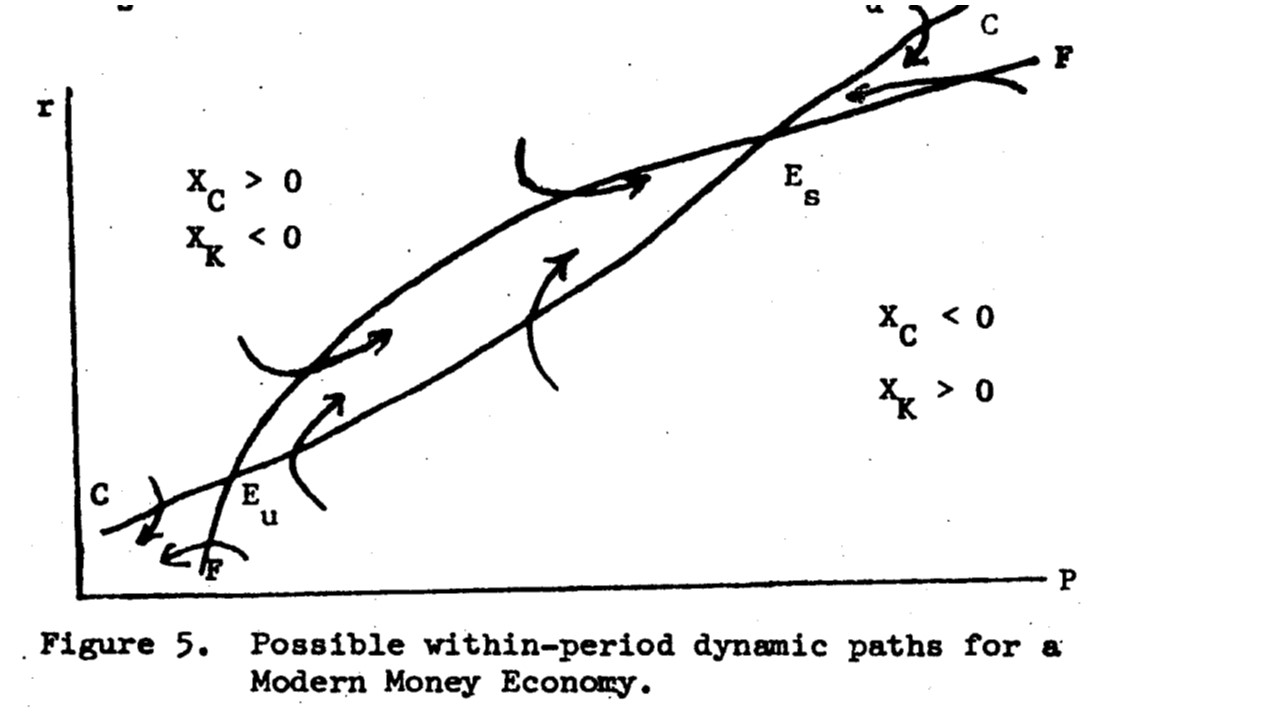
In this installment, I am going to work through Thompson’s argument about the potential for an unstable equilibrium in the version of his model with an upward-sloping LM curve corresponding to the case in which non-interest bearing money is monopolistically supplied by a central bank. Thompson makes the argument using Figure 5, a phase diagram showing the potential equilibria for such an economy in terms of the FF curve (representing price levels and nominal interest rates consistent with equilibrium in the markets for labor and capital services) and the CC curve (representing price levels and nominal interest rates consistent with equilibrium in the output market).

Thompson_Figure5A phase diagram shows the direction of price adjustment when the economy is not in equilibrium (one of the two points of intersection between the FF and the CC curves). A disequilibrium implies a price change in response to an excess supply or excess demand in some market. All points above and to the left of the FF curve correspond to an excess supply of capital services, implying a falling nominal interest rate; points below and to the right of the FF curve correspond to excess demand for capital services, implying a rising interest rate. Points above and to the left of the CC curve correspond to an excess demand for output, implying a rising price level; points below and to the right of the CC curve correspond to an excess supply of output, implying a falling price level. Points in between the FF and CC curves correspond either to an excess demand for commodities and for capital services, implying a rising price level and a rising nominal interest rate (in the region between the two points of intersection – Eu and Es — between the CC and FF curves) or to an excess supply of both capital services and commodities, implying a falling interest rate and a falling price level (in the regions below the lower intersection Eu and above the upper intersection Es). The arrows in the diagram indicate the direction in which the price level and the nominal interest rate are changing at any point in the diagram.

Given the direction of price change corresponding to points off the CC and FF curves, the upper intersection is shown to be a stable equilibrium, while the lower intersection is unstable. Moreover, the instability corresponding to the lower intersection is very dangerous, because entering the region between the CC and FF curves below Eu means getting sucked into a vicious downward spiral of prices and interest rates that can only be prevented by a policy intervention to shift the CC curve to the right, either directly by way of increased government spending or tax cuts, or indirectly, through monetary policy aimed at raising the price level and expected inflation, shifting the LM curve, and thereby the CC curve, to the right. It’s like stepping off a cliff into a black hole.

Although I have a lot of reservations about the practical relevance of this model as an analytical tool for understanding cyclical fluctuations and counter-cyclical policy, which I plan to discuss in a future post, the model does resonate with me, and it does so especially after my recent posts about the representative-agent modeling strategy in New Classical economics (here, here, and here). Representative-agent models, I argued, are inherently unable to serve as analytical tools in macroeconomics, because their reductionist approach implies that all relevant decision making can be reduced to the optimization of a single agent, insulating the analysis from any interactions between decision-makers. But it is precisely the interaction effects between decision makers that create analytical problems that constitute the subject matter of the discipline or sub-discipline known as macroeconomics. That Robert Lucas has made it his life’s work to annihilate this field of study is a sad commentary on his contribution, Nobel Prize or no Nobel Prize, as an economic theorist.

That is one reason why I regard Thompson’s model, despite its oversimplifications, as important: it is constructed on a highly aggregated, yet strictly neoclassical, foundation, including continuous market-clearing, arriving at the remarkable conclusion that not only is there an unstable equilibrium, but it is at least possible for an economy in the neighborhood of the unstable equilibrium to be caught in a vicious downward deflationary spiral in which falling prices do not restore equilibrium but, instead, suck the economy into a zero-output black hole. That result seems to me to be a major conceptual breakthrough, showing that the strict rationality assumptions of neoclassical theory can lead to aoutcome that is totally at odds with the usual presumption that the standard neoclassical assumptions inevitably generate a unique stable equilibrium and render macroeconomics superfluous.

Hicks on IS-LM and Temporary Equilibrium

Jan, commenting on my recent post about Krugman, Minsky and IS-LM, quoted the penultimate paragraph of J. R. Hicks’s 1980 paper on IS-LM in the Journal of Post-Keynesian Economics, a brand of economics not particularly sympathetic to Hicks’s invention. Hicks explained that in the mid-1930s he had been thinking along lines similar to Keynes’s even before the General Theory was published, and had the basic idea of IS-LM in his mind even before he had read the General Theory, while also acknowledging that his enthusiasm for the IS-LM construct had waned considerably over the years.

Hicks discussed both the similarities and the differences between his model and IS-LM. But as the discussion proceeds, it becomes clear that what he is thinking of as his model is what became his model of temporary equilibrium in Value and Capital. So it really is important to understand what Hicks felt were the similarities as well as the key differences between the temporary- equilibrium model, and the IS-LM model. Here is how Hicks put it:

I recognized immediately, as soon as I read The General Theory, that my model and Keynes’ had some things in common. Both of us fixed our attention on the behavior of an economy during a period—a period that had a past, which nothing that was done during the period could alter, and a future, which during the period was unknown. Expectations of the future would nevertheless affect what happened during the period. Neither of us made any assumption about “rational expectations” ; expectations, in our models, were strictly exogenous.3 (Keynes made much more fuss over that than I did, but there is the same implication in my model also.) Subject to these data— the given equipment carried over from the past, the production possibilities within the period, the preference schedules, and the given expectations— the actual performance of the economy within the period was supposed to be determined, or determinable. It would be determined as an equilibrium performance, with respect to these data.

There was all this in common between my model and Keynes’; it was enough to make me recognize, as soon as I saw The General Theory, that his model was a relation of mine and, as such, one which I could warmly welcome. There were, however, two differences, on which (as we shall see) much depends. The more obvious difference was that mine was a flexprice model, a perfect competition model, in which all prices were flexible, while in Keynes’ the level of money wages (at least) was exogenously determined. So Keynes’ was a model that was consistent with unemployment, while mine, in his terms, was a full employment model. I shall have much to say about this difference, but I may as well note, at the start, that I do not think it matters much. I did not think, even in 1936, that it mattered much. IS-LM was in fact a translation of Keynes’ nonflexprice model into my terms. It seemed to me already that that could be done; but how it is done requires explanation.

The other difference is more fundamental; it concerns the length of the period. Keynes’ (he said) was a “short-period,” a term with connotations derived from Marshall; we shall not go far wrong if we think of it as a year. Mine was an “ultra-short-period” ; I called it a week. Much more can happen in a year than in a week; Keynes has to allow for quite a lot of things to happen. I wanted to avoid so much happening, so that my (flexprice) markets could reflect propensities (and expectations) as they are at a moment. So it was that I made my markets open only on a Monday; what actually happened during the ensuing week was not to affect them. This was a very artificial device, not (I would think now) much to be recommended. But the point of it was to exclude the things which might happen, and must disturb the markets, during a period of finite length; and this, as we shall see, is a very real trouble in Keynes. (pp. 139-40)

Hicks then explained how the specific idea of the IS-LM model came to him as a result of working on a three-good Walrasian system in which the solution could be described in terms of equilibrium in two markets, the third market necessarily being in equilibrium if the other two were in equilibrium. That’s an interesting historical tidbit, but the point that I want to discuss is what I think is Hicks’s failure to fully understand the significance of his own model, whose importance, regrettably, he consistently underestimated in later work (e.g., in Capital and Growth and in this paper).

The point that I want to focus on is in the second paragraph quoted above where Hicks says “mine [i.e. temporary equilibrium] was a flexprice model, a perfect competition model, in which all prices were flexible, while in Keynes’ the level of money wages (at least) was exogenously determined. So Keynes’ was a model that was consistent with unemployment, while mine, in his terms, was a full employment model.” This, it seems to me, is all wrong, because Hicks, is taking a very naïve and misguided view of what perfect competition and flexible prices mean. Those terms are often mistakenly assumed to meant that if prices are simply allowed to adjust freely, all  markets will clear and all resources will be utilized.

I think that is a total misconception, and the significance of the temporary-equilibrium construct is in helping us understand why an economy can operate sub-optimally with idle resources even when there is perfect competition and markets “clear.” What prevents optimality and allows resources to remain idle despite freely adjustming prices and perfect competition is that the expectations held by agents are not consistent. If expectations are not consistent, the plans based on those expectations are not consistent. If plans are not consistent, then how can one expect resources to be used optimally or even at all? Thus, for Hicks to assert, casually without explicit qualification, that his temporary-equilibrium model was a full-employment model, indicates to me that Hicks was unaware of the deeper significance of his own model.

If we take a full equilibrium as our benchmark, and look at how one of the markets in that full equilibrium clears, we can imagine the equilibrium as the intersection of a supply curve and a demand curve, whose positions in the standard price/quantity space depend on the price expectations of suppliers and of demanders. Different, i.e, inconsistent, price expectations would imply shifts in both the demand and supply curves from those corresponding to full intertemporal equilibrium. Overall, the price expectations consistent with a full intertemporal equilibrium will in some sense maximize total output and employment, so when price expectations are inconsistent with full intertemporal equilibrium, the shifts of the demand and supply curves will be such that they will intersect at points corresponding to less output and less employment than would have been the case in full intertemporal equilibrium. In fact, it is possible to imagine that expectations on the supply side and the demand side are so inconsistent that the point of intersection between the demand and supply curves corresponds to an output (and hence employment) that is way less than it would have been in full intertemporal equilibrium. The problem is not that the price in the market doesn’t allow the market to clear. Rather, given the positions of the demand and supply curves, their point of intersection implies a low output, because inconsistent price expectations are such that potentially advantageous trading opportunities are not being recognized.

So for Hicks to assert that his flexprice temporary-equilibrium model was (in Keynes’s terms) a full-employment model without noting the possibility of a significant contraction of output (and employment) in a perfectly competitive flexprice temporary-equilibrium model when there are significant inconsistencies in expectations suggests strongly that Hicks somehow did not fully comprehend what his own creation was all about. His failure to comprehend his own model also explains why he felt the need to abandon the flexprice temporary-equilibrium model in his later work for a fixprice model.

There is, of course, a lot more to be said about all this, and Hicks’s comments concerning the choice of a length of the period are also of interest, but the clear (or so it seems to me) misunderstanding by Hicks of what is entailed by a flexprice temporary equilibrium is an important point to recognize in evaluating both Hicks’s work and his commentary on that work and its relation to Keynes.

Temporary Equilibrium One More Time

It’s always nice to be noticed, especially by Paul Krugman. So I am not upset, but in his response to my previous post, I don’t think that Krugman quite understood what I was trying to convey. I will try to be clearer this time. It will be easiest if I just quote from his post and insert my comments or explanations.

Glasner is right to say that the Hicksian IS-LM analysis comes most directly not out of Keynes but out of Hicks’s own Value and Capital, which introduced the concept of “temporary equilibrium”.

Actually, that’s not what I was trying to say. I wasn’t making any explicit connection between Hicks’s temporary-equilibrium concept from Value and Capital and the IS-LM model that he introduced two years earlier in his paper on Keynes and the Classics. Of course that doesn’t mean that the temporary equilibrium method isn’t connected to the IS-LM model; one would need to do a more in-depth study than I have done of Hicks’s intellectual development to determine how much IS-LM was influenced by Hicks’s interest in intertemporal equilibrium and in the method of temporary equilibrium as a way of analyzing intertemporal issues.

This involves using quasi-static methods to analyze a dynamic economy, not because you don’t realize that it’s dynamic, but simply as a tool. In particular, V&C discussed at some length a temporary equilibrium in a three-sector economy, with goods, bonds, and money; that’s essentially full-employment IS-LM, which becomes the 1937 version with some price stickiness. I wrote about that a long time ago.

Now I do think that it’s fair to say that the IS-LM model was very much in the spirit of Value and Capital, in which Hicks deployed an explicit general-equilibrium model to analyze an economy at a Keynesian level of aggregation: goods, bonds, and money. But the temporary-equilibrium aspect of Value and Capital went beyond the Keynesian analysis, because the temporary equilibrium analysis was explicitly intertemporal, all agents formulating plans based on explicit future price expectations, and the inconsistency between expected prices and actual prices was explicitly noted, while in the General Theory, and in IS-LM, price expectations were kept in the background, making an appearance only in the discussion of the marginal efficiency of capital.

So is IS-LM really Keynesian? I think yes — there is a lot of temporary equilibrium in The General Theory, even if there’s other stuff too. As I wrote in the last post, one key thing that distinguished TGT from earlier business cycle theorizing was precisely that it stopped trying to tell a dynamic story — no more periods, forced saving, boom and bust, instead a focus on how economies can stay depressed. Anyway, does it matter? The real question is whether the method of temporary equilibrium is useful.

That is precisely where I think Krugman’s grasp on the concept of temporary equilibrium is slipping. Temporary equilibrium is indeed about periods, and it is explicitly dynamic. In my previous post I referred to Hicks’s discussion in Capital and Growth, about 25 years after writing Value and Capital, in which he wrote

The Temporary Equilibrium model of Value and Capital, also, is “quasi-static” [like the Keynes theory] – in just the same sense. The reason why I was contented with such a model was because I had my eyes fixed on Keynes.

As I read this passage now — and it really bothered me when I read it as I was writing my previous post — I realize that what Hicks was saying was that his desire to conform to the Keynesian paradigm led him to compromise the integrity of the temporary equilibrium model, by forcing it to be “quasi-static” when it really was essentially dynamic. The challenge has been to convert a “quasi-static” IS-LM model into something closer to the temporary-equilibrium method that Hicks introduced, but did not fully execute in Value and Capital.

What are the alternatives? One — which took over much of macro — is to do intertemporal equilibrium all the way, with consumers making lifetime consumption plans, prices set with the future rationally expected, and so on. That’s DSGE — and I think Glasner and I agree that this hasn’t worked out too well. In fact, economists who never learned temporary-equiibrium-style modeling have had a strong tendency to reinvent pre-Keynesian fallacies (cough-Say’s Law-cough), because they don’t know how to think out of the forever-equilibrium straitjacket.

Yes, I agree! Rational expectations, full-equilibrium models have turned out to be a regression, not an advance. But the way I would make the point is that the temporary-equilibrium method provides a sort of a middle way to do intertemporal dynamics without presuming that consumption plans and investment plans are always optimal.

What about disequilibrium dynamics all the way? Basically, I have never seen anyone pull this off. Like the forever-equilibrium types, constant-disequilibrium theorists have a remarkable tendency to make elementary conceptual mistakes.

Again, I agree. We can’t work without some sort of equilibrium conditions, but temporary equilibrium provides a way to keep the discipline of equilibrium without assuming (nearly) full optimality.

Still, Glasner says that temporary equilibrium must involve disappointed expectations, and fails to take account of the dynamics that must result as expectations are revised.

Perhaps I was unclear, but I thought I was saying just the opposite. It’s the “quasi-static” IS-LM model, not temporary equilibrium, that fails to take account of the dynamics produced by revised expectations.

I guess I’d say two things. First, I’m not sure that this is always true. Hicks did indeed assume static expectations — the future will be like the present; but in Keynes’s vision of an economy stuck in sustained depression, such static expectations will be more or less right.

Again, I agree. There may be self-fulfilling expectations of a low-income, low-employment equilibrium. But I don’t think that that is the only explanation for such a situation, and certainly not for the downturn that can lead to such an equilibrium.

Second, those of us who use temporary equilibrium often do think in terms of dynamics as expectations adjust. In fact, you could say that the textbook story of how the short-run aggregate supply curve adjusts over time, eventually restoring full employment, is just that kind of thing. It’s not a great story, but it is the kind of dynamics Glasner wants — and it’s Econ 101 stuff.

Again, I agree. It’s not a great story, but, like it or not, the story is not a Keynesian story.

So where does this leave us? I’m not sure, but my impression is that Krugman, in his admiration for the IS-LM model, is trying too hard to identify IS-LM with the temporary-equilibrium approach, which I think represented a major conceptual advance over both the Keynesian model and the IS-LM representation of the Keynesian model. Temporary equilibrium and IS-LM are not necessarily inconsistent, but I mainly wanted to point out that the two aren’t the same, and shouldn’t be conflated.


About Me

David Glasner
Washington, DC

I am an economist in the Washington DC area. My research and writing has been mostly on monetary economics and policy and the history of economics. In my book Free Banking and Monetary Reform, I argued for a non-Monetarist non-Keynesian approach to monetary policy, based on a theory of a competitive supply of money. Over the years, I have become increasingly impressed by the similarities between my approach and that of R. G. Hawtrey and hope to bring Hawtrey’s unduly neglected contributions to the attention of a wider audience.

My new book Studies in the History of Monetary Theory: Controversies and Clarifications has been published by Palgrave Macmillan

Follow me on Twitter @david_glasner

Archives

Enter your email address to follow this blog and receive notifications of new posts by email.

Join 665 other subscribers
Follow Uneasy Money on WordPress.com