Posts Tagged 'Scott Sumner'


A New Paper Shows Just How Right Hawtrey and Cassel Were

I was pleasantly surprised to receive an email a couple of weeks ago from someone I don’t know, a graduate student in economics at George Mason University, James Caton. He sent me a link to a paper (“Good as Gold?: A Quantitative Analysis of Hawtrey and Cassel’s Theory of Gold Demand and the Gold Price Level During the Interwar Period”) that he recently posted on SSRN. Caton was kind enough to credit me and my co-author Ron Batchelder, as well as Doug Irwin (here and here) and Scott Sumner, for reviving interest in the seminal work of Ralph Hawtrey and Gustav Cassel on the interwar gold standard and the key role in causing the Great Depression played by the process of restoring the gold standard after it had been effectively suspended after World War I began.

The thesis independently, but cooperatively, advanced by Hawtrey and Cassel was that under a gold standard, fluctuations in the gold price level were sensitive to variations in the demand for gold reserves by the central banks. The main contribution of Caton’s paper is to provide econometric evidence of the tight correlation between variations in the total gold holdings of the world’s central banks and the gold price level in the period between the end of World War I (1918) to the start of Great Depression (1930-32). Caton uses a variation on a model used by Scott Sumner in his empirical work on the Great Depression to predict changes in the value of gold, and, hence, changes in the gold price level of commodities. If central banks in the aggregate are adding to their gold reserves at a faster rate than the rate at which the total world stock of gold is growing, then gold would be likely to appreciate, and if central banks are adding to their gold reserves at a slower rate than that at which the world stock is growing, then gold would be likely to depreciate.

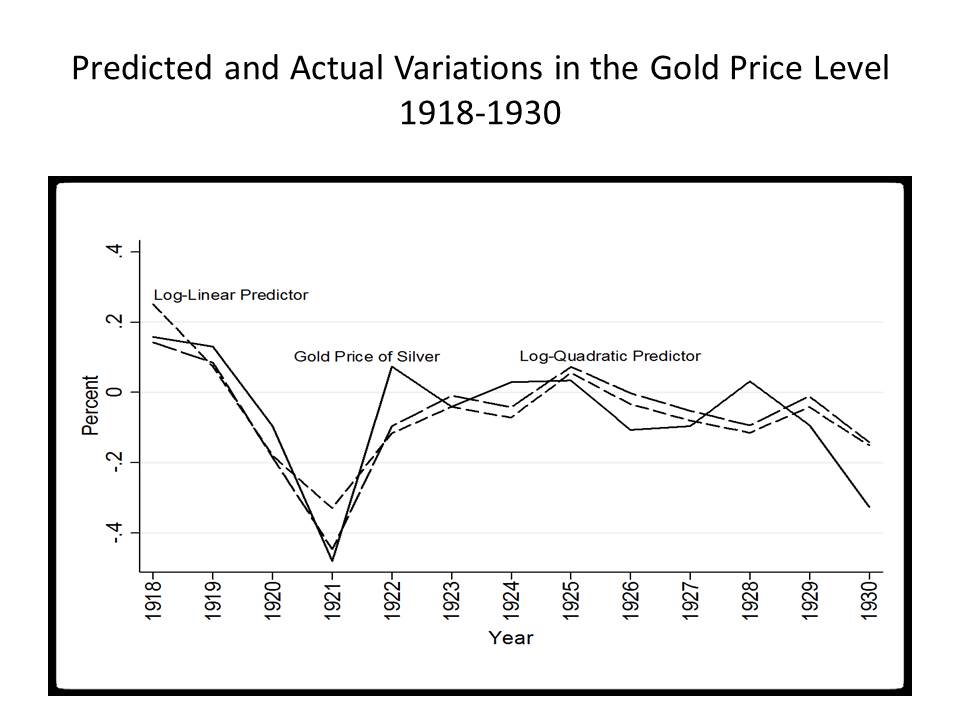
So from the published sources, Caton constructed a time series of international monetary gold holdings and the total world stock of gold from 1918 to 1932 and regressed the international gold price level on the international gold reserve ratio (the ratio of monetary gold reserves to the total world stock of gold). He used two different measures of the world gold price level, the Sauerback-Statist price index and the gold price of silver. Based on his regressions (calculated in both log-linear and log-quadratic forms and separately for the periods 1918-30, 1918-31, 1918-32), he compared the predicted gold price level against both the Sauerback-Statist price index and the gold price of silver. The chart below shows his result for the log-linear regression estimated over the period 1918-30.

Caton_Regressions

Pretty impressive, if you ask me. Have a look yourself.

Let me also mention that Caton’s results also shed important light on the puzzling behavior of the world price level immediately after the end of World War I. Unlike most wars in which the wartime inflation comes to an abrupt end after the end of the war, inflation actually accelerated after the end of the war. The inflation did not actually stop for almost two years after the end of the war, when a huge deflation set in. Caton shows that the behavior of the price level was largely determined by the declining gold holdings of the Federal Reserve after the war ended. Unnerved by the rapid inflation, the Fed finally changed policy, and began accumulating gold rapidly in 1920 by raising the discount rate to an all-time high of 7 percent. Although no other countries were then on the gold standard, other countries, unwilling, for the most part, to allow their currencies to depreciate too much against the dollar, imported US deflation.

Jim is also a blogger. Check out his blog here.

Update: Thanks to commenter Blue Aurora for pointing out that I neglected to provide a link to Jim Caton’s paper.  Sorry about that. The link is now embedded.

Leijonhufvud on Friedman

Before it was hijacked by Paul Krugman, Scott Sumner and I were having a friendly little argument about whether Milton Friedman repackaged the Keynesian theory of the demand for money as the quantity theory of money transmitted to him via a fictitious Chicago oral tradition, as I, relying on Don Patinkin and Harry Johnson, claim, or whether Friedman was a resolute anti-Keynesian, as Scott claims. We have been trading extended quotations from the literature to try to support our positions.

I now offer some additional quotations, all but one from Axel Leijonhufvud’s wonderful essay “The Wicksell Connection: Variations on a Theme,” published in Leijonfuvud’s volume Information and Coordination (Oxford University Press, 1981). By some coincidence, the quotations tend to support my position, but, more importantly, they shed important light on problems of interpreting what Keynes was really talking about, and suggest a way of thinking about Keynes that takes us beyond the sterile ideological debates into which we tend lapse at the mere mention of the name John Maynard Keynes, or for that matter, Milton Friedman. Of course, the main lesson that readers should take away is: read the whole essay.

Herewith are a few extracts in which Leijonhufvud comments on Friedman and his doctrinal relationship with Keynes.

Milton Friedman has emphatically denied that the elasticity of LM is at issue [in the Monetarist v. Keynesian controversies]. At the same time his use of what is basically an IS-LM structure in presenting his own theory, and his oft-repeated insistence that no theoretical issues but only questions of empirical magnitudes within this shared theoretical frame separate him from his opponents, have apparently fortified others in their belief that (whatever he says) this elasticity must be crucial. Furthermore, Friedman has himself played around with elasticities, for example in advancing the notion of a horizontal IS curve. (p. 144, fn. 22)

The troubles with keeping track of the Wicksellian theme in its Keynesian guises and disguises go far back in time. The original “Savings-equals-Investment” debate did not reach a clear-cut collective verdict. As Lipsey [“The Foundations of the Theory of National Income: An Analysis of Some Fundamental Errors”] has recently shown, confusion persists to the present day. The IS-LM framework did not lend itself too well to a sharp characterization of the question whether the excess demand for bonds or the excess demand for money governs the interest rate. It was concluded that the distinction between the Loanable Funds and Liquidity Preference hypotheses was probably either pointless or misleading and that, in either case, the issue could safely be left unresolved. Correspondingly, Hansen found, Keynes’ insistence that saving and investment determine income while money stock and liquidity preference determine the rate of interest (rather than the other way around) makes no sense once you realize that, in IS-LM, everything simultaneously determines everything.

In Hansen’s reading Keynes’ interest theory was “indeterminate” – money supply and demand could not determine the interest rate, as Keynes would have it, but only give you the LM curve, etc. This way of looking at it missed the issue of which excess demand governs the interest rate.

One is reminded of Hansen’s indeterminacy charge by Friedman’s more recent argument that Keynes’ theory suffered from a “missing equation” – and should be completed by adding an exogenously determined price level. Keynes’ theory . . . was of the dynamic-historical variety. In describing the state of the system at some point in the sequential process, such theories make use of information about the system’s initial (historical) state. Static models do not use historical information, of course, but have to have equations for all endogenous variables. Reading a dynamic-historical theory on the presumption that it is static, therefore, is apt to lead to the mistaken impression that it lacks equations and is indeterminate. (pp. 180-81 and fn. 84)

Friedman, like so many others, filters Keynes and Keynesian theory through the IS-LM model and, consequently, ends up where everyone else ends up: bogged down in the Neoclassical Synthesis, which is to say, with the conclusion that exogenous fixity of money wages was Keynes’ explanation of unemployment. His discussion is notable for a sophisticated treatment of Keynes’ demand for money function and for its sweeping endorsement of the Pigou-effect. . . . (p. 189)

I break off from the final quotation, which is just a small part of an extended discussion of Friedman, because the argument is too dense to summarize adequately, and the entire lengthy passage (pp. 187-94) has to be read to grasp its full import. But I close with one final quotation from Leijonhufvud’s essay “Schools, ‘Revolutions,’ and Research Programmes in Economic Theory,” also contained in Information and Coordination (pp. 291-345).

The most widely known “monetarist,” Professor Milton Friedman, has for a long time consistently voiced the position that “monetarists” and “(neo)-Keynesians” share essentially the same theory and that their differences all derive from contrasting hypotheses concerning certain crucial empirical magnitudes. (He has also, however, persistently denied that the issues can be defined as a “simple” matter of the magnitude of the interest-elasticity of the excess demand for money – an otherwise oft-repeated contention in the debate.) In his recent attempts to provide an explicit representation for his theory, accordingly, Friedman chose ot use the “Keynesian” so-called “IS-LM” framework as his language of formal discourse.

In my opinion, there are “hard core” differences between the two theories and ones, moreover, that the “IS-LM” framework will not help us define. Not only are these differences at the “cosmological” level not accurately represented by the models used, but they will also lead to divergent interpretations of empirical results. (pp. 298-99, fn. 10)

The last paragraph, I suspect, probably sums up not just the inconclusiveness of the debate between Monetarists and Keynesians, but also the inconclusiveness of the debate about whether Friedman was or wasn’t a Keynesian. So be it.

Second Thoughts on Friedman

After blowing off some steam about Milton Friedman in my previous post, thereby antagonizing a sizable segment of my readership, and after realizing that I had been guilty of a couple of memory lapses in citing sources that I was relying on, I thought that I should go back and consult some of the relevant primary sources. So I looked up Friedman’s 1966 article “Interest Rates and the Demand for Money” published in the Journal of Law and Economics in which he denied that he had ever asserted that the demand for money did not depend on the rate of interest and that the empirical magnitude of the elasticity of money demand with respect to the interest rate was not important unless it approached the very high elasticity associated with the Keynesian liquidity trap. I also took a look at Friedman’s reply to Don Patinkin essay “Friedman on the Quantity Theory and Keynesian Economics” in Milton Friedman’s Monetary Framework: A Debate with his Critics.

Perhaps on another occasion, I will offer some comments on Friedman and the interest elasticity of the demand for money, but, for now, I will focus on Friedman’s reply to Patinkin, which is most relevant to my previous post. Patinkin’s essay, entitled, “Friedman on the Quantity Theory and Keynesian Economics,” charged that Friedman had repackaged the Keynesian theory as a quantity theory and tried to sell it with a Chicago oral tradition label stuck on the package. That’s an overstatement of a far more sophisticated argument than my one sentence summary can do justice to, but it captures the polemical gist of Patinkin’s argument, an argument that he had made previously in a paper, “The Chicago Tradition, the Quantity Theory, and Friedman” published in the Journal of Money, Credit and Banking which Harry Johnson relied on in his 1970 Richard T. Ely lecture, “The Keynesian Revolution and the Monetarist Counterrevolution.” Friedman took personal offense at what he regarded as attacks on his scholarly integrity in those papers, and his irritation (to put it mildly) with Patinkin is plainly in evidence in his reply to Patinkin. Much, but not all, of my criticism of Friedman stems from my memory of the two papers by Patinkin and Johnson.

Now to give Friedman his due – and to reiterate what I have already said a number of times, Friedman was a great economist and you can learn a lot by reading his arguments carefully because he was a very skillful applied theorist — he makes a number of effective responses to Patinkin’s accusation that he was merely peddling a disguised version of Keynesianism under the banners of the quantity theory and the Chicago oral tradition. These are basically the same arguments that Scott Sumner used in the post that he wrote defending Friedman against my recycling of the Patinkin/Johnson criticism.

First, like earlier quantity theorists, and unlike Keynes in the General Theory, Friedman assumed that the price level is determined (not, as in the GT, somehow fixed exogenously) by the demand for money and the supply (effectively under the complete discretionary control of the monetary authority) of money.

Second, because differences between the demand for money and the supply of money (in nominal terms) are equilibrated primarily by changes in the price level (not, as in the GT, by changes in the rate of interest), the link between monetary policy and the economy that Friedman focused on was the price level not the rate of interest.

Third, Friedman did not deny that the demand for money was affected by the rate of interest, but he maintained that monetary policy would become ineffective only under conditions of a liquidity trap, which was therefore, in Friedman’s view, the chief theoretical innovation of the General Theory, but one which, on empirical grounds, Friedman flatly rejected.

So if I were to restate Patinkin’s objection in somewhat different terms, I would say that Friedman, in 1956 and in later expositions, described the quantity theory as a theory of the demand for money, which as a historical matter is a travesty, because the quantity theory was around for centuries before the concept of a demand for money was even articulated, but the theory of the demand for money that Friedman described was, in fact, very much influenced by the Keynesian theory of liquidity preference, an influence not mentioned by Friedman in 1956 but acknowledged in later expositions. Friedman explained away this failure by saying that Keynes was merely adding to a theory of the demand for money that had been evolving at Cambridge since Marshall’s day, and that the novel element in the General Theory, absolute liquidity preference, was empirically unsupported. That characterization of Keynes’s theory of liquidity preference strikes me as being ungenerous, but both Friedman and Patinkin neglected to point out that Keynes erroneously thought that his theory of liquidity preference was actually a complete theory of the rate of interest that displaced the real theory of interest.

So, my take on the dispute between Friedman and Patinkin is that Patinkin was right that Friedman did not sufficiently acknowledge the extent to which he was indebted to Keynes for the theory of the demand for money that he erroneously identified with the quantity theory of money. On the other hand, because Friedman explicitly allowed for the price level to be determined within his model, he avoided the Keynesian liquidity-preference relationship between the quantity of money and the rate of interest, allowing the real rate of interest to be determined by real factors not liquidity preference. In some sense, Friedman may have exaggerated the conceptual differences between himself and the Keynesians, but, by making a strategic assumption that the price level responds to changes in the quantity of money, Friedman minimized the effect of changes in the quantity of money on interest rates, except via changes in price level expectations.

But, having granted Friedman partial exoneration of the charge that he was a crypto-Keynesian, I want to explore a bit more carefully Friedman’s remarkable defense against the accusation by Patinkin and Johnson that he invented a non-existent Chicago oral tradition under whose name he could present his quasi-Keynesian theory of the demand for money. Friedman began his response to Patinkin with the following expression of outrage.

Patinkin . . . and Johnson criticize me for linking my work to a “Chicago tradition” rather than recognizing that, as they see it, my work is Keynesian. In the course of their criticism, they give a highly misleading impression of the Chicago tradition. . . .

Whether I conveyed the flavor of that tradition or not, there was such a tradition; it was significantly different from the quantity theory tradition that prevailed at other institutions of learning, notably the London School of Economics; that Chicago tradition had a great deal to do with the differential impact of Keynes’s General Theory on economists at Chicago and elsewhere; and it was responsible for the maintenance of interest in the quantity theory at Chicago. (Friedman’s Monetary Framework p. 158 )

Note the reference to the London School of Economics, as if LSE in the 1930s was in any way notable for its quantity theory tradition. There were to be sure monetary theorists of some distinction working at the LSE in the 1930s, but their relationship to the quantity theory was, at best, remote.

Friedman elaborates on this tidbit a few pages later, recalling that in the late 1940s or early 1950s he once debated Abba Lerner at a seminar at the University of Chicago. Despite agreeing with each other about many issues, Friedman recalled that they were in sharp disagreement about the Keynesian Revolution, Lerner being an avid Keynesian, and Friedman being opposed. The reason for their very different reaction to the Keynesian Revolution, Friedman conjectured, was that Lerner had been trained at the London School of Economics “where the dominant view was that the depression was an inevitable result of the prior boom, that it was deepened by the attempts ot prevent prices and wages from falling and firms from going bankrupt, that the monetary authorities had brought on the depression by inflationary policies before the crash and had prolonged it by ‘easy money’ policies thereafter; that the only sound policy was to let the depression run its course, bring down money costs, and eliminate the weak and unsound firms.” For someone trained in such a view, Friedman suggested, the Keynesian program would seem very attractive. Friedman continued:

It was the London School (really Austrian) view that I referred to in my “Restatement” when I spoke of “the atrophied and rigid caricature [of the quantity theory] that is so frequently described by the proponents of the new income-expenditure approach – and with some justice, to judge by much of the literature on policy that was spawned by the quantity theorists.”

The intellectual climate at Chicago had been wholly different. My teachers regarded the depression as largely the product of misguided government policy – or at least greatly intensified by such policies. They blamed the monetary and fiscal authorities for permitting banks to fail and the quantity of deposits to decline. Far from preaching the need to let deflation and bankruptcy run their course, they issued repeated pronouncements calling for governmental action to stem the deflation. . . .

It was this view the the quantity theory that I referred to in my “Restatement” as “a more subtle and relevant version, one in which the quantity theory was connected and integrated with general price theory and became a flexible and sensitive tool for interpreting movements in aggregate economic activity and for developing relevant policy prescriptions.” (pp. 162-63)

After quoting at length from a talk Jacob Viner gave in 1933 calling for monetary expansion, Friedman winds up with this gem.

What, in the field of interpretation and policy, did Keynes have to offer those of us who learned their economics at a Chicago filled with these views? Can anyone who knows my work read Viner’s comments and not see the direct links between them and Anna Schwartz’s and my Monetary History or between them and the empirical Studies in the Quantity Theory of Money? Indeed, as I have read Viner’s talk for purposes of this paper, I have myself been amazed to discover how precisely it foreshadows the main thesis of our Monetary History for the depression period, and have been embarrassed that we made no reference to it in our account. Can you find any similar link between [Lionel] Robbins’s [of LSE] comments [in his book The Great Depression] and our work? (p. 167)

So what is the evidence that Friedman provides to counter the scandalous accusation by Patinkin and Johnson that Friedman invented a Chicago oral tradition of the quantity theory? (And don’t forget: the quantity theory is a theory of the demand for money) Well, it’s that, at the London School of Economics, there were a bunch of guys who had crazy views about just allowing the Great Depression to run its course, and those guys were quantity theorists, which is why Keynes had to start a revolution to get rid of them all, but at Chicago, they didn’t allow any of those guys to spout their crazy ideas in the first place, so we didn’t need any damn Keynesian revolution.

Good grief! Is there a single word that makes sense? To begin with those detestable guys at LSE were Austrians, as Friedman acknowledges. What he didn’t say, or didn’t know, is that Austrians, either by self-description or by any reasonable definition of the term, are not quantity theorists. So the idea that there was anything special about the Chicago quantity theory as opposed to any other species of the quantity theory is total humbug.

But hold on, it only gets worse. Friedman holds up Jacob Viner as an exemplar of the Chicago quantity theory oral tradition. Jacob Viner was a superb economist, a magnificent scholar, and a legendary teacher for whom I have the utmost admiration, and I am sure that Friedman learned a lot from him at Chicago, But isn’t it strange that Friedman writes: “as I have read Viner’s talk for purposes of this paper, I have myself been amazed to discover how precisely it foreshadows the main thesis of our Monetary History for the depression period, and have been embarrassed that we made no reference to it in our account.” OMG! This is the oral tradition that exerted such a powerful influence on Friedman and his fellow students? Viner explains how to get out of the depression in 1933, and in 1971 Friedman is “amazed to discover” how precisely Viner’s talk foreshadowed the main thesis of his explanation of the Great Depression? That sounds more like a subliminal tradition than an oral tradition.

Responding to Patinkin’s charge that his theory of the demand for money – remember the quantity theory, according to Friedman is a theory of the demand for money — is largely derived from Keynes, Friedman plays a word game.

Is everything in the General Theory Keynesian? Obviously yes, in the trivial sense that the words were set down on paper by John Maynard Keynes. Obviously no, in the more important sense that the term Keynesian has come to refer to a theory of short-term economic change – or a way of analyzing such change – presented in the General Theory and distinctively different from the theory that preceded it. To take a noncontroversial example: in his chapter 20 on “The Employment Function” and elsewhere, Keynes uses the law of diminishing returns to conclude that an increase of employment requires a decline in real-wage rates. Clearly that does not make the “law of diminishing returns” Keynesian or justify describing the “analytical framework” of someone who embodies the law of diminishing returns in his theoretical structure as Keynesian.

In just the same sense, I maintain that Keynes’s discussion of the demand curve for money in the General Theory is for the most part a continuation of earlier quantity theory approaches, improved and refined but not basically modified. As evidence, I shall cite Keynes’s own writings in the Tract on Monetary Reform – long before he became a Keynesian in the present sense. (p. 168)

There are two problems with this line of defense. First, the analogy to the law of diminishing returns would have been appropriate only if Keynes had played a major role in the discovery of the law of diminishing returns just as, on Friedman’s own admission, he played a major role in discovering the theory of liquidity preference. Second, it is, to say the least, debatable to what extent “Keynes’s discussion of the demand curve for money was merely a continuation of earlier quantity theory approaches, improved and refined but not basically modified.” But there is no basis at all for the suggestion that a Chicago oral tradition was the least bit implicated in those earlier quantity theory approaches. So Friedman’s invocation of a Chicago oral tradition was completely fanciful.

This post has gone on too long already. I have more to say about Friedman’s discussion of the relationship between money, price levels, and interest rates. But that will have to wait till next time.
John Taylor, Post-Modern Monetary Theorist

In the beginning, there was Keynesian economics; then came Post-Keynesian economics.  After Post-Keynesian economics, came Modern Monetary Theory.  And now it seems, John Taylor has discovered Post-Modern Monetary Theory.

What, you may be asking yourself, is Post-Modern Monetary Theory all about? Great question!  In a recent post, Scott Sumner tried to deconstruct Taylor’s position, and found himself unable to determine just what it is that Taylor wants in the way of monetary policy.  How post-modern can you get?

Taylor is annoyed that the Fed is keeping interest rates too low by a policy of forward guidance, i.e., promising to keep short-term interest rates close to zero for an extended period while buying Treasuries to support that policy.

And yet—unlike its actions taken during the panic—the Fed’s policies have been accompanied by disappointing outcomes. While the Fed points to external causes, it ignores the possibility that its own policy has been a factor.

At this point, the alert reader is surely anticipating an explanation of why forward guidance aimed at reducing the entire term structure of interest rates, thereby increasing aggregate demand, has failed to do so, notwithstanding the teachings of both Keynesian and non-Keynesian monetary theory.  Here is Taylor’s answer:

At the very least, the policy creates a great deal of uncertainty. People recognize that the Fed will eventually have to reverse course. When the economy begins to heat up, the Fed will have to sell the assets it has been purchasing to prevent inflation.

Taylor seems to be suggesting that, despite low interest rates, the public is not willing to spend because of increased uncertainty.  But why wasn’t the public spending more in the first place, before all that nasty forward guidance?  Could it possibly have had something to do with business pessimism about demand and household pessimism about employment?  If the problem stems from an underlying state of pessimistic expectations about the future, the question arises whether Taylor considers such pessimism to be an element of, or related to, uncertainty?

I don’t know the answer, but Taylor posits that the public is assuming that the Fed’s policy will have to be reversed at some point. Why? Because the economy will “heat up.” As an economic term, the verb “to heat up” is pretty vague, but it seems to connote, at the very least, increased spending and employment. Which raises a further question: given a state of pessimistic expectations about future demand and employment, does a policy that, by assumption, increases the likelihood of additional spending and employment create uncertainty or diminish it?

It turns out that Taylor has other arguments for the ineffectiveness of forward guidance.  We can safely ignore his two throw-away arguments about on-again off-again asset purchases, and the tendency of other central banks to follow Fed policy.  A more interesting reason is provided when Taylor compares Fed policy to a regulatory price ceiling.

[I]f investors are told by the Fed that the short-term rate is going to be close to zero in the future, then they will bid down the yield on the long-term bond. The forward guidance keeps the long-term rate low and tends to prevent it from rising. Effectively the Fed is imposing an interest-rate ceiling on the longer-term market by saying it will keep the short rate unusually low.

The perverse effect comes when this ceiling is below what would be the equilibrium between borrowers and lenders who normally participate in that market. While borrowers might like a near-zero rate, there is little incentive for lenders to extend credit at that rate.

This is much like the effect of a price ceiling in a rental market where landlords reduce the supply of rental housing. Here lenders supply less credit at the lower rate. The decline in credit availability reduces aggregate demand, which tends to increase unemployment, a classic unintended consequence of the policy.

When economists talk about a price ceiling what they usually mean is that there is some legal prohibition on transactions between willing parties at a price above a specified legal maximum price.  If the prohibition is enforced, as are, for example, rent ceilings in New York City, some people trying to rent apartments will be unable to do so, even though they are willing to pay as much, or more, than others are paying for comparable apartments.  The only rates that the Fed is targeting, directly or indirectly, are those on US Treasuries at various maturities.  All other interest rates in the economy are what they are because, given the overall state of expectations, transactors are voluntarily agreeing to the terms reflected in those rates.  For any given class of financial instruments, everyone willing to purchase or sell those instruments at the going rate is able to do so.  For Professor Taylor to analogize this state of affairs to a price ceiling is not only novel, it  is thoroughly post-modern.


About Me

David Glasner
Washington, DC

I am an economist in the Washington DC area. My research and writing has been mostly on monetary economics and policy and the history of economics. In my book Free Banking and Monetary Reform, I argued for a non-Monetarist non-Keynesian approach to monetary policy, based on a theory of a competitive supply of money. Over the years, I have become increasingly impressed by the similarities between my approach and that of R. G. Hawtrey and hope to bring Hawtrey’s unduly neglected contributions to the attention of a wider audience.

My new book Studies in the History of Monetary Theory: Controversies and Clarifications has been published by Palgrave Macmillan

Follow me on Twitter @david_glasner

Archives

Enter your email address to follow this blog and receive notifications of new posts by email.

Join 665 other subscribers
Follow Uneasy Money on WordPress.com