Posts Tagged 'Hawtrey'


Does Macroeconomics Need Financial Foundations?

One of the little instances of collateral damage occasioned by the hue and cry following upon Stephen Williamson’s post arguing that quantitative easing has been deflationary was the dustup between Scott Sumner and financial journalist and blogger Izabella Kaminska. I am not going to comment on the specifics of their exchange except to say that the misunderstanding and hard feelings between them seem to have been resolved more or less amicably. However, in quickly skimming the exchange between them, I was rather struck by the condescending tone of Kaminska’s (perhaps understandable coming from the aggrieved party) comment about the lack of comprehension by Scott and Market Monetarists more generally of the basics of finance.

First I’d just like to say I feel much of the misunderstanding comes from the fact that market monetarists tend to ignore the influence of shadow banking and market plumbing in the monetary world. I also think (especially from my conversation with Lars Christensen) that they ignore technological disruption, and the influence this has on wealth distribution and purchasing decisions amongst the wealthy, banks and corporates. Also, as I outlined in the post, my view is slightly different to Williamson’s, it’s based mostly on the scarcity of safe assets and how this can magnify hoarding instincts and fragment store-of-value markets, in a Gresham’s law kind of way. Expectations obviously factor into it, and I think Williamson is absolutely right on that front. But personally I don’t think it’s anything to do with temporary or permanent money expansion expectations. IMO It’s much more about risk expectations, which can — if momentum builds — shift very very quickly, making something deflationary, inflationary very quickly. Though, that doesn’t mean I am worried about inflation (largely because I suspect we may have reached an important productivity inflection point).

This remark was followed up with several comments blasting Market Monetarists for their ignorance of the basics of finance and commending Kaminska for the depth of her understanding to which Kaminska warmly responded adding a few additional jibes at Sumner and Market Monetarists. Here is one.

Market monetarists are getting testy because now that everybody started scrutinizing QE they will be exposed as ignorant. The mechanisms they originally advocated QE would work through will be seen as hopelessly naive. For them the money is like glass beads squirting out of the Federal Reserve, you start talking about stuff like collateral, liquid assets, balance sheets and shadow banking and they are out of their depth.

For laughs: Sumner once tried to defend the childish textbook model of banks lending out reserves and it ended in a colossal embarrassment in the comments section http://www.themoneyillusion.com/?p=5893

For you to defend your credentials in front of such “experts” is absurd. There is a lot more depth to your understanding than to their sandbox vision of the monetary system. And yes, it *is* crazy that journalists and bloggers can talk about these things with more sense than academics. But this [is] the world we live in.

To which Kaminska graciously replied:

Thanks as well! And I tend to agree with your assessment of the market monetarist view of the world.

So what is the Market Monetarist view of the world of which Kaminska tends to have such a low opinion? Well, from reading Kaminska’s comments and those of her commenters, it seems to be that Market Monetarists have an insufficiently detailed and inaccurate view of financial intermediaries, especially of banks and shadow banks, and that Market Monetarists don’t properly understand the role of safe assets and collateral in the economy. But the question is why, and how, does any of this matter to a useful description of how the economy works?

Well, this whole episode started when Stephen Williamson had a blog post arguing that QE was deflationary, and the reason it’s deflationary is that creating more high powered money provides the economy with more safe assets and thereby reduces the liquidity premium associated with safe assets like short-term Treasuries and cash. By reducing the liquidity premium, QE causes the real interest rate to fall, which implies a lower rate of inflation.

Kaminska thinks that this argument, which Market Monetarists find hard to digest, makes sense, though she can’t quite bring herself to endorse it either. But she finds the emphasis on collateral and safety and market plumbing very much to her taste. In my previous post, I raised what I thought were some problems with Williamson’s argument.

First, what is the actual evidence that there is a substantial liquidity premium on short-term Treasuries? If I compare the rates on short-term Treasuries with the rates on commercial paper issued by non-Financial institutions, I don’t find much difference. If there is a substantial unmet demand for good collateral, and there is only a small difference in yield between commercial paper and short-term Treasuries, one would think that non-financial firms could make a killing by issuing a lot more commercial paper. When I wrote the post, I was wondering whether I, a financial novice, might be misreading the data or mismeasuring the liquidity premium on short-term Treasuries. So far, no one has said anything about that, but If I am wrong, I am happy to be enlightened.

Here’s something else I don’t get. What’s so special about so-called safe assets? Suppose, as Williamson claims, that there’s a shortage of safe assets. Why does that imply a liquidity premium? One could still compensate for the lack of safety by over-collateralizing the loan using an inferior asset. If that is a possibility, why is the size of the liquidity premium not constrained?

I also pointed out in my previous post that a declining liquidity premium would be associated with a shift out of money and into real assets, which would cause an increase in asset prices. An increase in asset prices would tend to be associated with an increase in the value of the underlying service flows embodied in the assets, in other words in an increase in current prices, so that, if Williamson is right, QE should have caused measured inflation to rise even as it caused inflation expectations to fall. Of course Williamson believes that the decrease in liquidity premium is associated with a decline in real interest rates, but it is not clear that a decline in real interest rates has any implications for the current price level. So Williamson’s claim that his model explains the decline in observed inflation since QE was instituted does not seem all that compelling.

Now, as one who has written a bit about banking and shadow banking, and as one who shares the low opinion of the above-mentioned commenter on Kaminska’s blog about the textbook model (which Sumner does not defend, by the way) of the money supply via a “money multiplier,” I am in favor of changing how the money supply is incorporated into macromodels. Nevertheless, it is far from clear that changing the way that the money supply is modeled would significantly change any important policy implications of Market Monetarism. Perhaps it would, but if so, that is a proposition to be proved (or at least argued), not a self-evident truth to be asserted.

I don’t say that finance and banking are not important. Current spreads between borrowing and lending rates, may not provide a sufficient margin for banks to provide the intermediation services that they once provided to a wide range of customers. Businesses have a wider range of options in obtaining financing than they used to, so instead of holding bank accounts with banks and foregoing interest on deposits to be able to have a credit line with their banker, they park their money with a money market fund and obtain financing by issuing commercial paper. This works well for firms large enough to have direct access to lenders, but smaller businesses can’t borrow directly from the market and can only borrow from banks at much higher rates or by absorbing higher costs on their bank accounts than they would bear on a money market fund.

At any rate, when market interest rates are low, and when perceived credit risks are high, there is very little margin for banks to earn a profit from intermediation. If so, the money multiplier — a crude measure of how much intermediation banks are engaging in goes down — it is up to the monetary authority to provide the public with the liquidity they demand by increasing the amount of bank reserves available to the banking system. Otherwise, total spending would contract sharply as the public tried to build up their cash balances by reducing their own spending – not a pretty picture.

So finance is certainly important, and I really ought to know more about market plumbing and counterparty risk  and all that than I do, but the most important thing to know about finance is that the financial system tends to break down when the jointly held expectations of borrowers and lenders that the loans that they agreed to would be repaid on schedule by the borrowers are disappointed. There are all kinds of reasons why, in a given case, those jointly held expectations might be disappointed. But financial crises are associated with a very large cluster of disappointed expectations, and try as they might, the finance guys have not provided a better explanation for that clustering of disappointed expectations than a sharp decline in aggregate demand. That’s what happened in the Great Depression, as Ralph Hawtrey and Gustav Cassel and Irving Fisher and Maynard Keynes understood, and that’s what happened in the Little Depression, as Market Monetarists, especially Scott Sumner, understand. Everything else is just commentary.
Hawtrey’s Good and Bad Trade, Part X: Financial Crises and Asset Crashes

After presenting his account of an endogenous cycle in chapters 14 and 15, Hawtrey focuses more specifically in chapter 16 on the phenomenon of a financial crisis, which he considers to be fundamentally a cyclical phenomenon arising because the monetary response to inflation is sharp and sudden rather than gradual. As Hawtrey puts it:

It is not easy to say precisely what constitutes a financial crisis, but broadly it may be defined to be an escape from inflation by way of widespread failures and bankruptcies instead of by a gradual reduction of credit money. (p. 201)

Hawtrey’s focus in his discussion of financial crises is on the investment in fixed capital, having already discussed the role of inventory investment by merchants and traders in his earlier explanation of how variations in the lending rates of the banking system can lead to cumulative expansions or contractions through variations in the desired holdings of inventories by traders and merchants. New investments in fixed capital are financed, according to Hawtrey, largely out of the savings of the wealthy, which are highly pro-cyclical. The demand for new investment projects by businesses is also pro-cyclical, depending on the expected profit of businesses from installing new capital assets, the expected profit, in turn, depending on the current effective demand.

The financing for new long-term investment projects is largely channeled to existing businesses through what Hawtrey calls the investment market, the most important element of which is the stock exchange. The stock exchange functions efficiently only because there are specialists whose business it is to hold inventories of various stocks, being prepared to buy those stocks from those wishing to sell them or sell those stock to those wishing to buy them, at prices that seem at any moment to be market-clearing, i.e, at prices that keep buy and sell orders roughly in balance. The specialists, like other traders and middlemen, finance their holdings of inventories by borrowing from banks, using the proceeds from purchases and sales – corresponding to the bid-ask spread  – to repay their indebtedness to the banks. Unlike commercial traders and merchants, the turnover of whose inventories is relatively predictable with little likelihood of large price swings, and can obtain short-term financing for a fixed term, stock dealers hold inventories that are not very predictable in their price and turnover, and therefore can obtain financing only on a day to day basis, or “at call.” The securities held by the stock dealer serves as collateral for the loan, and banks require the dealer to hold securities with a value exceeding some minimum percentage (margin) of the dealer’s indebtedness to the bank.

New investment financed by the issue of stock must ultimately be purchased by savers who are seeking profitable investment opportunities into which to commit their savings. Existing firms may sometimes finance new projects by issuing new stock, but more often they issue debt or retained earnings to finance investment. Debt financing can be obtained by issuing bonds or preferred stock or by borrowing from banks. New issues of stock have to be underwritten and marketed through middlemen who expect to earn a return on their underwriting or marketing function and must have financing resources sufficient to bear risk of holding a large stock of securities until they are sold to the public.

Now at a time of expanding trade and growing inflation, when there is a general expectation of high profits and at the same time there is a flood of savings seeking investment, an underwriter’s business yields a good profit at very little risk. But at the critical moment when the banks are compelled to intervene to reduce the inflation this is changed. There is a sudden diminution of profits which simultaneously checks the accumulation of savings and dispels the expectation of high profits. An underwriter may find that the diminution of savings upsets his calculations and leaves on his hands a quantity of securities for which before the tide turned he could have found a ready market and that the prospect of disposing of these securities grows less and less with the steady shrinkage in the demand for investments and the falling prospect of high dividends. . . . (pp. 210-11)

It will be seen, then, that of all the borrowers from the bans those who borrow for the purposes of the investment market are the most liable to failure when the period of good trade comes to an end. And as it happens, it is they who are most at the mercy of the banks in times of trouble. For it is their habit to borrow from day to day, and the bans, since they cannot call in loans to traders which will only mature after several weeks or months, are apt to try to reduce an excess of credit money by refusing to lend from day to day. If that happens, the investment market will suddenly have to find the money which the banks want. The total amount of ready money in the hands of the whole investment market will probably be quite small, and, except in so far as they can persuade the bans to wait (in consideration probably of a high rate of interest), they must raise money by selling securities. But there are limits to the amount that can be raised in this way. The demand for investments is very inelastic. The money offered at any time is ordinarily simply the amount of accumulated savings of the community till then uninvested. This total can only be added to by people investing sums which they would otherwise leave as part of their working balances of money, and they cannot be induced to increase their investments very much in this way, however low the price in proportion to the yield of the securities offered. Consequently when the banks curtail the accommodation which they give to the investment market and the investment market tries to raise money by selling securities, the prices of securities may fall heavily without attracting much additional money. Meanwhile the general fall in the prices of securities will undermine the position of the entire investment market, since the value of the assets held against their liabilities to the banks will be depreciated. If the banks insist on payment in such circumstances a multitude of failures on the Stock Exchange and in the investment market must follow. The knowledge of this will deter the banks from making the last turn of the screw if they can help it. But it may be that the banks themselves are acting under dire necessity. If they have let the creation of credit get beyond their control, if they are on the point of running short of the legal tender money necessary to meet the daily demands upon them, they must have no alternative but to insist on payment. When the collapse comes it is not unlikely that that some of the banks themselves will be dragged down by it. A bank which has suffered heavy losses may be unable any longer to show an excess of assets over liabilities, and if subjected to heavy demands may be unable to borrow to meet them.

The calling in of loans from the investment market enables the banks to reduce the excess of credit money rapidly. The failure of one or more banks, by annihilating the credi money based upon their demand liabilities, hastens the process still more. A crisis therefore has the effect of bringing a trade depression into being with striking suddenness. . . .

It should not escape attention that even in a financial crisis, which is ordinarily regarded as simply a “collapse of credit,” credit only plays a secondary part. The shortage of savings, which curtails the demand for investments, and the excess of credit money, which leads the banks to call in loans, are causes at least as prominent as the impairment of credit. And the impairment of credit itself is not a mere capricious loss of confidence, but is a revised estimate of the profits of commercial enterprises in general, which is based on the palpable facts of the market. The wholesale depreciation of securities at such a time is not due to a vague “distrust” but partly to the plain fact that the money values of the assets which they represent are falling and partly to forced sales necessitated by the sudden demand for money. . . .[T]he crisis dos not originate in distrust. Loss of credit in fact is only a symptom. (pp. 212-14)

Let me now go back to Hawtrey’s discussion in chapter 14 in which he considers the effect of expected inflation or deflation on the rate of interest (i.e., the Fisher effect). This discussion is one of the few, if not the only one, that I have seen that consders the special case in which expected deflation is actually greater than the real (or natural) rate of interest. In my paper “The Fisher Effect Under Deflationary Expectations” I suggested that such a situation would account for a sudden crash of asset values such as occurred in September and October of 2008.

It is in order to counteract the effect of the falling prices that the bankers fix a rate of interest lower than the natural rate by the rate at which prices are believed to be falling. If they fail to do this they will find their business gradually falling off and superfluous stocks of gold accumulating in their vaults. Here may digress for a moment to consider a special case. What if the rate of depreciation of prices is actually greater than the natural rate of interest? If that is so nothing that the bankers can do will make borrowing sufficiently attractive. Business will be revolving in a vicious circle; the dealers unwilling to buy in a falling market, the manufacturers unable to maintain their output in face of ever-diminishing orders, dealers and manufacturers alike cutting down their borrowings in proportion to the decline of business, demand falling in proportion to the shrinkage in credit money, and with the falling demand, the dealers more unwilling to buy than ever. This, which may be called “stagnation” of trade, is of course exceptional, but it deserves our attention in passing.

From the apparent impasse there is one way out – a drastic reduction of money wages. If at any time this step is taken the spell will be broken. Wholesale prices will fall abruptly, the expectation of a further fall will cease, dealers will begin to replenish their stocks, manufacturers to increase their output, dealers and manufacturers alike will borrow again, and the stock of credit money will grow. In fact the profit rate will recover, and will again equal or indeed exceed the natural rate. The market rate, however, will be kept below the profit rate, since in the preceding period of stagnation the bankers’ reserves will have been swollen beyond the necessary proportions, and the bankers will desire to develop their loan and discount business. It should be observed that this phenomenon of stagnation will only be possible where the expected rate of depreciation of prices of commodities happens to be high. As to the precise circumstances in which this will be so, it is difficult to arrive at any very definite conclusion. Dealers will be guided partly by the tendency of prices in the immediate past, partly by what they know of the conditions of production.

A remarkable example of trade stagnation occurred at the end of the period from 1873 to 1897, when there had been a prolonged falling off in the gold supply, and in consequence a continuous fall in prices. The rate of interest in London throughout the period of no less than seven years, ending with 1897, averaged only 1.5 percent, and yet superfluous gold went on accumulating in the vaults of the Bank of England. (pp. 186-87)

It seems that Hawtrey failed to see that the circumstances that he is describing here — an expected rate of deflation that exceeds the real rate of interest — would precipitate a crisis. If prices are expected to fall more rapidly than the expected yield on real capital, then the expected return on holding cash exceeds the expected return on holding real assets. If so, holders of real assets will want to sell their assets in order to hold cash, implying that asset prices must start falling. This is precisely the sort of situation that Hawtrey describes in the passages I quoted above from chapter 16, a crisis precipitated by the reversal of an inflationary credit expansion. Exactly why Hawtrey failed to see that the two processes that he describes in chapter 14 and in chapter 16 are essentially equivalent I am unable to say.

Hawtrey’s Good and Bad Trade, Part IX: An Endogenous Cycle

We are now at the point at which Hawtrey’s model of the business cycle can be assembled from the parts laid out in the previous thirteen chapters. Hawtrey had already shown that monetary disturbances can lead to significant cumulative fluctuations, while mere demand shifts cause only minor temporary fluctuations, but his aim was to account not just for a single cumulative expansion or contraction in response to a single disturbance, but for recurring cyclical fluctuations. His theoretical model therefore required a mechanism whereby a positive or expansionary impulse would be reversed and transformed into a negative or contractionary impulse. A complete cyclical theory must provide some explanation of how an expansion becomes a contraction, and how a contraction becomes an expansion.

In chapters 14 and 15, Hawtrey identifies the banking system as the transforming agent required for a theory of recurring cycles. The key behavioral relationship for Hawtrey was that banks demand reserves — either gold or currency or reserves held with the central bank — into which their own liabilities (banknotes or deposits) are convertible. Given their demand for reserves, banks set interest rates at a level that will maintain their reserves at the desired level, raising interest rates when their reserves are less than desired, and reducing interest rates when reserves are greater than desired. Hawtrey combined this behavioral relationship with two key empirical relationships: 1) that workers and other lower-income groups generally make little use of banknotes (limited in Britain to denominations above £5, roughly the equivalent of $200 at today’s prices) and almost none of bank deposits; 2) that the share of labor in total income is countercyclical.

Using these two relationships, Hawtrey provided a theoretical account of recurring cyclical fluctuations in output, income, and employment. He begins the story at the upper turning point, when a combination of rising inflation and diminishing reserves causes banks to raise their interest rates to stem a loss of reserves. The rise in interest rates causes a reduction in spending, thereby leading to falling prices, output, and employment. Hawtrey poses the following question:

We are now concerned not with the direct consequences of a given monetary disturbance, but with the influences at work to modify and, perhaps in the end, to counteract those consequence. In particular are we to regard the tendency towards renewed inflation which experience teaches us to expect after a period of depression as a fortuitous disturbance which may come sooner or later, or as a reaction the seeds of which are already sown? To put the same problem in another form, when the position of equilibrium which should follow a disturbance according to the theory of Chapter 6 is attained, is there any reason, apart from visible causes of renewed disturbance, why that equilibrium should not continue?  (pp. 182-83)

Hawtrey argues that the equilibrium will not continue, invoking the different money-holding habits of capitalists and workers along with the countercyclical share of labor in total income. Although both employment and wages fall in the downturn, Hawtrey maintains that profits fall more sharply than wages, so that the share of labor in total income actually increases in the downturn. The entire passage is worth quoting, because it also constitutes an implicit criticism of the Austrian theory of the downturn, notwithstanding the fact that Hawtrey very likely was not yet acquainted with the Austrian theory of the business cycles, its primary text, Mises’s Theory of Money and Credit, having been published in German in 1912 just a year before publication of Good and Bad Trade.

[R]ather than let their plant lie idle, manufacturers will sacrifice part or even the whole of their profits, and that in this way the restriction of output is mitigated. If all producers insisted on stopping work unless they could obtain a normal rate of profit, there would be a greater restriction of output and more workmen would be discharged, and in that case the proceeds of the diminished output would be divided (approximately) in the same proportion between the capitalists and the workmen as before. But in consequence of the sacrifice of profits to output which actually occurs, the number of workmen in employment and therefore also the aggregate of working-class earnings will not be so severely diminished as they would otherwise be. Thus the capitalists will get a smaller proportion and the workmen a greater proportion of the gross proceeds than before. But anything which tends to increase or maintain working-class earnings tends to increase or maintain the amount of cash in the hands of the working classes. If the banks have succeeded in reducing the outstanding amount of credit money by 10 percent, they will probably have reduced the incomes of the people with bank accounts by 10 percent, but the earnings of the working classes will have been reduced in a much smaller proportion – say, 5 percent. (pp. 189-90)

The reduction in the quantity of the liabilities of the banking system in the hands of the public will relieve the pressure that previously felt to increase their reserves, which pressure had caused them to raise interest rates.

Here is the process at work which is likely enough to produce fluctuations. For the bankers will thereupon be ready to increase the stock of credit money again, and once they have embarked on this course they may find it very difficult to stop short of a dangerous inflation. . . .

Instead of ending up, therefore, with the establishment of a golden mean of prosperity, unbroken by any deviation towards less or more, the depression will be marked in its later stages by a new complication. At the time when the reduction of wages is beginning to be accompanied not merely by an increase of employment, but also by an increase of profits, the banks will find that cash is beginning to accumulate in their vaults. They will ease off the rate of interest to something a little below the profit rate, and dealers will take advantage of the low rate to add to their stocks. The manufacturers will become aware of an increase in orders, and they will find that they can occupy their plant more fully. And now that stocks and output are both increased, borrowing will be increased and the bankers will have gained their end. But then the new accession to the amount of credit money means a corresponding increase of purchasing power. At existing prices the dealers find that their stocks are being depleted by the growing demand from the consumer. The prospect of rising prices is an inducement to add to their stocks as much as they can at existing prices, and so their order to the manufacturers grow, wholesale prices go up; and as the consumers’ demands on the dealers’ stocks grow, retail prices go up; ans as prices go up, the money needed to finance a given quantity of goods grows greater and greater, and both dealers and manufacturers borrow more and more from their bankers. In fact here are all the characteristics of a period of trade expansion in full swing. (pp. 190-92)

How far such a cumulative process of credit expansion can proceed before it reaches its upper turning point depends on the willingness of the banks to continue supplying credit with an ever smaller margin of reserves relative to liabilities.

The total credit money created by the banks will be so limited by them as not to outstrip the capacities of these working balances [deposits of the banks at the Bank of England], while the Bank of England will not allow the balances to grow out of proportion to its own cash holdings. It is indeed almost, though not quite, true to say that the entire stock of credit money in England is built up not on the cash holdings of the banks taken as a whole, but on the Reserve of the Bank of England. And as the legal tender money in circulation is something like four times the average amount of the reserves, it is obvious that a small proportional change in the quantity in circulation will produce a relatively large proportional change in the reserve, and therefor in the stock of credit money. The Bank of England does not maintain blindly a fixed proportion between reserve and deposits, so that a given change in the reserve isnot reflected immediately in the stock of credit money, but of course when there is a marked increase in the reserve there is a tendency toward a marked increase in the deposits and through the other banks towards a general increase in credit money. (pp. 195-96)

But as the expansion proceeds, and businesses begin to expect to profit from selling their output at rising prices, businesses short of workers with which to increase output will start bidding up wages.

Production having been stimulated to great activity there is a scarcity of labour, or at any rate of properly trained and competent labour, and employers are so anxious ot get the benefit of the high profits that ehy are more ready than usual to make concessions in preference to facing strikes which would leave their workers idle. There follows a period of full employment and rising wages. But this means growing cash requirements, and sooner or later the banks must take action to prevent their reserves being depleted. If they act in time they may manage to relieve the inflation of credit money gradually and an actual financial crisis may be avoided. But in either case there must ensue a period of slack trade. Here, therefore, we have proved that there is an inherent tendency toward fluctuations in the banking institutions which prevail in the world as it is. (p. 199)

This built-in cyclical pattern may also be amplified by other special factors.

Another cause which tends to aggravate trade fluctuations is that imprudent banking is profitable. In a period of buoyant trade such as marks the recovery from a state of depression the profit rate is high, and the rate of interest received by the banks on their loans and discounts is correspondingly high. It may be that during the depression the banks have had to be content with 1 or 1.5 percent. When the recovery begins they find in quite a short time that they can earn 4 or 5 percent. This is not 4 or 5 percent on their own capital, but on the money which they lend, which may be for ten times their capital. That portion of their deposits which is represented by cash in hand is idle and earns nothing, and they are eager to swell their profits by reducing their cash and reserves and increasing their loans and discounts. Working balances are more or less elastic and can at a pinch be reduced, but the lower its reserves fall the more likely is the bank to find it necessary to borrow from other institutions. Again, the reader a bank is to lend, the more likely it is to lend to speculative enterprises, the more likely it is to suffer losses through the total or perhaps temporary failure of such enterprises, and the more likely it is to show a balance on the wrong side of its accounts when it needs to borrow. When many banks have yielded to these temptations a crisis is almost inevitable, or if an acute crisis with its accompaniment of widespread bankruptcies is avoided, there is bound to be a very severe and probably prolonged depression during which the top-heavy structure of credit money is gently pulled down brick by brick. . . .

It will probably be only a minority of the banks that overreach themselves in speculation, and it may not occur in all countries. But the prudent banks have no means of guarding themselves against the consequences of their neighbours’ rashness. They could hardly be expected to increase their reserves beyond what they believe to be a prudent proportion. It is true that a central bank, in those countries where such an institution exists, can take this precaution. But it will only do so if aware of the over-speculation. Of this, however, it will have no accurate or complete knowledge, and it will experience great difficulty in determining what measures are to be taken. (pp. 200-02)

Hawtrey elaborates on his account of the cycle in chapter 16 with a discussion of financial crises, which he views as an exceptionally severe cyclical downturn. My next post in this series will focus on that discussion and possibly also on Hawtrey’s discussion in chapter 14 of another special case: the adjustment to an expected rate of deflation that exceeds the real rate of interest.

A New Paper Shows Just How Right Hawtrey and Cassel Were

I was pleasantly surprised to receive an email a couple of weeks ago from someone I don’t know, a graduate student in economics at George Mason University, James Caton. He sent me a link to a paper (“Good as Gold?: A Quantitative Analysis of Hawtrey and Cassel’s Theory of Gold Demand and the Gold Price Level During the Interwar Period”) that he recently posted on SSRN. Caton was kind enough to credit me and my co-author Ron Batchelder, as well as Doug Irwin (here and here) and Scott Sumner, for reviving interest in the seminal work of Ralph Hawtrey and Gustav Cassel on the interwar gold standard and the key role in causing the Great Depression played by the process of restoring the gold standard after it had been effectively suspended after World War I began.

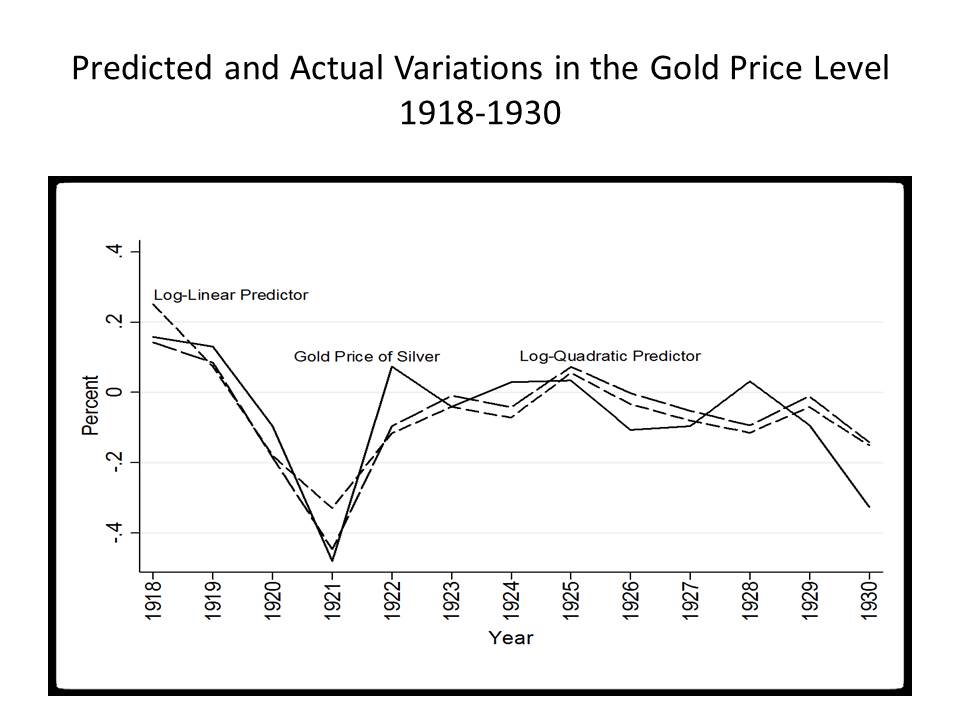
The thesis independently, but cooperatively, advanced by Hawtrey and Cassel was that under a gold standard, fluctuations in the gold price level were sensitive to variations in the demand for gold reserves by the central banks. The main contribution of Caton’s paper is to provide econometric evidence of the tight correlation between variations in the total gold holdings of the world’s central banks and the gold price level in the period between the end of World War I (1918) to the start of Great Depression (1930-32). Caton uses a variation on a model used by Scott Sumner in his empirical work on the Great Depression to predict changes in the value of gold, and, hence, changes in the gold price level of commodities. If central banks in the aggregate are adding to their gold reserves at a faster rate than the rate at which the total world stock of gold is growing, then gold would be likely to appreciate, and if central banks are adding to their gold reserves at a slower rate than that at which the world stock is growing, then gold would be likely to depreciate.

So from the published sources, Caton constructed a time series of international monetary gold holdings and the total world stock of gold from 1918 to 1932 and regressed the international gold price level on the international gold reserve ratio (the ratio of monetary gold reserves to the total world stock of gold). He used two different measures of the world gold price level, the Sauerback-Statist price index and the gold price of silver. Based on his regressions (calculated in both log-linear and log-quadratic forms and separately for the periods 1918-30, 1918-31, 1918-32), he compared the predicted gold price level against both the Sauerback-Statist price index and the gold price of silver. The chart below shows his result for the log-linear regression estimated over the period 1918-30.

Caton_Regressions

Pretty impressive, if you ask me. Have a look yourself.

Let me also mention that Caton’s results also shed important light on the puzzling behavior of the world price level immediately after the end of World War I. Unlike most wars in which the wartime inflation comes to an abrupt end after the end of the war, inflation actually accelerated after the end of the war. The inflation did not actually stop for almost two years after the end of the war, when a huge deflation set in. Caton shows that the behavior of the price level was largely determined by the declining gold holdings of the Federal Reserve after the war ended. Unnerved by the rapid inflation, the Fed finally changed policy, and began accumulating gold rapidly in 1920 by raising the discount rate to an all-time high of 7 percent. Although no other countries were then on the gold standard, other countries, unwilling, for the most part, to allow their currencies to depreciate too much against the dollar, imported US deflation.

Jim is also a blogger. Check out his blog here.

Update: Thanks to commenter Blue Aurora for pointing out that I neglected to provide a link to Jim Caton’s paper.  Sorry about that. The link is now embedded.

Hawtrey’s Good and Bad Trade, Part V: Did Hawtrey Discover PPP?

The first seven chapters of Hawtrey’s Good and Bad Trade present an admirably succinct exposition of the theory of a fiat monetary system with a banking system that issues a credit money convertible into the fiat money supplied by the government. Hawtrey also explains how cyclical fluctuations in output, employment and prices could arise in such a system, given that the interest rates set by banks in the course of their lending operations inevitably deviate, even if for no more than very short periods of time, from what he calls their natural levels. See the wonderful quotation (from pp. 76-77) in my previous post about the inherent instability of the equilibrium between the market rate set by banks and the natural rate.

In chapter 7, Hawtrey considers an international system of fiat currencies, each one issued by the government of a single country in which only that currency (or credit money convertible into that currency) is acceptable as payment. Hawtrey sets as his objective an explanation of the exchange rates between pairs of such currencies and the corresponding price levels in those countries. In summing up his discussion (pp. 90-93) of what determines the rate of exchange between any two currencies, Hawtrey makes the following observation

Practically, it may be said that the rate of exchange equates the general level of prices of commodities in one country with that in the other. This is of course only approximately true, since the rate of exchange is affected only by those commodities which are or might be transported between the two countries. If one of the two countries is at a disadvantage in the production of commodities which cannot be imported, or indeed in those which can only be imported at a specially heavy cost, the general level of prices, calculated fairly over all commodities, will be higher in that country than in the other. But, subject to this important qualification, the rate of exchange under stable conditions does represent that ratio between the units of currency which makes the price-levels and therefore the purchasing powers of the two units equal. (pp. 92-93)

That, of course, is a terse, but characteristically precise, statement of the purchasing power parity doctrine. What makes it interesting, and possibly noteworthy, is that Hawtrey made it 100 years ago, in 1913, which is five years before Hawtrey’s older contemporary, Gustav Cassel, who is usually credited with having originated the doctrine in 1918 in his paper “Abnormal Deviations in International Exchanges” Economic Journal 28:413-15. Here’s how Cassel put it:

According to the theory of international exchanges which I have tried to develop during the course of the war, the rate of exchange between two countries is primarily determined by the quotient between the internal purchasing power against goods of the money of each country. The general inflation which has taken place during the war has lowered this purchasing power in all countries, though in a very different degree, and the rates of exchanges should accordingly be expected to deviate from their old parity in proportion to the inflation in each country.

At every moment the real parity between two countries is represented by this quotient between the purchasing power of the money in the one country and the other. I propose to call this parity “the purchasing power parity.” As long as anything like free movement of merchandise and a somewhat comprehensive trade between two countries takes place, the actual rate of exchange cannot deviate very much from this purchasing power parity. (p. 413)

Hawtrey proceeds, in the rest of the chapter, to explain how international relationships would be affected by a contraction in the currency of one country. The immediate effects would be the same as those described in the case of a single closed economy. However, in an international system, the effects of a contraction in one country would create opportunities for international transactions, both real and financial, that would involve both countries in the adjustment to the initial monetary disturbance originating in one of them.

Hawtrey sums up the discussion about the adjustment to a contraction of the currency of one country as follows:

From the above description, which is necessarily rather complicated, it will be seen that the mutual influence of two areas with independent currency systems is on the whole not very great Indeed, the only important consequence to either of a contraction of currency in the other, is the tendency for the first to lend money to the second in order to get the benefit of the high rate of interest. This hastens the movement towards ultimate equilibrium in the area of stringency. At the same time it would raise the rate of interest slightly in the other country But as this rise in the rate of interest is due to an enhanced demand for loans, it will not have the effect of diminishing the total stock of bankers’ money. (p. 99)

He concludes the chapter with a refinement of the purchasing power parity doctrine.

It is important to notice that as soon as the assumption of stable conditions is abandoned the rate of exchange ceases to represent the ratio of the purchasing powers of the two units of currency which it relates. A difference between the rates of interest in the two countries concerned displaces the rate of exchange from its normal position of equality with this ratio, in the same direction as if the purchasing power of the currency with the higher rate of interest had been increased. Such a divergence between the rates of interest would only occur in case of some financial disturbance, and though such disturbances, great or small, are bound to be frequent, the ratio of purchasing powers may still be taken (subject to the qualification previously explained) to be the normal significance of the rate of exchange. (p. 101)

A Newly Revised Version of My Paper (with Ron Batchelder) on Hawtrey and Cassel Is Now Available on SSRN

This may not be the most important news of the day, but for those wishing to immerse themselves in the economics of Hawtrey and Cassel, a newly revised version of my paper with Ron Batchelder “Pre-Keynesian Monetary Explanations of the Great Depression: Whatever Happened to Hawtrey and Cassel?” is now available on SSRN.

The paper has also recently been submitted to a journal for review, so we are hoping that it will finally be published before too long. Wish us luck. Here’s the slightly revised abstract.

A strictly monetary theory of the Great Depression is generally thought to have originated with Milton Friedman. Designed to counter the Keynesian notion that the Depression resulted from instabilities inherent in modern capitalist economies, Friedman’s explanation identified the culprit as an ill-conceived monetary policy pursued by an inept Federal Reserve Board. More recent work on the Depression suggests that the causes of the Depression, rooted in the attempt to restore an international gold standard that had been suspended after World War I started, were more international in scope than Friedman believed. We document that current views about the causes of the Depression were anticipated in the 1920s by Ralph Hawtrey and Gustav Cassel who independently warned that restoring the gold standard risked causing a disastrous deflation unless the resulting increase in the international monetary demand for gold could be limited. Although their early warnings of potential disaster were validated, and their policy advice after the Depression started was consistently correct, their contributions were later ignored or forgotten. This paper explores the possible reasons for the remarkable disregard by later economists of the Hawtrey-Cassel monetary explanation of the Great Depression.

Hawtrey Reviews Cassel

While doing further research on Ralph Hawtrey, I recently came across a brief 1933 review written by Hawtrey in the Economic Journal of a short book by Gustav Cassel, The Crisis in the World Monetary System. Sound familiar? The review provides a wonderfully succinct summary of the views of both Cassel and Hawtrey of the causes of, and the cure for, the Great Depression. The review can still be read with pleasure and profit. It can also be read with wonder. It is amazing that something written 80 years ago about the problem of monetary disorder can have such relevance to the problems of today. Here is the review in full. And pay special attention to the last paragraph.

The delivery of a series of three lectures at Oxford last summer has given Professor Cassel an opportunity of fulfilling his function of instructing public opinion in the intricacies of economic theory, especially of monetary theory in their application to current events. This little book of just under 100 pages is the result. As admirers of Professor Cassel will expect, it is full of wisdom, expressed with an admirable clarity and simplicity.

He points out that so long as the policy of economising gold, recommended at the Genoa Conference, was carried out, it was possible to prevent any considerable rise in the value of gold. “The world reaped the fruits of this policy in an economic development in which most countries had their share and which for some countries meant a great deal of prosperity” (p. 27).

Progress up to 1928 was normally healthy; it was not more rapid than was usual in the pre-war period. It was interrupted in 1929 by the fall of prices, for which in Professor Cassel’s view the responsibility rests on the central banks. “The course of a ship is doubtless the combined result of wind, current and navigation, and each of these factors could be quoted as independent causes of the result that the ship arrives at a certain place.” But it is navigation that is within human control, and consequently the responsibility rests on the captain. So a central bank, which has the monopoly of supplying the community with currency, bears the responsibility for variations in the value of the currency (pp. 46-7).

Under a gold standard the responsibility becomes international, but “if some important central banks follow a policy which must lead, say, to a violent increase in the value of gold, the behaviour of such banks must be regarded as the cause of this movement” (p. 48).

Professor Cassel further apportions a heavy share of the responsibility for the breakdown to war debts and reparations. “The payment of war debts in conjunction with the unwillingness to receive payment in the normal form of goods led to unreasonable demands on the world’s monetary stocks; and the claimants failed to use in a proper way the gold that they had accumulated” (pp. 71-2).

Just as a reminder, if you have made it this far, don’t stop without reading the next and final paragraph.

Finally, for a remedy, “the best thing that the gold standard countries could do for a rapid economic recovery would be immediately to start an inflation of their currencies. If this inflation were the outcome of a deliberate and well-conceived policy it could be controlled, and the consequent rise of the general level of commodity prices could be kept within such limits as were deemed desirable for the restoration of a necessary equilibrium between different groups of prices, wages, and commercial debts” (p. 94).

Let’s read that again:

If inflation were the outcome of a deliberate and well-conceived policy, it could be controlled, and the consequent rise of the general level of commodity prices could be kept within such limits as were deemed desirable for the restoration of a necessary equilibrium between different groups of prices, wages, and commercial debts.

Liquidity Trap or Credit Deadlock

In earlier posts in my series about Hawtrey and Keynes, I’ve mentioned the close connection between Hawtrey’s concept of a “credit deadlock” and the better-known Keynesian concept of a “liquidity trap,” a term actually coined by J. R. Hicks in his classic paper summarizing the Keynesian system by way of the IS-LM model. As I’ve previously noted, the two concepts, though similar, are not identical, a characteristic of much of their work on money and business cycles. Their ideas, often very similar, almost always differ in some important way, often leading to sharply different policy implications. Keynes recognized the similarities in their thinking, acknowledging his intellectual debt to Hawtrey several times, but, on occasion, Keynes could not contain his frustration and exasperation with what he felt was Hawtrey’s obstinate refusal to see what he was driving at.

In this post, commenter GDF asked me about the credit deadlock and the liquidity trap:

Would you mind explaining your thoughts apropos of differences between Hawtrey’s credit deadlock theory and Keynes’ liquidity trap. It seems to me that modern liquidity trapists like Krugman, Woodford etc. have more in common with Hawtrey than Keynes in the sense that they deal with low money demand elasticity w.r.t. the short rate rather than high money demand elasticity w.r.t. the long rate.

To which I answered:

My view is that credit deadlock refers to a situation of extreme entrepreneurial pessimism, which I would associate with negative real rates of interest. Keynes’s liquidity trap occurs at positive real rates of interest (not the zero lower bound) because bear bond speculators will not allow the long-term rate to fall below some lower threshold because of the risk of suffering a capital loss on long-term bonds once the interest rate rises. Hawtrey did not think much of this argument.

Subsequently in this post, commenter Rob Rawlings suggested that I write about the credit deadlock and provided a link to a draft of a paper by Roger Sandilands, “Hawtreyan ‘Credit Deadlock’ or Keynesian ‘Liquidity Trap’? Lessons for Japan from the Great Depression” (eventually published as the final chapter in the volume David Laidler’s Contributions to Economics, edited by Robert Leeson, an outstanding collection of papers celebrating one of the greatest economists of our time). In our recent exchange of emails about Hawtrey, Laidler also drew my attention to Sandilands’s paper.

Sandilands’s paper covers an extremely wide range of topics in both the history of economics (mainly about Hawtrey and especially the largely forgotten Laughlin Currie), the history of the Great Depression, and the chronic Japanese deflation and slowdown since the early 1990s. But for this post, the relevant point from Sandilands’s paper is the lengthy quotation with which he concludes from Laidler’s paper, “Woodford and Wicksell on Interest and Prices: The Place of the Pure Credit Economy in the Theory of Monetary Policy.”

To begin with, a “liquidity trap” is a state of affairs in which the demnd for money becomes perfectly elastic with respect to a long rate of interest at some low positive level of the latter. Until the policy of “quantitative easing” was begun in 2001, the ratio of the Japanese money stock to national income, whether money was measured by the base, M1, or any broader aggregate, rose slowly at best, and it was short, not long, rates of interest that were essentially zero. Given these facts, it is hard to see what the empirical basis for the diagnosis of a liquidity trap could have been. On the other hand, and again before 2001, the empirical evidence gave no reason to reject the hypothesis that a quite separate and distinct phenomenon was at work, namely a Hawtreyan “credit deadlock”. Here the problem is not a high elasticity of the economy’s demand for money with respect to the long rate of interest, but a low elasticity of its demand for bank credit with respect to the short rate, which inhibits the borrowing that is a necessary prerequisite for money creation. The solution to a credit deadlock, as Hawtrey pointed out, is vigorous open market operations to bring about increases in the monetary base, and therefore the supply of chequable deposits, that mere manipulation of short term interest rates is usually sufficient to accomplish in less depressed times.

Now the conditions for a liquidity trap might indeed have existed in Japan in the 1990s. Until the credit deadlock affecting its monetary system was broken by quantitative easing in 2001 . . . it was impossible to know this. As it has happened, however, the subsequent vigorous up-turn of the Japanese economy that began in 2002 and is still proceeding is beginning to suggest that there was no liquidity trap at work in that economy. If further evidence bears out this conclusion, a serious policy error was made in the 1990s, and that error was based on a theory of monetary policy that treats the short interest rate as the central bank’s only tool, and characterizes the transmission mechanism as working solely through the influence of interest rates on aggregate demand.

That theory provided no means for Japanese policy makers to distinguish between a liquidity trap, which is a possible feature of the demand for money function, and a credit deadlock which is a characteristic of the money supply process, or for them to entertain the possibility that variations in the money supply might affect aggregate demand by channels over and above any effect on market rates of interest. It was therefore a dangerously defective guide to the conduct of monetary policy in Japan, as it is in any depressed economy.

Laidler is making two important points in this quotation. First, he is distinguishing, a bit more fully than I did in my reply above to GDF, between a credit deadlock and a liquidity trap. The liquidity trap is a property of the demand for money, premised on an empirical hypothesis of Keynes about the existence of bear speculators (afraid of taking capital losses once the long-term rate rises to its normal level) willing to hold unlimited amounts of money rather than long-term bonds, once long-term rates approach some low, but positive, level. But under Keynes’s analysis, there would be no reason why the banking system would not supply the amount of money demanded by bear speculators. In Hawtrey’s credit deadlock, however, the problem is not that the demand to hold money becomes perfectly elastic when the long-term rate reaches some low level, but that, because entrepreneurial expectations are so pessimistic, banks cannot find borrowers to lend to, even if short-term rates fall to zero. Keynes and Hawtrey were positing different causal mechanisms, Keynes focusing on the demand to hold money, Hawtrey on the supply of bank money. (I would note parenthetically that Laidler is leaving out an important distinction between the zero rate at which the central bank is lending to banks and the positive rate — sufficient to cover intermediation costs – at which banks will lend to their customers. The lack of borrowing at the zero lower bound is at least partly a reflection of a disintermediation process that occurs when there is insufficient loan demand to make intermediation by commercial banks profitable.)

Laidler’s second point is an empirical judgment about the Japanese experience in the 1990s and early 2000s. He argues that the relative success of quantitative easing in Japan in the early 2000s shows that Japan was suffering not from a liquidity trap, but from a credit deadlock. That quantitative easing succeeded in Japan after years of stagnation and slow monetary growth suggests to Laidler that the problem in the 1990s was not a liquidity trap, but a credit deadlock. If there was a liquidity trap, why did the unlimited demand to hold cash on the part of bear speculators not elicit a huge increase in the Japanese money supply? In fact, the Japanese money supply increased only modestly in the 1990s. The Japanese recovery in the early 200s coincided with a rapid increase in the money supply in response to open-market purchases by the Bank of Japan.  Quantitative easing worked not through a reduction of interest rates, but through the portfolio effects of increasing the quantity of cash balances in the economy, causing an increase in spending as a way of reducing unwanted cash balances.

How, then, on Laidler’s account, can we explain the feebleness of the US recovery from the 2007-09 downturn, notwithstanding the massive increase in the US monetary base? One possible answer, of course, is that the stimulative effects of increasing the monetary base have been sterilized by the Fed’s policy of paying interest on reserves. The other answer is that increasing the monetary base in a state of credit deadlock can stimulate a recovery only by changing expectations. However, long-term expectations, as reflected in the long-term real interest rates implicit in TIPS spreads, seem to have become more pessimistic since quantitative easing began in 2009. In this context, a passage, quoted by Sandilands, from the 1950 edition of Hawtrey’s Currency and Credit seems highly relevant.

If the banks fail to stimulate short-term borrowing, they can create credit by themselves buying securities in the investment market. The market will seek to use the resources thus placed in it, and it will become more favourable to new flotations and sales of securities. But even so and expansion of the flow of money is not ensured. If the money created is to move and to swell the consumers’ income, the favourable market must evoke additional capital outlay. That is likely to take time and conceivably capital outlay may fail to respond. A deficiency of demand for consumable goods reacts on capital outlay, for when the existing capacity of industries is underemployed, there is little demand for capital outlay to extend capacity. . .

The deadlock then is complete, and, unless it is to continue unbroken till some fortuitous circumstance restarts activity, recourse must be had to directly inflationary expedients, such as government expenditures far in excess of revenue, or a deliberate depreciation of the foreign exchange value of the money unit.

David Laidler on Hawtrey and the Treasury View

My recent post on Hawtrey and the Treasury View occasioned an exchange of emails with David Laidler about Hawtrey, the Treasury View. and the gold standard. As usual, David made some important points that I thought would be worth sharing. I will try to come back to some of his points in future posts, but for now I will just refer to his comments about Hawtrey and the Treasury View.

David drew my attention to his own discussion of Hawtrey and the Treasury View in his excellent book Fabricating the Keynesian Revolution (especially pp. 112-28). Here are some excerpts.

It is well known that Hawtrey was a firm advocate of using the central bank’s discount rate – bank rate, as it is called in British terminology – as the principal instrument of monetary policy, and this might at first sight seem to place him in the tradition of Walter Bagehot. However, Hawtrey’s conception of the appropriate target for policy was very different from Bagehot’s, and he was well aware of the this difference. Bagehot had regarded the maintenance of gold convertibility as the sine qua non of monetary policy, and as Hawtrey told reader of his Art of Central Banking, “a central bank working the gold standard must rectify an outflow of gold by a restriction of credit and an inflow of gold by a relaxation of credit. Under Hawtrey’s preferred scheme, on the other hand,

substantially the plan embodied in the currency resolution adopted at the Genoa Conference of 1922, . . . the contral banks of the world [would[ regulated credit with a view to preventing undue fluctuations in the purchasing power of gold.

More generally he saw the task of central banking as being to mitigate that inherent instability of credit which was the driving force of economic fluctuations, by ensuring, as far as possible, that cumulative expansions and contractions of bank deposits were eliminated, or, failing that, when faced by depression, to bring about whatever degree of monetary expansion might be required to restore economic activity to a satisfactory level. (pp. 122-23)

Laidler links Hawtrey’s position about the efficacy of central bank policy in moderating economic fluctuations to Hawtrey’s 1925 paper on public-works spending and employment, the classic statement of the Treasury View.

Unlike the majority of his English . . . contemporaries, Hawtrey thus had few doubts about the ultimate powers of conventional monetary policy to stimulate the economy, even in the most depressed circumstances. In parallel with that belief . . . he was skeptical about the powers of government-expenditure programs to have any aggregate effects on income and employment, except to the extent that they were financed by money creation. Hawtrey was, in fact, the originator of the particular version of “the Treasury view” of those matters that Hicks . . . characterized in terms of a vertical-LM-curve version of the IS-LM framework.

Hawtrey had presented at least the bare bones of that doctrine in Good and Bad Trade (1913), but his definitive exposition is to be found in his 1925 Economica paper. . . . [T]hat exposition was cast in terms of a system in which, given the levels of money wages and prices, the levels of output and employment were determined by the aggregate rate of low of expenditure on public works can be shown to imply an increase in the overall level of effective demand, the consequences must be an equal reduction in the expenditure of some other sector. . . .

That argument by Hawtrey deserves more respect than it is usually given. His conclusions do indeed follow from the money-growth-driven income-expenditure system with which he analysed the cycle. They follow from an IS-LM model when the economy is operating where the interest sensitivity of the demand for money in negligible, so that what Hicks would later call “the classical theory” is relevant. If, with the benefit of hindsight, Hawtrey might be convicted of over-generalizing from a special case, his analysis nevertheless made a significant contribution in demonstrating the dangers inherent in Pigou’s practice of going “behind the distorting veil of money” in order to deal with such matters. Hawtrey’s view, that the influence of public-works expenditures on the economy’s overall rate of flow of money expenditures was crucial to their effects on employment was surely valid. (pp.125-26)

Laidler then observes that no one else writing at the time had identified the interest-sensitivity of the demand for money as the relevant factor in judging whether public-works expenditure could increase employment.

It is true that the idea of a systematic interest sensitivity of the demand for money had been worked out by Lavington in the early 1920s, but it is also true that none of Hawtrey’s critics . . . saw its critical relevance to this matter during that decade and into the next. Indeed, Hawtrey himself came as close as any of them did before 1936 to developing a more general, not to say correct, argument about thte influence of the monetary system on the efficacy of public-works expenditure. . . . And he argued that once an expansion got under way, increased velocity would indeed accompany it. However, and crucially, he also insisted that “if no expansion of credit at all is allowed, the conditions which produce increased rapidity of circulation cannot begin to develop.”

Hindsight, illuminated by an IS-LM diagram with an upward-sloping LM curve, shows that the last step of his argument was erroneous, but Hawtrey was not alone in holding such a position. The fact is that in the 1920s and early 1930s, many advocates of public-works expenditures were careful to note that their success would be contingent upon their being accommodated by appropriate monetary measures. For example, when Richard Kahn addressed that issue in his classic article on the employment multiplier, he argued as follows:

It is, however, important to realize that the intelligent co-operation of the banking system is being taken for granted. . . . If the increased circulation of notes and the increased demand for working capital that may result from increased employment are made the occasion for a restriction of credit, then any attempt to increase employment . . . may be rendered nugatory. (pp. 126-27)

Thus, Laidler shows that Hawtrey’s position on the conditions in which public-works spending could increase employment was practically indistinguishable from Richard Kahn’s position on the same question in 1931. And I would emphasize once again that, inasmuch as Hawtrey’s 1925 position was taken when the Bank of England policy was setting its lending rate at the historically high level of 5% to encourage an inflow of gold and allow England to restore the gold standard at the prewar parity, Hawtrey was correct, notwithstanding any tendency of public-works spending to increase velocity, to dismiss public-works spending as a remedy for unemployment as long as bank rate was not reduced.

Hawtrey and the “Treasury View”

Mention the name Ralph Hawtrey to most economists, even, I daresay to most monetary economists, and you are unlikely to get much more than a blank stare. Some might recognize the name because of it is associated with Keynes, but few are likely to be able to cite any particular achievement or contribution for which he is remembered or worth remembering. Actually, your best chance of eliciting a response about Hawtrey might be to pose your query to an acolyte of Austrian Business Cycle theory, for whom Hawtrey frequently serves as a foil, because of his belief that central banks ought to implement a policy of price-level (actually wage-level) stabilization to dampen the business cycle, Murray Rothbard having described him as “one of the evil genius of the 1920s” (right up there, no doubt, with the likes of Lenin, Trotsky, Stalin and Mussolini). But if, despite the odds, you found someone who knew something about Hawtrey, there’s a good chance that it would be for his articulation of what has come to be known as the “Treasury View.”

The Treasury View was a position articulated in 1929 by Winston Churchill, then Chancellor of the Exchequer in the Conservative government headed by Stanley Baldwin, in a speech to the House of Commons opposing proposals by Lloyd George and the Liberals, supported notably by Keynes, to increase government spending on public-works projects as a way of re-employing the unemployed. Churchill invoked the “orthodox Treasury View” that spending on public works would simply divert an equal amount of private spending on other investment projects or consumption. Spending on public-works projects was justified if and only if the rate of return over cost from those projects was judged to be greater than the rate of return over cost from alternative private spending; public works spending could not be justified as a means by which to put the unemployed back to work. The theoretical basis for this position was an article published by Hawtrey in 1925 “Public Expenditure and the Demand for Labour.”

Exactly how Hawtrey’s position first articulated in a professional economics journal four years earlier became the orthodox Treasury View in March 1929 is far from clear. Alan Gaukroger in his doctoral dissertation on Hawtrey’s career at the Treasury provides much helpful background information. Apparently, Hawtrey’s position was elevated into the “orthodox Treasury View” because Churchill required some authority on which to rely in opposing Liberal agitation for public-works spending which the Conservative government and Churchill’s top Treasury advisers and the Bank of England did not want to adopt for a variety of reason. The “orthodox Treasury View” provided a convenient and respectable doctrinal cover with which to clothe their largely political opposition to public-works spending. This is not to say that Churchill and his advisers were insincere in taking the position that they did, merely that Churchill’s position emerged from on-the-spot political improvisation in the course of which Hawtrey’s paper was dredged up from obscurity rather than from applying any long-standing, well-established, Treasury doctrine. For an illuminating discussion of all this, see chapter 5 (pp. 234-75) of Gaukroger’s dissertation.

I have seen references to the Treasury View for a very long time, probably no later than my first year in graduate school, but until a week or two ago, I had never actually read Hawtrey’s 1925 paper. Brad Delong, who has waged a bit of a campaign against the Treasury View on his blog as part of his larger war against opponents of President Obama’s stimulus program, once left a comment on a post of mine about Hawtrey’s explanation of the Great Depression, asking whether I would defend Hawtrey’s position that public-works spending would not increase employment. I think I responded by pleading ignorance of what Hawtrey had actually said in his 1925 article, but that Hawtrey’s explanation of the Great Depression was theoretically independent of his position about whether public-works spending could increase employment. So in a sense, this post is partly belated reply to Delong’s query.

The first thing to say about Hawtrey’s paper is that it’s hard to understand. Hawtrey is usually a very clear expositor of his ideas, but sometimes I just can’t figure out what he means. His introductory discussion of A. C. Pigou’s position on the wisdom of concentrating spending on public works in years of trade depression was largely incomprehensible to me, but it is worth reading, nevertheless, for the following commentary on a passage from Pigou’s Wealth and Welfare in which Pigou proposed to “pass behind the distorting veil of money.”

Perhaps if Professsor Pigou had carried the argument so far, he would have become convinced that the distorting veil of money cannot be put aside. As well might he play lawn tennis without the distorting veil of the net. All the skill and all the energy emanate from the players and are transmitted through the racket to the balls. The net does nothing; it is a mere limiting condition. So is money.

Employment is given by producers. They produce in response to an effective demand for products. Effective demand means ultimately money, offered by consumers in the market.

A wonderful insight, marvelously phrased, but I can’t really tell, beyond Pigou’s desire to ignore the “distorting veil of money,” how it relates to anything Pigou wrote. At any rate, from here Hawtrey proceeds to his substantive argument, positing “a community in which there is unemployment.” In other words, “at the existing level of prices and wages, the consumers’ outlay [Hawtrey’s term for total spending] is sufficient only to employ a part of the productive resources of the country.” Beyond the bare statement that spending is insufficient to employ all resources at current prices, no deeper cause of unemployment is provided. The problem Hawtrey is going to address is what happens if the government borrows money to spend on new public works?

Hawtrey starts by assuming that the government borrows from private individuals (rather than from the central bank), allowing Hawtrey to take the quantity of money to be constant through the entire exercise, a crucial assumption. The funds that the government borrows therefore come either from that portion of consumer income that would have been saved, in which case they are not available to be spent on whatever private investment projects they would otherwise have financed, or they are taken from idle balances held by the public (the “unspent margin” in Hawtrey’s terminology). If the borrowed funds are obtained from cash held by the public, Hawtrey argues that the public will gradually reduce spending in order to restore their cash holdings to their normal level. Thus, either way, increased government spending financed by borrowing must be offset by a corresponding reduction in private spending. Nor does Hawtrey concede that there will necessarily be a temporary increase in spending, because the public may curtail expenditures to build up their cash balances in anticipation of lending to the government. Moreover, there is always an immediate effect on income from any form of spending (Hawtrey understood the idea of a multiplier effect, having relied on it in his explanation of how an increase in the stock of inventories held by traders in response to a cut in interest rates would produce a cumulative increase in total income and spending), so if government spending on public works reduces spending elsewhere, there is no necessary net increase in total spending even in the short run. Here is how Hawtrey sums up the crux of his argument.

To show why this does not happen, we must go back to consider the hypothesis with which we started. We assumed that no additional bank credits are created. It follows that there is no increase in the supply of the means of payment. As soon as the people employed on the new public works begin to receive payment, they will begin to accumulate cash balances and bank balances. Their balances can only be provided at the expense of the people already receiving incomes. These latter will therefore become short of ready cash and will curtail their expenditures with a view to restoring their balances. An individual can increase his balance by curtailing his expenditure, but if the unspent margin (that is to say, the total of all cash balances and bank balances) remains unchanged, he can only increase his balance at the expense of those of his neighbours. If all simultaneously try to increase their balances, they try in vain. The effect can only be that sales of goods are diminished, and the consumers’ income is reduced as much as the consumers’ outlay. In the end the normal proportion between the consumers’ income and the unspent margin is restored, not by an increase in balances, but by a decrease in incomes. It is this limitation of the unspent margin that really prevents the new Government expenditure from creating employment. (pp. 41-42)

Stated in these terms, the argument suggests another possible mechanism by which government expenditure could increase total income and employment: an increase in velocity. And Hawtrey explicitly recognized it.

There is, however, one possibility which would in certain conditions make the Government operations the means of a real increase in the rapidity of circulation. In a period of depression the rapidity of circulation is low, because people cannot find profitable outlets for their surplus funds and they accumulate idle balances. If the Government comes forward with an attractive gild-edged loan, it may raise money, not merely by taking the place of other possible capital issues, but by securing money that would otherwise have remained idle in balances. (pp. 42-43)

In other words, Hawtrey did indeed recognize the problem of a zero lower bound (in later works he called it a “credit deadlock”) in which the return to holding money exceeds the expected return from holding real capital assets, and that, in such circumstances, government spending could cause aggregate spending and income to increase.

Having established that, absent any increase in cash balances, government spending would have stimulative effects only at the zero lower bound, Hawtrey proceeded to analyze the case in which government spending increased along with an increase in cash balances.

In the simple case where the Government finances its operations by the creation of bank credits, there is no diminution in the consumers’ outlay to set against the new expenditure. It is not necessary for the whole of the expenditure to be so financed. All that is required is a sufficient increase in bank credits to supply balances of cash and credit for those engaged in the new enterprise, without diminishing the balances held by the rest of the community. . . . If the new works are financed by the creation of bank credits, they will give additional employment. (p. 43)

After making this concession, however, Hawtrey added a qualification, which has provoked the outrage of many Keynesians.

What has been shown is that expenditure on public works, if accompanied by a creation of credit, will give employment. But then the same reasoning shows that a creation of credit unaccompanied by any expenditure on public works would be equally effective in giving employment.

The public works are merely a piece of ritual, convenient to people who want to be able to say that they are doing something, but otherwise irrelevant. To stimulate an expansion of credit is usually only too easy. To resort for the purpose to the construction of expensive public works is to burn down the house for the sake of the roast pig.

That applies to the case where the works are financed by credit creation. In the practical application of the policy, however, this part of the programme is omitted. The works are started by the Government at the very moment when the central bank is doing all it can to prevent credit from expanding. The Chinaman burns down his house in emulation of his neighbour’s meal of roast pork, but omits the pig.

Keynesians are no doubt offended by the dismissive reference to public-works spending as “a piece of ritual.” But it is worth recalling the context in which Hawtrey published his paper in 1925 (read to the Economics Club on February 10). Britain was then in the final stages of restoring the prewar dollar-sterling parity in anticipation of formally reestablishing gold convertibility and the gold standard. In order to accomplish this goal, the Bank of England raised its bank rate to 5%, even though unemployment was still over 10%. Indeed, Hawtrey did favor going back on the gold standard, but not at any cost. His view was that the central position of London in international trade meant that the Bank of England had leeway to set its bank rate, and other central banks would adjust their rates to the bank rate in London. Hawtrey may or may not have been correct in assessing the extent of the discretionary power of the Bank of England to set its bank rate. But given his expansive view of the power of the Bank of England, it made no sense to Hawtrey that the Bank of England was setting its bank rate at 5% (historically a rate characterizing periods of “dear money” as Hawtrey demonstrated subsequently in his Century of Bank Rate) in order to reduce total spending, thereby inducing an inflow of gold, while the Government simultaneously initiated public-works spending to reduce unemployment. The unemployment was attributable to the restriction of spending caused by the high bank rate, so the obvious, and most effective, remedy for unemployment was a reduced bank rate, thereby inducing an automatic increase in spending. Given his view of the powers of the Bank of England, Hawtrey felt that the gold standard would take care of itself. But even if he was wrong, he did not feel that restoring the gold standard was worth the required contraction of spending and employment.

From the standpoint of pure monetary analysis, notwithstanding all the bad press that the “Treasury View” has received, there is very little on which to fault the paper that gave birth to the “Treasury View.”


About Me

David Glasner
Washington, DC

I am an economist in the Washington DC area. My research and writing has been mostly on monetary economics and policy and the history of economics. In my book Free Banking and Monetary Reform, I argued for a non-Monetarist non-Keynesian approach to monetary policy, based on a theory of a competitive supply of money. Over the years, I have become increasingly impressed by the similarities between my approach and that of R. G. Hawtrey and hope to bring Hawtrey’s unduly neglected contributions to the attention of a wider audience.

My new book Studies in the History of Monetary Theory: Controversies and Clarifications has been published by Palgrave Macmillan

Follow me on Twitter @david_glasner

Archives

Enter your email address to follow this blog and receive notifications of new posts by email.

Join 665 other subscribers
Follow Uneasy Money on WordPress.com