This article considers the contributions of Ralph Hawtrey to monetary theory and macroeconomics, focusing on his monetary business cycle theory and his monetary explanation of the Great Depression. Unlike Milton Friedman’s US-centred explanation of the Great Depression, Hawtrey’s was focused on the international gold standard that collapsed with the outset of World War I and the attempt to restore it. Hawtrey urged that, after restoration of the gold standard, increased monetary demand for gold be restrained to prevent gold appreciation and deflation. But deliberate French gold accumulation in 1928 and interest-rate increases by the Federal Reserve, led to the ruinous deflation foreseen by Hawtrey. The article then critically evaluates recent discussions of Hawtrey’s contributions in books by Hetzel (2023) and Mattei (2022).
An earlier version of the paper is available on SSRN:
Clara Mattei, associate professor of economics at the New School for Social Research, recently published a book, The Capital Order: How Economists Invented Austerity and Paved the Way to Fascism, (University of Chicago Press) in which she argues that the fiscal and monetary austerity imposed on Great Britain after World War I to restore the gold standard at the prewar parity of pound to the dollar provided a model for austerity policies imposed by Mussolini in Italy when he took control of the Italian state in the early 1920s. In making her argument, Mattei identifies Hawtrey, Director of Financial Enquiries in the British Treasury for the entire interwar period, as the eminence grise behind the austerity policies implemented by the Treasury and the Bank of England to restore convertibility at the prewar parity.
Mattei’s ideological position is obviously left of center, and her attempt to link British austerity policies during the 1920s with the rise of fascism in Italy furthers her ideological agenda. Although that agenda is not mine, my only interest here is to examine her claim that Hawtrey was the intellectual architect of the austerity policies she deplores. I leave it to others to assess her broader historical claims.
In her introductory chapter, Mattei (p. 10) justifies her attention to Hawtrey, by claiming that his “texts and memoranda . . . would serve as the guidelines for British austerity after World War I,” describing the Treasury officials Sir Basil Blackett and Sir Otto Niemeyer, under whom Hawtrey served, as “working at his side,” as if they were Hawtrey’s subordinates rather than the other way around. At the end of the chapter, Mattei (p. 20) writes: “I was riveted by the evidence of Hawtrey’s persuasion of the other two bureaucrats, and in turn how the two bureaucrats, neither one a trained economist, came to be missionaries in campaigns to export the British austerity agenda to other countries around the globe.” In a later passage (p. 171), she elaborates:
In the face of unrelenting opposition, Niemeyer and Blackett needed solid intellectual grounds to urge the chancellor of the exchequer to move for dear money and drastic cuts in public expenditures. In examining the controllers’ confidential Treasury files—virtually the only direct source of information we have about their economic beliefs—one is struck by the ubiquity and influence of the economist Ralph G. Hawtrey, the primary source of economic knowledge for Blackett and especially for Niemeyer. In fact, there is ample evidence that Hawtreyan economics refined and strengthened the economic stance of the senior Treasury officials, so as to enable the emergence of a full-blown austerity doctrine.
Given her emphasis on the documentary record left by Hawtrey during his nearly three decades as the in-house economist at the Treasury, I would have expected to see more than just the few direct quotations and citations from the voluminous internal memos written by Hawtrey to his Treasury colleagues to which Mattei makes general reference. The references to Hawtrey’s communications with his colleagues provide few specifics, while the more numerous citations to his writings seem to misinterpret, misrepresent or mischaracterize Hawtrey’s theoretical and policy views.
It should also be noted that Mattei’s estimation of Hawtrey’s influence at the Treasury is not shared by other researchers into Hawtrey’s life and career. R. D. C. Black, who wrote an admiring biographical essay on Hawtrey for the British Academy of which Hawtrey became a member in 1935, wrote dismissively of Hawtrey’s influence at the Treasury.
Hawtrey drew up many and varied reports and memoranda on economic and financial matters which are now to be found among the papers of senior Treasury officials of that period, but the impression prevails that they did not receive much attention, and that the Financial Enquiries Branch under Hawtrey was something of a backwater.
R. D. C. Black, “Ralph George Hawtrey, 1879-1975.” In Proceedings of the British Academy, 1977, p. 379.
Susan Howson, in her biographical essay on Hawtrey, believed that Hawtrey was influential eary in his tenure as Director of Financial Enquiries, primarily because of his important role in drafting the financial resolutions for the Genoa Conference of 1922, about which more will be said below, but that his influence declined subsequently. Mattei cites both Black and Howson in her book, but does not engage with their assesment of Hawtrey’s influence at Treasury. Mattei also cites the unpublished doctoral dissertation of Alan Gaukroger on Hawtrey, which focuses specifically on his service as Director of Financial Enquiries at the Treasury, but does not engage with his detailed assement, based on exhaustive reading of relevant Treasury memoranda, of Hawtrey’s influence on his Treasury colleagues and superiors. Here is how Gaukroger characterizes those memoranda:
In the case of Hawtrey, who was to some extent an outsider to the very small and closely knit group of influential policy makers, the written memorandum was his method of attempting to break into, and influence, the powerful central group. . . .
Many of Hawtrey’s memoranda were unsolicited. He produced them because he was critical of some spect of Government policy. In some of these memoranda there is a marked tone of anger. This was particularly apparent during the late 1920s when the United Kingdom had returned to the Gold Standard and Hawtrey believed that the Bank of England was pursuing a foolish and unnecessarily high interest rate policy. At this time, his memoranda, critical of Bank or even Treasury policy, could, for such a mild-mannered man, be quite savage in tone. Often, his memoranda were produced as a result of a specific request. On a very small number of occasions they were produced as a result of a direct request for guidance, or information, from the Chancellor of the Exchequer. At other times Hawtrey prepared a memorandum as a result of a Parliamentary Question. Often a senior colleague wanted support in reparing a memorandum and would seek to use Hawtrey’s expertise, particularly with regard to currency and foreign exchange. Hawtrey would invariably write an unsolicited memorandum after press criticism of Treasury Policy.
A. Gaukroger, “The Director of Financial Enquiries.” Ph.D. Thesis. University of Huddersfield, 2008, pp. 29-32
In criticizing the austerity doctrines and policies of the British Treasury and the Bank of England in the decade after World War I, Mattei mounts a comprehensive attack on Hawtrey’s views (or what she inaccurately represents to be his views) to which she, unlike other researchers, ascribes immense influence. She begins with the decision to restore the gold standard and the subsequent deflationary policy adopted in the1920-22 period to reverse the wartime and postwar inflations, and subsequently to restore the gold standard at the prewar parity of the pound to the dollar ($4.86). Mattei’s overestimation of Hawtrey’s influence is evidenced by her failure even to mention the 1918 interim report of the Cunliffe Commission (headed by the former Governor of the Bank of England Lord Cunliffe) recommending the prompt restoration of the gold standard in as close a form as possible to the prewar gold standard. Although no precise parity was specified, the goal of minimizing the departure from the prewar gold standard (except for not reintroducing a full-bodied gold coinage) made the prewar parity to the dollar, restored in 1919 to its prewar gold parity of $20.67/ounce, the obvious benchmark for restoration.
Her next object of criticism is Hawtrey’s advocacy of deflation in his 1919 article “The Gold Standard,” to reverse, if only partially, the inflation during and after the war that had cut the purchasing power of the pound by roughly 60%. The inflation, especially the postwar inflation, had been deeply unsettling, and there was undoubtedly strong political pressure on the government to halt the inflation. Although opposed to both inflation and deflation, Hawtrey believed that some deflation was needed to achieve stabilization, especially given that the US, which had restored convertibility of the dollar into gold in June 1919, would likely adopt a deflationary policy.
Mattei cites Hawtrey’s approval of the April 1920 increase in Bank rate by the Bank of England to an unprecedented 7% to break the inflationary spiral then underway. Inflation was quickly tamed, but a brutal deflation followed, while Bank rate remained at 7% for more than 12 months before a half a percent cut in April 1922 with further half-percent cuts at bimonthly intervals till the rate was reduced to 3% in July 1922.
Hawtrey’s support for deflation was less categorical and durable than Mattei claims. Prices having risen much faster than wages since the war started, Hawtrey thought that deflation would cause prices to fall before downward pressure on wages started. (See G. C. Peden, The Treasury and British Public Policy 1906-1959, Oxford: Oxford University Press, p. 154.) Once unemployment increased and wages came under significant downward pressure, Hawtrey began to call for easing of the dear-money policy of the Bank. Montague Norman, Governor of the Bank of England, aware of Hawtrey’s criticisms of Bank of England policy, shared his annoyance with Hawtrey in a letter to his counterpart at the Federal Reserve, Benjamin Strong, mentioning criticism from “a ‘leading light’ of the Treasury [who] made it his particular business to quarrel with the policy of the Treasury and the Bank of England.” (See G. C. Peden, Id. pp. 155-56.) Hawtrey later articulated the basis for his criticism.
In 1920 it was justifiable to keep up Bank rate so long as there was any uncertainty whether inflation had been successfully checked. But even in the late summer of 1920 there was no real doubt that this was so, and by November 1920, it was abundantly clear that the danger was in the opposite direction, and was that of excessive deflation.
Hawtrey, A Century of Bank Rate, London: Longmans, Green and Co., 1938, p. 133.
Mattei further attacks Hawtrey for his central role in the Genoa Conference of 1922, which, besides resolutions on other topics of international concern, adopted resolutions aimed at restoring the international gold standard. As early as in his 1919 article on the gold standard and in his important book Currency and Credit of the same year, Hawtrey was warning urgently that restoring the gold standard could cause severe–possibly disastrous–deflation unless countries rejoining the gold standard cooperated to moderate their demand for gold reserves when setting fixed parities between their currencies and gold.
Hawtrey therefore proposed that countries other than the US and Britain rejoin the gold standard by discharging their obligations in dollars or pound sterling, which were either (in the case of the dollar) already convertible into gold, or (in the case of sterling) likely to be convertible in the future. By freeing national central banks from the need to hold actual gold reserves to discharge their obligations, the Genoa proposals aimed to limit the international demand for gold, thereby moderating or eliminating the deflationary pressure otherwise entailed by restoring the gold standard. Additionally, the resulting demand by central banks to hold sterling-denominated liabilities would ease the pressure on the British balance of payments, thereby making room for the Bank of England to reduce Bank rate.
Ignoring Hawtrey’s anti-deflationary intent in drafting those resolution, Mattei focuses on the legal independence for central banks proposed by the resolutions, intended to insulate them from demands by national governments to print money to fund fiscal deficits, money printing by governments or by banks under government pressure to do so, having been, historically, a primary cause of inflation. Mattei further misrepresents Hawtrey’s call for monetary management to avoid the likely deflationary consequences of an unmanaged restoration of the prewar gold standard as evidence that Hawtrey desired to impose an even more draconian austerity on British workers than an unmanaged restoration of the gold standard would have imposed, thereby imputing to Hawtrey an intention precisely the opposite of what he meant to accomplish.
Mattei equates Hawtrey’s support for central-bank independence in the Genoa Resolutions with hostility to democracy. Quoting from Hawtrey’s 1925 article “Currency and Public Administration,” which, she suggests, betrays a technocratic and anti-democratic mindset that he shared with contemporary Italian theoreticians of fascism, Mattei seizes on the following passage:
The central bank is free to follow the precept: “never explain; never regret; never apologize.” It need make no statement of policy. Critics may rage for nine days, but in face of the silence imposed by tradition they do not keep it up.”
Hawtrey, “Currency and Public Administration” Public Administration 3(3):232-45, 243
Mattei subjects the elitist tone of Hawtrey’s defense of central bank independence to withering criticism, a criticism echoed by her ideological opposite Milton Friedman, but she neglects to quote an important explanatory passage.
The public interest in the broadest sense is profoundly affected by currency administration. Those who deprecate criticism fear an ill-judged pressure at critical times. Experience shows that, whenever an expansion of credit is developing to excess, a formidable opposition arises in the trading world to an increase in bank rate. When on the other hand, business is in a state of depression, no one minds what happens to bank rate. The influence of outside pressure is, therefore, just the contrary to what is required.
Perhaps that is so, because criticism is confined to financial and trading circles. When credits is expanding, traders want to borrow, and resent any measures which makes borrowing more difficult or more expensive. When business is depressed, they do not want to borrow. In neither case are they impelled to look beyond their own affairs to the effect of credit on the public interest.
Id.
It is interesting that Hawtrey would have written as he did in 1925 given his own recent experience in criticizing the dear money policy generally followed by the Bank of England since 1921 when the Bank of England steadfastly refused to lower Bank rate despite his own repeated pleas for rate reductions and criticisms of the Bank’s refusal to respond to those pleas.
In his lengthy and insightful doctoral dissertation about Hawtrey’s tenure at the Treasury, Alan Gaukroger, relying far more intensively and extensively than Mattei on the documentary record of Hawtrey’s tenure, discusses a Treasury Memorandum written by Hawtrey on December 5, 1925 soon after Bank of England raised Bank rate back to 5% after briefly reducing it to 4% immediately after restoration of the prewar parity with dollar in April.
The raising of the Bank rate to 5% is nothing less than a national disaster. That dear money causes unemployment is a proposition which ought not to admit of dispute. Not only is it the generally accepted opinion of theoretical economists, but it was well recognised by practical financiers and men of business before economists paid much attention to it.
Gaukroger, p. 194
Gaukroger (p. 193) also reports, relying on a recorded interview of Hawtrey conducted by Alexander Cairncross in 1965, that upon hearing the news that Bank rate had been raised back to 5%, Hawtrey went directly to Niemeyer’s office to express his fury at the news he had just heard, only to find, after he had begun denouncing the increase, that Montagu Norman himself had been seated in Niemeyer’s office behind the door he had just opened. Direct communication between Hawtrey and Norman never resumed.
Gaukroger also reports that Hawtrey’s view was dismissed not only by the Bank of England but by his superior Otto Niemeyer and by Niemeyer’s deputy Sir Frederick Leith-Ross, who invidiously compared Hawtrey in opposing an increase in Bank rate to Rudolf Havenstein, President of the German Reichsbank during the German hyperinflation of 1923.
As already mentioned, Mattei accuses Hawtrey of having harbored a deflationary bias owing to a belief that a credit economy is inherently predisposed toward inflation, a tendency that must be counteracted by restrictive monetary policy.
Mattei’s accusation of deflationary bias rests on a misunderstanding of Hawtrey’s monetary theory. In Hawtrey’s theory, if banks create too much credit, the result is inflation; if they create too little, the result is deflation. No endogenous mechanism keeps credit creation by banks on a stable non-inflationary, non-deflationary path. Once inflation or deflation sets in, a cumulative process leads to continuing, even accelerating, inflation or deflation. To achieve stability, an exogenous stabilizing mechanism, like a metallic standard or a central bank, is needed to constrain or stimulate, albeit imperfectly, credit creation by the banking system. It was only in the special conditions after World War I and the collapse of the prewar gold standard, which had been centered in London, that Hawtrey believed a limited deflation would be useful in pursuing the generally accepted goal of restoring the prewar gold standard. But the postwar deflation was far more extreme than the deflation contemplated, much less endorsed, by Hawtrey.
Mattei infers from Hawtrey’s support for deflation to reverse the postwar inflation, that he regarded inflation as a greater and more dangerous threat than inflation, without acknowledging that he regarded the 1920-22 deflation as excessive and unjustified. She also cites his endorsement of restoring convertibility of the pound at the prewar ($4.86) parity against the dollar, despite the deflationary implications of that restoration, as further evidence of Hawtrey’s approval of deflation. But Mattei ignores Hawtrey’s repeated arguments that, given the high rate of unemployment in Britain, there was ample room, even after restoration of the prewar parity, for the Bank of England to have reduced Bank rate to promote increased output and employment.
The advance of Bank rate to 5% in March 1925 supervened on a condition of things which promised to bring the pound sterling to par with the dollar without any effort at all. Credit was expanding and the price level in the United States, which may be taken as indicating the price level in terms of gold, was rising. This expansive tendency came abruptly to an end. The rediscount rate, it is true, was raised in New York, but only to 3.5%, and till 1928 the American Federal Reserve Bank adhered to moderate rediscount rates and a policy of credit relaxation. The deflationary tendency in the gold standard world was due to the continuance of dear money in London. In British industry unemployment remained practically undiminished.
Hawtrey, A Century of Bank Rate, London: Longmans, Green and Co., 1938, pp. 137-38
While Mattei acknowledges that Hawtrey favored easing monetary policy after the restoration of the prewar parity, she minimizes its significance by citing Hawtrey’s recommendation to increase Bank rate in 1939 from the 2% rate at which it had been pegged since July 1932. But by 1940 British inflation had risen above 10%, substantiating Hawtrey’s fear, with Britain about to enter into World War II, of renewed inflation.
Mattei even imputes a sinister motivation to Hawtrey’s opposition to inflation, suggesting that he blamed inflation on the moral turpitude of workers lacking the self-discipline to save any of their incomes rather than squander it all on wasteful purchases of alcohol and tobacco, in contrast to the virtuous habits of the bourgeoisie and the upper classes who saved a substantial portion of their incomes. In doing so, Mattei, in yet another misunderstanding and mischaracterization, mistakenly attributes an over-consumption theory of inflation to Hawtrey. The consumption habits of the working class are irrelevant to Hawtrey’s theory of income and prices in which total income is determined solely by the amount of credit created by the banking system.
If substantial idle resources are available, a reduced lending rate encourages retail and wholesale businesses and traders to increase their holdings of inventories by increasing orders to manufacturers who then increase output, thereby generating increased income which, in turn, leads to increased purchases of consumer and capital goods. The increase in output and income causes a further increase the desired holdings of inventories by businesses and traders, initiating a further round of increases in orders to manufacturers so that further increases in output and income are constrained by the limits of capacity, whereupon further reductions in lending rates would cause inflation rather than increased output.
While the composition of output between investment goods and consumption goods is governed, in Hawtrey’s theory, by the savings habits of households, the level of total output and income and the rate of inflation or deflation are determined entirely by the availability of credit. It was precisely on this theoretical basis that Hawtrey denied that increased public spending would increase output and employment during a depression unless that spending was financed by credit expansion (money creation); if financed by taxation or by borrowing, the public spending would simply reduce private spending by an equal amount. Mattei recognized the point in connection with public spending in her discussion of Hawtrey’s famous articulation of the Treasury View (see Hawtrey, “Public Expenditure and the Demand for Labour,”), but failed to recognize the same theoretical argument in the context of spending on consumption versus spending on investment.
I close this post with a quotation from Hawtrey’s Trade Depression and the Way Out, 2nd edition, a brilliant exposition of his monetary theory and its application to the problem of inadequate aggregate demand, a problem, as Keynes himself admitted, that he dealt with before Keynes had addressed it. I choose a passage from the last section, entitled “The Fear of Inflation,” of the penultimate chapter. Evidently, Mattei has not studied this book (which she does not cite or refer to). Otherwise, I cannot imagine how she could have written about Hawtrey in her book in the way that she did.
The fears that efforts to expand credit will be defeated in one way or anotherby the pessimism of traders are not wholly irrational. But that pessimism is no more than an obstacle to be overcome. And the much more usual view is that inflationary measures take effect only too easily
The real obstacle to measures of credit expansion is not the fear that they will not be effective, but the fear that they will. [author’s emphasis]
Yet what can be more irrational that that fear? The term inflation is very loosely used; sometimes it means any expansion of the currency or of bank credit, or any such expansion not covered by metallic reserves; sometimes it means an issue of currency by way of advances to the Government or else an issue backed by Government securities. But whatever the precise measures classed as inflationary may be, their common characteristic and the sole source of danger attributed to them is that they tend to bring about an enlargement of demand and a consequent rise of prices. And an enlargement of demand is the essential condition of recovery. To warnthe world against inflation is to warn it against economic revival.
If the economic system of the world had adjusted itself to the existing price level, there would be good reason to object to a renewed change. Inflation is rightly condemned, because it means an arbitrary change in the value of money in terms of wealth. But deflation equally means an arbitrary change in the value of money. The reason why inflation is more condemned and feared is that it is apt to appear convenient and attractive to financiers in difficulties. The consequences of deflation are so disastrous and the difficulties of carrying it out so great that no one thinks it necessary to attach any stigma to it. And since from time to time deflation has to be applied as a corrective of inflation, it is given the status of an austere and painful virtue.
But essentially it is not a virtue at all, and when it is wantonly imposed on the world, not as a corrective of inflation but as a departure from a pre-existing state of equilibrium, it ought to be regarded as a crime against humanity. [my emphasis]
Just as deflation may be needed as a corrective to an inflation to which the economic system has not adjusted itself, so at the present time inflation is needed as a corrective to deflation. If the monetary affairs of the world were wisely governed, both inflation and deflation would be avoided, or at any rate quickly corrected in their initial stages. Perhaps the ideal of monetary stability will be achieved in the future. But to start stereotyping conditions in which prices are utterly out of equilibrium with wages and debts, and with one another, would be to start the new polcy under impossible conditions.
The dread of inflation has been greatly accentuated by the experiences of the years following the war, when so many countries found that the monetary situation got completely out of control. The vicisous circle of inflation gained such power that it wrecked both the tax system and the investment market; it cut off all the normal resources for meeting public expenditure, and left Governments to subsist on issues of paper money. No country would willingly endure such a situation.
But that kind of monetary collapse does not come easily or suddenly. There is, I believe, no case in history in which inflation has got out of hand in less that three years. [author’s emphasis] . . .
The fear that one slip from parity means a fall into the abyss is entirely without foundation. Especially is that so when deflation is raging. The first impact of a monetary expansion is then felt rather in increased output than in higher prices. It is only when industry has become fully employed that the vicious circle of inflation is joined and prices begin to rise.
In my previous post, I explained how the real-bills doctrine originally espoused by Adam Smith was later misunderstood and misapplied as a policy guide for central banking, not, as Smith understood it, as a guide for individual fractional-reserve banks. In his recent book on the history of the Federal Reserve, Robert Hetzel recounts how the Federal Reserve was founded, and to a large extent guided in its early years, by believers in the real-bills doctrine. On top of their misunderstanding of what the real-bills doctrine really meant, they also misunderstood the transformation of the international monetary system from the classical gold standard that had been in effect as an international system from the early 1870s to the outbreak of World War I. Before World War I, no central bank, even the Bank of England, dominant central bank at the time, could determine the international price level shared by all countries on the gold standard. But by the early 1920s, the Federal Reserve System, after huge wartime and postwar gold inflows, held almost half of the world’s gold reserves. Its gold holdings empowered the Fed to control the value of gold, and thereby the price level, not only for itself but for all the other countries rejoining the restored gold standard during the 1920s.
All of this was understood by Hawtrey in 1919 when he first warned that restoring the gold standard after the war could cause catastrophic deflation unless the countries restoring the gold standard agreed to restrain their demands for gold. The cooperation, while informal and imperfect, did moderate the increased demand for gold as over 30 countries rejoined the gold standard in the 1920s until the cooperation broke down in 1928.
Unlike most other Monetarists, especially Milton Friedman and his followers, whose explanatory focus was almost entirely on the US quantity of money rather than on the international monetary conditions resulting from the fraught attempt to restore the international gold standard, Hetzel acknowledges Hawtrey’s contributions and his understanding of the confluence of forces that led to a downturn in the summer of 1929 followed by a stock-market crash in October.
Recounting events during the 1920s and the early stages of the Great Depression, Hetzel mentions or quotes Hawtrey a number of times, for example, crediting (p. 100) both Hawtrey and Gustav Cassel, for “predicting that a return to the gold standard as it existed prior to World War I would destabilize Europe through deflation.” Discussing the Fed’s exaggerated concerns about the inflationary consequences of stock-market spectulation, Hetzel (p. 136) quotes Hawtrey’s remark that the Fed’s dear-money policy, aiming to curb stock-market speculation “stopped speculation by stopping prosperity.” Hetzel (p. 142) also quotes Hawtrey approvingly about the importance of keeping value of money stable and the futility of urging monetary authorities to stabilize the value of money if they believe themselves incapable of doing so. Later (p. 156), Hetzel, calling Hawtrey a lone voice (thereby ignoring Cassel), quotes Hawtrey’s scathing criticism of the monetary authorities for their slow response to the sudden onset of rapid deflation in late 1929 and early 1930, including his remark: “Deflation may become so intense that it is difficult to induce traders to borrow on any terms, and that in that event the only remedy is the purchase of securities by the central bank with a view to directly increase the supply of money.”
In Chapter 9 (entitled “The Great Contraction” in a nod to the corresponding chapter in A Monetary History of the United States by Friedman and Schwartz), Hetzel understandably focuses on Federal Reserve policy. Friedman insisted that the Great Contraction started as a normal business-cycle downturn caused by Fed tightening to quell stock-market speculation that was needlessly exacerbated by the Fed’s failure to stop a collapse of the US money stock precipitated by a series of bank failures in 1930, and was then transmitted to the rest of the world through the fixed-exchange-rate regime of the restored gold standard. Unlike Friedman Hetzel acknowledges the essential role of the gold standard in not only propagating, but in causing, the Great Depression.
But Hetzel leaves the seriously mistaken impression that the international causes and dimensions of the Great Depression (as opposed to the US-centered account advanced by Friedman) was neither known nor understood until the recent research undertaken by such economists as Barry Eichengreen, Peter Temin, Douglas Irwin, Clark Johnson, and Scott Sumner, decades after publication of the Monetary History. What Hetzel leaves unsaid is that the recent work he cites largely rediscoveed the contemporaneous work of Hawtrey and Cassel. While recent research provides further, and perhaps more sophisticated, quantitative confirmation of the Hawtrey-Cassel monetary explanation of the Great Depression, it adds little, if anything, to their broad and deep analytical and historical account of the downward deflationary spiral from 1929 to 1933 and its causes.
In section 9.11 (with the heading “Why Did Learning Prove Impossible?”) Hetzel (p. 187) actually quotes a lengthy passage from Hawtrey (1932, pp. 204-05) describing the widely held view that the stock-market crash and subsequent downturn were the result of a bursting speculative bubble that had been encouraged and sustained by easy-money policies of the Fed and the loose lending practices of the banking system. It was of course a view that Hawtrey rejected, but was quoted by Hetzel to show that contemporary opinion during the Great Depression viewed easy monetary policy as both the cause of the crash and Great Depression, and as powerless to prevent or reverse the downward spiral that followed the bust.
Although Hetzel is familiar enough with Hawtrey’s writings to know that he believed that the Great Depression had been caused by misguided monetary stringency, Hetzel is perplexed by the long failure to recognize that the Great Depression was caused by mistaken monetary policy. Hetzel (p. 189) quotes Friedman’s solution to the puzzle:
It was believed [in the Depression] . . . that monetary policy had been tried and had been found wanting. In part that view reflected the natural tendency for the monetary authorities to blame other forces for the terrible economic events that were occurring. The people who run monetary policy are human beings, even as you and I, and a common human characteristic is that if anything bad happens it is somebody else’s fault.
Friedman, The Counter-revolution in Monetary Theory. London: Institute for Economic Affairs, p. 12.
To which Hetzel, as if totally unaware of Hawtrey and Cassel, adds: “Nevertheless, no one even outside the Fed [my emphasis] mounted a sustained, effective attack on monetary policy as uniformly contractionary in the Depression.”
Apparently further searching for a solution, Hetzel in Chapter twelve (“Contemporary Critics in the Depression”), provides a general overview of contemporary opinion about the causes of the Depression, focusing on 14 economists—all Americans, except for Joseph Schumpeter (arriving at Harvard in 1932), Gottfried Haberler (arriving at Harvard in 1936), Hawtrey and Cassel. Although acknowledging the difficulty of applying the quantity theory to a gold-standard monetary regime, especially when international in scope, Hetzel classifies them either as proponents or opponents of the quantity theory. Remarkably, Hetzel includes Hawtrey among those quantity theorists who “lacked a theory attributing money to the behavior of the Fed rather than to the commercial banking system” and who “lacked a monetary explanation of the Depression highlighting the role of the Fed as opposed to the maladjustment of relative prices.” Only one economist, Laughlin Currie, did not, in Hetzel’s view, lack those two theories.
Hetzel then briefly describes the views of each of the 14 economists: first opponents and then proponents of the quantity theory. He begins his summary of Hawtrey’s views with a favorable assessment of Hawtrey’s repeated warnings as early as 1919 that, unless the gold standard were restored in a way that did not substantially increase the demand for gold, a severe deflation would result.
Despite having already included Hawtrey among those lacking “a theory attributing money to the behavior of the Fed rather than to the commercial banking system,” Hetzel (p. 281-82) credits Hawtrey with having “almost alone among his contemporaries advanced the idea that central banks can create money,” quoting from Hawtrey’s The Art of Central Banking.
Now the central bank has the power of creating money. If it chooses to buy assets of any kind, it assumes corresponding liabilities and its liabilities, whether notes or deposits, are money. . . . When they [central banks] buy, they create money, and place it in the hands of the sellers. There must ultimately be a limit to the amount of money that the sellers will hold idle, and it follows that by this process the vicious cycle of deflation can always be broken, however great the stagnation of business and the reluctance of borrowers may be.
Hawtrey, The Art of Central Banking: London: Frank Cass, 1932 [1962], p. 172
Having already quoted Hawtrey’s explicit assertion that central banks can create money, Hetzel struggles to justify classifying Hawtrey among those denying that central banks can do so, by quoting later statements that, according to Hetzel, show that Hawtrey doubted that central banks could cause a recovery from depression, and “accepted the . . . view that central banks had tried to stimulate the economy, and . . . no longer mentioned the idea of central banks creating money.”
Efforts have been made over and over again to induce that expansion of demand which is the essential condition of a revival of activity. In the United States, particularly, cheap money, open-market purchases, mounting cash reserves, public works, budget deficits . . . in fact the whole apparatus of inflation has been applied, and inflation has not supervened.
Hawtrey, “The Credit Deadlock” in A. D. Gayer, ed., The Lessons of Monetary Experience, New York: Farrar & Rhinehart, p. 141.
Hetzel here confuses the two distinct and different deficiencies supposedly shared by quantity theorists other than Laughlin Currie: “[lack] of a theory attributing money to the . . . Fed rather than to the commercial banking system” and “[lack] of a monetary explanation of the Depression highlighting the role of the Fed as opposed to the maladjustment of relative prices.” Explicitly mentioning open-market purchases, Hawtrey obviously did not withdraw the attribution of money to the behavior of the Fed. It’s true that he questioned whether the increase in the money stock resulting from open-market purchases had been effective, but that would relate only to Hetzel’s second criterion–lack of a monetary explanation of the Depression highlighting the role of the Fed as opposed to the maladjustment of relative prices—not the first.
But even the relevance of the second criterion to Hawtrey is dubious, because Hawtrey explained both the monetary origins of the Depression and the ineffectiveness of the monetary response to the downturn, namely the monetary response having been delayed until the onset of a credit deadlock. The possibility of a credit deadlock doesn’t negate the underlying monetary theory of the Depression; it only suggests an explanation of why the delayed monetary expansion didn’t trigger a recovery as strong as a prompt expansion would have.
Turning to Hawtrey’s discussion of the brief, but powerful, revival that began almost immediately after FDR suspended the gold standard and raised the dollar gold price (i.e., direct monetary stimulus) upon taking office, Hetzel (Id.) misrepresents Hawtrey as saying that the problem was pessimism not contractionary monetary policy; Hawtrey actually attributed the weakening of the recovery to “an all-round increase of costs” following enactment of the National Industrial Recovery Act, that dissipated “expectations of profit on which the movement had been built.” In modern terminology it would be described as a negative supply-side shock.
In a further misrepresentation, Hetzel writes (p. 282), “despite the isolated reference above to ‘creating money,’ Hawtrey understood the central bank as operating through its influence on financial intermediation, with the corollary that in depression a lack of demand for funds would limit the ability of the central bank to stimulate the economy.” Insofar as that reference was isolated, the isolation was due to Hetzel’s selectivity, not Hawtrey’s understanding of the capacity of a central bank. Hawtrey undoubtedly wrote more extensively about the intermediation channel of monetary policy than about open-market purchases, inasmuch as it was through the intermediation channel that, historically, monetary policy had operated. But as early as 1925, Hawtrey wrote in his paper “Public Expenditure and the Demand for Labour”:
It is conceivable that . . . a low bank rate by itself might be found to be an insufficient restorative. But the effect of a low bank rate can be reinforced by purchase of securities on the part of the central bank in the open market.
Although Hawtrey was pessimistic that a low bank rate could counter a credit deadlock, he never denied the efficacy of open-market purchases. Hetzel cites the first (1931) edition of Hawtrey’s Trade Depression and the Way Out, to support his contention that “Hawtrey (1931, 24) believed that in the Depression ‘cheap money’ failed to revive the economy.” In the cited passage, Hawtrey observed that between 1844 and 1924 Bank rate had never fallen below 2% while in 1930 the New York Fed discount rate fell to 2.5% in June 1930, to 2% in December and to 1.5% in May 1931.
Apparently, Hetzel neglected to read the passage (pp. 30-31) (though he later quotes a passage on p. 32) in the next chapter (entitled “Deadlock in the Credit Market”), or he would not have cited the passage on p. 24 to show that Hawtrey denied that monetary policy could counter the Depression.
A moderate trade depression can be cured by cheap money. The cure will be prompter if a low Bank rate is reinforced by purchases of securities in the open market by the Central Bank. But so long as the depression is moderate, low rates will of themselves suffice to stimulate borrowing.
On the other hand, if the depression is very severe, enterprise will be killed. It is possible that no rate of interest, however low, will tempt dealers to buy goods. Even lending money without interest would not help if the borrower anticipated a loss on every conceivable use . . . of the money. In that case the purchase of securities by the Central Bank, which is otherwise no more than a useful reinforcement of the low Bank rate, hastening the progress of revival, becomes an essential condition of the revival beginning at all. By buying securities the Central Bank creates money [my emphasis], which appears in the form of deposits credited to the banks whose customers have sold the securities. The banks can thus be flooded with idle money, and given . . . powerful inducement to find additional borrowers.
Something like this situation occurred in the years 1894-96. The trade reaction which began after 1891 was disastrously aggravated by the American crisis of 1893. Enterprise seemed . . . absolutely dead. Bank rate was reduced to 2% in February 1894, and remained continuously at that rate for 2.5 years.
The Bank of England received unprecedented quantities of gold, and yet added to its holdings of Government securities. Its deposits rose to a substantially higher total than was ever reached either before or after, till the outbreak of war in 1914. Nevertheless, revival was slow. The fall of prices was not stopped till 1896. But by that time the unemployment percentage, which had exceeded 10% in the winter of 1893, had fallen to 3.3%.
Hawtrey, Trade Depression and the Way Out. London: Longmans, Green and Company, 1931.
This passage was likely written in mid-1931, the first edition having been published in September 1931. In the second edition published two years later, Hawtrey elaborated on the conditions in 1931 discussed in the first edition. Describing the context of the monetary policy of the Bank of England in 1930, Hawtrey wrote:
For some time the gold situation had been a source of anxiety in London. The inflow of “distress gold” was only a stop-gap defence against the apparently limitless demands of France and the United States. When it failed, and the country lost £20,000,000 of gold in three months, the Bank resorted to restrictive measures.
Bank rate was not raised, but the Government securities in the Banking Department were reduced from £52,000,000 in the middle of January 1931 to £28,000,000 at the end of March. That was the lowest figure since August 1928. The 3% bank rate became “effective,” the market rate on 3-months bills rising above 2.5%. Here was a restrictive open market policy, designed to curtail the amount of idle money in the banking system.
Between May 1930 and January 1931, the drain of gold to France and the United States had not caused any active measures of credit restriction. Even in that period credit relaxation had been less consistent and whole-hearted than it might have been. In the years 1894-96 the 2% bank rate was almost continuously ineffective, the market rate in 1895 averaging less than 1%. In 1930 the market rate never fell below 2%.
So, notwithstanding Hetzel’s suggestion to contrary, Hawtrey clearly did not believe that the failure of easy-money policy to promote a recovery in 1930-31 showed that monetary policy is necessarily ineffective in a deep depression; it showed that the open-market purchases of central banks had been too timid. Hawtrey made this point explicitly in the second edition (1933, p. 141) of Trade Depression and the Way Out:
When . . . expanding currency and expanding bank deposits do not bring revival, it is sometimes contended that it is no use creating additional credit, because it will not circulate, but will merely be added to the idle balances. And without doubt it ought not to be taken for granted that every addition to the volume of bank balances will necessarily and automatically be accompanied by a proportional addition to demand.
But people do not have an unlimited desire to hold idle balances. Because they already hold more than usual, it does not follow that they are willing to hold more still. And if in the first instance a credit expansion seems to do no more than swell balances without increasing demand, further expansion is bound ultimately to reach a point at which demand responds.
Trying to bolster his argument that Hawtrey conceded the inability of monetary policy to promote recovery from the Depression, Hetzel quotes from Hawtrey’s writings in 1937 and 1938. In his 1937 paper on “The Credit Deadlock,” Hawtrey considered the Fisher equation breaking down the nominal rate of interest into a real rate of interest (corresponding to the expected real rate of return on capital) and expected inflation. Hawtrey explored the theoretical possibility that agents’ expectations could become so pessimistic that the expected rate of deflation would exceed the expected rate of return on capital, so that holding money became more profitable than any capital investment; no investments would be forthcoming in such an economy, which would then descend into the downward deflationary spiral that Hawtrey called a credit deadlock.
In those circumstances, monetary policy couldn’t break the credit deadlock unless the pessimistic expectations preventing capital investments from being made were dispelled. In his gloss on the Fisher equation, a foundational proposition of monetary theory, Hawtrey didn’t deny that a central bank could increase the quantity of money via open-market operations; he questioned whether increasing the quantity of money could sufficiently increase spending and output to restore full employment if pessimistic expectations were not dispelled. Hawtrey’s argument was purely theoretical, but he believed it at least possible that the weak recovery from the Great Depression in the 1930s, even after abandonment of the gold standard and the widespread shift to easy money, had been dampened by entrepreneurial pessimism.
Hetzel also quotes two passages from Hawtrey’s 1938 volume A Century of Bank Rate to show that Hawtrey believed easy money was incapable of inducing increased investment spending and expanded output by business once pessimism and credit deadlock took hold. But those passages refer only to the inefficacy of reductions in bank rate, not of open-market purchases.
Hetzel (p. 283-84) then turns to a broad summary criticism of Hawtrey’s view of the Great Depression.
With no conception of the price system as the organizing principle behind the behavior of the economy, economists invented disequilibrium theories in which the psychology of businessmen and investors (herd behavior) powered cyclical fluctuations. The concept of the central bank causing recessions by interfering with the price system lay only in the future. Initially, Hawtrey found encouraging the Fed’s experiment in the 1920s with open market operations and economic stabilization. By the time Hawtrey wrote in 1938, it appeared evident that the experiment had failed.
Hetzel again mischaracterizes Hawtrey who certainly did not lack a conception of the price system as the organizing principle behind the behavior of the economy, and, unless Hetzel is prepared to repudiate the Fisher equation and the critical role it assigns to expectations of future prices as an explanation of macroeconomic fluctuations, it is hard to understand how the pejorative references psychology and herd behavior have any relevance to Hawtrey. And Hetzel’s suggestion that Hawtrey did not hold central banks responsible for recessions after Hetzel had earlier (p. 136) quoted Hawtrey’s statement that dear money had stopped speculation by stopping prosperity seems puzzling indeed.
Offering faint praise to Hawtrey, Hetzel calls him “especially interesting because of his deep and sophisticated knowledge of central banking,” whose “failure to understand the Great Depression as caused by an unremittingly contractionary monetary policy [is also] especially interesting.” Unfortunately, the only failure of understanding I can find in that sentence is Hetzel’s.
Hetzel concludes his summary of Hawtrey’s contribution to the understanding of the Great Depression with the observation that correction of the misperception that, in the Great Depression, a policy of easy money by the Fed had failed lay in the distant monetarist future. That dismissive observation about Hawtrey’s contribution is a misperception whose corretion I hope does not lie in the distant future.
One of my goals when launching this blog in 2011 was to revive interest in the important, but unfortunately neglected and largely forgotten, contributions to monetary and macroeconomic theory of Ralph Hawtrey. Two important books published within the last year have focused attention on Ralph Hawtrey: The Federal Reserve: A New History by Robert Hetzel, and The Capital Order by Clara Elizabeth Mattei.
While Hetzel’s discussion of Hawtrey’s monetary theory of the Great Depression is generally positive, it criticizes him for discounting, unlike Milton Friedman, the efficacy of open-market operations in reviving aggregate demand. But Hetzel’s criticism relies on an incomplete reading of Hawtrey’s discussions of open-market operations. Mattei’s criticism of Hawtrey is very different from Hetzel’s narrow technical criticism. Mattei is clearly deeply hostile to Hawtrey, portraying him as the grey eminence behind the austerity policies of the British Treasury and the Bank of England in the 1920s both before and after Britain restored the prewar gold standard. Mattei holds Hawtrey uniquely responsible for providing the intellectual rationale for the fiscal and monetary policies that ruthlessly tolerated high unemployment to suppress inflation and hold down wages.
I’ll address the inaccuracies in Hetzel’s discussion of Hawtrey and especially in Mattei’s deeply flawed misrepresentations of Hawtrey in future posts. In this post, I provide an overview of Hawtrey’s career drawn from papers I’ve written (two of which were co-authored by my friend Ron Batchelder) about Hawtrey included in my recent book, Studies in the History of Monetary Theory: Controversies and Clarifications (Chapters 10-14)
Ralph George Hawtrey, born in 1879, two years before his friend, fellow Cambridge man and Apostle, John Maynard Keynes, with whom he often disagreed, was in the 1920s and early 1930s almost as well-known as, and perhaps even more influential, at least among economists and policy-makers, than Keynes. Despite their Cambridge educations and careers in economics, as undergraduates, they both concentrated on mathematics[1] and philosophy and were deeply influenced by the Cambridge philosopher, G. E. Moore. Neither formally studied economics under Alfred Marshall.[2]
Perhaps the last autodidact to make significant contributions to economic theory, Hawtrey began his study of economics only when preparing for the civil-service exam at the Treasury. Hawtrey’s Cambridge background, his friendship with Keynes, and the similarities between his own monetary theories and those of Marshall, Keynes and other Cambridge economists contributed to the widespread impression that Hawtrey had ties to the Cambridge school of economics, a connection Hawtrey denied. Hawtrey’s powerful analytical mind, his command of monetary history and deep and wide knowledge of monetary and business institutions, acquired by dint of intense independent study, led to a rapid rise in the Treasury bureaucracy, eventually becoming Director of Economic Studies in 1919, a position he held until he retired from the Treasury in 1945.
Coincidentally, both Hawtrey and Keynes published their first books in 1913, Keynes writing about the reform of the Indian Currency system (Indian Currency and Finance) and Hawtrey propounding his monetary theory of the business cycle (Good and Bad Trade). A more substantive coincidence in their first books is that they both described a gold-exchange standard (resurrecting an idea described almost a century earlier by Ricardo in his Proposals for an Economical and Secure Currency) in which gold coins do not circulate and the central bank holds reserves, not in gold, but in foreign exchange denominated in currencies legally convertible into gold.
The trajectory of Hawtrey’s carrier (like Keynes’s) was sharply upward after publication of his first book. Hawtrey’s reputation was further enhanced by important academic articles about the history of monetary institutions and the gold standard. Those studies were incorporated in Hawtrey’s most important work on monetary economics, Currency and Credit published in 1919, a profound treatise on monetary economics in which his deep theoretical insights were deployed to shed light on important events and developments in the history of monetary institutions. A resounding success, the volume becoming a standard work routinely assigned to students of money and banking for over a decade, establishing Hawtrey as one of the most widely read and frequently cited economists in the 1920s and even the 1930s.
Although Keynes, by virtue of his celebrated book The Economic Consequences of the Peace became one of the most prominent public figures in Britain in the immediate postwar period, Hawtrey’s reputation among economists and policy makers likely overshadowed Keynes’s in the early 1920s. That distinction is exemplified by their roles at the 1922 Genoa Conference on postwar international cooperation and reconstruction.
In his writings about postwar monetary reconstruction, Hawtrey emphasized the necessity for international cooperation to restore international gold standard lest an uncoordinated restoration by individual countries with countries seeking to accumulate gold, thereby causing gold to appreciate and prices in terms of gold to fall. It was Hawtrey’s warnings, echoed independently by the Swedish economist Gustav Cassel, that caused the Treasury to recommend that planning for a coordinated restoration of the gold standard be included in agenda of the Genoa Conference.
While Hawtrey was the intellectual inspiration for including restoration of gold standard on the agenda of the Genoa Conference, Keynes’s role at Genoa was journalistic, serving as a correspondent for the Manchester Guardian. Keynes criticized the plan to reestablish an international gold standard even in the form of a gold-exchange standard that he and Hawtrey had described a decade earlier. Keynes observed that there was then only one nation with an effective gold standard, the United States. Conjecturing that the US, holding 40% of the world’s gold reserves, would likely choose to divest itself of at least part of its gold hoard, causing gold depreciation, Keynes argued that rejoining the gold standard would mean importing inflation from the United States. Keynes therefore recommended that Britain to adopt an independent monetary policy detached from gold to achieve a stable domestic price level.
But after it became clear that the US had no intention of unburdening itself of its huge gold holdings, Keynes reversed his rationale for opposing restoration of the gold standard. Given the depreciation of sterling against the dollar during and after World War I, the goal of restoring the prewar dollar-sterling parity of $4.86/pound would require Britain to endure even more deflation than it had already suffered following the sharp US deflation of 1920-21.
When Winston Churchill, appointed Chancelor of the Exchequer in the new Conservative Government, announced in November 1924 that he would restore the gold standard at the prewar parity by April 1925, the pound appreciated against the dollar. But the market exchange rate with the dollar remained 10% below the prewar parity. Keynes began arguing against restoring the prewar parity because a further 10% deflation would impose an unacceptable hardship on an economy that had not recovered from the effects of the recession and high unemployment caused by earlier deflation.
After personally consulting Keynes in person about his argument against restoring the prewar parity, Churchill also invited Hawtrey to hear his argument in favor of restoring the prewar parity. Hawtrey believed that doing so would bolster London’s position as the preeminent international financial center. But he also urged that, to avoid the dire consequences that Keynes warned would follow restoration of the prewar parity, the Bank of England reduce Bank Rate to promote economic expansion and employment. Given the unique position of London as the center of international finance, Hawtrey was confident that the Bank of England could ease its monetary policy and that the Federal Reserve and other central banks would ease their policies as well, thereby allowing the gold standard to be restored without significant deflation.
Supported by his Treasury advisers including Hawtrey, Churchill restored the gold standard at the prewar dollar parity in April 1925, causing Keynes to publish his brutal critique of that decision in his pamphlet The Economic Consequences of Mr. Churchill. While the consequences were perhaps not as dire as Keynes had predicted, they were less favorable than Hawtrey had hoped, the Bank of England refusing to reduce Bank Rate below 5% as Hawtrey had urged. At any rate, after a brief downturn in the latter part of 1925, the British economy did expand moderately from 1926 through early 1929 with unemployment declining slightly before Britain, along with the rest of the world, plunged into the Great Depression in the second half of 1929.
Keynes and Hawtrey again came into indirect opposition in the 1929 general election campaign, when Lloyd George, leader of the Liberal Party, proposed a program of public works to increase employment. In rejecting Lloyd George’s proposal, Churchill cited the “traditional Treasury view” that public spending simply displaced an equal amount of private spending, merely shifting spending from the private to the public sector without increasing total output and employment.
The source of “the traditional Treasury” view” was Hawtrey, himself, who had made the argument at length in a 1925 article in the Economic Journal which he had previously made in less detail in Good and Bad Trade. Replying to Churchill, Keynes and Hubert Henderson co-authored a pamphlet Can Lloyd George Do It supporting Lloyd George’s proposal and criticizing the Treasury View.
Keynes and Hawtrey confronted each other in person when Hawtrey testified before the Macmillan Committee investigating the causes of high unemployment. As a member of the Committee, Keynes questioned Hawtrey about his argument that the Bank of England could have countered rising unemployment by reducing Bank Rate, seemingly exposing an inconsistency in Hawtrey’s responses to his questions. But, when considered in light of Hawtrey’s assumption that a reduction in Bank Rate by the Bank of England would have led to Federal Reserve and other central banks to reduce their interest rates rather than absorb further inflows of gold, the inconsistency is resolved (see this post for further explanation).
Although Hawtrey had warned of the dreadful consequences of restoring the gold standard without coordination among central bank to avoid rapid accumulation of gold reserves, his warnings were disregarded when France returned to the gold standard in 1927 and began rapidly increasing its gold reserves in 1928. Hawtrey’s association with the Treasury view fostered the misimpression that, despite his unheeded advocacy of reducing Bank Rate to reduce unemployment, Hawtrey was oblivious to, or unconcerned by, the problem of unemployment. While Keynes often tried out new ideas, as he did with his neo-Wicksellian theory of the business cycle in his Treatise on Money only to abandon it in response to criticism and the changing economic environment of the Great Depression before writing his General Theoryof Interest, Income and Money, Hawtrey stuck to the same basic theory developed in his first two books.
While his output of new publications in the 1930s did not flag, Hawtrey’s reputation among economists and his influence in the Treasury gradually declined, especially after publication of Keynes’s General Theory as the attention of economists was increasingly occupied by an effort to comprehend and assimilate it into the received body of economic theory. By the time he retired from the Treasury in 1945 to become Professor of International Economics at the Royal Institute for International Affairs, Hawtrey was no longer at the cutting edge of the economics profession, and his work gradually fell from the view of younger economists.
Nevertheless, for the next two decades as he advanced to old age, Hawtrey continued to publish important works, mostly, but not exclusively concerning the conduct of British monetary policy, especially his lonely criticism of Britain’s 1947 devaluation of the pound. Elaborating on arguments advanced in his early writings, Hawtrey anticipated much of what would become known as the monetary approach to the balance of payments.
Given his monetary explanation of the Great Depression, it might have been expected that Monetarists, especially Milton Friedman, who, in the early 1950s, began his effort to develop a monetary theory of the Great Depression as an alternative to the Keynesian theory of a sudden decline in animal spirits that caused a stock-market crash and a drop in investment spending from which the private economy could not recover on its own, would have found Hawtrey’s explanation of the causes of the Great Depression to be worth their attention. However, one would search for Hawtrey’s name almost in vain in Friedman’s writings in general, and in his writings on the Great Depression, in particular. Certainly there was no recognition in the Monetarist literature on the Great Depression that a monetary theory of the Great Depression had actually been advanced by Hawtrey as the Great Depression was unfolding or that Hawtrey had warned in advance of the danger of the catastrophic deflation that would result from an uncoordinated restoration of the gold standard.
Years after Friedman’s magnum opus The Monetary History of the US was published, various researchers, including Peter Temin, Barry Eichengreen, Ben Bernanke, Kenneth Mouré, Clark Johnson, Scott Sumner, and Ronald Batchelder and I, recognized the critical importance of the newly restored gold standard in causing the Great Depression. While most of the later authors cited Hawtrey’s writings, the full extent of Hawtrey’s contributions that fully anticipated all the major conclusions of the later research remains generally unrecognized in most of the recent literature on the Great Depression, while Friedman’s very flawed account of the Great Depression continues to be regarded by most economists and financial historians as authoritative if not definitive.
In a future post, I’ll discuss Hetzel’s account of Hawtrey’s explanation of the Great Depression. Unlike earlier Monetarists who ignored Hawtrey’s explanation entirely, Hetzel does credit Hawtrey with having provided a coherent explanation of the causes of the Great Depression, without acknowledging the many respects in which Hawtrey’s explanation is more complete and more persuasive than Friedman’s. He also argues that Friedman provided a better account of the recovery than Hawtrey, because Friedman, unlike Hawtrey, recognized the effectiveness of open-market operations which Hawtrey maintained would be ineffective in initiating a recovery in situations of what Hawtrey called credit deadlock.
In another post, I’ll discuss the highly critical, and I believe tendentious, treatment by Clara Elizabeth Mattei, of Hawtrey’s supposed role in devising and rationalizing the austerity policies of the British Treasury in the 1920s up to and including the Great Depression.
[1] While Keynes was an accomplished mathematician who wrote an important philosophical and mathematical work A Treatise on Probability praised extravagantly by Bertrand Russell, Hawtrey’s mathematical skills were sufficiently formidable to have drawn the attention of Russell who included a footnote in his Principia Mathematica replying to a letter from Hawtrey.
[2] Keynes, however, the son of John Neville Keynes, a Cambridge philosopher and economist, had a personal connection to Marshall apart from his formal studies at Cambridge. Rather than pursue graduate studies, Hawtrey chose a career in the civil service, first at the Admiralty and soon thereafter at the Treasury.
UPDATE: My concluding paragraph was inadverently deleted from my post, so even if you’ve already read the post, you may want to go back and read my concluding paragraph.
Last December, Nathan Tankus wrote an essay for his substack site defending Arthur Burns and his record as Fed Chairman in the 1970s when inflation rose to double digits, setting the stage for Volcker’s shock therapy in 1981-82. Tankus believes that Burns has been blamed unfairly for the supposedly dreadful performance of the economy in the 1970s, a decade that probably ranks second for dreadfulness, after the 1930s, in the economic history of the 20th century. Nathan is not the first commentator or blogger I’ve seen over the past 10 years or so to offer a revisionist, favorable, take on Burns’s tenure at the Fed. Here are links to my earlier posts on Burns revisionism (link, link, link)
Nathan properly criticizes the treatment of the 1970s in journalistic mentions to that fraught decade. The decade endured a lot of unpleasantness along with the chronically high inflation that remains its most memorable feature, but it was also a decade of considerable economic growth, and, despite three recessions and rising unemployment, a huge increase in total US employment.
Nathan believes that Burns has been denigrated unfairly as a weak Fed Chairman who either ignored the inflationary forces, or succumbed, despite his conservative, anti-inflationary, political inclinations, to Nixon’s entreaties and pressure tactics, and deployed monetary policy to assist Nixon’s 1972 re-election campaign. Although the latter charge has at least some validity – it’s no accident that the literature on political business cycles, especially a seminal 1975 paper on that topic by William Nordhaus, a future Nobel laureate, was inspired by the Burns-Nixon episode – it’s not the whole story.
But, what is more important than Burns being cajoled or coerced by Nixon to speed the recovery from the 1969-70 recession, is that Burns was the victim of his own conceptual error in supposing that, if the incomes policy that he favored were adtoped, monetary expansion by the Fed wouldn’t lead to the inflationary consequences that they ultimately did have. Burns’s conceptual failure — whether willful or thoughtless — was to overlook the relationship between aggregate income and inflation. Although his confusion about that critical relationship was then widely, though not universally, held, his failure seems obvious, almost banal. But there were then only a few able to both identify and explain the failure and draw the appropriate policy implications. (In an earlier post about Burns, I’ve discussed Ralph Hawtrey’s final book published in 1966, but likely never noticed by Burns, in which the confusions were clearly dispelled and the appropriate policy implications clearly delineated.)
Nathan attributes the deterioration of Burns’s reputation to the influence of Milton Friedman, who wrote his doctoral dissertation under Burns at Columbia. Friedman, to be sure, was sharply critical of Burns’s performance at the Fed, but the acerbity of Friedman’s criticism also reflects his outrage that Burns had betrayed conservative, or “free-market”, principles by helping to persuade Nixon to adopt wage-and-price controls in 1971. Though I share Friedman’s disapproval of Burns’s role in the adoption of wage-and-price controls, Burns’s monetary-policy can be assessed independently of how one views the merits of the wage-and-price controls sought by Burns.
Here’s how Nathan describes Burns:
The actual Burns was – in his time – a well respected Monetary Policy “Hawk” who believed deeply in restrictive austerity. This was nearly universally acknowledged during his tenure, and then for a few years after. A New York Times article from 1978 about Burns’s successor, George Miller illustrates this well. Entitled “Miller Fights Inflation In Arthur Burns’s Style”, the article argues that Miller tightened monetary policy far more aggressively than the Carter administration expected and spoke in conservative, inflation focused and austere terms. In other words, he was a clone of Arthur Burns.
The reason this has been forgotten is the total victory of one influential dissenter: Milton Friedman. Milton Friedman, in real time, pilloried his former mentor as a money supply expanding inflationist. That view deserves its own piece sometime (spoiler: it’s mostly wrong.)
Given Friedman’s dictum — “inflation is always and everywhere a monetary phenomenon” – it’s no surprise that Friedman blamed the Federal Reserve and Burns for inflation. While confidently asserting on the one hand that changes in the quantity of money cause corresponding changes in prices, Friedman, on the other hand, invoked unexplained long and variable lags between changes in the quantity of money and changes in prices to parry evidence that the supposed correlations were less than clear-cut. So, Friedman’s narrow focus on the quantity of money rather than on total spending – increaes in the quantity of money being as much an effect as a cause of increased nominal spending and income — actually undercut his critique of Fed policy. In what follows I will therefore not discuss the quantity of money, which was, in Friedman’s mind, the key variable that had to be controlled to reduce or stop inflation. Instead, I focus on the behavior of total nominal spending (aka aggregate demand) and total nominal income, which is what monetary policy (perhaps in conjunction with fiscal policy) has some useful capacity to control.
Upon becoming Fed Chairman early in 1970, Burns continued the monetary tightening initiated by his predecessor in 1969 when inflation had risen to 6%. Although the recession caused by that tightening had started only two months before Burns succeeded Martin, inflation hardly declined, notwithstanding a steady rise in unemployment from the 3.4% rate inherited by Nixon in January 1969, at the start of his Presidency, to 4.2% when Burns became Chairman, and to 6.1% at the end of 1970.
The minimal impact of recession on inflation was troubling to Burns, reinforcing his doubts about the efficacy of conventional monetary and fiscal policy tools in an economy that seemed no longer to operate as supposed by textbook theory. It wasn’t long before Burn, in Congressional testimony (5/18/1970) voiced doubts about the efficacy of monetary policy in restraining inflation.
Another deficiency in the formulation of stabilization policies in the United States has been our tendency to rely too heavily on monetary restriction as a device to curb inflation…. severely restrictive monetary policies distort the structure of production. General monetary controls… have highly uneven effects on different sectors of the economy. On the one hand, monetary restraint has relatively slight impact on consumer spending or on the investments of large businesses. On the other hand, the homebuilding industry, State and local construction, real estate firms, and other small businesses are likely to be seriously handicapped in their operations. When restrictive monetary policies are pursued vigorously over a prolonged period, these sectors may be so adversely affected that the consequences become socially and economically intolerable.
We are in the transitional period of cost-push inflation, and we therefore need to adjust our policies to the special character of the inflationary pressures that we are now experiencing. An effort to offset, through monetary and fiscal restraints, all of the upward push that rising costs are now exerting on prices would be most unwise. Such an effort would restrict aggregate demand so severely as to increase greatly the risks of a very serious business recession. . . . There may be a useful… role for an incomes policy to play in shortening the period between suppression of excess demand and restoration of reasonable price stability.
Quoted by R. Hetzel in “Arthur Burns and Inflation” Federal Reserve Bank of Richmond Economic Quarterly, Winter 1998
The cost-push view of inflation that Burns articulated was not a new one for Burns. He had discussed it in a 1967 lecture at a seminar organized by the American Enterprise Institute concerning the wage-price guideposts, which had been invoked during the Eisenhower administration when he was CEA Chairman, and were continued in the Kennedy-Johnson administrations, to discourage labor and business from “excessive” increases in wages and prices.
The seminar consisted of two lectures, one by Burns (presumably offering a “conservative” or Republican view) and another by Paul Samuelson (offering a “liberal” or Democratic view), followed by the responses each to the other, and finally by questions from an audience of economists drawn from Washington-area universities, think-tanks and government agencies, and the responses of Burns and Samuelson. Transcripts of the lectures and the follow-up discusions were included in a volume published by AEI.
Inflation had become a contentious political issue in 1967, Republicans blaming the Johnson Administration for the highest inflation since the early 1950s. Though Burns, while voicing mild criticism of how the guideposts were administered and skepticism about their overall effect on inflation, neither rejected them on principle nor dismissed them as ineffective.
So, Burns did not arrive at the Fed as an ideological opponent of government intervention in the decisions of business and organized labor. Had Milton Friedman participated in the AEI seminar, he would have voiced implacable opposition to the guideposts as ineffective in practice and an arbitrary — extra-legal and therefore especially obnoxious — exercise of government power over the private sector. Burns’s conservatism, unlike Friedman’s, was the conventional Republican pro-business attitude, and, as Nathan himself notes, business wasn’t at all averse to government assistance in resisting union wage demands.
That doesn’t mean that Burns’s views hadn’t changed since 1967 when he voiced tepid support for guideposts as benchmarks for business and labor in setting prices and negotiating labor contracts. But the failure of monetary tightening and a deepening recession to cause more than a minimal slowdown in inflation seems to have shattered Burns’s shaky confidence that monetary policy could control inflation.
Unlike the preceding recessions in which increased (but still low) inflation quickly led to monetary tightening, the 1969-70 recession began only after inflation had risen steadily for five years from less than 2% in 1965 to 6% in 1969. It’s actually not surprising — it, at least, shouldn’t have been — that, after rising steadily for five years and becoming ingrained in public expectations, inflation would become less responsive to monetary tightening and recession than it had been before becoming ingrained in expectations. Nevertheless, the failure of a recession induced by monetary tightening to curtail inflation seems to have been considered by Burns proof that inflation is not a purely monetary phenomenon.
The further lesson drawn by Burns from the minimal decline in inflation after a year of monetary tightening followed by a recession and rising unemployment was that persistent inflation reflects the power of big business and big labor to keep raising prices and wages regardless of market conditions. The latter lesson became the basis of his approach to the inflation problem. Inflation control had to reckon with the new reality that, even if restrictive monetary and fiscal policies were adopted, it was big business and big labor that controlled pricing and inflation.
While the rationale that Burns offered for an incomes policy differed little from the rationale for the wage-price guideposts to which Burns had earlier paid lip-service, in articulating the old rationale, perhaps to provide the appearance of novelty, Burns found it useful to package the rationale in a new terminology — the vague British catchphrase “incomes policy” covering both informal wage-price guideposts and mandatory wage-price controls. The phrase helped him justify shifting monetary policy from restraint to stimulus, even though inflation was still unacceptably high, by asserting that responsibility for controlling inflation was merely being transferred, not abandoned, to another government entity with the legal power and authority to exercise that control.
It’s also noteworthy that both Burns’s diagnosis of inflation and the treatment that he recommended were remarkably similar to the diagnosis and treatment advanced in a 1967 best-selling book, The New Industrial State, by the famed Harvard economist and former adviser to President Kennedy, J. K. Galbraith.
Despite their very different political views and affiliations, Burns and Galbraith, both influenced by the Institutionalist School of economics, were skeptical of the standard neoclassical textbook paradigm. Galbraith argued that big corporations make their plans based on the prices and wages that they can impose on their smaller suppliers and smaller customers (especially, in Galbraith’s view, through the skillful deployment of modern advertising techniques) while negotiating pricing terms with labor unions and other large suppliers and with their large customers. (For more on Galbraith see this post.)
Though more sympathetic to big business and less sympathetic to big labor than Galbraith, Burns, by 1970, seems to have fully internalized, whether deliberately or inadvertently, the Galbrathian view of inflation.
Aside from his likely sincere belief that conventional anti-inflationary monetary and fiscal policy were no longer effective in an economy dominated by big business and big labor, Burns had other more political motivations for shifting his policy preferences toward direct controls over wages and prices. A full account of his thinking would require closer attention to the documentary record than I have undertaken, but, Burns was undoubtedly under pressure from Nixon to avoid a recession in the 1972 election year like the one precipitated by the Fed in 1960 when the Fed moved to suppress a minor uptick in inflation following its possibly excessive monetary stimulus after the 1957-58 recession. Burns had warned Nixon in 1960 that a looming recession might hurt his chances in the upcoming election, and Nixon thereafter blamed his 1960 loss on the Fed and on the failure of the Eisenhower adminisration to increase spending to promote recovery. Moreover, the disastrous (for Republicans) losses in the 1958 midterm elections were widely attributed to the 1957-58 recession. Substantial GOP losses in the 1970 midterms, plainly attributable to the 1970 recession, further increased Nixon’s anxiety and his pressure on Burns to hasten a recovery through monetary expansion to ensure Nixon’s reelection.
But it’s worth taking note of a subtle difference between the rationale for wage-price guideposts and the rationale for an incomes policy. While wage-price guideposts were aimed solely at individual decisions about wages and prices, the idea of an incomes policy had a macroeconomic aspect: reconciling the income demands of labor and business in a way that ensured consistency between the flow of aggregate income and low inflation. According to Burns, reconciling those diverse and conflicting income demands with low inflation required an incomes policy to prevent unrestrained individual demands for increased wages and prices from expanding the flow of income so much that inflation would be the necessary result.
What Burns and most other advocates of incomes policies overlooked is that incomes are generated from the spending decisions of households, business firms and the government. Those spending decisions are influenced by the monetary- and fiscal-policy choices of the monetary and fiscal authorities. Any combination of monetary- and fiscal-policy choices entails corresponding flows of total spending and total income. For any inflation target, there is a set of monetary- and fiscal-policy combinations that entails flows of total spending and total income consistent with that target.
Burns’s fallacy (and that of most incomes-policy supporters) was to disregard the relationship between total spending and monetary- and fiscal-policy choices. The limits on wage increases imposed by an incomes policy can be maintained only if a monetary- and fiscal-policy combination consistent with those limits is chosen. Burns’s fallacy is commonly known as the fallacy of composition: the idea that what is true for one individual in a group must be true for the group as a whole. For example, one spectator watching a ball game can get a better view of the game by standing up, but if all spectators stand up together, none of them gets a better view.
Wage increases for one worker or for workers in one firm can be limited to the percentage specified by the incomes policy, but the wage increases for all workers can’t be limited to the percentage specified by the incomes policy unless the chosen monetary- and fiscal-policy combination is consistent with that percentage.
If aggregate nominal spending and income exceed the nominal income consistent with the inflation target, only two outcomes are possible. The first, and more likely, outcome is that the demand for labor associated with the actual increase in aggregate demand will overwhelm the prescribed limit on wage increases. If it’s in the interest of workers to receive wage increases exceeding the permitted increase — and it surely is — and if it’s also in the interest of employers trying to increase output because demand for their output increases by more than expected, making it profitable to hire additional workers at increased wages, it’s hard to imagine that wages wouldn’t increase by more than the incomes policy allows. Indeed, since price increases are typically allowed only if costs increase, there’s an added incentive for firms to agree to wage increases to make price increases allowable.
Second, even if the limits on wage increases were not exceeded, those limits imply an income transfer from workers to employers. The implicit income redistribution might involve some reduction in total spending and in aggregate demand, but, ultimately, as long as the total spending and total income associated with the chosen monetary- and fiscal-policy combination exceeds the total income consistent with the inflation target, excess demands for goods will either cause domestic prices to rise or induce increased imports at increased prices, thereby depreciating the domestic currency and raising the prices of imported final goods and raw materials. Those increased prices and costs will be a further source of inflationary pressure on prices and on wages, thereby increasing inflation above the target or forcing the chosen monetary- and fiscal-policy combination to be tightened to prevent further currency depreciation.
To recapitulate, Burns actually had the glimmering of an insight into the problem of reducing inflation in an economy in which most economic agents make plans and decisions based on their inflationary expectations. When people make plans and commitments in expectation of persistent future inflation, reducing, much less stopping, inflation is hard, because doing so must disappoint their expectations, rendering the plans and commitments based on those expectations costly, or even impossible, to fulfill. The promise of an incomes policy is that, by gradually reducing inflation and facilitating the implementation of the fiscal and monetary policies necessary to reduce inflation, it can reduce expectations of inflation, thereby reducing the cost of reducing inflation by monetary and fiscal restraint.
But instead of understanding that an incomes policy aimed at reducing inflation by limiting the increases in wages and prices to percentages consistent with reduced inflation could succeed only if monetary and fiscal policies were also amed at slowing the growth of total spending and total income to rates consistent with the inflation target, Burns conducted a monetary policy with little attention to its consistency with explicit or implicit inflation targets. The failure to reduce the growth of aggregate spending and income rendered the incomes policy unfeasible, thereby ensuring the incomes policy aiming to reduce inflation would fail. The failure to grasp the impossibility of controlling wage-and-pricing decisions at the micro level without controlling aggregate spending and income at the macro level was the fatal conceptual mistake that guaranteed Burns’s failure as Fed Chairman. Perhaps Burns’s failure was tragic, but failure it was.
Let’s now look at the results of Burns’s monetary policies. The chart below shows the annual rates of change in nominal GDP and real GDP from Q1-1968 to Q1-1980
To give Burns his due, the freeze and the cost-of-living council that replaced it 90 days afterwards was a splendid political success, igniting an immediate stock-market boom and increasing Nixon’s popularity with both Democrats and Republicans notwithstanding Nixon’s repudiation of his repeated pledges never to impose wage-and-price controls. Burns continued — though erratically — the monetary easing that he began at the end of 1970, providing sufficient stimulus to reduce unemployment, which had barely budged from the peak rate of 6.1% in December 1970 to 6.0% in September 1971. While the decline in the unemployment rate was modest, to 5.6% in October 1972, the last official report before the election, total US employment between June 1970 (when US employment was at its cyclical trough) and October 1972 increased by 5%, reflecting both cyclical recovery and the beginning of an influx of babyboomers and women into the labor force.
The monetary stimulus provided by the Fed between the end of the recession in November 1970 and October 1972 can be inferred from the increase in total spending and income (as measured by nominal GDP) from Q1-1971 and Q3-1972. In that 7-quarter period, total spending and income increased by 18.6% (corresponding to an annual rate of 10.6%). Because the economy in Q4-1970 was still in a recession, nominal spending and income could increase at a faster rate during the recovery while inflation was declining than would have been consistent with the inflation target if maintained permanently.
But as the expansion continued, with employment and output expanding rapidly, the monetary stimulus should have been gradually withdrawn to slow the growth of total spending and income to a rate consistent with a low inflation target. But rather than taper off monetary stimulus, the Fed actually allowed total spending and income growth to accelerate in the next three quarters (Q4-1972 through Q2-1973) to an annual rate of 12.7%.
Inflation, which at first had shown only minimal signs of increasing as output and employment expanded rapidly before the 1972 election, not surprisingly began to accelerate rapidly in the first half of 1973. (The chart below provides three broadly consistent measures of inflation (Consumer Price Index, Personal Consumption Expenditures, and GDP implicit price deflator at quarterly intervals). The chart shows that all three measures show inflation rising rapidly in the first hals of 1973, with inflation in Q2-1973 in a range between 6.3% and 8.6%.
Burns rejected criticisms that the Fed was responsible for resurgent inflation, citing a variety of special factors like rising commodity prices as the cause of rising inflation. But, having allowed the growth of total spending and income to accelerate from Q4-1972 and Q2-1973, in violation of the rationale for the incomes policy that he had recommended, Burns had no credible defense of the Fed’s monetary policy.
With inflation approaching double digit levels – the highest in over 20 years – Burns and the Fed had already begun to raise interest rates in the first half of 1973, but not until the third quarter did rates rise enough to slow the growth of total spending and income. A belated tightening was, of course, in order, but, as if to compensate for its tardiness, the Fed, as it has so often been wont to do, tightened too aggressively, causing the growth of total spending to decline from 11% in Q2 1973 to less than 5% in Q3 1973, a slowdown that caused real GDP to fall, and the unemployment rate, having just reached its lowest point (4.6%) since April 1970, a rate not matched again for two decades, to start rising.
Perhaps surprised by the depth of the third-quarter slowdown, the Fed eased policy somewhat in the fourth quarter until war broke out between Egypt, Syria and Israel, soon followed by a cutback in overall oil production by OPEC and a selective boycott by Arab oil producers of countries, like the US, considered supportive of Israel. With oil prices quadrupling over the next few months, the cutback in oil production triggered a classic inflationary supply shock.
It’s now widely, though not universally, understood that the optimal policy response to a negative supply shock is not to tighten monetary policy, but to allow the price level to increase permanently and inflation to increase transitorily, with no attempt to reverse th price-level and inflation effects. But, given the Fed’s failure to prevent inflation from accelerating in the first half of 1973, the knee-jerk reaction of Burns and the Fed was to tighten monetary policy again after the brief relaxation in Q4-1973, as if previous mistakes could be rectified by another in the opposite direction.
The result was, by some measures, the deepest recession since 1937-38 with unemployment rising rapidly to 9% by May 1975. Because of the negative supply shock, most measures of inflation, despite monetary tightening, were above 10% for almost all of 1974. While the reduction in nominal GDP growth during the recession was only to 8%, which, under normal conditions, would have been excessive, the appropriate target for NGDP growth, given the severity of the supply shock that was causing both labor and capital to be idled, would, at least initially, have been closer to the pre-recession rate of 12.7% than to 8%. The monetary response to a supply shock should take into account that, at least during the contraction and even in the early stages of a recovery, monetary expansion, by encouraging the reemployment of resources, thereby moderating the decline in output, can actually be disinflationary.
I pause here to observe that inflation need not increase just because unemployment is falling. That is an inference often mistakenly drawn from the Phillips Curve relationship between unemployment and inflation. It is a naive and vulgar misunderstanding of the Phillips Curve to assume that dcelining unemployment is always and everywhere inflationary. The kernel of truth in that inference is that monetary expansion tends to be inflationary when the economy operates at close to full employment without sufficient slack to allow output to increase in proportion to an increase in aggregate spending. However, when the economy is operating with slack and is far from full employment, the inference is invalid and counter-productive.
Burns eventually did loosen monetary policy to promote recovery in the second half of 1975, output expanding rapidly even as inflation declined to the mid-single digits while unemployment fell from 9% in May 1975 to 7.7% in October 1976. But, just as it did after the 1972 Presidential election, growth of NGDP actually increased after the 1976 Presidential election.
In the seven quarters from Q1-1975 through Q3-1976, nominal GDP grew at an average annual rate of 10.2%, with inflation fallng from a 7.7% to 9.4% range in Q1-1975 to a 5.3% to 6.5% range in Q3-1976; in the four quarters from Q4-1976 through Q3-1977, nominal GDP grew at an average rate of 10.9%, with inflation remaining roughly unchanged (in the 5% to 6.2% range). Burns may have been trying to accommodate the desires of the Carter Administration to promote a rapid reduction in unemployment as Carter had promised as a Presidential candidate. Unemployment in March 1977 stood at 7.4% no less than it was in May 1976. While the unemployment rate was concerning, unemployment rates in the 1970s reflected the influx of baby boomers and women lacking work experience into work force, which tended to increase measured unemployment despite rapid job growth. Between May 1976 and March 1977, for example, an average of over 200,000 new jobs a month were filled despite an unchanged unemployment rate.
As it became evident, towards the end of 1977 that Burns would not be reappointed Chairman, and someone else more amentable to providing further monetary stimulus would replace him, the dollar started falling in foreign-exchange markets, almost 7% between September 1977 and March 1978, a depreciation that provoked a countervailing monetary tightening and an increase in interest rates by the Fed. The depreciation and the tightening were reflected in reduced NGDP growth and increased inflation in Q4 1977 and Q1 1978 just as Burns was being replaced by his successor G. William Miller in March 1978.
So, a retrospective on Burns’s record as Fed Chairman provides no support for a revisionist rehabilitation of that record. Not only did Burns lack a coherent theoretical understanding of the effects of monetary policy on macroeconomic performance, which, to be fair, didn’t set him apart from his predecessors or successors, but he allowed himself to be beguiled by the idea of an incomes policy as an alternative to monetary policy as a way to control inflation. Had he properly understood the rationale of an incomes policy, he would have realized that it could serve a useful function only insofar as it supplemented, not replaced, a monetary policy aiming to reduce the growth of aggregate demand to a rate consistent with reducing inflation. Instead, Burns viewed the incomes policy as a means to eliminate the upward pressure of wage increases on costs, increases that, for the most part, merely compensated workers for real-wage reductions resulting from previous unanticipated inflation. But the cause of the cost-push phenomenon that was so concerning to Burns is aggregate-demand growth, which either raises prices or encourages output increases that make it profitable for businesses to incur those increased costs. Burns’s failure to grasp these causal relationships led him to a series of incoherent policy decisions that gravely damaged the US economy.
Once again, the estimable Olivier Blanchard is weighing in on the question of inflation, expressing fears about an impending wage-price spiral that cannot be controlled by conventional monetary policy unless the monetary authority is prepared to impose sufficiently tight monetary conditions that would entail substantially higher unemployment than we have experienced since the aftermath of the 2008 financial crisis and Little Depression (aka Great Recession). Several months ago, Blanchard, supporting Larry Summers’s warnings that rising inflation was not likely to be transitory and instead would likely remain high and possibly increase over time, I tried to explain why his fears of high and rising inflation were likely exaggerated. Unpersuaded, he now returns to provide a deeper explanation of his belief that, unless the deep systemic forces that cause inflation are addressed politically rather than left, by default, to be handled by the monetary authority, inflation will remain a persistent and vexing problem.
1/8. A point which is often lost in discussions of inflation and central bank policy. Inflation is fundamentally the outcome of the distributional conflict, between firms, workers, and taxpayers. It stops only when the various players are forced to accept the outcome.
I’m sorry to say that Professor Blanchard starts off with a massive overstatement. While I don’t discount the possibility — even the reality — that inflation may sometimes be triggered by the attempt of a particular sector of the economy to increase the relative price of the goods or services that it provides, thereby increasing its share of total income at the expense of other sectors, I seriously question whether this is a typical, or even frequent, source of inflation. For example, oil-price increases in the 1970s and wage increases in France after the May 1968 student uprisings did trigger substantial inflation. Inflation served as a method of (1) mitigating ing adverse macroeconomic effects on output and employment and (2) diluting the size of the resulting wealth transfer from other sectors.
Blanchard continues:
2/8. The source of the conflict may be too hot an economy: In the labor market, workers may be in a stronger position to bargain for higher wages given prices. But, in the goods market, firms may also be in a stronger position to increase prices given wages. And, on, it goes.
Again, I’m sorry to say that I find this remark incomprehensible. Blanchard says “the source of the conflict may be too hot an economy,” and in the very next breath says that in the labor market (as if it made sense to view the labor market, accounting for more than half the nominal income of the economy, as a single homogeneous market with stable supply and demand curves), “workers may be in a strong position to bargain for higher wages given prices,” while in the goods market firms may be in a strong position to bargain for higher prices relative to wages. What kind of bargaining position is Blanchard talking about? Is it real, reflecting underlying economic conditions, or is it nominal, reflecting macroeconomic conditions. He doesn’t seem to know. And if he does know, he’s not saying. But he began by saying that the source of the conflict “may be too hot an economy,” suggesting that the source of the conflict is macroeconomic, not a conflict over shares. So I’m confused. We can only follow him a bit further to see what he may be thinking.
3/8. The source of the conflict may be in too high prices of commodities, such as energy. Firms want to increase prices given wages, to reflect the higher cost of intermediate inputs. Workers want to resist the decrease in the real wage, and ask for higher wages. And on it goes.
Now Blanchard seems to be attributing the conflict to an exogenous — and unexmplained — increase in commodity prices. One sector presumably enjoys an improvement in its bargaining position relative to the rest of the economy, thereby being enabled to increase its share of total income. Rather than consider the appropriate response to such an exercise of raw market power, Blanchard simply assumes that, but doesn’t explain how, this increase in share triggers a vicious cycle of compensating increases in the prices and wages of other sectors, rather than a one-off distributional change to reflect a new balance of economic power. This is a complicated story with interesting macroeconomic implications, but Blanchard doesn’t bother to do more than assert that the disturbance sets in motion an ongoing, possibly unlimited, cycle of price and wage increases.
4/8. The state can play various roles. Through fiscal policy, it can slow down the economy and eliminate the overheating. It can subsidize the cost of energy, limiting the decrease in the real wage and the pressure on nominal wages.
5/8. It can finance the subsidies by increasing taxes on some current taxpayers, say exceptional profit taxes, or through deficits and eventual taxes on future taxpayers (who have little say in the process…)
These two statements from the thread are largely innocuous and contribute little or nothing to an understanding of the cause or causes of inflation or of the policies that might mitigate inflation or its effect,
6/8. But, in the end, forcing the players to accept the outcome, and thus stabilizing inflation, is typically left to the central bank. By slowing down the economy, it can force firms to accept lower prices given wages, and workers to accept lower wages given prices.
It’s not clear to me what constitutes “acceptance” of the outcome. Under any circumstance, the players will presumably still seek to choose and execute what, given the situation in which they find themselves, they regard as an optimal plan. Whether the players can execute the plan that they choose will depend on the plans chosen by other players and on the policies adopted by the central bank and other policy makers. If policy makers adopt a consistent set of policies that are feasible and are aligned with the outcomes expected by the players, then the players will likely succeed in implementing what they regard as optimal plans. If the policies that are followed are not consistent and not feasible, then those policies will not be aligned with the outcomes expected by the players. In the latter case, matters will likely get worse not better.
7/8. It is a highly inefficient way to deal with distributional conflicts. One can/should dream of a negotiation between workers, firms, and the state, in which the outcome is achieved without triggering inflation and requiring a painful slowdown.
I can’t help but observe the vagueness associated with the pronoun “it” and its unidentified antecedent. The outcome of a complex economic process cannot be achieved by a negotiation between workers,firms and the state. Things don’t work that way. Whatever negotiation Professor Blanchard is dreaming about, no negotiation can possibly determine the details of an outcome. What is possible is some agreement on policy goals or targets for inflation and some feasible set of policies aimed at achieving, or coming close to, a target rate of inflation. The key variable over which policy makers have some control is total aggregate demand for the economy measured either as a rate of nominal spending and nominal income over a year or as a rate of growth in spending and income compared to the previous year. Since inflation is itself a rate of change, presumaby the relevant target should be a rate of change in total nominal spending and nominal income. Thus, the appropriate target for policy makers to aim for is the yearly rate of growth in total nominal spending and total nominal income.
Given some reasonable expectation about the rate of technical progress (labor productivity) and the rate of increase in the labor force, a target rate of inflation implies a target rate of increase in total nominal spending and total nominal income. Given expectations about the increase in labor productivity, there is an implied rate of increase in nominal wages that is broadly consistent with the inflation target. But that average rate of increase in nominal wages can hardly be expected to be uniform for all industries and all firms and all workers, and it would be folly, on purely technical reasons, to attempt to enforce such a target in average nominal wage growth. And for legal and political reasons, it would be an even greater folly to try to do so.
Besides announcing the underlying basis for the targeted rate of nominal income growth, and encouraging workers and firms to take those targets seriously when negotiating wage contracts and setting prices, while recognizing that deviations from those targets are often reasonable and appropriate in the light of the specific circumstances in which particular firms and industries and labor unions are operating, policy makers have no constructive role to play in the setting of prices or wages for individual firms industries or labor contracts. But providing useful benchmarks for private agents to use as a basis for forming their own expectations about the future to guide their planning for the future is entirely appropriate and useful.
I should acknowledge that, as I have done previously, that the approach to policy making summarized here is based on the analysis developed by Ralph Hawtrey over the course of more than a half century as both a monetary theorist and a policy advisor, and, especially, as Hawtrey explained over a half-century ago in his final book, Incomes and Money.
8/8. But, unfortunately, this requires more trust than can be hoped for and just does not happen. Still, this way of thinking inflation shows what the problem is, and how to think of the least painful solution.
Insofar as policymakers can show that they are coming reasonably close to meeting their announced targets, they will encourage private actors to take those announced targets seriously when forming their own expectations and when negotiating with counterparties on the terms of their economic relationships. The least painful solutions are those in which economic agents align their expectations with the policy targets announced — and achieved — by policy makers.
UPDATE (2/25/2022): George Selgin informs me that in the final version (his book Floored) of the Cato working paper which I discuss below he modified the argument that I criticize that paying interest on reserves caused banks to raise their lending rates to borrowers and that he now generally agrees with my argument that paying interest on reserves did not cause banks to raise the interest rates they charged borrowers. George also points out that I did misstate his position slightly. He did not argue, as I wrote, that paying interest on reserves caused banks to raise interest rates to borrowers; his argument was that banks would accept a reduced percentage of loan applications at the prevailing rate of interest.
The economic theory of banking has a long and checkered history reflecting an ongoing dialectic between two views of banking. One view, let’s call it the reserve view, is that the circulating bank liabilities, now almost exclusively bank deposits, are created by banks after they receive deposits of currency (either metallic or fiat). Rather than hold the currency in their vaults as “safe deposits,” banks cleverly (or in the view of some, deceitfully or fraudulently) lend out claims to their reserves in exchange for the IOUs of borrowers, from which they derive a stream of interest income.
The alternative view of banking, let’s call it the anti-reserve view (in chapter 7 of my new book Studies in the History of Monetary Theory, I trace the two views David Hume and Adam Smith) bank liabilities are first issued by established money lenders, probably traders or merchants, widely known to be solvent and well-capitalized, whose debts are widely recognized as reliable and safe. Borrowers therefore prefer to exchange their own debt for that of the lenders, which is more acceptable in exchange than their own less reliable debt. Lenders denominate their IOUs in terms of an accepted currency so that borrowers can use the lender’s IOU instead of the currency. To make their IOUs circulate like currency, lenders promise to redeem their IOUs on demand, so they must either hold, or have immediate access to, currency.
These two views of banking lead to conflicting interpretations of the hugely increased reserve holdings of banks since the aftermath of the 2008 financial crisis. Under the reserve view, reserves held by banks are the raw material from which deposits are created. Because of the inflationary potential of newly created deposits, a rapid infusion of reserves into the banking system is regarded as an inflationary surge waiting to happen.
On the anti-reserve view, however, causation flows not from reserves to deposits, but from deposits to reserves. Banks do not create deposits because they hold redundant reserves; they hold reserves because they create deposits, the holding of reserves being a the cost of creating deposits. Being a safe asset enabling banks to satisfy instantly, and without advance notice, demands for deposit redemption, reserves are held only as a precaution.
All businesses choose the forms in which to hold the assets best-suited to their operations. Manufactures own structures, buildings and machines used in producing the products they sell as well as holding inventories of finished or semi-finished outputs and inputs into the production process, as well as liquid capital like bank deposits, and other interest or income-generating assets. Banks also hold a variety of real assets (e.g., buildings, vaults, computers and machines) and a variety of financial assets. An important class of those financial assets are promissory notes of borrowers to whom banks have issued loans by creating deposits. In the ordinary course of business, banks accumulate reserves when new or existing customers make deposits, and when net positive clearings with other banks cause an inflow of reserves. The direction and the magnitude of the flow of reserves into, or out of, a bank are not beyond its power to control. Nor does a bank lack other means than increasing lending to reduce its holdings of unwanted reserves.
While reserves are the safest, most liquid, and most convenient asset that banks can hold, non-interest-bearing reserves provide banks with no pecuniary yield, so holding reserves rather than interest-bearing assets, or assets expected to appreciate involve a sacrifice of income that must be offset by the safety, liquidity and convenience provided by reserves. When the Fed began paying interest on reserves in October 2008, the holding of reserves no longer required foregoing a pecuniary yield offered by alternative assets. The next safest and most liquid class of assets available to banks is short-term Treasury notes, which do provide at least a small nominal interest return. Until October 2008, there was an active overnight market for reserves — the Federal Funds market — in which banks with excess reserves could lend to banks with insufficient reserves, thereby enabling the banking system as a whole to minimize the aggregate holding of excess (i.e., not legally required) reserves.
Legally required reserves being unavailable to banks to satisfy redemption demands without incurring a penalty for non-compliance with the legal reserve requirement, required reserves provide banks with little safety or liquidity. So, to obtain the desired safety and liquidity, banks must hold excess reserves. The cost (foregone interest) of holding excess reserves banks can be minimized by holding interest-bearing Treasuries easily exchanged for reserves and by lending or borrowing as needed in the overnight Fed Funds market. In normal conditions, the banking system can operate efficiently with excess reserves equal to only about one percent of total deposits.
The Fed did not begin paying interest on reserves until October 2008, less than a month after a financial panic and crisis brought the US and the international financial system to the brink of a catastrophic meltdown. The solvency of financial institutions and banks having been impaired by a rapid loss of asset value, distinguishing between solvent and insolvent counterparties became nearly impossible, putting almost any economic activity dependent on credit at risk of being unwound.
In danger of insolvency and desperate for liquidity, banks tried to hoard reserves and increase holdings of Treasury debt. Though yielding minimal interest, Treasury notes serve as preferred collateral in the Fed Funds market, enabling borrowers to offer lenders nearly zero-risk overnight or short-term lending opportunities via repurchase agreements in which Treasury notes are sold spot and repurchased forward at a preset price reflecting an implied interest rate on the loan.
Increased demand for Treasuries raised their prices and reduced their yields, but declining yields and lending rates couldn’t end the crisis once credit markets became paralyzed by pervasive doubts about counterparty solvency. Banks stopped lending to new customers, while hesitating, or even refusing, to renew or maintain credit facilities for existing customers, and were themselves often unable to borrow reserves without posting Treasuries as collateral for repo loans.
After steadfastly refusing to reduce its Fed Fund target rate and ease credit conditions, notwithstanding rapidly worsening economic conditions, during the summer of 2008, an intransigent stance from which it refused to budge even after the financial panic erupted in mid-September. While Treasury yields were falling as the markets sought liquidity and safety, chaotic market conditions caused overnight rates in the Fed Funds market to fluctuate erratically. Finally relenting in October as credit markets verged on collapse, the Fed reduced its Fed Funds target rate by 50 basis points. In the catastrophic conditions of October 2008, the half-percent reduction in the Fed Funds target was hardly adequate.
To prevent a system-wide catastrophe, the Fed began lending to banks on the security of assets of doubtful value or to buy assets — at book, rather than (unknown) market, value – that were not normally eligible to be purchased by the Fed. The resulting rapid expansion of the Fed’s balance sheet and the creation of bank reserves (Fed liabilities) raised fears (shared by the Fed) of potential future inflation.
Fearing that its direct lending to banks and its asset purchases were increasing bank reserves excessively, thereby driving the Fed Funds rate below its target, the Fed sought, and received, Congressional permission to begin paying interest on bank reserves so that banks would hold the newly acquired reserves, rather use the reserves to acquire assets like borrower IOUs, lest total spending and aggregate demand increase. Avoiding such a potentially inflationary increase in aggregate demand had been the chief policy objective of the Fed throughout 2008 even as the economy slid into deep recession just prior to the start of the financial crisis, and the Fed was sticking to that policy.
Struggling to contain a deepening financial crisis while adhering to a commitment to a 2-percent inflation target, the Fed experimented for almost two months with both its traditional Fed Funds target and its new policy of paying interest on bank reserves. The Fed eventually settled on a target for the Fed Funds rate between zero and .25% while paying .25% interest on reserves, thereby making it unnecessary for banks with accounts at the Fed to borrow, and making them unwilling to lend, reserves in the Fed Funds market. Thanks to the massive infusion of reserves into the banking system, the panic was quelled and the immediate financial crisis receded, but the underlying weakness of an economy was aggravated and continued to deepen; the liquidity and solvency problems that triggered the crisis were solved, but the aggregate-demand deficiency was not.
In his excellent historical and analytical account of how and why the Fed adopted its policy of paying interest on reserves, George Selgin credits the idea that had the Fed not paid interest to banks on their reserves, they would have used those reserves to increase lending, thereby providing stimulus to the economy. (Update: as noted above, the argument I criticize was made in Cato Working Paper not in the published version of George’s book, and he informs me that he modified the argument in the published version and now disavows it.) Although I agree with George that paying interest on bank reserves reduced aggregate demand, I disagree with his argument that the reduction in aggregate demand was caused by increased interest charged to borrowers owing to the payment of interest on reserves.
George believes that, by paying interest on reserves, the Fed increased the attractiveness of holding reserves relative to higher-yielding assets like the IOUs of borrowers. And, sure enough, after the Fed began paying interest on reserves, the share of bank loans in total bank assets declined by about the same percentage as the share of reserves in total bank assets.
The logic underlying this argument is that, at the margin, an optimizing bank equates the anticipated yield from holding every asset in its portfolio. If the expected return at margin from bank loans exceeds the expected return from reserves, an optimizing bank will increase its lending until the marginal return from lending no longer exceeds the marginal return from holding reserves. When the Fed began paying interest on reserves, the expected return at the margin from holding reserves increased and exceeded the expected return at the margin from bank loans, giving banks an incentive to increase their holdings of reserves relative to their holdings of bank loans. Presumably this means that banks would try to increase their holdings of bank reserves and reduce their lending.
At least two problems undercut this logic. First, as explained above, the yield from holding an asset can be pecuniary – a yield of interest, of dividends, or appreciation – or a flow of services. Clearly, the yield from holding reserves is primarily the service flow associated with the safety, liquidity and convenience provided by reserves. Before October 2008, reserves provided no pecuniary yield, either in explicit interest or expected appreciation, the optimal quantity of reserves held was such that, at the margin, the safety, liquidity and convenience generated by reserves was just sufficient to match the pecuniary return from the loan assets expected by an optimizing bank.
After the Fed began paying interest on reserves, the combined pecuniary and service return from holding reserves exceeded the return from banks’ loan assets. So, banks therefore chose to increase their holdings of reserves until the expected pecuniary and service yield from reserves no longer exceeded the expected return from loan assets. But as banks increased their reserve holdings, the marginal service flow provided by reserves diminished until the marginal pecuniary plus service yield was again equalized across the assets held in banks’ asset portfolios. But that does not imply that banks reduced their lending or the value of the loan assets in their portfolios compared to the value of loan assets held before interest was paid on reserves; it just means that optimal bank portfolios after the Fed began paying interest on bank reserves contained more reserves than previously.
Indeed, because reserves provided a higher pecuniary yield and more safety, liquidity and convenience than holding Treasuries, banks were willing to add reserves to their portfolios without limit, because holding reserves became costless. The only limit on the holding of bank reserves was the willingness of the Fed to create more reserves by buying additional assets from the private sector. The proceeds of sales would be deposited in the banking system. The yield on the acquired assets would accrue to the Fed, and that yield would be transferred to the banking system by way of interest paid on those reserves.
So, if I don’t think that paying interest on bank reserves caused banks to raise interest rates on loans, why do I think that paying interest on bank reserves reduced aggregate demand and slowed the recovery from the Little Depression (aka Great Recession)?
The conventional story, derived from the reserve view, is that if banks have more reserves than they wish to hold, they try to dispose of their excess reserves by increasing their lending to borrowers. But banks wouldn’t increase lending to borrowers unless the expected profitability of such lending increased; no increase in the quantity of non-interest-bearing reserves of the banks would have increased the profitability of bank lending unless consumer confidence or business optimism increased, neither of which depends in a straightforward way on the quantity of reserves held by banks.
In several published papers on classical monetary theory which were revised and republished in my new book Studies in the History of Monetary Theory (chapters 2-5 and 7 see front matter for original publication information), I described a mechanism of bank lending and money creation. Competitive banks create money by lending, but how much money they create is constrained by the willingness of the public to hold the liabilities (deposits) emitted in the process of lending.
The money-lending, deposit-creation process can be imperfectly described within a partial-equilibrium, marginal-revenue, marginal-cost framework. The marginal revenue from creating money corresponds to the spread between a bank’s borrowing rate (the interest rate paid on deposits) and its lending rate (the interest rate charged borrowers). At the margin, this spread equals the bank’s cost of intermediation, which includes the cost of holding reserves. The cost of intermediation increases as the difference between the yields on Treasuries and reserves increase, and as the quantity of reserves held increases.
So, in the basic model I work with, paying interest on reserves reduces the cost of creating deposits, thereby tending to increase the amount of lending by banks, contrary to Selgin’s argument that paying interest on reserves reduces bank lending by inducing banks to raise interest rates on loans.
But, in a recession — and even more so in a financial crisis or panic — the cost of intermediation increases, causing banks to reduce their lending, primarily by limiting or denying the extension of credit to new and existing customers. Of course, in a recession, businesses and households demand fewer loans to finance spending plans, and instead seek credit with which to meet current obligations coming due. As banks’ costs of intermediation rise, they inevitably curtail lending, increasing the share of reserves in banks’ total assets.
While Selgin attributes the increasing share of reserves in banks’ assets to the payment of interest on reserves, a more plausible explanation of the increase is that it results from the increased intermediation costs associated with recession and a financial crisis, which more than offset the cost reduction from paying interest on reserves.
Although paying interest on reserves was a major innovation, in a sense it was just a continuation of the policy approach adopted by the Fed in 2004 when started gradually raising its Fed Funds target rate to 5.25% in June 2006, where it stood until July 2007. Combined with the bursting of the housing bubble in 2006, the 5.25% Fed Funds target produced a gradual slowdown that led the Fed to reduce its target, but always too little and too late, as the economy slid into recession at the end of 2007. So, the payment of interest on reserves, intended to ensure that the reserves would not trigger a surge in spending, was entirely consistent with the restrictive policy orientation of the Fed before the financial panic and crisis of 2008, which continued during and after the crisis. That policy was largely responsible for the unusually weak economic recovery and expansion in the decade after the crisis, when banks willingly absorbed all the reserves created by the Fed.
The specific point on which I disagree with Selgin is his belief that paying interest on bank reserves discouraged banks from increasing their lending despite the increase in their reserves. I maintain that paying interest on reserves did not discourage banks from lending, but instead altered their incentive to hold reserves versus holding Treasuries. That decision was independent of the banks’ lending decisions. The demand for loans to finance spending plans by businesses and households was declining because of macroeconomic conditions in a recessionary economy during a financial crisis and recession and the subsequent slow recovery.
Had the Fed not paid interest on reserves while purchasing assets to provide liquidity to the banking system, I am doubtful that banks would have provided credit for increased private spending. If no interest were paid on reserves, it seems more likely that banks would have used the additional reserves created by the Fed to purchase Treasuries than to increase lending, driving up their prices and reducing their yields. Instead of receiving interest of .25% on their reserves, banks would have received slightly less interest on short-term Treasuries. So, without interest on reserves, banks would have received less interest income, and incurred slightly more risk, than they actually did. The Fed, on the other hand, would have had a net increase in revenue by not paying more interest to banks than it received from the Treasuries sold by the banks to the Fed.
The only plausible difference between paying interest on reserves and not doing so that I can see is that the Fed, by paying interest on reserves, lent credibility to its commitment to keep inflation at, or below, its 2-percent target. The Fed’s own justification for seeking permission to pay interest on reserves, as Selgin (Floored, p. 18) documented with a passage from Bernanke’s memoir , was that not doing so might result in an inflationary increase in lending by banks trying to shed their excess reserves. Because I believe that expectations of inflation have a tendency to be self-fulfilling, I don’t dismiss the idea that paying interest on reserves helped the Fed anchor inflation expectations at or near its 2-percent inflation target.
Economic conditions after the financial crisis of 2008-09 were characterized by an extreme entrepreneurial pessimism that Ralph Hawtrey called a credit deadlock, conditions akin to, but distinct from, the more familiar Keynesian phenomenon of a liquidity trap. The difference is that a credit deadlock results from pessimism so intense that entrepreneurs (and presumably households as well) are unwilling, regardless of the interest rate on loans, to undertake long-term spending plans (capital investment by businesses or consumer-durables purchases by households) requiring credit financing. In a liquidity trap, such spending plans might be undertaken at a sufficiently low interest rate, but the interest rate cannot fall, bear speculators cashing in their long-term bond holdings as soon as long-term bond prices rise to a level that speculators regard as unsustainable. To me, at least, the Hawtreyan credit deadlock seems a more plausible description of conditions in 2008-09 than the Keynesian liquidity trap.
In a Hawtreyan credit deadlock, the capacity of monetary policy to increase spending and aggregate demand is largely eliminated. Here’s Hawtrey’s description from the 1950 edition of his classic work Currency and Credit.
If the banks fail to stimulate short-term borrowing, they can create credit by themselves buying securities in the investment market. The market will seek to use the resources thus placed in it, and it will become more favourable to new flotations and sales of securities. But even so and expansion of the flow of money is not ensured. If the money created is to move and to swell the consumers’ income, the favourable market must evoke additional capital outlay. That is likely to take time and conceivably capital outlay may fail to respond. A deficiency of demand for consumable goods reacts on capital outlay, for when the existing capacity of industries is underemployed, there is little demand for capital outlay to extend capacity. . .
The deadlock then is complete, and, unless it is to continue unbroken till some fortuitous circumstance restarts activity, recourse must be had to directly inflationary expedients, such as government expenditures far in excess of revenue, or a deliberate depreciation of the foreign exchange value of the money unit.
In this passage, Hawtrey, originator of the widely reviled “Treasury View” (also see chapters 10-11 of my Studies in the History of Monetary Theory) that denied the efficacy of fiscal policy as a countercyclical tool, acknowledged the efficacy of fiscal policy in a credit deadlock, while monetary policy could be effective only through currency devaluation or depreciation, though I would add that in monetary policy could also be effective by inducing or creating expectations of inflation.
The long, but painfully slow, recovery from the 2008-09 financial crisis lent credence to Hawtrey’s description of credit deadlock, and my own empirical findings of the unusual positive correlation between changes in inflation expectations and changes in the S&P 500 supports the idea that increasing inflation expectations are a means whereby monetary policy can enable an escape from credit deadlock.
UPDATE (9:25am 11/16/2021): Thanks to philipji for catching some problematic passages in my initially posted version. I have also revised the opening paragraph, which was less than clear. Apologies for my sloppy late-night editing before posting.
When I started blogging ten-plus years ago, most of my posts were about monetary policy, because I then felt that the Fed was not doing as much as it could, and should, have been doing to promote a recovery from the Little Depression (aka Great Recession) for which Fed’s policy mistakes bore heavy responsibility. The 2008 financial crisis and the ensuing deep downturn were largely the product of an overly tight monetary policy starting in 2006, and, despite interest-rate cuts in 2007 and 2008, the Fed’s policy consistently erred on the side of tightness because of concerns about rising oil and commodities prices, for almost two months after the start of the crisis. The stance of monetary policy cannot be assessed just by looking at the level of the central bank policy rate; the stance depends on the relationship between the policy rate and the economic conditions at any particular moment. The 2-percent Fed Funds target in the summer of 2008, given economic conditions at the time, meant that monetary policy was tight, not easy.
Although, after the crisis, the Fed never did as much as it could — and should — have to promote recovery, it at least took small measures to avoid a lapse into a ruinous deflation, even as many of the sound-money types, egged on by deranged right-wing scare mongers, warned of runaway inflation.
Slowly but surely, a pathetically slow recovery by the end of Obama’s second term, brought us back to near full employment. By then, my interest in the conduct of monetary policy had given way to a variety of other concerns as we dove into the anni horribiles of the maladministration of Obama’s successor.
Riding a recovery that started seven and a half years before he took office, and buoyed by a right-wing propaganda juggernaut and a pathetically obscene personality cult that broadcast and amplified his brazenly megalomaniacal self-congratulations for the inherited recovery over which he presided, Obama’s successor watched incompetently as the Covid 19 virus spread through the United States, causing the sharpest drop in output and employment in US history.
Ten months after Obama’s successor departed from the White House, the US economy has recovered much, but not all, of the ground lost during the pandemic, employment still below its peak at the start of 2020, and real output still lagging the roughly 2% real growth path along which the economy had been moving for most of the preceding decade.
However, the very rapid increase in output in Q2 2021 and the less rapid, but still substantial, increase in output in Q3 2021, combined with inflation that has risen to the highest rates in 30 years, has provoked ominous warning of resurgent inflation similar to the inflation from the late 1960s till the early 1980s, ending only with the deep 1981-82 recession caused by the resolute anti-inflation policy administered by Fed Chairman Paul Volcker with the backing of the newly elected Ronald Reagan.
It’s worth briefly revisiting that history (which I have discussed previously on this blog here, here, and especially in the following series (1), (2) and (3) from 2020) to understand the nature of the theoretical misunderstanding and the resulting policy errors in the 1970s and 1980s. While I agree that the recent increase in inflation is worrisome, it’s far from clear that inflation is likely, as many now predict, to get worse, although the inflation risk can’t be dismissed.
What I find equally if not more worrisome is that the anti-inflation commentary that we are hearing now from very serious people like Larry Summers in today’s Washington Post is how much it sounds like the inflation talk of 2008, which frightened the Fed, then presided over by a truly eminent economist, Ben Bernanke, into thinking that the chief risk facing the economy was rising headline inflation that would cause inflation expectations to become “unanchored.”
So, rather than provide an economy rapidly sliding into recession, the FOMC, focused on rapid increases in oil and commodity prices, refused to loosen monetary policy in the summer of 2008, even though the pace of growth in nominal gross domestic product (NGDP) had steadily decelerated measured year on year. The accompanying table shows the steady decline in the quarterly year-on-year growth of NGDP in each successive quarter between Q1 2004 and Q4 2008. Between 2004 and 2006, the decline was gradual, but accelerated in 2007 leading to the start of a recession in December 2007.
The decline in the rate of NGDP growth was associated with a gradual increase in the Fed funds target rate from a very low level 1% until Q2 2004, but by Q2 2006, when the rate reached 5%, the slowdown in the growth of total spending quickened. As the rate of spending declined, the Fed eased interest rates in the second half of 2007, but that easing was insufficient to prevent an economy, already suffering financial distress after the the housing bubble burst in 2006, from lapsing into recession.
Although the Fed cut its interest-rate target substantially in March 2008, during the summer of 2008, when the recession was rapidly deteriorating, the FOMC, fearing that inflation expectations would become “unanchored”, given rising headline inflation associated with very large increases in crude-oil prices (which climbed to a record $130 a barrel) and in commodity prices even as the recession was visibly worsening, refused to reduce rates further.
The Fed, to be sure, was confronted with a difficult policy dilemma, but it was a disastrous error to prioritize a speculative concern about the “unanchoring” of long-term inflation expectations over the reality of a fragile and clearly weakening financial system in a contracting economy already clearly in a recession. The Fed made the wrong choice, and the crisis came.
That was then, and now is now. The choices are different, but once again, on one side there is pressure to prioritize the speculative concern about the “unanchoring” of long-term inflation expectations over promoting recovery and increased employment after a a recession and a punishing pandemic. And, once again, the concerns about inflation are driven by a likely transitory increase in the price of crude oil and gasoline prices.
The case for prioritizing fighting inflation was just made by none other than Larry Summers in an op-ed in the Washington Post. Let’s have a look at Summer’s case for fighting inflation now.
Fed Chair Jerome H. Powell’s Jackson Hole speech in late August provided a clear, comprehensive and authoritative statement, enumerated in five pillars, of the widespread team “transitory” view of inflation that prevailed at that time and shaped policy thinking at the central bank and in the administration. Today, all five pillars are wobbly at best.
First, there was a claim that price increases were confined to a few sectors. No longer. In October, prices for commodity goods outside of food and energy rose at more than a 12 percent annual rate. Various Federal Reserve system indexes that exclude sectors with extreme price movements are now at record highs.
Summers has a point. Price increases are spreading throughout the economy. However, that doesn’t mean that increasing oil prices are not causing the prices of many other products to increase as well, inasmuch as oil and other substitute forms of energy are so widely used throughout the economy. If the increase in oil prices, and likely, in food prices, has peaked, or will do so soon, it does not necessarily make sense to fight a war against an enemy that has retreated or is about to do so.
Second, Powell suggested that high inflation in key sectors, such as used cars and durable goods more broadly, was coming under control and would start falling again. In October, used-car prices accelerated to more than a 30 percent annual inflation rate, new cars to a 17 percent rate and household furnishings by an annualized rate of just above 10 percent.
Id.
Again, citing large increases in the price of cars when it’s clear that there are special circumstances causing new car prices to rise rapidly, bringing used-car prices tagging along, is not very persuasive, especially when those special circumstances appear likely to be short-lived. To be sure other durables prices are also rising, but in the absence of a deeper source of inflation, the atmospherics cited by Summers are not that compelling.
Third, the speech pointed out that there was “little evidence of wage increases that might threaten excessive inflation.” This claim is untenable today with vacancy and quit rates at record highs, workers who switch jobs in sectors ranging from fast food to investment banking getting double-digit pay increases, and ominous Employment Cost Index increases.
Id.
Wage increases are usually an indicator of inflation, though, again the withdrawal, permanent or temporary, of many workers from employment in the past two years is a likely cause of increased wages that is independent of an underlying and ongoing inflationary trend.
Fourth, the speech argued that inflation expectations remained anchored. When Powell spoke, market inflation expectations for the term of the next Federal Reserve chair were around 2.5 percent. Now they are about 3.1 percent, up half a percentage point in the past month alone. And consumer sentiment is at a 10-year low due to inflation fears.
Id.
Clearly inflation expectations have increased over the short term for a variety of reasons that we have just been considering. But the curve of inflation expectations still seems to be reverting toward a lower level in the medium term and the long-term.
Fifth, Powell emphasized global deflationary trends. In the same week the United States learned of the fastest annual inflation rate in 30 years, Japan, China and Germany all reported their highest inflation in more than a decade. And the price of oil, the most important global determinant of inflation, is very high and not expected by forward markets to decline rapidly.
Id.
Again, Summers is simply recycling the same argument. We know that there has been a short-term increase in inflation. The question we need to grapple with is whether this short-term inflationary blip is likely to be self-limiting, or will feed on itself, causing inflation expectations to become “unanchored”. Forward prices of oil may not be showing that the price of oil will decline rapidly, but they aren’t showing expectations of further increases. Without further increases in oil prices, it is fair to ask what the source of further, ongoing inflation, that will cause “unanchoring”?
As it has in the past, the threat of “unanchoring”, is doing an awful lot of work. And it is not clear how the work is being done except by way of begging the question that really needs to be answered not begged.
After his windup, Summers offers fairly mild suggestions for his anti-inflation program, and only one of his comments seems mistaken.
Because of inflation, real interest rates are lower, as money is easier than a year ago. The Fed should signal that this is unacceptable and will be reversed.
Id.
The real interest rate about which the Fed should be concerned is the ex ante real interest rate reflecting both the expected yield from real capital and the expected rate of inflation (which may and often does have feedback effects on the expected yield from real capital). Past inflation does not automatically get transformed into an increase in expected inflation, and it is not necessarily the case that past inflation has left the expected yield from real capital unaffected, so Summers’ inference that the recent blip in inflation necessarily implies that monetary policy has been eased could well be mistaken. Yet again, these are judgments (or even guesses) that policymakers have to make about the subjective judgments of market participants. Those are policy judgments that can’t be made simply by reading off a computer screen.
While I’m not overly concerned by Summers’s list of inflation danger signs, there’s no doubt that inflation risk has risen. Yet, at least for now, that risk seems to be manageable. The risk may require the Fed to take pre-emptive measures against inflation down the road, but I don’t think that we have reached that point yet.
The main reason why I think that inflation risk has been overblown is that inflation is a common occurrence in postwar economies, as occurred in the US after both World Wars, and after the Korean War and the Vietnam War. It is widely recognized that war itself is inflationary owing, among other reasons, to the usual practice of governments to finance wartime expenditures by printing money, but inflationary pressures tend to persist even after the wars end.
Why does inflation persist after wars come to an end? The main reason is that, during wartime, resources, labor and capital, are shifted from producing goods for civilian purposes to waging war and producing and transporting supplies to support the war effort. Because total spending, financed by printing money, increases during the war, money income goes up even though the production of goods and services for civilian purposes goes down.
The output of goods and services for civilian purposes having been reduced, the increased money income accruing to the civilian population implies rising prices of the civilian goods and services that are produced. The tendency for prices to rise during wartime is mitigated by the reduced availability of outlets for private spending, people normally postponing much of their non-essential spending while the war is ongoing. Consequently, the public accumulates cash and liquid assets during wartime with the intention of spending the accumulated cash and liquid assets when life returns to normal after the war.
The lack of outlets for private spending is reinforced when, as happened in World War I, World War II, the Korean War and the late stages of the Vietnam War, price controls prevent the prices of civilian goods still being produced from rising, so that consumers can’t buy goods – either at all or as much as they would like – that they would willingly have paid for. The result is suppressed inflation until wartime price controls are lifted, and deferred price increases are allowed to occur. As prices rise, the excess cash that had been accumulated while the goods people demanded were unavailable is absorbed by purchases made at the postponed increases in price.
In his last book, Incomes and Money, Ralph Hawtrey described with characteristic clarity the process by which postwar inflation absorbed redundant cash balances accumulated during the World War II when price controls were lifted.
America, like Britain, had imposed price controls during the war, and had accumulated a great amount of redundant money. So long as the price controls continued, the American manufacturers were precluded from checking demand by raising their prices. But the price controls were abandoned in the latter half of 1946, and there resulted a rise of prices reaching 30 per cent on manufactured goods in the latter part of 1947. That meant that American industry was able to defend itself against the excess demand. By the end of 1947 the rise of prices had nearly eliminated the redundant money; that it to say, the quantity of money (currency and bank deposits) was little more than in a normal proportion to the national income. There was no longer over-employment in American industry, and there was no reluctance to take export orders.
Hawtrey, Incomes and Money, p. 7
Responding to Paul Krugman’s similar claim that there was high inflation following World War II, Summers posted the following twitter thread.
@paulkrugman continues his efforts to minimize the inflation threat to the American economy and progressive politics by pointing to the fact that inflation surged and then there was a year of deflation after World War 2.
If this is the best argument for not being alarmed that someone as smart, rhetorically effective and committed as Paul can make, my anxiety about inflation is increased.
Pervasive price controls were removed after the war. Economists know that measured prices with controls are artificial, so subsequent inflation proves little.
Millions of soldiers were returning home and a massive demobilization was in effect. Nothing like the current pervasive labor shortage was present.
Summers is surely correct that the situation today is not perfectly analogous to the post-WWII situation, but post-WWII inflation, as Hawtrey explained, was only partially attributable to the lifting of price controls. He ignores the effect of excess cash balances, which ultimately had to be spent or somehow withdrawn from circulation through a deliberate policy of deflation, which neither Summers nor most economists would think advisable or even acceptable. While the inflationary effect of absorbing excess cash balances is therefore almost inevitable, the duration of the inflation is limited and need not cause inflation expectations to become “unanchored.”
With the advent of highly effective Covid vaccines, we are now gradually emerging from the worst horrors of the Covid pandemic, when a substantial fraction of the labor force was either laid off or chose to withdraw from employment. As formerly idle workers return to work, we are in a prolonged quasi-postwar situation.
Just as the demand for civilian products declines during wartime, the demand for a broad range of private goods declined during the pandemic as people stopped going to restaurants, going on vacations, attending public gathering, and limited their driving and travel. Thus, the fraction of earnings that was saved increased as outlets for private spending became unavailable, inappropriate or undesirable.
As the pandemic has receded, restoring outlets for private spending, pent-up suppressed private demands have re-emerged, financed by households drawing down accumulated cash balances or drawing on credit lines augmented by paying down indebtedness. For many goods, like cars, the release of pent-up private demand has outpaced the increase in supply, leading to substantial price increases that are unlikely to be sustained once short-term supply bottlenecks are eliminated. But such imbalances between rapid increases in demand and sluggish increases in supply does not seem like a reliable basis on which to make policy choices.
So what are we to do now? As always, Ralph Hawtrey offers the best advice. The control of inflation, he taught, ultimately depends on controlling the relationship between the rate of growth in total nominal spending (and income) and the rate of growth of total real output. If total nominal spending (and income) is increasing faster than the increase in total real output, the difference will be reflected in the prices at which goods and services are provided.
In the five years from 2015 to 2019, the average growth rate in nominal spending (and income) was about 3.9%. During that period the average rate of growth in real output was 2.2% annually and the average rate of inflation was 1.7%. It has been reasonably suggested that extrapolating the 3.9% annual growth in nominal spending in the previous five years provides a reasonable baseline against which to compare actual spending in 2020 and 2021.
Actual nominal spending in Q3 2021 was slightly below what nominal GDP would have been in Q3 if it had continued growing at the extrapolated 3.9% growth path in nominal GDP. But for nominal GDP in Q4 not exceed that extrapolated growth path in Q4, Q4 could increase by an annual rate of no more than 4.3%. Inasmuch as spending in Q3 2021 was growing at 7.8%, the growth rate of nominal spending would have to slow substantially in Q4 from its Q3 growth rate.
But it is not clear that a 3.9% growth rate in nominal spending is the appropriate baseline to use. From 2015 to 2019, the average growth rate in real output was only 2.2% annually and the average inflation rate was only 1.7%. The Fed has long announced that its inflation target was 2% and in the 2015 to 2019 period, it consistently failed to meet that target. If the target inflation was 2% rather than 1.7%, presumably the Fed believed that annual growth would not have been less with 2% inflation than with 1.7%, so there is no reason to believe that the Fed should not have been aiming for more than 3.9% growth in total spending. If so a baseline for extrapolating the growth path for nominal spending should certainly not be less than 4.2%, Even a 4.5% baseline seems reasonable, and a baseline as high as 5% does not seem unreasonable.
With a 5% baseline, total nominal spending in Q4 could increase by as much as 5.4% without raising total nominal spending above its target path. But I think the more important point is not whether total spending does or does not rise above its growth path. The important goal is for the growth in nominal spending to decline steadily toward a reasonable growth path of about 4.5 to 5% and for this goal to be communicated to the public in a convincing manner. The 13.4% increase in total spending in Q2, when it appeared that the pandemic might soon be over, was likely a one-off outlier reflecting the release of pent-up demand. The 7.8% increase in Q3 was excessive, but substantially less than the Q2 rate of increase. If the Q4 increase does not continue downward trend in the rate of increase in nominal spending, it will be time to re-evaluate policy to ensure that the growth of spending is brought down to a non-inflationary range.
Today, Sunday, August 15, 2021, marks the 50th anniversary of the closing of the gold window at the US Treasury, at which a small set of privileged entities were at least legally entitled to demand redemption of dollar claims issued by the US government at the official gold price of $35 an ounce. (In 1971, as in 2021, August 15 fell on a Sunday.) When I started blogging in July 2011, I wrote one of my early posts about the 40th anniversary of that inauspicious event. My attention in that post was directed more at the horrific consequences of Nixon’s decision to combine a freeze on wages and price with the closing of the gold window, which was clearly far more damaging than the largely symbolic effect of closing the gold window. I am also re-upping my original post with some further comments, but in this post, my attention is directed solely on the closing of the gold window.
The advent of cryptocurrencies and the continuing agitprop aiming to restore the gold standard apparently suggest to some people that the intrinsically trivial decision to do away with the final vestige of the last remnant of the short-lived international gold standard is somehow laden with cosmic significance. See for example the new book by Jeffrey Garten (Three Days at Camp David) marking the 50th anniversary.
About 10 years before the gold window was closed, Milton Friedman gave a lecture at the Mont Pelerin Society which he called “Real and Pseudo-Gold Standards“, which I previously wrote about here. Many if not most of the older members of the Mont Pelerin Society, notably (L. v. Mises and Jacques Rueff) were die-hard supporters of the gold standard who regarded the Bretton Woods system as a deplorable counterfeit imitation of the real gold standard and longed for restoration of that old-time standard. In his lecture, Friedman bowed in their direction by faintly praising what he called a real gold standard, which he described as a state of affairs in which the quantity of money could be increased only by minting gold or by exchanging gold for banknotes representing an equivalent value of gold. Friedman argued that although a real gold standard was an admirable monetary system, the Bretton Woods system was nothing of the sort, calling it a pseudo-gold standard. Given that the then existing Bretton Woods system was not a real gold standard, but merely a system of artificially controlling the price of a particular commodity, Friedman argued that the next-best alternative would be to impose a quantitative limit on the increase in the quantity of fiat money, by enacting a law that would prohibit the quantity of money from growing by more than some prescribed amount or by some percentage (k-percent per year) of the existing stock percent in any given time period.
While failing to win over the die-hard supporters of the gold standard, Friedman’s gambit was remarkably successful, and for many years, it actually was the rule of choice among most like-minded libertarians and self-styled classical liberals and small-government conservatives. Eventually, the underlying theoretical and practical defects in Friedman’s k-percent rule became sufficiently obvious to cause even Friedman, however reluctantly, to abandon his single-minded quest for a supposedly automatic non-discretionary quantitative monetary rule.
Nevertheless, Friedman ultimately did succeed in undermining support among most right-wing conservative, libertarian and many centrist or left-leaning economists and decision makers for the Bretton Woods system of fixed, but adjustable, exchange rates anchored by a fixed dollar price of gold. And a major reason for his success was his argument that it was only by shifting to flexible exchange rates and abandoning a fixed gold price that the exchange controls and restrictions on capital movements that were in place for a quarter of a century after World Was II could be lifted, a rationale congenial and persuasive to many who might have otherwise been unwilling to experiment with a system of flexible exchange rates among fiat currencies that had never previously been implemented.
Indeed, the neoliberal economic and financial globalization that followed the closing of the gold window and freeing of exchange rates after the demise of the Bretton Woods system, whether one applauds or reviles it, can largely be attributed to Friedman’s influence both as an economic theorist and as a propagandist. As much as Friedman deplored the imposition of wage and price controls on August 15, 1971, he had reason to feel vindicated by the closing of the gold window, the freeing of exchange rates, and, eventually, the lifting of all capital controls and the legalization of gold ownership by private individuals, all of which followed from the Camp David meeting.
But, the objective economic situation confronted by those at Camp David was such that the Bretton Woods System could not be salvaged. As I wrote in my 2011 post, the Bretton Woods system built on the foundation of a fixed gold price of $35 an ounce was not a true gold standard because a free market in gold did not exist and could not be maintained at the official price. Trade in gold was sharply restricted, and only privileged central banks and governments were legally entitled to buy or sell gold at the official price. Even the formal right of the privileged foreign governments and central banks was subject to the informal, but unwelcome and potentially dangerous, disapproval of the United States.
The gold standard is predicated on the idea that gold has an ascertainable value, so that if money is made exchangeable for gold at a fixed rate, money and gold will have an identical value owing to arbitrage transactions. Such arbitrage transactions can occur only if, and so long as, no barriers prevent effective arbitrage. The unquestioned convertibility of a unit of currency into gold ensured that arbitrage would constrain the value of money to equal the value of gold. But under Bretton Woods the opportunities for arbitrage were so drastically limited that the value of the dollar was never clearly equal to the value of gold, which was governed by, pardon the expression, fiat rather than by free-market transactions.
The lack of a tight link between the value of gold and the value of the dollar was not a serious problem as long as the value of the dollar was kept essentially stable and there was a functioning (albeit not freely) gold market. After its closure during World War II, the gold market did not function at all until 1954, so the wartime and postwar inflation and the brief Korean War inflation did not undermine the official gold price of $35 an ounce that had been set in 1934 and was maintained under Bretton Woods. Even after a functioning, but not entirely free, gold market was reopened in 1954, the official price was easily sustained until the late 1960s thanks to central-bank cooperation, whose formalization through the International Monetary Fund (IMF) was one of the positive achievements of Bretton Woods. The London gold price was hardly a free-market price, because of central bank intervention and restrictions imposed on access to the market, but the gold holdings of the central banks were so large that it had always been in their power to control the market price if they were sufficiently determined to do so. But over the course of the 1960s, their cohesion gradually came undone. Why was that?
The first point to note is that the gold standard evolved over the course of the eighteenth and nineteenth centuries first as a British institution, and much later as an international institution, largely by accident from a system of simultaneous gold and silver coinages that were closely but imperfectly linked by a relative price of between 15 to 16 ounces of silver per ounce of gold. Depending on the precise legal price ratio of silver coins to gold coins in any particular country, the legally overvalued undervalued metal would flow out of that country and the undervalued overvalued metal would flow into that country.
When Britain undervalued gold at the turn of the 18th century, gold flowed into Britain, leading to the birth of the British of gold standard. In most other countries, silver and gold coins were circulating simultaneously at a ratio of 15.5 ounces of silver per ounce of gold. It was only when the US, after the Civil War, formally adopted a gold standard and the newly formed German Reich also shifted from a bimetallic to a gold standard that the increased demand for gold caused gold to appreciate relative to silver. To avoid the resulting inflation, countries with bimetallic systems based on a 15.5 to 1 silver/gold suspended the free coinage of silver and shifted to the gold standard further raising the silver/gold price ratio. Thus, the gold standard became an international not just a British system only in the 1870s, and it happened not by design or international consensus but by a series of piecemeal decisions by individual countries.
The important takeaway from this short digression into monetary history is that the relative currency values of the gold standard currencies were largely inherited from the historical definitions of the currency units of each country, not by deliberate policy decisions about what currency value to adopt in establishing the gold standard in any particular country. But when the gold standard collapsed in August 1914 at the start of World War I, the gold standard had to be recreated more or less from scratch after the War. The US, holding 40% of the world’s monetary gold reserves was in a position to determine the value of gold, so it could easily restore convertibility at the prewar gold price of $20.67 an ounce. For other countries, the choice of the value at which to restore gold convertibility was really a decision about the dollar exchange rate at which to peg their currencies.
Before the war, the dollar-pound exchange rate was $4.86 per pound. The postwar dollar-pound exchange rate was just barely close enough to the prewar rate to make restoring the convertibility of the pound at the prewar rate with the dollar seem doable. Many including Keynes argued that Britain would be better with an exchange rate in the neighborhood of $4.40 or less, but Winston Churchill, then Chancellor of the Exchequer, was persuaded to restore convertibility at the prewar parity. That decision may or may not have been a good one, but I believe that its significance for the world economy at the time and subsequently has been overstated. After convertibility was restored at the prewar parity, chronically high postwar British unemployment increased only slightly in 1925-26 before declining modestly until with the onset of the Great Deflation and Great Depression in late 1929. The British economy would have gotten a boost if the prewar dollar-pound parity had not been restored (or if the Fed had accommodated the prewar parity by domestic monetary expansion), but the drag on the British economy after 1925 was a negligible factor compared to the other factors, primarily gold accumulation by the US and France, that triggered the Great Deflation in late 1929.
The cause of that deflation was largely centered in France (with a major assist from the Federal Reserve). Before the war the French franc was worth about 20 cents, but disastrous French postwar economic policies caused the franc to fall to just 2 cents in 1926 when Raymond Poincaré was called upon to lead a national-unity government to stabilize the situation. His success was remarkable, the franc rising to over 4 cents within a few months. However, despite earlier solemn pledges to restore the franc to its prewar value of 20 cents, he was persuaded to stabilize the franc at just 3.92 cents when convertibility into gold was reestablished in June 1928, undervaluing the franc against both the dollar and the pound.
Not only was the franc undervalued, but the Bank of France, which, under previous governments had been persuaded or compelled to supply francs to finance deficit spending, was prohibited by the new Monetary Law that restored convertibility at the fixed rate of 3.92 cents from increasing the quantity of francs except in exchange for gold or foreign-exchange convertible into gold. While protecting the independence of the Bank of France from government fiscal demands, the law also prevented the French money stock from increasing to accommodate increases in the French demand for money except by way of a current account surplus, or a capital inflow.
Meanwhile, the Bank of France began converting foreign-exchange reserves into gold. The resulting increase in French gold holdings led to gold appreciation. Under the gold standard, gold appreciation is manifested in price deflation affecting all gold-standard countries. That deflation was the direct and primary cause of the Great Depression, which led, over a period of five brutal years, to the failure and demise of the newly restored international gold standard.
These painful lessons were not widely or properly understood at the time, or for a long time afterward, but the clear takeaway from that experience was that trying to restore the gold standard again would be a dangerous undertaking. Another lesson that was intuited, if not fully understood, is that if a country pegs its exchange rate to gold or to another currency, it is safer to err on the side of undervaluation than overvaluation. So, when the task of recreating an international monetary system was undertaken at Bretton Woods in July 1944, the architects of the system tried to adapt it to the formal trappings of the gold standard while eliminating the deflationary biases and incentives that had doomed the interwar gold standard. To prevent increasing demand for gold from causing deflation, the obligation to convert cash into gold was limited to the United States and access to the US gold window was restricted to other central banks via the newly formed international monetary fund. Each country could, in consultation with the IMF, determine its exchange rate with the dollar.
Given the earlier experience, countries had an incentive to set exchange rates that undervalued their currencies relative to the dollar. Thus, for most of the 1950s and early 1960s, the US had to contend with a currency that was overvalued relative to the currencies of its principal trading partners, Germany and Italy (the two fastest growing economies in Europe) and Japan (later joined by South Korea and Taiwan) in Asia. In one sense, the overvaluation was beneficial to the US, because access to low-cost and increasingly high-quality imports was a form of repayment to the US of its foreign-aid assistance, and its ongoing defense protection against the threat of Communist expansionism , but the benefit came with the competitive disadvantage to US tradable-goods industries.
When West Germany took control of its economic policy from the US military in 1948, most price-and-wage controls were lifted and the new deutschmark was devalued by a third relative to the official value of the old reichsmark. A further devaluation of almost 25% followed a year later. Great Britain in 1949, perhaps influenced by the success of the German devaluation, devalued the pound by 30% from old parity of $4.03 to $2.80 in 1949. But unlike Germany, Britain, under the postwar Labour government, attempting to avoid postwar inflation, maintained wartime exchange controls and price controls. The underlying assumption at the time was that the Britain’s balance-of-payments deficit reflected an overvalued currency, so that devaluation would avoid repeating the mistake made two decades earlier when the dollar-pound parity had overvalued the pound.
That assumption, as Ralph Hawtrey had argued in lonely opposition to the devaluation, was misguided; the idea that the current account depends only, or even primarily, on the exchange rate abstracts from the monetary forces that affect the balance of payments and the current account. Worse, because British monetary policy was committed to the goal of maximizing short-term employment, the resulting excess supply of cash inevitably increased domestic spending, thereby attracting imports and diverting domestically produced products from export markets and preventing the devaluation from achieving the goal of improving the trade balance and promoting expansion of the tradable-goods sector.
Other countries, like Germany and Italy, combined currency undervaluation with monetary restraint, allowing only monetary expansion that was occasioned by current-account surpluses. This became the classic strategy, later called exchange-rate protection by Max Corden, of combining currency undervaluation with tight monetary policy. British attempts to use monetary policy to promote both (over)full employment subject to the balance-of-payments constraint imposed by an exchange rate pegged to the dollar proved unsustainable, while Germany, Italy, France (after De Gaulle came to power in 1958 and devalued the franc) found the combination of monetary restraint and currency undervaluation a successful economic strategy until the United States increased monetary expansion to counter chronic overvaluation of the dollar.
Because the dollar was the key currency of the world monetary system, and had committed itself to maintain the $35 an ounce price of gold, the US, unlike other countries whose currencies were pegged to the dollar, could not adjust the dollar exchange rate to reduce or alleviate the overvaluation of the dollar relative to the currencies of its trading partners. Mindful of its duties as supplier of the world’s reserve currency, US monetary authorities kept US inflation close to zero after the 1953 Korean War armistice.
However, that restrained monetary policy led to three recessions under the Eisenhower administration (1953-54, 1957-58, and 1960-61). The latter recessions led to disastrous Republican losses in the 1958 midterm elections and to Richard Nixon’s razor-thin loss in 1960 to John Kennedy, who had campaigned on a pledge to get the US economy moving again. The loss to Kennedy was a lesson that Nixon never forgot, and he was determined never to allow himself to lose another election merely because of scruples about US obligations as supplier of the world’s reserve currency.
Upon taking office, the Kennedy administration pressed for an easing of Fed policy to end the recession and to promote accelerated economic expansion. The result was a rapid recovery from the 1960-61 recession and the start of a nearly nine-year period of unbroken economic growth at perhaps the highest average growth rate in US history. While credit for the economic expansion is often given to the across-the-board tax cuts proposed by Kennedy in 1963 and enacted in 1964 under Lyndon Johnson, the expansion was already well under way by mid-1961, three years before the tax cuts became effective.
The international aim of monetary policy was to increase nominal domestic spending and to force US trading partners with undervalued currencies either to accept increased holdings of US liabilities or to revalue their exchange rates relative to the dollar to diminish their undervaluation relative to the dollar. Easier US monetary policy led to increasing complaints from Europeans, especially the Germans, that the US was exporting inflation and to charges that the US was taking advantage of the exorbitant privilege of its position as supplier of the world’s reserve currency.
The aggressive response of the Kennedy administration to undervaluation of most other currencies led to predictable pushback from France under de Gaulle who, like many other conservative and right-wing French politicians, was fixated on the gold standard and deeply resented Anglo-American monetary pre-eminence after World War I and American dominance after World War II. Like France under Poincaré, France under de Gaulle sought to increase its gold holdings as it accumulated dollar-denominated foreign exchange. But under Bretton Woods, French gold accumulation had little immediate economic effect other than to enhance the French and Gaullist pretensions to grandiosity.
Already in 1961 Robert Triffin predicted that the Bretton Woods system could not endure permanently because the growing world demand for liquidity could not be satisfied by the United States in a world with a relatively fixed gold stock and a stable or rising price level. The problem identified by Triffin was not unlike that raised by Gustav Cassel in the 1920s when he predicted that the world gold stock would likely not increase enough to prevent a worldwide deflation. This was a different problem from the one that actually caused the Great Depression, which was a substantial increase in gold demand associated with the restoration of the gold standard that triggered the deflationary collapse of late 1929. The long-term gold shortage feared by Cassel was a long-term problem distinct from the increase in gold demand caused by the restoration of the gold standard in the 1920s.
The problem Triffin identified was also a long-term consequence of the failure of the international gold stock to increase to provide the increased gold reserves that would be needed for the US to be able to credibly commit to maintaining the convertibility of the dollar into gold without relying on deflation to cause the needed increase in the real value of gold reserves.
Had it not been for the Vietnam War, Bretton Woods might have survived for several more years, but the rise of US inflation to over 4% in 1968-69, coupled with the 1969-70 recession in an unsuccessful attempt to reduce inflation, followed by a weak recovery in 1971, made it clear that the US would not undertake a deflationary policy to make the official $35 gold price credible. Although de Gaulle’s unexpected retirement in 1969 removed the fiercest opponent of US monetary domination, confidence that the US could maintain the official gold peg, when the London gold price was already 10% higher than the official price, caused other central banks to fear that they would be stuck with devalued dollar claims once the US raised the official gold price. Not only the French, but other central banks were already demanding redemption in gold of the dollar claims that they were holding.
An eleventh-hour policy reversal by the administration to save the official gold price was not in the cards, and everyone knew it. So all the handwringing about the abandonment of Bretton Woods on August 15, 1971 is either simple foolishness or gaslighting. The system was already broken, and it couldn’t be fixed at any price worth pondering for even half an instant. Nixon and his accomplices tried to sugarcoat their scrapping of the Bretton Woods System by pretending that they were announcing a plan that was the first step toward its reform and rejuvenation. But that pretense led to a so-called agreement with a new gold-price peg of $38 an ounce, which lasted hardly a year before it died not with a bang but a whimper.
What can we learn from this story? For me the real lesson is that the original international gold standard was, to borrow (via Hayek) a phrase from Adam Ferguson: “the [accidental] result of human action, not human design.” The gold standard, as it existed for those 40 years, was not an intuitively obvious or well understood mechanism working according to a clear blueprint; it was an improvised set of practices, partly legislated and partly customary, and partially nothing more than conventional, but not very profound, wisdom.
The original gold standard collapsed with the outbreak of World War I and the attempt to recreate it after World War I, based on imperfect understanding of how it had actually functioned, ended catastrophically with the Great Depression, a second collapse, and another, even more catastrophic, World War. The attempt to recreate a new monetary system –the Bretton Woods system — using a modified feature of the earlier gold standard as a kind of window dressing, was certainly not a real gold standard, and, perhaps, not even a pseudo-gold standard; those who profess to mourn its demise are either fooling themselves or trying to fool the rest of us.
We are now stuck with a fiat system that has evolved and been tinkered with over centuries. We have learned how to manage it, at least so far, to avoid catastrophe. With hard work and good luck, perhaps we will continue to learn how to manage it better than we have so far. But to seek to recreate a system that functioned fairly successfully for at most 40 years under conditions not even remotely likely ever again to be approximated, is hardly likely to lead to an outcome that will enhance human well-being. Even worse, if that system were recreated, the resulting outcome might be far worse than anything we have experienced in the last half century.
UPDATE: Re-upping this slightly revised post from July 11, 2011
Paul Krugman recently gave a lecture “Mr. Keynes and the Moderns” (a play on the title of the most influential article ever written about The General Theory, “Mr. Keynes and the Classics,” by another Nobel laureate J. R. Hicks) at a conference in Cambridge, England commemorating the publication of Keynes’s General Theory 75 years ago. Scott Sumner and Nick Rowe, among others, have already commented on his lecture. Coincidentally, in my previous posting, I discussed the views of Sumner and Krugman on the zero-interest lower bound, a topic that figures heavily in Krugman’s discussion of Keynes and his relevance for our current difficulties. (I note in passing that Krugman credits Brad Delong for applying the term “Little Depression” to those difficulties, a term that I thought I had invented, but, oh well, I am happy to share the credit with Brad).
In my earlier posting, I mentioned that Keynes’s, slightly older, colleague A. C. Pigou responded to the zero-interest lower bound in his review of The General Theory. In a way, the response enhanced Pigou’s reputation, attaching his name to one of the most famous “effects” in the history of economics, but it made no dent in the Keynesian Revolution. I also referred to “the layers upon layers of interesting personal and historical dynamics lying beneath the surface of Pigou’s review of Keynes.” One large element of those dynamics was that Keynes chose to make, not Hayek or Robbins, not French devotees of the gold standard, not American laissez-faire ideologues, but Pigou, a left-of-center social reformer, who in the early 1930s had co-authored with Keynes a famous letter advocating increased public-works spending to combat unemployment, the main target of his immense rhetorical powers and polemical invective. The first paragraph of Pigou’s review reveals just how deeply Keynes’s onslaught had wounded Pigou.
When in 1919, he wrote The Economic Consequences of the Peace, Mr. Keynes did a good day’s work for the world, in helping it back towards sanity. But he did a bad day’s work for himself as an economist. For he discovered then, and his sub-conscious mind has not been able to forget since, that the best way to win attention for one’s own ideas is to present them in a matrix of sarcastic comment upon other people. This method has long been a routine one among political pamphleteers. It is less appropriate, and fortunately less common, in scientific discussion. Einstein actually did for Physics what Mr. Keynes believes himself to have done for Economics. He developed a far-reaching generalization, under which Newton’s results can be subsumed as a special case. But he did not, in announcing his discovery, insinuate, through carefully barbed sentences, that Newton and those who had hitherto followed his lead were a gang of incompetent bunglers. The example is illustrious: but Mr. Keynes has not followed it. The general tone de haut en bas and the patronage extended to his old master Marshall are particularly to be regretted. It is not by this manner of writing that his desire to convince his fellow economists is best promoted.
Krugman acknowledges Keynes’s shady scholarship (“I know that there’s dispute about whether Keynes was fair in characterizing the classical economists in this way”), only to absolve him of blame. He then uses Keynes’s example to attack “modern economists” who deny that a failure of aggregate demand can cause of mass unemployment, offering up John Cochrane and Niall Ferguson as examples, even though Ferguson is a historian not an economist.
Krugman also addresses Robert Barro’s assertion that Keynes’s explanation for high unemployment was that wages and prices were stuck at levels too high to allow full employment, a problem easily solvable, in Barro’s view, by monetary expansion. Although plainly annoyed by Barro’s attempt to trivialize Keynes’s contribution, Krugman never addresses the point squarely, preferring instead to justify Keynes’s frustration with those (conveniently nameless) “classical economists.”
Keynes’s critique of the classical economists was that they had failed to grasp how everything changes when you allow for the fact that output may be demand-constrained.
Not so, as I pointed out in my first post. Frederick Lavington, an even more orthodox disciple than Pigou of Marshall, had no trouble understanding that “the inactivity of all is the cause of the inactivity of each.” It was Keynes who failed to see that the failure of demand was equally a failure of supply.
They mistook accounting identities for causal relationships, believing in particular that because spending must equal income, supply creates its own demand and desired savings are automatically invested.
Supply does create its own demand when economic agents succeed in executing their plans to supply; it is when, owing to their incorrect and inconsistent expectations about future prices, economic agents fail to execute their plans to supply, that both supply and demand start to contract. Lavington understood that; Pigou understood that. Keynes understood it, too, but believing that his new way of understanding how contractions are caused was superior to that of his predecessors, he felt justified in misrepresenting their views, and attributing to them a caricature of Say’s Law that they would never have taken seriously.
And to praise Keynes for understanding the difference between accounting identities and causal relationships that befuddled his predecessors is almost perverse, as Keynes’s notorious confusion about whether the equality of savings and investment is an equilibrium condition or an accounting identity was pointed out by Dennis Robertson, Ralph Hawtrey and Gottfried Haberler within a year after The General Theory was published. To quote Robertson:
(Mr. Keynes’s critics) have merely maintained that he has so framed his definition that Amount Saved and Amount Invested are identical; that it therefore makes no sense even to inquire what the force is which “ensures equality” between them; and that since the identity holds whether money income is constant or changing, and, if it is changing, whether real income is changing proportionately, or not at all, this way of putting things does not seem to be a very suitable instrument for the analysis of economic change.
It just so happens that in 1925, Keynes, in one of his greatest pieces of sustained, and almost crushing sarcasm, The Economic Consequences of Mr. Churchill, offered an explanation of high unemployment exactly the same as that attributed to Keynes by Barro. Churchill’s decision to restore the convertibility of sterling to gold at the prewar parity meant that a further deflation of at least 10 percent in wages and prices would be necessary to restore equilibrium. Keynes felt that the human cost of that deflation would be intolerable, and held Churchill responsible for it.
Of course Keynes in 1925 was not yet the Keynes of The General Theory. But what historical facts of the 10 years following Britain’s restoration of the gold standard in 1925 at the prewar parity cannot be explained with the theoretical resources available in 1925? The deflation that began in England in 1925 had been predicted by Keynes. The even worse deflation that began in 1929 had been predicted by Ralph Hawtrey and Gustav Cassel soon after World War I ended, if a way could not be found to limit the demand for gold by countries, rejoining the gold standard in aftermath of the war. The United States, holding 40 percent of the world’s monetary gold reserves, might have accommodated that demand by allowing some of its reserves to be exported. But obsession with breaking a supposed stock-market bubble in 1928-29 led the Fed to tighten its policy even as the international demand for gold was increasing rapidly, as Germany, France and many other countries went back on the gold standard, producing the international credit crisis and deflation of 1929-31. Recovery came not from Keynesian policies, but from abandoning the gold standard, thereby eliminating the deflationary pressure implicit in a rapidly rising demand for gold with a more or less fixed total supply.
Keynesian stories about liquidity traps and Monetarist stories about bank failures are epiphenomena obscuring rather than illuminating the true picture of what was happening. The story of the Little Depression is similar in many ways, except the source of monetary tightness was not the gold standard, but a monetary regime that focused attention on rising price inflation in 2008 when the appropriate indicator, wage inflation, had already started to decline.
I am an economist in the Washington DC area. My research and writing has been mostly on monetary economics and policy and the history of economics. In my book Free Banking and Monetary Reform, I argued for a non-Monetarist non-Keynesian approach to monetary policy, based on a theory of a competitive supply of money. Over the years, I have become increasingly impressed by the similarities between my approach and that of R. G. Hawtrey and hope to bring Hawtrey’s unduly neglected contributions to the attention of a wider audience.


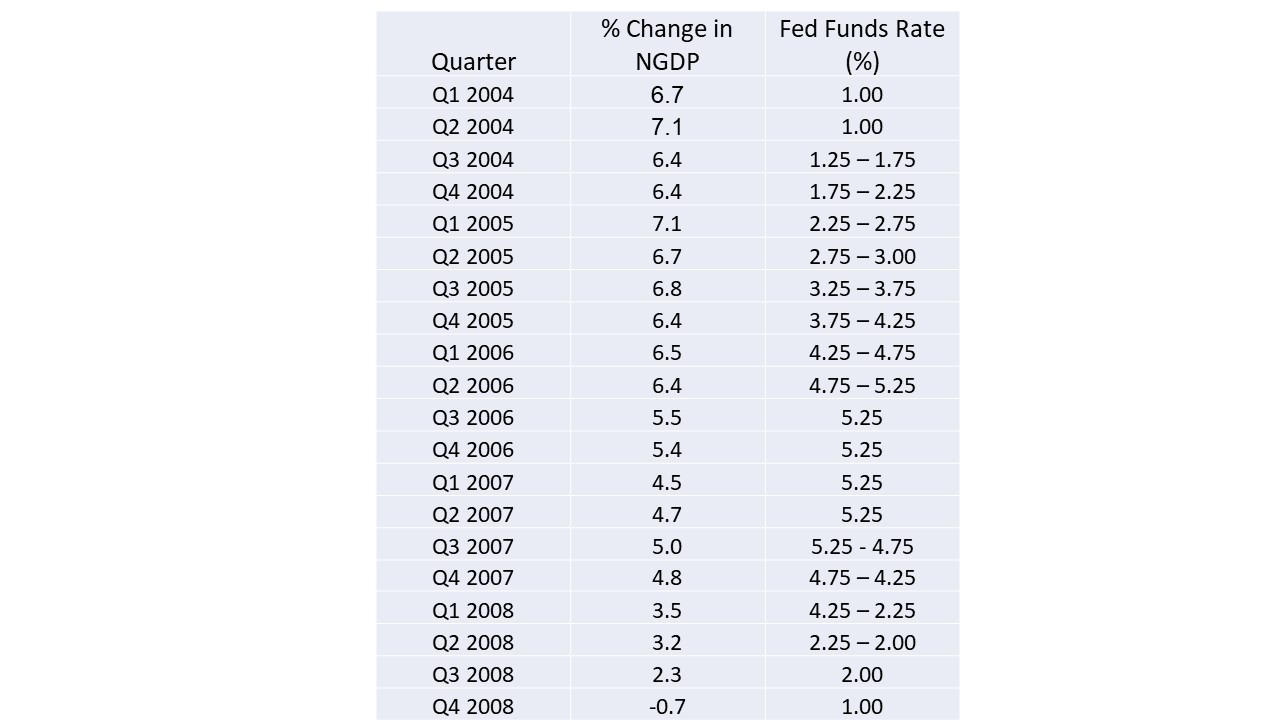

 Uneasy Money