Archive Page 38

Krugman Predicts the Future History of Economic Thought

It’s always nice to have a Nobel Laureate rely on something you’ve written in making an argument of his own, so I would prefer not to turn around and criticize Paul Krugman for the very blog-post in which he cited my recent posts about Milton Friedman. Now there are obviously certain basic points about Friedman that Krugman and I agree on, e.g., that Friedman relied more heavily on the Keynesian theory of the demand for money than he admitted, and second that Friedman’s description of his theory of the demand for money as the expression of an oral tradition transmitted from an earlier generation of Chicago quantity theorists lacked any foundation. Although some people, including my friend Scott Sumner, seem resistant to acknowledging these points, I don’t think that they are really very controversial statements.

However, Krugman goes beyond this to make a stronger point, which is that Friedman, unlike Keynes, is no longer a factor in policy debates, because the policy position that Friedman advocated is no longer tenable. Here’s how Krugman explains the posthumous untenability of Friedman’s position.

[A]t this point both of Friedman’s key contributions to macroeconomics look hard to defend.

First, on monetary policy . . . Friedman was still very much associated with the notion that the Fed can control the money supply, and controlling the money supply is all you need to stabilize the economy. In the wake of the 2008 crisis, this looks wrong from soup to nuts: the Fed can’t even control broad money, because it can add to bank reserves and they just sit there; and money in turn bears little relationship to GDP. And in retrospect the same was true in the 1930s, so that Friedman’s claim that the Fed could easily have prevented the Great Depression now looks highly dubious.

Krugman is making a tricky point. I agree that Friedman was wrong to focus entirely on the quantity of money in the Great Depression, but that’s because, under the gold standard then in place, the quantity of money was endogenous and prices exogenously determined by the gold standard. The Great Depression occurred because the international restoration of the gold standard in the late 1920s was driving up the value of gold and forcing deflation on all gold standard countries, not just the US, which is why leaving the gold standard or devaluation was a sure-fire way of starting a recovery even without expansionary fiscal policy, as evidenced by the spectacular recovery that started in April 1933 when FDR started devaluing the dollar. So Friedman was wrong about the nature of the monetary mechanisms then operating, but he wasn’t wrong about the ultimately monetary nature of the problem.

Second, on inflation and unemployment: Friedman’s success, with Phelps, in predicting stagflation was what really pushed his influence over the top; his notion of a natural rate of unemployment, of a vertical Phillips curve in the long run, became part of every textbook exposition. But it’s now very clear that at low rates of inflation the Phillips curve isn’t vertical at all, that there’s an underlying downward nominal rigidity to wages and perhaps many prices too that makes the natural rate hypothesis a very bad guide under depression conditions.

I don’t subscribe to the natural-rate hypothesis as a law of nature, but it did make an important contribution to the understanding of the limitations of macroeconomic policy. But even the strictest version of Friedman’s natural-rate hypothesis does not imply that, if the rate of unemployment is above the natural rate, an increase in the rate of inflation through expansionary monetary or fiscal policy would not hasten the transition back to the natural rate of unemployment. For an argument against expansionary monetary or fiscal policy in such circumstances, one has to resort to arguments other than those made by Friedman.

So Friedman’s economic analysis has taken a serious hit. But that’s not the whole story behind his disappearance; after all, all those economists who have been predicting runaway inflation still have a constituency after being wrong year after year.

Friedman’s larger problem, I’d argue, is that he was, when all is said and done, a man trying to straddle two competing world views — and our political environment no longer has room for that kind of straddle.

Think of it this way: Friedman was an avid free-market advocate, who insisted that the market, left to itself, could solve almost any problem. Yet he was also a macroeconomic realist, who recognized that the market definitely did not solve the problem of recessions and depressions. So he tried to wall off macroeconomics from everything else, and make it as inoffensive to laissez-faire sensibilities as possible. Yes, he in effect admitted, we do need stabilization policy — but we can minimize the government’s role by relying only on monetary policy, none of that nasty fiscal stuff, and then not even allowing the monetary authority any discretion.

At a fundamental level, however, this was an inconsistent position: if markets can go so wrong that they cause Great Depressions, how can you be a free-market true believer on everything except macro? And as American conservatism moved ever further right, it had no room for any kind of interventionism, not even the sterilized, clean-room interventionism of Friedman’s monetarism.

Well, inconsistency is in the eye of the beholder, and, anyway, it is surely appropriate to beware of that foolish consistency which is the hobgoblin of little minds. The Great Depression was the result of a complex pattern of events, and acknowledging the inability of free markets to cope with those events is not the same thing as agreeing that free markets caused the Great Depression.

So Friedman has vanished from the policy scene — so much so that I suspect that a few decades from now, historians of economic thought will regard him as little more than an extended footnote.

I suspect that Krugman is correct that the small-minded political right-wing of our time is no longer as willing to accept Milton Friedman as their pre-eminent economic authority figure as were earlier generations of political right-wingers in the last three or four decades of the twentieth century. But to extrapolate from that sociological factoid how future historians of economic thought will evaluate the contributions of Milton Friedman seems to me to be a bit of a stretch.

Hicks on Keynes and the Theory of the Demand for Money

One of my favorite papers is one published by J. R. Hicks in 1935 “A Suggestion for Simplifying the Demand for Theory of Money.” The aim of that paper was to explain how to reconcile the concept of a demand for money into the theory of rational choice. Although Marshall had attempted to do so in his writings, his formulations of the idea were not fully satisfactory, and other Cambridge economists, notably Pigou, Lavington, Robertson, and Keynes, struggled to express the idea in a more satisfactory way than Marshall had done.

In Hicks’s introductory essay to volume II of his Collected Essays on Economic Theory in which his 1935 essay appears, Hicks recounts that Keynes told him after reading his essay that the essay was similar to the theory of liquidity preference, on which Keynes was then working.

To anyone who comes over from the theory of value to the theory of money, there are a number of things which are rather startling. Chief of these is the preoccupation of monetary theorists with a certain equation, which states that the price of goods multiplied by the quantity of goods equals the amount of money which is spent on them. The equation crops up again and again, and it has all sorts of ingenious little arithmetical tricks performed on it. Sometimes it comes out as MV = PT . . .

Now we, of the theory of value, are not unfamiliar with this equation, and there was a time when we used to attach as much importance to it as monetary theorists seem to do still. This was in the middle of the last century, when we used to talk about value being “a ratio between demand and supply.” Even now, we accept the equation, and work it, more or less implicitly, into our systems. But we are rather inclined to take it for granted, since it is rather tautologous, and since we have found that another equation, not alternative to the quantity equation, but complementary with it, is much more significant. This is the equation which states that the relative value of two commodities depends upon their relative marginal utility.

Now to an ingénue, who comes over to monetary theory, it is extremely trying to be deprived of this sheet-anchor. It was marginal utility that really made sense of the theory of value; and to come to a branch of economics which does without marginal utility altogether! No wonder there are such difficulties and such differences! What is wanted is a “marginal revolution!”

That is my suggestion. But I know that it will meet with apparently crushing objections. I shall be told that the suggestion has been tried out before. It was tried by Wicksell, and though it led to interesting results, it did not lead to a marginal utility theory of money. It was tried by Mises, and led to the conclusion that money is a ghost of gold – because, so it appeared, money as such has no marginal utility. The suggestion has a history, and its history is not encouraging.

This would be enough to frighten one off, were it not for two things. Both in the theory of value and in the theory of money there have been developments in the twenty of thirty years since Wicksell and Mises wrote. And these developments have considerably reduced the barriers that blocked their way.

In the theory of value, the work of Pareto, Wicksteed, and their successors, has broadened and deepened our whole conception of marginal utility. We now realize that the marginal utility analysis is nothing else than a general theory of choice, which is applicable whenever the choice is between alternatives that are capable of quantitative expression. Now money is obviously capable of quantitative expression, and therefore the objection that money has no marginal utility must be wrong. People do choose to have money rather than other things, and therefore, in the relevant sense, money must have a marginal utility.

But merely to call their marginal utility X, and then proceed to draw curves, would not be very helpful. Fortunately the developments in monetary theory to which I alluded come to our rescue.

Mr. Keynes’s Treatise, so far as I have been able to discover, contains at least three theories of money. One of them is the Savings and Investment theory, which . . . seems to me only a quantity theory much glorified. One of them is a Wicksellian natural rate theory. But the third is altogether more interesting. It emerges when Mr. Keynes begins to talk about the price-level of investment goods; when he shows that this price-level depends upon the relative preference of the investor – to hold bank-deposits or to hold securities. Here at last we have something which to a value theorist looks sensible and interesting! Here at last we have a choice at the margin! And Mr. Keynes goes on to put substance into our X, by his doctrine that the relative preference depends upon the “bearishness” or “bullishness” of the public, upon their relative desire for liquidity or profit.

My suggestion may, therefore, be reformulated. It seems to me that this third theory of Mr. Keynes really contains the most important of his theoretical contribution; that here, at last, we have something which, on the analogy (the approximate analogy) of value theory, does begin to offer a chance of making the whole thing easily intelligible; that it si form this point, not from velocity of circulation, or Saving and Investment, that we ought to start in constructing the theory of money. But in saying this I am being more Keynesian than Keynes [note to Blue Aurora this was written in 1934 and published in 1935].

The point of this extended quotation, in case it is not obvious to the reader, is that Hicks is here crediting Keynes in his Treatise on Money with a crucial conceptual advance in formulating a theory of the demand for money consistent with the marginalist theory of value. Hicks himself recognized that Keynes in the General Theory worked out a more comprehensive version of the theory than that which he presented in his essay, even though they were not entirely the same. So there was no excuse for Friedman to present a theory of the demand for money which he described “as part of capital or wealth theory, concerned with the composition of the balance sheet or portfolio of assets,” without crediting Keynes for that theory, just because he rejected the idea of absolute liquidity preference.

Here is how Hicks summed up the relationship in his introductory essay referred to above.

Keynes’s Liquidity theory was so near to mine, and was put over in so much more effective a way than I could hope to achieve, that it seemed pointless, at first, to emphasize differences. Sometimes, indeed, he put his in such a way that there was hardly any difference. But, as time went on, what came to be regarded in many quarters, as Keynesian theory was something much more mechanical than he had probably intended. It was certainly more mechanical than I had intended. So in the end I had ot go back to “Simplifying,” and to insist that its message was a Declaration of Independence, not only from the “free market” school from which I was expressly liberating myself, but also from what came to pass as Keynesian economics.

Second Thoughts on Friedman

After blowing off some steam about Milton Friedman in my previous post, thereby antagonizing a sizable segment of my readership, and after realizing that I had been guilty of a couple of memory lapses in citing sources that I was relying on, I thought that I should go back and consult some of the relevant primary sources. So I looked up Friedman’s 1966 article “Interest Rates and the Demand for Money” published in the Journal of Law and Economics in which he denied that he had ever asserted that the demand for money did not depend on the rate of interest and that the empirical magnitude of the elasticity of money demand with respect to the interest rate was not important unless it approached the very high elasticity associated with the Keynesian liquidity trap. I also took a look at Friedman’s reply to Don Patinkin essay “Friedman on the Quantity Theory and Keynesian Economics” in Milton Friedman’s Monetary Framework: A Debate with his Critics.

Perhaps on another occasion, I will offer some comments on Friedman and the interest elasticity of the demand for money, but, for now, I will focus on Friedman’s reply to Patinkin, which is most relevant to my previous post. Patinkin’s essay, entitled, “Friedman on the Quantity Theory and Keynesian Economics,” charged that Friedman had repackaged the Keynesian theory as a quantity theory and tried to sell it with a Chicago oral tradition label stuck on the package. That’s an overstatement of a far more sophisticated argument than my one sentence summary can do justice to, but it captures the polemical gist of Patinkin’s argument, an argument that he had made previously in a paper, “The Chicago Tradition, the Quantity Theory, and Friedman” published in the Journal of Money, Credit and Banking which Harry Johnson relied on in his 1970 Richard T. Ely lecture, “The Keynesian Revolution and the Monetarist Counterrevolution.” Friedman took personal offense at what he regarded as attacks on his scholarly integrity in those papers, and his irritation (to put it mildly) with Patinkin is plainly in evidence in his reply to Patinkin. Much, but not all, of my criticism of Friedman stems from my memory of the two papers by Patinkin and Johnson.

Now to give Friedman his due – and to reiterate what I have already said a number of times, Friedman was a great economist and you can learn a lot by reading his arguments carefully because he was a very skillful applied theorist — he makes a number of effective responses to Patinkin’s accusation that he was merely peddling a disguised version of Keynesianism under the banners of the quantity theory and the Chicago oral tradition. These are basically the same arguments that Scott Sumner used in the post that he wrote defending Friedman against my recycling of the Patinkin/Johnson criticism.

First, like earlier quantity theorists, and unlike Keynes in the General Theory, Friedman assumed that the price level is determined (not, as in the GT, somehow fixed exogenously) by the demand for money and the supply (effectively under the complete discretionary control of the monetary authority) of money.

Second, because differences between the demand for money and the supply of money (in nominal terms) are equilibrated primarily by changes in the price level (not, as in the GT, by changes in the rate of interest), the link between monetary policy and the economy that Friedman focused on was the price level not the rate of interest.

Third, Friedman did not deny that the demand for money was affected by the rate of interest, but he maintained that monetary policy would become ineffective only under conditions of a liquidity trap, which was therefore, in Friedman’s view, the chief theoretical innovation of the General Theory, but one which, on empirical grounds, Friedman flatly rejected.

So if I were to restate Patinkin’s objection in somewhat different terms, I would say that Friedman, in 1956 and in later expositions, described the quantity theory as a theory of the demand for money, which as a historical matter is a travesty, because the quantity theory was around for centuries before the concept of a demand for money was even articulated, but the theory of the demand for money that Friedman described was, in fact, very much influenced by the Keynesian theory of liquidity preference, an influence not mentioned by Friedman in 1956 but acknowledged in later expositions. Friedman explained away this failure by saying that Keynes was merely adding to a theory of the demand for money that had been evolving at Cambridge since Marshall’s day, and that the novel element in the General Theory, absolute liquidity preference, was empirically unsupported. That characterization of Keynes’s theory of liquidity preference strikes me as being ungenerous, but both Friedman and Patinkin neglected to point out that Keynes erroneously thought that his theory of liquidity preference was actually a complete theory of the rate of interest that displaced the real theory of interest.

So, my take on the dispute between Friedman and Patinkin is that Patinkin was right that Friedman did not sufficiently acknowledge the extent to which he was indebted to Keynes for the theory of the demand for money that he erroneously identified with the quantity theory of money. On the other hand, because Friedman explicitly allowed for the price level to be determined within his model, he avoided the Keynesian liquidity-preference relationship between the quantity of money and the rate of interest, allowing the real rate of interest to be determined by real factors not liquidity preference. In some sense, Friedman may have exaggerated the conceptual differences between himself and the Keynesians, but, by making a strategic assumption that the price level responds to changes in the quantity of money, Friedman minimized the effect of changes in the quantity of money on interest rates, except via changes in price level expectations.

But, having granted Friedman partial exoneration of the charge that he was a crypto-Keynesian, I want to explore a bit more carefully Friedman’s remarkable defense against the accusation by Patinkin and Johnson that he invented a non-existent Chicago oral tradition under whose name he could present his quasi-Keynesian theory of the demand for money. Friedman began his response to Patinkin with the following expression of outrage.

Patinkin . . . and Johnson criticize me for linking my work to a “Chicago tradition” rather than recognizing that, as they see it, my work is Keynesian. In the course of their criticism, they give a highly misleading impression of the Chicago tradition. . . .

Whether I conveyed the flavor of that tradition or not, there was such a tradition; it was significantly different from the quantity theory tradition that prevailed at other institutions of learning, notably the London School of Economics; that Chicago tradition had a great deal to do with the differential impact of Keynes’s General Theory on economists at Chicago and elsewhere; and it was responsible for the maintenance of interest in the quantity theory at Chicago. (Friedman’s Monetary Framework p. 158 )

Note the reference to the London School of Economics, as if LSE in the 1930s was in any way notable for its quantity theory tradition. There were to be sure monetary theorists of some distinction working at the LSE in the 1930s, but their relationship to the quantity theory was, at best, remote.

Friedman elaborates on this tidbit a few pages later, recalling that in the late 1940s or early 1950s he once debated Abba Lerner at a seminar at the University of Chicago. Despite agreeing with each other about many issues, Friedman recalled that they were in sharp disagreement about the Keynesian Revolution, Lerner being an avid Keynesian, and Friedman being opposed. The reason for their very different reaction to the Keynesian Revolution, Friedman conjectured, was that Lerner had been trained at the London School of Economics “where the dominant view was that the depression was an inevitable result of the prior boom, that it was deepened by the attempts ot prevent prices and wages from falling and firms from going bankrupt, that the monetary authorities had brought on the depression by inflationary policies before the crash and had prolonged it by ‘easy money’ policies thereafter; that the only sound policy was to let the depression run its course, bring down money costs, and eliminate the weak and unsound firms.” For someone trained in such a view, Friedman suggested, the Keynesian program would seem very attractive. Friedman continued:

It was the London School (really Austrian) view that I referred to in my “Restatement” when I spoke of “the atrophied and rigid caricature [of the quantity theory] that is so frequently described by the proponents of the new income-expenditure approach – and with some justice, to judge by much of the literature on policy that was spawned by the quantity theorists.”

The intellectual climate at Chicago had been wholly different. My teachers regarded the depression as largely the product of misguided government policy – or at least greatly intensified by such policies. They blamed the monetary and fiscal authorities for permitting banks to fail and the quantity of deposits to decline. Far from preaching the need to let deflation and bankruptcy run their course, they issued repeated pronouncements calling for governmental action to stem the deflation. . . .

It was this view the the quantity theory that I referred to in my “Restatement” as “a more subtle and relevant version, one in which the quantity theory was connected and integrated with general price theory and became a flexible and sensitive tool for interpreting movements in aggregate economic activity and for developing relevant policy prescriptions.” (pp. 162-63)

After quoting at length from a talk Jacob Viner gave in 1933 calling for monetary expansion, Friedman winds up with this gem.

What, in the field of interpretation and policy, did Keynes have to offer those of us who learned their economics at a Chicago filled with these views? Can anyone who knows my work read Viner’s comments and not see the direct links between them and Anna Schwartz’s and my Monetary History or between them and the empirical Studies in the Quantity Theory of Money? Indeed, as I have read Viner’s talk for purposes of this paper, I have myself been amazed to discover how precisely it foreshadows the main thesis of our Monetary History for the depression period, and have been embarrassed that we made no reference to it in our account. Can you find any similar link between [Lionel] Robbins’s [of LSE] comments [in his book The Great Depression] and our work? (p. 167)

So what is the evidence that Friedman provides to counter the scandalous accusation by Patinkin and Johnson that Friedman invented a Chicago oral tradition of the quantity theory? (And don’t forget: the quantity theory is a theory of the demand for money) Well, it’s that, at the London School of Economics, there were a bunch of guys who had crazy views about just allowing the Great Depression to run its course, and those guys were quantity theorists, which is why Keynes had to start a revolution to get rid of them all, but at Chicago, they didn’t allow any of those guys to spout their crazy ideas in the first place, so we didn’t need any damn Keynesian revolution.

Good grief! Is there a single word that makes sense? To begin with those detestable guys at LSE were Austrians, as Friedman acknowledges. What he didn’t say, or didn’t know, is that Austrians, either by self-description or by any reasonable definition of the term, are not quantity theorists. So the idea that there was anything special about the Chicago quantity theory as opposed to any other species of the quantity theory is total humbug.

But hold on, it only gets worse. Friedman holds up Jacob Viner as an exemplar of the Chicago quantity theory oral tradition. Jacob Viner was a superb economist, a magnificent scholar, and a legendary teacher for whom I have the utmost admiration, and I am sure that Friedman learned a lot from him at Chicago, But isn’t it strange that Friedman writes: “as I have read Viner’s talk for purposes of this paper, I have myself been amazed to discover how precisely it foreshadows the main thesis of our Monetary History for the depression period, and have been embarrassed that we made no reference to it in our account.” OMG! This is the oral tradition that exerted such a powerful influence on Friedman and his fellow students? Viner explains how to get out of the depression in 1933, and in 1971 Friedman is “amazed to discover” how precisely Viner’s talk foreshadowed the main thesis of his explanation of the Great Depression? That sounds more like a subliminal tradition than an oral tradition.

Responding to Patinkin’s charge that his theory of the demand for money – remember the quantity theory, according to Friedman is a theory of the demand for money — is largely derived from Keynes, Friedman plays a word game.

Is everything in the General Theory Keynesian? Obviously yes, in the trivial sense that the words were set down on paper by John Maynard Keynes. Obviously no, in the more important sense that the term Keynesian has come to refer to a theory of short-term economic change – or a way of analyzing such change – presented in the General Theory and distinctively different from the theory that preceded it. To take a noncontroversial example: in his chapter 20 on “The Employment Function” and elsewhere, Keynes uses the law of diminishing returns to conclude that an increase of employment requires a decline in real-wage rates. Clearly that does not make the “law of diminishing returns” Keynesian or justify describing the “analytical framework” of someone who embodies the law of diminishing returns in his theoretical structure as Keynesian.

In just the same sense, I maintain that Keynes’s discussion of the demand curve for money in the General Theory is for the most part a continuation of earlier quantity theory approaches, improved and refined but not basically modified. As evidence, I shall cite Keynes’s own writings in the Tract on Monetary Reform – long before he became a Keynesian in the present sense. (p. 168)

There are two problems with this line of defense. First, the analogy to the law of diminishing returns would have been appropriate only if Keynes had played a major role in the discovery of the law of diminishing returns just as, on Friedman’s own admission, he played a major role in discovering the theory of liquidity preference. Second, it is, to say the least, debatable to what extent “Keynes’s discussion of the demand curve for money was merely a continuation of earlier quantity theory approaches, improved and refined but not basically modified.” But there is no basis at all for the suggestion that a Chicago oral tradition was the least bit implicated in those earlier quantity theory approaches. So Friedman’s invocation of a Chicago oral tradition was completely fanciful.

This post has gone on too long already. I have more to say about Friedman’s discussion of the relationship between money, price levels, and interest rates. But that will have to wait till next time.

My Milton Friedman Problem

In my previous post , I discussed Keynes’s perplexing and problematic criticism of the Fisher equation in chapter 11 of the General Theory, perplexing because it is difficult to understand what Keynes is trying to say in the passage, and problematic because it is not only inconsistent with Keynes’s reasoning in earlier writings in which he essentially reproduced Fisher’s argument, it is also inconsistent with Keynes’s reasoning in chapter 17 of the General Theory in his exposition of own rates of interest and their equilibrium relationship. Scott Sumner honored me with a whole post on his blog which he entitled “Glasner on Keynes and the Fisher Effect,” quite a nice little ego boost.

After paraphrasing some of what I had written in his own terminology, Scott quoted me in responding to a dismissive comment that Krugman recently made about Milton Friedman, of whom Scott tends to be highly protective. Here’s the passage I am referring to.

PPS.  Paul Krugman recently wrote the following:

Just stabilize the money supply, declared Milton Friedman, and we don’t need any of this Keynesian stuff (even though Friedman, when pressured into providing an underlying framework, basically acknowledged that he believed in IS-LM).

Actually Friedman hated IS-LM.  I don’t doubt that one could write down a set of equilibria in the money market and goods market, as a function of interest rates and real output, for almost any model.  But does this sound like a guy who “believed in” the IS-LM model as a useful way of thinking about macro policy?

Low interest rates are generally a sign that money has been tight, as in Japan; high interest rates, that money has been easy.

It turns out that IS-LM curves will look very different if one moves away from the interest rate transmission mechanism of the Keynesians.  Again, here’s David:

Before closing, I will just make two side comments. First, my interpretation of Keynes’s take on the Fisher equation is similar to that of Allin Cottrell in his 1994 paper “Keynes and the Keynesians on the Fisher Effect.” Second, I would point out that the Keynesian analysis violates the standard neoclassical assumption that, in a two-factor production function, the factors are complementary, which implies that an increase in employment raises the MEC schedule. The IS curve is not downward-sloping, but upward sloping. This is point, as I have explained previously (here and here), was made a long time ago by Earl Thompson, and it has been made recently by Nick Rowe and Miles Kimball.I hope in a future post to work out in more detail the relationship between the Keynesian and the Fisherian analyses of real and nominal interest rates.

Please do.  Krugman reads Glasner’s blog, and if David keeps posting on this stuff then Krugman will eventually realize that hearing a few wisecracks from older Keynesians about various non-Keynesian traditions doesn’t make one an expert on the history of monetary thought.

I wrote a comment on Scott’s blog responding to this post in which, after thanking him for mentioning me in the same breath as Keynes and Fisher, I observed that I didn’t find Krugman’s characterization of Friedman as someone who basically believed in IS-LM as being in any way implausible.

Then, about Friedman, I don’t think he believed in IS-LM, but it’s not as if he had an alternative macromodel. He didn’t have a macromodel, so he was stuck with something like an IS-LM model by default, as was made painfully clear by his attempt to spell out his framework for monetary analysis in the early 1970s. Basically he just tinkered with the IS-LM to allow the price level to be determined, rather than leaving it undetermined as in the original Hicksian formulation. Of course in his policy analysis and historical work he was not constained by any formal macromodel, so he followed his instincts which were often reliable, but sometimes not so.

So I am afraid that my take may on Friedman may be a little closer to Krugman’s than to yours. But the real point is that IS-LM is just a framework that can be adjusted to suit the purposes of the modeler. For Friedman the important thing was to deny that that there is a liquidity trap, and introduce an explicit money-supply-money-demand relation to determine the absolute price level. It’s not just Krugman who says that, it’s also Don Patinkin and Harry Johnson. Whether Krugman knows the history of thought, I don’t know, but surely Patinkin and Johnson did.

Scott responded:

I’m afraid I strongly disagree regarding Friedman. The IS-LM “model” is much more than just the IS-LM graph, or even an assumption about the interest elasticity of money demand. For instance, suppose a shift in LM also causes IS to shift. Is that still the IS-LM model? If so, then I’d say it should be called the “IS-LM tautology” as literally anything would be possible.

When I read Friedman’s work it comes across as a sort of sustained assault on IS-LM type thinking.

To which I replied:

I think that if you look at Friedman’s responses to his critics the volume Milton Friedman’s Monetary Framework: A Debate with his Critics, he said explicitly that he didn’t think that the main differences among Keynesians and Monetarists were about theory, but about empirical estimates of the relevant elasticities. So I think that in this argument Friedman’s on my side.

And finally Scott:

This would probably be easier if you provided some examples of monetary ideas that are in conflict with IS-LM. Or indeed any ideas that are in conflict with IS-LM. I worry that people are interpreting IS-LM too broadly.

For instance, do Keynesians “believe” in MV=PY? Obviously yes. Do they think it’s useful? No.

Everyone agrees there are a set of points where the money market is in equilibrium. People don’t agree on whether easy money raises interest rates or lowers interest rates. In my view the term “believing in IS-LM” implies a belief that easy money lowers rates, which boosts investment, which boosts RGDP. (At least when not at the zero bound.) Friedman may agree that easy money boosts RGDP, but may not agree on the transmission mechanism.

People used IS-LM to argue against the Friedman and Schwartz view that tight money caused the Depression. They’d say; “How could tight money have caused the Depression? Interest rates fell sharply in 1930?”

I think that Friedman meant that economists agreed on some of the theoretical building blocks of IS-LM, but not on how the entire picture fit together.

Oddly, your critique of Keynes reminds me a lot of Friedman’s critiques of Keynes.

Actually, this was not the first time that I provoked a negative response by writing critically about Friedman. Almost a year and a half ago, I wrote a post (“Was Milton Friedman a Closet Keynesian?”) which drew some critical comments from such reliably supportive commenters as Marcus Nunes, W. Peden, and Luis Arroyo. I guess Scott must have been otherwise occupied, because I didn’t hear a word from him. Here’s what I said:

Commenting on a supremely silly and embarrassingly uninformed (no, Ms. Shlaes, A Monetary History of the United States was not Friedman’s first great work, Essays in Positive Economics, Studies in the Quantity Theory of Money, A Theory of the Consumption Function, A Program for Monetary Stability, and Capitalism and Freedom were all published before A Monetary History of the US was published) column by Amity Shlaes, accusing Ben Bernanke of betraying the teachings of Milton Friedman, teachings that Bernanke had once promised would guide the Fed for ever more, Paul Krugman turned the tables and accused Friedman of having been a crypto-Keynesian.

The truth, although nobody on the right will ever admit it, is that Friedman was basically a Keynesian — or, if you like, a Hicksian. His framework was just IS-LM coupled with an assertion that the LM curve was close enough to vertical — and money demand sufficiently stable — that steady growth in the money supply would do the job of economic stabilization. These were empirical propositions, not basic differences in analysis; and if they turn out to be wrong (as they have), monetarism dissolves back into Keynesianism.

Krugman is being unkind, but he is at least partly right.  In his famous introduction to Studies in the Quantity Theory of Money, which he called “The Quantity Theory of Money:  A Restatement,” Friedman gave the game away when he called the quantity theory of money a theory of the demand for money, an almost shockingly absurd characterization of what anyone had ever thought the quantity theory of money was.  At best one might have said that the quantity theory of money was a non-theory of the demand for money, but Friedman somehow got it into his head that he could get away with repackaging the Cambridge theory of the demand for money — the basis on which Keynes built his theory of liquidity preference — and calling that theory the quantity theory of money, while ascribing it not to Cambridge, but to a largely imaginary oral tradition at the University of Chicago.  Friedman was eventually called on this bit of scholarly legerdemain by his old friend from graduate school at Chicago Don Patinkin, and, subsequently, in an increasingly vitriolic series of essays and lectures by his then Chicago colleague Harry Johnson.  Friedman never repeated his references to the Chicago oral tradition in his later writings about the quantity theory. . . . But the simple fact is that Friedman was never able to set down a monetary or a macroeconomic model that wasn’t grounded in the conventional macroeconomics of his time.

As further evidence of Friedman’s very conventional theoretical conception of monetary theory, I could also cite Friedman’s famous (or, if you prefer, infamous) comment (often mistakenly attributed to Richard Nixon) “we are all Keynesians now” and the not so famous second half of the comment “and none of us are Keynesians anymore.” That was simply Friedman’s way of signaling his basic assent to the neoclassical synthesis which was built on the foundation of Hicksian IS-LM model augmented with a real balance effect and the assumption that prices and wages are sticky in the short run and flexible in the long run. So Friedman meant that we are all Keynesians now in the sense that the IS-LM model derived by Hicks from the General Theory was more or less universally accepted, but that none of us are Keynesians anymore in the sense that this framework was reconciled with the supposed neoclassical principle of the monetary neutrality of a unique full-employment equilibrium that can, in principle, be achieved by market forces, a principle that Keynes claimed to have disproved.

But to be fair, I should also observe that missing from Krugman’s take down of Friedman was any mention that in the original HIcksian IS-LM model, the price level was left undetermined, so that as late as 1970, most Keynesians were still in denial that inflation was a monetary phenomenon, arguing instead that inflation was essentially a cost-push phenomenon determined by the rate of increase in wages. Control of inflation was thus not primarily under the control of the central bank, but required some sort of “incomes policy” (wage-price guidelines, guideposts, controls or what have you) which opened the door for Nixon to cynically outflank his Democratic (Keynesian) opponents by coopting their proposals for price controls when he imposed a wage-price freeze (almost 42 years ago on August 15, 1971) to his everlasting shame and discredit.

Scott asked me to list some monetary ideas that I believe are in conflict with IS-LM. I have done so in my earlier posts (here, here, here and here) on Earl Thompson’s paper “A Reformulation of Macroeconomic Theory” (not that I am totally satisfied with Thompson’s model either, but that’s a topic for another post). Three of the main messages from Thompson’s work are that IS-LM mischaracterizes the monetary sector, because in a modern monetary economy the money supply is endogenous, not exogenous as Keynes and Friedman assumed. Second, the IS curve (or something corresponding to it) is not negatively sloped as Keynesians generally assume, but upward-sloping. I don’t think Friedman ever said a word about an upward-sloping IS curve. Third, the IS-LM model is essentially a one-period model which makes it difficult to carry out a dynamic analysis that incorporates expectations into that framework. Analysis of inflation, expectations, and the distinction between nominal and real interest rates requires a richer model than the HIcksian IS-LM apparatus. But Friedman didn’t scrap IS-LM, he expanded it to accommodate expectations, inflation, and the distinction between real and nominal interest rates.

Scott’s complaint about IS-LM seems to be that it implies that easy money reduces interest rates and that tight money raises rates, but, in reality, it’s the opposite. But I don’t think that you need a macro-model to understand that low inflation implies low interest rates and that high inflation implies high interest rates. There is nothing in IS-LM that contradicts that insight; it just requires augmenting the model with a term for expectations. But there’s nothing in the model that prevents you from seeing the distinction between real and nominal interest rates. Similarly, there is nothing in MV = PY that prevented Friedman from seeing that increasing the quantity of money by 3% a year was not likely to stabilize the economy. If you are committed to a particular result, you can always torture a model in such a way that the desired result can be deduced from it. Friedman did it to MV = PY to get his 3% rule; Keynesians (or some of them) did it to IS-LM to argue that low interest rates always indicate easy money (and it’s not only Keynesians who do that, as Scott knows only too well). So what? Those are examples of the universal tendency to forget that there is an identification problem. I blame the modeler, not the model.

OK, so why am I not a fan of Friedman’s? Here are some reasons. But before I list them, I will state for the record that he was a great economist, and deserved the professional accolades that he received in his long and amazingly productive career. I just don’t think that he was that great a monetary theorist, but his accomplishments far exceeded his contributions to monetary theory. The accomplishments mainly stemmed from his great understanding of price theory, and his skill in applying it to economic problems, and his great skill as a mathematical statistician.

1 His knowledge of the history of monetary theory was very inadequate. He had an inordinately high opinion of Lloyd Mints’s History of Banking Theory which was obsessed with proving that the real bills doctrine was a fallacy, uncritically adopting its pro-currency-school and anti-banking-school bias.

2 He covered up his lack of knowledge of the history of monetary theory by inventing a non-existent Chicago oral tradition and using it as a disguise for his repackaging the Cambridge theory of the demand for money and aspects of the Keynesian theory of liquidity preference as the quantity theory of money, while deliberately obfuscating the role of the interest rate as the opportunity cost of holding money.

3 His theory of international monetary adjustment was a naïve version of the Humean Price-Specie-Flow mechanism, ignoring the tendency of commodity arbitrage to equalize price levels under the gold standard even without gold shipments, thereby misinterpreting the significance of gold shipments under the gold standard.

4 In trying to find a respectable alternative to Keynesian theory, he completely ignored all pre-Keynesian monetary theories other than what he regarded as the discredited Austrian theory, overlooking or suppressing the fact that Hawtrey and Cassel had 40 years before he published the Monetary History of the United States provided (before the fact) a monetary explanation for the Great Depression, which he claimed to have discovered. And in every important respect, Friedman’s explanation was inferior to and retrogression from Hawtrey and Cassel explanation.

5 For example, his theory provided no explanation for the beginning of the downturn in 1929, treating it as if it were simply routine business-cycle downturn, while ignoring the international dimensions, and especially the critical role played by the insane Bank of France.

6 His 3% rule was predicated on the implicit assumption that the demand for money (or velocity of circulation) is highly stable, a proposition for which there was, at best, weak empirical support. Moreover, it was completely at variance with experience during the nineteenth century when the model for his 3% rule — Peel’s Bank Charter Act of 1844 — had to be suspended three times in the next 22 years as a result of financial crises largely induced, as Walter Bagehot explained, by the restriction on creation of banknotes imposed by the Bank Charter Act. However, despite its obvious shortcomings, the 3% rule did serve as an ideological shield with which Friedman could defend his libertarian credentials against criticism for his opposition to the gold standard (so beloved of libertarians) and to free banking (the theory of which Friedman did not comprehend until late in his career).

7 Despite his professed libertarianism, he was an intellectual bully who abused underlings (students and junior professors) who dared to disagree with him, as documented in Perry Mehrling’s biography of Fischer Black, and confirmed to me by others who attended his lectures. Black was made so uncomfortable by Friedman that Black fled Chicago to seek refuge among the Keynesians at MIT.
On a Difficult Passage in the General Theory

Keynes’s General Theory is not, in my estimation, an easy read. The terminology is often unfamiliar, and, so even after learning one of his definitions, I have trouble remembering what the term means the next time it’s used.. And his prose style, though powerful and very impressive, is not always clear, so you can spend a long time reading and rereading a sentence or a paragraph before you can figure out exactly what he is trying to say. I am not trying to be critical, just to point out that the General Theory is a very challenging book to read, which is one, but not the only, reason why it is subject to a lot of conflicting interpretations. And, as Harry Johnson once pointed out, there is an optimum level of difficulty for a book with revolutionary aspirations. If it’s too simple, it won’t be taken seriously. And if it’s too hard, no one will understand it. Optimally, a revolutionary book should be hard enough so that younger readers will be able to figure it out, and too difficult for the older guys to understand or to make the investment in effort to understand.

In this post, which is, in a certain sense, a follow-up to an earlier post about what, or who, determines the real rate of interest, I want to consider an especially perplexing passage in the General Theory about the Fisher equation. It is perplexing taken in isolation, and it is even more perplexing when compared to other passages in both the General Theory itself and in Keynes’s other writings. Here’s the passage that I am interested in.

The expectation of a fall in the value of money stimulates investment, and hence employment generally, because it raises the schedule of the marginal efficiency of capital, i.e., the investment demand-schedule; and the expectation of a rise in the value of money is depressing, because it lowers the schedule of the marginal efficiency of capital. This is the truth which lies behind Professor Irving Fisher’s theory of what he originally called “Appreciation and Interest” – the distinction between the money rate of interest and the real rate of interest where the latter is equal to the former after correction for changes in the value of money. It is difficult to make sense of this theory as stated, because it is not clear whether the change in the value of money is or is not assumed to be foreseen. There is no escape from the dilemma that, if it is not foreseen, there will be no effect on current affairs; whilst, if it is foreseen, the prices of exiting goods will be forthwith so adjusted that the advantages of holding money and of holding goods are again equalized, and it will be too late for holders of money to gain or to suffer a change in the rate of interest which will offset the prospective change during the period of the loan in the value of the money lent. For the dilemma is not successfully escaped by Professor Pigou’s expedient of supposing that the prospective change in the value of money is foreseen by one set of people but not foreseen by another. (p. 142)

The statement is problematic on just about every level, and one hardly knows where to begin in discussing it. But just for starters, it is amazing that Keynes seems (or, for rhetorical purposes, pretends) to be in doubt whether Fisher is talking about anticipated or unanticipated inflation, because Fisher himself explicitly distinguished between anticipated and unanticipated inflation, and Keynes could hardly have been unaware that Fisher was explicitly speaking about anticipated inflation. So the implication that the Fisher equation involves some confusion on Fisher’s part between anticipated and unanticipated inflation was both unwarranted and unseemly.

What’s even more puzzling is that in his Tract on Monetary Reform, Keynes expounded the covered interest arbitrage principle that the nominal-interest-rate-differential between two currencies corresponds to the difference between the spot and forward rates, which is simply an extension of Fisher’s uncovered interest arbitrage condition (alluded to by Keynes in referring to “Appreciation and Interest”). So when Keynes found Fisher’s distinction between the nominal and real rates of interest to be incoherent, did he really mean to exempt his own covered interest arbitrage condition from the charge?

But it gets worse, because if we flip some pages from chapter 11, where the above quotation is found, to chapter 17, we see on page 224, the following passage in which Keynes extends the idea of a commodity or “own rate of interest” to different currencies.

It may be added that, just as there are differing commodity-rates of interest at any time, so also exchange dealers are familiar with the fact that the rate of interest is not even the same in terms of two different moneys, e.g. sterling and dollars. For here also the difference between the “spot” and “future” contracts for a foreign money in terms of sterling are not, as a rule, the same for different foreign moneys. . . .

If no change is expected in the relative value of two alternative standards, then the marginal efficiency of a capital-asset will be the same in whichever of the two standards it is measured, since the numerator and denominator of the fraction which leads up to the marginal efficiency will be changed in the same proportion. If, however, one of the alternative standards is expected to change in value in terms of the other, the marginal efficiencies of capital-assets will be changed by the same percentage, according to which standard they are measured in. To illustrate this let us take the simplest case where wheat, one of the alternative standards, is expected to appreciate at a steady rate of a percent per annum in terms of money; the marginal efficiency of an asset, which is x percent in terms of money, will then be x – a percent in terms of wheat. Since the marginal efficiencies of all capital assets will be altered by the same amount, it follows that their order of magnitude will be the same irrespective of the standard which is selected.

So Keynes in chapter 17 explicitly allows for the nominal rate of interest to be adjusted to reflect changes in the expected value of the asset (whether a money or a commodity) in terms of which the interest rate is being calculated. Mr. Keynes, please meet Mr. Keynes.

I think that one source of Keynes’s confusion in attacking the Fisher equation was his attempt to force the analysis of a change in inflation expectations, clearly a disequilibrium, into an equilibrium framework. In other words, Keynes is trying to analyze what happens when there has been a change in inflation expectations as if the change had been foreseen. But any change in inflation expectations, by definition, cannot have been foreseen, because to say that an expectation has changed means that the expectation is different from what it was before. Perhaps that is why Keynes tied himself into knots trying to figure out whether Fisher was talking about a change in the value of money that was foreseen or not foreseen. In any equilibrium, the change in the value of money is foreseen, but in the transition from one equilibrium to another, the change is not foreseen. When an unforeseen change occurs in expected inflation, leading to a once-and-for-all change in the value of money relative to other assets, the new equilibrium will be reestablished given the new value of money relative to other assets.

But I think that something else is also going on here, which is that Keynes was implicitly assuming that a change in inflation expectations would alter the real rate of interest. This is a point that Keynes makes in the paragraph following the one I quoted above.

The mistake lies in supposing that it is the rate of interest on which prospective changes in the value of money will directly react, instead of the marginal efficiency of a given stock of capital. The prices of existing assets will always adjust themselves to changes in expectation concerning the prospective value of money. The significance of such changes in expectation lies in their effect on the readiness to produce new assets through their reaction on the marginal efficiency of capital. The stimulating effect of the expectation of higher prices is due, not to its raising the rate of interest (that would be a paradoxical way of stimulating output – insofar as the rate of interest rises, the stimulating effect is to that extent offset) but to its raising the marginal efficiency of a given stock of capital. If the rate of interest were to rise pari passu with the marginal efficiency of capital, there would be no stimulating effect from the expectation of rising prices. For the stimulating effect depends on the marginal efficiency of capital rising relativevly to the rate of interest. Indeed Professor Fisher’s theory could best be rewritten in terms of a “real rate of interest” defined as being the rate of interest which would have to rule, consequently on change in the state of expectation as to the future value of money, in order that this change should have no effect on current output. (pp. 142-43)

Keynes’s mistake lies in supposing that an increase in inflation expectations could not have a stimulating effect except as it raises the marginal efficiency of capital relative to the rate of interest. However, the increase in the value of real assets relative to money will increase the incentive to produce new assets. It is the rise in the value of existing assets relative to money that raises the marginal efficiency of those assets, creating an incentive to produce new assets even if the nominal interest rate were to rise by as much as the rise in expected inflation.

Keynes comes back to this point at the end of chapter 17, making it more forcefully than he did the first time.

In my Treatise on Money I defined what purported to be a unique rate of interest, which I called the natural rate of interest – namely, the rate of interest which, in the terminology of my Treatise, preserved equality between the rate of saving (as there defined) and the rate of investment. I believed this to be a development and clarification of of Wicksell’s “natural rate of interest,” which was, according to him, the rate which would preserve the stability of some, not quite clearly specified, price-level.

I had, however, overlooked the fact that in any given society there is, on this definition, a different natural rate for each hypothetical level of employment. And, similarly, for every rate of interest there is a level of employment for which that rate is the “natural” rate, in the sense that the system will be in equilibrium with that rate of interest and that level of employment. Thus, it was a mistake to speak of the natural rate of interest or to suggest that the above definition would yield a unique value for the rate of interest irrespective of the level of employment. . . .

If there is any such rate of interest, which is unique and significant, it must be the rate which we might term the neutral rate of interest, namely, the natural rate in the above sense which is consistent with full employment, given the other parameters of the system; though this rate might be better described, perhaps, as the optimum rate. (pp. 242-43)

So what Keynes is saying, I think, is this. Consider an economy with a given fixed marginal efficiency of capital (MEC) schedule. There is some interest rate that will induce sufficient investment expenditure to generate enough spending to generate full employment. That interest rate Keynes calls the “neutral” rate of interest. If the nominal rate of interest is more than the neutral rate, the amount of investment will be less than the amount necessary to generate full employment. In such a situation an expectation that the price level will rise will shift up the MEC schedule by the amount of the expected increase in inflation, thereby generating additional investment spending. However, because the MEC schedule is downward-sloping, the upward shift in the MEC schedule that induces increased investment spending will correspond to an increase in the rate of interest that is less than the increase in expected inflation, the upward shift in the MEC schedule being partially offset by the downward movement along the MEC schedule. In other words, the increase in expected inflation raises the nominal rate of interest by less than increase in expected inflation by inducing additional investment that is undertaken only because the real rate of interest has fallen.

However, for an economy already operating at full employment, an increase in expected inflation would not increase employment, so whether there was any effect on the real rate of interest would depend on the extent to which there was a shift from holding money to holding real capital assets in order to avoid the inflation tax.

Before closing, I will just make two side comments. First, my interpretation of Keynes’s take on the Fisher equation is similar to that of Allin Cottrell in his 1994 paper “Keynes and the Keynesians on the Fisher Effect.” Second, I would point out that the Keynesian analysis violates the standard neoclassical assumption that, in a two-factor production function, the factors are complementary, which implies that an increase in employment raises the MEC schedule. The IS curve is not downward-sloping, but upward sloping. This is point, as I have explained previously (here and here), was made a long time ago by Earl Thompson, and it has been made recently by Nick Rowe and Miles Kimball.

I hope in a future post to work out in more detail the relationship between the Keynesian and the Fisherian analyses of real and nominal interest rates.

Bhide and Phelps v. Reality

I don’t know who Amar Bhide (apologies for not being able to insert an accent over the “e” in his last name) is, but Edmund Phelps is certainly an eminent economist and a deserving recipient of the 2006 Nobel Prize in economics. Unfortunately, Professor Phelps attached his name to an op-ed in Wednesday’s Wall Street Journal, co-authored with Bhide, consisting of little more than a sustained, but disjointed, rant about the Fed and central banking. I am only going to discuss that first part of the op-ed that touches on the monetary theory of increasing the money supply through open-market operations, and about the effect of that increase on inflation and inflation expectations. Bhide and Phelps not only get the theory wrong, they seem amazingly oblivious to well-known facts that flatly contradict their assertions about monetary policy since 2008. Let’s join them in their second paragraph.

Monetary policy might focus on the manageable task of keeping expectations of inflation on an even keel—an idea of Mr. Phelps’s [yes that same Mr. Phelps whose name appears as a co-author] in 1967 that was long influential. That would leave businesses and other players to determine the pace of recovery from a recession or of pullback from a boom.

Nevertheless, in late 2008 the Fed began its policy of “quantitative easing”—repeated purchases of billions in Treasury debt—aimed at speeding recovery. “QE2” followed in late 2010 and “QE3” in autumn 2012.

One can’t help wondering what planet Bhide and Phelps have been dwelling on these past four years. To begin with, the first QE program was not instituted until March 2009 after the target Fed funds rate had been reduced to 0.25% in December 2008. Despite a nearly zero Fed funds rate, asset prices, which had seemed to stabilize after the September through November crash, began falling sharply again in February, the S&P 500 dropping from 869.89 on February 9 to 676.53 on March 9, a decline of more than 20%, with inflation expectations as approximated, by the TIPS spread, again falling sharply as they had the previous summer and fall.

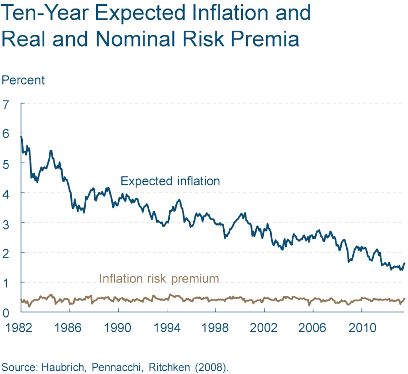
Apart from their confused chronology, their suggestion that the Fed’s various quantitative easings have somehow increased inflation and inflation expectations is absurd. Since 2009, inflation has averaged less than 2% a year – one of the longest periods of low inflation in the entire post-war era. Nor has quantitative easing increased inflation expectations. The TIPS spread and other measures of inflation expectations clearly show that inflation expectations have fluctuated within a narrow range since 2008, but have generally declined overall.

The graph below shows the estimates of the Cleveland Federal Reserve Bank of 10-year inflation expectations since 1982. The chart shows that the latest estimate of expected inflation, 1.65%, is only slightly above its the low point, reached in March, over the past 30 years. Thus expected inflation is now below the 2% target rate that the Fed has set. And to my knowledge Professor Phelps has never advocated targeting an annual inflation rate less than 2%. So I am unable to understand what he is complaining about.

cfimg8685191149364015372

Bhide and Phelps continue:

Fed Chairman Ben Bernanke said in November 2010 that this unprecedented program of sustained monetary easing would lead to “higher stock prices” that “will boost consumer wealth and help increase confidence, which can also spur spending.”

It is doubtful, though, that quantitative easing boosted either wealth or confidence. The late University of Chicago economist Lloyd Metzler argued persuasively years ago that a central-bank purchase, in putting the price level onto a higher path, soon lowers the real value of household wealth—by roughly the amount of the purchase, in his analysis. (People swap bonds for money, then inflation occurs, until the real value of money holdings is back to where it was.)

There are three really serious problems with this passage. First, and most obvious to just about anyone who has not been asleep for the last four years, central-bank purchases have not put the price level on a higher path than it was on before 2008; the rate of inflation has clearly fallen since 2008. Or would Bhide and Phelps have preferred to allow the deflation that briefly took hold in the fall of 2008 to have continued? I don’t think so. But if they aren’t advocating deflation, what exactly is their preferred price level path? Between zero and 1.5% perhaps? Is their complaint that the Fed has allowed inflation to be a half a point too high for the last four years? Good grief.

Second, Bhide and Phelps completely miss the point of the Metzler paper (“Wealth, Saving and the Rate of Interest”), one of the classics of mid-twentieth-century macroeconomics. (And I would just mention as an aside that while Metzler was indeed at the University of Chicago, he was the token Keynesian in the Chicago economics department in 1940s and early 1950s, until his active career was cut short by a brain tumor, which he survived, but with some impairment of his extraordinary intellectual gifts. Metzler’s illness therefore led the department to hire an up-and-coming young Keynesian who had greatly impressed Milton Friedman when he spent a year at Cambridge; his name was Harry Johnson. Unfortunately Friedman and Johnson did not live happily ever after at Chicago.) The point of the Metzler paper was to demonstrate that monetary policy, conducted via open-market operations, could in fact alter the real interest rate. Money, on Metzler’s analysis, is not neutral even in the long run. The conclusion was reached via a comparative-statics exercise, a comparison of two full-employment equilibria — one before and one after the central bank had increased the quantity of money by making open-market purchases.

The motivation for the exercise was that some critics of Keynes, arguing that deflation, at least in principle, could serve as a cure for involuntary unemployment — an idea that Keynes claimed to have refuted — had asserted that, because consumption spending depends not only on income, but on total wealth, deflation, by increasing the real value of the outstanding money stock, would actually make households richer, which would eventually cause households to increase consumption spending enough to restore full employment. Metzler argued that if consumption does indeed depend on total wealth, then, although the classical proposition that deflation could restore full employment would be vindicated, another classical proposition — the invariance of the real rate of interest with respect to the quantity of money — would be violated. So Metzler’s analysis — a comparison of two full-employment equilbria, the first with a lower quantity of money and a higher real interest rate and the second with a higher quantity of money and lower real interest rate – has zero relevance to the post-2008 period, in which the US economy was nowhere near full-employment equilibrium.

Finally, Bhide and Phelps, mischaracterize Metzler’s analysis. Metzler’s analysis depends critically on the proposition that the reduced real interest rate caused by monetary expansion implies an increase in household wealth, thereby leading to increased consumption. It is precisely the attempt to increase consumption that, in Metzler’s analysis, entails an inflationary gap that causes the price level to rise. But even after the increase in the price level, the real value of household assets, contrary to what Bhide and Phelps assert, remains greater than before the monetary expansion, because of a reduced real interest rate. A reduced real interest rate implies an increased real value of the securities retained by households.

Under Metzler’s analysis, therefore, if the starting point is a condition of less than full employment, increasing the quantity of money via open-market operations would tend to increase not only household wealth, but would also increase output and employment relative to the initial condition. So it is also clear that, on Metzler’s analysis, apparently regarded by Bhide and Phelps as authoritative, the problem with Fed policy since 2008 is not that it produced too much inflation, as Bhide and Phelps suggest, but that it produced too little.

If it seems odd that Bhide and Phelps could so totally misread the classic paper whose authority they invoke, just remember this: in the Alice-in-Wonderland world of the Wall Street Journal editorial page, things aren’t always what they seem.

HT: ChargerCarl

Hawtrey on the Keynesian Explanation of Unemployment

Here is a tidbit I just found the end of R. G. Hawtrey’s long chapter on the General Theory in his volume Capital and Employment, (second edition, 1952) pp. 218-19.

Unemployment in Great Britain seemed at the time [1935 when Keynes finished writing the General Theory] to be chronic: the number of unemployed had never fallen below a million since 1921. Keynes was looking for an explanation of chronic unemployment, but it was hardly plausible to attribute it to the low long-term rate of interest [i.e., to a liquidity trap]. The yield of Government securities had been exceptionally high till the Conversion of 1932.

And in reality there is no school of thought for which the explanation of unemployment presents any difficulty. If wages are too high for full employment, and resist reduction, unemployment is bound to result. Adam Smith held that for a growing population a corresponding growth of capital was essential to maintain wages at or above subsistence level; the penalty for the failure of capital to grow was unemployment as well as starvation. For his successors it was self-evident that the employment afforded by the “wage fund” was inversely proportional to the rate of wages, and, when the theory of the wage fund was superseded by that of the marginal yield of labour, it was no less self-evident that a wage-level held above marginal yield would prevent full employment. Say’s loi des debouches declared that production generated its own demand; but if for any reason production was below capacity and there was unemployment, the demand generated would be no more than sufficient to absorb output at that level.

What I find especially interesting in the passage is Hawtrey’s correct understanding of Say’s Law, so that it constitutes not, as Keynes supposed, an assertion that unemployment is impossible, but an explanation of how aggregate demand is itself just the flip side of aggregate supply. Contractions of supply can be cumulative. It’s not just Keynesians who forget this essential point. RBC theorists and others who model the business cycle as a general-equilibrium phenomenon miss an essential feature of what constitutes the business cycle.

The Dreaded Fed Reaction Function Strikes Again

The Labor Department announced today that the US economy added (a better-than-expected) 195,000 new jobs in June, while also revising upwards its estimates of job growth in April and May. Good news, right? Yes, it was good new, but there was also bad news. What was the bad news? Why, it was the good news, of course!

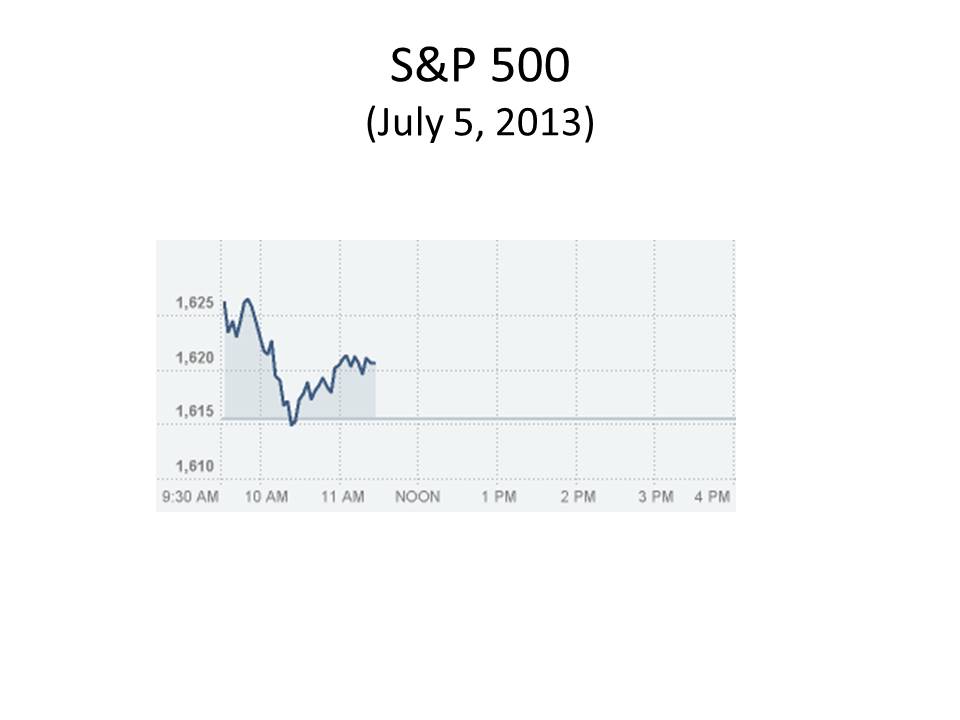
One hour after the Labor Department announcement, the NYSE opened with the S&P 500 10 points above its Wednesday close, and immediately started to fall. Here’s a picture of the S&P 500 so far today.

Image

What happened? The good news about job creation signals a strengthening economy that could be poised to start a real recovery as opposed to the pseudo-recovery of the past four years. But, as I explained last week, thanks to the Fed’s promise to start tapering off its asset purchases as soon as the economy starts to improve, the market now greets good news with fear and trepidation. So the good news about the economy is cancelled out by the bad news about Fed policy.

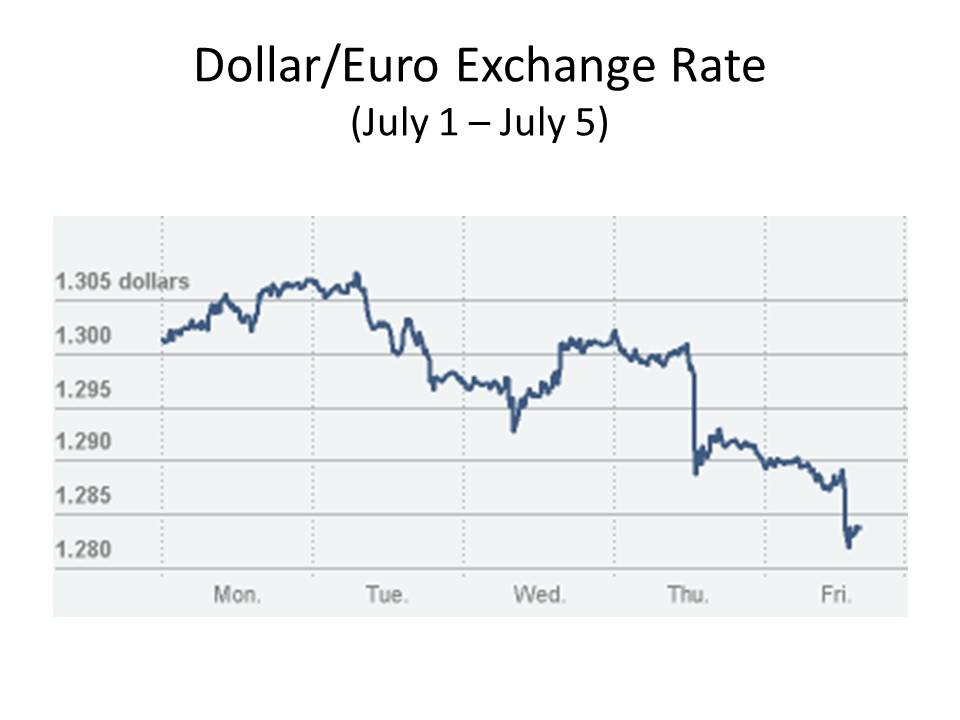
That explains why the yield on the 10-year Treasury note shot up this morning by 20 basis points today to its highest level in two years. And here’s a picture of what happened to the dollar/euro exchange rate today after the jobs announcement.Image

Well the sky is not falling — yet. But I just don’t know how much more good news like this the economy can stand.

Who Sets the Real Rate of Interest?

Understanding economics requires, among other things, understanding the distinction between real and nominal variables. Confusion between real and nominal variables is pervasive, constantly presenting barriers to clear thinking, and snares and delusions for the mentally lazy. In this post, I want to talk about the distinction between the real rate of interest and the nominal rate of interest. That distinction has been recognized for at least a couple of centuries, Henry Thornton having mentioned it early in the nineteenth century. But the importance of the distinction wasn’t really fully understood until Irving Fisher made the distinction between the real and nominal rates of interest a key element of his theory of interest and his theory of money, expressing the relationship in algebraic form — what we now call the Fisher equation. Notation varies, but the Fisher equation can be written more or less as follows:

i = r + dP/dt,

where i is the nominal rate, r is the real rate, and dP/dt is the rate of inflation. It is important to bear in mind that the Fisher equation can be understood in two very different ways. It can either represent an ex ante relationship, with dP/dt referring to expected inflation, or it can represent an ex post relationship, with dP/dt referring to actual inflation.

What I want to discuss in this post is the tacit assumption that usually underlies our understanding, and our application, of the ex ante version of the Fisher equation. There are three distinct variables in the Fisher equation: the real and the nominal rates of interest and the rate of inflation. If we think of the Fisher equation as an ex post relationship, it holds identically, because the unobservable ex post real rate is defined as the difference between the nominal rate and the inflation rate. The ex post, or the realized, real rate has no independent existence; it is merely a semantic convention. But if we consider the more interesting interpretation of the Fisher equation as an ex ante relationship, the real interest rate, though still unobservable, is not just a semantic convention. It becomes the theoretically fundamental interest rate of capital theory — the market rate of intertemporal exchange, reflecting, as Fisher masterfully explained in his canonical renderings of the theory of capital and interest, the “fundamental” forces of time preference and the productivity of capital. Because it is determined by economic “fundamentals,” economists of a certain mindset naturally assume that the real interest rate is independent of monetary forces, except insofar as monetary factors are incorporated in inflation expectations. But if money is neutral, at least in the long run, then the real rate has to be independent of monetary factors, at least in the long run. So in most expositions of the Fisher equation, it is tacitly assumed that the real rate can be treated as a parameter determined, outside the model, by the “fundamentals.” With r determined exogenously, fluctuations in i are correlated with, and reflect, changes in expected inflation.

Now there’s an obvious problem with the Fisher equation, which is that in many, if not most, monetary models, going back to Thornton and Wicksell in the nineteenth century, and to Hawtrey and Keynes in the twentieth, and in today’s modern New Keynesian models, it is precisely by way of changes in its lending rate to the banking system that the central bank controls the rate of inflation. And in this framework, the nominal interest rate is negatively correlated with inflation, not positively correlated, as implied by the usual understanding of the Fisher equation. Raising the nominal interest rate reduces inflation, and reducing the nominal interest rate raises inflation. The conventional resolution of this anomaly is that the change in the nominal interest rate is just temporary, so that, after the economy adjusts to the policy of the central bank, the nominal interest rate also adjusts to a level consistent with the exogenous real rate and to the rate of inflation implied by the policy of the central bank. The Fisher equation is thus an equilibrium relationship, while central-bank policy operates by creating a short-term disequilibrium. But the short-term disequilibrium imposed by the central bank cannot be sustained, because the economy inevitably begins an adjustment process that restores the equilibrium real interest rate, a rate determined by fundamental forces that eventually override any nominal interest rate set by the central bank if that rate is inconsistent with the equilibrium real interest rate and the expected rate of inflation.

It was just this analogy between the powerlessness of the central bank to hold the nominal interest rate below the sum of the exogenously determined equilibrium real rate and the expected rate of inflation that led Milton Friedman to the idea of a “natural rate of unemployment” when he argued that monetary policy could not keep the unemployment rate below the “natural rate ground out by the Walrasian system of general equilibrium equations.” Having been used by Wicksell as a synonym for the Fisherian equilibrium real rate, the term “natural rate” was undoubtedly adopted by Friedman, because monetarily induced deviations between the actual rate of unemployment and the natural rate of unemployment set in motion an adjustment process that restores unemployment to its “natural” level, just as any deviation between the nominal interest rate and the sum of the equilibrium real rate and expected inflation triggers an adjustment process that restores equality between the nominal rate and the sum of the equilibrium real rate and expected inflation.

So, if the ability of the central bank to use its power over the nominal rate to control the real rate of interest is as limited as the conventional interpretation of the Fisher equation suggests, here’s my question: When critics of monetary stimulus accuse the Fed of rigging interest rates, using the Fed’s power to keep interest rates “artificially low,” taking bread out of the mouths of widows, orphans and millionaires, what exactly are they talking about? The Fed has no legal power to set interest rates; it can only announce what interest rate it will lend at, and it can buy and sell assets in the market. It has an advantage because it can create the money with which to buy assets. But if you believe that the Fed cannot reduce the rate of unemployment below the “natural rate of unemployment” by printing money, why would you believe that the Fed can reduce the real rate of interest below the “natural rate of interest” by printing money? Martin Feldstein and the Wall Street Journal believe that the Fed is unable to do one, but perfectly able to do the other. Sorry, but I just don’t get it.

Look at the accompanying chart. It tracks the three variables in the Fisher equation (the nominal interest rate, the real interest rate, and expected inflation) from October 1, 2007 to July 2, 2013. To measure the nominal interest rate, I use the yield on 10-year Treasury bonds; to measure the real interest rate, I use the yield on 10-year TIPS; to measure expected inflation, I use the 10-year breakeven TIPS spread. The yield on the 10-year TIPS is an imperfect measure of the real rate, and the 10-year TIPS spread is an imperfect measure of inflation expectations, especially during financial crises, when the rates on TIPS are distorted by illiquidity in the TIPS market. Those aren’t the only problems with identifying the TIPS yield with the real rate and the TIPS spread with inflation expectations, but those variables usually do provide a decent approximation of what is happening to real rates and to inflation expectations over time.

real_and_nominal_interest_rates

Before getting to the main point, I want to make a couple of preliminary observations about the behavior of the real rate over time. First, notice that the real rate declined steadily, with a few small blips, from October 2007 to March 2008, when the Fed was reducing the Fed Funds target rate from 4.75 to 3% as the economy was sliding into a recession that officially began in December 2007. The Fed reduced the Fed Funds target to 2% at the end of April, but real interest rates had already started climbing in early March, so the failure of the FOMC to reduce the Fed Funds target again till October 2008, three weeks after the onset of the financial crisis, clearly meant that there was at least a passive tightening of monetary policy throughout the second and third quarters, helping create the conditions that precipitated the crisis in September. The rapid reduction in the Fed Funds target from 2% in October to 0.25% in December 2008 brought real interest rates down, but, despite the low Fed Funds rate, a lack of liquidity caused a severe tightening of monetary conditions in early 2009, forcing real interest rates to rise sharply until the Fed announced its first QE program in March 2009.

I won’t go into more detail about ups and downs in the real rate since March 2009. Let’s just focus on the overall trend. From that time forward, what we see is a steady decline in real interest rates from over 2% at the start of the initial QE program till real rates bottomed out in early 2012 at just over -1%. So, over a period of three years, there was a steady 3% decline in real interest rates. This was no temporary phenomenon; it was a sustained trend. I have yet to hear anyone explain how the Fed could have single-handedly produced a steady downward trend in real interest rates by way of monetary expansion over a period of three years. To claim that decline in real interest rates was caused by monetary expansion on the part of the Fed flatly contradicts everything that we think we know about the determination of real interest rates. Maybe what we think we know is all wrong. But if it is, people who blame the Fed for a three-year decline in real interest rates that few reputable economists – and certainly no economists that Fed critics pay any attention to — ever thought was achievable by monetary policy ought to provide an explanation for how the Fed suddenly got new and unimagined powers to determine real interest rates. Until they come forward with such an explanation, Fed critics have a major credibility problem.

So please – pleaseWall Street Journal editorial page, Martin Feldstein, John Taylor, et al., enlighten us. We’re waiting.

PS Of course, there is a perfectly obvious explanation for the three-year long decline in real interest rates, but not one very attractive to critics of QE. Either the equilibrium real interest rate has been falling since 2009, or the equilibrium real interest rate fell before 2009, but nominal rates adjusted slowly to the reduced real rate. The real interest rate might have adjusted more rapidly to the reduced equilibrium rate, but that would have required expected inflation to have risen. What that means is that sometimes it is the real interest rate, not, as is usually assumed, the nominal rate, that adjusts to the expected rate of inflation. My next post will discuss that alternative understanding of the implicit dynamics of the Fisher equation.

Watch out for that Fed Reaction Function

Scott Sumner had a terrific post today. The title said it all, but the rest of it wasn’t bad either.

The stock market wants fast economic growth, and they want the Fed to think economic growth is slow

Eureka!  Today we found out that NGDP (which the Fed looks at) grew at a 2.19% rate over the past 6 months and the more accurate NGDI grew by 5.06%.

Stocks soared on the news.

And shhhh!  Don’t anyone tell the Fed about NGDI!

Scott hit it right on the nose with that one.

It reminded me of something, so I went an looked it up in a book I happen to have at home.

Here’s what it says about Fed policy coming out of the 1981-82 recession.

The renewed stringency forced interest rates to rise slightly while driving the dollare ever higher and commodities prices ever lower. Yet the recovery, once under way, was too powerful to be slowed down perceptibly by the monetary pressure. . . .

The recovery continued in the first half of 1984. But the amazing strength of the recovery pulled the growth of M-1 above its targets, reviving fears that the Fed would have to tighten. Instead of being welcomed, each bit of favorable economic news – strong growth in real GNP, reduced unemployment, higher factory orders – was greeted with fear and trepidation in the financial markets, because such reports were viewed as portents of future tightening by the Fed. Those fears generated continuing increases in interest rates, appreciation of the dollar, and falling commodities prices. In the summer of 1984, monetary stringency and fears that the Fed would clamp down even more tightly to bring the growth of M-1 back within its targets were threatening to produce a credit crunch and abort the recovery.

With interest rates and the dollar’s exchange rate again starting to rise rapidly, and with commodity prices losing the modest gains they had made in the previous year, the recovery was indeed threatened. In late July of 1984, two years after the Fed had given up its earlier effort to meet its monetary targets, the conditions for a credit crunch, if not a full scale panic, were again developing. The most widely reported monetary aggregate, M-1, was above the upper limit of the Fed’s growth target, and economic growth in the second quarter of 1984 was reported to have been an unexpectedly strong 7.5%. Commodities prices were practically in free fall and the dollar was soaring.

Once again, however, a timely intervention by Mr. Volcker calmed the markets and put to rest fears that the Fed would strive to keep monetary growth within the announced target ranges. Appearing before Congress, he announced that he expected inflation to remain low [around 4%!!!] and that the Fed would maintain its policy without seeking any further tightening to bring monetary growth within the target range. This assurance stopped, at least for a brief spell, the dollar’s rise in foreign exchange markets and permitted a slight rebound in commodities prices. Mr. Volcker’s assurance that monetary policy would not be tightened encouraged the public to stop trying to build up precautionary balances. As a consequence, M-1 growth leveled off even as interest rates fell back somewhat.

All the while Monetarist were loudly protesting the conduct of monetary policy. Before the Fed abandoned its attempt to target M-1, Monetarists criticized the Fed for not keeping monetary growth steady enough. For a time, they even attributed the failure of interest rates to fall as rapidly as the rate of inflation in 1981, or to fall at all in the first half of 1982, to uncertainty created by too much variability in the rate of monetary growth. Later, when the Fed abandoned, at any rate deemphasized, monetary targets, they warned that inflation would soon start to rise again. In late 1982, just as the economy was hitting bottom, Milton Friedman was predicting the return of double-digit inflation [sound familiar?] before the next election.

What book did I get that from? OK, I admit it. It’s from my book Free Banking and Monetary Reform, pp. 220-21. So we’ve been through this before. When the Fed adopts a crazy reaction function in which it won’t tolerate real growth above a certain threshold, which is what the Fed seems to have done, with the threshold at 3% or less, funny things start to happen.

How come no one is laughing?

PS I apologize again for not replying to comments lately. I am still trying to cope with my workload.


About Me

David Glasner
Washington, DC

I am an economist in the Washington DC area. My research and writing has been mostly on monetary economics and policy and the history of economics. In my book Free Banking and Monetary Reform, I argued for a non-Monetarist non-Keynesian approach to monetary policy, based on a theory of a competitive supply of money. Over the years, I have become increasingly impressed by the similarities between my approach and that of R. G. Hawtrey and hope to bring Hawtrey’s unduly neglected contributions to the attention of a wider audience.

My new book Studies in the History of Monetary Theory: Controversies and Clarifications has been published by Palgrave Macmillan

Follow me on Twitter @david_glasner

Archives

Enter your email address to follow this blog and receive notifications of new posts by email.

Join 665 other subscribers
Follow Uneasy Money on WordPress.com