Archive for the 'expectations' Category


What Kind of Equilibrium Is This?

In my previous post, I suggested that Stephen Williamson’s views about the incapacity of monetary policy to reduce unemployment, and his fears that monetary expansion would simply lead to higher inflation and a repeat of the bad old days the 1970s when inflation and unemployment spun out of control, follow from a theoretical presumption that the US economy is now operating (as it almost always does) in the neighborhood of equilibrium. This does not seem right to me, but it is the sort of deep theoretical assumption (e.g., like the rationality of economic agents) that is not subject to direct empirical testing. It is part of what the philosopher Imre Lakatos called the hard core of a (in this case Williamson’s) scientific research program. Whatever happens, Williamson will process the observed facts in terms of a theoretical paradigm in which prices adjust and markets clear. No other way of viewing reality makes sense, because Williamson cannot make any sense of it in terms of the theoretical paradigm or world view to which he is committed. I actually have some sympathy with that way of looking at the world, but not because I think it’s really true; it’s just the best paradigm we have at the moment. But I don’t want to follow that line of thought too far now, but who knows, maybe another time.

A good illustration of how Williamson understands his paradigm was provided by blogger J. P. Koning in his comment on my previous post copying the following quotation from a post written by Williamson a couple of years on his blog.

In other cases, as in the link you mention, there are people concerned about disequilibrium phenomena. These approaches are or were popular in Europe – I looked up Benassy and he is still hard at work. However, most of the mainstream – and here I’m including New Keynesians – sticks to equilibrium economics. New Keynesian models may have some stuck prices and wages, but those models don’t have to depart much from standard competitive equilibrium (or, if you like, competitive equilibrium with monopolistic competition). In those models, you have to determine what a firm with a stuck price produces, and that is where the big leap is. However, in terms of determining everything mathematically, it’s not a big deal. Equilibrium economics is hard enough as it is, without having to deal with the lack of discipline associated with “disequilibrium.” In equilibrium economics, particularly monetary equilibrium economics, we have all the equilibria (and more) we can handle, thanks.

I actually agree that departing from the assumption of equilibrium can involve a lack of discipline. Market clearing is a very powerful analytical tool, and to give it up without replacing it with an equally powerful analytical tool leaves us theoretically impoverished. But Williamson seems to suggest (or at least leaves ambiguous) that there is only one kind of equilibrium that can be handled theoretically, namely a fully optimal general equilibrium with perfect foresight (i.e., rational expectations) or at least with a learning process leading toward rational expectations. But there are other equilibrium concepts that preserve market clearing, but without imposing, what seems to me, the unreasonable condition of rational expectations and (near) optimality.

In particular, there is the Hicksian concept of a temporary equilibrium (inspired by Hayek’s discussion of intertemporal equilibrium) which allows for inconsistent expectations by economic agents, but assumes market clearing based on supply and demand schedules reflecting those inconsistent expectations. Nearly 40 years ago, Earl Thompson was able to deploy that equilibrium concept to derive a sub-optimal temporary equilibrium with Keynesian unemployment and a role for countercyclical monetary policy in minimizing inefficient unemployment. I have summarized and discussed Thompson’s model previously in some previous posts (here, here, here, and here), and I hope to do a few more in the future. The model is hardly the last word, but it might at least serve as a starting point for thinking seriously about the possibility that not every state of the economy is an optimal equilibrium state, but without abandoning market clearing as an analytical tool.

There’s a Whole Lot of Bubbling Going On

Noah Smith picked up on the following comment, made in passing by Stephen Williamson in a blog post mainly occupied with bashing his (Williamson’s) nemesis, Paul Krugman. Maybe I’ll come back with further comments on the rest of Williamson’s post anon, but, then again, maybe not; we’ll see. In the meantime, here’s Williamson on how to identify a bubble and pointing to money as an example of a pure bubble:

What is a bubble? You certainly can’t know it’s a bubble by just looking at it. You need a model. (i) Write down a model that determines asset prices. (ii) Determine what the actual underlying payoffs are on each asset. (iii) Calculate each asset’s “fundamental,” which is the expected present value of these underlying payoffs, using the appropriate discount factors. (iv) The difference between the asset’s actual price and the fundamental is the bubble. Money, for example, is a pure bubble, as its fundamental is zero. There is a bubble component to government debt, due to the fact that it is used in financial transactions (just as money is used in retail transactions) and as collateral. Thus bubbles can be a good thing. We would not compare an economy with money to one without money and argue that the people in the monetary economy are “spending too much,” would we?

Noah (I actually don’t know Noah, but since he has written a few complimentary posts and tweets about me, I consider him one of my best friends) was moved to write a whole blog post about this paragraph. But before quoting Noah’s response, I will just observe that what Williamson describes as a bubble is what Keynes described as a liquidity premium. People are willing to accept a lower rate of return on money than on other assets that they could hold, because, at the margin, money is providing them with valuable liquidity services. The reduction in the rate of return that they are willing to accept is achieved by bidding up the value of money until the expected service (liquidity) yield on money just compensates for the reduced pecuniary rate of return associated with holding money compared to alternative assets. This liquidity premium, by the way, is a result of the real quantity of money being less than optimal. If the real quantity of money were optimal, the liquidity premium would be zero, but a zero liquidity premium would not imply, as Pesek and Saving notoriously argued about 40 years, that the value of money would be annihilated. I don’t think that Williamson is making the mistake that Pesek and Saving made, but he is (to engage in a bit of metaphor mixing) skating on thin ice. Anyway, now to Noah:

Can this be true? Is money fundamentally worth nothing more than the paper it’s printed on (or the bytes that keep track of it in a hard drive)? It’s an interesting and deep question. But my answer is: No.

First, consider the following: If money is a pure bubble, than nearly every financial asset is a pure bubble. Why? Simple: because most financial assets entitle you only to a stream of money. A bond entitles you to coupons and/or a redemption value, both of which are paid in money. Equity entitles you to dividends (money), and a share of the (money) proceeds from a sale of the company’s assets. If money has a fundamental value of zero, and a bond or a share of stock does nothing but spit out money, the fundamental value of every bond or stock in existence is precisely zero.

Noah is making a good argument, a sort of reductio ad absurdum argument, but I think it’s wrong. The reason is that what Noah is looking at — the real value of non-money assets — is really a ratio, namely the nominal value of an asset divided by the price level measured in terms of the money (unit of account) whose value is supposedly a bubble. Noah says OK, suppose Williamson is right that money is a pure bubble. What would happen once people caught on and figured out that the money that they used to think was valuable is really worthless? Well, when money becomes worthless, the price level is infinite, so the real value of any asset must be zero. Really? I don’t think so. Noah is making a category mistake. Not all financial assets are alike. Some financial assets (bonds) are claims to a fixed stream of payments. But other financial assets (stocks) are claims to a variable stream of payments. Certainly bonds would become worthless as the price level was expected to rise without limit, but why would that be true of stocks? The cash flows associated with stocks would rise along with the increase in the price level. What Noah is doing (I think) is evaluating a ratio, the price of a stock relative to the general price level, as the price level (the inverse of the value of money) goes to infinity. If the denominator is infinite, then the ratio must equal zero, right? Not so fast. Just because the value of the denominator of a ratio goes to infinity does not mean that value of the ratio goes to infinity. That’s a fairly elementary mathematical error. To evaluate the ratio, if both the numerator and denominator are changing, you must look at the behavior of the ratio as the value of the denominator goes to infinity, not just at the denominator in isolation. For a stock, the numerator would go to infinity as the price level rose without limit, so you can’t infer that the real value of the stock goes to zero.

So the way to do the thought experiment is to ask what would happen to the value of a stock once people realized that the value of money was going to collapse. The answer, it seems to me, is that people would be trying to exchange their money for real assets, including stocks, as a way of avoiding the loss of wealth implied by the expected drop in the value of money to zero. Under the standard neutrality assumptions, a once and for all reduction in the value of money would imply a proportional increase in all prices. But the bubble case is different, inasmuch as everyone is anticipating the loss of value of money before it takes place, and is therefore trying to switch from holding cash balances to holding real assets. The value of real assets, including financial assets like stocks, would therefore tend to rise faster than the prices of the anticipated service flows embodied in those assets. Asset and stock prices would therefore tend to rise even faster than the general price level, which is to say that the real value of those assets would be rising, not falling, let alone falling to zero, as Noah suggests. So I am sorry, but I don’t think that Noah has succeeded in refuting Williamson.

But in a sense Noah does get it right, because he goes on to question whether there is any meaning to the whole notion of “fundamental value.”

So what is “fundamental value”? Is it consumption value? If that’s the case, then a toaster has zero fundamental value, since you can’t eat a toaster (OK, you can fling it at the heads of your enemies, but let’s ignore that possibility for now). A toaster’s value is simply that it has the capability to make toast, which is what you actually want to consume. So does a toaster have zero fundamental value, or is its fundamental value equal to the discounted expected consumption value of the toast that you will use it to produce?

If it’s the latter, then why doesn’t money have fundamental value for the exact same reason? After all, I can use money to buy a toaster, then use a toaster to make toast, then eat the toast. If the toaster has fundamental value, the money should too.

Well, the problem here is that the whole question is whether you will be able to buy a toaster with money once people realize that the true value of money is zero. The toaster will remain valuable after money becomes worthless, but money will not remain valuable after money becomes worthless. Nevertheless, the value of a toaster to you is itself not invariant to the tastes and preferences of people other than yourself. Toasters have value only if there are enough other people around that demand sliced bread. If the only kinds of bread that people wanted to eat were baguettes or matzah, your toaster would be worthless. The only goods that have unambiguous consumption value are goods for which there are no network effects. But there are very few such goods, as my toaster example shows. If so, the consumption value of almost any good can be negatively affected if the demand for that good, or for complementary goods, goes down. What you are willing to pay for any asset embodying a future service flow depends on your expectations about the value of that flow. There is no way to define a fundamental value that is independent of expectations, or, as I have previously observed, expectations are fundamental. That is why Keynes’s much reviled comparison, in Chapter 12 of the General Theory, of the stock market to predictions about the outcome of a beauty contest, while surely a caricature, was an insightful caricature.

Noah’s post prompted Paul Krugman to weigh in on Williamson’s assertion that money is a pure bubble. Invoking Samuelson’s overlapping generations model of money, Krugman rejects the notion that fiat money is a bubble. It is rather a “social contrivance.” Social contrivances are not bubbles; they depend on a web of conventions and institutions that support expectations that things will not fall apart. Similarly, Social Security is not, as some maintain, a grand Ponzi scheme. Krugman concludes on this note:

[T]he notion that there must be a “fundamental” source for money’s value, although it’s a right-wing trope, bears a strong family resemblance to the Marxist labor theory of value. In each case what people are missing is that value is an emergent property, not an essence: money, and actually everything, has a market value based on the role it plays in our economy — full stop.

I agree with this in spirit, but as an analytical matter, we are still left with the problem of explaining how fiat money can retain a positive value, based on the expectation that someone accepting it now in exchange will, in turn, be able to purchase something else with it further in the future, even though there is a powerful logical argument for why the value of fiat money must eventually fall to zero, in which case backward induction implies that its value falls to zero immediately.  Krugman actually alludes to one possible explanation for why the value of fiat money does not immediately fall to zero: the government makes it acceptable as payment for the taxes it imposes, or actually requires that tax obligations be discharged using the currency that it issues. By putting a floor under the current value of money, the creation of a non-monetary demand for money as way of discharging tax liabilities excludes the class of potential equilibria in which the current value of money goes to zero. Brad DeLong spells this out in more detail in his post about Noah Smith and Stephen Williamson.

So what is my point? Yes, I agree that money is not a bubble. But merely asserting that money performs a useful social function from which everyone gains is not enough to prove that it is not. That assertion doesn’t explain why that high-value social contrivance is robust. Expectations about the value of money, unless supported by some legal or institutional foundation, could turn pessimistic, and those pessimistic expectations would be self-fulfilling, notwithstanding all the good that money accomplishes. Optimistic expectations about the value of money require an anchor. That anchor cannot be “fundamental value,” because under pessimistic expectations, the “fundamental value” turns out to be zero. That’s why the tax argument, as the great P. H. Wicksteed eloquently explained a century ago, is necessary.

Thompson’s Reformulation of Macroeconomic Theory, Part IV

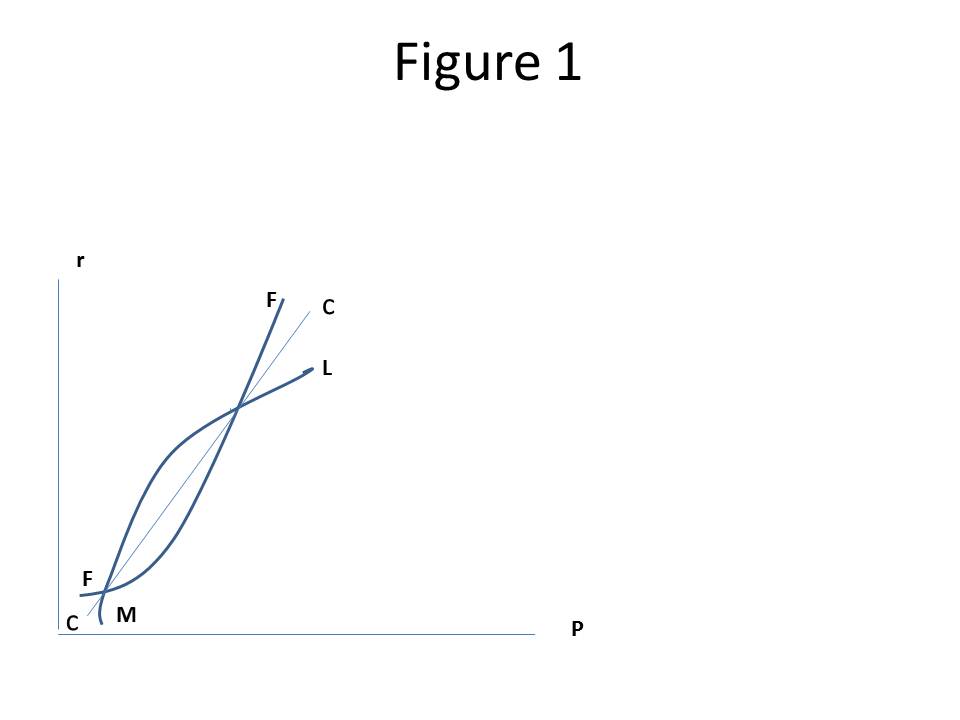
It’s time for another installment, after a longer than expected hiatus, in my series of posts summarizing and commenting on Earl Thompson’s path-breaking paper, “A Reformulaton of Macroeconomic Theory.” In the first three installments I described the shift on modeling strategy from the conventional Keynesian IS-LM model adopted by Thompson, and the basic properties of his reformulated model. In the first installment, I explained that Thompson’s key analytic insight was to ground the model in an explicitly neoclassical framework, exploiting the straightforward and powerful implications of the neoclassical theory of production to derive the basic properties of a macroeconomc model structurally comparable to the IS-LM model. The reformulated model shifts the analytic focus from the Keynesian spending functions to the conditions for factor-market equilibrium in a single-output, two-factor model. In the second installment, I explained how Thompson drew upon the Hicksian notion of temporary equilibrium for an explicit treatment of Keynesian (involuntary) unemployment dependent on incorrect (overly optimistic) expectations of future wages. While the model allows for inefficient (relative to correct expectations) choices by workers to remain unemployed owing to incorrect expectations, the temporary equilibrium nevertheless involves no departure from market clearing, and no violation of Walras’s Law. In the third installment, I described the solution of the model, deriving two market-equilibrium curves, one a locus of points of equilibrium (combinations of price levels and nominal interest rates) in the two factor markets (for labor and capital services) and one a locus of points of money-market equilibrium (again in terms of price levels and nominal interest rates) using the standard analytic techniques for deriving the Keynesian IS and LM curves.

Although not exactly the same as the Keynesian LM curve (constructed in income-interest-rate space), the locus of points of monetary equilibrium, having a similar upward slope, was assigned the familiar LM label. However, unlike the Keynesian IS curve it replaces, the locus of points, labeled FF, of factor-market equilibrium is positively sloped. The intersection of the two curves determines a temporary equilibrium, characterized by a price level, a corresponding level of employment, and for a given expected-inflation parameter, a corresponding real and nominal interest rate. The accompanying diagram, like Figure 4 in my previous installment, depicts such a temporary-equilibrium solution. I observed in the previous installment that applying Walras’s Law allows another locus of points corresponding to equilibrium in the market for the single output, which was labeled the CC curve (for commodity market equilibrium) by Thompson. The curve would have to lie in the space between the FF curve and the LM curve, where excess demands in each market have opposite (offsetting) signs. The CC curve is in some sense analogous to the Keynesian IS curve, but, as I am going to explain, it differs from the IS curve in a fundamental way. In the accompnaying diagram, I have reproduce the FF and LM curves of the with reformulated model with the CC curve drawn between the FF and LM curves. The slope of the CC curve is clearly positive, in contrast to the downward slope normally attributed to the Keynesian IS curve.

In this post, I am going to discuss Thompson’s explanation of the underlying connection between his reformulated macroeconomic model and the traditional Keynesian model. At a formal level, the two models share some of the same elements and a similar aggregative structure, raising the question what accounts for the different properties of the two models and to what extent can the analysis of one model be translated into the terms of the other model?

Aside from the difference in modeling strategy, focusing on factor-market equilibrium instead of an aggregate spending function, there must be a deeper underlying substantive difference between the two models, otherwise the choice of which market to focus on would not matter, Walras’s Law guaranteeing that anyone of the n markets can be eliminated without changing the equilibrium solution of a system of excess demand equations. So let us look a bit more closely at the difference between the Keynesian IS curve and the CC curve of the reformulated model. The most basic difference is that the CC curve relates to a stock equilibrium, with an equilibrating value of P in the market for purchasing the stock of commodities, representing the equilibrium market value of a unit of output. On the other hand, the Keynesian IS curve is measuring a flow, the rate of aggregate expenditure, the equilibrium corresponding to a particular rate of expenditure.

Thompson sums up the underlying difference between the Keynesian model and the reformulated model in two very dense paragraphs on pp. 16-17 of his paper under section heading “The role of aggregate spending and the Keynesian stock-flow fallacy.” I will quote the two paragraphs in full and try to explain as best as I can, what he is saying.

All of this is not to say that the flow of aggregate spending is irrelevant to our temporary equilibrium. The expected rate of inflation [as already noted a crucial parameter in the reformulated model] may depend parametrically upon the expected rate of spending. Then, an increase in the expected rate of spending on consumption or investment (or, more generally, an increase in the expected future excess demand for goods at the originally expected prices) would, by increased Pe [the expected price level] and thus r [the nominal interest rate] for a given R/P [the ratio of the rental price of capital to the price of capital, aka the real interest rate], shift up the FF curve. In a Modern Money Economy [i.e., an economy using a non-interest-bearing fiat money monopolistically supplied by a central bank], this shift induces a movement out of money [because an increase in the nominal interest rate increases the cost of holding non-interest-bearing fiat money] in the current market (a movement along the LM curve) and a higher current price level. This exogenous treatment of spendings variables, while perhaps most practical from the standpoint of business cycle policy, does not capture the Keynesian concept of an equilibrium rate of expenditure.

It is worth pausing here to ponder the final sentence of the paragraph, because the point that Thompson is getting at is far from obvious. I think what he means is that one can imagine, working within the framework of the reformulated FF-LM model, that a policy change, say an increase in government spending, could be captured by positing an effect on the expected price level. Additional government spending would raise the expected price level, thus causing an upward shift in the FF curve, thereby inducing people to hold less cash, leading to a new equilibrium associated with an intersection of the new FF curve at a point further up and to the right along the LM curve than the original intersection. Thus, the FF-LM framework can accommodate a traditional Keynesian fiscal policy exercise. But the IS-LM framework is unable to specify what the equilibrium rate of spending is and how that equilibrium can be determined, the problem being that there does not seem to be any variable in the model that adjusts to equilibrate the rate of spending in the way that the price level adjusts to equilibrate the market for output in the reformulated model. There is no condition specified to distinguish an equilibrium rate of spending from a non-equilibrium rate of spending. Now back to Thompson:

In order to obtain an equilibrium rate of expenditures – and thus an equilibrium rate of capital accumulation [aka investment, how much output will be carried over to next period] – a corresponding price variable must be added. The only economically natural price to introduce to equilibrate the demand and supply of next period’s capital goods is the price of next period’s capital goods. [In other words, how much of this period’s output that people want to hold until next period depends on the relationship between the current price of the output and the expected price in the next period.] This converts Pe into an equilibrating variable. Indeed, Section III below will show that if Pe is made the equilibrating price variable, making the rate of inflation an independently equilibrating variable rather than an expectations parameter determined by other variables in the system and extending the temporary equilibrium to a two-period equilibrium model in which only prices in the third and later periods may be incorrectly expected in the current period, the Keynesian expenditures condition, the equality of ex ante savings and investment, is indeed achieved. However, Section III will also show that the familiar Keynesian comparative statics results that are based upon a negatively sloped IS curve fail to hold in the extended model just as they fail in the above, single period model.

The upshot of Thompson’s argument is that you can’t have a Keynesian investment function without introducing an expected price for capital in the next period. Without an expected price of output in the next period, there is nothing to determine how much investment entrepreneurs choose to undertake in the current period. And if you want to identify an equilibrium rate of expenditure, which means an equilibrium rate of investment, then you must perforce allow the expected price for capital in the next period to adjust to achieve that equilibrium.

I must admit that I have been struggling with this argument since I first heard Earl make it in his graduate macro class almost 40 years ago, and it is only recently that I have begun to think that I understand what he was getting at. I was helped in seeing his point by the series of posts (this, this, this, this, this, this, this, and this) that I wrote earlier this year about identities and equilibrium conditions in the basic Keynesian model, and especially by the many comments and counterarguments that I received as a result of those posts. The standard Keynesian expenditure function is hard to distinguish from an income function (which also makes it hard to distinguish investment from savings), which makes it hard to understand the difference between expenditure being equal in equilibrium and being identical to savings in general or to understand the difference between savings and investment being equal in equilibrium and being identical in general. There is a basic problem in choosing define an equilibrium in terms of two magnitudes so closely related as income and expenditure. The equilibrating mechanism doesn’t seem to be performing any real economic work, so it hard to tell the difference between an equilibrium state and a disequilibrium state in such a model. Thompson may have been getting at this point from another angle by focusing on the lack of any equilibrating mechanism in the Keynesian model, and suggesting that an equilibrating mechanism, the expected future price level or rate of inflation, has to be added to the Keynesian model in order to make any sense out of it.

In my next installment, I will consider Thompson’s argument about the instability of the equilibrium in the FF-LM model.

Two Problems with Austrian Business-Cycle Theory

Even though he has written that he no longer considers himself an Austrian economist, George Selgin remains sympathetic to the Austrian theory of business cycles, and, in accord with the Austrian theory, still views recessions and depressions as more or less inevitable outcomes of distortions originating in the preceding, credit-induced, expansions. In a recent post, George argues that the 2002-06 housing bubble conforms to the Austrian pattern in which a central-bank lending rate held below the “appropriate,” or “natural” rate causes a real misallocation of resources reflecting the overvaluation of long-lived capital assets (like houses) induced by the low-interest rate policy. For Selgin, it was the Fed’s distortion of real interest rates from around 2003 to 2005 that induced a housing bubble even though the rate of increase in nominal GDP during the housing bubble was only slightly higher than the 5% rate of increase in nominal GDP during most of the Great Moderation.

Consequently, responses by Marcus Nunes, Bill Woolsey and Scott Sumner to Selgin, questioning whether he used an appropriate benchmark against which to gauge nominal GDP growth in the 2003 to 2006 period, don’t seem to me to address the core of Selgin’s argument. Selgin is arguing that the real distortion caused by the low-interest-rate policy of the Fed was more damaging to the economy than one would gather simply by looking at a supposedly excessive rate of nominal GDP growth, which means that the rate of growth of nominal GDP in that time period does not provide all the relevant information about the effects of monetary policy.

So to counter Selgin’s argument – which is to say, the central argument of Austrian Business-Cycle Theory – one has to take a step back and ask why a price bubble, or a distortion of interest rates, caused by central-bank policy should have any macroeconomic significance. In any conceivable real-world economy, entrepreneurial error is a fact of life. Malinvestments occur all the time; resources are, as a consequence, constantly being reallocated when new information makes clear that some resources were misallocated owing to mistaken expectations. To be sure, the rate of interest is a comprehensive price potentially affecting how all resources are allocated. But that doesn’t mean that a temporary disequilibrium in the rate of interest would trigger a major economy-wide breakdown, causing the growth of real output and income to fall substantially below their historical trend, perhaps even falling sharply in absolute terms.

The Austrian explanation for this system-wide breakdown is that the price bubble or the interest-rate misallocation leads to the adoption of investments projects and of production processes that “unsustainable.” The classic Austrian formulation is that the interest-rate distortion causes excessively roundabout production processes to be undertaken. For a time, these investment projects and production processes can be sustained by way of credit expansion that shifts resources from consumption to investment, what is sometimes called “forced saving.” At a certain point, the credit expansion must cease, and at that point, the unsustainability of the incomplete investment projects or even the completed, but excessively roundabout, production processes becomes clear, and the investments and production processes are abandoned. The capital embodied in those investment projects and production processes is revealed to have been worthless, and all or most of the cooperating factors of production, especially workers, are rendered unemployable in their former occupations.

Although it is not without merit, that story is far from compelling. There are two basic problems with it. First, the notion of unsustainability is itself unsustainable, or at the very least greatly exaggerated and misleading. Why must the credit expansion that produced the interest-rate distortion or the price bubble come to an end? Well, if one goes back to the original sources for the Austrian theory, namely Mises’s 1912 book The Theory of Money and Credit and Hayek’s 1929 book Monetary Theory and the Trade Cycle, one finds that the effective cause of the contraction of credit is not a physical constraint on the availability of resources with which to complete the investments and support lengthened production processes, but the willingness of the central bank to tolerate a decline in its gold holdings. It is quite a stretch to equate the demand of the central bank for a certain level of gold reserves with a barrier that renders the completion of investment projects and the operation of lengthened production processes impossible, which is how Austrian writers, fond of telling stories about what happens when someone tries to build a house without having the materials required for its completion, try to explain what “unsustainability” means.

The original Austrian theory of the business cycle was thus a theory specific to the historical conditions associated with classical gold standard. Hawtrey, whose theory of the business cycle, depended on a transmission mechanism similar to, but much simpler than, the mechanism driving the Austrian theory, realized that there was nothing absolute about the gold standard constraint on monetary expansion. He therefore believed that the trade cycle could be ameliorated by cooperation among the central banks to avoid the sharp credit contractions imposed by central banks when they feared that their gold reserves were falling below levels that they felt comfortable with. Mises and Hayek in the 1920s (along with most French economists) greatly mistrusted such ideas about central bank cooperation and economizing the use of gold as a threat to monetary stability and sound money.

However, despite their antipathy to proposals for easing the constraints of the gold standard on individual central banks, Mises and Hayek never succeeded in explaining why a central-bank expansion necessarily had to be stopped. Rather than provide such an explanation they instead made a different argument, which was that the stimulative effect of a central-bank expansion would wear off once economic agents became aware of its effects and began to anticipate its continuation. This was a fine argument, anticipating the argument of Milton Friedman and Edward Phelps in the late 1960s by about 30 or 40 years. But that was an argument that the effects of central-bank expansion would tend to diminish over time as its effects were anticipated. It was not an argument that the expansion was unsustainable. Just because total income and employment are not permanently increased by the monetary expansion that induces an increase in investment and an elongation of the production process does not mean that the investments financed by, and the production processes undertaken as a result of, the monetary expansion must be abandoned. The monetary expansion may cause a permanent shift in the economy’s structure of production in the same way that tax on consumption, whose proceeds were used to finance investment projects that would otherwise not have been undertaken, might be carried on indefinitely. So the Austrian theory has never proven that forced saving induced by monetary expansion, in the absence of a gold-standard constraint, is necessarily unsustainable, inevitably being reversed because of physical constraints preventing the completion of the projects financed by the credit expansion. That’s the first problem.

The second problem is even more serious, and it goes straight to the argument that Selgin makes against Market Monetarists. The whole idea of unsustainability involves a paradox. The paradox is that unsustainability results from some physical constraint on the completion of investment projects or the viability of newly adopted production processes, because the consumer demand is driving up the costs of resources to levels making it unprofitable to complete the investment projects or operate new production processes.  But this argument presumes that all the incomplete investment projects and all the new production processes become unprofitable more or less simultaneously, leading to their rapid abandonment. But the consequence is that all the incomplete investment projects and all the newly adopted production processes are scuttled, producing massive unemployment and redundant resources. But why doesn’t that drop in resource prices restore the profitability of all the investment projects and production processes just abandoned?

It therefore seems that the Austrian vision is of a completely brittle economy in which price adjustments continue without inducing any substitutions to ease the resource bottlenecks. Demands and supplies are highly inelastic, and adjustments cannot be made until prices can no longer even cover variable costs. At that point prices collapse, implying that resource bottlenecks are eliminated overnight, without restoring profitability to any of the abandoned projects or processes.  Actually the most amazing thing about such a vision may be how closely it resembles the vision of an economy espoused by Hayek’s old nemesis Piero Sraffa in his late work The Production of Commodities by Means of Commodities, a vision based on fixed factor proportions in production, thus excluding the possibility of resource substitution in production in response to relative price changes.

A more realistic vision, it seems to me, would be for resource bottlenecks to induce substitution away from the relatively scarce resources allowing production processes to continue in operation even though the value of many fixed assets would have to be written down substantially. Those write downs would allow existing or new owners to maintain output as long as total demand is not curtailed as a result of a monetary policy that either deliberately seeks or inadvertently allows monetary contraction. Real distortions inherited from the past can be accommodated and adjusted to by a market economy as long as that economy is not required at the same time to undergo a contraction, in total spending. But once a sharp contraction in total spending does occur, a recovery may require a temporary boost in total spending above the long-term trend that would have sufficed under normal conditions.

Economy, Heal Thyself

Lately, some smart economists (Eli Dourado backed up by Larry White, George Selgin, and Tyler Cowen) have been questioning whether it is plausible, four years after the US economy was hit with a severe negative shock to aggregate demand, and about three and a half years since aggregate demand stopped falling (nominal GDP subsequently growing at about a 4% annual rate), that the reason for persistent high unemployment and anemic growth in real output is that nominal aggregate demand has been growing too slowly. Even conceding that the 4% growth in nominal GDP was too slow to generate a rapid recovery from the original shock, they still ask why almost four years after hitting bottom, we should assume that slow growth in real GDP and persistent high unemployment are the result of deficient aggregate demand rather than the result of some underlying real disturbance, such as a massive misallocation of resources and capital induced by the housing bubble from 2002 to 2006. In other words, even if it was an aggregated demand shock that caused a sharp downturn in 2008-09, and even if insufficient aggregate demand growth unnecessarily weakened and prolonged the recovery, what reason is there to assume that the economy could not, by now, have adjusted to a slightly lower rate of growth in nominal GDP 4% (compared to the 5 to 5.5% that characterized the period preceding the 2008 downturn). As Eli Dourado puts it:

If we view the recession as a purely nominal shock, then monetary stimulus only does any good during the period in which the economy is adjusting to the shock. At some point during a recession, people’s expectations about nominal flows get updated, and prices, wages, and contracts adjust. After this point, monetary stimulus doesn’t help.

Thus, Dourado,White, Selgin, and Cowen want to know why an economy not afflicted by some deep structural, (i.e. real) problems would not have bounced back to its long-term trend of real output and employment after almost four years of steady 4% nominal GDP growth. Four percent growth in nominal GDP may have been too stingy, but why should we believe that 4% nominal GDP growth would not, in the long run, provide enough aggregate demand to allow an eventual return to the economy’s long-run real growth path?  And if one concedes that a steady rate of 4% growth in nominal GDP would eventually get the economy back on its long-run real growth path, why should we assume that four years is not enough time to get there?

Well, let me respond to that question with one of my own: what is the theoretical basis for assuming that an economy subjected to a very significant nominal shock that substantially reduces real output and employment would ever recover from that shock and revert back to its previous growth path? There is, I suppose, a presumption that markets equilibrate themselves through price adjustments, prices adjusting in response to excess demands and supplies until markets again clear. But there is a fallacy of composition at work here. Supply and demand curves are always drawn for a single market. The partial-equilibrium analysis that we are taught in econ 101 operates based on the implicit assumption that all markets other than the one under consideration are in equilibrium. (That is actually a logically untenable assumption, because, according to Walras’s Law, if one market is out of equilibrium at least one other market must also be out of equilibrium, but let us not dwell on that technicality.) But after an economy-wide nominal shock, the actual adjustment process involves not one market, but many (if not most, or even all) markets are out of equilibrium. When many markets are out of equilibrium, the adjustment process is much more problematic than under the assumptions of the partial-equilibrium analysis that we are so accustomed to. Just because the adjustment process that brings a single isolated market back from disequilibrium to equilibrium seems straightforward, we are not necessarily entitled to assume that there is an equivalent adjustment process from an economy-wide disequilibrium in which many, most, or all, markets are starting from a position of disequilibrium. A price adjustment in any one market will, in general, affect demands and supplies in at least some other markets. If only a single market is out of equilibrium, the effects on other markets of price and quantity adjustment in that one market are likely to be small enough, so that those effects on other markets can be safely ignored. But when many, most, or all, markets are in disequilibrium, the adjustments in some markets may aggravate the disequilibrium in other markets, setting in motion an endless series of adjustments that may – but may not! — lead the economy back to equilibrium. We just don’t know. And the uncertainty about whether equilibrium will be restored becomes even greater, when one of the markets out of equilibrium is the market for labor, a market in which income effects are so strong that they inevitably have major repercussions on all other markets.

Dourado et al. take it for granted that people’s expectations about nominal flows get updatd, and that prices, wages, and contracts adjust. But adjustment is one thing; equilibration is another. It is one thing to adjust expectations about a market in disequilibrium when all or most markets ar ein or near equilibrium; it is another to adjust expectations when markets are all out of equilibrium. Real interest rates, as very imperfectly approximated by TIPS, seem to have been falling steadily since early 2011 reflecting increasing pessimism about future growth in the economy. To overcome the growing entrepreneurial pessimism underlying the fall in real interest rates, it would have been necessary for workers to have accepted wage cuts far below their current levels. That scenario seems wildly unrealistic under any conceivable set of conditions. But even if the massive wage cuts necessary to induce a substantial increase in employment were realistic, wage cuts of that magnitude could have very unpredictable repercussions on consumption spending and prices, potentially setting in motion a destructive deflationary spiral. Dourado assumes that updating expectations about nominal flows, and the adjustments of prices and wages and contracts lead to equilibrium – that the short run is short. But that is question begging no less than those who look at slow growth and high unemployment and conclude that the economy is operating below its capacity. Dourado is sure that the economy has to return to equilibrium in a finite period of time, and I am sure that if the economy were in equilibrium real output would be growing at least 3% a year, and unemployment would be way under 8%. He has no more theoretical ground for his assumption than I do for mine.

Dourado challenges supporters of further QE to make “a broadly falsifiable claim about how long the short run lasts.” My response is that there is no theory available from which to deduce such a falsifiable claim. And as I have pointed out a number of times, no less an authority than F. A. Hayek demonstrated in his 1937 paper “Economics and Knowledge” that there is no economic theory that entitles us to conclude that the conditions required for an intertemporal equilibrium are in fact ever satisfied, or even that there is a causal tendency for them to be satisfied. All we have is some empirical evidence that economies from time to time roughly approximate such states. But that certainly does not entitle us to assume that any lapse from such a state will be spontaneously restored in a finite period of time.

Do we know that QE will work? Do we know that QE will increase real growth and reduce unemployment? No, but we do have a lot of evidence that monetary policy has succeeded in increasing output and employment in the past by changing expectations of the future price-level path. To assume that the current state of the economy is an equilibrium when unemployment is at a historically high level and inflation at a historically low level seems to me just, well, irresponsible.

Two Cheers for Ben

I admit that I have not been kind to Ben Bernanke. And although I have never met him, he seems like a very nice man, and I think that I would probably like Mr. Bernanke if I knew him. So, aside from my pleasure at seeing a concrete step taken toward recovery, I am happy to be able to say something nice about Mr. Bernanke for a change. And it’s not just me, obviously the stock market has also been pleased by Mr. Bernanke’s performance of late, and especially today.

Almost three months ago, I wrote a post in which I complained when the FOMC in its statement described a weakening economic recovery and falling inflation, already less than the Fed’s target, with no sense of urgency about improving the economic situation and ensuring that inflation would not continually fail to reach even the stingy and inadequate target that the Fed had set for itself.  A few days later, I voiced alarm that inflation expectations were falling rapidly, suggesting the risk of another financial crisis. The crisis did not come to pass, and Bernanke’s opaque ambiguity about policy, combined with an explicit acknowledgment of a weakening economy, provided some Fed watchers with grounds for hope that the Fed might be considering a change in policy. But in his testimony to Congress in July, Bernanke declined to offer any reassurance that a change of policy was in the offing, a wasted opportunity that I strongly criticized. However, in its August meeting, the FOMC finally gave a clear signal that it was dissatisfied with the current situation, and would take steps to change the policy in September unless clear signs of a strengthening recovery emerged that would indicate that no change of policy was necessary to get a recovery started.  By late July and early August, the perception that the Fed was moving toward a change in policy led to a mini-rally even before the August FOMC meeting.

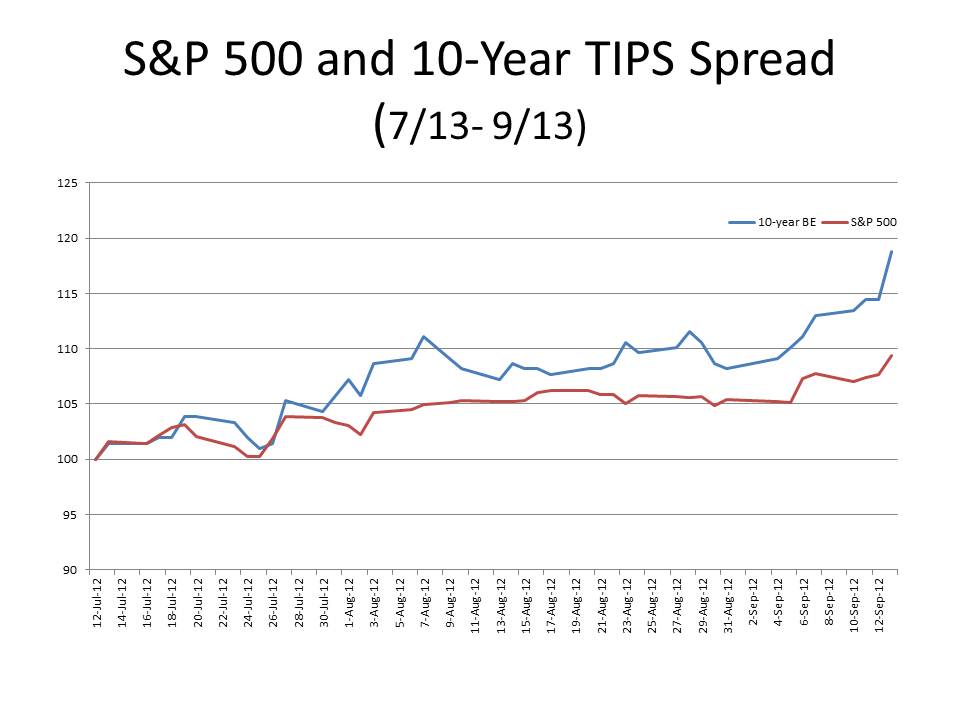
Thus, the entire summer can be viewed as a gradual build up to today’s announcement. From early July until today, inflation expectations, as approximated by the 10-year breakeven spread between 10-year Treasuries and 10-year TIPS, have been gradually rising as have stock prices. And today, the 10-year breakeven spread increased by 11 basis points, while the S&P 500 rose by almost 2%, the gains coming almost entirely after release of the FOMC statement shortly after 12PM this afternoon. Since early July, the 10-year breakeven spread has increased by 38 basis points, and the S&P 500 has risen by 9%.

The accompanying chart tracks the 10-year breakeven TIPS spread and the S&P 500 between July 12 and September 13 (both series normalized to be 100 on July 12). The correlation coefficient between the two series is 92.5%.

To provide a bit more perspective on what the increase in stock prices means, let me also note that today’s close of the S&P 500 was 1459.99. That is still about 100 points below the all-time high of the S&P 500, reached almost 5 years ago in October 2007. If the S&P 500 had increased modestly at about a 5% annual rate, the S&P 500 would now be in the neighborhood of 2000, so the S&P 500, even after more than doubling since it bottomed out in March 2009, may be less than 75% of the level it would be at if the economy were performing near capacity. To suggest that the S&P 500 is now overvalued – just another bubble — as critics of further QE have asserted, doesn’t seem even remotely reasonable.

So Mr. Bernanke had a very good day today. Let’s hope it’s the start of a trend of good decision-making, and not just a fluke.

The Wisdom of David Laidler

Michael Woodford’s paper for the Jackson Hole Symposium on Monetary Policy wasn’t the only important paper on monetary economics to be posted on the internet last month. David Laidler, perhaps the world’s greatest expert on the history of monetary theory and macroeconomics since the time of Adam Smith, has written an important paper with the somewhat cryptic title, “Two Crises, Two Ideas, and One Question.” Most people will figure out pretty quickly which two crises Laidler is referring to, but you will have to read the paper in order to figure out which two ideas and which question, Laidler has on his mind. Actually, you won’t have to read the paper if you keep reading this post, because I am about to tell you. The two ideas are what Laidler calls the “Fisher relation” between real and nominal interest rates, and the idea of a lender of last resort. The question is whether a market economy is inherently stable or unstable.

How does one weave these threads into a coherent narrative? Well, to really understand that you really will just have to read Laidler’s paper, but this snippet from the introduction will give you some sense of what he is up to.

These two particular ideas are especially interesting, because in the 1960s and ’70s, between our two crises, they feature prominently in the Monetarist reassessment of the Great Depression, which helped to establish the dominance in macroeconomic thought of the view that, far from being a manifestation of deep flaws in the very structure of the market economy, as it had at first been taken to be, this crisis was the consequence of serious policy errors visited upon an otherwise robustly self-stabilizing system. The crisis that began in 2007 has re-opened this question.

The Monetarist counterargument to the Keynesian view that the market economy is inherently subject to wide fluctuations and has no strong tendency toward full employment was that the Great Depression was caused primarily by a policy shock, the failure of the Fed to fulfill its duty to act as a lender of last resort during the US financial crisis of 1930-31. Originally, the Fisher relation did not figure prominently in this argument, but it eventually came to dominate Monetarism and the post-Monetarist/New Keynesian orthodoxy in which the job of monetary policy was viewed as setting a nominal interest rate (via a Taylor rule) that would be consistent with expectations of an almost negligible rate of inflation of about 2%.

This comfortable state of affairs – Monetarism without money is how Laidler describes it — in which an inherently stable economy would glide along its long-run growth path with low inflation, only rarely interrupted by short, shallow recessions, was unpleasantly overturned by the housing bubble and the subsequent financial crisis, producing the steepest downturn since 1937-38. That downturn has posed a challenge to Monetarist orthodoxy inasmuch as the sudden collapse, more or less out of nowhere in 2008, seemed to suggest that the market economy is indeed subject to a profound instability, as the Keynesians of old used to maintain. In the Great Depression, Monetarists could argue, it was all, or almost all, the fault of the Federal Reserve for not taking prompt action to save failing banks and for not expanding the money supply sufficiently to avoid deflation. But in 2008, the Fed provided massive support to banks, and even to non-banks like AIG, to prevent a financial meltdown, and then embarked on an aggressive program of open-market purchases that prevented an incipient deflation from taking hold.

As a result, self-identifying Monetarists have split into two camps. I will call one camp the Market Monetarists, with whom I identify even though I am much less of a fan of Milton Friedman, the father of Monetarism, than most Market Monetarists, and, borrowing terminology adopted in the last twenty years or so by political conservatives in the US to distinguish between old-fashioned conservatives and neoconservatives, I will call the old-style Monetarists, paleo-Monetarists. The paelo-Monetarists are those like Alan Meltzer, the late Anna Schwartz, Thomas Humphrey, and John Taylor (a late-comer to Monetarism who has learned quite well how to talk to the Monetarist talk). For the paleo-Monetarists, in the absence of deflation, the extension of Fed support to non-banking institutions and the massive expansion of the Fed’s balance sheet cannot be justified. But this poses a dilemma for them. If there is no deflation, why is an inherently stable economy not recovering? It seems to me that it is this conundrum which has led paleo-Monetarists into taking the dubious position that the extreme weakness of the economic recovery is a consequence of fiscal and monetary-policy uncertainty, the passage of interventionist legislation like the Affordable Health Care Act and the Dodd-Frank Bill, and the imposition of various other forms of interventionist regulations by the Obama administration.

Market Monetarists, on the other hand, have all along looked to monetary policy as the ultimate cause of both the downturn in 2008 and the lack of a recovery subsequently. So, on this interpretation, what separates paleo-Monetarists from Market Monetarists is whether you need outright deflation in order to precipitate a serious malfunction in a market economy, or whether something less drastic can suffice. Paleo-Monetarists agree that Japan in the 1990s and even early in the 2000s was suffering from a deflationary monetary policy, a policy requiring extraordinary measures to counteract. But the annual rate of deflation in Japan was never more than about 1% a year, a far cry from the 10% annual rate of deflation in the US between late 1929 and early 1933. Paleo-Monetarists must therefore explain why there is a radical difference between 1% inflation and 1% deflation. Market Monetarists also have a problem in explaining why a positive rate of inflation, albeit less than the 2% rate that is generally preferred, is not adequate to sustain a real recovery from starting more than four years after the original downturn. Or, if you prefer, the question could be restated as why a 3 to 4% rate of increase in NGDP is not adequate to sustain a real recovery, especially given the assumption, shared by paleo-Monetarists and Market Monetarists, that a market economy is generally stable and tends to move toward a full-employment equilibrium.

Here is where I think Laidler’s focus on the Fisher relation is critically important, though Laidler doesn’t explicitly address the argument that I am about to make. This argument, which I originally made in my paper “The Fisher Effect under Deflationary Expectations,” and have repeated in several subsequent blog posts (e.g., here) is that there is no specific rate of deflation that necessarily results in a contracting economy. There is plenty of historical experience, as George Selgin and others have demonstrated, that deflation is consistent with strong economic growth and full employment. In a certain sense, deflation can be a healthy manifestation of growth, allowing that growth, i.e., increasing productivity of some or all factors of production, to be translated into falling output prices. However, deflation is only healthy in an economy that is growing because of productivity gains. If productivity is flagging, there is no space for healthy (productivity-driven) deflation.

The Fisher relation between the nominal interest rate, the real interest rate and the expected rate of deflation basically tells us how much room there is for healthy deflation. If we take the real interest rate as given, that rate constitutes the upper bound on healthy deflation. Why, because deflation greater than real rate of interest implies a nominal rate of interest less than zero. But the nominal rate of interest has a lower bound at zero. So what happens if the expected rate of deflation is greater than the real rate of interest? Fisher doesn’t tell us, because in equilibrium it isn’t possible for the rate of deflation to exceed the real rate of interest. But that doesn’t mean that there can’t be a disequilibrium in which the expected rate of deflation is greater than the real rate of interest. We (or I) can’t exactly model that disequilibrium process, but whatever it is, it’s ugly. Really ugly. Most investment stops, the rate of return on cash (i.e., expected rate of deflation) being greater than the rate of return on real capital. Because the expected yield on holding cash exceeds the expected yield on holding real capital, holders of real capital try to sell their assets for cash. The only problem is that no one wants to buy real capital with cash. The result is a collapse of asset values. At some point, asset values having fallen, and the stock of real capital having worn out without being replaced, a new equilibrium may be reached at which the real rate will again exceed the expected rate of deflation. But that is an optimistic scenario, because the adjustment process of falling asset values and a declining stock of real capital may itself feed pessimistic expectations about the future value of real capital so that there literally might not be a floor to the downward spiral, at least not unless there is some exogenous force that can reverse the downward spiral, e.g., by changing price-level expectations.  Given the riskiness of allowing the rate of deflation to come too close to the real interest rate, it seems prudent to keep deflation below the real rate of interest by a couple of points, so that the nominal interest rate doesn’t fall below 2%.

But notice that this cumulative downward process doesn’t really require actual deflation. The same process could take place even if the expected rate of inflation were positive in an economy with a negative real interest rate. Real interest rates have been steadily falling for over a year, and are now negative even at maturities up to 10 years. What that suggests is that ceiling on tolerable deflation is negative. Negative deflation is the same as inflation, which means that there is a lower bound to tolerable inflation.  When the economy is operating in an environment of very low or negative real rates of interest, the economy can’t recover unless the rate of inflation is above the lower bound of tolerable inflation. We are not in the critical situation that we were in four years ago, when the expected yield on cash was greater than the expected yield on real capital, but it is a close call. Why are businesses, despite high earnings, holding so much cash rather than using it to purchase real capital assets? My interpretation is that with real interest rates negative, businesses do not see a sufficient number of profitable investment projects to invest in. Raising the expected price level would increase the number of investment projects that appear profitable, thereby inducing additional investment spending, finally inducing businesses to draw down, rather than add to, their cash holdings.

So it seems to me that paleo-Monetarists have been misled by a false criterion, one not implied by the Fisher relation that has become central to Monetarist and Post-Monetarist policy orthodoxy. The mere fact that we have not had deflation since 2009 does not mean that monetary policy has not been contractionary, or, at any rate, insufficiently expansionary. So someone committed to the proposition that a market economy is inherently stable is not obliged, as the paleo-Monetarists seem to think, to take the position that monetary policy could not have been responsible for the failure of the feeble recovery since 2009 to bring us back to full employment. Whether it even makes sense to think about an economy as being inherently stable or unstable is a whole other question that I will leave for another day.

HT:  Lars Christensen
The Good News and the (Very) Bad News about Bernanke’s Speech

UPDATE:  In response to a comment, I have revised slightly the third paragraph of this post to remove an unnecessarily harsh rhetorical attack on Mr. Bernanke.

Ben Bernanke gave his commentary about US monetary policy at the annual late summer monetary conference at Jackson Hole, Wyoming sponsored by the Federal Reserve Bank of Kansas City. At the 2010 meeting, just after the stock market had fallen by nearly in the month of August as fears of potential deflation were rapidly gathering strength, Bernanke signaled that the FOMC would undertake its second round of quantitative easing, prompting a quick turnaround in both inflation expectations and the stock market. The rally in inflation expectations and the stock market continued impressively from September through February when a series of adverse supply shocks, the loss of Libyan oil supplies after the uprising against Colonel Gaddafi’s regime, the earthquake, tsunami, and nuclear meltdowin in Japan, put a damper on the modest expansion that was getting underway. A similar downward drift of inflation expectations this spring led to a substantial drop in stock prices from their early 2012 highs, prompting Bernanke and the FOMC to emit faint signals that a third round of quantitative easing just might be in the offing at some future time if it seemed warranted. Those signals were enough to reverse a months long downward trend in inflation expectations producing a rebound in stock prices back close to their highs for 2012.

So the good news from Bernanke’s speech is that he argued that, contrary to those who deny that monetary policy can be effective at the zero lower bound, there is empirical evidence showing that the previous rounds of quantitative easing had a modest stimulative effect. Bernanke maintains that quantitative easing has increased GDP by 3% and private payroll employment by 2 million jobs compared to a scenario with no QE. That Bernanke went to the trouble of making the case that previous rounds of QE have been effective suggests strongly that Bernanke has decided that the time has come to try one more round of QE, notwithstanding the opposition of some members of the FOMC, like Richard Fisher of the Dallas Fed, and among the other regional Federal Reserve Bank Presidents, notably Jeffrey Lacker of the Richmond Fed and Charles Plosser of the Philadelphia Fed. That’s the good news.

Now for the bad news — the very bad news – which is that the arguments he makes for the effectiveness of QE show that Bernanke is totally clueless about how QE could be effective. If Bernanke thinks that QE can only work through the channels he discusses in his speech, then that gives us a very acute insight into why the Fed, under Bernanke’s watch, has failed so completely to bring about a decent recovery from the Little Depression in which we have been stuck since 2008.  Consider how Bernanke explains the way that the composition of the Fed’s balance sheet can affect economic activity.

In using the Federal Reserve’s balance sheet as a tool for achieving its mandated objectives of maximum employment and price stability, the FOMC has focused on the acquisition of longer-term securities–specifically, Treasury and agency securities, which are the principal types of securities that the Federal Reserve is permitted to buy under the Federal Reserve Act.  One mechanism through which such purchases are believed to affect the economy is the so-called portfolio balance channel, which is based on the ideas of a number of well-known monetary economists, including James Tobin, Milton Friedman, Franco Modigliani, Karl Brunner, and Allan Meltzer. The key premise underlying this channel is that, for a variety of reasons, different classes of financial assets are not perfect substitutes in investors’ portfolios.  For example, some institutional investors face regulatory restrictions on the types of securities they can hold, retail investors may be reluctant to hold certain types of assets because of high transactions or information costs, and some assets have risk characteristics that are difficult or costly to hedge.

Imperfect substitutability of assets implies that changes in the supplies of various assets available to private investors may affect the prices and yields of those assets. Thus, Federal Reserve purchases of mortgage-backed securities (MBS), for example, should raise the prices and lower the yields of those securities; moreover, as investors rebalance their portfolios by replacing the MBS sold to the Federal Reserve with other assets, the prices of the assets they buy should rise and their yields decline as well. Declining yields and rising asset prices ease overall financial conditions and stimulate economic activity through channels similar to those for conventional monetary policy.

Bernanke seems to think that changing the amount of MBSs available to the public can alter their prices and change the shape of the yield curve. That is absurd. The long-term assets whose supply the Fed is controlling are but a tiny sliver of the overall stock of assets whose prices adjust to maintain overall capital market equilibrium Affecting the market for a particular group of assets in which it is trading actively cannot force all the other asset markets to adjust accordingly unless the Fed is able to affect either expectations of future real rates or future inflation rates. If the Fed has succeeded in driving down the yields on long term assets, it is because the Fed has driven down expectations of future inflation or has caused expectations of future real rates to fall. The balance-sheet effect can at most affect the premium or discount of particular securities relative to other similar securities.  If I am in a position to change the price of crude oil at Cushing Oklahoma, it does not mean that I can control the price of crude throughout the entire world.  Bernanke continues:

Large-scale asset purchases can influence financial conditions and the broader economy through other channels as well. For instance, they can signal that the central bank intends to pursue a persistently more accommodative policy stance than previously thought, thereby lowering investors’ expectations for the future path of the federal funds rate and putting additional downward pressure on long-term interest rates, particularly in real terms. Such signaling can also increase household and business confidence by helping to diminish concerns about “tail” risks such as deflation.

Bernanke is on to something here, but he is still not making sense. What does Bernanke mean by “a more accommodative policy stance?” The policy stance of the central bank does not exist in isolation, it exists in relation to and in the context of the state of the real economy. Thus, any signal by the central bank about the future path of the federal funds rate is ambiguous insofar as it reflects both a signal about the central bank’s assessment of the public’s demand for accommodation and the central bank’s supply of accommodation conditional on that assessment. When the central bank announces that its lending rate will remain close to zero for another year, that doesn’t mean that the central bank is planning to adopt a more accommodative policy stance unless the central bank provides other signals about what its assessment of, or target for, the economy is.  The only way to provide such a signal would be to announce a higher target for inflation or for NGDP, thus providing a context within which its lending rate can be meaningfully interpreted.  And a signal that increases household and business confidence by diminishing concerns about deflation should not be associated with falling nominal interest rates and falling inflation expectations — precisely the result that Bernanke feels that earlier rounds of QE have accomplished. Actually, the initial success of QE2 was associated with rising long-term rates and rising inflation expectations. It was only when the program petered out, after adverse supply shocks caused a temporary blip in commodity prices and CPI inflation in the spring of 2011, that real interest rates and inflation expectations began to drift downwards again.

Because he completely misunderstands how QE might have provided a stimulus to economic activity, Bernanke completely misreads the evidence on the effects of QE.

[S]tudies have found that the $1.7 trillion in purchases of Treasury and agency securities under the first LSAP [large-scale asset purchases] program reduced the yield on 10-year Treasury securities by between 40 and 110 basis points. The $600 billion in Treasury purchases under the second LSAP program has been credited with lowering 10-year yields by an additional 15 to 45 basis points.  Three studies considering the cumulative influence of all the Federal Reserve’s asset purchases, including those made under the MEP, found total effects between 80 and 120 basis points on the 10-year Treasury yield.  These effects are economically meaningful.

The reductions in long-term interest rates reflect not the success of QE, but its failure. Why was QE a failure? Because the only way in which QE could have provided an economic stimulus was by increasing total spending (nominal GDP) which would have meant rising prices that would have called forth an increase in output. The combination of rising prices and rising output would have caused expected real yields and expected inflation to rise, thereby driving nominal interest rates up, not down. The success of QE would have been measured by the extent to which it would have produced rising, not falling, interest rates.

Bernanke makes this fatal misunderstanding explicit later on in his speech.

A second potential cost of additional securities purchases is that substantial further expansions of the balance sheet could reduce public confidence in the Fed’s ability to exit smoothly from its accommodative policies at the appropriate time. Even if unjustified, such a reduction in confidence might increase the risk of a costly unanchoring of inflation expectations, leading in turn to financial and economic instability. It is noteworthy, however, that the expansion of the balance sheet to date has not materially affected inflation expectations, likely in part because of the great emphasis the Federal Reserve has placed on developing tools to ensure that we can normalize monetary policy when appropriate, even if our securities holdings remain large. In particular, the FOMC will be able to put upward pressure on short-term interest rates by raising the interest rate it pays banks for reserves they hold at the Fed. Upward pressure on rates can also be achieved by using reserve-draining tools or by selling securities from the Federal Reserve’s portfolio, thus reversing the effects achieved by LSAPs. The FOMC has spent considerable effort planning and testing our exit strategy and will act decisively to execute it at the appropriate time.

Bernanke views the risk of an unanchoring of inflation expectations as a major cost of undertaking QE. Nevertheless, he exudes self-satisfaction that the expansion of the Fed’s balance sheet over which he has presided “has not materially affected inflation expectations.” OMG!  The only possible way by which QE could have provided any stimulus to the economy was precisely what Bernanke was trying to stop from happening. Has there ever been a more blatant admission of self-inflicted failure?

Hayek on the Unsustainability of Inflation-Fed Booms

In writing my previous post on Hayek’s classically neoclassical 1969 elucidation of the Ricardo Effect, I came across a passage, which is just too marvelous not to share. To provide just a bit of context for this brief passage, the point that Hayek was trying to establish was that even a continuous and fully anticipated injection of money would alter the real equilibrium of an economy. On this point, Hayek was taking issue with J. R. Hicks who had argued that a fully anticipated increase in the money supply would have no real effects. I think that Hicks was basically right and Hayek wrong on this issue, but that is not the point that I want readers to take away from this post. The point to pay attention to is what Hayek says about the alleged unsustainability of inflationary booms. In the paragraph just before the passage I am going to quote, Hayek explains what happens when the monetary expansion that had been feeding an investment boom is terminated. According to Hayek, that readjustment in the relative prices of investment goods and consumption goods is the Ricardo Effect, causing “some of the factors which during the boom will have become committed producing very capital-intensive equipment [to] become unemployed.”

Hayek continues:

This is the mechanism by which I conceive that, unless credit expansion is continued progressively, an inflation-fed boom must sooner or later be reversed by a decline in investment. This theory never claimed to do more than account for the upper turning point of the typical nineteenth–century business cycle. The cumulative process of contraction likely to set in once unemployment appears in the capital-goods industries is another matter which must be analyzed by conventional means. It has always been an open question to me as to how long a process of continued inflation, not checked by a built-in limit on the supply of money and credit, could effectively maintain investment above the volume justified by the voluntary rate of savings. It may well be that this inevitable check only comes when inflation becomes so rampant – as the progressively higher rate of inflation required to maintain a given volume of investment must make it sooner or later – that money ceases to be an adequate accounting basis.

The built-in limit on the supply of money to which Hayek referred was the gold standard, manifesting itself in a tendency for monetary expansion to cause both an external and an internal drain on the gold reserves of the monetary authority. In a fiat-money system with a flexible exchange rate, no such limit on the supply of money exists. So according to Hayek, at some point, the monetary authority is faced with a choice of either increasing the rate of inflation to keep investment at its artificially high level or allowing investment to decline, triggering a recession. That is the upper turning point of the cycle. But he also says “the cumulative process of contraction like to set in once unemployment appear in the capital-goods industries is another matter which must be analyzed by conventional means.” I take this to mean that, according to Hayek, the monetary authority can limit the cumulative process of contraction that results when the current rate of inflation is fully anticipated and monetary expansion is not increased to accelerate inflation to a higher, as yet unanticipated, level. There is thus a recession associated with the stabilization of inflation, but monetary policy can prevent it from becoming cumulative. After the real adjustment takes place and the capital goods industry Is downsized, a steady rate of inflation can be maintained, with no further real misallocations. There is inflation, but no boom and recession. In other words, it’s the Great Moderation.  Hayek called it in 1969.

Is the Gold Bubble About to Burst?

Today’s Financial Times contains an article “Gold price falls as Asian durchases dwindle” The article points out that purchases of gold by the two largest sources of demand for gold, India and China, have fallen sharply iin recent months “abruptly halting a consumption boom that started five years ago with the onset of the financial crisis.”

The article notes that gold prices, just over $1600 an ounce yesterday, are now about 17% below their all-time high (in nominal terms) of $1920 an ounce set almost a year ago last September.

With weakening Indian and Chinese demand, and a price stagnating well below the peak reached a year ago, speculative demand for gold may be poised to collapse, triggering a self-reinforcing downward spiral. That’s what happened after gold peaked at about $900 an ounce in the early 1980s, ushering in a long downward slide in which gold lost almost 75% of its peak value. That process was helped by historically high real interest rates, but that doesn’t mean that the current gold bubble couldn’t burst even with historically low real rates.

The article concludes with the assessment of Marcus Grubb, managing director for investment at the London-based Worl Gold Council:

The wild card is what will happen to investment in the second half and that will be driven by QE [quantitative easing, or central banks printing money] in the US, the eurozone and even emerging countries like China

So what we seem to have here is two potentially segmented clusters of markets that are dominated by inconsistent expectations. Bond markets are dominated by expectations of low inflation, while gold markets (commodities, futures, gold mines shares) may be the refuge of believers in imminent (or medium-term) hyperinflation. The confidence of the hyperinflationists seems to be wavering, but apparently they are still nursing hopes that the next round of QE will finally work its magic.

Now my question — and it’s primarily directed to all those believers in the efficient market hypothesis out there — is how does one  explain the apparently inconsistent expectations underlying the bond markets and the gold markets. Should there not be a profitable trading strategy out there that would enable one to arbitrage the inconsistent expectations of the gold markets and the bond markets? If not, what does that say about the efficient market hypothesis?


About Me

David Glasner
Washington, DC

I am an economist in the Washington DC area. My research and writing has been mostly on monetary economics and policy and the history of economics. In my book Free Banking and Monetary Reform, I argued for a non-Monetarist non-Keynesian approach to monetary policy, based on a theory of a competitive supply of money. Over the years, I have become increasingly impressed by the similarities between my approach and that of R. G. Hawtrey and hope to bring Hawtrey’s unduly neglected contributions to the attention of a wider audience.

My new book Studies in the History of Monetary Theory: Controversies and Clarifications has been published by Palgrave Macmillan

Follow me on Twitter @david_glasner

Archives

Enter your email address to follow this blog and receive notifications of new posts by email.

Join 665 other subscribers
Follow Uneasy Money on WordPress.com