Archive for the 'expectations' Category


Wherein I Try to Help Robert Waldmann Calm Down

Brad Delong kindly posted a long extract from my previous post (about Martin Feldstein) on his blog. The post elicited a longish comment from Robert Waldmann who has been annoyed with me for a while, because, well, because he seem to think that I have an unnatural obsession with monetary policy. Now it’s true that I advocate monetary easing, and think monetary policy, properly administered, could help get our economy moving again, but it’s not as if I have said that fiscal policy can’t work or shouldn’t be tried. So I don’t exactly understand why Waldmann keeps insisting that he won’t calm down. Anyway, let’s have a look at Waldmann’s comment.

After making a number of very cogent criticisms of the Feldstein piece that I criticized, Waldman continues:

On the other hand I also disagree with Glasner. This is the usual and I will not calm down.

Well, you maybe you should reconsider.

Then, quoting from my post on Feldstein,

“does he believe the Fed incapable of causing the price level to increase?” Obviously not (it made no sense to type the question) as he fears higher inflation.

That’s true, I started by asking why Feldstein believed a 20% increase in commodity prices was a bubble. I pointed out in my next sentence that if the Fed was causing inflation, then the increase in commodity prices was not a bubble.

I wish for higher inflation, but, unlike Glasner, I don’t hope for it. the Fed has made gigantic efforts to stimulate and inflation is well below the 2% target. What would it take to convince Glasner that the Fed can’t cause higher prices right now ? It seems to me that his faith is completely impervious to data.

OK, fair question. My point is that the Fed is still committed to a 2% inflation target. If the Fed said that it was aiming to increase the price level by 10% within a year and would take whatever steps necessary to raise prices by 10% and failed, that would be a fair test of the theory that the Fed can control the price level. But if the Fed is saying that it’s aiming at a 2% annual increase in the price level, and its undershooting its target, but isn’t even saying that it will do more to increase the rate of inflation, I don’t see that the proposition that the Fed can control the price level has been refuted by the evidence. The gigantic efforts that Waldmann references have all been undertaken in the context of a monetary regime that is committed to not letting the rate of inflation exceed 2%.

Continuing to quote from my post, Waldmann writes:

“Rising asset prices indicate the expectation of QE is inducing investors to shift out of cash into real assets”

Note the clear assumption. QE is the only possible cause of any change in asset prices. Glasner assumes that nothing else changes or that nothing else matters. He basically assumes that there is nothing under the sun but monetary policy.

I think I am being entirely fair to him. I think that, in fact, he assumes not only that monetary policy affects macroeconomic developments but that it is the only thing which affects macroeconomic developments. He has made this very clear when debating me. I think his identifying assumption is indefensible.

Sorry, but where is that clear assumption made? I said that rising asset prices could be attributed to an expectation that QE would increase the rate of inflation. My empirical study showed a strong correlation between inflation expectations and asset values, a correlation not present in the data before 2008. I didn’t say and my empirical study never suggested that asset prices depend on nothing else but inflation expectations, so I am at a loss to understand why Waldmann thinks that that is what I was assuming. What I do say is that monetary policy can affect the price level, not that monetary policy is the only thing that can affect the price level.

Waldmann concludes with a question:

I am curious as to whether there is another possible interpretation of Glasner.

The answer, Professor Waldmann, is yes! Why won’t you take “yes” for an answer? I hope that helps calm you down. It should.

PS I am sorry that I have not responded to comments recently. I have just been too busy. Perhaps over the weekend.

Martin Feldstein Is at It Again

Martin Feldstein writes in the Wall Street Journal (“The Federal Reserve’s Policy Dead End”)

Quantitative easing . . . is supposed to stimulate the economy by increasing share prices, leading to higher household wealth and therefore to increased consumer spending. Fed Chairman Ben Bernanke has described this as the “portfolio-balance” effect of the Fed’s purchase of long-term government securities instead of the traditional open-market operations that were restricted to buying and selling short-term government obligations.

Here’s how it is supposed to work. When the Fed buys long-term government bonds and mortgage-backed securities, private investors are no longer able to buy those long-term assets. Investors who want long-term securities therefore have to buy equities. That drives up the price of equities, leading to more consumer spending.

What Feldstein fails to ask, much less answer, is why anyone is willing to pay more for the stocks than they are worth (based on expectations of the future net cash flows generated by the underlying assets) just because they have excess cash in their pockets. Feldstein is covertly attributing irrationality to investors, although to be fair, he intimates, and has previously asserted explicitly, that the increase in stock prices since QE started was a bubble. And to be fair one more time, he is accurately characterizing Ben Bernanke’s explanation of how QE is supposed to work.

But despite the Fed’s current purchases of $85 billion a month and an accumulation of more than $2 trillion of long-term assets, the economy is limping along with per capita gross domestic product rising at less than 1% a year. Although it is impossible to know what would happen without the central bank’s asset purchases, the data imply that very little increase in GDP can be attributed to the so-called portfolio-balance effect of the Fed’s actions.

Even if all of the rise in the value of household equities since quantitative easing began could be attributed to the Fed policy, the implied increase in consumer spending would be quite small. According to the Federal Reserve’s Flow of Funds data, the total value of household stocks and mutual funds rose by $3.6 trillion between the end of 2009 and the end of 2012. Since past experience implies that each dollar of increased wealth raises consumer spending by about four cents, the $3.6 trillion rise in the value of equities would raise the level of consumer spending by about $144 billion over three years, equivalent to an annual increase of $48 billion or 0.3% of nominal GDP.

Again, all that is irrelevant, because the portfolio balance rationale for QE misrepresents the mechanism whereby QE can have any effect. That mechanism is primarily by preventing inflation expectations from dropping. Each one of the QE episodes has been initiated when expectations of inflation were dropping. In each instances, the announcement or even the expectation of QE succeeded in reversing the downward drift of inflation expectations, thereby contributing to expectations of increased profits and cash flows and thus allowing stock prices to recover from their deeply depressed levels after the 2007-09 downturn and panic. I explained the underlying theory in my paper “The Fisher Effect under Deflationary Expectations,” which also provided supporting empirical evidence showing of a strong positive correlation since 2008 between inflation expectations as measured by the TIPS spread and stock prices, a correlation not predicted by conventional theory and not observed in the data until 2008.

This 0.3% overstates the potential contribution of quantitative easing to the annual growth of GDP, since some of the increase in the value of household equities resulted from new saving and the resulting portfolio investment rather than from the rise in share prices. More important, the rise in equity prices also reflected a general increase in earnings per share and an increase in investor confidence after 2009 that the economy would not slide back into recession.

Earnings per share of the Standard & Poor’s 500 stocks rose 50% in 2010 and a further 9% in 2011, driving the increase in share prices. The S&P price-earnings ratio actually fell to 17 at the start of 2013 from 21 at the start of 2010, showing the importance of increased earnings rather than an increased demand for equities.

In other words, QE helped to improve earnings, thus validating the expectations that caused the increase in stock prices.

In short, it isn’t at all clear that the Fed’s long-term asset purchases have raised equity values as the portfolio balance theory predicted. Even if it did account for the entire rise in equity values, the increase in household equity wealth would have only a relatively small effect on consumer spending and GDP growth.

Feldstein continues to attack a strawman, albeit one presented to him by Ben Bernanke.

Mr. Bernanke has emphasized that the use of unconventional monetary policy requires a cost-benefit analysis that compares the gains that quantitative easing can achieve with the risks of asset-price bubbles, future inflation, and the other potential effects of a rapidly growing Fed balance sheet. I think the risks are now clear and the benefits are doubtful. The time has come for the Fed to recognize that it cannot stimulate growth and that a stronger recovery must depend on fiscal actions and tax reform by the White House and Congress.

Feldstein’s closing comment reminded me of a piece that he wrote two and a half years ago in the Financial Times entitled “QE2 is risky and should be limited.” Here are the first and last paragraphs of the FT contribution.

The Federal Reserve’s proposed policy of quantitative easing is a dangerous gamble with only a small potential upside benefit and substantial risks of creating asset bubbles that could destabilise the global economy. Although the US economy is weak and the outlook uncertain, QE is not the right remedy.

The truth is there is little more that the Fed can do to raise economic activity. What is required is action by the president and Congress: to help homeowners with negative equity and businesses that cannot get credit, to remove the threat of higher tax rates, and reduce the out-year fiscal deficits. Any QE should be limited and temporary.

I was not yet blogging in 2010, but I was annoyed enough by Feldstein to write this letter to the editor.

Sir, Arguing against quantitative easing, Martin Feldstein (“QE2 is risky and should be limited“, Comment, November 3) asserts that Federal Reserve signals that it would engage in QE, having depressed long-term interest rates, are fuelling asset and commodities bubbles that will burst once interest rates return to normal levels.

In fact, since Ben Bernanke made known his intent to ease monetary policy on August 29, longer-term rates have edged up. So rising asset and commodities prices are due not to falling long-term rates, but to expectations of rising future revenue streams. Investors, evidently, anticipate either rising output, rising prices or, most likely, some of both.

Why Mr Feldstein considers the recent modest rise in commodities and asset prices (the S&P is still more than 20 per cent below its 2007 all-time high) to be a bubble is not clear. Does he believe that with 15m US workers unemployed, expectations of increased output are irrational? Or does he believe the Fed incapable of causing the price level to increase? It would be odd if it were the latter, because Mr Feldstein goes on to insist that QE is dangerous because it may cause an “unwanted rise in inflation”?

Perhaps Mr Feldstein thinks that expectations of rising prices and rising output are inconsistent with expectations that interest rates will not rise sharply in the future, so that asset prices must take a hit when interest rates finally do rise. But he acknowledges that expectations of future inflation may allow real rates to fall into negative territory to reflect the current dismal economic climate. Since August 29, rates on inflation-adjusted Tips bonds have fallen below zero. Rising asset prices indicate the expectation of QE is inducing investors to shift out of cash into real assets, presaging increased real investment and a pick-up in recovery.

Why then is inflation “unwanted”? Mr Feldstein maintains that it would jeopardise the credibility of the Fed’s long-term inflation strategy. But it is not clear why Fed credibility would be jeopardised more by a temporary increase, than by a temporary decrease, in inflation, or, indeed, why credibility would be jeopardised at all by a short-term increase in inflation to compensate for a prior short-term decrease? The inflexible conception of inflation targeting espoused by Mr Feldstein, painfully articulated in Federal Open Market Committee minutes, led the Fed into a disastrous tightening of monetary policy between March and October 2008, while the US economy was falling into a deepening recession because of a misplaced concern that rising oil and food prices would cause inflation expectations to run out of control.

Two years later, Mr Feldstein, having learnt nothing and forgotten nothing, is urging the Fed to persist in its earlier mistake because of a neurotic concern that inflation expectations may soar amid massive unemployment and idle resources.

Well, that’s my story and I’m sticking to it.

They Come not to Praise Market Monetarism, but to Bury It

For some reason – maybe he is still annoyed with Scott Sumner – Paul Krugman decided to channel a post by Mike Konczal purporting to show that Market Monetarism has been refuted by the preliminary first quarter GDP numbers showing NGDP increasing at a 3.7% rate and real GDP increasing at a 2.5% rate in Q1. To Konczal and Krugman (hereinafter K&K) this shows that fiscal policy, not monetary policy, is what matters most for macroeconomic performance. Why is that? Because the Fed, since embarking on its latest splurge of bond purchasing last September, has failed to stimulate economic activity in the face of the increasingly contractionary stance of fiscal policy since them (the fiscal 2013 budget deficit recently being projected to be $775 billion, a mere 4.8% of GDP).

So can we get this straight? GDP is now rising at about the same rate it has been rising since the start of the “recovery” from the 2007-09 downturn. Since September monetary policy has become easier and fiscal policy tighter. And that proves what? Sorry, I still don’t get it. But then again, I was always a little slow on the uptake.

Marcus Nunes, the Economist, Scott Sumner, and David Beckworth all weigh in on the not very devastating K&K onslaught. (Also see this post by Evan Soltas written before the fact.) But let me try to cool things down a bit.

If we posit that we are still in something akin to a zero-lower-bound situation, there are perfectly respectable theoretical grounds on which to recommend both fiscal and monetary stimulus. It is true that monetary policy, in principle, could stimulate a recovery even without fiscal stimulus — and even in the face of fiscal contraction — but for monetary policy to be able to be that effective, it would have to operate through the expectations channel, raising price-level expectations sufficiently to induce private spending. However, for good or ill, monetary policy is not aiming at more than a marginal change in inflation expectations. In that kind of policy environment, the potential effect of monetary policy is sharply constrained. Hence, the monetary theoretical case for fiscal stimulus. This is classic Hawtreyan credit deadlock (see here and here).

If monetary policy can’t do all the work by itself, then the question is whether fiscal policy can help. In principle it could if the Fed is willing to monetize the added debt generated by the fiscal stimulus. But there’s the rub. If the Fed has to monetize the added debt created by the fiscal stimulus — which, for argument’s sake, let us assume is more stimulative than equivalent monetary expansion without the fiscal stimulus — what are we supposed to assume will happen to inflation and inflation expectations?

Here is the internal contradiction – the Sumner critique, if you will – implicit in the Keynesian fiscal-policy prescription. Can fiscal policy work without increasing the rate of inflation or inflation expectations? If monetary policy alone cannot work, because it cannot break through the inflation targeting regime that traps us at the 2 percent inflation ceiling, how is fiscal policy supposed to work its way around the 2% inflation ceiling, except by absolving monetary policy of the obligation to keep inflation at or below the ceiling? But if we can allow the ceiling to be pierced by fiscal policy, why can’t we allow it to be pierced by monetary policy?

Perhaps K&K can explain that one to us.

Hawtrey v. Keynes on the Rate of Interest that Matters

In my previous post, I quoted Keynes’s remark about the “stimulus and useful suggestion” he had received from Hawtrey and the “fundamental sympathy and agreement” that he felt with Hawtrey even though he nearly always disagreed with Hawtrey in detail. One important instance of such simultaneous agreement about principle and disagreement about detail involves their conflicting views about whether it is the short-run rate of interest (bank rate) or the long-run rate of interest (bond rate) that is mainly responsible for the fluctuations in investment that characterize business cycles, the fluctuations that monetary policy should therefore attempt to control.

Already in 1913 in his first work on monetary theory, Good and Bad Trade, Hawtrey had identified the short-term interest rate as the key causal variable in the business cycle, inasmuch as the holdings of inventories that traders want to hold are highly sensitive to the short-term interest rates at which traders borrow to finance those holdings. Increases in the desired inventories induce output increases by manufacturers, thereby generating increased incomes for workers and increased spending by consumers, further increasing the desired holding of stocks by traders. Reduced short-term interest rates, according to Hawtrey, initiated a cumulative process leading to a permanently higher level of nominal income and output. But Keynes disputed whether adjustments in the desired stocks held by traders were of sufficient size to account for the observed fluctuations in income and employment. Instead, Keynes argued, it was fluctuations in fixed-capital investment that accounted for the fluctuations in income and employment characteristic of business cycles. In his retrospective (1969) on the differences between Hawtrey and Keynes, J. R. Hicks observed that “there are large parts of the Treatise [on Money] which are a reply to Currency and Credit Hawtrey’s 1919 book on monetary theory and business cycles. But despite their differences, Hicks emphasized that Hawtrey and Keynes

started from common ground, not only on the need for policy, but in agreement that the instrument of policy was the rate of interest, or “terms of credit,” to be determined, directly or indirectly, by a Central Bank. But what rate of interest? It was Hawtrey’s doctrine that the terms of bank lending had a direct eSect on the activity of trade and industry; traders, having more to pay for credit, would seek to reduce their stocks, being therefore less willing to buy and more willing to sell. Keynes, from the start (or at least from the time of the Treatise 1930) rejected this in his opinion too simple view. He substituted for it (or began by substituting for it) an alternative mechanism through the long rate of interest. A change in the terms of bank lending affected the long rate of interest, the terms on which business could raise long-term capital; only in this roundabout way would a change in the terms of bank lending affect the activity of industry.

I think we can now see, after all that has happened, and has been said, since 1930, that the trouble with both of these views (as they were presented, or at least as they were got over) was that the forces they purported to identify were not strong enough to bear the weight that was put upon them. This is what Keynes said about Hawtrey (I quote from the Treatise):

The whole emphasis is placed on one particular kind of investment, namely, investment by dealers and middlemen in liquid goods-to which a degree of sensitivity to changes in Bank Rate is attributed which certainly does not exist in fact…. [Hawtrey] relies exclusively on the increased costs of business resulting from dearer money. [He] admits that these additional costs will be too small materially to affect the manufacturer, but assumes without investigation that they do materially affect the trader…. Yet probably the question whether he is paying S or 6 per cent for the accommodation he receives from his banker influences the mind of the dealer very little more than it influences the mind of the manufacturer as compared with the current and prospective rate of take-off for the goods he deals in and his expectations as to their prospective price-movements. [Treatise on Money, v. I, pp. 193-95.]

Although Hicks did not do so, it is worth quoting the rest of Keynes’s criticism of Hawtrey

The classical refutation of Hawtrey was given by Tooke in his examination of an argument very similar to Hawtrey’s, put forward nearly a hundred years ago by Joseph Hume. Before the crisis of 1836-37 the partisans of the “currency theory” . . . considered the influence of the Bank of England on the price level only operated through the amount of its circulation; but in 1839 the new-fangled notion was invented that Bank-rate also had an independent influence through its effect on “speculation.”

Keynes then quoted the following passage from Tooke:

There are, doubtless, persons, who, upon imperfect information, and upon insufficient grounds, or with too sanguine a view of contingencies in their favour, speculate improvidently; but their motive or inducement so to speculate is the opinion which, whether well or ill-founded, or whether upon their own view or upon the authority or example of other persons, they entertain the probability of an advance of price. It is not the mere facility of borrowing, or the difference between borrowing at 3 or at 6 percent that supplies the motive for purchasing, or even for selling. Few persons of the description here mentioned ever speculate but upon the confident expectation of an advance of price of at least 10 percent.

In his review of the Treatise, published in The Art of Central Banking, Hawtrey took note of this passage and Keynes’s invocation of Tooke’s comment on Joseph Hume.

This quotation from Tooke is entirely beside the point. My argument relates not to speculators . . . but to regular dealers or merchants. And as to these there is no evidence, in the following passage, that Tooke’s view of the effects of a rise in the rate of interest did not differ very widely from that which I have advocated. In volume v. of his History of Prices (p. 584) he wrote:

Inasmuch as a higher than ordinary rate of interest supposes a contraction of credit, such goods as are held by means of a large proportion of borrowed capital may be forced for sale by a difficulty in obtaining banking accommodation, the measure of which difficulty is in the rate of discount and perhaps in the insufficiency of security. In this view, and in this view only, a rate of interest higher than ordinary may be said to have an influence in depressing prices.

Tooke here concentrates on the effect of a high rate of interest in hastening sales. I should lay more emphasis on delaying purchases. But at any rate he clearly recognizes the susceptibility to credit conditions of the regular dealers in commodities.

And Hicks, after quoting Keynes’s criticism of Hawtrey’s focus on the short-term interest, followed up with following observation about Keynes:

Granted, but could not very much the same be said of Keynes’s own alternative mechanism? One has a feeling that in the years when he was designing the General Theory he was still clinging to it, for it is deeply embedded in the structure of his theory; yet one suspects that before the book left his hands it was already beginning to pass out. It has left a deep mark on the teaching of Keynesian economics, but a much less deep mark upon its practical influence. In the fight that ensued after the publication of the General Theory, it was quite clearly a casualty.

In other words, although Keynes in the Treatise believed that variation in the long-term interest rate could moderate business-cycle fluctuations by increasing or decreasing the amount of capital expenditure by business firms, Keynes in the General Theory was already advocating the direct control of spending through fiscal policy and minimizing the likely effectiveness of trying to control spending via the effect of monetary policy on the long-term interest rate. Hicks then goes on to observe that the most effective response to Keynes’s view that monetary policy operates by way of its effect on the long-term rate of interest came from none other than Hawtrey.

It had taken him some time to mount his attack on Keynes’s “modus operandi of Bank Rate” but when it came it was formidable. The empirical data which Keynes had used to support his thesis were derived from a short period only-the 1920’s; and Hawtrey was able to show that it was only in the first half of that decade (when, in the immediate aftermath of the War, the long rate in England was for that time unusually volatile) that an effect of monetary policy on the long rate, sufficient to give substantial support yo Keynes’s case, was at all readily detectable. Hawtrey took a much longer period. In A Century of Bank Rate which, in spite of the narrowness of its subject, seems to me to be one of his best books, he ploughed through the whole of the British experience from 1844 to the date of writing; and of any effect of Bank Rate (or of any short rate) upon the long rate of interest, sufficient to carry the weight of Keynes’s argument, he found little trace.

On the whole I think that we may infer that Bank Rate and measures of credit restriction taken together rarely, if ever, affected the price of Consols by more than two or three points; whereas a variation of }4 percent in the long-term rate of interest would correspond to about four points in the price of a 3 percent stock.

Now a variation of even less than 1/8 per cent in the long-term rate of interest ought, theoretically and in the long run, to have a definite effect for what it is worth on the volume of capital outlay…. But there is in reality no close adjustment of prospective yield to the rate of interest. Most of the industrial projects offered for exploitation at any time promise yields ever so far above the rate of interest…. [They will not be adopted until] promoters are satisfied that the projects they take up will yield a commensurate profit, and the rate of interest calculated on money raised will probably be no more than a very moderate deduction from this profit. [A Century of Bank Rate pp. 170-71]

Hicks concludes that, as regards the effect of the rate of interest on investment and aggregate spending, Keynes and Hawtrey cancelled each other out, thereby clearing the path for fiscal policy to take over as the key policy instrument for macroeconomic stabilization, a conclusion that Hawtrey never accepted. But Hicks adds an interesting and very modern-sounding (even 40 years on) twist to his argument.

When I reviewed the General Theory, the explicit introduction of expectations was one of the things which I praised; but I have since come to feel that what Keynes gave with one hand, he took away with the other. Expectations do appear in the General Theory, but (in the main) they appear as data; as autonomous influences that come in from outside, not as elements that are moulded in the course of the process that is being analysed. . . .

I would maintain that in this respect Hawtrey is distinctly superior. In his analysis of the “psychological effect” of Bank Rate — it is not just a vague indication, it is analysis — he identifies an element which ought to come into any monetary theory, whether the mechanism with which it is concerned is Hawtrey’s, or any other. . . .

What is essential, on Hawtrey’s analysis, is that it should be possible (and should look as if it were possible) for the Central Bank to take decisive action. There is a world of difference . . . between action which is determinedly directed to imposing restraint, so that it gives the impression that if not effective in itself, it will be followed by further doses of the same medicine; and identically the same action which does not engender the same expectations. Identically the same action may be indecisive, if it appears to be no more than an adjustment to existing market conditions; or if the impression is given that it is the most that is politically possible. If conditions are such that gentle pressure can be exerted in a decisive manner, no more than gentle pressure will, as a rule, be required. But as soon as there is doubt about decisiveness, gentle pressure is useless; even what would otherwise be regarded as violent action may then be ineffective.  [p. 313]

There is a term which was invented, and then spoiled, by Pigou . . . on which I am itching to get my hand; it is the term announcement effect. . . . I want to use the announcement effect of an act of policy to mean the change which takes place in people’s minds, the change in the prospect which they think to be before them, before there is any change which expresses itself in transactions of any kind. It is the same as what Hawtrey calls “psychological effect”; but that is a bad term, for it suggests something irrational, and this is entirely rational. Expectations of the future (entirely rational expectations) [note Hicks’s use of the term “rational expectations before Lucas or Sargent] are based upon the data that are available in the present. An act of policy (if it is what I have called a decisive action) is a significant addition to the data that are available; it should result, and should almost immediately result, in a shift in expectations. This is what I mean by an announcement effect.

What I learn from Hawtrey’s analysis is that the “classical” Bank Rate system was strong, or could be strong, in its announcement effects. Fiscal policy, at least as so far practised, gets from this point of view much worse marks. It is not simply that it is slow, being subject to all sorts of parliamentary and administrative delays; made indecisive, merely because the gap between announcement and effective operation is liable to be so long. This is by no means its only defect. Its announcement effect is poor, for the very reason which is often claimed to be one of its merits its selectivity; for selectivity implies complexity and an instrument which is to have a strong announcement effect should, above all, be simple. [p. 315]

Just to conclude this rather long and perhaps rambling selection of quotes with a tangentially related observation, I will note that Hawtrey’s criticism of Keynes’s identification of the long-term interest rate as the key causal and policy variable for the analysis of business cycles applies with equal force to Austrian business-cycle theory, which, as far as I can tell, rarely, if ever, distinguishes between the effects of changes in short-term and long-term rates caused by monetary policy.

HT: Alan Gaukroger

Some Popperian (and Kuhnian!) Responses to Robert Waldmann

Robert Waldmann has been criticizing my arguments for the importance of monetary policy in accounting for both the 2008 downturn and the weakness of the subsequent recovery. He raises interesting issues which I think warrant a response. In my previous response to Waldmann, I closed with the following paragraph:

I think that the way to pick out changes in monetary policy is to look at changes in inflation expectations, and I think that you can find some correlation between changes in monetary policy, so identified, and employment, though it is probably not nearly as striking as the relationship between asset prices and inflation expectations. I also don’t think that operation twist had any positive effect, but QE3 does seem to have had some. I am not familiar with the study by the San Francisco Fed economists, but I will try to find it and see what I can make out of it. In the meantime, even if Waldmann is correct about the relationship between monetary policy and employment since 2008, there are all kinds of good reasons for not rushing to reject a null hypothesis on the basis of a handful of ambiguous observations. That wouldn’t necessarily be the calm and reasonable thing to do.

Waldmann replied as follows on his blog:

Get the null on your side is my motto (I admit it).  You follow this.  You suggest that your hypothesis is the hull hypothesis then abuse Neyman and Person by implying that we can draw interesting conclusions from failure to reject the null.  Basically the sentence which includes the word “null” is the assertion that we should assume you are right and I am wrong until I offer solid proof.  To be briefer, since we are working in social science, you are asking that I assume you are right.  This is not an ideal approach to debate.
I ask you to review your sentence which contains the word “null” and reconsider if you really believe it.  The choice of the null should be harmless (it is an a priori choice without a prior).  How about we make the usual null hypothesis that an effect is zero.  Can you reject the null that monetary policy since 2009 has had no effect ? At what confidence level is the null rejected ?  Did you use a t-test ? an f-test ?  “null” is a technical term and I ask again if you would be willing to retract the sentence including the word “null”.

First, I was careless in identifying my hypothesis that monetary policy is an important factor with the “null” hypothesis. The convention in statistical testing is to identify the null hypothesis as alternative to the hypothesis being tested. What I meant to say was that even if the evidence is not sufficient to reject the null hypothesis that monetary policy is ineffective, there may still be good reason not to reject the alternative or maintained hypothesis that monetary policy is effective. In the real world, there is ambiguity. Evidence is not necessarily conclusive, so we accept for the most part that there really are alternative ways of looking at the world and that, as a practical matter, we don’t have sufficient evidence to reject conclusively either the null or the maintained hypothesis. With the relatively small numbers of observations that we are working with, statistical tests aren’t powerful enough to reject the null with a high level of confidence, so I have trouble accepting the standard statistical model of hypothesis testing in this context.

But even aside from the paucity of observations, there is a deeper problem which is that, as Karl Popper the arch-falsificationist was among the first to point out, observations are not independent of the underlying theory. We use the theory to interpret what we are observing. Think of Galileo, he was confronted with people telling him that the theory that the earth is travelling around a stationary sun is obviously refuted by the clear evidence that the earth is stationary and that it is the sun that is moving in the sky. Galileo therefore had to write a whole book in which he explained, using the Copernican theory, how to interpret the apparent evidence that the earth is stationary and the sun is moving. By doing so, Galileo didn’t prove that the earth-centric model was wrong, he simply was able to show that what his opponents regarded as conclusive empirical validation of their theory was not conclusive, inasmuch as the Copernican theory was able to interpret the supposedly contradictory evidence in a manner that is consistent with the premises of the Copernican theory. As Kuhn showed in the Structure of Scientific Revolutions, the initial astronomical evidence was more supportive of the Ptolomaic hypothesis than of the Copernican hypothesis. It was only because the Copernicans didn’t give up prematurely that they eventually gathered sufficient evidence to overwhelm the opposition.

Waldmann continues:

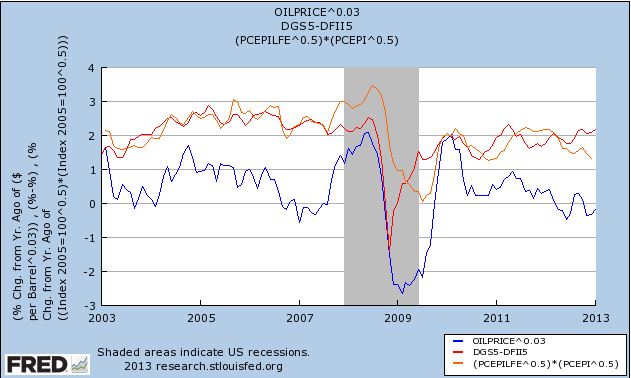
using expected inflation to identify monetary policy is only a valid statistical procedure if one is willing to assume that nothing else affects expected inflation.  If you think that say OPEC ever had any influence on expected inflation, then you can’t use your identifying assumption.  In particular TIPS breakevens can be fairly well fit (not predicted because not out of sample) using lagged data other than data on what the FOMC did.

again I refer to

http://www.angrybearblog.com/2013/02/inflation-expectations-and-lagged.html

[Here is the chart to which Waldmann refers.]

angry_bear

(legend here red is the 5 year TIPS breakeven or expected inflation, Blue is the change over the *past* year of the price of a barrel of oil times 0.1 plus 1.6, green is the geometric mean of the change over the *past year* of the personal consumption deflator and the personal consumption minus food and energy deflator.

Again, I don’t think formal statistical modeling is the issue here, because the data are neither sufficient in quantity nor unambiguous in their interpretation. The data are what they are, and if we cannot parse out what has been caused by OPEC and what has been caused by the Fed, we have to accept the ambiguity and not pretend that it doesn’t exist just so to impose an identifying assumption. I would also make what I would have thought is an obvious observation that since 2007 the causality between the price of oil and the state of the economy has been going in both directions, and any statistical model that takes the price of oil as exogenous is incredible.

I don’t see how anyone could look at this graph and then claim we can identify monetary policy by the TIPS breakeven.  That is only valid if nothing but monetary policy affects inflation expectations.

I don’t understand that. Why, if monetary policy accounts for 50% of the variation in inflation expectations is it not valid to use the TIPS spread to identify monetary policy? We may have to make some plausible assumptions about when there were supply-side disturbances or add some instrumental variables, but I don’t see why we would want to ignore monetary policy just because factors other than monetary policy may be affecting inflation expectations.

Similarly in 1933 monetary policy wasn’t the only thing that changed.  I understand that there was considerable policy reform in the so called “first hundred days.  ” The idea that we can identify the effect of monetary policy by looking at the USA in 1933 is based on the assumption that Roosevelt did nothing else.  This is not reasonable.

Sure he did other things, but you can’t seriously mean that government spending increased in the first 100 days by an amount sufficient to account for the explosion in output from April to July. I would concede that other things that Roosevelt did may have also helped restore confidence, but I don’t see how you can deny that the devaluation of the dollar was at or near the top of the list of economic actions taken in the first 4 months of his Presidency.

But I think we can detect the effect of recent monetary policy on TIPS breakevens if we agree that it (including QE) is working principally through forward guidance.  There should be quick effects on asset prices when surprising shifts are announced.  QE 4 (December 2012) was definitely a surprise.  The TIPS spread barely moved (within the range of normal fluctuations).  I think the question is settled.  I do not think it is optimal to ignore daily data when you have it and treat same quarter as the same instant.  Some prices are sticky and some aren’t.  Bond prices aren’t.

What makes you so sure that QE4 was a surprise. I think that there was considerable disappointment that there was no increase in the inflation target, just a willingness to accept some slight amount of overshooting (2.5%) before applying the brakes as long as unemployment remains over 6.5%. Ambiguity reins supreme.

That Oh So Elusive Natural Rate of Interest

Last week, I did a short post linking to the new draft of my paper with Paul Zimmerman about the Sraffa-Hayek exchange on the natural rate of interest. In the paper, we attempt to assess Sraffa’s criticism in his 1932 review of Prices and Production of Hayek’s use of the idea of a natural rate of interest as well as Hayek’s response, or, perhaps, his lack of response, to Sraffa’s criticism. The issues raised by Sraffa are devilishly tricky, especially because he introduced the unfamiliar terminology of own-rates of interest, later adopted Keynes in chapter 17 of the General Theory in order to express his criticism. The consensus about this debate is that Sraffa got the best of Hayek in this exchange – the natural rate of interest was just one of the issues Sraffa raised, and, in the process, he took Hayek down a peg or two after the startling success that Hayek enjoyed upon his arrival in England, and publication of Prices and Production. In a comment to my post, Greg Ransom questions this conventional version of the exchange, but that’s my story and I’m sticking to it.

What Paul and I do in the paper is to try to understand Sraffa’s criticism of Hayek. It seems to us that the stridency of Sraffa’s attack on Hayek suggests that Sraffa was arguing that Hayek’s conception of a natural rate of interest was somehow incoherent in a barter economy in which there is growth and investment and, thus, changes in relative prices over time, implying that commodity own rates of interest would have differ. If, in a barter economy with growth and savings and investment, there are many own-rates, Sraffa seemed to be saying, it is impossible to identify any one of them as the natural rate of interest. In a later account of the exchange between Sraffa and Hayek, Ludwig Lachmann, a pupil of Hayek, pointed out that, even if there are many own rates in a barter economy, the own rates must, in an intertemporal equilibrium, stand in a unique relationship to each other: the expected net return from holding any asset cannot differ from the expected net return on holding any other asset. That is a condition of equilibrium. If so, it is possible, at least conceptually, to infer a unique real interest rate. That unique real interest rate could be identified with Hayek’s natural rate of interest.

In fact, as we point out in our paper, Irving Fisher in his classic Appreciation and Interest (1896) had demonstrated precisely this point, theoretically extracting the real rate from the different nominal rates of interest corresponding to loans contracted in terms of different assets with different expected rates of price appreciation. Thus, Sraffa did not demonstrate that there was no natural rate of interest. There is a unique real rate of interest in intertemporal equilibrium which corresponds to the Hayekian natural rate. However, what Sraffa could have demonstrated — though had he done so, he would still have been 35 years behind Irving Fisher – is that the unique real rate is consistent with an infinite number of nominal rates provided that those nominal rates reflected corresponding anticipated rate of price appreciation. But, instead, Sraffa argued that there is no unique real rate in intertemporal equilibrium. That was a mistake.

Another interesting (at least to us) point in our paper is that Keynes who, as editor of the Economic Journal, asked Sraffa to review Prices and Production, borrowed Sraffa’s own-rate terminology in chapter 17 of the General Theory, but, instead of following Sraffa’s analysis and arguing that there is no natural rate of interest, Keynes proceeded to derive, using (without acknowledgment) a generalized version of Fisher’s argument of 1896, a unique relationship between commodity own rates, adjusted for expected price changes, and net service yields, such that the expected net returns on all assets would be equalized. From this, Keynes did not conclude, as had Sraffa, that there is no natural rate of interest. Rather, he made a very different argument: that the natural rate of interest is a useless concept, because there are many natural rates each corresponding to a different the level of income and employment, a consideration that Hayek, and presumably Fisher, had avoided by assuming full intertemporal equilibrium. But Keynes never disputed that for any given level of income and employment, there would be a unique real rate to which all commodity own rates had to correspond. Thus, Keynes turned Sraffa’s analysis on its head. And the final point of interest is that even though Keynes, in chapter 17, presented essentially the same analysis of own rates, though in more general terms, that Fisher had presented 40 years earlier, Keynes in chapter 13 explicitly rejected Fisher’s distinction between the real and nominal rates of interest. Go figure.

Bob Murphy wrote a nice paper on the Sraffa-Hayek debate, which I have referred to before on this blog. However, I disagree with him that Sraffa’s criticism of Hayek was correct. In a post earlier this week, he infers, from our statement that, as long as price expectations are correct, any nominal rate is consistent with the unique real natural rate, that we must agree with him that Sraffa was right and Hayek was wrong about the natural rate. I think that Bob is in error on the pure theory here. There is a unique real natural rate in intertemporal equilibrium, and, in principle, the monetary authority could set a money rate equal to that real rate, provided that that nominal rate was consistent with the price expectations held by the public. However, intertemporal equilibrium could be achieved by any nominal interest rate selected by the monetary authority, again provided that the nominal rate chosen was consistent with the price expectations held by the public. In practice, either formulation is very damaging to Hayek’s policy criterion of setting the nominal interest rate equal to the real natural rate. But contrary to Sraffa’s charge, the policy criterion is not incoherent. It is just unworkable, as Hayek formulated it, and, on Hayek’s own theory, the criterion is unnecessary to avoid distorting malinvestments.

Robert Waldmann, WADR, Maybe You Really Should Calm Down

Responding to this recent post of mine, Robert Waldmann wrote a post of his own with a title alluding to an earlier post of mine responding to a previous post of his. Just to recapitulate briefly, the point of the post which seems to have provoked Professor Waldmann was to refute the allegation that the Fed and the Bank of Japan are starting a currency war by following a policy of monetary ease in which they are raising (at least temporarily) their inflation target. I focused my attention on a piece written by Irwin Stelzer for the Weekly Standard, entitled not so coincidentally, “Currency Wars.” I also went on to point out that Stelzer, in warning of the supposedly dire consequences of starting a currency war, very misleadingly suggested that Hitler’s rise to power was the result of an inflationary policy followed by Germany in the 1930s.

Here is how Waldmann responds:

I do not find any reference to the zero lower bound in this post.  Your analysis of monetary expansion does not distinguish between the cases when the ZLB holds and when it doesn’t.  You assume that the effect of an expansion of the money supply on domestic demand can be analyzed ignoring that detail. I think it is clear that the association between the money supply and domestic demand has been different in the USA since oh September 2008 than it was before.  This doesn’t seem to me to be a detail which can be entirely overlooked in any discussion of current policy.

Actually, I don’t think that, in principle, I disagree with any of this. I agree that the zero lower bound is relevant to the analysis of the current situation. I prefer to couch the analysis in terms of the Fisher equation making use of the equilibrium condition that the nominal rate of interest must equal the real rate plus expected inflation. If the expected rate of deflation is greater than the real rate, equilibrium is impossible and the result is a crash of asset prices, which is what happened in 2008. But as long as the real rate of interest is negative (presumably because of pessimistic entrepreneurial expectations), the rate of inflation has to be sufficiently above real rate of interest for nominal rates to be comfortably above zero. As long as nominal rates are close to zero and real rates are negative, the economy cannot be operating in the neighborhood of full-employment equilibrium. I developed the basic theory in my paper “The Fisher Effect Under Deflationary Expectations” available on SSRN, and provided some empirical evidence (which I am hoping to update soon) that asset prices (as reflected in the S&P 500) since 2008 have been strongly correlated with expected inflation (as approximated by the TIPS spread) even though there is no strong theoretical reason for asset prices to be correlated with expected inflation, and no evidence of correlation before 2008. Although I think that this is a better way than the Keynesian model to think about why the US economy has been underperforming so badly since 2008, I don’t think that the models are contradictory or inconsistent, so I don’t deny that fiscal policy could have some stimulative effect. But apparently that is not good enough for Professor Waldmann.

Also, I note that prior to his [Stelzer’s] “jejune dismissal of monetary policy,” Stelzer jenunely dismissed fiscal policy.  You don’t mention this at all.  Your omission is striking, since the evidence that Stelzer is wrong to dismiss fiscal policy is overwhelming (not overwhelming enough to overwhelm John Taylor but then mere evidence couldn’t do that).  In contrast, the dismissal of monetary policy when an economy is in a liquidity trap is consistent with the available evidence.

It seems to me that Waldmann is being a tad oversensitive. Stelzer’s line was “stimulus packages don’t work very well, and monetary policy produces lots of fiat money but not very many jobs.” What was jejune was not the conclusion that fiscal policy and monetary policy aren’t effective; it was his formulation that monetary expansion produces lots of fiat money but not many jobs, a formulation which, I believe, was intended to be clever, but struck me as being not clever, but, well, jejune. So I did not mean to deny that fiscal policy could be effective at the zero lower bound, but I disagree that the available evidence is consistent with the proposition that monetary policy is ineffective in a liquidity trap. In 1933, for example, monetary policy triggered the fastest economic expansion in US history, when FDR devalued the dollar shortly after taking office, an expansion unfortunately prematurely terminated by the enactment of FDR’s misguided National Industrial Recovery Act. The strong correlation between inflation expectations and stock prices since 2008, it seems to me, also qualifies as evidence that monetary policy is not ineffective at the zero lower bound. But if Professor Waldmann has a different interpretation of the significance of that correlation, I would be very interested in hearing about it.

Instead of looking at the relationship between inflation expectations and stock prices, Waldmann wants to look at the relationship between job growth and monetary policy:

I hereby challenge you to show data on US “growth”  meaning (I agree with your guess) mostly employment growth since 2007 to someone unfamiliar with the debate and ask that person to find the dates of shifts in monetary policy.  I am willing to bet actual money (not much I don’t have much) that the person will not pick out QEIII or operation twist.    I also guess that this person will not detect forward guidance looking at day to day changes in asset prices.

I claim that the null that nothing special happened the day QEIV was announced or any of the 4 plausible dates of announcement of QE2 (starting with a FOMC meeting, then Bernanke’s Jackson Hole speech then 2 more) can’t be rejected by the data. This is based on analysis by two SF FED economists who look at the sum of changes over three of the days (not including the Jackson Hole day when the sign was wrong) and get a change (of the sign they want) whose square is less than 6 times the variance of daily changes (of the 10 year rate IIRC).  IIRC 4.5 times.  Cherry picking and not rejecting the null one wants to reject is a sign that one’s favored (alternative) hypothesis is not strongly supported by the data.

I think that the way to pick out changes in monetary policy is to look at changes in inflation expectations, and I think that you can find some correlation between changes in monetary policy, so identified, and employment, though it is probably not nearly as striking as the relationship between asset prices and inflation expectations. I also don’t think that operation twist had any positive effect, but QE3 does seem to have had some. I am not familiar with the study by the San Francisco Fed economists, but I will try to find it and see what I can make out of it. In the meantime, even if Waldmann is correct about the relationship between monetary policy and employment since 2008, there are all kinds of good reasons for not rushing to reject a null hypothesis on the basis of a handful of ambiguous observations. That wouldn’t necessarily be the calm and reasonable thing to do.

Why Are Real Interest Rates So Low, and Will They Ever Bounce Back?

In his recent post commenting on the op-ed piece in the Wall Street Journal by Michael Woodford and Frederic Mishkin on nominal GDP level targeting (hereinafter NGDPLT), Scott Sumner made the following observation.

I would add that Woodford’s preferred interest rate policy instrument is also obsolete.  In the next recession, and probably the one after that, interest rates will again fall to zero.  Indeed the only real suspense is whether they’ll be able to rise significantly above zero before the next recession hits.  In the US in 1937, Japan in 2001, and the eurozone in 2011, rates had barely nudged above zero before the next recession hit. Ryan Avent has an excellent post discussing this issue.

Perhaps I am misinterpreting him, but Scott seems to think that the decline in real interest rates reflects some fundamental change in the economy since approximately the start of the 21st century. Current low real rates, below zero on US Treasuries well up the yield curve. The real rate is unobservable, but it is related to (but not identical with) the yield on TIPS which are now negative up to 10-year maturities. The fall in real rates partly reflects the cyclical tendency for the expected rate of return on new investment to fall in recessions, but real interest rates were falling even before the downturn started in 2007.

In this post, at any rate, Scott doesn’t explain why the real rate of return on investment is falling. In the General Theory, Keynes speculated about the possibility that after the great industrialization of the 19th and early 20th centuries, new opportunities for investment were becoming exhausted. Alvin Hansen, an early American convert to Keynesianism, developed this idea into what he called the secular-stagnation hypothesis, a hypothesis suggesting that, after World War II, even with very low interest rates, the US economy was likely to relapse into depression. The postwar boom seemed to disprove Hansen’s idea, which became a kind of historical curiosity, if not an embarrassment. I wonder if Scott thinks that Keynes and Hansen were just about a half-century ahead of their time, or does he have some other reason in mind for why he thinks that real interest rates are destined to be very low?

One possibility, which, in a sense, is the optimistic take on our current predicament, is that low real interest rates are the result of bad monetary policy, the obstacle to an economic expansion that, in the usual course of events, would raise real interest rates back to more “normal” levels. There are two problems with this interpretation. First, the decline in real interest rates began in the last decade well before the 2007-09 downturn. Second, why does Scott, evidently accepting Ryan Avent’s pessimistic assessment of the life-expectancy of the current recovery notwithstanding rapidly increasing support for NGDPLT, anticipate a relapse into recession before the recovery raises real interest rates above their current near-zero levels? Whatever the explanation, I look forward to hearing more from Scott about all this.

But in the meantime, here are some thoughts of my own about our low real interest rates.

First, it can’t be emphasized too strongly that low real interest rates are not caused by Fed “intervention” in the market. The Fed can buy up all the Treasuries it wants to, but doing so could not force down interest rates if those low interest rates were inconsistent with expected rates of return on investment and the marginal rate of time preference of households. Despite low real interest rates, consumers are not rushing to borrow money at low rates to increase present consumption, nor are businesses rushing to take advantage of low real interest rates to undertake shiny new investment projects. Current low interest rates are a reflection of the expectations of the public about their opportunities for trade-offs between current and future consumption and between current and future production and their expectations about future price levels and interest rates. It is not the Fed that is punishing savers, as the editorial page of the Wall Street Journal constantly alleges. Rather, it is the distilled wisdom of market participants that is determining how much any individual should be rewarded for the act of abstaining from current consumption. Unfortunately, there is so little demand for resources to be used to increase future output, the act of abstaining from current consumption contributes essentially nothing, at the margin, to the increase of future output, which is why the market is now offering next to no reward for a marginal abstention from current consumption.

Second, interest rates reflect the expectations of businesses and investors about the profitability of investing in new capital, and the expectations of households about their future incomes (largely dependent on expectations about future employment). These expectations – about profitability and about future incomes — are distinct, but they are clearly interdependent. If businesses are optimistic about the profitability of future investment, households are likely to be optimistic about future incomes. If households are pessimistic about future incomes, businesses are unlikely to expect investments in new capital to be profitable. If real interest rates are stuck at zero, it suggests that businesses and households are stuck in a mutually reinforcing cycle of pessimistic expectations — households about future income and employment and businesses about the profitability of investing in new capital. Expectations, as I have said before, are fundamental. Low interest rates and secular stagnation need not be the result of an inevitable drying up of investment opportunities; they may be the result of a vicious cycle of mutually reinforcing pessimism by households and businesses.

The simple Keynesian model — at least the Keynesian-cross version of intro textbooks or even the IS-LM version of intermediate textbooks – generally holds expectations constant. But in fact, it is through the adjustment of expectations that full-employment equilibrium is reached. For fiscal or monetary policy to work, they must alter expectations. Conventional calculations of spending or tax multipliers, which implicitly hold expectations constant, miss the point, which is to alter expectations.

Similarly, as I have tried to suggest in my previous two posts, what Friedman called the natural rate of unemployment may itself depend on expectations. A change in monetary policy may alter expectations in a manner that reduces the natural rate. A straightforward application of the natural-rate model leads some to dismiss a reduction in unemployment associated with a small increase in the rate of inflation as inefficient, because the increase in employment results from workers being misled into accepting jobs that will turn out to pay workers a lower real wage than they had expected. But even if that is so, the increase in employment may still be welfare-increasing, because the employment of each worker improves the chances that another worker will become employed. The social benefit of employment may be greater than the private benefit. In that case, the apparent anomaly (from the standpoint of the natural-rate hypothesis) that measurements of social well-being seem to be greatest when employment is maximized actually make perfectly good sense.

In an upcoming post, I hope to explore some other possible explanations for low real interest rates.

The State We’re In

Last week, Paul Krugman, set off by this blog post, complained about the current state macroeconomics. Apparently, Krugman feels that if saltwater economists like himself were willing to accommodate the intertemporal-maximization paradigm developed by the freshwater economists, the freshwater economists ought to have reciprocated by acknowledging some role for countercyclical policy. Seeing little evidence of accommodation on the part of the freshwater economists, Krugman, evidently feeling betrayed, came to this rather harsh conclusion:

The state of macro is, in fact, rotten, and will remain so until the cult that has taken over half the field is somehow dislodged.

Besides engaging in a pretty personal attack on his fellow economists, Krugman did not present a very flattering picture of economics as a scientific discipline. What Krugman describes seems less like a search for truth than a cynical bargaining game, in which Krugman feels that his (saltwater) side, after making good faith offers of cooperation and accommodation that were seemingly accepted by the other (freshwater) side, was somehow misled into making concessions that undermined his side’s strategic position. What I found interesting was that Krugman seemed unaware that his account of the interaction between saltwater and freshwater economists was not much more flattering to the former than the latter.

Krugman’s diatribe gave Stephen Williamson an opportunity to scorn and scold Krugman for a crass misunderstanding of the progress of science. According to Williamson, modern macroeconomics has passed by out-of-touch old-timers like Krugman. Among modern macroeconomists, Williamson observes, the freshwater-saltwater distinction is no longer meaningful or relevant. Everyone is now, more or less, on the same page; differences are worked out collegially in seminars, workshops, conferences and in the top academic journals without the rancor and disrespect in which Krugman indulges himself. If you are lucky (and hard-working) enough to be part of it, macroeconomics is a great place to be. One can almost visualize the condescension and the pity oozing from Williamson’s pores for those not part of the charmed circle.

Commenting on this exchange, Noah Smith generally agreed with Williamson that modern macroeconomics is not a discipline divided against itself; the intetermporal maximizers are clearly dominant. But Noah allows himself to wonder whether this is really any cause for celebration – celebration, at any rate, by those not in the charmed circle.

So macro has not yet discovered what causes recessions, nor come anywhere close to reaching a consensus on how (or even if) we should fight them. . . .

Given this state of affairs, can we conclude that the state of macro is good? Is a field successful as long as its members aren’t divided into warring camps? Or should we require a science to give us actual answers? And if we conclude that a science isn’t giving us actual answers, what do we, the people outside the field, do? Do we demand that the people currently working in the field start producing results pronto, threatening to replace them with people who are currently relegated to the fringe? Do we keep supporting the field with money and acclaim, in the hope that we’re currently only in an interim stage, and that real answers will emerge soon enough? Do we simply conclude that the field isn’t as fruitful an area of inquiry as we thought, and quietly defund it?

All of this seems to me to be a side issue. Who cares if macroeconomists like each other or hate each other? Whether they get along or not, whether they treat each other nicely or not, is really of no great import. For example, it was largely at Milton Friedman’s urging that Harry Johnson was hired to be the resident Keynesian at Chicago. But almost as soon as Johnson arrived, he and Friedman were getting into rather unpleasant personal exchanges and arguments. And even though Johnson underwent a metamorphosis from mildly left-wing Keynesianism to moderately conservative monetarism during his nearly two decades at Chicago, his personal and professional relationship with Friedman got progressively worse. And all of that nastiness was happening while both Friedman and Johnson were becoming dominant figures in the economics profession. So what does the level of collegiality and absence of personal discord have to do with the state of a scientific or academic discipline? Not all that much, I would venture to say.

So when Scott Sumner says:

while Krugman might seem pessimistic about the state of macro, he’s a Pollyanna compared to me. I see the field of macro as being completely adrift

I agree totally. But I diagnose the problem with macro a bit differently from how Scott does. He is chiefly concerned with getting policy right, which is certainly important, inasmuch as policy, since early 2008, has, for the most part, been disastrously wrong. One did not need a theoretically sophisticated model to see that the FOMC, out of misplaced concern that inflation expectations were becoming unanchored, kept money way too tight in 2008 in the face of rising food and energy prices, even as the economy was rapidly contracting in the second and third quarters. And in the wake of the contraction in the second and third quarters and a frightening collapse and panic in the fourth quarter, it did not take a sophisticated model to understand that rapid monetary expansion was called for. That’s why Scott writes the following:

All we really know is what Milton Friedman knew, with his partial equilibrium approach. Monetary policy drives nominal variables.  And cyclical fluctuations caused by nominal shocks seem sub-optimal.  Beyond that it’s all conjecture.

Ahem, and Marshall and Wicksell and Cassel and Fisher and Keynes and Hawtrey and Robertson and Hayek and at least 25 others that I could easily name. But it’s interesting to note that, despite his Marshallian (anti-Walrasian) proclivities, it was Friedman himself who started modern macroeconomics down the fruitless path it has been following for the last 40 years when he introduced the concept of the natural rate of unemployment in his famous 1968 AEA Presidential lecture on the role of monetary policy. Friedman defined the natural rate of unemployment as:

the level [of unemployment] that would be ground out by the Walrasian system of general equilibrium equations, provided there is embedded in them the actual structural characteristics of the labor and commodity markets, including market imperfections, stochastic variability in demands and supplies, the costs of gathering information about job vacancies, and labor availabilities, the costs of mobility, and so on.

Aside from the peculiar verb choice in describing the solution of an unknown variable contained in a system of equations, what is noteworthy about his definition is that Friedman was explicitly adopting a conception of an intertemporal general equilibrium as the unique and stable solution of that system of equations, and, whether he intended to or not, appeared to be suggesting that such a concept was operationally useful as a policy benchmark. Thus, despite Friedman’s own deep skepticism about the usefulness and relevance of general-equilibrium analysis, Friedman, for whatever reasons, chose to present his natural-rate argument in the language (however stilted on his part) of the Walrasian general-equilibrium theory for which he had little use and even less sympathy.

Inspired by the powerful policy conclusions that followed from the natural-rate hypothesis, Friedman’s direct and indirect followers, most notably Robert Lucas, used that analysis to transform macroeconomics, reducing macroeconomics to the manipulation of a simplified intertemporal general-equilibrium system. Under the assumption that all economic agents could correctly forecast all future prices (aka rational expectations), all agents could be viewed as intertemporal optimizers, any observed unemployment reflecting the optimizing choices of individuals to consume leisure or to engage in non-market production. I find it inconceivable that Friedman could have been pleased with the direction taken by the economics profession at large, and especially by his own department when he departed Chicago in 1977. This is pure conjecture on my part, but Friedman’s departure upon reaching retirement age might have had something to do with his own lack of sympathy with the direction that his own department had, under Lucas’s leadership, already taken. The problem was not so much with policy, but with the whole conception of what constitutes macroeconomic analysis.

The paper by Carlaw and Lipsey, which I referenced in my previous post, provides just one of many possible lines of attack against what modern macroeconomics has become. Without in any way suggesting that their criticisms are not weighty and serious, I would just point out that there really is no basis at all for assuming that the economy can be appropriately modeled as being in a continuous, or nearly continuous, state of general equilibrium. In the absence of a complete set of markets, the Arrow-Debreu conditions for the existence of a full intertemporal equilibrium are not satisfied, and there is no market mechanism that leads, even in principle, to a general equilibrium. The rational-expectations assumption is simply a deus-ex-machina method by which to solve a simplified model, a method with no real-world counterpart. And the suggestion that rational expectations is no more than the extension, let alone a logical consequence, of the standard rationality assumptions of basic economic theory is transparently bogus. Nor is there any basis for assuming that, if a general equilibrium does exist, it is unique, and that if it is unique, it is necessarily stable. In particular, in an economy with an incomplete (in the Arrow-Debreu sense) set of markets, an equilibrium may very much depend on the expectations of agents, expectations potentially even being self-fulfilling. We actually know that in many markets, especially those characterized by network effects, equilibria are expectation-dependent. Self-fulfilling expectations may thus be a characteristic property of modern economies, but they do not necessarily produce equilibrium.

An especially pretentious conceit of the modern macroeconomics of the last 40 years is that the extreme assumptions on which it rests are the essential microfoundations without which macroeconomics lacks any scientific standing. That’s preposterous. Perfect foresight and rational expectations are assumptions required for finding the solution to a system of equations describing a general equilibrium. They are not essential properties of a system consistent with the basic rationality propositions of microeconomics. To insist that a macroeconomic theory must correspond to the extreme assumptions necessary to prove the existence of a unique stable general equilibrium is to guarantee in advance the sterility and uselessness of that theory, because the entire field of study called macroeconomics is the result of long historical experience strongly suggesting that persistent, even cumulative, deviations from general equilibrium have been routine features of economic life since at least the early 19th century. That modern macroeconomics can tell a story in which apparently large deviations from general equilibrium are not really what they seem is not evidence that such deviations don’t exist; it merely shows that modern macroeconomics has constructed a language that allows the observed data to be classified in terms consistent with a theoretical paradigm that does not allow for lapses from equilibrium. That modern macroeconomics has constructed such a language is no reason why anyone not already committed to its underlying assumptions should feel compelled to accept its validity.

In fact, the standard comparative-statics propositions of microeconomics are also based on the assumption of the existence of a unique stable general equilibrium. Those comparative-statics propositions about the signs of the derivatives of various endogenous variables (price, quantity demanded, quantity supplied, etc.) with respect to various parameters of a microeconomic model involve comparisons between equilibrium values of the relevant variables before and after the posited parametric changes. All such comparative-statics results involve a ceteris-paribus assumption, conditional on the existence of a unique stable general equilibrium which serves as the starting and ending point (after adjustment to the parameter change) of the exercise, thereby isolating the purely hypothetical effect of a parameter change. Thus, as much as macroeconomics may require microfoundations, microeconomics is no less in need of macrofoundations, i.e., the existence of a unique stable general equilibrium, absent which a comparative-statics exercise would be meaningless, because the ceteris-paribus assumption could not otherwise be maintained. To assert that macroeconomics is impossible without microfoundations is therefore to reason in a circle, the empirically relevant propositions of microeconomics being predicated on the existence of a unique stable general equilibrium. But it is precisely the putative failure of a unique stable intertemporal general equilibrium to be attained, or to serve as a powerful attractor to economic variables, that provides the rationale for the existence of a field called macroeconomics.

So I certainly agree with Krugman that the present state of macroeconomics is pretty dismal. However, his own admitted willingness (and that of his New Keynesian colleagues) to adopt a theoretical paradigm that assumes the perpetual, or near-perpetual, existence of a unique stable intertemporal equilibrium, or at most admits the possibility of a very small set of deviations from such an equilibrium, means that, by his own admission, Krugman and his saltwater colleagues also bear a share of the responsibility for the very state of macroeconomics that Krugman now deplores.
Maybe Robert Waldmann Should Calm Down

Robert Waldmann is unhappy with Matthew Yglesias for being hopeful that, Shinzo Abe, just elected prime minister of Japan, may be about to make an important contribution to the world economy, and to economic science, by prodding the Bank of Japan to increase its inflation target and by insisting that the BOJ actually hit the new target. Since I don’t regularly read Waldmann’s blog (not because it’s not worth reading — I usually enjoy reading it when I get to it – I just can’t keep up with that many blogs), I’m not sure why Waldmann finds Yglesias’s piece so annoying. OK, Waldmann’s a Keynesian and prefers fiscal to monetary policy, but so is Paul Krugman, and he thinks that monetary policy can be effective even at the zero lower bound. At any rate this is how Waldmann responds to Yglesias:

Ben Bernanke too has declared a policy of unlimited quantitative easing and increased inflation (new target only 2.5% but that’s higher than current inflation).  The declaration (which was a surprise) had essentially no effect on prices for medium term treasuries, TIPS or the breakeven.

I was wondering when you would comment, since you have confidently asserted again and again that if only the FOMC did what it just did, expected inflation would jump and then GDP growth would increase.

However, instead of noting the utter total failure of your past predictions (and the perfect confirmation of mine) you just boldly make new predictions.

Face fact,  like conventional monetary policy (in the US the Federal Funds rate) forward guidance is pedal to the metal.   It’s long past time for you to start climbing down.

I mention this, because just yesterday I happened across another blog post about what Bernanke said after the FOMC meeting.  This post by David Altig, executive VP and research director of the Atlanta Fed, was on the macroblog. Altig points out that, despite the increase in the Fed’s inflation threshold from 2 to 2.5%, the Fed increased neither its inflation target (still 2%) nor its inflation forecast (still under 2%). All that the Fed did was to say that it won’t immediately slam on the brakes if inflation rises above 2% provided that unemployment is greater than 6.5% and inflation is less than 2.5%. That seems like a pretty marginal change in policy to me.

Also have a look at this post from earlier today by Yglesias, showing that the Japanese stock market has risen about 5.5% in the last two weeks, and about 2% in the two days since Abe’s election. Here is Yglesias’s chart showing the rise of the Nikkei over the past two weeks.

abe-nomics

In addition, here is a news story from Bloomberg about rising yields on Japanese government bonds, which are now the highest since April.

Japan‘s bonds declined, sending 20- year yields to an eight-month high, as demand ebbed at a sale of the securities and domestic shares climbed.

The sale of 1.2 trillion yen ($14.3 billion) of 20-year bonds had the lowest demand in four months. Yields on the benchmark 10-year note rose to a one-month high as Japan’s Nikkei 225 Stock Average reached the most since April amid signs U.S. budget talks are progressing.

Finally, another item from Yglesias, a nice little graph showing the continuing close relationship between the S&P 500 and inflation expectations as approximated by the breakeven TIPS spread on 10-year Treasuries, a relationship for which I have provided (in a paper available here) a theoretical explanation as well as statistical evidence that the relationship did not begin to be observed until approximately the spring of 2008 as the US economy, even before the Lehman debacle, began its steep contraction. Here’s the graph.

yglesias_S&P500

HT: Mark Thoma

UPDATE:  Added a link above to the blog post by Altig about what Bernanke meant when he announced a 2.5% inflation threshold.


About Me

David Glasner
Washington, DC

I am an economist in the Washington DC area. My research and writing has been mostly on monetary economics and policy and the history of economics. In my book Free Banking and Monetary Reform, I argued for a non-Monetarist non-Keynesian approach to monetary policy, based on a theory of a competitive supply of money. Over the years, I have become increasingly impressed by the similarities between my approach and that of R. G. Hawtrey and hope to bring Hawtrey’s unduly neglected contributions to the attention of a wider audience.

My new book Studies in the History of Monetary Theory: Controversies and Clarifications has been published by Palgrave Macmillan

Follow me on Twitter @david_glasner

Archives

Enter your email address to follow this blog and receive notifications of new posts by email.

Join 665 other subscribers
Follow Uneasy Money on WordPress.com