Archive for the 'expectations' Category


On a Difficult Passage in the General Theory

Keynes’s General Theory is not, in my estimation, an easy read. The terminology is often unfamiliar, and, so even after learning one of his definitions, I have trouble remembering what the term means the next time it’s used.. And his prose style, though powerful and very impressive, is not always clear, so you can spend a long time reading and rereading a sentence or a paragraph before you can figure out exactly what he is trying to say. I am not trying to be critical, just to point out that the General Theory is a very challenging book to read, which is one, but not the only, reason why it is subject to a lot of conflicting interpretations. And, as Harry Johnson once pointed out, there is an optimum level of difficulty for a book with revolutionary aspirations. If it’s too simple, it won’t be taken seriously. And if it’s too hard, no one will understand it. Optimally, a revolutionary book should be hard enough so that younger readers will be able to figure it out, and too difficult for the older guys to understand or to make the investment in effort to understand.

In this post, which is, in a certain sense, a follow-up to an earlier post about what, or who, determines the real rate of interest, I want to consider an especially perplexing passage in the General Theory about the Fisher equation. It is perplexing taken in isolation, and it is even more perplexing when compared to other passages in both the General Theory itself and in Keynes’s other writings. Here’s the passage that I am interested in.

The expectation of a fall in the value of money stimulates investment, and hence employment generally, because it raises the schedule of the marginal efficiency of capital, i.e., the investment demand-schedule; and the expectation of a rise in the value of money is depressing, because it lowers the schedule of the marginal efficiency of capital. This is the truth which lies behind Professor Irving Fisher’s theory of what he originally called “Appreciation and Interest” – the distinction between the money rate of interest and the real rate of interest where the latter is equal to the former after correction for changes in the value of money. It is difficult to make sense of this theory as stated, because it is not clear whether the change in the value of money is or is not assumed to be foreseen. There is no escape from the dilemma that, if it is not foreseen, there will be no effect on current affairs; whilst, if it is foreseen, the prices of exiting goods will be forthwith so adjusted that the advantages of holding money and of holding goods are again equalized, and it will be too late for holders of money to gain or to suffer a change in the rate of interest which will offset the prospective change during the period of the loan in the value of the money lent. For the dilemma is not successfully escaped by Professor Pigou’s expedient of supposing that the prospective change in the value of money is foreseen by one set of people but not foreseen by another. (p. 142)

The statement is problematic on just about every level, and one hardly knows where to begin in discussing it. But just for starters, it is amazing that Keynes seems (or, for rhetorical purposes, pretends) to be in doubt whether Fisher is talking about anticipated or unanticipated inflation, because Fisher himself explicitly distinguished between anticipated and unanticipated inflation, and Keynes could hardly have been unaware that Fisher was explicitly speaking about anticipated inflation. So the implication that the Fisher equation involves some confusion on Fisher’s part between anticipated and unanticipated inflation was both unwarranted and unseemly.

What’s even more puzzling is that in his Tract on Monetary Reform, Keynes expounded the covered interest arbitrage principle that the nominal-interest-rate-differential between two currencies corresponds to the difference between the spot and forward rates, which is simply an extension of Fisher’s uncovered interest arbitrage condition (alluded to by Keynes in referring to “Appreciation and Interest”). So when Keynes found Fisher’s distinction between the nominal and real rates of interest to be incoherent, did he really mean to exempt his own covered interest arbitrage condition from the charge?

But it gets worse, because if we flip some pages from chapter 11, where the above quotation is found, to chapter 17, we see on page 224, the following passage in which Keynes extends the idea of a commodity or “own rate of interest” to different currencies.

It may be added that, just as there are differing commodity-rates of interest at any time, so also exchange dealers are familiar with the fact that the rate of interest is not even the same in terms of two different moneys, e.g. sterling and dollars. For here also the difference between the “spot” and “future” contracts for a foreign money in terms of sterling are not, as a rule, the same for different foreign moneys. . . .

If no change is expected in the relative value of two alternative standards, then the marginal efficiency of a capital-asset will be the same in whichever of the two standards it is measured, since the numerator and denominator of the fraction which leads up to the marginal efficiency will be changed in the same proportion. If, however, one of the alternative standards is expected to change in value in terms of the other, the marginal efficiencies of capital-assets will be changed by the same percentage, according to which standard they are measured in. To illustrate this let us take the simplest case where wheat, one of the alternative standards, is expected to appreciate at a steady rate of a percent per annum in terms of money; the marginal efficiency of an asset, which is x percent in terms of money, will then be x – a percent in terms of wheat. Since the marginal efficiencies of all capital assets will be altered by the same amount, it follows that their order of magnitude will be the same irrespective of the standard which is selected.

So Keynes in chapter 17 explicitly allows for the nominal rate of interest to be adjusted to reflect changes in the expected value of the asset (whether a money or a commodity) in terms of which the interest rate is being calculated. Mr. Keynes, please meet Mr. Keynes.

I think that one source of Keynes’s confusion in attacking the Fisher equation was his attempt to force the analysis of a change in inflation expectations, clearly a disequilibrium, into an equilibrium framework. In other words, Keynes is trying to analyze what happens when there has been a change in inflation expectations as if the change had been foreseen. But any change in inflation expectations, by definition, cannot have been foreseen, because to say that an expectation has changed means that the expectation is different from what it was before. Perhaps that is why Keynes tied himself into knots trying to figure out whether Fisher was talking about a change in the value of money that was foreseen or not foreseen. In any equilibrium, the change in the value of money is foreseen, but in the transition from one equilibrium to another, the change is not foreseen. When an unforeseen change occurs in expected inflation, leading to a once-and-for-all change in the value of money relative to other assets, the new equilibrium will be reestablished given the new value of money relative to other assets.

But I think that something else is also going on here, which is that Keynes was implicitly assuming that a change in inflation expectations would alter the real rate of interest. This is a point that Keynes makes in the paragraph following the one I quoted above.

The mistake lies in supposing that it is the rate of interest on which prospective changes in the value of money will directly react, instead of the marginal efficiency of a given stock of capital. The prices of existing assets will always adjust themselves to changes in expectation concerning the prospective value of money. The significance of such changes in expectation lies in their effect on the readiness to produce new assets through their reaction on the marginal efficiency of capital. The stimulating effect of the expectation of higher prices is due, not to its raising the rate of interest (that would be a paradoxical way of stimulating output – insofar as the rate of interest rises, the stimulating effect is to that extent offset) but to its raising the marginal efficiency of a given stock of capital. If the rate of interest were to rise pari passu with the marginal efficiency of capital, there would be no stimulating effect from the expectation of rising prices. For the stimulating effect depends on the marginal efficiency of capital rising relativevly to the rate of interest. Indeed Professor Fisher’s theory could best be rewritten in terms of a “real rate of interest” defined as being the rate of interest which would have to rule, consequently on change in the state of expectation as to the future value of money, in order that this change should have no effect on current output. (pp. 142-43)

Keynes’s mistake lies in supposing that an increase in inflation expectations could not have a stimulating effect except as it raises the marginal efficiency of capital relative to the rate of interest. However, the increase in the value of real assets relative to money will increase the incentive to produce new assets. It is the rise in the value of existing assets relative to money that raises the marginal efficiency of those assets, creating an incentive to produce new assets even if the nominal interest rate were to rise by as much as the rise in expected inflation.

Keynes comes back to this point at the end of chapter 17, making it more forcefully than he did the first time.

In my Treatise on Money I defined what purported to be a unique rate of interest, which I called the natural rate of interest – namely, the rate of interest which, in the terminology of my Treatise, preserved equality between the rate of saving (as there defined) and the rate of investment. I believed this to be a development and clarification of of Wicksell’s “natural rate of interest,” which was, according to him, the rate which would preserve the stability of some, not quite clearly specified, price-level.

I had, however, overlooked the fact that in any given society there is, on this definition, a different natural rate for each hypothetical level of employment. And, similarly, for every rate of interest there is a level of employment for which that rate is the “natural” rate, in the sense that the system will be in equilibrium with that rate of interest and that level of employment. Thus, it was a mistake to speak of the natural rate of interest or to suggest that the above definition would yield a unique value for the rate of interest irrespective of the level of employment. . . .

If there is any such rate of interest, which is unique and significant, it must be the rate which we might term the neutral rate of interest, namely, the natural rate in the above sense which is consistent with full employment, given the other parameters of the system; though this rate might be better described, perhaps, as the optimum rate. (pp. 242-43)

So what Keynes is saying, I think, is this. Consider an economy with a given fixed marginal efficiency of capital (MEC) schedule. There is some interest rate that will induce sufficient investment expenditure to generate enough spending to generate full employment. That interest rate Keynes calls the “neutral” rate of interest. If the nominal rate of interest is more than the neutral rate, the amount of investment will be less than the amount necessary to generate full employment. In such a situation an expectation that the price level will rise will shift up the MEC schedule by the amount of the expected increase in inflation, thereby generating additional investment spending. However, because the MEC schedule is downward-sloping, the upward shift in the MEC schedule that induces increased investment spending will correspond to an increase in the rate of interest that is less than the increase in expected inflation, the upward shift in the MEC schedule being partially offset by the downward movement along the MEC schedule. In other words, the increase in expected inflation raises the nominal rate of interest by less than increase in expected inflation by inducing additional investment that is undertaken only because the real rate of interest has fallen.

However, for an economy already operating at full employment, an increase in expected inflation would not increase employment, so whether there was any effect on the real rate of interest would depend on the extent to which there was a shift from holding money to holding real capital assets in order to avoid the inflation tax.

Before closing, I will just make two side comments. First, my interpretation of Keynes’s take on the Fisher equation is similar to that of Allin Cottrell in his 1994 paper “Keynes and the Keynesians on the Fisher Effect.” Second, I would point out that the Keynesian analysis violates the standard neoclassical assumption that, in a two-factor production function, the factors are complementary, which implies that an increase in employment raises the MEC schedule. The IS curve is not downward-sloping, but upward sloping. This is point, as I have explained previously (here and here), was made a long time ago by Earl Thompson, and it has been made recently by Nick Rowe and Miles Kimball.

I hope in a future post to work out in more detail the relationship between the Keynesian and the Fisherian analyses of real and nominal interest rates.
Bhide and Phelps v. Reality

I don’t know who Amar Bhide (apologies for not being able to insert an accent over the “e” in his last name) is, but Edmund Phelps is certainly an eminent economist and a deserving recipient of the 2006 Nobel Prize in economics. Unfortunately, Professor Phelps attached his name to an op-ed in Wednesday’s Wall Street Journal, co-authored with Bhide, consisting of little more than a sustained, but disjointed, rant about the Fed and central banking. I am only going to discuss that first part of the op-ed that touches on the monetary theory of increasing the money supply through open-market operations, and about the effect of that increase on inflation and inflation expectations. Bhide and Phelps not only get the theory wrong, they seem amazingly oblivious to well-known facts that flatly contradict their assertions about monetary policy since 2008. Let’s join them in their second paragraph.

Monetary policy might focus on the manageable task of keeping expectations of inflation on an even keel—an idea of Mr. Phelps’s [yes that same Mr. Phelps whose name appears as a co-author] in 1967 that was long influential. That would leave businesses and other players to determine the pace of recovery from a recession or of pullback from a boom.

Nevertheless, in late 2008 the Fed began its policy of “quantitative easing”—repeated purchases of billions in Treasury debt—aimed at speeding recovery. “QE2” followed in late 2010 and “QE3” in autumn 2012.

One can’t help wondering what planet Bhide and Phelps have been dwelling on these past four years. To begin with, the first QE program was not instituted until March 2009 after the target Fed funds rate had been reduced to 0.25% in December 2008. Despite a nearly zero Fed funds rate, asset prices, which had seemed to stabilize after the September through November crash, began falling sharply again in February, the S&P 500 dropping from 869.89 on February 9 to 676.53 on March 9, a decline of more than 20%, with inflation expectations as approximated, by the TIPS spread, again falling sharply as they had the previous summer and fall.

Apart from their confused chronology, their suggestion that the Fed’s various quantitative easings have somehow increased inflation and inflation expectations is absurd. Since 2009, inflation has averaged less than 2% a year – one of the longest periods of low inflation in the entire post-war era. Nor has quantitative easing increased inflation expectations. The TIPS spread and other measures of inflation expectations clearly show that inflation expectations have fluctuated within a narrow range since 2008, but have generally declined overall.

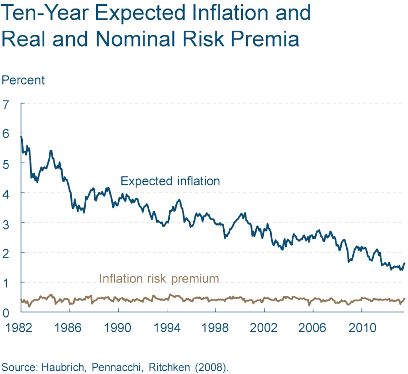
The graph below shows the estimates of the Cleveland Federal Reserve Bank of 10-year inflation expectations since 1982. The chart shows that the latest estimate of expected inflation, 1.65%, is only slightly above its the low point, reached in March, over the past 30 years. Thus expected inflation is now below the 2% target rate that the Fed has set. And to my knowledge Professor Phelps has never advocated targeting an annual inflation rate less than 2%. So I am unable to understand what he is complaining about.

cfimg8685191149364015372

Bhide and Phelps continue:

Fed Chairman Ben Bernanke said in November 2010 that this unprecedented program of sustained monetary easing would lead to “higher stock prices” that “will boost consumer wealth and help increase confidence, which can also spur spending.”

It is doubtful, though, that quantitative easing boosted either wealth or confidence. The late University of Chicago economist Lloyd Metzler argued persuasively years ago that a central-bank purchase, in putting the price level onto a higher path, soon lowers the real value of household wealth—by roughly the amount of the purchase, in his analysis. (People swap bonds for money, then inflation occurs, until the real value of money holdings is back to where it was.)

There are three really serious problems with this passage. First, and most obvious to just about anyone who has not been asleep for the last four years, central-bank purchases have not put the price level on a higher path than it was on before 2008; the rate of inflation has clearly fallen since 2008. Or would Bhide and Phelps have preferred to allow the deflation that briefly took hold in the fall of 2008 to have continued? I don’t think so. But if they aren’t advocating deflation, what exactly is their preferred price level path? Between zero and 1.5% perhaps? Is their complaint that the Fed has allowed inflation to be a half a point too high for the last four years? Good grief.

Second, Bhide and Phelps completely miss the point of the Metzler paper (“Wealth, Saving and the Rate of Interest”), one of the classics of mid-twentieth-century macroeconomics. (And I would just mention as an aside that while Metzler was indeed at the University of Chicago, he was the token Keynesian in the Chicago economics department in 1940s and early 1950s, until his active career was cut short by a brain tumor, which he survived, but with some impairment of his extraordinary intellectual gifts. Metzler’s illness therefore led the department to hire an up-and-coming young Keynesian who had greatly impressed Milton Friedman when he spent a year at Cambridge; his name was Harry Johnson. Unfortunately Friedman and Johnson did not live happily ever after at Chicago.) The point of the Metzler paper was to demonstrate that monetary policy, conducted via open-market operations, could in fact alter the real interest rate. Money, on Metzler’s analysis, is not neutral even in the long run. The conclusion was reached via a comparative-statics exercise, a comparison of two full-employment equilibria — one before and one after the central bank had increased the quantity of money by making open-market purchases.

The motivation for the exercise was that some critics of Keynes, arguing that deflation, at least in principle, could serve as a cure for involuntary unemployment — an idea that Keynes claimed to have refuted — had asserted that, because consumption spending depends not only on income, but on total wealth, deflation, by increasing the real value of the outstanding money stock, would actually make households richer, which would eventually cause households to increase consumption spending enough to restore full employment. Metzler argued that if consumption does indeed depend on total wealth, then, although the classical proposition that deflation could restore full employment would be vindicated, another classical proposition — the invariance of the real rate of interest with respect to the quantity of money — would be violated. So Metzler’s analysis — a comparison of two full-employment equilbria, the first with a lower quantity of money and a higher real interest rate and the second with a higher quantity of money and lower real interest rate – has zero relevance to the post-2008 period, in which the US economy was nowhere near full-employment equilibrium.

Finally, Bhide and Phelps, mischaracterize Metzler’s analysis. Metzler’s analysis depends critically on the proposition that the reduced real interest rate caused by monetary expansion implies an increase in household wealth, thereby leading to increased consumption. It is precisely the attempt to increase consumption that, in Metzler’s analysis, entails an inflationary gap that causes the price level to rise. But even after the increase in the price level, the real value of household assets, contrary to what Bhide and Phelps assert, remains greater than before the monetary expansion, because of a reduced real interest rate. A reduced real interest rate implies an increased real value of the securities retained by households.

Under Metzler’s analysis, therefore, if the starting point is a condition of less than full employment, increasing the quantity of money via open-market operations would tend to increase not only household wealth, but would also increase output and employment relative to the initial condition. So it is also clear that, on Metzler’s analysis, apparently regarded by Bhide and Phelps as authoritative, the problem with Fed policy since 2008 is not that it produced too much inflation, as Bhide and Phelps suggest, but that it produced too little.

If it seems odd that Bhide and Phelps could so totally misread the classic paper whose authority they invoke, just remember this: in the Alice-in-Wonderland world of the Wall Street Journal editorial page, things aren’t always what they seem.

HT: ChargerCarl

Who Sets the Real Rate of Interest?

Understanding economics requires, among other things, understanding the distinction between real and nominal variables. Confusion between real and nominal variables is pervasive, constantly presenting barriers to clear thinking, and snares and delusions for the mentally lazy. In this post, I want to talk about the distinction between the real rate of interest and the nominal rate of interest. That distinction has been recognized for at least a couple of centuries, Henry Thornton having mentioned it early in the nineteenth century. But the importance of the distinction wasn’t really fully understood until Irving Fisher made the distinction between the real and nominal rates of interest a key element of his theory of interest and his theory of money, expressing the relationship in algebraic form — what we now call the Fisher equation. Notation varies, but the Fisher equation can be written more or less as follows:

i = r + dP/dt,

where i is the nominal rate, r is the real rate, and dP/dt is the rate of inflation. It is important to bear in mind that the Fisher equation can be understood in two very different ways. It can either represent an ex ante relationship, with dP/dt referring to expected inflation, or it can represent an ex post relationship, with dP/dt referring to actual inflation.

What I want to discuss in this post is the tacit assumption that usually underlies our understanding, and our application, of the ex ante version of the Fisher equation. There are three distinct variables in the Fisher equation: the real and the nominal rates of interest and the rate of inflation. If we think of the Fisher equation as an ex post relationship, it holds identically, because the unobservable ex post real rate is defined as the difference between the nominal rate and the inflation rate. The ex post, or the realized, real rate has no independent existence; it is merely a semantic convention. But if we consider the more interesting interpretation of the Fisher equation as an ex ante relationship, the real interest rate, though still unobservable, is not just a semantic convention. It becomes the theoretically fundamental interest rate of capital theory — the market rate of intertemporal exchange, reflecting, as Fisher masterfully explained in his canonical renderings of the theory of capital and interest, the “fundamental” forces of time preference and the productivity of capital. Because it is determined by economic “fundamentals,” economists of a certain mindset naturally assume that the real interest rate is independent of monetary forces, except insofar as monetary factors are incorporated in inflation expectations. But if money is neutral, at least in the long run, then the real rate has to be independent of monetary factors, at least in the long run. So in most expositions of the Fisher equation, it is tacitly assumed that the real rate can be treated as a parameter determined, outside the model, by the “fundamentals.” With r determined exogenously, fluctuations in i are correlated with, and reflect, changes in expected inflation.

Now there’s an obvious problem with the Fisher equation, which is that in many, if not most, monetary models, going back to Thornton and Wicksell in the nineteenth century, and to Hawtrey and Keynes in the twentieth, and in today’s modern New Keynesian models, it is precisely by way of changes in its lending rate to the banking system that the central bank controls the rate of inflation. And in this framework, the nominal interest rate is negatively correlated with inflation, not positively correlated, as implied by the usual understanding of the Fisher equation. Raising the nominal interest rate reduces inflation, and reducing the nominal interest rate raises inflation. The conventional resolution of this anomaly is that the change in the nominal interest rate is just temporary, so that, after the economy adjusts to the policy of the central bank, the nominal interest rate also adjusts to a level consistent with the exogenous real rate and to the rate of inflation implied by the policy of the central bank. The Fisher equation is thus an equilibrium relationship, while central-bank policy operates by creating a short-term disequilibrium. But the short-term disequilibrium imposed by the central bank cannot be sustained, because the economy inevitably begins an adjustment process that restores the equilibrium real interest rate, a rate determined by fundamental forces that eventually override any nominal interest rate set by the central bank if that rate is inconsistent with the equilibrium real interest rate and the expected rate of inflation.

It was just this analogy between the powerlessness of the central bank to hold the nominal interest rate below the sum of the exogenously determined equilibrium real rate and the expected rate of inflation that led Milton Friedman to the idea of a “natural rate of unemployment” when he argued that monetary policy could not keep the unemployment rate below the “natural rate ground out by the Walrasian system of general equilibrium equations.” Having been used by Wicksell as a synonym for the Fisherian equilibrium real rate, the term “natural rate” was undoubtedly adopted by Friedman, because monetarily induced deviations between the actual rate of unemployment and the natural rate of unemployment set in motion an adjustment process that restores unemployment to its “natural” level, just as any deviation between the nominal interest rate and the sum of the equilibrium real rate and expected inflation triggers an adjustment process that restores equality between the nominal rate and the sum of the equilibrium real rate and expected inflation.

So, if the ability of the central bank to use its power over the nominal rate to control the real rate of interest is as limited as the conventional interpretation of the Fisher equation suggests, here’s my question: When critics of monetary stimulus accuse the Fed of rigging interest rates, using the Fed’s power to keep interest rates “artificially low,” taking bread out of the mouths of widows, orphans and millionaires, what exactly are they talking about? The Fed has no legal power to set interest rates; it can only announce what interest rate it will lend at, and it can buy and sell assets in the market. It has an advantage because it can create the money with which to buy assets. But if you believe that the Fed cannot reduce the rate of unemployment below the “natural rate of unemployment” by printing money, why would you believe that the Fed can reduce the real rate of interest below the “natural rate of interest” by printing money? Martin Feldstein and the Wall Street Journal believe that the Fed is unable to do one, but perfectly able to do the other. Sorry, but I just don’t get it.

Look at the accompanying chart. It tracks the three variables in the Fisher equation (the nominal interest rate, the real interest rate, and expected inflation) from October 1, 2007 to July 2, 2013. To measure the nominal interest rate, I use the yield on 10-year Treasury bonds; to measure the real interest rate, I use the yield on 10-year TIPS; to measure expected inflation, I use the 10-year breakeven TIPS spread. The yield on the 10-year TIPS is an imperfect measure of the real rate, and the 10-year TIPS spread is an imperfect measure of inflation expectations, especially during financial crises, when the rates on TIPS are distorted by illiquidity in the TIPS market. Those aren’t the only problems with identifying the TIPS yield with the real rate and the TIPS spread with inflation expectations, but those variables usually do provide a decent approximation of what is happening to real rates and to inflation expectations over time.

real_and_nominal_interest_rates

Before getting to the main point, I want to make a couple of preliminary observations about the behavior of the real rate over time. First, notice that the real rate declined steadily, with a few small blips, from October 2007 to March 2008, when the Fed was reducing the Fed Funds target rate from 4.75 to 3% as the economy was sliding into a recession that officially began in December 2007. The Fed reduced the Fed Funds target to 2% at the end of April, but real interest rates had already started climbing in early March, so the failure of the FOMC to reduce the Fed Funds target again till October 2008, three weeks after the onset of the financial crisis, clearly meant that there was at least a passive tightening of monetary policy throughout the second and third quarters, helping create the conditions that precipitated the crisis in September. The rapid reduction in the Fed Funds target from 2% in October to 0.25% in December 2008 brought real interest rates down, but, despite the low Fed Funds rate, a lack of liquidity caused a severe tightening of monetary conditions in early 2009, forcing real interest rates to rise sharply until the Fed announced its first QE program in March 2009.

I won’t go into more detail about ups and downs in the real rate since March 2009. Let’s just focus on the overall trend. From that time forward, what we see is a steady decline in real interest rates from over 2% at the start of the initial QE program till real rates bottomed out in early 2012 at just over -1%. So, over a period of three years, there was a steady 3% decline in real interest rates. This was no temporary phenomenon; it was a sustained trend. I have yet to hear anyone explain how the Fed could have single-handedly produced a steady downward trend in real interest rates by way of monetary expansion over a period of three years. To claim that decline in real interest rates was caused by monetary expansion on the part of the Fed flatly contradicts everything that we think we know about the determination of real interest rates. Maybe what we think we know is all wrong. But if it is, people who blame the Fed for a three-year decline in real interest rates that few reputable economists – and certainly no economists that Fed critics pay any attention to — ever thought was achievable by monetary policy ought to provide an explanation for how the Fed suddenly got new and unimagined powers to determine real interest rates. Until they come forward with such an explanation, Fed critics have a major credibility problem.

So please – pleaseWall Street Journal editorial page, Martin Feldstein, John Taylor, et al., enlighten us. We’re waiting.

PS Of course, there is a perfectly obvious explanation for the three-year long decline in real interest rates, but not one very attractive to critics of QE. Either the equilibrium real interest rate has been falling since 2009, or the equilibrium real interest rate fell before 2009, but nominal rates adjusted slowly to the reduced real rate. The real interest rate might have adjusted more rapidly to the reduced equilibrium rate, but that would have required expected inflation to have risen. What that means is that sometimes it is the real interest rate, not, as is usually assumed, the nominal rate, that adjusts to the expected rate of inflation. My next post will discuss that alternative understanding of the implicit dynamics of the Fisher equation.

Fear Is Contagious

Ever the optimist, I was hoping that yesterday’s immediate, sharply negative, reaction to the FOMC statement and Ben Bernanke’s press conference was only a mild correction, not the sign of a major revision in expectations. Today’s accelerating slide in stock prices, coupled with continuing rises declines in bond prices, across the entire yield curve, shows that the FOMC, whose obsession with inflation in 2008 drove the world economy into a Little Depression, may now be on the verge of precipitating yet another downturn even before any real recovery has taken place.

If 2008-09 was a replay of 1929-30, then we might be headed back to a reprise of 1937, when a combination of fiscal austerity and monetary tightening, fed by exaggerated, if not irrational fears of inflation, notwithstanding the absence of a full recovery from the 1929-33 downturn, caused a second downturn, nearly as sharp as that of 1929-30.

Nothing is inevitable. History does not have to repeat itself. But if we want to avoid a repeat of 1937, we must avoid repeating the same stupid mistakes made in 1937. Don’t withdraw – or talk about withdrawing — a stimulus that isn’t even generating the measly 2% inflation that the FOMC says its targeting, even while the unemployment rate is still 7.6%. And as Paul Krugman pointed out in his blog today, the labor force participation rate has barely increased since the downturn bottomed out in 2009. I reproduce his chart below.

labor_participation

Bernanke claims to be maintaining an accommodative monetary policy and is simply talking about withdrawing (tapering off), as conditions warrant, the additional stimulus associated with  the Fed’s asset purchases. That reminds me of the stance of the FOMC in 2008 when the Fed, having reduced interest rates to 2% in March, kept threatening to raise interest rates during the spring and summer to counter rising commodity prices, even as the economy was undergoing, even before the onset of the financial crisis, one of the fastest contractions since World War II. Yesterday’s announcement, making no commitment to ensure that the Fed’s own inflation target would be met, has obviously been understood by the markets to signal the willingness of the FOMC to tolerate even lower rates of inflation than we have now.

In my post yesterday, I observed that the steep rise in nominal and real interest rates (at least as approximated by the yield on TIPS) was accompanied by only a very modest decline in inflation expectations (as approximated by the TIPS spread). Well, today, nominal and real interest rates (as reflected in TIPS) rose again, but with the breakeven 10-year TIPS spread falling by 9 basis points, to 1.95%. Meanwhile, the dollar continued to appreciate against the euro, supporting the notion that the markets are reacting to a perceived policy change, a change in exactly the wrong direction. Oh, and by the way, the price of gold continued to plummet, reaching $1280 an ounce, the lowest in almost three years, nearly a third less than its 2011 peak.

But for a contrary view, have a look at theeditorial (“Monetary Withdrawal Symptom”) in Friday’s Wall Street Journal, as well as an op-ed piece by an asset fund manager, Romain Hatchuel, (“Central Banks and the Borrowing Addiction”). Both characterize central banks as drug pushers who have induced hundreds of millions, if not billions, of people around the world to become debt addicts. Hatchuel sees some deep significance in the fact that total indebtedness has, since 1980, increased as fast as GDP, while from 1950 to 1980 total indebtedness increased at a much slower rate.

Um, if more people are borrowing, more people are lending, so the mere fact that total indebtedness has increased faster in the last 30 years than it did in the previous 30 years says nothing about debt addiction. It simply says that more people have been gaining access to credit markets in recent years than had access to credit markets in the 1950s, 1960s and 1970s. If we are so addicted to debt, how come real interest rates are so low? If a growing epidemic of debt addiction started in 1980, shouldn’t real interest rates have been rising steadily since then? Guess what? Real interest rates have been falling steadily since 1982. The Wall Street Journal strikes (out) again.

Bernanke Gives the Markets a Scare

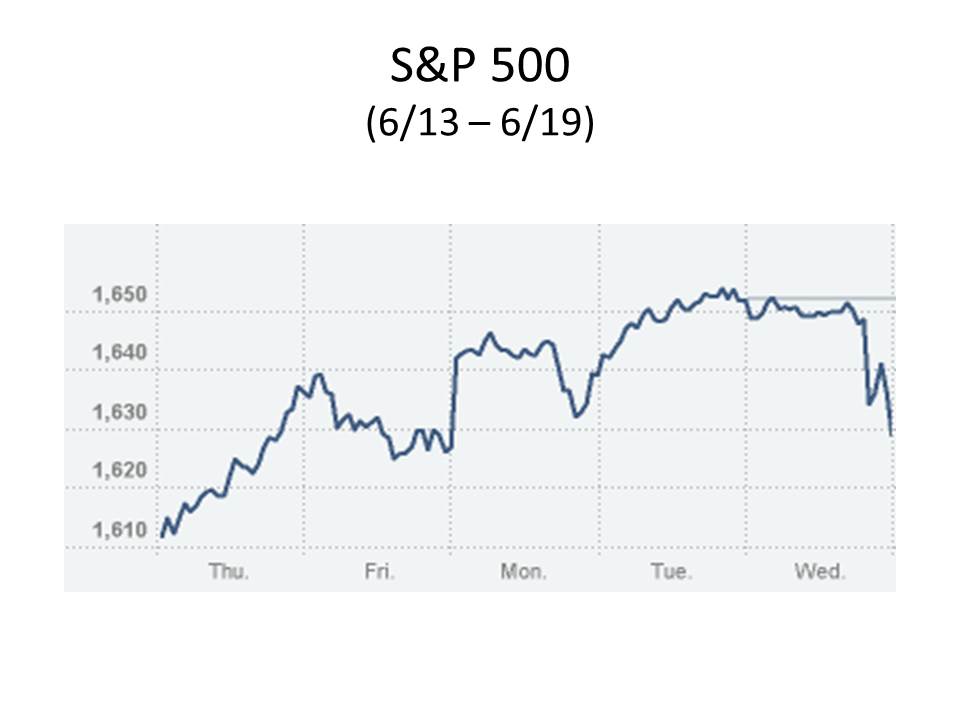
Ben Bernanke held a press conference today at the conclusion of the FOMC meeting held yesterday and today. The stock market had risen by almost 2 percent on Monday and Tuesday, apparently in hopes that Bernanke would have something encouraging to say about Fed policy. They were obviously disappointed. The accompanying chart shows how the S&P 500 has fluctuated since last Thursday, the sharp drop today coincided with Bernanke’s press conference.

S&P500_6-13_6-19 S&P500_6-13_6-19

What was so disturbing to the markets? Well, Bernanke’s press conference triggered some sharp movements in the bond markets. The yield on the 10-year Treasury jumped by 13 basis points to 2.33%. I don’t have a chart of the intra-day fluctuation, but I am pretty sure almost all of the movement occurred after the press conference started. Meanwhile the yield on the 10-year TIPS jumped 15 basis points, from 0.14% to 0.29%, implying a 2-basis-point drop in the breakeven TIPS spread, to 2.04%. A two-basis-point change in inflation expectations is not very remarkable. So it seems that what drove the increase in yield was the increase in the real rate. But one has to be careful in identifying the TIPS spread with the real rate of interest, especially when one sees sudden changes in the market, changes that could reflect factors other than the real rate of interest, such as illiquidity in the TIPS market or increasing uncertainty about future inflation, even though expected inflation is not changing much.

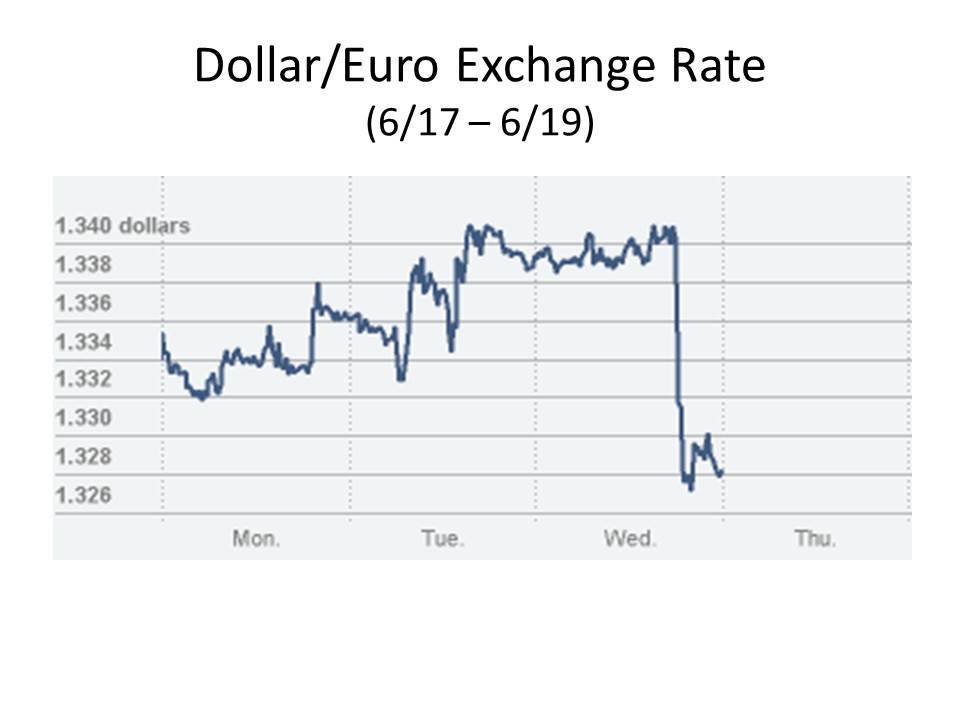
Let’s look at two other markets that moved sharply after Bernanke started talking this afternoon. The chart below shows the movement of dollar/euro exchange rate since Monday. The dollar weakened slightly on Monday and Tuesday and Wednesday morning, but as soon as Bernanke got started the dollar shot up against the euro.

dollar_euro_exchange_rate

That should not necessarily be construed as a vote of confidence in Bernanke, even though it apparently pleased Bernanke et al. to think that the sharp run-up in the value of the dollar in August 2008 was a sign of confidence that Fed policy to keep inflation expectations anchored was working. It is hard to interpret today’s sharp increase in the value of the dollar as anything but an expectation of future tightening of monetary policy by the Fed. But then why did inflation expectations fall by only 2 basis points?

Another market that is supposed to be sensitive to inflation expectations is gold, though in my view the demand for gold is too irrational to provide any usable information about expectations. But I will suspend my disbelief in the rationality of gold traders for the time being to note that the price of gold has just fallen to a new low for the year, dropping below $1340 an ounce or almost 3% since yesterday. A fall in the value of gold is consistent with an increase in real interest rates or with a decline in inflation expectations, so take your pick.

Some people have suggested that declining inflation expectations and rising real interest rates are manifestations of a positive supply shock, also reflected in declining commodity prices. A positive supply shock would have provided the Fed with an opportunity to relax monetary policy further without risk of raising inflation or inflation expectations from current levels, which already are well below the Fed’s announced 2% target. If continued Fed easing was what the markets had been anticipating earlier in the week, reflected in a gently falling dollar exchange rate, even with inflation expectations stable or falling, then Bernanke’s announcement today constituted a tightening of policy relative to expectations. The tightening drove up the dollar and caused a further, albeit small, decline in inflation expectations. (But I should note that this interpretation depends on what may be an oversimplified identification of the TIPS spread with inflation expectations.)

At any rate, I don’t think that we have a clear understanding of what is driving markets at this point. Markets still seem to be in confusion. Today’s movements in the markets were sudden and sharp, but they were also fairly modest. A one or two percent movement in markets is hardly a major event. Nevertheless, by displaying an unseemly haste to withdraw the very modest monetary stimulus that the Fed has begrudgingly provided, Bernanke may have given the markets a bit of scare, reminding them how indifferent central bankers have been to the ongoing disaster of the Little Depression. The markets did not panic, but we may be flying into turbulence. Keep your seat belts fastened.

What’s a Central Banker To Do?

The FOMC is meeting tomorrow and Wednesday, and it seems as if everyone is weighing in with advice for Ben Bernanke and company. But you can always count on the Wall Street Journal editorial page to dish up something especially fatuous when the topic turns to monetary policy and the Fed. This time the Journal turns to George Melloan, a former editor and columnist at the Journal, to explain why the market has recently turned “skittish” in anticipation that the Fed may be about to taper off from its latest venture into monetary easing.

Some of us have been arguing that recent Fed signals that it will taper off from quantitative easing have scared the markets, which are now anticipating rising real interest rates and declining inflation. Inflation expectations have been declining since March, but, until the latter part of May, that was probably a positive development, reflecting expectations of increased real output under the steady, if less than adequate, policy announced last fall. But the expectation that quantitative easing may soon be tapered off seems to have caused a further decline in inflation expectations and a further increase in real interest rates.

But Melloan sees it differently

We are in an age where the eight male and four female members of the FOMC are responsible for whether securities markets float or sink. Traders around the world who in better times considered a range of variables now focus on a single one, Federal Reserve policy. . . .

In the bygone days of free markets, stocks tended to move counter to bonds as investors switched from one to the other to maximize yield. But in the new world of government rigging, they often head in the same direction. That’s not good for investors.

Oh dear, where to begin? Who cares how many males and females are on the FOMC? Was the all-male Federal Reserve Board that determined monetary during the Great Depression more to Mr. Melloan’s liking? I discovered about three years ago that since early in 2008 there has been a clear correlation between inflation expectations and stock prices. (See my paper “The Fisher Effect Under Deflationary Expectations.“) That correlation was not created, as Melloan and his colleagues at the Journal seem to think, by the Fed’s various half-hearted attempts at quantitative-easing; it is caused by a dangerous conjuncture between low real rates of interest and low or negative rates of expected inflation. Real rates of interest are largely, but not exclusively, determined by entrepreneurial expectations of future economic conditions, and inflation expectations are largely, but not exclusively, determined by the Fed policy.

So the cure for a recession will generally require inflation expectations to increase relative to real interest rates. Either real rates must fall or inflation expectations (again largely under the control of the Fed) must rise. Thus, an increase in inflation expectations, when real interest rates are too high, can cause stock prices to rise without causing bond prices to fall. It is certainly true that it is not good for investors when the economy happens to be in a situation such that an increase in expected inflation raises stock prices. But that’s no reason not to reduce real interest rates. Using monetary policy to raise real interest rates, as Mr. Melloan would like the Fed to do, in a recession is a prescription for perpetuating joblessness.

Melloan accuses the Fed of abandoning free markets and rigging interest rates. But he can’t have it both ways. The Fed did not suddenly lose the power to rig markets last month when interest rates on long-term bonds rose sharply. Bernanke only hinted at the possibility of a tapering off from quantitative easing. The Fed’s control over the market is supported by nothing but the expectations of millions of market participants. If the expectations of traders are inconsistent with the Fed’s policy, the Fed has no power to prevent market prices from adjusting to the expectations of traders.

Melloan closes with the further accusation that Bernanke et al. hold “the grandiose belief . . . that the Fed is capable of superhuman feats, like running the global economy.” That’s nonsense. The Fed is not running the global economy. In its own muddled fashion, the Fed is trying to create market expectations about the future value of the dollar that will support an economic expansion. Unfortunately, the Fed seems not to have figured out that a rapid recovery is highly unlikely to occur unless something is done to sharply raise the near term expected rate of inflation relative to the real rate of interest.

Markets in Confusion

I have been writing a lot lately about movements in the stock market and in interest rates, trying to interpret those movements within the framework I laid out in my paper “The Fisher Effect Under Deflationary Expectations.” Last week I pointed out that, over the past three months, the close correlation, manifested from early 2008 to early 2013, between inflation expectations and the S&P 500 seems to have disappeared, inflation expectations declining at the same time that real interest rates, as approximated by the yield on the 10-year TIPS, and the stock market were rising.

However, for the past two days, the correlation seems to have made a strong comeback. The TIPS spread declined by 8 basis points, and the S&P 500 fell by 2%, over the past two days. (As I write this on Wednesday evening, the Nikkei average is down 5% in early trading on Thursday in Japan.) Meanwhile, the recent upward trajectory of the yield on TIPS has become even steeper, climbing 11 basis points in two days.

Now there are two possible interpretations of an increase in real interest rates. One is that expected real growth in earnings (net future corporate cash flows) is increasing. But that explanation for rising real interest rates is hard to reconcile with a sharp decline in stock prices. The other possible interpretation for a rise in real interest rates is that monetary policy is expected to be tightened, future interest rates being expected to rise when the monetary authority restricts the availability of base money. That interpretation would also be consistent with the observed decline in inflation expectations.

For almost three weeks since Bernanke testified to Congress last month, hinting at the possibility that the Fed would begin winding down QE3, markets have been in some turmoil, and I conjecture that the turmoil is largely due to uncertainty caused by the possibility of a premature withdrawal from QE. This suggests that we may have entered into a perverse expectational reaction function in which any positive economic information, such as the better-than-expected May jobs report, creates an expectation that monetary stimulus will be withdrawn, thereby counteracting the positive expectational boost of the good economic news. This is the Sumner critique with a vengeance — call it the super-Sumner critique. Not only is the government-spending multiplier zero; the private-investment multiplier is also zero!

Now I really like this story, and the catchy little name that I have thought up for it is also cute. But candor requires me to admit that I detect a problem with it. I don’t think that it is a fatal problem, but maybe it is. If I am correct that real interest rates are rising because the odds that the Fed will tighten its policy and withdraw QE are increasing, then I would have expected that expectations of a Fed tightening would also cause the dollar to rise against other currencies in the foreign-exchange markets. But that has not happened; the dollar has been falling for the past few weeks, and the trend has continued for the last two days also. The only explanation that I can offer for that anomaly is that a tightening in US monetary policy would be expected to cause other central banks to tighten their policies even more severely than the Fed. I can understand why some tightening by other central banks would be expected to follow from a Fed tightening, but I can’t really understand why the reaction would be more intense than the initial change. Of course the other possibility is that different segments of the markets are being dominated by different expectations, in which case, there are some potentially profitable trading strategies that could be followed to take advantage of those differences.

It wasn’t so long ago that we were being told by opponents of stimulus programs that the stimulus programs, whether fiscal or monetary, were counterproductive, because “the markets need certainty.” Well, maybe the certainty that is needed is the certainty that the stimulus won’t be withdrawn before it has done its job.

PS I apologize for not having responded to any comments lately. I have just been swamped with other obligations.

News Flash: Real Interest Rates Are Turning Positive!

Just after I wrote my previous post about the recent decoupling of inflation expectations and the S&P 500, it was reported that the breakeven 10-year TIPS spread at the close of trading on Friday was a paltry 0.03%. But that 0.03% was a remarkable milestone, because the last time that 10-year TIPS spread closed above zero, was January 24, 2012, almost 18 months ago. At the close of trading on Thursday, the TIPS spread had been -0.05%. Friday’s jump of 8 basis points in the TIPS spread followed the announcement that 175,000 new jobs had been added in the US in May, more than expected given fears that continued fiscal tightening is now acting as a drag on the recovery. The S&P 500 rose by 18 points, over 1%, suggesting that the announcement was taken as a sign that net corporate cash flows would exceed previous expectations, which is how stock prices could rise despite being discounted at rising real rates.

And again today, real rates again rose by another 8%. However, the S&P 500 was essentially unchanged, which suggests that there was a slight further improvement in expectations of future net cash flows, but that these improvements were exactly offset by the increase in real discount rates. All in all, the expectational news for the past two business days seems mildly favorable. However, inflation expectations are continuing on their recent downward trend, so the prospect of a premature withdrawal from the Fed’s half-hearted QE program seems to be a cause for concern.

Say, it ain’t so, Ben!

What Gives? Has the Market Stopped Loving Inflation?

One of my few, and not very compelling, claims to fame is a (still unpublished) paper (“The Fisher Effect Under Deflationary Expectations“) that I wrote in late 2010 in which I used the Fisher Equation relating the real and nominal rates of interest via the expected rate of inflation to explain what happens in a financial panic. I pointed out that the usual understanding that the nominal rate of interest and the expected rate of inflation move in the same direction, and possibly even by the same amount, cannot be valid when the expected rate of inflation is negative and the real rate is less than expected deflation. In those perilous conditions, the normal equilibrating process, by which the nominal rate adjusts to reflect changes in inflation expectations, becomes inoperative, because the nominal rate gets stuck at zero. In that unstable environment, the only avenue for adjustment is in the market for assets. In particular, when the expected yield from holding money (the expected rate of deflation) approaches or exceeds the expected yield on real capital, asset prices crash as asset owners all try to sell at the same time, the crash continuing until the expected yield on holding assets is no longer less than the expected yield from holding money. Of course, even that adjustment mechanism will restore an equilibrium only if the economy does not collapse entirely before a new equilibrium of asset prices and expected yields can be attained, a contingency not necessarily as unlikely as one might hope.

I therefore hypothesized that while there is not much reason, in a well-behaved economy, for asset prices to be very sensitive to changes in expected inflation, when expected inflation approaches, or exceeds, the expected return on capital assets (the real rate of interest), changes in expected inflation are likely to have large effects on asset values. This possibility that the relationship between expected inflation and asset prices could differ depending on the prevalent macroeconomic environment suggested an empirical study of the relationship between expected inflation (as approximated by the TIPS spread on 10-year Treasuries) and the S&P 500 stock index. My results were fairly remarkable, showing that, since early 2008 (just after the start of the downturn in late 2007), there was a consistently strong positive correlation between expected inflation and the S&P 500. However, from 2003 to 2008, no statistically significant correlation between expected inflation and asset prices showed up in the data.

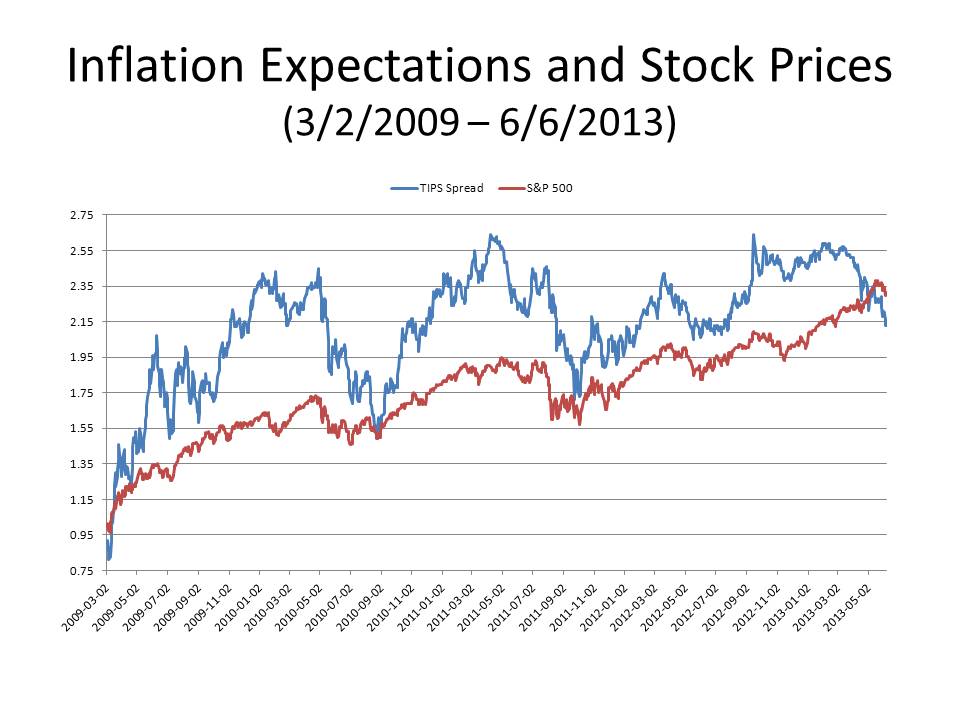
Ever since then, I have used this study (and subsequent informal follow-ups that have consistently generated similar results) as the basis for my oft-repeated claim that the stock market loves inflation. But now, guess what? The correlation between inflation expectations and the S&P 500 has recently vanished. The first of the two attached charts plots both expected inflation, as measured by the 10-year TIPS spread, and the S&P 500 (normalized to 1 on March 2, 2009). It is obvious that two series are highly correlated. However, you can see that over the last few months it looks as if the correlation has been reversed, with inflation expectations falling even as the S&P 500 has been regularly reaching new all-time highs.

TIPS_S&P500_new

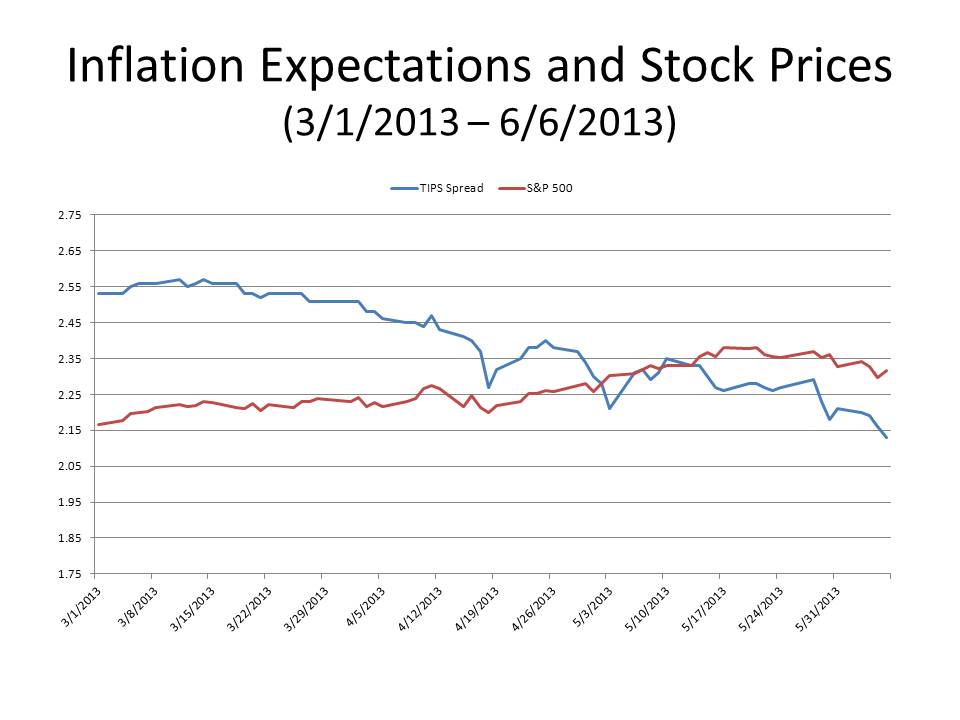
Here is a second chart that provides a closer look at the behavior of the S&P 500 and the TIPS spread since the beginning of March.

TIPS_S&P500_new_2

So what’s going on? I wish I knew. But here is one possibility. Maybe the economy is finally emerging from its malaise, and, after four years of an almost imperceptible recovery, perhaps the overall economic outlook has improved enough so that, even if we haven’t yet returned to normalcy, we are at least within shouting distance of it. If so, maybe asset prices are no longer as sensitive to inflation expectations as they were from 2008 to 2012. But then the natural question becomes: what caused the economy to reach a kind of tipping point into normalcy in March? I just don’t know.

And if we really are back to normal, then why is the real rate implied by the TIPS negative? True, the TIPS yield is not really the real rate in the Fisher equation, but a negative yield on a 10-year TIPS does not strike me as characteristic of a normal state of affairs. Nevertheless, the real yield on the 10-year TIPS has risen by about 50 basis points since March and by 75 basis points since December, so something noteworthy seems to have happened. And a fairly sharp rise in real rates suggests that recent increases in stock prices have been associated with expectations of increasing real cash flows and a strengthening economy. Increasing optimism about real economic growth, given that there has been no real change in monetary policy since last September when QE3 was announced, may themselves have contributed to declining inflation expectations.

What does this mean for policy? The empirical correlation between inflation expectations and asset prices is subject to an identification problem. Just because recent developments may have caused the observed correlation between inflation expectations and stock prices to disappear, one can’t conclude that, in the “true” structural model, the effect of a monetary policy that raised inflation expectations would not be to raise asset prices. The current semi-normal is not necessarily a true normal.

So my cautionary message is: Don’t use the recent disappearance of the correlation between inflation expectations and asset prices to conclude that it’s safe to abandon QE.

Scott Sumner, Meet Robert Lucas

I just saw Scott Sumner’s latest post. It’s about the zero fiscal multiplier. Scott makes a good and important point, which is that, under almost any conditions, fiscal policy cannot be effective if monetary policy is aiming at a policy objective that is inconsistent with that fiscal policy. Here’s how Scott puts it in his typical understated fashion.

From today’s news:

The marked improvement in the labor market since the U.S. central bank began its third round of quantitative easing, or QE3, has added an edge to calls by some policy hawks to dial down the stimulus. The roughly 50 percent jump in monthly job creation since the program began has even won renewed support from centrists, raising at least some chance the Fed could ratchet back its buying as early as next month.

I hope I don’t have to do any more of these.  The fiscal multiplier theory is as dead as John Cleese’s parrot.  The growth in jobs didn’t slow with fiscal austerity, it sped up!  And the Fed is saying that any job improvement due to fiscal stimulus will be offset with tighter money.  They talk like the multiplier is zero, and their actions produce a zero multiplier.

This is classic Sumner, and he deserves credit for rediscovering an argument that Ralph Hawtrey made in 1925, but was ignored and then forgotten until Sumner figured it out for himself. When I went through Hawtrey’s analysis in my recent series of posts on Hawtrey and Keynes, Scott immediately identified the identity between what Hawtrey was saying and what he was saying. So up to this point, I am with Scott all the way. But then he loses me, by asking the following question

Has there ever been a more decisive refutation of a major economic theory?

What’s wrong with that question? Well, it seems to me to fly in the face of another critique by another famous economist whom, I think, Scott actually knows: Robert Lucas. Almost 40 years ago, Lucas published a paper about the Phillips Curve in which he argued that the existence of an empirical relationship between inflation and unemployment, even if empirically well-founded, was not a relationship that policy makers could use as a basis for their policy decisions, because the expectations (of low inflation or stable prices) under which the negative relationship between inflation and unemployment was observed would break down once policy makers used that relationship to try to reduce unemployment by increasing inflation. That simple point, dressed up with just enough mathematical notation to obscure its obviousness, helped Lucas win the Noble Prize, and before long became widely known as the Lucas Critique.

The crux of the Lucas Critique is that economic theory posits deep structural relationships governing economic activity. These structural relationships are necessarily sensitive to the expectations of decision makers, so that no observed empirical relationship between economic variables is invariant to the expectational effects of the policy rules governing policy decisions. Observed relationships between economic variables are useless for policy makers unless they understand those deep structural relationships and how they are affected by expectations.

But now Scott seems to be turning the Lucas Critique on its head by saying that the expectations that result from a particular policy regime — a policy regime that has been subjected to withering criticism by none other than Scott himself – refutes a structural theory (that government spending can increase aggregate spending and income) of how the economy works. I don’t think so. The fact that the Fed has adopted and tenaciously sticks to a perverse reaction function cannot refute a theory in which the Fed’s reaction function is a matter of choice not necessity.

I agree with Scott that monetary policy is usually the best tool for macroeconomic stabilization. But that doesn’t mean that fiscal policy can never ever promote recovery. Even Ralph Hawtrey, originator of the “Treasury view” that fiscal policy is powerless to affect aggregate spending, acknowledged that, in a credit deadlock, when expectations are so pessimistic that the monetary authority is powerless to increase private spending, deficit spending by the government financed by money creation might be the only way to increase aggregate spending. That, to be sure, is a pathological situation. But, with at least some real interest rates, currently below zero, it is not impossible to suppose that we are, or have been, in something like a Hawtreyan credit deadlock. I don’t say that we are in one, just that it’s possible that we are close enough to being there that we can’t confidently exclude the possibility, if only the Fed would listen to Scott and stop targeting 2% inflation, of a positive fiscal multiplier.

With US NGDP not even increasing at a 4% annual rate, and the US economy far below its pre-2008 trendline of 5% annual NGDP growth, I don’t understand why one wouldn’t welcome the aid of fiscal policy in getting NDGP to increase at a faster rate than it has for the last 5 years. Sure the economy has been expanding despite a sharp turn toward contractionary fiscal policy two years ago. If fiscal stimulus had not been withdrawn so rapidly, can we be sure that the economy would not have grown faster? Under conditions such as these, as Hawtrey himself well understood, the prudent course of action is to err on the side of recklessness.


About Me

David Glasner
Washington, DC

I am an economist in the Washington DC area. My research and writing has been mostly on monetary economics and policy and the history of economics. In my book Free Banking and Monetary Reform, I argued for a non-Monetarist non-Keynesian approach to monetary policy, based on a theory of a competitive supply of money. Over the years, I have become increasingly impressed by the similarities between my approach and that of R. G. Hawtrey and hope to bring Hawtrey’s unduly neglected contributions to the attention of a wider audience.

My new book Studies in the History of Monetary Theory: Controversies and Clarifications has been published by Palgrave Macmillan

Follow me on Twitter @david_glasner

Archives

Enter your email address to follow this blog and receive notifications of new posts by email.

Join 665 other subscribers
Follow Uneasy Money on WordPress.com