About six months ago, I mentioned a forthcoming paper by Kenneth Carlaw and Richard Lipsey, “Does history matter? Empirical analysis of evolutionary versus stationary equilibrium views of the economy.” The paper was recently published in the Journal of Evolutionary Economics. The empirical analysis undertaken by Carlaw and Lipsey undermines many widely accepted propositions of modern macroeconomics, and is thus especially timely after the recent flurry of posts on the current state of macroecoomics by Krugman, Williamson, Smith, Delong, Sumner, et al., a topic about which I may have a word or two to say anon. Here is the abstract of the Carlaw and Lipsey paper.
The evolutionary vision in which history matters is of an evolving economy driven by bursts of technological change initiated by agents facing uncertainty and producing long term, path-dependent growth and shorter-term, non-random investment cycles. The alternative vision in which history does not matter is of a stationary, ergodic process driven by rational agents facing risk and producing stable trend growth and shorter term cycles caused by random disturbances. We use Carlaw and Lipsey’s simulation model of non-stationary, sustained growth driven by endogenous, path-dependent technological change under uncertainty to generate artificial macro data. We match these data to the New Classical stylized growth facts. The raw simulation data pass standard tests for trend and difference stationarity, exhibiting unit roots and cointegrating processes of order one. Thus, contrary to current belief, these tests do not establish that the real data are generated by a stationary process. Real data are then used to estimate time-varying NAIRU’s for six OECD countries. The estimates are shown to be highly sensitive to the time period over which they are made. They also fail to show any relation between the unemployment gap, actual unemployment minus estimated NAIRU and the acceleration of inflation. Thus there is no tendency for inflation to behave as required by the New Keynesian and earlier New Classical theory. We conclude by rejecting the existence of a well-defined a short-run, negatively sloped Philips curve, a NAIRU, a unique general equilibrium, short and long-run, a vertical long-run Phillips curve, and the long-run neutrality of money.
UPDATE: In addition to the abstract, I think it would be worthwhile to quote the three introductory paragraphs from Carlaw and Lipsey.
Economists face two conflicting visions of the market economy, visions that reflect two distinct paradigms, the Newtonian and the Darwinian. In the former, the behaviour of the economy is seen as the result of an equilibrium reached by the operation of opposing forces – such as market demanders and suppliers or competing oligopolists – that operate in markets characterised by negative feedback that returns the economy to its static equilibrium or its stationary equilibrium growth path. In the latter, the behaviour of the economy is seen as the result of many different forces – especially technological changes – that evolve endogenously over time, that are subject to many exogenous shocks, and that often operate in markets subject to positive feedback and in which agents operate under conditions of genuine uncertainty.
One major characteristic that distinguishes the two visions is stationarity for the Newtonian and non-stationarity for the Darwinian. In the stationary equilibrium of a static general equilibrium model and the equilibrium growth path of a Solow-type or endogenous growth model, the path by which the equilibrium is reached has no effect on the equilibrium values themselves. In short, history does not matter. In contrast, an important characteristic of the Darwinian vision is path dependency: what happens now has important implications for what will happen in the future. In short, history does matter.
In this paper, we consider, and cast doubts on, the stationarity properties of models in the Newtonian tradition. These doubts, if sustained, have important implications for understanding virtually all aspects of macroeconomics, including of long term economic growth, shorter term business cycles, and stabilisation policy.
UPDATE (12/28/12): I received an email from Richard Lipsey about this post. He attached two footnotes (1 and 5) from his article with Carlaw, which he thinks are relevant to some of the issues raised in comments to this post. Footnote 1 explains their use of “Darwinian” to describe their path-dependent approach to economic modeling; footnote 5 observes that the analysis of many microeconomic problems and short-run macro-policy analysis may be amenable to the static-equilibrium method.
1 The use of the terms Darwinian and Newtonian here is meant to highlight the significant difference in equilibrium concept employed in the two groups of theories that we contrast, the evolutionary and what we call equilibrium with deviations (EWD) theories. Not all evolutionary theories, including the one employed here, are strictly speaking Darwinian in the sense that they embody replication and selection. We use the term, Darwinian to highlight the critical equilibrium concept of a path dependent, non-ergodic, historical process employed in Darwinian and evolutionary theories and to draw the contrast between that and the negative feedback, usually unique, ergodic equilibrium concept employed in Newtonian and EWD theories.
5 Most evolutionary economists accept that for many issues in micro economics, comparative static equilibrium models are useful. Also, there is nothing incompatible between the evolutionary world view and the use of Keynesian models – of which IS-LM closed by an expectations-augmented Phillips curve is the prototype – to study such short run phenomenon as stagflation and the impact effects of monetary and fiscal policy shocks. Problems arise, however, when such analyses are applied to situations in which technology is changing endogenously over time periods that are relevant to the issues being studied. Depending on the issue at hand, this might be as short as a few months.
Robert Waldmann is unhappy with Matthew Yglesias for being hopeful that, Shinzo Abe, just elected prime minister of Japan, may be about to make an important contribution to the world economy, and to economic science, by prodding the Bank of Japan to increase its inflation target and by insisting that the BOJ actually hit the new target. Since I don’t regularly read Waldmann’s blog (not because it’s not worth reading — I usually enjoy reading it when I get to it – I just can’t keep up with that many blogs), I’m not sure why Waldmann finds Yglesias’s piece so annoying. OK, Waldmann’s a Keynesian and prefers fiscal to monetary policy, but so is Paul Krugman, and he thinks that monetary policy can be effective even at the zero lower bound. At any rate this is how Waldmann responds to Yglesias:
Ben Bernanke too has declared a policy of unlimited quantitative easing and increased inflation (new target only 2.5% but that’s higher than current inflation). The declaration (which was a surprise) had essentially no effect on prices for medium term treasuries, TIPS or the breakeven.
I was wondering when you would comment, since you have confidently asserted again and again that if only the FOMC did what it just did, expected inflation would jump and then GDP growth would increase.
However, instead of noting the utter total failure of your past predictions (and the perfect confirmation of mine) you just boldly make new predictions.
Face fact, like conventional monetary policy (in the US the Federal Funds rate) forward guidance is pedal to the metal. It’s long past time for you to start climbing down.
I mention this, because just yesterday I happened across another blog post about what Bernanke said after the FOMC meeting. This post by David Altig, executive VP and research director of the Atlanta Fed, was on the macroblog. Altig points out that, despite the increase in the Fed’s inflation threshold from 2 to 2.5%, the Fed increased neither its inflation target (still 2%) nor its inflation forecast (still under 2%). All that the Fed did was to say that it won’t immediately slam on the brakes if inflation rises above 2% provided that unemployment is greater than 6.5% and inflation is less than 2.5%. That seems like a pretty marginal change in policy to me.
Also have a look at this post from earlier today by Yglesias, showing that the Japanese stock market has risen about 5.5% in the last two weeks, and about 2% in the two days since Abe’s election. Here is Yglesias’s chart showing the rise of the Nikkei over the past two weeks.
In addition, here is a news story from Bloomberg about rising yields on Japanese government bonds, which are now the highest since April.
Japan‘s bonds declined, sending 20- year yields to an eight-month high, as demand ebbed at a sale of the securities and domestic shares climbed.
The sale of 1.2 trillion yen ($14.3 billion) of 20-year bonds had the lowest demand in four months. Yields on the benchmark 10-year note rose to a one-month high as Japan’s Nikkei 225 Stock Average reached the most since April amid signs U.S. budget talks are progressing.
Finally, another item from Yglesias, a nice little graph showing the continuing close relationship between the S&P 500 and inflation expectations as approximated by the breakeven TIPS spread on 10-year Treasuries, a relationship for which I have provided (in a paper available here) a theoretical explanation as well as statistical evidence that the relationship did not begin to be observed until approximately the spring of 2008 as the US economy, even before the Lehman debacle, began its steep contraction. Here’s the graph.
HT: Mark Thoma
UPDATE: Added a link above to the blog post by Altig about what Bernanke meant when he announced a 2.5% inflation threshold.
Perhaps the most interesting and influential financial journalist of the 1970s was a guy by the name of Jude Wanniski, who was an editorial writer for Wall Street Journal, from 1972 to 1978. In the wake of the Watergate scandal, and the devastating losses suffered by the Republicans in the 1974 Congressional elections, many people thought that the Republican party might not survive. The GOP certainly did not seem to offer much hope for free-market conservatives and libertarians, Richard Nixon having imposed wage-and-price controls in 1971, with the help of John Connally and Arthur Burns and enthusiastic backing from almost all Republicans. After Nixon resigned, leadership of the party was transferred to his successor, Gerald Ford, a very nice and decent fellow, whose lack of ideological conviction was symbolized by his choice of Nelson Rockefeller, an interventionist, big-government Republican if there ever was one, to serve as his Vice-President.
In this very dispirited environment for conservatives, Jude Wanniski’s editorial pieces in the Wall Street Journal and his remarkable 1978 book The Way the World Works, in which he advocated cuts in income tax rates as a cure for economic stagnation, proved to be an elixir of life for demoralized Republicans and conservatives. Wanniski was especially hard on old-fashioned Republicans and conservatives for whom balancing the federal budget had become the be all and end of all of economic policy, a doctrine that the Wall Street Journal itself had once espoused. A gifted phrase maker, Wanniski dubbed traditional Republican balanced-budget policy, root-canal economics. Instead, Wanniski adopted the across-the-board income tax cuts proposed by John Kennedy in 1963, a proposal that conservative icon Barry Goldwater had steadfastly opposed, as his model for economic policy.
Wanniski quickly won over a rising star in the Republican party, former NFL quarterback Jack Kemp, to his way of thinking. Another acolyte was an ambitious young Georgian by the name of Newt Gingrich. In 1978, Kemp and Senator Bill Roth form Delaware (after whom the Roth IRA is named), co-authored a bill, without support from the Republican Congressional leadership, to cut income taxes across the board by 25%. Many Republicans running for Congress and the Senate in 1978 pledged to support what became known as the Kemp-Roth bill. An unexpectedly strong showing by Republicans supporting the Kemp-Roth bill in the 1978 elections encouraged Jack Kemp to consider running for President in 1980 on a platform of across-the-board tax cuts. However, when Ronald Reagan, nearly 70 years old, and widely thought, after unsuccessfully challenging Gerald Ford for the GOP nomination in 1976, to be past his prime, signed on as a supporter of the Kemp-Roth bill, Kemp bowed out of contention, endorsing Reagan for the nomination, and uniting conservatives behind the Gipper.
After his landslide victory in the 1980 election, Reagan, riding a crest of popularity, enhanced by an unsuccessful assassination attempt in the first few months of his term, was able to push the Kemp-Roth bill through Congress, despite warnings from the Democrats that steep tax cuts would cause large budget deficits. To such warnings, Jack Kemp famously responded that Republicans no longer worshiped at the altar of a balanced budget. No one cheered louder for that heretical statement by Kemp than, you guessed it, the Wall Street Journal editorial page.
Fast forward to 2012, the Wall Street Journal, which never fails to invoke the memory of Ronald Reagan whenever an opportunity arises, nevertheless seems to have rediscovered the charms of root-canal economics. How else can one explain this piece of sophistry from Robert L. Pollock, a member of the group of sages otherwise known as the Editorial Board of the Wall Street Journal? Consider what Mr. Pollock had to say in an opinion piece on the Journal‘s website.
[T]o the extent that the United States finds itself in a precarious fiscal situation, Federal Reserve Chairman Ben Bernanke shares much of the blame. Simply put, there is no way that Washington could have run the deficits it has in recent years without the active assistance of a near-zero interest rate policy. . . .
European governments finally decided to take cost-cutting steps when their borrowing costs went up. But Democrats and liberal economists use Mr. Bernanke’s low rates and willingness to buy government bonds as evidence that there’s no pressing problem here to be addressed.
This is a strange argument for high interest rates, especially coming from a self-avowed conservative. Conservatives got all bent out of shape when Obama’s Energy Secretary, Stephen Chu, opined that rising gasoline prices might actually serve a useful function by inducing consumers and businesses to be more economical in their their use of gasoline. That comment was seized on by Republicans as proof that the Obama administration was seeking to increase gasoline prices as a way of reducing gasoline consumption. Now, Mr. Pollock provides us with a new argument for high interest rates: by raising the cost of borrowing, high interest rates will force the government to be more economical in its spending decisions. Evidently, it’s wrong to suggest that an increased price will reduce gasoline consumption, but it’s fine to say that an increased interest rate will cut government spending. Go figure.
Well, here’s what Wanniski had to say about the Republican obsession with reducing government spending for its own sake:
It isn’t that Republicans don’t enjoy cutting taxes. They love it. But there is something in the Republican chemistry that causes the GOP to become hypnotized by the prospect of an imbalanced budget. Static analysis tells them taxes can’t be cut or inflation will result. They either argue for a tax hike to dampen inflation when the economy is in a boom or demand spending cuts to balance the budget when the economy is in recession.
Either way, of course, they embrace the role of Scrooge, playing into the hands of the Democrats, who know the first rule of successful politics is Never Shoot Santa Claus. The political tension in the market place of ideas must be between tax reduction and spending increases, and as long as Republicans have insisted on balanced budgets, their influence as a party has shriveled, and budgets have been imbalanced.
How’s that old root-canal economics working out for ya?
Now back to Pollock. Here’s how he explains why low interest rates may not really be helping the economy.
It would be one thing if there were widespread agreement that low rates are the right medicine for the economy. But easy money on the Bernanke scale is a heretofore untested policy, one for which the past few years of meager growth haven’t provided convincing evidence.
Fair enough. Low rates haven’t been helping the economy all that much. But the question arises: why are rates so low? Is it really all the Fed’s doing, or could it possibly have something to do with pessimism on the part of businesses and consumers about whether they will be able to sell their products or their services in the future? If it is the latter, then low interest rates may not be a symptom of easy money, but of tight money.
Pollock, of course, has a different explanation for why low interest rates are not promoting a recovery.
Economists such as David Malpass argue that low rates are actually contractionary because they cause capital to be diverted from more productive uses to less productive ones.
Oh my. What can one say about an argument like that? I have encountered Mr. Malpass before and was less than impressed by his powers of economic reasoning; I remain unimpressed. How can a low interest rate divert capital from more productive uses to less productive ones unless capital rationing is taking place? If some potential borrowers were unable to secure funding for their productive projects while other borrowers with less productive projects were able to get funding for theirs, the disappointed borrowers could have offered to borrow at increased interest rates, thereby outbidding borrowers with unproductive projects, and driving up interest rates in the process. That is just elementary. That interest rates are now at such low levels is more reflective of the pessimism of most potential borrowers about the projects for which they seeking funding, than of the supposed power of the Fed to determine interest rates.
So there you have it. The Wall Street Journal editorial page, transformed in the 1970s by the daring and unorthodox ideas of a single, charismatic economic journalist, Jude Wanniski, has now, almost four decades later, finally come back to its roots. Welcome home where you belong.
In my previous post, I suggested that Stephen Williamson’s views about the incapacity of monetary policy to reduce unemployment, and his fears that monetary expansion would simply lead to higher inflation and a repeat of the bad old days the 1970s when inflation and unemployment spun out of control, follow from a theoretical presumption that the US economy is now operating (as it almost always does) in the neighborhood of equilibrium. This does not seem right to me, but it is the sort of deep theoretical assumption (e.g., like the rationality of economic agents) that is not subject to direct empirical testing. It is part of what the philosopher Imre Lakatos called the hard core of a (in this case Williamson’s) scientific research program. Whatever happens, Williamson will process the observed facts in terms of a theoretical paradigm in which prices adjust and markets clear. No other way of viewing reality makes sense, because Williamson cannot make any sense of it in terms of the theoretical paradigm or world view to which he is committed. I actually have some sympathy with that way of looking at the world, but not because I think it’s really true; it’s just the best paradigm we have at the moment. But I don’t want to follow that line of thought too far now, but who knows, maybe another time.
A good illustration of how Williamson understands his paradigm was provided by blogger J. P. Koning in his comment on my previous post copying the following quotation from a post written by Williamson a couple of years on his blog.
In other cases, as in the link you mention, there are people concerned about disequilibrium phenomena. These approaches are or were popular in Europe – I looked up Benassy and he is still hard at work. However, most of the mainstream – and here I’m including New Keynesians – sticks to equilibrium economics. New Keynesian models may have some stuck prices and wages, but those models don’t have to depart much from standard competitive equilibrium (or, if you like, competitive equilibrium with monopolistic competition). In those models, you have to determine what a firm with a stuck price produces, and that is where the big leap is. However, in terms of determining everything mathematically, it’s not a big deal. Equilibrium economics is hard enough as it is, without having to deal with the lack of discipline associated with “disequilibrium.” In equilibrium economics, particularly monetary equilibrium economics, we have all the equilibria (and more) we can handle, thanks.
I actually agree that departing from the assumption of equilibrium can involve a lack of discipline. Market clearing is a very powerful analytical tool, and to give it up without replacing it with an equally powerful analytical tool leaves us theoretically impoverished. But Williamson seems to suggest (or at least leaves ambiguous) that there is only one kind of equilibrium that can be handled theoretically, namely a fully optimal general equilibrium with perfect foresight (i.e., rational expectations) or at least with a learning process leading toward rational expectations. But there are other equilibrium concepts that preserve market clearing, but without imposing, what seems to me, the unreasonable condition of rational expectations and (near) optimality.
In particular, there is the Hicksian concept of a temporary equilibrium (inspired by Hayek’s discussion of intertemporal equilibrium) which allows for inconsistent expectations by economic agents, but assumes market clearing based on supply and demand schedules reflecting those inconsistent expectations. Nearly 40 years ago, Earl Thompson was able to deploy that equilibrium concept to derive a sub-optimal temporary equilibrium with Keynesian unemployment and a role for countercyclical monetary policy in minimizing inefficient unemployment. I have summarized and discussed Thompson’s model previously in some previous posts (here, here, here, and here), and I hope to do a few more in the future. The model is hardly the last word, but it might at least serve as a starting point for thinking seriously about the possibility that not every state of the economy is an optimal equilibrium state, but without abandoning market clearing as an analytical tool.
The FOMC, after over four years of overly tight monetary policy, seems to be feeling its way toward an easier policy stance. But will it do any good? Unfortunately, there is reason to doubt that it will. The FOMC statement pledges to continue purchasing $85 billion a month of Treasuries and mortgage-backed securities and to keep interest rates at current low levels until the unemployment rate falls below 6.5% or the inflation rate rises above 2.5%. In other words, the Fed is saying that it will tolerate an inflation rate only marginally higher than the current target for inflation before it begins applying the brakes to the expansion. Here is how the New York Times reported on the Fed announcement.
The Federal Reserve said Wednesday it planned to hold short-term interest rates near zero so long as the unemployment rate remains above 6.5 percent, reinforcing its commitment to improve labor market conditions.
The Fed also said that it would continue in the new year its monthly purchases of $85 billion in Treasury bonds and mortgage-backed securities, the second prong of its effort to accelerate economic growth by reducing borrowing costs.
But Fed officials still do not expect the unemployment rate to fall below the new target for at least three more years, according to forecasts also published Wednesday, and they chose not to expand the Fed’s stimulus campaign.
In fairness to the FOMC, the Fed, although technically independent, must operate within an implicit consensus on what kind of decisions it can take, its freedom of action thereby being circumscribed in the absence of a clear signal of support from the administration for a substantial departure from the terms of the implicit consensus. For the Fed to substantially raise its inflation target would risk a political backlash against it, and perhaps precipitate a deep internal split within the Fed’s leadership. At the depth of the financial crisis and in its immediate aftermath, perhaps Chairman Bernanke, if he had been so inclined, might have been able to effect a drastic change in monetary policy, but that window of opportunity closed quickly once the economy stopped contracting and began its painfully slow pseudo recovery.
As I have observed a number of times (here, here, and here), the paradigm for the kind of aggressive monetary easing that is now necessary is FDR’s unilateral decision to take the US off the gold standard in 1933. But FDR was a newly elected President with a massive electoral mandate, and he was making decisions in the midst of the worst economic crisis in modern times. Could an unelected technocrat (or a collection of unelected technocrats) take such actions on his (or their) own? From the get-go, the Obama administration showed no inclination to provide any significant input to the formulation of monetary policy, either out of an excess of scruples about Fed independence or out of a misguided belief that monetary policy was powerless to affect the economy when interest rates were close to zero.
Stephen Williamson, on his blog, consistently gives articulate expression to the doctrine of Fed powerlessness. In a post yesterday, correctly anticipating that the Fed would continue its program of buying mortgage backed securities and Treasuries, and would tie its policy to numerical triggers relating to unemployment, Williamson disdainfully voiced his skepticism that the Fed’s actions would have any positive effect on the real performance of the economy, while registering his doubts that the Fed would be any more successful in preventing inflation from getting out of hand while attempting to reduce unemployment than it was in the 1970s.
It seems to me that Williamson reaches this conclusion based on the following premises. The Fed has little or no control over interest rates or inflation, and the US economy is not far removed from its equilibrium growth path. But Williamson also believes that the Fed might be able to increase inflation, and that that would be a bad thing if the Fed were actually to do so. The Fed can’t do any good, but it could do harm.
Williamson is fairly explicit in saying that he doubts the ability of positive QE to stimulate, and negative QE (which, I guess, might be called QT) to dampen real or nominal economic activity.
Short of a theory of QE – or more generally a serious theory of the term structure of interest rates – no one has a clue what the effects are, if any. Until someone suggests something better, the best guess is that QE is irrelevant. Any effects you think you are seeing are either coming from somewhere else, or have to do with what QE signals for the future policy rate. The good news is that, if it’s irrelevant, it doesn’t do any harm. But if the FOMC thinks it works when it doesn’t, that could be a problem, in that negative QE does not tighten, just as positive QE does not ease.
But Williamson seems a bit uncertain about the effects of “forward guidance” i.e., the Fed’s commitment to keep interest rates low for an extended period of time, or until a trigger is pulled e.g., unemployment falls below a specified level. This is where Williamson sees a real potential for mischief.
(1)To be well-understood, the triggers need to be specified in a very simple form. As such it seems as likely that the Fed will make a policy error if it commits to a trigger as if it commits to a calendar date. The unemployment rate seems as good a variable as any to capture what is going on in the real economy, but as such it’s pretty bad. It’s hardly a sufficient statistic for everything the Fed should be concerned with.
(2)This is a bad precedent to set, for two reasons. First, the Fed should not be setting numerical targets for anything related to the real side of the dual mandate. As is well-known, the effect of monetary policy on real economic activity is transient, and the transmission process poorly understood. It would be foolish to pretend that we know what the level of aggregate economic activity should be, or that the Fed knows how to get there. Second, once you convince people that triggers are a good idea in this “unusual” circumstance, those same people will wonder what makes other circumstances “normal.” Why not just write down a Taylor rule for the Fed, and send the FOMC home? Again, our knowledge of how the economy works, and what future contingencies await us, is so bad that it seems optimal, at least to me, that the Fed make it up as it goes along.
I agree that a fixed trigger is a very blunt instrument, and it is hard to know what level to set it at. In principle, it would be preferable if the trigger were not pulled automatically, but only as a result of some exercise of discretionary judgment by the part of the monetary authority; except that the exercise of discretion may undermine the expectational effect of setting a trigger. Williamson’s second objection strikes me as less persuasive than the first. It is at least misleading, and perhaps flatly wrong, to say that the effect of monetary policy on real economic activity is transient. The standard argument for the ineffectiveness of monetary policy involves an exercise in which the economy starts off at equilibrium. If you take such an economy and apply a monetary stimulus to it, there is a plausible (but not necessarily unexceptionable) argument that the long-run effect of the stimulus will be nil, and any transitory gain in output and employment may be offset (or outweighed) by a subsequent transitory loss. But if the initial position is out of equilibrium, I am unaware of any plausible, let alone compelling, argument that monetary stimulus would not be effective in hastening the adjustment toward equilibrium. In a trivial sense, the effect of monetary policy is transient inasmuch as the economy would eventually reach an equilibrium even without monetary stimulus. However, unlike the case in which monetary stimulus is applied to an economy in equilibrium, applying monetary policy to an economy out of equilibrium can produce short-run gains that aren’t wiped out by subsequent losses. I am not sure how to interpret the rest of Williamson’s criticism. One might almost interpret him as saying that he would favor a policy of targeting nominal GDP (which bears a certain family resemblance to the Taylor rule), a policy that would also address some of the other concerns Williamson has about the Fed’s choice of triggers, except that Williamson is already on record in opposition to NGDP targeting.
In reply to a comment on this post, Williamson made the following illuminating observation:
Read James Tobin’s paper, “How Dead is Keynes?” referenced in my previous post. He was writing in June 1977. The unemployment rate is 7.2%, the cpi inflation rate is 6.7%, and he’s complaining because he thinks the unemployment rate is disastrously high. He wants more accommodation. Today, I think we understand the reasons that the unemployment rate was high at the time, and we certainly don’t think that monetary policy was too tight in mid-1977, particularly as inflation was about to take off into the double-digit range. Today, I don’t think the labor market conditions we are looking at are the result of sticky price/wage inefficiencies, or any other problem that monetary policy can correct.
The unemployment rate in 1977 was 7.2%, at least one-half a percentage point less than the current rate, and the cpi inflation rate was 6.7% nearly 5% higher than the current rate. Just because Tobin was overly disposed toward monetary expansion in 1977 when unemployment was less and inflation higher than they are now, it does not follow that monetary expansion now would be as misguided as it was in 1977. Williamson is convinced that the labor market is now roughly in equilibrium, so that monetary expansion would lead us away from, not toward, equilibrium. Perhaps it would, but most informed observers simply don’t share Williamson’s intuition that the current state of the economy is not that far from equilibrium. Unless you buy that far-from-self-evident premise, the case for monetary expansion is hard to dispute. Nevertheless, despite his current unhappiness, I am not so sure that Williamson will be as upset with what the actual policy that the Fed is going to implement as he seems to think he will be. The Fed is moving in the right direction, but is only taking baby steps.
PS I see that Williamson has now posted his reaction to the Fed’s statement. Evidently, he is not pleased. Perhaps I will have something more to say about that tomorrow.
Once again, I find myself slightly behind the curve, with Scott Sumner (and again, and again, and again, and again), Nick Rowe and Bill Woolsey out there trying to face down an onslaught of Austrians rallying under the dreaded banner (I won’t say what color) of Cantillon Effects. At this point, the best I can do is some mopping up by making a few general observations about the traditional role of Cantillon Effects in Austrian business cycle theory and how that role squares with the recent clamor about Cantillon Effects.
Scott got things started, as he usually does, with a post challenging an Austrian claim that the Federal Reserve favors the rich because its injections of newly printed money enter the economy at “specific points,” thereby conferring unearned advantages on those lucky or well-connected few into whose hands those crisp new dollar bills hot off the printing press first arrive. The fortunate ones who get to spend the newly created money before the fresh new greenbacks have started on their inflationary journey through the economy are able to buy stuff at pre-inflation prices, while the poor suckers further down the chain of transactions triggered by the cash infusion must pay higher prices before receiving any of the increased spending. Scott’s challenge provoked a fierce Austrian counterattack from commenters on his blog and from not-so-fierce bloggers like Bob Murphy. As is often the case, the discussion (or the shouting) produced no clear outcome, each side confidently claiming vindication. Scott and Nick argued that any benefits conferred on first recipients of cash would be attributable to the fiscal impact of the Fed’s actions (e.g., purchasing treasury bonds with new money rather than helicopter distribution), with Murphy et al. arguing that distinctions between the fiscal and monetary effects of Fed operations are a dodge. No one will be surprised when I say that Scott and Nick got the better of the argument.
But there are a couple of further points that I would like to bring up about Cantillon effects. It seems to me that the reason Cantillon effects were thought to be of import by the early Austrian theorists like Hayek was that they had a systematic theory of the distribution or the incidence of those effects. Merely to point out that such effects exist and redound to the benefits of some lucky individuals would have been considered a rather trivial and pointless exercise by Hayek. Hayek went to great lengths in the 1930s to spell out a theory of how the creation of new money resulting in an increase in total expenditure would be associated with a systematic and (to the theorist) predictable change in relative prices between consumption goods and capital goods, a cheapening of consumption goods relative to capital goods causing a shift in the composition of output in favor of capital goods. Hayek then argued that such a shift in the composition of output would be induced by the increase in capital-goods prices relative to consumption-goods prices, the latter shift, having been induced by a monetary expansion that could not (for reasons I have discussed in previous posts, e.g., here) be continued indefinitely, eventually having to be reversed. This reversal was identified by Hayek with the upper-turning point of the business cycle, because it would trigger a collapse of the capital-goods industries and a disruption of all the production processes dependent on a continued supply of those capital goods.
Hayek’s was an interesting theory, because it identified a particular consequence of monetary expansion for an important sector of the economy, providing an explanation of the economic mechanism and a prediction about the direction of change along with an explanation of why the initial change would eventually turn out to be unsustainable. The theory could be right or wrong, but it involved a pretty clear-cut set of empirical implications. But the point to bear in mind is that this went well beyond merely saying that in principle there would be some gainers and some losers as the process of monetary expansion unfolds.
What accounts for the difference between the empirically rich theory of systematic Cantillon Effects articulated by Hayek over 80 years ago and the empirically trivial version on which so much energy was expended over the past few days on the blogosphere? I think that the key difference is that in Hayek’s cycle theory, it is the banks that are assumed somehow or other to set an interest rate at which they are willing to lend, and this interest rate may or may not be consistent with the constant volume of expenditure that Hayek thought (albeit with many qualifications) was ideal criterion of the neutral monetary policy which he favored. A central bank might or might not be involved in the process of setting the bank rate, but the instrument of monetary policy was (depending on circumstances) the lending rate of the banks, or, alternatively, the rate at which the central bank was willing lending to banks by rediscounting the assets acquired by banks in lending to their borrowers.
The way Hayek’s theory works is through an unobservable natural interest rate that would, if it were chosen by the banks, generate a constant rate of total spending. There is, however, no market mechanism guaranteeing that the lending rate selected by the banks (with or without the involvement of a central bank) coincides with the ideal but unobservable natural rate. Deviations of the banks’ lending rate from the natural rate cause Cantillon Effects involving relative-price distortions, thereby misdirecting resources from capital-goods industries to consumption-goods industries, or vice versa. But the specific Cantillon effect associated with Hayek’s theory presumes that the banking system has the power to determine the interest rates at which borrowing and lending take place for the entire economy. This presumption is nowhere ot my knowledge justified, and it does not seem to me that the presumption is even remotely justifiable unless one accepts the very narrow theory of interest known as the loanable-funds theory. According to the loanable-funds theory, the rate of interest is that rate which equates the demand for funds to be borrowed with the supply of funds available to be lent. However, if one views the rate of interest (in the sense of the entire term structure of interest rates) as being determined in the process by which the entire existing stock of capital assets is valued (i.e., the price for each asset at which it would be willingly held by just one economic agent) those valuations being mutually consistent only when the expected net cash flows attached to each asset are discounted at the equilibrium term structure and equilibrium risk premia. Given that comprehensive view of asset valuations and interest-rate determination, the notion that banks (with or without a central bank) have any substantial discretion in choosing interest rates is hard to take seriously. And to the extent that banks have any discretion over lending rates, it is concentrated at the very short end of the term structure. I really can’t tell what she meant, but it is at least possible that Joan Robinson was alluding to this idea when, in her own uniquely charming way, she criticized Hayek’s argument in Prices and Production.
I very well remember Hayek’s visit to Cambridge on his way to the London School. He expounded his theory and covered a black board with his triangles. The whole argument, as we could see later, consisted in confusing the current rate of investment with the total stock of capital goods, but we could not make it out at the time. The general tendency seemed to be to show that the slump was caused by [excessive] consumption. R. F. Kahn, who was at that time involved in explaining that the multiplier guaranteed that saving equals investment, asked in a puzzled tone, “Is it your view that if I went out tomorrow and bought a new overcoat, that would increase unemploy- ment?”‘ “Yes,” said Hayek, “but,” pointing to his triangles on the board, “it would take a very long mathematical argument to explain why.”
At any rate, if interest rates are determined comprehensively in all the related markets for existing stocks of physical assets, not in flow markets for current borrowing and lending, Hayek’s notion that the banking system can cause significant Cantillon effects via its control over interest rates is hard to credit. There is perhaps some room to alter very short-term rates, but longer-term rates seem impervious to manipulation by the banking system except insofar as inflation expectations respond to the actions of the banking system. But how does one derive a Cantillon Effect from a change in expected inflation? Cantillon Effects may or may not exist, but unless they are systematic, predictable, and unsustainable, they have little relevance to the study of business cycles.
A new book by Angus Burgin about the role of F. A. Hayek and Milton Friedman and the Mont Pelerin Society (an organization of free-market economists plus some scholars in other disciplines founded by Hayek and later headed by Friedman) in resuscitating free-market capitalism as a political ideal after its nineteenth-century version had been discredited by the twin catastrophes of the Great War and the Great Depression was the subject of an interesting and in many ways insightful review by Robert Solow in the latest New Republic. Despite some unfortunate memory lapses and apologetics concerning his own errors and those of his good friend and colleague Paul Samuelson in their assessments of the of efficiency of central planning, thereby minimizing the analytical contributions of Hayek and Friedman, Solow does a good job of highlighting the complexity and nuances of Hayek’s thought — a complexity often ignored not only by Hayek’s critics but by many of his most vocal admirers — and of contrasting Hayek’s complexity and nuance with Friedman’s rhetorically and strategically compelling, but intellectually dubious, penchant for simplification.
First, let’s get the apologetics out of the way. Tyler Cowen pounced on this comment by Solow:
The MPS [Mont Pelerin Society] was no more influential inside the economics profession. There were no publications to be discussed. The American membership was apparently limited to economists of the Chicago School and its scattered university outposts, plus a few transplanted Europeans. “Some of my best friends” belonged. There was, of course, continuing research and debate among economists on the good and bad properties of competitive and noncompetitive markets, and the capacities and limitations of corrective regulation. But these would have gone on in the same way had the MPS not existed. It has to be remembered that academic economists were never optimistic about central planning. Even discussion about the economics of some conceivable socialism usually took the form of devising institutions and rules of behavior that would make a socialist economy function like a competitive market economy (perhaps more like one than any real-world market economy does). Maybe the main function of the MPS was to maintain the morale of the free-market fellowship.
And one of Tyler’s commenters unearthed this gem from Samuelson’s legendary textbook:
The Soviet economy is proof that, contrary to what many skeptics had earlier believed, a socialist command economy can function and even thrive.
Tyler also dug up this nugget from the classic paper by Sameulson and Solow on the Phillips Curve (but see this paper by James Forder for some revisionist history about the Samuelson-Solow paper):
We have not here entered upon the important question of what feasible institutional reforms might be introduced to lessen the degree of disharmony between full employment and price stability. These could of course involve such wide-ranging issues as direct price and wage controls, antiunion and antitrust legislation, and a host of other measures hopefully designed to move the American Phillips’ curves downward and to the left.
But actually, Solow was undoubtedly right that the main function of the MPS was morale-building! Plus networking. Nothing to be sneered at, and nothing to apologize for. The real heavy lifting was done in the 51 weeks of the year when the MPS was not in session.
Anyway, enough score settling, because Solow does show a qualified, but respectful, appreciation for Hayek’s virtues as an economist, scholar, and social philosopher, suggesting that there was a Good Hayek, who struggled to reformulate a version of liberalism that transcended the inadequacies (practical and theoretical) that doomed the laissez-faire liberalism of the nineteenth century, and a Bad Hayek, who engaged in a black versus white polemical struggle with “socialists of all parties.” The trope strikes me as a bit unfair, but Hayek could sometimes be injudicious in his policy pronouncements, or in his off-the-cuff observations and remarks. Despite his natural reserve, Hayek sometimes indulged in polemical exaggeration. The appetite for rhetorical overkill was especially hard for Hayek to resist when the topic of discussion was J. M. Keynes, the object of both Hayek’s admiration and his disdain. Hayek seemingly could not help but caricature Keynes in a way calculated to make him seem both ridiculous and irresistible. Have a look.
So I would not dispute that Hayek occasionally committed rhetorical excesses when wearing his policy-advocate hat. And there were some other egregious lapses on Hayek’s part like his unqualified support for General Pinochet, reflecting perhaps a Quixotic hope that somewhere there was a benevolent despot waiting to be persuaded to implement Hayek’s ideas for a new liberal political constitution in which the principle of the separation of powers would be extended to separate the law-making powers of the legislative body from the governing powers of the representative assembly.
But Solow exaggerates by characterizing the Road to Serfdom as an example of the Bad Hayek, despite acknowledging that the Road to Serfdom was very far from advocating a return to nineteenth-century laissez-faire. What Solow finds troubling is thesis that
the standard regulatory interventions in the economy have any inherent tendency to snowball into “serfdom.” The correlations often run the other way. Sixty-five years later, Hayek’s implicit prediction is a failure, rather like Marx’s forecast of the coming “immiserization of the working class.”
This is a common interpretation of Hayek’s thesis in the Road to Serfdom. And it is true that Hayek did intimate that piecemeal social engineering (to borrow a phrase coined by Hayek’s friend Karl Popper) created tendencies, which, if not held in check by strict adherence to liberal principles, could lead to comprehensive central planning. But that argument is a different one from the main argument of the Road to Serfdom that comprehensive central planning could be carried out effectively only by a government exercising unlimited power over individuals. And there is no empirical evidence that refutes Hayek’s main thesis.
A few years ago, in perhaps his last published article, Paul Samuelson wrote a brief historical assessment of Hayek, including personal recollections of their mostly friendly interactions and of one not so pleasant exchange they had in Hayek’s old age, when Hayek wrote to Samuelson demanding that Samuelson retract the statement in his textbook (essentially the same as the one made by Solow) that the empirical evidence, showing little or no correlation between economic and political freedom, refutes the thesis of the Road to Serfdom that intervention leads to totalitarianism. Hayek complained that this charge misrepresented what he had argued in the Road to Serfdom. Observing that Hayek, with whom he had long been acquainted, never previously complained about the passage, Samuelson explained that he tried to placate Hayek with an empty promise to revise the passage, attributing Hayek’s belated objection to the irritability of old age and a bad heart. Whether Samuelson’s evasive response to Hayek was an appropriate one is left as an exercise for the reader.
Defenders of Hayek expressed varying degrees of outrage at the condescending tone taken by Samuelson in his assessment of Hayek. I think that they were overreacting. Samuelson, an academic enfant terrible if there ever was one, may have treated his elders and peers with condescension, but, speaking from experience, I can testify that he treated his inferiors with the utmost courtesy. Samuelson was not dismissing Hayek, he was just being who he was.
The question remains: what was Hayek trying to say in the Road to Serfdom, and in subsequent works? Well, believe it or not, he was trying to say many things, but the main thesis of the Road to Serfdom was clearly what he always said it was: comprehensive central planning is, and always will be, incompatible with individual and political liberty. Samuelson and Solow were not testing Hayek’s main thesis. None of the examples of interventionist governments that they cite, mostly European social democracies, adopted comprehensive central planning, so Hayek’s thesis was not refuted by those counterexamples. Samuelson once acknowledged “considerable validity . . . for the nonnovel part [my emphasis] of Hayek’s warning” in the Road to Serfdom: “controlled socialist societies are rarely efficient and virtually never freely democratic.” Presumably Samuelson assumed that Hayek must have been saying something more than what had previously been said by other liberal economists. After all, if Hayek were saying no more than that liberty and democracy are incompatible with comprehensive central planning, what claim to originality could Hayek have been making? None.
Yep, that’s exactly right; Hayek was not making any claim to originality in the Road to Serfdom. But sometimes old truths have to be restated in a new and more persuasive form than that in which they were originally stated. That was especially the case in the early 1940s when collectivism and planning were widely viewed as the wave of the future, and even so thoroughly conservative and so eminent an economic theorist as Joseph Schumpeter could argue without embarrassment that there was no practical or theoretical reason why socialist central planning could not be implemented. And besides, the argument that every intervention leads to another one until the market system becomes paralyzed was not invented by Hayek either, having been made by Ludwig von Mises some twenty years earlier, and quite possibly by other writers before that. So even the argument that Samuelson tried to pin on Hayek was not really novel either.
To be sure, Hayek’s warning that central planning would inevitably lead to totalitarianism was not the only warning he made in the Road to Serfdom, but conceptually distinct arguments should not be conflated. Hayek clearly wanted to make the argument that an unprincipled policy of economic interventions was dangerous, because interventions introduce distortions that beget further interventions, producing a cumulative process of ever-more intrusive interventions, thereby smothering market forces and eventually sapping the productive capacity of the free enterprise system. That is an argument about how it is possible to stumble into central planning without really intending to do so. Hayek clearly believed in that argument, often invoking it in tandem with, or as a supplement to, his main argument about the incompatibility of central planning with liberty and democracy. Despite the undeniable tendency for interventions to create pressure (for both political and economic reasons) to adopt additional interventions, Hayek clearly overestimated the power of that tendency, failing to understand, or at least to take sufficient account of, the countervailing political forces resisting further interventions. So although Hayek was right that no intellectual principle enables one to say “so much intervention and not a drop more,” there could still be a kind of (messy) democratic political equilibrium that effectively limits the extent to which new interventions can be piled on top of old ones. That surely was a significant gap in Hayek’s too narrow, and overly critical, view of how the democratic political process operates.
That said, I think that Solow came close to getting it right in this paragraph:
THE GOOD HAYEK was not happy with the reception of The Road to Serfdom. He had not meant to provide a manifesto for the far right. Careless readers ignored his rejection of unqualified laissez-faire, and the fact that he reserved a useful, limited economic role for government. He had not actually claimed that the descent into serfdom was inevitable. There is no reason to doubt Hayek’s sincerity in this (although the Bad Hayek occasionally made other appearances). Perhaps he would be appalled at the thought of a Congress full of Tea Party Hayekians. But it was his book, after all. The fact that natural allies such as Knight and moderates such as Viner thought that he had overreached suggests that the Bad Hayek really was there in the text.
But not exactly right. Hayek was not totally good. Who is? Hayek made mistakes. Let he who is without sin cast the first stone. Frank Knight didn’t like the Road to Serfdom. But as Solow, himself, observed earlier in his review, Knight was a curmudgeon, and had previously crossed swords with Hayek over arcane issues of capital theory. So any inference from Knight’s reaction to the Road to Serfdom must be taken with a large grain of salt. And one might also want to consider what Schumpeter said about Hayek in his review of the Road to Serfdom, criticizing Hayek for “politeness to a fault,” because Hayek would “hardly ever attribute to opponents anything beyond intellectual error.” Was the Bad Hayek really there in the text? Was it really “not a good book?” The verdict has to be: unproven.
PS In his review, Solow expressed a wish for a full list of the original attendees at the founding meeting of the Mont Pelerin Society. Hayek included the list as a footnote to his “Opening Address to a Conference at Mont Pelerin” published in his Studies in Philosophy, Politics and Economics. There is a slightly different list of original members in Wikipedia.
Maurice Allais, Paris
Carlo Antoni, Rome
Hans Barth, Zurich
Karl Brandt, Stanford, Calif.
John Davenport, New York
Stanley R. Dennison, Cambridge
Walter Eucken, Freiburg i. B.
Erich Eyck, Oxford
Milton Friedman, Chicago
H. D. Gideonse, Brooklyn
F. D. Graham, Princeton
F. A. Harper, Irvington-on-Hudson, NY
Henry Hazlitt, New York
T. J. B. Hoff, Oslo
Albert Hunold, Zurich
Bertrand de Jouvenal, Chexbres, Vaud
Carl Iversen, Copenhagen
John Jewkes, Manchester
F. H. Knight, Chicgao
Fritz Machlup, Buffalo
L. B. Miller, Detroit
Ludwig von Mises, New York
Felix Morely, Washington, DC
Michael Polanyi, Manchester
Karl R. Popper, London
William E. Rappard, Geneva
L. E. Read, Irvington-on-Hudson, NY
Lionel Robbins, London
Wilhelm Roepke, Geneva
George J. Stigler, Providence, RI
Herbert Tingsten, Stockholm
Fracois Trevoux, Lyon
V. O. Watts, Irvington-on-Hudson, NY
C. V. Wedgewood, London
In addition, Hayek included the names of others invited but unable to attend who joined MPS as original members
A few weeks ago, just when I was trying to sort out my ideas on whether, and, if so, how, the Chinese engage in currency manipulation (here, here, and here), Scott Sumner started another one of his periodic internet dustups (continued here, here, and here) this one about whether the medium of account or the medium of exchange is the essential characteristic of money, and whether monetary disequilibrium is the result of a shock to the medium of account or to the medium exchange? Here’s how Scott put it (here):
Money is also that thing we put in monetary models of the price level and the business cycle. That . . . raises the question of whether the price level is determined by shocks to the medium of exchange, or shocks to the medium of account. Once we answer that question, the business cycle problem will also be solved, as we all agree that unanticipated price level shocks can trigger business cycles.
Scott answers the question unequivocally in favor of the medium of account. When we say that money matters, Scott thinks that what we mean is that the medium of account (and only the medium of account) matters. The medium of exchange is just an epiphenomenon (or something of that ilk), because often the medium of exchange just happens to be the medium of account as well. However, Scott maintains, the price level depends on the medium of account, and because the price level (in a world of sticky prices and wages) has real effects on output and employment, it is the medium-of-account characteristic of money that is analytically crucial. (I don’t like “sticky price” talk, as I have observed from time to time on this blog. As Scott, himself, might put it: you can’t reason from a price (non-)change, at least not without specifying what it is that is causing prices to be sticky and without explaining what would characterize a non-sticky price. But that’s a topic for a future post, maybe).
And while I am on a digression, let me also say a word or two about the terminology. A medium of account refers to the ultimate standard of value; it could be gold or silver or copper or dollars or pounds. All prices for monetary exchange are quoted in terms of the medium of account. In the US, the standard of value has at various times been silver, gold, and dollars. When the dollar is defined in terms of some commodity (e.g., gold or silver), dollars may or may not be the medium of account, depending on whether the definition is tied to an operational method of implementing the definition. That’s why, under the Bretton Woods system, the nominal definition of the dollar — one-35th of an ounce of gold — was a notional definition with no operational means of implementation, inasmuch as American citizens (with a small number of approved exceptions) were prohibited from owning gold, so that only foreign central banks had a quasi-legal right to convert dollars into gold, but, with the exception of those pesky, gold-obsessed, French, no foreign central bank was brazen enough to actually try to exercise its right to convert dollars into gold, at least not whenever doing so might incur the displeasure of the American government. A unit of account refers to a particular amount of gold that defines a standard, e.g., a dollar or a pound. If the dollar is the ultimate medium of account, then medium of account and the unit of account are identical. But if the dollar is defined in terms of gold, then gold is the medium account while the dollar is a unit of account (i.e., the name assigned to a specific quantity of gold).
Scott provoked the ire of blogging heavyweights Nick Rowe and Bill Woolsey (not to mention some heated comments on his own blog) who insist that the any monetary disturbance must be associated with an excess supply of, or an excess demand for, the medium of exchange. Now the truth is that I am basically in agreement with Scott in all of this, but, as usual, when I agree with Scott (about 97% of the time, at least about monetary theory and policy), there is something that I can find to disagree with him about. This time is no different, so let me explain why I think Scott is pretty much on target, but also where Scott may also have gone off track.
Rather than work through the analysis in terms of a medium of account and a medium of exchange, I prefer to talk about outside money and inside money. Outside money is either a real commodity like gold, also functioning as a medium of exchange and thus combining both the medium-of-exchange and the medium-of-account functions, or it is a fiat money that can only be issued by the state. (For the latter proposition I am relying on the proposition (theorem?) that only the state, but not private creators of money, can impart value to an inconvertible money.) The value of an outside money is determined by the total stock in existence (whether devoted to real or monetary uses) and the total demand (real and monetary) for it. Since, by definition, all prices are quoted in terms of the medium of account and the price of something in terms of itself must be unity, changes in the value of the medium of account must correspond to changes in the money prices of everything else, which are quoted in terms of the medium of account. There may be cases in which the medium of account is abstract so that prices are quoted in terms of the abstract medium of account, but in such cases there is a fixed relationship between the abstract medium of account and the real medium of account. Prices in Great Britain were once quoted in guineas, which originally was an actual coin, but continued to be quoted in guineas even after guineas stopped circulating. But there was a fixed relationship between pounds and guineas: 1 guinea = 1.05 pounds.
I understand Scott to be saying that the price level is determined in the market for the outside money. The outside money can be a real commodity, as it was under a metallic standard like the gold or silver standard, or it can be a fiat money issued by the government, like the dollar when it is not convertible into gold or silver. This is certainly right. Changes in the price level undoubtedly result from changes in the value of outside money, aka the medium of account. When Nick Rowe and Bill Woolsey argue that changes in the price level and other instances of monetary disequilibrium are the result of excess supplies or excess demands for the medium of exchange, they can have in mind only two possible situations. First, that there is an excess monetary demand for, or excess supply of, outside money. But that situation does not distinguish their position from Scott’s, because outside money is both a medium of exchange and a medium of account. The other possible situation is that there is zero excess demand for outside money, but there is an excess demand for, or an excess supply of, inside money.
Let’s unpack what it means to say that there is an excess demand for, or an excess supply of, inside money. By inside money, I mean money that is created by banks or by bank-like financial institutions (money market funds) that can be used to settle debts associated with the purchase and sale of goods, services, and assets. Inside money is created in the process of lending by banks when they create deposits or credit lines that borrowers can spend or hold as desired. And inside money is almost always convertible unit for unit with some outside money. In modern economies, most of the money actually used in executing transactions is inside money produced by banks and other financial intermediaries. Nick Rowe and Bill Woolsey and many other really smart economists believe that the source of monetary disequilibrium causing changes in the price level and in real output and employment is an excess demand for, or an excess supply of, inside money. Why? Because when people have less money in their bank accounts than they want (i.e., given their income and wealth and other determinants of their demand to hold money), they reduce their spending in an attempt to increase their cash holdings, thereby causing a reduction in both nominal and real incomes until, at the reduced level of nominal income, the total amount of inside money in existence matches the amount of inside money that people want to hold in the aggregate. The mechanism causing this reduction in nominal income presupposes that the fixed amount of inside money in existence is exogenously determined; once created, it stays in existence. Since the amount of inside money can’t change, it is the rest of the economy that has to adjust to whatever quantity of inside money the banks have, in their wisdom (or their folly), decided to create. This result is often described as the hot potato effect. Somebody has to hold the hot potato, but no one wants to, so it gets passed from one person to the next. (Sorry, but the metaphor works in only one direction.)
But not everyone agrees with this view of how the quantity of inside money is determined. There are those (like Scott and me) who believe that the quantity of inside money created by the banks is not some fixed amount that bears no relationship to the demand of the public to hold it, but that the incentives of the banks to create inside money change as the demand of the public to hold inside money changes. In other words, the quantity of inside money is determined endogenously. (I have discussed this mechanism at greater length here, here, here, and here.) This view of how banks create inside money goes back at least to Adam Smith in the Wealth of Nations. Almost 70 years later, it was restated in greater detail and with greater rigor by John Fullarton in his 1844 book On the Regulation of Currencies, in which he propounded his Law of Reflux. Over 100 years after Fullarton, the Smith-Fullarton view was brilliantly rediscovered, and further refined, by James Tobin, apparently under the misapprehension that he was propounding a “New View,” in his wonderful 1962 essay “Commercial Banks as Creators of Money.”
According to the “New View,” if there is an excess demand for, or excess supply of, money, there is a market mechanism by which the banks are induced to bring the amount of inside money that they have created into closer correspondence with the amount of money that the public wants to hold. If banks change the amount of inside money that they create when the amount of inside money demanded by the public doesn’t match the amount in existence, then nominal income doesn’t have to change at all (or at least not as much as it otherwise would have) to eliminate the excess demand for, or the excess supply of, inside money. So when Scott says that the medium of exchange is not important for changes in prices or for business cycles, what I think he means is that the endogeneity of inside money makes it unnecessary for an economy to undergo a significant change in nominal income to restore monetary equilibrium.
There’s just one problem: Scott offers another, possibly different, explanation than the one that I have just given. Scott says that we rarely observe an excess demand for, or an excess supply of, the medium of exchange. Now the reason that we rarely observe that an excess demand for, or an excess supply of, the medium of exchange could be because of the endogeneity of the supply of inside money, in which case, I have no problem with what Scott is saying. However, to support his position that we rarely observe an excess demand for the medium of exchange, he says that anyone can go to an ATM machine and draw out more cash. But that argument is irrelevant for two reasons. First, because what we are (or should be) talking about is an excess demand for inside money (i.e., bank deposits) not an excess demand for currency (i.e., outside money). And second, the demand for money is funny, because, as a medium of exchange, money is always circulating, so that it is relatively easy for most people to accumulate or decumulate cash, either currency or deposits, over a short period. But when we talk about the demand for money what we usually mean is not the amount of money in our bank account or in our wallet at a particular moment, but the average amount that we want to hold over a non-trivial period of time. Just because we almost never observe a situation in which people are literally unable to find cash does not mean that people are always on their long-run money demand curves.
So whether Nick Rowe and Bill Woolsey are right that inflation and recession are caused by a monetary disequilibrium involving an excess demand for, or an excess supply of, the medium of exchange, or whether Scott Sumner is right that monetary disequilibrium is caused by an excess demand for, or an excess supply of, the medium of account depends on whether the supply of inside money is endogenous or exogenous. There are certain monetary regimes in which various regulations, such as restrictions on the payment of interest on deposits, may gum up the mechanism (the adjustment of interest rates on deposits) by which market forces determine the quantity of inside money thereby making the supply of inside money exogenous over fairly long periods of time. That was what the US monetary system was like after the Great Depression until the 1980s when those regulations lost effectiveness because of financial innovations designed to circumvent the regulations. As a result the regulations were largely lifted, though the deregulatory process introduced a whole host of perverse incentives that helped get us into deep trouble further down the road. The monetary regime from about 1935 to 1980 was the kind of system in which the correct way to think about money is the way Nick Rowe and Bill Woolsey do, a world of exogenous money. But, one way or another, for better or for worse, that world is gone. Endogeneity of the supply of inside money is here to stay. Better get used to it.
Last week I did a post based on a chart that I saw in an article in the New York Review of Books by Paul Krugman. Relying on an earlier paper by Robert Hall on the empirical evidence about the effectiveness of fiscal stimulus, Krugman used the chart to illustrate the efficacy of government spending as a stimulus to economic recovery. While Krugman evidently thought his chart was a pretty compelling visual aid in showing that fiscal stimulus really works, I didn’t find his chart that impressive, because there were relatively few years in which changes in government spending were clearly associated with large changes in growth, and a lot of years with large changes in growth, but little or no change in government spending.
In particular, the years in which government spending seemed to make a big difference were during and immediately after World War II. The 1930s, however, were associated with huge swings in GDP, but with comparatively minimal changes in government spending. Instead, changes in GDP in the 1930s were associated with big changes in the price level. The big increases in GDP in the early 1940s were also associated with big increases in the price level, the rapid rise in the price level slowing down only in 1943 after price controls were imposed in 1942. When controls were gradually lifted in 1946 and 1947, inflation increased sharply notwithstanding a sharp economic contraction, creating a spurious (in my view) negative correlation between (measured) inflation and the change in GDP. From 1943 to mid-1945, properly measured inflation was increasing much faster than official indices that made no adjustment for the shortages and quality degradation caused by the price controls. Similarly, the measured inflation from late 1945 through 1947, when price controls were being gradually relaxed and dismantled, overstated actual inflation, because increases in official prices were associated with the elimination of shortages and improving quality.
So in my previous post, I tried to do a quantitative analysis of the data underlying Krugman’s chart. Unfortunately, I only came up with a very rough approximation of his data. Using my rough approximation (constructing a chart resembling, but clearly different from, Krugman’s), I ran a regression estimating the statistical relationship between yearly changes in military spending (Krugman’s statistical instrument for fiscal stimulus) as a percentage of GDP and yearly changes in real GDP from 1929 to 1962. I then compared that statistical relationship to the one between annual changes in the price level and annual changes in real GDP over the same time period. After controlling for the mismeasurement of inflation in 1946 and 1947, I found that changes in the rate of inflation were more closely correlated to changes in real GDP over the 1929-1962 time period than were changes in military spending and changes in real GDP. Unfortunately, I also claimed (mistakenly) that that regressing changes in real GDP on both changes in military spending and inflation (again controlling for mismeasurement of inflation in 1946-47) did not improve the statistical fit of the regression, and did not show a statistically significant coefficient for the military-spending term. That claim was based on looking at the wrong regression estimates. Sorry, I blew that one.
Over the weekend, Mark Sadowski kindly explained to me how Krugman did the calculations underlying his chart, even generating the data for me, thereby allowing me to reconstruct Krugman’s chart and to redo my earlier regressions using the exact data. Here are the old and the new results.
OLD: dGDP = 3.60 + .70dG, r-squared = .295
NEW: dGDP = 3.26 + .51dG, r-squared = .433
So, according to the correct data set, the relationship between changes in government spending and changes in GDP is closer than the approximated data set that I used previously. However, the newly estimated coefficient on the government spending term is almost 30% smaller than the coefficient previously estimated using the approximated data set. In other words a one dollar increase in government spending generates an increase in GDP of only 50 cents. Increasing government spending reduces private spending by about half.
The estimated regression for changes in real GDP on inflation changed only slightly:
OLD: dGDP = 2.48 + .69dP, r-squared = .199
NEW: dGDP = 2.46 + .70dP, r-squared = .193
The estimated regression for changes in real GDP on inflation (controlled for mismeasurement of inflation in 1946 and 1947) also showed only a slight change:
Here are my old and new regressions for changes in real GDP on government spending as well as on inflation (controlled for mismeasurement of inflation in 1946-47). As you can see, the statistical fit of the regression improves by including both inflation and the change in government spending as variables (the adjusted r-squared is .648) and the coefficient on the government-spending term is positive and significant (t = 2.37). When I re-estimated the regression on Krugman’s data set, the statistical fit improved, and the coefficient on the government-spending variable remained positive and statistically significant (t = 3.45), but was about a third smaller than the coefficient estimated from the approximated data set.
So even if we allow for the effect of inflation on changes in output, and contrary to what I suggested in my previous post, changes in government spending were indeed positively and significantly correlated with changes in real GDP, implying that government spending may have some stimulative effect even apart from the effect of monetary policy on inflation. Moreover, insofar as government spending affects inflation, attributing price-level changes exclusively to monetary policy may underestimate the stimulative effect of government spending. However, if one wants to administer stimulus to the private sector rather than increase the size of the public sector at the expense of the private sector (the implication of a coefficient less than one on the government-spending term in the regression), there is reason to prefer monetary policy as a method of providing stimulus.
The above, aside from the acknowledment of Mark Sadowski’s assistance and the mea culpa for negligence in reporting my earlier results, is all by way of introduction to a comment on a recent post by my internet buddy Lars Christensen on his Market Moneterist blog in which he welcomes the looming fiscal cliff. Here’s how Lars puts it:
The point is that the US government is running clearly excessive public deficits and the public debt has grown far too large so isn’t fiscal tightening exactly what you need? I think it and the fiscal cliff ensures that. Yes, I agree tax hikes are unfortunate from a supply side perspective, but cool down a bit – it is going to have only a marginally negative impact on long-term US growth perspective that the Bush tax cuts experiences. But more importantly the fiscal cliff would mean cuts in US defense spending. The US is spending more on military hardware than any other country in the world. It seems to me like US policy makers have not realized that the Cold War is over. You don’t need to spend 5% of GDP on bombs. In fact I believe that if the entire 4-5% fiscal consolidation was done as cuts to US defence spending the world would probably be a better place. But that is not my choice – and it is the peace loving libertarian rather than the economist speaking (here is a humorous take on the sad story of war). What I am saying is that the world is not coming to an end if the US defense budget is cut marginally. Paradoxically the US conservatives this time around are against budget consolidation. Sad, but true.
I am not going to take the bait and argue with Lars about the size of the US defense budget. The only issue that I want to consider is what would happen as a result of the combination of a large cut in defense (and in other categories of) spending and an increase in taxes? It might not be catastrophic, but there seems to me to be a non-negligible risk that such an outcome would have a significant contractionary effect on aggregate demand at a time when the recovery is still anemic and requires as much stimulus as it can get. Lars argues that any contractionary effect caused by reduced government spending and increased taxes could be offset by sufficient monetary easing. I agree in theory, but in practice there are just too many uncertainties associated with how massive fiscal tightening would be received by public and private decision makers to rely on the theoretical ability of monetary policy in one direction to counteract fiscal policy in the opposite direction. This would be the case even if we knew that Bernanke and the FOMC would do the right thing. But, despite encouraging statements by Bernanke and other Fed officials since September, it seems more than a bit risky at this time and this place to just assume that the Fed will become the stimulator of last resort.
So, Lars, my advice to you is: be careful what you wish for.
PS Noah Smith has an excellent post about inflation today.
UPDATE: See my correction of an error in the penultimate paragraph.
Last week I read an article Paul Krugman published several months ago for the New York Review of Books just before his book End This Depression Now came out. The article was aimed not aimed at an audience of professional economists, and consisted of arguments that Krugman has been making regularly since the onset of the crisis just over four years ago. However, the following passage towards the end of the article caught my eye.
[S]ince the crisis began there has been a boom in research into the effects of fiscal policy on output and employment. This body of research is growing fast, and much of it is too technical to be summarized in this article. But here are a few highlights.
First, Stanford’s Robert Hall has looked at the effects of large changes in US government purchases—which is all about wars, specifically World War II and the Korean War. Figure 2 on this page [see below] compares changes in US military spending with changes in real GDP—both measured as a percentage of the preceding year’s GDP—over the period from 1929 to 1962 (there’s not much action after that). Each dot represents one year; I’ve labeled the points corresponding to the big buildup during World War II and the big demobilization just afterward. Obviously, there were big moves in years when nothing much was happening to military spending, notably the slump from 1929 to 1933 and the recovery from 1933 to 1936. But every year in which there was a big spending increase was also a year of strong growth, and the reduction in military spending after World War II was a year of sharp output decline.
Krugman did not explain his chart in detail, so I consulted the study by Robert Hall cited by Krugman. Hall’s insight was to focus not on government spending, just military spending, because other components of government spending are themselves influenced by the state of the economy, making it difficult to disentangle the effects of spending on the economy from the effects of the economy on spending. However, military spending is largely driven, especially in wartime (World War II and Korea), by factors unrelated to how the economy is performing. This makes military spending an appropriate instrument by which to identify and estimate the effect of government spending on the economy.
The problem with Krugman’s discussion is that, although using military expenditures allowed him to avoid the identification problem associated with the interdependency of government spending and the level of economic activity, he left out any mention of the behavior of the price level, which, many of us (and perhaps even Krugman himself) believe, powerfully affects the overall level of economic activity. Krugman artfully avoids any discussion of this relationship with the seemingly innocent observation “there were big moves in years when nothing much was happening to military spending, notably the slump from 1929 to 1933 and the recovery from 1933 to 1936.” But even this implicit acknowledgment of the importance of the behavior of the price level overlooks the fact that the huge wartime increase in military spending took place against the backdrop of rapid inflation, so that attributing economic expansion during World War II solely to the increase in government spending does not seem to warranted, because at least some of the increase in output would have been been forthcoming, even without increased military spending, owing to the rise in the price level.
It is not hard to compare the effects of inflation and the effects of military spending on economic growth over the time period considered by Krugman. One can simply take annual inflation each year from 1930 to 1962 and plot the yearly rates of inflation and economic growth that Krugman plotted on his figure. Here is my version of Krugman’s chart substituting inflation for the change in military spending as a percentage of GDP.
It is difficult visually to compare the diagrams to see which one provides the more informative account of the fluctuations in economic growth over the 33 years in the sample. But it is not hard to identify the key difference between the two diagrams. In Krugman’s diagram, the variation in military spending provides no information about the variation in economic growth during the 1930s. There are is a cluster of points up and down the vertical axis corresponding to big positive and negative fluctuations in GDP with minimal changes in military spending. But large changes in GDP during the 1940s do correspond to changes in the same direction in military spending. Similarly, during the Korean War in the early 1950s, there was a positive correlation between changes in military spending. From the mid-1950s to the early 1960s, annual changes in GDP and in military spending were relatively small.
In my diagram plotting annual rates of inflation against annual changes in GDP, the large annual changes in GDP are closely related to positive or negative changes in the price level. In that respect, my diagram provides a more informative representation of the data than does Krugman’s. Even in World War II, the points representing the war years 1942 to 1945 are not far from a trend line drawn through the scatter of points. Where the diagram runs into serious trouble is that two points are way, way off to one side. Those are the years 1946 and 1947.
What was going on in those years? GDP was contracting, especially in 1946, and prices were rising rapidly, exactly contrary to the usual presumption that rising prices tend to generate increases in output. What was going on? It all goes back to 1942, when FDR imposed wartime price controls. This was partly a way of preventing suppliers from raising prices to the government, and also a general anti-inflation measure. However, the result was that there were widespread shortages, with rationing of a wide range of goods and services. The officially measured rate of inflation from 1942 to 1945 was therefore clearly understated. In 1946 and 1947, controls were gradually relaxed and finally eliminated, with measured inflation rates actually increasing even though the economy was contracting. Measured inflation in 1946 and 1947 therefore overstated actual inflation by an amount corresponding (more or less) to the cumulative understatement of inflation from 1942 to 1945. That the dots representing 1946 and 1947 are outliers is not because the hypothesized causal relationship between inflation and GDP was inoperative or reversed, but because of a mistaken measurement of what inflation actually was.
To get a better handle on the relative explanatory power of the government-spending and the inflation hypotheses in accounting for fluctuations in GDP than visual inspection of the data allows, one has to work with the underlying data. Unfortunately, when I tried to measure changes in military spending from 1929 to 1962, I could not reproduce the data underlying Krugman’s chart. That was not Krugman’s fault; I don’t doubt that he accurately calculated the relevant data from the appropriate sources. But when I searched for data on military spending since 1929, the only source that I found was this. So that is what I used. I assume that Krugman was using a different source from the one that I used, and he may also have defined his government spending variable in a different way from how I did. At any rate, when I did the calculation, I generated a chart that looked like the one below. It is generally similar to Krugman’s, but obviously not the same. If someone can explain why I did not come up with the same numbers for changes in government spending that Krugman did, I would be very much obliged and will redo my calculations. However, in the meantime, I am going to assume that my numbers are close enough to Krugman’s, so that my results would not be reversed if I used his numbers instead.
Taking my version of Krugman’s data, I ran a simple regression of the annual change in real GDP (dGDP) on the annual change in government (i.e., military spending) as a percentage of GDP (dG) from 1930 to 1962 (the data start in 1929, but the changes don’t start till 1930). The regression equation that I estimated was the following:
dGDP = 3.60 + .70dG, r-squared = .295.
This equation says that the percent increase in real GDP in any year is 3.6% plus seven-tenths of the percentage increase in government (i.e., military) spending for that year.
I then ran a corresponding regression of the annual change in real GDP on the annual change in the price level (dP, derived from my estimate of the GDP price deflator). The estimated regression was the following:
dGDP = 2.48 + .69dP, r-squared = .199.
The equation says that the percent increase in real GDP in any year is 2.48% plus .69 times that year’s rate of inflation.
Because the r-squared of the first equation is about 50% higher than that of the second, there would be good reason to prefer the first equation over the second were it not for the measurement problem that I mentioned above. I tried a number of ways of accounting for that measurement problem, but the simplest adjustment was simply to add two dummy variables, one for price controls during World War II and one for the lifting of price controls in 1946 and 1947. When I introduced both dummy variables into the equation, it turned out that the dummy variable for price controls during World War II was statistically insignificant, inasmuch as there was some measured inflation even during the World War II price controls. It was only the dummy variable controlling for the (mis)measured inflation associated with the lifting of price controls that was statistically significant. Here is the estimated regression:
I also tried attributing the inflation measured in 1946 and 1947 to the years 1942 to 1945, giving each of those years an inflation rate of about 9.7% and attributing zero inflation to the years 1946 and 1947. The regression equation that I estimated using that approach did not perform as well, based on a comparison of adjusted r-squares, as the simple equation with a single dummy variable. I also estimated equations using both the government spending variable and the inflation variable, and the two price-control dummies. That specification, despite two extra variables, had an r-squared less than the r-squared of the above equation. [Update 11/20/2012: This was my mistake, because the best results were obtained using only a dummy variable for 1946 and 1947. When the government spending and the inflation variables were estimated with a dummy for 1946-1947, the coefficients on both variables were positive and significant.] So my tentative conclusion is that the best way to summarize the observed data pattern for the fluctuations of real GDP between 1929 and 1962 is with an equation with only an inflation variable and an added dummy variable accounting for the mismeasurement of inflation in 1946 and 1947.
Nevertheless, I would caution against reading too much into these results, even on the assumption that the provisional nature of the data that I have used has not introduced any distortions and that there are no other errors in my results. (Anyone who wants to check my results is welcome to email me at uneasymoney@hotmail.com, and I will send you the (Stata) data files that I have used.) Nor do I claim that government spending has no effect on real GDP. I am simply suggesting that for the time period between 1929 and 1962 in the US, there does not seem to be strong evidence that government spending significantly affected real GDP, once account is taken of the effects of changes in the price level. With only 33 observations, the effect of government spending, though theoretically present, may not be statistically detectable, at least not using a simple linear regression model. One might also argue that wartime increases in government spending contributed to the wartime inflation, so that the effect of government spending is masked by including a price-level variable. Be that as it may, Krugman’s (and Hall’s) argument that government spending was clearly effective in increasing real GDP in World War II and Korea, and would, therefore, be likely to be effective under other circumstances, is not as self-evidently true as Krugman makes it out to be. I don’t say that it is incorrect, but the evidence seems to be, at best, ambiguous.
I am an economist in the Washington DC area. My research and writing has been mostly on monetary economics and policy and the history of economics. In my book Free Banking and Monetary Reform, I argued for a non-Monetarist non-Keynesian approach to monetary policy, based on a theory of a competitive supply of money. Over the years, I have become increasingly impressed by the similarities between my approach and that of R. G. Hawtrey and hope to bring Hawtrey’s unduly neglected contributions to the attention of a wider audience.


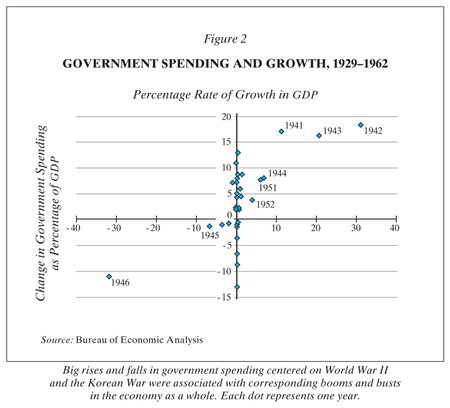
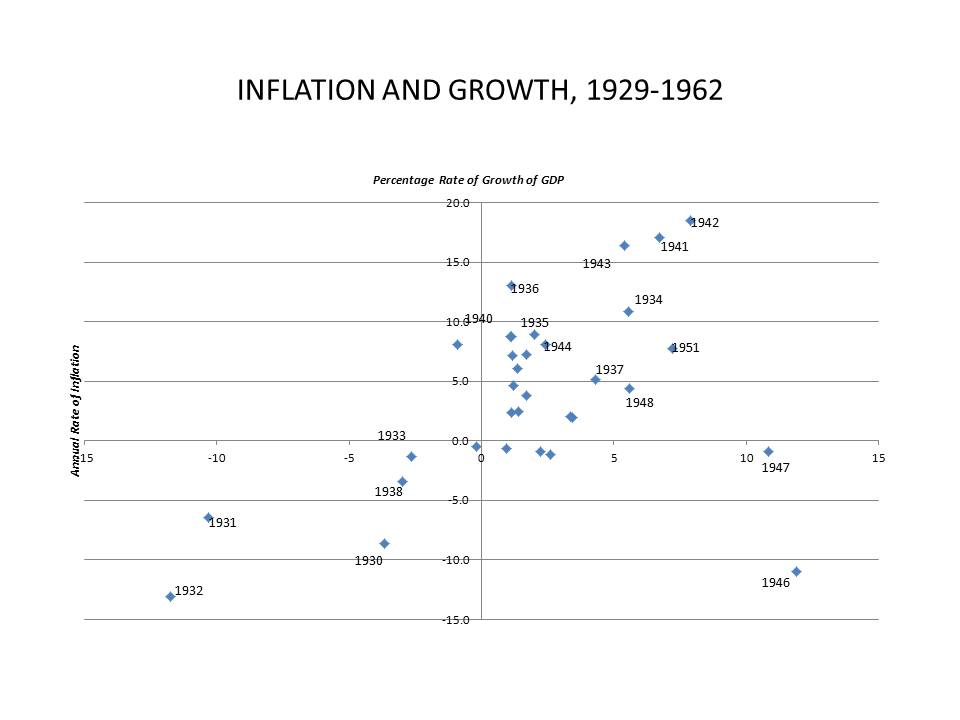
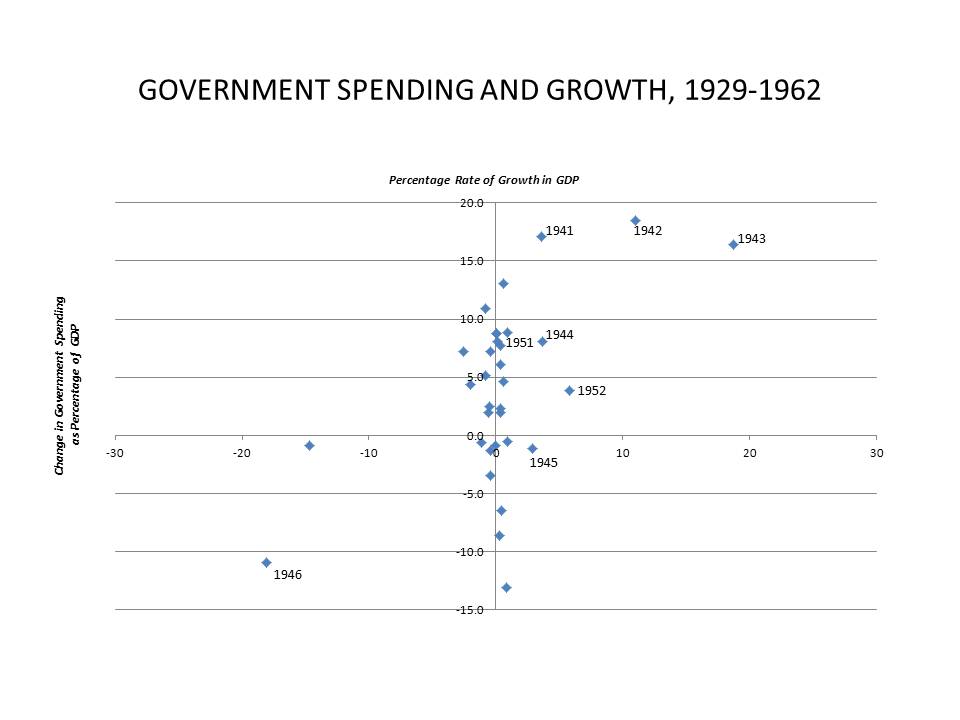

 Uneasy Money