Archive for the 'Paul Krugman' Category


The Reinhart-Rogoff Rally

In the current issue of the New York Review of Books, Paul Krugman explains “How the Case for Austerity Has Crumbled,” focusing at length on the infamous Reinhart-Rogoff 90% debt-to-GDP threshold, and how it became a sort of banner, especially in the US and Europe, for the worldwide austerity caucus. Aside from some quibbles, I don’t have much to criticize in Krugman’s treatment, though I am puzzled by his Figure 1, showing, insofar as I can understand it, that government spending increased sharply in 2008 and tapered off thereafter. But Krugman asserts:

[A]fter a brief surge in 2009, government spending began falling in both Europe and the United States.

In his Figure 1 (reproduced below), Krugman identifies his zero year as 2007 (“zero year is the before global recession (2007 in the current slump) and spending is compared with its level in that base year.”) But government spending equals 100 in year -1 and increases sharply in year 0. So his figure indicates that spending increased in 2008 not 2009. It therefore seems to me that the horizontal axis in Figure 1 was mislabeled.

Krugman_government_spending

The 90% debt-to-GDP threshold was derived from a paper, “Growth in Time of Debt,” by Reinhart and Rogoff. After other researches had repeatedly failed to replicate its results, Thomas Herndon, Michael Ash, and Robert Polin identified a coding error, missing data, and an unconventional weighting of summary statistics by Reinhart and Rogoff, the three together accounting for the existence of the otherwise inexplicable 90% threshold in the paper.

Despite several attempts Reinhart and Rogoff to minimize the misleading implications of their paper, the 90% threshold, which never had any theoretical credibility, is now thoroughly discredited; any citation of  it as authoritative would rightly invite scorn and ridicule.

Krugman comments:

At this point, then, austerity economics is in a very bad way. Its predictions have proved utterly wrong; its founding academic documents haven’t just lost their canonized status, they’ve become the objects of much ridicule. But as I’ve pointed out, none of this (except that Excel error) should have come as a surprise: basic macroeconomics should have told everyone to expect what did, in fact, happen, and the papers that have now fallen into disrepute were obviously flawed from the start.

What has not yet been commented on as far as I know is the extent to which the discrediting of the Reinhart-Rogoff 90% threshold has had tangible economic consequences.

When the Herndon, Ash, and Pollin paper was posted on the internet about 5 weeks ago on April 15, the S&P 500 closed at 1552.36. The S&P 500 began 2013 at 1426.19, surpassing1500 on January 25. From January 25 until April 15, the S&P 500 fluctuated in the 1500 to 1550 range, only occasionally rising above or falling below those limits. On April 16 and 17, the S&P 500 rose and then fell by about 20 points, closing at 1552.01 on Wednesday April 17. On Thursday April 18, Krugman wrote his New York Times column “The Excel Depression,” the S&P 500 fell to an intraday low of 1536.03 before closing at 1541.61. The S&P 500 has subsequently risen 17 of the next 21 trading days, closing at 1667.47 on last Friday, an increase of almost 126 points, or more than 8%.

I suggest that the most important economic news since April 15 may have been the collapse of the austerity caucus following the public exposure of the Reinhart-Rogoff 90% threshold as a fraud, so that the markets are no longer worried (or, at least, are less worried than before) about the risks that further fiscal tightening will offset the Fed’s modest steps in the direction of monetary ease.

Another positive development has been the decline in the CPI in both March and April, reflecting fortuitous supply-side expansions associated with declining energy and commodity prices. With falling inflation expectations caused by positive supply-side (as opposed to negative demand-side) forces, real interest rates have risen sharply, the 10-year TIPS yield rising from -.69% on April 15 to -.31% on May 17. That increase in real interest rates presumably corresponds to an increase in expected future real incomes. So the economic outlook has gotten a little less bleak over the past month. Call it a reverse Reinhart-Rogoff effect.

They Come not to Praise Market Monetarism, but to Bury It

For some reason – maybe he is still annoyed with Scott Sumner – Paul Krugman decided to channel a post by Mike Konczal purporting to show that Market Monetarism has been refuted by the preliminary first quarter GDP numbers showing NGDP increasing at a 3.7% rate and real GDP increasing at a 2.5% rate in Q1. To Konczal and Krugman (hereinafter K&K) this shows that fiscal policy, not monetary policy, is what matters most for macroeconomic performance. Why is that? Because the Fed, since embarking on its latest splurge of bond purchasing last September, has failed to stimulate economic activity in the face of the increasingly contractionary stance of fiscal policy since them (the fiscal 2013 budget deficit recently being projected to be $775 billion, a mere 4.8% of GDP).

So can we get this straight? GDP is now rising at about the same rate it has been rising since the start of the “recovery” from the 2007-09 downturn. Since September monetary policy has become easier and fiscal policy tighter. And that proves what? Sorry, I still don’t get it. But then again, I was always a little slow on the uptake.

Marcus Nunes, the Economist, Scott Sumner, and David Beckworth all weigh in on the not very devastating K&K onslaught. (Also see this post by Evan Soltas written before the fact.) But let me try to cool things down a bit.

If we posit that we are still in something akin to a zero-lower-bound situation, there are perfectly respectable theoretical grounds on which to recommend both fiscal and monetary stimulus. It is true that monetary policy, in principle, could stimulate a recovery even without fiscal stimulus — and even in the face of fiscal contraction — but for monetary policy to be able to be that effective, it would have to operate through the expectations channel, raising price-level expectations sufficiently to induce private spending. However, for good or ill, monetary policy is not aiming at more than a marginal change in inflation expectations. In that kind of policy environment, the potential effect of monetary policy is sharply constrained. Hence, the monetary theoretical case for fiscal stimulus. This is classic Hawtreyan credit deadlock (see here and here).

If monetary policy can’t do all the work by itself, then the question is whether fiscal policy can help. In principle it could if the Fed is willing to monetize the added debt generated by the fiscal stimulus. But there’s the rub. If the Fed has to monetize the added debt created by the fiscal stimulus — which, for argument’s sake, let us assume is more stimulative than equivalent monetary expansion without the fiscal stimulus — what are we supposed to assume will happen to inflation and inflation expectations?

Here is the internal contradiction – the Sumner critique, if you will – implicit in the Keynesian fiscal-policy prescription. Can fiscal policy work without increasing the rate of inflation or inflation expectations? If monetary policy alone cannot work, because it cannot break through the inflation targeting regime that traps us at the 2 percent inflation ceiling, how is fiscal policy supposed to work its way around the 2% inflation ceiling, except by absolving monetary policy of the obligation to keep inflation at or below the ceiling? But if we can allow the ceiling to be pierced by fiscal policy, why can’t we allow it to be pierced by monetary policy?

Perhaps K&K can explain that one to us.

The State We’re In

Last week, Paul Krugman, set off by this blog post, complained about the current state macroeconomics. Apparently, Krugman feels that if saltwater economists like himself were willing to accommodate the intertemporal-maximization paradigm developed by the freshwater economists, the freshwater economists ought to have reciprocated by acknowledging some role for countercyclical policy. Seeing little evidence of accommodation on the part of the freshwater economists, Krugman, evidently feeling betrayed, came to this rather harsh conclusion:

The state of macro is, in fact, rotten, and will remain so until the cult that has taken over half the field is somehow dislodged.

Besides engaging in a pretty personal attack on his fellow economists, Krugman did not present a very flattering picture of economics as a scientific discipline. What Krugman describes seems less like a search for truth than a cynical bargaining game, in which Krugman feels that his (saltwater) side, after making good faith offers of cooperation and accommodation that were seemingly accepted by the other (freshwater) side, was somehow misled into making concessions that undermined his side’s strategic position. What I found interesting was that Krugman seemed unaware that his account of the interaction between saltwater and freshwater economists was not much more flattering to the former than the latter.

Krugman’s diatribe gave Stephen Williamson an opportunity to scorn and scold Krugman for a crass misunderstanding of the progress of science. According to Williamson, modern macroeconomics has passed by out-of-touch old-timers like Krugman. Among modern macroeconomists, Williamson observes, the freshwater-saltwater distinction is no longer meaningful or relevant. Everyone is now, more or less, on the same page; differences are worked out collegially in seminars, workshops, conferences and in the top academic journals without the rancor and disrespect in which Krugman indulges himself. If you are lucky (and hard-working) enough to be part of it, macroeconomics is a great place to be. One can almost visualize the condescension and the pity oozing from Williamson’s pores for those not part of the charmed circle.

Commenting on this exchange, Noah Smith generally agreed with Williamson that modern macroeconomics is not a discipline divided against itself; the intetermporal maximizers are clearly dominant. But Noah allows himself to wonder whether this is really any cause for celebration – celebration, at any rate, by those not in the charmed circle.

So macro has not yet discovered what causes recessions, nor come anywhere close to reaching a consensus on how (or even if) we should fight them. . . .

Given this state of affairs, can we conclude that the state of macro is good? Is a field successful as long as its members aren’t divided into warring camps? Or should we require a science to give us actual answers? And if we conclude that a science isn’t giving us actual answers, what do we, the people outside the field, do? Do we demand that the people currently working in the field start producing results pronto, threatening to replace them with people who are currently relegated to the fringe? Do we keep supporting the field with money and acclaim, in the hope that we’re currently only in an interim stage, and that real answers will emerge soon enough? Do we simply conclude that the field isn’t as fruitful an area of inquiry as we thought, and quietly defund it?

All of this seems to me to be a side issue. Who cares if macroeconomists like each other or hate each other? Whether they get along or not, whether they treat each other nicely or not, is really of no great import. For example, it was largely at Milton Friedman’s urging that Harry Johnson was hired to be the resident Keynesian at Chicago. But almost as soon as Johnson arrived, he and Friedman were getting into rather unpleasant personal exchanges and arguments. And even though Johnson underwent a metamorphosis from mildly left-wing Keynesianism to moderately conservative monetarism during his nearly two decades at Chicago, his personal and professional relationship with Friedman got progressively worse. And all of that nastiness was happening while both Friedman and Johnson were becoming dominant figures in the economics profession. So what does the level of collegiality and absence of personal discord have to do with the state of a scientific or academic discipline? Not all that much, I would venture to say.

So when Scott Sumner says:

while Krugman might seem pessimistic about the state of macro, he’s a Pollyanna compared to me. I see the field of macro as being completely adrift

I agree totally. But I diagnose the problem with macro a bit differently from how Scott does. He is chiefly concerned with getting policy right, which is certainly important, inasmuch as policy, since early 2008, has, for the most part, been disastrously wrong. One did not need a theoretically sophisticated model to see that the FOMC, out of misplaced concern that inflation expectations were becoming unanchored, kept money way too tight in 2008 in the face of rising food and energy prices, even as the economy was rapidly contracting in the second and third quarters. And in the wake of the contraction in the second and third quarters and a frightening collapse and panic in the fourth quarter, it did not take a sophisticated model to understand that rapid monetary expansion was called for. That’s why Scott writes the following:

All we really know is what Milton Friedman knew, with his partial equilibrium approach. Monetary policy drives nominal variables.  And cyclical fluctuations caused by nominal shocks seem sub-optimal.  Beyond that it’s all conjecture.

Ahem, and Marshall and Wicksell and Cassel and Fisher and Keynes and Hawtrey and Robertson and Hayek and at least 25 others that I could easily name. But it’s interesting to note that, despite his Marshallian (anti-Walrasian) proclivities, it was Friedman himself who started modern macroeconomics down the fruitless path it has been following for the last 40 years when he introduced the concept of the natural rate of unemployment in his famous 1968 AEA Presidential lecture on the role of monetary policy. Friedman defined the natural rate of unemployment as:

the level [of unemployment] that would be ground out by the Walrasian system of general equilibrium equations, provided there is embedded in them the actual structural characteristics of the labor and commodity markets, including market imperfections, stochastic variability in demands and supplies, the costs of gathering information about job vacancies, and labor availabilities, the costs of mobility, and so on.

Aside from the peculiar verb choice in describing the solution of an unknown variable contained in a system of equations, what is noteworthy about his definition is that Friedman was explicitly adopting a conception of an intertemporal general equilibrium as the unique and stable solution of that system of equations, and, whether he intended to or not, appeared to be suggesting that such a concept was operationally useful as a policy benchmark. Thus, despite Friedman’s own deep skepticism about the usefulness and relevance of general-equilibrium analysis, Friedman, for whatever reasons, chose to present his natural-rate argument in the language (however stilted on his part) of the Walrasian general-equilibrium theory for which he had little use and even less sympathy.

Inspired by the powerful policy conclusions that followed from the natural-rate hypothesis, Friedman’s direct and indirect followers, most notably Robert Lucas, used that analysis to transform macroeconomics, reducing macroeconomics to the manipulation of a simplified intertemporal general-equilibrium system. Under the assumption that all economic agents could correctly forecast all future prices (aka rational expectations), all agents could be viewed as intertemporal optimizers, any observed unemployment reflecting the optimizing choices of individuals to consume leisure or to engage in non-market production. I find it inconceivable that Friedman could have been pleased with the direction taken by the economics profession at large, and especially by his own department when he departed Chicago in 1977. This is pure conjecture on my part, but Friedman’s departure upon reaching retirement age might have had something to do with his own lack of sympathy with the direction that his own department had, under Lucas’s leadership, already taken. The problem was not so much with policy, but with the whole conception of what constitutes macroeconomic analysis.

The paper by Carlaw and Lipsey, which I referenced in my previous post, provides just one of many possible lines of attack against what modern macroeconomics has become. Without in any way suggesting that their criticisms are not weighty and serious, I would just point out that there really is no basis at all for assuming that the economy can be appropriately modeled as being in a continuous, or nearly continuous, state of general equilibrium. In the absence of a complete set of markets, the Arrow-Debreu conditions for the existence of a full intertemporal equilibrium are not satisfied, and there is no market mechanism that leads, even in principle, to a general equilibrium. The rational-expectations assumption is simply a deus-ex-machina method by which to solve a simplified model, a method with no real-world counterpart. And the suggestion that rational expectations is no more than the extension, let alone a logical consequence, of the standard rationality assumptions of basic economic theory is transparently bogus. Nor is there any basis for assuming that, if a general equilibrium does exist, it is unique, and that if it is unique, it is necessarily stable. In particular, in an economy with an incomplete (in the Arrow-Debreu sense) set of markets, an equilibrium may very much depend on the expectations of agents, expectations potentially even being self-fulfilling. We actually know that in many markets, especially those characterized by network effects, equilibria are expectation-dependent. Self-fulfilling expectations may thus be a characteristic property of modern economies, but they do not necessarily produce equilibrium.

An especially pretentious conceit of the modern macroeconomics of the last 40 years is that the extreme assumptions on which it rests are the essential microfoundations without which macroeconomics lacks any scientific standing. That’s preposterous. Perfect foresight and rational expectations are assumptions required for finding the solution to a system of equations describing a general equilibrium. They are not essential properties of a system consistent with the basic rationality propositions of microeconomics. To insist that a macroeconomic theory must correspond to the extreme assumptions necessary to prove the existence of a unique stable general equilibrium is to guarantee in advance the sterility and uselessness of that theory, because the entire field of study called macroeconomics is the result of long historical experience strongly suggesting that persistent, even cumulative, deviations from general equilibrium have been routine features of economic life since at least the early 19th century. That modern macroeconomics can tell a story in which apparently large deviations from general equilibrium are not really what they seem is not evidence that such deviations don’t exist; it merely shows that modern macroeconomics has constructed a language that allows the observed data to be classified in terms consistent with a theoretical paradigm that does not allow for lapses from equilibrium. That modern macroeconomics has constructed such a language is no reason why anyone not already committed to its underlying assumptions should feel compelled to accept its validity.

In fact, the standard comparative-statics propositions of microeconomics are also based on the assumption of the existence of a unique stable general equilibrium. Those comparative-statics propositions about the signs of the derivatives of various endogenous variables (price, quantity demanded, quantity supplied, etc.) with respect to various parameters of a microeconomic model involve comparisons between equilibrium values of the relevant variables before and after the posited parametric changes. All such comparative-statics results involve a ceteris-paribus assumption, conditional on the existence of a unique stable general equilibrium which serves as the starting and ending point (after adjustment to the parameter change) of the exercise, thereby isolating the purely hypothetical effect of a parameter change. Thus, as much as macroeconomics may require microfoundations, microeconomics is no less in need of macrofoundations, i.e., the existence of a unique stable general equilibrium, absent which a comparative-statics exercise would be meaningless, because the ceteris-paribus assumption could not otherwise be maintained. To assert that macroeconomics is impossible without microfoundations is therefore to reason in a circle, the empirically relevant propositions of microeconomics being predicated on the existence of a unique stable general equilibrium. But it is precisely the putative failure of a unique stable intertemporal general equilibrium to be attained, or to serve as a powerful attractor to economic variables, that provides the rationale for the existence of a field called macroeconomics.

So I certainly agree with Krugman that the present state of macroeconomics is pretty dismal. However, his own admitted willingness (and that of his New Keynesian colleagues) to adopt a theoretical paradigm that assumes the perpetual, or near-perpetual, existence of a unique stable intertemporal equilibrium, or at most admits the possibility of a very small set of deviations from such an equilibrium, means that, by his own admission, Krugman and his saltwater colleagues also bear a share of the responsibility for the very state of macroeconomics that Krugman now deplores.

Negotiating the Fiscal Cliff

Last week I did a post based on a chart that I saw in an article in the New York Review of Books by Paul Krugman. Relying on an earlier paper by Robert Hall on the empirical evidence about the effectiveness of fiscal stimulus, Krugman used the chart to illustrate the efficacy of government spending as a stimulus to economic recovery. While Krugman evidently thought his chart was a pretty compelling visual aid in showing that fiscal stimulus really works, I didn’t find his chart that impressive, because there were relatively few years in which changes in government spending were clearly associated with large changes in growth, and a lot of years with large changes in growth, but little or no change in government spending.

In particular, the years in which government spending seemed to make a big difference were during and immediately after World War II. The 1930s, however, were associated with huge swings in GDP, but with comparatively minimal changes in government spending. Instead, changes in GDP in the 1930s were associated with big changes in the price level. The big increases in GDP in the early 1940s were also associated with big increases in the price level, the rapid rise in the price level slowing down only in 1943 after price controls were imposed in 1942. When controls were gradually lifted in 1946 and 1947, inflation increased sharply notwithstanding a sharp economic contraction, creating a spurious (in my view) negative correlation between (measured) inflation and the change in GDP. From 1943 to mid-1945, properly measured inflation was increasing much faster than official indices that made no adjustment for the shortages and quality degradation caused by the price controls. Similarly, the measured inflation from late 1945 through 1947, when price controls were being gradually relaxed and dismantled, overstated actual inflation, because increases in official prices were associated with the elimination of shortages and improving quality.

So in my previous post, I tried to do a quantitative analysis of the data underlying Krugman’s chart. Unfortunately, I only came up with a very rough approximation of his data. Using my rough approximation (constructing a chart resembling, but clearly different from, Krugman’s), I ran a regression estimating the statistical relationship between yearly changes in military spending (Krugman’s statistical instrument for fiscal stimulus) as a percentage of GDP and yearly changes in real GDP from 1929 to 1962. I then compared that statistical relationship to the one between annual changes in the price level and annual changes in real GDP over the same time period. After controlling for the mismeasurement of inflation in 1946 and 1947, I found that changes in the rate of inflation were more closely correlated to changes in real GDP over the 1929-1962 time period than were changes in military spending and changes in real GDP. Unfortunately, I also claimed (mistakenly)  that that regressing changes in real GDP on both changes in military spending and inflation (again controlling for mismeasurement of inflation in 1946-47) did not improve the statistical fit of the regression, and did not show a statistically significant coefficient for the military-spending term. That claim was based on looking at the wrong regression estimates.  Sorry, I blew that one.

Over the weekend, Mark Sadowski kindly explained to me how Krugman did the calculations underlying his chart, even generating the data for me, thereby allowing me to reconstruct Krugman’s chart and to redo my earlier regressions using the exact data. Here are the old and the new results.

OLD: dGDP = 3.60 + .70dG, r-squared = .295

NEW: dGDP = 3.26 + .51dG, r-squared = .433

So, according to the correct data set, the relationship between changes in government spending and changes in GDP is closer than the approximated data set that I used previously. However, the newly estimated coefficient on the government spending term is almost 30% smaller than the coefficient previously estimated using the approximated data set. In other words a one dollar increase in government spending generates an increase in GDP of only 50 cents. Increasing government spending reduces private spending by about half.

The estimated regression for changes in real GDP on inflation changed only slightly:

OLD: dGDP = 2.48 + .69dP, r-squared = .199

NEW: dGDP = 2.46 + .70dP, r-squared = .193

The estimated regression for changes in real GDP on inflation (controlled for mismeasurement of inflation in 1946 and 1947) also showed only a slight change:

OLD: dGDP = 2.76 + 1.28dP – 23.29PCON, r-squared = .621

NEW: dGDP = 3.02 + 1.25dP – 23.13PCON, r-squared = .613

Here are my old and new regressions for changes in real GDP on government spending as well as on inflation (controlled for mismeasurement of inflation in 1946-47). As you can see, the statistical fit of the regression improves by including both inflation and the change in government spending as variables (the adjusted r-squared is .648) and the coefficient on the government-spending term is positive and significant (t = 2.37). When I re-estimated the regression on Krugman’s data set, the statistical fit improved, and the coefficient on the government-spending variable remained positive and statistically significant (t = 3.45), but was about a third smaller than the coefficient estimated from the approximated data set.

OLD: dGDP = 2.27 + .49dG + 1.15dP – 13.36PCON, r-squared = .681

NEW: dGDP = 2.56 + .33dG + 1.00dP – 13.14PCON, r-squared = .728

So even if we allow for the effect of inflation on changes in output, and contrary to what I suggested in my previous post, changes in government spending were indeed positively and significantly correlated with changes in real GDP, implying that government spending may have some stimulative effect even apart from the effect of monetary policy on inflation. Moreover, insofar as government spending affects inflation, attributing price-level changes exclusively to monetary policy may underestimate the stimulative effect of government spending. However, if one wants to administer stimulus to the private sector rather than increase the size of the public sector at the expense of the private sector (the implication of a coefficient less than one on the government-spending term in the regression), there is reason to prefer monetary policy as a method of providing stimulus.

The above, aside from the acknowledment of Mark Sadowski’s assistance and the mea culpa for negligence in reporting my earlier results, is all by way of introduction to a comment on a recent post by my internet buddy Lars Christensen on his Market Moneterist blog in which he welcomes the looming fiscal cliff. Here’s how Lars puts it:

The point is that the US government is running clearly excessive public deficits and the public debt has grown far too large so isn’t fiscal tightening exactly what you need? I think it and the fiscal cliff ensures that. Yes, I agree tax hikes are unfortunate from a supply side perspective, but cool down a bit – it is going to have only a marginally negative impact on long-term US growth perspective that the Bush tax cuts experiences. But more importantly the fiscal cliff would mean cuts in US defense spending. The US is spending more on military hardware than any other country in the world. It seems to me like US policy makers have not realized that the Cold War is over. You don’t need to spend 5% of GDP on bombs. In fact I believe that if the entire 4-5% fiscal consolidation was done as cuts to US defence spending the world would probably be a better place. But that is not my choice – and it is the peace loving libertarian rather than the economist speaking (here is a humorous take on the sad story of war). What I am saying is that the world is not coming to an end if the US defense budget is cut marginally. Paradoxically the US conservatives this time around are against budget consolidation. Sad, but true.

I am not going to take the bait and argue with Lars about the size of the US defense budget. The only issue that I want to consider is what would happen as a result of the combination of a large cut in defense (and in other categories of) spending and an increase in taxes? It might not be catastrophic, but there seems to me to be a non-negligible risk that such an outcome would have a significant contractionary effect on aggregate demand at a time when the recovery is still anemic and requires as much stimulus as it can get. Lars argues that any contractionary effect caused by reduced government spending and increased taxes could be offset by sufficient monetary easing. I agree in theory, but in practice there are just too many uncertainties associated with how massive fiscal tightening would be received by public and private decision makers to rely on the theoretical ability of monetary policy in one direction to counteract fiscal policy in the opposite direction. This would be the case even if we knew that Bernanke and the FOMC would do the right thing. But, despite encouraging statements by Bernanke and other Fed officials since September, it seems more than a bit risky at this time and this place to just assume that the Fed will become the stimulator of last resort.

So, Lars, my advice to you is: be careful what you wish for.

PS Noah Smith has an excellent post about inflation today.

Paul Krugman on Fiscal Stimulus 1929-1962

UPDATE:  See my correction of an error in the penultimate paragraph.

Last week I read an article Paul Krugman published several months ago for the New York Review of Books just before his book End This Depression Now came out. The article was aimed not aimed at an audience of professional economists, and consisted of arguments that Krugman has been making regularly since the onset of the crisis just over four years ago. However, the following passage towards the end of the article caught my eye.

[S]ince the crisis began there has been a boom in research into the effects of fiscal policy on output and employment. This body of research is growing fast, and much of it is too technical to be summarized in this article. But here are a few highlights.

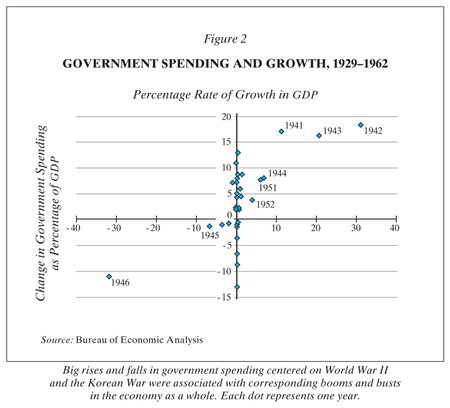
First, Stanford’s Robert Hall has looked at the effects of large changes in US government purchases—which is all about wars, specifically World War II and the Korean War. Figure 2 on this page [see below] compares changes in US military spending with changes in real GDP—both measured as a percentage of the preceding year’s GDP—over the period from 1929 to 1962 (there’s not much action after that). Each dot represents one year; I’ve labeled the points corresponding to the big buildup during World War II and the big demobilization just afterward. Obviously, there were big moves in years when nothing much was happening to military spending, notably the slump from 1929 to 1933 and the recovery from 1933 to 1936. But every year in which there was a big spending increase was also a year of strong growth, and the reduction in military spending after World War II was a year of sharp output decline.

Krugman did not explain his chart in detail, so I consulted the study by Robert Hall cited by Krugman. Hall’s insight was to focus not on government spending, just military spending, because other components of government spending are themselves influenced by the state of the economy, making it difficult to disentangle the effects of spending on the economy from the effects of the economy on spending. However, military spending is largely driven, especially in wartime (World War II and Korea), by factors unrelated to how the economy is performing. This makes military spending an appropriate instrument by which to identify and estimate the effect of government spending on the economy.

The problem with Krugman’s discussion is that, although using military expenditures allowed him to avoid the identification problem associated with the interdependency of government spending and the level of economic activity, he left out any mention of the behavior of the price level, which, many of us (and perhaps even Krugman himself) believe, powerfully affects the overall level of economic activity. Krugman artfully avoids any discussion of this relationship with the seemingly innocent observation “there were big moves in years when nothing much was happening to military spending, notably the slump from 1929 to 1933 and the recovery from 1933 to 1936.” But even this implicit acknowledgment of the importance of the behavior of the price level overlooks the fact that the huge wartime increase in military spending took place against the backdrop of rapid inflation, so that attributing economic expansion during World War II solely to the increase in government spending does not seem to warranted, because at least some of the increase in output would have been been forthcoming, even without increased military spending, owing to the rise in the price level.

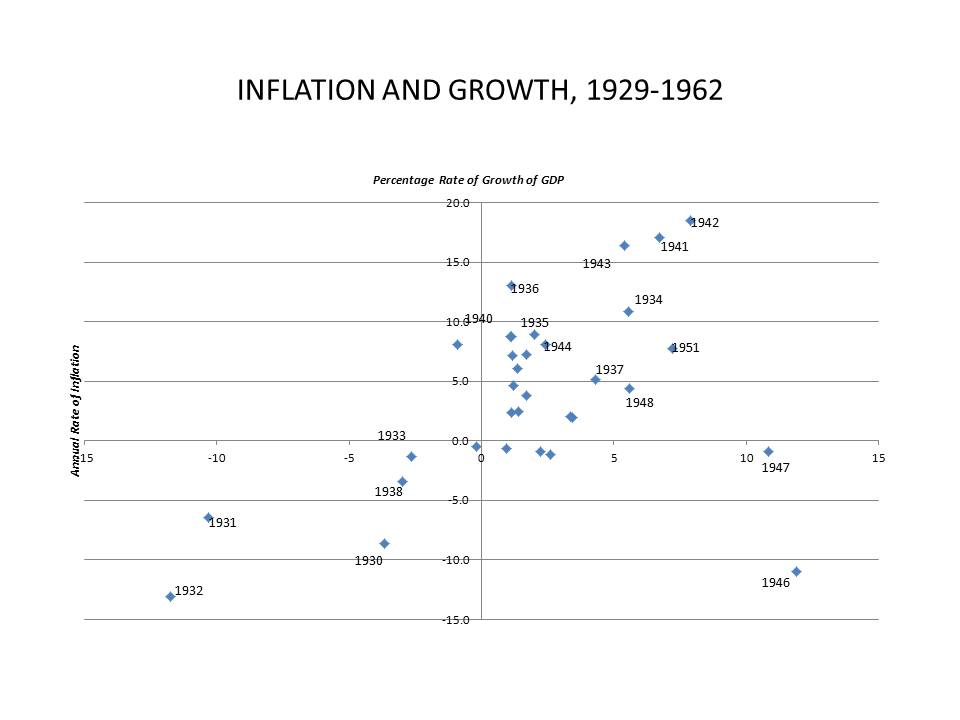
It is not hard to compare the effects of inflation and the effects of military spending on economic growth over the time period considered by Krugman. One can simply take annual inflation each year from 1930 to 1962 and plot the yearly rates of inflation and economic growth that Krugman plotted on his figure. Here is my version of Krugman’s chart substituting inflation for the change in military spending as a percentage of GDP.

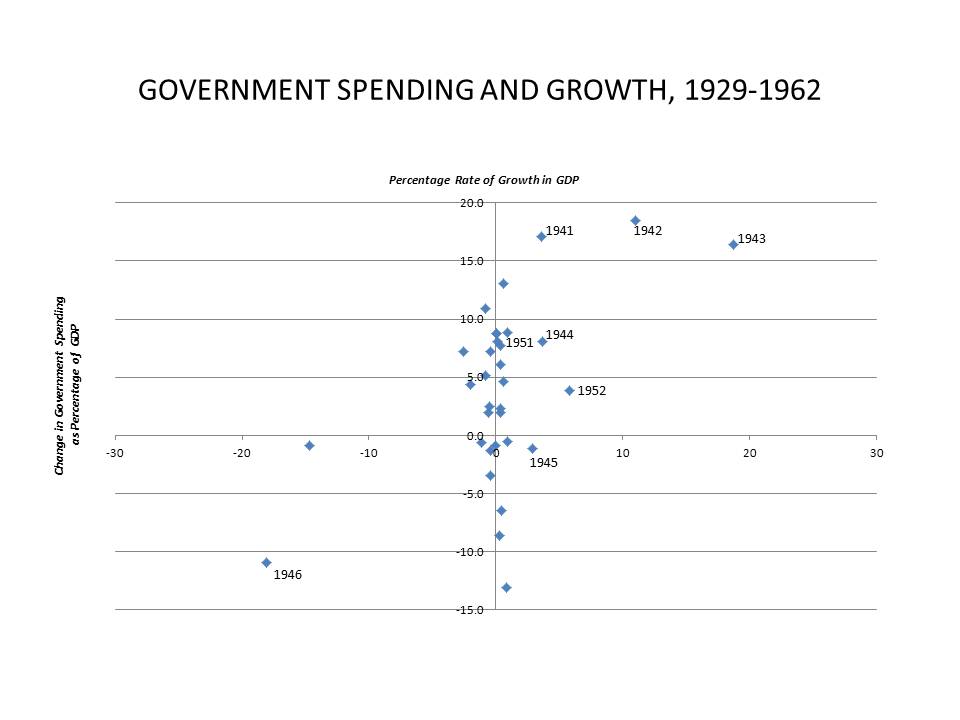
It is difficult visually to compare the diagrams to see which one provides the more informative account of the fluctuations in economic growth over the 33 years in the sample. But it is not hard to identify the key difference between the two diagrams. In Krugman’s diagram, the variation in military spending provides no information about the variation in economic growth during the 1930s. There are is a cluster of points up and down the vertical axis corresponding to big positive and negative fluctuations in GDP with minimal changes in military spending. But large changes in GDP during the 1940s do correspond to changes in the same direction in military spending. Similarly, during the Korean War in the early 1950s, there was a positive correlation between changes in military spending. From the mid-1950s to the early 1960s, annual changes in GDP and in military spending were relatively small.

In my diagram plotting annual rates of inflation against annual changes in GDP, the large annual changes in GDP are closely related to positive or negative changes in the price level. In that respect, my diagram provides a more informative representation of the data than does Krugman’s. Even in World War II, the points representing the war years 1942 to 1945 are not far from a trend line drawn through the scatter of points. Where the diagram runs into serious trouble is that two points are way, way off to one side. Those are the years 1946 and 1947.

What was going on in those years? GDP was contracting, especially in 1946, and prices were rising rapidly, exactly contrary to the usual presumption that rising prices tend to generate increases in output. What was going on? It all goes back to 1942, when FDR imposed wartime price controls. This was partly a way of preventing suppliers from raising prices to the government, and also a general anti-inflation measure. However, the result was that there were widespread shortages, with rationing of a wide range of goods and services.  The officially measured rate of inflation from 1942 to 1945 was therefore clearly understated. In 1946 and 1947, controls were gradually relaxed and finally eliminated, with measured inflation rates actually increasing even though the economy was contracting.  Measured inflation in 1946 and 1947 therefore overstated actual inflation by an amount corresponding (more or less) to the cumulative understatement of inflation from 1942 to 1945. That the dots representing 1946 and 1947 are outliers is not because the hypothesized causal relationship between inflation and GDP was inoperative or reversed, but because of a mistaken measurement of what inflation actually was.

To get a better handle on the relative explanatory power of the government-spending and the inflation hypotheses in accounting for fluctuations in GDP than visual inspection of the data allows, one has to work with the underlying data. Unfortunately, when I tried to measure changes in military spending from 1929 to 1962, I could not reproduce the data underlying Krugman’s chart. That was not Krugman’s fault; I don’t doubt that he accurately calculated the relevant data from the appropriate sources. But when I searched for data on military spending since 1929, the only source that I found was this. So that is what I used. I assume that Krugman was using a different source from the one that I used, and he may also have defined his government spending variable in a different way from how I did. At any rate, when I did the calculation, I generated a chart that looked like the one below. It is generally similar to Krugman’s, but obviously not the same. If someone can explain why I did not come up with the same numbers for changes in government spending that Krugman did, I would be very much obliged and will redo my calculations. However, in the meantime, I am going to assume that my numbers are close enough to Krugman’s, so that my results would not be reversed if I used his numbers instead.

Taking my version of Krugman’s data, I ran a simple regression of the annual change in real GDP (dGDP) on the annual change in government (i.e., military spending) as a percentage of GDP (dG) from 1930 to 1962 (the data start in 1929, but the changes don’t start till 1930). The regression equation that I estimated was the following:

dGDP = 3.60 + .70dG, r-squared = .295.

This equation says that the percent increase in real GDP in any year is 3.6% plus seven-tenths of the percentage increase in government (i.e., military) spending for that year.

I then ran a corresponding regression of the annual change in real GDP on the annual change in the price level (dP, derived from my estimate of the GDP price deflator). The estimated regression was the following:

dGDP = 2.48 + .69dP, r-squared = .199.

The equation says that the percent increase in real GDP in any year is 2.48% plus .69 times that year’s rate of inflation.

Because the r-squared of the first equation is about 50% higher than that of the second, there would be good reason to prefer the first equation over the second were it not for the measurement problem that I mentioned above. I tried a number of ways of accounting for that measurement problem, but the simplest adjustment was simply to add two dummy variables, one for price controls during World War II and one for the lifting of price controls in 1946 and 1947. When I introduced both dummy variables into the equation, it turned out that the dummy variable for price controls during World War II was statistically insignificant, inasmuch as there was some measured inflation even during the World War II price controls. It was only the dummy variable controlling for the (mis)measured inflation associated with the lifting of price controls that was statistically significant. Here is the estimated regression:

dGDP = 2.76 + 1.28dP – 23.29PCON, r-squared = .621

I also tried attributing the inflation measured in 1946 and 1947 to the years 1942 to 1945, giving each of those years an inflation rate of about 9.7% and attributing zero inflation to the years 1946 and 1947. The regression equation that I estimated using that approach did not perform as well, based on a comparison of adjusted r-squares, as the simple equation with a single dummy variable. I also estimated equations using both the government spending variable and the inflation variable, and the two price-control dummies. That specification, despite two extra variables, had an r-squared less than the r-squared of the above equation. [Update 11/20/2012:  This was my mistake, because the best results were obtained using only a dummy variable for 1946 and 1947.  When the government spending and the inflation variables were estimated with a dummy for 1946-1947, the coefficients on both variables were positive and significant.]  So my tentative conclusion is that the best way to summarize the observed data pattern for the fluctuations of real GDP between 1929 and 1962 is with an equation with only an inflation variable and an added dummy variable accounting for the mismeasurement of inflation in 1946 and 1947.

Nevertheless, I would caution against reading too much into these results, even on the assumption that the provisional nature of the data that I have used has not introduced any distortions and that there are no other errors in my results. (Anyone who wants to check my results is welcome to email me at uneasymoney@hotmail.com, and I will send you the (Stata) data files that I have used.) Nor do I claim that government spending has no effect on real GDP. I am simply suggesting that for the time period between 1929 and 1962 in the US, there does not seem to be strong evidence that government spending significantly affected real GDP, once account is taken of the effects of changes in the price level. With only 33 observations, the effect of government spending, though theoretically present, may not be statistically detectable, at least not using a simple linear regression model. One might also argue that wartime increases in government spending contributed to the wartime inflation, so that the effect of government spending is masked by including a price-level variable. Be that as it may, Krugman’s (and Hall’s) argument that government spending was clearly effective in increasing real GDP in World War II and Korea, and would, therefore, be likely to be effective under other circumstances, is not as self-evidently true as Krugman makes it out to be. I don’t say that it is incorrect, but the evidence seems to be, at best, ambiguous.


About Me

David Glasner
Washington, DC

I am an economist in the Washington DC area. My research and writing has been mostly on monetary economics and policy and the history of economics. In my book Free Banking and Monetary Reform, I argued for a non-Monetarist non-Keynesian approach to monetary policy, based on a theory of a competitive supply of money. Over the years, I have become increasingly impressed by the similarities between my approach and that of R. G. Hawtrey and hope to bring Hawtrey’s unduly neglected contributions to the attention of a wider audience.

My new book Studies in the History of Monetary Theory: Controversies and Clarifications has been published by Palgrave Macmillan

Follow me on Twitter @david_glasner

Archives

Enter your email address to follow this blog and receive notifications of new posts by email.

Join 665 other subscribers
Follow Uneasy Money on WordPress.com