Archive for the 'monetary policy' Category


What Kind of Equilibrium Is This?

In my previous post, I suggested that Stephen Williamson’s views about the incapacity of monetary policy to reduce unemployment, and his fears that monetary expansion would simply lead to higher inflation and a repeat of the bad old days the 1970s when inflation and unemployment spun out of control, follow from a theoretical presumption that the US economy is now operating (as it almost always does) in the neighborhood of equilibrium. This does not seem right to me, but it is the sort of deep theoretical assumption (e.g., like the rationality of economic agents) that is not subject to direct empirical testing. It is part of what the philosopher Imre Lakatos called the hard core of a (in this case Williamson’s) scientific research program. Whatever happens, Williamson will process the observed facts in terms of a theoretical paradigm in which prices adjust and markets clear. No other way of viewing reality makes sense, because Williamson cannot make any sense of it in terms of the theoretical paradigm or world view to which he is committed. I actually have some sympathy with that way of looking at the world, but not because I think it’s really true; it’s just the best paradigm we have at the moment. But I don’t want to follow that line of thought too far now, but who knows, maybe another time.

A good illustration of how Williamson understands his paradigm was provided by blogger J. P. Koning in his comment on my previous post copying the following quotation from a post written by Williamson a couple of years on his blog.

In other cases, as in the link you mention, there are people concerned about disequilibrium phenomena. These approaches are or were popular in Europe – I looked up Benassy and he is still hard at work. However, most of the mainstream – and here I’m including New Keynesians – sticks to equilibrium economics. New Keynesian models may have some stuck prices and wages, but those models don’t have to depart much from standard competitive equilibrium (or, if you like, competitive equilibrium with monopolistic competition). In those models, you have to determine what a firm with a stuck price produces, and that is where the big leap is. However, in terms of determining everything mathematically, it’s not a big deal. Equilibrium economics is hard enough as it is, without having to deal with the lack of discipline associated with “disequilibrium.” In equilibrium economics, particularly monetary equilibrium economics, we have all the equilibria (and more) we can handle, thanks.

I actually agree that departing from the assumption of equilibrium can involve a lack of discipline. Market clearing is a very powerful analytical tool, and to give it up without replacing it with an equally powerful analytical tool leaves us theoretically impoverished. But Williamson seems to suggest (or at least leaves ambiguous) that there is only one kind of equilibrium that can be handled theoretically, namely a fully optimal general equilibrium with perfect foresight (i.e., rational expectations) or at least with a learning process leading toward rational expectations. But there are other equilibrium concepts that preserve market clearing, but without imposing, what seems to me, the unreasonable condition of rational expectations and (near) optimality.

In particular, there is the Hicksian concept of a temporary equilibrium (inspired by Hayek’s discussion of intertemporal equilibrium) which allows for inconsistent expectations by economic agents, but assumes market clearing based on supply and demand schedules reflecting those inconsistent expectations. Nearly 40 years ago, Earl Thompson was able to deploy that equilibrium concept to derive a sub-optimal temporary equilibrium with Keynesian unemployment and a role for countercyclical monetary policy in minimizing inefficient unemployment. I have summarized and discussed Thompson’s model previously in some previous posts (here, here, here, and here), and I hope to do a few more in the future. The model is hardly the last word, but it might at least serve as a starting point for thinking seriously about the possibility that not every state of the economy is an optimal equilibrium state, but without abandoning market clearing as an analytical tool.

Too Little, Too Late?

The FOMC, after over four years of overly tight monetary policy, seems to be feeling its way toward an easier policy stance. But will it do any good? Unfortunately, there is reason to doubt that it will. The FOMC statement pledges to continue purchasing $85 billion a month of Treasuries and mortgage-backed securities and to keep interest rates at current low levels until the unemployment rate falls below 6.5% or the inflation rate rises above 2.5%. In other words, the Fed is saying that it will tolerate an inflation rate only marginally higher than the current target for inflation before it begins applying the brakes to the expansion. Here is how the New York Times reported on the Fed announcement.

The Federal Reserve said Wednesday it planned to hold short-term interest rates near zero so long as the unemployment rate remains above 6.5 percent, reinforcing its commitment to improve labor market conditions.

The Fed also said that it would continue in the new year its monthly purchases of $85 billion in Treasury bonds and mortgage-backed securities, the second prong of its effort to accelerate economic growth by reducing borrowing costs.

But Fed officials still do not expect the unemployment rate to fall below the new target for at least three more years, according to forecasts also published Wednesday, and they chose not to expand the Fed’s stimulus campaign.

In fairness to the FOMC, the Fed, although technically independent, must operate within an implicit consensus on what kind of decisions it can take, its freedom of action thereby being circumscribed in the absence of a clear signal of support from the administration for a substantial departure from the terms of the implicit consensus. For the Fed to substantially raise its inflation target would risk a political backlash against it, and perhaps precipitate a deep internal split within the Fed’s leadership. At the depth of the financial crisis and in its immediate aftermath, perhaps Chairman Bernanke, if he had been so inclined, might have been able to effect a drastic change in monetary policy, but that window of opportunity closed quickly once the economy stopped contracting and began its painfully slow pseudo recovery.

As I have observed a number of times (here, here, and here), the paradigm for the kind of aggressive monetary easing that is now necessary is FDR’s unilateral decision to take the US off the gold standard in 1933. But FDR was a newly elected President with a massive electoral mandate, and he was making decisions in the midst of the worst economic crisis in modern times. Could an unelected technocrat (or a collection of unelected technocrats) take such actions on his (or their) own? From the get-go, the Obama administration showed no inclination to provide any significant input to the formulation of monetary policy, either out of an excess of scruples about Fed independence or out of a misguided belief that monetary policy was powerless to affect the economy when interest rates were close to zero.

Stephen Williamson, on his blog, consistently gives articulate expression to the doctrine of Fed powerlessness. In a post yesterday, correctly anticipating that the Fed would continue its program of buying mortgage backed securities and Treasuries, and would tie its policy to numerical triggers relating to unemployment, Williamson disdainfully voiced his skepticism that the Fed’s actions would have any positive effect on the real performance of the economy, while registering his doubts that the Fed would be any more successful in preventing inflation from getting out of hand while attempting to reduce unemployment than it was in the 1970s.

It seems to me that Williamson reaches this conclusion based on the following premises. The Fed has little or no control over interest rates or inflation, and the US economy is not far removed from its equilibrium growth path. But Williamson also believes that the Fed might be able to increase inflation, and that that would be a bad thing if the Fed were actually to do so.  The Fed can’t do any good, but it could do harm.

Williamson is fairly explicit in saying that he doubts the ability of positive QE to stimulate, and negative QE (which, I guess, might be called QT) to dampen real or nominal economic activity.

Short of a theory of QE – or more generally a serious theory of the term structure of interest rates – no one has a clue what the effects are, if any. Until someone suggests something better, the best guess is that QE is irrelevant. Any effects you think you are seeing are either coming from somewhere else, or have to do with what QE signals for the future policy rate. The good news is that, if it’s irrelevant, it doesn’t do any harm. But if the FOMC thinks it works when it doesn’t, that could be a problem, in that negative QE does not tighten, just as positive QE does not ease.

But Williamson seems a bit uncertain about the effects of “forward guidance” i.e., the Fed’s commitment to keep interest rates low for an extended period of time, or until a trigger is pulled e.g., unemployment falls below a specified level. This is where Williamson sees a real potential for mischief.

(1)To be well-understood, the triggers need to be specified in a very simple form. As such it seems as likely that the Fed will make a policy error if it commits to a trigger as if it commits to a calendar date. The unemployment rate seems as good a variable as any to capture what is going on in the real economy, but as such it’s pretty bad. It’s hardly a sufficient statistic for everything the Fed should be concerned with.

(2)This is a bad precedent to set, for two reasons. First, the Fed should not be setting numerical targets for anything related to the real side of the dual mandate. As is well-known, the effect of monetary policy on real economic activity is transient, and the transmission process poorly understood. It would be foolish to pretend that we know what the level of aggregate economic activity should be, or that the Fed knows how to get there. Second, once you convince people that triggers are a good idea in this “unusual” circumstance, those same people will wonder what makes other circumstances “normal.” Why not just write down a Taylor rule for the Fed, and send the FOMC home? Again, our knowledge of how the economy works, and what future contingencies await us, is so bad that it seems optimal, at least to me, that the Fed make it up as it goes along.

I agree that a fixed trigger is a very blunt instrument, and it is hard to know what level to set it at. In principle, it would be preferable if the trigger were not pulled automatically, but only as a result of some exercise of discretionary judgment by the part of the monetary authority; except that the exercise of discretion may undermine the expectational effect of setting a trigger. Williamson’s second objection strikes me as less persuasive than the first. It is at least misleading, and perhaps flatly wrong, to say that the effect of monetary policy on real economic activity is transient. The standard argument for the ineffectiveness of monetary policy involves an exercise in which the economy starts off at equilibrium. If you take such an economy and apply a monetary stimulus to it, there is a plausible (but not necessarily unexceptionable) argument that the long-run effect of the stimulus will be nil, and any transitory gain in output and employment may be offset (or outweighed) by a subsequent transitory loss. But if the initial position is out of equilibrium, I am unaware of any plausible, let alone compelling, argument that monetary stimulus would not be effective in hastening the adjustment toward equilibrium. In a trivial sense, the effect of monetary policy is transient inasmuch as the economy would eventually reach an equilibrium even without monetary stimulus. However, unlike the case in which monetary stimulus is applied to an economy in equilibrium, applying monetary policy to an economy out of equilibrium can produce short-run gains that aren’t wiped out by subsequent losses. I am not sure how to interpret the rest of Williamson’s criticism. One might almost interpret him as saying that he would favor a policy of targeting nominal GDP (which bears a certain family resemblance to the Taylor rule), a policy that would also address some of the other concerns Williamson has about the Fed’s choice of triggers, except that Williamson is already on record in opposition to NGDP targeting.

In reply to a comment on this post, Williamson made the following illuminating observation:

Read James Tobin’s paper, “How Dead is Keynes?” referenced in my previous post. He was writing in June 1977. The unemployment rate is 7.2%, the cpi inflation rate is 6.7%, and he’s complaining because he thinks the unemployment rate is disastrously high. He wants more accommodation. Today, I think we understand the reasons that the unemployment rate was high at the time, and we certainly don’t think that monetary policy was too tight in mid-1977, particularly as inflation was about to take off into the double-digit range. Today, I don’t think the labor market conditions we are looking at are the result of sticky price/wage inefficiencies, or any other problem that monetary policy can correct.

The unemployment rate in 1977 was 7.2%, at least one-half a percentage point less than the current rate, and the cpi inflation rate was 6.7% nearly 5% higher than the current rate. Just because Tobin was overly disposed toward monetary expansion in 1977 when unemployment was less and inflation higher than they are now, it does not follow that monetary expansion now would be as misguided as it was in 1977. Williamson is convinced that the labor market is now roughly in equilibrium, so that monetary expansion would lead us away from, not toward, equilibrium. Perhaps it would, but most informed observers simply don’t share Williamson’s intuition that the current state of the economy is not that far from equilibrium. Unless you buy that far-from-self-evident premise, the case for monetary expansion is hard to dispute.  Nevertheless, despite his current unhappiness, I am not so sure that Williamson will be as upset with what the actual policy that the Fed is going to implement as he seems to think he will be.  The Fed is moving in the right direction, but is only taking baby steps.

PS I see that Williamson has now posted his reaction to the Fed’s statement.  Evidently, he is not pleased.  Perhaps I will have something more to say about that tomorrow.

Negotiating the Fiscal Cliff

Last week I did a post based on a chart that I saw in an article in the New York Review of Books by Paul Krugman. Relying on an earlier paper by Robert Hall on the empirical evidence about the effectiveness of fiscal stimulus, Krugman used the chart to illustrate the efficacy of government spending as a stimulus to economic recovery. While Krugman evidently thought his chart was a pretty compelling visual aid in showing that fiscal stimulus really works, I didn’t find his chart that impressive, because there were relatively few years in which changes in government spending were clearly associated with large changes in growth, and a lot of years with large changes in growth, but little or no change in government spending.

In particular, the years in which government spending seemed to make a big difference were during and immediately after World War II. The 1930s, however, were associated with huge swings in GDP, but with comparatively minimal changes in government spending. Instead, changes in GDP in the 1930s were associated with big changes in the price level. The big increases in GDP in the early 1940s were also associated with big increases in the price level, the rapid rise in the price level slowing down only in 1943 after price controls were imposed in 1942. When controls were gradually lifted in 1946 and 1947, inflation increased sharply notwithstanding a sharp economic contraction, creating a spurious (in my view) negative correlation between (measured) inflation and the change in GDP. From 1943 to mid-1945, properly measured inflation was increasing much faster than official indices that made no adjustment for the shortages and quality degradation caused by the price controls. Similarly, the measured inflation from late 1945 through 1947, when price controls were being gradually relaxed and dismantled, overstated actual inflation, because increases in official prices were associated with the elimination of shortages and improving quality.

So in my previous post, I tried to do a quantitative analysis of the data underlying Krugman’s chart. Unfortunately, I only came up with a very rough approximation of his data. Using my rough approximation (constructing a chart resembling, but clearly different from, Krugman’s), I ran a regression estimating the statistical relationship between yearly changes in military spending (Krugman’s statistical instrument for fiscal stimulus) as a percentage of GDP and yearly changes in real GDP from 1929 to 1962. I then compared that statistical relationship to the one between annual changes in the price level and annual changes in real GDP over the same time period. After controlling for the mismeasurement of inflation in 1946 and 1947, I found that changes in the rate of inflation were more closely correlated to changes in real GDP over the 1929-1962 time period than were changes in military spending and changes in real GDP. Unfortunately, I also claimed (mistakenly)  that that regressing changes in real GDP on both changes in military spending and inflation (again controlling for mismeasurement of inflation in 1946-47) did not improve the statistical fit of the regression, and did not show a statistically significant coefficient for the military-spending term. That claim was based on looking at the wrong regression estimates.  Sorry, I blew that one.

Over the weekend, Mark Sadowski kindly explained to me how Krugman did the calculations underlying his chart, even generating the data for me, thereby allowing me to reconstruct Krugman’s chart and to redo my earlier regressions using the exact data. Here are the old and the new results.

OLD: dGDP = 3.60 + .70dG, r-squared = .295

NEW: dGDP = 3.26 + .51dG, r-squared = .433

So, according to the correct data set, the relationship between changes in government spending and changes in GDP is closer than the approximated data set that I used previously. However, the newly estimated coefficient on the government spending term is almost 30% smaller than the coefficient previously estimated using the approximated data set. In other words a one dollar increase in government spending generates an increase in GDP of only 50 cents. Increasing government spending reduces private spending by about half.

The estimated regression for changes in real GDP on inflation changed only slightly:

OLD: dGDP = 2.48 + .69dP, r-squared = .199

NEW: dGDP = 2.46 + .70dP, r-squared = .193

The estimated regression for changes in real GDP on inflation (controlled for mismeasurement of inflation in 1946 and 1947) also showed only a slight change:

OLD: dGDP = 2.76 + 1.28dP – 23.29PCON, r-squared = .621

NEW: dGDP = 3.02 + 1.25dP – 23.13PCON, r-squared = .613

Here are my old and new regressions for changes in real GDP on government spending as well as on inflation (controlled for mismeasurement of inflation in 1946-47). As you can see, the statistical fit of the regression improves by including both inflation and the change in government spending as variables (the adjusted r-squared is .648) and the coefficient on the government-spending term is positive and significant (t = 2.37). When I re-estimated the regression on Krugman’s data set, the statistical fit improved, and the coefficient on the government-spending variable remained positive and statistically significant (t = 3.45), but was about a third smaller than the coefficient estimated from the approximated data set.

OLD: dGDP = 2.27 + .49dG + 1.15dP – 13.36PCON, r-squared = .681

NEW: dGDP = 2.56 + .33dG + 1.00dP – 13.14PCON, r-squared = .728

So even if we allow for the effect of inflation on changes in output, and contrary to what I suggested in my previous post, changes in government spending were indeed positively and significantly correlated with changes in real GDP, implying that government spending may have some stimulative effect even apart from the effect of monetary policy on inflation. Moreover, insofar as government spending affects inflation, attributing price-level changes exclusively to monetary policy may underestimate the stimulative effect of government spending. However, if one wants to administer stimulus to the private sector rather than increase the size of the public sector at the expense of the private sector (the implication of a coefficient less than one on the government-spending term in the regression), there is reason to prefer monetary policy as a method of providing stimulus.

The above, aside from the acknowledment of Mark Sadowski’s assistance and the mea culpa for negligence in reporting my earlier results, is all by way of introduction to a comment on a recent post by my internet buddy Lars Christensen on his Market Moneterist blog in which he welcomes the looming fiscal cliff. Here’s how Lars puts it:

The point is that the US government is running clearly excessive public deficits and the public debt has grown far too large so isn’t fiscal tightening exactly what you need? I think it and the fiscal cliff ensures that. Yes, I agree tax hikes are unfortunate from a supply side perspective, but cool down a bit – it is going to have only a marginally negative impact on long-term US growth perspective that the Bush tax cuts experiences. But more importantly the fiscal cliff would mean cuts in US defense spending. The US is spending more on military hardware than any other country in the world. It seems to me like US policy makers have not realized that the Cold War is over. You don’t need to spend 5% of GDP on bombs. In fact I believe that if the entire 4-5% fiscal consolidation was done as cuts to US defence spending the world would probably be a better place. But that is not my choice – and it is the peace loving libertarian rather than the economist speaking (here is a humorous take on the sad story of war). What I am saying is that the world is not coming to an end if the US defense budget is cut marginally. Paradoxically the US conservatives this time around are against budget consolidation. Sad, but true.

I am not going to take the bait and argue with Lars about the size of the US defense budget. The only issue that I want to consider is what would happen as a result of the combination of a large cut in defense (and in other categories of) spending and an increase in taxes? It might not be catastrophic, but there seems to me to be a non-negligible risk that such an outcome would have a significant contractionary effect on aggregate demand at a time when the recovery is still anemic and requires as much stimulus as it can get. Lars argues that any contractionary effect caused by reduced government spending and increased taxes could be offset by sufficient monetary easing. I agree in theory, but in practice there are just too many uncertainties associated with how massive fiscal tightening would be received by public and private decision makers to rely on the theoretical ability of monetary policy in one direction to counteract fiscal policy in the opposite direction. This would be the case even if we knew that Bernanke and the FOMC would do the right thing. But, despite encouraging statements by Bernanke and other Fed officials since September, it seems more than a bit risky at this time and this place to just assume that the Fed will become the stimulator of last resort.

So, Lars, my advice to you is: be careful what you wish for.

PS Noah Smith has an excellent post about inflation today.

Paul Krugman on Fiscal Stimulus 1929-1962

UPDATE:  See my correction of an error in the penultimate paragraph.

Last week I read an article Paul Krugman published several months ago for the New York Review of Books just before his book End This Depression Now came out. The article was aimed not aimed at an audience of professional economists, and consisted of arguments that Krugman has been making regularly since the onset of the crisis just over four years ago. However, the following passage towards the end of the article caught my eye.

[S]ince the crisis began there has been a boom in research into the effects of fiscal policy on output and employment. This body of research is growing fast, and much of it is too technical to be summarized in this article. But here are a few highlights.

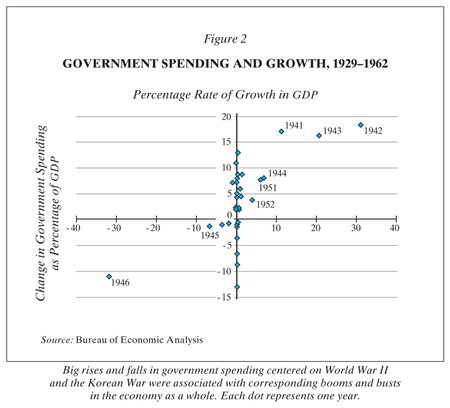
First, Stanford’s Robert Hall has looked at the effects of large changes in US government purchases—which is all about wars, specifically World War II and the Korean War. Figure 2 on this page [see below] compares changes in US military spending with changes in real GDP—both measured as a percentage of the preceding year’s GDP—over the period from 1929 to 1962 (there’s not much action after that). Each dot represents one year; I’ve labeled the points corresponding to the big buildup during World War II and the big demobilization just afterward. Obviously, there were big moves in years when nothing much was happening to military spending, notably the slump from 1929 to 1933 and the recovery from 1933 to 1936. But every year in which there was a big spending increase was also a year of strong growth, and the reduction in military spending after World War II was a year of sharp output decline.

Krugman did not explain his chart in detail, so I consulted the study by Robert Hall cited by Krugman. Hall’s insight was to focus not on government spending, just military spending, because other components of government spending are themselves influenced by the state of the economy, making it difficult to disentangle the effects of spending on the economy from the effects of the economy on spending. However, military spending is largely driven, especially in wartime (World War II and Korea), by factors unrelated to how the economy is performing. This makes military spending an appropriate instrument by which to identify and estimate the effect of government spending on the economy.

The problem with Krugman’s discussion is that, although using military expenditures allowed him to avoid the identification problem associated with the interdependency of government spending and the level of economic activity, he left out any mention of the behavior of the price level, which, many of us (and perhaps even Krugman himself) believe, powerfully affects the overall level of economic activity. Krugman artfully avoids any discussion of this relationship with the seemingly innocent observation “there were big moves in years when nothing much was happening to military spending, notably the slump from 1929 to 1933 and the recovery from 1933 to 1936.” But even this implicit acknowledgment of the importance of the behavior of the price level overlooks the fact that the huge wartime increase in military spending took place against the backdrop of rapid inflation, so that attributing economic expansion during World War II solely to the increase in government spending does not seem to warranted, because at least some of the increase in output would have been been forthcoming, even without increased military spending, owing to the rise in the price level.

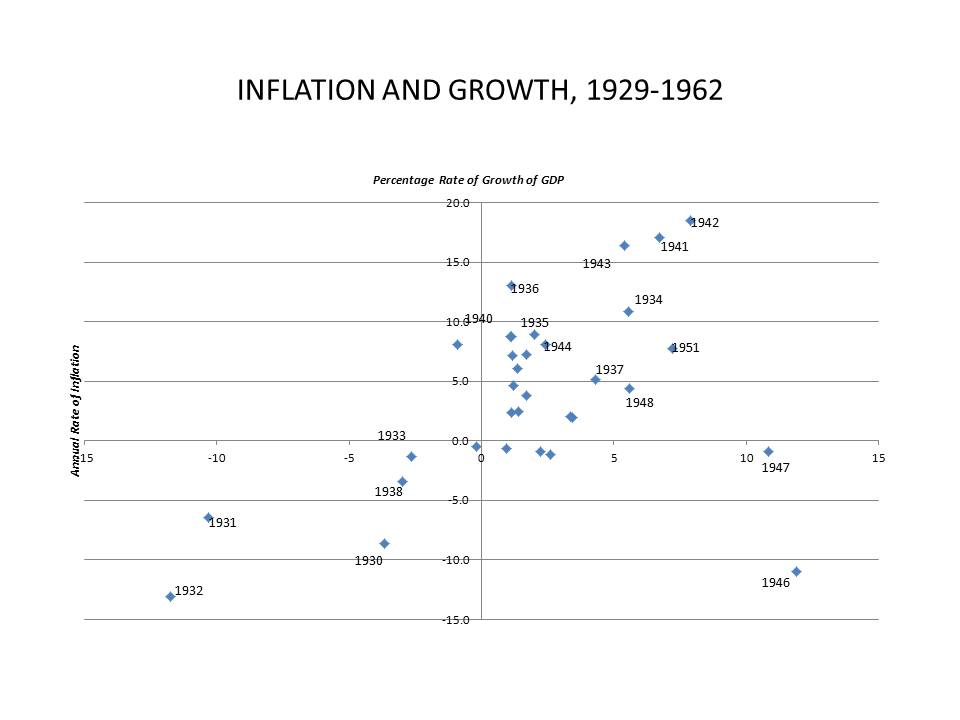
It is not hard to compare the effects of inflation and the effects of military spending on economic growth over the time period considered by Krugman. One can simply take annual inflation each year from 1930 to 1962 and plot the yearly rates of inflation and economic growth that Krugman plotted on his figure. Here is my version of Krugman’s chart substituting inflation for the change in military spending as a percentage of GDP.

It is difficult visually to compare the diagrams to see which one provides the more informative account of the fluctuations in economic growth over the 33 years in the sample. But it is not hard to identify the key difference between the two diagrams. In Krugman’s diagram, the variation in military spending provides no information about the variation in economic growth during the 1930s. There are is a cluster of points up and down the vertical axis corresponding to big positive and negative fluctuations in GDP with minimal changes in military spending. But large changes in GDP during the 1940s do correspond to changes in the same direction in military spending. Similarly, during the Korean War in the early 1950s, there was a positive correlation between changes in military spending. From the mid-1950s to the early 1960s, annual changes in GDP and in military spending were relatively small.

In my diagram plotting annual rates of inflation against annual changes in GDP, the large annual changes in GDP are closely related to positive or negative changes in the price level. In that respect, my diagram provides a more informative representation of the data than does Krugman’s. Even in World War II, the points representing the war years 1942 to 1945 are not far from a trend line drawn through the scatter of points. Where the diagram runs into serious trouble is that two points are way, way off to one side. Those are the years 1946 and 1947.

What was going on in those years? GDP was contracting, especially in 1946, and prices were rising rapidly, exactly contrary to the usual presumption that rising prices tend to generate increases in output. What was going on? It all goes back to 1942, when FDR imposed wartime price controls. This was partly a way of preventing suppliers from raising prices to the government, and also a general anti-inflation measure. However, the result was that there were widespread shortages, with rationing of a wide range of goods and services.  The officially measured rate of inflation from 1942 to 1945 was therefore clearly understated. In 1946 and 1947, controls were gradually relaxed and finally eliminated, with measured inflation rates actually increasing even though the economy was contracting.  Measured inflation in 1946 and 1947 therefore overstated actual inflation by an amount corresponding (more or less) to the cumulative understatement of inflation from 1942 to 1945. That the dots representing 1946 and 1947 are outliers is not because the hypothesized causal relationship between inflation and GDP was inoperative or reversed, but because of a mistaken measurement of what inflation actually was.

To get a better handle on the relative explanatory power of the government-spending and the inflation hypotheses in accounting for fluctuations in GDP than visual inspection of the data allows, one has to work with the underlying data. Unfortunately, when I tried to measure changes in military spending from 1929 to 1962, I could not reproduce the data underlying Krugman’s chart. That was not Krugman’s fault; I don’t doubt that he accurately calculated the relevant data from the appropriate sources. But when I searched for data on military spending since 1929, the only source that I found was this. So that is what I used. I assume that Krugman was using a different source from the one that I used, and he may also have defined his government spending variable in a different way from how I did. At any rate, when I did the calculation, I generated a chart that looked like the one below. It is generally similar to Krugman’s, but obviously not the same. If someone can explain why I did not come up with the same numbers for changes in government spending that Krugman did, I would be very much obliged and will redo my calculations. However, in the meantime, I am going to assume that my numbers are close enough to Krugman’s, so that my results would not be reversed if I used his numbers instead.

Taking my version of Krugman’s data, I ran a simple regression of the annual change in real GDP (dGDP) on the annual change in government (i.e., military spending) as a percentage of GDP (dG) from 1930 to 1962 (the data start in 1929, but the changes don’t start till 1930). The regression equation that I estimated was the following:

dGDP = 3.60 + .70dG, r-squared = .295.

This equation says that the percent increase in real GDP in any year is 3.6% plus seven-tenths of the percentage increase in government (i.e., military) spending for that year.

I then ran a corresponding regression of the annual change in real GDP on the annual change in the price level (dP, derived from my estimate of the GDP price deflator). The estimated regression was the following:

dGDP = 2.48 + .69dP, r-squared = .199.

The equation says that the percent increase in real GDP in any year is 2.48% plus .69 times that year’s rate of inflation.

Because the r-squared of the first equation is about 50% higher than that of the second, there would be good reason to prefer the first equation over the second were it not for the measurement problem that I mentioned above. I tried a number of ways of accounting for that measurement problem, but the simplest adjustment was simply to add two dummy variables, one for price controls during World War II and one for the lifting of price controls in 1946 and 1947. When I introduced both dummy variables into the equation, it turned out that the dummy variable for price controls during World War II was statistically insignificant, inasmuch as there was some measured inflation even during the World War II price controls. It was only the dummy variable controlling for the (mis)measured inflation associated with the lifting of price controls that was statistically significant. Here is the estimated regression:

dGDP = 2.76 + 1.28dP – 23.29PCON, r-squared = .621

I also tried attributing the inflation measured in 1946 and 1947 to the years 1942 to 1945, giving each of those years an inflation rate of about 9.7% and attributing zero inflation to the years 1946 and 1947. The regression equation that I estimated using that approach did not perform as well, based on a comparison of adjusted r-squares, as the simple equation with a single dummy variable. I also estimated equations using both the government spending variable and the inflation variable, and the two price-control dummies. That specification, despite two extra variables, had an r-squared less than the r-squared of the above equation. [Update 11/20/2012:  This was my mistake, because the best results were obtained using only a dummy variable for 1946 and 1947.  When the government spending and the inflation variables were estimated with a dummy for 1946-1947, the coefficients on both variables were positive and significant.]  So my tentative conclusion is that the best way to summarize the observed data pattern for the fluctuations of real GDP between 1929 and 1962 is with an equation with only an inflation variable and an added dummy variable accounting for the mismeasurement of inflation in 1946 and 1947.

Nevertheless, I would caution against reading too much into these results, even on the assumption that the provisional nature of the data that I have used has not introduced any distortions and that there are no other errors in my results. (Anyone who wants to check my results is welcome to email me at uneasymoney@hotmail.com, and I will send you the (Stata) data files that I have used.) Nor do I claim that government spending has no effect on real GDP. I am simply suggesting that for the time period between 1929 and 1962 in the US, there does not seem to be strong evidence that government spending significantly affected real GDP, once account is taken of the effects of changes in the price level. With only 33 observations, the effect of government spending, though theoretically present, may not be statistically detectable, at least not using a simple linear regression model. One might also argue that wartime increases in government spending contributed to the wartime inflation, so that the effect of government spending is masked by including a price-level variable. Be that as it may, Krugman’s (and Hall’s) argument that government spending was clearly effective in increasing real GDP in World War II and Korea, and would, therefore, be likely to be effective under other circumstances, is not as self-evidently true as Krugman makes it out to be. I don’t say that it is incorrect, but the evidence seems to be, at best, ambiguous.
More on Currency Manipulation

My previous post on currency manipulation elicited some excellent comments and responses, helping me, I hope, to gain a better understanding of the subject than I started with. What seemed to me the most important point to emerge from the comments was that the Chinese central bank (PBC) imposes high reserve requirements on banks creating deposits. Thus, the creation of deposits by the Chinese banking system implies a derived demand for reserves that must be held with the PBC either to satisfy the legal reserve requirement or to satisfy the banks’ own liquidity demand for reserves. Focusing directly on the derived demand of the banking system to hold reserves is a better way to think about whether the Chinese are engaging in currency manipulation and sterilization than the simple framework of my previous post. Let me try to explain why.

In my previous post, I argued that currency manipulation is tantamount to the sterilization of foreign cash inflows triggered by the export surplus associated with an undervalued currency. Thanks to an undervalued yuan, Chinese exporters enjoy a competitive advantage in international markets, the resulting export surplus inducing an inflow of foreign cash to finance that surplus. But neither that surplus, nor the undervaluation of the yuan that underlies it, is sustainable unless the inflow of foreign cash is sterilized. Otherwise, the cash inflow, causing a corresponding increase in the Chinese money supply, would raise the Chinese price level until the competitive advantage of Chinese exporters was eroded. Sterilization, usually conceived of as open-market sales of domestic assets held by the central bank, counteracts the automatic increase in the domestic money supply and in the domestic price level caused by the exchange of domestic for foreign currency. But this argument implies (or, at least, so I argued) that sterilization is not occurring unless the central bank is running down its holdings of domestic assets to offset the increase in its holdings of foreign exchange. So I suggested that, unless the Chinese central holdings of domestic assets had been falling, it appeared that the PBC was not actually engaging in sterilization. Looking at balance sheets of the PBC since 1999, I found that 2009 was the only year in which the holdings of domestic assets by the PBC actually declined. So I tentatively concluded that there seemed to be no evidence that, despite its prodigious accumulation of foreign exchange reserves, the PBC had been sterilizing inflows of foreign cash triggered by persistent Chinese export surpluses.

Somehow this did not seem right, and I now think that I understand why not. The answer is that reserve requirements imposed by the PBC increase the demand for reserves by the Chinese banking system. (See here.) The Chinese reserve requirements on the largest banks were until recently as high as 21.5% of deposits (apparently the percentage is the same for both time deposits and demand deposits). The required reserve ratio is the highest in the world. Thus, if Chinese banks create 1 million yuan in deposits, they are required to hold approximately 200,000 yuan in reserves at the PBC. That 200,000 increase in reserves must come from somewhere. If the PBC does not create those reserves from domestic credit, the only way that they can be obtained by the banks (in the aggregate) is by obtaining foreign exchange with which to satisfy their requirement. So given a 20% reserve requirement, unless the PBC undertakes net purchases of domestic assets equal to at least 200,000 yuan, it is effectively sterilizing the inflows of foreign exchange. So in my previous post, using the wrong criterion for determining whether sterilization was taking place, I had it backwards. The criterion for whether sterilization has occurred is whether bank reserves have increased over time by a significantly greater percentage than the increase in the domestic asset holdings of the PBC, not, as I had thought, whether those holdings of the PBC have declined.

In fact it is even more complicated than that, because the required-reserve ratio has fluctuated over time, the required-reserve ratio having roughly tripled between 2001 and 2010, so that the domestic asset holdings of the PBC would have had to increase more than proportionately to the increase in reserves to avoid effective sterilization. Given that the reserves held by banking system with the PBC at the end of 2010 were almost 8 times as large as they had been at the end of 2001, while the required reserve ratio over the period roughly tripled, the domestic asset holdings of the PBC should have increased more than twice as fast as bank reserves over the same period, an increase of, say, 20-fold, if not more. In the event, the domestic asset holdings of the PBC at the end of 2010 were just 2.2 times greater than they were at the end of 2001, so the inference of effective sterilization seems all but inescapable.

Why does the existence of reserve requirements mean that, unless the domestic asset holdings of the central bank increase at least as fast as reserves, sterilization is taking place? The answer is that the existence of a reserve requirement means that an increase in deposits implies a roughly equal percentage increase in reserves. If the additional reserves are not forthcoming from domestic sources, the domestic asset holdings of the central bank not having increased as fast as did required reserves, the needed reserves can be obtained from abroad only by way of an export surplus. Thus, an increase in the demand of the public to hold deposits cannot be accommodated unless the required reserves can be obtained from some source. If the central bank does not make the reserves available by purchasing domestic assets, then the only other mechanism by which the increased demand for deposits can be accommodated is through an export surplus, the surplus being achieved by restricting domestic spending, thereby increasing exports and reducing imports. The economic consequences of the central bank not purchasing domestic assets when required reserves increase are the same as if the central bank sold some of its holdings of domestic assets when required reserves were unchanged.

The more general point is that one cannot assume that the inflow of foreign exchange corresponding to an export surplus is determined solely by the magnitude of domestic currency undervaluation. It is also a function of monetary policy. The tighter is monetary policy, the larger the export surplus, the export surplus serving as the mechanism by which the public increases their holdings of cash. Unfortunately, most discussions treat the export surplus as if it were determined solely by the exchange rate, making it seem as if an easier monetary policy would have little or no effect on the export surplus.

The point is similar to one I made almost a year ago when I criticized F. A. Hayek’s 1932 defense of the monetary policy of the insane Bank of France. Hayek acknowledged that the gold holdings of the Bank of France had increased by a huge amount in the late 1920s and early 1930s, but, nevertheless, absolved the Bank of France of any blame for the Great Depression, because the quantity of money in France had increased by as much as the increase in gold reserves of the Bank of France.  To Hayek this meant that the Bank of France had done “all that was necessary for the gold standard to function.” This was a complete misunderstanding on Hayek’s part of how the gold standard operated, because what the Bank of France had done was to block every mechanism for increasing the quantity of money in France except the importation of gold. If the Bank of France had not embarked on its insane policy of gold accumulation, the quantity of money in France would have been more or less the same as it turned out to be, but France would have imported less gold, alleviating the upward pressure being applied to the real value of gold, or stated equivalently alleviating the downward pressure on the prices of everything else, a pressure largely caused by insane French policy of gold accumulation.

The consequences of the Chinese sterilization policy for the world economy are not nearly as disastrous as those of the French gold accumulation from 1928 to 1932, because the Chinese policy does not thereby impose deflation on any other country. The effects of Chinese sterilization and currency manipulation are more complex than those of French gold accumulation. I’ll try to at least make a start on analyzing those effects in an upcoming post addressing the comments of Scott Sumner on my previous post.

On the Unsustainability of Austrian Business-Cycle Theory, Or How I Discovered that Ludwig von Mises Actually Rejected His Own Theory

Robert Murphy, a clever fellow with an excessive, but, to his credit, not entirely uncritical (see here and here), devotion to Austrian Business Cycle Theory (ABCT), criticized my previous post about ABCT. Murphy’s criticism focuses on my alleged misreading or misrepresentation of Mises’s original version of ABCT in his The Theory of Money and Credit. (Note, however, that we are both dealing with the 1934 translation of the revised 1924 edition, not the original 1912 German text.)

Murphy quotes the following passage from my post focusing especially on the part in bold print.

[T]he notion of unsustainability [in Austrian business cycle theory] is itself unsustainable, or at the very least greatly exaggerated and misleading. Why must the credit expansion that produced the interest-rate distortion or the price bubble come to an end? Well, if one goes back to the original sources for the Austrian theory, namely Mises’s 1912 book The Theory of Money and Credit and Hayek’s 1929 book Monetary Theory and the Trade Cycle, one finds that the effective cause of the contraction of credit is not a physical constraint on the availability of resources with which to complete the investments and support lengthened production processes, but the willingness of the central bank to tolerate a decline in its gold holdings. It is quite a stretch to equate the demand of the central bank for a certain level of gold reserves with a barrier that renders the completion of investment projects and the operation of lengthened production processes impossible, which is how Austrian writers, fond of telling stories about what happens when someone tries to build a house without having the materials required for its completion, try to explain what “unsustainability” means.

The original Austrian theory of the business cycle was thus a theory specific to the historical conditions associated with classical gold standard.

Murphy then chastises me for not having read or having forgotten the following statement by von Mises.

Painful consideration of the question whether fiduciary media really could be indefinitely augmented without awakening the mistrust of the public would be not only supererogatory, but otiose.

Now it’s true that I did not recall this particular passage when writing my post, but the passage is not inconsistent with the point I was making. If you look at the passage from section 4 of chapter 5 of Part III of The Theory of Money and Credit (p. 357 of the 1934 edition), you will see that the context in which the statement is written is a hypothetical example in which banks can engage in an unlimited credit expansion without the constraints of an internal or external drain on their balance sheets. So while it is true that Mises anticipated in The Theory of Money and Credit the question whether a banking system not constrained by any internal or external drains could engage in an unlimited credit expansion, Mises was engaged in a hypothetical exercise, not the analysis of any business cycle ever encountered.

Murphy provides two longer quotations from a bit later in the same chapter in which Mises tried to explain why an unlimited credit expansion would be unsustainable:

The situation is as follows: despite the fact that there has been no increase of intermediate products and there is no possibility of lengthening the average period of production, a rate of interest is established in the loan market which corresponds to a longer period of production; and so, although it is in the last resort inadmissible and impracticable, a lengthening of the period of production promises for the time to be profitable. But there cannot be the slightest doubt as to where this will lead. A time must necessarily come when the means of subsistence available for consumption are all used up although the capital goods employed in production have not yet been transformed into consumption goods. This time must come all the more quickly inasmuch as the fall in the rate of interest weakens the motive for saving and so slows up the rate of accumulation of capital. The means of subsistence will prove insufficient to maintain the labourers during the whole period of the process of production that has been entered upon. Since production and consumption are continuous, so that every day new processes of production are started upon and others completed, this situation does not imperil human existence by suddenly manifesting itself as a complete lack of consumption goods; it is merely expressed in a reduction of the quantity of goods available for consumption and a consequent restriction of consumption. The market prices of consumption goods rise and those of production goods fall. (p. 362)

And

If our doctrine of crises is to be applied to more recent history, then it must be observed that the banks have never gone as far as they might in extending credit and expanding the issue of fiduciary media. They have always left off long before reaching this limit, whether because of growing uneasiness on their own part and on the part of all those who had not forgotten the earlier crises, or whether because they had to defer to legislative regulations concerning the maximum circulation of fiduciary media. And so the crises broke out before they need have broken out. It is only in this sense that we can interpret the statement that it is apparently true after all to say that restriction of loans is the cause of economic crises, or at least their immediate impulse; that if the banks would only go on reducing the rate of interest on loans they could continue to postpone the collapse of the market. If the stress is laid upon the word postpone, then this line of argument can be assented to without more ado. Certainly, the banks would be able to postpone the collapse; but nevertheless, as has been shown, the moment must eventually come when no further extension of the circulation of fiduciary media is possible. Then the catastrophe occurs, and its consequences are the worse. (p. 365)

The latter quotation actually confirms my assertion that Mises’s theory of business cycles as a historical phenomenon was a theory of the effects a credit expansion brought to a close by an external constraint imposed on the banks by the gold standard or perhaps by some artificial legal constraint on the reserve holdings of the banks. It is true that Mises hypothesized that a credit expansion by a completely unconstrained banking system was inevitably destined to be unsustainable, but this is a purely theoretical argument disconnected from historical experience.

But that is just what I said in my post:

[D]espite their antipathy to proposals for easing the constraints of the gold standard on individual central banks, Mises and Hayek never succeeded in explaining why a central-bank expansion necessarily had to be stopped. Rather than provide such an explanation they instead made a different argument, which was that the stimulative effect of a central-bank expansion would wear off once economic agents became aware of its effects and began to anticipate its continuation. This was a fine argument, anticipating the argument of Milton Friedman and Edward Phelps in the late 1960s by about 30 or 40 years. But that was an argument that the effects of central-bank expansion would tend to diminish over time as its effects were anticipated. It was not an argument that the expansion was unsustainable.

So let’s go back to what Mises said in the middle quotation above, where he tries to do the heavy lifting.

[D]espite the fact that there has been no increase of intermediate products and there is no possibility of lengthening the average period of production, a rate of interest is established in the loan market which corresponds to a longer period of production; and so, although it is in the last resort inadmissible and impracticable, a lengthening of the period of production promises for the time to be profitable.

I don’t understand why there has been no increase in intermediate products. The initial monetary expansion causes output to increase temporarily, allowing the amount of intermediate products to increase, and the average period of production to lengthen.

But there cannot be the slightest doubt as to where this will lead.

Note the characteristic Misesian rhetorical strategy: proof by assertion. There cannot be the slightest doubt that I am right and you are wrong. QED. Praxeology in action!

A time must necessarily come when the means of subsistence available for consumption are all used up although the capital goods employed in production have not yet been transformed into consumption goods.

Are the means of subsistence a common property resource? When property rights don’t exist over resources, those resources run out. The means of subsistence are owned and they are sold, not given away or taken at will. As their supply dwindles, their prices rise and consumption is restricted.

This time must come all the more quickly inasmuch as the fall in the rate of interest weakens the motive for saving and so slows up the rate of accumulation of capital.

But the whole point is that monetary expansion is raising the prices of consumption goods thereby imposing forced saving on households to accommodate the additional investment.

The means of subsistence will prove insufficient to maintain the labourers during the whole period of the process of production that has been entered upon.

What does this mean? Are workers dying of starvation? Is Mises working with a Ricardian subsistence theory of wages? But wait; let’s read on.

Since production and consumption are continuous, so that every day new processes of production are started upon and others completed, this situation does not imperil human existence by suddenly manifesting itself as a complete lack of consumption goods; it is merely expressed in a reduction of the quantity of goods available for consumption and a consequent restriction of consumption. The market prices of consumption goods rise and those of production goods fall.

OK, so what is the point? What is unsustainable about this?

Now I am really confused.  But wait!  Look at the preceding paragraph, and read the following:

Now it is true that an increase of fiduciary media brings about a redistribution of wealth in the course of its effects on the objective exchange value of money which may well lead to increased saving and a reduction of the standard of living. A depreciation of money, when metallic money is employed, may also lead directly to an increase in the stock of goods in that it entails a diversion of some metal from monetary to industrial uses. So far as these factors enter into consideration, an increase of fiduciary media does cause a diminution of even the natural rate of interest, as we could show if it were necessary. But the case that we have to investigate is a different one. We are not concerned with a reduction in the natural rate of interest brought about by an increase in the issue of fiduciary media, but with a reduction below this rate in the money rate charged by the banks, inaugurated by the credit-issuing banks and necessarily followed by the rest of the loan market. The power of the banks to do such a thing has already been demonstrated. (pp. 361-62)

So von Mises actually conceded that monetary expansion by the banks could reduce the real rate of interest via the imposition of forced savings caused by a steady rate of inflation. Unsustainability results only when the central bank reduces the rate of interest below the natural rate and succeeds in keeping it permanently below the natural rate. The result is hyperinflation, which almost everyone agrees is unsustainable. We don’t need ABCT to teach us that!  But the question that I and most non-Austrian economists are interested in is whether there is anything unsustainable about a steady rate of monetary expansion associated with a steady rate of growth in NGDP.  Answer: not obviously. And, evidently, even the great Ludwig von Mises, himself, admitted that a steady monetary expansion is indeed sustainable.  You can look it up.

Two Problems with Austrian Business-Cycle Theory

Even though he has written that he no longer considers himself an Austrian economist, George Selgin remains sympathetic to the Austrian theory of business cycles, and, in accord with the Austrian theory, still views recessions and depressions as more or less inevitable outcomes of distortions originating in the preceding, credit-induced, expansions. In a recent post, George argues that the 2002-06 housing bubble conforms to the Austrian pattern in which a central-bank lending rate held below the “appropriate,” or “natural” rate causes a real misallocation of resources reflecting the overvaluation of long-lived capital assets (like houses) induced by the low-interest rate policy. For Selgin, it was the Fed’s distortion of real interest rates from around 2003 to 2005 that induced a housing bubble even though the rate of increase in nominal GDP during the housing bubble was only slightly higher than the 5% rate of increase in nominal GDP during most of the Great Moderation.

Consequently, responses by Marcus Nunes, Bill Woolsey and Scott Sumner to Selgin, questioning whether he used an appropriate benchmark against which to gauge nominal GDP growth in the 2003 to 2006 period, don’t seem to me to address the core of Selgin’s argument. Selgin is arguing that the real distortion caused by the low-interest-rate policy of the Fed was more damaging to the economy than one would gather simply by looking at a supposedly excessive rate of nominal GDP growth, which means that the rate of growth of nominal GDP in that time period does not provide all the relevant information about the effects of monetary policy.

So to counter Selgin’s argument – which is to say, the central argument of Austrian Business-Cycle Theory – one has to take a step back and ask why a price bubble, or a distortion of interest rates, caused by central-bank policy should have any macroeconomic significance. In any conceivable real-world economy, entrepreneurial error is a fact of life. Malinvestments occur all the time; resources are, as a consequence, constantly being reallocated when new information makes clear that some resources were misallocated owing to mistaken expectations. To be sure, the rate of interest is a comprehensive price potentially affecting how all resources are allocated. But that doesn’t mean that a temporary disequilibrium in the rate of interest would trigger a major economy-wide breakdown, causing the growth of real output and income to fall substantially below their historical trend, perhaps even falling sharply in absolute terms.

The Austrian explanation for this system-wide breakdown is that the price bubble or the interest-rate misallocation leads to the adoption of investments projects and of production processes that “unsustainable.” The classic Austrian formulation is that the interest-rate distortion causes excessively roundabout production processes to be undertaken. For a time, these investment projects and production processes can be sustained by way of credit expansion that shifts resources from consumption to investment, what is sometimes called “forced saving.” At a certain point, the credit expansion must cease, and at that point, the unsustainability of the incomplete investment projects or even the completed, but excessively roundabout, production processes becomes clear, and the investments and production processes are abandoned. The capital embodied in those investment projects and production processes is revealed to have been worthless, and all or most of the cooperating factors of production, especially workers, are rendered unemployable in their former occupations.

Although it is not without merit, that story is far from compelling. There are two basic problems with it. First, the notion of unsustainability is itself unsustainable, or at the very least greatly exaggerated and misleading. Why must the credit expansion that produced the interest-rate distortion or the price bubble come to an end? Well, if one goes back to the original sources for the Austrian theory, namely Mises’s 1912 book The Theory of Money and Credit and Hayek’s 1929 book Monetary Theory and the Trade Cycle, one finds that the effective cause of the contraction of credit is not a physical constraint on the availability of resources with which to complete the investments and support lengthened production processes, but the willingness of the central bank to tolerate a decline in its gold holdings. It is quite a stretch to equate the demand of the central bank for a certain level of gold reserves with a barrier that renders the completion of investment projects and the operation of lengthened production processes impossible, which is how Austrian writers, fond of telling stories about what happens when someone tries to build a house without having the materials required for its completion, try to explain what “unsustainability” means.

The original Austrian theory of the business cycle was thus a theory specific to the historical conditions associated with classical gold standard. Hawtrey, whose theory of the business cycle, depended on a transmission mechanism similar to, but much simpler than, the mechanism driving the Austrian theory, realized that there was nothing absolute about the gold standard constraint on monetary expansion. He therefore believed that the trade cycle could be ameliorated by cooperation among the central banks to avoid the sharp credit contractions imposed by central banks when they feared that their gold reserves were falling below levels that they felt comfortable with. Mises and Hayek in the 1920s (along with most French economists) greatly mistrusted such ideas about central bank cooperation and economizing the use of gold as a threat to monetary stability and sound money.

However, despite their antipathy to proposals for easing the constraints of the gold standard on individual central banks, Mises and Hayek never succeeded in explaining why a central-bank expansion necessarily had to be stopped. Rather than provide such an explanation they instead made a different argument, which was that the stimulative effect of a central-bank expansion would wear off once economic agents became aware of its effects and began to anticipate its continuation. This was a fine argument, anticipating the argument of Milton Friedman and Edward Phelps in the late 1960s by about 30 or 40 years. But that was an argument that the effects of central-bank expansion would tend to diminish over time as its effects were anticipated. It was not an argument that the expansion was unsustainable. Just because total income and employment are not permanently increased by the monetary expansion that induces an increase in investment and an elongation of the production process does not mean that the investments financed by, and the production processes undertaken as a result of, the monetary expansion must be abandoned. The monetary expansion may cause a permanent shift in the economy’s structure of production in the same way that tax on consumption, whose proceeds were used to finance investment projects that would otherwise not have been undertaken, might be carried on indefinitely. So the Austrian theory has never proven that forced saving induced by monetary expansion, in the absence of a gold-standard constraint, is necessarily unsustainable, inevitably being reversed because of physical constraints preventing the completion of the projects financed by the credit expansion. That’s the first problem.

The second problem is even more serious, and it goes straight to the argument that Selgin makes against Market Monetarists. The whole idea of unsustainability involves a paradox. The paradox is that unsustainability results from some physical constraint on the completion of investment projects or the viability of newly adopted production processes, because the consumer demand is driving up the costs of resources to levels making it unprofitable to complete the investment projects or operate new production processes.  But this argument presumes that all the incomplete investment projects and all the new production processes become unprofitable more or less simultaneously, leading to their rapid abandonment. But the consequence is that all the incomplete investment projects and all the newly adopted production processes are scuttled, producing massive unemployment and redundant resources. But why doesn’t that drop in resource prices restore the profitability of all the investment projects and production processes just abandoned?

It therefore seems that the Austrian vision is of a completely brittle economy in which price adjustments continue without inducing any substitutions to ease the resource bottlenecks. Demands and supplies are highly inelastic, and adjustments cannot be made until prices can no longer even cover variable costs. At that point prices collapse, implying that resource bottlenecks are eliminated overnight, without restoring profitability to any of the abandoned projects or processes.  Actually the most amazing thing about such a vision may be how closely it resembles the vision of an economy espoused by Hayek’s old nemesis Piero Sraffa in his late work The Production of Commodities by Means of Commodities, a vision based on fixed factor proportions in production, thus excluding the possibility of resource substitution in production in response to relative price changes.

A more realistic vision, it seems to me, would be for resource bottlenecks to induce substitution away from the relatively scarce resources allowing production processes to continue in operation even though the value of many fixed assets would have to be written down substantially. Those write downs would allow existing or new owners to maintain output as long as total demand is not curtailed as a result of a monetary policy that either deliberately seeks or inadvertently allows monetary contraction. Real distortions inherited from the past can be accommodated and adjusted to by a market economy as long as that economy is not required at the same time to undergo a contraction, in total spending. But once a sharp contraction in total spending does occur, a recovery may require a temporary boost in total spending above the long-term trend that would have sufficed under normal conditions.

Economy, Heal Thyself

Lately, some smart economists (Eli Dourado backed up by Larry White, George Selgin, and Tyler Cowen) have been questioning whether it is plausible, four years after the US economy was hit with a severe negative shock to aggregate demand, and about three and a half years since aggregate demand stopped falling (nominal GDP subsequently growing at about a 4% annual rate), that the reason for persistent high unemployment and anemic growth in real output is that nominal aggregate demand has been growing too slowly. Even conceding that the 4% growth in nominal GDP was too slow to generate a rapid recovery from the original shock, they still ask why almost four years after hitting bottom, we should assume that slow growth in real GDP and persistent high unemployment are the result of deficient aggregate demand rather than the result of some underlying real disturbance, such as a massive misallocation of resources and capital induced by the housing bubble from 2002 to 2006. In other words, even if it was an aggregated demand shock that caused a sharp downturn in 2008-09, and even if insufficient aggregate demand growth unnecessarily weakened and prolonged the recovery, what reason is there to assume that the economy could not, by now, have adjusted to a slightly lower rate of growth in nominal GDP 4% (compared to the 5 to 5.5% that characterized the period preceding the 2008 downturn). As Eli Dourado puts it:

If we view the recession as a purely nominal shock, then monetary stimulus only does any good during the period in which the economy is adjusting to the shock. At some point during a recession, people’s expectations about nominal flows get updated, and prices, wages, and contracts adjust. After this point, monetary stimulus doesn’t help.

Thus, Dourado,White, Selgin, and Cowen want to know why an economy not afflicted by some deep structural, (i.e. real) problems would not have bounced back to its long-term trend of real output and employment after almost four years of steady 4% nominal GDP growth. Four percent growth in nominal GDP may have been too stingy, but why should we believe that 4% nominal GDP growth would not, in the long run, provide enough aggregate demand to allow an eventual return to the economy’s long-run real growth path?  And if one concedes that a steady rate of 4% growth in nominal GDP would eventually get the economy back on its long-run real growth path, why should we assume that four years is not enough time to get there?

Well, let me respond to that question with one of my own: what is the theoretical basis for assuming that an economy subjected to a very significant nominal shock that substantially reduces real output and employment would ever recover from that shock and revert back to its previous growth path? There is, I suppose, a presumption that markets equilibrate themselves through price adjustments, prices adjusting in response to excess demands and supplies until markets again clear. But there is a fallacy of composition at work here. Supply and demand curves are always drawn for a single market. The partial-equilibrium analysis that we are taught in econ 101 operates based on the implicit assumption that all markets other than the one under consideration are in equilibrium. (That is actually a logically untenable assumption, because, according to Walras’s Law, if one market is out of equilibrium at least one other market must also be out of equilibrium, but let us not dwell on that technicality.) But after an economy-wide nominal shock, the actual adjustment process involves not one market, but many (if not most, or even all) markets are out of equilibrium. When many markets are out of equilibrium, the adjustment process is much more problematic than under the assumptions of the partial-equilibrium analysis that we are so accustomed to. Just because the adjustment process that brings a single isolated market back from disequilibrium to equilibrium seems straightforward, we are not necessarily entitled to assume that there is an equivalent adjustment process from an economy-wide disequilibrium in which many, most, or all, markets are starting from a position of disequilibrium. A price adjustment in any one market will, in general, affect demands and supplies in at least some other markets. If only a single market is out of equilibrium, the effects on other markets of price and quantity adjustment in that one market are likely to be small enough, so that those effects on other markets can be safely ignored. But when many, most, or all, markets are in disequilibrium, the adjustments in some markets may aggravate the disequilibrium in other markets, setting in motion an endless series of adjustments that may – but may not! — lead the economy back to equilibrium. We just don’t know. And the uncertainty about whether equilibrium will be restored becomes even greater, when one of the markets out of equilibrium is the market for labor, a market in which income effects are so strong that they inevitably have major repercussions on all other markets.

Dourado et al. take it for granted that people’s expectations about nominal flows get updatd, and that prices, wages, and contracts adjust. But adjustment is one thing; equilibration is another. It is one thing to adjust expectations about a market in disequilibrium when all or most markets ar ein or near equilibrium; it is another to adjust expectations when markets are all out of equilibrium. Real interest rates, as very imperfectly approximated by TIPS, seem to have been falling steadily since early 2011 reflecting increasing pessimism about future growth in the economy. To overcome the growing entrepreneurial pessimism underlying the fall in real interest rates, it would have been necessary for workers to have accepted wage cuts far below their current levels. That scenario seems wildly unrealistic under any conceivable set of conditions. But even if the massive wage cuts necessary to induce a substantial increase in employment were realistic, wage cuts of that magnitude could have very unpredictable repercussions on consumption spending and prices, potentially setting in motion a destructive deflationary spiral. Dourado assumes that updating expectations about nominal flows, and the adjustments of prices and wages and contracts lead to equilibrium – that the short run is short. But that is question begging no less than those who look at slow growth and high unemployment and conclude that the economy is operating below its capacity. Dourado is sure that the economy has to return to equilibrium in a finite period of time, and I am sure that if the economy were in equilibrium real output would be growing at least 3% a year, and unemployment would be way under 8%. He has no more theoretical ground for his assumption than I do for mine.

Dourado challenges supporters of further QE to make “a broadly falsifiable claim about how long the short run lasts.” My response is that there is no theory available from which to deduce such a falsifiable claim. And as I have pointed out a number of times, no less an authority than F. A. Hayek demonstrated in his 1937 paper “Economics and Knowledge” that there is no economic theory that entitles us to conclude that the conditions required for an intertemporal equilibrium are in fact ever satisfied, or even that there is a causal tendency for them to be satisfied. All we have is some empirical evidence that economies from time to time roughly approximate such states. But that certainly does not entitle us to assume that any lapse from such a state will be spontaneously restored in a finite period of time.

Do we know that QE will work? Do we know that QE will increase real growth and reduce unemployment? No, but we do have a lot of evidence that monetary policy has succeeded in increasing output and employment in the past by changing expectations of the future price-level path. To assume that the current state of the economy is an equilibrium when unemployment is at a historically high level and inflation at a historically low level seems to me just, well, irresponsible.

So Many QE-Bashers, So Little Time

Both the Financial Times and the Wall Street Journal have been full of articles and blog posts warning of the ill-effects of QE3. In my previous post, I discussed the most substantial of the recent anti-QE discussions. I was going to do a survey of some of the others that I have seen, but today all I can manage is a comment on one of them.

In the Wall Street Journal, Benn Steil, director of international economics at the Council of Foreign Relations, winner of the 2010 Hayek Book Award for his book Money, Markets, and Sovereignty (co-authored with Manuel Hinds), and Dinah Walker, an analyst at the CFR, complain that since 2000, the Fed has stopped following the Taylor Rule, to which it supposedly adhered from 1987 to 1999 during a period of exceptional monetary stability, and, from 2000 to the present, the Fed supposedly abandoned the rule. This is a familiar argument endlessly repeated by none other than John Taylor, himself. But as I recently pointed out, Taylor has implicitly at least, conceded that the supposedly non-discretionary, uncertainty-minimizing, Taylor rule comes in multiple versions, and, notwithstanding Taylor’s current claim that he prefers the version that he originally proposed in 1993, he is unable to provide any compelling reason – other than his own exercise of discretion — why that version is entitled to any greater deference than alternative versions of the rule.

Despite the inability of the Taylor rule to specify a unique value, or even a narrow range of values, of the target for the Fed Funds rate, Steil and Walker, presumably taking Taylor’s preferred version as canonical, make the following assertion about the difference between how the Fed Funds rate was set in the 1987-99 period compared how it was set in the 2000-08 period.

Between 1987, when Alan Greenspan became Fed chairman, and 1999 a neat approximation of how the Fed responded to market signals was captured by the Taylor Rule. Named for John Taylor, the Stanford economist who introduced the rule in 1993, it stipulated that the fed-funds rate, which banks use to set interest rates, should be nudged up or down proportionally to changes in inflation and economic output. By our calculations, the Taylor Rule explained 69% of the variation in the fed-funds rate over that period. (In the language of statistics, the relationship between the rule and the rate had an R-squared of .69.)

Then came a dramatic change. Between 2000 and 2008, when the Fed cut the fed-funds target rate to near zero, the R-squared collapsed to .35. The Taylor Rule was clearly no longer guiding U.S. monetary policy.

This is a pretty extravagant claim. The 1987-99 period was marked by a single recession, a recession triggered largely by a tightening of monetary policy when inflation was rising above the 3.5 to 4 percent range that was considered acceptable after the Volcker disinflation in the early 1980s. So the 1992 recession was triggered by the application of Taylor rule, and the recession triggered a response that was consistent with the Taylor rule. The 2000-08 period was marked by two recessions, both of which were triggered by financial stresses, not rising inflation.  To say that the Fed abandoned a rule that it was following in the earlier period is simply to say that circumstances that the Fed did not have to face in the 1987-99 period confronted the Fed in the 2000-08 period. The difference in the R-squared found by Steil and Watson may indicate no more than the more variable economic environment in the latter period than the former.

As I pointed out in my recent post (hyper-linked above) on the multiple Taylor rules, following the Taylor rule in 2008 would have meant targeting the Fed Funds rate for most of 2008 at an even higher level than the disastrously high rate that the Fed was targeting in 2008 while the economy was already in recession and entering, even before the Lehman debacle, one of the sharpest contractions since World War II. Indeed, Taylor’s preferred version implied that the Fed should have increased (!) the Fed Funds rate in the spring of 2008.

Steil and Watkins attribute the Fed’s deviation from the Taylor rule to an implicit strategy of targeting asset prices.

In a now-famous speech invoking the analogy of a “helicopter drop of money,” [Bernanke] argued that monetary interventions that boosted asset values could help combat deflation risk by lowering the cost of capital and improving the balance sheets of potential borrowers.

Mr. Bernanke has since repeatedly highlighted asset-price movements as a measure of policy success. In 2003 he argued that “unanticipated changes in monetary policy affect stock prices . . . by affecting the perceived riskiness of stocks,” suggesting an explicit reason for using monetary policy to affect the public’s appetite for stocks. And this past February he noted that “equity prices [had] risen significantly” since the Fed began reinvesting maturing securities.

This is a tendentious misreading of Bernanke’s statements. He is not targeting stock prices, but he is arguing that movements in stock prices are correlated with expectations about the future performance of the economy, so that rising stock prices in response to a policy decision of the Fed provide some evidence that the policy has improved economic conditions. Why should that be controversial?

Steil and Watkins then offer a strange statistical “test” of their theory that the Fed is targeting stock prices.

Between 2000 and 2008, the level of household risk aversion—which we define as the ratio of household currency holdings, bank deposits and money-market funds to total household financial assets—explained a remarkable 77% of the variation in the fed-funds rate (an R-squared of .77). In other words, the Fed was behaving as if it were targeting “risk on, risk off,” moving interest rates to push investors toward or away from risky assets.

What Steil and Watkins are measuring by their “ratio of household risk aversion” is liquidity preference or the demand for money. They seem to have a problem with the Fed acting to accommodate the public’s demand for liquidity. The alternative to the Fed’s accommodating a demand for liquidity is to have that demand manifested in deflation. That’s what happened in 1929-33, when the Fed deliberately set out to combat stock-market speculation by raising interest rates until the stock market crashed, and only then reduced rates to 2%, which, in an environment of rapidly falling prices, was still a ferociously tight monetary policy. The .77 R-squared that Steil and Watkins find reflects the fact, for which we can all be thankful, that the Fed has at least prevented a deflationary catastrophe from overtaking the US economy.

The fact is that what mainly governs the level of stock prices is expectations about the future performance of the economy. If the Fed takes seriously its dual mandate, then it is necessarily affecting the level of stock prices. That is something very different from the creation of a “Bernanke put” in which the Fed is committed to “ease monetary policy whenever there is a stock market correction.” I don’t know why some people have a problem understanding the difference.  But they do, or at least act as if they do.

Bullard Defends the Indefensible

James Bullard, the President of the St. Louis Federal Reserve Bank, is a very fine economist, having worked his way up the ranks at the St. Louis Fed after joining the research department at the St. Louis Fed in 1990, as newly minted Ph. D. from Indiana University, publishing his research widely in leading journals (and also contributing an entry on “learning” to Business Cycles and Depressions: An Encyclopedia which I edited). Bullard may just be the most centrist member of the FOMC (see here), and his pronouncements on monetary policy are usually measured and understated, eschewing the outspoken style of some of his colleagues (especially the three leading inflation hawks on the FOMC, Charles Plosser, Jeffrey Lacker, and Richard Fisher).

But even though Bullard is a very sensible and knowledgeable guy, whose views I take seriously, I am having a lot of trouble figuring out what he was up to in the op-ed piece he published in today’s Financial Times (“Patience needed for Fed’s dual mandate”) in which he argued that the fact that the Fed has persistently undershot its inflation target while unemployment has been way over any reasonable the rate consistent with full employment, is no reason for the Fed to change its policy toward greater ease.  In other words, Bullard sees no reason why the Fed should now  seek, or at least tolerate, an inflation rate that temporarily meets or exceeds the Fed’s current 2% target. In a recent interview, Bullard stated that he would not have supported the decision to embark on QE3.

To support his position, Bullard cites a 2007 paper in the American Economic Review by Smets and Wouters “Shocks and Frictions in US Business Cycles.” The paper estimates a DSGE model of the US economy and uses it to generate out-of-sample predictions that are comparable to those of a Bayesian vector autoregression model. Here’s how Bullard characterizes the rationale for QE3 and explains how that rationale is undercut by the results of the Smets and Wouters paper.

The Fed has a directive that calls for it to maintain stable prices as well as maximum employment, along with moderate long-term interest rates. Since unemployment is high by historical standards (8.1 per cent), observers argue the Fed must not be “maximising employment”. Inflation, as measured by the personal consumption expenditures deflator price index, has increased to about 1.3 per cent in the year to July. The Fed’s target is 2 per cent, so critics can say the Fed has not met this part of the mandate. When unemployment is above the natural rate, they say, inflation should be above the inflation target, not below.

I disagree. So does the economic literature. Here is my account of where we are: the US economy was hit by a large shock in 2008 and 2009. This lowered output and employment far below historical trend levels while reducing inflation substantially below 2 per cent. The question is: how do we expect these variables to return to their long-run or targeted values under monetary policy? That is, should the adjustment path be relatively smooth, or should we expect some overshooting?

Evidence, for example a 2007 paper by Frank Smets and Raf Wouters, suggests that it is reasonable to believe that output, employment and inflation will return to their long-run or targeted values slowly and steadily. In the jargon, we refer to this type of convergence as “monotonic”: a shock knocks the variables off their long-run values but they gradually return, without overshooting on the other side. Wild dynamics would be disconcerting.

What is wrong with Bullard’s argument? Well, just because Smets and Wouters estimated a DSGE model in 2007 that they were able to use to generate “good” out-of-sample predictions does not prove that the model would generate good out-of-sample predictions for 2008-2012. Maybe it does, I don’t know. But Bullard is a very smart economist, and he has a bunch of very smart economists economists working for him. Have they used the Smets and Wouters DSGE model to generate out-of-sample predictions for 2008 to 2012? I don’t know. But if they have, why doesn’t Bullard even mention what they found?

Bullard says that the Smets and Wouters paper “suggests that it is reasonable to believe that output, employment and inflation will return to their long-run or targeted values slowly and steadily.” Even if we stipulate to that representation of what the paper shows, that is setting the bar very low. Bullard’s representation calls to mind a famous, but often misunderstood, quote by a dead economist.

The long run is a misleading guide to current affairs. In the long run we are all dead. Economists set themselves too easy, too useless a task if in tempestuous seasons they can only tell us that when the storm is past the ocean is flat again.

Based on a sample that included no shock to output, employment, and inflation of comparable magnitude to the shock experienced in 2008-09, Bullard is prepared to opine confidently that we are now on a glide path headed toward the economy’s potential output, toward full employment, and toward 2% inflation.  All we need is patience. But Bullard provides no evidence, not even a simulation based on the model that he says that he is relying on, that would tell us how long it will take to reach the end state whose realization he so confidently promises.  Nor does he provide any evidence, not even a simulation based on the Smets-Wouters model — a model that, as far as I know, has not yet achieved anything like canonical status — estimating what the consequences of increasing the Fed’s inflation target would be, much less the consequences of changing the policy rule underlying Smets-Wouters model from inflation targeting to something like a price-level target or a NGDP target. And since the Lucas Critique tells us that a simulation based on a sample in which one policy rule was being implemented cannot be relied upon to predict the consequences of adopting a different policy rule from that used in the original estimation, I have no idea how Bullard can be so confident about what the Smets and Wouters paper can teach us about adopting QE3.

PS  In the comment below Matt Rognlie, with admirable clearness and economy, fleshes out my intuition that the Smets-Wouters paper provides very little empirical support for the proposition that Bullard is arguing for in his FT piece.  Many thanks and kudos to Matt for his contribution.


About Me

David Glasner
Washington, DC

I am an economist in the Washington DC area. My research and writing has been mostly on monetary economics and policy and the history of economics. In my book Free Banking and Monetary Reform, I argued for a non-Monetarist non-Keynesian approach to monetary policy, based on a theory of a competitive supply of money. Over the years, I have become increasingly impressed by the similarities between my approach and that of R. G. Hawtrey and hope to bring Hawtrey’s unduly neglected contributions to the attention of a wider audience.

My new book Studies in the History of Monetary Theory: Controversies and Clarifications has been published by Palgrave Macmillan

Follow me on Twitter @david_glasner

Archives

Enter your email address to follow this blog and receive notifications of new posts by email.

Join 665 other subscribers
Follow Uneasy Money on WordPress.com