Archive for the 'monetary policy' Category


Hawtrey and the “Treasury View”

Mention the name Ralph Hawtrey to most economists, even, I daresay to most monetary economists, and you are unlikely to get much more than a blank stare. Some might recognize the name because of it is associated with Keynes, but few are likely to be able to cite any particular achievement or contribution for which he is remembered or worth remembering. Actually, your best chance of eliciting a response about Hawtrey might be to pose your query to an acolyte of Austrian Business Cycle theory, for whom Hawtrey frequently serves as a foil, because of his belief that central banks ought to implement a policy of price-level (actually wage-level) stabilization to dampen the business cycle, Murray Rothbard having described him as “one of the evil genius of the 1920s” (right up there, no doubt, with the likes of Lenin, Trotsky, Stalin and Mussolini). But if, despite the odds, you found someone who knew something about Hawtrey, there’s a good chance that it would be for his articulation of what has come to be known as the “Treasury View.”

The Treasury View was a position articulated in 1929 by Winston Churchill, then Chancellor of the Exchequer in the Conservative government headed by Stanley Baldwin, in a speech to the House of Commons opposing proposals by Lloyd George and the Liberals, supported notably by Keynes, to increase government spending on public-works projects as a way of re-employing the unemployed. Churchill invoked the “orthodox Treasury View” that spending on public works would simply divert an equal amount of private spending on other investment projects or consumption. Spending on public-works projects was justified if and only if the rate of return over cost from those projects was judged to be greater than the rate of return over cost from alternative private spending; public works spending could not be justified as a means by which to put the unemployed back to work. The theoretical basis for this position was an article published by Hawtrey in 1925 “Public Expenditure and the Demand for Labour.”

Exactly how Hawtrey’s position first articulated in a professional economics journal four years earlier became the orthodox Treasury View in March 1929 is far from clear. Alan Gaukroger in his doctoral dissertation on Hawtrey’s career at the Treasury provides much helpful background information. Apparently, Hawtrey’s position was elevated into the “orthodox Treasury View” because Churchill required some authority on which to rely in opposing Liberal agitation for public-works spending which the Conservative government and Churchill’s top Treasury advisers and the Bank of England did not want to adopt for a variety of reason. The “orthodox Treasury View” provided a convenient and respectable doctrinal cover with which to clothe their largely political opposition to public-works spending. This is not to say that Churchill and his advisers were insincere in taking the position that they did, merely that Churchill’s position emerged from on-the-spot political improvisation in the course of which Hawtrey’s paper was dredged up from obscurity rather than from applying any long-standing, well-established, Treasury doctrine. For an illuminating discussion of all this, see chapter 5 (pp. 234-75) of Gaukroger’s dissertation.

I have seen references to the Treasury View for a very long time, probably no later than my first year in graduate school, but until a week or two ago, I had never actually read Hawtrey’s 1925 paper. Brad Delong, who has waged a bit of a campaign against the Treasury View on his blog as part of his larger war against opponents of President Obama’s stimulus program, once left a comment on a post of mine about Hawtrey’s explanation of the Great Depression, asking whether I would defend Hawtrey’s position that public-works spending would not increase employment. I think I responded by pleading ignorance of what Hawtrey had actually said in his 1925 article, but that Hawtrey’s explanation of the Great Depression was theoretically independent of his position about whether public-works spending could increase employment. So in a sense, this post is partly belated reply to Delong’s query.

The first thing to say about Hawtrey’s paper is that it’s hard to understand. Hawtrey is usually a very clear expositor of his ideas, but sometimes I just can’t figure out what he means. His introductory discussion of A. C. Pigou’s position on the wisdom of concentrating spending on public works in years of trade depression was largely incomprehensible to me, but it is worth reading, nevertheless, for the following commentary on a passage from Pigou’s Wealth and Welfare in which Pigou proposed to “pass behind the distorting veil of money.”

Perhaps if Professsor Pigou had carried the argument so far, he would have become convinced that the distorting veil of money cannot be put aside. As well might he play lawn tennis without the distorting veil of the net. All the skill and all the energy emanate from the players and are transmitted through the racket to the balls. The net does nothing; it is a mere limiting condition. So is money.

Employment is given by producers. They produce in response to an effective demand for products. Effective demand means ultimately money, offered by consumers in the market.

A wonderful insight, marvelously phrased, but I can’t really tell, beyond Pigou’s desire to ignore the “distorting veil of money,” how it relates to anything Pigou wrote. At any rate, from here Hawtrey proceeds to his substantive argument, positing “a community in which there is unemployment.” In other words, “at the existing level of prices and wages, the consumers’ outlay [Hawtrey’s term for total spending] is sufficient only to employ a part of the productive resources of the country.” Beyond the bare statement that spending is insufficient to employ all resources at current prices, no deeper cause of unemployment is provided. The problem Hawtrey is going to address is what happens if the government borrows money to spend on new public works?

Hawtrey starts by assuming that the government borrows from private individuals (rather than from the central bank), allowing Hawtrey to take the quantity of money to be constant through the entire exercise, a crucial assumption. The funds that the government borrows therefore come either from that portion of consumer income that would have been saved, in which case they are not available to be spent on whatever private investment projects they would otherwise have financed, or they are taken from idle balances held by the public (the “unspent margin” in Hawtrey’s terminology). If the borrowed funds are obtained from cash held by the public, Hawtrey argues that the public will gradually reduce spending in order to restore their cash holdings to their normal level. Thus, either way, increased government spending financed by borrowing must be offset by a corresponding reduction in private spending. Nor does Hawtrey concede that there will necessarily be a temporary increase in spending, because the public may curtail expenditures to build up their cash balances in anticipation of lending to the government. Moreover, there is always an immediate effect on income from any form of spending (Hawtrey understood the idea of a multiplier effect, having relied on it in his explanation of how an increase in the stock of inventories held by traders in response to a cut in interest rates would produce a cumulative increase in total income and spending), so if government spending on public works reduces spending elsewhere, there is no necessary net increase in total spending even in the short run. Here is how Hawtrey sums up the crux of his argument.

To show why this does not happen, we must go back to consider the hypothesis with which we started. We assumed that no additional bank credits are created. It follows that there is no increase in the supply of the means of payment. As soon as the people employed on the new public works begin to receive payment, they will begin to accumulate cash balances and bank balances. Their balances can only be provided at the expense of the people already receiving incomes. These latter will therefore become short of ready cash and will curtail their expenditures with a view to restoring their balances. An individual can increase his balance by curtailing his expenditure, but if the unspent margin (that is to say, the total of all cash balances and bank balances) remains unchanged, he can only increase his balance at the expense of those of his neighbours. If all simultaneously try to increase their balances, they try in vain. The effect can only be that sales of goods are diminished, and the consumers’ income is reduced as much as the consumers’ outlay. In the end the normal proportion between the consumers’ income and the unspent margin is restored, not by an increase in balances, but by a decrease in incomes. It is this limitation of the unspent margin that really prevents the new Government expenditure from creating employment. (pp. 41-42)

Stated in these terms, the argument suggests another possible mechanism by which government expenditure could increase total income and employment: an increase in velocity. And Hawtrey explicitly recognized it.

There is, however, one possibility which would in certain conditions make the Government operations the means of a real increase in the rapidity of circulation. In a period of depression the rapidity of circulation is low, because people cannot find profitable outlets for their surplus funds and they accumulate idle balances. If the Government comes forward with an attractive gild-edged loan, it may raise money, not merely by taking the place of other possible capital issues, but by securing money that would otherwise have remained idle in balances. (pp. 42-43)

In other words, Hawtrey did indeed recognize the problem of a zero lower bound (in later works he called it a “credit deadlock”) in which the return to holding money exceeds the expected return from holding real capital assets, and that, in such circumstances, government spending could cause aggregate spending and income to increase.

Having established that, absent any increase in cash balances, government spending would have stimulative effects only at the zero lower bound, Hawtrey proceeded to analyze the case in which government spending increased along with an increase in cash balances.

In the simple case where the Government finances its operations by the creation of bank credits, there is no diminution in the consumers’ outlay to set against the new expenditure. It is not necessary for the whole of the expenditure to be so financed. All that is required is a sufficient increase in bank credits to supply balances of cash and credit for those engaged in the new enterprise, without diminishing the balances held by the rest of the community. . . . If the new works are financed by the creation of bank credits, they will give additional employment. (p. 43)

After making this concession, however, Hawtrey added a qualification, which has provoked the outrage of many Keynesians.

What has been shown is that expenditure on public works, if accompanied by a creation of credit, will give employment. But then the same reasoning shows that a creation of credit unaccompanied by any expenditure on public works would be equally effective in giving employment.

The public works are merely a piece of ritual, convenient to people who want to be able to say that they are doing something, but otherwise irrelevant. To stimulate an expansion of credit is usually only too easy. To resort for the purpose to the construction of expensive public works is to burn down the house for the sake of the roast pig.

That applies to the case where the works are financed by credit creation. In the practical application of the policy, however, this part of the programme is omitted. The works are started by the Government at the very moment when the central bank is doing all it can to prevent credit from expanding. The Chinaman burns down his house in emulation of his neighbour’s meal of roast pork, but omits the pig.

Keynesians are no doubt offended by the dismissive reference to public-works spending as “a piece of ritual.” But it is worth recalling the context in which Hawtrey published his paper in 1925 (read to the Economics Club on February 10). Britain was then in the final stages of restoring the prewar dollar-sterling parity in anticipation of formally reestablishing gold convertibility and the gold standard. In order to accomplish this goal, the Bank of England raised its bank rate to 5%, even though unemployment was still over 10%. Indeed, Hawtrey did favor going back on the gold standard, but not at any cost. His view was that the central position of London in international trade meant that the Bank of England had leeway to set its bank rate, and other central banks would adjust their rates to the bank rate in London. Hawtrey may or may not have been correct in assessing the extent of the discretionary power of the Bank of England to set its bank rate. But given his expansive view of the power of the Bank of England, it made no sense to Hawtrey that the Bank of England was setting its bank rate at 5% (historically a rate characterizing periods of “dear money” as Hawtrey demonstrated subsequently in his Century of Bank Rate) in order to reduce total spending, thereby inducing an inflow of gold, while the Government simultaneously initiated public-works spending to reduce unemployment. The unemployment was attributable to the restriction of spending caused by the high bank rate, so the obvious, and most effective, remedy for unemployment was a reduced bank rate, thereby inducing an automatic increase in spending. Given his view of the powers of the Bank of England, Hawtrey felt that the gold standard would take care of itself. But even if he was wrong, he did not feel that restoring the gold standard was worth the required contraction of spending and employment.

From the standpoint of pure monetary analysis, notwithstanding all the bad press that the “Treasury View” has received, there is very little on which to fault the paper that gave birth to the “Treasury View.”
Hawtrey v. Keynes on the Rate of Interest that Matters

In my previous post, I quoted Keynes’s remark about the “stimulus and useful suggestion” he had received from Hawtrey and the “fundamental sympathy and agreement” that he felt with Hawtrey even though he nearly always disagreed with Hawtrey in detail. One important instance of such simultaneous agreement about principle and disagreement about detail involves their conflicting views about whether it is the short-run rate of interest (bank rate) or the long-run rate of interest (bond rate) that is mainly responsible for the fluctuations in investment that characterize business cycles, the fluctuations that monetary policy should therefore attempt to control.

Already in 1913 in his first work on monetary theory, Good and Bad Trade, Hawtrey had identified the short-term interest rate as the key causal variable in the business cycle, inasmuch as the holdings of inventories that traders want to hold are highly sensitive to the short-term interest rates at which traders borrow to finance those holdings. Increases in the desired inventories induce output increases by manufacturers, thereby generating increased incomes for workers and increased spending by consumers, further increasing the desired holding of stocks by traders. Reduced short-term interest rates, according to Hawtrey, initiated a cumulative process leading to a permanently higher level of nominal income and output. But Keynes disputed whether adjustments in the desired stocks held by traders were of sufficient size to account for the observed fluctuations in income and employment. Instead, Keynes argued, it was fluctuations in fixed-capital investment that accounted for the fluctuations in income and employment characteristic of business cycles. In his retrospective (1969) on the differences between Hawtrey and Keynes, J. R. Hicks observed that “there are large parts of the Treatise [on Money] which are a reply to Currency and Credit Hawtrey’s 1919 book on monetary theory and business cycles. But despite their differences, Hicks emphasized that Hawtrey and Keynes

started from common ground, not only on the need for policy, but in agreement that the instrument of policy was the rate of interest, or “terms of credit,” to be determined, directly or indirectly, by a Central Bank. But what rate of interest? It was Hawtrey’s doctrine that the terms of bank lending had a direct eSect on the activity of trade and industry; traders, having more to pay for credit, would seek to reduce their stocks, being therefore less willing to buy and more willing to sell. Keynes, from the start (or at least from the time of the Treatise 1930) rejected this in his opinion too simple view. He substituted for it (or began by substituting for it) an alternative mechanism through the long rate of interest. A change in the terms of bank lending affected the long rate of interest, the terms on which business could raise long-term capital; only in this roundabout way would a change in the terms of bank lending affect the activity of industry.

I think we can now see, after all that has happened, and has been said, since 1930, that the trouble with both of these views (as they were presented, or at least as they were got over) was that the forces they purported to identify were not strong enough to bear the weight that was put upon them. This is what Keynes said about Hawtrey (I quote from the Treatise):

The whole emphasis is placed on one particular kind of investment, namely, investment by dealers and middlemen in liquid goods-to which a degree of sensitivity to changes in Bank Rate is attributed which certainly does not exist in fact…. [Hawtrey] relies exclusively on the increased costs of business resulting from dearer money. [He] admits that these additional costs will be too small materially to affect the manufacturer, but assumes without investigation that they do materially affect the trader…. Yet probably the question whether he is paying S or 6 per cent for the accommodation he receives from his banker influences the mind of the dealer very little more than it influences the mind of the manufacturer as compared with the current and prospective rate of take-off for the goods he deals in and his expectations as to their prospective price-movements. [Treatise on Money, v. I, pp. 193-95.]

Although Hicks did not do so, it is worth quoting the rest of Keynes’s criticism of Hawtrey

The classical refutation of Hawtrey was given by Tooke in his examination of an argument very similar to Hawtrey’s, put forward nearly a hundred years ago by Joseph Hume. Before the crisis of 1836-37 the partisans of the “currency theory” . . . considered the influence of the Bank of England on the price level only operated through the amount of its circulation; but in 1839 the new-fangled notion was invented that Bank-rate also had an independent influence through its effect on “speculation.”

Keynes then quoted the following passage from Tooke:

There are, doubtless, persons, who, upon imperfect information, and upon insufficient grounds, or with too sanguine a view of contingencies in their favour, speculate improvidently; but their motive or inducement so to speculate is the opinion which, whether well or ill-founded, or whether upon their own view or upon the authority or example of other persons, they entertain the probability of an advance of price. It is not the mere facility of borrowing, or the difference between borrowing at 3 or at 6 percent that supplies the motive for purchasing, or even for selling. Few persons of the description here mentioned ever speculate but upon the confident expectation of an advance of price of at least 10 percent.

In his review of the Treatise, published in The Art of Central Banking, Hawtrey took note of this passage and Keynes’s invocation of Tooke’s comment on Joseph Hume.

This quotation from Tooke is entirely beside the point. My argument relates not to speculators . . . but to regular dealers or merchants. And as to these there is no evidence, in the following passage, that Tooke’s view of the effects of a rise in the rate of interest did not differ very widely from that which I have advocated. In volume v. of his History of Prices (p. 584) he wrote:

Inasmuch as a higher than ordinary rate of interest supposes a contraction of credit, such goods as are held by means of a large proportion of borrowed capital may be forced for sale by a difficulty in obtaining banking accommodation, the measure of which difficulty is in the rate of discount and perhaps in the insufficiency of security. In this view, and in this view only, a rate of interest higher than ordinary may be said to have an influence in depressing prices.

Tooke here concentrates on the effect of a high rate of interest in hastening sales. I should lay more emphasis on delaying purchases. But at any rate he clearly recognizes the susceptibility to credit conditions of the regular dealers in commodities.

And Hicks, after quoting Keynes’s criticism of Hawtrey’s focus on the short-term interest, followed up with following observation about Keynes:

Granted, but could not very much the same be said of Keynes’s own alternative mechanism? One has a feeling that in the years when he was designing the General Theory he was still clinging to it, for it is deeply embedded in the structure of his theory; yet one suspects that before the book left his hands it was already beginning to pass out. It has left a deep mark on the teaching of Keynesian economics, but a much less deep mark upon its practical influence. In the fight that ensued after the publication of the General Theory, it was quite clearly a casualty.

In other words, although Keynes in the Treatise believed that variation in the long-term interest rate could moderate business-cycle fluctuations by increasing or decreasing the amount of capital expenditure by business firms, Keynes in the General Theory was already advocating the direct control of spending through fiscal policy and minimizing the likely effectiveness of trying to control spending via the effect of monetary policy on the long-term interest rate. Hicks then goes on to observe that the most effective response to Keynes’s view that monetary policy operates by way of its effect on the long-term rate of interest came from none other than Hawtrey.

It had taken him some time to mount his attack on Keynes’s “modus operandi of Bank Rate” but when it came it was formidable. The empirical data which Keynes had used to support his thesis were derived from a short period only-the 1920’s; and Hawtrey was able to show that it was only in the first half of that decade (when, in the immediate aftermath of the War, the long rate in England was for that time unusually volatile) that an effect of monetary policy on the long rate, sufficient to give substantial support yo Keynes’s case, was at all readily detectable. Hawtrey took a much longer period. In A Century of Bank Rate which, in spite of the narrowness of its subject, seems to me to be one of his best books, he ploughed through the whole of the British experience from 1844 to the date of writing; and of any effect of Bank Rate (or of any short rate) upon the long rate of interest, sufficient to carry the weight of Keynes’s argument, he found little trace.

On the whole I think that we may infer that Bank Rate and measures of credit restriction taken together rarely, if ever, affected the price of Consols by more than two or three points; whereas a variation of }4 percent in the long-term rate of interest would correspond to about four points in the price of a 3 percent stock.

Now a variation of even less than 1/8 per cent in the long-term rate of interest ought, theoretically and in the long run, to have a definite effect for what it is worth on the volume of capital outlay…. But there is in reality no close adjustment of prospective yield to the rate of interest. Most of the industrial projects offered for exploitation at any time promise yields ever so far above the rate of interest…. [They will not be adopted until] promoters are satisfied that the projects they take up will yield a commensurate profit, and the rate of interest calculated on money raised will probably be no more than a very moderate deduction from this profit. [A Century of Bank Rate pp. 170-71]

Hicks concludes that, as regards the effect of the rate of interest on investment and aggregate spending, Keynes and Hawtrey cancelled each other out, thereby clearing the path for fiscal policy to take over as the key policy instrument for macroeconomic stabilization, a conclusion that Hawtrey never accepted. But Hicks adds an interesting and very modern-sounding (even 40 years on) twist to his argument.

When I reviewed the General Theory, the explicit introduction of expectations was one of the things which I praised; but I have since come to feel that what Keynes gave with one hand, he took away with the other. Expectations do appear in the General Theory, but (in the main) they appear as data; as autonomous influences that come in from outside, not as elements that are moulded in the course of the process that is being analysed. . . .

I would maintain that in this respect Hawtrey is distinctly superior. In his analysis of the “psychological effect” of Bank Rate — it is not just a vague indication, it is analysis — he identifies an element which ought to come into any monetary theory, whether the mechanism with which it is concerned is Hawtrey’s, or any other. . . .

What is essential, on Hawtrey’s analysis, is that it should be possible (and should look as if it were possible) for the Central Bank to take decisive action. There is a world of difference . . . between action which is determinedly directed to imposing restraint, so that it gives the impression that if not effective in itself, it will be followed by further doses of the same medicine; and identically the same action which does not engender the same expectations. Identically the same action may be indecisive, if it appears to be no more than an adjustment to existing market conditions; or if the impression is given that it is the most that is politically possible. If conditions are such that gentle pressure can be exerted in a decisive manner, no more than gentle pressure will, as a rule, be required. But as soon as there is doubt about decisiveness, gentle pressure is useless; even what would otherwise be regarded as violent action may then be ineffective.  [p. 313]

There is a term which was invented, and then spoiled, by Pigou . . . on which I am itching to get my hand; it is the term announcement effect. . . . I want to use the announcement effect of an act of policy to mean the change which takes place in people’s minds, the change in the prospect which they think to be before them, before there is any change which expresses itself in transactions of any kind. It is the same as what Hawtrey calls “psychological effect”; but that is a bad term, for it suggests something irrational, and this is entirely rational. Expectations of the future (entirely rational expectations) [note Hicks’s use of the term “rational expectations before Lucas or Sargent] are based upon the data that are available in the present. An act of policy (if it is what I have called a decisive action) is a significant addition to the data that are available; it should result, and should almost immediately result, in a shift in expectations. This is what I mean by an announcement effect.

What I learn from Hawtrey’s analysis is that the “classical” Bank Rate system was strong, or could be strong, in its announcement effects. Fiscal policy, at least as so far practised, gets from this point of view much worse marks. It is not simply that it is slow, being subject to all sorts of parliamentary and administrative delays; made indecisive, merely because the gap between announcement and effective operation is liable to be so long. This is by no means its only defect. Its announcement effect is poor, for the very reason which is often claimed to be one of its merits its selectivity; for selectivity implies complexity and an instrument which is to have a strong announcement effect should, above all, be simple. [p. 315]

Just to conclude this rather long and perhaps rambling selection of quotes with a tangentially related observation, I will note that Hawtrey’s criticism of Keynes’s identification of the long-term interest rate as the key causal and policy variable for the analysis of business cycles applies with equal force to Austrian business-cycle theory, which, as far as I can tell, rarely, if ever, distinguishes between the effects of changes in short-term and long-term rates caused by monetary policy.

HT: Alan Gaukroger

Keynes and Hawtrey: The Treatise on Money and Discovering the Multiplier

In my previous post on Keynes and Hawtrey, I tried to show the close resemblance between their upbringing and education and early careers. It becomes apparent that Keynes’s brilliance, and perhaps also his more distinguished family connections, had already enabled Keynes to begin overshadowing Hawtrey, four years his senior, as Keynes was approaching his thirties, and by 1919, when Hawtrey was turning 40, Keynes, having achieved something close to superstardom with the publication of The Econoomic Consequences of the Peace, had clearly eclipsed Hawtrey as a public figure, though as a pure monetary theoretician Hawtrey still had a claim to be the more influential of the two. For most of the 1920s, their relative standing did not change greatly, Hawtrey writing prolifically for economics journals as well as several volumes on monetary theory and a general treatise on economics, but without making much of an impression on broader public opinion, while Keynes, who continued to write primarily for a non-professional, though elite, audience, had the much higher public profile.

In the mid-1920s Keynes began writing his first systematic work on monetary theory and policy, the Treatise on Money. The extent to which Keynes communicated with Hawtrey about the Treatise in the five or six years during which he was working on it is unknown to me, but Keynes did send Hawtrey the proofs of the Treatise (totaling over 700 pages) in installments between April and July 1930. Hawtrey sent Keynes detailed comments, which Keynes later called “tremendously useful,” but, except for some minor points, Keynes could not incorporate most of the lengthy comments, criticisms or suggestions he received from Hawtrey before sending the final version of the Treatise to the publisher on September 14. Keynes did not mention Hawtrey in the preface to the Treatise, in which D. H. Robertson, R. F. Kahn, and H. D. Henderson were acknowledged for their assistance. Hawtrey would be mentioned along with Kahn, Joan Robinson, and Roy Harrod in the preface to the General Theory, but Hawtrey’s role in the preparation of the General Theory will be the subject of my next installment in this series. Hawtrey published his comments on the Treatise in his 1932 volume The Art of Central Banking.

Not long after the Treatise was published, and almost immediately subjected to critical reviews by Robertson and Hayek, among others, Keynes made it known that he was dissatisfied with the argument of the Treatise, and began work on what would eventually evolve into the General Theory. Hawtrey’s discussion was especially notable for two criticisms.  First Hawtrey explained that Keynes’s argument that an excess of investment over saving caused prices to rise was in fact a tautology entailed by Keynes’s definition of savings and investment.

[T]he fundamental equations disclose . . . that the price level is composed of two terms, one of which is cost per unit and the other is the difference between price and cost per unit.

Thus the difference between saving and investment is simply another name for the windfall gains or losses or for the difference between prices and costs of output. Throughout the Treatise Mr. Keynes adduces a divergence between saving and investment as the criterion of a departure from monetary equilibrium. But this criterion is nothing more or less than a divergence between prices and costs. Though the criterion ostensibly depends on two economic activities, “investment” and “saving,” it depends in reality not on them but on movements of the price level relative to costs.

That does not mean that the price level may not be influenced by changes in investment or in saving in some sense. But Mr. Keynes’s formula does not record such changes till their effect upon the price level is an accomplished fact. (p. 336)

Hawtrey’s other important criticism was his observation that Keynes assumed that a monetary disequilibrium would manifest itself exclusively in price changes and not at all in changes in output and employment. In fact this criticism followed naturally from Hawtrey’s criticism of Keynes’s definitions of savings and investment, from which the fundamental equations were derived, as not being grounded in the decisions of consumers and entrepreneurs.

With regard to savings, the individual consumers decide what they shall spend (or refrain from spending) on consumption. The balance of their earnings is “savings.” But the balance of their incomes (earnings plus windfall gains) is “investment.” Their decisions determine the amount of investment just as truly and in just the same way as they determine the amount of savings.

For all except entrepreneurs, earnings and income are the same. For entrepreneurs they differ if, and only if, there is a windfall gain or loss. But if there is a windfall gains, the recipients must decide what to do with it exactly as with any other receipt. If there is a windfall loss, the victims are deemed, according to Mr. Keynes’s definition of saving, to “save” the money they do not receive. But this is the result of the definition, not of any “decision.” (p. 345)

Preferring the more natural definition of savings as unconsumed income and of investment as capital outlay, Hawtrey proceeded to suggest an alternative analysis of an increase in saving by consumers. In the alternative analysis both output and prices could vary. It was Hawtrey therefore who provided the impetus for a switch to output and employment, not just prices, as equilibrating variable to a monetary disequilibrium.

It has been pointed out above that a difference between savings and investment [as defined by Keynes] cannot be regarded as the cause of a windfall loss or gain, for it is the windfall loss or gain. To find a causal sequence, we must turn to the decisions relating to consumption and capital outlay. When we do so, we find the windfall loss or gain to be one only among several consequences, and neither the earliest, nor necessarily the most important.

Throughout the Treatise Mr. Keynes refers to these decisions, and bases his argument upon them. And I think it is true to say that almost everywhere what he says may be interpreted as applying to the modified analysis which we have arrived at just as well as to that embodied in his fundamental equations. (p. 349)

To a large extent, Hawtrey’s criticisms of Keynes were criticisms of Keynes’s choice of definitions and the formal structure of his model rather than of the underlying theoretical intuition motivating Keynes’s theoretical apparatus. Hawtrey made this point in correcting Keynes’s misinterpretation of Hawtrey’s own position.

Mr. Keynes attributes to me (rather tentatively, it is true) acceptance of the view of “Bank rate as acting directly on the quantity of bank credit and so on prices in accordance with the Quantity Equation” (vol. 1., p. 188). But the passage which he quotes from my Currency and Credit contains no reference, explicit or implicit, to the quantity equation. Possibly I have misled him by using the expression “contraction of credit” for what I have sometimes called more accurately a “retardation of the creation of credit.”

The doctrine that I have consistently adhered to, that an acceleration or retardation of the creation of credit acts through changes in consumers’ income and outlay on the price level and on productive activity, and not through changes in the unspent margin [Hawtrey’s term of holdings of cash], is, I think, very close to Mr. Keynees’s theory. (p. 363)

In drawing attention to his belief “that an acceleration or retardation of the creation of credit acts through changes in consumers’ income and outlay . . . not through changes in the unspent margin,” Hawtrey emphasized that his monetary theory was not strictly speaking a quantity-theoretic monetary theory, as Keynes had erroneously suggested. Rather, he shared with Keynes the belief that there is a tendency for changes in expenditure and income to be cumulative. It was Hawtrey’s belief that the most reliable method by which such changes in income and expenditure could be realized was by way of changes in the short-term interest rate, which normally cause businesses and traders to alter their desired stocks of unfinished goods, working capital and inventories. Those changes, in turn, lead to increases in output and income and consumer outlay, which trigger further increases, and so on. In short, as early as 1913, Hawtrey had already sketched out in Good and Bad Trade the essential concept of a multiplier process initiated by changes in short-term interest rates, by way of their effect on desired stocks of working capital and inventories.

Thus, it is a complete misunderstanding of Hawtrey to suggest that, in the words of Peter Clarke (The Keynesian Revolution in the Making  pp. 242-43) that he was “the man who, having stumbled upon [the multiplier], painstakingly suppressed news of its discovery in his subsequent publications.” The multiplier analysis was not stumbled upon, nor was it suppressed. Rather, Hawtrey simply held that, under normal conditions, unless supported by credit expansion (i.e., a lower bank rate), increased government spending would be offset by reduced spending elsewhere producing no net increase in spending and therefore no multiplier effect. In fact, Hawtrey in 1931 in his Trade Depression and the Way Out (or perhaps only in the second 1933 edition of that book) conceded that under conditions of what he called a “credit deadlock” in which businesses could not be induced to borrow to increase spending, monetary policy would not be effective unless it was used to directly finance government spending. In Keynesian terminology, the situation was described as a liquidity trap, and we no refer to it as the zero lower bound. But the formal analysis of the multiplier was a staple of Hawtrey’s cycle theory from the very beginning. It was just kept in the background, not highlighted as in the Keynesian analysis. But it was perfectly natural for Hawtrey to have explained how Keynes could use it in his commentary on the Treatise.

UPDATE (03/12/13): In reading the excellent doctoral thesis of Alan Gaukroger about Hawtrey’s career at the British Treasury (to view and download the thesis click here) to which I refer in my reply to Luis Arroyo’s comment, I realized that Hawtrey did not introduce the terms “consumers’ income” and “consumers’ outlay” in Good and Bad Trade as I asserted in the post.  Those terms were only introduced six years later in Currency and Credit. I will have to reread the relevant passages more carefully to determine to what extent the introduction of the new terms in Currency and Credit represented an actual change in Hawtrey’s conceptual framework as opposed to the introduction of a new term for an a concept that he had previously worked out.

Some Popperian (and Kuhnian!) Responses to Robert Waldmann

Robert Waldmann has been criticizing my arguments for the importance of monetary policy in accounting for both the 2008 downturn and the weakness of the subsequent recovery. He raises interesting issues which I think warrant a response. In my previous response to Waldmann, I closed with the following paragraph:

I think that the way to pick out changes in monetary policy is to look at changes in inflation expectations, and I think that you can find some correlation between changes in monetary policy, so identified, and employment, though it is probably not nearly as striking as the relationship between asset prices and inflation expectations. I also don’t think that operation twist had any positive effect, but QE3 does seem to have had some. I am not familiar with the study by the San Francisco Fed economists, but I will try to find it and see what I can make out of it. In the meantime, even if Waldmann is correct about the relationship between monetary policy and employment since 2008, there are all kinds of good reasons for not rushing to reject a null hypothesis on the basis of a handful of ambiguous observations. That wouldn’t necessarily be the calm and reasonable thing to do.

Waldmann replied as follows on his blog:

Get the null on your side is my motto (I admit it).  You follow this.  You suggest that your hypothesis is the hull hypothesis then abuse Neyman and Person by implying that we can draw interesting conclusions from failure to reject the null.  Basically the sentence which includes the word “null” is the assertion that we should assume you are right and I am wrong until I offer solid proof.  To be briefer, since we are working in social science, you are asking that I assume you are right.  This is not an ideal approach to debate.
I ask you to review your sentence which contains the word “null” and reconsider if you really believe it.  The choice of the null should be harmless (it is an a priori choice without a prior).  How about we make the usual null hypothesis that an effect is zero.  Can you reject the null that monetary policy since 2009 has had no effect ? At what confidence level is the null rejected ?  Did you use a t-test ? an f-test ?  “null” is a technical term and I ask again if you would be willing to retract the sentence including the word “null”.

First, I was careless in identifying my hypothesis that monetary policy is an important factor with the “null” hypothesis. The convention in statistical testing is to identify the null hypothesis as alternative to the hypothesis being tested. What I meant to say was that even if the evidence is not sufficient to reject the null hypothesis that monetary policy is ineffective, there may still be good reason not to reject the alternative or maintained hypothesis that monetary policy is effective. In the real world, there is ambiguity. Evidence is not necessarily conclusive, so we accept for the most part that there really are alternative ways of looking at the world and that, as a practical matter, we don’t have sufficient evidence to reject conclusively either the null or the maintained hypothesis. With the relatively small numbers of observations that we are working with, statistical tests aren’t powerful enough to reject the null with a high level of confidence, so I have trouble accepting the standard statistical model of hypothesis testing in this context.

But even aside from the paucity of observations, there is a deeper problem which is that, as Karl Popper the arch-falsificationist was among the first to point out, observations are not independent of the underlying theory. We use the theory to interpret what we are observing. Think of Galileo, he was confronted with people telling him that the theory that the earth is travelling around a stationary sun is obviously refuted by the clear evidence that the earth is stationary and that it is the sun that is moving in the sky. Galileo therefore had to write a whole book in which he explained, using the Copernican theory, how to interpret the apparent evidence that the earth is stationary and the sun is moving. By doing so, Galileo didn’t prove that the earth-centric model was wrong, he simply was able to show that what his opponents regarded as conclusive empirical validation of their theory was not conclusive, inasmuch as the Copernican theory was able to interpret the supposedly contradictory evidence in a manner that is consistent with the premises of the Copernican theory. As Kuhn showed in the Structure of Scientific Revolutions, the initial astronomical evidence was more supportive of the Ptolomaic hypothesis than of the Copernican hypothesis. It was only because the Copernicans didn’t give up prematurely that they eventually gathered sufficient evidence to overwhelm the opposition.

Waldmann continues:

using expected inflation to identify monetary policy is only a valid statistical procedure if one is willing to assume that nothing else affects expected inflation.  If you think that say OPEC ever had any influence on expected inflation, then you can’t use your identifying assumption.  In particular TIPS breakevens can be fairly well fit (not predicted because not out of sample) using lagged data other than data on what the FOMC did.

again I refer to

http://www.angrybearblog.com/2013/02/inflation-expectations-and-lagged.html

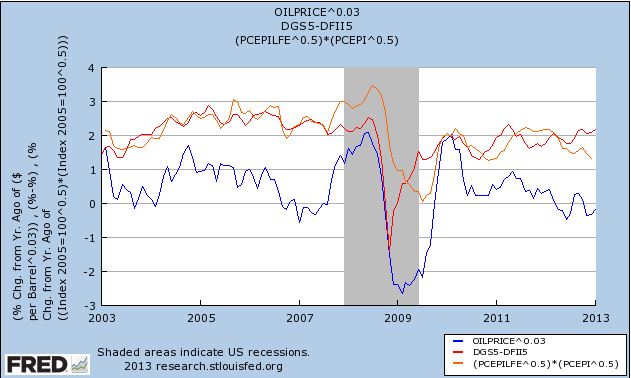
[Here is the chart to which Waldmann refers.]

angry_bear

(legend here red is the 5 year TIPS breakeven or expected inflation, Blue is the change over the *past* year of the price of a barrel of oil times 0.1 plus 1.6, green is the geometric mean of the change over the *past year* of the personal consumption deflator and the personal consumption minus food and energy deflator.

Again, I don’t think formal statistical modeling is the issue here, because the data are neither sufficient in quantity nor unambiguous in their interpretation. The data are what they are, and if we cannot parse out what has been caused by OPEC and what has been caused by the Fed, we have to accept the ambiguity and not pretend that it doesn’t exist just so to impose an identifying assumption. I would also make what I would have thought is an obvious observation that since 2007 the causality between the price of oil and the state of the economy has been going in both directions, and any statistical model that takes the price of oil as exogenous is incredible.

I don’t see how anyone could look at this graph and then claim we can identify monetary policy by the TIPS breakeven.  That is only valid if nothing but monetary policy affects inflation expectations.

I don’t understand that. Why, if monetary policy accounts for 50% of the variation in inflation expectations is it not valid to use the TIPS spread to identify monetary policy? We may have to make some plausible assumptions about when there were supply-side disturbances or add some instrumental variables, but I don’t see why we would want to ignore monetary policy just because factors other than monetary policy may be affecting inflation expectations.

Similarly in 1933 monetary policy wasn’t the only thing that changed.  I understand that there was considerable policy reform in the so called “first hundred days.  ” The idea that we can identify the effect of monetary policy by looking at the USA in 1933 is based on the assumption that Roosevelt did nothing else.  This is not reasonable.

Sure he did other things, but you can’t seriously mean that government spending increased in the first 100 days by an amount sufficient to account for the explosion in output from April to July. I would concede that other things that Roosevelt did may have also helped restore confidence, but I don’t see how you can deny that the devaluation of the dollar was at or near the top of the list of economic actions taken in the first 4 months of his Presidency.

But I think we can detect the effect of recent monetary policy on TIPS breakevens if we agree that it (including QE) is working principally through forward guidance.  There should be quick effects on asset prices when surprising shifts are announced.  QE 4 (December 2012) was definitely a surprise.  The TIPS spread barely moved (within the range of normal fluctuations).  I think the question is settled.  I do not think it is optimal to ignore daily data when you have it and treat same quarter as the same instant.  Some prices are sticky and some aren’t.  Bond prices aren’t.

What makes you so sure that QE4 was a surprise. I think that there was considerable disappointment that there was no increase in the inflation target, just a willingness to accept some slight amount of overshooting (2.5%) before applying the brakes as long as unemployment remains over 6.5%. Ambiguity reins supreme.

My Paper (co-authored with Paul Zimmerman) on Hayek and Sraffa

I have just uploaded to the SSRN website a new draft of the paper (co-authored with Paul Zimmerman) on Hayek and Sraffa and the natural rate of interest, presented last June at the History of Economics Society conference at Brock University. The paper evolved from an early post on this blog in September 2011. I also wrote about the Hayek-Sraffa controversy in a post in June 2012 just after the HES conference.

One interesting wrinkle that occurred to me just as I was making revisions in the paper this week is that Keynes’s treatment of own rates in chapter 17 of the General Theory, which was in an important sense inspired by Sraffa, but, in my view, came to a very different conclusion from Sraffa’s, was actually nothing more than a generalization of Irving Fisher’s analysis of the real and nominal rates of interest, first presented in Fisher’s 1896 book Appreciation and Interest. In his Tract on Monetary Reform, Keynes extended Fisher’s analysis into his theory of covered interest rate arbitrage. What is really surprising is that, despite his reliance on Fisher’s analysis in the Tract and also in the Treatise on Money, Keynes sharply criticized Fisher’s analysis of the nominal and real rates of interest in chapter 13 of the General Theory. (I discussed that difficult passage in the General Theory in this post).  That is certainly surprising. But what is astonishing to me is that, after trashing Fisher in chapter 13 of the GT, Keynes goes back to Fisher in chapter 17, giving a generalized restatement of Fisher’s analysis in his discussion of own rates. Am I the first person to have noticed Keynes’s schizophrenic treatment of Fisher in the General Theory?

PS: My revered teacher, the great Armen Alchian passed away yesterday at the age of 98. There have been many tributes to him, such as this one by David Henderson, also a student of Alchian’s, in the Wall Street Journal. I have written about Alchian in the past (here, here, here, here, and here), and I hope to write about Alchian again in the near future. There was none like him; he will be missed terribly.

Robert Waldmann, WADR, Maybe You Really Should Calm Down

Responding to this recent post of mine, Robert Waldmann wrote a post of his own with a title alluding to an earlier post of mine responding to a previous post of his. Just to recapitulate briefly, the point of the post which seems to have provoked Professor Waldmann was to refute the allegation that the Fed and the Bank of Japan are starting a currency war by following a policy of monetary ease in which they are raising (at least temporarily) their inflation target. I focused my attention on a piece written by Irwin Stelzer for the Weekly Standard, entitled not so coincidentally, “Currency Wars.” I also went on to point out that Stelzer, in warning of the supposedly dire consequences of starting a currency war, very misleadingly suggested that Hitler’s rise to power was the result of an inflationary policy followed by Germany in the 1930s.

Here is how Waldmann responds:

I do not find any reference to the zero lower bound in this post.  Your analysis of monetary expansion does not distinguish between the cases when the ZLB holds and when it doesn’t.  You assume that the effect of an expansion of the money supply on domestic demand can be analyzed ignoring that detail. I think it is clear that the association between the money supply and domestic demand has been different in the USA since oh September 2008 than it was before.  This doesn’t seem to me to be a detail which can be entirely overlooked in any discussion of current policy.

Actually, I don’t think that, in principle, I disagree with any of this. I agree that the zero lower bound is relevant to the analysis of the current situation. I prefer to couch the analysis in terms of the Fisher equation making use of the equilibrium condition that the nominal rate of interest must equal the real rate plus expected inflation. If the expected rate of deflation is greater than the real rate, equilibrium is impossible and the result is a crash of asset prices, which is what happened in 2008. But as long as the real rate of interest is negative (presumably because of pessimistic entrepreneurial expectations), the rate of inflation has to be sufficiently above real rate of interest for nominal rates to be comfortably above zero. As long as nominal rates are close to zero and real rates are negative, the economy cannot be operating in the neighborhood of full-employment equilibrium. I developed the basic theory in my paper “The Fisher Effect Under Deflationary Expectations” available on SSRN, and provided some empirical evidence (which I am hoping to update soon) that asset prices (as reflected in the S&P 500) since 2008 have been strongly correlated with expected inflation (as approximated by the TIPS spread) even though there is no strong theoretical reason for asset prices to be correlated with expected inflation, and no evidence of correlation before 2008. Although I think that this is a better way than the Keynesian model to think about why the US economy has been underperforming so badly since 2008, I don’t think that the models are contradictory or inconsistent, so I don’t deny that fiscal policy could have some stimulative effect. But apparently that is not good enough for Professor Waldmann.

Also, I note that prior to his [Stelzer’s] “jejune dismissal of monetary policy,” Stelzer jenunely dismissed fiscal policy.  You don’t mention this at all.  Your omission is striking, since the evidence that Stelzer is wrong to dismiss fiscal policy is overwhelming (not overwhelming enough to overwhelm John Taylor but then mere evidence couldn’t do that).  In contrast, the dismissal of monetary policy when an economy is in a liquidity trap is consistent with the available evidence.

It seems to me that Waldmann is being a tad oversensitive. Stelzer’s line was “stimulus packages don’t work very well, and monetary policy produces lots of fiat money but not very many jobs.” What was jejune was not the conclusion that fiscal policy and monetary policy aren’t effective; it was his formulation that monetary expansion produces lots of fiat money but not many jobs, a formulation which, I believe, was intended to be clever, but struck me as being not clever, but, well, jejune. So I did not mean to deny that fiscal policy could be effective at the zero lower bound, but I disagree that the available evidence is consistent with the proposition that monetary policy is ineffective in a liquidity trap. In 1933, for example, monetary policy triggered the fastest economic expansion in US history, when FDR devalued the dollar shortly after taking office, an expansion unfortunately prematurely terminated by the enactment of FDR’s misguided National Industrial Recovery Act. The strong correlation between inflation expectations and stock prices since 2008, it seems to me, also qualifies as evidence that monetary policy is not ineffective at the zero lower bound. But if Professor Waldmann has a different interpretation of the significance of that correlation, I would be very interested in hearing about it.

Instead of looking at the relationship between inflation expectations and stock prices, Waldmann wants to look at the relationship between job growth and monetary policy:

I hereby challenge you to show data on US “growth”  meaning (I agree with your guess) mostly employment growth since 2007 to someone unfamiliar with the debate and ask that person to find the dates of shifts in monetary policy.  I am willing to bet actual money (not much I don’t have much) that the person will not pick out QEIII or operation twist.    I also guess that this person will not detect forward guidance looking at day to day changes in asset prices.

I claim that the null that nothing special happened the day QEIV was announced or any of the 4 plausible dates of announcement of QE2 (starting with a FOMC meeting, then Bernanke’s Jackson Hole speech then 2 more) can’t be rejected by the data. This is based on analysis by two SF FED economists who look at the sum of changes over three of the days (not including the Jackson Hole day when the sign was wrong) and get a change (of the sign they want) whose square is less than 6 times the variance of daily changes (of the 10 year rate IIRC).  IIRC 4.5 times.  Cherry picking and not rejecting the null one wants to reject is a sign that one’s favored (alternative) hypothesis is not strongly supported by the data.

I think that the way to pick out changes in monetary policy is to look at changes in inflation expectations, and I think that you can find some correlation between changes in monetary policy, so identified, and employment, though it is probably not nearly as striking as the relationship between asset prices and inflation expectations. I also don’t think that operation twist had any positive effect, but QE3 does seem to have had some. I am not familiar with the study by the San Francisco Fed economists, but I will try to find it and see what I can make out of it. In the meantime, even if Waldmann is correct about the relationship between monetary policy and employment since 2008, there are all kinds of good reasons for not rushing to reject a null hypothesis on the basis of a handful of ambiguous observations. That wouldn’t necessarily be the calm and reasonable thing to do.

John Taylor, Post-Modern Monetary Theorist

In the beginning, there was Keynesian economics; then came Post-Keynesian economics.  After Post-Keynesian economics, came Modern Monetary Theory.  And now it seems, John Taylor has discovered Post-Modern Monetary Theory.

What, you may be asking yourself, is Post-Modern Monetary Theory all about? Great question!  In a recent post, Scott Sumner tried to deconstruct Taylor’s position, and found himself unable to determine just what it is that Taylor wants in the way of monetary policy.  How post-modern can you get?

Taylor is annoyed that the Fed is keeping interest rates too low by a policy of forward guidance, i.e., promising to keep short-term interest rates close to zero for an extended period while buying Treasuries to support that policy.

And yet—unlike its actions taken during the panic—the Fed’s policies have been accompanied by disappointing outcomes. While the Fed points to external causes, it ignores the possibility that its own policy has been a factor.

At this point, the alert reader is surely anticipating an explanation of why forward guidance aimed at reducing the entire term structure of interest rates, thereby increasing aggregate demand, has failed to do so, notwithstanding the teachings of both Keynesian and non-Keynesian monetary theory.  Here is Taylor’s answer:

At the very least, the policy creates a great deal of uncertainty. People recognize that the Fed will eventually have to reverse course. When the economy begins to heat up, the Fed will have to sell the assets it has been purchasing to prevent inflation.

Taylor seems to be suggesting that, despite low interest rates, the public is not willing to spend because of increased uncertainty.  But why wasn’t the public spending more in the first place, before all that nasty forward guidance?  Could it possibly have had something to do with business pessimism about demand and household pessimism about employment?  If the problem stems from an underlying state of pessimistic expectations about the future, the question arises whether Taylor considers such pessimism to be an element of, or related to, uncertainty?

I don’t know the answer, but Taylor posits that the public is assuming that the Fed’s policy will have to be reversed at some point. Why? Because the economy will “heat up.” As an economic term, the verb “to heat up” is pretty vague, but it seems to connote, at the very least, increased spending and employment. Which raises a further question: given a state of pessimistic expectations about future demand and employment, does a policy that, by assumption, increases the likelihood of additional spending and employment create uncertainty or diminish it?

It turns out that Taylor has other arguments for the ineffectiveness of forward guidance.  We can safely ignore his two throw-away arguments about on-again off-again asset purchases, and the tendency of other central banks to follow Fed policy.  A more interesting reason is provided when Taylor compares Fed policy to a regulatory price ceiling.

[I]f investors are told by the Fed that the short-term rate is going to be close to zero in the future, then they will bid down the yield on the long-term bond. The forward guidance keeps the long-term rate low and tends to prevent it from rising. Effectively the Fed is imposing an interest-rate ceiling on the longer-term market by saying it will keep the short rate unusually low.

The perverse effect comes when this ceiling is below what would be the equilibrium between borrowers and lenders who normally participate in that market. While borrowers might like a near-zero rate, there is little incentive for lenders to extend credit at that rate.

This is much like the effect of a price ceiling in a rental market where landlords reduce the supply of rental housing. Here lenders supply less credit at the lower rate. The decline in credit availability reduces aggregate demand, which tends to increase unemployment, a classic unintended consequence of the policy.

When economists talk about a price ceiling what they usually mean is that there is some legal prohibition on transactions between willing parties at a price above a specified legal maximum price.  If the prohibition is enforced, as are, for example, rent ceilings in New York City, some people trying to rent apartments will be unable to do so, even though they are willing to pay as much, or more, than others are paying for comparable apartments.  The only rates that the Fed is targeting, directly or indirectly, are those on US Treasuries at various maturities.  All other interest rates in the economy are what they are because, given the overall state of expectations, transactors are voluntarily agreeing to the terms reflected in those rates.  For any given class of financial instruments, everyone willing to purchase or sell those instruments at the going rate is able to do so.  For Professor Taylor to analogize this state of affairs to a price ceiling is not only novel, it  is thoroughly post-modern.

Charles Goodhart on Nominal GDP Targeting

Charles Goodhart might just be the best all-around monetary economist in the world, having made impressive contributions to both monetary theory and the history of monetary theory, to monetary history, and the history of monetary institutions, especially of central banking, and to the theory and, in his capacity as chief economist of the Bank of England, practice of monetary policy. So whenever Goodhart offers his views on monetary policy, it is a good idea to pay close attention to what he says. But if there is anything to be learned from the history of economics (and I daresay the history of any scientific discipline), it is that nobody ever gets it right all the time. It’s nice to have a reputation, but sadly reputation provides no protection from error.

In response to the recent buzz about targeting nominal GDP, Goodhart, emeritus professor at the London School of Economics and an adviser to Morgan Stanley along with two Morgan Stanley economists, Jonathan Ashworth and Melanie Baker, just published a critique of a recent speech by Mark Carney, Governor-elect of the Bank of England, in which Carney seemed to endorse targeting the level of nominal GDP (hereinafter NGDPLT). (See also Marcus Nunes’s excellent post about Goodhart et al.) Goodhart et al. have two basic complaints about NGDPLT. The first one is that our choice of an initial target level (i.e., do we think that current NGDP is now at its target or away from its target and if so by how much) and of the prescribed growth in the target level over time would itself create destabilizing uncertainty in the process of changing to an NGDPLT monetary regime. The key distinction between a level target and a growth-rate target is that the former requires a subsequent compensatory adjustment for any deviation from the target while the latter requires no such adjustment for a deviation from the target. Because deviations will occur under any targeting regime, Goodhart et al. worry that the compensatory adjustments required by NGDPLT could trigger destabilizing gyrations in NGDP growth, especially if expectations, as they think likely, became unanchored.

This concern seems easily enough handled if the monetary authority is given say a 1-1.5% band around its actual target within which to operate. Inevitable variations around the target would not automatically require an immediate rapid compensatory adjustment. As long as the monetary authority remained tolerably close to its target, it would not be compelled to make a sharp policy adjustment. A good driver does not always drive down the middle of his side of the road, the driver uses all the space available to avoid having to make an abrupt changes in the direction in which the car is headed. The same principle would govern the decisions of a skillful monetary authority.

Another concern of Goodhart et al. is that the choice of the target growth rate of NGDP depends on how much real growth,we think the economy is capable of. If real growth of 3% a year is possible, then the corresponding NGDP level target depends on how much inflation policy makers believe necessary to achieve that real GDP growth rate. If the “correct” rate of inflation is about 2%, then the targeted level of NGDP should grow at 5% a year. But Goodhart et al. are worried that achievable growth may be declining. If so, NGDPLT at 5% a year will imply more than 2% annual inflation.

Effectively, any overestimation of the sustainable real rate of growth, and such overestimation is all too likely, could force an MPC [monetary policy committee], subject to a level nominal GDP target, to soon have to aim for a significantly higher rate of inflation. Is that really what is now wanted? Bring back the stagflation of the 1970s; all is forgiven?

With all due respect, I find this concern greatly overblown. Even if the expectation of 3% real growth is wildly optimistic, say 2% too high, a 5% NGDP growth path would imply only 4% inflation. That might be too high a rate for Goodhart’s taste, or mine for that matter, but it would be a far cry from the 1970s, when inflation was often in the double-digits. Paul Volcker achieved legendary status in the annals of central banking by bringing the US rate of inflation down to 3.5 to 4%, so one needs to maintain some sense of proportion in these discussions.

Finally, Goodhart et al. invoke the Phillips Curve.

[A]n NGDP target would appear to run counter to the previously accepted tenets of monetary theory. Perhaps the main claim of monetary economics, as persistently argued by Friedman, and the main reason for having an independent Central Bank, is that over the medium and longer term monetary forces influence only monetary variables. Other real (e.g. supply-side) factors determine growth; the long-run Phillips curve is vertical. Do those advocating a nominal GDP target now deny that? Do they really believe that faster inflation now will generate a faster, sustainable, medium- and longer-term growth rate?

While it is certainly undeniable that Friedman showed, as, in truth, many others had before him, that, for an economy in approximate full-employment equilibrium, increased inflation cannot permanently reduce unemployment, it is far from obvious (to indulge in bit of British understatement) that we are now in a state of full-employment equilibrium. If the economy is not now in full-employment equilibrium, the idea that monetary-neutrality propositions about money influencing only monetary, but not real, variables in the medium and longer term are of no relevance to policy. Those advocating a nominal GDP target need not deny that the long-run Phillips Curve is vertical, though, as I have argued previously (here, here, and here) the proposition that the long-run Phillips Curve is vertical is very far from being the natural law that Goodhart and many others seem to regard it as. And if Goodhart et al. believe that we in fact are in a state of full-employment equilibrium, then they ought to say so forthrightly, and they ought to make an argument to justify that far from obvious characterization of the current state of affairs.

Having said all that, I do have some sympathy with the following point made by Goodhart et al.

Given our uncertainty about sustainable growth, an NGDP target also has the obvious disadvantage that future certainty about inflation becomes much less than under an inflation (or price level) target. In order to estimate medium- and longer-term inflation rates, one has first to take some view about the likely sustainable trends in future real output. The latter is very difficult to do at the best of times, and the present is not the best of times. So shifting from an inflation to a nominal GDP growth target is likely to have the effect of raising uncertainty about future inflation and weakening the anchoring effect on expectations of the inflation target.

That is one reason why in my book Free Banking and Monetary Reform, I advocated Earl Thompson’s proposal for a labor standard aimed at stabilizing average wages (or, more precisely, average expected wages). But if you stabilize wages, and productivity is falling, then prices must rise. That’s just a matter of arithmetic. But there is no reason why the macroeconomically optimal rate of inflation should be invariant with respect to the rate of technological progress.

HT:  Bill Woolsey

Maybe Robert Waldmann Should Calm Down

Robert Waldmann is unhappy with Matthew Yglesias for being hopeful that, Shinzo Abe, just elected prime minister of Japan, may be about to make an important contribution to the world economy, and to economic science, by prodding the Bank of Japan to increase its inflation target and by insisting that the BOJ actually hit the new target. Since I don’t regularly read Waldmann’s blog (not because it’s not worth reading — I usually enjoy reading it when I get to it – I just can’t keep up with that many blogs), I’m not sure why Waldmann finds Yglesias’s piece so annoying. OK, Waldmann’s a Keynesian and prefers fiscal to monetary policy, but so is Paul Krugman, and he thinks that monetary policy can be effective even at the zero lower bound. At any rate this is how Waldmann responds to Yglesias:

Ben Bernanke too has declared a policy of unlimited quantitative easing and increased inflation (new target only 2.5% but that’s higher than current inflation).  The declaration (which was a surprise) had essentially no effect on prices for medium term treasuries, TIPS or the breakeven.

I was wondering when you would comment, since you have confidently asserted again and again that if only the FOMC did what it just did, expected inflation would jump and then GDP growth would increase.

However, instead of noting the utter total failure of your past predictions (and the perfect confirmation of mine) you just boldly make new predictions.

Face fact,  like conventional monetary policy (in the US the Federal Funds rate) forward guidance is pedal to the metal.   It’s long past time for you to start climbing down.

I mention this, because just yesterday I happened across another blog post about what Bernanke said after the FOMC meeting.  This post by David Altig, executive VP and research director of the Atlanta Fed, was on the macroblog. Altig points out that, despite the increase in the Fed’s inflation threshold from 2 to 2.5%, the Fed increased neither its inflation target (still 2%) nor its inflation forecast (still under 2%). All that the Fed did was to say that it won’t immediately slam on the brakes if inflation rises above 2% provided that unemployment is greater than 6.5% and inflation is less than 2.5%. That seems like a pretty marginal change in policy to me.

Also have a look at this post from earlier today by Yglesias, showing that the Japanese stock market has risen about 5.5% in the last two weeks, and about 2% in the two days since Abe’s election. Here is Yglesias’s chart showing the rise of the Nikkei over the past two weeks.

abe-nomics

In addition, here is a news story from Bloomberg about rising yields on Japanese government bonds, which are now the highest since April.

Japan‘s bonds declined, sending 20- year yields to an eight-month high, as demand ebbed at a sale of the securities and domestic shares climbed.

The sale of 1.2 trillion yen ($14.3 billion) of 20-year bonds had the lowest demand in four months. Yields on the benchmark 10-year note rose to a one-month high as Japan’s Nikkei 225 Stock Average reached the most since April amid signs U.S. budget talks are progressing.

Finally, another item from Yglesias, a nice little graph showing the continuing close relationship between the S&P 500 and inflation expectations as approximated by the breakeven TIPS spread on 10-year Treasuries, a relationship for which I have provided (in a paper available here) a theoretical explanation as well as statistical evidence that the relationship did not begin to be observed until approximately the spring of 2008 as the US economy, even before the Lehman debacle, began its steep contraction. Here’s the graph.

yglesias_S&P500

HT: Mark Thoma

UPDATE:  Added a link above to the blog post by Altig about what Bernanke meant when he announced a 2.5% inflation threshold.

The Prodigal Son Returns: The Wall Street Journal Editorial Page Rediscovers Root Canal Economics

Perhaps the most interesting and influential financial journalist of the 1970s was a guy by the name of Jude Wanniski, who was an editorial writer for Wall Street Journal, from 1972 to 1978. In the wake of the Watergate scandal, and the devastating losses suffered by the Republicans in the 1974 Congressional elections, many people thought that the Republican party might not survive. The GOP certainly did not seem to offer much hope for free-market conservatives and libertarians, Richard Nixon having imposed wage-and-price controls in 1971, with the help of John Connally and Arthur Burns and enthusiastic backing from almost all Republicans. After Nixon resigned, leadership of the party was transferred to his successor, Gerald Ford, a very nice and decent fellow, whose lack of ideological conviction was symbolized by his choice of Nelson Rockefeller, an interventionist, big-government Republican if there ever was one, to serve as his Vice-President.

In this very dispirited environment for conservatives, Jude Wanniski’s editorial pieces in the Wall Street Journal and his remarkable 1978 book The Way the World Works, in which he advocated cuts in income tax rates as a cure for economic stagnation, proved to be an elixir of life for demoralized Republicans and conservatives. Wanniski was especially hard on old-fashioned Republicans and conservatives for whom balancing the federal budget had become the be all and end of all of economic policy, a doctrine that the Wall Street Journal itself had once espoused. A gifted phrase maker, Wanniski dubbed traditional Republican balanced-budget policy, root-canal economics. Instead, Wanniski adopted the across-the-board income tax cuts proposed by John Kennedy in 1963, a proposal that conservative icon Barry Goldwater had steadfastly opposed, as his model for economic policy.

Wanniski quickly won over a rising star in the Republican party, former NFL quarterback Jack Kemp, to his way of thinking.  Another acolyte was an ambitious young Georgian by the name of Newt Gingrich. In 1978, Kemp and Senator Bill Roth form Delaware (after whom the Roth IRA is named), co-authored a bill, without support from the Republican Congressional leadership, to cut income taxes across the board by 25%. Many Republicans running for Congress and the Senate in 1978 pledged to support what became known as the Kemp-Roth bill. An unexpectedly strong showing by Republicans supporting the Kemp-Roth bill in the 1978 elections encouraged Jack Kemp to consider running for President in 1980 on a platform of across-the-board tax cuts. However, when Ronald Reagan, nearly 70 years old, and widely thought, after unsuccessfully challenging Gerald Ford for the GOP nomination in 1976, to be past his prime, signed on as a supporter of the Kemp-Roth bill, Kemp bowed out of contention, endorsing Reagan for the nomination, and uniting conservatives behind the Gipper.

After his landslide victory in the 1980 election, Reagan, riding a crest of popularity, enhanced by an unsuccessful assassination attempt in the first few months of his term, was able to push the Kemp-Roth bill through Congress, despite warnings from the Democrats that steep tax cuts would cause large budget deficits. To such warnings, Jack Kemp famously responded that Republicans no longer worshiped at the altar of a balanced budget. No one cheered louder for that heretical statement by Kemp than, you guessed it, the Wall Street Journal editorial page.

Fast forward to 2012, the Wall Street Journal, which never fails to invoke the memory of Ronald Reagan whenever an opportunity arises, nevertheless seems to have rediscovered the charms of root-canal economics. How else can one explain this piece of sophistry from Robert L. Pollock, a member of the group of sages otherwise known as the Editorial Board of the Wall Street Journal? Consider what Mr. Pollock had to say in an opinion piece on the Journal‘s website.

[T]o the extent that the United States finds itself in a precarious fiscal situation, Federal Reserve Chairman Ben Bernanke shares much of the blame. Simply put, there is no way that Washington could have run the deficits it has in recent years without the active assistance of a near-zero interest rate policy. . . .

European governments finally decided to take cost-cutting steps when their borrowing costs went up. But Democrats and liberal economists use Mr. Bernanke’s low rates and willingness to buy government bonds as evidence that there’s no pressing problem here to be addressed.

This is a strange argument for high interest rates, especially coming from a self-avowed conservative. Conservatives got all bent out of shape when Obama’s Energy Secretary, Stephen Chu, opined that rising gasoline prices might actually serve a useful function by inducing consumers and businesses to be more economical in their their use of gasoline. That comment was seized on by Republicans as proof that the Obama administration was seeking to increase gasoline prices as a way of reducing gasoline consumption. Now, Mr. Pollock provides us with a new argument for high interest rates: by raising the cost of borrowing, high interest rates will force the government to be more economical in its spending decisions.  Evidently, it’s wrong to suggest that an increased price will reduce gasoline consumption, but it’s fine to say that an increased interest rate will cut government spending. Go figure.

Well, here’s what Wanniski had to say about the Republican obsession with reducing government spending for its own sake:

It isn’t that Republicans don’t enjoy cutting taxes. They love it. But there is something in the Republican chemistry that causes the GOP to become hypnotized by the prospect of an imbalanced budget. Static analysis tells them taxes can’t be cut or inflation will result. They either argue for a tax hike to dampen inflation when the economy is in a boom or demand spending cuts to balance the budget when the economy is in recession.

Either way, of course, they embrace the role of Scrooge, playing into the hands of the Democrats, who know the first rule of successful politics is Never Shoot Santa Claus. The political tension in the market place of ideas must be between tax reduction and spending increases, and as long as Republicans have insisted on balanced budgets, their influence as a party has shriveled, and budgets have been imbalanced.

How’s that old root-canal economics working out for ya?

Now back to Pollock. Here’s how he explains why low interest rates may not really be helping the economy.

It would be one thing if there were widespread agreement that low rates are the right medicine for the economy. But easy money on the Bernanke scale is a heretofore untested policy, one for which the past few years of meager growth haven’t provided convincing evidence.

Fair enough. Low rates haven’t been helping the economy all that much. But the question arises: why are rates so low? Is it really all the Fed’s doing, or could it possibly have something to do with pessimism on the part of businesses and consumers about whether they will be able to sell their products or their services in the future? If it is the latter, then low interest rates may not be a symptom of easy money, but of tight money.

Pollock, of course, has a different explanation for why low interest rates are not promoting a recovery.

Economists such as David Malpass argue that low rates are actually contractionary because they cause capital to be diverted from more productive uses to less productive ones.

Oh my. What can one say about an argument like that? I have encountered Mr. Malpass before and was less than impressed by his powers of economic reasoning; I remain unimpressed. How can a low interest rate divert capital from more productive uses to less productive ones unless capital rationing is taking place? If some potential borrowers were unable to secure funding for their productive projects while other borrowers with less productive projects were able to get funding for theirs, the disappointed borrowers could have offered to borrow at increased interest rates, thereby outbidding borrowers with unproductive projects, and driving up interest rates in the process.   That is just elementary.  That interest rates are now at such low levels is more reflective of the pessimism of most potential borrowers about the projects for which they seeking funding, than of the supposed power of the Fed to determine interest rates.

So there you have it. The Wall Street Journal editorial page, transformed in the 1970s by the daring and unorthodox ideas of a single, charismatic economic journalist, Jude Wanniski, has now, almost four decades later, finally come back to its roots.  Welcome home where you belong.


About Me

David Glasner
Washington, DC

I am an economist in the Washington DC area. My research and writing has been mostly on monetary economics and policy and the history of economics. In my book Free Banking and Monetary Reform, I argued for a non-Monetarist non-Keynesian approach to monetary policy, based on a theory of a competitive supply of money. Over the years, I have become increasingly impressed by the similarities between my approach and that of R. G. Hawtrey and hope to bring Hawtrey’s unduly neglected contributions to the attention of a wider audience.

My new book Studies in the History of Monetary Theory: Controversies and Clarifications has been published by Palgrave Macmillan

Follow me on Twitter @david_glasner

Archives

Enter your email address to follow this blog and receive notifications of new posts by email.

Join 665 other subscribers
Follow Uneasy Money on WordPress.com