Archive for the 'inflation' Category


Negotiating the Fiscal Cliff

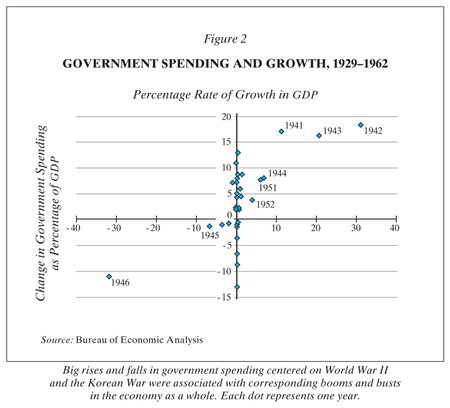
Last week I did a post based on a chart that I saw in an article in the New York Review of Books by Paul Krugman. Relying on an earlier paper by Robert Hall on the empirical evidence about the effectiveness of fiscal stimulus, Krugman used the chart to illustrate the efficacy of government spending as a stimulus to economic recovery. While Krugman evidently thought his chart was a pretty compelling visual aid in showing that fiscal stimulus really works, I didn’t find his chart that impressive, because there were relatively few years in which changes in government spending were clearly associated with large changes in growth, and a lot of years with large changes in growth, but little or no change in government spending.

In particular, the years in which government spending seemed to make a big difference were during and immediately after World War II. The 1930s, however, were associated with huge swings in GDP, but with comparatively minimal changes in government spending. Instead, changes in GDP in the 1930s were associated with big changes in the price level. The big increases in GDP in the early 1940s were also associated with big increases in the price level, the rapid rise in the price level slowing down only in 1943 after price controls were imposed in 1942. When controls were gradually lifted in 1946 and 1947, inflation increased sharply notwithstanding a sharp economic contraction, creating a spurious (in my view) negative correlation between (measured) inflation and the change in GDP. From 1943 to mid-1945, properly measured inflation was increasing much faster than official indices that made no adjustment for the shortages and quality degradation caused by the price controls. Similarly, the measured inflation from late 1945 through 1947, when price controls were being gradually relaxed and dismantled, overstated actual inflation, because increases in official prices were associated with the elimination of shortages and improving quality.

So in my previous post, I tried to do a quantitative analysis of the data underlying Krugman’s chart. Unfortunately, I only came up with a very rough approximation of his data. Using my rough approximation (constructing a chart resembling, but clearly different from, Krugman’s), I ran a regression estimating the statistical relationship between yearly changes in military spending (Krugman’s statistical instrument for fiscal stimulus) as a percentage of GDP and yearly changes in real GDP from 1929 to 1962. I then compared that statistical relationship to the one between annual changes in the price level and annual changes in real GDP over the same time period. After controlling for the mismeasurement of inflation in 1946 and 1947, I found that changes in the rate of inflation were more closely correlated to changes in real GDP over the 1929-1962 time period than were changes in military spending and changes in real GDP. Unfortunately, I also claimed (mistakenly)  that that regressing changes in real GDP on both changes in military spending and inflation (again controlling for mismeasurement of inflation in 1946-47) did not improve the statistical fit of the regression, and did not show a statistically significant coefficient for the military-spending term. That claim was based on looking at the wrong regression estimates.  Sorry, I blew that one.

Over the weekend, Mark Sadowski kindly explained to me how Krugman did the calculations underlying his chart, even generating the data for me, thereby allowing me to reconstruct Krugman’s chart and to redo my earlier regressions using the exact data. Here are the old and the new results.

OLD: dGDP = 3.60 + .70dG, r-squared = .295

NEW: dGDP = 3.26 + .51dG, r-squared = .433

So, according to the correct data set, the relationship between changes in government spending and changes in GDP is closer than the approximated data set that I used previously. However, the newly estimated coefficient on the government spending term is almost 30% smaller than the coefficient previously estimated using the approximated data set. In other words a one dollar increase in government spending generates an increase in GDP of only 50 cents. Increasing government spending reduces private spending by about half.

The estimated regression for changes in real GDP on inflation changed only slightly:

OLD: dGDP = 2.48 + .69dP, r-squared = .199

NEW: dGDP = 2.46 + .70dP, r-squared = .193

The estimated regression for changes in real GDP on inflation (controlled for mismeasurement of inflation in 1946 and 1947) also showed only a slight change:

OLD: dGDP = 2.76 + 1.28dP – 23.29PCON, r-squared = .621

NEW: dGDP = 3.02 + 1.25dP – 23.13PCON, r-squared = .613

Here are my old and new regressions for changes in real GDP on government spending as well as on inflation (controlled for mismeasurement of inflation in 1946-47). As you can see, the statistical fit of the regression improves by including both inflation and the change in government spending as variables (the adjusted r-squared is .648) and the coefficient on the government-spending term is positive and significant (t = 2.37). When I re-estimated the regression on Krugman’s data set, the statistical fit improved, and the coefficient on the government-spending variable remained positive and statistically significant (t = 3.45), but was about a third smaller than the coefficient estimated from the approximated data set.

OLD: dGDP = 2.27 + .49dG + 1.15dP – 13.36PCON, r-squared = .681

NEW: dGDP = 2.56 + .33dG + 1.00dP – 13.14PCON, r-squared = .728

So even if we allow for the effect of inflation on changes in output, and contrary to what I suggested in my previous post, changes in government spending were indeed positively and significantly correlated with changes in real GDP, implying that government spending may have some stimulative effect even apart from the effect of monetary policy on inflation. Moreover, insofar as government spending affects inflation, attributing price-level changes exclusively to monetary policy may underestimate the stimulative effect of government spending. However, if one wants to administer stimulus to the private sector rather than increase the size of the public sector at the expense of the private sector (the implication of a coefficient less than one on the government-spending term in the regression), there is reason to prefer monetary policy as a method of providing stimulus.

The above, aside from the acknowledment of Mark Sadowski’s assistance and the mea culpa for negligence in reporting my earlier results, is all by way of introduction to a comment on a recent post by my internet buddy Lars Christensen on his Market Moneterist blog in which he welcomes the looming fiscal cliff. Here’s how Lars puts it:

The point is that the US government is running clearly excessive public deficits and the public debt has grown far too large so isn’t fiscal tightening exactly what you need? I think it and the fiscal cliff ensures that. Yes, I agree tax hikes are unfortunate from a supply side perspective, but cool down a bit – it is going to have only a marginally negative impact on long-term US growth perspective that the Bush tax cuts experiences. But more importantly the fiscal cliff would mean cuts in US defense spending. The US is spending more on military hardware than any other country in the world. It seems to me like US policy makers have not realized that the Cold War is over. You don’t need to spend 5% of GDP on bombs. In fact I believe that if the entire 4-5% fiscal consolidation was done as cuts to US defence spending the world would probably be a better place. But that is not my choice – and it is the peace loving libertarian rather than the economist speaking (here is a humorous take on the sad story of war). What I am saying is that the world is not coming to an end if the US defense budget is cut marginally. Paradoxically the US conservatives this time around are against budget consolidation. Sad, but true.

I am not going to take the bait and argue with Lars about the size of the US defense budget. The only issue that I want to consider is what would happen as a result of the combination of a large cut in defense (and in other categories of) spending and an increase in taxes? It might not be catastrophic, but there seems to me to be a non-negligible risk that such an outcome would have a significant contractionary effect on aggregate demand at a time when the recovery is still anemic and requires as much stimulus as it can get. Lars argues that any contractionary effect caused by reduced government spending and increased taxes could be offset by sufficient monetary easing. I agree in theory, but in practice there are just too many uncertainties associated with how massive fiscal tightening would be received by public and private decision makers to rely on the theoretical ability of monetary policy in one direction to counteract fiscal policy in the opposite direction. This would be the case even if we knew that Bernanke and the FOMC would do the right thing. But, despite encouraging statements by Bernanke and other Fed officials since September, it seems more than a bit risky at this time and this place to just assume that the Fed will become the stimulator of last resort.

So, Lars, my advice to you is: be careful what you wish for.

PS Noah Smith has an excellent post about inflation today.
Paul Krugman on Fiscal Stimulus 1929-1962

UPDATE:  See my correction of an error in the penultimate paragraph.

Last week I read an article Paul Krugman published several months ago for the New York Review of Books just before his book End This Depression Now came out. The article was aimed not aimed at an audience of professional economists, and consisted of arguments that Krugman has been making regularly since the onset of the crisis just over four years ago. However, the following passage towards the end of the article caught my eye.

[S]ince the crisis began there has been a boom in research into the effects of fiscal policy on output and employment. This body of research is growing fast, and much of it is too technical to be summarized in this article. But here are a few highlights.

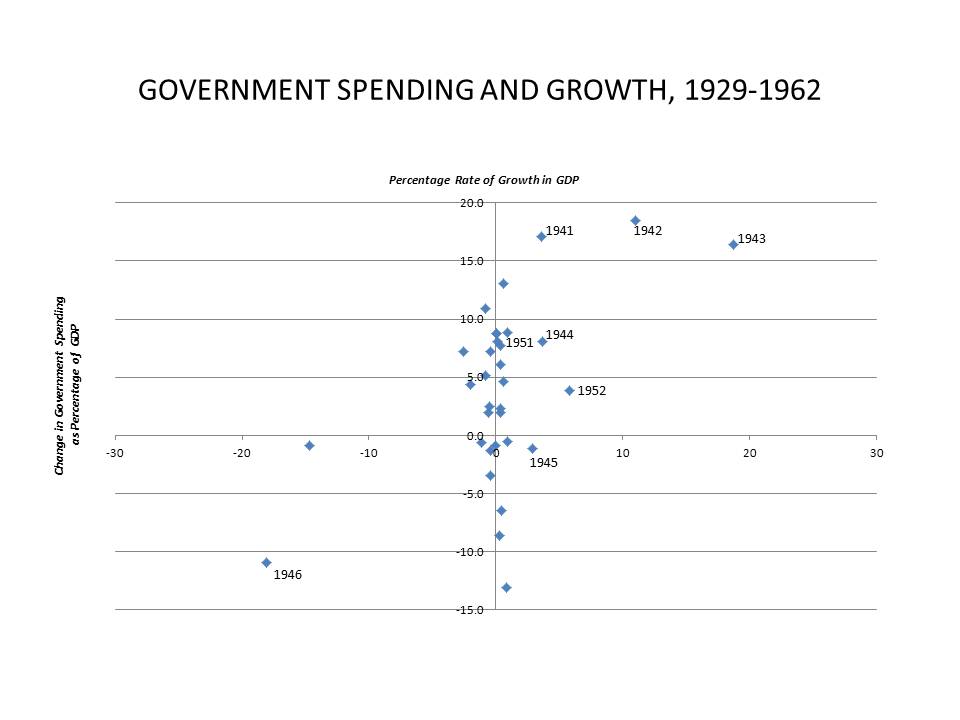
First, Stanford’s Robert Hall has looked at the effects of large changes in US government purchases—which is all about wars, specifically World War II and the Korean War. Figure 2 on this page [see below] compares changes in US military spending with changes in real GDP—both measured as a percentage of the preceding year’s GDP—over the period from 1929 to 1962 (there’s not much action after that). Each dot represents one year; I’ve labeled the points corresponding to the big buildup during World War II and the big demobilization just afterward. Obviously, there were big moves in years when nothing much was happening to military spending, notably the slump from 1929 to 1933 and the recovery from 1933 to 1936. But every year in which there was a big spending increase was also a year of strong growth, and the reduction in military spending after World War II was a year of sharp output decline.

Krugman did not explain his chart in detail, so I consulted the study by Robert Hall cited by Krugman. Hall’s insight was to focus not on government spending, just military spending, because other components of government spending are themselves influenced by the state of the economy, making it difficult to disentangle the effects of spending on the economy from the effects of the economy on spending. However, military spending is largely driven, especially in wartime (World War II and Korea), by factors unrelated to how the economy is performing. This makes military spending an appropriate instrument by which to identify and estimate the effect of government spending on the economy.

The problem with Krugman’s discussion is that, although using military expenditures allowed him to avoid the identification problem associated with the interdependency of government spending and the level of economic activity, he left out any mention of the behavior of the price level, which, many of us (and perhaps even Krugman himself) believe, powerfully affects the overall level of economic activity. Krugman artfully avoids any discussion of this relationship with the seemingly innocent observation “there were big moves in years when nothing much was happening to military spending, notably the slump from 1929 to 1933 and the recovery from 1933 to 1936.” But even this implicit acknowledgment of the importance of the behavior of the price level overlooks the fact that the huge wartime increase in military spending took place against the backdrop of rapid inflation, so that attributing economic expansion during World War II solely to the increase in government spending does not seem to warranted, because at least some of the increase in output would have been been forthcoming, even without increased military spending, owing to the rise in the price level.

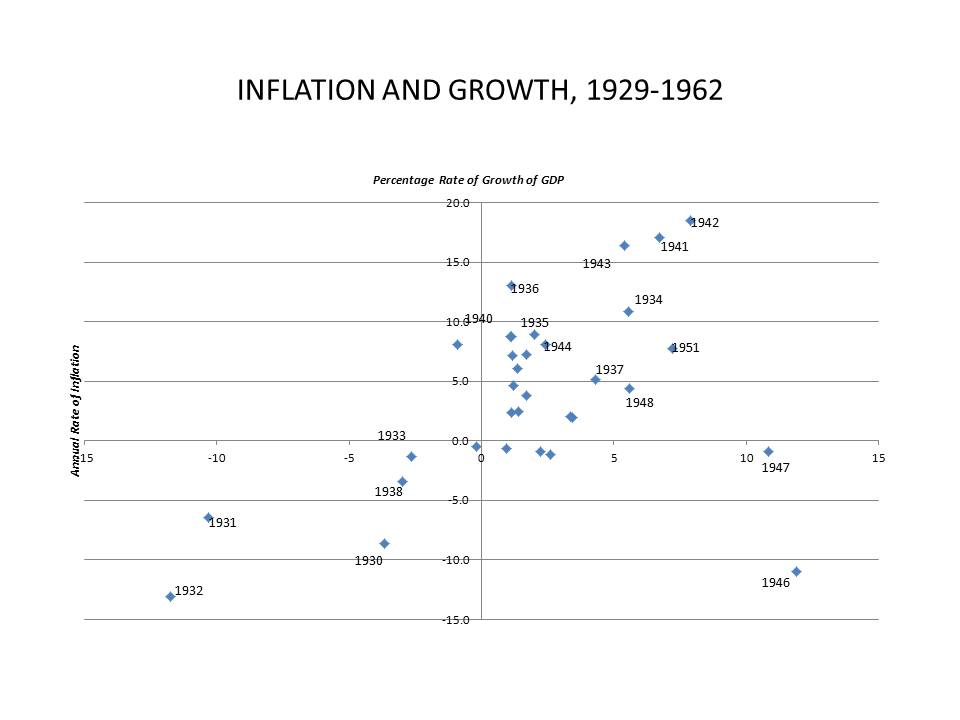
It is not hard to compare the effects of inflation and the effects of military spending on economic growth over the time period considered by Krugman. One can simply take annual inflation each year from 1930 to 1962 and plot the yearly rates of inflation and economic growth that Krugman plotted on his figure. Here is my version of Krugman’s chart substituting inflation for the change in military spending as a percentage of GDP.

It is difficult visually to compare the diagrams to see which one provides the more informative account of the fluctuations in economic growth over the 33 years in the sample. But it is not hard to identify the key difference between the two diagrams. In Krugman’s diagram, the variation in military spending provides no information about the variation in economic growth during the 1930s. There are is a cluster of points up and down the vertical axis corresponding to big positive and negative fluctuations in GDP with minimal changes in military spending. But large changes in GDP during the 1940s do correspond to changes in the same direction in military spending. Similarly, during the Korean War in the early 1950s, there was a positive correlation between changes in military spending. From the mid-1950s to the early 1960s, annual changes in GDP and in military spending were relatively small.

In my diagram plotting annual rates of inflation against annual changes in GDP, the large annual changes in GDP are closely related to positive or negative changes in the price level. In that respect, my diagram provides a more informative representation of the data than does Krugman’s. Even in World War II, the points representing the war years 1942 to 1945 are not far from a trend line drawn through the scatter of points. Where the diagram runs into serious trouble is that two points are way, way off to one side. Those are the years 1946 and 1947.

What was going on in those years? GDP was contracting, especially in 1946, and prices were rising rapidly, exactly contrary to the usual presumption that rising prices tend to generate increases in output. What was going on? It all goes back to 1942, when FDR imposed wartime price controls. This was partly a way of preventing suppliers from raising prices to the government, and also a general anti-inflation measure. However, the result was that there were widespread shortages, with rationing of a wide range of goods and services.  The officially measured rate of inflation from 1942 to 1945 was therefore clearly understated. In 1946 and 1947, controls were gradually relaxed and finally eliminated, with measured inflation rates actually increasing even though the economy was contracting.  Measured inflation in 1946 and 1947 therefore overstated actual inflation by an amount corresponding (more or less) to the cumulative understatement of inflation from 1942 to 1945. That the dots representing 1946 and 1947 are outliers is not because the hypothesized causal relationship between inflation and GDP was inoperative or reversed, but because of a mistaken measurement of what inflation actually was.

To get a better handle on the relative explanatory power of the government-spending and the inflation hypotheses in accounting for fluctuations in GDP than visual inspection of the data allows, one has to work with the underlying data. Unfortunately, when I tried to measure changes in military spending from 1929 to 1962, I could not reproduce the data underlying Krugman’s chart. That was not Krugman’s fault; I don’t doubt that he accurately calculated the relevant data from the appropriate sources. But when I searched for data on military spending since 1929, the only source that I found was this. So that is what I used. I assume that Krugman was using a different source from the one that I used, and he may also have defined his government spending variable in a different way from how I did. At any rate, when I did the calculation, I generated a chart that looked like the one below. It is generally similar to Krugman’s, but obviously not the same. If someone can explain why I did not come up with the same numbers for changes in government spending that Krugman did, I would be very much obliged and will redo my calculations. However, in the meantime, I am going to assume that my numbers are close enough to Krugman’s, so that my results would not be reversed if I used his numbers instead.

Taking my version of Krugman’s data, I ran a simple regression of the annual change in real GDP (dGDP) on the annual change in government (i.e., military spending) as a percentage of GDP (dG) from 1930 to 1962 (the data start in 1929, but the changes don’t start till 1930). The regression equation that I estimated was the following:

dGDP = 3.60 + .70dG, r-squared = .295.

This equation says that the percent increase in real GDP in any year is 3.6% plus seven-tenths of the percentage increase in government (i.e., military) spending for that year.

I then ran a corresponding regression of the annual change in real GDP on the annual change in the price level (dP, derived from my estimate of the GDP price deflator). The estimated regression was the following:

dGDP = 2.48 + .69dP, r-squared = .199.

The equation says that the percent increase in real GDP in any year is 2.48% plus .69 times that year’s rate of inflation.

Because the r-squared of the first equation is about 50% higher than that of the second, there would be good reason to prefer the first equation over the second were it not for the measurement problem that I mentioned above. I tried a number of ways of accounting for that measurement problem, but the simplest adjustment was simply to add two dummy variables, one for price controls during World War II and one for the lifting of price controls in 1946 and 1947. When I introduced both dummy variables into the equation, it turned out that the dummy variable for price controls during World War II was statistically insignificant, inasmuch as there was some measured inflation even during the World War II price controls. It was only the dummy variable controlling for the (mis)measured inflation associated with the lifting of price controls that was statistically significant. Here is the estimated regression:

dGDP = 2.76 + 1.28dP – 23.29PCON, r-squared = .621

I also tried attributing the inflation measured in 1946 and 1947 to the years 1942 to 1945, giving each of those years an inflation rate of about 9.7% and attributing zero inflation to the years 1946 and 1947. The regression equation that I estimated using that approach did not perform as well, based on a comparison of adjusted r-squares, as the simple equation with a single dummy variable. I also estimated equations using both the government spending variable and the inflation variable, and the two price-control dummies. That specification, despite two extra variables, had an r-squared less than the r-squared of the above equation. [Update 11/20/2012:  This was my mistake, because the best results were obtained using only a dummy variable for 1946 and 1947.  When the government spending and the inflation variables were estimated with a dummy for 1946-1947, the coefficients on both variables were positive and significant.]  So my tentative conclusion is that the best way to summarize the observed data pattern for the fluctuations of real GDP between 1929 and 1962 is with an equation with only an inflation variable and an added dummy variable accounting for the mismeasurement of inflation in 1946 and 1947.

Nevertheless, I would caution against reading too much into these results, even on the assumption that the provisional nature of the data that I have used has not introduced any distortions and that there are no other errors in my results. (Anyone who wants to check my results is welcome to email me at uneasymoney@hotmail.com, and I will send you the (Stata) data files that I have used.) Nor do I claim that government spending has no effect on real GDP. I am simply suggesting that for the time period between 1929 and 1962 in the US, there does not seem to be strong evidence that government spending significantly affected real GDP, once account is taken of the effects of changes in the price level. With only 33 observations, the effect of government spending, though theoretically present, may not be statistically detectable, at least not using a simple linear regression model. One might also argue that wartime increases in government spending contributed to the wartime inflation, so that the effect of government spending is masked by including a price-level variable. Be that as it may, Krugman’s (and Hall’s) argument that government spending was clearly effective in increasing real GDP in World War II and Korea, and would, therefore, be likely to be effective under other circumstances, is not as self-evidently true as Krugman makes it out to be. I don’t say that it is incorrect, but the evidence seems to be, at best, ambiguous.

Economy, Heal Thyself

Lately, some smart economists (Eli Dourado backed up by Larry White, George Selgin, and Tyler Cowen) have been questioning whether it is plausible, four years after the US economy was hit with a severe negative shock to aggregate demand, and about three and a half years since aggregate demand stopped falling (nominal GDP subsequently growing at about a 4% annual rate), that the reason for persistent high unemployment and anemic growth in real output is that nominal aggregate demand has been growing too slowly. Even conceding that the 4% growth in nominal GDP was too slow to generate a rapid recovery from the original shock, they still ask why almost four years after hitting bottom, we should assume that slow growth in real GDP and persistent high unemployment are the result of deficient aggregate demand rather than the result of some underlying real disturbance, such as a massive misallocation of resources and capital induced by the housing bubble from 2002 to 2006. In other words, even if it was an aggregated demand shock that caused a sharp downturn in 2008-09, and even if insufficient aggregate demand growth unnecessarily weakened and prolonged the recovery, what reason is there to assume that the economy could not, by now, have adjusted to a slightly lower rate of growth in nominal GDP 4% (compared to the 5 to 5.5% that characterized the period preceding the 2008 downturn). As Eli Dourado puts it:

If we view the recession as a purely nominal shock, then monetary stimulus only does any good during the period in which the economy is adjusting to the shock. At some point during a recession, people’s expectations about nominal flows get updated, and prices, wages, and contracts adjust. After this point, monetary stimulus doesn’t help.

Thus, Dourado,White, Selgin, and Cowen want to know why an economy not afflicted by some deep structural, (i.e. real) problems would not have bounced back to its long-term trend of real output and employment after almost four years of steady 4% nominal GDP growth. Four percent growth in nominal GDP may have been too stingy, but why should we believe that 4% nominal GDP growth would not, in the long run, provide enough aggregate demand to allow an eventual return to the economy’s long-run real growth path?  And if one concedes that a steady rate of 4% growth in nominal GDP would eventually get the economy back on its long-run real growth path, why should we assume that four years is not enough time to get there?

Well, let me respond to that question with one of my own: what is the theoretical basis for assuming that an economy subjected to a very significant nominal shock that substantially reduces real output and employment would ever recover from that shock and revert back to its previous growth path? There is, I suppose, a presumption that markets equilibrate themselves through price adjustments, prices adjusting in response to excess demands and supplies until markets again clear. But there is a fallacy of composition at work here. Supply and demand curves are always drawn for a single market. The partial-equilibrium analysis that we are taught in econ 101 operates based on the implicit assumption that all markets other than the one under consideration are in equilibrium. (That is actually a logically untenable assumption, because, according to Walras’s Law, if one market is out of equilibrium at least one other market must also be out of equilibrium, but let us not dwell on that technicality.) But after an economy-wide nominal shock, the actual adjustment process involves not one market, but many (if not most, or even all) markets are out of equilibrium. When many markets are out of equilibrium, the adjustment process is much more problematic than under the assumptions of the partial-equilibrium analysis that we are so accustomed to. Just because the adjustment process that brings a single isolated market back from disequilibrium to equilibrium seems straightforward, we are not necessarily entitled to assume that there is an equivalent adjustment process from an economy-wide disequilibrium in which many, most, or all, markets are starting from a position of disequilibrium. A price adjustment in any one market will, in general, affect demands and supplies in at least some other markets. If only a single market is out of equilibrium, the effects on other markets of price and quantity adjustment in that one market are likely to be small enough, so that those effects on other markets can be safely ignored. But when many, most, or all, markets are in disequilibrium, the adjustments in some markets may aggravate the disequilibrium in other markets, setting in motion an endless series of adjustments that may – but may not! — lead the economy back to equilibrium. We just don’t know. And the uncertainty about whether equilibrium will be restored becomes even greater, when one of the markets out of equilibrium is the market for labor, a market in which income effects are so strong that they inevitably have major repercussions on all other markets.

Dourado et al. take it for granted that people’s expectations about nominal flows get updatd, and that prices, wages, and contracts adjust. But adjustment is one thing; equilibration is another. It is one thing to adjust expectations about a market in disequilibrium when all or most markets ar ein or near equilibrium; it is another to adjust expectations when markets are all out of equilibrium. Real interest rates, as very imperfectly approximated by TIPS, seem to have been falling steadily since early 2011 reflecting increasing pessimism about future growth in the economy. To overcome the growing entrepreneurial pessimism underlying the fall in real interest rates, it would have been necessary for workers to have accepted wage cuts far below their current levels. That scenario seems wildly unrealistic under any conceivable set of conditions. But even if the massive wage cuts necessary to induce a substantial increase in employment were realistic, wage cuts of that magnitude could have very unpredictable repercussions on consumption spending and prices, potentially setting in motion a destructive deflationary spiral. Dourado assumes that updating expectations about nominal flows, and the adjustments of prices and wages and contracts lead to equilibrium – that the short run is short. But that is question begging no less than those who look at slow growth and high unemployment and conclude that the economy is operating below its capacity. Dourado is sure that the economy has to return to equilibrium in a finite period of time, and I am sure that if the economy were in equilibrium real output would be growing at least 3% a year, and unemployment would be way under 8%. He has no more theoretical ground for his assumption than I do for mine.

Dourado challenges supporters of further QE to make “a broadly falsifiable claim about how long the short run lasts.” My response is that there is no theory available from which to deduce such a falsifiable claim. And as I have pointed out a number of times, no less an authority than F. A. Hayek demonstrated in his 1937 paper “Economics and Knowledge” that there is no economic theory that entitles us to conclude that the conditions required for an intertemporal equilibrium are in fact ever satisfied, or even that there is a causal tendency for them to be satisfied. All we have is some empirical evidence that economies from time to time roughly approximate such states. But that certainly does not entitle us to assume that any lapse from such a state will be spontaneously restored in a finite period of time.

Do we know that QE will work? Do we know that QE will increase real growth and reduce unemployment? No, but we do have a lot of evidence that monetary policy has succeeded in increasing output and employment in the past by changing expectations of the future price-level path. To assume that the current state of the economy is an equilibrium when unemployment is at a historically high level and inflation at a historically low level seems to me just, well, irresponsible.

Hayek on the Unsustainability of Inflation-Fed Booms

In writing my previous post on Hayek’s classically neoclassical 1969 elucidation of the Ricardo Effect, I came across a passage, which is just too marvelous not to share. To provide just a bit of context for this brief passage, the point that Hayek was trying to establish was that even a continuous and fully anticipated injection of money would alter the real equilibrium of an economy. On this point, Hayek was taking issue with J. R. Hicks who had argued that a fully anticipated increase in the money supply would have no real effects. I think that Hicks was basically right and Hayek wrong on this issue, but that is not the point that I want readers to take away from this post. The point to pay attention to is what Hayek says about the alleged unsustainability of inflationary booms. In the paragraph just before the passage I am going to quote, Hayek explains what happens when the monetary expansion that had been feeding an investment boom is terminated. According to Hayek, that readjustment in the relative prices of investment goods and consumption goods is the Ricardo Effect, causing “some of the factors which during the boom will have become committed producing very capital-intensive equipment [to] become unemployed.”

Hayek continues:

This is the mechanism by which I conceive that, unless credit expansion is continued progressively, an inflation-fed boom must sooner or later be reversed by a decline in investment. This theory never claimed to do more than account for the upper turning point of the typical nineteenth–century business cycle. The cumulative process of contraction likely to set in once unemployment appears in the capital-goods industries is another matter which must be analyzed by conventional means. It has always been an open question to me as to how long a process of continued inflation, not checked by a built-in limit on the supply of money and credit, could effectively maintain investment above the volume justified by the voluntary rate of savings. It may well be that this inevitable check only comes when inflation becomes so rampant – as the progressively higher rate of inflation required to maintain a given volume of investment must make it sooner or later – that money ceases to be an adequate accounting basis.

The built-in limit on the supply of money to which Hayek referred was the gold standard, manifesting itself in a tendency for monetary expansion to cause both an external and an internal drain on the gold reserves of the monetary authority. In a fiat-money system with a flexible exchange rate, no such limit on the supply of money exists. So according to Hayek, at some point, the monetary authority is faced with a choice of either increasing the rate of inflation to keep investment at its artificially high level or allowing investment to decline, triggering a recession. That is the upper turning point of the cycle. But he also says “the cumulative process of contraction like to set in once unemployment appear in the capital-goods industries is another matter which must be analyzed by conventional means.” I take this to mean that, according to Hayek, the monetary authority can limit the cumulative process of contraction that results when the current rate of inflation is fully anticipated and monetary expansion is not increased to accelerate inflation to a higher, as yet unanticipated, level. There is thus a recession associated with the stabilization of inflation, but monetary policy can prevent it from becoming cumulative. After the real adjustment takes place and the capital goods industry Is downsized, a steady rate of inflation can be maintained, with no further real misallocations. There is inflation, but no boom and recession. In other words, it’s the Great Moderation.  Hayek called it in 1969.

Stock Prices Rose by 5% in Two Weeks – Guess Why?

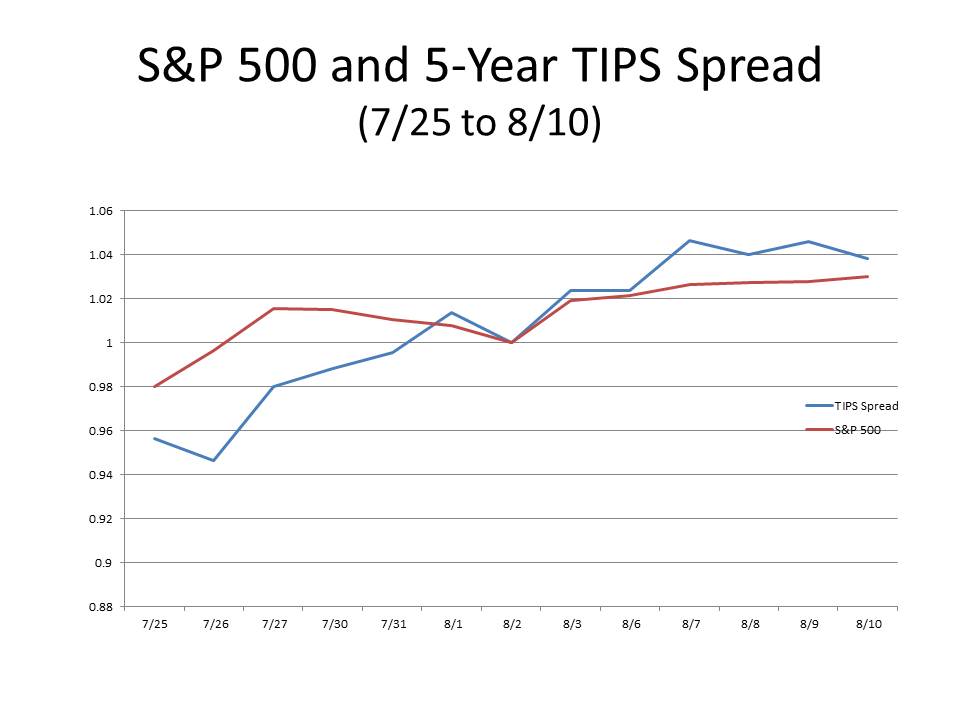
On Wednesday, July 25, the S&P 500 closed at 1337.89. On Wednesday, August 8, the S&P 500 closed at 1402.22, a gain of just under 5%. Care to guess why the market rose?

Well, it’s been a while since I’ve mentioned the stock market, but long-time readers of this blog already know that the stock market loves inflation (see here, here, and here), there having been a strong positive correlation between movements in inflation expectations and the direction of the stock market since early 2008, as I showed in my paper “The Fisher Effect Under Deflationary Expectations.” The correlation between inflation expectations and asset values is not a general implication of financial theory, which makes a strong and continuing correlation between inflation expectations and movements in stock prices something of an anomaly, an anomaly that reflects and underscores the dysfunctional state of the US and international economies since 2008, when monetary policy began to exert a deflationary bias even as the economy was sliding into a contraction. Using Bloomberg’s calculations of the breakeven TIPS spread on 1-, 2-, 5-, and 10-year Treasuries between July 25 and August 10, I calculated correlation coefficients between the Bloomberg TIPS spreads at those maturities and the S&P 500 of .764, 915, .906, and .87. Calculating the TIPS spreads on 5- and 10-year constant maturity Treasuries from the Treasury yield curve website, I found correlation coefficients of .904 and .887 between those TIPS spreads and the S&P 500. So the correlations are robust regardless of the specific TIPS spread one uses.

In the chart below, I draw a graph plotting movements in the 5-year TIPS spread (as calculated by Bloomberg) and in the S&P 500 between July 25 and August 10 (with both series normalized to equal 1 on August 2).

Get the picture?

Ever since March 2009, after the stock market hit bottom, having lost more than 50% of its value in the summer of 2008, the Fed has periodically signaled that it would take aggressive steps to stimulate the economy. The stock market, yearning for inflation, has repeatedly responded to signs that the Fed would respond to its desire for inflation, only to fall back in disappointment after it became clear that the Fed was not going to deliver the inflation that it had earlier dangled enticingly in front of desperate investors. Recently, as the signs of recovery that had been visible in the winter and early spring started to fade, the Fed has been sending out signals — faint and ambiguous, to be sure, but still signals — that it may finally provide some inflationary relief, and the stock market responded predictably and promptly. Will the Fed, perhaps relying on recent favorable employment data as an excuse, once again snooker the market?  Stay tuned.

Murdoch Tends to Corrupt

Allan Meltzer has had a long and distinguished career as an economist and scholar, making many notable contributions to monetary economics at both the theoretical and empirical levels, also writing valuable and highly regarded contributions to the history of economics and economic history, especially his 1989 book on Keynes and his recent monumental two-volume history of the Federal Reserve System. Meltzer has the added virtue of being a UCLA-trained economist, where as a student he began his long collaboration with his teacher Karl Brunner. So I take no pleasure in writing this post about what can only be described as an embarrassment, namely, the abysmal op-ed article (“What’s Wrong with the Federal Reserve?”) Meltzer wrote in today’s Wall Street Journal about the Fed and current monetary policy.

Meltzer immediately gets off to a bad start, from which he never recovers, with the following opening sentence.

By allowing its monetary policy to be influenced by elected politicians and market speculators, the Federal Reserve is putting its independence at risk.

Now you might have thought that a serious charge about the Fed’s conduct would require some supporting evidence that the Fed’s policy was being influenced by either politicians or speculators. Well, this is what seems to count as evidence for Professor Meltzer.

Consider the response to last week’s employment report for June—a meager 80,000 net new jobs created, and an unemployment rate stuck at 8.2%. Day traders and speculators immediately clamored for additional monetary easing. Even the president of the Federal Reserve Bank of Chicago joined in.

So the people that Professor Meltzer thinks are now controlling Fed policy are a bunch of day traders. This goes way past what even Ron Paul would say about who is controlling the Fed, i.e., international bankers (aka the Rothschilds). No, it’s a conspiracy of the day traders, apparently having co-opted the president of the Chicago Federal Reserve Bank. Talk about lowering the bar. But it gets worse. Let’s read on.

To his credit, Mr. Bernanke did not immediately agree. But he failed utterly to state the obvious: The country’s sluggish growth and stubbornly high unemployment rate was [sic] not caused by, nor could it [sic] be cured by, monetary policy.

OK, Professor Meltzer has discovered that the Fed is being controlled by a conspiracy of day traders working through the president of the Chicago Fed.  Except that Bernanke and the FOMC (except for that guy from Chicago) did not go along with the conspirators! What then is the evidence that Fed policy is controlled by the day traders? Apparently, the failure of Bernanke to make an abject admission of the Fed’s impotence.

Now what is Professor Meltzer’s evidence for the Fed’s impotence? Let him speak for himself:

Market interest rates on all maturities of government bonds are the lowest since the founding of the republic.

This is astonishing. Allan Meltzer is widely regarded as a founding fathers (along with Milton Friedman and Karl Brunner) of modern Moneterism, one of whose basic tenets is that nominal interest rates are primarily determined by inflation expectations. Thus, low interest rates, as Milton Friedman always pointed out, are symptomatic of tight monetary policy that keeps inflation, and inflation expectations, low, as they are now. But somehow Professor Meltzer has now concluded, like the Keynesians that Monetarists once disputed, that low interest rates are symptomatic of easy money. Meltzer later invokes Friedman’s authority to support the proposition that monetary policy is an unreliable instrument for stabilizing short-term fluctuations in the economy, causing one to wonder whether his memory lapses are random or selective.

Professor Meltzer’s memory of recent economic history is also dubious. Discussing the Fed’s adoption of QE2 in the fall of 2010, he writes:

Consider also how, in the summer of 2010, the Fed allowed itself to be spooked by cries about a double-dip recession and deflation. It added $600 billion to banks’ reserves by buying up federal Treasurys and mortgage-backed securities. Today, $500 billion of those reserves remain on bank balance sheets, and most of the rest of the dollars are held by foreign central banks. Not much help to the U.S. economy. By early autumn 2010, it had become clear that fears of a double-dip recession and deflation were just short-term hysteria.

Actually, Chairman Bernanke only signaled in late August and early September 2010 that the Fed would engage in renewed quantitative easing, thereby producing an immediate market response. The renewed purchases did not begin until the autumn. What became clear in the autumn was not that recession and deflation fears were just short-term hysteria, but that quantitative easing prevented the slide into recession that had been anticipated by a sharp dive in the stock market in August 2010.

Meltzer asserts that the cause of the weak recovery is uncertainty about future tax rates, health-care costs, and the regulatory burden. One would expect that, as an accomplished empirical economist, Professor Meltzer would attempt to back up his assertion with evidence. But he apparently regards it as too self-evident a proposition to require any empirical support.

Professor Meltzer again displays a shockingly cavalier attitude toward empirical evidence with the following assertion:

Evidence is growing that many think higher inflation is in our future. One sign is the premium that investors pay to hold index-linked Treasury bonds that protect against inflation.

These claims about inflation expectations are not backed up by data of any kind, even though they are readily available. The only problem is that the data don’t support Meltzer’s claims.  Breakeven TIPS spreads have edged up slightly in the last couple of weeks as fears of an imminent financial crisis in Europe have eased, but even at the 10-year time horizon the breakeven rate is barely above 2%, which is less than inflation expectations have been for most of the nearly four years since the onset of the financial crisis in 2008. And according to the estimates of inflation expectations by the Cleveland Fed, 10-year inflation expectations in June were at an all-time low, about 1.2%.

Although there is much more to criticize about this piece, it would be churlish to continue further. But I cannot help wonder why Professor Meltzer is so heedless of his reputation that he would allow his name to be attached to a piece of work so far below not just his own formerly high standards, but even below a standard of minimal competence. My only conjecture is that Rupert Murdoch is somehow responsible. Perhaps Murdoch has cast a demonic spell on Professor Meltzer. That seems as good an explanation as any.

Williamson v. Sumner

Stephen Williamson weighed in on nominal GDP targeting in a blog post on Monday. Scott Sumner and Marcus Nunes have already responded, and Williamson has already responded to Scott, so I will just offer a few semi-random comments about Williamson’s post, the responses and counter-response.

Let’s start with Williamson’s first post. He interprets Fed policy, since the Volcker era, as an implementation of the Taylor rule:

The Taylor rule takes as given the operating procedure of the Fed, under which the FOMC determines a target for the overnight federal funds rate, and the job of the New York Fed people who manage the System Open Market Account (SOMA) is to hit that target. The Taylor rule, if the FOMC follows it, simply dictates how the fed funds rate target should be set every six weeks, given new information.

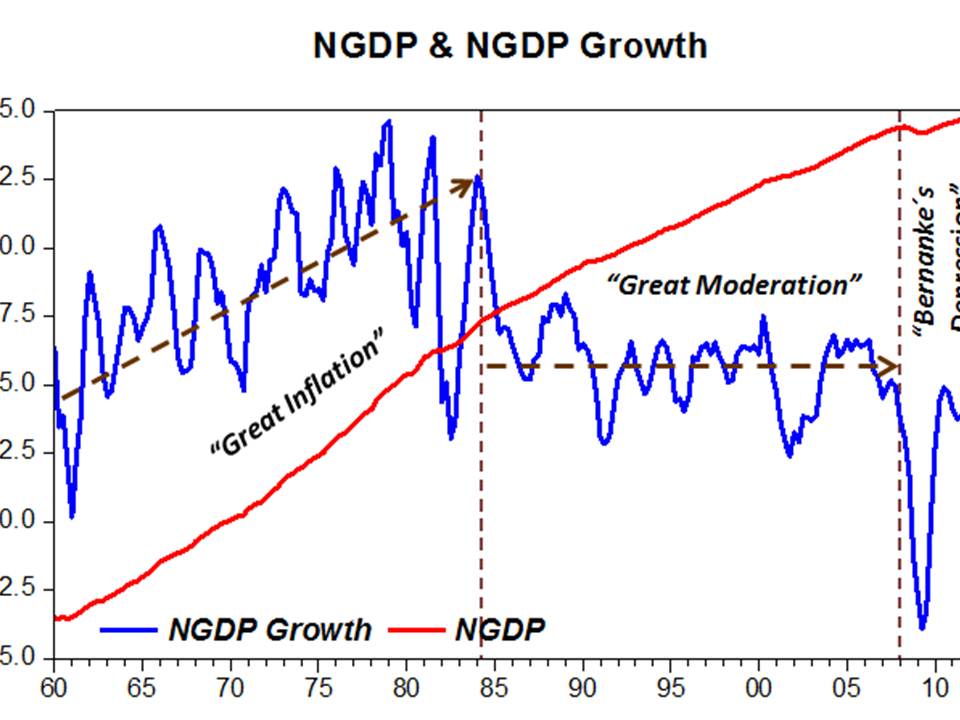
So, from the mid-1980s until 2008, everything seemed to be going swimmingly. Just as the inflation targeters envisioned, inflation was not only low, but we had a Great Moderation in the United States. Ben Bernanke, who had long been a supporter of inflation targeting, became Fed Chair in 2006, and I think it was widely anticipated that he would push for inflation targeting with the US Congress.

Thus, under the Taylor rule, as implemented, ever more systematically, by the FOMC, the federal funds rate (FFR) was set with a view to achieving an implicit inflation target, presumably in the neighborhood of 2%. However, as a result of the Little Depression beginning in 2008, Scott Sumner et al. have proposed targeting NGDP instead of inflation. Williamson has problems with NGDP targeting that I will come back to, but he makes a positive case for inflation targeting in terms of Friedman’s optimal-supply-of-money rule, under which the nominal rate of interest is held at zero via a rate of inflation that is the negative of the real interest rate (i.e., deflation whenever the real rate of interest is positive). Back to Williamson:

The Friedman rule . . . dictates that monetary policy be conducted so that the nominal interest rate is always zero. Of course we know that no central bank does that, and we have good reasons to think that there are other frictions in the economy which imply that we should depart from the Friedman rule. However, the lesson from the Friedman rule argument is that the nominal interest rate reflects a distortion and that, once we take account of other frictions, we should arrive at an optimal policy rule that will imply that the nominal interest rate should be smooth. One of the frictions some macroeconomists like to think about is price stickiness. In New Keynesian models, price stickiness leads to relative price distortions that monetary policy can correct.

If monetary policy is about managing price distortions, what does that have to do with targeting some nominal quantity? Any model I know about, if subjected to a NGDP targeting rule, would yield a suboptimal allocation of resources.

I really don’t understand this. Williamson is apparently defending current Fed practice (i.e., targeting a rate of inflation) by presenting it as a practical implementation of Friedman’s proposal to set the nominal interest rate at zero. But setting the nominal interest rate at zero is analogous to inflation targeting only if the real rate of interest doesn’t change. Friedman’s rule implies that the rate of deflation changes by as much as the real rate of interest changes. Or does Williamson believe that the real rate of interest never changes? Those of us now calling for monetary stimulus believe that we are stuck in a trap of widespread entrepreneurial pessimism, reflected in very low nominal and negative real interest rates. To get out of such a self-reinforcing network of pessimistic expectations, the economy needs a jolt of inflationary shock therapy like the one administered by FDR in 1933 when he devalued the dollar by 40%.

As I said a moment ago, even apart from Friedman’s optimality argument for a zero nominal interest rate, Williamson thinks that NGDP targeting is a bad idea, but the reasons that he offers for thinking it a bad idea strike me as a bit odd. Consider this one. The Fed would never adopt NGDP targeting, because it would be inconsistent with the Fed’s own past practice. I kid you not; that’s just what he said:

It will be a cold day in hell when the Fed adopts NGDP targeting. Just as the Fed likes the Taylor rule, as it confirms the Fed’s belief in the wisdom of its own actions, the Fed will not buy into a policy rule that makes its previous actions look stupid.

So is Williamson saying that the Fed will not adopt any policy that is inconsistent with its actions in, say, the Great Depression? That will surely do a lot to enhance the Fed’s institutional credibility, about which Williamson is so solicitous.

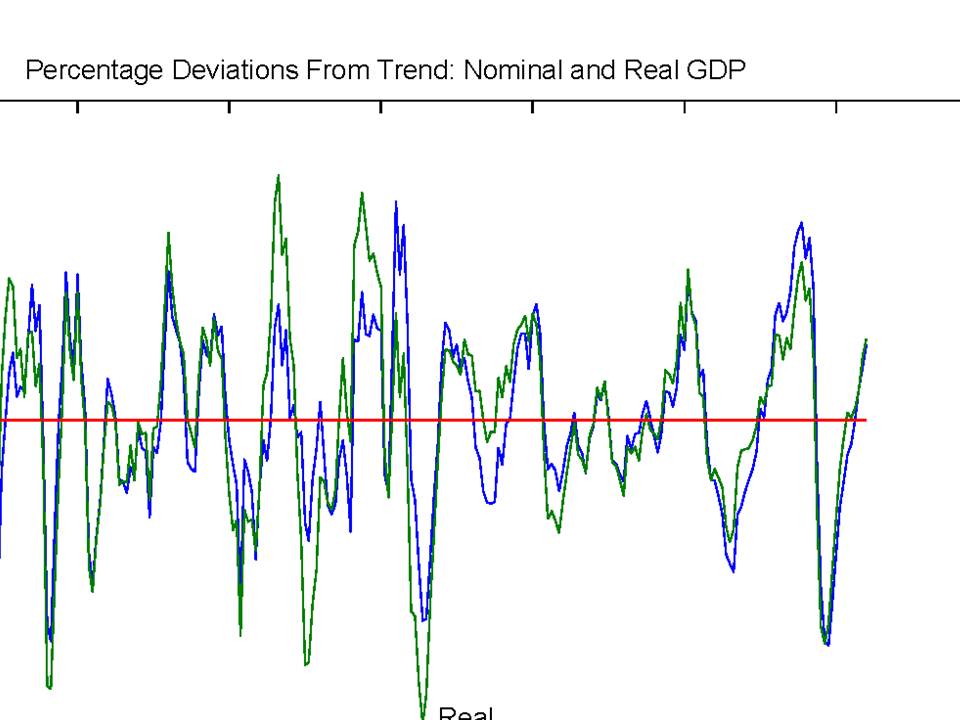
Then Williamson makes another curious argument based on a comparison of Hodrick-Prescott-filtered NGDP and RGDP data from 1947 to 2011. Williamson plotted the two series on the accompanying graph. Observing that while NGDP was less variable than RDGP in the 1970s, the two series tracked each other closely in the Great-Moderation period (1983-2007), Williamson suggests that, inasmuch as the 1970s are now considered to have been a period of bad monetary policy, low variability of NGDP does not seem to matter that much.

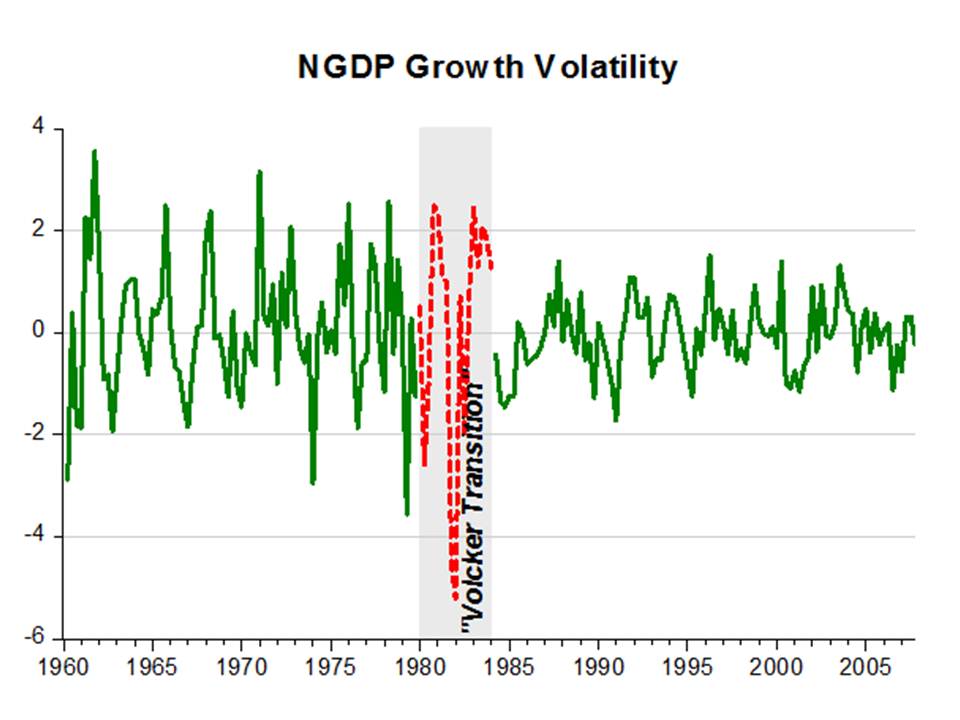
Marcus Nunes, I think properly, concludes that Williamson’s graph is wrong, because Williamson ignores the fact that there was a rising trend of NGDP growth during the 1970s, while during the Great Moderation, NGDP growth was stationary. Marcus corrects Williamson’s error with two graphs of his own (which I attach), showing that the shift to NGDP targeting was associated with diminished volatility in RGDP during the Great Moderation.

Furthermore, Scott Sumner questions whether the application of the Hodrick-Prescott filter to the entire 1947-2011 period was appropriate, given the collapse of NGDP after 2008, thereby distorting estimates of the trend.

There may be further issues associated with the appropriateness of the Hodrick-Prescott filter, issues which I am certainly not competent to assess, but I will just quote from Andrew Harvey’s article on filters for Business Cycles and Depressions: An Encyclopedia, to which I referred recently in my post about Anna Schwartz. Here is what Harvey said about the HP filter.

Thus for quarterly data, applying the [Hodrick-Prescott] filter to a random walk is likely to create a spurious cycle with a period of about seven or eight years which could easily be identified as a business cycle . . . Of course, the application of the Hodrick-Prescott filter yields quite sensible results in some cases, but everything depends on the properties of the series in question.

Williamson then wonders, if stabilizing NGDP is such a good idea, why not stabilize raw NGDP rather than seasonally adjusted NGDP, as just about all advocates of NGDP targeting implicitly or explicitly recommend? In a comment on Williamson’s blog, Nick Rowe raised the following point:

The seasonality question is interesting. We could push it further. Should we want the same level of NGDP on weekends as during the week? What about nighttime?

But then I think the same question could be asked for inflation targeting, or price level path targeting, because there is a seasonal pattern to CPI too. And (my guess is) the CPI is higher on weekends. Not sure if the CPI is lower or higher at night.

In a subsequent comment, Nick made the following, quite telling, observation:

Actually, thinking about seasonality is a regular repeated shock reminds me of something Lucas once said about rational expectations equilibria. I don’t remember his precise words, but it was something to the effect that we should be very wary of assuming the economy will hit the RE equilibrium after a shock that is genuinely new, but if the shock is regular and repeated agents will have figured out the RE equilibrium. Seasonality, and day of the week effects, will be presumably like that.

So, I think the point about eliminating seasonal fluctuations has been pretty much laid to rest. But perhaps Williamson will try to resurrect it (see below).

In his reply to Scott, Williamson reiterates his long-held position that the Fed is powerless to affect the economy except by altering the interest rate, now 0.25%, paid to banks on their reserves held at the Fed. Since the Fed could do no more than cut the rate to zero, and a negative interest rate would be deemed an illegal tax, Williamson sees no scope for monetary policy to be effective. Lars Chritensen, however, points out that the Fed could aim at a lower foreign exchange value of the dollar and conduct its monetary policy via unsterilized sales of dollars in the foreign-exchange markets in support of an explicit price level or NGDP target.

Williamson defends his comments about stabilizing seasonal fluctuations as follows:

My point in looking at seasonally adjusted nominal GDP was to point out that fluctuations in nominal GDP can’t be intrinsically bad. I think we all recognize that seasonal variation in NGDP is something that policy need not be doing anything to eliminate. So how do we know that we want to eliminate this variation at business cycle frequencies? In contrast to what Sumner states, it is widely recognized that some of the business cycle variability in RGDP we observe is in fact not suboptimal. Most of what we spend our time discussing (or fighting about) is the nature and quantitative significance of the suboptimalities. Sumner seems to think (like old-fashioned quantity theorists), that there is a sufficient statistic for subomptimality – in this case NGDP. I don’t see it.

So, apparently, Williamson does accept the comment from Nick Rowe (quoted above) on his first post. He now suggests that Scott Sumner and other NGDP targeters are too quick to assume that observed business-cycle fluctuations are non-optimal, because some business-cycle fluctuations may actually be no less optimal than the sort of responses to seasonal fluctuations that are general conceded to be unproblematic. The difference, of course, is that seasonal fluctuations are generally predictable and predicted, which is not the case for business-cycle fluctuations. Why, then, is there any theoretical presumption that unpredictable business-cycle fluctuations that falsify widely held expectations result in optimal responses? The rational for counter-cyclical policy is to minimize incorrect expectations that lead to inefficient search (unemployment) and speculative withholding of resources from their most valuable uses. The first-best policy for doing this, as I explained in the last chapter of my book Free Banking and Monetary Reform, would be to stabilize a comprehensive index of wage rates.  Practical considerations may dictate choosing a less esoteric policy target than stabilizing a wage index, say, stablizing the growth path of NGDP.

I think I’ve said more than enough for one post, so I’ll pass on Williamson’s further comments of the Friedman rule and why he chooses to call himself a Monetarist.

PS Yesterday was the first anniversary of this blog. Happy birthday and many happy returns to all my readers.

Yikes! Inflation Expectations Turned Negative Yesterday

In the wake of the FOMC’s decision Wednesday to ignore reality (and its own forecasts), the stock market dove yesterday. Inflation expectations, as approximated by the breakeven TIPS spread, also dove. And for the first time since March 2009, when the S&P 500 fell below 700, the implied breakeven TIPS spread on a one-year Treasury turned negative. I point this out just to illustrate the gravity of the current situation, not because there is a huge difference between the expectation of slightly positive inflation and slightly negative deflation.

Check out this chart for the one-year breakeven TIPS spread, this one for the 2-year, this one for the 5-year, and this one for the 10-year.

Chairman Bernanke has been reduced to defending the indefensible. Paul Krugman properly castigated the FOMC’s abdication of responsibility this week. Scott Sumner believes that Bernanke’s heart is in the right place, but his hands are tied, and is therefore unable to do what he knows in his heart ought to be done. If Scott is right, then Bernanke has only one honorable course of action: to resign and to explain that he cannot continue to serve as Fed Chairman, presiding over, and complicit in, a policy that he knows is mistaken and leading us to disaster.

The FOMC Kicks the Can Down the Road

At its meeting today, the Federal Open Market Committee (FOMC) decided . . . , well, decided not to decide. Faced with a feeble US economic recovery showing clear signs of getting weaker still, and a perilous economic situation in Europe poised to spin out of control into a full-blown financial crisis, the FOMC opted to continue the status quo, prolonging its so-called Operation Twist in which the Fed is liquidating its holdings of short-dated Treasuries and replacing them with longer-dated Treasuries, on the theory that changing the maturity structure of the Fed’s balance sheet will reduce long-term interest rates, thereby providing some further incentive for long-term borrowing, as if the problem holding back a recovery were long-term nominal interest rates that are not low enough.

What I found most interesting in today’s statement was the FOMC’s assessment of inflation. In the opening paragraph of its statement, the FOMC states:

Inflation has declined, mainly reflecting lower prices of crude oil and gasoline, and longer-term inflation expectations have remained stable.

What is the basis for the FOMC’s statement that inflation expectations are stable?  Does the FOMC not take seriously the estimate of inflation expectations just published by the Cleveland Fed showing that inflation expectations over a 10-year time horizon are at an all-time low of 1.19% and the expectation for the next 12 months is 0.6%, the lowest since March 2009 when the stock market reached its post-crisis low?  And the FOMC’s April projection for PCE inflation in 2012 was in a range 1.9 to 2.0%; its current projection is now 1.2 to 1.7%.  In contrast to 2008, when the FOMC was in a tizzy about inflation expectations becoming unanchored because of rapidly rising food and energy prices, the FOMC seems remarkably calm and unperturbed about a 0.3% fall in headline inflation in May.

Then in the next paragraph the FOMC makes another — shall we say, puzzling — statement:

The Committee anticipates that inflation over the medium term will run at or below the rate that it judges most consistent with its dual mandate.

So the FOMC admits that inflation is likely to be less than its own inflation target. Let’s be sure that we understand this. The economy is weakening, growth is slowing, unemployment, after nearly four years above 8 percent, is once again rising, and the Fed’s own expectation of the inflation rate for 2012 is well below the FOMC target. And what is the FOMC response?  Steady as you go.

In a news story about the FOMC decision, Marketwatch reporter Steve Goldstein writes:

The Federal Reserve on Wednesday softened its growth and inflation forecasts over the next three years, as the central bank said the unemployment rate will hold above 8% through the end of 2012. The Fed also cut its inflation forecast down aggressively, to between 1.2% and 1.7% this year, as opposed to its forecast in April between 1.9% and 2%. The central bank targets 2% inflation over the medium term, so the reduced inflation forecast is likely to ratchet up expectations of additional central bank easing, possibly as soon as August. The Fed’s forecast for growth this year is down to a range of 1.9% to 2.4%, down from 2.4% to 2.9% in April — and its April 2011 forecast that 2012 growth would range between 3.5% and 4.2%. Also of note, it appears that the two newest voters, Jerome Powell and Jeremy Stein, are among the most dovish; the most recent breakdown of when the right time to raise hikes shows the only change is in 2015, which now has six members in that camp, up from four in April. Powell and Stein were recently sworn in as Fed governors.

So the optimistic take on all this is that the FOMC has set the stage for taking aggressive action at its next meeting. Since bottoming out last week, stock prices recovered, apparently in expectation of easing by the Fed. Today’s announcement is not what the market was hoping for, but there are at least signs that the FOMC will take action soon. In our desperation, we have been reduced to grasping at straws.

1970s Stagflation

Karl Smith, Scott Sumner, and Yichuan Wang have been discussing whether the experience of the 1970s qualifies as “stagflation.” The term stagflation seems to have been coined in the 1973-74 recession, which was characterized by a rising inflation rate and a rising unemployment rate, a paradoxical conjunction of events for which economic theory did not seem to have a ready explanation. Scott observed that inasmuch as average real GDP growth over the decade was a quite respectable 3.2%, applying the term “stagflation” to the decade seems to be misplaced. Karl Smith says that although real GDP growth was fairly strong unemployment rates were much higher after the early 1970s than they had been in the 1960s and even in the lackluster 1950s (a decade of low inflation and low growth). Yichuan Wang weighs in with the observation that high growth in GDP produced almost no measurable effect on real GDP growth even though a simple Phillips Curve or AD/AS framework would suggest that all that extra growth in nominal GDP should have produced some payoff in added real GDP growth.

Here are some further observations on what happened in the 1970s. Inflation expectations began increasing in the late 1960s, so that a very modest tightening of monetary policy in 1969-70 produced a minor recession, but an almost imperceptible reduction in inflation. Nixon, not wanting to run for reelection with a stagnating economy — the memory of running unsuccessfully for President in 1960 during a recession having seared in his consciousness — forced an unwilling Fed to increase money growth rapidly while cynically imposing wage and price controls to keep a lid on inflation. The political strategy was a smashing success, but the stage was set for a ratcheting up of inflation and inflation expectations, though markets were actually slow to anticipate the rapid rise in inflation that followed.

Thus, the early part of the decade fits in well with Scott’s interpretation. Rising aggregate demand produced rising inflation and rising real GDP growth. Unfortunately, wage and price control quickly began to have harmful economic effects, producing shortages and other disruptions in economic activity that may have shaved a few percentage points off real GDP growth over the next few years. More serious was the first big oil-price shock in late 1973 in the wake of the Yom Kippur war, causing a quadrupling of oil prices over a period of a few months as well as horrific gasoline shortages attributable to the effects of remaining price controls on the petroleum sector, controls that, for political reasons, could not be removed even though other price controls had mercifully been allowed to expire. So in 1974, there was a rapid increase in inflation expectations fueled both by a tardy realization of the inflationary implications of the Nixon/Burns monetary policy of 1971-73, and a presumption that increases in oil prices would be accommodated in output prices rather than prices of complementary inputs being forced down. But because of general anti-inflation sentiment, monetary policy was tightened at precisely the moment when aggregate supply was contracting as a result of rising inflation expectations and an exogenous oil-price shock. That meant that real GDP began falling sharply even while output-price inflation was accelerating. It was that temporary conjunction of falling real GDP, rising unemployment, and rising inflation in 1974 that gave rise to the term “stagflation.” After initially focusing on inflation, the newly installed Ford administration quickly pivoted and provided economic stimulus to generate a recovery and the temporary inflationary bulge worked its way through the system. The recovery was robust enough to have enabled Ford to have been re-elected but for Ford’s monumental gaffe in his debate against Jimmy Carter, denying that Poland was under Soviet domination, and for lingering resentment against Ford from his pre-emptive pardon of Richard Nixon for any crimes that he committed during his Presidency.

By the time that Jimmy Carter took office, the US economy was well into a cyclical expansion, but Carter, after replacing Arthur Burns as Fed chairman with the clueless G. William Miller, encouraged Miller to continue a policy of rapid monetary expansion, producing rising inflation in 1977 and 1978. Once again, excess monetary stimulus produced rising inflation and rising inflation expectations just before a second oil-price shock, precipitated by the Iranian Revolution, began in 1979. The combination of rising inflation expectations and rapidly rising oil prices (exacerbated by the continuing controls on petroleum pricing causing renewed shortages of gasoline and other refined products) induced a leftward shift in aggregate supply, causing inflation to rise while output fell. Hence the second episode of stagflation.

So what does this all mean? Well, if one looks at the periods of rapid increases in aggregate demand in which oil price shocks were absent, we observe very high rates of real GDP growth. In the 1960s from the third quarter of 1961 to the third quarter of 1969, real GDP growth averaged 4.8%. Over the same period, the average annual rate of increase in the GDP price deflator was 2.6%. For the 10 quarters from the first quarter of 1971 through the second quarter of 1973, real GDP growth averaged 5.9%, and for 15 quarters from the second quarter of 1975 to the fourth quarter of 1978, real GDP growth averaged 5.1%. The average annual rate of increase in the GDP deflator in the 1971-73 period was 5.2% and in the 1975-78 period, the rate of increase in prices was 6.4%. In the periods of recession or slow growth associated with the oil-price shocks (i.e, 1973-74 and 1979, the rate of increase in the GDP deflator was 9.3% in the former period, and 8.4% in the latter. Thus inflation was higher in recession or slow growth periods than in rapid growth periods. That was stagflation.  Although economic expansions were about as fast in the 1970s as the 1960s, it would not be outlandish to suggest that rapid increases in nominal GDP in the 1970s did produce faster real GDP growth than would have occurred otherwise, though one might also argue that those temporary increases in real GDP growth had a non-trivial downside.

Why was unemployment so much higher in the 1970s than in the 1960s even though the rate of labor force participation was higher? I think that the obvious answer is that there was an influx of women and baby boomers into the work force without much previous work experience. Typically, new entrants into the labor force spend more time searching for employment than workers with previous experience, so it would not be surprising to observe a higher measured unemployment rate in the 1970s than in the 1960s even though jobs were not harder to find for most of the 1970s than they were in the 1960s.


About Me

David Glasner
Washington, DC

I am an economist in the Washington DC area. My research and writing has been mostly on monetary economics and policy and the history of economics. In my book Free Banking and Monetary Reform, I argued for a non-Monetarist non-Keynesian approach to monetary policy, based on a theory of a competitive supply of money. Over the years, I have become increasingly impressed by the similarities between my approach and that of R. G. Hawtrey and hope to bring Hawtrey’s unduly neglected contributions to the attention of a wider audience.

My new book Studies in the History of Monetary Theory: Controversies and Clarifications has been published by Palgrave Macmillan

Follow me on Twitter @david_glasner

Archives

Enter your email address to follow this blog and receive notifications of new posts by email.

Join 665 other subscribers
Follow Uneasy Money on WordPress.com