Archive for the 'Great Depression' Category


My Milton Friedman Problem

In my previous post , I discussed Keynes’s perplexing and problematic criticism of the Fisher equation in chapter 11 of the General Theory, perplexing because it is difficult to understand what Keynes is trying to say in the passage, and problematic because it is not only inconsistent with Keynes’s reasoning in earlier writings in which he essentially reproduced Fisher’s argument, it is also inconsistent with Keynes’s reasoning in chapter 17 of the General Theory in his exposition of own rates of interest and their equilibrium relationship. Scott Sumner honored me with a whole post on his blog which he entitled “Glasner on Keynes and the Fisher Effect,” quite a nice little ego boost.

After paraphrasing some of what I had written in his own terminology, Scott quoted me in responding to a dismissive comment that Krugman recently made about Milton Friedman, of whom Scott tends to be highly protective. Here’s the passage I am referring to.

PPS.  Paul Krugman recently wrote the following:

Just stabilize the money supply, declared Milton Friedman, and we don’t need any of this Keynesian stuff (even though Friedman, when pressured into providing an underlying framework, basically acknowledged that he believed in IS-LM).

Actually Friedman hated IS-LM.  I don’t doubt that one could write down a set of equilibria in the money market and goods market, as a function of interest rates and real output, for almost any model.  But does this sound like a guy who “believed in” the IS-LM model as a useful way of thinking about macro policy?

Low interest rates are generally a sign that money has been tight, as in Japan; high interest rates, that money has been easy.

It turns out that IS-LM curves will look very different if one moves away from the interest rate transmission mechanism of the Keynesians.  Again, here’s David:

Before closing, I will just make two side comments. First, my interpretation of Keynes’s take on the Fisher equation is similar to that of Allin Cottrell in his 1994 paper “Keynes and the Keynesians on the Fisher Effect.” Second, I would point out that the Keynesian analysis violates the standard neoclassical assumption that, in a two-factor production function, the factors are complementary, which implies that an increase in employment raises the MEC schedule. The IS curve is not downward-sloping, but upward sloping. This is point, as I have explained previously (here and here), was made a long time ago by Earl Thompson, and it has been made recently by Nick Rowe and Miles Kimball.I hope in a future post to work out in more detail the relationship between the Keynesian and the Fisherian analyses of real and nominal interest rates.

Please do.  Krugman reads Glasner’s blog, and if David keeps posting on this stuff then Krugman will eventually realize that hearing a few wisecracks from older Keynesians about various non-Keynesian traditions doesn’t make one an expert on the history of monetary thought.

I wrote a comment on Scott’s blog responding to this post in which, after thanking him for mentioning me in the same breath as Keynes and Fisher, I observed that I didn’t find Krugman’s characterization of Friedman as someone who basically believed in IS-LM as being in any way implausible.

Then, about Friedman, I don’t think he believed in IS-LM, but it’s not as if he had an alternative macromodel. He didn’t have a macromodel, so he was stuck with something like an IS-LM model by default, as was made painfully clear by his attempt to spell out his framework for monetary analysis in the early 1970s. Basically he just tinkered with the IS-LM to allow the price level to be determined, rather than leaving it undetermined as in the original Hicksian formulation. Of course in his policy analysis and historical work he was not constained by any formal macromodel, so he followed his instincts which were often reliable, but sometimes not so.

So I am afraid that my take may on Friedman may be a little closer to Krugman’s than to yours. But the real point is that IS-LM is just a framework that can be adjusted to suit the purposes of the modeler. For Friedman the important thing was to deny that that there is a liquidity trap, and introduce an explicit money-supply-money-demand relation to determine the absolute price level. It’s not just Krugman who says that, it’s also Don Patinkin and Harry Johnson. Whether Krugman knows the history of thought, I don’t know, but surely Patinkin and Johnson did.

Scott responded:

I’m afraid I strongly disagree regarding Friedman. The IS-LM “model” is much more than just the IS-LM graph, or even an assumption about the interest elasticity of money demand. For instance, suppose a shift in LM also causes IS to shift. Is that still the IS-LM model? If so, then I’d say it should be called the “IS-LM tautology” as literally anything would be possible.

When I read Friedman’s work it comes across as a sort of sustained assault on IS-LM type thinking.

To which I replied:

I think that if you look at Friedman’s responses to his critics the volume Milton Friedman’s Monetary Framework: A Debate with his Critics, he said explicitly that he didn’t think that the main differences among Keynesians and Monetarists were about theory, but about empirical estimates of the relevant elasticities. So I think that in this argument Friedman’s on my side.

And finally Scott:

This would probably be easier if you provided some examples of monetary ideas that are in conflict with IS-LM. Or indeed any ideas that are in conflict with IS-LM. I worry that people are interpreting IS-LM too broadly.

For instance, do Keynesians “believe” in MV=PY? Obviously yes. Do they think it’s useful? No.

Everyone agrees there are a set of points where the money market is in equilibrium. People don’t agree on whether easy money raises interest rates or lowers interest rates. In my view the term “believing in IS-LM” implies a belief that easy money lowers rates, which boosts investment, which boosts RGDP. (At least when not at the zero bound.) Friedman may agree that easy money boosts RGDP, but may not agree on the transmission mechanism.

People used IS-LM to argue against the Friedman and Schwartz view that tight money caused the Depression. They’d say; “How could tight money have caused the Depression? Interest rates fell sharply in 1930?”

I think that Friedman meant that economists agreed on some of the theoretical building blocks of IS-LM, but not on how the entire picture fit together.

Oddly, your critique of Keynes reminds me a lot of Friedman’s critiques of Keynes.

Actually, this was not the first time that I provoked a negative response by writing critically about Friedman. Almost a year and a half ago, I wrote a post (“Was Milton Friedman a Closet Keynesian?”) which drew some critical comments from such reliably supportive commenters as Marcus Nunes, W. Peden, and Luis Arroyo. I guess Scott must have been otherwise occupied, because I didn’t hear a word from him. Here’s what I said:

Commenting on a supremely silly and embarrassingly uninformed (no, Ms. Shlaes, A Monetary History of the United States was not Friedman’s first great work, Essays in Positive Economics, Studies in the Quantity Theory of Money, A Theory of the Consumption Function, A Program for Monetary Stability, and Capitalism and Freedom were all published before A Monetary History of the US was published) column by Amity Shlaes, accusing Ben Bernanke of betraying the teachings of Milton Friedman, teachings that Bernanke had once promised would guide the Fed for ever more, Paul Krugman turned the tables and accused Friedman of having been a crypto-Keynesian.

The truth, although nobody on the right will ever admit it, is that Friedman was basically a Keynesian — or, if you like, a Hicksian. His framework was just IS-LM coupled with an assertion that the LM curve was close enough to vertical — and money demand sufficiently stable — that steady growth in the money supply would do the job of economic stabilization. These were empirical propositions, not basic differences in analysis; and if they turn out to be wrong (as they have), monetarism dissolves back into Keynesianism.

Krugman is being unkind, but he is at least partly right.  In his famous introduction to Studies in the Quantity Theory of Money, which he called “The Quantity Theory of Money:  A Restatement,” Friedman gave the game away when he called the quantity theory of money a theory of the demand for money, an almost shockingly absurd characterization of what anyone had ever thought the quantity theory of money was.  At best one might have said that the quantity theory of money was a non-theory of the demand for money, but Friedman somehow got it into his head that he could get away with repackaging the Cambridge theory of the demand for money — the basis on which Keynes built his theory of liquidity preference — and calling that theory the quantity theory of money, while ascribing it not to Cambridge, but to a largely imaginary oral tradition at the University of Chicago.  Friedman was eventually called on this bit of scholarly legerdemain by his old friend from graduate school at Chicago Don Patinkin, and, subsequently, in an increasingly vitriolic series of essays and lectures by his then Chicago colleague Harry Johnson.  Friedman never repeated his references to the Chicago oral tradition in his later writings about the quantity theory. . . . But the simple fact is that Friedman was never able to set down a monetary or a macroeconomic model that wasn’t grounded in the conventional macroeconomics of his time.

As further evidence of Friedman’s very conventional theoretical conception of monetary theory, I could also cite Friedman’s famous (or, if you prefer, infamous) comment (often mistakenly attributed to Richard Nixon) “we are all Keynesians now” and the not so famous second half of the comment “and none of us are Keynesians anymore.” That was simply Friedman’s way of signaling his basic assent to the neoclassical synthesis which was built on the foundation of Hicksian IS-LM model augmented with a real balance effect and the assumption that prices and wages are sticky in the short run and flexible in the long run. So Friedman meant that we are all Keynesians now in the sense that the IS-LM model derived by Hicks from the General Theory was more or less universally accepted, but that none of us are Keynesians anymore in the sense that this framework was reconciled with the supposed neoclassical principle of the monetary neutrality of a unique full-employment equilibrium that can, in principle, be achieved by market forces, a principle that Keynes claimed to have disproved.

But to be fair, I should also observe that missing from Krugman’s take down of Friedman was any mention that in the original HIcksian IS-LM model, the price level was left undetermined, so that as late as 1970, most Keynesians were still in denial that inflation was a monetary phenomenon, arguing instead that inflation was essentially a cost-push phenomenon determined by the rate of increase in wages. Control of inflation was thus not primarily under the control of the central bank, but required some sort of “incomes policy” (wage-price guidelines, guideposts, controls or what have you) which opened the door for Nixon to cynically outflank his Democratic (Keynesian) opponents by coopting their proposals for price controls when he imposed a wage-price freeze (almost 42 years ago on August 15, 1971) to his everlasting shame and discredit.

Scott asked me to list some monetary ideas that I believe are in conflict with IS-LM. I have done so in my earlier posts (here, here, here and here) on Earl Thompson’s paper “A Reformulation of Macroeconomic Theory” (not that I am totally satisfied with Thompson’s model either, but that’s a topic for another post). Three of the main messages from Thompson’s work are that IS-LM mischaracterizes the monetary sector, because in a modern monetary economy the money supply is endogenous, not exogenous as Keynes and Friedman assumed. Second, the IS curve (or something corresponding to it) is not negatively sloped as Keynesians generally assume, but upward-sloping. I don’t think Friedman ever said a word about an upward-sloping IS curve. Third, the IS-LM model is essentially a one-period model which makes it difficult to carry out a dynamic analysis that incorporates expectations into that framework. Analysis of inflation, expectations, and the distinction between nominal and real interest rates requires a richer model than the HIcksian IS-LM apparatus. But Friedman didn’t scrap IS-LM, he expanded it to accommodate expectations, inflation, and the distinction between real and nominal interest rates.

Scott’s complaint about IS-LM seems to be that it implies that easy money reduces interest rates and that tight money raises rates, but, in reality, it’s the opposite. But I don’t think that you need a macro-model to understand that low inflation implies low interest rates and that high inflation implies high interest rates. There is nothing in IS-LM that contradicts that insight; it just requires augmenting the model with a term for expectations. But there’s nothing in the model that prevents you from seeing the distinction between real and nominal interest rates. Similarly, there is nothing in MV = PY that prevented Friedman from seeing that increasing the quantity of money by 3% a year was not likely to stabilize the economy. If you are committed to a particular result, you can always torture a model in such a way that the desired result can be deduced from it. Friedman did it to MV = PY to get his 3% rule; Keynesians (or some of them) did it to IS-LM to argue that low interest rates always indicate easy money (and it’s not only Keynesians who do that, as Scott knows only too well). So what? Those are examples of the universal tendency to forget that there is an identification problem. I blame the modeler, not the model.

OK, so why am I not a fan of Friedman’s? Here are some reasons. But before I list them, I will state for the record that he was a great economist, and deserved the professional accolades that he received in his long and amazingly productive career. I just don’t think that he was that great a monetary theorist, but his accomplishments far exceeded his contributions to monetary theory. The accomplishments mainly stemmed from his great understanding of price theory, and his skill in applying it to economic problems, and his great skill as a mathematical statistician.

1 His knowledge of the history of monetary theory was very inadequate. He had an inordinately high opinion of Lloyd Mints’s History of Banking Theory which was obsessed with proving that the real bills doctrine was a fallacy, uncritically adopting its pro-currency-school and anti-banking-school bias.

2 He covered up his lack of knowledge of the history of monetary theory by inventing a non-existent Chicago oral tradition and using it as a disguise for his repackaging the Cambridge theory of the demand for money and aspects of the Keynesian theory of liquidity preference as the quantity theory of money, while deliberately obfuscating the role of the interest rate as the opportunity cost of holding money.

3 His theory of international monetary adjustment was a naïve version of the Humean Price-Specie-Flow mechanism, ignoring the tendency of commodity arbitrage to equalize price levels under the gold standard even without gold shipments, thereby misinterpreting the significance of gold shipments under the gold standard.

4 In trying to find a respectable alternative to Keynesian theory, he completely ignored all pre-Keynesian monetary theories other than what he regarded as the discredited Austrian theory, overlooking or suppressing the fact that Hawtrey and Cassel had 40 years before he published the Monetary History of the United States provided (before the fact) a monetary explanation for the Great Depression, which he claimed to have discovered. And in every important respect, Friedman’s explanation was inferior to and retrogression from Hawtrey and Cassel explanation.

5 For example, his theory provided no explanation for the beginning of the downturn in 1929, treating it as if it were simply routine business-cycle downturn, while ignoring the international dimensions, and especially the critical role played by the insane Bank of France.

6 His 3% rule was predicated on the implicit assumption that the demand for money (or velocity of circulation) is highly stable, a proposition for which there was, at best, weak empirical support. Moreover, it was completely at variance with experience during the nineteenth century when the model for his 3% rule — Peel’s Bank Charter Act of 1844 — had to be suspended three times in the next 22 years as a result of financial crises largely induced, as Walter Bagehot explained, by the restriction on creation of banknotes imposed by the Bank Charter Act. However, despite its obvious shortcomings, the 3% rule did serve as an ideological shield with which Friedman could defend his libertarian credentials against criticism for his opposition to the gold standard (so beloved of libertarians) and to free banking (the theory of which Friedman did not comprehend until late in his career).

7 Despite his professed libertarianism, he was an intellectual bully who abused underlings (students and junior professors) who dared to disagree with him, as documented in Perry Mehrling’s biography of Fischer Black, and confirmed to me by others who attended his lectures. Black was made so uncomfortable by Friedman that Black fled Chicago to seek refuge among the Keynesians at MIT.

Fear Is Contagious

Ever the optimist, I was hoping that yesterday’s immediate, sharply negative, reaction to the FOMC statement and Ben Bernanke’s press conference was only a mild correction, not the sign of a major revision in expectations. Today’s accelerating slide in stock prices, coupled with continuing rises declines in bond prices, across the entire yield curve, shows that the FOMC, whose obsession with inflation in 2008 drove the world economy into a Little Depression, may now be on the verge of precipitating yet another downturn even before any real recovery has taken place.

If 2008-09 was a replay of 1929-30, then we might be headed back to a reprise of 1937, when a combination of fiscal austerity and monetary tightening, fed by exaggerated, if not irrational fears of inflation, notwithstanding the absence of a full recovery from the 1929-33 downturn, caused a second downturn, nearly as sharp as that of 1929-30.

Nothing is inevitable. History does not have to repeat itself. But if we want to avoid a repeat of 1937, we must avoid repeating the same stupid mistakes made in 1937. Don’t withdraw – or talk about withdrawing — a stimulus that isn’t even generating the measly 2% inflation that the FOMC says its targeting, even while the unemployment rate is still 7.6%. And as Paul Krugman pointed out in his blog today, the labor force participation rate has barely increased since the downturn bottomed out in 2009. I reproduce his chart below.

labor_participation

Bernanke claims to be maintaining an accommodative monetary policy and is simply talking about withdrawing (tapering off), as conditions warrant, the additional stimulus associated with  the Fed’s asset purchases. That reminds me of the stance of the FOMC in 2008 when the Fed, having reduced interest rates to 2% in March, kept threatening to raise interest rates during the spring and summer to counter rising commodity prices, even as the economy was undergoing, even before the onset of the financial crisis, one of the fastest contractions since World War II. Yesterday’s announcement, making no commitment to ensure that the Fed’s own inflation target would be met, has obviously been understood by the markets to signal the willingness of the FOMC to tolerate even lower rates of inflation than we have now.

In my post yesterday, I observed that the steep rise in nominal and real interest rates (at least as approximated by the yield on TIPS) was accompanied by only a very modest decline in inflation expectations (as approximated by the TIPS spread). Well, today, nominal and real interest rates (as reflected in TIPS) rose again, but with the breakeven 10-year TIPS spread falling by 9 basis points, to 1.95%. Meanwhile, the dollar continued to appreciate against the euro, supporting the notion that the markets are reacting to a perceived policy change, a change in exactly the wrong direction. Oh, and by the way, the price of gold continued to plummet, reaching $1280 an ounce, the lowest in almost three years, nearly a third less than its 2011 peak.

But for a contrary view, have a look at theeditorial (“Monetary Withdrawal Symptom”) in Friday’s Wall Street Journal, as well as an op-ed piece by an asset fund manager, Romain Hatchuel, (“Central Banks and the Borrowing Addiction”). Both characterize central banks as drug pushers who have induced hundreds of millions, if not billions, of people around the world to become debt addicts. Hatchuel sees some deep significance in the fact that total indebtedness has, since 1980, increased as fast as GDP, while from 1950 to 1980 total indebtedness increased at a much slower rate.

Um, if more people are borrowing, more people are lending, so the mere fact that total indebtedness has increased faster in the last 30 years than it did in the previous 30 years says nothing about debt addiction. It simply says that more people have been gaining access to credit markets in recent years than had access to credit markets in the 1950s, 1960s and 1970s. If we are so addicted to debt, how come real interest rates are so low? If a growing epidemic of debt addiction started in 1980, shouldn’t real interest rates have been rising steadily since then? Guess what? Real interest rates have been falling steadily since 1982. The Wall Street Journal strikes (out) again.

A Newly Revised Version of My Paper (with Ron Batchelder) on Hawtrey and Cassel Is Now Available on SSRN

This may not be the most important news of the day, but for those wishing to immerse themselves in the economics of Hawtrey and Cassel, a newly revised version of my paper with Ron Batchelder “Pre-Keynesian Monetary Explanations of the Great Depression: Whatever Happened to Hawtrey and Cassel?” is now available on SSRN.

The paper has also recently been submitted to a journal for review, so we are hoping that it will finally be published before too long. Wish us luck. Here’s the slightly revised abstract.

A strictly monetary theory of the Great Depression is generally thought to have originated with Milton Friedman. Designed to counter the Keynesian notion that the Depression resulted from instabilities inherent in modern capitalist economies, Friedman’s explanation identified the culprit as an ill-conceived monetary policy pursued by an inept Federal Reserve Board. More recent work on the Depression suggests that the causes of the Depression, rooted in the attempt to restore an international gold standard that had been suspended after World War I started, were more international in scope than Friedman believed. We document that current views about the causes of the Depression were anticipated in the 1920s by Ralph Hawtrey and Gustav Cassel who independently warned that restoring the gold standard risked causing a disastrous deflation unless the resulting increase in the international monetary demand for gold could be limited. Although their early warnings of potential disaster were validated, and their policy advice after the Depression started was consistently correct, their contributions were later ignored or forgotten. This paper explores the possible reasons for the remarkable disregard by later economists of the Hawtrey-Cassel monetary explanation of the Great Depression.

Hawtrey Reviews Cassel

While doing further research on Ralph Hawtrey, I recently came across a brief 1933 review written by Hawtrey in the Economic Journal of a short book by Gustav Cassel, The Crisis in the World Monetary System. Sound familiar? The review provides a wonderfully succinct summary of the views of both Cassel and Hawtrey of the causes of, and the cure for, the Great Depression. The review can still be read with pleasure and profit. It can also be read with wonder. It is amazing that something written 80 years ago about the problem of monetary disorder can have such relevance to the problems of today. Here is the review in full. And pay special attention to the last paragraph.

The delivery of a series of three lectures at Oxford last summer has given Professor Cassel an opportunity of fulfilling his function of instructing public opinion in the intricacies of economic theory, especially of monetary theory in their application to current events. This little book of just under 100 pages is the result. As admirers of Professor Cassel will expect, it is full of wisdom, expressed with an admirable clarity and simplicity.

He points out that so long as the policy of economising gold, recommended at the Genoa Conference, was carried out, it was possible to prevent any considerable rise in the value of gold. “The world reaped the fruits of this policy in an economic development in which most countries had their share and which for some countries meant a great deal of prosperity” (p. 27).

Progress up to 1928 was normally healthy; it was not more rapid than was usual in the pre-war period. It was interrupted in 1929 by the fall of prices, for which in Professor Cassel’s view the responsibility rests on the central banks. “The course of a ship is doubtless the combined result of wind, current and navigation, and each of these factors could be quoted as independent causes of the result that the ship arrives at a certain place.” But it is navigation that is within human control, and consequently the responsibility rests on the captain. So a central bank, which has the monopoly of supplying the community with currency, bears the responsibility for variations in the value of the currency (pp. 46-7).

Under a gold standard the responsibility becomes international, but “if some important central banks follow a policy which must lead, say, to a violent increase in the value of gold, the behaviour of such banks must be regarded as the cause of this movement” (p. 48).

Professor Cassel further apportions a heavy share of the responsibility for the breakdown to war debts and reparations. “The payment of war debts in conjunction with the unwillingness to receive payment in the normal form of goods led to unreasonable demands on the world’s monetary stocks; and the claimants failed to use in a proper way the gold that they had accumulated” (pp. 71-2).

Just as a reminder, if you have made it this far, don’t stop without reading the next and final paragraph.

Finally, for a remedy, “the best thing that the gold standard countries could do for a rapid economic recovery would be immediately to start an inflation of their currencies. If this inflation were the outcome of a deliberate and well-conceived policy it could be controlled, and the consequent rise of the general level of commodity prices could be kept within such limits as were deemed desirable for the restoration of a necessary equilibrium between different groups of prices, wages, and commercial debts” (p. 94).

Let’s read that again:

If inflation were the outcome of a deliberate and well-conceived policy, it could be controlled, and the consequent rise of the general level of commodity prices could be kept within such limits as were deemed desirable for the restoration of a necessary equilibrium between different groups of prices, wages, and commercial debts.

Keynes v. Hawtrey on British Monetary Policy after Rejoining the Gold Standard

The close, but not always cozy, relationship between Keynes and Hawtrey was summed up beautifully by Keynes in 1929 when, commenting on a paper by Hawtrey, “Money and Index Numbers,” presented to the Royal Statistical Society, Keynes began as follows.

There are very few writers on monetary subjects from whom one receives more stimulus and useful suggestion . . . and I think there are few writers on these subjects with whom I personally feel more fundamental sympathy and agreement. The paradox is that in spite of that, I nearly always disagree in detail with what he says! Yet truly and sincerely he is one of the writers who seems to me to be most nearly on the right track!

The tension between these two friendly rivals was dramatically displayed in April 1930, when Hawtrey gave testimony before the Macmillan Committee (The Committee on Finance and Industry) established after the stock-market crash in 1929 to investigate the causes of depressed economic conditions and chronically high unemployment in Britain. The Committee, chaired by Hugh Pattison Macmillan, included an impressive roster of prominent economists, financiers, civil servants, and politicians, but its dominant figure was undoubtedly Keynes, who was a relentless interrogator of witnesses and principal author of the Committee’s final report. Keynes’s position was that, having mistakenly rejoined the gold standard at the prewar parity in 1925, Britain had no alternative but to follow a policy of high interest rates to protect the dollar-sterling exchange rate that had been so imprudently adopted. Under those circumstances, reducing unemployment required a different kind of policy intervention from reducing the bank rate, which is what Hawtrey had been advocating continuously since 1925.

In chapter 5 of his outstanding doctoral dissertation on Hawtrey’s career at the Treasury, which for me has been a gold mine (no pun intended) of information, Alan Gaukroger discusses the work of the Macmillan Committee, focusing particularly on Hawtrey’s testimony in April 1930 and the reaction to that testimony by the Committee. Especially interesting are the excerpts from Hawtrey’s responses to questions asked by the Committee, mostly by Keynes. Hawtrey’s argument was that despite the overvaluation of sterling, the Bank of England could have reduced British unemployment had it dared to cut the bank rate rather than raise it to 5% in 1925 before rejoining the gold standard and keeping it there, with only very brief reductions to 4 or 4.5% subsequently. Although reducing bank rate would likely have caused an outflow of gold, Hawtrey believed that the gold standard was not worth the game if it could only be sustained at the cost of the chronically high unemployment that was the necessary consequence of dear money. But more than that, Hawtrey believed that, because of London’s importance as the principal center for financing international trade, cutting interest rates in London would have led to a fall in interest rates in the rest of the world, thereby moderating the loss of gold and reducing the risk of being forced off the gold standard. It was on that point that Hawtrey faced the toughest questioning.

After Hawtrey’s first day of his testimony, in which he argued to a skeptical committee that the Bank of England, if it were willing to take the lead in reducing interest rates, could induce a world-wide reduction in interest rates, Hawtrey was confronted by the chairman of the Committee, Hugh Macmillan. Summarizing Hawtrey’s position, Macmillan entered into the following exchange with Hawtrey

MACMILLAN. Suppose . . . without restricting credit . . . that gold had gone out to a very considerable extent, would that not have had very serious consequences on the international position of London?

HAWTREY. I do not think the credit of London depends on any particular figure of gold holding. . . . The harm began to be done in March and April of 1925 [when] the fall in American prices started. There was no reason why the Bank of England should have taken ny action at that time so far as the question of loss of gold is concerned. . . . I believed at the time and I still think that the right treatment would have been to restore the gold standard de facto before it was restored de jure. That is what all the other countries have done. . . . I would have suggested that we should have adopted the practice of always selling gold to a sufficient extent to prevent the exchange depreciating. There would have been no legal obligation to continue convertibility into gold . . . If that course had been adopted, the Bank of England would never have been anxious about the gold holding, they would have been able to see it ebb away to quite a considerable extent with perfect equanimity, and might have continued with a 4 percent Bank Rate.

MACMILLAN. . . . the course you suggest would not have been consistent with what one may call orthodox Central Banking, would it?

HAWTREY. I do not know what orthodox Central Banking is.

MACMILLAN. . . . when gold ebbs away you must restrict credit as a general principle?

HAWTREY. . . . that kind of orthodoxy is like conventions at bridge; you have to break them when the circumstances call for it. I think that a gold reserve exists to be used. . . . Perhaps once in a century the time comes when you can use your gold reserve for the governing purpose, provided you have the courage to use practically all of it. I think it is possible that the situation arose in the interval between the return to the gold standard . . . and the early part of 1927 . . . That was the period at which the greater part of the fall in the [international] price level took place. [Gaukroger, p. 298]

Somewhat later, Keynes began his questioning.

KEYNES. When we returned to the gold standard we tried to restore equilibrium by trying to lower prices here, whereas we could have used our influence much more effectively by trying to raise prices elsewhere?

HAWTREY. Yes.

KEYNES . . . I should like to take the argument a little further . . . . the reason the method adopted has not been successful, as I understand you, is partly . . . the intrinsic difficulty of . . . [reducing] wages?

HAWTREY. Yes.

KEYNES. . . . and partly the fact that the effort to reduce [prices] causes a sympathetic movement abroad . . .?

HAWTREY. Yes.

KEYNES. . . . you assume a low Bank Rate [here] would have raised prices elsewhere?

HAWTREY. Yes.

KEYNES. But it would also, presumably, have raised [prices] here?

HAWTREY. . . . what I have been saying . . . is aimed primarily at avoiding the fall in prices both here and abroad. . . .it is possible there might have been an actual rise in prices here . . .

KEYNES. One would have expected our Bank Rate to have more effect on our own price level than on the price level of the rest of the world?

HAWTREY. Yes.

KEYNES. So, in that case . . . wouldn’t dear money have been more efficacious . . . in restoring equilibrium between home and foreign price . . .?

HAWTREY. . . .the export of gold itself would have tended to produce equilibrium. It depends very much at what stage you suppose the process to be applied.

KEYNES. . . . so cheap money here affects the outside world more than it affects us, but dear money here affects us more than it affects the outside world.

HAWTREY. No. My suggestion is that through cheap money here, the export of gold encourages credit expansion elsewhere, but the loss of gold tends to have some restrictive effect on credit here.

KEYNES. But this can only happen if the loss of gold causes a reversal of the cheap money policy?

HAWTREY. No, I think that the export of gold has some effect consistent with cheap money.

In his questioning, Keynes focused on an apparent asymmetry in Hawtrey’s argument. Hawtrey had argued that allowing an efflux of gold would encourage credit expansion in the rest of the world, which would make it easier for British prices to adjust to a rising international price level rather than having to fall all the way to a stable or declining international price level. Keynes countered that, even if the rest of the world adjusted its policy to the easier British policy, it was not plausible to assume that the effect of British policy would be greater on the international price level than on the internal British price level. Thus, for British monetary policy to facilitate the adjustment of the internal British price level to the international price level, cheap money would tend to be self-defeating, inasmuch as cheap money would tend to raise British prices faster than it raised the international price level. Thus, according to Keynes, for monetary policy to close the gap between the elevated internal British price level and the international price level, a dear-money policy was necessary, because dear money would reduce British internal prices faster than it reduced international prices.

Hawtrey’s response was that the export of gold would induce a policy change by other central banks. What Keynes called a dear-money policy was the status quo policy in which the Bank of England was aiming to maintain its current gold reserve. Under Hawtrey’s implicit central-bank reaction function, dear money (i.e., holding Bank of England gold reserves constant) would induce no reaction by other central banks. However, an easy-money policy (i.e., exporting Bank of England gold reserves) would induce a “sympathetic” easing of policy by other central banks. Thus, the asymmetry in Hawtrey’s argument was not really an asymmetry, because, in the context of the exchange between Keynes and Hawtrey, dear money meant keeping Bank of England gold reserves constant, while easy money meant allowing the export of gold. Thus, only easy money would induce a sympathetic response from other central banks. Unfortunately, Hawtrey’s response did not explain that the asymmetry identified by Keynes was a property not of Hawtrey’s central-bank reaction function, but of Keynes’s implicit definitions of cheap and dear money. Instead, Hawtrey offered a cryptic response about “the loss of gold tend[ing] to have some restrictive effect on credit” in Britain.

The larger point is that, regardless of the validity of Hawtrey’s central-bank reaction function as a representation of the role of the Bank of England in the international monetary system under the interwar gold standard, Hawtrey’s model of how the gold standard operated was not called into question by this exchange. It is not clear from the exchange whether Keynes was actually trying to challenge Hawtrey on his model of the international monetary system or was just trying to cast doubt on Hawtrey’s position that monetary policy was, on its own, a powerful enough instrument to have eliminated unemployment in Britain without adopting any other remedial policies, especially Keynes’s preferred policy of public works. As the theoretical source of the Treasury View that public works were incapable of increasing employment without monetary expansion, it is entirely possible that that was Keynes’s ultimate objective. However, with the passage of time, Keynes drifted farther and farther away from the monetary model that, in large measure, he shared with Hawtrey in the 1920s and the early 1930s.

Hayek v. Hawtrey on the Trade Cycle

While searching for material on the close and multi-faceted relationship between Keynes and Hawtrey which I am now studying and writing about, I came across a remarkable juxtaposition of two reviews in the British economics journal Economica, published by the London School of Economics. Economica was, after the Economic Journal published at Cambridge (and edited for many years by Keynes), probably the most important economics journal published in Britain in the early 1930s. Having just arrived in Britain in 1931 to a spectacularly successful debut with his four lectures at LSE, which were soon published as Prices and Production, and having accepted the offer of a professorship at LSE, Hayek began an intense period of teaching and publishing, almost immediately becoming the chief rival of Keynes. The rivalry had been more or less officially inaugurated when Hayek published the first of his two-part review-essay of Keynes’s recently published Treatise on Money in the August 1931 issue of Economica, followed by Keynes’s ill-tempered reply and Hayek’s rejoinder in the November 1931 issue, with the second part of Hayek’s review appearing in the February 1932 issue.

But interestingly in the same February issue containing the second installment of Hayek’s lengthy review essay, Hayek also published a short (2 pages, 3 paragraphs) review of Hawtrey’s Trade Depression and the Way Out immediately following Hawtrey’s review of Hayek’s Prices and Production in the same issue. So not only was Hayek engaging in controversy with Keynes, he was arguing with Hawtrey as well. The points at issue were similar in the two exchanges, but there may well be more to learn from the lower-key, less polemical, exchange between Hayek and Hawtrey than from the overheated exchange between Hayek and Keynes.

So here is my summary (in reverse order) of the two reviews:

Hayek on Trade Depression and the Way Out.

Hayek, in his usual polite fashion, begins by praising Hawtrey’s theoretical eminence and skill as a clear expositor of his position. (“the rare clarity and painstaking precision of his theoretical exposition and his very exceptional knowledge of facts making anything that comes from his pen well worth reading.”) However, noting that Hawtrey’s book was aimed at a popular rather than a professional audience, Hayek accuses Hawtrey of oversimplification in attributing the depression to a lack of monetary stimulus.

Hayek proceeds in his second paragraph to explain what he means by oversimplification. Hayek agrees that the origin of the depression was monetary, but he disputes Hawtrey’s belief that the deflationary shocks were crucial.

[Hawtrey’s] insistence upon the relation between “consumers’ income” and “consumers’ outlay” as the only relevant factor prevents him from seeing the highly important effects of monetary causes upon the capitalistic structure of production and leads him along the paths of the “purchasing power theorists” who see the source of all evil in the insufficiency of demand for consumers goods. . . . Against all empirical evidence, he insists that “the first symptom of contracting demand is a decline in sales to the consumer or final purchaser.” In fact, of course, depression has always begun with a decline in demand, not for consumers’ goods but for capital goods, and the one marked phenomenon of the present depression was that the demand for consumers’ goods was very well maintained for a long while after the crisis occurred.

Hayek’s comment seems to me to misinterpret Hawtrey slightly. Hawtrey wrote “a decline in sales to the consumer or final purchaser,” which could refer to a decline in the sales of capital equipment as well as the sales of consumption goods, so Hawtrey’s assertion was not necessarily inconsistent with Hayek’s representation about the stability of consumption expenditure immediately following a cyclical downturn. It would also not be hard to modify Hawtrey’s statement slightly; in an accelerator model, with which Hawtrey was certainly familiar, investment depends on the growth of consumption expenditures, so that a leveling off of consumption, rather than an actual downturn in consumption, would suffice to trigger the downturn in investment which, according to Hayek, was a generally accepted stylized fact characterizing the cyclical downturn.

Hayek continues:

[W]hat Mr. Hawtrey, in common with many other English economists [I wonder whom Hayek could be thinking of], lacks is an adequate basic theory of the factors which affect [the] capitalistic structure of production.

Because of Hawtrey’s preoccupation with the movements of the overall price level, Hayek accuses Hawtrey of attributing the depression solely “to a process of deflation” for which the remedy is credit expansion by the central banks. [Sound familiar?]

[Hawtrey] seems to extend [blame for the depression] on the policy of the Bank of England even to the period before 1929, though according to his own criterion – the rise in the prices of the original factors of production [i.e., wages] – it is clear that, in that period, the trouble was too much credit expansion. “In 1929,” Mr. Hawtrey writes, “when productive activity was at its highest in the United States, wages were 120 percent higher than in 1913, while commodity prices were only 50 percent higher.” Even if we take into account the fact that the greater part of this rise in wages took place before 1921, it is clear that we had much more credit expansion before 1929 than would have been necessary to maintain the world-wage-level. It is not difficult to imagine what would have been the consequences if, during that period, the Bank of England had followed Mr. Hawtrey’s advice and had shown still less reluctance to let go. But perhaps, this would have exposed the dangers of such frankly inflationist advice quicker than will now be the case.

A remarkable passage indeed! To accuse Hawtrey of toleration of inflation, he insinuates that the 50% rise in wages from 1913 to 1929, was at least in part attributable to the inflationary policies Hawtrey was advocating. In fact, I believe that it is clear, though I don’t have easy access to the best data source C. H. Feinstein’s “Changes in Nominal Wages, the Cost of Living, and Real Wages in the United Kingdom over Two Centuries, 1780-1990,” in Labour’s Reward edited by P. Schoillers and V. Zamagni (1995). From 1922 to 1929 the overall trend of nominal wages in Britain was actually negative. Hayek’s reference to “frankly inflationist advice” was not just wrong, but wrong-headed.

Hawtrey on Prices and Production

Hawtrey spends the first two or three pages or so of his review giving a summary of Hayek’s theory, explaining the underlying connection between Hayek and the Bohm-Bawerkian theory of production as a process in time, with the length of time from beginning to end of the production process being a function of the rate of interest. Thus, reducing the rate of interest leads to a lengthening of the production process (average period of production). Credit expansion financed by bank lending is the key cyclical variable, lengthening the period of production, but only temporarily.

The lengthening of the period of production can only take place as long as inflation is increasing, but inflation cannot increase indefinitely. When inflation stops increasing, the period of production starts to contract. Hawtrey explains:

Some intermediate products (“non-specific”) can readily be transferred from one process to another, but others (“specific”) cannot. These latter will no longer be needed. Those who have been using them, and still more those who have producing them, will be thrown out of employment. And here is the “explanation of how it comes about at certain times that some of the existing resources cannot be used.” . . .

The originating cause of the disturbance would therefore be the artificially enhanced demand for producers’ goods arising when the creation of credit in favour of producers supplements the normal flow savings out of income. It is only because the latter cannot last for ever that the reaction which results in under-employment occurs.

But Hawtrey observes that only a small part of the annual capital outlay is applied to lengthening the period of production, capital outlay being devoted mostly to increasing output within the existing period of production, or to enhancing productivity through the addition of new plant and equipment embodying technical progress and new inventions. Thus, most capital spending, even when financed by credit creation, is not associated with any alteration in the period of production. Hawtrey would later introduce the terms capital widening and capital deepening to describe investments that do not affect the period of production and those that do affect it. Nor, in general, are capital-deepening investments the most likely to be adopted in response to a change in the rate of interest.

Similarly, If the rate of interest were to rise, making the most roundabout processes unprofitable, it does not follow that such processes will have to be scrapped.

A piece of equipment may have been installed, of which the yield, in terms of labour saved, is 4 percent on its cost. If the market rate of interest rises to 5 percent, it would no longer be profitable to install a similar piece. But that does not mean that, once installed, it will be left idle. The yield of 4 percent is better than nothing. . . .

When the scrapping of plant is hastened on account of the discovery of some technically improved process, there is a loss not only of interest but of the residue of depreciation allowance that would otherwise have accumulated during its life of usefulness. It is only when the new process promises a very suitable gain in efficiency that premature scrapping is worthwhile. A mere rise in the rate of interest could never have that effect.

But though a rise in the rate of interest is not likely to cause the scrapping of plant, it may prevent the installation of new plant of the kind affected. Those who produce such plant would be thrown out of employment, and it is this effect which is, I think, the main part of Dr. Hayek’s explanation of trade depressions.

But what is the possible magnitude of the effect? The transition from activity to depression is accompanied by a rise in the rate of interest. But the rise in the long-term rate is very slight, and moreover, once depression has set in, the long-term rate is usually lower than ever.

Changes are in any case perpetually occurring in the character of the plant and instrumental goods produced for use in industry. Such changes are apt to throw out of employment any highly specialized capital and labour engaged in the production of plant which becomes obsolete. But among the causes of obsolescence a rise in the rate of interest is certainly one of the least important and over short periods it may safely be said to be quite negligible.

Hawtrey goes on to question Hayek’s implicit assumption that the effects of the depression were an inevitable result of stopping the expansion of credit, an assumption that Hayek disavowed much later, but it was not unreasonable for Hawtrey to challenge Hayek on this point.

It is remarkable that Dr. Hayek does not entertain the possibility of a contraction of credit; he is content to deal with the cessation of further expansion. He maintains that at a time of depression a credit expansion cannot provide a remedy, because if the proportion between the demand for consumers’ goods and the demand for producers’ goods “is distorted by the creation of artificial demand, it must mean that part of the available resources is again led into a wrong direction and a definite and lasting adjustment is again postponed.” But if credit being contracted, the proportion is being distorted by an artificial restriction of demand.

The expansion of credit is assumed to start by chance, or at any rate no cause is suggested. It is maintained because the rise of prices offers temporary extra profits to entrepreneurs. A contraction of credit might equally well be assumed to start, and then to be maintained because the fall of prices inflicts temporary losses on entrepreneurs, and deters them from borrowing. Is not this to be corrected by credit expansion?

Dr. Hayek recognizes no cause of under-employment of the factors of production except a change in the structure of production, a “shortening of the period.” He does not consider the possibility that if, through a credit contraction or for any other reason, less money altogether is spent on intermediate products (capital goods), the factors of production engaged in producing these products will be under-employed.

Hawtrey then discusses the tension between Hayek’s recognition that the sense in which the quantity of money should be kept constant is the maintenance of a constant stream of money expenditure, so that in fact an ideal monetary policy would adjust the quantity of money to compensate for changes in velocity. Nevertheless, Hayek did not feel that it was within the capacity of monetary policy to adjust the quantity of money in such a way as to keep total monetary expenditure constant over the course of the business cycle.

Here are the concluding two paragraphs of Hawtrey’s review:

In conclusion, I feel bound to say that Dr. Hayek has spoiled an original piece of work which might have been an important contribution to monetary theory, by entangling his argument with the intolerably cumbersome theory of capital derived from Jevons and Bohm-Bawerk. This theory, when it was enunciated, was a noteworthy new departure in the metaphysics of political economy. But it is singularly ill-adapted for use in monetary theory, or indeed in any practical treatment of the capital market.

The result has been to make Dr. Hayek’s work so difficult and obscure that it is impossible to understand his little book of 112 pages except at the cost of many hours of hard work. And at the end we are left with the impression, not only that this is not a necessary consequence of the difficulty of the subject, but that he himself has been led by so ill-chosen a method of analysis to conclusions which he would hardly have accepted if given a more straightforward form of expression.

Negotiating the Fiscal Cliff

Last week I did a post based on a chart that I saw in an article in the New York Review of Books by Paul Krugman. Relying on an earlier paper by Robert Hall on the empirical evidence about the effectiveness of fiscal stimulus, Krugman used the chart to illustrate the efficacy of government spending as a stimulus to economic recovery. While Krugman evidently thought his chart was a pretty compelling visual aid in showing that fiscal stimulus really works, I didn’t find his chart that impressive, because there were relatively few years in which changes in government spending were clearly associated with large changes in growth, and a lot of years with large changes in growth, but little or no change in government spending.

In particular, the years in which government spending seemed to make a big difference were during and immediately after World War II. The 1930s, however, were associated with huge swings in GDP, but with comparatively minimal changes in government spending. Instead, changes in GDP in the 1930s were associated with big changes in the price level. The big increases in GDP in the early 1940s were also associated with big increases in the price level, the rapid rise in the price level slowing down only in 1943 after price controls were imposed in 1942. When controls were gradually lifted in 1946 and 1947, inflation increased sharply notwithstanding a sharp economic contraction, creating a spurious (in my view) negative correlation between (measured) inflation and the change in GDP. From 1943 to mid-1945, properly measured inflation was increasing much faster than official indices that made no adjustment for the shortages and quality degradation caused by the price controls. Similarly, the measured inflation from late 1945 through 1947, when price controls were being gradually relaxed and dismantled, overstated actual inflation, because increases in official prices were associated with the elimination of shortages and improving quality.

So in my previous post, I tried to do a quantitative analysis of the data underlying Krugman’s chart. Unfortunately, I only came up with a very rough approximation of his data. Using my rough approximation (constructing a chart resembling, but clearly different from, Krugman’s), I ran a regression estimating the statistical relationship between yearly changes in military spending (Krugman’s statistical instrument for fiscal stimulus) as a percentage of GDP and yearly changes in real GDP from 1929 to 1962. I then compared that statistical relationship to the one between annual changes in the price level and annual changes in real GDP over the same time period. After controlling for the mismeasurement of inflation in 1946 and 1947, I found that changes in the rate of inflation were more closely correlated to changes in real GDP over the 1929-1962 time period than were changes in military spending and changes in real GDP. Unfortunately, I also claimed (mistakenly)  that that regressing changes in real GDP on both changes in military spending and inflation (again controlling for mismeasurement of inflation in 1946-47) did not improve the statistical fit of the regression, and did not show a statistically significant coefficient for the military-spending term. That claim was based on looking at the wrong regression estimates.  Sorry, I blew that one.

Over the weekend, Mark Sadowski kindly explained to me how Krugman did the calculations underlying his chart, even generating the data for me, thereby allowing me to reconstruct Krugman’s chart and to redo my earlier regressions using the exact data. Here are the old and the new results.

OLD: dGDP = 3.60 + .70dG, r-squared = .295

NEW: dGDP = 3.26 + .51dG, r-squared = .433

So, according to the correct data set, the relationship between changes in government spending and changes in GDP is closer than the approximated data set that I used previously. However, the newly estimated coefficient on the government spending term is almost 30% smaller than the coefficient previously estimated using the approximated data set. In other words a one dollar increase in government spending generates an increase in GDP of only 50 cents. Increasing government spending reduces private spending by about half.

The estimated regression for changes in real GDP on inflation changed only slightly:

OLD: dGDP = 2.48 + .69dP, r-squared = .199

NEW: dGDP = 2.46 + .70dP, r-squared = .193

The estimated regression for changes in real GDP on inflation (controlled for mismeasurement of inflation in 1946 and 1947) also showed only a slight change:

OLD: dGDP = 2.76 + 1.28dP – 23.29PCON, r-squared = .621

NEW: dGDP = 3.02 + 1.25dP – 23.13PCON, r-squared = .613

Here are my old and new regressions for changes in real GDP on government spending as well as on inflation (controlled for mismeasurement of inflation in 1946-47). As you can see, the statistical fit of the regression improves by including both inflation and the change in government spending as variables (the adjusted r-squared is .648) and the coefficient on the government-spending term is positive and significant (t = 2.37). When I re-estimated the regression on Krugman’s data set, the statistical fit improved, and the coefficient on the government-spending variable remained positive and statistically significant (t = 3.45), but was about a third smaller than the coefficient estimated from the approximated data set.

OLD: dGDP = 2.27 + .49dG + 1.15dP – 13.36PCON, r-squared = .681

NEW: dGDP = 2.56 + .33dG + 1.00dP – 13.14PCON, r-squared = .728

So even if we allow for the effect of inflation on changes in output, and contrary to what I suggested in my previous post, changes in government spending were indeed positively and significantly correlated with changes in real GDP, implying that government spending may have some stimulative effect even apart from the effect of monetary policy on inflation. Moreover, insofar as government spending affects inflation, attributing price-level changes exclusively to monetary policy may underestimate the stimulative effect of government spending. However, if one wants to administer stimulus to the private sector rather than increase the size of the public sector at the expense of the private sector (the implication of a coefficient less than one on the government-spending term in the regression), there is reason to prefer monetary policy as a method of providing stimulus.

The above, aside from the acknowledment of Mark Sadowski’s assistance and the mea culpa for negligence in reporting my earlier results, is all by way of introduction to a comment on a recent post by my internet buddy Lars Christensen on his Market Moneterist blog in which he welcomes the looming fiscal cliff. Here’s how Lars puts it:

The point is that the US government is running clearly excessive public deficits and the public debt has grown far too large so isn’t fiscal tightening exactly what you need? I think it and the fiscal cliff ensures that. Yes, I agree tax hikes are unfortunate from a supply side perspective, but cool down a bit – it is going to have only a marginally negative impact on long-term US growth perspective that the Bush tax cuts experiences. But more importantly the fiscal cliff would mean cuts in US defense spending. The US is spending more on military hardware than any other country in the world. It seems to me like US policy makers have not realized that the Cold War is over. You don’t need to spend 5% of GDP on bombs. In fact I believe that if the entire 4-5% fiscal consolidation was done as cuts to US defence spending the world would probably be a better place. But that is not my choice – and it is the peace loving libertarian rather than the economist speaking (here is a humorous take on the sad story of war). What I am saying is that the world is not coming to an end if the US defense budget is cut marginally. Paradoxically the US conservatives this time around are against budget consolidation. Sad, but true.

I am not going to take the bait and argue with Lars about the size of the US defense budget. The only issue that I want to consider is what would happen as a result of the combination of a large cut in defense (and in other categories of) spending and an increase in taxes? It might not be catastrophic, but there seems to me to be a non-negligible risk that such an outcome would have a significant contractionary effect on aggregate demand at a time when the recovery is still anemic and requires as much stimulus as it can get. Lars argues that any contractionary effect caused by reduced government spending and increased taxes could be offset by sufficient monetary easing. I agree in theory, but in practice there are just too many uncertainties associated with how massive fiscal tightening would be received by public and private decision makers to rely on the theoretical ability of monetary policy in one direction to counteract fiscal policy in the opposite direction. This would be the case even if we knew that Bernanke and the FOMC would do the right thing. But, despite encouraging statements by Bernanke and other Fed officials since September, it seems more than a bit risky at this time and this place to just assume that the Fed will become the stimulator of last resort.

So, Lars, my advice to you is: be careful what you wish for.

PS Noah Smith has an excellent post about inflation today.

Paul Krugman on Fiscal Stimulus 1929-1962

UPDATE:  See my correction of an error in the penultimate paragraph.

Last week I read an article Paul Krugman published several months ago for the New York Review of Books just before his book End This Depression Now came out. The article was aimed not aimed at an audience of professional economists, and consisted of arguments that Krugman has been making regularly since the onset of the crisis just over four years ago. However, the following passage towards the end of the article caught my eye.

[S]ince the crisis began there has been a boom in research into the effects of fiscal policy on output and employment. This body of research is growing fast, and much of it is too technical to be summarized in this article. But here are a few highlights.

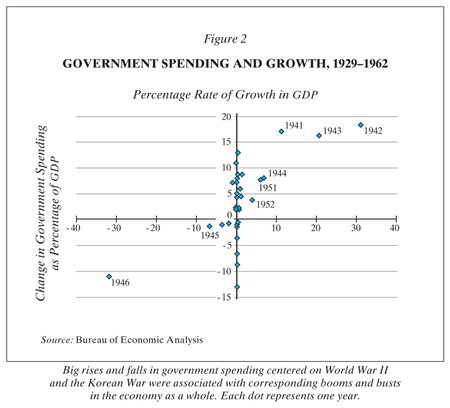
First, Stanford’s Robert Hall has looked at the effects of large changes in US government purchases—which is all about wars, specifically World War II and the Korean War. Figure 2 on this page [see below] compares changes in US military spending with changes in real GDP—both measured as a percentage of the preceding year’s GDP—over the period from 1929 to 1962 (there’s not much action after that). Each dot represents one year; I’ve labeled the points corresponding to the big buildup during World War II and the big demobilization just afterward. Obviously, there were big moves in years when nothing much was happening to military spending, notably the slump from 1929 to 1933 and the recovery from 1933 to 1936. But every year in which there was a big spending increase was also a year of strong growth, and the reduction in military spending after World War II was a year of sharp output decline.

Krugman did not explain his chart in detail, so I consulted the study by Robert Hall cited by Krugman. Hall’s insight was to focus not on government spending, just military spending, because other components of government spending are themselves influenced by the state of the economy, making it difficult to disentangle the effects of spending on the economy from the effects of the economy on spending. However, military spending is largely driven, especially in wartime (World War II and Korea), by factors unrelated to how the economy is performing. This makes military spending an appropriate instrument by which to identify and estimate the effect of government spending on the economy.

The problem with Krugman’s discussion is that, although using military expenditures allowed him to avoid the identification problem associated with the interdependency of government spending and the level of economic activity, he left out any mention of the behavior of the price level, which, many of us (and perhaps even Krugman himself) believe, powerfully affects the overall level of economic activity. Krugman artfully avoids any discussion of this relationship with the seemingly innocent observation “there were big moves in years when nothing much was happening to military spending, notably the slump from 1929 to 1933 and the recovery from 1933 to 1936.” But even this implicit acknowledgment of the importance of the behavior of the price level overlooks the fact that the huge wartime increase in military spending took place against the backdrop of rapid inflation, so that attributing economic expansion during World War II solely to the increase in government spending does not seem to warranted, because at least some of the increase in output would have been been forthcoming, even without increased military spending, owing to the rise in the price level.

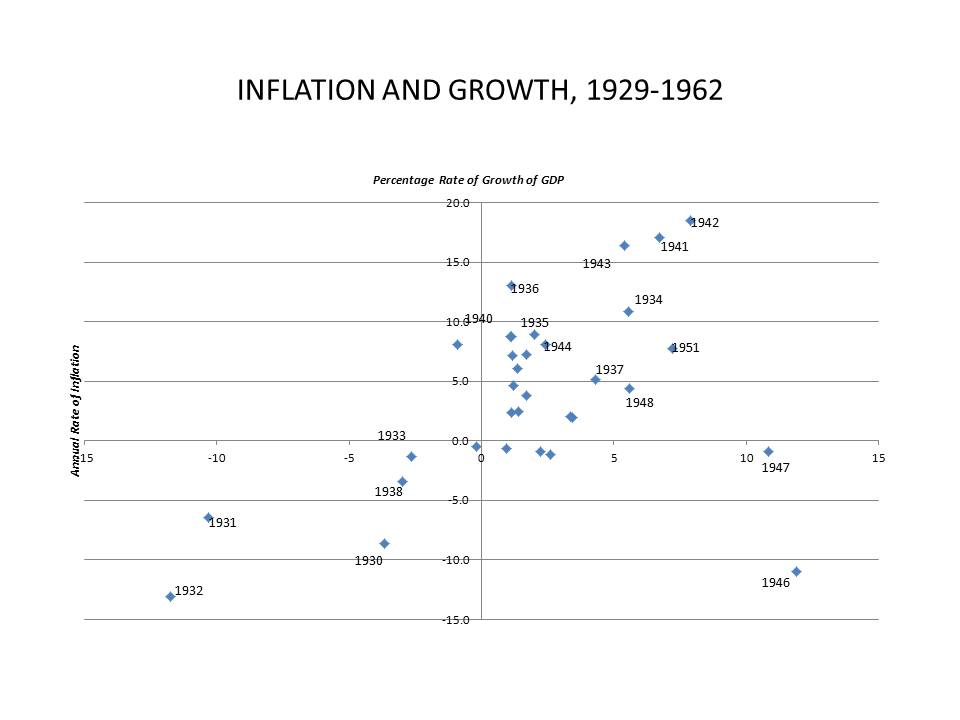
It is not hard to compare the effects of inflation and the effects of military spending on economic growth over the time period considered by Krugman. One can simply take annual inflation each year from 1930 to 1962 and plot the yearly rates of inflation and economic growth that Krugman plotted on his figure. Here is my version of Krugman’s chart substituting inflation for the change in military spending as a percentage of GDP.

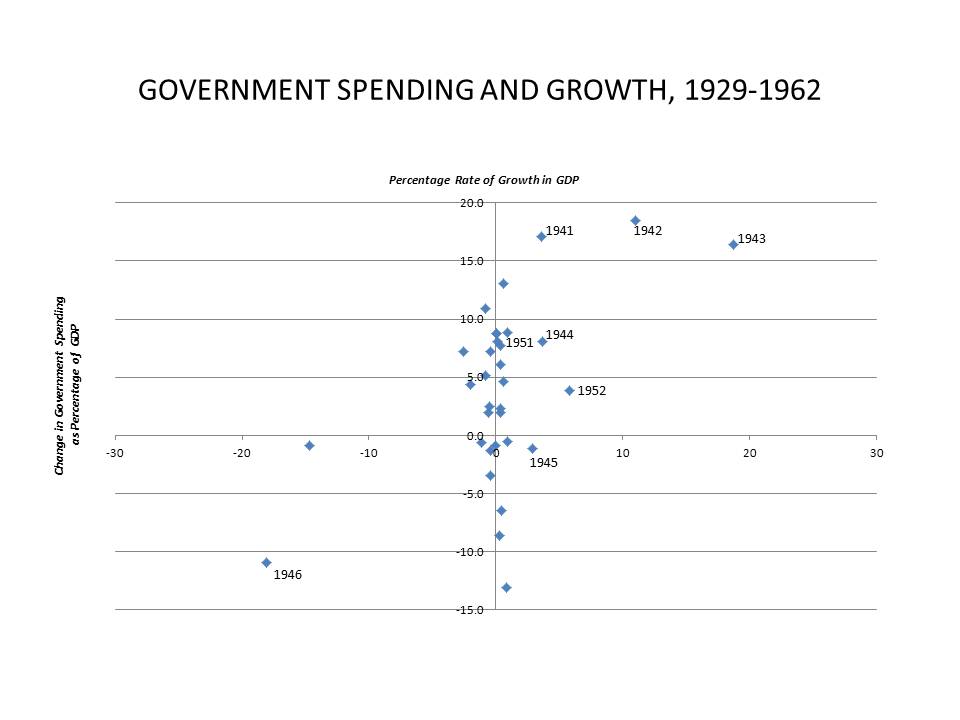
It is difficult visually to compare the diagrams to see which one provides the more informative account of the fluctuations in economic growth over the 33 years in the sample. But it is not hard to identify the key difference between the two diagrams. In Krugman’s diagram, the variation in military spending provides no information about the variation in economic growth during the 1930s. There are is a cluster of points up and down the vertical axis corresponding to big positive and negative fluctuations in GDP with minimal changes in military spending. But large changes in GDP during the 1940s do correspond to changes in the same direction in military spending. Similarly, during the Korean War in the early 1950s, there was a positive correlation between changes in military spending. From the mid-1950s to the early 1960s, annual changes in GDP and in military spending were relatively small.

In my diagram plotting annual rates of inflation against annual changes in GDP, the large annual changes in GDP are closely related to positive or negative changes in the price level. In that respect, my diagram provides a more informative representation of the data than does Krugman’s. Even in World War II, the points representing the war years 1942 to 1945 are not far from a trend line drawn through the scatter of points. Where the diagram runs into serious trouble is that two points are way, way off to one side. Those are the years 1946 and 1947.

What was going on in those years? GDP was contracting, especially in 1946, and prices were rising rapidly, exactly contrary to the usual presumption that rising prices tend to generate increases in output. What was going on? It all goes back to 1942, when FDR imposed wartime price controls. This was partly a way of preventing suppliers from raising prices to the government, and also a general anti-inflation measure. However, the result was that there were widespread shortages, with rationing of a wide range of goods and services.  The officially measured rate of inflation from 1942 to 1945 was therefore clearly understated. In 1946 and 1947, controls were gradually relaxed and finally eliminated, with measured inflation rates actually increasing even though the economy was contracting.  Measured inflation in 1946 and 1947 therefore overstated actual inflation by an amount corresponding (more or less) to the cumulative understatement of inflation from 1942 to 1945. That the dots representing 1946 and 1947 are outliers is not because the hypothesized causal relationship between inflation and GDP was inoperative or reversed, but because of a mistaken measurement of what inflation actually was.

To get a better handle on the relative explanatory power of the government-spending and the inflation hypotheses in accounting for fluctuations in GDP than visual inspection of the data allows, one has to work with the underlying data. Unfortunately, when I tried to measure changes in military spending from 1929 to 1962, I could not reproduce the data underlying Krugman’s chart. That was not Krugman’s fault; I don’t doubt that he accurately calculated the relevant data from the appropriate sources. But when I searched for data on military spending since 1929, the only source that I found was this. So that is what I used. I assume that Krugman was using a different source from the one that I used, and he may also have defined his government spending variable in a different way from how I did. At any rate, when I did the calculation, I generated a chart that looked like the one below. It is generally similar to Krugman’s, but obviously not the same. If someone can explain why I did not come up with the same numbers for changes in government spending that Krugman did, I would be very much obliged and will redo my calculations. However, in the meantime, I am going to assume that my numbers are close enough to Krugman’s, so that my results would not be reversed if I used his numbers instead.

Taking my version of Krugman’s data, I ran a simple regression of the annual change in real GDP (dGDP) on the annual change in government (i.e., military spending) as a percentage of GDP (dG) from 1930 to 1962 (the data start in 1929, but the changes don’t start till 1930). The regression equation that I estimated was the following:

dGDP = 3.60 + .70dG, r-squared = .295.

This equation says that the percent increase in real GDP in any year is 3.6% plus seven-tenths of the percentage increase in government (i.e., military) spending for that year.

I then ran a corresponding regression of the annual change in real GDP on the annual change in the price level (dP, derived from my estimate of the GDP price deflator). The estimated regression was the following:

dGDP = 2.48 + .69dP, r-squared = .199.

The equation says that the percent increase in real GDP in any year is 2.48% plus .69 times that year’s rate of inflation.

Because the r-squared of the first equation is about 50% higher than that of the second, there would be good reason to prefer the first equation over the second were it not for the measurement problem that I mentioned above. I tried a number of ways of accounting for that measurement problem, but the simplest adjustment was simply to add two dummy variables, one for price controls during World War II and one for the lifting of price controls in 1946 and 1947. When I introduced both dummy variables into the equation, it turned out that the dummy variable for price controls during World War II was statistically insignificant, inasmuch as there was some measured inflation even during the World War II price controls. It was only the dummy variable controlling for the (mis)measured inflation associated with the lifting of price controls that was statistically significant. Here is the estimated regression:

dGDP = 2.76 + 1.28dP – 23.29PCON, r-squared = .621

I also tried attributing the inflation measured in 1946 and 1947 to the years 1942 to 1945, giving each of those years an inflation rate of about 9.7% and attributing zero inflation to the years 1946 and 1947. The regression equation that I estimated using that approach did not perform as well, based on a comparison of adjusted r-squares, as the simple equation with a single dummy variable. I also estimated equations using both the government spending variable and the inflation variable, and the two price-control dummies. That specification, despite two extra variables, had an r-squared less than the r-squared of the above equation. [Update 11/20/2012:  This was my mistake, because the best results were obtained using only a dummy variable for 1946 and 1947.  When the government spending and the inflation variables were estimated with a dummy for 1946-1947, the coefficients on both variables were positive and significant.]  So my tentative conclusion is that the best way to summarize the observed data pattern for the fluctuations of real GDP between 1929 and 1962 is with an equation with only an inflation variable and an added dummy variable accounting for the mismeasurement of inflation in 1946 and 1947.

Nevertheless, I would caution against reading too much into these results, even on the assumption that the provisional nature of the data that I have used has not introduced any distortions and that there are no other errors in my results. (Anyone who wants to check my results is welcome to email me at uneasymoney@hotmail.com, and I will send you the (Stata) data files that I have used.) Nor do I claim that government spending has no effect on real GDP. I am simply suggesting that for the time period between 1929 and 1962 in the US, there does not seem to be strong evidence that government spending significantly affected real GDP, once account is taken of the effects of changes in the price level. With only 33 observations, the effect of government spending, though theoretically present, may not be statistically detectable, at least not using a simple linear regression model. One might also argue that wartime increases in government spending contributed to the wartime inflation, so that the effect of government spending is masked by including a price-level variable. Be that as it may, Krugman’s (and Hall’s) argument that government spending was clearly effective in increasing real GDP in World War II and Korea, and would, therefore, be likely to be effective under other circumstances, is not as self-evidently true as Krugman makes it out to be. I don’t say that it is incorrect, but the evidence seems to be, at best, ambiguous.

More on Currency Manipulation

My previous post on currency manipulation elicited some excellent comments and responses, helping me, I hope, to gain a better understanding of the subject than I started with. What seemed to me the most important point to emerge from the comments was that the Chinese central bank (PBC) imposes high reserve requirements on banks creating deposits. Thus, the creation of deposits by the Chinese banking system implies a derived demand for reserves that must be held with the PBC either to satisfy the legal reserve requirement or to satisfy the banks’ own liquidity demand for reserves. Focusing directly on the derived demand of the banking system to hold reserves is a better way to think about whether the Chinese are engaging in currency manipulation and sterilization than the simple framework of my previous post. Let me try to explain why.

In my previous post, I argued that currency manipulation is tantamount to the sterilization of foreign cash inflows triggered by the export surplus associated with an undervalued currency. Thanks to an undervalued yuan, Chinese exporters enjoy a competitive advantage in international markets, the resulting export surplus inducing an inflow of foreign cash to finance that surplus. But neither that surplus, nor the undervaluation of the yuan that underlies it, is sustainable unless the inflow of foreign cash is sterilized. Otherwise, the cash inflow, causing a corresponding increase in the Chinese money supply, would raise the Chinese price level until the competitive advantage of Chinese exporters was eroded. Sterilization, usually conceived of as open-market sales of domestic assets held by the central bank, counteracts the automatic increase in the domestic money supply and in the domestic price level caused by the exchange of domestic for foreign currency. But this argument implies (or, at least, so I argued) that sterilization is not occurring unless the central bank is running down its holdings of domestic assets to offset the increase in its holdings of foreign exchange. So I suggested that, unless the Chinese central holdings of domestic assets had been falling, it appeared that the PBC was not actually engaging in sterilization. Looking at balance sheets of the PBC since 1999, I found that 2009 was the only year in which the holdings of domestic assets by the PBC actually declined. So I tentatively concluded that there seemed to be no evidence that, despite its prodigious accumulation of foreign exchange reserves, the PBC had been sterilizing inflows of foreign cash triggered by persistent Chinese export surpluses.

Somehow this did not seem right, and I now think that I understand why not. The answer is that reserve requirements imposed by the PBC increase the demand for reserves by the Chinese banking system. (See here.) The Chinese reserve requirements on the largest banks were until recently as high as 21.5% of deposits (apparently the percentage is the same for both time deposits and demand deposits). The required reserve ratio is the highest in the world. Thus, if Chinese banks create 1 million yuan in deposits, they are required to hold approximately 200,000 yuan in reserves at the PBC. That 200,000 increase in reserves must come from somewhere. If the PBC does not create those reserves from domestic credit, the only way that they can be obtained by the banks (in the aggregate) is by obtaining foreign exchange with which to satisfy their requirement. So given a 20% reserve requirement, unless the PBC undertakes net purchases of domestic assets equal to at least 200,000 yuan, it is effectively sterilizing the inflows of foreign exchange. So in my previous post, using the wrong criterion for determining whether sterilization was taking place, I had it backwards. The criterion for whether sterilization has occurred is whether bank reserves have increased over time by a significantly greater percentage than the increase in the domestic asset holdings of the PBC, not, as I had thought, whether those holdings of the PBC have declined.

In fact it is even more complicated than that, because the required-reserve ratio has fluctuated over time, the required-reserve ratio having roughly tripled between 2001 and 2010, so that the domestic asset holdings of the PBC would have had to increase more than proportionately to the increase in reserves to avoid effective sterilization. Given that the reserves held by banking system with the PBC at the end of 2010 were almost 8 times as large as they had been at the end of 2001, while the required reserve ratio over the period roughly tripled, the domestic asset holdings of the PBC should have increased more than twice as fast as bank reserves over the same period, an increase of, say, 20-fold, if not more. In the event, the domestic asset holdings of the PBC at the end of 2010 were just 2.2 times greater than they were at the end of 2001, so the inference of effective sterilization seems all but inescapable.

Why does the existence of reserve requirements mean that, unless the domestic asset holdings of the central bank increase at least as fast as reserves, sterilization is taking place? The answer is that the existence of a reserve requirement means that an increase in deposits implies a roughly equal percentage increase in reserves. If the additional reserves are not forthcoming from domestic sources, the domestic asset holdings of the central bank not having increased as fast as did required reserves, the needed reserves can be obtained from abroad only by way of an export surplus. Thus, an increase in the demand of the public to hold deposits cannot be accommodated unless the required reserves can be obtained from some source. If the central bank does not make the reserves available by purchasing domestic assets, then the only other mechanism by which the increased demand for deposits can be accommodated is through an export surplus, the surplus being achieved by restricting domestic spending, thereby increasing exports and reducing imports. The economic consequences of the central bank not purchasing domestic assets when required reserves increase are the same as if the central bank sold some of its holdings of domestic assets when required reserves were unchanged.

The more general point is that one cannot assume that the inflow of foreign exchange corresponding to an export surplus is determined solely by the magnitude of domestic currency undervaluation. It is also a function of monetary policy. The tighter is monetary policy, the larger the export surplus, the export surplus serving as the mechanism by which the public increases their holdings of cash. Unfortunately, most discussions treat the export surplus as if it were determined solely by the exchange rate, making it seem as if an easier monetary policy would have little or no effect on the export surplus.

The point is similar to one I made almost a year ago when I criticized F. A. Hayek’s 1932 defense of the monetary policy of the insane Bank of France. Hayek acknowledged that the gold holdings of the Bank of France had increased by a huge amount in the late 1920s and early 1930s, but, nevertheless, absolved the Bank of France of any blame for the Great Depression, because the quantity of money in France had increased by as much as the increase in gold reserves of the Bank of France.  To Hayek this meant that the Bank of France had done “all that was necessary for the gold standard to function.” This was a complete misunderstanding on Hayek’s part of how the gold standard operated, because what the Bank of France had done was to block every mechanism for increasing the quantity of money in France except the importation of gold. If the Bank of France had not embarked on its insane policy of gold accumulation, the quantity of money in France would have been more or less the same as it turned out to be, but France would have imported less gold, alleviating the upward pressure being applied to the real value of gold, or stated equivalently alleviating the downward pressure on the prices of everything else, a pressure largely caused by insane French policy of gold accumulation.

The consequences of the Chinese sterilization policy for the world economy are not nearly as disastrous as those of the French gold accumulation from 1928 to 1932, because the Chinese policy does not thereby impose deflation on any other country. The effects of Chinese sterilization and currency manipulation are more complex than those of French gold accumulation. I’ll try to at least make a start on analyzing those effects in an upcoming post addressing the comments of Scott Sumner on my previous post.

Earl Thompson

Sunday, July 29, will be the second anniversary of the sudden passing of Earl Thompson, one of the truly original and creative minds that the economics profession has ever produced. For some personal recollections of Earl, see the webpage devoted to him on the UCLA website, where a list of his publications and working papers, most of which are downloadable, is available. Some appreciations and recollections of Earl are available on the web (e.g, from Tyler Cowen, Scott Sumner, Josh Wright, and Thomas Lifson).  I attach a picture of Earl taken by a department secretary, Lorraine Grams, in 1974, when Earl was about 35 years old.

I first met Earl when I was an undergraduate at UCLA in the late 1960s, his reputation for brilliant, inconclastic, eccentricity already well established. My interactions with Earl as undergraduate were minimal, his other reputation as a disorganized and difficult-to-follow lecturer having deterred me, as a callow sophomore, from enrolling in his intermediate micro class. Subsequently as a first-year graduate student, I had the choice of taking either Axel Leijonhufvud’s macro-theory sequence or Earl’s. Having enjoyed Axel’s intermediate macro course, I never even considered not taking the graduate sequence from Axel, who had just achieved academic stardom with the publication of his wonderful book On Keynesian Economics and the Economics of Keynes. However, little by little over the years, I had started reading some of Earl’s papers on money, especially an early version of his paper “The Theory of Money and Income Consistent with Orthodox Value Theory,” which, containing an explicit model of a competitive supply of money, a notion that I had been exposed to when taking Ben Klein’s undergraduate money and banking course and his graduate monetary theory course, became enormously influential on my own thinking, providing the foundation for my paper, “A Reinterpretation of Classical Monetary Theory” and for much of my book Free Banking and Monetary Reform, and most of my subsequent work in monetary economics. So as a second-year grad student, I decided to attend Earl’s weekly 3-hour graduate macro theory lecture. Actually I think at least half of us in the class may have been there just to listen to Earl, not to take the class for credit. Despite his reputation as a disorganized and hard to follow lecturer, each lecture, which was just Earl at the blackboard with a piece of chalk drawing various supply and demand curves, and occasionally something more complicated, plus some math notation, but hardly ever any complicated math or formal proofs, and just explaining the basic economic intuition of whatever concept he was discussing. By this time he had already worked out just about all of the concepts, and he was not just making it up as he was going along, which he could also do when confronted with a question about something he hadn’t yet thought through. But by then, Earl had thought through the elements of his monetary theory so thoroughly and for so long, that everything just fit into place beautifully. And when you challenged him about some point, he almost always had already anticipated your objection and proceeded to explain why your objection wasn’t a problem or even supported his own position.

I didn’t take detailed notes of his lectures, preferring just to try to understand how Earl was thinking about the topics that he was discussing, so I don’t have a clear memory of the overall course outline.  However his paper “A Reformulation of Macroeconomic Theory,” of which he had just produced an early draft, provides the outline of what he was covering. He started with a discussion of general equilibrium and its meaning, using Hicksian temporary equilibrium as his theoretical framework.  Perhaps without realizing it, he developed many of the ideas in Hayek’s Economics and Knowledge paper, which may, in turn, have influenced Hicks, who was for a short time Hayek’s student and colleague at LSE — in particular the idea that intertemporal equilibrium means consistency of plans so that economic agents are able to execute their plans as intended and therefore do not regret their decisions ex post. From there I think he developed a search-theoretic explanation of involuntary unemployment in which mistaken worker expectations of wages, resulting from an inability to distinguish between sector-specific and economy-wide shocks, causes labor-supply curves to be highly elastic at the currently expected wage, implying large fluctuations in employment, in response to economy-wide shocks, rather than rapid adjustments in nominal wages . With this theoretical background, Earl constructed a simple aggregative model as an alternative to the Keynesian model, the difference being that Earl dispensed with the Keynesian expenditure functions and the savings equals investment equilibrium condition, replacing them with a capital-market equilibrium condition derived from neo-classical production theory — an inspired modeling choice.

Thus, in one fell swoop, Earl created a model fully consistent with individual optimizing behavior, market equilibrium and Keynesian unemployment. Doing so involved replacing the traditional downward-sloping IS curve with an upward-sloping, factor-market equilibrium curve. At this point, the model could be closed either with a traditional LM curve corresponding to an exogenously produced money supply or with a vertical LM curve associated with a competitively produced money supply. That discussion in turn led to a deep excursion into the foundations of monetary theory, the historical gold standard, fiat money, and a comparison of the static and dynamic efficiency of alternative monetary institutions, combined with a historical perspective on the Great Depression, and the evolution of modern monetary institutions. It was a terrific intellectual tour de force, and a highlight of my graduate training at UCLA.

Unfortunately, “A Reformulation of Macroeconomic Theory” has never been published, though a revised version of the paper (dated 1977) is available on Earl’s webpage. The paper is difficult to read, at least for me, because Earl was much too terse in his exposition – many propositions are just stated with insufficient motivation or explanation — with readers often left scratching their heads about the justification for what they have read or why they should care.  So over the next week or so, I am going to write a series of posts summarizing the main points of the paper, and discussing why I think the argument is important, problems I have with his argument or ways in which the argument needs further elaboration or what not. I hope the discussions will lead people to read the original paper, as well as Earl’s other papers.


About Me

David Glasner
Washington, DC

I am an economist in the Washington DC area. My research and writing has been mostly on monetary economics and policy and the history of economics. In my book Free Banking and Monetary Reform, I argued for a non-Monetarist non-Keynesian approach to monetary policy, based on a theory of a competitive supply of money. Over the years, I have become increasingly impressed by the similarities between my approach and that of R. G. Hawtrey and hope to bring Hawtrey’s unduly neglected contributions to the attention of a wider audience.

My new book Studies in the History of Monetary Theory: Controversies and Clarifications has been published by Palgrave Macmillan

Follow me on Twitter @david_glasner

Archives

Enter your email address to follow this blog and receive notifications of new posts by email.

Join 665 other subscribers
Follow Uneasy Money on WordPress.com