Archive for the '1920-21 Depression' Category

Mattei Misjudges Hawtrey

Clara Mattei, associate professor of economics at the New School for Social Research, recently published a book, The Capital Order: How Economists Invented Austerity and Paved the Way to Fascism, (University of Chicago Press) in which she argues that the fiscal and monetary austerity imposed on Great Britain after World War I to restore the gold standard at the prewar parity of pound to the dollar provided a model for austerity policies imposed by Mussolini in Italy when he took control of the Italian state in the early 1920s. In making her argument, Mattei identifies Hawtrey, Director of Financial Enquiries in the British Treasury for the entire interwar period, as the eminence grise behind the austerity policies implemented by the Treasury and the Bank of England to restore convertibility at the prewar parity.

Mattei’s ideological position is obviously left of center, and her attempt to link British austerity policies during the 1920s with the rise of fascism in Italy furthers her ideological agenda. Although that agenda is not mine, my only interest here is to examine her claim that Hawtrey was the intellectual architect of the austerity policies she deplores. I leave it to others to assess her broader historical claims.

In her introductory chapter, Mattei (p. 10) justifies her attention to Hawtrey, by claiming that his “texts and memoranda . . . would serve as the guidelines for British austerity after World War I,” describing the Treasury officials Sir Basil Blackett and Sir Otto Niemeyer, under whom Hawtrey served, as “working at his side,” as if they were Hawtrey’s subordinates rather than the other way around. At the end of the chapter, Mattei (p. 20) writes: “I was riveted by the evidence of Hawtrey’s persuasion of the other two bureaucrats, and in turn how the two bureaucrats, neither one a trained economist, came to be missionaries in campaigns to export the British austerity agenda to other countries around the globe.” In a later passage (p. 171), she elaborates:

In the face of unrelenting opposition, Niemeyer and Blackett needed solid intellectual grounds to urge the chancellor of the exchequer to move for dear money and drastic cuts in public expenditures. In examining the controllers’ confidential Treasury files—virtually the only direct source of information we have about their economic beliefs—one is struck by the ubiquity and influence of the economist Ralph G. Hawtrey, the primary source of economic knowledge for Blackett and especially for Niemeyer. In fact, there is ample evidence that Hawtreyan economics refined and strengthened the economic stance of the senior Treasury officials, so as to enable the emergence of a full-blown austerity doctrine.

Given her emphasis on the documentary record left by Hawtrey during his nearly three decades as the in-house economist at the Treasury, I would have expected to see more than just the few direct quotations and citations from the voluminous internal memos written by Hawtrey to his Treasury colleagues to which Mattei makes general reference. The references to Hawtrey’s communications with his colleagues provide few specifics, while the more numerous citations to his writings seem to misinterpret, misrepresent or mischaracterize Hawtrey’s theoretical and policy views.

It should also be noted that Mattei’s estimation of Hawtrey’s influence at the Treasury is not shared by other researchers into Hawtrey’s life and career. R. D. C. Black, who wrote an admiring biographical essay on Hawtrey for the British Academy of which Hawtrey became a member in 1935, wrote dismissively of Hawtrey’s influence at the Treasury.

Hawtrey drew up many and varied reports and memoranda on economic and financial matters which are now to be found among the papers of senior Treasury officials of that period, but the impression prevails that they did not receive much attention, and that the Financial Enquiries Branch under Hawtrey was something of a backwater.

R. D. C. Black, “Ralph George Hawtrey, 1879-1975.” In Proceedings of the British Academy, 1977, p. 379.

Susan Howson, in her biographical essay on Hawtrey, believed that Hawtrey was influential eary in his tenure as Director of Financial Enquiries, primarily because of his important role in drafting the financial resolutions for the Genoa Conference of 1922, about which more will be said below, but that his influence declined subsequently. Mattei cites both Black and Howson in her book, but does not engage with their assesment of Hawtrey’s influence at Treasury. Mattei also cites the unpublished doctoral dissertation of Alan Gaukroger on Hawtrey, which focuses specifically on his service as Director of Financial Enquiries at the Treasury, but does not engage with his detailed assement, based on exhaustive reading of relevant Treasury memoranda, of Hawtrey’s influence on his Treasury colleagues and superiors. Here is how Gaukroger characterizes those memoranda:

In the case of Hawtrey, who was to some extent an outsider to the very small and closely knit group of influential policy makers, the written memorandum was his method of attempting to break into, and influence, the powerful central group. . . .

Many of Hawtrey’s memoranda were unsolicited. He produced them because he was critical of some spect of Government policy. In some of these memoranda there is a marked tone of anger. This was particularly apparent during the late 1920s when the United Kingdom had returned to the Gold
Standard and Hawtrey believed that the Bank of England was pursuing a foolish and unnecessarily high interest rate policy. At this time, his memoranda, critical of Bank or even Treasury policy, could, for such a mild-mannered man, be quite savage in tone. Often, his memoranda were produced as a result of a specific request. On a very small number of occasions they were produced as a result of a direct request for guidance, or information, from the Chancellor of the Exchequer. At other times Hawtrey prepared a memorandum as a result of a Parliamentary Question. Often a senior colleague wanted support in reparing a memorandum and would seek to use Hawtrey’s expertise, particularly with regard to currency and foreign exchange. Hawtrey would invariably write an unsolicited memorandum after press criticism of Treasury Policy.

A. Gaukroger, “The Director of Financial Enquiries.” Ph.D. Thesis. University of Huddersfield, 2008, pp. 29-32

In criticizing the austerity doctrines and policies of the British Treasury and the Bank of England in the decade after World War I, Mattei mounts a comprehensive attack on Hawtrey’s views (or what she inaccurately represents to be his views) to which she, unlike other researchers, ascribes immense influence. She begins with the decision to restore the gold standard and the subsequent deflationary policy adopted in the1920-22 period to reverse the wartime and postwar inflations, and subsequently to restore the gold standard at the prewar parity of the pound to the dollar ($4.86). Mattei’s overestimation of Hawtrey’s influence is evidenced by her failure even to mention the 1918 interim report of the Cunliffe Commission (headed by the former Governor of the Bank of England Lord Cunliffe) recommending the prompt restoration of the gold standard in as close a form as possible to the prewar gold standard. Although no precise parity was specified, the goal of minimizing the departure from the prewar gold standard (except for not reintroducing a full-bodied gold coinage) made the prewar parity to the dollar, restored in 1919 to its prewar gold parity of $20.67/ounce, the obvious benchmark for restoration.

Her next object of criticism is Hawtrey’s advocacy of deflation in his 1919 article “The Gold Standard,” to reverse, if only partially, the inflation during and after the war that had cut the purchasing power of the pound by roughly 60%. The inflation, especially the postwar inflation, had been deeply unsettling, and there was undoubtedly strong political pressure on the government to halt the inflation. Although opposed to both inflation and deflation, Hawtrey believed that some deflation was needed to achieve stabilization, especially given that the US, which had restored convertibility of the dollar into gold in June 1919, would likely adopt a deflationary policy.

Mattei cites Hawtrey’s approval of the April 1920 increase in Bank rate by the Bank of England to an unprecedented 7% to break the inflationary spiral then underway. Inflation was quickly tamed, but a brutal deflation followed, while Bank rate remained at 7% for more than 12 months before a half a percent cut in April 1922 with further half-percent cuts at bimonthly intervals till the rate was reduced to 3% in July 1922.

Hawtrey’s support for deflation was less categorical and durable than Mattei claims. Prices having risen much faster than wages since the war started, Hawtrey thought that deflation would cause prices to fall before downward pressure on wages started. (See G. C. Peden, The Treasury and British Public Policy 1906-1959, Oxford: Oxford University Press, p. 154.) Once unemployment increased and wages came under significant downward pressure, Hawtrey began to call for easing of the dear-money policy of the Bank. Montague Norman, Governor of the Bank of England, aware of Hawtrey’s criticisms of Bank of England policy, shared his annoyance with Hawtrey in a letter to his counterpart at the Federal Reserve, Benjamin Strong, mentioning criticism from “a ‘leading light’ of the Treasury [who] made it his particular business to quarrel with the policy of the Treasury and the Bank of England.” (See G. C. Peden, Id. pp. 155-56.) Hawtrey later articulated the basis for his criticism.

In 1920 it was justifiable to keep up Bank rate so long as there was any uncertainty whether inflation had been successfully checked. But even in the late summer of 1920 there was no real doubt that this was so, and by November 1920, it was abundantly clear that the danger was in the opposite direction, and was that of excessive deflation.

Hawtrey, A Century of Bank Rate, London: Longmans, Green and Co., 1938, p. 133.

Mattei further attacks Hawtrey for his central role in the Genoa Conference of 1922, which, besides resolutions on other topics of international concern, adopted resolutions aimed at restoring the international gold standard. As early as in his 1919 article on the gold standard and in his important book Currency and Credit of the same year, Hawtrey was warning urgently that restoring the gold standard could cause severe–possibly disastrous–deflation unless countries rejoining the gold standard cooperated to moderate their demand for gold reserves when setting fixed parities between their currencies and gold.

Hawtrey therefore proposed that countries other than the US and Britain rejoin the gold standard by discharging their obligations in dollars or pound sterling, which were either (in the case of the dollar) already convertible into gold, or (in the case of sterling) likely to be convertible in the future. By freeing national central banks from the need to hold actual gold reserves to discharge their obligations, the Genoa proposals aimed to limit the international demand for gold, thereby moderating or eliminating the deflationary pressure otherwise entailed by restoring the gold standard. Additionally, the resulting demand by central banks to hold sterling-denominated liabilities would ease the pressure on the British balance of payments, thereby making room for the Bank of England to reduce Bank rate.

Ignoring Hawtrey’s anti-deflationary intent in drafting those resolution, Mattei focuses on the legal independence for central banks proposed by the resolutions, intended to insulate them from demands by national governments to print money to fund fiscal deficits, money printing by governments or by banks under government pressure to do so, having been, historically, a primary cause of inflation. Mattei further misrepresents Hawtrey’s call for monetary management to avoid the likely deflationary consequences of an unmanaged restoration of the prewar gold standard as evidence that Hawtrey desired to impose an even more draconian austerity on British workers than an unmanaged restoration of the gold standard would have imposed, thereby imputing to Hawtrey an intention precisely the opposite of what he meant to accomplish.

Mattei equates Hawtrey’s support for central-bank independence in the Genoa Resolutions with hostility to democracy. Quoting from Hawtrey’s 1925 article “Currency and Public Administration,” which, she suggests, betrays a technocratic and anti-democratic mindset that he shared with contemporary Italian theoreticians of fascism, Mattei seizes on the following passage:

The central bank is free to follow the precept: “never explain; never regret; never apologize.” It need make no statement of policy. Critics may rage for nine days, but in face of the silence imposed by tradition they do not keep it up.”

Hawtrey, “Currency and Public Administration” Public Administration 3(3):232-45, 243

Mattei subjects the elitist tone of Hawtrey’s defense of central bank independence to withering criticism, a criticism echoed by her ideological opposite Milton Friedman, but she neglects to quote an important explanatory passage.

The public interest in the broadest sense is profoundly affected by currency administration. Those who deprecate criticism fear an ill-judged pressure at critical times. Experience shows that, whenever an expansion of credit is developing to excess, a formidable opposition arises in the trading world to an increase in bank rate. When on the other hand, business is in a state of depression, no one minds what happens to bank rate. The influence of outside pressure is, therefore, just the contrary to what is required.

Perhaps that is so, because criticism is confined to financial and trading circles. When credits is expanding, traders want to borrow, and resent any measures which makes borrowing more difficult or more expensive. When business is depressed, they do not want to borrow. In neither case are they impelled to look beyond their own affairs to the effect of credit on the public interest.

Id.

It is interesting that Hawtrey would have written as he did in 1925 given his own recent experience in criticizing the dear money policy generally followed by the Bank of England since 1921 when the Bank of England steadfastly refused to lower Bank rate despite his own repeated pleas for rate reductions and criticisms of the Bank’s refusal to respond to those pleas.

In his lengthy and insightful doctoral dissertation about Hawtrey’s tenure at the Treasury, Alan Gaukroger, relying far more intensively and extensively than Mattei on the documentary record of Hawtrey’s tenure, discusses a Treasury Memorandum written by Hawtrey on December 5, 1925 soon after Bank of England raised Bank rate back to 5% after briefly reducing it to 4% immediately after restoration of the prewar parity with dollar in April.

The raising of the Bank rate to 5% is nothing less than a national disaster. That dear money causes unemployment is a proposition which ought not to admit of dispute. Not only is it the generally accepted opinion of theoretical economists, but it was well recognised by practical financiers and men of business before economists paid much attention to it.

Gaukroger, p. 194

Gaukroger (p. 193) also reports, relying on a recorded interview of Hawtrey conducted by Alexander Cairncross in 1965, that upon hearing the news that Bank rate had been raised back to 5%, Hawtrey went directly to Niemeyer’s office to express his fury at the news he had just heard, only to find, after he had begun denouncing the increase, that Montagu Norman himself had been seated in Niemeyer’s office behind the door he had just opened. Direct communication between Hawtrey and Norman never resumed.

Gaukroger also reports that Hawtrey’s view was dismissed not only by the Bank of England but by his superior Otto Niemeyer and by Niemeyer’s deputy Sir Frederick Leith-Ross, who invidiously compared Hawtrey in opposing an increase in Bank rate to Rudolf Havenstein, President of the German Reichsbank during the German hyperinflation of 1923.

As already mentioned, Mattei accuses Hawtrey of having harbored a deflationary bias owing to a belief that a credit economy is inherently predisposed toward inflation, a tendency that must be counteracted by restrictive monetary policy.

Mattei’s accusation of deflationary bias rests on a misunderstanding of Hawtrey’s monetary theory. In Hawtrey’s theory, if banks create too much credit, the result is inflation; if they create too little, the result is deflation. No endogenous mechanism keeps credit creation by banks on a stable non-inflationary, non-deflationary path. Once inflation or deflation sets in, a cumulative process leads to continuing, even accelerating, inflation or deflation. To achieve stability, an exogenous stabilizing mechanism, like a metallic standard or a central bank, is needed to constrain or stimulate, albeit imperfectly, credit creation by the banking system. It was only in the special conditions after World War I and the collapse of the prewar gold standard, which had been centered in London, that Hawtrey believed a limited deflation would be useful in pursuing the generally accepted goal of restoring the prewar gold standard. But the postwar deflation was far more extreme than the deflation contemplated, much less endorsed, by Hawtrey.

Mattei infers from Hawtrey’s support for deflation to reverse the postwar inflation, that he regarded inflation as a greater and more dangerous threat than inflation, without acknowledging that he regarded the 1920-22 deflation as excessive and unjustified. She also cites his endorsement of restoring convertibility of the pound at the prewar ($4.86) parity against the dollar, despite the deflationary implications of that restoration, as further evidence of Hawtrey’s approval of deflation. But Mattei ignores Hawtrey’s repeated arguments that, given the high rate of unemployment in Britain, there was ample room, even after restoration of the prewar parity, for the Bank of England to have reduced Bank rate to promote increased output and employment.

The advance of Bank rate to 5% in March 1925 supervened on a condition of things which promised to bring the pound sterling to par with the dollar without any effort at all. Credit was expanding and the price level in the United States, which may be taken as indicating the price level in terms of gold, was rising. This expansive tendency came abruptly to an end. The rediscount rate, it is true, was raised in New York, but only to 3.5%, and till 1928 the American Federal Reserve Bank adhered to moderate rediscount rates and a policy of credit relaxation. The deflationary tendency in the gold standard world was due to the continuance of dear money in London. In British industry unemployment remained practically undiminished.

Hawtrey, A Century of Bank Rate, London: Longmans, Green and Co., 1938, pp. 137-38

While Mattei acknowledges that Hawtrey favored easing monetary policy after the restoration of the prewar parity, she minimizes its significance by citing Hawtrey’s recommendation to increase Bank rate in 1939 from the 2% rate at which it had been pegged since July 1932. But by 1940 British inflation had risen above 10%, substantiating Hawtrey’s fear, with Britain about to enter into World War II, of renewed inflation.

Mattei even imputes a sinister motivation to Hawtrey’s opposition to inflation, suggesting that he blamed inflation on the moral turpitude of workers lacking the self-discipline to save any of their incomes rather than squander it all on wasteful purchases of alcohol and tobacco, in contrast to the virtuous habits of the bourgeoisie and the upper classes who saved a substantial portion of their incomes. In doing so, Mattei, in yet another misunderstanding and mischaracterization, mistakenly attributes an over-consumption theory of inflation to Hawtrey. The consumption habits of the working class are irrelevant to Hawtrey’s theory of income and prices in which total income is determined solely by the amount of credit created by the banking system.

If substantial idle resources are available, a reduced lending rate encourages retail and wholesale businesses and traders to increase their holdings of inventories by increasing orders to manufacturers who then increase output, thereby generating increased income which, in turn, leads to increased purchases of consumer and capital goods. The increase in output and income causes a further increase the desired holdings of inventories by businesses and traders, initiating a further round of increases in orders to manufacturers so that further increases in output and income are constrained by the limits of capacity, whereupon further reductions in lending rates would cause inflation rather than increased output.

While the composition of output between investment goods and consumption goods is governed, in Hawtrey’s theory, by the savings habits of households, the level of total output and income and the rate of inflation or deflation are determined entirely by the availability of credit. It was precisely on this theoretical basis that Hawtrey denied that increased public spending would increase output and employment during a depression unless that spending was financed by credit expansion (money creation); if financed by taxation or by borrowing, the public spending would simply reduce private spending by an equal amount. Mattei recognized the point in connection with public spending in her discussion of Hawtrey’s famous articulation of the Treasury View (see Hawtrey, “Public Expenditure and the Demand for Labour,”), but failed to recognize the same theoretical argument in the context of spending on consumption versus spending on investment.

I close this post with a quotation from Hawtrey’s Trade Depression and the Way Out, 2nd edition, a brilliant exposition of his monetary theory and its application to the problem of inadequate aggregate demand, a problem, as Keynes himself admitted, that he dealt with before Keynes had addressed it. I choose a passage from the last section, entitled “The Fear of Inflation,” of the penultimate chapter. Evidently, Mattei has not studied this book (which she does not cite or refer to). Otherwise, I cannot imagine how she could have written about Hawtrey in her book in the way that she did.

The fears that efforts to expand credit will be defeated in one way or anotherby the pessimism of traders are not wholly irrational. But that pessimism is no more than an obstacle to be overcome. And the much more usual view is that inflationary measures take effect only too easily

The real obstacle to measures of credit expansion is not the fear that they will not be effective, but the fear that they will. [author’s emphasis]

Yet what can be more irrational that that fear? The term inflation is very loosely used; sometimes it means any expansion of the currency or of bank credit, or any such expansion not covered by metallic reserves; sometimes it means an issue of currency by way of advances to the Government or else an issue backed by Government securities. But whatever the precise measures classed as inflationary may be, their common characteristic and the sole source of danger attributed to them is that they tend to bring about an enlargement of demand and a consequent rise of prices. And an enlargement of demand is the essential condition of recovery. To warnthe world against inflation is to warn it against economic revival.

If the economic system of the world had adjusted itself to the existing price level, there would be good reason to object to a renewed change. Inflation is rightly condemned, because it means an arbitrary change in the value of money in terms of wealth. But deflation equally means an arbitrary change in the value of money. The reason why inflation is more condemned and feared is that it is apt to appear convenient and attractive to financiers in difficulties. The consequences of deflation are so disastrous and the difficulties of carrying it out so great that no one thinks it necessary to attach any stigma to it. And since from time to time deflation has to be applied as a corrective of inflation, it is given the status of an austere and painful virtue.

But essentially it is not a virtue at all, and when it is wantonly imposed on the world, not as a corrective of inflation but as a departure from a pre-existing state of equilibrium, it ought to be regarded as a crime against humanity. [my emphasis]

Just as deflation may be needed as a corrective to an inflation to which the economic system has not adjusted itself, so at the present time inflation is needed as a corrective to deflation. If the monetary affairs of the world were wisely governed, both inflation and deflation would be avoided, or at any rate quickly corrected in their initial stages. Perhaps the ideal of monetary stability will be achieved in the future. But to start stereotyping conditions in which prices are utterly out of equilibrium with wages and debts, and with one another, would be to start the new polcy under impossible conditions.

The dread of inflation has been greatly accentuated by the experiences of the years following the war, when so many countries found that the monetary situation got completely out of control. The vicisous circle of inflation gained such power that it wrecked both the tax system and the investment market; it cut off all the normal resources for meeting public expenditure, and left Governments to subsist on issues of paper money. No country would willingly endure such a situation.

But that kind of monetary collapse does not come easily or suddenly. There is, I believe, no case in history in which inflation has got out of hand in less that three years. [author’s emphasis] . . .

The fear that one slip from parity means a fall into the abyss is entirely without foundation. Especially is that so when deflation is raging. The first impact of a monetary expansion is then felt rather in increased output than in higher prices. It is only when industry has become fully employed that the vicious circle of inflation is joined and prices begin to rise.
Milton Friedman’s Rabble-Rousing Case for Abolishing the Fed

I recently came across this excerpt from a longer interview of Milton Friedman conducted by Brian Lamb on Cspan in 1994. In this excerpt Lamb asks Friedman what he thinks of the Fed, and Friedman, barely able to contain his ideological fervor, quickly rattles off his version of the history of the Fed, blaming the Fed, at least by implication, for all the bad monetary and macroeconomic events that happened between 1914, when the Fed came into existence, and the1970s.

Here’s a rough summary of Friedman’s tirade:

I have long been in favor of abolishing [the Fed]. There is no institution in the United States that has such a high public standing and such a poor record of performance. . . . The Federal Reserve began operations in 1914 and presided over a doubling of prices during World War I. It produced a major collapse in 1921. It had a good period from about 1922 to 1928. It took actions in 1928 and 1929 that led to a major recession in 1929 and 1930, and it converted that recession by its actions into the Great Depression. The major villain in the Great Depression in my opinion was unquestionably the Federal Reserve System. Since that time, it presided over a doubling of price in World War II. It financed the inflation of the 1970s. On the whole it has a very poor record. It’s done far more harm than good.

Let’s go through Friedman’s complaints one at a time.

World War I inflation.

Friedman blames World War I inflation on the Fed. Friedman, as I have shown in many previous posts, had a very shaky understanding of how the gold standard worked. His remark about the Fed’s “presiding over a doubling of prices” during World War I is likely yet another example of Friedman’s incomprehension, though his use of the weasel words “presided over” rather than the straightforward “caused” does suggest that Friedman was merely trying to insinuate that the Fed was blameworthy when he actually understood that the Fed had almost no control over inflation in World War I, the US remaining formally on the gold standard until April 6, 1917, when the US declared war on Germany and entered World War I, formally suspending the convertibility of the dollar into gold.

As long as the US remained on a gold standard, the value of the dollar was determined by the value of gold. The US was importing lots of gold during the first two and a half years of the World War I as the belligerents used their gold reserves and demonetized their gold coins to finance imports of war material from the US. The massive demonetization of gold caused gold to depreciate on world markets. Another neutral country, Sweden, actually left the gold standard during World War I to avoid the inevitable inflation associated with the wartime depreciation of gold. So it was either ignorant or disingenuous for Friedman to attribute the World War I inflation to the actions of the Federal Reserve. No country could have remained on the gold standard during World War I without accepting inflation, and the Federal Reserve had no legal authority to abrogate or suspend the legal convertibility of the dollar into a fixed weight of gold.

The Post-War Collapse of 1921

Friedman correctly blames the 1921 collapse to the Fed. However, after a rapid wartime and postwar inflation, the US was trying to recreate a gold standard while holding 40% of the world’s gold reserves. The Fed therefore took steps to stabilize the value of gold, which meant raising interest rates, thereby inducing a further inflow of gold into the US to stop the real value of gold from falling in international markets. The problem was that the Fed went overboard, causing a really, and probably unnecessarily, steep deflation.

The Great Depression

Friedman is right that the Fed helped cause the Great Depression by its actions in 1928 and 1929, raising interest rates to try to quell rapidly rising stock prices. But the concerns about rising stock-market prices were probably misplaced, and the Fed’s raising of interest rates caused an inflow of gold into the US just when a gold outflow from the US was needed to accommodate the rising demand for gold on the part of the Bank of France and other central banks rejoining the gold standard and accumulating gold reserves. It was the sudden tightening of the world gold market, with the US and France and other countries rejoining the gold standard simultaneously trying to increase their gold holdings, that caused the value of gold to rise (and nominal prices to fall) in 1929 starting the Great Depression. Friedman totally ignored the international context in which the Fed was operating, failing to see that the US price level under the newly established gold standard, being determined by the international value of gold, was beyond the control of the Fed.

World War II Inflation

As with World War I, Friedman blamed the Fed for “presiding over” a doubling of prices in World War II. But unlike World War I, when rising US prices reflected a falling real value of gold caused by events outside the US and beyond the control of the Fed, in World War II rising US prices reflected the falling value of an inconvertible US dollar caused by Fed “money printing” at the behest of the President and the Treasury. But why did Friedman consider Fed money printing in World War II to have been a blameworthy act on the part of the Fed? The US was then engaged in a total war against the Axis powers. Under those circumstances, was the primary duty of the Fed to keep prices stable or to use its control over “printing press” to ensure that the US government had sufficient funds to win the war against Nazi totalitarianism and allied fascist forces, thereby preserving American liberties and values even more fundamental than keeping inflation low and enabling creditors to extract what was owed to them by their debtors in dollars of undiminished real purchasing power.

Now it’s true that many of Friedman’s libertarian allies were appalled by US participation in World War II, but Friedman, to his credit, did not share their disapproval of US participation in World War II. But, given his support for World War II, Friedman should have at least acknowledged the obvious role of inflationary finance in emergency war financing, a role which, as Earl Thompson and I and others have argued, rationalizes the historic legal monopoly on money printing maintained by almost all sovereign states. To condemn the Fed for inflationary policies during World War II without recognizing the critical role of the “printing press” in war finance was a remarkably uninformed and biased judgment on Friedman’s part.

1970s Inflation

The Fed certainly had a major role in inflation during the 1970s, which as early as 1966 was already starting to creep up from 1-2% rates that had prevailed from 1953 to 1965. The rise in inflation was again triggered by war-related expenditures, owing to the growing combat role of the US in Vietnam starting in 1965. The Fed’s role in rising inflation in the late 1960s and early 1970s was hardly the Fed’s finest hour, but again, it is unrealistic to expect a public institution like the Fed to withhold the financing necessary to support a military action undertaken by the national government. Certainly, the role of Arthur Burns, appointed by Nixon in 1970 to become Fed Chairman in encouraging Nixon to impose wage-and-price controls as an anti-inflationary measure was one of the most disreputable chapters in the Fed’s history, and the cluelessness of Carter’s first Fed Chairman, G. William Miller, appointed to succeed Burns, is almost legendary, but given the huge oil-price increases of 1973-74 and 1978-79, a policy of accommodating those supply-side shocks by allowing a temporary increase in inflation was probably optimal. So, given the difficult circumstances under which the Fed was operating, the increased inflation of the 1970s was not entirely undesirable.

But although Friedman was often sensitive to the subtleties and nuances of policy making when rendering scholarly historical and empirical judgments, he rarely allowed subtleties and nuances to encroach on his denunciations when he was operating in full rabble-rousing mode.

Milton Friedman, Monetarism, and the Great and Little Depressions

Brad Delong has a nice little piece bashing Milton Friedman, an activity that, within reasonable limits, I consider altogether commendable and like to engage in myself from time to time (see here, here, here, here, here , here, here, here, here and here). Citing Barry Eichengreen’s recent book Hall of Mirrors, Delong tries to lay the blame for our long-lasting Little Depression (aka Great Recession) on Milton Friedman and his disciples whose purely monetary explanation for the Great Depression caused the rest of us to neglect or ignore the work of Keynes and Minsky and their followers in explaining the Great Depression.

According to Eichengreen, the Great Depression and the Great Recession are related. The inadequate response to our current troubles can be traced to the triumph of the monetarist disciples of Milton Friedman over their Keynesian and Minskyite peers in describing the history of the Great Depression.

In A Monetary History of the United States, published in 1963, Friedman and Anna Jacobson Schwartz famously argued that the Great Depression was due solely and completely to the failure of the US Federal Reserve to expand the country’s monetary base and thereby keep the economy on a path of stable growth. Had there been no decline in the money stock, their argument goes, there would have been no Great Depression.

This interpretation makes a certain kind of sense, but it relies on a critical assumption. Friedman and Schwartz’s prescription would have worked only if interest rates and what economists call the “velocity of money” – the rate at which money changes hands – were largely independent of one another.

What is more likely, however, is that the drop in interest rates resulting from the interventions needed to expand the country’s supply of money would have put a brake on the velocity of money, undermining the proposed cure. In that case, ending the Great Depression would have also required the fiscal expansion called for by John Maynard Keynes and the supportive credit-market policies prescribed by Hyman Minsky.

I’m sorry, but I find this criticism of Friedman and his followers just a bit annoying. Why? Well, there are a number of reasons, but I will focus on one: it perpetuates the myth that a purely monetary explanation of the Great Depression originated with Friedman.

Why is it a myth? Because it wasn’t Friedman who first propounded a purely monetary theory of the Great Depression. Nor did the few precursors, like Clark Warburton, that Friedman ever acknowledged. Ralph Hawtrey and Gustav Cassel did — 10 years before the start of the Great Depression in 1919, when they independently warned that going back on the gold standard at the post-World War I price level (in terms of gold) — about twice the pre-War price level — would cause a disastrous deflation unless the world’s monetary authorities took concerted action to reduce the international monetary demand for gold as countries went back on the gold standard to a level consistent with the elevated post-War price level. The Genoa Monetary Conference of 1922, inspired by the work of Hawtrey and Cassel, resulted in an agreement (unfortunately voluntary and non-binding) that, as countries returned to the gold standard, they would neither reintroduce gold coinage nor keep their monetary reserves in the form of physical gold, but instead would hold reserves in dollar or (once the gold convertibility of sterling was restored) pound-denominated assets. (Ron Batchelder and I have a paper discussing the work of Hawtrey and Casssel on the Great Depression; Doug Irwin has a paper discussing Cassel.)

After the short, but fierce, deflation of 1920-21 (see here and here), when the US (about the only country in the world then on the gold standard) led the world in reducing the price level by about a third, but still about two-thirds higher than the pre-War price level, the Genoa system worked moderately well until 1928 when the Bank of France, totally defying the Genoa Agreement, launched its insane policy of converting its monetary reserves into physical gold. As long as the US was prepared to accommodate the insane French gold-lust by permitting a sufficient efflux of gold from its own immense holdings, the Genoa system continued to function. But in late 1928 and 1929, the Fed, responding to domestic fears about a possible stock-market bubble, kept raising interest rates to levels not seen since the deflationary disaster of 1920-21. And sure enough, a 6.5% discount rate (just shy of the calamitous 7% rate set in 1920) reversed the flow of gold out of the US, and soon the US was accumulating gold almost as rapidly as the insane Bank of France was.

This was exactly the scenario against which Hawtrey and Cassel had been warning since 1919. They saw it happening, and watched in horror while their warnings were disregarded as virtually the whole world plunged blindly into a deflationary abyss. Keynes had some inkling of what was going on – he was an old friend and admirer of Hawtrey and had considerable regard for Cassel – but, for reasons I don’t really understand, Keynes was intent on explaining the downturn in terms of his own evolving theoretical vision of how the economy works, even though just about everything that was happening had already been foreseen by Hawtrey and Cassel.

More than a quarter of a century after the fact, and after the Keynesian Revolution in macroeconomics was well established, along came Friedman, woefully ignorant of pre-Keynesian monetary theory, but determined to show that the Keynesian explanation for the Great Depression was wrong and unnecessary. So Friedman came up with his own explanation of the Great Depression that did not even begin until December 1930 when the Fed allowed the Bank of United States to fail, triggering, in Friedman’s telling, a wave of bank failures that caused the US money supply to decline by a third by 1933. Rather than see the Great Depression as a global phenomenon caused by a massive increase in the world’s monetary demand for gold, Friedman portrayed it as a largely domestic phenomenon, though somehow linked to contemporaneous downturns elsewhere, for which the primary explanation was the Fed’s passivity in the face of contagious bank failures. Friedman, mistaking the epiphenomenon for the phenomenon itself, ignorantly disregarded the monetary theory of the Great Depression that had already been worked out by Hawtrey and Cassel and substituted in its place a simplistic, dumbed-down version of the quantity theory. So Friedman reinvented the wheel, but did a really miserable job of it.

A. C. Pigou, Alfred Marshall’s student and successor at Cambridge, was a brilliant and prolific economic theorist in his own right. In his modesty and reverence for his teacher, Pigou was given to say “It’s all in Marshall.” When it comes to explaining the Great Depression, one might say as well “it’s all in Hawtrey.”

So I agree that Delong is totally justified in criticizing Friedman and his followers for giving such a silly explanation of the Great Depression, as if it were, for all intents and purposes, made in the US, and as if the Great Depression didn’t really start until 1931. But the problem with Friedman is not, as Delong suggests, that he distracted us from the superior insights of Keynes and Minsky into the causes of the Great Depression. The problem is that Friedman botched the monetary theory, even though the monetary theory had already been worked out for him if only he had bothered to read it. But Friedman’s interest in the history of monetary theory did not extend very far, if at all, beyond an overrated book by his teacher Lloyd Mints A History of Banking Theory.

As for whether fiscal expansion called for by Keynes was necessary to end the Great Depression, we do know that the key factor explaining recovery from the Great Depression was leaving the gold standard. And the most important example of the importance of leaving the gold standard is the remarkable explosion of output in the US beginning in April 1933 (surely before expansionary fiscal policy could take effect) following the suspension of the gold standard by FDR and an effective 40% devaluation of the dollar in terms of gold. Between April and July 1933, industrial production in the US increased by 70%, stock prices nearly doubled, employment rose by 25%, while wholesale prices rose by 14%. All that is directly attributable to FDR’s decision to take the US off gold, and devalue the dollar (see here). Unfortunately, in July 1933, FDR snatched defeat from the jaws of victory (or depression from the jaws of recovery) by starting the National Recovery Administration, whose stated goal was (OMG!) to raise prices by cartelizing industries and restricting output, while imposing a 30% increase in nominal wages. That was enough to bring the recovery to a virtual standstill, prolonging the Great Depression for years.

I don’t say that the fiscal expansion under FDR had no stimulative effect in the Great Depression or that the fiscal expansion under Obama in the Little Depression had no stimulative effect, but you can’t prove that monetary policy is useless just by reminding us that Friedman liked to assume (as if it were a fact) that the demand for money is highly insensitive to changes in the rate of interest. The difference between the rapid recovery from the Great Depression when countries left the gold standard and the weak recovery from the Little Depression is that leaving the gold standard had an immediate effect on price-level expectations, while monetary expansion during the Little Depression was undertaken with explicit assurances by the monetary authorities that the 2% inflation target – in the upper direction, at any rate — was, and would forever more remain, sacred and inviolable.

A Keynesian Postscript on the Bright and Shining, Dearly Beloved, Depression of 1920-21

In his latest blog post Paul Krugman drew my attention to Keynes’s essay The Great Slump of 1930. In describing the enormity of the 1930 slump, Keynes properly compared the severity of the 1930 slump with the 1920-21 episode, noting that the price decline in 1920-21 was of a similar magnitude to that of 1930. James Grant, in his book on the Greatest Depression, argues that the Greatest Depression was so outstanding, because, in contrast to the Great Depression, there was no attempt by the government in 1920-21 to cushion the blow. Instead, the powers that be just stood back and let the devil take the hindmost.

Keynes had a different take on the difference between the Greatest Depression and the Great Depression:

First of all, the extreme violence of the slump is to be noticed. In the three leading industrial countries of the world—the United States, Great Britain, and Germany—10,000,000 workers stand idle. There is scarcely an important industry anywhere earning enough profit to make it expand—which is the test of progress. At the same time, in the countries of primary production the output of mining and of agriculture is selling, in the case of almost every important commodity, at a price which, for many or for the majority of producers, does not cover its cost. In 1921, when prices fell as heavily, the fall was from a boom level at which producers were making abnormal profits; and there is no example in modern history of so great and rapid a fall of prices from a normal figure as has occurred in the past year. Hence the magnitude of the catastrophe.

In diagnosing what went wrong in the Great Depression, Keynes largely, though not entirely, missed the most important cause of the catastrophe, the appreciation of gold caused by the attempt to restore an international gold standard without a means by which to control the monetary demand for gold of the world’s central banks — most notoriously, the insane Bank of France. Keynes should have paid more attention to Hawtrey and Cassel than he did. But Keynes was absolutely on target in explaining why the world more easily absorbed and recovered from a 40% deflation in 1920-21 than it was able to do in 1929-33.

Thoughts and Details on the Dearly Beloved, Bright and Shining, Depression of 1920-21, of Blessed Memory

Commenter TravisV kindly referred me to a review article by David Frum in the current issue of the Atlantic Monthly of The Deluge by Adam Tooze, an economic history of the First World War, its aftermath, and the rise of America as the first global superpower since the Roman Empire. Frum draws an interesting contrast between Tooze’s understanding of the 1920-21 depression and the analysis of that episode presented in James Grant’s recent paean to the Greatest Depression.

But in thinking about Frum’s article, and especially his comments on Grant, I realized that my own discussion of the 1920-21 depression was not fully satisfactory, and so I have been puzzling for a couple of weeks about my own explanation for the good depression of 1920-21. What follows is a progress report on my thinking.

Here is what Frum says about Grant:

Periodically, attempts have been made to rehabilitate the American leaders of the 1920s. The most recent version, James Grant’s The Forgotten Depression, 1921: The Crash That Cured Itself, was released just two days before The Deluge: Grant, an influential financial journalist and historian, holds views so old-fashioned that they have become almost retro-hip again. He believes in thrift, balanced budgets, and the gold standard; he abhors government debt and Keynesian economics. The Forgotten Depression is a polemic embedded within a narrative, an argument against the Obama stimulus joined to an account of the depression of 1920-21.

As Grant correctly observes, that depression was one of the sharpest and most painful in American history. Total industrial production may have dropped by 30 percent. [According to Industrial Production Index of the Federal Reserve, industrial production dropped by almost 40%, DG] Unemployment spiked at perhaps close to 12 percent (accurate joblessness statistics don’t exist for this period). Overall, prices plummeted at the steepest rate ever recorded—steeper than in 1929-33. Then, after 18 months of extremely hard times, the economy lurched into recovery. By 1923, the U.S. had returned to full employment.

Grant presents this story as a laissez-faire triumph. Wartime inflation was halted. . . . Recovery then occurred naturally, without any need for government stimulus. “The hero of my narrative is the price mechanism, Adam Smith’s invisible hand,” he notes. “In a market economy, prices coordinate human effort. They channel investment, saving and work. High prices encourage production but discourage consumption; low prices do the opposite. The depression of 1920-21 was marked by plunging prices, the malignity we call deflation. But prices and wages fell only so far. They stopped falling when they become low enough to entice consumers into shopping, investors into committing capital and employers into hiring. Through the agency of falling prices and wages, the American economy righted itself.” Reader, draw your own comparisons!

. . .

Grant rightly points out that wars are usually followed by economic downturns. Such a downturn occurred in late 1918-early 1919. “Within four weeks of the … Armistice, the [U.S.] War Department had canceled $2.5 billion of its then outstanding $6 billion in contracts; for perspective, $2.5 billion represented 3.3 percent of the 1918 gross national product,” he observes. Even this understates the shock, because it counts only Army contracts, not Navy ones. The postwar recession checked wartime inflation, and by March 1919, the U.S. economy was growing again.

Here is where the argument needs further clarity and elaboration. But first let me comment parenthetically that there are two distinct kinds of post-war downturns. First, there is an inevitable adjustment whereby productive resources are shifted to accommodate the shift in demand from armaments to civilian products. The reallocation entails the temporary unemployment that is described in familiar search and matching models. Because of the magnitude of the adjustment, these sectoral-adjustment downturns can last for some time, typically two to four quarters. But there is a second and more serious kind of downturn; it can be associated either with an attempt to restore a debased currency to its legal parity, or with the cessation of money printing to finance military expenditures by the government. Either the deflationary adjustment associated with restoring a suspended monetary standard or the disinflationary adjustment associated with the end of a monetary expansion tends to exacerbate and compound the pure resource reallocation problem that is taking place simultaneously.

What I have been mainly puzzling over is how to think about the World War I monetary expansion and inflation, especially in the US. From the beginning of World War I in 1914 till the US entered the war in April 1917, the dollar remained fully convertible into gold at the legal gold price of $20.67 an ounce. Nevertheless, there was a huge price inflation in the US prior to April 1917. How was this possible while the US was on the gold standard? It’s not enough to say that a huge influx of gold into the US caused the US money supply to expand, which is the essence of the typical quantity-theoretic explanation of what happened, an explanation that you will find not just in Friedman and Schwartz, but in most other accounts as well.

Why not? Because, as long as the dollar was still redeemable at the official gold price, people could redeem their excess dollars for gold to avoid the inflationary losses incurred by holding dollars. Why didn’t they? In my previous post on the subject, I suggested that it was because gold, too, was depreciating, so that rapid US inflation from 1915 to 1917 before entering the war was a reflection of the underlying depreciation of gold.

But why was gold depreciating? What happened to make gold less valuable? There are two answers. First, a lot of gold was being withdrawn from circulation, as belligerent governments were replacing their gold coins with paper or base metallic coins. But there was a second reason: the private demand for gold was being actively suppressed by governments. Gold could no longer be freely imported or exported. Without easy import and export of gold, the international gold market, a necessary condition for the gold standard, ceased to function. If you lived in the US and were concerned about dollar depreciation, you could redeem your dollars for gold, but you could not easily find anyone else in the world that would pay you more than the official price of $20.67 an ounce, even though there were probably people out there willing to pay you more than that price if you could only find them and circumvent the export and import embargoes to ship the gold to them. After the US entered the war in April 1917, an embargo was imposed on the export of gold from the US, but that was largely just a precaution. Even without an embargo, little gold would have been exported.

So it was at best an oversimplification for me to say in my previous post that the dollar depreciated along with gold during World War I, because there was no market mechanism that reflected or measured the value of gold during World War I. Insofar as the dollar was still being used as a medium of exchange, albeit with many restrictions, it was more correct to say that the value of gold reflected the value of the dollar, than that the value of the dollar reflected the value of gold.

In my previous post, I posited that, owing to the gold-export embargo imposed after US entry into World War I, the dollar actually depreciated by less than gold between April 1917 and the end of the war. I then argued that after full dollar convertibility into gold was restored after the war, the dollar had to depreciate further to match the value of gold. That was an elegant explanation for the anomalous postwar US inflation, but that explanation has a problem: gold was flowing out of the US during the inflation, but if my explanation of the postwar inflation were right, gold should have been flowing into the US as the trade balance turned in favor of the US.

So, much to my regret, I have to admit that my simple explanation, however elegant, of the post-World War I inflation, as an equilibration of the dollar price level with the gold price level, was too simple. So here are some provisional thoughts, buttressed by a bit of empirical research and evidence drawn mainly from two books by W. A. Brown England and the New Gold Standard and The International Gold Standard Reinterpreted 1914-34.

The gold standard ceased to function as an economic system during World War I, because a free market in gold ceased to exist. Nearly two-thirds of all the gold in the world was mined in territories under the partial or complete control of the British Empire (South Africa, Rhodesia, Australia, Canada, and India). Another 15% of the world’s output was mined in the US or its territories. Thus, Britain was in a position, with US support and approval, to completely dominate the world gold market. When the war ended, a gold standard could not begin to function again until a free market in gold was restored. Here is how Brown describes the state of the world gold market (or non-market) immediately after the War.

In March 1919 when the sterling-dollar rate was freed from control, the export of gold was for the first time legally [my emphasis] prohibited. It was therefore still impossible to measure the appreciation or depreciation of any currency in terms of a world price of gold. The price of gold was nowhere determined by world-wide forces. The gold of the European continent was completely shut out of the world’s trade by export embargoes. There was an embargo upon the export of gold from Australia. All the gold exported from the Union of South Africa had still to be sold to the Bank of England at its statutory price. Gold could not be exported from the United States except under government license. All the avenues of approach by which gold from abroad could reach the public in India were effectually closed. The possessors of gold in the United States, South Africa, India, or in England, Spain, or France, could not offer their gold to prospective buyers in competition with one another. The purchasers of gold in these countries did not have access to the world’s supplies, but on the other hand, they were not exposed to foreign competition for the supplies in their own countries, or in the sphere of influence of their own countries.

Ten months after the war ended, on September 12, 1919, many wartime controls over gold having been eliminated, a free market in gold was reestablished in London.

No longer propped up by the elaborate wartime apparatus of controls and supports, the official dollar-sterling exchange rate of $4.76 per pound gave way in April 1919, falling gradually to less than $4 by the end of 1919. With the dollar-sterling exchange rate set free and the dollar was pegged to gold at the prewar parity of $20.67 an ounce, the sterling price of gold and the dollar-sterling exchange rate varied inversely. The US wholesale price index (in current parlance the producer price index) stood at 23.5 in November 1918 when the war ended (compared to 11.6 in July 1914 just before the war began). Between November 1918 and June 1919 the wholesale price index was roughly stable, falling to 23.4, a drop of just 0.4% in seven months. However, the existence of wartime price controls, largely dismantled in the months after the war ended, introduces some noise into the price indices, making price-level estimates and comparisons in the latter stages of the War and its immediate aftermath problematic.

When the US embargo on gold exports was lifted in June 1919, causing a big jump in gold exports in July 1919, wholesale prices shot up nearly 4% to 24.3, and to 24.9 in August, suggesting that lifting the gold export embargo tended to reduce the international value of gold to which the dollar corresponded. Prices dropped somewhat in September when the London gold market was reestablished, perhaps reflecting the impact of pent-up demand for gold suddenly becoming effective. Prices remained stable in October before rising almost 2% in November. Price increases accelerated in December and January, leveled off in February and March, before jumping up in April, the PPI reaching its postwar peak (28.8, a level not reached again till November 1950!) in May 1920.

My contention is that the US price level after World War I largely reflected the state of the world gold market, and the state of the world gold market was mainly determined by the direction and magnitude of gold flows into or out of the US. From the War’s end in November 1918 till the embargo on US gold exports was lifted the following July, the gold market was insulated from the US. The wartime controls imposed on the world gold market were gradually being dismantled, but until the London gold market reopened in September 1919, allowing gold to move to where it was most highly valued, there was no such thing as a uniform international value of gold to which the dollar had to correspond.

My understanding of the postwar US inflation and the subsequent deflation is based on the close relationship between monetary policy and the direction and magnitude of gold flows. Under a gold standard, and given the demand to hold the liabilities of a central bank, a central bank typically controlled the amount of gold reserves it held by choosing the interest rate at which it would lend. The relationship between the central-bank lending rate and its holdings of reserves is complex, but the reserve position of a central bank was reliably correlated with the central-bank lending rate, as Hawtrey explained and documented in his Century of Bank Rate. So the central bank lending rate can be thought of as the means by which a central bank operating under a gold standard made its demand for gold reserves effective.

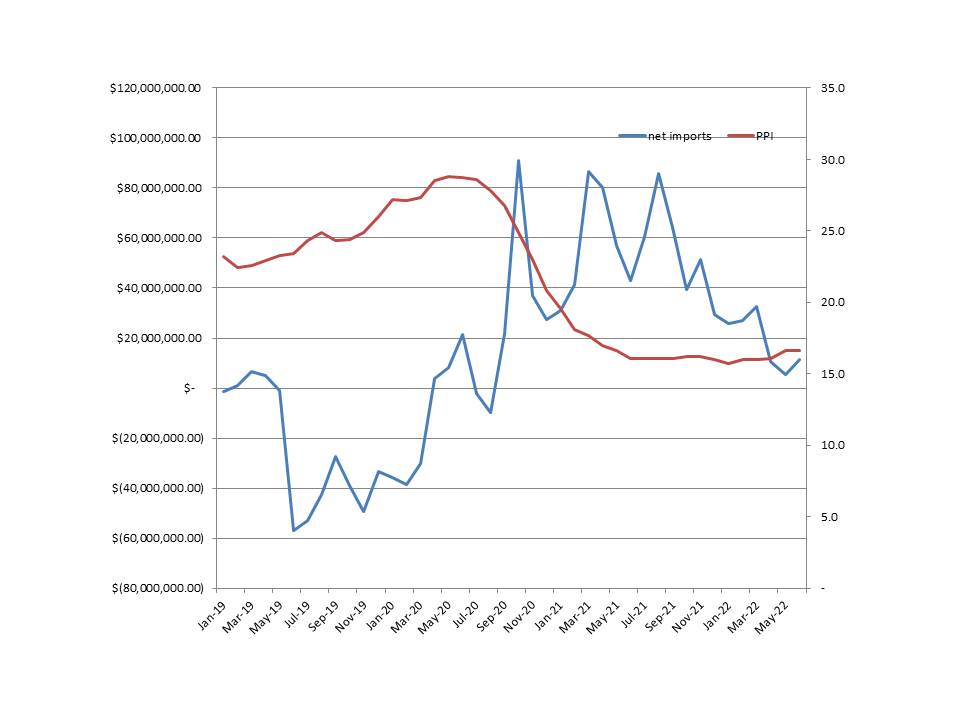
The chart below shows monthly net gold flows into the US from January 1919 through June 1922. Inflows (outflows) correspond to positive (negative) magnitudes measured on left vertical axis; the PPI is measured on the right vertical axis. From January 1919 to June 1920, prices were relatively high and rising, while gold was generally flowing out of the US. From July 1920 till June 1921, prices fell sharply while huge amounts of gold were flowing into the US. Prices hit bottom in June, and gold inflows gradually tapered off in the second half of 1921.

gold_imports_2The correlation is obviously very far from perfect; I have done a number of regressions trying to explain movements in the PPI from January 1919 to June 1922, and the net monthly inflow of gold into the US consistently accounts for roughly 25% of the monthly variation in the PPI, and I have yet to find any other variable that is reliably correlated with the PPI over that period. Of course, I would be happy to receive suggestions about other variables that might be correlated with price level changes. Here’s the simplest regression result.

y = -4.41e-10 NGOLDIMP, 41 observations, t = -3.99, r-squared = .285, where y is the monthly percentage change in the PPI, and NGOLDIMP is net monthly gold imports into the US.

The one part of the story that still really puzzles me is that deflation bottomed out in June 1921, even though monthly gold inflows remained strong throughout the spring and summer of 1921 before tapering off in the autumn. Perhaps there was a complicated lag structure in the effects of gold inflows on prices that might be teased out of the data, but I don’t see it. And adding lagged variables does little if anything to improve the fit of the regression.

I want to make two further points about the dearly beloved 1920-21 depression. Let me go to the source and quote from James Grant himself waxing eloquent in the Wall Street Journal about the beguiling charms of the wonderful 1920-21 experience.

In the absence of anything resembling government stimulus, a modern economist may wonder how the depression of 1920-21 ever ended. Oddly enough, deflation turned out to be a tonic. Prices—and, critically, wages too—were allowed to fall, and they fell far enough to entice consumers, employers and investors to part with their money. Europeans, noticing that America was on the bargain counter, shipped their gold across the Atlantic, where it swelled the depression-shrunken U.S. money supply. Shares of profitable and well-financed American companies changed hands at giveaway valuations.

The first point to make is that Grant has the causation backwards; it was the flow of gold into the US that caused deflation by driving up the international value of gold and forcing down prices in terms of gold. The second point to make is that Grant completely ignores the brutal fact that the US exported its deflation to Europe and most of the rest of the world. Indeed, because Europe and much of the rest of the world were aiming to rejoin the gold standard, which effectively meant going on a dollar standard at the prewar dollar parity, and because, by 1920, almost every other currency was at a discount relative to the prewar dollar parity, the rest of the world had to endure a far steeper deflation than the US did in order to bring their currencies back to the prewar parity against the dollar. So the notion that US deflation lured eager bargain-hunting Europeans to flock to the US to spend their excess cash would be laughable, if it weren’t so pathetic. Even when the US recovery began in the summer of 1921, almost everywhere else prices were still falling, and output and employment contractin.

This can be seen by looking at the exchange rates of European countries against the dollar, normalizing the February 1920 exchange rates as 100. In February 1921, here are the exchange rates. (Source W. A. Brown The International Gold Standard Reinterpreted 1914-34, Table 29)

UK 114.6

France 101.8

Switzerland 99.3

Denmark 124.4

Belgium 103.6

Sweden 119.6

Holland 94.9

Italy 81.6

Norway 102.8

Spain 84.9

And in 1922, the exchange rates for every country had risen against the dollar (peak month noted in parentheses), implying steeper deflation in each of those countries in 1921 than in the US.

UK (June) 134.3

France (April) 131.1

Switzerland (February) 118.5

Denmark (June) 145.4

Belgium (April) 117.7

Sweden (March) 140.6

Holland (April) 105.2

Italy (April) 119.6

Norway (May) 106.8

Spain (February) 94.9

As David Frum emphasizes, the damage inflicted by the bright and shining depression of 1920-21 was not confined to the US, it exacted an even greater price on the already devastated European continent, thereby setting the stage, in conjunction with the draconian reparations imposed by the Treaty of Versailles and the war debts that the US insisted on collecting, preferably in gold, not imports, from its allies, first for the great German hyperinflation and then the Great Depression. And we all know what followed.

So, yes, by all means, let us all raise our glasses and toast the dearly beloved, bright and shining, depression of 1920-21, of blessed memory, the greatest depression ever. May we never see its like again.

D.H. Robertson on Why the Gold Standard after World War I Was Really a Dollar Standard

In a recent post, I explained how the Depression of 1920-21 was caused by Federal Reserve policy that induced a gold inflow into the US thereby causing the real value of gold to appreciate. The appreciation of gold implied that, measured in gold, prices for most goods and services had to fall. Since the dollar was equal to a fixed weight of gold, dollar prices also had to fall, and insofar as other countries kept their currencies from depreciating against the dollar, prices in terms of other currencies were also falling. So in 1920-21, pretty much the whole world went into a depression along with the US. The depression stopped in late 1921 when the Fed decided to allowed interest rates to fall sufficiently to stop the inflow of gold into the US, thereby halting the appreciation of gold.

As an addendum to my earlier post, I reproduce here a passage from D. H. Robertson’s short classic, one of the Cambridge Economic Handbooks, entitled Money, originally published 92 years ago in 1922. I first read the book as an undergraduate – I think when I took money and banking from Ben Klein – which would have been about 46 years ago. After seeing Nick Rowe’s latest post following up on my post, I remembered that it was from Robertson that I first became aware of the critical distinction between a small country on the gold standard and a large country on the gold standard. So here is Dennis Robertson from chapter IV (“The Gold Standard”), section 6 (“The Value of Money and the Value of Gold”) (pp. 65-67):

We can now resume the main thread of our argument. In a gold standard country, whatever the exact device in force for facilitating the maintenance of the standard, the quantity of money is such that its value and that of a defined weight of gold are kept at an equality with one another. It looks therefore as if we could confidently take a step forward, and say that in such a country the quantity of money depends on the world value of gold. Before the war this would have been a true enough statement, and it may come to be true again in the lifetime of those now living: it is worthwhile therefore to consider what, if it be true, are its implications.

The value of gold in its turn depends on the world’s demand for it for all purposes, and on the quantity of it in existence in the world. Gold is demanded not only for use as money and in reserves, but for industrial and decorative purposes, and to be hoarded by the nations of the East : and the fact that it can be absorbed into or ejected from these alternative uses sets a limit to the possible changes in its value which may arise from a change in the demand for it for monetary uses, or from a change in its supply. But from the point of view of any single country, the most important alternative use for gold is its use as money or reserves in other countries; and this becomes on occasion a very important matter, for it means that a gold standard country is liable to be at the mercy of any change in fashion not merely in the methods of decoration or dentistry of its neighbours, but in their methods of paying their bills. For instance, the determination of Germany to acquire a standard money of gold in the [eighteen]’seventies materially restricted the increase of the quantity of money in England.

But alas for the best made pigeon-holes! If we assert that at the present day the quantity of money in every gold standard country, and therefore its value, depends on the world value of gold, we shall be in grave danger of falling once more into Alice’s trouble about the thunder and the lightning. For the world’s demand for gold includes the demand of the particular country which we are considering; and if that country be very large and rich and powerful, the value of gold is not something which she must take as given and settled by forces outside her control, but something which up to a point at least she can affect at will. It is open to such a country to maintain what is in effect an arbitrary standard, and to make the value of gold conform to the value of her money instead of making the value of her money conform to the value of gold. And this she can do while still preserving intact the full trappings of a gold circulation or gold bullion system. For as we have hinted, even where such a system exists it does not by itself constitute an infallible and automatic machine for the preservation of a gold standard. In lesser countries it is still necessary for the monetary authority, by refraining from abuse of the elements of ‘play’ still left in the monetary system, to make the supply of money conform to the gold position: in such a country as we are now considering it is open to the monetary authority, by making full use of these same elements of ‘play,’ to make the supply of money dance to its own sweet pipings.

Now for a number of years, for reasons connected partly with the war and partly with its own inherent strength, the United States has been in such a position as has just been described. More than one-third of the world’s monetary gold is still concentrated in her shores; and she possesses two big elements of ‘play’ in her system — the power of varying considerably in practice the proportion of gold reserves which the Federal Reserve Banks hold against their notes and deposits (p. 47), and the power of substituting for one another two kinds of common money, against one of which the law requires a gold reserve of 100 per cent and against the other only one of 40 per cent (p. 51). Exactly what her monetary aim has been and how far she has attained it, is a difficult question of which more later. At present it is enough for us that she has been deliberately trying to treat gold as a servant and not as a master.

It was for this reason, and for fear that the Red Queen might catch us out, that the definition of a gold standard in the first section of this chapter had to be so carefully framed. For it would be misleading to say that in America the value of money is being kept equal to the value of a defined weight of gold: but it is true even there that the value of money and the value of a defined weight of gold are being kept equal to one another. We are not therefore forced into the inconveniently paradoxical statement that America is not on a gold standard. Nevertheless it is arguable that a truer impression of the state of the world’s monetary affairs would be given by saying that America is on an arbitrary standard, while the rest of the world has climbed back painfully on to a dollar standard.


About Me

David Glasner
Washington, DC

I am an economist in the Washington DC area. My research and writing has been mostly on monetary economics and policy and the history of economics. In my book Free Banking and Monetary Reform, I argued for a non-Monetarist non-Keynesian approach to monetary policy, based on a theory of a competitive supply of money. Over the years, I have become increasingly impressed by the similarities between my approach and that of R. G. Hawtrey and hope to bring Hawtrey’s unduly neglected contributions to the attention of a wider audience.

My new book Studies in the History of Monetary Theory: Controversies and Clarifications has been published by Palgrave Macmillan

Follow me on Twitter @david_glasner

Archives

Enter your email address to follow this blog and receive notifications of new posts by email.

Join 665 other subscribers
Follow Uneasy Money on WordPress.com