Archive Page 47

Hayek Was a Neoclassical – Yes, NEOCLASSICAL! — Economist

In a long and productive scholarly career, F. A. Hayek worked for the most part in relative obscurity. That obscurity was interrupted by three, maybe four, short periods when his fame extended beyond his fellow economists to a wider public. The first was in the early 1930s when, arriving in London in the depths of the Great Depression, he became, while still a young man, the second most famous economist — surpassed only by Keynes himself — in Britain. Next, at the end of World War II, in middle age, he achieved international celebrity when his book The Road to Serfdom became a surprise best-seller. Then, in his old age, to the surprise of almost everyone, Hayek was awarded the 1974 Nobel Prize in economics. Finally, when he was almost 90, Hayek enjoyed a final moment of glory after the Soviet empire imploded in the late 1980s, providing ultimate vindication for his argument, advanced almost six decades earlier, but widely dismissed and mocked by many economists who should have known better, that comprehensive central planning was ultimately an unworkable system for running a modern economy. Now, once again, some 20 years after his death, Hayek seems to be enjoying another of his periodic bursts of fame — this time because the presumptive Republican nominee for Vice-President of the United States, Paul Ryan, likes to cite Hayek as one of his intellectual inspirations, offering Hayek as an alternative source for his ideological position to Ayn Rand, whom Ryan had to throw overboard because of her militant atheism, Hayek’s discreet agnosticism apparently not (yet?) making him untouchable.

Hayek’s renewed celebrity earned him the dubious honor of being written about in the New York Times Magazine by Adam Davidson, a financial journalist for Planet Money, and a columnist for the New York Times Magazine. Davidson does not get off to a good start, calling Hayek “an awkwardly shy (and largely ignored) economist and philosopher who died in 1992.” Hayek did die in 1992, and he was an economist and a philosopher, but to say that Hayek was “largely ignored” is a curious way to describe a Nobel Prize winner, even if one makes due allowance for the surprise with which the award of the Nobel Prize to Hayek was met. That was bad enough, but to call Hayek “awkwardly shy” is sheer fiction, and not just fiction, but an absurd fiction. I have never seen Hayek described by anyone as shy. And in my intermittent acquaintance with Hayek, over almost 20 years from the time I met and took classes from Hayek as an undergraduate student when he visited UCLA in the 1968-69 academic year, I never observed an awkward moment. Hayek to be sure evidenced a certain reserve, but it was the courtly, aristocratic reserve of the Viennese haute bourgeoisie, the “von,” which Hayek dropped from his surname upon becoming a British subject in the 1930s, marking the elitist background from which Hayek sprang. Among his family connections were his cousins Ludwig Wittgenstein, the philosopher and Paul Wittgenstein, the concert pianist, who, after losing his right arm in World War I, commissioned Maurice Ravel to compose his Concerto for the Left Hand.  The Wittgensteins’ father, Karl, was perhaps the wealthiest industrialist in Austria.  After a preposterous start like that, nothing that Davidson says about Hayek can carry any credibility.

But in his third paragraph, Davidson goes completely off the rails:

For the past century, nearly every economic theory in the world has emerged from a broad tradition known as neoclassical economics. (Even communism can be seen as a neoclassical critique.) Neoclassicists can be left-wing or right-wing, but they share a set of crucial core beliefs, namely that it is useful to look for government policies that can improve the economy. Hayek and the rest of his ilk — known as the Austrian School — reject this. To an Austrian, the economy is incomprehensibly complex and constantly changing; and technocrats and politicians who claim to have figured out how to use government are deluded or self-interested or worse. According to Hayek, government intervention in the free market, like targeted tax cuts, can only make things worse.

Here Davidson doesn’t just get Hayek wrong, he gets everything wrong. Where to start? “For the past century, nearly every economic theory in the world has emerged from a broad tradition known as neoclassical economics.” Fair enough, though the dominance of neoclassical economics probably goes back to at least 1880, and certainly no later than the publication of Alfred Marshall’s Principles of Economics in 1890, 120 years ago. But what can Davidson possibly mean by the bizarre parenthetical side comment “even communism can be seen as a neoclassical critique?” Does he mean that communism is a version of neoclassical economics? Or perhaps he means that Communism is a critique of neoclassical economics.  Either alternative would be truly amazing if, by Communism, he means the economic doctrines of Karl Marx, doctrines Marx had developed well before the principal founders of neoclassical economics, William Stanley Jevons, Carl Menger and Leon Walras, published their versions of the marginal utility theory of value in the early 1870s. Perhaps Davidson means something else by Communism, but for the life of me, I can’t imagine what it might be.  Then, paying no attention to the theoretical content of neoclassical theory, Davidson identifies the set of crucial core beliefs of neoclassical economics as follows: “it is useful to look for government policies that can improve the economy.” The mind boggles. This is not just cluelessness; it’s cluelessness masquerading as profundity.

Then we are told that Hayek and his fellow “Austrians” reject the notion that it is useful to look for government policies that can improve the economy. But this has nothing to do with neoclassical economics. Davidson seems to have relied on George Mason University economist, Peter Boettke, for some of his ideas, but I find it hard to imagine that Davidson is quoting Boettke accurately when he writes:

In actuality, Ryan is like a lot of politicians who merely cherry-pick Hayek to promote neoclassical policies, says Peter Boettke, an economist at George Mason University and editor of The Review of Austrian Economics.

Does Davidson know what a neoclassical policy is? Does Boettke? Does anyone? I don’t think so, because neoclassical economics, as such, has no policy agenda. But whatever a neoclassical policy might be, Davidson assures us that Hayek is totally against it.

Now, although the term “neoclassical policy” is a pure nonsense term, I can guess how Davidson, after talking to a bunch of Austrians — I hope not Boetkke or Bruce Caldwell, who is also quoted in Davidson’s piece — picked up on the propensity of modern self-styled Austrians — generally followers of the fanatical Murray Rothbard, as distinguished from the authentic Austrians of Hayek’s generation — to deploy “neoclassical” as a term of abuse, providing sufficient justification for these modern Austrians to dismiss any economic doctrine or policy they don’t like by strategically applying the epithet “neoclassical” to it.

So let me assert flatly that F. A. Hayek was a neoclassical economist through and through. He was also an authentic Austrian economist, schooled in both branches of Austrian theory by way of his association with his primary teacher at the University of Vienna, Friedrich von Weiser Wieser, one of the two principal successors of Carl Menger, the founder of the Austrian School, and through his subsequent collaboration with Ludwig von Mises, a leading student of Eugen von Bohm-Bawerk, the other principal successor of Menger.

In an introductory essay (“The Place of Menger’s Grundsatze in the History of Economic Thought”) to a volume, Carl Menger and the Austrian Theory of Value, edited by J. R. Hicks, commemorating the centenary of Menger’s classic work Grundsatze der Volkwirtschaftslehre (Principles of Economics) propounding the marginal-utility theory of value, Hayek explained that Menger’s theory had been incorporated into the larger body of economic theory that grew from the foundational contributions of Jevons, Menger, and Walras. While Menger’s work had become less influential in the second half century following publication of Menger’s Grundsatze than it had been in the first half-century after its publication, Hayek attributed that fact to a shift, under the influence of Keynes, in the interests of economists from micro- to macro-economics. Keynes’s work was not neoclassical economics, and it has been an ongoing project ever since Keynes published the General Theory to determine whether, and to what extent, Keynes’s theory could be reconciled with neoclassical economic theory. Here is how Hayek summed up his essay.

It seems to me that signs can already be discerned of a revival of interest in the kind of theory that reached its first high point a generation ago – at the end of the period during which Menger’s influence had mainly been felt. His ideas had by then, of course, ceased to be the property of a distinct Austrian School but had become merged in a common body of theory which was taught in most parts of the world. But though there is no longer a distinct Austrian School, I believe there is still a distinct Austrian tradition form which we may hope for many further contributions to the future development of economic theory. The fertility of its approach is by no means exhausted and there are still a number of tasks to which it can profitably be applied.

So we are all (or almost all) neoclassical economists, and none more so than Hayek, who was steeped in the neoclassical tradition. But no tradition is static. When a tradition stops changing, when it stops evolving, it becomes a relic, not a tradition. And with change come differences of opinion and disagreements, even bitter disagreements, between practitioners operating within a single broad tradition. Many Austrians now view themselves as completely distinct and separate from the broader neoclassical tradition from which their own doctrines evolved, but that was never Hayek’s view. And for all the severe criticisms and complaints he voiced about the direction of economics since the 1930s, he never viewed himself as being cut off, or alienated, from the mainstream of neoclassical economic theory. That Hayek could be both a critic and a practitioner of neoclassical economics is obviously too complicated a proposition for Mr. Davidson, and many others for that matter, to comprehend, but to Hayek it seemed entirely natural and unremarkable.
Intangible Infrastructural Capital

By intangible infrastructural capital, I mean knowledge about other people acquired by individuals in the course of their daily lives when interacting with, and relating to, other people, even superficially, within the different sorts of communities to which they belong. The concept of intangible infrastructural capital could properly be expanded to include language and law and traditions of various kinds, but for purposes of this post, I prefer to focus chiefly on a narrow subset of the entire class of knowledge that might fit into the category. By knowledge, I don’t mean factual or scientific knowledge, I mean expectations about what people will do or how they will react under a variety of conditions or circumstances. I call this knowledge capital, because almost all knowledge has some value and usefulness, and this knowledge is acquired only through the expenditure of some effort, even when the knowledge is acquired more or less incidentally in the course of actions that people take or activities in which they engage that bring them into contact — regular contact — with other people. Thus, the assets are acquired and maintained only by way of some minimal investment of time and effort to form such relationships, however superficial. The assets are intangible, because the assets are almost never embodied in physical form, rather existing only in the minds and memories of individuals, available for use when particular circumstances make that knowledge useful. The assets are infrastructural, because, like physical infrastructure – roads, public utilities and the like — they create an environment in which people are able to pursue their own interests and formulate and execute their own plans to advance those interests. The individual pieces of knowledge are more meaningful and useful in the aggregate than they are considered as separate bits of information, because the aggregate of knowledge helps people coordinate expectations in a way that allows their lives to be conducted on the basis of shared mutually consistent expectations about how each other will behave.

The above, overly long, paragraph is probably written too abstractly for most readers who managed to slog through it to have gained a clear understanding of what I am talking about. So let me try to make my ideas more concrete (no pun intended) by quoting from Jane Jacobs’s extraordinary book The Death and Life of American Cities. (pp. 45-47)

A well-used city street is apt to be a safe street. A deserted city street is apt to be unsafe. But how does this work, really? And what makes a city street well used or shunned? . . .

A city street equipped to handle strangers, and to make a safety asset, in itself, out of the presence of strangers, as the streets of successful city neighborhoods always do, must have three main qualities:

First, there must be a clear demarcation between what is public space and what is private space. Public and private spaces cannot ooze into each other as they do typically in suburban setting or in projects.

Second, there must be eyes upon the street, eyes belonging to those we might call the natural proprietors of the street. The buildings on a street equipped to handle strangers and to insure the safety of both residents and strangers, must be oriented to the street. They cannot turn their backs or blank sides on it and leave it behind.

And third, the sidewalk must have users on it fairly continuously, both to add to the number of effective eyes on the street and to induce people in buildings along the street to watch the sidewalks in sufficient numbers. Nobody enjoys sitting on a stoop or looking out a window at an empty street. Almost nobody does such a thing. Large numbers of people entertain themselves, off and on, by watching street activity.

In settlements that are smaller and simpler than big cities, controls on acceptable public behavior, if not on crime, seem to operate with greater or lesser success through a web of reputation, gossip, approval, disapproval and sanctions, all of which are powerful if people know each other and word travels. But a city’s streets, which must control not only the behavior of the people of the city but also of visitors from suburbs and towns who want to have a big time away from the gossip and sanctions at home, have to operate by more direct straightforward methods. It is a wonder cities have solved such an inherently difficult problem at all. And yet in many streets they do it magnificently.

In the space of a few short paragraphs, Jacobs covers two different, but not unrelated, kinds of intangible infrastructural capital, the more comprehensive knowledge about the conduct of particular known individuals in smaller face-to-face communities, and the sketchy knowledge of the behavior of mostly unknown individuals in the big city. In both contexts, people feel a need for safety and an expectation that they will not be the victim of an attack on their person or property. In the small face-to-face community, people tend to know a lot about their neighbors; in the city they don’t know as much. An effective city street provides a feeling of safety by being occupied by a steady stream of foot traffic, a stream encouraged by having a mixture of businesses, stores, shops, restaurants, bars, and residences on the same street. People living and working on the street may not know very much about the people they see, but their personal stake in maintaining good order on the street encourages feelings of responsibility even to those passersby with whom they have no personal connection. Jacobs describes an incident in which people living or working on her street were moved almost instinctively to come to the aid of an unknown passerby who seemed to be in danger: (pp. 49-50)

The incident that attracted my attention was a suppressed struggle going on between a man and a little girl of eight or nine years old. The man seemed to be trying to get the girl to go with him. By turns he was directing a cajoling attention to her, and then assuming an air of nonchalance. The girl was making herself rigid, as children do when they resist, against the wall of one of the tenements across the street.

As I watched from our second-floor window, making up my mind how to intervene if it seemed advisable, I saw it was not going to be necessary. From the butcher shop beneath the tenements had emerged a woman who, with her husband, runs the shop; she was standing within earshot of the man, her arms folded and a look of determination on her face. Joe Corncchia, who with his sons-in-law keeps the delicatessen, emerged about the same moment and stood solidly to the other side. Several heads poked out of the tenement windows above, one was withdrawn quickly and its owner reappeared a moment later in the doorway behind the man. Two men from the bar next to the butcher shop came to the doorway and waited. On my side of the street, I saw that the locksmith, the fruit man and the laundry proprietor had all come out of their shops and that the scene was also being surveyed from a number of windows besides ours. That man did not know it, but he was surrounded. Nobody was going to allow a little girl to be dragged off, even if nobody knew who she was.

I am sorry – sorry purely for dramatic purposes – to have to report that the little girl turned out to be the man’s daughter.

For large collections of, mostly anonymous, individuals to interact with reasonable expectations of personal safety, those individuals must hold confident expectations of safety, expectations supported by the knowledge that they will be visible to others who could help them should they be endangered. That is why cities and urban neighborhoods thrive when there is a lot pedestrian traffic and decay when that traffic dwindles. People feel safe when they can walk in places where a lot of other people are walking or watching. Jacobs became the scourge of urban planners and advocates of urban renewals who wanted to create planned self-contained residential communities without that healthy organic mix of small business and shops and high density residences that draw people onto the streets, infusing those neighborhoods with an energy absent from monotonous planned single-use communities. High population density is an important condition that allows neighborhoods to achieve the vibrancy of diverse mutually supporting activities.

Jacobs justly became a famous, almost legendary, public figure through her epic battles with the ultra-powerful, seemingly invincible, urban planner and infrastructure builder, Robert Moses, who wanted to decimate Jacobs’s beloved Greenwich Village community, turning it into an urban renewal project while running a super highway through lower Manhattan. The magnitude of Jacobs’s achievement in standing up to, and ultimately thwarting, Moses’s designs on her neighborhood, stopping the juggernaut in its tracks, is memorably described in Robert Caro’s monumental, award-winning biography of Robert Moses, The Power Broker:  Robert Moses and the Fall of New York.

While the devastating implications of what Robert Moses wanted to do to lower Manhattan in 1960 are now widely acknowledged, it seems to me that we still have not arrived anywhere near a proper understanding of the scale of destruction inflicted on communities, both urban and rural, by the interstate-highway system, still widely regarded as one of the great achievements of the federal government in the second half of the twentieth century, perhaps the chief domestic achievement of Eisenhower administration, and often cited as a model by contemporary advocates of physical infrastructural investment. The massive interstate highways, cutting through every major urban center in the country, destroyed countless urban neighborhoods and communities, uprooting many hundreds of thousands of residents, and forcing thousands of small businesses out of existence. Beyond those direct effects, there were much wider indirect effects, the new highways not just destroying the structures in their direct paths, but interrupting and disrupting the previous patterns of pedestrian and vehicular traffic on the city streets they dismembered, thereby rendering nearby businesses and communities not directly swallowed up by the highways economically unsustainable. The destruction of those neighborhoods and communities, disproportionately occupied by minorities and low-income families, often herded into newly constructed, large-scale, utterly dysfunctional, urban-renewal projects, had devastating consequences on residents, contributing to and exacerbating the social pathologies associated with the breakdown of formerly stable communities. Even in the big cities, where the “web[s] of reputation, gossip, approval, disapproval and sanctions, all of which are powerful if people know each other and word travels” are less constricting than those in small towns, those informal social controls are not entirely absent or ineffective. The destruction of communities and neighborhoods by interstate highways cutting right through them meant the annihilation of the intangible infrastructural capital by which basic standards of acceptable conduct could be transmitted to, and enforced upon, young people, or at least some of them, some of the time. The collapse of communities meant a collapse of standards. The construction of new physical infrastructure led directly to the destruction of a much more valuable intangible infrastructure of social standards and restraints on anti-social conduct.

I also conjecture that the construction of interstate highways spelled doom for many rural communities dependent on traffic flows along, or connected to, the formerly well-traveled highways bypassed by the new interstates, contributing to and accelerating the migration of young people from rural areas and small towns to major metropolitan areas, again causing a breakdown in the restraints on anti-social conduct. It was also the interstate-highway system that enabled Walmart to achieve rapid growth in sales by locating its new stores very close to major interstates, which gave the new stores a huge advantage over their small local competitors off the interstate-highway system, competitors less accessible both to customers and to the large trucks delivering merchandise from wholesalers and manufacturers. Little by little the economic vitality of small communities off the interstate-highway system was drained out of them, causing many of those communities to wither and shrivel up. In the case of Walmart, at any rate, President Obama’s now infamous remark “you didn’t build that” was eminently justified. Of course, the irony and tragedy is that it actually was built.  Would that it weren’t!

This post is not meant to as an attack on investing in tangible infrastructure. I actually think that the return on many kinds of physical infrastructure is pretty high. But we ought to be more aware than we seem to be of the disastrous consequences that the construction of the interstate-highway system had on individuals, families, neighborhoods, communities, towns and cities, all across the country. And we should at least be somewhat mindful of the risks that future large-scale investments in physical infrastructure could have similarly unfortunate unintended consequences.

Where Does Money Come From?

Free exchange, the economics column in the Economist, has a really interesting piece in this week’s issue on two theories of the origin of money. The first theory is the evolutionary market theory propounded by Carl Menger, one of the three independent and simultaneous co-discoverers of the marginal utility theory of value in the early 1870s, (the two co-discoverers being William Stanley Jevons and Leon Walras) in a classic 1892 paper “On the Origins of Money,” and the other being the Cartalist theory, famously advanced by G. F. Knapp in his State Theory of Money, but also by other more orthodox theorists like P. H. Wicksteed (see my earlier posts here and here), and more recently in a paper by Charles Goodhart, discover of Goodhart’s Law, an only slightly less general statement of what came to be known some years later as the Lucas Critique.

Menger’s theory is a brilliant conjectural history of how money might have evolved as the result of individual choices by individuals seeking to reduce their transactions costs in an economic environment that is changing from subsistence farming into a market economy characterized by specialization. Some individuals, realizing that certain commodities were easier to trade than others, would begin holding inventories of those goods beyond their immediate demands, thereby enhancing their ability to find trading partners. But by holding inventories of those commodities, these alert individuals would do two things, first they would make it even easier to trade in those commodities, and second they would induce other people to follow their example. As others followed their example, the costs of trading in those commodities originally identified as low cost commodities to trade would be reduced still more. This was an early description of what have recently come to be known as network effects or network externalities. A good characterized by a network effect is a good for which the demand increases as more people demand it. Menger beautifully described the process by which a commodity would emerge as money owing to the network effects inherent in being used as a medium of exchange.

While theoretically brilliant and supported by some historical evidence, Menger’s conjectural history hardly provides a complete or unerring account of the development of money. One important part of the story that Menger left out is the pervasive, though not necessarily exclusive, role of the state in the development of money.  Here is Free exchange:

Take the widespread use of precious metals as money. A Mengerian would say that this happens because metals are durable, divisible and portable: that makes them an ideal medium of exchange. But it is incredibly hard to value raw metals, Mr Goodhart argued, so the cost of using them in trade is high. It is much easier to assess the value of a bag of salt or a cow than a lump of metal. Raw metals fail Menger’s own saleableness test.

This is complicated. Traders traveling long distances would want to use a medium of exchange that had a high value relative to the cost of transportation. So precious metals probably became more important as media of exchange not in the earliest stages of the historical development of money, when salt and cattle were widely used, but at a later stage, when professional traders began buying in one location and selling in other, distant locations, precious metals served their purposes better than bulkier commodities, much more costly to transport than precious metals.  Free exchange continues:

This problem explains why metal money has circulated not in lumps but as coins, with a regulated amount of metal in each coin. But history shows that minting developed not as a private-sector attempt to minimise the costs of trading, but as a government operation. It was state intervention, not the private market, that made metal specie work as money.

Again, my reading of the historical evidence – and I don’t claim more than a superficial knowledge of the historical evidence – is that there is evidence of early private minting operations. However, the early private mints were quickly displaced by mints operated by the state (or whatever you care to call the organizations headed by early monarchs). In my book Free Banking and Monetary Reform, I argued that having a monopoly over the mint was beneficial to the survival chances of any “state” competing for survival against other nearby states. To be able to survive, a state needed to be able to hire soldiers and pay for weapons. How could a monarch do that if he didn’t have an efficient system of collecting taxes? One very good way was to own a mint, and have at least a local monopoly over the minting of coins, which gave the monarch the ability to raise funds in an emergency by debasing the coinage. A prudent state would not debase the coinage except under dire circumstances, but in order to be able to engage in currency debasement, the state needed a monopoly over the coinage, and the ability to force its subjects to accept those coins at face value to discharge previously contracted obligations.  Monarchs that were also monopolists over mints had an important advantage in competition with monarchs without a mint.  So mints became part of the essential equipment of any self-respecting monarch.  Back to Free exchange:

Mr Goodhart used monetary history to test these competing theories. He examined the overthrow of Rome and a period in the tenth century when the Japanese government stopped minting coins. If the origin of money were purely private, these shocks should have had no monetary effects. But after Rome’s collapse, traders resorted to barter; in Japan they started to use rice instead of coins. There is a clear link between fiscal power and money.

My interpretation of Roman history (I am afraid that I must plead ignorance about Japanese history) is a bit different. The overthrow of Rome was largely the work of the Arab conquests of the seventh and eighth centuries. Henri Pirenne in his wonderful book Mohammed and Charlemagne argued that the Arab conquests of most of the Mediterranean sea ports essentially cut off the long-distance Mediterranean trade of the remnants of Western Roman empire. The closing off of export markets and the corresponding loss of imported goods caused a regression from specialization and trade back to autarchy. As foreign trade collapsed, local economies became increasingly self-sufficient and the demand for money dropped correspondingly. Reversion to barter was not occasioned by the absence of a state that provided coinage, but by the collapse of an exchange economy that created the demand for coinage.

So I don’t see the conflict between the Mengerian theory and Cartalist theory as being as sharp as Goodhart and Free exchange seem to suggest. On the other hand, the 1998 paper by Goodhart was remarkably prescient in describing the kinds of problems that have beset the euro, problems closely associated with “unprecedented divorce between the main monetary and fiscal authorities” in charge of conducting policy for the Eurozone.

The topic is far from exhausted, but I am.  Perhaps I will have more to say on subject in a future post.

Is the Gold Bubble About to Burst?

Today’s Financial Times contains an article “Gold price falls as Asian durchases dwindle” The article points out that purchases of gold by the two largest sources of demand for gold, India and China, have fallen sharply iin recent months “abruptly halting a consumption boom that started five years ago with the onset of the financial crisis.”

The article notes that gold prices, just over $1600 an ounce yesterday, are now about 17% below their all-time high (in nominal terms) of $1920 an ounce set almost a year ago last September.

With weakening Indian and Chinese demand, and a price stagnating well below the peak reached a year ago, speculative demand for gold may be poised to collapse, triggering a self-reinforcing downward spiral. That’s what happened after gold peaked at about $900 an ounce in the early 1980s, ushering in a long downward slide in which gold lost almost 75% of its peak value. That process was helped by historically high real interest rates, but that doesn’t mean that the current gold bubble couldn’t burst even with historically low real rates.

The article concludes with the assessment of Marcus Grubb, managing director for investment at the London-based Worl Gold Council:

The wild card is what will happen to investment in the second half and that will be driven by QE [quantitative easing, or central banks printing money] in the US, the eurozone and even emerging countries like China

So what we seem to have here is two potentially segmented clusters of markets that are dominated by inconsistent expectations. Bond markets are dominated by expectations of low inflation, while gold markets (commodities, futures, gold mines shares) may be the refuge of believers in imminent (or medium-term) hyperinflation. The confidence of the hyperinflationists seems to be wavering, but apparently they are still nursing hopes that the next round of QE will finally work its magic.

Now my question — and it’s primarily directed to all those believers in the efficient market hypothesis out there — is how does one  explain the apparently inconsistent expectations underlying the bond markets and the gold markets. Should there not be a profitable trading strategy out there that would enable one to arbitrage the inconsistent expectations of the gold markets and the bond markets? If not, what does that say about the efficient market hypothesis?

Where Does Paul Ryan Go When He Thinks About Monetary Policy?

If you don’t already know the answer to that question, you haven’t been paying attention since Mitt Romney chose Ryan to be his running mate on the GOP ticket. But I have. Well, not really, but I did stumble across a piece by David Wiegel today in Slate. My jaw is still out of position after that experience.

Just by way of background, since Congressman Ryan became a major figure a couple of years ago, it became common knowledge that he was something of a devote of Ayn Rand, the well-known lunatic, psychopathic, and megalomaniacal author of really bad books like The Fountainhead and Atlas Shrugged read by millions of adolescents and juveniles of all ages around the world, and the author of a not very well-known, unfinished and unpublished novel, The Little Street inspired by someone possibly even more monstrous than she, the murderer William Edward Hickman. While Rand has a cult following among certain strains of extreme right-wing zealotry, conservative Christians tend to take offense at Rand’s hysterical anti-religious bigotry. Right-wing criticism of Rand’s militant atheism combined with liberal Catholic criticism of Ryan’s budget proposals as based on the principles and teachings of Ayn Rand forced Congressman Ryan to disavow Rand in an interview with National Review. Beyond disassociating himself from Rand, Ryan called the widely circulated story that that he required members of his staff to read The Fountainhead and Atlas Shrugged as an “urban legend.” Unfortunately for Mr. Ryan, there is a recording of a 2005 speech that he gave to the Atlas Society in which he himself stated:

I grew up reading Ayn Rand and it taught me quite a bit about who I am and what my value systems are, and what my beliefs are. It’s inspired me so much that it’s required reading in my office for all my interns and my staff. We start with Atlas Shrugged. People tell me I need to start with The Fountainhead then go to Atlas Shrugged [laughter]. There’s a big debate about that. We go to Fountainhead, but then we move on, and we require Mises and Hayek as well.

Congressman Ryan apparently does not know that although Rand admired Mises, she loathed and detested Hayek as a compromiser.

David Wiegel delved into Ryan’s speech to the Atlas Society and found this mind-boggling passage (which I quote in slightly more detail than Wiegel).

It’s so important that we go back to our roots to look at Ayn Rand‘s vision, her writings, to see what our girding, under-grounding [sic] principles are. I always go back to, you know, Francisco d’Anconia’s speech (at Bill Taggart’s wedding) on money when I think about monetary policy. And then I go to the 64-page John Galt speech, you know, on the radio at the end, and go back to a lot of other things that she did, to try and make sure that I can check my premises so that I know that what I’m believing and doing and advancing are square with the key principles of individualism…

I now quote from Wiegel’s piece:

The Galt speech is fairly famous, but the d’Anconia speech is more obscure. So: In the novel, Francisco Domingo Carlos Andres Sebastian d’Anconia is the heir to a copper mining fortune who slowly dismantles it by purposefully giving in to the demands of “looters.” He admits this to Dagny Taggart, the heroine (and his former love), fairly early on. He spent $8 million, for example, on a “housing settlement” that the Mexican government demanded he build at one of the mines. It’ll all fall apart soon, he admits, except for the miners’ new church — “they’ll need it,” he says contemptuously. “Whether I did it on purpose, or through neglect, or through stupidity, don’t you understand that that doesn’t make any difference? The same element was missing.”

In early chapters, d’Anconia pretends to be a Bruce Wayne-esque reckless playboy. He occasionally slips, because he’s a Rand character. Thus, “Bill Taggart’s wedding speech,” when d’Anconia goes to the party of a businessman using state connections to make money. A left-wing magazine writer tells him that “money is the root of all evil.” That sets off d’Anconia, who launches rant about money that runs to 23 paragraphs. “When you accept money in payment for your effort,” he says, “you do so only on the conviction that you will exchange it for the product of the effort of others. It is not the moochers or the looters who give value to money. Not an ocean of tears nor all the guns in the world can transform those pieces of paper in your wallet into the bread you will need to survive tomorrow. Those pieces of paper, which should have been gold, are a token of honor – your claim upon the energy of the men who produce.”

The problem, says d’Anconia, is that statists — looters and moochers — see dollar signs and think they can, must redistribute them. “Whenever destroyers appear among men,” he says, “they start by destroying money, for money is men’s protection and the base of a moral existence. Destroyers seize gold and leave to its owners a counterfeit pile of paper. This kills all objective standards and delivers men into the arbitrary power of an arbitrary setter of values. Gold was an objective value, an equivalent of wealth produced. Paper is a mortgage on wealth that does not exist, backed by a gun aimed at those who are expected to produce it. Paper is a check drawn by legal looters upon an account which is not theirs: upon the virtue of the victims. Watch for the day when it becomes, marked: ‘Account overdrawn.'”

So there you have it; this is where Paul Ryan goes to think about monetary policy. Let’s read it again:  “Destroyers seize gold and leave to its owners a counterfeit pile of paper. . . . Gold was an objective value, an equivalent of wealth produced. Paper is a mortgage on wealth that does not exist, backed by a gun aimed at those who are expected to produce it. Paper is a check drawn by legal looters upon an account which is not theirs.” OMG!

Jack Kemp, for whom Paul Ryan worked when he started his career, had what, at the time, seemed like a merely eccentric obsession with gold, expending a great deal of his considerable political energy and capital in futile attempts over at least two decades to stir up interest in restoring the gold standard. Apparently he was also an admirer of Ayn Rand. Thanks to David Weigel, we now know that the inspiration for a fetishistic obsession with gold may just be Francisco d’Anconia’s speech at Bill Taggart’s wedding in Atlas Shrugged.  Paul Ryan has been somewhat more circumspect than his mentor, Jack Kemp, in prostelytizing on behalf of the gold standard.  But now we know where his head is.  And we know the source — the fountainhead — for his “thinking” on monetary policy.  He said so himself.  Thank you, Congressman Ryan, for sharing.

Thompson’s Reformulation of Macroeconomic Theory, Part III: Solving the FF-LM Model

In my two previous installments on Earl Thompson’s reformulation of macroeconomic theory (here and here), I have described the paradigm shift from the Keynesian model to Thompson’s reformulation — the explicit modeling of the second factor of production needed to account for a declining marginal product of labor, and the substitution of a factor-market equilibrium condition for equality between savings and investment to solve the model. I have also explained how the Hicksian concept of temporary equilibrium could be used to reconcile market clearing with involuntary Keynesian unemployment by way of incorrect expectations of future wages by workers occasioned by incorrect expectations of the current (unobservable) price level.

In this installment I provide details of how Thompson solved his macroeconomic model in terms of equilibrium in two factor markets instead of equality between savings and investment. The model consists of four markets: a market for output (C – a capital/consumption good), labor (L), capital services (K), and money (M). Each market has its own price: the price of output is P; the price of labor services is W; the price of capital services is R; the price of money, which serves as numeraire, is unity. Walras’s Law allows exclusion of one of these markets, and in the neoclassical spirit of the model, the excluded market is the one for output, i.e., the market characterized by the Keynesian expenditure functions. The model is solved by setting three excess demand functions equal to zero: the excess demand for capital services, XK, the excess demand for labor services, XL, and the excess demand for money, XM. The excess demands all depend on W, P, and R, so the solution determines an equilibrium wage rate, an equilibrium rental rate for capital services, and an equilibrium price level for output.

In contrast, the standard Keynesian model includes a bond market instead of a market for capital services. The excluded market is the bond market, with equilibrium determined by setting the excess demands for labor services, for output, and for money equal to zero. The market for output is analyzed in terms of the Keynesian expenditure functions for household consumption and business investment, reflected in the savings-equals-investment equilibrium condition.

Thompson’s model is solved by applying the simple logic of the neoclassical theory of production, without reliance on the Keynesian speculations about household and business spending functions. Given perfect competition, and an aggregate production function, F(K, L), with the standard positive first derivatives and negative second derivatives, the excess demand for capital services can be represented by the condition that the rental rate for capital equal the value of the marginal product of capital (MPK) given the fixed endowment of capital, K*, inherited from the last period, i.e.,

R = P times MPK.

The excess demand for labor can similarly be represented by the condition that the reservation wage at which workers are willing to accept employment equals the value of the marginal product of labor given the inherited stock of capital K*. As I explained in the previous installment, this condition allows for the possibility of Keynesian involuntary unemployment when wage expectations by workers are overly optimistic.

The market rate of interest, r, satisfies the following version of the Fisher equation:

r = R/P + (Pe – P)/P), where Pe is the expected price level in the next period.

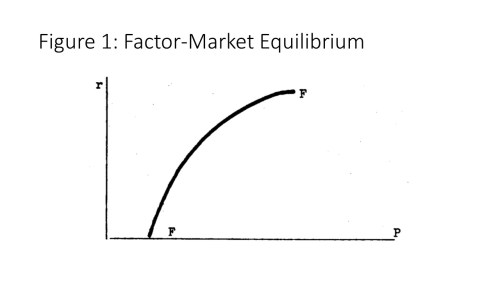
Because K* is assumed to be fully employed with a positive marginal product, a given value of P determines a unique corresponding equilibrium value of L, the supply of labor services being upward-sloping, but relatively elastic with respect to the nominal wage for given wage expectations by workers. That value of L in turn determines an equilibrium value of R for the given value of P. If we assume that inflation expectations are constant (i.e., that Pe varies in proportion to P), then a given value of P must correspond to a unique value of r. Because simultaneous equilibrium in the markets for capital services and labor services can be represented by unique combinations of P and r, a factor-market equilibrium condition can be represented by a locus of points labeled the FF curve in Figure 1 below.

Thompson_Figure1

The FF curve must be upward-sloping, because a linear homogenous production function of two scarce factors (i.e., doubling inputs always doubles output) displaying diminishing marginal products in both factors implies that the factors are complementary (i.e., adding more of one factor increases the marginal productivity of the other factor). Because an increase in P increases employment, the marginal product of capital increases, owing to complementarity between the factors, implying that R must increase by more than P. An increase in the price level, P, is therefore associated with an increase in the market interest rate r.

Beyond the positive slope of the FF curve, Thompson makes a further argument about the position of the FF curve, trying to establish that the FF curve must intersect the horizontal (P) axis at a positive price level as the nominal interest rate goes to 0. The point of establishing that the FF curve intersects the horizontal axis at a positive value of r is to set up a further argument about the stability of the model’s equilibrium. I find that argument problematic. But discussion of stability issues are better left for a future post.

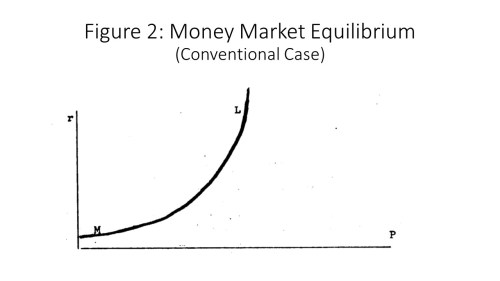
Corresponding to the FF curve, it is straightforward to derive another curve, closely analogous to the Keynesian LM curve, with which to complete a graphical solution of the model. The two LM curves are not the same, Thompson’s LM curve being constructed in terms of the nominal interest rate and the price level rather than in terms of nominal interest rate and nominal income, as is the Keynesian LM curve. The switch in axes allows Thompson to construct two versions of his LM curve. In the conventional case, a fixed nominal quantity of non-interest-bearing money being determined exogenously by the monetary authority, increasing price levels imply a corresponding increase in the nominal demand for money. Thus, with a fixed nominal quantity of money, as the price level rises the nominal interest rate must rise to reduce the quantity of money demanded to match the nominal quantity exogenously determined. This version of the LM curve is shown in Figure 2.

Thompson_Figure2

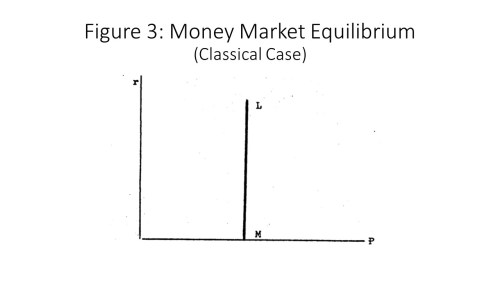
A second version of the LM curve can be constructed corresponding to Thompson’s characterization of the classical model of a competitively supplied interest-bearing money supply convertible into commodities at a fixed exchange rate (i.e., a gold standard except that with only one output money is convertible into output in general not one of many commodities). The quantity of money competitively supplied by the banking system would equal the quantity of money demanded at the price level determined by convertibility between money and output. Because money in the classical model pays competitive interest, changes in the nominal rate of interest do not affect the quantity of money demanded. Thus, the LM curve in the classical case is a vertical line corresponding to the price level determined by the convertibility of money into output. The classical LM curve is shown in Figure 3.

Thompson_Figure3

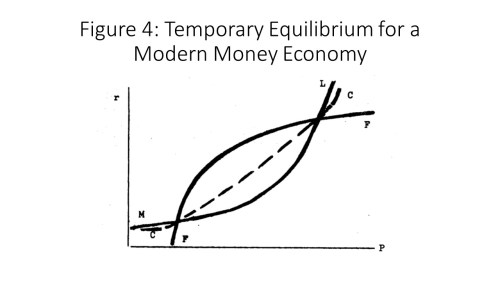
The full solution of the model (in the conventional case) is represented graphically by the intersection of the FF curve with the LM curve in Figure 4.

Thompson_Figure4

Note that by applying Walras’s Law, one could draw a CC curve representing equilibrium in the market for commodities (an analogue to the Keynesian IS curve) in the space between the FF and the LM curves and intersecting the two curves precisely at their point of intersection. Thus, Thompson’s reformulation supports Nick Rowe’s conjecture that the IS curve, contrary to the usual derivation, is really upward-sloping.

Stock Prices Rose by 5% in Two Weeks – Guess Why?

On Wednesday, July 25, the S&P 500 closed at 1337.89. On Wednesday, August 8, the S&P 500 closed at 1402.22, a gain of just under 5%. Care to guess why the market rose?

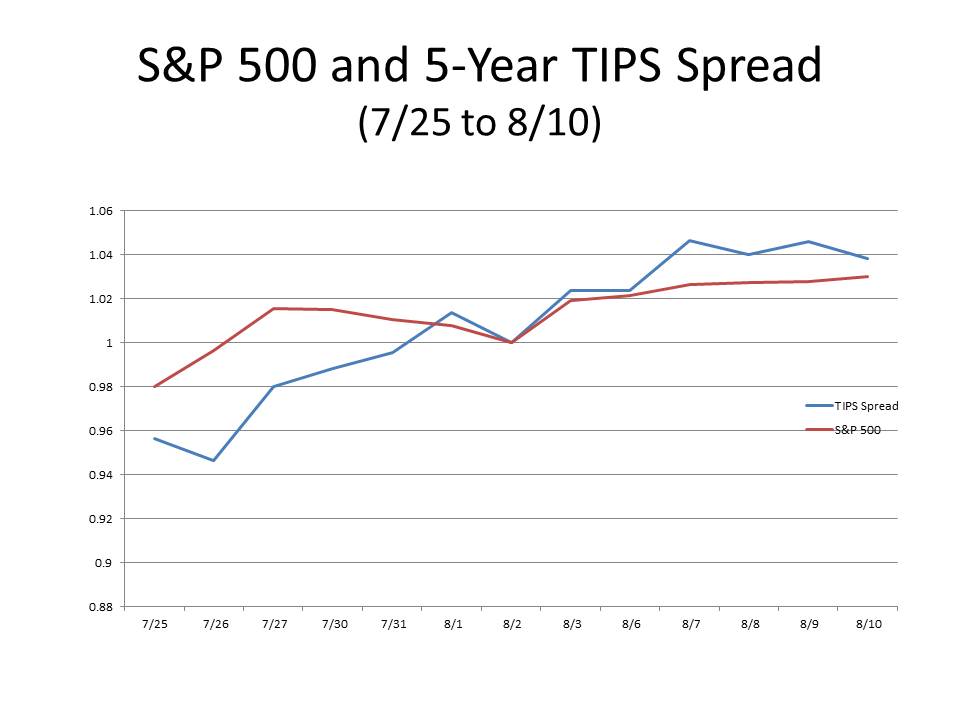
Well, it’s been a while since I’ve mentioned the stock market, but long-time readers of this blog already know that the stock market loves inflation (see here, here, and here), there having been a strong positive correlation between movements in inflation expectations and the direction of the stock market since early 2008, as I showed in my paper “The Fisher Effect Under Deflationary Expectations.” The correlation between inflation expectations and asset values is not a general implication of financial theory, which makes a strong and continuing correlation between inflation expectations and movements in stock prices something of an anomaly, an anomaly that reflects and underscores the dysfunctional state of the US and international economies since 2008, when monetary policy began to exert a deflationary bias even as the economy was sliding into a contraction. Using Bloomberg’s calculations of the breakeven TIPS spread on 1-, 2-, 5-, and 10-year Treasuries between July 25 and August 10, I calculated correlation coefficients between the Bloomberg TIPS spreads at those maturities and the S&P 500 of .764, 915, .906, and .87. Calculating the TIPS spreads on 5- and 10-year constant maturity Treasuries from the Treasury yield curve website, I found correlation coefficients of .904 and .887 between those TIPS spreads and the S&P 500. So the correlations are robust regardless of the specific TIPS spread one uses.

In the chart below, I draw a graph plotting movements in the 5-year TIPS spread (as calculated by Bloomberg) and in the S&P 500 between July 25 and August 10 (with both series normalized to equal 1 on August 2).

Get the picture?

Ever since March 2009, after the stock market hit bottom, having lost more than 50% of its value in the summer of 2008, the Fed has periodically signaled that it would take aggressive steps to stimulate the economy. The stock market, yearning for inflation, has repeatedly responded to signs that the Fed would respond to its desire for inflation, only to fall back in disappointment after it became clear that the Fed was not going to deliver the inflation that it had earlier dangled enticingly in front of desperate investors. Recently, as the signs of recovery that had been visible in the winter and early spring started to fade, the Fed has been sending out signals — faint and ambiguous, to be sure, but still signals — that it may finally provide some inflationary relief, and the stock market responded predictably and promptly. Will the Fed, perhaps relying on recent favorable employment data as an excuse, once again snooker the market?  Stay tuned.

A Laffer Postscript

In my previous post, I discussed Arthur Laffer’s op-ed in Monday’s Wall Street Journal, in which he argued that a comparison across 34 countries belonging to the OECD showed that the adoption of greater fiscal stimulus in the 2007-09 time period was bigger declines in the rate of economic growth. Laffer argued that this correlation provides conclusive empirical refutation of the Keynesian doctrine that additional government spending can stimulate economic recovery.

In my earlier post, I complained that Laffer had not explained the meaning of one of the variables — the change in government spending as a percentage of GDP — that he used to make his comparison, and did not provide an adequate source for where his numbers came from, noting that when I tried to calculate the same number using the data on the St. Louis Fed website, I arrived at a substantially smaller value for the US change in government spending as a fraction of GDP than Laffer’s reported. I also observed that the change in government spending as a percentage of GDP can rise not just because of an increase in government spending, but can also rise because of a contraction in total GDP, making the comparison Laffer was purporting to perform invalid, the comparison amounting to no more than a restatement of the truism that countries with bigger contractions in GDP would experience bigger reductions in their rates of growth than countries with smaller reductions in GDP.

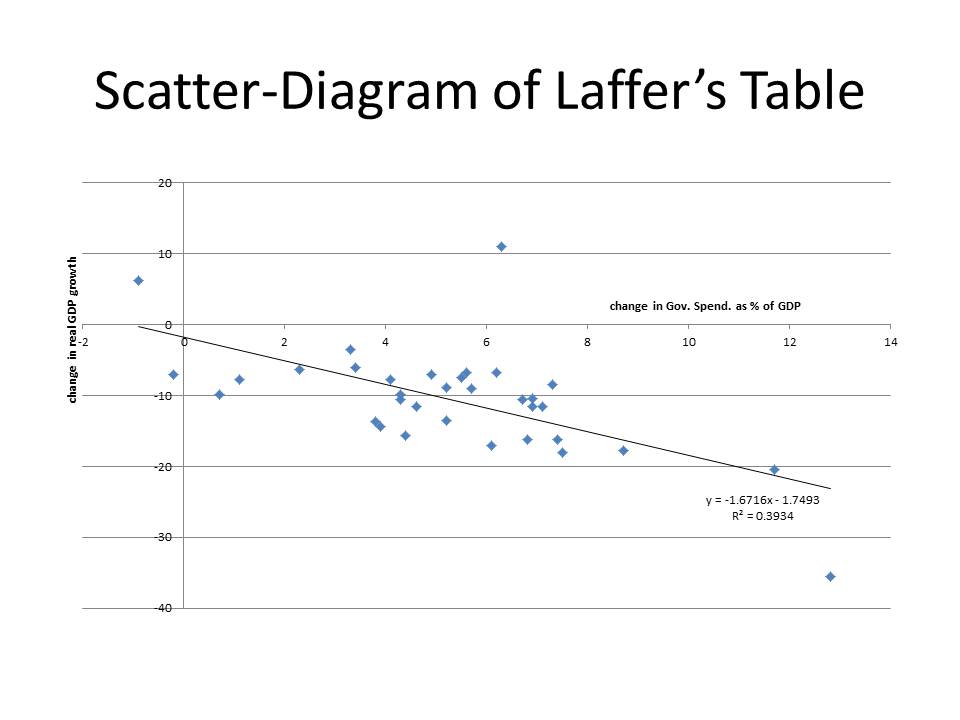
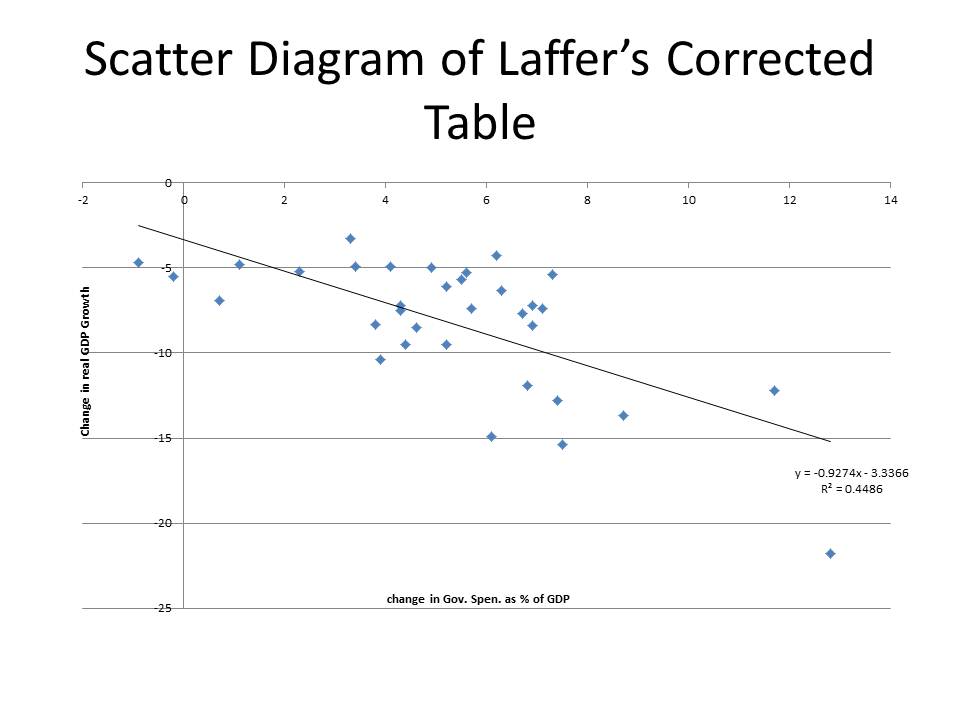
JR, a diligent commenter to my post, kindly provided me with the source for Laffer’s numbers on the IMF website, confirming that the numbers Laffer used for the change in government spending as a percentage of GDP did indeed reflect the underlying data reported by the IMF. JR was unable to reproduce Laffer’s numbers for the change in real GDP growth, and neither could I. But when I calculated the changes and replaced them in Laffer’s table, I found a similar negative relationship and a better fit (higher r-squared) than shown in Laffer’s table. In either case, the main reason for the negative correlation is that a decrease in real GDP growth is, by definition, correlated with an increase in government spending as a percentage of GDP. So Laffer’s result is pre-ordained by his choice of variables.

To show what is going on, I provide below two scatter diagrams of Laffer’s table with his numbers and my corrections of the numbers. You can see that the downward slope of the regression line is steeper using his original numbers, but there is less variation around the regression line with the corrected numbers.

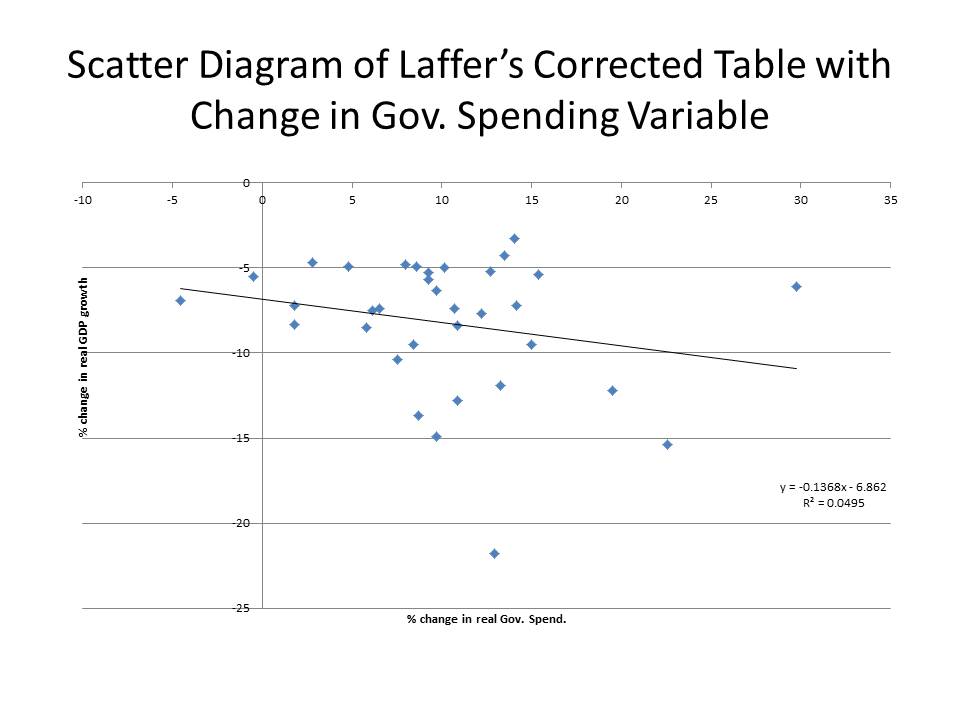
To see what happens when you eliminate the inherent negative correlation between the change in government spending as a percentage of GDP and the rate of growth of GDP, I recalculated the government spending variable as the real percentage change in GDP between 2007 and 2009. Substituting that redefined variable which is definitionally independent of changes in GDP gives me the following scatter diagram. The slope is still negative, but it is an order of magnitude less than the slope of the regression line implied by Laffer’s numbers.

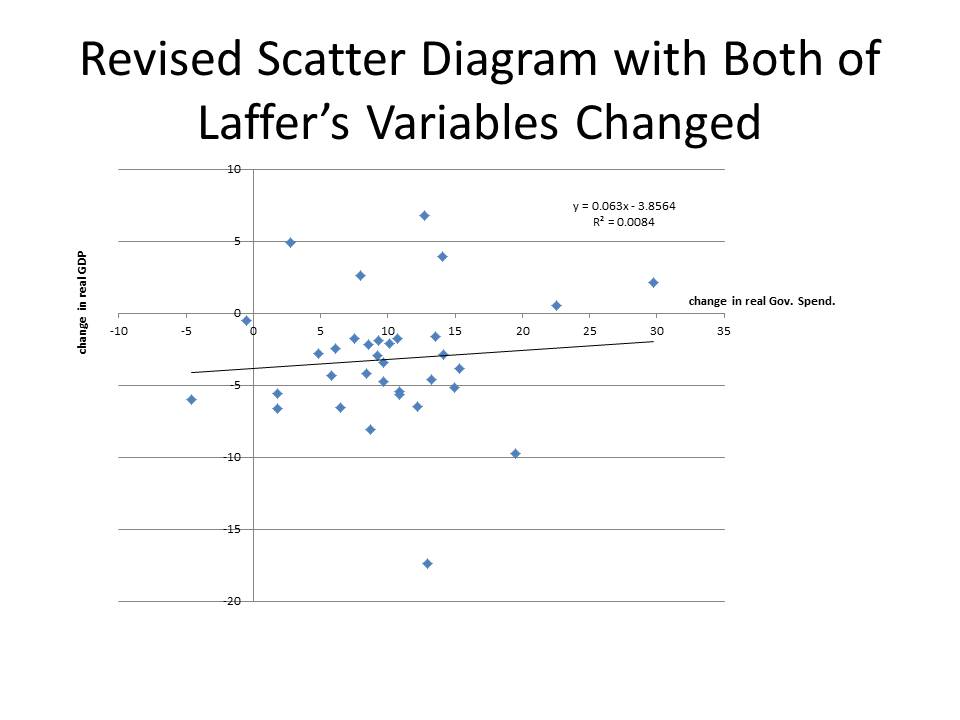
I then tried on further variation which was to replace the change in the growth rate of real GDP between 2007 and 2009 with the change in real GDP between 2007 and 2009. Here is the scatter diagram for corresponding to that change in variables.

As you can see, the regression line now has a positive slope, though it is probably statistically insignificant given the very low value of the r-squared. But in view of the simultaneity issues, I mentioned in my previous post, that is hardly surprising.

Some readers are probably wondering why I bothered posting all this.  I am asking myself the same question, but I just couldn’t help trying to figure out what Professor Laffer was up to.  Perhaps this makes it all a bit clearer.

Arthur Laffer, Anti-Enlightenment Economist

The Wall Street Journal, building on its solid reputation for providing a platform for moderately to extremely well-known economists to embarrass themselves, featured an op-ed today  by Arthur Laffer. Laffer certainly qualifies as a well-known economist, and he takes full advantage of the opportunity provided so generously by the Journal to embarrass himself.

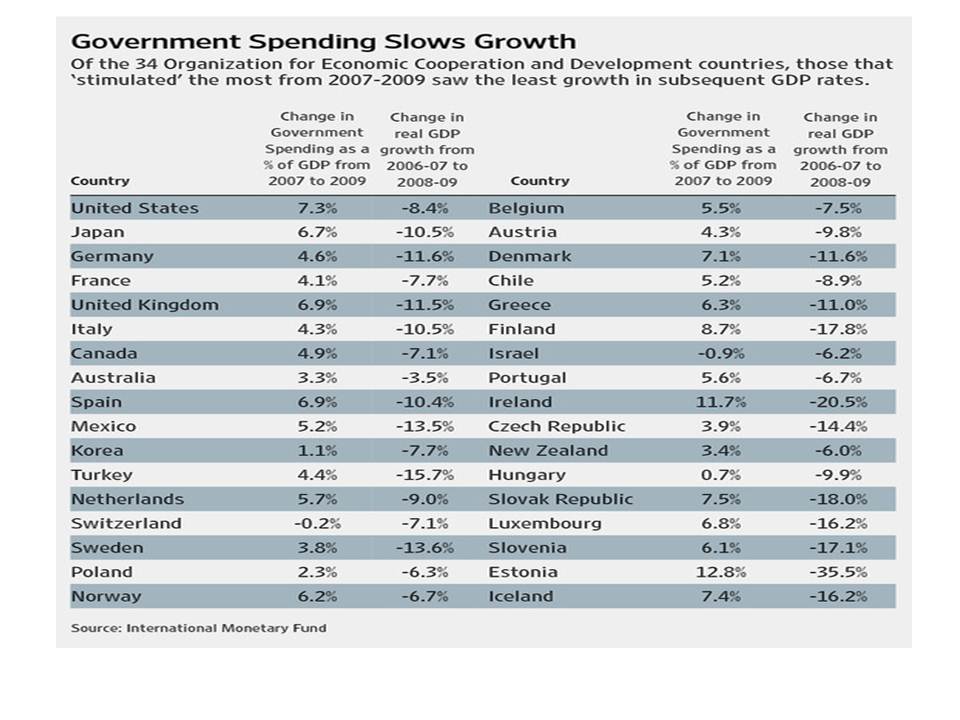
Laffer’s op-ed is primarily a commentary on a table constructed by Laffer, which I reproduce herewith.

For each of the 34 OECD countries, the table provides two numbers. The first number has the following description: “change in government spending as a percentage of GDP from 2007 to 2009.” This number is treated by Laffer as a proxy for the amount of stimulus spending to counteract the 2008-09 recession. The second number has the following description: “change in real GDP growth from 2006-2007 to 2008-2009.” The second number is treated by Laffer as a proxy of the effectiveness of stimulus spending. Laffer thus regards the correlation between the two numbers as evidence on whether government spending actually helped to achieve a recovery from the 2008-09 recession.

Now, there are multiple problems with this starting with the following: Laffer’s description of the first number is ambiguous to the point of incomprehension. Does Laffer mean to say that he is subtracting the 2007 ratio of government spending to GDP in each country from the same ratio in 2009? Or, does he mean that he is subtracting total government spending in each country in 2007 from total government spending in 2009, and expressing that difference as a percentage of GDP in that country in 2007. Which calculation he is performing makes a big difference. Suppose Estonia — Laffer’s poster child for Keynesian stimulus — kept spending unchanged between 2007 and 2009, but GDP contracted by one-third. If Laffer is calculating his first number by the first method, he comes up with an increase in government spending as a percentage of GDP of 33%, even though government spending did not change. That is just perverse. So how did Laffer perform his calculation?  He doesn’t say.  All he does is cite the IMF as the source for his table. Thanks a lot, Art; that was really helpful, but unfortunately, not helpful enough to figure out what you are talking about.

But I didn’t just give up; I persisted.  I thought to myself: “maybe I can calculate the number both ways for the US using readily available statistics on GDP and government spending and see which method allows me to reproduce his result of a 7.3% increase in US government spending as a percentage of US GDP between 2007 and 2009.”  And that’s what I did. Just one problem, though. Adding state, local, and federal spending as a percentage of GDP in 2007, I came up with about 35%. Doing the same calculation for 2009, I came up with about 40%, implying a change of slightly over 5%, well under Laffer’s number of 7.3%. Inasmuch as nominal US GDP in 2009 was greater than nominal US GDP in 2007, the alternative method would have given me a number even smaller than I got using the first method. So I have no idea how Laffer got his 7.3% number for the US, and I seriously doubt that there was any valid way by which he could have arrived at an increase in government spending as a percentage of US GDP between 2007 and 2009 greater than 7%. So why should I even bother checking any of his other numbers?

As if this were not enough, Laffer offers an equally mysterious second number, the difference between the 2006-07 growth rate in each country and the 2008-09 growth rate. But wait, 2008-09 was when there was a recession, not a recovery. So how does Laffer know that his second number is measuring the strength the forces of recovery rather than the strength of the forces of contraction?  Answer: He doesn’t. He doesn’t, because he can’t, there being no way to disentangle the two.

Finally – by which I mean, not that I am exhausting the criticisms that could be made of what Laffer has written, but that I am exhausting my own, and perhaps my readers’, patience – suppose that Laffer’s numbers had been accurately calculated, and second that his numbers actually mean something approximating what Laffer purports them to mean. Does the not-very-strong negative correlation that Laffer finds between increases in government spending and increases in the rate of growth of real GDP imply that government spending is useless in stimulating a recovery, as he claims it does? Not at all. As a former member of the University of Chicago faculty, Laffer should be aware of the concept of automatic fiscal stabilizers that none other than Milton Friedman often referred to in his writings on fiscal policy. Because almost all countries have some sort of social safety net, recessions automatically increase government spending through programs like unemployment insurance, food stamps, Medicaid and others that provide services and benefits to people who lose their  jobs in recessions. The worse the recession, the greater the automatic increase in government spending. Thus, the negative correlation between government spending and economic growth that Laffer purports to uncover is easily explained by the existence of automatic stabilizers. The worse the recession, the greater the induced increase in government spending.

Moreover, suppose we knew with certainty that government spending stimulates a recovery, and suppose that governments, secure in that knowledge, increased their spending in recessions to achieve a recovery. If you went out and looked at the statistics on GDP and government spending, what would you find?  You would find that governments increased spending when the economy was contracting and decreased spending when the economy was expanding.  So what empirical correlation would you expect to observe between government spending and growth in real GDP?  Exactly the one that Laffer finds and claims proves just the opposite of what we “know” to be true.

Art, heckuva job.

PS If Laffer had the sense to read Nick Rowe’s blog he might not have made such a ridiculous argument.

PPS Lars Christensen and Brad Delong are also exasperated with Laffer.

Thompson’s Reformulation of Macroeconomic Theory, Part II: Temporary Equilibrium

I explained in my first post on Earl Thompson’s reformulation of macroeconomics that Thompson posited a model consisting of a single output serving as both a consumption good and as a second factor of production cooperating with labor to produce the output. The single output is traded in two markets: a market for sale to be consumed and a market for hire as a factor of production. The ratio of the rental price to the purchase price determines a real interest rate, and adding the expected rate of change in the purchase price from period to period to the real interest rate determines the nominal interest rate. The money wage is determined in a labor market, and the absolute price level is determined in the money market. A market for bonds exists, but the nominal interest rate determined by the ratio of the rental price of the output to its purchase price plus the expected rate of change in the purchase price from period to period governs the interest rate on bonds, conveniently allowing the bond market to be excluded from the analysis.

The typical IS-LM modeling approach is to posit a sticky wage that prevents equilibrium at full employment from being achieved except via an increase in aggregate demand. Wage rigidity is thus introduced as an ad hoc assumption to explain how an unemployment “equilibrium” is possible. However, by extending the model to encompass a second period, Thompson was able to derive wage stickiness in the context of a temporary equilibrium construct that does not rely on an arbitrary assumption of wage stickiness, but derives wage stickiness as an implication of incorrect expectations, in particular from overly optimistic wage expectations by workers who, upon observing unexpectedly low wage offers, choose to remain unemployed, preferring instead to engage in job search, leisure, or non-market labor activity.  The model assumptions are basically those of Lucas, and Thompson provides some commentary on the rationale for his assumptions.

One might, however, reasonably doubt that government policy makers have systematically better information than private decision makers regarding future prices. Such doubting would be particularly strong for commodity markets, where, in the real world, market specialists normally arbitrage between present and future markets. . . . But laws prohibiting long-term labor contracts have effectively prevented human capital from coming under the control of market specialists. As a consequence, the typical laborer, who is not naturally an expert in the market for his kind of service, makes his own employment decisions despite relative ignorance about the market. (p. 6)

I will just note parenthetically that my own view is that the information problem is exacerbated in the real world by the existence of many products and many different  kinds of services. Shocks are transmitted from sector to sector via complicated and indirect interrelationships between markets and sectors. In the process of transmission, initial shocks are magnified, some sectors being affected more than others in unpredictable, or at least unpredicted, ways causing sector-specific shocks that, in turn, get transmitted to other sectors. These interactions are analogous to the Cantillon effects associated with sector-specific variations in the rate of additional spending caused by monetary expansion.  Austrian economists tend to wring their hands and shake their heads in despair about the terrible distortions associated with Cantillon effects caused by monetary expansion, but seem to regard the Cantillon effects associated with monetary contraction as benign and remedial.  Highly aggregated models don’t capture these interactions and thus leave out an important feature of business-cycle contractions.

Starting from a position of full equilibrium, an exogenous shift creates a temporary equilibrium with Keynesian unemployment when there is an overall excess supply of labor at the original wage rates and some laborers mistakenly believe that the resulting lower wage offers from their present employers may be a result of a shift which lowers the value of their products in their present firms relative to other firms who hire workers in their occupations. As a consequence, some of these laborers refuse the lower wage offers from their present employers and spend their present labor service inefficiently searching for higher-wage jobs in their present occupation or resting in wait for what they expect to be the higher future wages.

Since monetary shifts, which are apparently observed to induce inefficient adjustments in employment, also change the temporary equilibrium level of prices of current outputs, we must assume that some workers do not know of the present change in the price level. Otherwise, all workers, in responding to a monetary shift, would be able to observe the price level change which accompanied the change in their wage offers and would not make the mistake of assuming that wage offers elsewhere have not similarly changed. . . . (p. 7)

The price level of current outputs is only an expectation function for these laborers, as they cannot be assumed to know the actual price level in the current period. This is represented . . . by allowing labor’s perception of current non-labor prices to depend only on last period’s prices, which are parameters rather than variables to be determined, and on current wage offers. (p. 8)

Because workers may construe an overall shift in the demand for labor as a relative shift in demand for their own type of labor, it follows that future wage and price expectations are inelastic with respect to observed increases in wage offers. Thus, a change in observed wages does not cause a corresponding revision of expected future wages and prices, so the supply of labor does not shift significantly when observed wages are higher or lower than expected.  When wages change because of an overall reduction in the demand for labor destined to cause future wages and prices to fall, workers with slowly adjusting expectations inefficiently supply services to employers on the basis of incorrect expectations. The temporary equilibrium corresponds to the intersection of a demand curve and a supply curve.  This is a type of wage rigidity different from that associated with the conventional Keynesian model.  The labor market is in equilibrium in the sense that current plans are being executed. However, current plans are conditional on incorrect expectations. There is an inefficiency associated with incorrect expectations. But it is an inefficiency that countercyclical policy can overcome, and that is why there is potentially a multiplier effect associated with an increase in aggregate demand.


About Me

David Glasner
Washington, DC

I am an economist in the Washington DC area. My research and writing has been mostly on monetary economics and policy and the history of economics. In my book Free Banking and Monetary Reform, I argued for a non-Monetarist non-Keynesian approach to monetary policy, based on a theory of a competitive supply of money. Over the years, I have become increasingly impressed by the similarities between my approach and that of R. G. Hawtrey and hope to bring Hawtrey’s unduly neglected contributions to the attention of a wider audience.

My new book Studies in the History of Monetary Theory: Controversies and Clarifications has been published by Palgrave Macmillan

Follow me on Twitter @david_glasner

Archives

Enter your email address to follow this blog and receive notifications of new posts by email.

Join 665 other subscribers
Follow Uneasy Money on WordPress.com