Archive Page 45

Currency Manipulation: Is It Just About Saving?

After my first discussion of currency manipulation, Scott Sumner responded with some very insightful comments of his own in which he pointed out that the current account surplus (an inflow of cash) corresponds to the difference between domestic savings and domestic investment. Scott makes the point succinctly:

There are two views of current account surpluses.  One is that they reflect “undervalued” currencies.  Another is that they reflect saving/investment imbalances.  Thus the CA surplus is the capital account deficit, which is (by definition) domestic saving minus domestic investment.

The difference is that when an undervalued currency leads to a current account surplus, the surplus itself tends to be self-correcting, because, under fixed exchange rates, the current account surplus leads (unless sterilized) to an increase of the domestic money stock, thereby raising domestic prices, with the process continuing until the currency ceases to be undervalued. A current account surplus caused by an imbalance between domestic saving and domestic investment is potentially more long-lasting, inasmuch as it depends on the relationship between the saving propensities of the community and the investment opportunities available to the community, a relationship that will not necessarily be altered as a consequence of the current account surplus.

From this observation, Scott infers that it is not really monetary policy, but a high savings rate, that causes an undervalued currency.

Actual Chinese exchange rate manipulation usually involves three factors:

1.  More Chinese government saving.

2.  The saving is done by the central bank.

3.  The central bank keeps the nominal exchange rate pegged.

But only the first is important.  If the Chinese government saves a huge percentage of GDP, and total Chinese saving rises above total Chinese investment, then by definition China has a CA surplus.  And this surplus would occur even if the exchange rate were floating, and if the purchases were done by the Chinese Treasury, not its central bank. That’s why you often see huge CA surpluses in countries that don’t have pegged exchange rates (Switzerland (prior to the recent peg), Singapore, Norway, etc).  They have government policies which involve either enormous government saving (Singapore and Norway) or policies that encourage private saving (Switzerland.)  It should also be noted that government saving does not automatically produce a CA surplus. Australia is a notable counterexample.  The Aussie government does some saving, but the private sector engages in massive borrowing from the rest of the world, so they still end up with a large CA deficit.

I think that Scott is largely correct, but he does overlook some important aspects of Chinese policy that distinguish it from other countries with high savings rates. First, Scott already observed that it is not savings alone that determines the current account surplus; it is the difference between domestic savings and domestic investment. China has a very high savings rate, but why is China’s domestic saving being channeled into holdings of American treasury notes yielding minimal nominal interest and negative real interest rather than domestic investment projects? While the other high-savings countries mentioned by Scott, are small wealthy countries with limited domestic investment opportunities, China is a vast poor and underdeveloped country with very extensive domestic investment opportunities. So one has to wonder why more Chinese domestic savings is not being channeled directly into financing Chinese investment opportunities.

In my follow-up post to the one Scott was commenting on, I pointed out the role of high Chinese reserve requirements on domestic bank deposits in sterilizing foreign cash inflows. As China develops and its economy expands, with income and output increasing at rates of 10% a year or more, the volume of market transactions is probably increasing even more rapidly than income, implying a very rapid increase in the demand to hold cash and deposits. By imposing high reserve requirements on deposits and choosing to let its holdings of domestic assets grow at a much slower rate than the expansion of its liabilities (the monetary base), the Chinese central bank has prevented the Chinese public from satisfying their growing demand for money except through an export surplus with which to obtain foreign assets that can be exchanged with the Chinese central bank for the desired additions to their holdings of deposits.

Now It is true, as Scott points out, that an export surplus could be achieved by other means, and all of the alternatives would ultimately involve increasing domestic saving above domestic investment. But that does not mean that there is nothing distinctive about the use of monetary policy as the instrument by which the export surplus and the excess of domestic saving over domestic investment (corresponding to the increase in desired holdings of the monetary base) is achieved. The point is that China is using monetary policy to pursue a protectionist policy favoring its tradable goods industries and disadvantaging the tradable goods industries of other countries including the US. It is true that a similar result would follow from an alternative set of policies that increased the Chinese savings relative to Chinese domestic investment, but it is not obvious that other policies aimed at increasing Chinese savings would not tend to increase Chinese domestic investment, leaving the overall effect on the Chinese tradable goods sector in doubt.

So it seems clear to me that Chinese monetary policy is protectionist, but Scott questions whether the US should care about that.

In the end none of this should matter, as the job situation in the US is determined by two factors:

1.  US supply-side policies

2.  US NGDP growth (i.e. monetary policy.)

After all, in a strict welfare sense, it would seem that China is doing us a favor by selling their products to us cheaply. Why should we complain about that? US employment depends on US nominal GDP, and with an independent monetary authority, the US can control nominal GDP and employment.

But it seems to me that this sort of analysis may be a bit too Ricardian, in the sense that it focuses mainly on long-run equilibrium tendencies. In fact there are transitional effects on US tradable goods industries and the factors of production specific to those industries. When those industries become unprofitable because of Chinese competition, the redundant factors of production bear heavy personal and economic costs. Second, if China uses protectionism to compete by keeping its real wages low, then low Chinese wages may tend to amplify downward pressure on real wages in the US compared to a non-protectionist Chinese policy. If so, Chinese protectionism may be exacerbating income inequality in the US. Theoretically, I think that the effects could go either way, but I don’t think that the concerns can be dismissed so easily. If countries have agreed not to follow protectionist policies, it seems to me that they should not be able to avoid blame for policies that are protectionist simply by saying that the same or similar effects would have been achieved by a sufficiently large excess of domestic savings over domestic investment.
Mary Anastasia O’Grady Needs to Take a Deep Breath

Obviously upset at Tuesday’s election results, Mary Anastasia O’Grady, member of the Wall Street Journal editorial board, takes out her frustration on Ben Bernanke, accusing Mr. Bernanke of buying the election for Mr. Obama. I mean who needs Sheldon Adelson when you’ve got the Chairman of the Federal Reserve Board out there working for you day and night?

Which brings us to whom Mr. Obama, if he is going to be honest, ought to thank for his victory. It is the man behind the curtain at the Federal Reserve in Washington. By pulling the monetary levers driving credit—fast and furiously and out of the view of most Americans—Fed Chairman Ben Bernanke artificially juiced asset prices and the housing market just in time for Election Day.

If you doubt that, consider this: The total return on the S&P 500 from the beginning of this election year until yesterday was almost 13.9%. The Dow Jones Industrial Average returned almost 9.2%. That means that as millions of Americans have opened their monthly 401 (K) statement this year, they have been under the impression that the losses they suffered after the 2008 financial crisis are being recovered. There has also been a recovery in a number of housing markets around the country.

Now lest you think that rising stock prices and a bottoming out of housing prices show that Mr. Bernanke is ably discharging his responsibilities as Fed Chairman, Mrs. O’Grady proceeds to explain why you are being taken for a sucker by a con artist.

That cheap credit and the search for yield is driving what is likely to become another bubble may not be appreciated by these investors. Instead, it is not unreasonable to suggest that some significant number, having had their portfolios injected with Mr. Bernanke’s feel-good monetary stimulus, decided that Mr. Obama is in fact making them better off.

But are near-zero interest rates and the central bank financing of the U.S. government, through quantitative easing, sustainable policies? To put it another way, can the Fed print our way out of economic and fiscal troubles? If that were possible, Argentina would be a rich country. Instead it is poor and its political system is dominated by leftwing populist demagogues.

Mrs. O’Grady has a point. A country cannot permanently increase its output beyond what its available resources are capable of producing. A poor country cannot become rich by inflating its currency. The problem in the US is not that we lack resources, but that we are not utilizing the resources that are available. There are millions of people not working, something that Mrs. O’Grady’s preferred candidate for President spent a fair amount of time repeating for more than a year. The question is not whether monetary policy can create resources that don’t exist, but whether monetary policy can help get idle resources back to work. Perhaps monetary policy can’t do that.  After all, there are some smart people who don’t think it can.  But we do have a lot of evidence that bad monetary policy does cause high unemployment, as in the Great Depression. And some of us are old enough to remember when, during the Reagan administration, the Wall Street Journal editorial page was continually berating Paul Volcker for holding back a recovery by keeping monetary policy too tight and interest rates too high. The evidence shows that in deep depressions currency devaluation and inflation can work wonders, as FDR proved in 1933. It even worked for Argentina after its financial crisis in 2001. The disastrous policies of the past several years don’t mean that monetary expansion was not instrumental for Argentina’s recovery from the earlier crisis.

More on Currency Manipulation

My previous post on currency manipulation elicited some excellent comments and responses, helping me, I hope, to gain a better understanding of the subject than I started with. What seemed to me the most important point to emerge from the comments was that the Chinese central bank (PBC) imposes high reserve requirements on banks creating deposits. Thus, the creation of deposits by the Chinese banking system implies a derived demand for reserves that must be held with the PBC either to satisfy the legal reserve requirement or to satisfy the banks’ own liquidity demand for reserves. Focusing directly on the derived demand of the banking system to hold reserves is a better way to think about whether the Chinese are engaging in currency manipulation and sterilization than the simple framework of my previous post. Let me try to explain why.

In my previous post, I argued that currency manipulation is tantamount to the sterilization of foreign cash inflows triggered by the export surplus associated with an undervalued currency. Thanks to an undervalued yuan, Chinese exporters enjoy a competitive advantage in international markets, the resulting export surplus inducing an inflow of foreign cash to finance that surplus. But neither that surplus, nor the undervaluation of the yuan that underlies it, is sustainable unless the inflow of foreign cash is sterilized. Otherwise, the cash inflow, causing a corresponding increase in the Chinese money supply, would raise the Chinese price level until the competitive advantage of Chinese exporters was eroded. Sterilization, usually conceived of as open-market sales of domestic assets held by the central bank, counteracts the automatic increase in the domestic money supply and in the domestic price level caused by the exchange of domestic for foreign currency. But this argument implies (or, at least, so I argued) that sterilization is not occurring unless the central bank is running down its holdings of domestic assets to offset the increase in its holdings of foreign exchange. So I suggested that, unless the Chinese central holdings of domestic assets had been falling, it appeared that the PBC was not actually engaging in sterilization. Looking at balance sheets of the PBC since 1999, I found that 2009 was the only year in which the holdings of domestic assets by the PBC actually declined. So I tentatively concluded that there seemed to be no evidence that, despite its prodigious accumulation of foreign exchange reserves, the PBC had been sterilizing inflows of foreign cash triggered by persistent Chinese export surpluses.

Somehow this did not seem right, and I now think that I understand why not. The answer is that reserve requirements imposed by the PBC increase the demand for reserves by the Chinese banking system. (See here.) The Chinese reserve requirements on the largest banks were until recently as high as 21.5% of deposits (apparently the percentage is the same for both time deposits and demand deposits). The required reserve ratio is the highest in the world. Thus, if Chinese banks create 1 million yuan in deposits, they are required to hold approximately 200,000 yuan in reserves at the PBC. That 200,000 increase in reserves must come from somewhere. If the PBC does not create those reserves from domestic credit, the only way that they can be obtained by the banks (in the aggregate) is by obtaining foreign exchange with which to satisfy their requirement. So given a 20% reserve requirement, unless the PBC undertakes net purchases of domestic assets equal to at least 200,000 yuan, it is effectively sterilizing the inflows of foreign exchange. So in my previous post, using the wrong criterion for determining whether sterilization was taking place, I had it backwards. The criterion for whether sterilization has occurred is whether bank reserves have increased over time by a significantly greater percentage than the increase in the domestic asset holdings of the PBC, not, as I had thought, whether those holdings of the PBC have declined.

In fact it is even more complicated than that, because the required-reserve ratio has fluctuated over time, the required-reserve ratio having roughly tripled between 2001 and 2010, so that the domestic asset holdings of the PBC would have had to increase more than proportionately to the increase in reserves to avoid effective sterilization. Given that the reserves held by banking system with the PBC at the end of 2010 were almost 8 times as large as they had been at the end of 2001, while the required reserve ratio over the period roughly tripled, the domestic asset holdings of the PBC should have increased more than twice as fast as bank reserves over the same period, an increase of, say, 20-fold, if not more. In the event, the domestic asset holdings of the PBC at the end of 2010 were just 2.2 times greater than they were at the end of 2001, so the inference of effective sterilization seems all but inescapable.

Why does the existence of reserve requirements mean that, unless the domestic asset holdings of the central bank increase at least as fast as reserves, sterilization is taking place? The answer is that the existence of a reserve requirement means that an increase in deposits implies a roughly equal percentage increase in reserves. If the additional reserves are not forthcoming from domestic sources, the domestic asset holdings of the central bank not having increased as fast as did required reserves, the needed reserves can be obtained from abroad only by way of an export surplus. Thus, an increase in the demand of the public to hold deposits cannot be accommodated unless the required reserves can be obtained from some source. If the central bank does not make the reserves available by purchasing domestic assets, then the only other mechanism by which the increased demand for deposits can be accommodated is through an export surplus, the surplus being achieved by restricting domestic spending, thereby increasing exports and reducing imports. The economic consequences of the central bank not purchasing domestic assets when required reserves increase are the same as if the central bank sold some of its holdings of domestic assets when required reserves were unchanged.

The more general point is that one cannot assume that the inflow of foreign exchange corresponding to an export surplus is determined solely by the magnitude of domestic currency undervaluation. It is also a function of monetary policy. The tighter is monetary policy, the larger the export surplus, the export surplus serving as the mechanism by which the public increases their holdings of cash. Unfortunately, most discussions treat the export surplus as if it were determined solely by the exchange rate, making it seem as if an easier monetary policy would have little or no effect on the export surplus.

The point is similar to one I made almost a year ago when I criticized F. A. Hayek’s 1932 defense of the monetary policy of the insane Bank of France. Hayek acknowledged that the gold holdings of the Bank of France had increased by a huge amount in the late 1920s and early 1930s, but, nevertheless, absolved the Bank of France of any blame for the Great Depression, because the quantity of money in France had increased by as much as the increase in gold reserves of the Bank of France.  To Hayek this meant that the Bank of France had done “all that was necessary for the gold standard to function.” This was a complete misunderstanding on Hayek’s part of how the gold standard operated, because what the Bank of France had done was to block every mechanism for increasing the quantity of money in France except the importation of gold. If the Bank of France had not embarked on its insane policy of gold accumulation, the quantity of money in France would have been more or less the same as it turned out to be, but France would have imported less gold, alleviating the upward pressure being applied to the real value of gold, or stated equivalently alleviating the downward pressure on the prices of everything else, a pressure largely caused by insane French policy of gold accumulation.

The consequences of the Chinese sterilization policy for the world economy are not nearly as disastrous as those of the French gold accumulation from 1928 to 1932, because the Chinese policy does not thereby impose deflation on any other country. The effects of Chinese sterilization and currency manipulation are more complex than those of French gold accumulation. I’ll try to at least make a start on analyzing those effects in an upcoming post addressing the comments of Scott Sumner on my previous post.

On the Manipulation of Currencies

Mitt Romney is promising to declare China a currency manipulator on “day one” of his new administration. Why? Ostensibly, because Mr. Romney, like so many others, believes that the Chinese are somehow interfering with the foreign-exchange markets and holding the exchange rate of their currency (confusingly called both the yuan and the remnibi) below its “true” value. But the other day, Mary Anastasia O’Grady, a member of the editorial board of the avidly pro-Romeny Wall Street Journal, wrote an op-ed piece (“Ben Bernanke: Currency Manipulator” ) charging that Bernanke is no less a currency manipulator than those nasty Chinese Communists. Why? Well, that was not exactly clear, but it seemed to have something to do with the fact that Mr. Bernanke, seeking to increase the pace of our current anemic recovery, is conducting a policy of monetary expansion to speed the recovery.

So, is what Mr. Bernanke is doing (or supposed to be doing) really the same as what the Chinese are doing (or supposed to be doing)?

Well, obviously it is not. What the Chinese are accused of doing is manipulating the yuan’s exchange rate by, somehow, intervening in the foreign-exchange market to prevent the yuan from rising to its “equilibrium” value against the dollar. The allegation against Mr. Bernanke is that he is causing the exchange rate of the dollar to fall against other currencies by increasing the quantity of dollars in circulation. But given the number of dollars in circulation, the foreign-exchange market is establishing a price that reflects the “equilibrium” value of dollars against any other currency. Mr. Bernanke is not setting the value of the dollar in foreign-exchange markets, as the Chinese are accused of doing to the dollar/yuan exchange rate. Even if he wanted to control the exchange value of the dollar, it is not directly within Mr. Bernanke’s power to control the value that participants in the foreign-exchange markets attach to the dollar relative to other currencies.

But perhaps this is too narrow a view of what Mr. Bernanke is up to. If the Chinese government wants the yuan to have a certain exchange value against the dollar and other currencies, all it has to do is to create (or withdraw) enough yuan to ensure that the value of yuan on the foreign-exchange markets falls (or rises) to its target. In the limit, the Chinese government could peg its exchange rate against the dollar (or against any other currency or any basket of currencies) by offering to buy and sell dollars (or any other currency or any basket of currencies) in unlimited quantities at the pegged rate with the yuan. Does that qualify as currency manipulation? For a very long time, pegged or fixed exchange rates in which countries maintained fixed exchange rates against all other currencies was the rule, not the exception, except that the pegged rate was most often a fixed price for gold or silver rather than a fixed price for a particular currency. No one ever said that simply maintaining a fixed exchange rate between one currency and another or between one currency and a real commodity is a form of currency manipulation. And for some 40 years, since the demise of the Bretton Woods system, the Wall Street Journal editorial page has been tirelessly advocating restoration of a system of fixed exchange rates, or, ideally, restoration of a gold standard. And now the Journal is talking about currency manipulation?

So it’s all very confusing. To get a better handle on the question of currency manipulation, I suggest going back to a classic statement of the basic issue by none other than John Maynard Keynes in a book, A Tract on Monetary Reform, that he published in 1923, when the world was trying to figure out how to reconstruct an international system of monetary arrangements to replace the prewar international gold standard, which had been one of the first casualties of the outbreak of World War I.

Since . . . the rate of exchange of a country’s currency with the currency of the rest of the world (assuming for the sake of simplicity that there is only one external currency) depends on the relation between the internal price level and the external price level [i.e., the price level of the rest of the world], it follows that the exchange cannot be stable unless both internal and external price levels remain stable. If, therefore, the external price level lies outside our control, we must submit either to our own internal price level or to our exchange rate being pulled about by external influences. If the external price level is unstable, we cannot keep both our own price level and our exchanges stable. And we are compelled to choose.

I like to call this proposition – that a country can control either its internal price level or the exchange rate of its currency, but cannot control both — Keynes’s Law, though Keynes did not discover it and was not the first to articulate it (but no one else did so as succinctly and powerfully as he). So, according to Keynes, whether a country pegs its exchange rate or controls its internal price level would not matter if the price level in the rest of the world were stable, because in that case for any internal price level there would be a corresponding exchange rate and for every exchange rate there would be a corresponding internal price level. For a country to reduce its own exchange rate to promote exports would not work, because the low exchange rate would cause its internal prices to rise correspondingly, thereby eliminating any competitive advantage for its products in international trade. This principle, closely related to the idea of purchasing power parity (a concept developed by Gustav Cassel), implies that currency manipulation is not really possible, except for transitory periods, because prices adjust to nullify any temporary competitive advantage associated with a weak, or undervalued, currency. An alternative way of stating the principle is that a country can control its nominal exchange rate, but cannot control its real exchange rate, i.e, the exchange rate adjusted for price-level differences. If exchange rates and price levels tend to adjust to maintain purchasing power parity across currency areas, currency manipulation is an exercise in futility.

That, at any rate, is what the theory says. But for any proposition derived from economic theory, it is usually possible to come up with exceptions by altering the assumptions. Now for Keynes’s Law, there are two mechanisms causing prices to rise faster in a country with an undervalued currency than they do elsewhere. First, price arbitrage between internationally traded products tends to equalize prices in all locations after adjusting for exchange rate differentials. If it is cheaper for Americans to buy wheat in Winnipeg than in Wichita at the current exchange rate between the US and Canadian dollars, Americans will buy wheat in Winnipeg rather than Wichita forcing the Wichita price down until buying wheat in Wichita is again economical. But the arbitrage mechanism works rapidly only for internationally traded commodities like wheat. Many commodities, especially factors of production, like land and labor, are not tradable, so that price differentials induced by an undervalued exchange rate cannot be eliminated by direct arbitrage. But there is another mechanism operating to force prices in the country with an undervalued exchange rate to rise faster than elsewhere, which is that the competitive advantage from an undervalued currency induces an inflow of cash from other countries importing those cheap products, the foreign cash influx, having been exchanged for domestic cash, becoming an additional cause of rising domestic prices. The influx of cash won’t stop until purchasing power parity is achieved, and the competitive advantage eliminated.

What could prevent this automatic adjustment process from eliminating the competitive advantage created by an undervalued currency? In principle, it would be possible to interrupt the process of international arbitrage tending to equalize the prices of internationally traded products by imposing tariffs or quotas on imports or by imposing exchange controls on the movement of capital across borders. All of those restrictions or taxes on international transactions prevent the price equalization implied by Keynes’s Law and purchasing power parity from actually occurring. But after the steady trend of liberalization since World War II, these restrictions, though plenty remain, are less important than they used to be, and a web of international agreements, codified by the International Trade Organization, makes resorting to them a lot trickier than it used to be.

That leaves another, less focused, method by which governments can offer protection from international competition to certain industries or groups. The method is precisely for the government and the monetary authority to do what Keynes’s Law says can’t be done:  to choose an exchange rate that undervalues the currency, thereby giving an extra advantage or profit cushion to all producers of tradable products (i.e., export industries and import-competing industries), perhaps spreading the benefits of protection more widely than governments, if their choices were not restricted by international agreements, would wish. However, to prevent the resulting inflow of foreign cash from driving up domestic prices and eliminating any competitive advantage, the monetary authority must sterilize the induced cash inflows by selling assets to mop up the domestic currency just issued in exchange for the foreign cash directed toward domestic exporters. (The classic analysis of such a policy was presented by Max Corden in his paper “Exchange Rate Protection,” reprinted in his Production, Growth, and Trade: Essays in International Economics.) But to borrow a concept from Austrian Business Cycle Theory, this may not be a sustainable long-run policy for a central bank, because maintaining the undervalued exchange rate would require the central bank to keep accumulating foreign-exchange reserves indefinitely, while selling off domestic assets to prevent the domestic money supply from increasing. The central bank might even run out of domestic assets with which to mop up the currency created to absorb the inflow of foreign cash. But in a rapidly expanding economy (like China’s), the demand for currency may be growing so rapidly that the domestic currency created in exchange for the inflow of foreign currency can be absorbed by the public without creating any significant upward pressure on prices necessitating a sell-off of domestic assets to prevent an outbreak of domestic inflation.

It is thus the growth in, and the changing composition of, the balance sheet of China’s central bank rather than the value of the dollar/yuan exchange rate that tells us whether the Chinese are engaging in currency manipulation. To get some perspective on how the balance sheet of Chinese central banks has been changing, consider that Chinese nominal GDP in 2009 was about 2.5 times as large as it was in 2003 while Chinese holdings of foreign exchange reserves in 2009 were more than 5 times greater than those holdings were in 2003. This means that the rate of growth (about 25% a year) in foreign-exchange reserves held by the Chinese central bank between 2003 and 2009 was more than twice as great as the rate of growth in Chinese nominal GDP over the same period. Over that period, the share of the total assets of the Chinese central bank represented by foreign exchange has grown from 48% in December 2003 to almost 80% in December 2010. Those changes are certainly consistent with the practice of currency manipulation.  However, except for 2009, there was no year since 2000 in which the holdings of domestic assets by the Chinese central bank actually fell, suggesting that there has been very little actual sterilization undertaken by the Chinese central bank.  If there has indeed been no (or almost no) actual sterilization by the Chinese central bank, then, despite my long-standing suspicions about what the Chinese have been doing, I cannot conclude that the Chinese have been engaging in currency manipulation. But perhaps one needs to look more closely at the details of how the balance sheet of the Chinese central bank has been changing over time.  I would welcome the thoughts of others on how to interpret evidence of how the balance sheet of the Chinese central bank has been changing.

At any rate, to come back to Mary Anastasia O’Grady’s assertion that Ben Bernanke is guilty of currency manipulation, her accusation, based on the fact that Bernanke is expanding the US money supply, is clearly incompatible with Max Corden’s exchange-rate-protection model. In Corden’s model, undervaluation is achieved by combining a tight monetary policy that sterilizes (by open-market sales!) the inflows induced by an undervalued exchange rate. But, according to Mrs. O’Grady, Bernanke is guilty of currency manipulation, because he is conducting open-market purchases, not open-market sales! So Mrs. O’Grady has got it exactly backwards.  But, then, what would you expect from a member of the Wall Street Journal editorial board?

PS  I have been falling way behind in responding to recent comments.  I hope to catch up over the weekend as well as write up something on medium of account vs. medium of exchange.

PPS  Thanks to my commenters for providing me with a lot of insight into how the Chinese operate their monetary and banking systems.  My frequent commenter J.P. Koning has an excellent post and a terrific visual chart on his blog Moneyness showing the behavior over time of the asset and liability sides of the Chinese central bank.  Scott Sumner has also added an excellent discussion of his own about what Chinese monetary policy is all about.  I am trying to assimilate the various responses and hope to have a further post on the subject in the next day or two.

My Paper on the Monetary Theories of Ricardo and Thornton Is Now Available

I have just posted (on the Social Science Research Network) a revised version of a paper I presented last year in Tokyo at the Ricardo Society Conference on Money, Finance and Ricardo. The paper, “Monetary Disequilibrium and the Demand for Money in Ricardo and Thornton,” will be published next year by Routledge in a forthcoming volume edited by Susumu Takenaga, containing the papers presented at the conference. Here is the abstract of my paper.

This paper attempts to provide an account of the reasons for the differences between the theories of David Ricardo and Henry Thornton for the depreciation of sterling during the Napoleonic Wars. Ricardo held that only overissue by the Bank of England could cause depreciatiaon of sterling during the Restriction while Thornton believed that other causes, like a bad harvest, could also be responsible for declining value of sterling in terms of bullion. Ricardo thought that a strict application of the conditions of international commodity arbitrage under the gold standard showed that a bad harvest could not cause a depreciation of sterling, but, applying a barter model, he failed to consider the effect of a bad harvest on the demand for money. In contrast, Thornton’s anticipation of Wicksell’s natural-rate theory did not strictly adhere to the conditions of international commodity arbitrage assumed by Ricardo, allowing for the operation of a Humean price-specie-flow mechanism, but, like Ricardo, Thornton implicitly made the untenable assumption of an unchanging demand for money.

The paper is available for download at the Social Science Research Network website. Here’s a link

http://papers.ssrn.com/sol3/papers.cfm?abstract_id=2168012

Any comments or suggestions would be greatly appreciated.

And Now Here’s a Kind Word for Austrian Business Cycle Theory

I recently wrote two posts (this and this) about the Austrian Theory of Business Cycles (ABCT) that could be construed as criticisms of the theory, and regular readers of this blog are probably aware that critical comments about ABCT are not unprecedented on this blog. Nevertheless, I am not at all hostile to ABCT, though I am hostile to the overreach of some ABCT enthusiasts who use ABCT as a justification for their own radically nihilistic political agenda of promoting the collapse of our existing financial and monetary system and the resulting depression in the expectation that the apocalypse would lead us into a libertarian free market paradise. So, even though I don’t consider myself an Austrian economist, I now want to redress the balance by saying something positive about ABCT, because I actually believe that the Austrian theory and approach has something important to teach us about business-cycle theory and macroeconomics.

The idea for writing a positive post about Austrian business-cycle theory actually came to me while I was writing my latest installment on Earl Thompson’s reformulation of macroeconomics. The point of my series on Earl Thompson is to explain how Thompson constructed a macroeconomic model in many ways similar to the Keynesian IS-LM model, but on a consistent and explicitly neoclassical foundation. Moreover, by inquiring deeply into the differences between his reformulated model with IS-LM model, Thompson identified some important conceptual shortcomings in the Keynesian model, perhaps most notably the downward-sloping IS curve, a shortcoming with potentially important policy implications.

Now to be able to construct a macroeconomic model at what Thompson called “a Keynesian level of aggregation” (i.e, a model consisting of just four markets, money, output, capital services and labor services) that could also be reconciled with neoclassical production theory, it was necessary to assume that capital and output are a single homogeneous substance that can either be consumed or used as an input in the production process for new output. One can, as Thompson did, construct a consistent model based on these assumptions, a model that may even yield important and useful insights, but it is not clear to me that these minimal assumptions provide a sufficient basis for constructing a reliable macroeconomic model.

What does this have to do with ABCT? Well, ABCT seeks to provide an explanation of business cycles that is built from the ground up based on how individuals engage in rational goal-oriented action in market transactions. In Austrian theory, understanding how market actions are motivated and coordinated is primarily achieved by understanding how relative prices adjust to the market forces of demand and supply. Market determined prices direct resources toward their most highly valued uses given the available resources and the structure of demand for final outputs, while coordinating the separate plans of individual households and business firms. In this view, total aggregate spending is irrelevant as it is nothing more than the sum total of individual decisions. It is the individual decisions that count; total spending is simply the resultant of all those individual decisions, not the determinant of them.  Those decisions are made in light of the incentives and costs faced by the individual decision-makers. Total spending doesn’t figure into their decision-making processes, so what is the point of including it as a variable in the mode?

This mistaken preoccupation of Keynesian macroeconomics with aggregate spending has been the central message of Austrian anti-Keynesianism going back at least to Hayek’s 1931 review of Keynes’s Treatise on Money in which Hayek charged that “Mr. Keynes’s aggregates conceal the most fundamental mechanisms of change.” But the assertion that aggregates are irrelevant to individual decisions is not necessarily valid. Businesses decide on how much they are going to invest based on some forecast of the future demand for their products. Is that forecast of future demand independent of what total spending will be in the future? That is a matter of theoretical judgment, not an issue of methodological malpractice.  Interest rates, a quintessential market price, the rate at which one can transform current commodities or money units into future commodities or future money units, are not independent of forecasts about the future purchasing power of the monetary unit. But the purchasing power of the monetary unit is another one of those illegitimate aggregate about which Austrians complain. So although I sympathize with Austrian mistrust of overly aggregated macroeconomic models, I am not sure that I agree with their specific criticisms about the meaningfulness and relevance of particular aggregates.

So let me offer an alternative criticism of excessive aggregation, but in the context of a different kind of example. Suppose I wish to explain a very simple kind of social interaction in which a decision by one person can lead to a kind of chain reaction followed by a rapid succession of subsequent, but formally, independent, decisions. Think of a crowd of people watching a ball game. The spectators are all seated in their seats.  Suddenly something important or exciting happens on the court or the field and almost instantaneously everyone is standing. Why? As soon as one person stands he blocks the vision of the person behind him, forcing that person to stand, causing a chain reaction. For some reason, the action on the field causes a few people to stand. If those people did not stand, no one else would have stood. In fact, even if the first people to stand stood for reasons that had nothing to do with what was happening on the field, the effect would have been the same, because everyone else would have stood; once their vision is  blocked by people in front of them, spectators have to stand up to to see the action.  But this phenomenon of everyone in a crowd standing when something exciting happens on the ball field happens only with a crowd of spectators of some minimum density.   Below that density, not everyone will be forced to stand just because a few people near the front get up from their seats.

A similar chain reaction, causing a more serious inefficiency, results when traffic slows down to a crawl on an expressway not because of an obstruction, but just because there is something off to the side of the road that some people are slowing down to look at. The effect only happens, or is at least highly sensitive to, the traffic density on the expressway. If the expressway is sufficiently uncrowded, some attention-attracting sight on the side of the road will cause only a minimal slowdown in the flow of traffic.

The point here is that there is something about certain kinds of social phenomena that is very sensitive to certain kinds of interactions between the individuals in the larger group under consideration. The phenomenon cannot be explained unless you take account of how the individuals are interacting. Just looking at the overall characteristics of the group without taking into account the interactions between the individuals will cause you to miss something essential to the process that you are trying to explain. It seems to me that there is something about business-cycle phenomena that is deeply similar to the crowd-like effects in the two examples I gave in the previous paragraph. Aggregation in economic models is not necessarily bad, even Austrians routinely engaging in aggregation in their business-cycle analyses, rarely, for example, discussing changes in the shape of the yield curve, but simply assuming that the entire yield curve rises or falls with “the interest rate.” The question is always a pragmatic one, is the increased tractability of the analysis that aggregation permits worth the impoverishment of the model, by reducing the scope for interactions between the remaining variables. In this respect, it seems to me that real-business cycle models, especially those of the representative-agent ilk, are, by far, the most impoverished of all.  I mean can you imagine, a representative spectator or representative-driver model of either of the social interactions described above?

So my advice, for whatever it’s worth, to Austrians (and non-Austrians) is to try to come up with explanations for why aggregated models suppress some type of interaction between agents that is crucial to the explanation of a phenomenon of interest.  That would be an more useful analytical contribution than simply complaining about aggregation in the abstract.

PS  Via Mark Thoma I see that Alan Kirman has just posted an article on Vox in which he makes a number of points very similar to those that I make here. For example:

The student then moves on to macroeconomics and is told that the aggregate economy or market behaves just like the average individual she has just studied. She is not told that these general models in fact poorly reflect reality. For the macroeconomist, this is a boon since he can now analyse the aggregate allocations in an economy as though they were the result of the rational choices made by one individual. The student may find this even more difficult to swallow when she is aware that peoples’ preferences, choices and forecasts are often influenced by those of the other participants in the economy. Students take a long time to accept the idea that the economy’s choices can be assimilated to those of one individual.

There’s a Whole Lot of Bubbling Going On

Noah Smith picked up on the following comment, made in passing by Stephen Williamson in a blog post mainly occupied with bashing his (Williamson’s) nemesis, Paul Krugman. Maybe I’ll come back with further comments on the rest of Williamson’s post anon, but, then again, maybe not; we’ll see. In the meantime, here’s Williamson on how to identify a bubble and pointing to money as an example of a pure bubble:

What is a bubble? You certainly can’t know it’s a bubble by just looking at it. You need a model. (i) Write down a model that determines asset prices. (ii) Determine what the actual underlying payoffs are on each asset. (iii) Calculate each asset’s “fundamental,” which is the expected present value of these underlying payoffs, using the appropriate discount factors. (iv) The difference between the asset’s actual price and the fundamental is the bubble. Money, for example, is a pure bubble, as its fundamental is zero. There is a bubble component to government debt, due to the fact that it is used in financial transactions (just as money is used in retail transactions) and as collateral. Thus bubbles can be a good thing. We would not compare an economy with money to one without money and argue that the people in the monetary economy are “spending too much,” would we?

Noah (I actually don’t know Noah, but since he has written a few complimentary posts and tweets about me, I consider him one of my best friends) was moved to write a whole blog post about this paragraph. But before quoting Noah’s response, I will just observe that what Williamson describes as a bubble is what Keynes described as a liquidity premium. People are willing to accept a lower rate of return on money than on other assets that they could hold, because, at the margin, money is providing them with valuable liquidity services. The reduction in the rate of return that they are willing to accept is achieved by bidding up the value of money until the expected service (liquidity) yield on money just compensates for the reduced pecuniary rate of return associated with holding money compared to alternative assets. This liquidity premium, by the way, is a result of the real quantity of money being less than optimal. If the real quantity of money were optimal, the liquidity premium would be zero, but a zero liquidity premium would not imply, as Pesek and Saving notoriously argued about 40 years, that the value of money would be annihilated. I don’t think that Williamson is making the mistake that Pesek and Saving made, but he is (to engage in a bit of metaphor mixing) skating on thin ice. Anyway, now to Noah:

Can this be true? Is money fundamentally worth nothing more than the paper it’s printed on (or the bytes that keep track of it in a hard drive)? It’s an interesting and deep question. But my answer is: No.

First, consider the following: If money is a pure bubble, than nearly every financial asset is a pure bubble. Why? Simple: because most financial assets entitle you only to a stream of money. A bond entitles you to coupons and/or a redemption value, both of which are paid in money. Equity entitles you to dividends (money), and a share of the (money) proceeds from a sale of the company’s assets. If money has a fundamental value of zero, and a bond or a share of stock does nothing but spit out money, the fundamental value of every bond or stock in existence is precisely zero.

Noah is making a good argument, a sort of reductio ad absurdum argument, but I think it’s wrong. The reason is that what Noah is looking at — the real value of non-money assets — is really a ratio, namely the nominal value of an asset divided by the price level measured in terms of the money (unit of account) whose value is supposedly a bubble. Noah says OK, suppose Williamson is right that money is a pure bubble. What would happen once people caught on and figured out that the money that they used to think was valuable is really worthless? Well, when money becomes worthless, the price level is infinite, so the real value of any asset must be zero. Really? I don’t think so. Noah is making a category mistake. Not all financial assets are alike. Some financial assets (bonds) are claims to a fixed stream of payments. But other financial assets (stocks) are claims to a variable stream of payments. Certainly bonds would become worthless as the price level was expected to rise without limit, but why would that be true of stocks? The cash flows associated with stocks would rise along with the increase in the price level. What Noah is doing (I think) is evaluating a ratio, the price of a stock relative to the general price level, as the price level (the inverse of the value of money) goes to infinity. If the denominator is infinite, then the ratio must equal zero, right? Not so fast. Just because the value of the denominator of a ratio goes to infinity does not mean that value of the ratio goes to infinity. That’s a fairly elementary mathematical error. To evaluate the ratio, if both the numerator and denominator are changing, you must look at the behavior of the ratio as the value of the denominator goes to infinity, not just at the denominator in isolation. For a stock, the numerator would go to infinity as the price level rose without limit, so you can’t infer that the real value of the stock goes to zero.

So the way to do the thought experiment is to ask what would happen to the value of a stock once people realized that the value of money was going to collapse. The answer, it seems to me, is that people would be trying to exchange their money for real assets, including stocks, as a way of avoiding the loss of wealth implied by the expected drop in the value of money to zero. Under the standard neutrality assumptions, a once and for all reduction in the value of money would imply a proportional increase in all prices. But the bubble case is different, inasmuch as everyone is anticipating the loss of value of money before it takes place, and is therefore trying to switch from holding cash balances to holding real assets. The value of real assets, including financial assets like stocks, would therefore tend to rise faster than the prices of the anticipated service flows embodied in those assets. Asset and stock prices would therefore tend to rise even faster than the general price level, which is to say that the real value of those assets would be rising, not falling, let alone falling to zero, as Noah suggests. So I am sorry, but I don’t think that Noah has succeeded in refuting Williamson.

But in a sense Noah does get it right, because he goes on to question whether there is any meaning to the whole notion of “fundamental value.”

So what is “fundamental value”? Is it consumption value? If that’s the case, then a toaster has zero fundamental value, since you can’t eat a toaster (OK, you can fling it at the heads of your enemies, but let’s ignore that possibility for now). A toaster’s value is simply that it has the capability to make toast, which is what you actually want to consume. So does a toaster have zero fundamental value, or is its fundamental value equal to the discounted expected consumption value of the toast that you will use it to produce?

If it’s the latter, then why doesn’t money have fundamental value for the exact same reason? After all, I can use money to buy a toaster, then use a toaster to make toast, then eat the toast. If the toaster has fundamental value, the money should too.

Well, the problem here is that the whole question is whether you will be able to buy a toaster with money once people realize that the true value of money is zero. The toaster will remain valuable after money becomes worthless, but money will not remain valuable after money becomes worthless. Nevertheless, the value of a toaster to you is itself not invariant to the tastes and preferences of people other than yourself. Toasters have value only if there are enough other people around that demand sliced bread. If the only kinds of bread that people wanted to eat were baguettes or matzah, your toaster would be worthless. The only goods that have unambiguous consumption value are goods for which there are no network effects. But there are very few such goods, as my toaster example shows. If so, the consumption value of almost any good can be negatively affected if the demand for that good, or for complementary goods, goes down. What you are willing to pay for any asset embodying a future service flow depends on your expectations about the value of that flow. There is no way to define a fundamental value that is independent of expectations, or, as I have previously observed, expectations are fundamental. That is why Keynes’s much reviled comparison, in Chapter 12 of the General Theory, of the stock market to predictions about the outcome of a beauty contest, while surely a caricature, was an insightful caricature.

Noah’s post prompted Paul Krugman to weigh in on Williamson’s assertion that money is a pure bubble. Invoking Samuelson’s overlapping generations model of money, Krugman rejects the notion that fiat money is a bubble. It is rather a “social contrivance.” Social contrivances are not bubbles; they depend on a web of conventions and institutions that support expectations that things will not fall apart. Similarly, Social Security is not, as some maintain, a grand Ponzi scheme. Krugman concludes on this note:

[T]he notion that there must be a “fundamental” source for money’s value, although it’s a right-wing trope, bears a strong family resemblance to the Marxist labor theory of value. In each case what people are missing is that value is an emergent property, not an essence: money, and actually everything, has a market value based on the role it plays in our economy — full stop.

I agree with this in spirit, but as an analytical matter, we are still left with the problem of explaining how fiat money can retain a positive value, based on the expectation that someone accepting it now in exchange will, in turn, be able to purchase something else with it further in the future, even though there is a powerful logical argument for why the value of fiat money must eventually fall to zero, in which case backward induction implies that its value falls to zero immediately.  Krugman actually alludes to one possible explanation for why the value of fiat money does not immediately fall to zero: the government makes it acceptable as payment for the taxes it imposes, or actually requires that tax obligations be discharged using the currency that it issues. By putting a floor under the current value of money, the creation of a non-monetary demand for money as way of discharging tax liabilities excludes the class of potential equilibria in which the current value of money goes to zero. Brad DeLong spells this out in more detail in his post about Noah Smith and Stephen Williamson.

So what is my point? Yes, I agree that money is not a bubble. But merely asserting that money performs a useful social function from which everyone gains is not enough to prove that it is not. That assertion doesn’t explain why that high-value social contrivance is robust. Expectations about the value of money, unless supported by some legal or institutional foundation, could turn pessimistic, and those pessimistic expectations would be self-fulfilling, notwithstanding all the good that money accomplishes. Optimistic expectations about the value of money require an anchor. That anchor cannot be “fundamental value,” because under pessimistic expectations, the “fundamental value” turns out to be zero. That’s why the tax argument, as the great P. H. Wicksteed eloquently explained a century ago, is necessary.

Thompson’s Reformulation of Macroeconomic Theory, Part IV

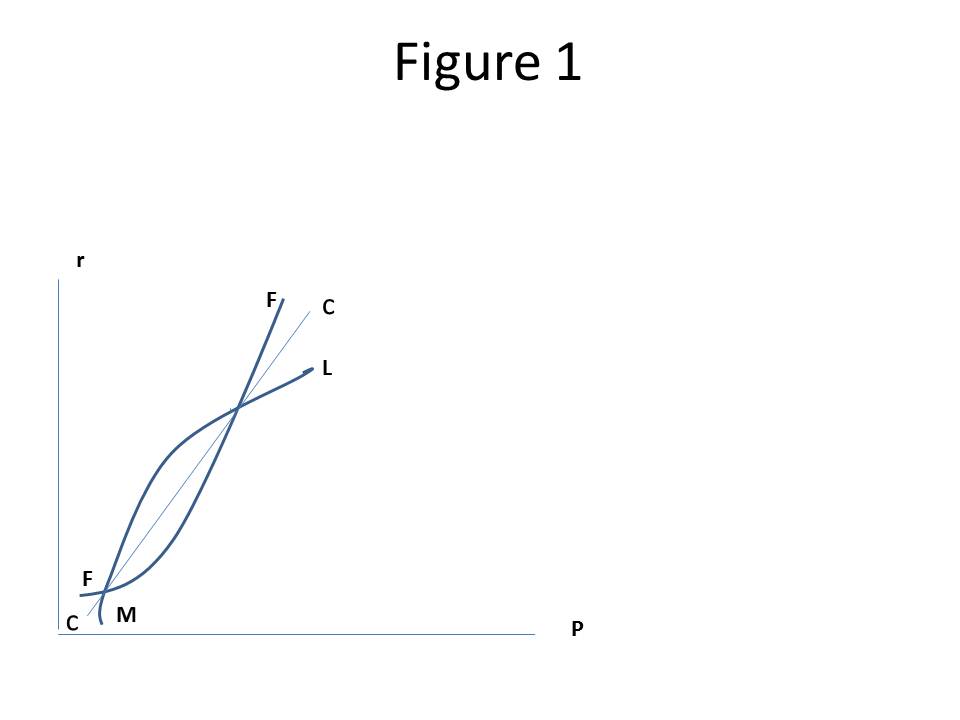
It’s time for another installment, after a longer than expected hiatus, in my series of posts summarizing and commenting on Earl Thompson’s path-breaking paper, “A Reformulaton of Macroeconomic Theory.” In the first three installments I described the shift on modeling strategy from the conventional Keynesian IS-LM model adopted by Thompson, and the basic properties of his reformulated model. In the first installment, I explained that Thompson’s key analytic insight was to ground the model in an explicitly neoclassical framework, exploiting the straightforward and powerful implications of the neoclassical theory of production to derive the basic properties of a macroeconomc model structurally comparable to the IS-LM model. The reformulated model shifts the analytic focus from the Keynesian spending functions to the conditions for factor-market equilibrium in a single-output, two-factor model. In the second installment, I explained how Thompson drew upon the Hicksian notion of temporary equilibrium for an explicit treatment of Keynesian (involuntary) unemployment dependent on incorrect (overly optimistic) expectations of future wages. While the model allows for inefficient (relative to correct expectations) choices by workers to remain unemployed owing to incorrect expectations, the temporary equilibrium nevertheless involves no departure from market clearing, and no violation of Walras’s Law. In the third installment, I described the solution of the model, deriving two market-equilibrium curves, one a locus of points of equilibrium (combinations of price levels and nominal interest rates) in the two factor markets (for labor and capital services) and one a locus of points of money-market equilibrium (again in terms of price levels and nominal interest rates) using the standard analytic techniques for deriving the Keynesian IS and LM curves.

Although not exactly the same as the Keynesian LM curve (constructed in income-interest-rate space), the locus of points of monetary equilibrium, having a similar upward slope, was assigned the familiar LM label. However, unlike the Keynesian IS curve it replaces, the locus of points, labeled FF, of factor-market equilibrium is positively sloped. The intersection of the two curves determines a temporary equilibrium, characterized by a price level, a corresponding level of employment, and for a given expected-inflation parameter, a corresponding real and nominal interest rate. The accompanying diagram, like Figure 4 in my previous installment, depicts such a temporary-equilibrium solution. I observed in the previous installment that applying Walras’s Law allows another locus of points corresponding to equilibrium in the market for the single output, which was labeled the CC curve (for commodity market equilibrium) by Thompson. The curve would have to lie in the space between the FF curve and the LM curve, where excess demands in each market have opposite (offsetting) signs. The CC curve is in some sense analogous to the Keynesian IS curve, but, as I am going to explain, it differs from the IS curve in a fundamental way. In the accompnaying diagram, I have reproduce the FF and LM curves of the with reformulated model with the CC curve drawn between the FF and LM curves. The slope of the CC curve is clearly positive, in contrast to the downward slope normally attributed to the Keynesian IS curve.

In this post, I am going to discuss Thompson’s explanation of the underlying connection between his reformulated macroeconomic model and the traditional Keynesian model. At a formal level, the two models share some of the same elements and a similar aggregative structure, raising the question what accounts for the different properties of the two models and to what extent can the analysis of one model be translated into the terms of the other model?

Aside from the difference in modeling strategy, focusing on factor-market equilibrium instead of an aggregate spending function, there must be a deeper underlying substantive difference between the two models, otherwise the choice of which market to focus on would not matter, Walras’s Law guaranteeing that anyone of the n markets can be eliminated without changing the equilibrium solution of a system of excess demand equations. So let us look a bit more closely at the difference between the Keynesian IS curve and the CC curve of the reformulated model. The most basic difference is that the CC curve relates to a stock equilibrium, with an equilibrating value of P in the market for purchasing the stock of commodities, representing the equilibrium market value of a unit of output. On the other hand, the Keynesian IS curve is measuring a flow, the rate of aggregate expenditure, the equilibrium corresponding to a particular rate of expenditure.

Thompson sums up the underlying difference between the Keynesian model and the reformulated model in two very dense paragraphs on pp. 16-17 of his paper under section heading “The role of aggregate spending and the Keynesian stock-flow fallacy.” I will quote the two paragraphs in full and try to explain as best as I can, what he is saying.

All of this is not to say that the flow of aggregate spending is irrelevant to our temporary equilibrium. The expected rate of inflation [as already noted a crucial parameter in the reformulated model] may depend parametrically upon the expected rate of spending. Then, an increase in the expected rate of spending on consumption or investment (or, more generally, an increase in the expected future excess demand for goods at the originally expected prices) would, by increased Pe [the expected price level] and thus r [the nominal interest rate] for a given R/P [the ratio of the rental price of capital to the price of capital, aka the real interest rate], shift up the FF curve. In a Modern Money Economy [i.e., an economy using a non-interest-bearing fiat money monopolistically supplied by a central bank], this shift induces a movement out of money [because an increase in the nominal interest rate increases the cost of holding non-interest-bearing fiat money] in the current market (a movement along the LM curve) and a higher current price level. This exogenous treatment of spendings variables, while perhaps most practical from the standpoint of business cycle policy, does not capture the Keynesian concept of an equilibrium rate of expenditure.

It is worth pausing here to ponder the final sentence of the paragraph, because the point that Thompson is getting at is far from obvious. I think what he means is that one can imagine, working within the framework of the reformulated FF-LM model, that a policy change, say an increase in government spending, could be captured by positing an effect on the expected price level. Additional government spending would raise the expected price level, thus causing an upward shift in the FF curve, thereby inducing people to hold less cash, leading to a new equilibrium associated with an intersection of the new FF curve at a point further up and to the right along the LM curve than the original intersection. Thus, the FF-LM framework can accommodate a traditional Keynesian fiscal policy exercise. But the IS-LM framework is unable to specify what the equilibrium rate of spending is and how that equilibrium can be determined, the problem being that there does not seem to be any variable in the model that adjusts to equilibrate the rate of spending in the way that the price level adjusts to equilibrate the market for output in the reformulated model. There is no condition specified to distinguish an equilibrium rate of spending from a non-equilibrium rate of spending. Now back to Thompson:

In order to obtain an equilibrium rate of expenditures – and thus an equilibrium rate of capital accumulation [aka investment, how much output will be carried over to next period] – a corresponding price variable must be added. The only economically natural price to introduce to equilibrate the demand and supply of next period’s capital goods is the price of next period’s capital goods. [In other words, how much of this period’s output that people want to hold until next period depends on the relationship between the current price of the output and the expected price in the next period.] This converts Pe into an equilibrating variable. Indeed, Section III below will show that if Pe is made the equilibrating price variable, making the rate of inflation an independently equilibrating variable rather than an expectations parameter determined by other variables in the system and extending the temporary equilibrium to a two-period equilibrium model in which only prices in the third and later periods may be incorrectly expected in the current period, the Keynesian expenditures condition, the equality of ex ante savings and investment, is indeed achieved. However, Section III will also show that the familiar Keynesian comparative statics results that are based upon a negatively sloped IS curve fail to hold in the extended model just as they fail in the above, single period model.

The upshot of Thompson’s argument is that you can’t have a Keynesian investment function without introducing an expected price for capital in the next period. Without an expected price of output in the next period, there is nothing to determine how much investment entrepreneurs choose to undertake in the current period. And if you want to identify an equilibrium rate of expenditure, which means an equilibrium rate of investment, then you must perforce allow the expected price for capital in the next period to adjust to achieve that equilibrium.

I must admit that I have been struggling with this argument since I first heard Earl make it in his graduate macro class almost 40 years ago, and it is only recently that I have begun to think that I understand what he was getting at. I was helped in seeing his point by the series of posts (this, this, this, this, this, this, this, and this) that I wrote earlier this year about identities and equilibrium conditions in the basic Keynesian model, and especially by the many comments and counterarguments that I received as a result of those posts. The standard Keynesian expenditure function is hard to distinguish from an income function (which also makes it hard to distinguish investment from savings), which makes it hard to understand the difference between expenditure being equal in equilibrium and being identical to savings in general or to understand the difference between savings and investment being equal in equilibrium and being identical in general. There is a basic problem in choosing define an equilibrium in terms of two magnitudes so closely related as income and expenditure. The equilibrating mechanism doesn’t seem to be performing any real economic work, so it hard to tell the difference between an equilibrium state and a disequilibrium state in such a model. Thompson may have been getting at this point from another angle by focusing on the lack of any equilibrating mechanism in the Keynesian model, and suggesting that an equilibrating mechanism, the expected future price level or rate of inflation, has to be added to the Keynesian model in order to make any sense out of it.

In my next installment, I will consider Thompson’s argument about the instability of the equilibrium in the FF-LM model.

On the Unsustainability of Austrian Business-Cycle Theory, Or How I Discovered that Ludwig von Mises Actually Rejected His Own Theory

Robert Murphy, a clever fellow with an excessive, but, to his credit, not entirely uncritical (see here and here), devotion to Austrian Business Cycle Theory (ABCT), criticized my previous post about ABCT. Murphy’s criticism focuses on my alleged misreading or misrepresentation of Mises’s original version of ABCT in his The Theory of Money and Credit. (Note, however, that we are both dealing with the 1934 translation of the revised 1924 edition, not the original 1912 German text.)

Murphy quotes the following passage from my post focusing especially on the part in bold print.

[T]he notion of unsustainability [in Austrian business cycle theory] is itself unsustainable, or at the very least greatly exaggerated and misleading. Why must the credit expansion that produced the interest-rate distortion or the price bubble come to an end? Well, if one goes back to the original sources for the Austrian theory, namely Mises’s 1912 book The Theory of Money and Credit and Hayek’s 1929 book Monetary Theory and the Trade Cycle, one finds that the effective cause of the contraction of credit is not a physical constraint on the availability of resources with which to complete the investments and support lengthened production processes, but the willingness of the central bank to tolerate a decline in its gold holdings. It is quite a stretch to equate the demand of the central bank for a certain level of gold reserves with a barrier that renders the completion of investment projects and the operation of lengthened production processes impossible, which is how Austrian writers, fond of telling stories about what happens when someone tries to build a house without having the materials required for its completion, try to explain what “unsustainability” means.

The original Austrian theory of the business cycle was thus a theory specific to the historical conditions associated with classical gold standard.

Murphy then chastises me for not having read or having forgotten the following statement by von Mises.

Painful consideration of the question whether fiduciary media really could be indefinitely augmented without awakening the mistrust of the public would be not only supererogatory, but otiose.

Now it’s true that I did not recall this particular passage when writing my post, but the passage is not inconsistent with the point I was making. If you look at the passage from section 4 of chapter 5 of Part III of The Theory of Money and Credit (p. 357 of the 1934 edition), you will see that the context in which the statement is written is a hypothetical example in which banks can engage in an unlimited credit expansion without the constraints of an internal or external drain on their balance sheets. So while it is true that Mises anticipated in The Theory of Money and Credit the question whether a banking system not constrained by any internal or external drains could engage in an unlimited credit expansion, Mises was engaged in a hypothetical exercise, not the analysis of any business cycle ever encountered.

Murphy provides two longer quotations from a bit later in the same chapter in which Mises tried to explain why an unlimited credit expansion would be unsustainable:

The situation is as follows: despite the fact that there has been no increase of intermediate products and there is no possibility of lengthening the average period of production, a rate of interest is established in the loan market which corresponds to a longer period of production; and so, although it is in the last resort inadmissible and impracticable, a lengthening of the period of production promises for the time to be profitable. But there cannot be the slightest doubt as to where this will lead. A time must necessarily come when the means of subsistence available for consumption are all used up although the capital goods employed in production have not yet been transformed into consumption goods. This time must come all the more quickly inasmuch as the fall in the rate of interest weakens the motive for saving and so slows up the rate of accumulation of capital. The means of subsistence will prove insufficient to maintain the labourers during the whole period of the process of production that has been entered upon. Since production and consumption are continuous, so that every day new processes of production are started upon and others completed, this situation does not imperil human existence by suddenly manifesting itself as a complete lack of consumption goods; it is merely expressed in a reduction of the quantity of goods available for consumption and a consequent restriction of consumption. The market prices of consumption goods rise and those of production goods fall. (p. 362)

And

If our doctrine of crises is to be applied to more recent history, then it must be observed that the banks have never gone as far as they might in extending credit and expanding the issue of fiduciary media. They have always left off long before reaching this limit, whether because of growing uneasiness on their own part and on the part of all those who had not forgotten the earlier crises, or whether because they had to defer to legislative regulations concerning the maximum circulation of fiduciary media. And so the crises broke out before they need have broken out. It is only in this sense that we can interpret the statement that it is apparently true after all to say that restriction of loans is the cause of economic crises, or at least their immediate impulse; that if the banks would only go on reducing the rate of interest on loans they could continue to postpone the collapse of the market. If the stress is laid upon the word postpone, then this line of argument can be assented to without more ado. Certainly, the banks would be able to postpone the collapse; but nevertheless, as has been shown, the moment must eventually come when no further extension of the circulation of fiduciary media is possible. Then the catastrophe occurs, and its consequences are the worse. (p. 365)

The latter quotation actually confirms my assertion that Mises’s theory of business cycles as a historical phenomenon was a theory of the effects a credit expansion brought to a close by an external constraint imposed on the banks by the gold standard or perhaps by some artificial legal constraint on the reserve holdings of the banks. It is true that Mises hypothesized that a credit expansion by a completely unconstrained banking system was inevitably destined to be unsustainable, but this is a purely theoretical argument disconnected from historical experience.

But that is just what I said in my post:

[D]espite their antipathy to proposals for easing the constraints of the gold standard on individual central banks, Mises and Hayek never succeeded in explaining why a central-bank expansion necessarily had to be stopped. Rather than provide such an explanation they instead made a different argument, which was that the stimulative effect of a central-bank expansion would wear off once economic agents became aware of its effects and began to anticipate its continuation. This was a fine argument, anticipating the argument of Milton Friedman and Edward Phelps in the late 1960s by about 30 or 40 years. But that was an argument that the effects of central-bank expansion would tend to diminish over time as its effects were anticipated. It was not an argument that the expansion was unsustainable.

So let’s go back to what Mises said in the middle quotation above, where he tries to do the heavy lifting.

[D]espite the fact that there has been no increase of intermediate products and there is no possibility of lengthening the average period of production, a rate of interest is established in the loan market which corresponds to a longer period of production; and so, although it is in the last resort inadmissible and impracticable, a lengthening of the period of production promises for the time to be profitable.

I don’t understand why there has been no increase in intermediate products. The initial monetary expansion causes output to increase temporarily, allowing the amount of intermediate products to increase, and the average period of production to lengthen.

But there cannot be the slightest doubt as to where this will lead.

Note the characteristic Misesian rhetorical strategy: proof by assertion. There cannot be the slightest doubt that I am right and you are wrong. QED. Praxeology in action!

A time must necessarily come when the means of subsistence available for consumption are all used up although the capital goods employed in production have not yet been transformed into consumption goods.

Are the means of subsistence a common property resource? When property rights don’t exist over resources, those resources run out. The means of subsistence are owned and they are sold, not given away or taken at will. As their supply dwindles, their prices rise and consumption is restricted.

This time must come all the more quickly inasmuch as the fall in the rate of interest weakens the motive for saving and so slows up the rate of accumulation of capital.

But the whole point is that monetary expansion is raising the prices of consumption goods thereby imposing forced saving on households to accommodate the additional investment.

The means of subsistence will prove insufficient to maintain the labourers during the whole period of the process of production that has been entered upon.

What does this mean? Are workers dying of starvation? Is Mises working with a Ricardian subsistence theory of wages? But wait; let’s read on.

Since production and consumption are continuous, so that every day new processes of production are started upon and others completed, this situation does not imperil human existence by suddenly manifesting itself as a complete lack of consumption goods; it is merely expressed in a reduction of the quantity of goods available for consumption and a consequent restriction of consumption. The market prices of consumption goods rise and those of production goods fall.

OK, so what is the point? What is unsustainable about this?

Now I am really confused.  But wait!  Look at the preceding paragraph, and read the following:

Now it is true that an increase of fiduciary media brings about a redistribution of wealth in the course of its effects on the objective exchange value of money which may well lead to increased saving and a reduction of the standard of living. A depreciation of money, when metallic money is employed, may also lead directly to an increase in the stock of goods in that it entails a diversion of some metal from monetary to industrial uses. So far as these factors enter into consideration, an increase of fiduciary media does cause a diminution of even the natural rate of interest, as we could show if it were necessary. But the case that we have to investigate is a different one. We are not concerned with a reduction in the natural rate of interest brought about by an increase in the issue of fiduciary media, but with a reduction below this rate in the money rate charged by the banks, inaugurated by the credit-issuing banks and necessarily followed by the rest of the loan market. The power of the banks to do such a thing has already been demonstrated. (pp. 361-62)

So von Mises actually conceded that monetary expansion by the banks could reduce the real rate of interest via the imposition of forced savings caused by a steady rate of inflation. Unsustainability results only when the central bank reduces the rate of interest below the natural rate and succeeds in keeping it permanently below the natural rate. The result is hyperinflation, which almost everyone agrees is unsustainable. We don’t need ABCT to teach us that!  But the question that I and most non-Austrian economists are interested in is whether there is anything unsustainable about a steady rate of monetary expansion associated with a steady rate of growth in NGDP.  Answer: not obviously. And, evidently, even the great Ludwig von Mises, himself, admitted that a steady monetary expansion is indeed sustainable.  You can look it up.

Two Problems with Austrian Business-Cycle Theory

Even though he has written that he no longer considers himself an Austrian economist, George Selgin remains sympathetic to the Austrian theory of business cycles, and, in accord with the Austrian theory, still views recessions and depressions as more or less inevitable outcomes of distortions originating in the preceding, credit-induced, expansions. In a recent post, George argues that the 2002-06 housing bubble conforms to the Austrian pattern in which a central-bank lending rate held below the “appropriate,” or “natural” rate causes a real misallocation of resources reflecting the overvaluation of long-lived capital assets (like houses) induced by the low-interest rate policy. For Selgin, it was the Fed’s distortion of real interest rates from around 2003 to 2005 that induced a housing bubble even though the rate of increase in nominal GDP during the housing bubble was only slightly higher than the 5% rate of increase in nominal GDP during most of the Great Moderation.

Consequently, responses by Marcus Nunes, Bill Woolsey and Scott Sumner to Selgin, questioning whether he used an appropriate benchmark against which to gauge nominal GDP growth in the 2003 to 2006 period, don’t seem to me to address the core of Selgin’s argument. Selgin is arguing that the real distortion caused by the low-interest-rate policy of the Fed was more damaging to the economy than one would gather simply by looking at a supposedly excessive rate of nominal GDP growth, which means that the rate of growth of nominal GDP in that time period does not provide all the relevant information about the effects of monetary policy.

So to counter Selgin’s argument – which is to say, the central argument of Austrian Business-Cycle Theory – one has to take a step back and ask why a price bubble, or a distortion of interest rates, caused by central-bank policy should have any macroeconomic significance. In any conceivable real-world economy, entrepreneurial error is a fact of life. Malinvestments occur all the time; resources are, as a consequence, constantly being reallocated when new information makes clear that some resources were misallocated owing to mistaken expectations. To be sure, the rate of interest is a comprehensive price potentially affecting how all resources are allocated. But that doesn’t mean that a temporary disequilibrium in the rate of interest would trigger a major economy-wide breakdown, causing the growth of real output and income to fall substantially below their historical trend, perhaps even falling sharply in absolute terms.

The Austrian explanation for this system-wide breakdown is that the price bubble or the interest-rate misallocation leads to the adoption of investments projects and of production processes that “unsustainable.” The classic Austrian formulation is that the interest-rate distortion causes excessively roundabout production processes to be undertaken. For a time, these investment projects and production processes can be sustained by way of credit expansion that shifts resources from consumption to investment, what is sometimes called “forced saving.” At a certain point, the credit expansion must cease, and at that point, the unsustainability of the incomplete investment projects or even the completed, but excessively roundabout, production processes becomes clear, and the investments and production processes are abandoned. The capital embodied in those investment projects and production processes is revealed to have been worthless, and all or most of the cooperating factors of production, especially workers, are rendered unemployable in their former occupations.

Although it is not without merit, that story is far from compelling. There are two basic problems with it. First, the notion of unsustainability is itself unsustainable, or at the very least greatly exaggerated and misleading. Why must the credit expansion that produced the interest-rate distortion or the price bubble come to an end? Well, if one goes back to the original sources for the Austrian theory, namely Mises’s 1912 book The Theory of Money and Credit and Hayek’s 1929 book Monetary Theory and the Trade Cycle, one finds that the effective cause of the contraction of credit is not a physical constraint on the availability of resources with which to complete the investments and support lengthened production processes, but the willingness of the central bank to tolerate a decline in its gold holdings. It is quite a stretch to equate the demand of the central bank for a certain level of gold reserves with a barrier that renders the completion of investment projects and the operation of lengthened production processes impossible, which is how Austrian writers, fond of telling stories about what happens when someone tries to build a house without having the materials required for its completion, try to explain what “unsustainability” means.

The original Austrian theory of the business cycle was thus a theory specific to the historical conditions associated with classical gold standard. Hawtrey, whose theory of the business cycle, depended on a transmission mechanism similar to, but much simpler than, the mechanism driving the Austrian theory, realized that there was nothing absolute about the gold standard constraint on monetary expansion. He therefore believed that the trade cycle could be ameliorated by cooperation among the central banks to avoid the sharp credit contractions imposed by central banks when they feared that their gold reserves were falling below levels that they felt comfortable with. Mises and Hayek in the 1920s (along with most French economists) greatly mistrusted such ideas about central bank cooperation and economizing the use of gold as a threat to monetary stability and sound money.

However, despite their antipathy to proposals for easing the constraints of the gold standard on individual central banks, Mises and Hayek never succeeded in explaining why a central-bank expansion necessarily had to be stopped. Rather than provide such an explanation they instead made a different argument, which was that the stimulative effect of a central-bank expansion would wear off once economic agents became aware of its effects and began to anticipate its continuation. This was a fine argument, anticipating the argument of Milton Friedman and Edward Phelps in the late 1960s by about 30 or 40 years. But that was an argument that the effects of central-bank expansion would tend to diminish over time as its effects were anticipated. It was not an argument that the expansion was unsustainable. Just because total income and employment are not permanently increased by the monetary expansion that induces an increase in investment and an elongation of the production process does not mean that the investments financed by, and the production processes undertaken as a result of, the monetary expansion must be abandoned. The monetary expansion may cause a permanent shift in the economy’s structure of production in the same way that tax on consumption, whose proceeds were used to finance investment projects that would otherwise not have been undertaken, might be carried on indefinitely. So the Austrian theory has never proven that forced saving induced by monetary expansion, in the absence of a gold-standard constraint, is necessarily unsustainable, inevitably being reversed because of physical constraints preventing the completion of the projects financed by the credit expansion. That’s the first problem.

The second problem is even more serious, and it goes straight to the argument that Selgin makes against Market Monetarists. The whole idea of unsustainability involves a paradox. The paradox is that unsustainability results from some physical constraint on the completion of investment projects or the viability of newly adopted production processes, because the consumer demand is driving up the costs of resources to levels making it unprofitable to complete the investment projects or operate new production processes.  But this argument presumes that all the incomplete investment projects and all the new production processes become unprofitable more or less simultaneously, leading to their rapid abandonment. But the consequence is that all the incomplete investment projects and all the newly adopted production processes are scuttled, producing massive unemployment and redundant resources. But why doesn’t that drop in resource prices restore the profitability of all the investment projects and production processes just abandoned?

It therefore seems that the Austrian vision is of a completely brittle economy in which price adjustments continue without inducing any substitutions to ease the resource bottlenecks. Demands and supplies are highly inelastic, and adjustments cannot be made until prices can no longer even cover variable costs. At that point prices collapse, implying that resource bottlenecks are eliminated overnight, without restoring profitability to any of the abandoned projects or processes.  Actually the most amazing thing about such a vision may be how closely it resembles the vision of an economy espoused by Hayek’s old nemesis Piero Sraffa in his late work The Production of Commodities by Means of Commodities, a vision based on fixed factor proportions in production, thus excluding the possibility of resource substitution in production in response to relative price changes.

A more realistic vision, it seems to me, would be for resource bottlenecks to induce substitution away from the relatively scarce resources allowing production processes to continue in operation even though the value of many fixed assets would have to be written down substantially. Those write downs would allow existing or new owners to maintain output as long as total demand is not curtailed as a result of a monetary policy that either deliberately seeks or inadvertently allows monetary contraction. Real distortions inherited from the past can be accommodated and adjusted to by a market economy as long as that economy is not required at the same time to undergo a contraction, in total spending. But once a sharp contraction in total spending does occur, a recovery may require a temporary boost in total spending above the long-term trend that would have sufficed under normal conditions.


About Me

David Glasner
Washington, DC

I am an economist in the Washington DC area. My research and writing has been mostly on monetary economics and policy and the history of economics. In my book Free Banking and Monetary Reform, I argued for a non-Monetarist non-Keynesian approach to monetary policy, based on a theory of a competitive supply of money. Over the years, I have become increasingly impressed by the similarities between my approach and that of R. G. Hawtrey and hope to bring Hawtrey’s unduly neglected contributions to the attention of a wider audience.

My new book Studies in the History of Monetary Theory: Controversies and Clarifications has been published by Palgrave Macmillan

Follow me on Twitter @david_glasner

Archives

Enter your email address to follow this blog and receive notifications of new posts by email.

Join 665 other subscribers
Follow Uneasy Money on WordPress.com