Archive for the 'Robert Hetzel' Category

My New Paper on Hawtrey Is Available on SSRN

Last fall and early winter I posted a series of four blogposts (here, here, here, and here) about or related to Ralph Hawtrey as I was trying to gather my thoughts about an essay I wanted to write about Hawtrey as a largely forgotten pioneer of macroeconomics who has received the attention of two recent books by Robert Hetzel and Clara Mattei. After working on and off on the essay in the winter and spring, receiving helpful comments and advice from friends and colleagues, I posted a draft on SSRN.

Here is the abstract:

hawtrey_paper

I conclude the paper as follows:

Hawtrey’s discussion of the fear of inflation refutes the key contentions about Hawtrey made by Hetzel and by Mattei: first, that Hawtrey believed that monetary policy was powerless to increase aggregate demand and stimulate a recovery from the Great Depression (Hetzel), and second that Hawtrey was instrumental in designing a Treasury policy agenda of austerity using deflation and unemployment to crush the aspirations of the British working class for radical change, providing a model emulated by fascists and authoritarians upon coming to power (Mattei).

A slight, non-substantive, revisions of the essay is now being reviewed by SSRN before replacing the current version now available. After some further revisions, the essay will appear later this year as an article in Economic Affairs.

Hetzel Withholds Credit from Hawtrey for his Monetary Explanation of the Great Depression

In my previous post, I explained how the real-bills doctrine originally espoused by Adam Smith was later misunderstood and misapplied as a policy guide for central banking, not, as Smith understood it, as a guide for individual fractional-reserve banks. In his recent book on the history of the Federal Reserve, Robert Hetzel recounts how the Federal Reserve was founded, and to a large extent guided in its early years, by believers in the real-bills doctrine. On top of their misunderstanding of what the real-bills doctrine really meant, they also misunderstood the transformation of the international monetary system from the classical gold standard that had been in effect as an international system from the early 1870s to the outbreak of World War I. Before World War I, no central bank, even the Bank of England, dominant central bank at the time, could determine the international price level shared by all countries on the gold standard. But by the early 1920s, the Federal Reserve System, after huge wartime and postwar gold inflows, held almost half of the world’s gold reserves. Its gold holdings empowered the Fed to control the value of gold, and thereby the price level, not only for itself but for all the other countries rejoining the restored gold standard during the 1920s.

All of this was understood by Hawtrey in 1919 when he first warned that restoring the gold standard after the war could cause catastrophic deflation unless the countries restoring the gold standard agreed to restrain their demands for gold. The cooperation, while informal and imperfect, did moderate the increased demand for gold as over 30 countries rejoined the gold standard in the 1920s until the cooperation broke down in 1928.

Unlike most other Monetarists, especially Milton Friedman and his followers, whose explanatory focus was almost entirely on the US quantity of money rather than on the international monetary conditions resulting from the fraught attempt to restore the international gold standard, Hetzel acknowledges Hawtrey’s contributions and his understanding of the confluence of forces that led to a downturn in the summer of 1929 followed by a stock-market crash in October.

Recounting events during the 1920s and the early stages of the Great Depression, Hetzel mentions or quotes Hawtrey a number of times, for example, crediting (p. 100) both Hawtrey and Gustav Cassel, for “predicting that a return to the gold standard as it existed prior to World War I would destabilize Europe through deflation.” Discussing the Fed’s exaggerated concerns about the inflationary consequences of stock-market spectulation, Hetzel (p. 136) quotes Hawtrey’s remark that the Fed’s dear-money policy, aiming to curb stock-market speculation “stopped speculation by stopping prosperity.” Hetzel (p. 142) also quotes Hawtrey approvingly about the importance of keeping value of money stable and the futility of urging monetary authorities to stabilize the value of money if they believe themselves incapable of doing so. Later (p. 156), Hetzel, calling Hawtrey a lone voice (thereby ignoring Cassel), quotes Hawtrey’s scathing criticism of the monetary authorities for their slow response to the sudden onset of rapid deflation in late 1929 and early 1930, including his remark: “Deflation may become so intense that it is difficult to induce traders to borrow on any terms, and that in that event the only remedy is the purchase of securities by the central bank with a view to directly increase the supply of money.”

In Chapter 9 (entitled “The Great Contraction” in a nod to the corresponding chapter in A Monetary History of the United States by Friedman and Schwartz), Hetzel understandably focuses on Federal Reserve policy. Friedman insisted that the Great Contraction started as a normal business-cycle downturn caused by Fed tightening to quell stock-market speculation that was needlessly exacerbated by the Fed’s failure to stop a collapse of the US money stock precipitated by a series of bank failures in 1930, and was then transmitted to the rest of the world through the fixed-exchange-rate regime of the restored gold standard. Unlike Friedman Hetzel acknowledges the essential role of the gold standard in not only propagating, but in causing, the Great Depression.

But Hetzel leaves the seriously mistaken impression that the international causes and dimensions of the Great Depression (as opposed to the US-centered account advanced by Friedman) was neither known nor understood until the recent research undertaken by such economists as Barry Eichengreen, Peter Temin, Douglas Irwin, Clark Johnson, and Scott Sumner, decades after publication of the Monetary History. What Hetzel leaves unsaid is that the recent work he cites largely rediscoveed the contemporaneous work of Hawtrey and Cassel. While recent research provides further, and perhaps more sophisticated, quantitative confirmation of the Hawtrey-Cassel monetary explanation of the Great Depression, it adds little, if anything, to their broad and deep analytical and historical account of the downward deflationary spiral from 1929 to 1933 and its causes.

In section 9.11 (with the heading “Why Did Learning Prove Impossible?”) Hetzel (p. 187) actually quotes a lengthy passage from Hawtrey (1932, pp. 204-05) describing the widely held view that the stock-market crash and subsequent downturn were the result of a bursting speculative bubble that had been encouraged and sustained by easy-money policies of the Fed and the loose lending practices of the banking system. It was of course a view that Hawtrey rejected, but was quoted by Hetzel to show that contemporary opinion during the Great Depression viewed easy monetary policy as both the cause of the crash and Great Depression, and as powerless to prevent or reverse the downward spiral that followed the bust.

Although Hetzel is familiar enough with Hawtrey’s writings to know that he believed that the Great Depression had been caused by misguided monetary stringency, Hetzel is perplexed by the long failure to recognize that the Great Depression was caused by mistaken monetary policy. Hetzel (p. 189) quotes Friedman’s solution to the puzzle:

It was believed [in the Depression] . . . that monetary policy had been tried and had been found wanting. In part that view reflected the natural tendency for the monetary authorities to blame other forces for the terrible economic events that were occurring. The people who run monetary policy are human beings, even as you and I, and a common human characteristic is that if anything bad happens it is somebody else’s fault.

Friedman, The Counter-revolution in Monetary Theory. London: Institute for Economic Affairs, p. 12.

To which Hetzel, as if totally unaware of Hawtrey and Cassel, adds: “Nevertheless, no one even outside the Fed [my emphasis] mounted a sustained, effective attack on monetary policy as uniformly contractionary in the Depression.”

Apparently further searching for a solution, Hetzel in Chapter twelve (“Contemporary Critics in the Depression”), provides a general overview of contemporary opinion about the causes of the Depression, focusing on 14 economists—all Americans, except for Joseph Schumpeter (arriving at Harvard in 1932), Gottfried Haberler (arriving at Harvard in 1936), Hawtrey and Cassel. Although acknowledging the difficulty of applying the quantity theory to a gold-standard monetary regime, especially when international in scope, Hetzel classifies them either as proponents or opponents of the quantity theory. Remarkably, Hetzel includes Hawtrey among those quantity theorists who “lacked a theory attributing money to the behavior of the Fed rather than to the commercial banking system” and who “lacked a monetary explanation of the Depression highlighting the role of the Fed as opposed to the maladjustment of relative prices.” Only one economist, Laughlin Currie, did not, in Hetzel’s view, lack those two theories.

Hetzel then briefly describes the views of each of the 14 economists: first opponents and then proponents of the quantity theory. He begins his summary of Hawtrey’s views with a favorable assessment of Hawtrey’s repeated warnings as early as 1919 that, unless the gold standard were restored in a way that did not substantially increase the demand for gold, a severe deflation would result.

Despite having already included Hawtrey among those lacking “a theory attributing money to the behavior of the Fed rather than to the commercial banking system,” Hetzel (p. 281-82) credits Hawtrey with having “almost alone among his contemporaries advanced the idea that central banks can create money,” quoting from Hawtrey’s The Art of Central Banking.

Now the central bank has the power of creating money. If it chooses to buy assets of any kind, it assumes corresponding liabilities and its liabilities, whether notes or deposits, are money. . . . When they [central banks] buy, they create money, and place it in the hands of the sellers. There must ultimately be a limit to the amount of money that the sellers will hold idle, and it follows that by this process the vicious cycle of deflation can always be broken, however great the stagnation of business and the reluctance of borrowers may be.

Hawtrey, The Art of Central Banking: London: Frank Cass, 1932 [1962], p. 172

Having already quoted Hawtrey’s explicit assertion that central banks can create money, Hetzel struggles to justify classifying Hawtrey among those denying that central banks can do so, by quoting later statements that, according to Hetzel, show that Hawtrey doubted that central banks could cause a recovery from depression, and “accepted the . . . view that central banks had tried to stimulate the economy, and . . . no longer mentioned the idea of central banks creating money.”

Efforts have been made over and over again to induce that expansion of demand which is the essential condition of a revival of activity. In the United States, particularly, cheap money, open-market purchases, mounting cash reserves, public works, budget deficits . . . in fact the whole apparatus of inflation has been applied, and inflation has not supervened.

Hawtrey, “The Credit Deadlock” in A. D. Gayer, ed., The Lessons of Monetary Experience, New York: Farrar & Rhinehart, p. 141.

Hetzel here confuses the two distinct and different deficiencies supposedly shared by quantity theorists other than Laughlin Currie: “[lack] of a theory attributing money to the . . . Fed rather than to the commercial banking system” and “[lack] of a monetary explanation of the Depression highlighting the role of the Fed as opposed to the maladjustment of relative prices.” Explicitly mentioning open-market purchases, Hawtrey obviously did not withdraw the attribution of money to the behavior of the Fed. It’s true that he questioned whether the increase in the money stock resulting from open-market purchases had been effective, but that would relate only to Hetzel’s second criterion–lack of a monetary explanation of the Depression highlighting the role of the Fed as opposed to the maladjustment of relative prices—not the first.

But even the relevance of the second criterion to Hawtrey is dubious, because Hawtrey explained both the monetary origins of the Depression and the ineffectiveness of the monetary response to the downturn, namely the monetary response having been delayed until the onset of a credit deadlock. The possibility of a credit deadlock doesn’t negate the underlying monetary theory of the Depression; it only suggests an explanation of why the delayed monetary expansion didn’t trigger a recovery as strong as a prompt expansion would have.

Turning to Hawtrey’s discussion of the brief, but powerful, revival that began almost immediately after FDR suspended the gold standard and raised the dollar gold price (i.e., direct monetary stimulus) upon taking office, Hetzel (Id.) misrepresents Hawtrey as saying that the problem was pessimism not contractionary monetary policy; Hawtrey actually attributed the weakening of the recovery to “an all-round increase of costs” following enactment of the National Industrial Recovery Act, that dissipated “expectations of profit on which the movement had been built.” In modern terminology it would be described as a negative supply-side shock.

In a further misrepresentation, Hetzel writes (p. 282), “despite the isolated reference above to ‘creating money,’ Hawtrey understood the central bank as operating through its influence on financial intermediation, with the corollary that in depression a lack of demand for funds would limit the ability of the central bank to stimulate the economy.” Insofar as that reference was isolated, the isolation was due to Hetzel’s selectivity, not Hawtrey’s understanding of the capacity of a central bank. Hawtrey undoubtedly wrote more extensively about the intermediation channel of monetary policy than about open-market purchases, inasmuch as it was through the intermediation channel that, historically, monetary policy had operated. But as early as 1925, Hawtrey wrote in his paper “Public Expenditure and the Demand for Labour”:

It is conceivable that . . . a low bank rate by itself might be found to be an insufficient restorative. But the effect of a low bank rate can be reinforced by purchase of securities on the part of the central bank in the open market.

Although Hawtrey was pessimistic that a low bank rate could counter a credit deadlock, he never denied the efficacy of open-market purchases. Hetzel cites the first (1931) edition of Hawtrey’s Trade Depression and the Way Out, to support his contention that “Hawtrey (1931, 24) believed that in the Depression ‘cheap money’ failed to revive the economy.” In the cited passage, Hawtrey observed that between 1844 and 1924 Bank rate had never fallen below 2% while in 1930 the New York Fed discount rate fell to 2.5% in June 1930, to 2% in December and to 1.5% in May 1931.

Apparently, Hetzel neglected to read the passage (pp. 30-31) (though he later quotes a passage on p. 32) in the next chapter (entitled “Deadlock in the Credit Market”), or he would not have cited the passage on p. 24 to show that Hawtrey denied that monetary policy could counter the Depression.

A moderate trade depression can be cured by cheap money. The cure will be prompter if a low Bank rate is reinforced by purchases of securities in the open market by the Central Bank. But so long as the depression is moderate, low rates will of themselves suffice to stimulate borrowing.

On the other hand, if the depression is very severe, enterprise will be killed. It is possible that no rate of interest, however low, will tempt dealers to buy goods. Even lending money without interest would not help if the borrower anticipated a loss on every conceivable use . . . of the money. In that case the purchase of securities by the Central Bank, which is otherwise no more than a useful reinforcement of the low Bank rate, hastening the progress of revival, becomes an essential condition of the revival beginning at all. By buying securities the Central Bank creates money [my emphasis], which appears in the form of deposits credited to the banks whose customers have sold the securities. The banks can thus be flooded with idle money, and given . . . powerful inducement to find additional borrowers.

Something like this situation occurred in the years 1894-96. The trade reaction which began after 1891 was disastrously aggravated by the American crisis of 1893. Enterprise seemed . . . absolutely dead. Bank rate was reduced to 2% in February 1894, and remained continuously at that rate for 2.5 years.

The Bank of England received unprecedented quantities of gold, and yet added to its holdings of Government securities. Its deposits rose to a substantially higher total than was ever reached either before or after, till the outbreak of war in 1914. Nevertheless, revival was slow. The fall of prices was not stopped till 1896. But by that time the unemployment percentage, which had exceeded 10% in the winter of 1893, had fallen to 3.3%.

Hawtrey, Trade Depression and the Way Out. London: Longmans, Green and Company, 1931.

This passage was likely written in mid-1931, the first edition having been published in September 1931. In the second edition published two years later, Hawtrey elaborated on the conditions in 1931 discussed in the first edition. Describing the context of the monetary policy of the Bank of England in 1930, Hawtrey wrote:

For some time the gold situation had been a source of anxiety in London. The inflow of “distress gold” was only a stop-gap defence against the apparently limitless demands of France and the United States. When it failed, and the country lost £20,000,000 of gold in three months, the Bank resorted to restrictive measures.

Bank rate was not raised, but the Government securities in the Banking Department were reduced from £52,000,000 in the middle of January 1931 to £28,000,000 at the end of March. That was the lowest figure since August 1928. The 3% bank rate became “effective,” the market rate on 3-months bills rising above 2.5%. Here was a restrictive open market policy, designed to curtail the amount of idle money in the banking system.

Between May 1930 and January 1931, the drain of gold to France and the United States had not caused any active measures of credit restriction. Even in that period credit relaxation had been less consistent and whole-hearted than it might have been. In the years 1894-96 the 2% bank rate was almost continuously ineffective, the market rate in 1895 averaging less than 1%. In 1930 the market rate never fell below 2%.

So, notwithstanding Hetzel’s suggestion to contrary, Hawtrey clearly did not believe that the failure of easy-money policy to promote a recovery in 1930-31 showed that monetary policy is necessarily ineffective in a deep depression; it showed that the open-market purchases of central banks had been too timid. Hawtrey made this point explicitly in the second edition (1933, p. 141) of Trade Depression and the Way Out:

When . . . expanding currency and expanding bank deposits do not bring revival, it is sometimes contended that it is no use creating additional credit, because it will not circulate, but will merely be added to the idle balances. And without doubt it ought not to be taken for granted that every addition to the volume of bank balances will necessarily and automatically be accompanied by a proportional addition to demand.

But people do not have an unlimited desire to hold idle balances. Because they already hold more than usual, it does not follow that they are willing to hold more still. And if in the first instance a credit expansion seems to do no more than swell balances without increasing demand, further expansion is bound ultimately to reach a point at which demand responds.

Trying to bolster his argument that Hawtrey conceded the inability of monetary policy to promote recovery from the Depression, Hetzel quotes from Hawtrey’s writings in 1937 and 1938. In his 1937 paper on “The Credit Deadlock,” Hawtrey considered the Fisher equation breaking down the nominal rate of interest into a real rate of interest (corresponding to the expected real rate of return on capital) and expected inflation. Hawtrey explored the theoretical possibility that agents’ expectations could become so pessimistic that the expected rate of deflation would exceed the expected rate of return on capital, so that holding money became more profitable than any capital investment; no investments would be forthcoming in such an economy, which would then descend into the downward deflationary spiral that Hawtrey called a credit deadlock.

In those circumstances, monetary policy couldn’t break the credit deadlock unless the pessimistic expectations preventing capital investments from being made were dispelled. In his gloss on the Fisher equation, a foundational proposition of monetary theory, Hawtrey didn’t deny that a central bank could increase the quantity of money via open-market operations; he questioned whether increasing the quantity of money could sufficiently increase spending and output to restore full employment if pessimistic expectations were not dispelled. Hawtrey’s argument was purely theoretical, but he believed it at least possible that the weak recovery from the Great Depression in the 1930s, even after abandonment of the gold standard and the widespread shift to easy money, had been dampened by entrepreneurial pessimism.

Hetzel also quotes two passages from Hawtrey’s 1938 volume A Century of Bank Rate to show that Hawtrey believed easy money was incapable of inducing increased investment spending and expanded output by business once pessimism and credit deadlock took hold. But those passages refer only to the inefficacy of reductions in bank rate, not of open-market purchases.

Hetzel (p. 283-84) then turns to a broad summary criticism of Hawtrey’s view of the Great Depression.

With no conception of the price system as the organizing principle behind the behavior of the economy, economists invented disequilibrium theories in which the psychology of businessmen and investors (herd behavior) powered cyclical fluctuations. The concept of the central bank causing recessions by interfering with the price system lay only in the future. Initially, Hawtrey found encouraging the Fed’s experiment in the 1920s with open market operations and economic stabilization. By the time Hawtrey wrote in 1938, it appeared evident that the experiment had failed.

Hetzel again mischaracterizes Hawtrey who certainly did not lack a conception of the price system as the organizing principle behind the behavior of the economy, and, unless Hetzel is prepared to repudiate the Fisher equation and the critical role it assigns to expectations of future prices as an explanation of macroeconomic fluctuations, it is hard to understand how the pejorative references psychology and herd behavior have any relevance to Hawtrey. And Hetzel’s suggestion that Hawtrey did not hold central banks responsible for recessions after Hetzel had earlier (p. 136) quoted Hawtrey’s statement that dear money had stopped speculation by stopping prosperity seems puzzling indeed.

Offering faint praise to Hawtrey, Hetzel calls him “especially interesting because of his deep and sophisticated knowledge of central banking,” whose “failure to understand the Great Depression as caused by an unremittingly contractionary monetary policy [is also] especially interesting.” Unfortunately, the only failure of understanding I can find in that sentence is Hetzel’s.

Hetzel concludes his summary of Hawtrey’s contribution to the understanding of the Great Depression with the observation that correction of the misperception that, in the Great Depression, a policy of easy money by the Fed had failed lay in the distant monetarist future. That dismissive observation about Hawtrey’s contribution is a misperception whose corretion I hope does not lie in the distant future.

Central Banking and the Real-Bills Doctrine

            Robert Hetzel, a distinguished historian of monetary theory and of monetary institutions, deployed his expertise in both fields in his recent The Federal Reserve: A New History. Hetzel’s theoretical point departure is that the creation of the Federal Reserve System in 1913 effectively replaced the pre-World War I gold standard, in which the value of the dollar was determined by the value of gold into which a dollar was convertible at a fixed rate, with a fiat-money system. The replacement did not happen immediately upon creation of the Fed; it took place during World War I as the international gold standard collapsed with all belligerent countries suspending the convertibility of their currencies into gold, to allow the mobilization of gold to finance imports of food and war materials. As a result, huge amounts of gold flowed into the US, where of much of those imports originated, and continued after the war when much of the imports required for European reconstruction also originated there, with the US freely supplying dollars in exchange for gold at the fixed price at which the dollar was convertible into gold, causing continued postwar inflation beyond the wartime inflation.

Holding more than half the world’s total stock of monetary gold reserves by 1920, the US could determine the value of gold at any point (within a wide range) of its own choosing. The value of the dollar was therefore no longer constrained by the value of gold, as it had been under the prewar gold standard, because the value of gold was now controlled by the Federal Reserve. That fundamental change was widely acknowledged at the time by economists like Keynes, Fisher, Robertson, Mises, and Hawtrey. But the Fed had little understanding of how to exercise that power. Hetzel explains the mechanisms whereby the power could be exercised, and the large gaps and errors in the Fed’s grasp of how to deploy the mechanisms. The mechanisms were a) setting an interest rate at which to lend reserves (by rediscounting commercial bank assets offered as collateral) to the banking system, and b) buying or selling government securities and other instruments like commercial paper (open-market operations) whereby reserves could be injected into, or withdrawn from, the banking system.

In discussing how the Fed could control the price level after World War I, Hetzel emphasizes the confusion sewed by the real-bills doctrine which provided the conceptual framework for the architects of the Federal Reserve and many of its early officials. Hetzel is not the first to identify the real-bills doctrine as a key conceptual error that contributed to the abysmal policy mistakes of the Federal Reserve before and during the Great Depression. The real-bills doctrine has long been a bete noire of Chicago School economists, (see for example the recent book by Thomas Humphrey and Richard Timberlake, Gold, the Real Bills Doctrine and the Fed), but Chicago School economists since Milton Friedman’s teacher Lloyd Mints have misunderstood both the doctrine (though not in the same way as those they criticize) because they adopt a naive view of the quantity theory the prevents them from understanding how the gold standard actually worked.

Long and widely misunderstood, the real-bills doctrine was first articulated by Adam Smith. But, as I showed in a 1992 paper (reprinted as Chapter 4 of my recent Studies in the History of Monetary Theory), Smith conceived the doctrine as a rule of thumb to be followed by individual banks to ensure that they had sufficient liquidity to meet demands for redemption of their liabilities (banknotes and deposits) should the demand for those liabilities decline. Because individual banks have no responsibility, beyond the obligation to keep their redemption commitments, for maintaining the value of their liabilities, Smith’s version of the real-bills doctrine was orthogonal to the policy question of how a central bank should discharge a mandate to keep the general price level reasonably stable.

Not until two decades after publication of Smith’s great work, during the Napoleonic Wars that confusion arose about what the real-bills doctrine actually means. After convertibility of the British pound into gold was suspended in 1797 owing to fear of a possible French invasion, the pound fell to a discount against gold, causing a general increase in British prices. The persistent discount of the pound against gold was widely blamed on an overissue of banknotes by the Bank of England (whose notes had been made legal tender to discharge debts after their convertibility into gold had been suspended. The Bank Directors responded to charges of overissue by asserting that they had strictly followed Smith’s maxim of lending only on the security of real bills of short duration. Their defense was a misunderstanding of Smith’s doctrine, which concerned the conduct of a bank obligated to redeem its liabilities in terms of an asset (presumably gold or silver) whose supply it could not control, whereas the Bank of England was then under no legal obligation to redeem its banknotes in terms of any outside asset.

Although their response misrepresented Smith’s doctrine, that misrepresentation soon became deeply imbedded in the literature on money and banking. Few commentators grasped the distinction between the doctrine applied to individual banks and the doctrine applied to the system as a whole or to a central bank issuing a currency whose value it can control.

The Bank Directors argued that because they scrupulously followed the real-bills doctrine, an overissue of banknotes was not possible. The discount against gold must therefore have been occasioned by some exogenous cause beyond the Bank’s control. This claim could have been true only in part. Even if the Bank did not issue more banknotes than it would have had convertibility not been suspended, so that the discount of the pound against gold was not necessarily the result of any action committed by the Bank, that does not mean that the Bank could not have prevented or reversed the discount by taking remedial or countervailing measures.

The discount against gold might, for example, have occurred, even with no change in the lending practices of the Bank, simply because public confidence in the pound declined after the suspension of convertibility, causing the demand for gold bullion to increase, raising the price of gold in terms of pounds. The Bank could have countered such a self-fulfilling expectation of pound depreciation by raising its lending rate or otherwise restricting credit thereby withdrawing pounds from circulation, preventing or reversing the discount. Because it did not take such countermeasures the Bank did indeed bear some responsibility for the discount against gold.

Although it is not obvious that the Bank ought to have responded in that way to prevent or reverse the discount, the claim of the Bank Directors that, by following the real-bills doctrine, they had done all that they could have done to avoid the rise in prices was both disingenuous and inaccurate. The Bank faced a policy question: whether to tolerate a rise in prices or prevent or reverse it by restricting credit, perhaps causing a downturn in economic activity and increased unemployment. Unwilling either to accept responsibility for their decision or to defend it, the Bank Directors invoked the real-bills doctrine as a pretext to deny responsibility for the discount. An alternative interpretation would be that the Bank Directors’ misunderstanding of the situation they faced was so comprehensive that they were oblivious to the implications of the policy choices that an understanding of the situation would have forced upon them.

The broader lesson of the misguided attempt by the Bank Directors to defend their conduct during the Napoleonic Wars is that the duty of a central bank cannot be merely to maintain its own liquidity; its duty must also encompass the liquidity and stability of the entire system. The liquidity and stability of the entire system depends chiefly on the stability of the general price level. Under a metallic (silver or gold) standard, central banks had very limited ability to control the price level, which was determined primarily in international markets for gold and silver. Thus, the duty of a central bank under a metallic standard could extend no further than to provide liquidity to the banking system during the recurring periods of stress or even crisis that characterized nineteenth-century banking systems.

Only after World War I did it become clear, at least to some economists, that the Federal Reserve had to take responsibility for stabilizing the general price level (not only for itself but for all countries on the restored gold standard), there being no greater threat to the liquidity—indeed, the solvency—of the system than a monetarily induced deflation in which bank assets depreciate faster than liabilities. Unless a central bank control the price level it could not discharge its responsibility to provide liquidity to the banking system. However, the misunderstanding of the real-bills doctrine led to the grave error that, by observing the real-bills doctrine, a central bank was doing all that was necessary and all that was possible to ensure the stability of the price level. However, the Federal Reserve, beguiled by its misunderstanding of the real-bills doctrine and its categorical misapplication to central banking, therefore failed abjectly to discharge its responsibility to control the price level. And the Depression came.

Ralph Hawtrey, Part 1: An Overview of his Career

One of my goals when launching this blog in 2011 was to revive interest in the important, but unfortunately neglected and largely forgotten, contributions to monetary and macroeconomic theory of Ralph Hawtrey. Two important books published within the last year have focused attention on Ralph Hawtrey: The Federal Reserve: A New History by Robert Hetzel, and The Capital Order by Clara Elizabeth Mattei.

While Hetzel’s discussion of Hawtrey’s monetary theory of the Great Depression is generally positive, it criticizes him for discounting, unlike Milton Friedman, the efficacy of open-market operations in reviving aggregate demand. But Hetzel’s criticism relies on an incomplete reading of Hawtrey’s discussions of open-market operations. Mattei’s criticism of Hawtrey is very different from Hetzel’s narrow technical criticism. Mattei is clearly deeply hostile to Hawtrey, portraying him as the grey eminence behind the austerity policies of the British Treasury and the Bank of England in the 1920s both before and after Britain restored the prewar gold standard. Mattei holds Hawtrey uniquely responsible for providing the intellectual rationale for the fiscal and monetary policies that ruthlessly tolerated high unemployment to suppress inflation and hold down wages.

I’ll address the inaccuracies in Hetzel’s discussion of Hawtrey and especially in Mattei’s deeply flawed misrepresentations of Hawtrey in future posts. In this post, I provide an overview of Hawtrey’s career drawn from papers I’ve written (two of which were co-authored by my friend Ron Batchelder) about Hawtrey included in my recent book, Studies in the History of Monetary Theory: Controversies and Clarifications (Chapters 10-14)

Ralph George Hawtrey, born in 1879, two years before his friend, fellow Cambridge man and Apostle, John Maynard Keynes, with whom he often disagreed, was in the 1920s and early 1930s almost as well-known as, and perhaps even more influential, at least among economists and policy-makers, than Keynes. Despite their Cambridge educations and careers in economics, as undergraduates, they both concentrated on mathematics[1] and philosophy and were deeply influenced by the Cambridge philosopher, G. E. Moore. Neither formally studied economics under Alfred Marshall.[2]

Perhaps the last autodidact to make significant contributions to economic theory, Hawtrey began his study of economics only when preparing for the civil-service exam at the Treasury. Hawtrey’s Cambridge background, his friendship with Keynes, and the similarities between his own monetary theories and those of Marshall, Keynes and other Cambridge economists contributed to the widespread impression that Hawtrey had ties to the Cambridge school of economics, a connection Hawtrey denied. Hawtrey’s powerful analytical mind, his command of monetary history and deep and wide knowledge of monetary and business institutions, acquired by dint of intense independent study, led to a rapid rise in the Treasury bureaucracy, eventually becoming Director of Economic Studies in 1919, a position he held until he retired from the Treasury in 1945.

Coincidentally, both Hawtrey and Keynes published their first books in 1913, Keynes writing about the reform of the Indian Currency system (Indian Currency and Finance) and Hawtrey propounding his monetary theory of the business cycle (Good and Bad Trade). A more substantive coincidence in their first books is that they both described a gold-exchange standard (resurrecting an idea described almost a century earlier by Ricardo in his Proposals for an Economical and Secure Currency) in which gold coins do not circulate and the central bank holds reserves, not in gold, but in foreign exchange denominated in currencies legally convertible into gold.

The trajectory of Hawtrey’s carrier (like Keynes’s) was sharply upward after publication of his first book. Hawtrey’s reputation was further enhanced by important academic articles about the history of monetary institutions and the gold standard. Those studies were incorporated in Hawtrey’s most important work on monetary economics, Currency and Credit published in 1919, a profound treatise on monetary economics in which his deep theoretical insights were deployed to shed light on important events and developments in the history of monetary institutions. A resounding success, the volume becoming a standard work routinely assigned to students of money and banking for over a decade, establishing Hawtrey as one of the most widely read and frequently cited economists in the 1920s and even the 1930s.

Although Keynes, by virtue of his celebrated book The Economic Consequences of the Peace became one of the most prominent public figures in Britain in the immediate postwar period, Hawtrey’s reputation among economists and policy makers likely overshadowed Keynes’s in the early 1920s. That distinction is exemplified by their roles at the 1922 Genoa Conference on postwar international cooperation and reconstruction.

In his writings about postwar monetary reconstruction, Hawtrey emphasized the necessity for international cooperation to restore international gold standard lest an uncoordinated restoration by individual countries with countries seeking to accumulate gold, thereby causing gold to appreciate and prices in terms of gold to fall. It was Hawtrey’s warnings, echoed independently by the Swedish economist Gustav Cassel, that caused the Treasury to recommend that planning for a coordinated restoration of the gold standard be included in agenda of the Genoa Conference.

While Hawtrey was the intellectual inspiration for including restoration of gold standard on the agenda of the Genoa Conference, Keynes’s role at Genoa was journalistic, serving as a correspondent for the Manchester Guardian. Keynes criticized the plan to reestablish an international gold standard even in the form of a gold-exchange standard that he and Hawtrey had described a decade earlier. Keynes observed that there was then only one nation with an effective gold standard, the United States. Conjecturing that the US, holding 40% of the world’s gold reserves, would likely choose to divest itself of at least part of its gold hoard, causing gold depreciation, Keynes argued that rejoining the gold standard would mean importing inflation from the United States. Keynes therefore recommended that Britain to adopt an independent monetary policy detached from gold to achieve a stable domestic price level. 

But after it became clear that the US had no intention of unburdening itself of its huge gold holdings, Keynes reversed his rationale for opposing restoration of the gold standard. Given the depreciation of sterling against the dollar during and after World War I, the goal of restoring the prewar dollar-sterling parity of $4.86/pound would require Britain to endure even more deflation than it had already suffered following the sharp US deflation of 1920-21.

When Winston Churchill, appointed Chancelor of the Exchequer in the new Conservative Government, announced in November 1924 that he would restore the gold standard at the prewar parity by April 1925, the pound appreciated against the dollar. But the market exchange rate with the dollar remained 10% below the prewar parity. Keynes began arguing against restoring the prewar parity because a further 10% deflation would impose an unacceptable hardship on an economy that had not recovered from the effects of the recession and high unemployment caused by earlier deflation.

After personally consulting Keynes in person about his argument against restoring the prewar parity, Churchill also invited Hawtrey to hear his argument in favor of restoring the prewar parity. Hawtrey believed that doing so would bolster London’s position as the preeminent international financial center. But he also urged that, to avoid the dire consequences that Keynes warned would follow restoration of the prewar parity, the Bank of England reduce Bank Rate to promote economic expansion and employment. Given the unique position of London as the center of international finance, Hawtrey was confident that the Bank of England could ease its monetary policy and that the Federal Reserve and other central banks would ease their policies as well, thereby allowing the gold standard to be restored without significant deflation.

Supported by his Treasury advisers including Hawtrey, Churchill restored the gold standard at the prewar dollar parity in April 1925, causing Keynes to publish his brutal critique of that decision in his pamphlet The Economic Consequences of Mr. Churchill. While the consequences were perhaps not as dire as Keynes had predicted, they were less favorable than Hawtrey had hoped, the Bank of England refusing to reduce Bank Rate below 5% as Hawtrey had urged. At any rate, after a brief downturn in the latter part of 1925, the British economy did expand moderately from 1926 through early 1929 with unemployment declining slightly before Britain, along with the rest of the world, plunged into the Great Depression in the second half of 1929.

Keynes and Hawtrey again came into indirect opposition in the 1929 general election campaign, when Lloyd George, leader of the Liberal Party, proposed a program of public works to increase employment. In rejecting Lloyd George’s proposal, Churchill cited the “traditional Treasury view” that public spending simply displaced an equal amount of private spending, merely shifting spending from the private to the public sector without increasing total output and employment.

The source of “the traditional Treasury” view” was Hawtrey, himself, who had made the argument at length in a 1925 article in the Economic Journal which he had previously made in less detail in Good and Bad Trade. Replying to Churchill, Keynes and Hubert Henderson co-authored a pamphlet Can Lloyd George Do It supporting Lloyd George’s proposal and criticizing the Treasury View.

Keynes and Hawtrey confronted each other in person when Hawtrey testified before the Macmillan Committee investigating the causes of high unemployment. As a member of the Committee, Keynes questioned Hawtrey about his argument that the Bank of England could have countered rising unemployment by reducing Bank Rate, seemingly exposing an inconsistency in Hawtrey’s responses to his questions. But, when considered in light of Hawtrey’s assumption that a reduction in Bank Rate by the Bank of England would have led to Federal Reserve and other central banks to reduce their interest rates rather than absorb further inflows of gold, the inconsistency is resolved (see this post for further explanation).

Although Hawtrey had warned of the dreadful consequences of restoring the gold standard without coordination among central bank to avoid rapid accumulation of gold reserves, his warnings were disregarded when France returned to the gold standard in 1927 and began rapidly increasing its gold reserves in 1928. Hawtrey’s association with the Treasury view fostered the misimpression that, despite his unheeded advocacy of reducing Bank Rate to reduce unemployment, Hawtrey was oblivious to, or unconcerned by, the problem of unemployment. While Keynes often tried out new ideas, as he did with his neo-Wicksellian theory of the business cycle in his Treatise on Money only to abandon it in response to criticism and the changing economic environment of the Great Depression before writing his General Theory of Interest, Income and Money, Hawtrey stuck to the same basic theory developed in his first two books.

While his output of new publications in the 1930s did not flag, Hawtrey’s reputation among economists and his influence in the Treasury gradually declined, especially after publication of Keynes’s General Theory as the attention of economists was increasingly occupied by an effort to comprehend and assimilate it into the received body of economic theory. By the time he retired from the Treasury in 1945 to become Professor of International Economics at the Royal Institute for International Affairs, Hawtrey was no longer at the cutting edge of the economics profession, and his work gradually fell from the view of younger economists.

Nevertheless, for the next two decades as he advanced to old age, Hawtrey continued to publish important works, mostly, but not exclusively concerning the conduct of British monetary policy, especially his lonely criticism of Britain’s 1947 devaluation of the pound. Elaborating on arguments advanced in his early writings, Hawtrey anticipated much of what would become known as the monetary approach to the balance of payments.

Given his monetary explanation of the Great Depression, it might have been expected that Monetarists, especially Milton Friedman, who, in the early 1950s, began his effort to develop a monetary theory of the Great Depression as an alternative to the Keynesian theory of a sudden decline in animal spirits that caused a stock-market crash and a drop in investment spending from which the private economy could not recover on its own, would have found Hawtrey’s explanation of the causes of the Great Depression to be worth their attention. However, one would search for Hawtrey’s name almost in vain in Friedman’s writings in general, and in his writings on the Great Depression, in particular. Certainly there was no recognition in the Monetarist literature on the Great Depression that a monetary theory of the Great Depression had actually been advanced by Hawtrey as the Great Depression was unfolding or that Hawtrey had warned in advance of the danger of the catastrophic deflation that would result from an uncoordinated restoration of the gold standard.

Years after Friedman’s magnum opus The Monetary History of the US was published, various researchers, including Peter Temin, Barry Eichengreen, Ben Bernanke, Kenneth Mouré, Clark Johnson, Scott Sumner, and Ronald Batchelder and I, recognized the critical importance of the newly restored gold standard in causing the Great Depression. While most of the later authors cited Hawtrey’s writings, the full extent of Hawtrey’s contributions that fully anticipated all the major conclusions of the later research remains generally unrecognized in most of the recent literature on the Great Depression, while Friedman’s very flawed account of the Great Depression continues to be regarded by most economists and financial historians as authoritative if not definitive.

In a future post, I’ll discuss Hetzel’s account of Hawtrey’s explanation of the Great Depression. Unlike earlier Monetarists who ignored Hawtrey’s explanation entirely, Hetzel does credit Hawtrey with having provided a coherent explanation of the causes of the Great Depression, without acknowledging the many respects in which Hawtrey’s explanation is more complete and more persuasive than Friedman’s. He also argues that Friedman provided a better account of the recovery than Hawtrey, because Friedman, unlike Hawtrey, recognized the effectiveness of open-market operations which Hawtrey maintained would be ineffective in initiating a recovery in situations of what Hawtrey called credit deadlock.

In another post, I’ll discuss the highly critical, and I believe tendentious, treatment by Clara Elizabeth Mattei, of Hawtrey’s supposed role in devising and rationalizing the austerity policies of the British Treasury in the 1920s up to and including the Great Depression.


[1] While Keynes was an accomplished mathematician who wrote an important philosophical and mathematical work A Treatise on Probability praised extravagantly by Bertrand Russell, Hawtrey’s mathematical skills were sufficiently formidable to have drawn the attention of Russell who included a footnote in his Principia Mathematica replying to a letter from Hawtrey.

[2] Keynes, however, the son of John Neville Keynes, a Cambridge philosopher and economist, had a personal connection to Marshall apart from his formal studies at Cambridge. Rather than pursue graduate studies, Hawtrey chose a career in the civil service, first at the Admiralty and soon thereafter at the Treasury.

Arthur Burns and How Things Fell Apart in the 1970s

Back in 2013 Karl Smith offered a startling rehabilitation of Arthur Burns’s calamitous tenure as Fed Chairman, first under Richard Nixon who appointed him, later under Gerald Ford who reappointed him, and finally, though briefly, under Jimmy Carter who did not reappoint him. Relying on an academic study of Burns by Fed economist Robert Hetzel drawing extensively from Burns’s papers at the Fed, Smith argued that Burns had a more coherent and sophisticated view of how the economy works and of the limitations of monetary policy than normally acknowledged by the standard, and almost uniformly negative, accounts of Burns’s tenure, which portray Burns either as a willing, or as a possibly reluctant, and even browbeaten, accomplice of Nixon in deploying Fed powers to rev up the economy and drive down unemployment to ensure Nixon’s re-election in 1972, in willful disregard of the consequences of an overdose of monetary stimulus.

According to Smith, Burns held a theory of inflation in which the rate of inflation corresponds to the average, or median, expected rate of inflation held by the public. (I actually don’t disagree with this at all, and it’s important, but I don’t think it’s enough to rationalize Burns’s conduct and policies as Fed chairman.) When, as was true in the 1970s, wages determined through collective bargaining between big corporations and big labor unions, the incentive of every union was to negotiate contracts providing members with wage increases not less than the average rate of wage increase being negotiated by other unions.

Given the pressure on all unions to negotiate higher-than-average wage increases, using monetary policy to reduce inflation would inevitably aggregate spending to fall short of the level needed to secure full employment, but without substantially moderating the rate of increase in wages and prices. As long as the unions were driven to negotiate increasing rates of wage increase for their members, increasing rates of wage inflation could be accommodated only by ever-increasing growth rates in the economy or by progressive declines in the profit share of business. But without accelerating real economic growth or a declining profit share, union demands for accelerating wage increases could be accommodated only by accelerating inflation and corresponding increases in total spending.

But rising inflation triggers political demands for countermeasures to curb inflation. Believing the Fed incapable of controlling inflation through monetary policy, restrictive monetary policy affecting output and employment rather than wages and prices, Burns concluded that inflation could controlled only by limiting the wage increases negotiated between employers and unions. Control over wages, Burns argued, would cause inflation expectations to moderate, thereby allowing monetary policy to reduce aggregate spending without reducing output and employment.

This, at any rate, was the lesson that Burns drew from the short and relatively mild recession of 1970 after he assumed the Fed chairmanship in which unemployment rose to 6 percent from less than 4 percent, with only a marginal reduction in inflation from the pre-recession rate of 4-5%, before Nixon, fearing his bid for re-election would fail, literally assaulted Burns, blaming him for a weak recovery that, Nixon believed, had resulted in substantial Republican losses in the 1970 midterm elections, just as a Fed-engineered recession in 1960 had led to his own loss to John Kennedy in the 1960 Presidential election. Here is how Burns described the limited power of monetary policy to reduce inflation.

The hard fact is that market forces no longer can be counted on to check the upward course of wages and prices even when the aggregate demand for goods and services declines in the course of a business recession. During the recession of 1970 and the weak recovery of early 1971, the pace of wage increases did not at all abate as unemployment rose….The rate of inflation was almost as high in the first half of 1971, when unemployment averaged 6 percent of the labor force, as it was in 1969, when the unemployment rate averaged 3 1/2 percent….Cost-push inflation, while a comparatively new phenomenon on the American scene, has been altering the economic environment in fundamental ways….If some form of effective control over wages and prices were not retained in 1973, major collective bargaining settlements and business efforts to increase profits could reinforce the pressures on costs and prices that normally come into play when the economy is advancing briskly, and thus generate a new wave of inflation. If monetary and fiscal policy became sufficiently restrictive to deal with the situation by choking off growth in aggregate demand, the cost in terms of rising unemployment, lost output, and shattered confidence would be enormous.

So in 1971 Burns began advocating for what was then called an incomes policy whose objective was to slow the rate of increase in wages being negotiated by employers and unions so that full employment could be maintained while inflation was reduced. Burns declared the textbook rules of economics obsolete, because big labor and big business had become impervious to the market forces that, in textbook theory, were supposed to discipline wage demands and price increases in the face of declining demand. The ability of business and labor to continue to raise prices and wages even in a recession made it impossible to control inflation by just reducing the rate of growth in total spending. As Burns wrote:

. . . the present inflation in the midst of substantial unemployment poses a problem that traditional monetary and fiscal policy remedies cannot solve as quickly as the national interest demands. That is what has led me…to urge additional governmental actions involving wages and prices….The problem of cost-push inflation, in which escalating wages lead to escalating prices in a never-ending circle, is the most difficult economic issue of our time.

As for excessive power on the part of some of our corporations and our trade unions, I think it is high time we talked about that in a candid way. We will have to step on some toes in the process. But I think the problem is too serious to be handled quietly and politely….we live in a time when there are abuses of economic power by private groups, and abuses by some of our corporations, and abuses by some of our trade unions.

Relying on statements like these, Karl Smith described Burns’s strategy as Fed Chairman as a sophisticated approach to the inflation and unemployment problems facing the US in the early 1970s when organized labor exercised substantial market power, making it impossible for monetary policy to control inflation without bearing an unacceptable cost of lost output and employment, with producers unable to sell the output that could be produced at prices sufficient to cover their costs (largely determined by union contracts already agreed to). But the rub is that even if unions recognized that their wage demands would result in unemployment, they would still find it in their self-interest not to moderate their wage demands.

[T]he story here is pretty sophisticated and well beyond the simplistic tale of wage-price spirals I heard as an econ student. The core idea is that while unions and corporations are nominally negotiating with each other, the real action is an implicit game between various unions.

One union, say the autoworkers, pushes for higher wages. The auto industry will consent and then the logic of profit maximization dictates that industry push at least some, if not all, of that cost on to their customers as high beer prices, and the rest on to their investors as a lower dividends and the government as lower taxes (since profits are lower.)

Higher prices for cars, increases the cost of living for most workers in the economy and thus lowers their real wages. In response, those workers will ask for a raise. Its straightforward how this will echo through the economy raising all prices. The really sexy part, however, is yet to come. The autoworkers union understands that all of this is going to happen, and so they push for even higher wages, to compensate them for the loss they know they are going to experience through the resulting ripple of price increases throughout the country.

Now, one might say – shouldn’t the self-defeating nature of this exercise be obvious and lead union leaders to give up? Oh [sic] contraire! The self-defeating nature of the enterprise demands that they participate. Suppose all unions except one stopped demanding excessive wage increases. Then the general increase in prices would stop and that one union would receive a huge windfall. Thus, there is a prisoners dilemma encouraging all unions to seek unreasonably high wage increases.

Yet, the plot thickens still. This upward push in prices factors into expectations throughout the entire economy, so that interest rates, asset prices, etc. are all set on the assumption that the upward push will continue. At that point the upward push must continue or else there will be major dislocations in financial markets. And, in order to accommodate that push the Fed must print more money. . . .

So, casting Burn’s view in our modern context would go something like this. Unemployment rises when inflation falls short of expected inflation. Expected inflation is determined by how much consumers think major corporations will raises their prices. Corporations plan price raises based on what they expect their unions to demand. Unions set their demands based on what they expect other unions to do. “Other unions” are always expected to make unreasonable demands because the unions are locked in prisoners dilemma. Actual inflation tends towards expected inflation unless the Fed curtails money growth.

Thus the Federal Reserve could only halt inflation by refusing to play along. . . In general, high unemployment would persist for however long it took to breakdown this entire chain of expectations. Moreover, unless the power of unions was broken the cycle would simply start back immediately after the disinflation.

No, instead the government had to find a way to get all participants in the economy to expect low inflation. How to do this? Outlaw inflation. Then unemployment need not rise since everyone expects the law to be followed. At that point the Federal Reserve could slow money creation without doing damage to the economy. Wage and price controls are thus a means of coordinating expectations.

Burns’s increasingly outspoken advocacy for an incomes policy after Nixon began pressing him to ease monetary policy in time to ensure Nixon’s re-election bore fruit in August 1971 when Nixon announced a 90-day wage and price freeze to be followed by continuing wage and price controls to keep inflation below 3% thereafter. Relieved of responsibility for controlling inflation, Burns was liberated to provide the monetary stimulus on which Nixon was insisting.

I pause here to note that Nixon had no doubt about the capacity of the Fed to deliver the monetary stimulus he was demanding, and there is no evidence that I am aware to suggest that Burns told Nixon that the Fed was not in a position to provide the desired stimulus.

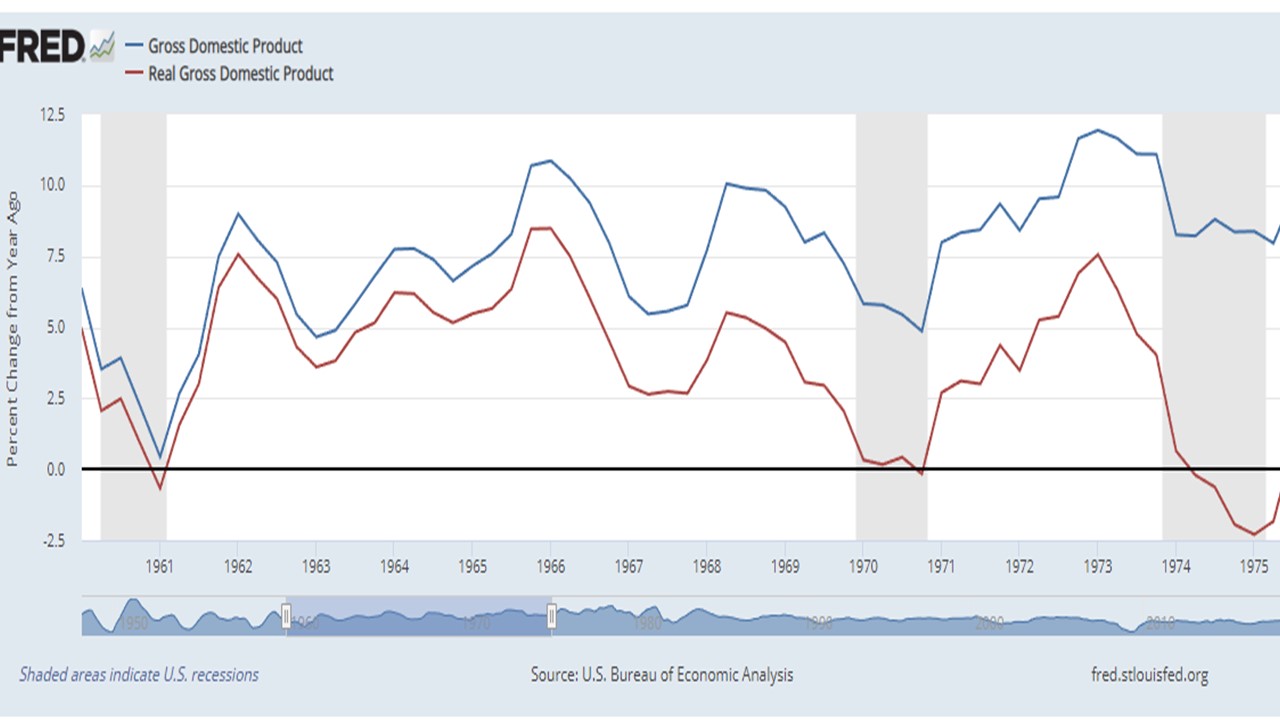
To place the upsurge in total spending presided over by Burns in context, the figure below shows the year over year increase in nominal GDP from the first quarter of 1960 in the last year of the Eisenhower administration when the economy was in recession through the second quarter of 1975 when the economy had just begun to recover from the 1974-75 recession that followed the Yom Kippur War between Israel and its Arab neighbors, which triggered an Arab embargo of oil shipments to the United States and a cutback in the total world output of oil resulting in a quadrupling of crude oil prices within a few months.


https://fred.stlouisfed.org/graph/?graph_id=552628

As Hetzel documents, Burns sought to minimize the magnitude of the monetary stimulus provided after August 15, 1971, instead attributing inflation to special factors like increasing commodity prices and devaluation of the dollar, as if rising commodity prices were an independent of cause of inflation, rather than a manifestation of it, and as if devaluation of the dollar was some sort of random non-monetary event. Rising commodity prices, such as the increase in oil prices after the Arab oil embargo, and even devaluation of the dollar could, indeed, be the result of external non-monetary forces. But the Arab oil embargo did not take place until late in 1973 when inflation, wage-and-price controls notwithstanding, had already surged well beyond acceptable limits, and commodity prices were rising rapidly, largely because of high demand, not because of supply disruptions. And it strains credulity to suppose that devaluation of the dollar was not primarily the result of the cumulative effects of monetary policy over a long period of time rather than a sudden shift in the terms of trade between the US and its trading partners.

Burns also blamed loose fiscal policy in the 1960s for the inflation that started rising in the late 1960s. But the notion that loose fiscal policy in the 1970s significantly affected inflation is inconsistent with the fact that the federal budget deficit exceeded 2% of GDP only once (1968) between 1960 and 1974.

It’s also clear that the fluctuation in the growth rate of nominal GDP in the figure above were quite closely related to changes in Fed policy. The rise in nominal GDP growth after the 1960 recession followed an easing of Fed policy while the dip in nominal GDP growth in 1966-67 was induced by a deliberate tightening by the Fed as a preemptive move against inflation that was abandoned because of a credit crunch that adversely affected mortgage lending and the home building industry.

When Nixon took office in Q1 1969 was 9.3% higher than in Q1 1968, the fourth consecutive quarter in which the rate of NGDP increase was between 9 and 10%. Having pledged to reduce inflation without wage and price controls or raising taxes, the only anti-inflation tool in Nixon’s quiver was monetary policy. It was therefore up to the Fed, then under the leadership of William McChesney Martin, an Eisenhower appointee, was thus expected to tighten monetary policy.

A moderate tightening, reflected in a modestly slower increases in NGDP in the remainder of 1969 (8% in Q2, 8.3% in Q3 and 7.2% in Q4) began almost immediately. The slowdown in the growth of spending did little to subdue inflation, leading instead to a slowing of real GDP growth, but without increasing unemployment. Not until 1970, after Burns replaced Martin at the Fed, and further tightened monetary policy, causing nominal spending growth to slow further (5.8% in Q1 and Q2, 5.4% in Q3 and 4.9% in Q4), did real GDP growth stall, with unemployment sharply rising from less than 4% to just over 6%. The economy having expanded and unemployment having fallen almost continuously since 1961, the sharp rise in unemployment provoked a strong outcry and political reaction, spurring big Democratic gains in the 1970 midterm elections.

After presiding over the first recession in almost a decade, Burns, under pressure from Nixon, reversed course, eased monetary policy to fuel a modest recovery in 1971, with nominal GDP growth increasing to rates higher than 1969 and almost as high as in 1968 (8% in Q1, 8.3% in Q2 and 8.4% in Q3). It was at the midpoint of Q3 (August 15) that Nixon imposed a 90-day wage-and-price freeze, and nominal GDP growth accelerated to 9.3% in Q4 (the highest rate since Q4 1968). With costs held in check by the wage-and-price freeze, the increase in nominal spending induced a surge in output and employment.

In 1972, nominal GDP growth, after a slight deceleration in Q1, accelerated to 9.5% in Q2, to 9.6% in Q3 and to 11.6% in Q4, a growth rate maintained during 1973. So Burns’s attempt to disclaim responsibility for the acceleration of inflation associated with accelerating growth in nominal spending and income between 1971 and 1973 was obviously disingenuous and utterly lacking in credibility.

Hetzel summed up Burns’s position after the imposition of wage-and-price controls as follows:

More than anyone else, Burns had created widespread public support for the wage and price controls imposed on August 15, 1971. For Burns, controls were the prerequisite for the expansionary monetary policy desired by the political system—both Congress and the Nixon Administration. Given the imposition of the controls that he had promoted, Burns was effectively committed to an expansionary monetary policy. Moreover, with controls, he did not believe that expansionary monetary policy in 1972 would be inflationary.

Perhaps Burns really did believe that an expansionary monetary policy would not be inflationary with wage-and-price controls in place. But if that’s what Burns believed, he was in a state of utter confusion. An expansionary monetary policy followed under cover of wage-and-price controls could contain inflation only as long as there was sufficient excess capacity and unemployment to channel increased aggregate spending to induce increased output and employment rather than create shortages of products and resources that would drive up costs and prices. To suppress the pressure of rising costs and prices wage-and-price controls would inevitably distort relative prices and create shortages, leading to ever-increasing and cascading waste and inefficiency, and eventually to declining output. That’s what began to happen in 1973 making it politically impossible, to Burns’s chagrin, to re-authorize continuation of those controls after the initial grant of authority expired in April 1974.

I discussed the horrible legacy of Nixon’s wage-and-price freeze and the subsequent controls in one of my first posts on this blog, so I needn’t repeat myself here about the damage done by controls; the point I do want to emphasize is, Karl Smith to the contrary notwithstanding, how incoherent Burns’s thinking was in assuming that a monetary policy leading aggregate spending to rise by a rate exceeding 11% for four consecutive quarters wasn’t seriously inflationary.

If monetary policy is such that nominal GDP is growing at an 11% rate, while real GDP grows at a 4% rate, the difference between those two numbers will necessarily manifest itself in 7% inflation. If wage-and-price controls suppress inflation, the suppressed inflation will be manifested in shortages and other economic dislocations, reducing the growth of real GDP and causing an unwanted accumulation of cash balances, which is what eventually happened under wage-and-price controls in late 1973 and 1974. Once an economy is operating at full capacity, as it surely was by the end of 1973, there could have been no basis for thinking that real GDP could increase at substantially more than a 4% rate, which is why real GDP growth diminished quarter by quarter in 1973 from 7.6% in Q1 to 6.3% in Q2 to 4.8% in Q3 and 4% in Q4.

Thus, in 1973, even without an oil shock in late 1973 used by Burns as an excuse with which to deflect the blame for rising inflation from himself to uncontrollable external forces, Burns’s monetary policy was inexorably on track to raise inflation to 7%. Bad as the situation was before the oil shock, Burns chose to make the situation worse by tightening monetary policy, just as oil prices were quadrupling, It was the worst possible time to tighten policy, because the negative supply shock associated with the rise in oil and other energy prices would likely have led the economy into a recession even if monetary policy had not been tightened.

I am planning to write another couple of posts on what happened in the 1970s, actually going back to the late sixties and forward to the early eighties. The next post will be about Ralph Hawtrey’s last book Incomes and Money in which he discussed the logic of incomes policies that Arthur Burns would have done well to have studied and could have provided him with a better approach to monetary policy than his incoherent embrace of an incomes policy divorced from any notion of the connection between monetary policy and aggregate spending and nominal income. So stay tuned, but it may take a couple of weeks before the next installment.

The Free Market Economy Is Awesome and Fragile

Scott Sumner’s three most recent posts (here, here, and here)have been really great, and I’ld like to comment on all of them. I will start with a comment on his post discussing whether the free market economy is stable; perhaps I will get around to the other two next week. Scott uses a 2009 paper by Robert Hetzel as the starting point for his discussion. Hetzel distinguishes between those who view the stabilizing properties of price adjustment as being overwhelmed by real instabilities reflecting fluctuations in consumer and entrepreneurial sentiment – waves of optimism and pessimism – and those who regard the economy as either perpetually in equilibrium (RBC theorists) or just usually in equilibrium (Monetarists) unless destabilized by monetary shocks. Scott classifies himself, along with Hetzel and Milton Friedman, in the latter category.

Scott then brings Paul Krugman into the mix:

Friedman, Hetzel, and I all share the view that the private economy is basically stable, unless disturbed by monetary shocks. Paul Krugman has criticized this view, and indeed accused Friedman of intellectual dishonesty, for claiming that the Fed caused the Great Depression. In Krugman’s view, the account in Friedman and Schwartz’s Monetary History suggests that the Depression was caused by an unstable private economy, which the Fed failed to rescue because of insufficiently interventionist monetary policies. He thinks Friedman was subtly distorting the message to make his broader libertarian ideology seem more appealing.

This is a tricky topic for me to handle, because my own view of what happened in the Great Depression is in one sense similar to Friedman’s – monetary policy, not some spontaneous collapse of the private economy, was what precipitated and prolonged the Great Depression – but Friedman had a partial, simplistic and distorted view of how and why monetary policy failed. And although I believe Friedman was correct to argue that the Great Depression did not prove that the free market economy is inherently unstable and requires comprehensive government intervention to keep it from collapsing, I think that his account of the Great Depression was to some extent informed by his belief that his own simple k-percent rule for monetary growth was a golden bullet that would ensure economic stability and high employment.

I’d like to first ask a basic question: Is this a distinction without a meaningful difference? There are actually two issues here. First, does the Fed always have the ability to stabilize the economy, or does the zero bound sometimes render their policies impotent?  In that case the two views clearly do differ. But the more interesting philosophical question occurs when not at the zero bound, which has been the case for all but one postwar recession. In that case, does it make more sense to say the Fed caused a recession, or failed to prevent it?

Here’s an analogy. Someone might claim that LeBron James is a very weak and frail life form, whose legs will cramp up during basketball games without frequent consumption of fluids. Another might suggest that James is a healthy and powerful athlete, who needs to drink plenty of fluids to perform at his best during basketball games. In a sense, both are describing the same underlying reality, albeit with very different framing techniques. Nonetheless, I think the second description is better. It is a more informative description of LeBron James’s physical condition, relative to average people.

By analogy, I believe the private economy in the US is far more likely to be stable with decent monetary policy than is the economy of Venezuela (which can fall into depression even with sufficiently expansionary monetary policy, or indeed overly expansionary policies.)

I like Scott’s LeBron James analogy, but I have two problems with it. First, although LeBron James is a great player, he’s not perfect. Sometimes, even he messes up. When he messes up, it may not be his fault, in the sense that, with better information or better foresight – say, a little more rest in the second quarter – he might have sunk the game-winning three-pointer at the buzzer. Second, it’s one thing to say that a monetary shock caused the Great Depression, but maybe we just don’t know how to avoid monetary shocks. LeBron can miss shots, so can the Fed. Milton Friedman certainly didn’t know how to avoid monetary shocks, because his pet k-percent rule, as F. A. Hayek shrewdly observed, was a simply a monetary shock waiting to happen. And John Taylor certainly doesn’t know how to avoid monetary shocks, because his pet rule would have caused the Fed to raise interest rates in 2011 with possibly devastating consequences. I agree that a nominal GDP level target would have resulted in a monetary policy superior to the policy the Fed has been conducting since 2008, but do I really know that? I am not sure that I do. The false promise held out by Friedman was that it is easy to get monetary policy right all the time. It certainly wasn’t the case for Friedman’s pet rule, and I don’t think that there is any monetary rule out there that we can be sure will keep us safe and secure and fully employed.

But going beyond the LeBron analogy, I would make a further point. We just have no theoretical basis for saying that the free-market economy is stable. We can prove that, under some assumptions – and it is, to say the least, debatable whether the assumptions could properly be described as reasonable – a model economy corresponding to the basic neoclassical paradigm can be solved for an equilibrium solution. The existence of an equilibrium solution means basically that the neoclassical model is logically coherent, not that it tells us much about how any actual economy works. The pieces of the puzzle could all be put together in a way so that everything fits, but that doesn’t mean that in practice there is any mechanism whereby that equilibrium is ever reached or even approximated.

The argument for the stability of the free market that we learn in our first course in economics, which shows us how price adjusts to balance supply and demand, is an argument that, when every market but one – well, actually two, but we don’t have to quibble about it – is already in equilibrium, price adjustment in the remaining market – if it is small relative to the rest of the economy – will bring that market into equilibrium as well. That’s what I mean when I refer to the macrofoundations of microeconomics. But when many markets are out of equilibrium, even the markets that seem to be equilibrium (with amounts supplied and demanded equal) are not necessarily in equilibrium, because the price adjustments in other markets will disturb the seeming equilibrium of the markets in which supply and demand are momentarily equal. So there is not necessarily any algorithm, either in theory or in practice, by which price adjustments in individual markets would ever lead the economy into a state of general equilibrium. If we believe that the free market economy is stable, our belief is therefore not derived from any theoretical proof of the stability of the free market economy, but simply on an intuition, and some sort of historical assessment that free markets tend to work well most of the time. I would just add that, in his seminal 1937 paper, “Economics and Knowledge,” F. A. Hayek actually made just that observation, though it is not an observation that he, or most of his followers – with the notable and telling exceptions of G. L. S. Shackle and Ludwig Lachmann – made a big fuss about.

Axel Leijonhufvud, who is certainly an admirer of Hayek, addresses the question of the stability of the free-market economy in terms of what he calls a corridor. If you think of an economy moving along a time path, and if you think of the time path that would be followed by the economy if it were operating at a full-employment equilibrium, Leijonjhufvud’s corridor hypothesis is that the actual time path of the economy tends to revert to the equilibrium time path as long as deviations from the equilibrium are kept within certain limits, those limits defining the corridor. However, if the economy, for whatever reasons (exogenous shocks or some other mishaps) leaves the corridor, the spontaneous equilibrating tendencies causing the actual time path to revert back to the equilibrium time path may break down, and there may be no further tendency for the economy to revert back to its equilibrium time path. And as I pointed out recently in my post on Earl Thompson’s “Reformulation of Macroeconomic Theory,” he was able to construct a purely neoclassical model with two potential equilibria, one of which was unstable so that a shock form the lower equilibrium would lead either to a reversion to the higher-level equilibrium or to downward spiral with no endogenous stopping point.

Having said all that, I still agree with Scott’s bottom line: if the economy is operating below full employment, and inflation and interest rates are low, there is very likely a problem with monetary policy.


About Me

David Glasner
Washington, DC

I am an economist in the Washington DC area. My research and writing has been mostly on monetary economics and policy and the history of economics. In my book Free Banking and Monetary Reform, I argued for a non-Monetarist non-Keynesian approach to monetary policy, based on a theory of a competitive supply of money. Over the years, I have become increasingly impressed by the similarities between my approach and that of R. G. Hawtrey and hope to bring Hawtrey’s unduly neglected contributions to the attention of a wider audience.

My new book Studies in the History of Monetary Theory: Controversies and Clarifications has been published by Palgrave Macmillan

Follow me on Twitter @david_glasner

Archives

Enter your email address to follow this blog and receive notifications of new posts by email.

Join 665 other subscribers
Follow Uneasy Money on WordPress.com