Archive for the 'monetary theory' Category


Selgin Takes Down Taylor on NGDP Targeting

A couple of weeks ago (November 18, 2011), responding to the recent groundswell of interest in NGDP targeting, John Taylor wrote a critique of NGDP targeting on his blog (“More on Nominal GDP Targeting”). Taylor made two main points in his critique. First, noting that recent proposals for NGDP targeting (in contrast to earlier proposals advanced in the 1980s) propose targeting the level (or more precisely a trend line) of NGDP rather than the growth rate of NGDP, Taylor conceded that in recoveries from recessions there is a case for allowing NGDP to grow faster than the long-run trend. Strict rate targeting would not accommodate faster than normal NGDP growth in recoveries, level targeting would. However, Taylor argued that level targeting has a corresponding drawback.

[I]f an inflation shock takes the price level and thus NGDP above the target NGDP path, then the Fed will have to take sharp tightening action which would cause real GDP to fall much more than with inflation targetting and most likely result in abandoning the NGDP target.

Taylor’s second point was that NGDP targeting is not an adequate rule, because it allows the monetary authorities too much discretion in choosing how to hit the specified target. Taylor regards this as a dangerous concession of arbitrary authority to the central bank.

NGDP targeting may seem like a policy rule, but it does not give much quantitative operational guidance about what the central bank should do with the instruments. It is highly discretionary. Like the wolf dressed up as a sheep, it is discretion in rules clothing.

In reply Scott Sumner wrote a good defense of NGDP targeting, focusing mainly on the forward-looking orientation of NGDP targeting in contrast to the backward-looking orientation of the rule favored by Taylor. Further, Taylor’s criticism is beside the point, having nothing to do with NGDP targeting; it’s all about level targeting versus growth targeting. Scott also points out that his own version of NGDP targeting precisely specifies what the central bank is supposed to do to implement its objective, avoiding entirely Taylor’s charge of giving too much discretion to the central bank.

All well and good, but no coup de grace.

It took almost two weeks, but the coup de grace was finally administered with admirable clarity and efficiency at 3:58 PM on December 1, 2011 by George Selgin on the Free Banking Blog. Selgin’s main point is that it is illegitimate for Taylor to posit an inflation shock to the price level, because inflation shocks don’t just happen, they must be caused by some other, more fundamental, cause. That cause can either be classified as a (negative) shift in aggregate supply or a (positive) shift in aggregate demand. If the shift affected aggregate supply, meaning that aggregate demand has not changed, there is no particular reason to suppose that any change has occurred in NGDP. So there is no reason for the Fed to tighten monetary policy to counteract the increase in the price level. On the other hand, if the inflation shock was caused by an increase in aggregate demand, then NGDP has certainly increased, and a tightening action would be required, but the cause of the tightening would have been the targeting of NGDP,  but the failure to do so.

Now in fairness to Professor Taylor, one could interpret his point in a different way: Central bankers are not infallible. Try as they might, they will not succeed in hitting their NGDP targets every time. But each miss will require an offsetting change in the opposite direction. The result of random errors in targeting, may be increased instability in NGDP. But if that was what Taylor meant, he should have said so. Selgin identifies the source of Taylor’s confusion as follows:

But lurking below the surface of Professor Taylor’s nonsensical critique is, I sense, a more fundamental problem, consisting of his implicit treatment of stabilization of aggregate demand or spending, not as a desirable end in itself, but as a rough-and-ready (if not seriously flawed) means by which the Fed might attempt to fulfill its so-called dual mandate–a mandate calling for it to concern itself with both the control of inflation and the stability of employment and real output.

What Selgin is arguing for is a policy targeting a (nearly) constant level of NGDP, taking seriously the vague (and essentially non-operational) goal, mentioned by Hayek in his early work, of a constant level of monetary expenditure.

[A]lthough it is true that unsound monetary policy tends to contribute to undesirable and unnecessary fluctuations in prices and output, it does not follow that the soundest conceivable policy is one that eliminates such fluctuations altogether. The goal of monetary policy ought, rather, to be that of avoiding unnatural fluctuations in output–that is, departures of output from its full-information level–while refraining from interfering with fluctuations that are “natural.”

I find Selgin’s formulation really interesting, because a few months ago I was trying to think through the following problem. Suppose there is a supply shock that causes real output to fall. Unless the supply shock is caused by a reduced supply of labor, the real wage must fall. Under a policy of stabilizing nominal income, the nominal wage as well as the real wage would (or at least could) fall if, as a result of the supply shock, labor’s share of factor income also declined. But a falling nominal wage would tend to cause inefficient (involuntary) unemployment, because workers, observing unexpectedly reduced wages, would therefore not accept the relatively low wage offers, becoming unemployed in the mistaken expectation of finding better paying jobs while unemployed. A policy of stabilizing nominal wages would avoid inefficient (involuntary) unemployment, which is an argument for making stable wages (as advocated by Hawtrey and Earl Thompson) rather than stable nominal income the goal of economic policy.  Thus, it seems to me that from the standpoint of optimal employment policy, a policy of stabilizing wages may do better than a policy of stabilizing NGDP.  Of course, if one adopts a policy of targeting a sufficiently high growth rate of NGDP, the likelihood that nominal wage would fall as a result of a supply shock would be correspondingly reduced.

I also want to comment further on Taylor’s criticism of NGDP targeting as unacceptably discretionary, but that will have to wait for another day.

The Tender-Hearted Prof. Sumner Gives Mises and Hayek a Pass

Scott Sumner is such a kindly soul. You can count on him to give everyone the benefit of the doubt, bending over backwards to find a way to make sense out of the most ridiculous statement that you can imagine. Even when he disagrees, he expresses his disagreement in the mildest possible terms. And if you don’t believe me, just ask Paul Krugman, about whom Scott, despite their occasional disagreements, always finds a way to say something nice and complimentary. I have no doubt that if you were fortunate enough to take one of Scott’s courses at Bentley, you could certainly count on getting at least a B+ if you showed up for class and handed in your homework, because Scott is the kind of guy who just would not want to hurt anyone’s feelings, not even a not very interested student. In other words, Scott is the very model of a modern major general – er, I mean, of a modern sensitive male.

But I am afraid that Scott has finally let his niceness get totally out of hand. In his latest post “The myth at the heart of internet Austrianism,” Scott ever so gently points out a number of really serious (as in fatal) flaws in Austrian Business Cycle Theory, especially as an explanation of the Great Depression, which it totally misdiagnosed, wrongly attributing the downturn to a crisis caused by inflationary monetary policy, and for which it prescribed a disastrously mistaken remedy, namely, allowing deflation to run its course as a purgatory of the malinvestments undertaken in the preceding boom. Scott certainly deserves a pat on the back for trying to shed some light on a subject as fraught with fallacy and folly as Austrian Business Cycle Theory, but unfortunately Scott’s niceness got the better of him when he made the following introductory disclaimer:

This post is not about Austrian economics, a field I know relatively little about. [Scott is not just nice, he is also modest and self-effacing to a fault, DG] Rather it is a response to dozens of comments I have received by people who claim to represent the Austrian viewpoint.

And then after his partial listing of the problems with Austrian Business Cycle Theory, Scott just couldn’t help softening the blow with the following comment.

Austrian monetary economics has some great ideas – most notably NGDP targeting. I wish internet Austrians would pay more attention to Hayek, and less attention to whoever is telling them that the Depression was triggered by the collapse of an inflationary bubble during the 1920s. There was no inflationary bubble, by any reasonable definition of the world “inflation.”

Scott greatly admires Hayek (as do I), so he sincerely wants to believe that the mistakes of Austrian Business Cycle Theory are not Hayek’s fault, but are the invention of some nasty inauthentic Internet Austrians. In fact, because in a few places Hayek seemed to understand that an increased demand for money (aka a reduction in the velocity of circulation) would cause a reduction in total spending (aggregate demand or nominal income) unless matched by an increased quantity of money, acknowledging that, at least in principle, the neutral monetary policy he favored should not hold the stock of money constant, but should aim at a constant level of total spending (aggregate demand or nominal income), Scott wants to absolve Hayek from responsibility for the really bad (as in horrendous) policy advice he offered in the 1930s, opposing reflation and any efforts to increase spending by deliberately increasing the stock of money. During the Great Depression, Hayek’s recognition that in principle the objective of monetary policy ought to be to stabilize total spending was more in the way of a theoretical nuance than a bedrock principle of monetary policy. The recognition is buried in chapter four of Prices and Production. The tenor of his remarks and the uselessness of his recognition in principle that total spending should be stabilized are well illustrated by the following remark at the beginning of the final section of the chapter

Anybody who is sceptical of the value of theoretical analysis if it does not result in practical suggestions for economic policy will probably be deeply disappointed by the small return of so prolonged an argument.

Then in the 1932 preface to the English translation of his Monetary Theory and the Trade Cycle, Hayek wrote the following nugget:

Far from following a deflationary policy, Central Banks, particularly in the United States, have been making earlier and more far reaching efforts than have ever been undertaken before to combat the depression by a policy of credit expansion – with the result that the depression has lasted longer and has become more severe than any preceding one. What we need is a readjustment of those elements in the structure of production and of prices which existed before the deflation began and which then made it unprofitable for industry to borrow. But, instead of furthering the inevitable liquidation of the maladjustments brought about by the boom during the last three years, all conceivable means have been used to prevent that readjustment from taking place; and one of these means, which has been repeatedly tried though without success, from the earliest to the most recent stages of depression, has been this deliberate policy of credit expansion. (pp. 19-20)

And then Hayek came to this staggering conclusion (which is the constant refrain of all Internet Austrians):

To combat the depression by a forced credit expansion is to attempt to cure the evil by the very means which brought it about; because we are suffering from a misdirection of production, we want to create further misdirection – a procedure which can only lead to a much more severe crisis as soon as the credit expansion comes to an end. It would not be the first experiment of this kind which has been made. We should merely be repeating, on a much larger scale, the course followed by the Federal Reserve system in 1927, an experiment which Mr. A. C. Miller, the only economist on the Federal Reserve Board [the Charles Plosser of his time, DG] and, at the same time, its oldest member, has rightly characterized as “the greatest and boldest operation ever undertaken by the Federal reserve system”, an operation which “resulted in one of the most costly errors committed by it or any other banking system in the last 75 years”. It is probably to this experiment, together with the attempts to prevent liquidation once the crisis had come, that we owe the exceptional severity and duration of the depression. We must not forget that, for the last six or eight years, monetary policy all over the world [like, say, France for instance? DG] has followed the advice of the stabilizers. It is high time that their influence, which has already done harm enough, should be overthrown. [OMG, DG] (pp. 21-22)

That the orthodox Austrian (espoused by Mises, Hayek, Haberler, and Machlup) view at the time was that the Great Depression was caused by an inflationary monetary policy administered by the Federal Reserve in concert with other central banks at the time is clearly shown by the following quotation from Lionel Robbins’s book The Great Depression. Robbins, one of the great English economists of the twentieth century, became a long-distance disciple of Mises and Hayek in the 1920s and was personally responsible for Hayek’s invitation to deliver his lectures (eventually published as Prices and Production) on Austrian Business Cycle Theory at the London School of Economics in 1931, and after their huge success, arranged for Hayek to be offered a chair in economic theory at LSE. Robbins published his book on the Great Depression in 1934 while still very much under the influence of Mises and Hayek. He subsequently changed his views, publicly disavowing the book, refusing to allow it to be reprinted in his lifetime.

Thus in the last analysis, it was deliberate co-operation between Central bankers, deliberate “reflation” on the part of the Federal Reserve authorities, which produced the worst phase of this stupendous fluctuation. Far from showing the indifference to prevalent trends of opinion, of which they have so often been accused, it seems that they had learnt the lesson only too well. It was not old-fashioned practice but new-fashioned theory which was responsible for the excesses of the American disaster. (p. 54)

Like Robbins, Haberler and Machlup, who went on to stellar academic careers in the USA, also disavowed their early espousal of ABCT. Mises, unable to tolerate apostasy on the part of traitorous erstwhile disciples, stopped speaking to them. Hayek, though never disavowing his earlier views as Robbins, Haberler, and Machlup had, acknowledged that he had been mistaken in not forthrightly supporting a policy of stabilizing total spending. Mises was probably unhappy with Hayek for his partial u-turn, but continued speaking to him nevertheless. Of course, Internet Austrians like Thomas Woods, whose book Meltdown was a best-seller and helped fuel the revival of Austrianism after the 2008 crisis, feel no shame in citing the works of Hayek, Haberler, Machlup, and Robbins about the Great Depression that they later disavowed in whole or in part, without disclosing that the authors of the works being cited changed or even rejected the views for which they were being cited.

So I am sorry to have to tell Scott: “I know it’s hard for you, but stop trying to be nice to Mises and Hayek. They were great economists, but they got the Great Depression all wrong. Don’t try to sugarcoat it. It can’t be done.”

Rules v. Discretion

I gave a talk this afternoon at a panel on the Heritage of Monetary Economics and Macroeconomics at the meetings of the Southern Economic Association in Washington. The panel was brought together to commemorate a confluence of significant anniversaries this year: the 300th anniversary of David Hume’s birth, the 200th anniversary of the publication of the Bullion Report to the British Parliament, the 100th anniversary of the publication of Irving Fisher’s Purchasing Power of Money, the 75th anniversary of the publication of Keynes’s General Theory, and the 50th anniversary of the publication of John Muth’s paper on rational expectations. I spoke about the Bullion Report and the contributions of classical monetary theory. At some point, I may post the entire paper on SSRN, but I thought that the section of my paper on rules versus discretion in monetary policy might be of interest to readers of the blog, so here is an abridged version of that section of my paper.

The Bullion Report, whose 200th anniversary we are observing, is an appropriate point from which to start a discussion of the classical contribution to the perpetual debate over rules versus discretion in the conduct of monetary policy. The Bullion Report contained an extended discussion of several important theoretical issues, but its official purpose was to recommend an early resumption of convertibility (suspended since 1797) of Bank of England banknotes, to make them redeemable again at a fixed parity in terms of gold. In other words, the Bullion Report called for a rapid return to the gold standard, then regarded as a safe and workable rule for the conduct of monetary policy.

Despite the rejection by Parliament of the Report’s recommendation to quickly restore the gold standard, the general argument of the Bullion Report for the gold standard undoubtedly influenced the ultimate decision to restore the gold standard after the Napoleonic Wars. But full restoration of gold standard in 1821 did not produce the promised monetary stability, with ongoing disturbances punctuated by financial crises every 10 years or so, in 1825, 1836, 1847, 1857 and 1866. The result of the early disturbances was the adoption of new rules motivated by the idea that monetary disturbances were symptomatic of the failure of a mixed (gold and paper) currency to fluctuate exactly as a purely metallic currency would have.

These new rules seem to me to have been altogether misguided and pernicious, but their adoption reflected a fear that the simple rule embodying the gold standard, the requirement that banknotes be convertible into gold, would not ensure monetary stability unless supplemented by further rules limiting the creation of banknotes by the banks. The rules had to be tightened and spelled out in increasing detail to effectively limit the discretion of the bankers and prevent them from engaging in the destabilizing behavior that they would otherwise engage in.

Thus, over the course of the nineteenth century, there evolved a conception of the rules of the game governing the behavior of the monetary authorities under gold standard. However, the historical record is far from clear on the extent to which the rules of the game were actually observed. The record of equivocal adherence by the monetary authorities under the gold standard to the rules of the game can be interpreted to mean either that the rules of the game were unworkable or irrelevant — in which case following the rules would have been destabilizing — or that it was the failure to follow the rules of the game that caused the instabilities observed even in the heyday of the international gold standard (1880-1914).

The outbreak of World War I led quickly to the effective suspension of the international gold. The prestige of the gold standard was such that hardly anyone questioned the objective of restoring it after the war.  However, there was an increasing understanding that the assumption that the gold standard was the simplest and most effective arrangement by which to achieve price-level stability was unlikely to be valid in the post-war environment. Ralph Hawtrey and Gustav Cassel were especially emphatic after the war about the deflationary dangers associated with restoring the international gold standard unless measures were taken to reduce the monetary demand for gold as countries went back on the gold standard. As a result, the 1920s literature on monetary policy contain frequent derogatory references by supporters of the orthodox gold standard to supporters of managed money, i.e., to advocates of using monetary policy to stabilize prices rather than accept whatever price level was generated by allowing the gold standard to operate according to the rules of the game.

Advocates of price-level stabilization, especially Hawtrey and Cassel, attributed the Great Depression to a failure to manage the gold standard in a way that prevented a sharp increase in the worldwide monetary demand for gold after France, followed by a number of other countries, rejoined the gold standard in 1928 and began redeeming foreign exchange holdings for gold. It was at just this point that the Federal Reserve, having followed a somewhat accommodative policy since 1925, shifted to a tighter policy in late 1928 out of concern with stock-market speculation supposedly fueling a bubble in stock prices. Supporters of the traditional gold standard blamed the crisis on the “inflationary” policies of the Federal Reserve which prevented the “natural” deflation that would otherwise have started in 1927.

Supporters of the traditional gold standard thought that they were upholding the classical tradition of a monetary policy governed by rules not discretion. But Hawtrey and Cassel were not advocates of unlimited policy discretion; they believed that the gold standard ought to be managed by the leading central banks with an understanding of how their policies jointly would determine the international price level and that they should therefore do what was necessary to avoid the deflation to which the world economy was dangerously susceptible because of the rapidly increasing monetary demand for gold.

The Keynesian Revolution after the Great Depression provided a rationale for not allowing policy rules (e.g., keeping the government’s budget balanced, or keeping an exchange rate or an internal price level constant) to preclude taking fiscal or monetary actions designed to increase employment. Achieving full employment by controlling aggregate spending by manipulating fiscal and monetary instruments became the explicit goal of economic policy for the first time. The gold standard having been effectively discredited, opponents of discretionary policies had to search for an alternative rule in terms of which they could take a principled stand against discretionary Keynesian policies. A natural rule to specify would have been to stabilize a price index, as Irving Fisher had proposed after World War I, with his plan for a compensated dollar based on adjusting the price of gold at which the dollar would be made convertible as necessary to keep the price level constant. But Fisher’s plan was too complicated for laymen to understand, and Milton Friedman, the dominant anti-Keynesian of the 1950s and 1960s, preferred to formulate a monetary rule in terms of the quantity of money, perhaps reflecting the Currency School bias for quantitative rules he inherited from his teacher at Chicago Lloyd Mints. A quantitative rule, Friedman argued, imposes a tighter, more direct, constraint on the actions of the central bank than a price-level rule.

The attempt by the Federal Reserve under Paul Volcker to implement a strict Monetarist control over the growth of the money aggregates proved unsuccessful even though the Fed succeeded in its ultimate goal of reducing inflation. Friedman himself, observing the rapid growth of the monetary aggregates, after inflation had been brought down, predicted that inflation would soon rise again to near double-digit rates. That error marked the end of Monetarism as a serious guide to conducting monetary policy.

However, traditional Keynesian prescriptions were, by then, no longer fashionable either, and we entered a two-decade period in which monetary policy aimed at a gradually declining inflation target, falling from 3.5% in the late 1980s to about 2% at present. The instrument used to achieve the inflation target was the traditional pre-Keynesian instrument of the bank rate. John Taylor suggested a rule for setting the bank rate based on the target inflation rate and the gap between actual and potential output that seemed consistent with the recent behavior of the Fed and other central banks. Everything seemed to be going well, and central banks basked in a glow of general approval and gratitude for achieving what was called the Great Moderation. But, perhaps because the Fed didn’t follow the Taylor rule for a few years after the dot-com bubble and the 9/11 attack, there was a housing bubble and then a recession and then a financial crisis, and we now find ourselves mired in the worst recession – actually a Little Depression — since the Great Depression.

The classical monetary theorists, with very few exceptions, believed in some sort of monetary rule, for the most part, either a simple gold standard governed only by the obligation to maintain convertibility or a gold standard hedged in by a variety of rules specifying the appropriate adjustments. Only a few classical economists had other ideas about a monetary regime, and of these they were also rule-based systems such as bimetallism or some form of a tabular standard. The idea of a purely discretionary regime unconstrained by any rule was generally beyond their comprehension.

The problem, for which we as yet have no solution, is that it is dangerous to formulate a rule governing monetary policy if one doesn’t have a fully adequate model of the economy and of the monetary system for which the rule is supposed to determine policy. Ever since the nineteenth century, monetary reformers have been proposing rules to govern policy whose effects they have grossly misunderstood. The Currency School erroneously believed that monetary and financial crises were caused by the failure of a mixed currency to fluctuate in exactly the same way as a purely metallic currency would have. The attempt to impose such a rule simply aggravated the crises to which any gold standard was naturally subject as a result of more or less random fluctuations in the value of gold. The Great Depression was caused by a misguided attempt to recreate the prewar gold standard without taking into account the effect that restoring the gold standard would have on the value of gold. A Monetarist rule to control the rate of growth of the money supply was nearly impossible to implement, because Monetarists stubbornly believed that the demand for money was extremely stable and almost unaffected by the rate of interest so that a steady rate of growth in the money supply was a necessary and sufficient condition for achieving the maximum degree of macroeconomic stability monetary policy was capable of.

After those failures, it was thought that a policy of inflation targeting would achieve macroeconomic stability. But there are two problems with inflation targeting. First, it calls for a perverse response to supply shocks, adding stimulus when a positive productivity shock speeds economic growth and reduces inflation, and reducing aggregate demand when a negative supply shock reduces economic growth and increases inflation. Thus, in one of the greatest monetary policy mistakes since the Great Depression, the FOMC stubbornly tightened policy for most of 2008, because negative supply shocks were driving up commodities prices, causing fears that inflation expectations would become unanchored. The result was an accelerating downturn in the summer of 2008, producing deflationary expectations that precipitated a financial panic and a crash in asset prices.

Second, even without a specific supply shock, if profit expectations worsen sufficiently, causing equilibrium real short-term interest rates to go negative, the only way to avoid a financial crisis is for the rate of inflation to increase sufficiently to allow the real short term interest rate to drop to the equilibrium level. If inflation doesn’t increase sufficiently to allow the real interest rate to drop to its equilibrium level, the expected rate of return on holding cash will exceed the expected return from holding capital causing a crash in asset prices, just what happened in October 2008.

Some of us are hoping that targeting nominal GDP may be an improvement over the rules that have been followed to date.  But the historical record, at any rate, does not offer much comfort to anyone who believes that adopting a following a simple rule is the answer to our monetary ills.
Some Unpleasant Fisherian Arithmetic

I have been arguing for the past four months on this blog and before that in my paper “The Fisher Effect Under Deflationary Expectations” (available here), that the Fisher equation which relates the nominal rate of interest to the real (inflation-adjusted) interest rate and to expected inflation conveys critical information about the future course of asset prices and the economy when the expected rate of deflation comes close to or exceeds the real rate of interest. When that happens, the expected return to holding cash is greater than the expected rate of return on real capital, inducing those holding real capital to try to liquidate their holdings in exchange for cash. The result is a crash in asset prices, such as we had in 2008 and early 2009, when expected inflation was either negative or very close to zero, and the expected return on real capital was negative. Ever since, expected inflation has been low, usually less than 2%, and the expected return on real capital has been in the neighborhood of zero or even negative. With the expected return on real capital so low, people (i.e., households and businesses) are reluctant to spend to acquire assets (either consumer durables or new plant and equipment), preferring to stay liquid while trying to reduce, or at least not add to, their indebtedness.

According to this way of thinking about the economy, a recovery can occur either because holding cash becomes less attractive or because holding real assets more attractive. Holding cash becomes less attractive if expected inflation rises; holding assets becomes more attractive if the expected cash flows associated with those real assets increase (either because expected demand is rising or because the productivity of capital is rising).

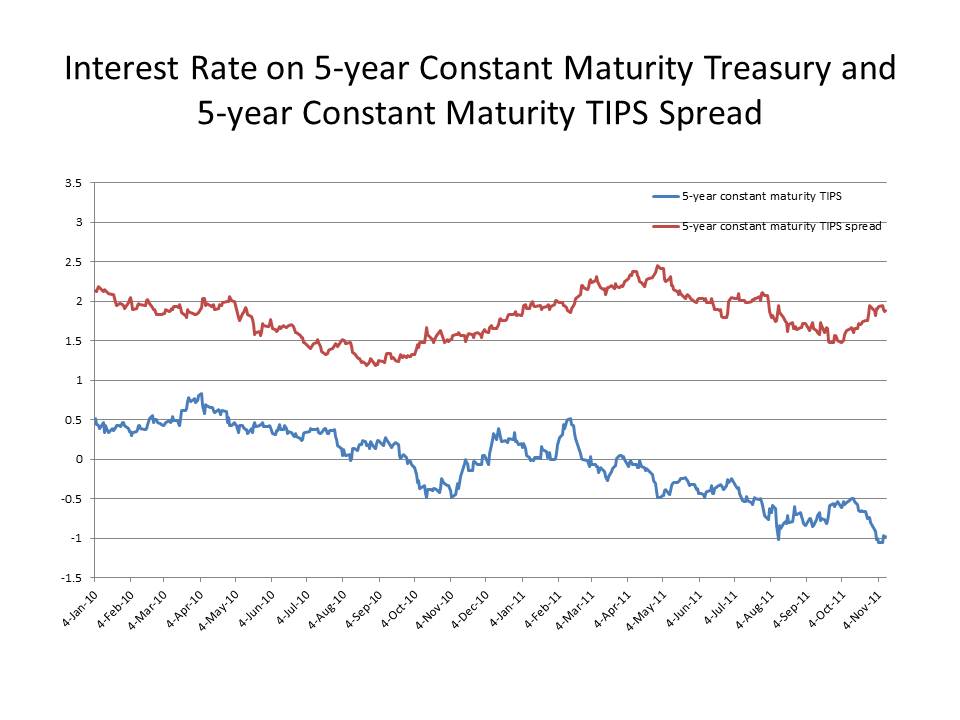
The attached chart plots expected inflation since January 2010 as measured by the breakeven 5-year TIPS spread on constant maturity Treasuries, and it plots the expected real return over a 5-year time horizon since January 2010 as reflected in the yield on constant maturity 5-year TIPS bonds.

In the late winter and early spring of 2010, real yields were rising even as inflation expectations were stable; stock prices were also rising and there were some encouraging signs of economic expansion. But in the late spring and summer of 2010, inflation expectations began to fall from 2% to less about 1.2% even as real yields started to drop.  With stock prices falling and amid fears of deflation and a renewed recession, the Fed felt compelled to adopt QE2, leading to an almost immediate increase in inflation expectations. At first, the increase in inflation expectations allowed real yields to drop, suggesting that expected yields on real assets had dropped further than implied by the narrowing TIPS spreads in the spring and summer. By late fall and winter, real yields reversed course and were rising along with inflation expectations, producing a substantial increase in stock prices. Rising optimism was reflected in a sharp increase in real yields to their highest levels in nearly a year in February of 2011. But the increase in real yields was quickly reversed by a combination of adverse supply side shocks that drove inflation expectations to their highest levels since the summer before the 2008 crash. However, after the termination of QE2, inflation expectations started sliding back towards the low levels of the summer before QE2 was adopted. The fall in inflation expectations was accompanied by an ominous fall in real yields and in stock prices.

Although suggestions that weakness in the economy might cause the Fed to resume some form of monetary easing seem to have caused some recovery in inflation expectations, real yields continue to fall. With real yield on capital well into negative territory (the real yield on a constant maturity 5-year TIPS bond is now around -1%, an astonishing circumstance. With real yields that low, 2% expected inflation would almost certainly not be enough to trigger a significant increase in spending. To generate a rebound in spending sufficient to spark a recovery, 3 to 4% inflation (the average rate of inflation in the recovery following the 1981-82 recovery in the golden age of Reagan) is probably the absolute minimum required.

Update:  Daniel Kuehn just posted an interesting comment on this post in his blog, correctly noting the conceptual similarity (if not identity) between the Fisher effect under deflationary expectations and the Keynesian liquidity trap.  I think that insight points to a solution of Keynes’s puzzling criticism of the Fisher effect in the General Theory even though he had previously endorsed Fisher’s reasoning in the Treatise on Money.

Scott Sumner Bans Inflation

Scott Sumner, the world’s greatest economics blogger, has had it with inflation. He hates inflation so much he wants to stop people from even talking about it or even mentioning it. He has banned use of the i-word on his blog, and if Scott has his way, the i-word will be banned from polite discourse from here to eternity.

Why is Scott so upset about inflation? It has nothing to do with the economic effects of inflation. It is all about people’s inability to think clearly about it.

Some days I want to just shoot myself, like when I read the one millionth comment that easy money will hurt consumers by raising prices.  Yes, there are some types of inflation that hurt consumers.  And yes, there are some types of inflation created by Fed policy.  But in a Venn diagram those two types of inflation have no overlap.

So Scott thinks that if only we could get people to stop talking about inflation, they would start thinking more clearly. Well, maybe yes, maybe no.

At any rate, if we are no longer allowed to speak about inflation, that is going to make my life a lot more complicated, because I have been trying to explain to people almost since I started this blog started four months ago why the stock market loves inflation and have repeated myself again and again and again and again. In a comment on my last iteration of that refrain, Marcus Nunes anticipated Scott with this comment.

That´s why I think mentioning the I word is bad. Even among “like thinkers” it gives many the “goosebumps”. What the stock market loves is to envision (even if temporarily) the possibility that NGDP will climb towards trend.

And when Scott announced the ban on the i-word on his blog, Marcus posted this comment on Scott’s blog:

Scott: David Glasner won´t be allowed to place comments here. Early this month I did a post on the I word.
http://thefaintofheart.wordpress.com/2011/10/07/two-words-you-should-never-use-inflation-stimulus/

In DG´s latest post Yes, Virginia, the stock market loves inflation I commented:

That´s why I think mentioning the I word is bad. Even among “like thinkers” it gives many the “goosebumps”. What the stock market loves is to envision (even if temporarily) the possibility that NGDP will climb towards trend.

He answered:

Marcus, I think inflation is important because it focuses on the choice between holding assets and holding money.!

Scott replied

We’ll see how David reacts to this post.

Well after that invitation, of course I had to respond. And I did as follows:

Scott, Even before I started blogging, I couldn’t keep up with you and now that I am blogging I have been falling farther and farther behind. So I just saw your kind invitation to weigh in on your “modest proposal.” I actually am not opposed to your proposal, and I greatly sympathize with and share your frustration with the confusion that attributes a fall in real income to an increase in prices as if it were the increase in prices that caused the fall in income rather than the other way around. On the other hand, on my blog I will continue to talk about inflation and every so often, despite annoying you and Marcus, I will continue to point out that since 2008 the stock market has been in love with inflation, even though it normally is indifferent or hostile to inflation.

I also don’t think that you have properly characterized the Fisher equation in terms of the real interest rate and expected NGDP growth. As a rough approximation the real interest rate (r) equals the rate of growth in real GDP; and the nominal interest rate (i) equals the rate of growth in nominal GDP. So stating the Fisher equation in terms of GDP should give you i = r + p (where p is the rate of inflation or the ratio of nominal to real GDP).

Finally, I am wondering whether you also want to ban use of the world “deflation” from polite discourse. I think it would be a shame if you did, because you and I both think that it was an increase in the value of gold (AKA deflation) that caused the decline in NGDP in the Great Depression, not a decline in NGDP that caused the increase in the value of gold.

So what is the upshot of all this? I guess I am just too conservative to give up using a word that I have grown up using since I started studying economics. It would also help if I could make sense of the Fisher equation — think of it as Newton’s law of monetary motion — without the rate of inflation. So I am waiting for Scott to explain that one to me. And I think that we need to have some notion of the purchasing power of money in order to explain the preferences of individuals for holding money versus other assets. If so, the concepts of a price level and a rate of inflation seem to be necessary as well.

Having said all that, I would add that Scott is a very persistent and persuasive guy, so I am definitely keeping all my options open.

Update:  Thanks to the ever-vigilant Scott Sumner for flagging my mistaken version of the Fisher equation.  It’s i = r + p, not r = i + p, as I originally had it.  I just corrected the equation in the body of the post as well and reduced the font to its normal size.

Do What Is Right Though the World Should Perish

An ancient debate among economists is whether the monetary authority should be subject to and constrained by an explicit operating rule or should be allowed discretion to act as it sees fit.  The debate goes back to the Bullion Debates in Britain after the British government, in the early stages of the Napoleonic Wars, suspended the obligation of the Bank of England to convert their banknotes into gold at the legally prescribed value of the pound.  One side in the debate, the Bullionists, argued that the Bank of England, enjoying special legal privileges that made it the center of the British monetary system, should be bound by a fixed rule, the absolute duty to convert Bank of England notes, on demand, into a fixed quantity of gold.  The other side, the Anti-Bullionists, maintained that there was no need for the Bank of England to be bound by the obligation to convert.

Over 20 years of intermittent exchanges between opponents and supporters of the suspension, producing some of the most important contributions to monetary thought of the nineteenth century, the Bullion Debates led to a general (though not unanimous) acceptance of the need for convertibility into gold as a stabilizing anchor for a money and banking system in which private banks produce a large share of all the money in circulation.  Despite the resumption of convertibility in 1821, Great Britain experienced damaging financial disturbances in 1825 and 1836, leading to the passage of Bank Charter Act in 1844, imposing a fixed limit on the total amount of banknotes issued by the Bank of England and by other private banks, requiring 100% gold cover for any banknotes issued beyond that fixed limit.

Hopes that, by mimicking the fluctuation of a purely gold currency in response to gold inflows and outflows, the reformed monetary system would avoid future crises were soon disappointed, Britain suffering financial crises in 1847, 1857, and 1866.  Each time the government was forced to grant immunity to the directors of the Bank of England for violating the Bank Charter Act and issuing banknotes in excess of the legal maximum in order to calm commercial panics triggered by fears that the Bank of England would be prevented by the Bank Charter Act from satisfying the demand for credit.  Once temporary suspension of the Act was announced, the panic subsided, the knowledge that credit could be obtained if needed sufficing to moderate the precautionary demand for credit.

By the last two decades of the nineteenth century, the Bank of England, the key institution managing what had become an international gold standard, seemed to have figured out how to do its job reasonably well, and the period of 1880 to 1913 is still looked upon as a golden age of economic stability, growth and prosperity.  But the gold standard couldn’t withstand the pressures of World War I, effectively being suspended in substance in almost all countries.  The attempt to recreate the gold standard in the 1920s led to the Great Depression, because the way the gold standard worked before World War I was not well enough understood for the system to be recreated, more or less from scratch, under the new postwar conditions.  Attempting to follow a misguided conception of how a gold standard ought to work, countries, especially France, redesigned their monetary institutions in ways that inordinately increased the total world demand for gold, producing a world-wide deflation that began in the summer of 1929.

The two economists who really understood the nature of the pathology overtaking the international economy in 1929 were Ralph Hawtrey and Gustav Cassel, having warned of just the potential for a deflationary increase in the demand for gold as a consequence of a simultaneous restoration of the gold standard by many countries, but their warnings went largely unheeded.  Instead, the focus of most economists, central bankers, governments, and practitioners of la haute finance, was to preserve the gold standard at all costs, because to tamper with the gold standard was to allow the unbridled exercise of discretion, to make monetary policy unpredictable, to sanction runaway inflation and monetary anarchy.  But runaway inflation was not the danger — in Hawtrey’s immortal analogy to warn of inflation was like crying “fire, fire” in Noah’s flood – it was runaway deflation.  But rules are rules, and one must always follow the rules.  That the rules had been broken, or at least suspended, in the nineteenth century didn’t seem to matter, because as the old maxim teaches, we must do what is right though the world should perish.

The Great Depression came to an end mainly because the rules were not only broken, they were tossed out the window.  The gold standard was junked.  First, Britain gave up in September 1931, and a recovery started within a few months.  The US held out till March 1933, but when Franklin Roosevelt became President, understanding that prices had to rise before a recovery could start, he suspended the gold standard, devalued the dollar, thereby igniting the fastest expansion of industrial output in any 4-month period (57%) in American history while the Dow Jones average nearly doubled.

In our own Little Depression, we have become attached – I would say dysfunctionally attached – to an inflation target of 2% or less.  The inflation target is to the Little Depression what the gold standard was to the Great Depression.  The consequences this time are less horrific than they were last time, but they are plenty bad.  And the justification is equally spurious.  I would not go so far as to say that rules are made to be broken.  Some rules should not be broken under almost any circumstances, and almost any rule may have to be broken under some very extreme circumstances.  But not every rule — certainly not a rule that says that inflation may never exceed 2% — is entitled to such deference.

The European union and the common European currency are now on the verge of disaster because the European Central Bank, dominated by a German aversion to inflation, refused to provide enough monetary expansion to allow the weaker members of the Eurozone to generate enough nominal income to service the interest obligations on their debt.  In the Great Depression, it was Germany that was overindebted and unable to service its obligations.  Attempting to play under the dysfunctional rules of the gold standard, Germany imposed draconian austerity measures in the form of tax increases and public expenditure reductions and wage cuts.  But all such measures were doomed from the start.  All that was accomplished was to pave Hitler’s path to power.  And now, in a historic role reversal, it is Germany that is paving the way for consequences which we may not yet even be able to imagine.  But evidently as long as the European Central Bank can achieve its inflation target, it will be worth it, because, as the old maxim teaches, one must do what is right even if the world should perish.

A Reply to John Taylor

John Taylor responded to my post criticizing his op-ed piece in yesterday’s Wall Street Journal.  Here are some comments on Professor Taylor’s response.

Professor Taylor responds to my charge of exaggerating the difference between U.S. policies “in the years after World War II . . . promoting economic growth through reliance on the market and the incentives it provides” and current supposedly interventionist fiscal and monetary policies and increasingly burdensome regulation by admitting that post-war “American economic policy was not perfect.”  Nevertheless, in the aftermath of World War II, when America helped Japan and Europe recover, “the American model was a far cry from what was being set up in large areas of the world which were not free either economically or politically.” 

Well, yes, but it is somewhat chauvinistic on Professor Taylor’s part to assume that the only intellectual and policy resources on which Europe and Japan could draw were to be found in America.  Economic and political liberalism were imported and adopted, perhaps even improved, by America from Europe, not vice versa.  It is an old story, but perhaps worth repeating for Professor Taylor’s benefit, that in 1948, with the German economy in a state of semi-collapse owing to runaway inflation, price controls, and rationing imposed by the occupying powers, Ludwig Erhard, the German economics minister in the British and American occupation zones, unilaterally lifted price controls and ended rationing while imposing a tight monetary policy, despite the objections of the Allied authorities.   Thus began what would become known as the “German economic miracle” of which Erhard was the acknowledged architect.

Professor Taylor was also a bit shaky in describing what happened in the 1980s and 1990s, calling American economic ideas “contagious, not just in Britain under Margaret Thatcher but in the developing world.”  But Mrs. Thatcher came to power in May 1979, over a year and a half before Ronald Reagan.  So, once again, the flow of ideas went from east to west.

Turning to my charge of inconsistency in opposing quantitative easing by the Fed in 2009 and 2010, when he had supported a similar policy for Japan in 2002, Professor Taylor maintains that since there was actual deflation in Japan (measured by both the CPI and the GDP price deflator) while inflation in the U.S., with only brief exceptions, remained positive after the 2008 financial crisis.  But Professor Taylor himself acknowledged in one of the papers cited in his response to my post that even positive inflation is potentially dangerous when it approaches zero (especially at the zero-interest lower bound) . 

In addition, “increasing the monetary base in Japan” was supposed to “get the growth rate of the money supply . . . back up . . . not to drive up temporarily the price of mortgage securities or stock prices, which is frequently used to justify quantitative easing by the Fed today.”  Ahem, the purpose of getting the growth of the money supply back up in Japan was to stop deflation, thereby increasing output and employment.  Increasing the money supply is just a means to accomplish that objective.  The purpose of quantitative easing in the US is to increase the rate of nominal GDP (NGDP) growth, and thereby increase output and employment.  That some people believe doing so would also have the beneficial side-effect of raising the prices of mortgage securities or stocks is just a red herring.

Professor Taylor also refers to the debate over rules versus discretion in the conduct of monetary policy. 

If a central bank follows a money growth rule of the type Milton Friedman argued for – and which is quite appropriate when the interest rate hit zero in Japan – then the central bank should increase the monetary base to prevent money growth from falling or to increase money growth if it has already fallen.  In other words such an easing policy can be justified as being consistent with a policy rule, in this case for the growth of the money supply.  The rule calls for keeping money growth from declining.  But the large-scale asset purchases by the Fed today are highly discretionary, largely unpredictable, short-term interventions, which are not rule-like at all.  It is the deviation from more predictable rule-like policy by the Fed (which began in 2003-2005 and continues today) that most concerns me.

A Friedman-type rule for growth of the money supply has long since been abandoned even by Friedman, the so-called Taylor rule being an attempt to provide an alternative with which to replace the Friedman rule.  But the Fed, since its unsuccessful attempt to adhere to a Friedman-type rule in 1981-82, has never articulated a specific rule, so it is not clear what rule Professor Taylor believes the Fed has been deviating from since 2003-05.  One could as easily infer from the data that the Fed was following a rule targeting a 5-6% growth path for NGDP as any other rule.  If so, one could argue that quantitative easing designed to restore NGDP growth to its 5-6% long-run trend is as good a rule as any.  Indeed, with inflation expectations (as measured by the TIPS spread) now running well under 2%, and with a substantial output gap, most versions of the Taylor rule would imply that monetary policy should be eased.  If the target interest rate is already at the lower bound, then the alternative is to increase the monetary base.  That’s called quantitative easing. 

Finally, Professor Taylor refers to my “long rebuttal” to his criticism of “recent interventionist fiscal and monetary policies in the United States.”  Inasmuch as nearly half of my post consisted of direct quotations from Professor Taylor, I am afraid that he has an equal share in the blame for the length of my rebuttal.

HT:  Scott Sumner, Lars Christensen, Nick Rowe

Keynes v. Hayek: Advantage Hawtrey

On Labor Day, I finally got around to watching the Keynes v. Hayek debate at  the London School of Economics on August 3 between Robert Skidelsky and Duncan Weldon on behalf of Keynes and George Selgin and Jamie Whyte on behalf of Hayek.  Inspired by the Hayek-Keynes rap videos, the debate, it seems to me, did not rise very far above the intellectual level of the rap videos, with both sides preferring to caricature the other side rather than engage in a debate on the merits.  The format of the debate, emphasizing short declaratory statements and sound bites, invites such tactics.

Thus, Robert Skidelsky began the proceedings by lambasting Hayek for being a liquidationist in the manner of Andrew Mellon (as rather invidiously described by his boss, Herbert Hoover, in the latter’s quest in his memoirs for self-exculpation), even though Skidelsky surely is aware that Hayek later disavowed his early policy recommendations in favor of allowing deflation to continue with no countermeasures.  Skidelsky credited FDR’s adoption of moderate Keynesian fiscal stimulus as the key to a gradual recovery from the Great Depression until massive spending on World War II brought about the Depression to a decisive conclusion.

Jamie Whyte responded with a notably extreme attack on Keynesian policies, denying that Keynesian policies, or apparently any policy other than pure laissez-faire, could lead to a “sustainable” recovery rather than just sow the seeds of the next downturn, embracing, in other words, the very caricature that Skidelsky had just unfairly used in his portrayal of Hayek as an out-of-touch ideologue.  George Selgin was therefore left with the awkward task of defending Hayek against both Skidelsky and his own colleague.

Selgin contended that it was only in the 1929-31 period that Hayek argued for deflation as a way out of depression, but later came to recognize that a contraction of total spending, associated with an increasing demand by the public to hold cash, ought, in principle, to be offset by a corresponding increase in the money supply to stabilize the aggregate flow of expenditure.   Larry White has documented the shift in Hayek’s views in a recent paper, but the argument is a tad disingenuous, because, despite having conceded this point in principle in some papers in the early to mid-1930s, Hayek remained skeptical that it could be implemented in practice, as Selgin has shown himself to be here.  It was not until years later that Hayek expressed regret for his earlier stance and took an outspoken and unequivocal stand against deflation and a contraction in aggregate expenditure.

I happen to think that one can learn a lot form both Hayek and Keynes.  Both were profound thinkers who had deep insights into economics and the workings of market economies.  Emotionally, I have always been drawn more to Hayek, whom I knew personally and under whom I studied when he visited UCLA in my junior year, than to Keynes.  But Hayek’s best work verged on the philosophical, and his philosophical and scholarly bent did not suit him for providing practical advice on policy.  Hayek, himself, admitted to having been dazzled by Keynes’s intellect, but Keynes could be too clever by a half, and was inclined to be nasty and unprincipled when engaged in scholarly or policy disputes, the list of his victims including not only Hayek, but A. C. Pigou and D. H. Robertson, among others.

So if we are looking for a guide from the past to help us understand the nature of our present difficulties, someone who had a grasp of what went wrong in the Great Depression, why it happened and why it took so long to recover from, our go-to guy should not be Keynes or Hayek, but the eminent British economist, to whose memory this blog is dedicated, Ralph Hawtrey.  (For further elaboration see my paper “Where Keynes Went Wrong.”)  It was Hawtrey who, before anyone else, except possibly Gustav Cassel, recognized the deflationary danger inherent in restoring a gold standard after it had been disrupted and largely abandoned during World War I.  It was Hawtrey, more emphatically than Keynes, who warned of the potential for a deflationary debacle as a result of a scramble for gold by countries seeking to restore the gold standard, a scramble that began in earnest in 1928 when the Bank of France began cashing in its foreign exchange reserves for gold bullion, a  move coinciding with the attempt of the Federal Reserve System to check what it regarded as a stock-market bubble by raising interest rates, attracting an inflow of gold into the United States just when the Bank of France and other central banks were increasing their own demands for gold.  It was the confluence of those policies in 1928-29, not a supposed inflationary boom that existed only in the imagination of Mises and Hayek and their followers that triggered the start of a downturn in the summer of 1929 and the stock-market crash of October 1929.   Once the downturn and the deflation took hold, the dynamics of the gold standard transmitted a rapid appreciation in the real value of gold across the entire world from which the only escape was to abandon the gold standard.

Leaving the gold standard, thereby escaping the deflation associated with a rising value of gold, was the one sure method of bringing about recovery.  Fiscal policy may have helped — certainly a slavish devotion to balancing the budget and reducing public debt – could do only harm, but monetary policy was the key.  FDR, influenced by George Warren and Frank Pearson, two Cornell economists, grasped both the importance of stopping deflation and the role of the gold standard in producing and propagating deflation.  So, despite the opposition of some of his closest advisers and the conventional wisdom of the international financial establishment, he followed the advice of Warren and Pearson and suspended the gold standard shortly after taking office, raising the gold price in stages from $20.67 an ounce to $35 an ounce.  Almost at once, a recovery started, the fastest recovery over any 4-month period (from April through July 1933) in American history.

Had Roosevelt left well enough alone, the Great Depression might have been over within another year, or two at the most, but FDR could not keep himself from trying another hare-brained scheme, and forced the National Industrial Recovery Act through Congress in July 1933.  Real and money wages jumped by 20% overnight; government sponsored cartels perversely cut back output to raise prices.  As a result, the recovery slowed to a crawl, not picking up speed again till 1935 when the NRA was ruled unconstitutional by the Supreme Court.  Thus, whatever recovery there was under FDR owed at least as much to monetary policy as to fiscal policy.  Remember also that World War II was a period of rapid inflation and monetary expansion along with an increase in government spending for the war.  In addition, the relapse into depression in 1937-38 was at least as much the result of monetary as of fiscal tightening.

I would never say forget about Keynes or Hayek, but really the true master– the man whom Keynes called his “grandparent in the paths of errancy” — was Ralph G. Hawtrey.


About Me

David Glasner
Washington, DC

I am an economist in the Washington DC area. My research and writing has been mostly on monetary economics and policy and the history of economics. In my book Free Banking and Monetary Reform, I argued for a non-Monetarist non-Keynesian approach to monetary policy, based on a theory of a competitive supply of money. Over the years, I have become increasingly impressed by the similarities between my approach and that of R. G. Hawtrey and hope to bring Hawtrey’s unduly neglected contributions to the attention of a wider audience.

My new book Studies in the History of Monetary Theory: Controversies and Clarifications has been published by Palgrave Macmillan

Follow me on Twitter @david_glasner

Archives

Enter your email address to follow this blog and receive notifications of new posts by email.

Join 665 other subscribers
Follow Uneasy Money on WordPress.com