Archive for the 'monetary policy' Category


In Praise of Gustav Cassel

When I started this blog almost 5 months ago, I decided to highlight my intellectual debt to Ralph Hawtrey by emblazoning his picture (to the annoyance of some – sorry, but deal with it) on the border of the blog and giving the blog an alias (hawtreyblog.com) to go along with its primary name. I came to realize Hawtrey’s importance when, sometime after being exposed as a graduate student to Earl Thompson’s monetary, but anti-Monetarist (in the Friedmanian sense), theory of the Great Depression, according to which the Depression was caused by a big increase in the world’s monetary demand for gold in the late 1920s when many countries, especially France, almost simultaneously rejoined the gold standard, driving down the international price level, causing ruinous deflation. Thompson developed his theory independently, and I assumed that his insight was unprecedented, so it was a surprise when (I can’t remember exactly how or when) I discovered that Ralph Hawtrey (by the 1970s a semi-forgotten fugure in the history of monetary thought) had developed Thompson’s theory years earlier. Not only that, but I found that Hawtrey had developed the theory before the fact, and had predicted almost immediately after World War I exactly what would happen if restoration of the gold standard (effectively suspended during World War I) was mismanaged, producing a large increase in the international monetary demand for gold.  It dawned on me that there was a major intellectual puzzle, how was it that Hawtrey’s theory of the Great Depression had been so thoroughly forgotten (or ignored) by the entire economics profession.

A few years later, in a conversation with my old graduate school buddy, Ron Batchelder, also a student of Thompson, I mentioned to him that Earl’s theory of the Great Depression had actually been anticipated right after World War I by Ralph Hawtrey. Batchelder then told me that he had discovered that Earl’s theory had also been anticipated by the great Swedish economist, Gustav Cassel, who also had been warning during the 1920s that a depression could result from an increased monetary demand for gold. That was the genesis of the paper that Ron and I wrote many years ago, “Pre-Keynesian Monetary Theories of the Great Depression: Whatever Happened to Hawtrey and Cassel?” Ron and I wrote the paper in 1991, but always planning to do one more revision, we have submitted it for publication. I am hoping finally to do another revision in the next month or so and then submit it. An early draft is still available as a UCLA working paper, and I will post the revised version on the SSRN website. Scott Sumner wrote a blog post about the paper almost two years ago.

At any rate, when I started the blog, I had a bit of a guilty conscience for not giving Cassel his due as well as Hawtrey. I suppose that I prefer Hawtrey’s theoretical formulations, emphasizing the law of one price rather than the price-specie-flow mechanism, and the endogeneity of the money supply to Cassel’s formulations which are closer to the standard quantity theory than I feel comfortable with. But the substantive differences between Hawtrey and Cassel were almost nil, and both of these estimable scholars and gentlemen are deserving of all the posthumous glory that can be bestowed on them, and then some.

So, with that lengthy introduction, I am happy to give a shout-out to Doug Irwin who has just written a paper “Anticipating the Great Depression? Gustav Cassel’s Analysis of the Interwar Gold Standard.” Doug provides detailed documentation of Cassel’s many warnings before the fact about the potentially disastrous consequences of not effectively controlling the international demand for gold during the 1920s as countries returned to the gold standard, of his identification as they were taking place of the misguided policies adopted by the Bank of France and the Federal Reserve Board that guaranteed that the world would be plunged into a catastrophic depression, and his brave and lonely battle to persuade the international community to abandon the gold standard as the indispensable prerequisite for recovery.

Here is a quotation from Cassel on p. 19 Doug’s paper:

All sorts of disturbances and maladjustments have contributed to the present crisis. But it is difficult to see why they should have brought about a fall of the general level of commodity prices. . . . A restriction of the means of payment has caused a fall of the general level of commodity prices – a deflation has taken place. But people shut their eyes to what is going on in the monetary sphere and pay attention only to the other disturbances.

Another quote from Cassel appears in footnote 21 (pp. 31-32). Here is the entire footnote:

Before accepting the view that monetary policy was impotent, Cassel insisted that “we should make sure that the necessary measures have been applied with sufficient resoluteness. A central bank ought not to stop its purchases of Government securities just at the moment when such purchases could be expected to exercise a direct influence on the volume of active purchasing power. If it is stated in advance that [the?]central bank intends to go on supplying means of payment until a certain rise in the general level of prices has been brought about, the result will doubtless be much easier to attain.”

On top of all that, the paper is a pleasure to read, providing many interesting bits of personal and historical information as well as a number of valuable observations on Cassel’s relationships with Keynes and Hayek. In other words, it’s a must read.
What Are They Thinking?

The common European currency seems well on its way toward annihilation, and the demise is more likely to happen with a bang than a whimper. One might have thought that the looming catastrophe would elicit a sense of urgency in the statements and actions of European officials. “Depend upon it, sir,” Samuel Johnson once told Boswell, “when a man knows he is to be hanged in a fortnight, it concentrates his mind wonderfully.” So far, however, there is little evidence that minds are being concentrated, least of all the minds of those who really count, Chancellor Merkel and the European Central Bank (ECB).

As I pointed out in a previous post in August, the main cause of the debt crisis is that incomes are not growing fast enough to generate enough free cash flow to pay off the fixed nominal obligations incurred by the insolvent, nearly insolvent, or potentially insolvent Eurozone countries. Even worse, stagnating incomes impose added borrowing requirements on governments to cover expanding fiscal deficits. When a private borrower, having borrowed in expectation of increased future income, becomes insolvent, regaining solvency just by reducing expenditures is rarely possible. So if the borrower’s income doesn’t increase, the options are usually default and bankruptcy or a negotiated write down of the borrower’s indebtedness to creditors. A community or a country is even less likely than an individual to regain solvency through austerity, because the reduced spending of one person diminishes the incomes earned by others (the paradox of thrift), meaning that austerity may impair the income-earning, and, hence, the debt-repaying, capacity of the community as a whole.

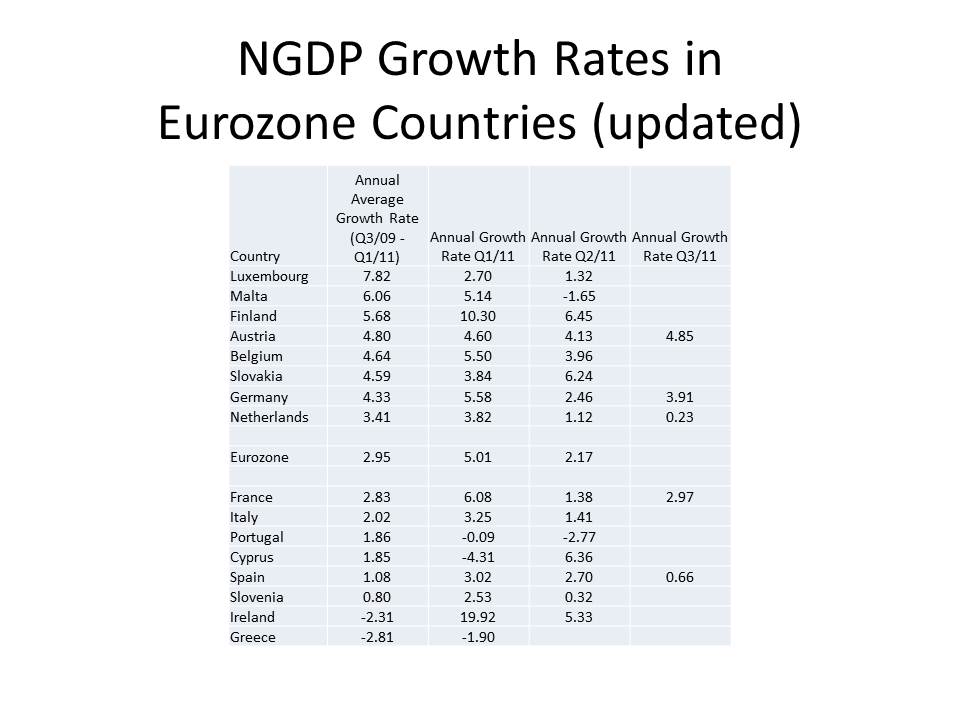
I reproduce below a new version of the table that I included in my August post. It shows that from the third quarter of 2009 to the first quarter of 2011, NGDP for the Eurozone as a whole increased at the anemic rate of 2.95%. Eight countries (Luxembourg, Malta, Austria, Finland, Belgium, Slovakia, Germany, and the Netherlands) grew faster than the Eurozone as a whole, and eight countries (France, Italy, Portugal, Cyprus, Spain, Slovenia, Greece, and Ireland) grew less rapidly than the Eurozone as a whole. Guess which of the two groups the countries with debt problems are in. I have now added NGDP growth rates for the first, second and (where available) third quarters.

Comparing NGDP growth rates in Q1 with growth rates in Q2 and Q3 is instructive inasmuch as the ECB raised its benchmark interest rates by 25 basis points at the start of Q2 (April 13). In Q1, Eurozone NGDP rose by 5.01%, but in Q2, Eurozone NGDP growth fell to just 2.17%, with Q2 NDGP growth less than Q1 growth in every Eurozone country except Slovakia and Cyprus (Greece not yet reporting NGDP for Q2). On July 13, the ECB raised its benchmark interest rates by another 25 basis points. For the five countries (Austria, France, Germany, Netherlands, and Spain) already reporting NGDP growth for Q3, four had slower NGDP growth in Q3 than in Q1, with three reporting slower NGDP growth in Q3 than the average between Q3 2009 and Q1 2011. Rebecca Wilder has an important recent post with graph showing that the spreads between bonds issued by Belgium, Italy and Spain and bonds issued by Germany began increasing almost immediately after the ECB announced the increase in its benchmark interest rates on April 13, with the spreads continuing to increase in Q3. The connection between monetary policy, NGDP growth and the debt crisis could not be any more plain.

Nevertheless, there are those (and not just the Wall Street Journal) that seem to find merit in the unyielding stance of the Mrs. Merkel and the ECB. In his column last week in the Financial Times, John Kay, usually an insightful and sensible commentator, compares bailing out the insolvent Eurozone countries with a martingale strategy in which a bettor increases his bet each time he loses, in the expectation that he will eventually win enough to pay off his losses. Such a strategy only works if one has deep enough pockets to sustain the losses while waiting for a lucky strike. The problem in John Kay’s view is that the other side (the rest of the world) has deeper and can raise the ante to an intolerable level. Here is how Kay sums up the current situation:

Now the players look to the only remaining credible supporter. Surely the European Central Bank can enable them to see the night through. The ECB really does have infinite resources: if it runs out of money, it can print more.

Up to a point. Money created by a central bank is not free – if it were, we could all be as rich as Croesus. The resources of a monetary agency come either directly from taxpayers or indirectly from everyone through general inflation. To fund the bet the ECB would have to stand ready to buy, not just every Eurozone government bond issued so far, but any that might be issued. And more. . . .

Of course, say the advocates of this course, if only the banker would promise to underwrite our losses he would not actually have to pay. If you will only lend me a bit more money, says the gambler, you will get it all back, and more. That is the seductive song of the martingale.

The difference, of course, is that gambling is a zero-sum game. When the ECB is asked to print more money, the point is not to lend money with which insolvent governments can place a bet in the hope of winning enough to repay what they owe; the point is to create an economic environment conducive to growth. The inflation that John Kay finds so scary is actually the last best hope for all those creditors holding the sovereign debt of five or more Eurozone countries, debt increasingly unlikely, thanks to Mrs. Merkel and the ECB, ever to be repaid.

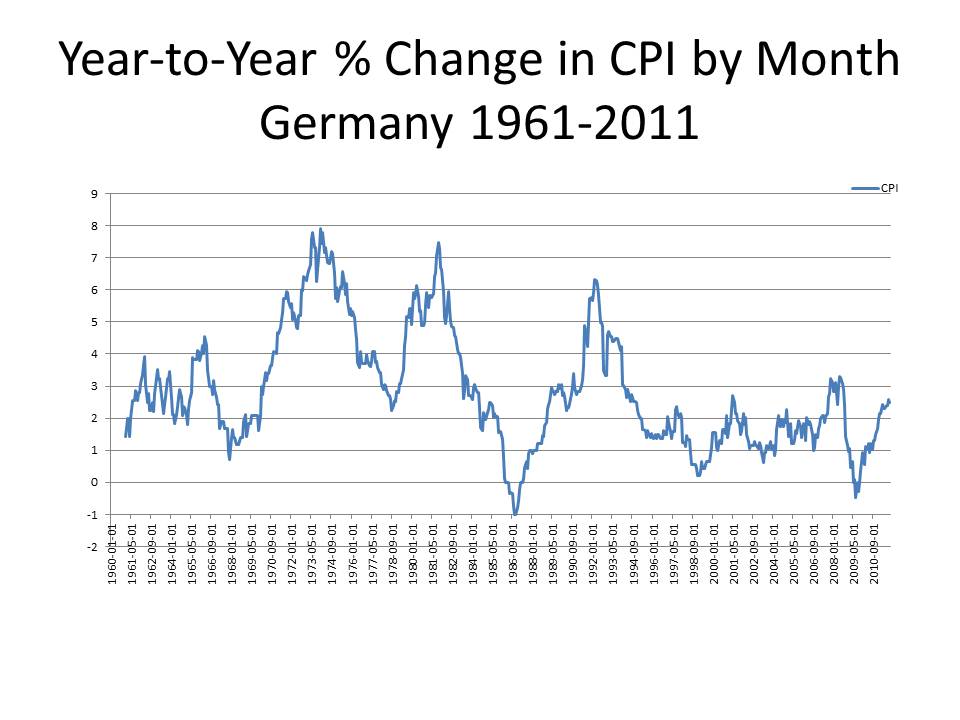
Before leaving the subject of inflation, I will make one further comment on German inflation-phobia. It is certainly true that the German hyperinflation of 1923-24 was a traumatic event in German history, undoubtedly leaving a deep imprint on the German national memory. Although a deep aversion to inflation has been a constant feature of German economic policy since World War II, it is also true that inflation in Germany for the past three years has been at or near its lowest level since the end of World War II. Nor is there much doubt that German inflation hawkishness has increased since the creation of the ECB, Germans becoming more sensitive about the danger of inflation created by a non-German institution than they were about inflation produced by the good old German Bundesbank. Conversely, the ECB has been all too eager to show that it can be even more hawkish on inflation than even a German central bank.

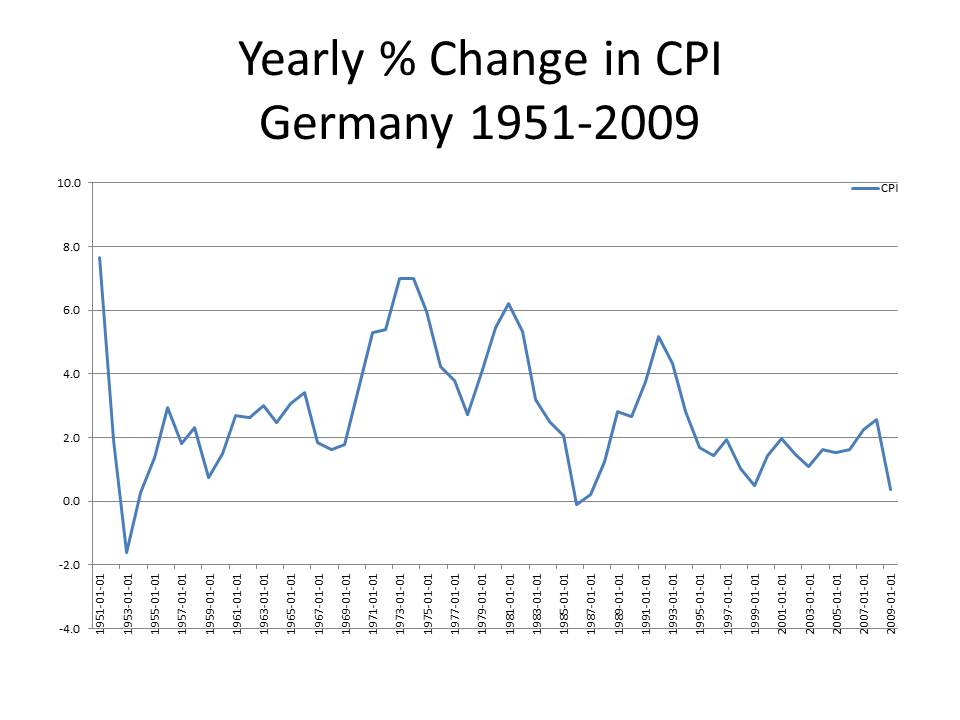
But have a look at German inflation in historical context. Here are two charts presenting German CPI. The first shows the annual change in the CPI in Germany from 1951 to 2009.

The second shows the year-on-year change in the CPI by month from January 1961 to October 2011.

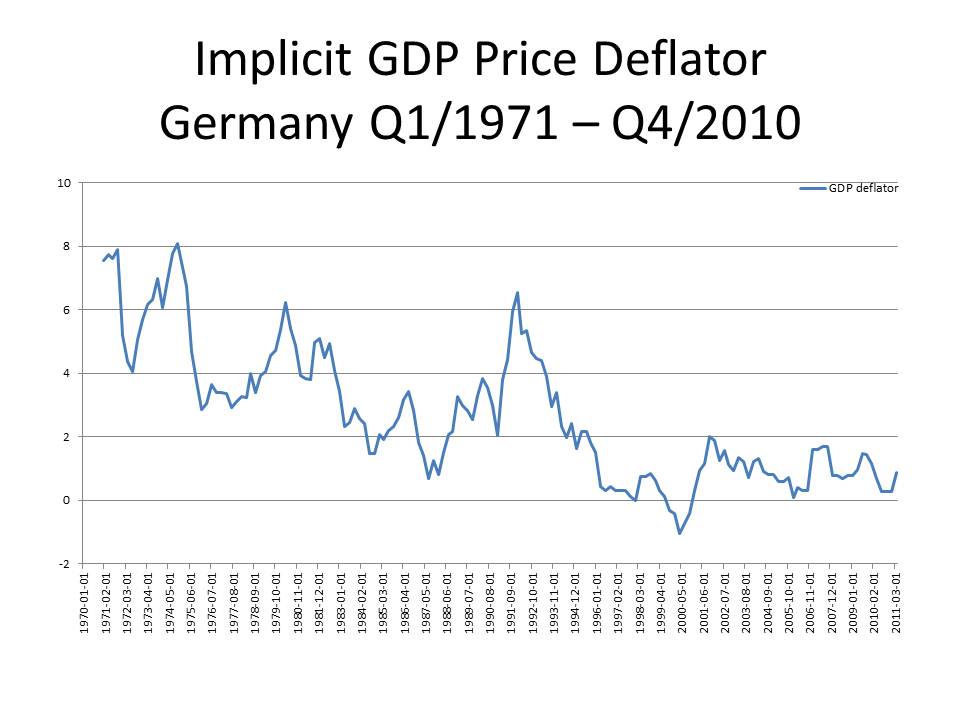
The charts are instructive in showing that even in the heyday of the German Wirtschaftswunder from 1950 to 1966 under conservative governments headed by Konrad Adenauer and then by Ludwig Erhard (friend and disciple of Hayek, member of the Mont Pelerin Society, and the acknowledged architect of the Wirtschaftswunder) the rate of inflation was often above 3%. For long stretches of time since 1950, Germany has had inflation above 3%, sometimes over 5%, nevertheless managing to avoid the political and economic disasters that, we are now told, supposedly follow inexorably whenever inflation exceeds 2%.

A similar story is told by the third chart showing the German GDP price deflator measured quarterly since 1971. The price deflator is now running at the lowest rates in 40 years.

Is the risk to the German economy from a rate of inflation closer to the mean rate of the last 40 years, say 3-4%, really so intolerable? What are they thinking?

Watching the CPI Can Get You into Deep Trouble

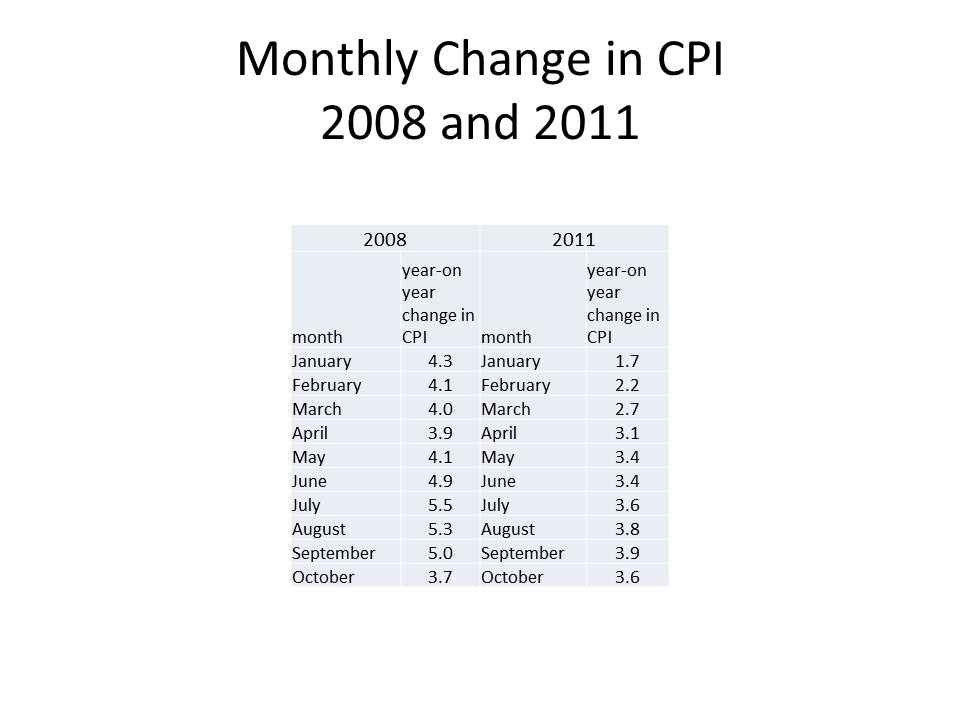
This post is just a footnote to Marcus Nunes’s demolition of Glenn Hubbard’s recent comments on Fed policy, pointing out that Hubbard, as late as July 2008 when the US economy was rapidly contracting in the run-up to the impending financial crisis, was warning that monetary policy was too easy. OMG he though monetary policy was too easy in 2008! Just to put things into a little clearer perspective, here is a comparison of the monthly year on year change in the CPI in 2008 and 2011.

As you can see, the monthly year-on-year change in the CPI, driven by rising oil and food prices, was running at over 5% in the summer of 2008, providing the inflation hawks on the FOMC with the ammunition they needed to keep the Fed from easing money in time to avert the financial catastrophe down the road. And now with inflation running 2 percentage points lower than it was in 2008 before the crash, we are again being warned that inflation is the problem. Plus ca change.

Nicholas Crafts on the Lessons of the 1930s

In Wednesday’s Financial Times, Nicholas Crafts, Professor of Economics at Warwick University, writes a superb op-ed “Fiscal stimulus is not our only option” explaining how an easy money policy worked for England in the 1930s, generating a 20% increase in real GDP between 1933 and 1937 despite fiscal retrenchment.  The op-ed summarizes a report (Delivering growth while reducing deficits:  Lessons from the 1930s) just published by the Centre Forum, a liberal think tank based in London.

Here is the opening paragraph:

The lessons of the 1930s are not well understood but are important. Britain enjoyed a strong recovery from the depression, with growth exceeding 3 per cent in each year between 1933 and 1937, despite a double-dip recession in 1932 and continuing turmoil in the international economy. Until 1936, growth owed nothing to rearmament. Indeed, as now, in the early 1930s the government was engaged in fiscal consolidation at a time of very precarious public finances, while from mid-1932 short-term interest rates were close to zero and could not be cut to deliver monetary stimulus. The parallels with today are clear, but today’s policymakers are unaware of the successful economic policy that revived growth. How did they pull this off 80 years ago – and could we do the same?

Crafts answers his question — correctly! — in the affirmative.

Some Unpleasant Fisherian Arithmetic

I have been arguing for the past four months on this blog and before that in my paper “The Fisher Effect Under Deflationary Expectations” (available here), that the Fisher equation which relates the nominal rate of interest to the real (inflation-adjusted) interest rate and to expected inflation conveys critical information about the future course of asset prices and the economy when the expected rate of deflation comes close to or exceeds the real rate of interest. When that happens, the expected return to holding cash is greater than the expected rate of return on real capital, inducing those holding real capital to try to liquidate their holdings in exchange for cash. The result is a crash in asset prices, such as we had in 2008 and early 2009, when expected inflation was either negative or very close to zero, and the expected return on real capital was negative. Ever since, expected inflation has been low, usually less than 2%, and the expected return on real capital has been in the neighborhood of zero or even negative. With the expected return on real capital so low, people (i.e., households and businesses) are reluctant to spend to acquire assets (either consumer durables or new plant and equipment), preferring to stay liquid while trying to reduce, or at least not add to, their indebtedness.

According to this way of thinking about the economy, a recovery can occur either because holding cash becomes less attractive or because holding real assets more attractive. Holding cash becomes less attractive if expected inflation rises; holding assets becomes more attractive if the expected cash flows associated with those real assets increase (either because expected demand is rising or because the productivity of capital is rising).

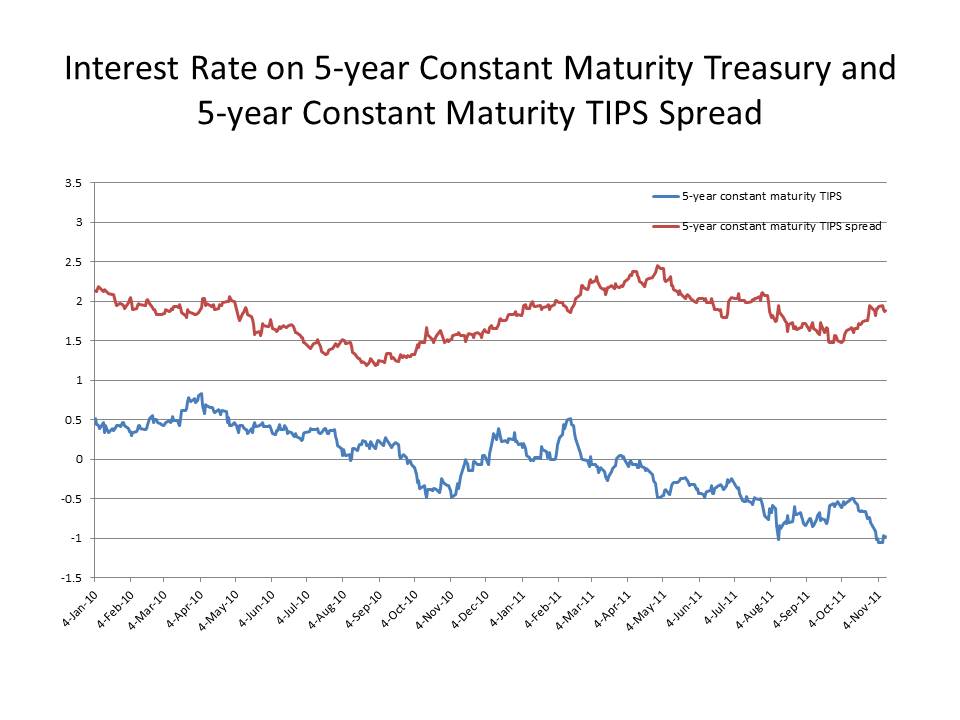
The attached chart plots expected inflation since January 2010 as measured by the breakeven 5-year TIPS spread on constant maturity Treasuries, and it plots the expected real return over a 5-year time horizon since January 2010 as reflected in the yield on constant maturity 5-year TIPS bonds.

In the late winter and early spring of 2010, real yields were rising even as inflation expectations were stable; stock prices were also rising and there were some encouraging signs of economic expansion. But in the late spring and summer of 2010, inflation expectations began to fall from 2% to less about 1.2% even as real yields started to drop.  With stock prices falling and amid fears of deflation and a renewed recession, the Fed felt compelled to adopt QE2, leading to an almost immediate increase in inflation expectations. At first, the increase in inflation expectations allowed real yields to drop, suggesting that expected yields on real assets had dropped further than implied by the narrowing TIPS spreads in the spring and summer. By late fall and winter, real yields reversed course and were rising along with inflation expectations, producing a substantial increase in stock prices. Rising optimism was reflected in a sharp increase in real yields to their highest levels in nearly a year in February of 2011. But the increase in real yields was quickly reversed by a combination of adverse supply side shocks that drove inflation expectations to their highest levels since the summer before the 2008 crash. However, after the termination of QE2, inflation expectations started sliding back towards the low levels of the summer before QE2 was adopted. The fall in inflation expectations was accompanied by an ominous fall in real yields and in stock prices.

Although suggestions that weakness in the economy might cause the Fed to resume some form of monetary easing seem to have caused some recovery in inflation expectations, real yields continue to fall. With real yield on capital well into negative territory (the real yield on a constant maturity 5-year TIPS bond is now around -1%, an astonishing circumstance. With real yields that low, 2% expected inflation would almost certainly not be enough to trigger a significant increase in spending. To generate a rebound in spending sufficient to spark a recovery, 3 to 4% inflation (the average rate of inflation in the recovery following the 1981-82 recovery in the golden age of Reagan) is probably the absolute minimum required.

Update:  Daniel Kuehn just posted an interesting comment on this post in his blog, correctly noting the conceptual similarity (if not identity) between the Fisher effect under deflationary expectations and the Keynesian liquidity trap.  I think that insight points to a solution of Keynes’s puzzling criticism of the Fisher effect in the General Theory even though he had previously endorsed Fisher’s reasoning in the Treatise on Money.

The Economic Consequences of Mrs. Merkel

Winston Churchill, in 1925 Chancellor of the Exchequer in the Conservative government headed by Stanley Baldwin, was pressed by the Governor of the Bank of England, Montagu Norman, to restore the British pound to its pre-war parity of $4.86, thereby re-establishing the gold standard in Britain, paving the way for a general restoration of the international gold standard, one of the first casualties of war in August 1914. Having accumulated an enormous stockpile of gold in exchange for supplies it provided to the belligerents, US restored convertibility into gold soon after the end of hostilities, but sterling had depreciated against the dollar by about 25 percent after the war, so Britain could not achieve its goal of restoring the convertibility into gold at the prewar parity without a tight monetary policy aimed at raising the external value of the pound from about $4 to $4.86.

In 1925, sterling had risen to within about 10% of the old parity, making restoration of the pre-war dollar parity seem attainable, thus increasing the pressure from the London and the international financial communities to take the final steps toward the magic $4.86 level. Churchill understood that such a momentous step was both politically and economically dangerous and sought advice from a wide range of opinion, pro and con, both inside and outside government. The most persuasive advice he received was undoubtedly from J. M. Keynes, who, having served as a Treasury economist during World War I and then serving on the British delegation to the Versailles Peace Conference, became world famous after resigning from the Treasury to write The Economic Consequences of the Peace, his devastating critique of the Treaty of Versailles, protesting the overly harsh and economically untenable reparations obligations imposed on Germany. Keynes advised Churchill that the supposedly minimal 10% appreciation of sterling against the dollar would impose an intolerable burden on British workers, who had suffered from exceptionally high unemployment since the 1920-21 postwar deflation.

Despite Keynes’s powerful arguments, Churchill in the end followed the advice of the Bank of England and other members of the British financial establishment. Perhaps one argument that helped persuade him to follow the orthodox advice was that of another Treasury economist, the great Ralph Hawtrey, who submitted a paper analyzing the effects of restoring the prewar dollar parity. Hawtrey argued that Britain and the world would benefit from the restoration of an international gold standard, provided that the restoration was managed in a way that avoided the deflationary tendencies associated a remonetization of gold. Hawtrey suggested that there was reason to think that the institution that mattered most, the U.S. Federal Reserve, with its huge stockpile of gold, would follow a mildly inflationary policy allowing Britain to maintain the prewar parity without additional deflationary pressure. However, Hawtrey warned that if the US did not follow an accommodative policy, it would be a mistake and futile for Britain to defend the parity by deflating.

Keynes, who never suffered from a lack of self-confidence, undoubtedly thought that he had gotten the better of his opponents in presenting the case against restoring the prewar dollar parity to Churchill. When the decision went against him, he vented his outrage at the decision, and perhaps his own personal frustration, by writing a short pamphlet, The Economic Consequences of Mr. Churchill, a withering rhetorical assault on Churchill and the decision to restore the pre-war dollar parity. However, the consequences of the decision to restore the prewar parity were, at least initially, less devastating than Keynes predicted. Contrary to Keynes’s prediction, unemployment in Britain actually declined slightly in 1926 and 1927, falling below 10% for the first time in the 1920s. Hawtrey’s conjecture that the Federal Reserve, then led by the head of the New York Federal Reserve Bank, Benjamin Strong, would follow a mildly accommodative policy, alleviating the deflationary pressure on Britain, turned out to be correct. However, ill health forced Strong to resign in 1928 only months before his untimely death. His accommodative policy was reversed just as the Bank of France started accumulating gold, unleashing deflationary forces that had been contained since the deflation of 1920-21.

Fast forward some four score years to today’s tragic re-enactment of the deflationary dynamics that nearly destroyed European civilization in the 1930s. But what a role reversal! In 1930 it was Germany that was desperately seeking to avoid defaulting on its obligations by engaging in round after round of futile austerity measures and deflationary wage cuts, causing the collapse of one major European financial institution after another in the annus horribilis of 1931, finally (at least a year after too late) forcing Britain off the gold standard in September 1931. Eighty years ago it was France, accumulating huge quantities of gold, in Midas-like self-satisfaction despite the economic wreckage it was inflicting on the rest of Europe and ultimately itself, whose monetary policy was decisive for the international value of gold and the downward course of the international economy. Now, it is Germany, the economic powerhouse of Europe dominating the European Central Bank, which effectively controls the value of the euro. And just as deflation under the gold standard made it impossible for Germany (and its state and local governments) not to default on its obligations in 1931, the policy of the European Central Bank, self-righteously dictated by Germany, has made default by Greece and now Italy and at least three other members of the Eurozone inevitable.

The only way to have saved the gold standard in 1930 would have been for France and the US to have radically changed their monetary policy to encourage an outflow of gold, driving down the international value of gold and reversing the deflation. Such a policy reversal, though advocated by Hawtrey and the great Swedish economist Gustav Cassel, was beyond the limited imagination of the world’s central bankers and monetary authorities at the time. But once started, the deflationary downward spiral did not stop until France, finally having had enough, abandoned gold in 1935. If the European central bank does not soon – and I mean really soon – grasp that there is no exit from the debt crisis without a reversal of monetary policy sufficient to enable nominal incomes in all the economies in the Eurozone to grow more rapidly than does their indebtedness, the downward spiral will overtake even the stronger European economies. (I pointed out three months ago that the European crisis is a NGDP crisis not a debt crisis.) As the weakest countries choose to ditch the euro and revert back to their own national currencies, the euro is likely to start to appreciate as it comes to resemble ever more closely the old deutschmark. At some point the deflationary pressures of a rising euro will cause even the Germans, like the French in 1935, to relent. But one shudders at the economic damage that will be inflicted until the Germans come to their senses. Only then will we be able to assess the full economic consequences of Mrs. Merkel.

Understanding the Balanced-Budget Multiplier Theorem

Scott Sumner recently linked to David Henderson who cited the following comment by Professor T. Norman Van Cott of Ball State University to an op-ed by Alan Meltzer trashing Keynesian economics.

Particularly egregious is something labeled “the balanced budget multiplier.” To wit, an equal increase in government expenditures and taxes leads to an increase in national output equal to the additional government expenditures and taxes. Mr. Samuelson, et al., gives the notion a scientific aura by packaging it in equations and graphs.
Economic surrealism? You bet. Note that national output and taxes rising by the same amount means producers’ after-tax incomes are unchanged. How or why would producers produce more for no increase in after-tax income? Hint: They won’t. Never mind the smoke screen of graphs and equations.

I posted the following comment on Henderson’s blog, but my comment came three days after the previous comment so no one seemed to notice.  So I thought I would post it here to see what people think.

David, Just saw a link to your question on Scott Sumner’s blog. I think that the simple answer is that the balanced-budget multiplier presumes that there is involuntary unemployment. The additional output is produced by the employment of those previously unemployed; those previously employed experience a reduction in their real wage. I am not necessarily endorsing the analysis, but I think that is logic behind it.

A further elaboration is that under Keynes’s definition of involuntary unemployment, the way in which you re-employ the involuntarily unemployed is by raising the price of output while holding the wage constant.  So, under Keynes’s (economic) logic you need inflation to get the involuntarily unemployed reemployed.  That logic somehow gets lost in “the smoke screen of graphs and equations.”

Scott Sumner Bans Inflation

Scott Sumner, the world’s greatest economics blogger, has had it with inflation. He hates inflation so much he wants to stop people from even talking about it or even mentioning it. He has banned use of the i-word on his blog, and if Scott has his way, the i-word will be banned from polite discourse from here to eternity.

Why is Scott so upset about inflation? It has nothing to do with the economic effects of inflation. It is all about people’s inability to think clearly about it.

Some days I want to just shoot myself, like when I read the one millionth comment that easy money will hurt consumers by raising prices.  Yes, there are some types of inflation that hurt consumers.  And yes, there are some types of inflation created by Fed policy.  But in a Venn diagram those two types of inflation have no overlap.

So Scott thinks that if only we could get people to stop talking about inflation, they would start thinking more clearly. Well, maybe yes, maybe no.

At any rate, if we are no longer allowed to speak about inflation, that is going to make my life a lot more complicated, because I have been trying to explain to people almost since I started this blog started four months ago why the stock market loves inflation and have repeated myself again and again and again and again. In a comment on my last iteration of that refrain, Marcus Nunes anticipated Scott with this comment.

That´s why I think mentioning the I word is bad. Even among “like thinkers” it gives many the “goosebumps”. What the stock market loves is to envision (even if temporarily) the possibility that NGDP will climb towards trend.

And when Scott announced the ban on the i-word on his blog, Marcus posted this comment on Scott’s blog:

Scott: David Glasner won´t be allowed to place comments here. Early this month I did a post on the I word.
http://thefaintofheart.wordpress.com/2011/10/07/two-words-you-should-never-use-inflation-stimulus/

In DG´s latest post Yes, Virginia, the stock market loves inflation I commented:

That´s why I think mentioning the I word is bad. Even among “like thinkers” it gives many the “goosebumps”. What the stock market loves is to envision (even if temporarily) the possibility that NGDP will climb towards trend.

He answered:

Marcus, I think inflation is important because it focuses on the choice between holding assets and holding money.!

Scott replied

We’ll see how David reacts to this post.

Well after that invitation, of course I had to respond. And I did as follows:

Scott, Even before I started blogging, I couldn’t keep up with you and now that I am blogging I have been falling farther and farther behind. So I just saw your kind invitation to weigh in on your “modest proposal.” I actually am not opposed to your proposal, and I greatly sympathize with and share your frustration with the confusion that attributes a fall in real income to an increase in prices as if it were the increase in prices that caused the fall in income rather than the other way around. On the other hand, on my blog I will continue to talk about inflation and every so often, despite annoying you and Marcus, I will continue to point out that since 2008 the stock market has been in love with inflation, even though it normally is indifferent or hostile to inflation.

I also don’t think that you have properly characterized the Fisher equation in terms of the real interest rate and expected NGDP growth. As a rough approximation the real interest rate (r) equals the rate of growth in real GDP; and the nominal interest rate (i) equals the rate of growth in nominal GDP. So stating the Fisher equation in terms of GDP should give you i = r + p (where p is the rate of inflation or the ratio of nominal to real GDP).

Finally, I am wondering whether you also want to ban use of the world “deflation” from polite discourse. I think it would be a shame if you did, because you and I both think that it was an increase in the value of gold (AKA deflation) that caused the decline in NGDP in the Great Depression, not a decline in NGDP that caused the increase in the value of gold.

So what is the upshot of all this? I guess I am just too conservative to give up using a word that I have grown up using since I started studying economics. It would also help if I could make sense of the Fisher equation — think of it as Newton’s law of monetary motion — without the rate of inflation. So I am waiting for Scott to explain that one to me. And I think that we need to have some notion of the purchasing power of money in order to explain the preferences of individuals for holding money versus other assets. If so, the concepts of a price level and a rate of inflation seem to be necessary as well.

Having said all that, I would add that Scott is a very persistent and persuasive guy, so I am definitely keeping all my options open.

Update:  Thanks to the ever-vigilant Scott Sumner for flagging my mistaken version of the Fisher equation.  It’s i = r + p, not r = i + p, as I originally had it.  I just corrected the equation in the body of the post as well and reduced the font to its normal size.

Do What Is Right Though the World Should Perish

An ancient debate among economists is whether the monetary authority should be subject to and constrained by an explicit operating rule or should be allowed discretion to act as it sees fit.  The debate goes back to the Bullion Debates in Britain after the British government, in the early stages of the Napoleonic Wars, suspended the obligation of the Bank of England to convert their banknotes into gold at the legally prescribed value of the pound.  One side in the debate, the Bullionists, argued that the Bank of England, enjoying special legal privileges that made it the center of the British monetary system, should be bound by a fixed rule, the absolute duty to convert Bank of England notes, on demand, into a fixed quantity of gold.  The other side, the Anti-Bullionists, maintained that there was no need for the Bank of England to be bound by the obligation to convert.

Over 20 years of intermittent exchanges between opponents and supporters of the suspension, producing some of the most important contributions to monetary thought of the nineteenth century, the Bullion Debates led to a general (though not unanimous) acceptance of the need for convertibility into gold as a stabilizing anchor for a money and banking system in which private banks produce a large share of all the money in circulation.  Despite the resumption of convertibility in 1821, Great Britain experienced damaging financial disturbances in 1825 and 1836, leading to the passage of Bank Charter Act in 1844, imposing a fixed limit on the total amount of banknotes issued by the Bank of England and by other private banks, requiring 100% gold cover for any banknotes issued beyond that fixed limit.

Hopes that, by mimicking the fluctuation of a purely gold currency in response to gold inflows and outflows, the reformed monetary system would avoid future crises were soon disappointed, Britain suffering financial crises in 1847, 1857, and 1866.  Each time the government was forced to grant immunity to the directors of the Bank of England for violating the Bank Charter Act and issuing banknotes in excess of the legal maximum in order to calm commercial panics triggered by fears that the Bank of England would be prevented by the Bank Charter Act from satisfying the demand for credit.  Once temporary suspension of the Act was announced, the panic subsided, the knowledge that credit could be obtained if needed sufficing to moderate the precautionary demand for credit.

By the last two decades of the nineteenth century, the Bank of England, the key institution managing what had become an international gold standard, seemed to have figured out how to do its job reasonably well, and the period of 1880 to 1913 is still looked upon as a golden age of economic stability, growth and prosperity.  But the gold standard couldn’t withstand the pressures of World War I, effectively being suspended in substance in almost all countries.  The attempt to recreate the gold standard in the 1920s led to the Great Depression, because the way the gold standard worked before World War I was not well enough understood for the system to be recreated, more or less from scratch, under the new postwar conditions.  Attempting to follow a misguided conception of how a gold standard ought to work, countries, especially France, redesigned their monetary institutions in ways that inordinately increased the total world demand for gold, producing a world-wide deflation that began in the summer of 1929.

The two economists who really understood the nature of the pathology overtaking the international economy in 1929 were Ralph Hawtrey and Gustav Cassel, having warned of just the potential for a deflationary increase in the demand for gold as a consequence of a simultaneous restoration of the gold standard by many countries, but their warnings went largely unheeded.  Instead, the focus of most economists, central bankers, governments, and practitioners of la haute finance, was to preserve the gold standard at all costs, because to tamper with the gold standard was to allow the unbridled exercise of discretion, to make monetary policy unpredictable, to sanction runaway inflation and monetary anarchy.  But runaway inflation was not the danger — in Hawtrey’s immortal analogy to warn of inflation was like crying “fire, fire” in Noah’s flood – it was runaway deflation.  But rules are rules, and one must always follow the rules.  That the rules had been broken, or at least suspended, in the nineteenth century didn’t seem to matter, because as the old maxim teaches, we must do what is right though the world should perish.

The Great Depression came to an end mainly because the rules were not only broken, they were tossed out the window.  The gold standard was junked.  First, Britain gave up in September 1931, and a recovery started within a few months.  The US held out till March 1933, but when Franklin Roosevelt became President, understanding that prices had to rise before a recovery could start, he suspended the gold standard, devalued the dollar, thereby igniting the fastest expansion of industrial output in any 4-month period (57%) in American history while the Dow Jones average nearly doubled.

In our own Little Depression, we have become attached – I would say dysfunctionally attached – to an inflation target of 2% or less.  The inflation target is to the Little Depression what the gold standard was to the Great Depression.  The consequences this time are less horrific than they were last time, but they are plenty bad.  And the justification is equally spurious.  I would not go so far as to say that rules are made to be broken.  Some rules should not be broken under almost any circumstances, and almost any rule may have to be broken under some very extreme circumstances.  But not every rule — certainly not a rule that says that inflation may never exceed 2% — is entitled to such deference.

The European union and the common European currency are now on the verge of disaster because the European Central Bank, dominated by a German aversion to inflation, refused to provide enough monetary expansion to allow the weaker members of the Eurozone to generate enough nominal income to service the interest obligations on their debt.  In the Great Depression, it was Germany that was overindebted and unable to service its obligations.  Attempting to play under the dysfunctional rules of the gold standard, Germany imposed draconian austerity measures in the form of tax increases and public expenditure reductions and wage cuts.  But all such measures were doomed from the start.  All that was accomplished was to pave Hitler’s path to power.  And now, in a historic role reversal, it is Germany that is paving the way for consequences which we may not yet even be able to imagine.  But evidently as long as the European Central Bank can achieve its inflation target, it will be worth it, because, as the old maxim teaches, one must do what is right even if the world should perish.

A Reply to John Taylor

John Taylor responded to my post criticizing his op-ed piece in yesterday’s Wall Street Journal.  Here are some comments on Professor Taylor’s response.

Professor Taylor responds to my charge of exaggerating the difference between U.S. policies “in the years after World War II . . . promoting economic growth through reliance on the market and the incentives it provides” and current supposedly interventionist fiscal and monetary policies and increasingly burdensome regulation by admitting that post-war “American economic policy was not perfect.”  Nevertheless, in the aftermath of World War II, when America helped Japan and Europe recover, “the American model was a far cry from what was being set up in large areas of the world which were not free either economically or politically.” 

Well, yes, but it is somewhat chauvinistic on Professor Taylor’s part to assume that the only intellectual and policy resources on which Europe and Japan could draw were to be found in America.  Economic and political liberalism were imported and adopted, perhaps even improved, by America from Europe, not vice versa.  It is an old story, but perhaps worth repeating for Professor Taylor’s benefit, that in 1948, with the German economy in a state of semi-collapse owing to runaway inflation, price controls, and rationing imposed by the occupying powers, Ludwig Erhard, the German economics minister in the British and American occupation zones, unilaterally lifted price controls and ended rationing while imposing a tight monetary policy, despite the objections of the Allied authorities.   Thus began what would become known as the “German economic miracle” of which Erhard was the acknowledged architect.

Professor Taylor was also a bit shaky in describing what happened in the 1980s and 1990s, calling American economic ideas “contagious, not just in Britain under Margaret Thatcher but in the developing world.”  But Mrs. Thatcher came to power in May 1979, over a year and a half before Ronald Reagan.  So, once again, the flow of ideas went from east to west.

Turning to my charge of inconsistency in opposing quantitative easing by the Fed in 2009 and 2010, when he had supported a similar policy for Japan in 2002, Professor Taylor maintains that since there was actual deflation in Japan (measured by both the CPI and the GDP price deflator) while inflation in the U.S., with only brief exceptions, remained positive after the 2008 financial crisis.  But Professor Taylor himself acknowledged in one of the papers cited in his response to my post that even positive inflation is potentially dangerous when it approaches zero (especially at the zero-interest lower bound) . 

In addition, “increasing the monetary base in Japan” was supposed to “get the growth rate of the money supply . . . back up . . . not to drive up temporarily the price of mortgage securities or stock prices, which is frequently used to justify quantitative easing by the Fed today.”  Ahem, the purpose of getting the growth of the money supply back up in Japan was to stop deflation, thereby increasing output and employment.  Increasing the money supply is just a means to accomplish that objective.  The purpose of quantitative easing in the US is to increase the rate of nominal GDP (NGDP) growth, and thereby increase output and employment.  That some people believe doing so would also have the beneficial side-effect of raising the prices of mortgage securities or stocks is just a red herring.

Professor Taylor also refers to the debate over rules versus discretion in the conduct of monetary policy. 

If a central bank follows a money growth rule of the type Milton Friedman argued for – and which is quite appropriate when the interest rate hit zero in Japan – then the central bank should increase the monetary base to prevent money growth from falling or to increase money growth if it has already fallen.  In other words such an easing policy can be justified as being consistent with a policy rule, in this case for the growth of the money supply.  The rule calls for keeping money growth from declining.  But the large-scale asset purchases by the Fed today are highly discretionary, largely unpredictable, short-term interventions, which are not rule-like at all.  It is the deviation from more predictable rule-like policy by the Fed (which began in 2003-2005 and continues today) that most concerns me.

A Friedman-type rule for growth of the money supply has long since been abandoned even by Friedman, the so-called Taylor rule being an attempt to provide an alternative with which to replace the Friedman rule.  But the Fed, since its unsuccessful attempt to adhere to a Friedman-type rule in 1981-82, has never articulated a specific rule, so it is not clear what rule Professor Taylor believes the Fed has been deviating from since 2003-05.  One could as easily infer from the data that the Fed was following a rule targeting a 5-6% growth path for NGDP as any other rule.  If so, one could argue that quantitative easing designed to restore NGDP growth to its 5-6% long-run trend is as good a rule as any.  Indeed, with inflation expectations (as measured by the TIPS spread) now running well under 2%, and with a substantial output gap, most versions of the Taylor rule would imply that monetary policy should be eased.  If the target interest rate is already at the lower bound, then the alternative is to increase the monetary base.  That’s called quantitative easing. 

Finally, Professor Taylor refers to my “long rebuttal” to his criticism of “recent interventionist fiscal and monetary policies in the United States.”  Inasmuch as nearly half of my post consisted of direct quotations from Professor Taylor, I am afraid that he has an equal share in the blame for the length of my rebuttal.

HT:  Scott Sumner, Lars Christensen, Nick Rowe


About Me

David Glasner
Washington, DC

I am an economist in the Washington DC area. My research and writing has been mostly on monetary economics and policy and the history of economics. In my book Free Banking and Monetary Reform, I argued for a non-Monetarist non-Keynesian approach to monetary policy, based on a theory of a competitive supply of money. Over the years, I have become increasingly impressed by the similarities between my approach and that of R. G. Hawtrey and hope to bring Hawtrey’s unduly neglected contributions to the attention of a wider audience.

My new book Studies in the History of Monetary Theory: Controversies and Clarifications has been published by Palgrave Macmillan

Follow me on Twitter @david_glasner

Archives

Enter your email address to follow this blog and receive notifications of new posts by email.

Join 665 other subscribers
Follow Uneasy Money on WordPress.com