Archive for the 'Keynes' Category


How to Think about Own Rates of Interest, Version 2.0

In my previous post, I tried to explain how to think about own rates of interest. Unfortunately, I made a careless error in calculating the own rate of interest in the simple example I constructed to capture the essence of Sraffa’s own-rate argument against Hayek’s notion of the natural rate of interest. But sometimes these little slip-ups can be educational, so I am going to try to turn my conceptual misstep to advantage in working through and amplifying the example I presented last time.

But before I reproduce the passage from Sraffa’s review that will serve as our basic text in this post as it did in the previous post, I want to clarify another point. The own rate of interest for a commodity may be calculated in terms of any standard of value. If I borrow wheat and promise to repay in wheat, the wheat own rate of interest may be calculated in terms of wheat or in terms of any other standard; all of those rates are own rates, but each is expressed in terms of a different standard.

Lend me 100 bushels of wheat today, and I will pay you back 102 bushels next year. The own rate of interest for wheat in terms of wheat would be 2%. Alternatively, I could borrow $100 of wheat today and promise to pay back $102 of wheat next year. The own rate of interest for wheat in terms of wheat and the own rate of interest for wheat in terms of dollars would be equal if and only if the forward dollar price of wheat is the same as the current dollar price of wheat. The commodity or asset in terms of which a price is quoted or in terms of which we measure the own rate is known as the numeraire. (If all that Sraffa was trying to say in criticizing Hayek was that there are many equivalent ways of expressing own interest rates, he was making a trivial point. Perhaps Hayek didn’t understand that trivial point, in which case the rough treatment he got from Sraffa was not undeserved. But it seems clear that Sraffa was trying — unsuccessfully — to make a more substantive point than that.)

In principle, there is a separate own rate of interest for every commodity and for every numeraire. If there are n commodities, there are n potential numeraires, and n own rates can be expressed in terms of each numeraire. So there are n-squared own rates. Each own rate can be thought of as equilibrating the demand for loans made in terms of a given commodity and a given numeraire. But arbitrage constraints tightly link all these separate own rates together. If it were cheaper to borrow in terms of one commodity than another, or in terms of one numeraire than another, borrowers would switch to the commodity and numeraire with the lowest cost of borrowing, and if it were more profitable to lend in terms of one commodity, or in terms of one numeraire, than another, lenders would switch to lending in terms of the commodity or numeraire with the highest return.

Thus, competition tends to equalize own rates across all commodities and across all numeraires. Of course, perfect arbitrage requires the existence of forward markets in which to contract today for the purchase or sale of a commodity at a future date. When forward markets don’t exist, some traders may anticipate advantages to borrowing or lending in terms of particular commodities based on their expectations of future prices for those commodities. The arbitrage constraint on the variation of interest rates was discovered and explained by Irving Fisher in his great work Appreciation and Interest.

It is clear that if the unit of length were changed and its change were foreknown, contracts would be modified accordingly. Suppose a yard were defined (as once it probably was) to be the length of the king’s girdle, and suppose the king to be a child. Everybody would then know that the “yard” would increase with age and a merchant who should agree to deliver 1000 “yards” ten years hence, would make his terms correspond to his expectations. To alter the mode of measurement does not alter the actual quantities involved but merely the numbers by which they are represented. (p. 1)

We thus see that the farmer who contracts a mortgage in gold is, if the interest is properly adjusted, no worse and no better off than if his contract were in a “wheat” standard or a “multiple” standard. (p. 16)

I pause to make a subtle, but, I think, an important, point. Although the relationship between the spot and the forward price of any commodity tightly constrains the own rate for that commodity, the spot/forward relationship does not determine the own rate of interest for that commodity. There is always some “real” rate reflecting a rate of intertemporal exchange that is consistent with intertemporal equilibrium. Given such an intertemporal rate of exchange — a real rate of interest — the spot/forward relationship for a commodity in terms of a numeraire pins down the own rate for that commodity in terms of that numeraire.

OK with that introduction out of the way, let’s go back to my previous post in which I wrote the following:

Sraffa correctly noted that arbitrage would force the terms of such a loan (i.e., the own rate of interest) to equal the ratio of the current forward price of the commodity to its current spot price, buying spot and selling forward being essentially equivalent to borrowing and repaying.

That statement now seems quite wrong to me. Sraffa did not assert that arbitrage would force the own rate of interest to equal the ratio of the spot and forward prices. He merely noted that in a stationary equilibrium with equality between all spot and forward prices, all own interest rates would be equal. I criticized him for failing to note that in a stationary equilibrium all own rates would be zero. The conclusion that all own rates would be zero in a stationary equilibrium might in fact be valid, but if it is, it is not as obviously valid as I suggested, and my criticism of Sraffa and Ludwig von Mises for not drawing what seemed to me an obvious inference was not justified. To conclude that own rates are zero in a stationary equilibrium, you would, at a minimum, have to show that there is at least one commodity which could be carried from one period to the next at a non-negative profit. Sraffa may have come close to suggesting such an assumption in the passage in which he explains how borrowing to buy cotton spot and immediately selling cotton forward can be viewed as the equivalent of contracting a loan in terms of cotton, but he did not make that assumption explicitly. In any event, I mistakenly interpreted him to be saying that the ratio of the spot and forward prices is the same as the own interest rate, which is neither true nor what Sraffa meant.

And now let’s finally go back to the key quotation of Sraffa’s that I tried unsuccessfully to parse in my previous post.

Suppose there is a change in the distribution of demand between various commodities; immediately some will rise in price, and others will fall; the market will expect that, after a certain time, the supply of the former will increase, and the supply of the latter fall, and accordingly the forward price, for the date on which equilibrium is expected to be restored, will be below the spot price in the case of the former and above it in the case of the latter; in other words, the rate of interest on the former will be higher than on the latter. (“Dr. Hayek on Money and Capital,” p. 50)

In my previous post I tried to flesh out Sraffa’s example by supposing that, in the stationary equilibrium before the demand shift, tomatoes and cucumbers were both selling for a dollar each. In a stationary equilibrium, tomato and cucumber prices would remain, indefinitely into the future, at a dollar each. A shift in demand from tomatoes to cucumbers upsets the equilibrium, causing the price of tomatoes to fall to, say, $.90 and the price of cucumbers to rise to, say, $1.10. But Sraffa also argued that the prices of tomatoes and cucumbers would diverge only temporarily from their equilibrium values, implicitly assuming that the long-run supply curves of both tomatoes and cucumbers are horizontal at a price of $1 per unit.

I misunderstood Sraffa to be saying that the ratio of the future price and the spot price of tomatoes equals one plus the own rate on tomatoes. I therefore incorrectly calculated the own rate on tomatoes as 1/.9 minus one or 11.1%. There were two mistakes. First, I incorrectly inferred that equality of all spot and forward prices implies that the real rate must be zero, and second, as Nick Edmunds pointed out in his comment, a forward price exceeding the spot price would actually be reflected in an own rate less than the zero real rate that I had been posited. To calculate the own rate on tomatoes, I ought to have taken the ratio of spot price to the forward price — (.9/1) — and subtracted one plus the real rate. If the real rate is zero, then the implied own rate is .9 minus 1, or -10%.

To see where this comes from, we can take the simple algebra from Fisher (pp. 8-9). Let i be the interest rate calculated in terms of one commodity and one numeraire, and j be the rate of interest calculated in terms of a different commodity in that numeraire. Further, let a be the rate at which the second commodity appreciates relative to the first commodity. We have the following relationship derived from the arbitrage condition.

(1 + i) = (1 + j)(1 + a)

Now in our case, we are trying to calculate the own rate on tomatoes given that tomatoes are expected (an expectation reflected in the forward price of tomatoes) to appreciate by 10% from $.90 to $1.00 over the term of the loan. To keep the analysis simple, assume that i is zero. Although I concede that a positive real rate may be consistent with the stationary equilibrium that I, following Sraffa, have assumed, a zero real rate is certainly not an implausible assumption, and no important conclusions of this discussion hinge on assuming that i is zero.

To apply Fisher’s framework to Sraffa’s example, we need only substitute the ratio of the forward price of tomatoes to the spot price — [p(fwd)/p(spot)] — for the appreciation factor (1 + a).

So, in place of the previous equation, I can now substitute the following equivalent equation:

(1 + i) = (1 + j) [p(fwd)/p(spot)].

Rearranging, we get:

[p(spot)/p(fwd)] (1 + i) = (1 + j).

If i = 0, the following equation results:

[p(spot)/p(fwd)] = (1 + j).

In other words:

j = [p(spot)/p(fwd)] – 1.

If the ratio of the spot to the forward price is .9, then the own rate on tomatoes, j, equals -10%.

My assertion in the previous post that the own rate on cucumbers would be negative by the amount of expected depreciation (from $1.10 to $1) in the next period was also backwards. The own rate on cucumbers would have to exceed the zero equilibrium real rate by as much as cucumbers would depreciate at the time of repayment. So, for cucumbers, j would equal 11%.

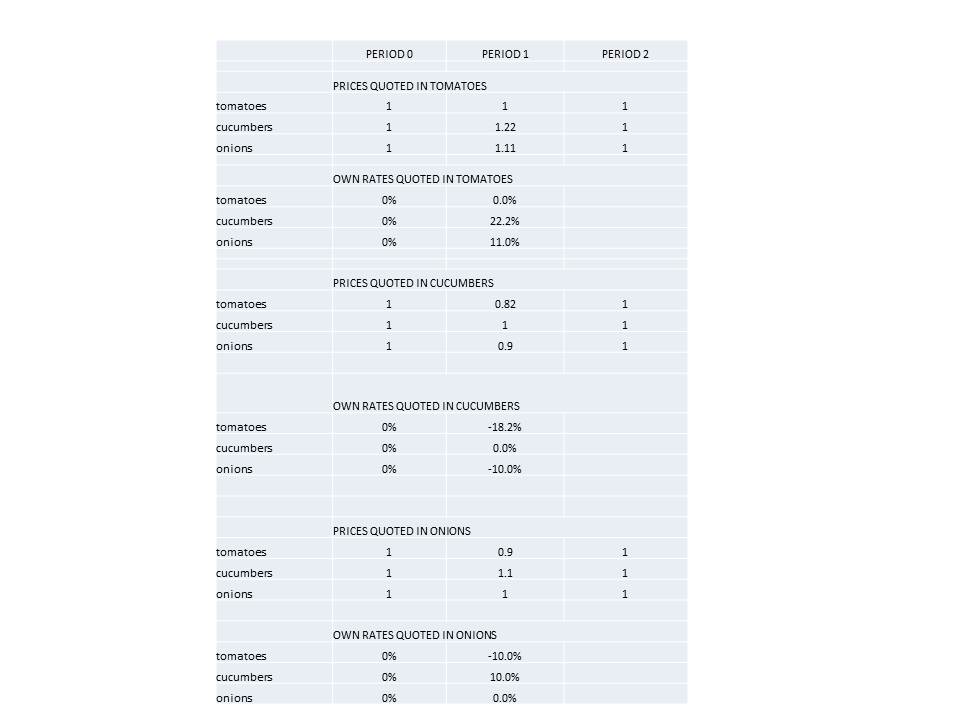
Just to elaborate further, let’s assume that there is a third commodity, onions, and that, in the initial equilibrium, the unit prices of onions, tomatoes and cucumbers are equal. If the demand shift from tomatoes to cucumbers does not affect the demand for onions, then, even after the shift in demand, the price of onions will remain one dollar per onion.

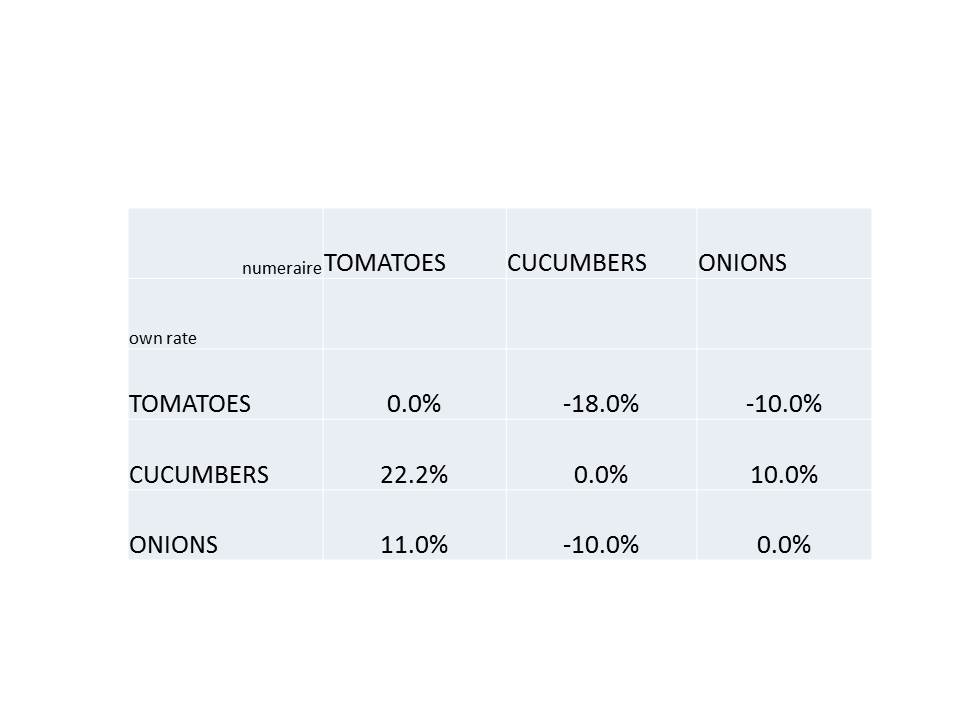
The table below shows prices and own rates for tomatoes, cucumbers and onions for each possible choice of numeraire. If prices are quoted in tomatoes, the price of tomatoes is fixed at 1. Given a zero real rate, the own rate on tomatoes in period is zero. What about the own rate on cucumbers? In period 0, with no change in prices expected, the own rate on cucumbers is also zero. However in period 1, after the price of cucumbers has risen to 1.22 tomatoes, the own rate on cucumbers must reflect the expected reduction in the price of a cucumber in terms of tomatoes from 1.22 tomatoes in period 1 to 1 tomato in period 2, a price reduction of 22% percent in terms of tomatoes, implying a cucumber own rate of 22% in terms of tomatoes. Similarly, the onion own rate in terms of tomatoes would be 11% percent reflecting a forward price for onions in terms of tomatoes 11% below the spot price for onions in terms of tomatoes. If prices were quoted in terms of cucumbers, the cucumber own rate would be zero, and because the prices of tomatoes and onions would be expected to rise in terms of cucumbers, the tomato and onion own rates would be negative (-18.2% for tomatoes and -10% for onions). And if prices were quoted in terms of onions, the onion own rate would be zero, while the tomato own rate, given the expected appreciation of tomatoes in terms of onions, would be negative (-10%), and the cucumber own rate, given the expected depreciation of cucumbers in terms of onions, would be positive (10%).
own_rates_in_terms_of_tomatoes_cucumbers_onions

The next table, summarizing the first one, is a 3 by 3 matrix showing each of the nine possible combinations of numeraires and corresponding own rates.
own_rates_in_terms_of_tomatoes_cucumbers_onions_2

Thus, although the own rates of the different commodities differ, and although the commodity own rates differ depending on the choice of numeraire, the cost of borrowing (and the return to lending) is equal regardless of which commodity and which numeraire is chosen. As I stated in my previous post, Sraffa believed that, by showing that own rates can diverge, he showed that Hayek’s concept of a natural rate of interest was a nonsense notion. However, the differences in own rates, as Fisher had already showed 36 years earlier, are purely nominal. The underlying real rate, under Sraffa’s own analysis, is independent of the own rates.

Moreover, as I pointed out in my previous post, though the point was made in the context of a confused exposition of own rates,  whenever the own rate for a commodity is negative, there is an incentive to hold it now for sale in the next period at a higher price it would fetch in the current period. It is therefore only possible to observe negative own rates on commodities that are costly to store. Only if the cost of holding a commodity is greater than its expected appreciation would it not be profitable to withhold the commodity from sale this period and to sell instead in the following period. The rate of appreciation of a commodity cannot exceed the cost of storing it (as a percentage of its price).

What do I conclude from all this? That neither Sraffa nor Hayek adequately understood Fisher. Sraffa seems to have argued that there would be multiple real own rates of interest in disequilibrium — or at least his discussion of own rates seem to suggest that that is what he thought — while Hayek failed to see that there could be multiple nominal own rates. Fisher provided a definitive exposition of the distinction between real and nominal rates that encompasses both own rates and money rates of interest.

A. C. Pigou, the great and devoted student of Alfred Marshall, and ultimately his successor at Cambridge, is supposed to have said “It’s all in Marshall.” Well, one could also say “it’s all in Fisher.” Keynes, despite going out of his way in Chapter 12 of the General Theory to criticize Fisher’s distinction between the real and nominal rates of interest, actually vindicated Fisher’s distinction in his exposition of own rates in Chapter 17 of the GT, providing a valuable extension of Fisher’s analysis, but apparently failing to see the connection between his discussion and Fisher’s, and instead crediting Sraffa for introducing the own-rate analysis, even as he undermined Sraffa’s ambiguous suggestion that real own rates could differ. Go figure.

How to Think about Own Rates of Interest

Phil Pilkington has responded to my post about the latest version of my paper (co-authored by Paul Zimmerman) on the Sraffa-Hayek debate about the natural rate of interest. For those of you who haven’t been following my posts on the subject, here’s a quick review. Almost three years ago I wrote a post refuting Sraffa’s argument that Hayek’s concept of the natural rate of interest is incoherent, there being a multiplicity of own rates of interest in a barter economy (Hayek’s benchmark for the rate of interest undisturbed by monetary influences), which makes it impossible to identify any particular own rate as the natural rate of interest.

Sraffa maintained that if there are many own rates of interest in a barter economy, none of them having a claim to priority over the others, then Hayek had no basis for singling out any particular one of them as the natural rate and holding it up as the benchmark rate to guide monetary policy. I pointed out that Ludwig Lachmann had answered Sraffa’s attack (about 20 years too late) by explaining that even though there could be many own rates for individual commodities, all own rates are related by the condition that the cost of borrowing in terms of all commodities would be equalized, differences in own rates reflecting merely differences in expected appreciation or depreciation of the different commodities. Different own rates are simply different nominal rates; there is a unique real own rate, a point demonstrated by Irving Fisher in 1896 in Appreciation and Interest.

Let me pause here for a moment to explain what is meant by an own rate of interest. It is simply the name for the rate of interest corresponding to a loan contracted in terms of a particular commodity, the borrower receiving the commodity now and repaying the lender with the same commodity when the term of the loan expires. Sraffa correctly noted that in equilibrium arbitrage would force the terms of such a loan (i.e., the own rate of interest) to equal the ratio of the current forward price of the commodity to its current spot price, buying spot and selling forward being essentially equivalent to borrowing and repaying.

Now what is tricky about Sraffa’s argument against Hayek is that he actually acknowledges at the beginning of his argument that in a stationary equilibrium, presumably meaning that prices remain at their current equilibrium levels over time, all own rates would be equal. In fact if prices remain (and are expected to remain) constant period after period, the ratio of forward to spot prices would equal unity for all commodities implying that the natural rate of interest would be zero. Sraffa did not make that point explicitly, but it seems to be a necessary implication of his analysis. (This implication seems to bear on an old controversy in the theory of capital and interest, which is whether the rate of interest would be positive in a stationary equilibrium with constant real income). Schumpeter argued that the equilibrium rate of interest would be zero, and von Mises argued that it would be positive, because time preference implying that the rate of interest is necessarily always positive is a kind of a priori praxeological law of nature, the sort of apodictic gibberish to which von Mises was regrettably predisposed. The own-rate analysis supports Schumpeter against Mises.

So to make the case against Hayek, Sraffa had to posit a change, a shift in demand from one product to another, that disrupts the pre-existing equilibrium. Here is the key passage from Sraffa:

Suppose there is a change in the distribution of demand between various commodities; immediately some will rise in price, and others will fall; the market will expect that, after a certain time, the supply of the former will increase, and the supply of the latter fall, and accordingly the forward price, for the date on which equilibrium is expected to be restored, will be below the spot price in the case of the former and above it in the case of the latter; in other words, the rate of interest on the former will be higher than on the latter. (p. 50)

This is a difficult passage, and in previous posts, and in my paper with Zimmerman, I did not try to parse this passage. But I am going to parse it now. Assume that demand shifts from tomatoes to cucumbers. In the original equilibrium, let the prices of both be $1 a pound. With a zero own rate of interest in terms of both tomatoes and cucumbers, you could borrow a pound of tomatoes today and discharge your debt by repaying the lender a pound of tomatoes at the expiration of the loan. However, after the demand shift, the price of tomatoes falls to, say, $0.90 a pound, and the price of cucumbers rises to, say, $1.10 a pound. Sraffa posits that the price changes are temporary, not because the demand shift is temporary, but because the supply curves of tomatoes and cucumbers are perfectly elastic at $1 a pound. However, supply does not adjust immediately, so Sraffa believes that there can be a temporary deviation from the long-run equilibrium prices of tomatoes and cucumbers.

The ratio of the forward prices to the spot prices tells you what the own rates are for tomatoes and cucumbers. For tomatoes, the ratio is 1/.9, implying an own rate of 11.1%. For cucumbers the ratio is 1/1.1, implying an own rate of -9.1%. Other prices have not changed, so all other own rates remain at 0. Having shown that own rates can diverge, Sraffa thinks that he has proven Hayek’s concept of a natural rate of interest to be a nonsense notion. He was mistaken.

There are at least two mistakes. First, the negative own rate on cucumbers simply means that no one will lend in terms of cucumbers for negative interest when other commodities allow lending at zero interest. It also means that no one will hold cucumbers in this period to sell at a lower price in the next period than the cucumbers would fetch in the current period. Cucumbers are a bad investment, promising a negative return; any lending and investing will be conducted in terms of some other commodity. The negative own rate on cucumbers signifies a kind of corner solution, reflecting the impossibility of transporting next period’s cucumbers into the present. If that were possible cucumber prices would be equal in the present and the future, and the cucumber own rate would be equal to all other own rates at zero. But the point is that if any lending takes place, it will be at a zero own rate.

Second, the positive own rate on tomatoes means that there is an incentive to lend in terms of tomatoes rather than lend in terms of other commodities. But as long as it is possible to borrow in terms of other commodities at a zero own rate, no one borrows in terms of tomatoes. Thus, if anyone wanted to lend in terms of tomatoes, he would have to reduce the rate on tomatoes to make borrowers indifferent between borrowing in terms of tomatoes and borrowing in terms of some other commodity. However, if tomatoes today can be held at zero cost to be sold at the higher price prevailing next period, currently produced tomatoes would be sold in the next period rather than sold today. So if there were no costs of holding tomatoes until the next period, the price of tomatoes in the next period would be no higher than the price in the current period. In other words, the forward price of tomatoes cannot exceed the current spot price by more than the cost of holding tomatoes until the next period. If the difference between the spot and the forward price reflects no more than the cost of holding tomatoes till the next period, then, as Keynes showed in chapter 17 of the General Theory, the own rates are indeed effectively equalized after appropriate adjustment for storage costs and expected appreciation.

Thus, it was Keynes, who having selected Sraffa to review Hayek’s Prices and Production in the Economic Journal, of which Keynes was then the editor, adapted Sraffa’s own rate analysis in the General Theory, but did so in a fashion that, at least partially, rehabilitated the very natural-rate analysis that had been the object of Sraffa’s scorn in his review of Prices and Production. Keynes also rejected the natural-rate analysis, but he did so not because it is nonsensical, but because the natural rate is not independent of the level of employment. Keynes’s argument that the natural rate depends on the level of employment seems to me to be inconsistent with the idea that the IS curve is downward sloping. But I will have to think about that a bit and reread the relevant passage in the General Theory and perhaps revisit the point in a future post.

 UPDATE (07/28/14 13:02 EDT): Thanks to my commenters for pointing out that my own thinking about the own rate of interest was not quite right. I should have defined the own rate in terms of a real numeraire instead of $, which was a bit of awkwardness that I should have fixed before posting. I will try to publish a corrected version of this post later today or tomorrow. Sorry for posting without sufficient review and revision.

UPDATE (08/04/14 11:38 EDT): I hope to post the long-delayed sequel to this post later today. A number of personal issues took precedence over posting, but I also found it difficult to get clear on several minor points, which I hope that I have now resolved adequately, for example I found that defining the own rate in terms of a real numeraire was not really the source of my problem with this post, though it was a useful exercise to work through. Anyway, stay tuned.

A New Version of my Paper (with Paul Zimmerman) on the Hayek-Sraffa Debate Is Available on SSRN

One of the good things about having a blog (which I launched July 5, 2011) is that I get comments about what I am writing about from a lot of people that I don’t know. One of my most popular posts – it’s about the sixteenth most visited — was one I wrote, just a couple of months after starting the blog, about the Hayek-Sraffa debate on the natural rate of interest. Unlike many popular posts, to which visitors are initially drawn from very popular blogs that linked to those posts, but don’t continue to drawing a lot of visitors, this post initially had only modest popularity, but still keeps on drawing visitors.

That post also led to a collaboration between me and my FTC colleague Paul Zimmerman on a paper “The Sraffa-Hayek Debate on the Natural Rate of Interest” which I presented two years ago at the History of Economics Society conference. We have now finished our revisions of the version we wrote for the conference, and I have just posted the new version on SSRN and will be submitting it for publication later this week.

Here’s the abstract posted on the SSRN site:

Hayek’s Prices and Production, based on his hugely successful lectures at LSE in 1931, was the first English presentation of Austrian business-cycle theory, and established Hayek as a leading business-cycle theorist. Sraffa’s 1932 review of Prices and Production seems to have been instrumental in turning opinion against Hayek and the Austrian theory. A key element of Sraffa’s attack was that Hayek’s idea of a natural rate of interest, reflecting underlying real relationships, undisturbed by monetary factors, was, even from Hayek’s own perspective, incoherent, because, without money, there is a multiplicity of own rates, none of which can be uniquely identified as the natural rate of interest. Although Hayek’s response failed to counter Sraffa’s argument, Ludwig Lachmann later observed that Keynes’s treatment of own rates in Chapter 17 of the General Theory (itself a generalization of Fisher’s (1896) distinction between the real and nominal rates of interest) undercut Sraffa’s criticism. Own rates, Keynes showed, cannot deviate from each other by more than expected price appreciation plus the cost of storage and the commodity service flow, so that anticipated asset yields are equalized in intertemporal equilibrium. Thus, on Keynes’s analysis in the General Theory, the natural rate of interest is indeed well-defined. However, Keynes’s revision of Sraffa’s own-rate analysis provides only a partial rehabilitation of Hayek’s natural rate. There being no unique price level or rate of inflation in a barter system, no unique money natural rate of interest can be specified. Hayek implicitly was reasoning in terms of a constant nominal value of GDP, but barter relationships cannot identify any path for nominal GDP, let alone a constant one, as uniquely compatible with intertemporal equilibrium.

Aside from clarifying the conceptual basis of the natural-rate analysis and its relationship to Sraffa’s own-rate analysis, the paper also highlights the connection (usually overlooked but mentioned by Harald Hagemann in his 2008 article on the own rate of interest for the International Encyclopedia of the Social Sciences) between the own-rate analysis, in either its Sraffian or Keynesian versions, and Fisher’s early distinction between the real and nominal rates of interest. The conceptual identity between Fisher’s real and nominal distinction and Keynes’s own-rate analysis in the General Theory only magnifies the mystery associated with Keynes’s attack in chapter 13 of the General Theory on Fisher’s distinction between the real and the nominal rates of interest.

I also feel that the following discussion of Hayek’s role in developing the concept of intertemporal equilibrium, though tangential to the main topic of the paper, makes an important point about how to think about intertemporal equilibrium.

Perhaps the key analytical concept developed by Hayek in his early work on monetary theory and business cycles was the idea of an intertemporal equilibrium. Before Hayek, the idea of equilibrium had been reserved for a static, unchanging, state in which economic agents continue doing what they have been doing. Equilibrium is the end state in which all adjustments to a set of initial conditions have been fully worked out. Hayek attempted to generalize this narrow equilibrium concept to make it applicable to the study of economic fluctuations – business cycles – in which he was engaged. Hayek chose to formulate a generalized equilibrium concept. He did not do so, as many have done, by simply adding a steady-state rate of growth to factor supplies and technology. Nor did Hayek define equilibrium in terms of any objective or measurable magnitudes. Rather, Hayek defined equilibrium as the mutual consistency of the independent plans of individual economic agents.

The potential consistency of such plans may be conceived of even if economic magnitudes do not remain constant or grow at a constant rate. Even if the magnitudes fluctuate, equilibrium is conceivable if the fluctuations are correctly foreseen. Correct foresight is not the same as perfect foresight. Perfect foresight is necessarily correct; correct foresight is only contingently correct. All that is necessary for equilibrium is that fluctuations (as reflected in future prices) be foreseen. It is not even necessary, as Hayek (1937) pointed out, that future price changes be foreseen correctly, provided that individual agents agree in their anticipations of future prices. If all agents agree in their expectations of future prices, then the individual plans formulated on the basis of those anticipations are, at least momentarily, equilibrium plans, conditional on the realization of those expectations, because the realization of those expectations would allow the plans formulated on the basis of those expectations to be executed without need for revision. What is required for intertemporal equilibrium is therefore a contingently correct anticipation by future agents of future prices, a contingent anticipation not the result of perfect foresight, but of contingently, even fortuitously, correct foresight. The seminal statement of this concept was given by Hayek in his classic 1937 paper, and the idea was restated by J. R. Hicks (1939), with no mention of Hayek, two years later in Value and Capital.

I made the following comment in a footnote to the penultimate sentence of the quotation:

By defining correct foresight as a contingent outcome rather than as an essential property of economic agents, Hayek elegantly avoided the problems that confounded Oskar Morgenstern ([1935] 1976) in his discussion of the meaning of equilibrium.

I look forward to reading your comments.

Never Reason from a Disequilibrium

One of Scott Sumner’s many contributions as a blogger has been to show over and over and over again how easy it is to lapse into fallacious economic reasoning by positing a price change and then trying to draw inferences about the results of the price change. The problem is that a price change doesn’t just happen; it is the result of some other change. There being two basic categories of changes (demand and supply) that can affect price, there are always at least two possible causes for a given price change. So, until you have specified the antecedent change responsible for the price change under consideration, you can’t work out the consequences of the price change.

In this post, I want to extend Scott’s insight in a slightly different direction, and explain how every economic analysis has to begin with a statement about the initial conditions from which the analysis starts. In particular, you need to be clear about the equilibrium position corresponding to the initial conditions from which you are starting. If you posit some change in the system, but your starting point isn’t an equilibrium, you have no way of separating out the adjustment to the change that you are imposing on the system from the change the system would be undergoing simply to reach the equilibrium toward which it is already moving, or, even worse, from the change the system would be undergoing if its movement is not toward equilibrium.

Every theoretical analysis in economics properly imposes a ceteris paribus condition. Unfortunately, the ubiquitous ceteris paribus condition comes dangerously close to rendering economic theory irrefutable, except perhaps in a statistical sense, because empirical refutations of the theory can always be attributed to changes, abstracted from only in the theory, but not in the real world of our experience. An empirical model with a sufficient number of data points may be able to control for the changes in conditions that the theory holds constant, but the underlying theory is a comparison of equilibrium states (comparative statics), and it is quite a stretch to assume that the effects of perpetual disequilibrium can be treated as nothing but white noise. Austrians are right to be skeptical of econometric analysis; so was Keynes, for that matter. But skepticism need not imply nihilism.

Let me try to illustrate this principle by applying it to the Keynesian analysis of involuntary unemployment. In the General Theory Keynes argued that if adequate demand is deficient, the likely result is an equilibrium with involuntary unemployment. The “classical” argument that Keynes disputed was that, in principle at least, involuntary unemployment could not persist, because unemployed workers, if only they would accept reduced money wages, would eventually find employment. Keynes denied that involuntary unemployment could not persist, arguing that if workers did accept reduced money wages, the wage reductions would not get translated into reduced real wages. Instead, falling nominal wages would induce employers to cut prices by roughly the same percentage as the reduction in nominal wages, leaving real wages more or less unchanged, thereby nullifying the effectiveness of nominal-wage cuts, and, instead, fueling a vicious downward spiral of prices and wages.

In making this argument, Keynes didn’t dispute the neoclassical proposition that, with a given capital stock, the marginal product of labor declines as employment increases, implying that real wages have to fall for employment to be increased. His argument was about the nature of the labor-supply curve, labor supply, in Keynes’s view, being a function of both the real and the nominal wage, not, as in the neoclassical theory, only the real wage. Under Keynes’s “neoclassical” analysis, the problem with nominal-wage cuts is that they don’t do the job, because they lead to corresponding price cuts. The only way to reduce unemployment, Keynes insisted, is to raise the price level. With nominal wages constant, an increased price level would achieve the real-wage cut necessary for employment to be increased. And this is precisely how Keynes defined involuntary unemployment: the willingness of workers to increase the amount of labor actually supplied in response to a price level increase that reduces their real wage.

Interestingly, in trying to explain why nominal-wage cuts would fail to increase employment, Keynes suggested that the redistribution of income from workers to entrepreneurs associated with reduced nominal wages would tend to reduce consumption, thereby reducing, not increasing, employment. But if that is so, how is it that a reduced real wage, achieved via inflation, would increase employment? Why would the distributional effect of a reduced nominal, but unchanged real, wage be more adverse to employment han a reduced real wage, achieved, with a fixed nominal wage, by way of a price-level increase?

Keynes’s explanation for all this is confused. In chapter 19, where he makes the argument that money-wage cuts can’t eliminate involuntary unemployment, he presents a variety of reasons why nominal-wage cuts are ineffective, and it is usually not clear at what level of theoretical abstraction he is operating, and whether he is arguing that nominal-wage cuts would not work even in principle, or that, although nominal-wage cuts might succeed in theory, they would inevitably fail in practice. Even more puzzling, It is not clear whether he thinks that real wages have to fall to achieve full employment or that full employment could be restored by an increase in aggregate demand with no reduction in real wages. In particular, because Keynes doesn’t start his analysis from a full-employment equilibrium, and doesn’t specify the shock that moves the economy off its equilibrium position, we can only guess whether Keynes is talking about a shock that had reduced labor productivity or (more likely) a shock to entrepreneurial expectations (animal spirits) that has no direct effect on labor productivity.

There was a rhetorical payoff for Keynes in maintaining that ambiguity, because he wanted to present a “general theory” in which full employment is a special case. Keynes therefore emphasized that the labor market is not self-equilibrating by way of nominal-wage adjustments. That was a perfectly fine and useful insight: when the entire system is out of kilter; there is no guarantee that just letting the free market set prices will bring everything back into place. The theory of price adjustment is fundamentally a partial-equilibrium theory that isolates the disequiibrium of a single market, with all other markets in (approximate) equilibrium. There is no necessary connection between the adjustment process in a partial-equilibrium setting and the adjustment process in a full-equilibrium setting. The stability of a single market in disequilibrium does not imply the stability of the entire system of markets in disequilibrium. Keynes might have presented his “general theory” as a theory of disequilibrium, but he preferred (perhaps because he had no other tools to work with) to spell out his theory in terms of familiar equilibrium concepts: savings equaling investment and income equaling expenditure, leaving it ambiguous whether the failure to reach a full-employment equilibrium is caused by a real wage that is too high or an interest rate that is too high. Axel Leijonhufvud highlights the distinction between a disequilibrium in the real wage and a disequilibrium in the interest rate in an important essay “The Wicksell Connection” included in his book Information and Coordination.

Because Keynes did not commit himself on whether a reduction in the real wage is necessary for equilibrium to be restored, it is hard to assess his argument about whether, by accepting reduced money wages, workers could in fact reduce their real wages sufficiently to bring about full employment. Keynes’s argument that money-wage cuts accepted by workers would be undone by corresponding price cuts reflecting reduced production costs is hardly compelling. If the current level of money wages is too high for firms to produce profitably, it is not obvious why the reduced money wages paid by entrepreneurs would be entirely dissipated by price reductions, with none of the cost decline being reflected in increased profit margins. If wage cuts do increase profit margins, that would encourage entrepreneurs to increase output, potentially triggering an expansionary multiplier process. In other words, if the source of disequilibrium is that the real wage is too high, the real wage depending on both the nominal wage and price level, what is the basis for concluding that a reduction in the nominal wage would cause a change in the price level sufficient to keep the real wage at a disequilibrium level? Is it not more likely that the price level would fall no more than required to bring the real wage back to the equilibrium level consistent with full employment? The question is not meant as an expression of policy preference; it is a question about the logic of Keynes’s analysis.

Interestingly, present-day opponents of monetary stimulus (for whom “Keynesian” is a term of extreme derision) like to make a sort of Keynesian argument. Monetary stimulus, by raising the price level, reduces the real wage. That means that monetary stimulus is bad, as it is harmful to workers, whose interests, we all know, is the highest priority – except perhaps the interests of rentiers living off the interest generated by their bond portfolios — of many opponents of monetary stimulus. Once again, the logic is less than compelling. Keynes believed that an increase in the price level could reduce the real wage, a reduction that, at least potentially, might be necessary for the restoration of full employment.

But here is my question: why would an increase in the price level reduce the real wage rather than raise money wages along with the price level. To answer that question, you need to have some idea of whether the current level of real wages is above or below the equilibrium level. If unemployment is high, there is at least some reason to think that the equilibrium real wage is less than the current level, which is why an increase in the price level would be expected to cause the real wage to fall, i.e., to move the actual real wage in the direction of equilibrium. But if the current real wage is about equal to, or even below, the equilibrium level, then why would one think that an increase in the price level would not also cause money wages to rise correspondingly? It seems more plausible that, in the absence of a good reason to think otherwise, that inflation would cause real wages to fall only if real wages are above their equilibrium level.

Hawtrey v. Keynes on the General Theory and the Rate of Interest

Almost a year ago, I wrote a post briefly discussing Hawtrey’s 1936 review of the General Theory, originally circulated as a memorandum to Hawtrey’s Treasury colleagues, but included a year later in a volume of Hawtrey’s essays Capital and Employment. My post covered only the initial part of Hawtrey’s review criticizing Keynes’s argument that the rate of interest is a payment for the sacrifice of liquidity, not a reward for postponing consumption – the liquidity-preference theory of the rate of interest. After briefly quoting from Hawtrey’s criticism of Keynes, the post veered off in another direction, discussing the common view of Keynes and Hawtrey that an economy might suffer from high unemployment because the prevailing interest rate might be too high. In the General Theory Keynes theorized that the reason that the interest rate was too high to allow full employment might be that liquidity preference was so intense that the interest rate could not fall below a certain floor (liquidity trap). Hawtrey also believe that unemployment might result from an interest rate that was too high, but Hawtrey maintained that the most likely reason for such a situation was that the monetary authority was committed to an exchange-rate peg that, absent international cooperation, required an interest higher than the rate consistent with full employment. In this post I want to come back and look more closely at Hawtrey’s review of the General Theory and also at Keynes’s response to Hawtrey in a 1937 paper (“Alternative Theories of the Rate of Interest”) and at Hawtrey’s rejoinder to that response.

Keynes’s argument for his liquidity-preference theory of interest was a strange one. It had two parts. First, in contrast to the old orthodox theory, the saving-investment equilibrium is achieved by variations of income, not by variations in the rate of interest. Second – and this is where the strangeness really comes in — the rate of interest has an essential nature or meaning. That essential meaning, according to Keynes, is not a rate of exchange between cash in the present and cash in the future, but the sacrifice of liquidity accepted by a lender in forgoing money in the present in exchange for money in the future. For Keynes the existence of a margin between the liquidity of cash and the rate of interest is the essence of what interest is all about. Although Hawtrey thought that the idea of liquidity preference was an important contribution to monetary theory, he rejected the idea that liquidity preference is the essence of interest. Instead, he viewed liquidity preference as an independent constraint that might prevent the interest rate, determined, in part, by other forces, from falling to a level as low as it might otherwise.

Let’s have a look at Keynes’s argument that liquidity preference is what determines the rate of interest. Keynes begins Chapter 7 of the General Theory with the following statement:

In the previous chapter saving and investment have been so defined that they are necessarily equal in amount, being, for the community as a whole, merely different aspect of the same thing.

Because savings and investment (in the aggregate) are merely different names for the same thing, both equaling the unconsumed portion of total income, Keynes argued that any theory of interest — in particular what Keynes called the classical or orthodox theory of interest — in which the rate of interest is that rate at which savings and investment are equal is futile and circular. How can the rate of interest be said to equilibrate savings and investment, when savings and investment are necessarily equal? The function of the rate of interest, Keynes concluded, must be determined by something other than equilibrating savings and investment.

To find what it is that the rate of interest is equilibrating, Keynes undertook a brilliant analysis of own rates of interest in chapter 13 of the General Theory. Corresponding to every commodity or asset that can be held into the future, there is an own rate of interest which corresponds to the rate at which a unit of the asset can be exchanged today for a unit in the future. The money rate of interest is simply the own rate of interest in terms of money. In equilibrium, the expected net rate of return, including the service flow or the physical yield of the asset, storage costs, and expected appreciation or depreciation, must be equalized. Keynes believed that money, because it provides liquidity services, must be associated with a liquidity premium, and that this liquidity premium implied that the rate of return from holding money (exclusive of its liquidity services) had to be correspondingly less than the expected net rate of return on holding other assets. For some reason, Keynes concluded that it was the liquidity premium that explained why the own rate of interest on real assets had to be positive. The rate of interest, Keynes asserted, was not the reward for foregoing consumption, i.e., carrying an asset forward from the current period to the next period; it is the reward for foregoing liquidity. But that is clearly false. The liquidity premium explains why there is a difference between the rate of return from holding a real asset that provides no liquidity services and the rate of return from holding money. It does not explain what the equilibrium expected net rate of return from holding any asset is what it is. Somehow Keynes missed that obvious distinction.

Equally as puzzling is that Keynes also argued that there is an economic mechanism operating to ensure the equality of savings and investment, just as there is an economic mechanism (namely price adjustment) operating to ensure the equality of aggregate purchases and sales. Just as price adjusts to equilibrate purchases and sales, income adjusts to equilibrate savings and investment.

Keynes argued himself into a corner, and in his review of the General Theory, Hawtrey caught him there and pummeled him.

The identity of saving and investment may be compared to the identity of two sides of an account.

Identity so established does not prove anything. The idea that a tendency for saving and investment so defined to become different has to be counteracted by an expansion or contraction of the total of incomes is an absurdity; such a tendency cannot strain the economic system; it can only strain Keynes’s vocabulary.

Thus, Keynes’s premise that it is income, not the rate of interest, which equilibrates saving and investment was based on a logical misconception. Now to be sure, Keynes was correct in pointing out that variations in income also affect saving and investment. But that just means that income, savings, investment, the demand for money and the supply of money and the rate of interest are simultaneously determined in a macroeconomic model, a model that cannot be partitioned in such a way investment and saving depend exclusively on income and are completely independent of the rate of interest. Whatever the shortcomings of the Hicksian IS-LM model, it at least recognized that the variables in the model are simultaneously, not sequentially, determined. That Keynes, who was a highly competent and skilled mathematician, author of one of the most important works ever written on probability theory, seems to have been oblivious to this simple distinction is hugely perplexing.

In 1937, a year after publishing the General Theory, Keynes wrote an article “Alternative Theories of the Rate of Interest” in which he defended his liquidity-preference theory of interest against the alternative theories of interest of Ohlin, Robertson, and Hawtrey in which the rate of interest was conceived as the price of credit. Responding to Hawtrey’s criticism of his attempt to define aggregate investment and aggregate savings as different aspects of the same thing while also using their equality as an equilibrium condition that determines what the equilibrium level of income is, Keynes returned again to a comparison between the identity of investment and savings and the identity of purchases and sales:

Aggregate saving and aggregate investment . . . are necessarily equal in the same way in which the aggregate purchases of anything on the market are equal to the aggregate sales. But this does not mean that “buying” and “selling” are identical terms, and that the laws of supply and demand are meaningless.

Keynes went on to explain the relationship between his view that saving and investment are equilibrated by income and his view of what determines the rate of interest.

[T]he . . . novelty lies in my maintaining that it is not the rate of interest, but the level of incomes which ensures equality between saving and investment. The arguments which lead up to this initial conclusion are independent of my subsequent theory of the rate of interest, and in fact I reached it before I had reached the latter theory. But the result of it was to leave the rate of interest in the air. If the rate of interest in not determined by saving and investment in the same way in which price is determined by supply and demand, how is it determined? One naturally began by supposing that the rate of interest must be determined in some sense by productivity – that it was, perhaps, simply the monetary equivalent of the marginal efficiency of capital, the latter being independently fixed by physical and technical considerations in conjunction with expected demand. It was only when this line of approach led repeatedly to what seemed to be circular reasoning, that I hit on what I now think to be the true explanation. The resulting theory, whether right or wrong, is exceedingly simply – namely, that the rate of interest on a loan of given quality and maturity has to be established at the level which, in the opinion of those who have the opportunity of choice – i.e., of wealth-holders – equalises the attractions of holding idle cash and of holding the loan. It would be true to say that this by itself does not carry us very far. But it gives us firm and intelligible ground from which to proceed.

The concluding sentence seems to convey some intuition on Keynes’s part of how inadequate his liquidity-preference theory is as a theory of the rate of interest. But if he had thought the matter through to the bottom, he could not have claimed even that much for it.

Here is Hawtrey’s response to Keynes’s attempt to defend his position.

The part of Mr. Keynes’ article . . . which refers to my book Capital and Employment is concerned mainly with questions of terminology. He finds fault with my statement that he has defined saving and investment as “two different names for the same thing.” He himself describes them as being “for the community as a whole, merely different aspects of the same thing ” . . . . If, as I suppose, we both mean the same thing by the same thing, the distinction is rather a fine one. In Capital and Employment . . . I point out that the identity of . . . saving and investment . . . “is not a purely verbal proposition: it is an arithmetical identity, comparable to two sides of an account.”

Something very like that seems to be in Mr. Keynes’ mind when he compares the relation between saving and investment to that between purchases and sales. Purchases and sales are necessarily equal, but “this does not mean that buying and selling are identical terms, and that the laws of supply and demand are meaningless.”

Purchases and sales are also “different aspects of the same thing.” And surely, if demand were defined to mean purchases and supply to mean sales, any proposition about economic forces tending to make demand and supply equal, or about their equality being a condition of equilibrium, or indeed a condition of anything whatever, would be nonsense.

“The theory of the rate of interest which prevailed before 1914,” Mr. Keynes writes, “regarded it as the factor which ensured equality between saving and investment,” and he claims therefore that, “in maintaining the equality of saving and investment,” he is “returning to old-fashioned orthodoxy.” That is not so. Old-fashioned orthodoxy never held that saving and investment could not be unequal; it held that their inequality, when it did occur, was inconsistent with equilibrium. If they are defined as “different aspects of the same thing,” how can it possibly be “the level of incomes which ensures equality between saving and investment”? Whatever the level of incomes may be, and however great the disequilibrium, the condition that saving and investment must be equal is always identically satisfied.

While it is widely recognized that Hawtrey showed that Keynes’s attempt to define investment and savings as different aspects of the same thing and as a condition of equilibrium was untenable (a criticism made by others like Haberler and Robertson as well), the fallacy committed by Keynes was not a fatal one, though the fallacy has not been entirely extirpated from textbook expositions of the basic Keynesian model. Unfortunately, the related fallacy underlying Keynes’s attempt to transform his liquidity-preference theory of the demand for money into a full-fledged theory of the rate of interest was not as easily exposed. In his review, Hawtrey discussed various limitations of Keynes’s own-rate analysis, but, unless I have missed it, he failed to see the fallacy in supposing that liquidity premium on money explains the equilibrium net return from holding assets, which is what the real (or natural) rate of interest corresponds to in the analytical framework of chapter 13 of the General Theory.

Who’s Afraid of Say’s Law?

There’s been a lot of discussion about Say’s Law in the blogosphere lately, some of it finding its way into the comments section of my recent post “What Does Keynesisan Mean,” in which I made passing reference to Keynes’s misdirected tirade against Say’s Law in the General Theory. Keynes wasn’t the first economist to make a fuss over Say’s Law. It was a big deal in the nineteenth century when Say advanced what was then called the Law of the Markets, pointing out that the object of all production is, in the end, consumption, so that all productive activity ultimately constitutes a demand for other products. There were extended debates about whether Say’s Law was really true, with Say, Ricardo, James and John Stuart Mill all weighing on in favor of the Law, and Malthus and the French economist J. C. L. de Sismondi arguing against it. A bit later, Karl Marx also wrote at length about Say’s Law, heaping his ample supply of scorn upon Say and his Law. Thomas Sowell’s first book, I believe drawn from the doctoral dissertation he wrote under George Stigler, was about the classical debates about Say’s Law.

The literature about Say’s Law is too vast to summarize in a blog post. Here’s my own selective take on it.

Say was trying to refute a certain kind of explanation of economic crises, and what we now would call cyclical or involuntary unemployment, an explanation attributing such unemployment to excess production for which income earners don’t have enough purchasing power in their pockets to buy. Say responded that the reason why income earners had supplied the services necessary to produce the available output was to earn enough income to purchase the output. This is the basic insight behind the famous paraphrase (I don’t know if it was Keynes’s paraphrase or someone else’s) of Say’s Law — supply creates its own demand. If it were instead stated as products or services are supplied only because the suppliers want to buy other products or services, I think that it would be more in sync than the standard formulation with Say’s intent. Another way to think about Say’s Law is as a kind of conservation law.

There were two famous objections made to Say’s Law: first, current supply might be offered in order to save for future consumption, and, second, current supply might be offered in order to add to holdings of cash. In either case, there could be current supply that is not matched by current demand for output, so that total current demand would be insufficient to generate full employment. Both these objections are associated with Keynes, but he wasn’t the first to make either of them. The savings argument goes back to the nineteenth century, and the typical response was that if there was insufficient current demand, because the desire to save had increased, the public deciding to reduce current expenditures on consumption, the shortfall in consumption demand would lead to an increase in investment demand driven by falling interest rates and rising asset prices. In the General Theory, Keynes proposed an argument about liquidity preference and a potential liquidity trap, suggesting a reason why the necessary adjustment in the rate of interest would not necessarily occur.

Keynes’s argument about a liquidity trap was and remains controversial, but the argument that the existence of money implies that Say’s Law can be violated was widely accepted. Indeed, in his early works on business-cycle theory, F. A. Hayek made the point, seemingly without embarrassment or feeling any need to justify it at length, that the existence of money implied a disconnect between overall supply and overall demand, describing money as a kind of loose joint in the economic system. This argument, apparently viewed as so trivial or commonplace by Hayek that he didn’t bother proving it or citing authority for it, was eventually formalized by the famous market-socialist economist (who, for a number of years was a tenured professor at that famous bastion of left-wing economics the University of Chicago) Oskar Lange who introduced a distinction between Walras’s Law and Say’s Law (“Say’s Law: A Restatement and Criticism”).

Walras’s Law says that the sum of all excess demands and excess supplies, evaluated at any given price vector, must identically equal zero. The existence of a budget constraint makes this true for each individual, and so, by the laws of arithmetic, it must be true for the entire economy. Essentially, this was a formalization of the logic of Say’s Law. However, Lange showed that Walras’s Law reduces to Say’s Law only in an economy without money. In an economy with money, Walras’s Law means that there could be an aggregate excess supply of all goods at some price vector, and the excess supply of goods would be matched by an equal excess demand for money. Aggregate demand would be deficient, and the result would be involuntary unemployment. Thus, according to Lange’s analysis, Say’s Law holds, as a matter of necessity, only in a barter economy. But in an economy with money, an excess supply of all real commodities was a logical possibility, which means that there could be a role for some type – the choice is yours — of stabilization policy to ensure that aggregate demand is sufficient to generate full employment. One of my regular commenters, Tom Brown, asked me recently whether I agreed with Nick Rowe’s statement: “the goal of good monetary policy is to try to make Say’s Law true.” I said that I wasn’t sure what the statement meant, thereby avoiding the need to go into a lengthy explanation about why I am not quite satisfied with that way of describing the goal of monetary policy.

There are at least two problems with Lange’s formulation of Say’s Law. The first was pointed out by Clower and Leijonhufvud in their wonderful paper (“Say’s Principle: What It Means and Doesn’t Mean” reprinted here and here) on what they called Say’s Principle in which they accepted Lange’s definition of Say’s Law, while introducing the alternative concept of Say’s Principle as the supply-side analogue of the Keynesian multiplier. The key point was to note that Lange’s analysis was based on the absence of trading at disequilibrium prices. If there is no trading at disequilibrium prices, because the Walrasian auctioneer or clearinghouse only processes information in a trial-and-error exercise aimed at discovering the equilibrium price vector, no trades being executed until the equilibrium price vector has been discovered (a discovery which, even if an equilibrium price vector exists, may not be made under any price-adjustment rule adopted by the auctioneer, rational expectations being required to “guarantee” that an equilibrium price vector is actually arrived at, sans auctioneer), then, indeed, Say’s Law need not obtain in notional disequilibrium states (corresponding to trial price vectors announced by the Walrasian auctioneer or clearinghouse). The insight of Clower and Leijonhufvud was that in a real-time economy in which trading is routinely executed at disequilibrium prices, transactors may be unable to execute the trades that they planned to execute at the prevailing prices. But when planned trades cannot be executed, trading and output contract, because the volume of trade is constrained by the lesser of the amount supplied and the amount demanded.

This is where Say’s Principle kicks in; If transactors do not succeed in supplying as much as they planned to supply at prevailing prices, then, depending on the condition of their balances sheets, and the condition of credit markets, transactors may have to curtail their demands in subsequent periods; a failure to supply as much as had been planned last period will tend reduce demand in this period. If the “distance” from equilibrium is large enough, the demand failure may even be amplified in subsequent periods, rather than damped. Thus, Clower and Leijonhufvud showed that the Keynesian multiplier was, at a deep level, really just another way of expressing the insight embodied in Say’s Law (or Say’s Principle, if you insist on distinguishing what Say meant from Lange’s reformulation of it in terms of Walrasian equilibrium).

I should add that, as I have mentioned in an earlier post, W. H. Hutt, in a remarkable little book, clarified and elaborated on the Clower-Leijonhufvud analysis, explaining how Say’s Principle was really implicit in many earlier treatments of business-cycle phenomena. The only reservation I have about Hutt’s book is that he used it to wage an unnecessary polemical battle against Keynes.

At about the same time that Clower and Leijonhufvud were expounding their enlarged view of the meaning and significance of Say’s Law, Earl Thompson showed that under “classical” conditions, i.e., a competitive supply of privately produced bank money (notes and deposits) convertible into gold, Say’s Law in Lange’s narrow sense, could also be derived in a straightforward fashion. The demonstration followed from the insight that when bank money is competitively issued, it is accomplished by an exchange of assets and liabilities between the bank and the bank’s customer. In contrast to the naïve assumption of Lange (adopted as well by his student Don Patinkin in a number of important articles and a classic treatise) that there is just one market in the monetary sector, there are really two markets in the monetary sector: a market for money supplied by banks and a market for money-backing assets. Thus, any excess demand for money would be offset not, as in the Lange schema, by an excess supply of goods, but by an excess supply of money-backing services. In other words, the public can increase their holdings of cash by giving their IOUs to banks in exchange for the IOUs of the banks, the difference being that the IOUs of the banks are money and the IOUs of customers are not money, but do provide backing for the money created by banks. The market is equilibrated by adjustments in the quantity of bank money and the interest paid on bank money, with no spillover on the real sector. With no spillover from the monetary sector onto the real sector, Say’s Law holds by necessity, just as it would in a barter economy.

A full exposition can be found in Thompson’s original article. I summarized and restated its analysis of Say’s Law in my 1978 1985 article on classical monetary theory and in my book Free Banking and Monetary Reform. Regrettably, I did not incorporate the analysis of Clower and Leijonhufvud and Hutt into my discussion of Say’s Law either in my article or in my book. But in a world of temporary equilibrium, in which future prices are not correctly foreseen by all transactors, there are no strict intertemporal budget constraints that force excess demands and excess supplies to add up to zero. In short, in such a world, things can get really messy, which is where the Clower-Leijonhufvud-Hutt analysis can be really helpful in sorting things out.

Paul Krugman and Roger Farmer on Sticky Wages

I was pleasantly surprised last Friday to see that Paul Krugman took favorable notice of my post about sticky wages, but also registering some disagreement.

[Glasner] is partially right in suggesting that there has been a bit of a role reversal regarding the role of sticky wages in recessions: Keynes asserted that wage flexibility would not help, but Keynes’s self-proclaimed heirs ended up putting downward nominal wage rigidity at the core of their analysis. By the way, this didn’t start with the New Keynesians; way back in the 1940s Franco Modigliani had already taught us to think that everything depended on M/w, the ratio of the money supply to the wage rate.

That said, wage stickiness plays a bigger role in The General Theory — and in modern discussions that are consistent with what Keynes said — than Glasner indicates.

To document his assertion about Keynes, Krugman quotes a passage from the General Theory in which Keynes seems to suggest that in the nineteenth century inflexible wages were partially compensated for by price level movements. One might quibble with Krugman’s interpretation, but the payoff doesn’t seem worth the effort.

But I will quibble with the next paragraph in Krugman’s post.

But there’s another point: even if you don’t think wage flexibility would help in our current situation (and like Keynes, I think it wouldn’t), Keynesians still need a sticky-wage story to make the facts consistent with involuntary unemployment. For if wages were flexible, an excess supply of labor should be reflected in ever-falling wages. If you want to say that we have lots of willing workers unable to find jobs — as opposed to moochers not really seeking work because they’re cradled in Paul Ryan’s hammock — you have to have a story about why wages aren’t falling.

Not that I really disagree with Krugman that the behavior of wages since the 2008 downturn is consistent with some stickiness in wages. Nevertheless, it is still not necessarily the case that, if wages were flexible, an excess supply of labor would lead to ever-falling wages. In a search model of unemployment, if workers are expecting wages to rise every year at a 3% rate, and instead wages rise at only a 1% rate, the model predicts that unemployment will rise, and will continue to rise (or at least not return to the natural rate) as long as observed wages did not increase as fast as workers were expecting wages to rise. Presumably over time, wage expectations would adjust to a new lower rate of increase, but there is no guarantee that the transition would be speedy.

Krugman concludes:

So sticky wages are an important part of both old and new Keynesian analysis, not because wage cuts would help us, but simply to make sense of what we see.

My own view is actually a bit more guarded. I think that “sticky wages” is simply a name that we apply to a problematic phenomenon for ehich we still haven’t found a really satisfactory explanation for. Search models, for all their theoretical elegance, simply can’t explain the observed process by which unemployment rises during recessions, i.e., by layoffs and a lack of job openings rather than an increase in quits and refused offers, as search models imply. The suggestion in my earlier post was intended to offer a possible basis of understanding what the phrase “sticky wages” is actually describing.

Roger Farmer, a long-time and renowned UCLA economist, also commented on my post on his new blog. Welcome to the blogosphere, Roger.

Roger has a different take on the sticky-wage phenomenon. Roger argues, as did some of the commenters to my post, that wages are not sticky. To document this assertion, Roger presents a diagram showing that the decline of nominal wages closely tracked that of prices for the first six years of the Great Depression. From this evidence Roger concludes that nominal wage rigidity is not the cause of rising unemployment during the Great Depression, and presumably, not the cause of rising unemployment in the Little Depression.

farmer_sticky_wagesInstead, Roger argues, the rise in unemployment was caused by an outbreak of self-fulfilling pessimism. Roger believes that there are many alternative equilibria and which equilibrium (actually equilibrium time path) we reach depends on what our expectations are. Roger also believes that our expectations are rational, so that we get what we expect, as he succinctly phrases it “beliefs are fundamental.” I have a lot of sympathy for this way of looking at the economy. In fact one of the early posts on this blog was entitled “Expectations are Fundamental.” But as I have explained in other posts, I am not so sure that expectations are rational in any useful sense, because I think that individual expectations diverge. I don’t think that there is a single way of looking at reality. If there are many potential equilibria, why should everyone expect the same equilibrium. I can be an optimist, and you can be a pessimist. If we agreed, we would be right, but if we disagree, we will both be wrong. What economic mechanism is there to reconcile our expectations? In a world in which expectations diverge — a world of temporary equilibrium — there can be cumulative output reductions that get propagated across the economy as each sector fails to produce its maximum potential output, thereby reducing the demand for the output of other sectors to which it is linked. That’s what happens when there is trading at prices that don’t correspond to the full optimum equilibrium solution.

So I agree with Roger in part, but I think that the coordination problem is (at least potentially) more serious than he imagines.

Why Are Wages Sticky?

The stickiness of wages seems to be one of the key stylized facts of economics. For some reason, the idea that sticky wages may be the key to explaining business-cycle downturns in which output and employment– not just prices and nominal incomes — fall is now widely supposed to have been a, if not the, major theoretical contribution of Keynes in the General Theory. The association between sticky wages and Keynes is a rather startling, and altogether unfounded, inversion of what Keynes actually wrote in the General Theory, heaping scorn on what he called the “classical” doctrine that cyclical (or in Keynesian terminology “involuntary”) unemployment could be attributed to the failure of nominal wages to fall in response to a reduction in aggregate demand. Keynes never stopped insisting that the key defining characteristic of “involuntary” unemployment is that a nominal-wage reduction would not reduce “involuntary” unemployment. The very definition of involuntary unemployment is that it can only be eliminated by an increase in the price level, but not by a reduction in nominal wages.

Keynes devoted three entire chapters (19-21) in the General Theory to making, and mathematically proving, that argument. Insofar as I understand it, his argument doesn’t seem to me to be entirely convincing, because, among other reasons, his reasoning seems to involve implicit comparative-statics exercises that start from a disequlibrium situation, but that is definitely a topic for another post. My point is simply that the sticky-wages explanation for unemployment was exactly the “classical” explanation that Keynes was railing against in the General Theory.

So it’s really quite astonishing — and amusing — to observe that, in the current upside-down world of modern macroeconomics, what differentiates New Classical from New Keynesian macroeconomists is that macroecoomists of the New Classical variety, dismissing wage stickiness as non-existent or empirically unimportant, assume that cyclical fluctuations in employment result from high rates of intertemporal substitution by labor in response to fluctuations in labor productivity, while macroeconomists of the New Keynesian variety argue that it is nominal-wage stickiness that prevents the steep cuts in nominal wages required to maintain employment in the face of exogenous shocks in aggregate demand or supply. New Classical and New Keynesian indeed! David Laidler and Axel Leijonhufvud have both remarked on this role reversal.

Many possible causes of nominal-wage stickiness (especially in the downward direction) have been advanced. For most of the twentieth century, wage stickiness was blamed on various forms of government intervention, e.g., pro-union legislation conferring monopoly privileges on unions, as well as other forms of wage-fixing like minimum-wage laws and even unemployment insurance. Whatever the merits of these criticisms, it is hard to credit claims that wage stickiness is mainly attributable to labor-market intervention on the side of labor unions. First, the phenomenon of wage stickiness was noted and remarked upon by economists as long ago as the early nineteenth century (e.g., Henry Thornton in his classic The Nature and Effects of the Paper Credit of Great Britain) long before the enactment of pro-union legislation. Second, the repeal or weakening of pro-union legislation since the 1980s does not seem to have been associated with any significant reduction in nominal-wage stickiness.

Since the 1970s, a number of more sophisticated explanations of wage stickiness have been advanced, for example search theories coupled with incorrect price-level expectations, long-term labor contracts, implicit contracts, and efficiency wages. Search theories locate the cause of wage nominal stickiness in workers’ decisions about what wage offers to accept. Thus, the apparent downward stickiness of wages in a recession seems to imply that workers are turning down offers of employment or quitting their jobs in the mistaken expectation that search will uncover better offers, but that doesn’t seem to be what happens in recessions, when quits decline and layoffs increase. Long-term contracts can and frequently are renegotiated when conditions change. Implicit contracts also can be adjusted when conditions change. So insofar as these theories posit that workers are somehow making decisions that lead to their unemployment, the story seems to be incomplete. If workers could be made better off by accepting reduced wages instead of being unemployed, why isn’t it happening?

Efficiency wages posit a different cause for wage stickiness: that employers have cleverly discovered that by overpaying workers, workers will work their backsides off to continue to be considered worthy of receiving the rents that their employers are conferring upon them. Thus, when a recession hits, employers use the opportunity to weed out their least deserving employees. This theory at least has the virtue of not assigning responsibility for sub-optimal decisions to the workers.

All of these theories were powerfully challenged about eleven or twelve years ago by Truman Bewley in a book Why Wages Don’t Fall During a Recession. (See also Peter Howitt’s excellent review of Bewely’s book in the Journal of Economic Literature.) Bewley, though an accomplished theorist, simply went out and interviewed lots of business people, asking them to explain why they didn’t cut wages to their employees in recessions rather than lay off workers. Overwhelmingly, the responses Bewley received did not correspond to any of the standard theories of wage-stickiness. Instead, business people explained wage stickiness as necessary to avoid a collapse of morale among their employees. Layoffs also hurt morale, but the workers that are retained get over it, and those let go are no longer around to hurt the morale of those that stay.

While I have always preferred the search explanation for apparent wage stickiness, which was largely developed at UCLA in the 1960s (see Armen Alchian’s classic “Information costs, Pricing, and Resource Unemployment”), I recognize that it doesn’t seem to account for the basic facts of the cyclical pattern of layoffs and quits. So I think that it is clear that wage stickiness remains a problematic phenomenon. I don’t claim to have a good explanation to offer, but it does seem to me that an important element of an explanation may have been left out so far — at least I can’t recall having seen it mentioned.

Let’s think about it in the following way. Consider the incentive to cut price of a firm that can’t sell as much as it wants at the current price. The firm is off its supply curve. The firm is a price taker in the sense that, if it charges a higher price than its competitors, it won’t sell anything, losing all its sales to competitors. Would the firm have any incentive to cut its price? Presumably, yes. But let’s think about that incentive. Suppose the firm has a maximum output capacity of one unit, and can produce either zero or one units in any time period. Suppose that demand has gone down, so that the firm is not sure if it will be able to sell the unit of output that it produces (assume also that the firm only produces if it has an order in hand). Would such a firm have an incentive to cut price? Only if it felt that, by doing so, it would increase the probability of getting an order sufficiently to compensate for the reduced profit margin at the lower price. Of course, the firm does not want to set a price higher than its competitors, so it will set a price no higher than the price that it expects its competitors to set.

Now consider a different sort of firm, a firm that can easily expand its output. Faced with the prospect of losing its current sales, this type of firm, unlike the first type, could offer to sell an increased amount at a reduced price. How could it sell an increased amount when demand is falling? By undercutting its competitors. A firm willing to cut its price could, by taking share away from its competitors, actually expand its output despite overall falling demand. That is the essence of competitive rivalry. Obviously, not every firm could succeed in such a strategy, but some firms, presumably those with a cost advantage, or a willingness to accept a reduced profit margin, could expand, thereby forcing marginal firms out of the market.

Workers seem to me to have the characteristics of type-one firms, while most actual businesses seem to resemble type-two firms. So what I am suggesting is that the inability of workers to take over the jobs of co-workers (the analog of output expansion by a firm) when faced with the prospect of a layoff means that a powerful incentive operating in non-labor markets for price cutting in response to reduced demand is not present in labor markets. A firm faced with the prospect of being terminated by a customer whose demand for the firm’s product has fallen may offer significant concessions to retain the customer’s business, especially if it can, in the process, gain an increased share of the customer’s business. A worker facing the prospect of a layoff cannot offer his employer a similar deal. And requiring a workforce of many workers, the employer cannot generally avoid the morale-damaging effects of a wage cut on his workforce by replacing current workers with another set of workers at a lower wage than the old workers were getting. So the point that I am suggesting seems to dovetail with morale-preserving explanation for wage-stickiness offered by Bewley.

If I am correct, then the incentive for price cutting is greater in markets for most goods and services than in markets for labor employment. This was Henry Thornton’s observation over two centuries ago when he wrote that it was a well-known fact that wages are more resistant than other prices to downward pressure in periods of weak demand. And if that is true, then it suggests that real wages tend to fluctuate countercyclically, which seems to be a stylized fact of business cycles, though whether that is indeed a fact remains controversial.

Microfoundations (aka Macroeconomic Reductionism) Redux

In two recent blog posts (here and here), Simon Wren-Lewis wrote sensibly about microfoundations. Though triggered by Wren-Lewis’s posts, the following comments are not intended as criticisms of him, though I think he does give microfoundations (as they are now understood) too much credit. Rather, my criticism is aimed at the way microfoundations have come to be used to restrict the kind of macroeconomic explanations and models that are up for consideration among working macroeconomists. I have written about microfoundations before on this blog (here and here)  and some, if not most, of what I am going to say may be repetitive, but obviously the misconceptions associated with what Wren-Lewis calls the “microfoundations project” are not going to be dispelled by a couple of blog posts, so a little repetitiveness may not be such a bad thing. Jim Buchanan liked to quote the following passage from Herbert Spencer’s Data of Ethics:

Hence an amount of repetition which to some will probably appear tedious. I do not, however, much regret this almost unavoidable result; for only by varied iteration can alien conceptions be forced on reluctant minds.

When the idea of providing microfoundations for macroeconomics started to catch on in the late 1960s – and probably nowhere did they catch on sooner or with more enthusiasm than at UCLA – the idea resonated, because macroeconomics, which then mainly consisted of various versions of the Keynesian model, seemed to embody certain presumptions about how markets work that contradicted the presumptions of microeconomics about how markets work. In microeconomics, the primary mechanism for achieving equilibrium is the price (actually the relative price) of whatever good is being analyzed. A full (or general) microeconomic equilibrium involves a set of prices such that each of markets (whether for final outputs or for inputs into the productive process) are in equilibrium, equilibrium meaning that every agent is able to purchase or sell as much of any output or input as desired at the equilibrium price. The set of equilibrium prices not only achieves equilibrium, the equilibrium, under some conditions, has optimal properties, because each agent, in choosing how much to buy or sell of each output or input, is presumed to be acting in a way that is optimal given the preferences of the agent and the social constraints under which the agent operates. Those optimal properties don’t always follow from microeconomic presumptions, optimality being dependent on the particular assumptions (about preferences, production and exchange technology, and property rights) adopted by the analyst in modeling an individual market or an entire system of markets.

The problem with Keynesian macroeconomics was that it seemed to overlook, or ignore, or dismiss, or deny, the possibility that a price mechanism is operating — or could operate — to achieve equilibrium in the markets for goods and for labor services. In other words, the Keynesian model seemed to be saying that a macoreconomic equilibrium is compatible with the absence of market clearing, notwithstanding that the absence of market clearing had always been viewed as the defining characteristic of disequilibrium. Thus, from the perspective of microeconomic theory, if there is an excess supply of workers offering labor services, i.e., there are unemployed workers who would be willing to be employed at the same wage that currently employed workers are receiving, there ought to be market forces that would reduce wages to a level such that all workers willing to work at that wage could gain employment. Keynes, of course, had attempted to explain why workers could only reduce their nominal wages, not their real wages, and argued that nominal wage cuts would simply induce equivalent price reductions, leaving real wages and employment unchanged. The microeconomic reasoning on which that argument was based hinged on Keynes’s assumption that nominal wage cuts would trigger proportionate price cuts, but that assumption was not exactly convincing, if only because the percentage price cut would seem to depend not just on the percentage reduction in the nominal wage, but also on the labor intensity of the product, Keynes, habitually and inconsistently, arguing as if labor were the only factor of production while at the same time invoking the principle of diminishing marginal productivity.

At UCLA, the point of finding microfoundations was not to create a macroeconomics that would simply reflect the results and optimal properties of a full general equilibrium model. Indeed, what made UCLA approach to microeconomics distinctive was that it aimed at deriving testable implications from relaxing the usual informational and institutional assumptions (full information, zero transactions costs, fully defined and enforceable property rights) underlying conventional microeconomic theory. If the way forward in microeconomics was to move away from the extreme assumptions underlying the perfectly competitive model, then it seemed plausible that relaxing those assumptions would be fruitful in macroeconomics as well. That led Armen Alchian and others at UCLA to think of unemployment as largely a search phenomenon. For a while that approach seemed promising, and to some extent the promise was fulfilled, but many implications of a purely search-theoretic approach to unemployment don’t seem to be that well supported empirically. For example, search models suggest that in recessions, quits increase, and that workers become more likely to refuse offers of employment after the downturn than before. Neither of those implications seems to be true. A search model would suggest that workers are unemployed because they are refusing offers below their reservation wage, but in fact most workers are becoming unemployed because they are being laid off, and in recessions workers seem likely to accept offers of employment at the same wage that other workers are getting. Now it is possible to reinterpret workers’ behavior in recessions in a way that corresponds to the search-theoretic model, but the reinterpretation seems a bit of a stretch.

Even though he was an early exponent of the search theory of unemployment, Alchian greatly admired and frequently cited a 1974 paper by Donald Gordon “A Neoclassical Theory of Keynesian Unemployment,” which proposed an implicit-contract theory of employer-employee relationship. The idea was that workers make long-term commitments to their employers, and realizing their vulnerability, after having committed themselves to their employer, to exploitation by a unilateral wage cut imposed by the employer under threat of termination, expect some assurance from their employer that they will not be subjected to a unilateral demand to accept a wage cut. Such implicit understandings make it very difficult for employers, facing a reduction in demand, to force workers to accept a wage cut, because doing so would make it hard for the employer to retain those workers that are most highly valued and to attract new workers.

Gordon’s theory of implicit wage contracts has a certain similarity to Dennis Carlton’s explanation of why many suppliers don’t immediately raise prices to their steady customers. Like Gordon, Carlton posits the existence of implicit and sometimes explicit contracts in which customers commit to purchase minimum quantities or to purchase their “requirements” from a particular supplier. In return for the assurance of having a regular customer on whom the supplier can count, the supplier gives the customer assurance that he will receive his customary supply at the agreed upon price even if market conditions should change. Rather than raise the price in the event of a shortage, the supplier may feel that he is obligated to continue supplying his regular customers at the customary price, while raising the price to new or occasional customers to “market-clearing” levels. For certain kinds of supply relationships in which customer and supplier expect to continue transacting regularly over a long period of time, price is not the sole method by which allocation decisions are made.

Klein, Crawford and Alchian discussed a similar idea in their 1978 article about vertical integration as a means of avoiding or mitigating the threat of holdup when a supplier and a customer must invest in some sunk asset, e.g., a pipeline connection, for the supply relationship to be possible. The sunk investment implies that either party, under the right circumstances, could threaten to holdup the other party by threatening to withdraw from the relationship leaving the other party stuck with a useless fixed asset. Vertical integration avoids the problem by aligning the incentives of the two parties, eliminating the potential for holdup. Price rigidity can thus be viewed as a milder form of vertical integration in cases where transactors have a relatively long-term relationship and want to assure each other that they will not be taken advantage of after making a commitment (i.e., foregoing other trading opportunities) to the other party.

The search model is fairly easy to incorporate into a standard framework because search can be treated as a form of self-employment that is an alternative to accepting employment. The shape and position of the individual’s supply curve reflects his expectations about future wage offers that he will receive if he chooses not to accept employment in the current period. The more optimistic the worker’s expectation of future wages, the higher the worker’s reservation wage in the current period. The more certain the worker feels about the expected future wage, the more elastic is his supply curve in the neighborhood of the expected wage. Thus, despite its empirical shortcomings, the search model could serve as a convenient heuristic device for modeling cyclical increases in unemployment because of the unwillingness of workers to accept nominal wage cuts. From a macroeconomic modeling perspective, the incorrect or incomplete representation of the reason for the unwillingness of workers to accept wage cuts may be less important than the overall implication of the model, which is that unanticipated aggregate demand shocks can have significant and persistent effects on real output and employment. For example in his reformulation of macroeconomic theory, Earl Thompson, though he was certainly aware of Donald Gordon’s paper, relied exclusively on a search-theoretic rationale for Keynesian unemployment, and I don’t know (or can’t remember) if he had a specific objection to Gordon’s model or simply preferred to use the search-theoretic approach for pragmatic modeling reasons.

At any rate, these comments about the role of search models in modeling unemployment decisions are meant to illustrate why microfoundations could be useful for macroeconomics: by adding to the empirical content of macromodels, providing insight into the decisions or circumstances that lead workers to accept or reject employment in the aftermath of aggregate demand shocks, or why employers impose layoffs on workers rather than offer employment at reduced wages. The spectrum of such microeconomic theories of employer-employee relationships have provided us with a richer understanding of what the term “sticky wages” might actually be referring to, beyond the existence of minimum wage laws or collective bargaining contracts specifying nominal wages over a period of time for all covered employees.

In this context microfoundations meant providing a more theoretically satisfying, more micreconomically grounded explanation for a phenomenon – “sticky wages” – that seemed somehow crucial for generating the results of the Keynesian model. I don’t think that anyone would question that microfoundations in this narrow sense has been an important and useful area of research. And it is not microfoundations in this sense that is controversial. The sense in which microfoundations is controversial is whether a macroeconomic model must show that aggregate quantities that it generates can be shown to consistent with the optimizing choices of all agents in the model. In other words, the equilibrium solution of a macroeconomic model must be such that all agents are optimizing intertemporally, subject to whatever informational imperfections are specified by the model. If the model is not derived from or consistent with the solution to such an intertemporal optimization problem, the macromodel is now considered inadequate and unworthy of consideration. Here’s how Michael Woodford, a superb economist, but very much part of the stifling microfoundations consensus that has overtaken macroeconomics, put in his paper “The Convergence in Macroeconomics: Elements of the New Synthesis.”

But it is now accepted that one should know how to render one’s growth model and one’s business-cycle model consistent with one another in principle, on those occasions when it is necessary to make such connections. Similarly, microeconomic and macroeconomic analysis are no longer considered to involve fundamentally different principles, so that it should be possible to reconcile one’s views about household or firm behavior, or one’s view of the functioning of individual markets, with one’s model of the aggregate economy, when one needs to do so.

In this respect, the methodological stance of the New Classical school and the real business cycle theorists has become the mainstream. But this does not mean that the Keynesian goal of structural modeling of short-run aggregate dynamics has been abandoned. Instead, it is now understood how one can construct and analyze dynamic general-equilibrium models that incorporate a variety of types of adjustment frictions, that allow these models to provide fairly realistic representations of both shorter-run and longer-run responses to economic disturbances. In important respects, such models remain direct descendants of the Keynesian macroeconometric models of the early postwar period, though an important part of their DNA comes from neoclassical growth models as well.

Woodford argues that by incorporating various imperfections into their general equilibrium models, e.g.., imperfectly competitive output and labor markets, lags in the adjustment of wages and prices to changes in market conditions, search and matching frictions, it is possible to reconcile the existence of underutilized resources with intertemporal optimization by agents.

The insistence of monetarists, New Classicals, and early real business cycle theorists on the empirical relevance of models of perfect competitive equilibrium — a source of much controversy in past decades — is not what has now come to be generally accepted. Instead, what is important is having general-equilibrium models in the broad sense of requiring that all equations of the model be derived from mutually consistent foundations, and that the specified behavior of each economic unit make sense given the environment created by the behavior of the others. At one time, Walrasian competitive equilibrium models were the only kind of models with these features that were well understood; but this is no longer the case.

Woodford shows no recognition of the possibility of multiple equilibria, or that the evolution of an economic system and time-series data may be path-dependent, making the long-run neutrality propositions characterizing most DSGE models untenable. If the world – the data generating mechanism – is not like the world assumed by modern macroeconomics, the estimates derived from econometric models reflecting the worldview of modern macroeconomics will be inferior to estimates derived from an econometric model reflecting another, more accurate, world view. For example, if there are many possible equilibria depending on changes in expectational parameters or on the accidental deviations from an equilibrium time path, the idea of intertemporal optimization may not even be meaningful. Rather than optimize, agents may simply follow certain simple rules of thumb. But, on methodological principle, modern macroeconomics treats the estimates generated by any alternative econometric model insufficiently grounded in the microeconomic principles of intertemporal optimization as illegitimate.

Even worse from the perspective of microfoundations are the implications of something called the Sonnenchein-Mantel-Debreu Theorem, which, as I imperfectly understand it, says something like the following. Even granting the usual assumptions of the standard general equilibrium model — continuous individual demand and supply functions, homogeneity of degree zero in prices, Walras’s Law, and suitable boundary conditions on demand and supply functions, there is no guarantee that there is a unique stable equilibrium for such an economy. Thus, even apart from the dependence of equilibrium on expectations, there is no rationally expected equilibrium because there is no unique equilibrium to serve as an attractor for expectations. Thus, as I have pointed out before, as much as macroeconomics may require microfoundations, microeconomics requires macrofoundations, perhaps even more so.

Now let us compare the methodological demand for microfoundations for macroeconomics, which I would describe as a kind of macroeconomic methodological reductionism, with the reductionism of Newtonian physics. Newtonian physics reduced the Keplerian laws of planetary motion to more fundamental principles of gravitation governing the motion of all bodies celestial and terrestrial. In so doing, Newtonian physics achieved an astounding increase in explanatory power and empirical scope. What has the methodological reductionism of modern macroeconomics achieved? Reductionsim was not the source, but the result, of scientific progress. But as Carlaw and Lipsey demonstrated recently in an important paper, methodological reductionism in macroeconomics has resulted in a clear retrogression in empirical and explanatory power. Thus, methodological reductionism in macroeconomics is an antiscientific exercise in methodological authoritarianism.

Uneasy Money Marks the Centenary of Hawtrey’s Good and Bad Trade

As promised, I am beginning a series of posts about R. G. Hawtrey’s book Good and Bad Trade, published 100 years ago in 1913. Good and Bad Trade was not only Hawtrey’s first book on economics, it was his first publication of any kind on economics, and only his second publication of any kind, the first having been an article on naval strategy written even before his arrival at Cambridge as an undergraduate. Perhaps on the strength of that youthful publication, Hawtrey’s first position, after having been accepted into the British Civil Service, was in the Admiralty, but he soon was transferred to the Treasury where he remained for over forty years till 1947.

Though he was a Cambridge man, Hawtrey had studied mathematics and philosophy at Cambridge. He was deeply influenced by the Cambridge philosopher G. E. Moore, an influence most clearly evident in one of Hawtrey’s few works of economics not primarily concerned with monetary theory, history or policy, The Economic Problem. Hawtrey’s mathematical interests led him to a correspondence with another Cambridge man, Bertrand Russell, which Russell refers to in his Principia Mathematica. However, Hawtrey seems to have had no contact with Alfred Marshall or any other Cambridge economist. Indeed, the only economist mentioned by Hawtrey in Good and Bad Trade was none other than Irving Fisher, whose distinction between the real and nominal rates of interest Hawtrey invokes in chapter 5. So Hawtrey was clearly an autodidact in economics. It is likely that Hawtrey’s self-education in economics started after his graduation from Cambridge when he was studying for the Civil Service entrance examination, but it seems likely that Hawtrey continued an intensive study of economics even afterwards, for although Hawtrey was not in the habit of engaging in lengthy discussions of earlier economists, his sophisticated familiarity with the history of economics and of economic history is quite unmistakable. Nevertheless, it is a puzzle that Hawtrey uses the term “natural rate of interest” to signify more or less the same idea that Wicksell had when he used the term, but without mentioning Wicksell.

In his introductory chapter, Hawtrey lays out the following objective:

My present purposed is to examine certain elements in the modern economic organization of the world, which appear to be intimately connected with [cyclical] fluctuations. I shall not attempt to work back from a precise statistical analysis of the fluctuations which the world has experienced to the causes of all the phenomena disclosed by such analysis. But I shall endeavor to show what the effects of certain assumed economic causes would be, and it will, I think, be found that these calculated effects correspond very closely with the observed features of the fluctuations.

The general result up to which I hope to work is that the fluctuations are due to disturbances in the available stock of “money” – the term “money” being take to cover every species of purchasing power available for immediate use, both legal tender money and credit money, whether in the form of coin, notes, or deposits at banks. (p. 3)

In the remainder of this post, I will present a quick overview of the entire book, and, then, as a kind of postscript to my earlier series of posts on Hawtrey and Keynes, I will comment on the fact that it seems quite clear that it was Hawtrey who invented the term “effective demand,” defining it in a way that does not appear significantly different from the meaning that Keynes attached to it.

Hawtrey posits that the chief problem associated with the business cycle is that workers are unable to earn an income with which to sustain themselves during business-cycle contractions. The source of this problem in Hawtrey’s view is some sort of malfunction in the monetary system, even though money, when considered from the point of view of an equilibrium, seems unimportant, inasmuch as any set of absolute prices would work just as well as another, provided that relative prices were consistent with equilibrium.

In chapter 2, Hawtrey explains the idea of a demand for money and how this demand for money, together with any fixed amount of inconvertible paper money will determine the absolute level of prices and the relationship between the total amount of money in nominal terms and the total amount of income.

In chapter 3, Hawtrey introduces the idea of credit money and banks, and the role of a central bank.

In chapter 4, Hawtrey discusses the organization of production, the accumulation of capital, and the employment of labor, explaining the matching circular flows: expenditure on goods and services, the output of goods and services, and the incomes accruing from that output.

Having laid the groundwork for his analysis, Hawtrey in chapter 5 provides an initial simplified analysis of the effects of a monetary disturbance in an isolated economy with no banking system.

Hawtrey continues the analysis in chapter 6 with a discussion of a monetary disturbance in an isolated economy with a banking system.

In chapter 7, Hawtrey discusses how a monetary disturbance might actually come about in an isolated community.

In chapter 8, Hawtrey extends the discussion of the previous three chapters to an open economy connected to an international system.

In chapter 9, Hawtrey drops the assumption of an inconvertible paper money and introduces an international metallic system (corresponding to the international gold standard then in operation).

Having completed his basic model of the business cycle, Hawtrey, in chapter 10, introduces other sources of change, e.g., population growth and technological progress, and changes in the supply of gold.

In chapter 11, Hawtrey drops the assumption of the previous chapters that there are no forces leading to change in relative prices among commodities.

In chapter 12, Hawtrey enters into a more detailed analysis of money, credit and banking, and, in chapter 13, he describes international differences in money and banking institutions.

In chapters 14 and 15, Hawtrey traces out the sources and effects of international cyclical disturbances.

In chapter 16, Hawtey considers financial crises and their relationship to cyclical phenomena.

In chapter 17, Hawtrey discusses banking and currency legislation and their effects on the business cycle.

Chapters 18 and 19 are devoted to taxation and public finance.

Finally in chapter 20, Hawtrey poses the question whether cyclical fluctuations can be prevented.

After my series on Hawtrey and Keynes, I condensed those posts into a paper which, after further revision, I hope will eventually appear in the forthcoming Elgar Companion to Keynes. After I sent it to David Laidler for comments, he pointed out to me that I had failed to note that it was actually Hawtrey who, in Good and Bad Trade, introduced the term “effective demand.”

The term makes its first appearance in chapter 1 (p. 4).

The producers of commodities depend, for their profits and for the means of paying wages and other expenses, upon the money which they receive for the finished commodities. They supply in response to a demand, but only to an effective demand. A want becomes an effective demand when the person who experiences the want possesses (and can spare) the purchasing power necessary ot meet the price of the thing which will satisfy it. A man may want a hat, but if he has no money [i.e., income or wealth] he cannot buy it, and his want does not contribute to the effective demand for hats.

Then at the outset of chapter 2 (p. 6), Hawtrey continues:

The total effective demand for all finished commodities in any community is simply the aggregate of all money incomes. The same aggregate represents also the total cost of production of all finished commodities.

Once again, Hawtrey, in chapter 4 (pp. 32-33), returns to the concept of effective demand

It was laid down that the total effective demand for all commodities si simply the aggregate of all incomes, and that the same aggregate represents the total cost of production of all commodities.

Hawtrey attributed fluctuations in employment to fluctuations in effective demand inasmuch as wages and prices would not adjust immediately to a change in total spending.

Here is how Keynes defines aggregate demand in the General Theory (p. 55)

[T]he effective demand is simply the aggregate income or (proceeds) which the entrepreneurs expect to receive, inclusive of the income which they will hand on to the other factors of production, from the amount of current employment which they decide to give. The aggregate demand function relates various hypothetical quantities of employment to the proceeds which their outputs are expected to yield; and the effective demand is the point on the aggregate demand function which becomes effective because, taken in conjunction with the conditions of supply, it corresponds to the level of employment which maximizes the entrepreneur’s expectation of profit.

So Keynes in the General Theory obviously presented an analytically more sophisticated version of the concept of effective demand than Hawtrey did over two decades earlier, having expressed the idea in terms of entrepreneurial expectations of income and expenditure and specifying a general functional relationship (aggregate demand) between employment and expected income. Nevertheless, the basic idea is still very close to Hawtrey’s. Interestingly, Hawtrey never asserted a claim of priority on the concept, whether it was because of his natural reticence or because he was unhappy with how Keynes made use of the idea, or perhaps some other reason, I would not venture to say. But perhaps others would like to weigh in with some speculations of their own.


About Me

David Glasner
Washington, DC

I am an economist in the Washington DC area. My research and writing has been mostly on monetary economics and policy and the history of economics. In my book Free Banking and Monetary Reform, I argued for a non-Monetarist non-Keynesian approach to monetary policy, based on a theory of a competitive supply of money. Over the years, I have become increasingly impressed by the similarities between my approach and that of R. G. Hawtrey and hope to bring Hawtrey’s unduly neglected contributions to the attention of a wider audience.

My new book Studies in the History of Monetary Theory: Controversies and Clarifications has been published by Palgrave Macmillan

Follow me on Twitter @david_glasner

Archives

Enter your email address to follow this blog and receive notifications of new posts by email.

Join 665 other subscribers
Follow Uneasy Money on WordPress.com