Archive Page 65

The Perverse Effects of Inflation or Price-Level Targeting

I used to think that the most important objective for monetary policy was to stabilize the price level, and that it mattered less which particular price level was stabilized than that some price level be stabilized.  I thought that really bad things happen when there is inflation or deflation, but if the price level — any reasonably broad price level — could be stabilized, whatever fluctuations occurred would be of a second order of magnitude compared to the high inflation or substantial deflation liable to occur without an explicit commitment to price-level stabilization.  I also thought, having learned  Friedman’s lesson of  the natural rate of unemployment a little too well, that aiming for price-level stability would made it unnecessary to worry about preventing unemployment, because high and long-lasting unemployment could not occur without falling prices.  That seemed to imply that if you could just ensure that monetary policy would keep prices broadly stable, unemployment would take care of itself.  In other words, deliberately trying to reduce unemployment would only get you a temporary reduction in unemployment at the cost of a permanent increase in inflation; a bad bargain, or so, at any rate, it seemed to me.

That was one of the main messages of my book Free Banking and Monetary Reform in which I advocated stabilizing the expected wage level (via a mechanism invented by Earl Thompson).  Although I pointed out that stabilizing an output price index could have undesirable effects in case of a supply shock that raised input prices, in retrospect I don’t think that I took that contingency as seriously as I should have.  If you try to keep the level of prices constant in the face of such a supply shock, you will succeed only if you can force down nominal wages or the return on investment.  Either one is a recipe for a major recession.  If you allow output prices to rise to reflect the increased cost of inputs, real wages will fall without a reduction in nominal wages, avoiding the costly adjustment (i.e., reduced output and employment) associated with trying to effect a reduction in nominal wages.

But the problem goes even deeper than that.  Suppose you have a central bank that is credibly committed to stabilizing the price level or to stabilizing the rate of inflation at some target level, say, just to pick a number at random, about 2% a year or slightly below that.  Then suppose that there is a supply shock, so that the central bank has basically two choices.

The first would be for the central bank to allow the supply shock to work its way through the system, enabling producers to pass through their increased input costs to consumers by providing enough monetary expansion to allow increased input costs to be added to output prices without forcing any other inputs to absorb a nominal reduction in their nominal incomes.  Thus to avoid a recession, you would probably need a slightly higher rate of NGDP growth than the rate corresponding to to the one that would have met the inflation target had there been no supply shock.  In other words, I am suggesting, though I could be wrong about this, and I invite others to weigh in on this point, that accommodating the supply shock requires a slight loosening of monetary policy relative to what it was before the shock.  But if the central bank accommodates the supply shock, it will overshoot its inflation target, undermining its precious inflation-fighting credibility.

The second option of course is to resist the supply shock in order to maintain the precious inflation-fighting credibility of the central bank.  But this requires the central bank to tighten its policy, because unless policy is tightened some part of the unexpected increase in input prices will get passed forward into the price of output, forcing the realized rate of inflation to rise above the target rate.  The tightening of policy therefore necessarily results in reduced nominal incomes to other inputs (i.e., labor and capital) causing a decline in real output and employment.

At least in broad outline (though I (or we) perhaps have to do some more work on the details), there is nothing really new in this discussion.  But I think that there is something else going on here that is not so well understood.  The part that is not so well understood is that if the public understands that the central bank cares more about its precious inflation-fighting credibility than about causing a recession, the public will anticipate that the central bank will tighten monetary policy, which means that the public will immediately increase its precautionary demand for money, which means a spontaneous demand-induced tightening of monetary policy even before the central bank lifts a finger.

I have no doubt that something like this was going on in the spring and summer of 2008 when the FOMC kept making periodic and downright scarry statements about how increases in headline inflation caused by rising commodity prices (Oh, Lord, protect us from those rising commodity prices!) were threatening to cause inflation expectations from becoming unanchored even as the economy was rapidly going down the tubes long before the Lehman debacle (and don’t forget that it took the FOMC three whole weeks after Lehman collapsed — during which time there was an already scheduled FOMC meeting at which the status quo was reaffirmed! — to reduce the federal funds rate to 1.5% from the 2% rate at which it had been held since March).

And I also believe that something like this has been going on over the past few weeks as inflation and money-printing hysteria has increased, fueled, among other things, by an unexpected 0.5% increase in the July CPI.  I am suggesting that the 0.5% increase in the CPI caused the markets to attach an increased probability to a tightening of monetary policy, causing an increased precautionary demand for money.

In chapter 10 of my book (pp. 218-21) in the section “the lessons of the Monetarist experiment 1979-82,” I described the perverse expectational reactions triggered by the Fed’s attempt to follow the Monetarist prescription for targeting the growth rates of the monetary aggregates.  I introduced that section with the following prescient quotation from Hayek’s Denationalization of Money.

As regards Professor Friedman’s proposal of a legal limit on the rate at which a monopolistic issuer of money was to be allowed to increase the quantity in circulation, I can only say that I would not like to see what would happen if under such a provision it ever became known that the amount of cash in circulation was approaching the upper limit and therefore a need for increased liquidity could not be met

The perverse response under inflation targeting when there is a supply shock is, I think, more or less analogous to the one so clearly foreseen by Hayek, which I documented in my book for the 1979-82 period (with intermittent recurrences in 1983-84 as well).  Who says history never repeats itself?
Yes We Can (and Must) Inflate Our Way out of Debt

In last Tuesday’s Financial Times, Raghuram Rajan wrote an op-ed piece entitled “Why we cannot inflate our way out of debt.”  Here is how it starts:

We are experiencing financial panic. A downgrade of US debt has triggered a flight to liquidity towards the very assets downgraded. Ultimately, the cure for market paranoia is strong economic growth. Several commentators propose a sharp, contained bout of inflation as a way to reenergise growth in the US and the industrial world. Are they right?

To understand the prescription, we must understand the diagnosis. Recoveries from crises that result in over-leveraged balance sheets are slow, and are typically resistant to traditional macroeconomic stimulus. Over-leveraged, households cannot spend, banks cannot lend and governments cannot stimulate. So why not generate higher inflation for a while? This will surprise fixed income lenders who agreed to lend long term at low rates; bring down the real values of debt; eliminate debt “overhang”; and spur growth. Yet there are concerns. Can central banks with anti-inflation credibility generate sharply higher inflation in an environment of low rates? Will it work as intended? What could be the unintended consequences? And are there better alternatives?

In reply, I sent the following letter to Financial Times, which was not printed.

Sir, Raghuram Rajan (“Why we cannot inflate our way our of debt” August 16) argues that inflation is not the answer to the debt overhang weighing down the international economy and holding back its recovery.  Professor Rajan offers four reasons for skepticism that inflation can solve our debt problem: 1) that it will squander dearly bought central bank credibility; 2) that it may fail to stimulate growth as promised; 3) that it will have unwanted side effects, e.g., reducing real wages and harming bondholders; and 4) narrowly targeted relief for debtors could be provided and would be more effective than inflation in relieving the debt burden.

Unfortunately, Prof. Rajan fails to grasp, or chooses to ignore, several important reasons why inflation is our best hope for escaping the depression in which we are now stuck.

First, rising prices and the expectation of rising prices instantly encourage production, enhancing incentives for businesses to increase output, hire additional workers, and undertake new investment instead of continuing to accumulate idle cash.  The prospect of rising prices will would also encourage households to increase purchases of consumer durables instead of paying down their debt.

Second, any stimulus to output when an economy is beset with chronic unemployment and idle capacity tends to induce further increases in output.  The yield on 5-year inflation-adjusted Treasuries is almost minus 1 percent.  That is a measure of the extreme pessimism about future economic conditions now pervading the markets, discouraging real investment and growth in a vicious cycle of self-fulfilling gloomy expectations.  Increasing inflation expectations and output would promote further improvements in expectations. initiating a virtuous cycle of self-fulfilling optimistic expectations and rising real interest rates, encouraging new investment and reducing desired holdings of cash.  This is why an unusual positive correlation began to emerge in 2008 between changes in inflation expectations and changes in the S&P 500 stock index. The correlation, which continues to be observed even now, is documented in my paper “The Fisher Effect Under Deflationary Expectations” available at http://papers.ssrn.com/sol3/papers.cfm?abstract_id=1749062.

Third, central bank credibility is worthless if it supports — even encourages — such expectations of stagnant or declining future output as now exist (otherwise the real yield on 5-year Treasury could not be negative).  Central bank credibility would not be squandered if they announced an explicit price-level target at least 10 percent above the current level and pledged to reach that target within two years.  Alternatively they could announce targets for nominal spending (NGDP) to grow by 8 to 10 percent for at least the next two years.

Finally, the tendency for rising prices to depress real wages is largely transitory, and, in any case, would be more than offset in the transition by falling unemployment.  Similarly, the harm to bondholders and banks from the erosion of the real value of their assets would be offset by the increased likelihood that debtors would repay most of what they owed rather than default entirely, leaving  creditors with nothing but worthless paper. Only by ignoring all this, can Prof. Rajan imagine that targeted debt relief could be a substitute for a stiff dose of inflation.

Inflation Expectations Dove Today

Yesterday, the yield on the 10-year constant maturity Treasury was 2.17% and the yield on the 10-year constant maturity TIPS was 0.01%.  So the implied expected rate of inflation for a 10-year time horizon was 2.16%.  At the close of trading today, the corresponding rates were 2.08% and 0.09%, implying that expected inflation over the next 10 years fell to 1.99%, one of the largest single day declines in inflation expectations in the available data on 10-year TIPS going back to 2003.  Not coincidentally, the S&P 500 fell by 4.6%.

What can account for the decline in inflation expectations?  In my post earlier today I quoted from today’s lead editorial in the Wall Street Journal.  Let me quote the passage in its entirety.

Merely by raising the Fed as a subject, Mr. Perry has sent a political signal to the folks at the Eccles Building to tread carefully as they conduct monetary policy in the coming months. This alone is a public service. Mr. Perry and the other GOP candidates should be more careful in their language, and more precise about the Fed’s mistakes. But they shouldn’t shrink from debating the subject of sound money that is so crucial to restoring American prosperity.

So the Journal, behind the cover of its admonition to Governor Perry to be more circumspect in his word choice, whole-heartedly endorses his message to the Fed not even to think about using monetary policy to promote economic recovery (“tread carefully as they conduct monetary policy in the coming months”), while encouraging other Republican candidates to join Governor Perry in sending that message to the Fed.  Today’s editorial was coupled with the bad news that the CPI rose by half a percent in July, way above the .2% that had been expected, encouraging further scare mongering about inflation, while strengthening the hand of those on the FOMC opposed to any further monetary easing.  Is it any wonder that the markets are revising their expectations of future monetary policy in a downward direction — in a sharply downward direction?

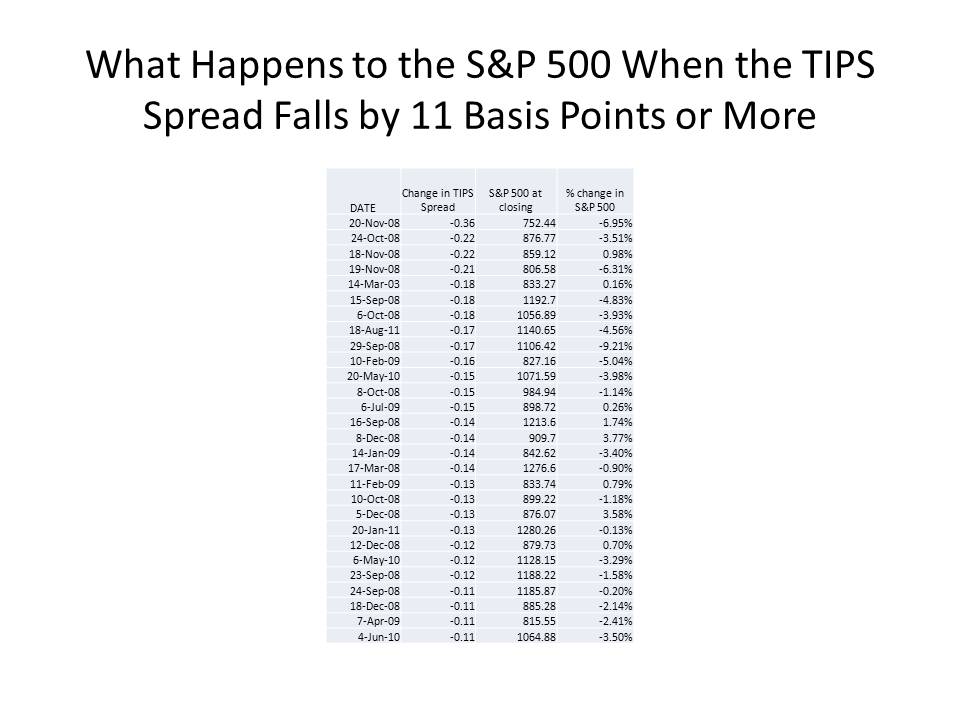
In the table below, I list 28 instances in which inflation expectations (measured by the TIPS spread on 10-year constant maturity Treasuries) suffered a decline of 11 basis points or more in a single day.  Only one such instance took place before 2008, on March 14, 2003; another occurred on March 17, 2008.  The remaining 26, have all occurred since the financial panic that occurred after the Lehman Brothers debacle in September 2008.  Of those 26 instances, 17 were associated with declines in the S&P 500 greater than 1%.

In a paper available here, and discussed here, here, and here, I have shown that until early 2008, the there is no systematic correlation to be found in the data between asset prices (measured by the S&P 500) and inflation expectations.  However, since 2008, the daily change in expected inflation (measure by the TIPS spread on 10-year Treasuries) has been highly correlated with the daily change in the S&P 500.  To me that is persuasive evidence that in current atypical economic conditions, characterized by unusually pessimistic expectations of future economic activity, raising expected inflation tends to improve expectations of real economic growth, thereby, in and of itself, promoting increased investment, output and employment.

One would think that conservatives, who profess to favor unleashing the private sector, would favor a policy calculated to encourage additional private investment and promote increased output by and hiring by American business without any increase in government intrusion into the economy.  Isn’t that what the magic of the market is all about?  That’s what one would  think, but the Wall Street Journal editorial page, in its almost infinite wisdom, seems to think otherwise.

Defending the Dollar

After administering a pro-forma slap on the wrist to Texas Governor Rick Perry for saying that it would be treasonous for Fed Chairman Bernanke to “print more money between now and the election,” The Wall Street Journal in today’s lead editorial heaps praise on the governor for taking a stand in favor of “sound money.”  First there was Governor Palin, and now comes Governor Perry to defend the cause of sound money against a Fed Chairman who, in the view of the Journal editorial page, is conducting a massive money-printing operation that is debasing the dollar.

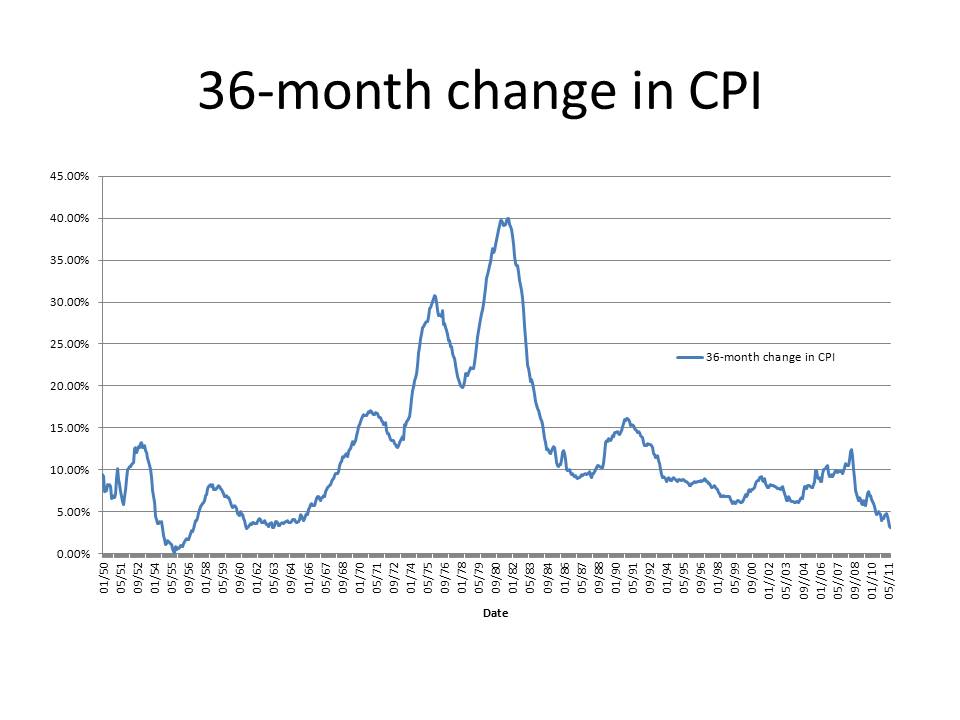
Well, let’s take a look at Mr. Bernanke’s record of currency debasement.  The Bureau of Labor Statistics announced the latest reading (for July 2011) of the consumer price index (CPI); it stood at 225.922.  Thirty-six months ago, in July 2008, the index stood at 219.133.  So over that entire three-year period, the CPI rose by a whopping 3.1%.  That is not an annual rate, that it the total increase over three years, so the average annual inflation rate over the whole period was less than 1%.  The last time that the CPI rose by as little as 3% over any 36-month period was 1958-61.  It is noteworthy that during the administration of Ronald Reagan — a kind of golden age, in the Journal‘s view, of free-market capitalism, low taxes, and sound money — there was no 36-month period in which the CPI increased by less than 8.97%, or about 3 times as fast as the CPI has risen during the quantitative-easing, money-printing, dollar-debasing orgy just presided over by Chairman Bernanke.  Here is a graph showing the moving 36-month change in the CPI from 1950 to 2011.  If you can identify which planet the editorial writers for The Wall Street Journal are living on, you deserve a prize.

“Mr. Perry,” the Journal continues, “seems to appreciate that the Federal Reserve can’t conjure prosperity from the monetary printing presses.”  A huge insight to be sure.  But the Journal is oblivious to the possibility that there are circumstances in which monetary stimulus in the form of rising prices and the expectation of rising prices could be necessary to overcome persistent and debilitating entrepreneurial pessimism about future demand.  How else can one explain the steady decline in real (inflation-adjusted) interest rates over the past six months?  On February 10 the yield on the 10-year TIPS bond was 1.39%; today the yield has dropped below zero.  For the Journal to attribute the growing pessimism to the regulatory burden and high taxes, as it reflexively does, is simply laughable now that Congressional Republicans have succeeded in preserving the Bush tax cuts, preventing any new revenue-raising measures, and blocking any new regulations that were not already in place 6 months ago.

The Journal concludes:

Merely by raising the Fed as a subject, Mr. Perry has sent a political signal to the folks at the Eccles Building to tread carefully as they conduct monetary policy in the coming months.  This alone is a public service.

Yes, and as I write this the S&P 500 is down 54 points, almost 5%.

What Did This Week Teach Us?

Scott Sumner is trying to figure out the answer to that question in an interesting thread on his blog.  I just posted this comment.

Scott, Sorry I have not been following this thread and am just jumping in from out of left field, so pardon me if this has already been mentioned, but as you pointed out to me in an email, one also needs to take into account the uncertainty or riskiness of estimates of expected inflation. I think that it is quite plausible that the FOMC statement confused everybody and increased the perceived risk of TIPS, causing the BE TIPS spread to rise even though the mean expected inflation rate may not have risen or even fallen. It’s a jungle out there.

To elaborate slightly:  Last week when things started to fall apart, I flagged falling inflation expectations as a likely factor tending to push down stock prices.  For several days changes in stock prices and in inflation expectations (as reflected in the TIPS spread) were fairly closely correlated.  This week, however, the S&P 500 seemed to be decoupled from the TIPS spread.  I asked Scott in an email what his thoughts were about that, and he reminded me that the Cleveland Fed has a model in which the TIPS spread is decomposed into inflation expectations plus a risk factor.  (Sorry, I am rushed now so I can’t provide a link.)  My tentative hypothesis is that the FOMC confused everybody this week causing up and down movements in the stock market and an increase in the TIPS spread which reflected not an increase in expected inflation but increased risk in attempting to predict expected inflation.  Once again, a great job by the FOMC.

The Fed Has Not Done Enough and it Has Not Fired Most of its Ammunition

These are difficult times.  The sudden collapse of stock prices is not creating panic so much as despair, a despair voiced by Joseph Stiglitz in his column in the Financial Times today in which he correctly observes:

The Fed’s announcement that it will keep the target federal funds rate near zero for the next two years does convey its sense of despair about the economy.  But, even if it succeeds in stopping the slide in equity prices, it won’t provide the basis of recovery: it is not high interest rates that have been keeping the economy down.

Joseph Stiglitz is a brilliant economist, richly deserving the Nobel Prize he won in 2001, but it is shocking that he would assert that monetary policy can promote recovery only by reducing interest rates.  Evidently, that idea has been repeated so often and with such conviction that even an economist of Professor Stiglitz’s stature can unthinkingly parrot it without embarrassment.

Does Professor Stiglitz believe that if US monetary authorities decided to buy foreign exchange with dollars driving down the value of the dollar against other currencies, dollar prices would not rise?  And if foreign governments responded by purchasing dollars with their own currencies does he believe that prices in terms of those currencies would not rise?  Competitive devaluations would require no reduction in interest rates to be effective and would produce an immediate increase in money supplies and prices.  So it is clearly within the power of central banks, if they had the will to do so, to achieve any desired increase in the price level.  That the Fed and other central banks have not done so means only that they have not tried.

Stiglitz continues:

Corporations are awash with cash, but banks have not been lending to the small and medium-sized  companies that are the source of job creation.  The Fed and Treasury have failed to get this lending restarted, which would do more to rekindle growth than extending low interest rates though 2015

He is right that the Fed and Treasury have failed to get lending restarted, but fails to mention the primary reason: banks are being rewarded for holding reserves with a higher interest rate than they could earn by holding short-term Treasuries.  Returning to a zero-interest-rate policy on reserves or even imposing a tax on excess reserves would certainly change banks incentives, inducing them to reduce their holdings of reserves and to seek alternative ways, like lending to businesses and consumers, to generate income.

A similar sense of futility, though reflecting a profoundly different economic outlook from that of Professor Stiglitz is evidenced in The Wall Street Journal in its August 9 editorial on the FOMC’s announcement.

This is what a central bank does when it wants to appear to do something to help the economy but has already fire most of its ammunition.

But within two paragraphs, the Journal sharply pivots in its characterization of the Fed’s statement.  After noting the dissents of three FOMC members, regional bank presidents not appointed by President Obama, the Journal conjectures that:

the policy statement may have been a compromise, and that others on the committee would have gone further, perhaps so far as to start a third round of quantitative easing.

So the Journal itself seems to imply that the Fed’s statement ought to have been characterized as follows:  This is what a central bank does when it can’t agree to use the ammunition that it has.

The Journal, like Professor Stiglitz, pronounces the Fed’s quantitative easing a failure because all it accomplished was to “[push] investors into riskier assets (stocks and commodities).  But the prices of those assets have since fallen back down to what investors think they’re worth.”  It is almost surprising to read that the Journal believes that the Fed has power to push investors into anything, but readers of the Journal editorial page are no longer so easily surprised.  Investors make judgments, which may or may not be correct, on their own based on the policy signals emitted by the Fed.  If asset prices rose as a result of the Fed’s policy, it was because that was what investors, given the information they then had, felt the assets were worth.  If the assets fell in price later, that was because investors revised their expectations, presumably in light of new information, including new information about the Fed’s policy intentions, as well as the intentions of other relevant policy makers.

The Journal presumes that QE2 was intended to produce wealth effects that would increase consumer spending.  In this presumption, the Journal actually has some support from unfortunately inaccurate explanations of how the program would work by Mr. Bernanke himself.  But such wealth effects were, in the Journal’s view, offset by the negative “income effects” occasioned by the commodity-price bubble induced by QE2. 

Economic growth has decelerated over the past year despite QE2, so we wonder what good Mr. Bernanke thinks it did.  We’re hard pressed to see what good QE3 would do as well.

We know that QE2 was intended to prevent inflation expectations from falling to dangerously low, even negative, levels, as they seemed about to do last summer.  And in this it was successful.  The deceleration in growth was associated with a series of unfortunate one-off events: severe winter weather, a spike in oil prices as a result of the Libyan uprising against Colonel Ghaddafi, and the tsunami and nuclear disaster in Japan.  But rather than accommodate these supply shocks by allowing prices to rise as would be natural in the face of a supply shock, pressure built to tighten monetary policy to counter the supply-driven rise in prices, with results that are now becoming all too evident:  rapidly falling inflation expectations and real interest rates.

The correct explanation of how QE2 was supposed to work is that it would raise the cost of holding liquid assets that would lose value as prices rose.  That is why, within a few months after QE2 was initiated interest rates actually rose along with stock prices, contrary to the Journal’s story about “pushing investors into riskier assets.”  This would have induced business to shift some of their cash holdings into real investment rather than watch their idle cash lose value and to induce consumers to shift depreciating cash into consumer durables.

The notion that QE2 was undermined by a commodity price bubble is nothing but an urban legend.  I apologize for being unable to reproduce the graph on the blog, but if you go to here, you will find the Dow-Jones/UBS commodity index and you will see that that at the peak of the so-called commodity price bubble in April 2011, the index was at the same level it was at in September 2005 and 20% less than it was in July 2008.  The jump in food prices was largely the result of bad wheat harvests and US ethanol subsidies that have driven up the price of corn to unprecedented heights and caused farmers to shift production from other crops to corn.

The Journal then delivers the following piece of wisdom:

The larger error is to assume that monetary policy will save the economy from its current malaise.  That’s the latest mantra from the same economists who told us that $1 trillion in spending stimulus was the answer in 2009.  Since that has failed, we are now told the economy needs a bout of extended inflation to reduce our debt burden.  Harvard’s Kenneth Rogoff says the Fed should allow “a sustained burst of moderate inflation, say 4-6% for several years.”

That may be the mantra of Keynesians, but it is also the policy advice that has consistently been given by monetary economists of various stripes who have warned since 2008 that an overly tight monetary policy would produce a recession and that Fed policy, because of its payment of interest on reserves, has not been the least bit expansive despite the rapid increase in the Fed’s balance sheet.  Fiscal policy may have failed, but monetary policy has yet to be tried.

The Journal concedes that inflation can erode the value of money and debt, a truism too obvious for even the Journal to dispute.  But the Journal counters with the withering observation that Argentina tries this every few years, as if Argentina were the model that Rogoff and others advocating a rapid but limited increase in the price level were offering for emulation.

“The middle class,” warns the Journal, “pays a huge price in a debased standard of living.”  But the standard of living depends primarily on the real level of output and employment.  And there are powerful theoretical reasons to expect that a substantial rise in prices would trigger a large increase in output and employment, restoring living standards to levels not seen in years.  In addition, the historical example of FDR’s devaluation of the dollar in 1933 provides striking empirical evidence that for an economy with very widespread unemployment a period of rapidly rising prices can induce a substantial increase in output and employment.  In the four months following FDR’s devaluation of the dollar, wholesale prices rose by 14 percent, and industrial output rose by 56%, while the Dow Jones average doubled, the fastest increase in output and employment in US history.

“Once you encourage more inflation, it’s hard to stop at 4%,” asserts the Journal as if it were laying down a law of nature.  But there is no economic theory to support such a proposition.  If the Fed announced a specific price level target, there is no reason why it could not reach the target, and, having reached the target, no reason why it could not remain there or revert back to a sustainable long-run price-level path.

“If monetary policy by itself could conjure growth, or compensate for bad fiscal and regulatory policy,” the Journal reasons, “we’d already be booming.”  The Journal simply fails to grasp an elementary distinction: the difference between, on the one hand, the long-run potential rate of growth of an advanced economy, roughly 3% a year over long periods of time, a rate determined by real forces including the incentives provided for investment in the stock of human and physical capital, a stable legal system and efficient tax and regulatory policies, and, on the other, the job of restoring an economy to a long-run growth path from which it has lapsed.  With the former, monetary policy, indeed, has little to do; for the latter, as F. A. Hayek recognized in The Road to Serfdom (p. 121) monetary policy is preeminently responsible.

There is, finally, the supremely important problem of combating general fluctuations of economic activity and the recurrent waves of large-scale unemployment which accompany them.  This is, of course, one of the gravest and most pressing problems of our time. . . . Many economists hope, indeed, that the ultimate remedy may be found in the field of monetary policy, which would involve nothing incompatible even with nineteenth-century liberalism.

FOMC Stabilized Inflation Expectations Yesterday and the Stock Market Soared

After the FOMC issued its statement yesterday, the S&P which had been down almost 2 percent rose about 6 percent to close up for the day by about 4 percent.  Presumably, this allayed fears that the Fed would passively allow inflation and NGDP to keep falling.  For the day, the TIPS spread depending on which measure you look at was constant or rose slightly.  However, the yield on Treasuries dropped by 20 basis points on both the 5- and 10-year bonds.  So the real yield dropped by 20 basis points or so, which says that profit expectations are falling or perceived uncertainty is rising.  Nevertheless, the mild and not very helpful statement was at least able to stop the bleeding.  NPR says that Dow futures are down 1 percent before the market opens in a half an hour.  I am not at all sure that the FOMC statement will be enough to turn the tide.  But I also thought that Bernanke’s Jackson Hole speech last August would not do the trick, and it in fact did succeed in turning things around (for a while).  Hold on to your hats.

PS  Does anyone know by how much the yields on the 5- and 10-year Treasuries and TIPS changed after the FOMC press release?

Hayek on Central Banking and Central Planning

Just to follow up my earlier post about the difference between central banking  and central planning, I would just like to post the following quotation from Hayek’s The Road to Serfdom pp.121-22.

There is, finally, the supremely important problem of combating general fluctuations of economic activity and the recurrent waves of large-scale unemployment which accompany them.  This is, of course, one of the gravest and most pressing problems of our time.  But, though its solution will require much planning (my emphasis) in the good sense, it does not — or at least need not — require that special kind of planning which according to its advocates is to replace the market (my emphasis).  Many economists hope, indeed, that the ultimate remedy may be found in the field of monetary policy, which would involve nothing incompatible even with nineteenth-century liberalism (my emphasis).  Others, it is true, believe that real success can be expected only from the skillful timing of public works undertaken on a very large scale.  This might (my emphasis) lead to much more serious restrictions of the competitive sphere, and, in experimenting in this direction, we shall have to carefully watch our step if we are to avoid making all economic activity progressively more dependent on the direction and volume of government expenditure.  But his is neither the only nor, in my opinion, the most promising way of meeting the gravest threat to economic security.  In any case, the very necessary effort to secure protection against these fluctuations do not lead to the kind of planning which constitutes such a threat to our freedom (my emphasis).

For good measure, here is Hayek in The Constitution of Liberty (pp. 324-25)

The experience of the last fifty years has taught most people the importance of a stable monetary system.  Compared with the preceding century, this period has been one of great monetary disturbances.  Governments have assumed a much more active part in controlling money, and this has been as much a cause as a consequence of instability.  It is only natural, therefore, that some people should feel it would be better if governments were deprived of their control over monetary policy.  Why, it is sometimes asked, should we not rely on the spontaneous forces of the market to supply whatever is needed for a satisfactory medium of exchange as we do in most other respects?

It is important to be clear at the outset that this is not only politically impracticable today but would probably be undesirable if it were possible.  Perhaps, if governments had never interfered, a kind of monetary arrangement might have evolved which would not have required deliberate control; in particular, if men had not come extensively to use credit instruments as money or close substitutes for money, we might have been able to rely on a self-regulating mechanism.   This choice, however, is now closed to us.  We know of no substantially different alternatives to the credit institutions on which the organization of modern business has come largely to rely; and historical developments have created conditions in which the existence of these institut9ions makes necessary some degree of deliberate control of the interacting money and credit systems (my emphasis).  Moreover, other circumstances which we certainly could not hope to change by merely altering our monetary arrangements make it, for the time being, inevitable that this control should be largely exercised by governments.

Europe Is Having an NGDP Crisis not a Debt Crisis

Aside from rampant pessimism about the US economy, the mini-panic now swamping international stock markets is also being attributed to worries about the eurozone and the increasing likelihood that at least five members of eurozone will default on their debt unless rescued by the other countries.  The problems of three countries, Greece, Ireland, and Portugal, have been well known for at least a year and a half.  But the problems of Spain and Italy, which had been thought to be manageable and unlikely to cause a crisis, have suddenly become critical as well.  Because of their size and the size of their debt burdens, it is unclear whether any rescue package would be feasible if the debt of all five countries had to be rescued by the eurozone governments.

It has been fashionable to blame the crisis on the fecklessness of the politicians in these countries, the greediness of their public employee unions and the overly generous pensions that they have extracted from taxpayers, overly generous welfare benefits, and an unwillingness to work hard and save like the good old solid Northern Europeans.  There probably is some truth in that assessment, though there is probably some exaggeration as well.

However, assigning blame in this way is really a distraction from the true cause of the crisis, which is a stagnation of income growth, making it impossible to pay off debts that were undertaken when it was expected that incomes would be rising.  Since the debts are fixed in nominal terms, the condition for being able to pay off the debts is that nominal income (NGDP) rise fast enough to provide enough free cash flows to service the debts.  That hasn’t happened in the five countries now unable to borrow at manageable rates.

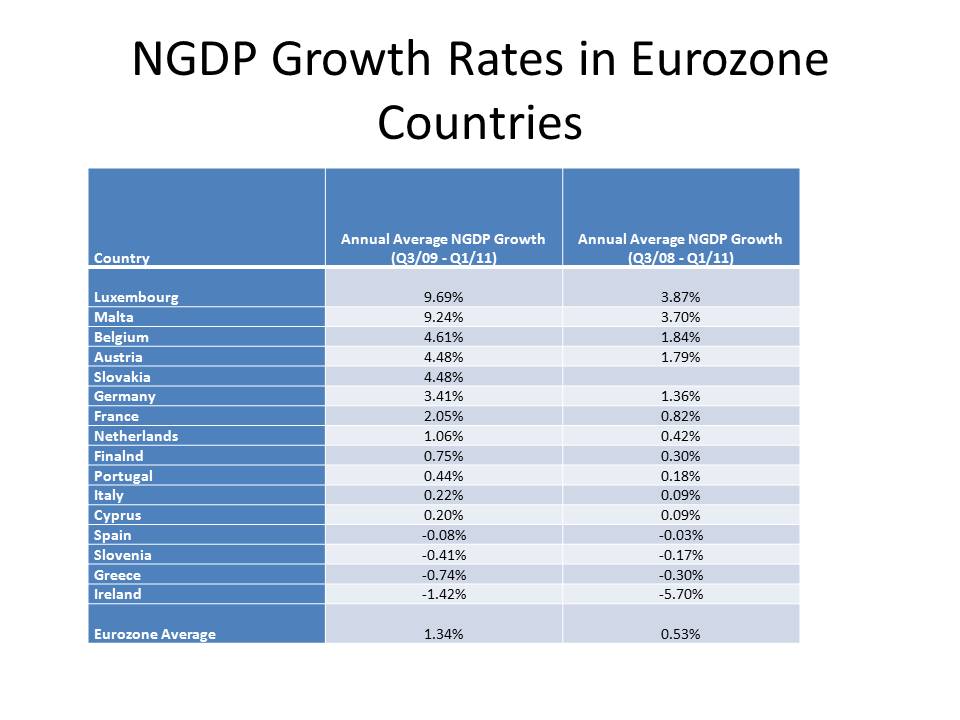
Using official data of the European Commission, I calculated the average annual rate of growth in NGDP for each of the 15 countries in the eurozone since the third quarter of 2008 when the eurozone went into recession and for each of the 16 countries in the eurozone since the third quarter of 2009 when the recovery started (Slovakia having joined in eurozone in the second quarter of 2009) through the first quarter of 2011.

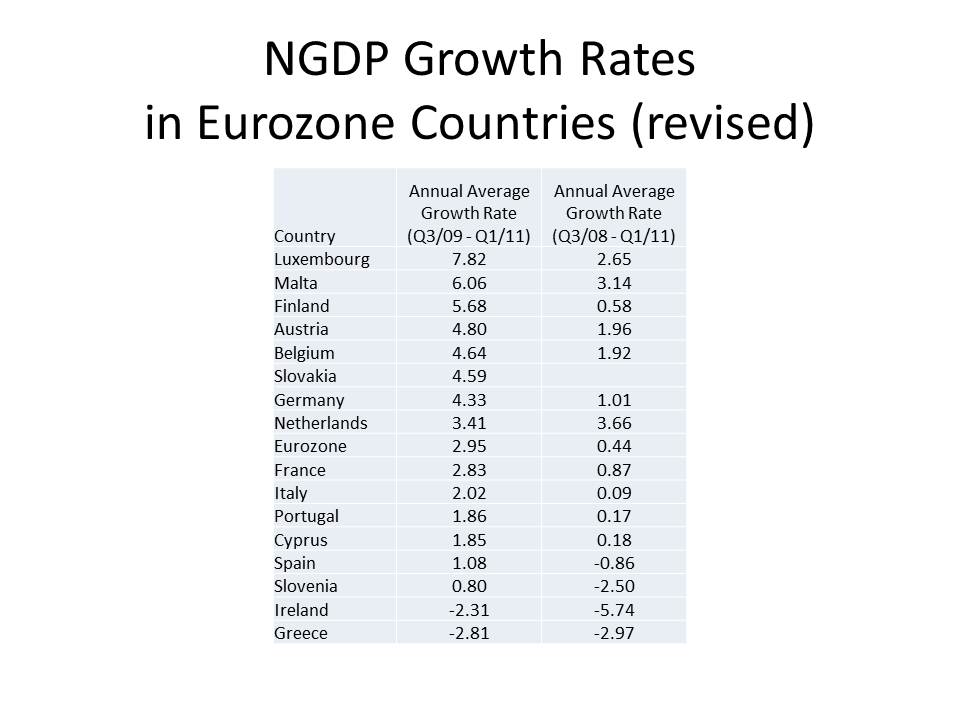
Here are the two lists arranged in order from the fastest to the slowest growth rates of NGDP

The five countries primarily implicated in the debt crisis are at the bottom of NGDP growth rates.  The only other countries in that range are Cyprus and Slovenia.  Cyprus bonds also seem to be problematic, but Slovenia bonds are still rated AA by S&P.

The European debt crisis can thus primarily be laid at the doorstep of Chancellor Merkel and Jean-Claude Trichet, President of the European Central Bank who, in their inflation fighting zeal, have spurned calls for monetary easing to speed the recovery.  We are now all reaping what they have sown.

Chancellor Merkel is following in the worst tradition of one of her predecessors, the unfortunate Chancellor Heinrich Bruning, who in his obsession with proving that Germany was unable to pay off its World War I obligations to the Allies, drove Germany mercilessly into a deflationary spiral in the early 1930s paving the way for Hitler’s ascent to power.  This time, Germany has largely been spared the pain caused by the tight monetary policy for which Chancellor Merkel has expended so much effort.  The pain has mostly been borne by others.  But Germany ultimately cannot escape the costs of its unyielding attachment to tight monetary policy.  Mr. Trichet, too, can look for inspiration to the tragically misguided Emile Moreau, governor the of the Bank of France who presided over the disastrous accumulation of gold by France in the late 1920s and early 1930s that was perhaps the most important factor in triggering the international deflation that led to the Great Depression.

UPDATE (11/25/2011):  In working on a new post about the euro crisis, I discovered that I seriously misstated the growth rates from Q3/09 to Q1/11 for the eurozone countries reported in the above table.  Although I got the numbers wrong, the general relationship among the growth rates in the various countries was not wildly off, so the mistake does not affect the central message of the post, but in my haste, I negligent in checking the numbers.  There were also a few mistakes in the column reporting reporting growth rates from Q3/08 to Q1/11,but only a few of those number were mistaken, not the whole column, as was unfortunately the case for Q3/09 to Q1/11.  Here is a revised table, which aside from correcting my own mistkaes is also based on revised data from the EU.

It’s the Economy not the S&P Downgrade

Treasury prices are rising across the board (except for maturities six months or less) suggesting that the S&P downgrade is having little or no effect on the markets.  What is affecting the markets is the overall economic outlook which is bad and getting worse.  Now it may be that the sense that economic policy in the US is out of control, which, at least in part, was the basis for the downgrade, is affecting contributing to pessimism about the future, but in that case the downgrade is merely reflecting what the market already was sensing.  But it is not quality of US Treasuries that is the issue.

From today’s New York Times story:

The decision late Friday by the ratings agency Standard & Poor’s to downgrade the United States’s debt rating one level to AA+ from AAA has global implications, said Alessandro Giansanti, a credit market strategist at ING in Amsterdam.

“We can see that this may force the U.S. to move more aggressively to cut spending,” he said, something that could drive the already weak economy into recession and weigh on the economies of all of its trading partners. “That’s the main driver” of the stock market declines, he said.

So the markets are taking fright because they are expecting more draconian cuts in government spending and perhaps increased taxes as part of an upcoming budget deal.  You don’t have to be a Keynesian to understand that slashing government spending and raising taxes precisely when the economy is starting to weaken is not good counter-cyclical policy.  But that is the program that almost everyone in Washington, gripped by a deficit-cutting frenzy, has signed on to.  The idea that we must — MUST — reduce the budget deficit is now wreaking havoc.  With the Fed apparently as paralyzed now as it was in September 2008, we are not in a good place.


About Me

David Glasner
Washington, DC

I am an economist in the Washington DC area. My research and writing has been mostly on monetary economics and policy and the history of economics. In my book Free Banking and Monetary Reform, I argued for a non-Monetarist non-Keynesian approach to monetary policy, based on a theory of a competitive supply of money. Over the years, I have become increasingly impressed by the similarities between my approach and that of R. G. Hawtrey and hope to bring Hawtrey’s unduly neglected contributions to the attention of a wider audience.

My new book Studies in the History of Monetary Theory: Controversies and Clarifications has been published by Palgrave Macmillan

Follow me on Twitter @david_glasner

Archives

Enter your email address to follow this blog and receive notifications of new posts by email.

Join 665 other subscribers
Follow Uneasy Money on WordPress.com