Archive for the 'Uncategorized' Category


Are Markets Finally Getting Scared about the Debt Ceiling?

For weeks, pundits have noted with bemusement that the markets have been pretty calm about the ongoing struggle over raising the debt ceiling, notwithstanding warnings of catastrophic consequences should the ceiling not be raised.  The conventional wisdom has been that the markets simply could not imagine that Congress and the President would allow themselves to cause a catastrophe.  Eventually someone has to blink.  So the markets seem to have been treating all the ups and downs in the negotiations for the last month as inconsequential, yields on US debt and stock prices having generally traded within a narrow range over the past two or three months.

In my paper “The Fisher Effect Under Deflationary Expectations” available here, I presented evidence that since early 2008, shortly after the downturn began, stock prices have been strongly correlated with inflation expectations as reflected in both TIP spreads and the dollar/euro exchange rate.  These correlations, not implied by economic or finance theory under “normal” conditions, did not begin to appear in the data until after the Little Depression started.

In updating the empirical results in my paper to include the data since the end of 2010, I have found that the unusual correlation between stock prices and inflation expectations continues to show up in the more recent data.  However, on Monday the TIPS spread (reflecting the expected rate of inflation over 10 years) increased by .04 percentage points and the dollar depreciated by half a percent against the euro, both of which changes having been associated with rising stock prices.  According to my regression estimates, the S&P 500 should have increased by almost half a percent on Monday.  Instead the S&P 500 fell by over half a percent.  On Tuesday, the model seemed to be working, perhaps because it looked like an agreement might be in sight.  But today Speaker Boehner seemed unable to deliver a majority, the S&P 500 fell 2 percent, and the process of raising the debt as if it may really be unraveling.

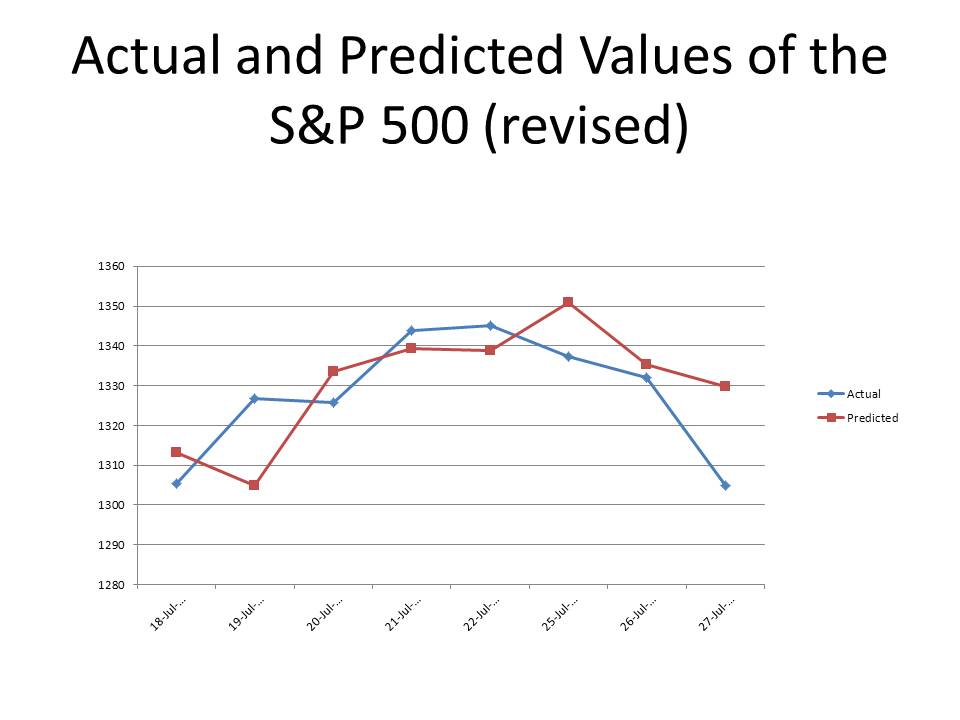
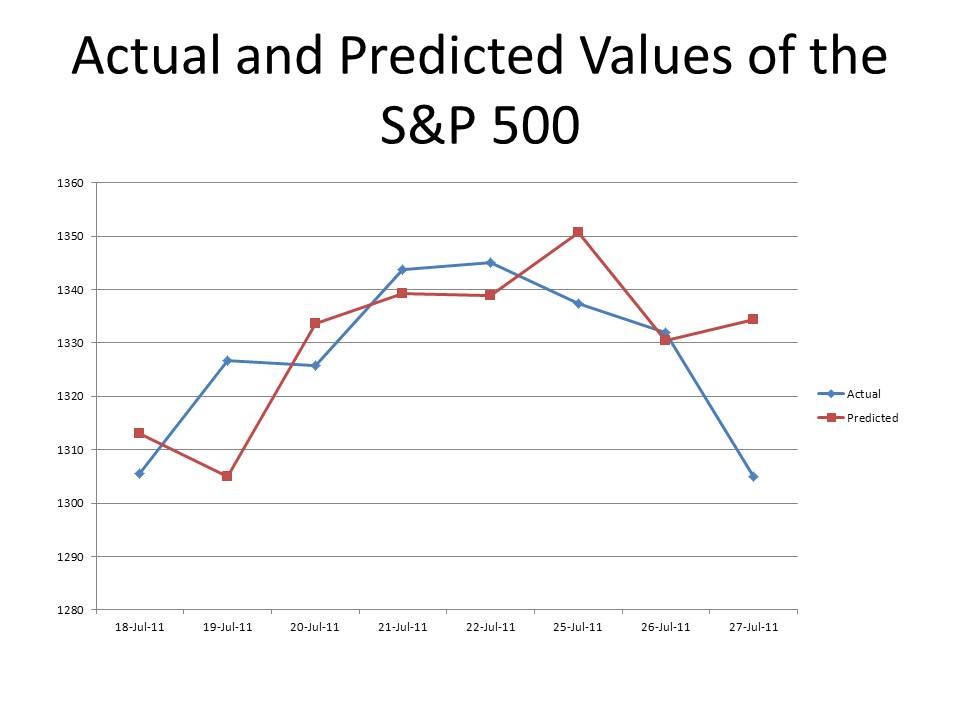
Here are the actual values for the S&P 500 and my predicted values since Monday

Date           Actual S&P 500        Predicted S&P 500

7/25                    1337.43                         1350.76

7/26                    1331.94                          1330.47

7/27                    1304.89                         1334.48

Here’s a chart with the actual and predicted values of the S&P 500 since last week.

Maybe this is starting to get serious.

On the other hand, maybe there’s a silver lining.  If people start dumping Treasuries, the Fed may feel constrained to start buying them, and voila!  Inflationary monetary expansion.  Problem solved.  Go figure.

UPDATE:  When I made my calculations I used the wrong value for the yield on the constant maturity 10-year Treasury.  Fixing that slight glitch changes my little table as follows:

Date           Actual S&P 500        Predicted S&P 500

7/25                    1337.43                         1350.76

7/26                    1331.94                         1335.28

7/27                    1304.89                         1329.71

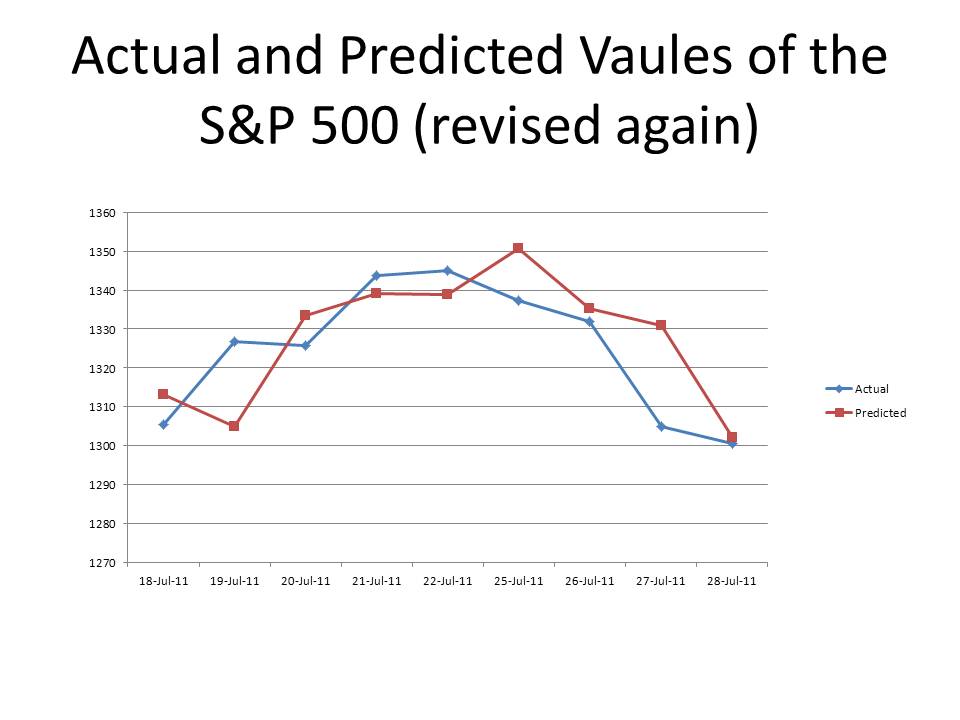
Here’s the revised chart:

UPDATE 7/29:  I used 3.00% percent as the yield on the 10-year constant maturity Treasury for 7/27 when it should have been 3.01%.  So the predicted value for the S&P500 was slightly understated for 7/27.  Yesterday, the predicted value for the S&P500 fell sharply, almost as low as  the actual value, so there no longer seems to be any residual to attribute to  the debt-ceiling.  Economic conditions seem to be getting worse all on their own, thank you very much.  This will probably be my last update on this topic, even if the world doesn’t come to an end next Tuesday.

Date           Actual S&P 500        Predicted S&P 500

7/25                    1337.43                         1350.76

7/26                    1331.94                         1335.28

7/27                    1304.89                         1330.90

7/28                    1300.67                         1302.21


Gold and Ideology, Continued

Last week I commented on the views of James Grant about the gold standard.  I disagree with Mr. Grant about the gold standard, but he knows a great deal about a lot of things and he understands really well how financial markets work at the ground level.  Aside from that he is a really good writer, which suggests that he is a clear, if occasionally misguided, thinker.  This week, I turn to Dr. Judy Shelton, writing in the new (August 1) issue of the Weekly Standard (“Gold Standard or Bust”) and extolling the virtues of the gold standard.  I don’t know, and have never met Dr. Shelton, but she has been a frequent op-ed contributor to the Wall Street Journal and various other publications of a like ideological orientation for 20 years or more, invariably advocating a return to the gold standard.  In 1994, she published a book Money Meltdown touting the gold standard as a cure for all our monetary ills.  I also observe that she is listed as a contributor on the Free Banking blog, but has yet to post anything.

I was tempted to provide a line-by-line commentary on Dr. Shelton’s Weekly Standard piece, but it would be  tedious and churlish to dwell excessively on her deficiencies as a wordsmith or lapses from lucidity.

But consider the following passage:

As government-issued claims against our country’s future output accumulate, there is a hollowing-out effect, with financial capital drawn away from the real economy.  Real economic growth happens when private investors take their chances on innovative entrepreneurs – not when they are induced to purchase “safe” government securities.

What can this possibly mean?  That government borrowing necessarily takes resources away from the private economy?  What if those resources are not being used and would remain (temporarily or permanently) idle but for government borrowing?  What does it mean for “financial capital to be drawn away from the real economy”?  Drawn by what?  By rising interest rates?  Aren’t interest rates now at the lowest levels since the Great Depression?  And how does government borrowing induce private investors not to “take their chances on innovative entrepreneurs?”  Might the level of aggregate demand possibly be relevant to this discussion?  I don’t say that the answers to these questions are obvious, but Dr. Shelton, securely ensconced in her own ideological cocoon, seems blissfully unaware that the questions even exist.

Dr. Shelton continues:

Since the resources needed to pay for current government expenditures are not available, the government is laying claim to future revenues.

That seems like a truism, but Dr. Shelton is just preparing us for the following profundity:

The notion of money as a claim on tangible assets is thus rendered abstract.

OK, time to move on.

After having established, to her own satisfaction at any rate, the imminent danger of currency debasement, Dr. Shelton conjectures that the interests of ordinary Americans have come into perfect alignment with those of la haute finance internationale.

The connection was made last November when former Alaska governor Sarah Palin called for a stable dollar to put our economy back on the right track.  ‘The Fed’s pump priming addiction has got our small businesses running scared,” she noted, “and our allies worried.”  Robert Zoellick, who heads the World Bank, lamented in a Financial Times op-ed that global consternation over the Fed’s quantitative easing was prompting talk of currency wars.  Zoellick proposed that the global monetary regime be reformed to spur economic growth —and suggested that nay new system should “consider employing gold as an international reference point.”

Perhaps Dr. Shelton has forgotten, but within two days of his reference to gold, Mr. Zoellick specifically denied that he meant to support or suggest restoring the gold standard.  But for Dr. Shelton, gold should not be a mere reference point, but a standard.  Why?  Because gold stands for discipline, so that people who mistrust the government can cash their currency in for gold at the fixed parity.  In this way, the money supply will adjust to “the collective assessment of market participants” rather than to the “less-than-omniscient hunches of central bankers.” 

According to the ideology of the gold standard, a gold standard would make the value of  money totally independent of the “less-than-omniscient hunches of central bankers.”  The value of a dollar would be identical to the value of gold, not to what the central bankers want it to be.  But, in a recent New York Times story about the revival of interest in the gold standard, it was reported that central banks still have 29,000 tons of gold sitting in their vaults out of perhaps 166,000 tons of gold that have been mined throughout world history.  Why does Dr. Shelton, or anyone else, imagine that, with such an enormous stockpile of gold under their control, the value of gold would be insulated from the decisions or whims of central bankers?

Gold provides a self-correcting mechanism for irrational exuberance; as credit begins to flow too freely, as equity values or commodity prices appear frothy, the astute observer at the margin cashes out in gold. Monetary central planning gives way to the aggregate wisdom of the free market.

Here Dr. Shelton indulges in a favorite trope of modern gold standard ideology: the facile identification (and deliberate confusion) of central banking with central planning.

Quoting Ludwig von Mises, Dr. Shelton extols the gold standard as a barrier against runaway government spending, as if there was no government borrowing under the gold standard.  Once in a lecture, Mises offered the following argument:

If, under the gold standard, a government is asked to spend money for something new, the minister of finance can say: “And where do I get the money? Tell me, first, how I will find the money for this additional expenditure.”

Yet, without a tinge of embarrassment, Dr. Shelton also invokes the memory of Jack Kemp, who not very successfully sought the Presidency on a promise to cut taxes and restore the gold standard.  Some of us,  however, still remember when Kemp, defending the Reagan administration, to the delight of the Wall Street Journal editorial page, for running huge deficits during a recession, declared that Republicans “no longer worship at the altar of a balanced budget.”  But that was then and now is now.

The Paradox of Fiat Money

Hal Varian is a very, very smart economist, now Professor emeritus at UC Berkeley, and chief economist at Google.  For a number of years, he used to write a monthly column for the New York Times.  In a January 2004 column, he posed the question “Why Is that Dollar in Your Wallet Worth Anything?.”  The first answer he considered was the one in which most lay people probably believe:  that the government makes it worth something by declaring it legal tender.  The problem with that answer, Varian observed, is that whatever the government says, nothing prevents people who want to from using something other than dollars to execute the transactions or discharge their debts.  If people didn’t find it in their own best interest to transact in dollars, all the legal tender laws in the world couldn’t force them to keep making transactions in dollars.

Varian therefore proposed another explanation, suggesting that people accept fiat money out of social convention.  In other words, the expectation that people will accept payment in dollars creates mutually reinforcing expectations, what we now call a network effect, that induce others to adopt the same expectation.  Writing in the aftermath of the US invasion of Iraq, Varian cited the experience of Kurdistan, which, having achieved de facto autonomy from Iraq after the first Gulf war, continued using the old Iraqi dinar as its local currency even after Saddam Hussein introduced a new currency that became the legal and the customary currency in the non-Kurdish part of Iraq remaining under Saddam’s effective control until the US invaded in March 2003.

That column elicited a response from Frank Shostak in the Mises Daily, a web-based publication of the Ludwig von Mises Institute at Auburn University.  Shostak made a powerful objection to Varian’s explanation of the value of fiat money.

And yet that still doesn’t tell us why the dollar bill in our pocket has value. To say that the value of money is on account of social convention is to say very little. In fact, what Varian has told us is that money has value because it is accepted, and why is it accepted? . . . because it is accepted! Obviously this is not a good explanation of why money has value.

To bolster his thesis Varian suggests that the value of the dollar is a result of the “network effect.” According to him, “Just as a fax machine is valuable to you only if lots of other people you correspond with also have fax machines, a currency is valuable to you only if a lot of people you transact with are willing to accept it as payment.”

Shostak tried a different tack, invoking the famed (well, famed, at any rate among the hard-core of the Austrian School) Regression Theorem of Ludwig von Mises, the most venerated, and most authoritative figure in the pantheon of Austrian economics.  (Many outsiders erroneously assume that F. A. Hayek is the leading figure in twentieth century Austrian economics, but among insiders, Hayek is viewed with less than unequivocal admiration for having appropriated Mises’s earlier insights in business-cycle theory, for his willingness to adopt the terminology and methods of mainstream economic theory in his exposition of Mises’s theory, for his subsequent recantation of his early opposition to any form of countercyclical policy by the monetary authority, and, more generally, an insufficiently rigorous opposition to all forms of interventionist economic policies.) 

According to the Regression Theorem, the demand for any money, i.e., an asset demanded because it is accepted in exchange, not for any direct services that it provides, is contingent on its previous value.  Thus, the value of any medium of exchange must have been derived from its value as a commodity before anyone ever accepted it as a medium of exchange.  The Regression Theorem traces back the demand for every medium of exchange to some earlier time when it had value strictly as a commodity, not as a medium of exchange.  But then, how does one explain the value of a fiat money which provides no real services and never did provide any real services that made it valuable in its own right?  The Regression Theorem asserts (some theorem!  But despite his extravagant claims to have created a purely deductive, apodictically certain, theory of human action, Mises did not overly concern himself with the logical rigor of his “proofs”) that every fiat money must, at some point, have been convertible into a real asset to have become valuable in the first place.  Only then, having acquired value through its convertibility into a real asset, usually gold or silver, could the money retain any value after the link to a real asset with commodity value was severed.

More problematic than the failure of the Regression Theorem to provide a valid deductive argument for a historical conjecture about the origins of fiat money is that the Regression Theorem completely misses the point of the whole exercise.   The difficult question, for which Varian struggled to find an answer, is why a fiat money, regardless of why it might once have had value, can retain any value.  The Regression Theorem, as its name attests, is backward-looking.  But economic problems, as Austrian economics to its credit usually recognizes, are forward-looking.  Whether a fiat money once had value is irrelevant to an understanding of why and how it retains value. 

Why should a fiat money not be able to retain value?  Well, consider the following thought experiment.  For a pure medium of exchange, a fiat money, to have value, there must be an expectation that it will be accepted in exchange by someone else.  Without that expectation, a fiat money could not, by definition, have value.  But at some point, before the world comes to its end, it will be clear that there will be no one who will accept the money because there will be no one left with whom to exchange it.  But if it is clear that at some time in the future, no one will accept fiat money and will then lose its value, a logical process of backward induction implies that it must lose its value now.

I first heard this backward induction argument from Earl Thompson in his graduate macroeconomics course at UCLA (in those days both Axel Leijonhufvud and Earl Thompson taught graduate macro, and having taken Axel’s course for credit in my first year, I audited Earl’s course in my second year).  To say that not everyone was willing to accept the backward induction proof that fiat money must be worthless would be an understatement, and for a long time, I, too, tried to resist.  But eventually, I had to yield to the force of logic that seemed compelling. 

Since I have found that the backward induction argument rarely convinces anyone that fiat money can’t have value, perhaps I should try to explain the process that led me to accept it despite my initial qualms.  While still an undergraduate at UCLA, I took Ben Klein’s course in money and banking.  Ben had just arrived at UCLA, Ph. D. not quite in hand, from the University of Chicago.  His dissertation on the Competitive Supply of Money (a portion of which was published under that title in the Journal of Money Credit and Banking) made a historic breakthrough in modeling the behavior of banks in terms of the standard theory of the firm, instead of the usual ad hoc derivation of the money multiplier, disproving in the process, Milton Friedman’s oft-made assertion that free competition in the supply of money would force the value of money down to its zero marginal cost of production.  Ben pointed out that the argument works only if banks produce indistinguishable monies and are forced to redeem each other’s monies at par.  Rather than competing to increase the amount of money they issued, banks would compete to increase the demand to hold their monies by paying interest to depositors.  Ben started a theoretical revolution in the analysis of banks and the money supply, unfortunately still not fully incorporated into modern money and banking theory.

As yet unknown to me, Earl Thompson had also developed a similar theory of a competitive money supply, except that in Earl’s model bank money was convertible into a real asset, gold.  The theoretical difference between Ben’s model and Earl’s model was that Earl argued that only through convertibility into a real asset could a private bank make its money valuable while Ben held that, even without a convertibility commitment, a bank could invest in brand name capital by incurring sunk costs that would be forfeited should it later depreciate its money. 

So there the argument stood until the spring quarter of my second year as a graduate student, when I took Armen Alchian’s seminar in applied price theory.  The seminar involved Armen discussing some current event or issue in the news or some problem for a journal article, working the problem out with us by applying the logic of economic theory.  I have never seen another economist who, using only chalk and a blackboard and elementary economic theory, could provide such a deep and empirically meaningful analysis of any problem that he put his mind to.  One of the papers that we discussed in Armen’s seminar was Ronald Coase’s paper “Durability and Monopoly” which had just been, or was about to be, published in the Journal of Law and Economics

Coase posited a monopolist over a durable good, and asked the question: what price can the monopolist charge for the good.  The surprising answer that Coase arrived at was:  the competitive price.  And the reason was that if the monopolist tried to set the price any higher, then no one would buy the good, because each prospective purchaser would assume that after selling as much as he could sell at the monopoly price, the monopolist would then try to sell additional units of the good at a lower price inasmuch as the incremental sales at that price would still exceed the incremental cost.  And after selling as much as he could at the lower price, the monopolist would have an incentive to cut price yet again to sell additional units, selling the last unit at a price equal to marginal cost.  Anticipating that the monopolist would eventually sell at a price equal to marginal cost, no purchaser would be willing to pay more than marginal cost in the first place.  After going through that argument, Coase then reasoned that to avoid having to sell at a price equal to marginal cost, the monopolist could offer either to rent rather than sell the durable good, or, alternatively, could offer to sell the durable good with a buy-back option if the price were reduced below the initial selling price.  Either way, a renter or a purchaser would be protected against a capital loss on his purchase in case of opportunistic sales by the monopolist.

At some point, I had a eureka moment realizing that Coase’s argument was simply an informal version of the backward induction argument for the worthlessness of fiat money that Earl Thompson had used.  So, after Armen’s seminar one day, I suggested to him that if Coase’s reasoning about durability and monopoly was right, Ben Klein’s argument that investments in brand name capital would enable a competitive supplier of money to maintain a positive value for its money, even without convertibility, could not be right.  I don’t know if Armen had already seen the connection, but he responded that Klein had also discussed a case in which competing money suppliers made their moneys convertible into what Ben called a “dominant” money.  The motivation for that case, it now seems to me, had more to do with a recognition of what would now be called the network effects of a single monetary standard than with the logic of backward induction or Coase’s durability and monopoly argument, but Alchian’s response persuaded me that the backward induction argument was more than an application of esoteric and possibly dubious game-theoretic reasoning, but was well grounded in basic price theory. 

So if the argument that fiat money is worthless is as strong as I believe it to be, how does one answer Hal Varian’s question why is a dollar worth anything?  There are two possibilities.  First, the real world could be less rational than pure economic logic would suggest.  I no longer would dismiss this possibility out of hand, as I once did.  But we should at least recognize that a positive value for fiat money may involve an element of irrationality.  A positive value for fiat money may be no less a bubble than tulips in 17th century Holland, or houses in 21st century America.  People may be accepting money in the false expectation that they will always be able to find some other sucker willing to accept it.  If so, everyone will eventually realize what’s going on, and the game will be over.

The other possibility, the one proposed by Earl Thompson, is that fiat money actually does provide a real service, which is that governments accept it as payment to discharge tax liability.  By making fiat money acceptable as payment for taxes, the government ensures that there is another source of demand for money aside from its use as a means of exchange for private transactions, which is all that is necessary to avoid the backward induction argument.  That the US government accepts other currencies than the dollar in payment of the taxes that it imposes does not mean that there is zero demand to hold dollars with which to discharge tax liability.  Similarly, just because most people hold money for reasons other than paying taxes does not prove that acceptability in payment of taxes is not a necessary condition for dollars to have positive exchange value.  Under a gold standard, most people did not hold gold for the real services it provided.  But without those real services, gold could not have rendered any services as a medium of exchange.

Earl Thompson wasn’t the first economist to offer this explanation for the value of a fiat currency.  Abba Lerner suggested it in the 1940s.  But the most famous source is the German economist G. F. Knapp in his State Theory of Money.  This doctrine was dubbed by Keynes as chartalism.  I believe that at least some of the bad press that chartalism has gotten over the years is due to the hostile and dismissive treatment Knapp’s theory received at the hands of Ludwig von Mises in his Theory of Money and Credit, which grossly misrepresented what Knapp was trying to say.  Offering few specifics, Mises heaped scorn on Knapp’s work, unjustly accusing Knapp of a complete lack of understanding of economic theory.  However, 15 years before the State Theory of Money was published, P. H. Wicksteed, in his magnificent Common Sense of Political Economy (1910), the most elegant and most comprehensive verbal presentation of neoclassical economic theory ever written, a work subsequently embraced by Austrian economists as one of their own despite the lack of any interaction between Wicksteed and the Austrian economists, based his explanation of why inconvertible paper money had a positive value squarely on its being made acceptable by the government for the payment of taxes (volume 2, pp. 618-22).  So any notion that chartalism is at odds with orthodox economic theory, as Mises alleged, is utterly unfounded.

Recently Scott Sumner has been engaged in some pretty acrimonious debates about whether the Fed or central banks in general have the power to control the price level with supporters of what is called Modern Monetary Theory.  One of the main tenets is of Modern Monetary Theory is chartalism.  On my, possibly biased, reading of those debates, I think that Scott has gotten the better of those exchanges.  But it seems to me that the opinion one has about why fiat money has positive value is independent of whether one thinks that central banks really can control the price level.  Perhaps I will have more to say about that in a future posting.
What Should the Fed Target?

Over the past 30 years a consensus has formed among central bankers around the notion that their job is to keep the rate of inflation at or perhaps just under 2 percent a year.  Exactly how they arrived at this figure is not exactly clear to me; I think the idea is that you want inflation to be so low that people aren’t very conscious of it in their everyday lives, but you don’t actually want to bring it down to zero, because if you did, you might inadvertently fall into a deflationary downward spiral.  So about 2 percent inflation provides a bit of protective cushion against drifting into that deflationary danger zone without raising inflation enough to become imbedded in the public consciousness.

Of course there are many different ways to measure inflation, and it was long ago understood by economists that no single price index could perfectly measure what we mean when we talk about the purchasing power of money.  The most popular inflation measure is the consumer price index, but the CPI tracks only a subset of goods, those entering into the budget of a typical urban working household.  In addition, there are all kinds of issues associated with adjusting for quality changes (generally improvement) in the goods consumed over time and issues associated with taking into account the changing composition of the basket of goods the typical urban household purchases (in part in response to relative price changes among the goods in the basket).

In recent years, the Fed has been placing greater emphasis on what is called “core inflation” than on the standard CPI, also referred to as “headline inflation.”  Core inflation subtracts off from the CPI volatile energy and food prices, which, it is argued, are a) highly volatile, so that a given monthly change may present a misleading impression about inflation over a longer time horizon, and b) subject to various forces capable of producing significant price  movements even with no change in monetary conditions.  This reasoning suggests that by cross checking “headline inflation” with “core inflation,” the monetary authorities can reach a better judgment about the danger that inflation might accelerate than by looking at “headline inflation” in isolation.

Interestingly, the FOMC, in 2008, did just the opposite — with disastrous results.  Even though core inflation was fairly well contained in 2008, the Fed viewed with alarm the increases in headline inflation associated with the run up in oil prices in the first half of 2008.  Fearing that high headline inflation would cause inflation expectations to become unanchored, the FOMC refused to cut the Fed Funds rate below 3 percent from March to October — yes October! — 2008 despite all the evidence that the economy, even before the Lehman debacle, was already in, or about to fall into, a recession.

Once again, voices at the Fed and in the FOMC are being raised to focus attention on headline rather than core inflation.   James Bullard, President of the St. Louis Fed, recently (5/18/2011) gave a speech to the Money Marketeers of New York University, dispassionately titled “Measuring Inflation: The Core Is Rotten.”  The speech does not address directly whether current Fed policy is too tight or too loose, but Bullard, who supported QE2, providing crucial support to Bernanke in September 2010 after Bernanke’s Jackson Hole speech, signalling his intention to press forward with another round of quantitative easing, has since signaled his own opposition to further steps toward monetary ease.  What Bullard does do is review a lengthy list of reasons why the Fed should stay focused on headline rather than core inflation.  I have no reason to think that Bullard is not sincere in preferring that the Fed target headline rather than core inflation, but the subtext of Bullard’s remarks suggests to me that he believes that the current rate of headline inflation is higher than he would like it to be and that monetary policy should be adjusted accordingly.

The US focus on  core inflation tends to damage Fed credibility.  As I noted in the introduction, many other central banks have solidified their position on this question by adopting explicit, numerical inflation targets in terms of headline inflation, thus keeping faith with their citizens that they will work to keep headline inflation low and stable.  The Fed should do the same.

But why should headline inflation be the measure of inflation of most concern to the Fed?  Rather than explain, Bullard simply asserts that stabilizing headline inflation is what gives the Fed credibility.

With trips to the gas station and the grocery store being some of the most frequent shopping experiences for many Americans, it is hardly helpful for Fed credibility to appear to exclude all those prices from consideration in the formation of monetary policy.

Historically, the rationale for stabilizing a price index has been that, by doing so, the monetary authority could damp down the business cycle.  This was the position of the great Swedish economist Knut Wicksell in the late nineteenth and early twentieth centuries.  He believed that swings of inflation and deflation were the cause of the business cycle in output and employment.  Stabilize prices in general and you would stabilize the rest of the economy.  The great American economist Irving Fisher reached the same conclusion, characterizing the business cycle as a dance of the dollar.

It was in this spirit that the Federal Reserve Act imposed a dual mandate on the Fed to achieve stable prices while also promoting maximum employment.  Does that dual mandate have any operational meaning?  I think it does.  It means, for starters, that you should not try to reduce inflation when it is already at a historically low level and when reducing it further threatens to decrease, not increase, employment.  That’s all well and good, but how is one to know whether inflation is at historically low levels?  Hasn’t headline CPI inflation has in fact been increasing over the past six months, rising by 3.3%.

I suggest looking at wages.  According to the Employment Cost Index published by the St. Louis Fed, wages between the first quarter of 2001 and the first quarter of 2008 increased at any annual rate of 2.94%.  In only two of those 29 quarters did wages increase at a less than 2% annual rate.  Since the second quarter of 2008, wages have increased at a rate of 1.51%, and for the last 10 quarters in a row wages have increased at a less than 2% annual rate.  So, despite the recent uptick in headline inflation, there is no sign that wage inflation is increasing.  With wages increasing now half as fast as the trend from 2001 to 2008, with the labor market clearly not tightening and unlikely to do so in the foreseeable future, what possible justification can there be, under the dual mandate, or under any reasonable assessment of the risk that  inflation will speed up, for monetary policy to aim at reducing inflation?  No increase in the trend rate of inflation is possible without a roughly corresponding increase in wages.  If wage inflation is virtually absent, there is negligible risk of an increase in the trend rate of inflation.

Throughout his long career, Ralph Hawtrey recommended stabilizing the wage level as the goal of monetary policy.  Hawtrey did not advocate stabilizing a wage index, he advocated stabilizing the wage for unskilled labor.  I am guessing that wages for skilled labor generally rise somewhat faster than the wages of unskilled labor, so we are very close to meeting Hawtrey’s criterion for wage stability.  But the middle of the deepest downturn in 80 years is not the time to pursue the long-term goal of wage stability.  If prices are now rising somewhat faster than wages, it is probably because of recent supply shocks that raised oil prices.  Until wages start rising faster than the 3 percent rate at which they rose from 2001 to 2008, those supply side factors will not translate into a sustained increase in price inflation.  Hawtrey was right.  We should keep our eye on wages.

What’s Fundamentally Wrong With EMH

Scott Sumner is a terrific economist, a creative thinker and a formidable debater.  He not only knows a lot about economic theory and history, he has an uncanny knack for knowing how to draw interesting and useful empirical inferences from the theory.  Plus, he’s funny and writes really well.  No wonder he is just about the best and most prolifiic blogger there is.  He is also a very nice guy, and has the added virtue of agreeing with me about 97 percent of the time.  So why am I about to start an argument with him?

Well, for a couple of years, Scott has been using his blog periodically (here is the latest) to take on critics of the efficient markets hypothesis (EMH), and doing an excellent job, pointing out many of the lapses in the reasoning of EMH critics, for example that supposed anomalies in pricing that prove that pricing is inefficient may simply be statistical flukes incapable of providing a basis for profitable trading, which is what a true exception to EMH would provide.   And Scott very effectively asks why all those people who were so convinced that there was a real estate bubble before 2007 weren’t out there shorting the market.

So let me give Scott his due and say that I don’t know of a more effective defender of EMH than he is, but I still can’t accept EMH.  What’s the problem?  Well, the most important empirical claim of EMH, the one that Scott uses relentlessly to bludgeon EMH critics, is that future prices cannot be predicted from past prices.  The best predictor of the price tomorrow is the price today.  That powerful empirical regularity seems to imply that today’s market price has already processed all the available information about the price tomorrow, so that, given the information today, the price tomorrow is already where it should be.  The price tomorrow will be different from today’s if and only if some new information not now available will cause it to change.  But new information, by its nature, can’t be anticipated, so even though new information causing us to revise the estimate of tomorrow’s price incorporated in today’s price might arrive, that possibility provides no basis for revising today’s price before the new information reaches us.  If you could predict when new information would arrive and how it would affect tomorrow’s price, that information, insofar as it really was predictable, would not be new.

This view of how asset markets operate is related to the idea that market prices are ultimately determined by fundamentals, demand, supply, cost, taxes, etc., objective magnitudes that can be ascertained, or at least estimated, by doing enough research into the asset that one is trying to evaluate.  Markets reflect the central tendency of all the various judgments about an asset being made at any time.  That explains why the current market  price is more likely to predict tomorrow’s price than is any single person, no matter how knowledgeable or astute, and why it so hard for any individual to outguess the market consistently.

In a famous discussion in Chapter 12 of the General Theory, Keynes offered a different view of how the stock market operates, comparing the stock market to a newspaper competition

in which competitors have to pick out the six prettiest faces from a hundred photographs, the prize being awarded to the competitor whose choice corresponds to the average preferences of the competitors as  a whole; so that each competitor has to pick, not those faces which he himself finds prettiest, but those which he thinks likeliest to catch the fancy of the other competitors, all of whom are looking at the problem from the same point of view.  It is not a case of choosing those which, to the best of one’s own judgment, are really the prettiest, nor even those which average opinion genuinely thinks the prettiest.  We have reached the third degree where we devote our intelligences to anticipating what average opinion expects the average opinion to be. (p. 156)

When I first read this chapter as a graduate student already trained to think of markets as efficient processors of information, I thought it quite remarkable that an economist as great as Keynes could have entertained such a primitive notion of how the stock market operates.  Sadly, I can no longer indulge myself with feelings of superiority when reading that chapter, because I am no longer convinced that Keynes was totally misguided in his characterization,  indeed, caricature – but caricatures are effective by identifying and emphasizing some salient feature of reality — of how the stock market works.

I would note parenthetically that on Keynes’s view, asset markets are no less unpredictable than they are under EMH.  So,  despite the identification in the EMH literature of efficiency with unpredictability, the two concepts are not necessarily equivalent.

So why do I think that Keynes was on to something in describing the stock market as a kind of beauty contest?  The key point, it seems to me, is that it is misleading to believe that there is a clear distinction between fundamentals and opinions.  In Keynes’s beauty contest, the fundamental question is which are the prettiest pictures.  Working with the fundamentals, you would compete in the contest by doing fundamental research on the pictures.  The contest would be efficient if the winner selected the prettiest pictures.  Keynes said that whether the prettiest pictures are chosen is irrelevant, because to win the contest what you have to do is to guess who the other competitors will think are (or will select as) the prettiest pictures.

The problem that I see with Keynes’s analogy is that he implicitly admits a dichotomy between fundamentals and opinions, between the prettiest pictures and pictures selected by those trying to guess who will be selected.  I take Keynes a step further; beauty is in the eye of the beholder, so the pictures selected as prettiest have as much claim as any others to be the prettiest, and there are no fundamentals by which to determine which pictures are the prettiest apart from the process that has chosen them.

Let’s try to bring the argument back from beauty contests to  markets.  We all know that expectations sometimes can be self-fulfilling.  That’s what network effects teach us.  The market goes where it is expected to go.  Sure there can be exceptions; expectations can be disappointed. But when expectations point toward a particular outcome,  it can be very difficult to avoid that outcome, especially when network effects are strong.  When expectations determine the outcome, the distinction between the expectations of traders and fundamentals starts to disappear.  If depositors expect a bank to go insolvent, it goes insolvent.  If traders expect the price of oil to go up, it goes up.  If they are pessimistic about the economy, the stock market goes down and the economy may follow.  So Keynes was right, traders in the stock market are trying to figure out where everyone else thinks that stocks are headed.  That’s not the whole story, but it is part of the story, and a part of the story that is left out of EMH.

Let me cite a specific example.  An important milestone on the way to the development of EMH was Milton Friedman’s paper “The Case for Flexible Exchange Rates” in which he argued that currency speculation would be stabilizing rather than destabilizing.  Friedman’s reason was that in order for speculators to earn profits, they would have to buy low and sell high, but buying at low prices tends to make the prices higher than they would have been and selling at high prices tends to make them lower than they would have been. So speculators are smoothing out the fluctuations in exchange rates, raising the lows and bringing down the highs.  The argument presumes that speculators on average are earning profits, which may or may not be true, but leave that aside.  I want to address another unstated presumption of Friedman’s argument:  that there is in fact an exchange rate consistent with the fundamentals and that sooner or later the exchange rate always comes back to the equilibrium level determined by fundamentals.  The fundamentals consist of the real exchange rate determined by real factors and the monetary policy of the government and the monetary authority.  Suppose speculators believe that the monetary policy will become more lax and drive the value of the currency down.  The government and the monetary authority are now confronted with a choice:  accept the depreciation or tighten money, raising interest rates, perhaps risking a recession to restore the old exchange rate.  The government might decide that it is just not worth it to take the actions required to restore the old exchange rate even though it had no intention of loosening monetary policy in the first place.  Thus, it was the expectations of speculators that created the change in fundamentals.  And their expectations were both destabilizing and profitable.

So when Scott defends EMH against its critics and points out that it is very hard to find a way to make profits systematically by exploiting inefficiencies in the asset prices, I agree with him, sort of.  But I can’t figure out what this has to do with efficiency.

Gold and Ideology

Our politics have reached an ideological pitch more strident than any I can remember.   Perhaps bad economic times encourage the gravitation toward extreme ideological positions.  Sensing the shift in public mood, politicians respond by adopting and espousing those rigid ideological positions themselves.  These musings are triggered, in part, by the ongoing debate over the budget and raising the debt ceiling, but that is not what I want to comment on.  Rather, it is how ideology has started to drive the debate over monetary policy.

As in the budget debate, most of the ideological fervor about monetary policy seems to be on the right.  The Fed stands accused by James Grant in the weekend Wall Street Journal of “flooding the system with dollar bills;” it is also held responsible for devaluing the dollar, fuelling inflation, and creating commodity and asset bubbles, all while failing abjectly to produce the recovery that all that money printing was supposed to have produced.   General anti-Fed sentiment and resentment over its monetary policy have been catalysts for reviving interest in and support for the gold standard.  The gold standard has become the ideological fad du jour.

But do supporters of the gold standard understand what it is that they are supporting?  Do they have any idea what it would it mean for the dollar to go back on a gold standard and how would it be implemented?

Many, perhaps most, people who say that they support going back on a gold standard think that a gold standard means that every dollar has to be “backed” by a specified amount of gold reserves for each dollar.  But gold “backing” (i.e., the holding of a fixed quantity of gold per dollar) does not establish a gold standard, and it would be entirely possible  to go back on the gold standard with no, or almost no, gold backing in the sense of a fixed quantity of gold reserves held per dollar.  Holding gold reserves for each dollar would mean only that to print more dollars the US would have to go out and buy gold to “back” the extra dollars.  That would not pin down the value of the dollar, it would merely transfer some or all of the profit that the US Treasury earns from creating dollars (seignorage) to the owners of gold.  So you can see why owners of gold would be charmed by the prospect of increasing the gold “backing” of dollars.  Having to share its profit from creating dollars with owners of gold would certainly reduce the Treasury’s incentive to create more dollars, but the value of the dollar would not be linked directly to the value of gold.  Only convertibility of the dollar into gold at a fixed exchange rate that can do that.

As I understand a gold standard, and I believe that my understanding accords with that of most monetary theorists who understand how the gold standard worked, a sufficient condition for a gold standard to be  in operation is that the  issuer promises to redeem the currency at a fixed, unchangeable, exchange rate between the currency and gold.  The higher the fixed gold price is set, the less valuable is a unit currency in relation to gold.   But that is just a nominal value, the real value of the currency is the real value of the corresponding amount of gold.

This past Friday, the value of gold rose to almost $1600 an ounce.  If the US established a gold standard tomorrow at a fixed rate of $1600 an ounce, making $1 the equivalent of one-sixteen-hundredth of an ounce of gold.  What would that do to the value of the dollar?  Well, the value of a dollar would have to equal the value of one-sixteen hundredth of an ounce of gold.  But what would that value be?  It would depend on the demand for gold in relation to the supply.  There is a huge stock of gold sitting in bank vaults and other treasure houses throughout the world, and hardly anyone has a good handle on what that supply is.  But the available supply surely dwarfs both current production and the current demand for gold in industrial and ornamental uses.  So the current value of gold is almost entirely dependent on the demand to hold gold by people who have no use for it except to keep it locked up in a vault.  Does that fact make anyone feel confident that the value of gold in the future is likely to be stable?

Or look at it another way.  Supporters of the gold standard like to point out that since creation of the Fed in 1913 the dollar has lost 95% of its value.  Well in 1913, the dollar was convertible into an ounce of gold at $20.86 an ounce.  So while the dollar has lost 95 percent of its value, gold has appreciated even more rapidly than the dollar has depreciated.  If gold had kept its value in 1913, its value today would be somewhere between $400 and $500 an ounce.  Accept for argument’s sake the claim of supporters of the gold standard that the recent run up in the value of gold was caused by a loss of confidence in the dollar.  Would it not be reasonable to conclude from that assumption that if the dollar were made convertible into gold, people would then start selling off their gold, the threat of dollar depreciation having been eliminated?

But wait.  If people started selling off their gold, the value of gold would decline.  If the real value of the gold fell from its current value back to its value in 1913 when the dollar was convertible into gold at $20.86, the value of would lose two-thirds to three-quarters of its value.  We are talking about two or three hundred percent inflation.  Does that make you feel more confident about the value of your savings?

James Grant, in a recent interview  by Larry Kudlow, another advocate of restoring the gold standard, made the following point.

Our monetary policy today is dependent upon the judgment of a clique of monetary policy Mandarins, whose judgment is sometimes right but more often wrong because they are, after all, mortal people. So the gold standard has been billed as something antediluvian, and the idea of returning to it, or moving forward to it, is typically characterized as something quixotic, but on the contrary, it seems to me, this is the most eminently practical step we could begin to discuss. We must begin to discuss it.

Mr. Grant, a very intelligent, practical, and insightful analyst of business and financial affairs, seems somehow oblivious to the fact that the gold standard never managed itself; in its classical period from 1870 till World War I it was  under the constant management of the Bank of England with the occasional assistance of the Bank of France and other major banking institutions.  As gold reserves accumulated rapidly in the late nineteenth century and early twentieth century, managing the level of gold reserves held by the central banks to preserve a reasonably stable equilibrium in the world gold market became an increasingly challenging task requiring  the full attention of the Mandarins who managed the gold standard in the days of its greatest glory. 

Samuel Johnson called a second marriage the triumph of hope over experience.  For Mr. Grant now to imagine that we could simply go back on the gold standard for a third time and enjoy the blessings of a stable currency with no risk of inflation or deflation and with no necessity for intelligent technocratic management is truly a stunning triumph of ideology over experience. 

What Bernanke Giveth, Fisher Taketh Away

It’s fun to bat clean-up behind Scott Sumner in the line-up. He just posted this news item on his blog:

NEW YORK (AP) — Comments from Fed Chairman Ben Bernanke set off a stock market rally early Wednesday, but it wasn’t long before another Fed official helped cut it short.

In testimony before Congress, Bernanke said the central bank would be open to new economic stimulus measures, but only if the economy gets much worse. The remarks were far from a promise for more Fed action, but markets reacted immediately nonetheless. The Dow Jones industrial average jumped as many as 164 points, or 1.3 percent.

Most of those gains evaporated later in the day after Federal Reserve Bank of Dallas President Richard Fisher said in a speech that the Fed had already “pressed the limits of monetary policy.”

Then Scott added this comment:

I wonder what it feels like to be able to destroy several hundred billion dollars in wealth (worldwide) by just opening your mouth.

One of the commenters wrote:

Blaming Richard Fisher for “destroying wealth” sure is a funny way of looking at things. Markets bounce around all the time on all kinds of news, odds are very high that the market would have pulled back eventually whether he talked or not. It could be that some speculators tried to ride out the Bernanke statement bounce then sold at the top.

In my post yesterday, I quoted from the Bloomberg item on the “Bernanke rally,” noting that the yield on the 10-year Treasury had risen, along with the stock market, from 2.88 to 2.95. By the end of the day, the yield had fallen back to 2.88.

Was it just coincidence that the yield on the 10-year Treasury and the S&P 500 were moving in sync? I don’t think so. Nor do I think that the timing of the turning point yesterday was unrelated to Fisher’s comment. Last September, after Bernanke first signaled a second round of quantitative easing, the stock market did not really start to move strongly upward until James Bullard, President of the St. Louis Fed, and William Dudley, President of the New York Fed, publicly endorsed QE2. Unfortunately, Bullard, head of that bastion of Chicago-School Monetarism in St. Louis, seems to have switched sides.

Why the Stock Market Loves Inflation

Scott Sumner just posted an item on his blog pointing out how the stock market rallied today when Ben Bernanke testified that the Fed would take action to stimulate the economy if needed. Bloomberg reports:

The greenback fell the most in six months versus the euro as Bernanke said central bank is prepared to take additional action, including buying more government bonds, if the economy appears to be in danger of stalling. The Australian and New Zealand dollars led earlier gains against the currency after China’s economic growth exceeded analysts’ estimates. The euro advanced as Italian and Spanish bonds rose for a second day.

“The markets are weighing the trade-off between the potential for liquidity injections and worsening in global growth prospects,” said Aroop Chatterjee, a currency strategist at Barclays Plc in New York. “For the time being liquidity is winning out. Bernanke’s comments may take some of the focus off what markets have been trading on, which have been largely linked to European news.”

The dollar weakened 1.4 percent against the euro to $1.4166 at 12:38 p.m. in New York, its biggest drop since Jan. 13. It reached $1.3837 yesterday, the strongest level since March 11.

The Standard & Poor’s 500 Index rose 1.2 percent and the yield on 10-year Treasuries increased seven basis points to 2.95 percent.

The weakening of the dollar and the increase in the 10-year Treasury both suggest an increase in inflation expectations. If stock prices are increasing in the face of increased interest rates at which future earnings must be discounted it can only mean that investors are expecting earnings to increase faster than prices. In other words, investors expect that inflation under current conditions will increase earnings in real terms. That relationship between expected inflation and the expected growth of earning seems to have prevailed, as I showed in my paper “The Fisher Effect Under Deflationary Expectations,” since early in 2008 when inflation expectations started to falter as the economic downturn started. My data analysis only went as far as the end of 2010. The last six months show basically the same relationship except for a while when oil prices spiked in February because of the Libyan situation. I hope to revise and update the paper sometime this summer.

Scott writes:

But you might ask “weren’t the high inflation 1970s really bad for stocks?” Yes they were. Just like in the story of the three little bears, the stock market doesn’t want too much inflation, nor too little. Something for the inflation hawks to think about.

That is not quite how I would put it. Whether the market likes inflation or not depends on how high real interest rates are. If real interest rates are high, then markets can tolerate deflation. But when the real rate is already low and for sure if it’s negative, deflation, or even the very low inflation we have now, is very damaging and holds back the recovery. In the 1970s, however, nominal interest rates were at double-digit levels. At those levels, inflation provides little or no stimulus to growth, and has all sorts of negative side effects. In addition, there were supply side shocks in the 1970s, which should properly have been accommodated by monetary easing. Stock prices fell in response to the supply-side shocks not only because inflation was too high.

Sarah Palin, Economist

Who knew?

Reporter Peter J. Boyer in the current issue of Newsweek magazine:


[Sarah] Palin has also become conversant on the subject of quantitative easing, the inflationary effects of which she illustrated with a personal anecdote. “I was ticked off at Todd yesterday,” she said. “He walks into a gas station as we’re driving over from Minnesota. He buys a Slim Jim—we’re always eating that jerky stuff—for $2.69. I said, ‘Todd, those used to be 99 cents, just recently!’ And he says, ‘Man, the dollar’s worth nothing anymore.’ A jug of milk and a loaf of bread and a dozen eggs—every time I walk into that grocery store, a couple of pennies more.”

http://online.wsj.com/article/SB10001424052702303678704576441931372140072.html?mod=WSJ_Opinion_LEFTTopOpinion

Why Is This Recovery Different from all Others?

I have mentioned a couple of times in previous posts that I was working on a comparison of the anemic recovery from our Little Depression to recoveries from previous post-World War II recessions.  The comparison actually involved getting my hands dirty with some data, doing some actual, but low-level, empirical work.  My results seem interesting enough to share, even if they are not exactly the sort of thing that one would publish in an econ journal.  The exposition may be slightly more technical than is customary for blogs, but I hope that some readers may be willing to at least skim through to the end to get a sense of what I have done.  So here it goes.

About two weeks ago while I was in the final stages of talking myself into starting this blog, I saw a short piece (in the weekend (June 24) edition of the Wall Street Journal) by editorial writer Stephen Moore, touting a report (“Uncharted Depths”) of the Republican staff of the Congressional Joint Economic Committee, purporting to show that, on every metric, this recovery is by far the weakest recovery since World War II.

Disdaining any pretense of objectivity, Mr. Moore, in his second paragraph, highlighted the finding of the JEC report that employment is still 5 percent below what it was at the start of the downturn 38 months ago.  “This,” Moore continued, “compares to an average rise in employment of 3.7% over the same period in prior post-WWII recessions.” But the latest downturn was both deeper and longer-lasting than any post-WWII recession.  So for Mr. Moore et al. to compare, on the one hand, employment 38 months ago at the start of the downturn with employment now, and on the other hand, employment at the start of previous recessions with employment 38 months later, is to bias the comparison of the recoveries from the get-go.  Obviously, if one downturn is deeper and longer-lasting than another, the ratio of employment (or any other cyclical variable) in the bigger downturn a given length of time after it began relative to employment when the downturn started will be less than the same ratio in the smaller downturn even if, once underway, the recoveries are equally strong.  But, obviously, the point of the exercise for Mr. Moore and the authors of the JEC report was not to perform a fair and balanced comparison;  it was to inflict damage in a political battle.

Nevertheless, their bias notwithstanding, Mr. Moore et al. had the germ of an interesting idea.  So I decided to try to redo their comparison of recoveries from post-WWII downturns, while also taking into account the length and severity of the downturn preceding the recoveries.  So for each of the 10 stand-alone downturns (i.e., excluding the 1980 recession, overtaken a year and a half after it began by the steep 1981-82 recession), I took the peak quarterly real GDP at or before the downturn and real GDP 13 quarters after the downturn started.  (After the 1957-58 downturn, another recession started 11 quarters later, so I compared the peak quarterly GDP before the downturn with peak GDP 11 quarters later.)  I also calculated the difference between the peak quarterly GDP before the downturn and the lowest quarterly GDP after the downturn, as well as the percentage of months in which the economy was in recovery for each (with the above-mentioned exception) 14-quarter downturn-recovery cycle.

So I amassed data for the following 10 post-WWII downturns and subsequent recoveries:  1948-49, 1953, 1957-58, 1960-61, 1969-70, 1973-75, 1981-82, 1993, 2001, 2007-09.  The data consisted in the percentage increase in real GDP 13 quarters after the start of each downturn over the peak GDP at or before the downturn, the percentage decline in real GDP at the depth of the downturn from peak GDP at or before the downturn, and the percentage of each downturn-recovery cycle (measured in terms of months) in which the economy was recovering.

With these data, I performed a simple statistical analysis, an ordinary least-squares regression, dropping the constant term from the regression (thereby greatly improving its fit).  Ordinary least squares estimation produced the following equation:

% increase in RGDP = .95 X (% fall in RGDP) + 16.18 X (% of cycle in expansion)

The equation says that the percentage change in real GDP 13 quarters after the start of the downturn relative to peak real GDP at or before the downturn can be broken down into two components.  The first component equals .95 of the percentage reduction in real GDP during the downturn (measuring the depth of the downturn).  (This means that reducing the fall of real GDP during the downturn was associated with an increase in the growth of GDP over the 13 quarters following the downturn of about 0.95%.)  The second component is 16.18 times the percentage of the 14-quarter cycle in which the economy was recovering (measuring the length of the downturn).  (This means that a 10-percentage point increase in the percentage of the cycle in which the economy was expanding was associated with an increase in the growth of GDP over the 14-quarter cycle of about 1.62%.)

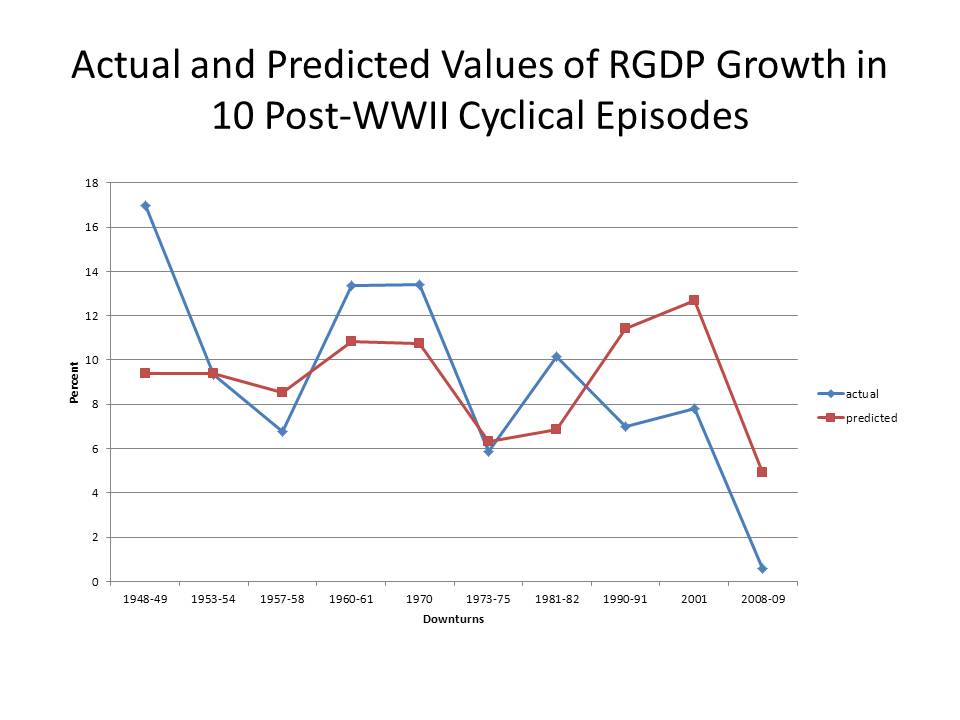
The r-squared of the regression, measuring how much of the variation in the increase in real GDP is accounted for by the regression, is .855, which is not too bad, actually.  Using the regression coefficients, I calculated the implied increase in GDP 13 quarters after the start of each of the 10 recessions and plotted those predicted values against the actual values in following chart.  What is noteworthy about the chart is that although the current recovery is obviously the weakest of the 10 post-WWII recoveries, it is not, contrary to Mr. Moore and associates, the worst post-WWII under-achiever.  Relative to the depth and duration of the earlier recession, the current recovery is no worse, perhaps even slightly better, than the recoveries from the 1990-91 and 2001 recessions.  The other under-achiever, as one might have guessed, is the truncated recovery to the 1957-58 downturn.

Now it also occurred to me that some other factors might also help account for the variations in the strength of the recoveries to post-WWII downturns.  The most plausible or most interesting ones that I could think of were the rate of inflation (of course) and the tax rate.  There are multiple ways to measure these variables, but, for purposes of this exercise, the GDP price deflator and the top marginal tax rate seemed the most informative and relevant.

But a moment’s reflection is enough to make it obvious that it isn’t even worth trying to estimate a regression with the top marginal tax rate as a variable; the top marginal tax rate, having  started at about 90% percent in the late 1940s, falling to 70% in the 1964 and to 50% in 1982, 39.6% in 1993 and 35% in 2003, clearly tends to be positively correlated with the strength of a recovery, the weakest recoveries having all been registered when the top marginal rate was lowest and the strongest recovery (to the 1948-49 downturn) when the top marginal rate was at its maximum.  Hardly anyone would believe that there is a causal link between high tax rates and strong recoveries, so the observed correlation is, somehow or other, either purely random or coincidental, with some other, as yet unspecified, variable.  Nevertheless, the strong apparent correlation between high marginal tax rates and strong recoveries ought to suggest to those who argue that low taxes will solve any problem, that they may be overstating the miracle-working powers of low marginal tax rates, at least as a method of promoting cyclical recoveries.   Even the powerful recovery from the 1981-82 recession, when that famous tax-cutter Ronald Reagan was President, coincided with a top marginal rate of 50%, a rate that would now trigger howls of outrage from Reagan’s present-day acolytes.

But it did seem worthwhile to reestimate a regression including a variable for inflation.  In each downturn-recovery cycle, I compared the GDP price deflator in the last quarter of the downturn with the GDP deflator 13 quarters after the downturn started.   Doing so isolates inflation in the recovery, because I want to know if greater inflation is associated with a stronger recovery.  Taking the overall increase in the GDP deflator during the recovery, I calculated the implied annual rate of inflation over the entire recovery and estimated the regression using the natural logarithm of the average annual rate of inflation during the recovery.  I used the logarithm, because additional doses of inflation might well have a declining stimulative power, implying that the logarithm of the inflation rate would give a better fit than the inflation rate itself.  In fact, estimating the regression both ways, I found that, as expected, the logarithm of inflation gave a better fit than did inflation itself.

Here is the regression equation that I estimated:

%increase in RGDP = .94 X (%fall in RGDP) + 12.77 X (% of cycle in expansion) + 2.75 X (log of inflation)

The equation says that the percentage increase over the whole cyclical episode can be broken down into three components.  The first two are as they were previously, but with somewhat reduced coefficients.  The third component is 2.75 times the logarithm of the rate of inflation, which implies that a 1% increase in inflation was associated with an increased real GDP growth over the cycle of somewhat more than 1%.

The r-squared of the new regression is .881.  The adjusted r-squared, which takes into account the number of variables, rises from .82 with no inflation variable to .83 with an inflation variable.  Not spectacular, but still respectable.

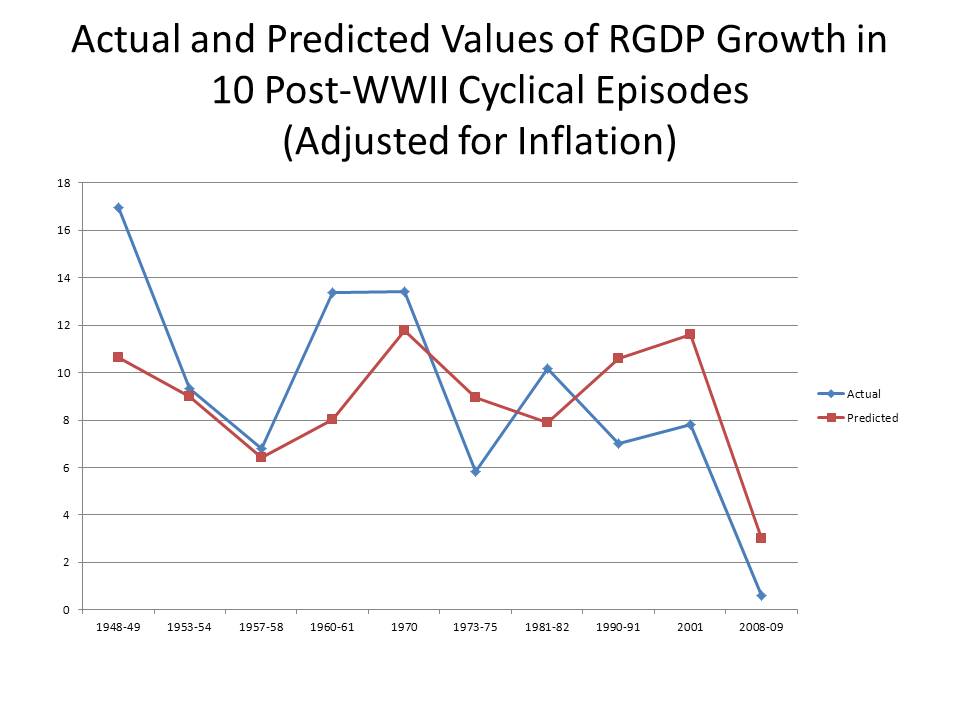
As before, I also calculated the predicted values for real GDP growth in each cycle and plotted them against the actual values.  Those plots are in the chart below.

It is apparent that adjusting for the rate of inflation makes the current recovery seem a bit less of an under-achiever than when no account was taken of inflation.  In the previous chart, the current recovery performed only slightly less well relative to the prediction than did the recoveries after the 1990-91 and 2001 recessions.  In this chart, it does noticeably, though not very much, better than did the two previous recoveries, and also better than the 1973-75 recession (which makes sense inasmuch as inflation in that recession was driven largely by supply-side, not demand-side, factors).

What is the point of all this?  Well, with only 10 observations, one would hardly want to put much reliance on any statistical result, so the main lesson is negative.  Although the current recovery is certainly very weak, in the sort of naïve comparison that Stephen Moore and associates were performing, the current recovery is actually less of an under-achiever,  given the length and depth of the preceding downturn and the very low rate of inflation, than either of the previous two recoveries.

To put a slightly finer point on it, if the rate of inflation in the current recovery had been equal to the rate of inflation in the recovery from the 1981-82 recession when Ronald Reagan was President, the corresponding increase in the predicted rate of growth would have been 3%.  According to Okun’s Law, adding 3% to real GDP would reduce the unemployment rate by 1%.  Do the data prove that that is what would have happened?  By no means.  Correlation is not causation.  But perhaps Mr. Moore and associates, so quick to draw conclusions from a simplistic, if not simple-minded, comparison of this recovery with earlier recoveries, should entertain the possibility that the data, apparently so compelling, may be telling a different story from the one they thought they were hearing.

HT:  Marcus Nunes


About Me

David Glasner
Washington, DC

I am an economist in the Washington DC area. My research and writing has been mostly on monetary economics and policy and the history of economics. In my book Free Banking and Monetary Reform, I argued for a non-Monetarist non-Keynesian approach to monetary policy, based on a theory of a competitive supply of money. Over the years, I have become increasingly impressed by the similarities between my approach and that of R. G. Hawtrey and hope to bring Hawtrey’s unduly neglected contributions to the attention of a wider audience.

My new book Studies in the History of Monetary Theory: Controversies and Clarifications has been published by Palgrave Macmillan

Follow me on Twitter @david_glasner

Archives

Enter your email address to follow this blog and receive notifications of new posts by email.

Join 665 other subscribers
Follow Uneasy Money on WordPress.com