Archive for the 'Uncategorized' Category


Benjamin Cole Sets James Pethokoukis Straight

In the January issue of Commentary magazine, financial journalist James Pethokoukis wrote an article attacking the idea of NGDP targeting. The article was a bundle of silly arguments whose common thread was that NGDP targeting would lead us down the road to inflation and currency debasement. For example, Pethokoukis warned that targeting 5% nominal GDP growth would cause consumers and businesses to worry that inflation would get out of control, thereby undoing the “30 years of startlingly low inflation due to the visionary anti-Keynesian efforts of Paul Volcker in 1981 and 1982.”

How interesting.  The inflation record of Paul Volcker was about 3.5% a year measured in terms of the CPI, once the recovery from the 1981-82 recession got under way. From Q1 1983 through Q2 1987 when Volcker was replaced by Alan Greenspan as Fed Chairman there were only two quarters (Q1 1986 and Q3 1986) when nominal GDP grew at less than a 5% annual rate. For five consecutive quarters, from Q2 1983 through Q2 1984, nominal GDP increased at more than a 10% annual rate. And Mr. Pethokoukis is horrified at the prospect of allowing nominal GDP to grow at a 5% annual rate?

On his blog, David Beckworth responded to Pethokoukis’s article, having been singled out for special attention by Pethokoukis for a piece he wrote with Ramesh Ponnuru in the New Republic advocating NGDP targeting.

I received the April issue of Commentary in the mail yesterday and I was pleased to find a letter to the editor sent by none other than our very own Benjamin Cole commenting on Pethokoukis’s article. Here’s what Benjamin had to say about the article.

James Pethokoukis worries that allowing a bit of inflation could easily “get out of hand,” thereby harming economic growth. But keeping inflation low doesn’t seem to be doing any good, either, which undermines the fear of inflation to which Mr. Pethokoukis subscribes. According to the Federal Reserve Bank of Cleveland, “its latest estimate of 10-year expected inflation is 1.34 percent. In other words, the public currently expects the inflation rate to be less than 2 percent on average the next decade.” And whata is this low-inflation-as-far-as-they-eye-can-see forecast doing for growth?

Inflation is not the problem. Inflation is dead. And judging from Japan, inflation is not likely to be a problem.

Growth is the problem — or, rather, lack thereof. The Fed should get aggressive (and not through fiscal stimulus). Really, would not five years of 5 percent real growth and 5 percent inflation do wonder for the economy. Is a slavish and peevish devotion to fighting inflation worth sacrificing prosperity?

Here’s Pethokoukis’s response.

Benjamin Cole makes a point with which I agree. Growth is the real problem. And it has been for a long time. That’s why the United States needs policies that create a fertile environment for stronger long-term growth via more innovation and productivity. Stable prices are a key part of that formula. Higher inflation makes investment less rewarding and creates massive uncertainty. There’s no doubt inflation is low today. Good. Let’s check that box and get to work on reforming the tax code and creating an education system that prepares Americans for the careers of tomorrow. I have a lot more faith in that working to create sustainable growth than in the ability of Ben Bernanke or his successors to precisely dial inflation up or down on command.

Well, the three months since Mr. Pethokoukis published his piece have evidently passed with little sign of any improvement in the ability of Mr. Pethotoukis to formulate a coherent argument. Is it too much to expect that a financial journalist writing in one of the premier opinion magazines in the US be able to distinguish between a strategy for speeding up a cyclical recovery, about which we have a fair amount of economic knowledge, and a strategy for increasing the long-term trend rate of growth of an advanced economy, about which we unfortunately have not much knowledge at all? And how on earth did a policy of stabilizing the rate of nominal GDP growth at 5 percent get transformed into having “Ben Bernanke or his successors . . . precisely dial inflation up or down on command?” Good grief.

Japan’s 2-Decade Experiment with Fiscal Austerity (or Stimulus) and -0.3% Annual NGDP Growth

UPDATE:  Thanks to Scott Sumner who alerted me in his comment below that I had not properly checked the data for Japanese GDP on the St. Louis Fed website.  There was one series covering real GDP annually from 1960 to 2010 and another quarterly series from 1994 to 2011, which is what I used.  The second series was listed as GDP, so I assumed that it meant nominal GDP.  But when I checked after reading Scott’s comment, I found that indeed it was real GDP as well.  Then using a separate series for the GDP deflator I calculated nominal GDP.  I make corrections in the post below and have modified the title of the post accordingly.

Peter Tasker has an excellent op-ed (“Europe can learn from Japan’s austerity endgame”) in Monday’s Financial Times, pointing out that Japan for the last two decades has been pursuing the kind of fiscal austerity program now being urged on Europe to combat their debt crisis.

When Japan’s bubble economy imploded in the early 1990s, public finances were in surplus and government debt was a mere 20 percent of gross domestic product. Twenty years on, the government is running a yawning deficit and gross public debt as swollen to a sumo-sized 200 percent of GDP.

Fiscal austerity did not begin immediately, but “Japan’s experiment with Keynesian-style public works programmes” ended in 1997. The public works programs did not promote a significant recovery, but in the six years from 1992 to 1997, real GDP at least managed to grow at a feeble 1.3% annual rate. But in the two years after austerity began — public works spending being cut back and the consumption tax raised, real GDP fell by 2.1% (1998) and 0.1% (1999). Despite fiscal austerity after 1997, the budgetary situation steadily deteriorated, government outlays rising as percentage of GDP while tax revenues are 5% lower as a percentage of GDP than in 1988 when the consumption tax was introduced.

Tasker also asserts observes that Japan’s nominal GDP is now lower than it was in 1992. The data on the St. Louis Fed website do not seem to bear out that claim. According to the St. Louis Fed data, nominal real GDP in the third quarter of 2011 was 13.1% higher than in the first quarter of 1994, which is the starting point for the St. Louis Fed data series of Japanese nominal GDP.  Nominal GDP over the same period fell by 5.2%.  Thus, over the 17.5 years for which the St. Louis Fed reports Japanese NGDP, the average annual rate of growth of NGDP has been 0.74 -0.3%. That is the future the Eurozone countries are looking at unless the European Central Bank is willing to take aggressive steps to ensure that nominal GDP growth is at least 5% a year for the foreseeable future. An increase in Japanese NGDP growth wouldn’t be such a bad idea either.  As I have observed before (also here and here), the European debt crisis is really an NGDP crisis.

Krugman on Mistaken Identities

Last week I wrote a series of posts (starting with this and ending with this) that were mainly motivated by a single objective: to show how taking the accounting identity between savings and investment seriously can get someone, even a very fine economist, into serious trouble. That, I suggested, is what happened to Scott Sumner when, in a post about whether a temporary increase in government spending and taxes would increase GDP, he relied on the accounting identity between savings and investment to conclude that a reduction in savings necessarily leads to a reduction in investment. Trying to trace Scott’s mistake to misuse of an accounting identity led me a little further than I anticipated into the substance of the argument about how a temporary increase in government spending and taxes affects GDP, an argument that I am still not quite satisfied with, but which – you can relax — I am not going to discuss in this post. My aim in this post is merely to respond to one of Scott’s rejoinders to me, which is that he was just relying on a proposition – the identity of savings and investment – that is taught in just about every macro textbook, including textbooks by Paul Krugman and Greg Mankiw, two of the current heavyweights of the profession. If so, Scott observed, my argument is not really with him, but with the entire profession.

No doubt about it, Scott has a point, though I think that most textbooks and most economists have an intuitive understanding that the accounting identity is basically a fudge, and therefore, unlike Scott, generally do not rely on it for any substantive conclusions. The way that most textbooks try to handle the identity is to say that the identity really just refers to realized (ex post) saving and investment which must be equal, while planned (ex ante) investment and planned (ex ante) saving may not be equal, with the difference between planned investment and planned saving corresponding to unplanned investment (accumulation) of inventories. Equilibrium is determined by the equality of planned investment and planned saving, and any disequilibrium (corresponding to a divergence between planned saving and planned investment) is reflected in unplanned inventory accumulation (either positive or negative) which ensures that the identity between realized investment and realized saving is always satisfied.  The usual fudge distinguishing between planned and realized investment and saving and postulating that unplanned inventory investment is what accounts for any difference between planned investment and saving is itself problematic, but it at least puts one on notice that there is a difference between an equilibrium condition and an accounting identity, while nevertheless erroneously suggesting that the accounting identity has some economic significance.

Not entirely coincidentally, Scott having got started on this topic by responding to a post by Paul Krugman, Krugman himself weighed in on the subject of accounting identities last week, enthusiastically citing a post by Noah Smith warning about the misuse of accounting identities in arguments about economics. Now the truth is that there is not too much in Krugman’s post that I disagree with, but there are certain verbal slips or misstatements that betray the confusion between accounting identities and equilibrium conditions that I am trying to get people to recognize and to stay away from. While avoiding any substantive error, Krugman perpetuates the confusion, thus contributing unwittingly to the very problem that motivated his post. Thus, his confusion is not just annoying to compulsive grammarians like me; it is also unnecessary and easily avoidable, and creates the potential for more serious mistakes by the unwary. So there is really no excuse for continuing to pay lip service to the supposed identity between savings and investment, regardless of how deeply entrenched it has become as the result of many decades of unthinking, rote repetition on the part of textbook writers.

Here’s Krugman:

Via Mark Thoma, Noah Smith has a terrific piece on how to argue with economists. All the points are good, but I’d like to focus on Principle 4, “Argument by accounting identity almost never works.”

What he’s referring to, I assume, is arguments like “since savings equals investment, fiscal stimulus can’t affect overall spending”, or “since the current account balance is equal to the difference between domestic saving and domestic investment, exchange rates can’t affect trade”. The first argument is, more or less, Say’s Law and/or the Treasury view. The second argument is what John Williamson called the doctrine of immaculate transfer.

This is pretty straightforward, though I don’t care for the examples that Krugman gives, displaying a conventional misunderstanding of Say’s Law. But Say’s Law is a whole topic unto itself. Nor can the Treasury view be dismissed as nothing more than the misapplication of an accounting identity. So I’m just going to ignore those two specific examples for purposes of this discussion. Back to Krugman.

Why are such arguments so misleading? Noah doesn’t fully explain, so let me put in a further word. As I see it, economic explanations pretty much always have to involve micromotives and macrobehavior (the title of a book by Tom Schelling). That is, when we tell economic stories, they normally involve describing how the actions of individuals, driven by individual motives (and maybe, though not necessarily, by rational self-interest), add up to interesting behavior at the aggregate level.

Again, nothing to argue with there, though the verb “add up” has just faintest whiff of an identity insinuating itself into the discussion.

And the key point is that individuals in general [as opposed to those strange creatures called economists who do care about “aggregate accounting identities?] neither know nor care about aggregate accounting identities.

Ok, now we are starting to have a problem. Individuals in general neither know nor care about aggregate accounting identities. Does that mean that those strange creatures called economist should know or care about aggregate accounting identities? I have yet to hear any cogent reason why they should.

Take the doctrine of immaculate transfer: if you want to claim that a rise in savings translates directly into a fall in the trade deficit, without any depreciation of the currency, you have to tell me how that rise in savings induces domestic consumers to buy fewer foreign goods, or foreign consumers to buy more domestic goods. Don’t tell me about how the identity must hold, tell me about the mechanism that induces the individual decisions that make it hold.

Here is where Krugman, after skating on the edge, finally slips up and begins to talk nonsense — very subtle nonsense, but nonsense nonetheless. What does it mean to say that an identity must hold? It means that, by the very meaning of the terms that one is using, the identity of which one is speaking must be true. It is inconceivable that an identity would not hold. If the difference between investment and savings (in an open economy) is defined to be identitically equal to the trade deficit, then talking about a mechanism that induces individual decisions to make it hold makes as much sense as saying that there must be a mechanism that induces individual decisions to make 2 + 2 equal 4. If, by the very meaning of the terms that I am using, the difference between investment and savings must equal the trade deficit (which, to repeat, is what it means to say that there is an identity between those magnitudes) there is no conceivable set of circumstances in which the two magnitudes would not be equal. If, in the very nature of things, two magnitudes could never possibly be different, it is nonsense to say that there is a mechanism of any kind (much less one describable in terms of the decisions of individual human beings) that operates to bring it about that the equality actually holds.

And once you do that, you realize that something else has to be happening — a slump in the economy, a depreciation of the real exchange rate, it depends on the circumstances, but it can’t be immaculate, with nothing moving to enforce the identity.

No, no! A thousand times no! If we are really talking about an identity, nothing has to be happening to enforce the identity. Identities don’t have to be enforced. Something that could not conceivably be otherwise requires nothing to prevent the inconceivable from happening.

When it comes to confusions about the macro implications of S=I, again the question is how the identity gets reflected in individual motives — is it via the interest rate, via changes in GDP, or what?

There are no macro implications of an identity; an identity has no empirical implications of any kind — period, full stop. If S necessarily equals I, because they have been defined in such a way that they could not possibly be unequal, then there is no conceivable state of the world in which they are unequal. Obviously, if S and I are equal in every conceivable state of the world, the necessary identity between them cannot rule out any conceivable state of the world. That means that the identity between S and I has no empirical implications. It says nothing about what can or cannot be observed in the real world at either the micro or the macro level.

Accounting identities are important; in fact, they’re the law. But they should inform your stories about how people behave, not act as a substitute for behavioral analysis.

I don’t know what law Krugman is referring to, but usually laws of nature tell us that some conceivable observations are not possible. Accounting identities don’t tell us anything of the sort. They are merely express certain conventional meanings that we are assigning to specific terms that we are using. How an accounting identity that could not be inconsistent with any conceivable state of the world can inform anything is a mystery, but I heartily agree that an accounting identity cannot be “a substitute for behavioral analysis.”

I have been rather (perhaps overly) harsh in my criticism on Krugman, but not to show that I am smarter than he is, which I certainly am not, but to show how easily habitual ways of speaking about macro lead to (easily rectifiable) nonsense statements. The problem is not any real misunderstanding on his part. Indeed, I would be surprised if, should he ever read this, he did not immediately realize that he had been expressing himself sloppily. The point is that macroeconomists have gotten into a lot of bad habits in describing their models and in failing to distinguish properly between accounting identities, which are theoretically unimportant, and equilibrium conditions, which are essential. Everything that Krugman said would have made sense if he had properly distinguished between accounting identities and equilibrium conditions rather than mix them up as he did, and as textbooks have been doing for three generations.

Savings and investment are equal in equilibrium, because that equality is a necessary and sufficient condition for the existence of an equilibrium. If so, being out of equilibrium means that savings and investment are not equal. So if we think that a real economy is ever out of equilibrium, one way to test for the existence of disequilibrium would be to see if actual savings and actual investment are unequal, notwithstanding the presumed accounting identity between savings and investment. That accounting identity is a product of the special definitions assigned to savings and investment by national income accounting practices, not by the meaning that our theory of national income assigns to those terms.

PS I will once again mention (having done so in previous posts on accounting identities) that all the essential points I am making in this post are derived from the really outstanding and unfortunately not very widely known paper by Richard G. Lipsey, “The Foundations of the Theory of National Income” originally published in Essays in Honour of Lord Robbins and reprinted in Macroeconomic Theory and Policy:  Selected Essays of Richard G. Lipsey.

How Ronald Reagan (Not to Mention Republicans, Conservatives and the Wall Street Journal Editorial Board) Learned to Stop Worrying and Love Moderate Inflation

In my previous post, I pointed out that inflation (measured by both the GDP price deflator and the Personal Consumption Price Index) in the fourth quarter has fallen back to a level well below the Fed’s 2% target.  Indeed, it is running at nearly the lowest rate since the end of World War II. Later, when reading this post by Noah Smith commenting on this post by John Taylor’s (also see Taylor’s op-ed in the Wall Street Journal), it occurred to me that, viewed from the perspective of the current rhetoric about sound money and proposals to eliminate the dual mandate of the Fed and impose on the Fed a single unambiguous mandate of maintaining price stability, it is hard to understand why some people are so harshly critical of Mr. Obama’s record as President. If price stability is really the alpha and omega of monetary policy, then, based on his success in keeping inflation low, shouldn’t Mr. Obama be rated the most economically successful President in living memory?

If, despite President Obama’s stellar record in suppressing inflation – either directly or through his re-appointment of Ben Bernanke as Fed Chairman — is not enough to mollify the critics who loudly assert that the only macroeconomic objective of the Federal Reserve Board should be to ensure price stability, doesn’t that suggest that they actually care about more than price stability and that calls for the Fed to stop paying attention to anything but the rate of inflation are perhaps less than 100% sincere?  After all, inflation is lower now than it was during the administration of Ronald Reagan, and aside from his reputation as the quintessential Conservative, Reagan is also viewed as the slayer of inflation and the very paragon on a sound money man.  So I thought that it might be useful to go back and see what the Reagan administration itself had to say about inflation while it was in office.

So herewith I provide a few excerpts from the  Annual Reports of the Council of Economic Advisers published in the Economic Report of the President during the Reagan Presidency.

Economic Report of the President 1984

The tendency toward a slight increase in inflation over the year was also registered by the producer price index. Over the 6 months ending June, the index for total finished goods fell at annual rate of 0.9 percent,but over the second half of the year this index rose at 2.0 percent annual rate. Even so, inflation by this measure was lower than that in the recession phase of the cycle. The GNP implicit price deflator, the broadest measure of inflation, rose by 4.0 percent over the four quarters of the year. (p. 190)

The gradual reduction in inflation assumed by the Administration does not depend on a policy assumption that such a result will be “forced” by deliberate actions to choke off economic growth whenever there is any sign of a rise in inflation. Rather, the decline in inflation is the anticipated outcome of the assumed steady and predictable monetary and fiscal policies. As with real growth, it is expected that inflation may sometimes be higher and sometimes lower than the Administration assumption, but that the trend will be downward as indicated. (p. 199)

Economic Report of the President 1985

Although it is common for inflation to fall somewhat during the early stages of business cycle recoveries, few observers anticipated that the inflation rate would remain so low during a recovery as rapid as that experience in 1983-84. The inflation rate rose slightly in the second half of 1983 and early 1984, but there was no apparent tendency for the rate to rise further. Indeed, over the course of 1984 the inflation rate declined somewhat. However, inflation is still higher than desireable, and it worth noting that the services component of the CPI in 1984 showed some signs of slightly rising inflation. (p. 44)

The inflation outlook for 1985 is good. With moderate expansion in the money aggregates and continuing real growth, the inflation rate, as measured by the GNP deflator, is expected to average 4.3 percent over the four quarters of 1985. (p. 62)

Economic Report of the President 1986

After being lower than expected in 1985, the inflation rate, as measure by the GNP deflator, is expected to rise somewhat in 1986. Rapid monetary growth throughout 1985 as well as the depreciation of the dollar are expected to place upward pressure on prices. The projected rise in near-term inflation, however, is expected to be temporary, provided that a policy of gradual money-growth reduction is pursued. (p. 23)

The unsatisfactory economic performance associated with the rise of inflation and the adjustment problems that arise during disinflation provide a clear lesson: reacceleration of inflation must prevented. The surest way to avoid the costs of both inflation and disinflation is to avoid the policies that lead to an acceleration of inflation. Moreover, the experience of the past 3 years has indicated that substantial economic growth can occur without rekindling inflation. (p. 70)

Economic Report of the President 1987

More than 4 years of economic expansion, with the inflation rate remaining near or below 4 percent and interest rates declining to their lowest levels in 9 years, have laid te foundation for sustainable real growth with moderate inflation. (p. 19)

The inflation rate is 1987 is forecast to return to the 3.5 to 4 percent range of recent years, before the decline in oil prices temporarily depressed the inflation rate in 1986. Specifically the GNP deflator is forecast to rise at a 3.6 percent annual rate during 1987, after a 2.2 percent rate of increase during 1986. (p. 58)

Economic Report of the President 1988

Higher oil prices and higher import prices increased the 1987 inflation rate (as measured by the CPI) above the very low rate recorded in 1986. Higher import prices also are expected to contribute to consumer price inflation in 1988. However, after a year of slow growth of monetary aggregates, and in view of the expected slowing of real economic growth, acceleration of inflation is not seen as a likely danger in 1988. On a fourth-quarter to fourth-quarter basis, the CPI is forecast to rise 4.3 percent in 1988, a small decline from the rise in 1987. The GNP deflator, which is not affected directly by import prices, is forecast to rise 3.9 percent in 1988. (pp. 48-49)

Economic Report of the President 1989

An important legacy of this Administration is the refocusing of economic policy. The Administration deemphasized short-run stabilization policies; worked to provide a stable policy environment with market-based incentives for productive behavior, including low inflation; and attempted to extricate private markets from burdensome regulations. The strength and durability of the current expansion bear testimony to the soundness of these policies. In December 1988, the current economic expansion entered its seventh year, making it the longest peacetime expansion and the third longest on record. Most impressively, the inflation rate has not risen during this expansion, but has remained in the neighborhood of 3 to 4 percent. (pp. 258-59)

So it seems that President Reagan and his economic advisers thought that they were doing well to keep inflation at 4 percent a year.  Sure, they would have liked to get the inflation rate down a  bit, but they weren’t prepared to risk even a slowdown in the rate of decrease in unemployment to reduce inflation, much less tolerate any increase in the unemployment rate.  Promised reductions in the rate of inflation below the steady 3.5-4% rate that prevailed for the most part after the recovery started in 1983 just kept getting deferred further and further into the future.  Is that a record that John Taylor would like the next President of the United States to emulate?

It All Depends on the MPC

UPDATE (01/25/12):  This post is erroneous and none of its conclusions should be relied upon.

OK, so it has come down to this.  I just asserted that the way to translate Lucas and Cochrane into the Keynesian model is to set the mpc equal to zero.  In that case, any increase in government spending that is offset by taxes causes no net increase in income, because as, Lucas puts it, the increase in government spending is exactly offset by a decrease in consumption of an equal amount thanks to the reduction in after-tax income.  This exercise is predicated on the assumption that the equal increase in government spending and taxes is permanent.  But in the exercise proposed by Wren-Lewis, the increase in government spending is temporary and the increase in taxes is also temporary.  How does the transitory nature of the increase in government spending and taxes alter the analysis under a Lucasian version of the Keynesian model?

Wren-Lewis claimed that you get a stimulative effect.  The increase in government spending is concentrated in the present, but the reduction in spending is spread out over the future, leaving a net positive effect in the current period.

Thanks to Scott Sumner’s comment on my previous post (which I too confidently pronounced definitive), I now see where Wren-Lewis and the rest of us went wrong.  The stimulative effect of the government spending is depends on the existence of a simple multiplier greater than 1 (i.e., an mpc greater than 0) [This is in error, a stimulative effect is present for any value of the MPC less than 1 for which a unique equilibrium exists in the simple Keynesian model.].  So to say that government spending must be stimulative, even if offset by taxation, begs the question whether government spending generates any increase in income beyond the amount of initial spending.  If you assume fully rational maximizing on the part of households (Ricardian equivalence), their mpc is equal to 0 (though that may perhaps be subject to some quibble, in which case there would still be room for argument on the effect of tax-financed government spending).  [The balanced budget multiplier is 1 in the simple Keynesian model even if the MPC equals 0.]

But if you are willing to grant for the sake of argument that the mpc is equal to 0, then it does seem that even a temporary increase in government spending would imply no net increase in income because of the absence of multiplier effects.  The increase in government spending would be offset by an equal decrease in consumption spending caused either by 1) increased taxes today or 2) by increased saving today in the expectation of future tax payments.  (I am now a bit troubled that this doesn’t seem to accord with Nick Rowe’s analysis, but I will  have to live with that until he weighs in again on the subject.)  [I should have realized that I was confused at this point and started over.]

Note that I didn’t need to say anything about accounting identities to get to this result.  (Gotta find that silver lining somewhere.)  But Scott can still feel good about having convinced me that his basic intuition was right.  The should teach us all to remember the old maxim, “Don’t Mess with Scott.”

PS At this stage, I am fully prepared to be proven wrong yet again, so I will be reading your comments very carefully to find the next surprise lying in store for me.

I Figured Out What Scott Sumner Is Talking About

I won’t bother with another encomium to Scott Sumner. But how many other bloggers are there who could touch off the sort of cyberspace fireworks triggered by his series of posts (this, this, this, this, this and this) about Paul Krugman and Simon Wren-Lewis and their criticism of Bob Lucas and John Cochrane? In my previous post, after heaping well-deserved, not at all overstated, praise upon Scott, I registered my own perplexity at what Scott was saying. Thanks to an email from Scott replying to my post (owing to some technical difficulties about which I am clueless, his comment, and possibly others, to that post weren’t being accepted last Friday) and, after reading more of the back and forth between Scott and Wren-Lewis, I now think that I finally understand what Scott was trying to say. Unfortunately, I’m still not happy with him.

Excuse me for reviewing this complicated multi-sided debate, but I don’t know how else to get started. It all began with assertions by Lucas and Cochrane that that old mainstay of the Keynesian model, the balanced-budget multiplier theorem, is an absurd result because increased government spending financed by taxes simply transfers spending from the private sector to the public sector, without increasing spending in total. Lucas and Cochrane supported their assertions by invoking the principle of Ricardian equivalence, the notion that the effect of taxation on present consumption is independent of when the taxes are actually collected, because the expectation of future tax liability reduces consumption immediately (consumption smoothing). Paul Krugman and Simon Wren-Lewis pounced on this assertion, arguing that Ricardian equivalence actually reinforces the stimulative effect of government spending financed by taxes, because consumption smoothing implies that a temporary increase in taxation would cause current consumption to fall by less than would a permanent increase in taxation. Thus, the full stimulative effect of a temporary increase in government spending is felt right away, but the contractionary effect of a temporary increase in taxes is partially deferred to the future, implying that a temporary increase in both government spending and taxes has a net positive immediate effect.

[See update below] Now this response by Krugman and Wren-Lewis was just a bit opportunistic and disingenuous, the standard explanation for a balanced-budget multiplier equal to one having nothing to do with the deferred effect of temporary taxation. Rather, it seems to me that Krugman and Wren-Lewis were trying to show that they could turn Ricardian equivalence to their own advantage. It’s always nice to turn a favorite argument of your opponent against him and show that it really supports your position not his. But in this case the gambit seems too clever by a half.

Enter Scott Sumner. Responding to Krugman and Wren-Lewis, Scott tried to show that the consumption-smoothing argument is wrong, and the attempt to turn Ricardian equivalence into a Keynesian argument a failure. I don’t know about others, but it did not occur to me on first reading that Scott’s criticism of Krugman and Wren-Lewis was so narrowly focused. The other problem that I had with Scott’s criticism was that he was also deploying some very strange arguments about the alleged significance of accounting identities, which led me in my previous post to make some controversial assertions of my own denying Scott’s assertion that savings and investment are identically equal as well as the equivalent one that income and expenditure are identically equal.

So what Scott was trying to do was to show that consumption smoothing cannot be an independent explanation of why an equal temporary increase in government spending and in taxes increases equilibrium income.  Krugman and Wren-Lewis were suggesting that it is precisely the consumption-smoothing effect that produces the balanced-budget multiplier. Here’s Wren-Lewis:

Both make the same simple error. If you spend X at time t to build a bridge, aggregate demand increases by X at time t. If you raise taxes by X at time t, consumers will smooth this effect over time, so their spending at time t will fall by much less than X. Put the two together and aggregate demand rises.

This is not your parent’s proof of the balanced-budget multiplier, in which consumption decisions are based only on current income without consideration of future income or expected tax liability. It’s a new proof. And it drove Scott bonkers. So what he did was to say, let’s see if Wren-Lewis’s proof can work on its own. In other words, let’s assume that the standard argument for the balanced-budget theorem — that all government spending on goods and services is spent, but part of a tax cut is spent and part is saved, so that an equal increase in government spending and taxes generates a net increase in expenditure, leading in turn to a corresponding increase in income — is somehow false.  Could consumption smoothing rescue an otherwise disabled balanced-budget multiplier

This was a clever idea on Scott’s part. But implementing it is not so simple, because if you are working with the simple Keynesian model, you can’t help but get the balanced-budget multiplier automatically. (A balanced-budget multiplier of 1 is implied by the Keynesian cross. In the world of IS-LM, you must be in a liquidity trap to get a multiplier of 1. Otherwise the multiplier is between 0 and 1.) At this point, the way to proceed would have been for Scott to say, well, let’s assume that something in the Keynesian model changes simultaneously along with the temporary increase in both government spending and taxes that exactly offsets the expansionary effect of the increase in spending and taxes, so that in the new equilibrium, income is exactly where is started. So, let’s say that initially Y = 400, and G and T then increase by 100. The balanced-budget multiplier says that Y would rise to 500. But let’s say that something else also changed, so that the two changes together just offset one another, resulting in a new equilibrium with Y = 400, just as it was previously. At this point, Scott could have introduced consumption smoothing and determined how consumption smoothing would alter the equilibrium.

But that is not what Scott did.  Instead, he relied on arguments from irrelevant accounting identities, as if an accounting identity can be used to predict (even conditionally) the response of an economic variable to an exogenous parameter change. Let’s now go back to a more recent restatement of his argument against Wren-Lewis (a restatement with the really bad title “It’s tough to argue against an identity”). Here’s Scott responding to Paul Krugman’s jab that Lucas and Cochrane had committed “simple fail-an-undergraduate-level-quiz errors.”

First recall that C + I + G  = AD = GDP = gross income in a closed economy.  Because the problem involves a tax-financed increase in G, we can assume that any changes in after-tax income and C + I are identical.

By after-tax income, Scott means C + S, because in equilibrium, E (expenditure) ≡ C + I + G = Y (income) ≡ C + S + T. So if G = T, then C + S = C + I. Scott continues:

Suppose that because of consumption smoothing, any reduction in after-tax income causes C to fall by 20% of the fall in after-tax income.  Then by definition saving must fall by 80% of the decline in after-tax income.  So far nothing controversial; just basic national income accounting.

It is not clear what accounting identity Scott is referring to; the accounting identities of national income accounting do not match up with the equilibrium conditions of the Keynesian model. But the argument is getting confused, because there are two equilibria that Scott is talking about (the equilibrium without consumption smoothing and the one with smoothing), and he doesn’t keep track of the difference between them. In the equilibrium without consumption smoothing, Y is unchanged from the initial equilibrium. Because after-tax income must be less in the new equilibrium than in the old one, taxes having risen with no change in Y, private consumption must be less in the new equilibrium than the old one. By how much consumption fell Scott doesn’t say; it would depend on the assumptions of the model. But he assumes that in the equilibrium with consumption smoothing, consumption falls by 20%. Presumably, without consumption smoothing, consumption would have fallen by more than 20%. But here’s the problem. Instead of analyzing the implications of consumption smoothing for an increase in government spending and taxes that would otherwise fail to increase equilibrium income, while reducing disposable income by the amount of taxes, Scott simply assumes that consumption smoothing leaves Y unchanged. Let’s follow Scott to the next step.

Now let’s suppose the tax-financed bridge cost $100 million.  If taxes reduced disposable income by $100 million, then Wren-Lewis is arguing that consumption would only fall by $20 million; the rest of the fall in after-tax income would show up as less saving.  I agree.

Again, Scott is assuming a solution to a model without paying attention to what the model implies. The solution of a model must be derived, not assumed. The only assumption that Scott can legitimately make is that Wren-Lewis would agree that without consumption smoothing the $100 million bridge financed by $100 million in taxes would not change Y. The effect on Y (and implicitly on C and S) of consumption smoothing must be derived, not assumed. Next step.

But Wren-Lewis seems to forget that saving is the same thing as spending on capital goods.

I interrupt here to protest emphatically. There is simply no basis for saying that saving is the same thing as spending on capital goods, just as there is no basis for saying that eggs are chickens, or that chickens are eggs. Eggs give rise to chickens, and chickens give rise to eggs, but eggs are not the same as chickens. Even I can tell the difference between an egg and a chicken, and I venture to say that Scott Sumner can, too. Now back to Scott:

Thus the public might spend $20 million less on consumer goods and $80 million less on new houses.  In that case private aggregate demand falls by exactly the same amount as G increases, even though we saw exactly the sort of consumption smoothing that Wren-Lewis assumed. But Wren-Lewis seems to forget that saving is the same thing as spending on capital goods.  Thus the public might spend $20 million less on consumer goods and $80 million less on new houses.  In that case private aggregate demand falls by exactly the same amount as G increases, even though we saw exactly the sort of consumption smoothing that Wren-Lewis assumed.

Scott has illegitimately assumed a solution to a model after introducing a change in the consumption function to accommodate consumption smoothing, rather than derive the solution from the model. His numerical assumptions are therefore irrelevant even for illustrative purposes. Even worse, by illegitimately asserting an identity where none exists, he infers a reduction in investment that contradicts the assumptions of the very model he purports to analyze. To say “in that case private aggregate demand falls by exactly the same amount as G increases, even though we saw exactly the sort of consumption smoothing that Wren-Lewis assumed” is simply wrong. It is wrong precisely because saving is not “the same thing as spending on capital goods.” I know this is painful, but let’s keep going.

Those readers who agree with Brad DeLong’s assertion that Krugman is never wrong must be scratching their heads.  He would never endorse such a simple error.  Perhaps investment was implicitly assumed fixed; after all, it is sometimes treated as being autonomous in the Keynesian model.  So maybe C fell by $20 million and investment was unchanged.  Yeah, that could happen, but in that case private after-tax income fell by only $20 million and there was no consumption smoothing at all.

What Scott is saying is that if you were to assume that savings is not the same as investment, so that investment remains at its original level, then C + I goes down by only $20. Then in equilibrium, given that G = T, C + S, private after-tax income also went down by $20 million, in which case consumption accounted for the entire reduction in Y, which, if I understand Scott’s point correctly, contradicts the very idea of consumption smoothing. But the problem with Scott’s discussion is that he is just picking numbers out of thin air without showing the numbers to be consistent with the solution of a well-specified model.

Let’s now go through the exercise the way it should have been done. Start with our initial equilibrium with no government spending or taxes. Let C (consumption) = .5Y and let I (investment) = 200.

Equilibrium is a situation in which expenditure (E) equals income (Y).  Thus, E ≡ C + I = .5Y + 200 = Y. The condition is satisfied when E = Y = 400. Solving for C, we find that consumption equals 200. Income is disposed of by households either by spending on consumption or by saving (additional holdings of cash or bonds). Thus, Y ≡ C + S. Solving for S, we find that savings equals 200. Call this Equilibrium 1.

Now let’s add government spending (G) = 100 and taxes (T) = 100. Consumption is now given by C = .5(Y – T) = .5(Y – 100). Our equilibrium condition can be rewritten E ≡ C + I + G = .5(Y – 100) + 200 + 100 = .5Y + 250 = Y. The equilibrium condition is satisfied when E = Y = 500. So an increase in government spending and taxes of 100 generates an increase in Y of 100. The balanced budget multiplier is 1. Consumption and saving are unchanged at 200. Call this Equilibrium 2.

Now to carry out Scott’s thought experiment in which the balanced-budget multiplier is 0, we have to assume that something else is going on to keep income and expenditure from rising to 500, but to be held at 400 instead. What could be happening? Perhaps the increase in government spending causes businesses to reduce their planned investment spending either because the government spending somehow reduces the expected profits of business, by reducing business expectations of future sales. At any rate to reduce equilibrium income by 100 from the level it would otherwise have reached after the increase in G and T, private investment would have to fall by 50. Thus in our revised model we have E ≡ C + I + G = .5(Y – 100) + 150 + 100 = .5Y + 200 = Y. The equilibrium condition is satisfied when E = Y = 400. The increase in government spending and in taxes of 100 causes a reduction in investment of 50, and therefore generates no increase in Y. The balanced budget multiplier is 0. Consumption and savings both fall by 50 to 150. Call this Equilibrium 2′.

Now we can evaluate the effect of consumption smoothing. Let’s assume that households, expecting the tax to expire in the future, borrow money (or draw down their accumulated holdings of cash or bonds) by 10 to finance consumption expenditures, planning to replenish their assets or repay the loans in the future after the tax expires. The new consumption function can be written as C = 10 + .5(Y – T). The revised model can now be solved in terms of the following equilibrium condition: E ≡ C + I + G = 10 + .5(Y – 100) + 150 + 100 = .5Y + 210 = Y. The equilibrium condition is satisfied when E = Y = 420.  Call this equilibrium 3.  Relative to equilibrium 1, consumption and savings in equilibrium 3 fall by 30 to 170, and the balanced budget multiplier is .2.  The difference between equilibrium 2′ with a zero multiplier and equilibrium 3 witha multiplier of .2 is entirely attributable to the effect of consumption smoothing.  However, the multiplier is well under the traditional Keynesian balanced-budget multiplier of 1.

Scott could have avoided all this confusion if he had followed his own good advice: never reason from a price change. In this situation, we’re not dealing with a price change, but we are dealing with a change in some variable in a model. You can’t just assume that a variable in a model changes. If it changes, it’s because some parameter in the model has changed, which means that other variables of the model have probably changed. Reasoning in terms of accounting identities just won’t do.

Update (1/17/12):  Brad DeLong emailed me last night, pointing out that I was misreading what Krugman and Wren-Lewis were trying to do, which was pretty much what I was trying to do, namely to assume that for whatever reason the balanced-budget multiplier without consumption smoothing is zero, so that an equal increase in G and T leads to a new equilibrium in which Y is unchanged, and then introduce consumption smoothing.  Consumption smoothing leads to an increase in Y relative to both the original equilibrium and the equilibrium after G and T increase by an equal amount.  So I withdraw my (I thought) mild rebuke of Krugman and Wren-Lewis for being slightly opportunistic and disingenuous in their debating tactics.  I see that Krugman also chastises me in his blog today for not checking my facts first.  My apologies for casting unwarranted aspersions, though my rebuke was meant to be more facetious than condemnatory.
Nordhaus on Energy and Bathtubs

I rarely venture beyond the narrow confines of macroeconomics, monetary theory and monetary policy on this blog, and I am not planning to change that focus.  But it’s my blog, so I get to write about whatever I choose to.  How’s that for libertarianism in action?  At any rate, I just read an excellent essay on energy policy by William Nordhaus of Yale (“Energy: Friend or Enemy?” in the New York Review of Books, 10/27/11), not the least of whose many accomplishments was being chosen by Paul Samuelson as co-author of later editions of Samuelson’s legendary principles textbook (a wonderful textbook, but not the best economics textbook ever written.) Nordhaus’s essay is structured around a review of two new books The End of Energy: The Unmaking of America’s Environment, Security and Independence by Michael J. Graetz, and Hidden Costs of Energy: Unpriced Consequences of Energy Production and Use a report by the National Research Council’s Committee on Health, Environmental, and Other External Costs and Benefits of Energy Production and Consumption. National Academies Press (available for free at http://www.nap.edu).

Rather than try to summarize Nordhaus’s essay, I will just mention what seem to me to be the two most important points. First, all the major sources of energy now used in the US, (petroleum, natural gas, and coal) are associated with significant external effects (aka externalities), causing damage to property and injury to the health and well-being of individuals as well as contributing to global warming. Nordhaus cites estimates from Hidden Costs of Energy that if taxes on sulfur, carbon dioxide and other pollutants were imposed at levels corresponding to the damages caused, $300 billion a year in additional revenue would be raised. (Nordhaus doesn’t say what assumptions were made about the effect of taxation on the amount of pollution generated. If the estimates assume no reduction, less than $300 billion in revenue would be raised.)  And these estimates include only taxes on electricity generation, transportation, and heat production, leaving out other industrial and commercial uses of energy.

To put the $300 billion a year estimate in perspective, consider that the recent ill-fated Congressional super-committee was charged with reducing federal deficits by $1.5 trillion over 10 years. Thus, taxing pollution would generate (subject to the qualification mentioned in the previous paragraph) about twice as much deficit reduction as Congress agreed, but failed, to implement. Insofar as taxing pollution would lead a reduction of pollution, there would be further long-term budgetary benefits by reducing future expenditures on medical treatment for illnesses and diseases caused by pollution as well as avoiding income (and tax revenue) losses associated with those illnesses and diseases. “Environmental taxes,” Nordhaus observes,

can play a central role in reducing the fiscal gap in the years to come. These are efficient taxes because they tax “bads” rather than “goods.” Environmental taxes have the unique feature of raising revenues, increasing economic efficiency, and improving the public health.

Nordhaus sums up our dysfunctional energy-policy paralysis in a truly depressing paragraph.

In reality, U.S. energy policy has largely shunned environmental taxes in favor of environmental regulation. Virtually every proposal for an energy tax from Nixon to Obama was defeated in Congress. By way of explanation Graetz writes, “We have eschewed taxes and instead employed virtually every other policy too imaginable. Handing out tens of billions of dollars in subsidies annually is far more seductive to politicians.” And many of these subsidies mainly serve as tax shelters. Graetz quotes Congressman Pete Stark: “They are not wind farms; they are tax farms.”

Instead of raising taxes on energy to match the full costs of producing and using energy, we have engaged in an endless series of ad hoc regulatory interventions supposedly designed to reduce energy consumption and dependence on foreign oil. CAFE standards require car manufacturers to meet minimum average fuel economy standards on passenger cars. Do CAFE standards reduce fuel consumption? Perhaps they do, but not necessarily. Increasing average miles per gallon of new cars reduces the marginal cost of driving those cars, so the number of miles they are driven increases as a result. If the percentage increase in miles driven exceeds the percentage increase in miles per gallon, the net effect is an increase in fuel consumption. On the other hand, if you tax gasoline consumption, you raise the marginal cost of driving (at least compared to the cost if there is no tax), so fewer miles would be driven than with no tax on gasoline.

The second important point made by Nordhaus is the unity of the world oil market. The unity of the world oil market makes the very concept of national energy independence, to which every administration since the Nixon administration has paid foolish lip service, a snare and a delusion.

We can usefully think of the oil market as a single integrated world market – like a giant bathtub of oil. In the bathtub view, there are spigots from Saudi Arabia, Russia, and other producers that introduce oil into the inventory. And there are drains from which the United States, China, and other consumers draw oil. Nevertheless, the dynamics of the price and quantity are determined by the sum of these demands and supplies, and are independent of whether the faucets are labeled “US,” “Russia,” or “China.” In other words, prices are determined by global supply and demand, and the composition of supply and demand is irrelevant. . . .

This means crude oil is fungible, like dollar bills. A shortfall in one region can be made up by shipping a similar oil there from elsewhere in the world. U.S. oil policies make no more sense than trying to lower the water level in one end of the bathtub by taking a few cups of water from that end.

We know that the world oil market is unified because there is a single price of crude oil that holds no matter what the source. For example, we can look at whether prices (with corrections for gravity and sulfur) in fact move together. . . . A good test of this view would be to ask whether a benchmark crude price predicts the movement of other prices. Looking at crude oil from 28 different regions around the world from 1977 to 2009, I found that a 10.00 percent change in the price of “Brent” crude oil – a blend of crude often used as a benchmark for price – led to a 9.99 percent change in the prices of other crude oils. . . .

The implication of the bathtub view is profound. It means that virtually no important oil issue involves US dependency on foreign oil. Whether we consider pollution, macroeconomic impacts, price volatility, supply interruptions, or Middle East politics, our vulnerability depends upon the global market. It does not depend upon the fraction of our consumption that is imported.

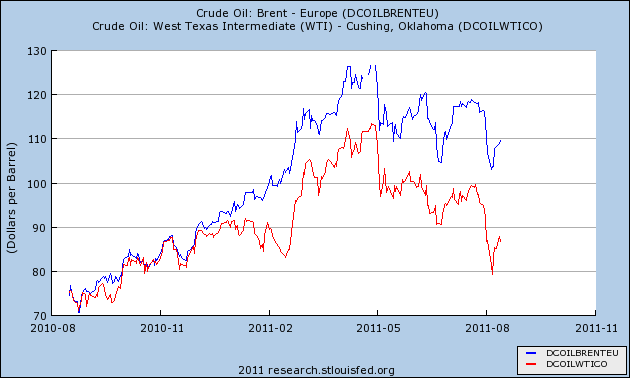
Nordhaus is undoubtedly correct in emphasizing the bathtub view. However, he may be overstating the case just a bit. Over the past couple of years, and especially in 2011, the spread between WTI and Brent crudes, which for years was almost nil, has widened to an extraordinary extent, approaching $30 a barrel in July and still remaining close to $10 a barrel.  See the chart below.

Nordhaus argues that the bathtub theory implies that imposing sanctions or an embargo on Iranian oil exports would be futile, but I suspect that although an embargo on Iranian oil exports could not cut off Iranian oil exports from the world market, it could impose a real hardship on Iran, reducing its income from oil exports by some non-negligible amount, quite likely at least 5-10%, though probably less than 25%. But I am just quibbling about a detail, an important detail to be sure, but still a detail. If you want to understand energy policy and how it fits in with other aspects of economic policy, read what Nordhaus has to say.

Correction

Sorry to have to do this, but I discovered a serious error in the table in my post from August on the European crisis.  I have inserted a new revised table correcting and updating the growth rates in the eurozone countries since 2008 and 2009.  I had hoped to post something new on the European crisis before Thanksgiving, but I have been struggling to correct and update the old table before I could get around to writing up something new on the European situation.  Perhaps I’ll have something ready over the weekend.  Again, my apologies.

A Walk Down Memory Lane with John Taylor

John Taylor has had a long and distinguished career both as an academic economist and as a government official and policy-maker.  He is justly admired for his contributions as an economist and well-liked by his colleagues and peers as a human being.  So it gives me no pleasure to aim criticism in his direction.  But it was pretty disturbing to read Professor Taylor’s op-ed piece (“A Slow-Growth America Can’t Lead the World”) in today’s Wall Street Journal, a piece devoid of even the slightest attempt to make a reasoned argument rather than assemble a hodge podge of superficial bromides about the magic of the market and the importance of fiscal discipline and sound monetary policies.  It is almost surprising that Taylor failed to mention motherhood, apple pie, and American flag while he was at.  Even more disturbing, Taylor proceeds, with no hint of embarrassment, to trash the half-hearted attempts by the Federal Reserve to use monetary policy to promote recovery even though the Fed’s policies are similar to, though much less aggressive than, the “quantitative easing” that he applauded the Japanese government and the Bank of Japan for adopting from 2002 to 2004 to extricate Japan from a decade-long period of deflation and slow growth starting in the early 1990s.

Taylor begins by attacking President Obama’s policies, strongly suggesting that those policies are responsible for the weak economic recovery.

At the most recent [G-20] meeting a year ago in Seoul, the G-20 rejected [President Obama’s] pleas for a deficit-increasing Keynesian stimulus and instead urged credible budget-deficit reduction and a return to sound fiscal policy.  And on that trip he had to defend the activist monetary policy of the Federal Reserve against widespread criticism that its easy money was damaging to emerging-market countries, causing volatile capital flows and inflationary pressures.

With a weak recovery – retarded by new health-care legislation and financial regulations, an exploding debt, and threats of higher taxes – the U.S. is in no position to lead as it has in the past.

Taylor then invidiously compares Obama’s failure in Seoul with the good old days after World War II when America called the shots.

By contrast, in the years after World War II, the U.S. led the world in promoting economic growth through reliance on the market and the incentives it provides, the rule of law, limited government, and more predictable fiscal and monetary policy.

This tendentious characterization of post-war economic policy overlooks the many sectors of the US economy then subject to strict regulation of prices and other aspects of their business operations, the powerful position of labor unions, and top marginal income tax rates as high as 92%, falling to 70% only after the Kennedy tax cuts were enacted in 1964.  High marginal tax rates and powerful labor unions were the norm in all developed countries in the 1950s and 1960s, so economic reality was far from the free-market utopia one might have imagined based on the comic-book picture offered by Taylor.  But that comic-book picture inspires Taylor to draw the following grand geopolitical lesson from the history of the last 65 years. 

As the U.S. has moved away from the principles of economic freedom – instead promoting short-term fiscal and monetary interventionism with more federal government regulations – its leadership has declined.  Some, even in the U.S., may cheer the decline, but it is not good for the world or the U.S.

Warming to his area of special expertise, monetary policy, Taylor continues by expounding on the evils of “monetary interventionism”

In the case of monetary policy . . . decisions on interest rates by foreign central banks are influenced by interest-rate decisions at the Federal Reserve because of the large size of the U.S. economy.  If the Fed holds its interest rate too low for too long, then central banks in other countries will have to hold rates low too, creating inflation risks.  If they resist, capital flows into their countries seeking higher seeking higher yields, thereby jacking up the value of their currencies and the prices of their exports.

But Professor Taylor has not always taken such a negative view of “monetary interventionism.”  In 2006, he wrote a background paper for the International Conference of the Economic and Social Research Institute Cabinet Office of the Government of Japan (September 14, 2006) entitled (I swear) “Lessons from the Recovery from the “Lost Decade” in Japan:  The Case of the Great Intervention and Money Injection.”

Describing his involvement in 2001, while Under-Secretary of the Treasury for International Affairs in the Bush Administration, in the formulation and execution of Japanese monetary policy, Taylor writes:

[I]n March 2001, the Bank of Japan announced that it would follow the new type of monetary policy, which it called “quantitative easing” and under which it would pump up the money supply in Japan until deflation ended.  I was ecstatic when I heard this announcement.  Since 1994 I had been an adviser to the Bank of Japan, a position I had to resign from when I joined the Bush Administration and I had recommended many times that the Bank of Japan focus on increasing the money supply as a means to end their deflation, and many other economists had recommended the same thing.

Now it’s true that inflation in the US as measured by the CPI has been running in the 3-4% range over the past year, but average inflation over the past 3 years has averaged only about 1% and expected inflation over a two-year time horizon has been consistently below 2% for the last year.  So the recent rise in inflation seems to be a transitory phenomenon while GDP growth remains very slow and unemployment very high.  With inflation, after a short blip, again falling and expected to remain very low for years, it is not at all clear that our situation is much different from the situation in Japan in 2001.  Yet Taylor wrote in 2006 that he had been ecstatic when he heard that the Bank of Japan “would pump up the money supply in Japan until deflation ended,” while now protesting his unqualified opposition to a not entirely dissimilar, though certainly less aggressive, policy by the Federal Reserve.

Taylor goes on to describe how the Japanese exited from their “monetary intervention.”

During the fall and winter evidence of a sustainable recovery in Japan mounted, and I thought that the sooner the recovery became clear, the soon Japan could exit from its intervention.  On December 5, 2003, I gave a speech in New York asserting that Japan was on the road to recovery.  It was still a little risky to declare victory that early, but fortunately I was right and the economy had indeed turned the corner.  Michael Phillips of the Wall Street Journal  wrote a piece entitled “U.S. Sees Reason to be Optimistic on Japan Growth” on the morning of my talk saying:  “The Bush Administration believes the Japanese economy may finally have turned the corner after more than a decade of little or no growth.  In a speech to be delivered today, the Treasury Department’s top international official, John Taylor, will credit the Koizumi government’s market changes and the Bank of Japan’s accommodating monetary policy for giving impetus to the country’s laggard economy. . . The upbeat comments from the Undersecretary of the Treasury for International Affairs represent a sharp shift in Washington’s long pessimistic view of Japan’s fortunes.”

In today’s Journal, however, the possibility that “monetary intervention” could give “impetus the [U.S]’s lagging economy” seems never even to have crossed Professor Taylor’s mind.

Some countries . . . are complaining that the Fed is exporting inflation with its near-zero interest rate and massive purchases of long-term government debt. . . And when global inflation picks up, as it has started to do in many emerging markets, it feeds back into more inflation in the U.S. through higher prices of globally traded commodities.  With unemployment already high, the result would be stagflation – slow growth, high inflation, steady unemployment – as we saw in the 1970s.

I guess we are just supposed to forget, along with Professor Taylor, about “accommodating monetary policy giving impetus to the country’s laggard economy.”  Oh my what a difference four or five years make.  Things do change, don’t they?

HT:  Benjamin Cole

Expectations Are Fundamental

Over the weekend I received a comment on my post about Clark Johnson’s new paper from someone who disputed Johnson’s assertion that it is a myth that the Fed has been following an expansionary monetary policy since the 2008 financial crisis. Here is the relevant part of the comment:

The Fed cannot fix the economy by changing “expectations” because they have no tools to follow through. Just saying that they should “change expectations” is not enough. I cannot change expectations of the whole economy, because I have no tools to follow through, the same applies to the Fed.

Even though I disagree with the commenter that the Fed cannot affect expectations, I understand and sympathize with the commenter’s skepticism that Fed could actually do so. As I have written here before, I don’t think that our current theory of fiat money explains very well how the value of a fiat money (i.e., the inverse of a comprehensively defined price level) is determined. Without such a theory, it is hard to specify the exact mechanism or channel by which a central bank can control the price level. Nevertheless, it seems clear that an essential element in that mechanism is control, though perhaps limited and imperfect, over the price-level expectations of economic agents.

Then I read this morning on Scott Sumner’s blog the following quotation from a news item in the New York Times:

WASHINGTON — The Federal Reserve made a rare promise on Tuesday to hold short-term interest rates near zero through at least the middle of 2013, in a sign that it has all but written off the chances of an expansion strong enough to drive up wages and prices. . . .

By its action, the Fed is declaring that it, too, sees little prospect of rapid growth and little risk of inflation. Its hope is that the showman’s gesture will spur investment and risk-taking by convincing markets that the cost of borrowing will not rise for at least two years.

The Fed’s statement, with its mix of grim tidings and welcome aid, contributed to wild market oscillations as investors struggled to make sense of the economy and the path ahead.

The juxtaposition of my commenter’s skepticism about the ability of the Fed to affect expectations with the news item quoted by Scott suggests to me (or, to be more precise, reinforces for me) the following observations about expectations:

  1. Expectations are partly autonomous, partly induced by policy rules or by policy announcements made by policy makers;
  2. Expectations sometimes affect outcomes;
  3. Expectations can therefore be self-fulfilling (referred to by Karl Popper as the Oedipus effect);
  4. Expectations are often contagious;
  5. Expectations can be cyclical (even exhibiting bubble-like characteristics);
  6. Expectations sometimes are, and sometimes are not, consistent with equilibrium
  7. There may be multiple equilibria corresponding to various sets of expectations;
  8. Keynes’s famous characterization (General Theory, chapter 12) of the stock market as a beauty contest has an important kernel of truth to it and does not presume that traders act irrationally;
  9. There is no clear distinction between expectations and fundamentals, because expectations are fundamentals.

If these observations about expectations are right, then conventional rational expectations (DSGE) models, which assume a unique equilibrium determined by fundamentals, are flawed at the most basic level, because they exclude a priori the existence of multiple potential equilibria. If there are many possible equilibria, each corresponding to a particular set of expectations, economic policy can affect outcomes by altering expectations, leading to the realization of a different equilibrium from the one that would have been realized under the old set of expectations. What real business cycle theorists identify as productivity shocks could just as easily be regarded as expectational shocks, possibly induced by policy choices. Put another way, by affecting expectations, monetary policy can affect not only the expected rate of inflation, it can affect the real rate of interest, so that the standard interpretation of the Fisher equation, in which expected inflation is added to an unvarying real rate of interest, is valid only on the assumption that there is a unique real equilibrium independent of the expected rate of inflation. But if there are multiple possible equilibria, whose realizations depend on what rate of inflation is expected, the observed nominal rate is not simply the sum of expected inflation and a uniform real rate, because the real rate is not uniform with respect to the expected rate of inflation.

This is what Keynes meant when (General Theory, p. 219) he rejected the concept of a unique natural rate (which in his terminology corresponded to the Fisherian real rate), because there is a different real rate corresponding to each level of employment. In fact, it is even more complicated than that because in Keynesian terminology, the real marginal efficiency of capital may shift as the expected rate of inflation changes. But we can save that complication for another time.


About Me

David Glasner
Washington, DC

I am an economist in the Washington DC area. My research and writing has been mostly on monetary economics and policy and the history of economics. In my book Free Banking and Monetary Reform, I argued for a non-Monetarist non-Keynesian approach to monetary policy, based on a theory of a competitive supply of money. Over the years, I have become increasingly impressed by the similarities between my approach and that of R. G. Hawtrey and hope to bring Hawtrey’s unduly neglected contributions to the attention of a wider audience.

My new book Studies in the History of Monetary Theory: Controversies and Clarifications has been published by Palgrave Macmillan

Follow me on Twitter @david_glasner

Archives

Enter your email address to follow this blog and receive notifications of new posts by email.

Join 665 other subscribers
Follow Uneasy Money on WordPress.com