For those interested in following me on a short excursion into philosophy and theology, click here.
Archive for the 'Uncategorized' Category
My Paper (co-authored with Paul Zimmerman) on Hayek and Sraffa
Published February 20, 2013 Alchian , Austrian Business-Cycle Theory , Fisher equation , Hayek , Irving Fisher , Keynes , Piero Sraffa , Uncategorized 13 CommentsTags: Alchian, David Henderson, Hayek, Keynes, Sraffa
I have just uploaded to the SSRN website a new draft of the paper (co-authored with Paul Zimmerman) on Hayek and Sraffa and the natural rate of interest, presented last June at the History of Economics Society conference at Brock University. The paper evolved from an early post on this blog in September 2011. I also wrote about the Hayek-Sraffa controversy in a post in June 2012 just after the HES conference.
One interesting wrinkle that occurred to me just as I was making revisions in the paper this week is that Keynes’s treatment of own rates in chapter 17 of the General Theory, which was in an important sense inspired by Sraffa, but, in my view, came to a very different conclusion from Sraffa’s, was actually nothing more than a generalization of Irving Fisher’s analysis of the real and nominal rates of interest, first presented in Fisher’s 1896 book Appreciation and Interest. In his Tract on Monetary Reform, Keynes extended Fisher’s analysis into his theory of covered interest rate arbitrage. What is really surprising is that, despite his reliance on Fisher’s analysis in the Tract and also in the Treatise on Money, Keynes sharply criticized Fisher’s analysis of the nominal and real rates of interest in chapter 13 of the General Theory. (I discussed that difficult passage in the General Theory in this post). That is certainly surprising. But what is astonishing to me is that, after trashing Fisher in chapter 13 of the GT, Keynes goes back to Fisher in chapter 17, giving a generalized restatement of Fisher’s analysis in his discussion of own rates. Am I the first person to have noticed Keynes’s schizophrenic treatment of Fisher in the General Theory?
PS: My revered teacher, the great Armen Alchian passed away yesterday at the age of 98. There have been many tributes to him, such as this one by David Henderson, also a student of Alchian’s, in the Wall Street Journal. I have written about Alchian in the past (here, here, here, here, and here), and I hope to write about Alchian again in the near future. There was none like him; he will be missed terribly.
Robert Waldmann, WADR, Maybe You Really Should Calm Down
Published February 17, 2013 expectations , fiscal policy , inflation , monetary policy , Robert Waldmann , Uncategorized , zero lower bound 15 CommentsTags: FDR, liquidity trap, Robert Waldmann
Responding to this recent post of mine, Robert Waldmann wrote a post of his own with a title alluding to an earlier post of mine responding to a previous post of his. Just to recapitulate briefly, the point of the post which seems to have provoked Professor Waldmann was to refute the allegation that the Fed and the Bank of Japan are starting a currency war by following a policy of monetary ease in which they are raising (at least temporarily) their inflation target. I focused my attention on a piece written by Irwin Stelzer for the Weekly Standard, entitled not so coincidentally, “Currency Wars.” I also went on to point out that Stelzer, in warning of the supposedly dire consequences of starting a currency war, very misleadingly suggested that Hitler’s rise to power was the result of an inflationary policy followed by Germany in the 1930s.
Here is how Waldmann responds:
I do not find any reference to the zero lower bound in this post. Your analysis of monetary expansion does not distinguish between the cases when the ZLB holds and when it doesn’t. You assume that the effect of an expansion of the money supply on domestic demand can be analyzed ignoring that detail. I think it is clear that the association between the money supply and domestic demand has been different in the USA since oh September 2008 than it was before. This doesn’t seem to me to be a detail which can be entirely overlooked in any discussion of current policy.
Actually, I don’t think that, in principle, I disagree with any of this. I agree that the zero lower bound is relevant to the analysis of the current situation. I prefer to couch the analysis in terms of the Fisher equation making use of the equilibrium condition that the nominal rate of interest must equal the real rate plus expected inflation. If the expected rate of deflation is greater than the real rate, equilibrium is impossible and the result is a crash of asset prices, which is what happened in 2008. But as long as the real rate of interest is negative (presumably because of pessimistic entrepreneurial expectations), the rate of inflation has to be sufficiently above real rate of interest for nominal rates to be comfortably above zero. As long as nominal rates are close to zero and real rates are negative, the economy cannot be operating in the neighborhood of full-employment equilibrium. I developed the basic theory in my paper “The Fisher Effect Under Deflationary Expectations” available on SSRN, and provided some empirical evidence (which I am hoping to update soon) that asset prices (as reflected in the S&P 500) since 2008 have been strongly correlated with expected inflation (as approximated by the TIPS spread) even though there is no strong theoretical reason for asset prices to be correlated with expected inflation, and no evidence of correlation before 2008. Although I think that this is a better way than the Keynesian model to think about why the US economy has been underperforming so badly since 2008, I don’t think that the models are contradictory or inconsistent, so I don’t deny that fiscal policy could have some stimulative effect. But apparently that is not good enough for Professor Waldmann.
Also, I note that prior to his [Stelzer’s] “jejune dismissal of monetary policy,” Stelzer jenunely dismissed fiscal policy. You don’t mention this at all. Your omission is striking, since the evidence that Stelzer is wrong to dismiss fiscal policy is overwhelming (not overwhelming enough to overwhelm John Taylor but then mere evidence couldn’t do that). In contrast, the dismissal of monetary policy when an economy is in a liquidity trap is consistent with the available evidence.
It seems to me that Waldmann is being a tad oversensitive. Stelzer’s line was “stimulus packages don’t work very well, and monetary policy produces lots of fiat money but not very many jobs.” What was jejune was not the conclusion that fiscal policy and monetary policy aren’t effective; it was his formulation that monetary expansion produces lots of fiat money but not many jobs, a formulation which, I believe, was intended to be clever, but struck me as being not clever, but, well, jejune. So I did not mean to deny that fiscal policy could be effective at the zero lower bound, but I disagree that the available evidence is consistent with the proposition that monetary policy is ineffective in a liquidity trap. In 1933, for example, monetary policy triggered the fastest economic expansion in US history, when FDR devalued the dollar shortly after taking office, an expansion unfortunately prematurely terminated by the enactment of FDR’s misguided National Industrial Recovery Act. The strong correlation between inflation expectations and stock prices since 2008, it seems to me, also qualifies as evidence that monetary policy is not ineffective at the zero lower bound. But if Professor Waldmann has a different interpretation of the significance of that correlation, I would be very interested in hearing about it.
Instead of looking at the relationship between inflation expectations and stock prices, Waldmann wants to look at the relationship between job growth and monetary policy:
I hereby challenge you to show data on US “growth” meaning (I agree with your guess) mostly employment growth since 2007 to someone unfamiliar with the debate and ask that person to find the dates of shifts in monetary policy. I am willing to bet actual money (not much I don’t have much) that the person will not pick out QEIII or operation twist. I also guess that this person will not detect forward guidance looking at day to day changes in asset prices.
I claim that the null that nothing special happened the day QEIV was announced or any of the 4 plausible dates of announcement of QE2 (starting with a FOMC meeting, then Bernanke’s Jackson Hole speech then 2 more) can’t be rejected by the data. This is based on analysis by two SF FED economists who look at the sum of changes over three of the days (not including the Jackson Hole day when the sign was wrong) and get a change (of the sign they want) whose square is less than 6 times the variance of daily changes (of the 10 year rate IIRC). IIRC 4.5 times. Cherry picking and not rejecting the null one wants to reject is a sign that one’s favored (alternative) hypothesis is not strongly supported by the data.
I think that the way to pick out changes in monetary policy is to look at changes in inflation expectations, and I think that you can find some correlation between changes in monetary policy, so identified, and employment, though it is probably not nearly as striking as the relationship between asset prices and inflation expectations. I also don’t think that operation twist had any positive effect, but QE3 does seem to have had some. I am not familiar with the study by the San Francisco Fed economists, but I will try to find it and see what I can make out of it. In the meantime, even if Waldmann is correct about the relationship between monetary policy and employment since 2008, there are all kinds of good reasons for not rushing to reject a null hypothesis on the basis of a handful of ambiguous observations. That wouldn’t necessarily be the calm and reasonable thing to do.
It Ain’t What People Don’t Know that Gets Them into Trouble; It’s What They Know That Ain’t So
Published February 10, 2013 competitive devaluation , Hawtrey , Irwin Stelzer , Uncategorized 38 CommentsTags: currency manipulation, currency war, trade war
I start with a short autobiographical introduction. In the interlude between my brief academic career and my 25 years at the FTC, one of my jobs was as an antitrust economist at a consulting firm called NERA (National Economic Research Associates). The President (and founder) of the firm was then Irwin Stelzer who, after selling the business for a tidy sum to Marsh & McLennan, eventually relinquished day-to-day management of the firm. When I was at NERA, it actually had a reputation of being a Democratic-leaning, pro-enforcement, non-Chicago-School, firm, but, at some point after Stelzer left NERA, I began seeing articles and op-eds by him promoting a pro-Republican, pro-deregulation, agenda. He became Director of Regulatory Policy Studies at the American Enterprise Institute and subsequently Director of Economic Policy Studies at the Hudson Institute. Stelzer developed a relationship with Rupert Murdoch, writing regular columns on economic policy for a number of Murdoch publications, such as the Sunday Times and the Weekly Standard. The relationship with Murdoch has apparently made Stelzer a somewhat controversial figure in Britain, where he maintains a residence, but all details about that relationship are unknown to me. After not seeing Irwin for almost 30 years, I have recently chanced to meet him twice at concerts at the Kennedy Center in Washington, enjoying a very pleasant conversation with him, possibly even mentioning to him my new career as a blogger, and later exchanging a few emails.
I mention all this, because last night I happened to see Stelzer’s latest economic commentary in the Weekly Standard on the subject of currency wars. Given my past, and recently resumed, relationship with Stelzer, I do feel a little funny now that I am about to write somewhat critically about him, but, hey, a blogger’s gotta do what a blogger’s gotta do.
Stelzer’s first paragraph sets the tone:
Growth is the summum bonum of economic policy. Tough to arrange at home: stimulus packages don’t work very well, and monetary policy produces lots of fiat money but not very many jobs. The solution: export-led growth—the other guy will buy so much of your goods and services that your economy will grow. There are two ways to make this sort of growth happen. Lower the international value of your currency so that your output is cheaper overseas, or increase productivity at home by lowering labor and other costs and therefore the prices you need to charge foreigners. The first is painless, or so it seems initially. The second requires a politically difficult assault on benefits and union created labor market rigidities.
What we have here is a confusion of concepts and meanings. Starting with a facile identification of the highest good of economic policy with growth, where growth seems to denote growth in employment, Stelzer offers up a jejune dismissal of monetary policy, and concludes that exports are the answer. How are exports to be increased? The easy, but disreputable, way is to depreciate your currency, the hard, but virtuous, way is to cut your costs. The underlying confusion here is that between the nominal and the real exchange rate. Let me try to sort things out.
A nominal exchange rate tells you how much of one currency can be exchanged for a unit of another currency. The exchange rate between the dollar and the euro is now about $1.33 per euro. If the euro depreciated against the dollar, the exchange rate might fall to something like, say, $1.25 per euro. For given euro prices of stuff made in Europe, a depreciated euro would mean that the prices, measured in dollars, of European stuff would fall, presumably causing European exports to the US to rise. The reduced exchange rate would work in favor of European exports. However, prices do change, and a falling euro would tend to raise the euro prices of the stuff made in Europe. If the US and European economies were in (foreign-trade) equilibrium before the euro depreciated against the dollar, prices of European stuff would keep going up until the European export advantage was eliminated. So even as the nominal euro exchange rate depreciated against the dollar, price adjustments would tend to restore the real euro exchange rate back to its original equilibrium level, thereby eliminating the temporary advantage enjoyed by European exports immediately after the fall in the nominal euro exchange rate.
That’s not to say that monetary policy cannot affect the real exchange rate, just that doing so requires more than reducing the nominal exchange rate. I discussed this a while back in a couple of posts (here and here) on currency manipulation and the Chinese central bank. The upshot of those posts was that to prevent domestic prices from rising in response to a depreciated nominal exchange rate, thereby offsetting the reduction in the nominal exchange rate and restoring the real exchange rate to its original level, a country (or its central bank) would have to follow a tight-money policy aimed at sterilizing the inflows of foreign cash corresponding to the increased outflow of exports.
Apparently Stelzer did not read my posts on the subject (tsk, tsk). Otherwise, he could not have written the following:
Until now, China has been the world’s devaluer par excellence, keeping the yuan low so that its export-led economy could continue to provide jobs for the millions of Chinese moving off the farms and into the cities.
Well, to begin with, China has not been keeping the nominal yuan low. For a long time, the yuan was pegged at a fixed exchange rate against the dollar. More recently, the yuan has been appreciating against the dollar. However, the Chinese central bank has been sterilizing inflows of foregin exchange and preventing domestic price increases that would have slowed the growth of Chinese exports and encouraged Chinese imports. In other words, the Chinese central bank has been printing too little money. Let’s follow Dr. Stelzer a bit further.
Now, Japan’s new prime minister Shinzo Abe has joined the war, pressuring his central bank to print money and drive down the value of the yen to rescue Japan from “the strengthening yen.” From Mr. Abe’s point of view, so far so good: the yen has fallen about 15 percent against other currencies, making Japanese cars and other products considerably cheaper overseas; the Nikkei share price index is up about 35 percent; and U.S. importers are again ordering Japanese products that they discontinued in the stronger-yen era.
Stelzer is also afraid that Brazil and Great Britain under the new Governor of the Bank of England are going to follow the bad example of China and Japan. This has him really worried.
It should be obvious that the currency war is a trade war by other means. The use of traditional weapons—tariffs to keep out imports and thereby increase demand for homemade products and create jobs—was outlawed by mutual consent of the warring parties when they agreed to abide by the rules of the World Trade Organization. So a new weapon of trade destruction has been rolled out—the printing press. Run the presses, flood the markets with your currency, and later, if not sooner, your currency will depreciate, giving you an edge in world markets. Until trading partners respond.
I’m sorry, but this is all wrong. Trade war, Chinese style, involves reducing the nominal exchange rate to gain a competitive advantage and tightening monetary policy, i.e., not running the printing presses, repeat, not running the printing presses, to prevent the increase in the money stock that would normally follow from an export surplus. The depreciation of the nominal exchange rate in response to money printing makes everyone better off, because it raises the home demand for imports while increasing the foreign demand for exports.
Last February, I published a post about Ralph Hawtrey’s take on currency wars, aka competitive devaluation, quoting at length from Hawtrey’s excellent book, Trade Depression and the Way Out. I reproduce the last three paragraphs of the passage I quoted in my earlier post.
In consequence of the competitive advantage gained by a country’s manufacturers from a depreciation of its currency, any such depreciation is only too likely to meet with recriminations and even retaliation from its competitors. . . . Fears are even expressed that if one country starts depreciation, and others follow suit, there may result “a competitive depreciation” to which no end can be seen.
This competitive depreciation is an entirely imaginary danger. The benefit that a country derives from the depreciation of its currency is in the rise of its price level relative to its wage level, and does not depend on its competitive advantage. If other countries depreciate their currencies, its competitive advantage is destroyed, but the advantage of the price level remains both to it and to them. They in turn may carry the depreciation further, and gain a competitive advantage. But this race in depreciation reaches a natural limit when the fall in wages and in the prices of manufactured goods in terms of gold has gone so far in all the countries concerned as to regain the normal relation with the prices of primary products. When that occurs, the depression is over, and industry is everywhere remunerative and fully employed. Any countries that lag behind in the race will suffer from unemployment in their manufacturing industry. But the remedy lies in their own hands; all they have to do is to depreciate their currencies to the extent necessary to make the price level remunerative to their industry. Their tardiness does not benefit their competitors, once these latter are employed up to capacity. Indeed, if the countries that hang back are an important part of the world’s economic system, the result must be to leave the disparity of price levels partly uncorrected, with undesirable consequences to everybody. . . .
The picture of an endless competition in currency depreciation is completely misleading. The race of depreciation is towards a definite goal; it is a competitive return to equilibrium. The situation is like that of a fishing fleet threatened with a storm; no harm is done if their return to a harbor of refuge is “competitive.” Let them race; the sooner they get there the better.
I would have been happy to end the post here, having a) clarified an important, but often overlooked, distinction between the nominal and the real exchange rate, b) made the important analytical point that currency manipulation or trade war via monetary policy, requires tightening, not easing, monetary policy, and c) concluded the whole discussion with a wonderful quote from R. G. Hawtrey. Unfortunately, my work is not yet complete, because Stelzer writes the following in the penultimate paragraph of his piece.
The U.S. and the UK, among others, have already deployed that weapon, and the new head of Japan’s central bank is likely to be chosen by Abe from the warrior class. Germany, not overjoyed with Draghi’s hint that he might take up arms, continues to insist that the ECB remain a non-combatant. Angela Merkel has made it clear that the long unpleasantness that followed Germany’s decision to run the money presses overtime in the 1930s is still etched in Germans’ minds, and that she agrees with Vladimir Ilyich Lenin that “the surest way to destroy a nation is to debauch its currency,” a view on which John Maynard Keynes put his stamp of approval: “Lenin was certainly right. There is no subtler, no surer means of overturning the existing basis of society than to debauch the currency.”
OMG! Something has gone very, very wrong here. I repeat the critical passage to make sure it sinks all the way in.
Angela Merkel has made it clear that the long unpleasantness that followed Germany’s decision to run the money presses overtime in the 1930s is still etched in Germans’ minds
I can’t tell if Stelzer’s memory has failed him, and he is misrepresenting what Mrs. Merkel believes, or if — and this is an even more frightening thought — Mrs. Merkel actually believes that Hitler came to power, because Germany ran the money presses overtime in the 1930s. But the plain facts are that the German hyperinflation occurred in 1923, and Hitler came to power in 1933 when Germany, after years of deflation, austerity and wage cuts imposed in a futile, and self-destructive, attempt to remain on the gold standard, was still wallowing in the depths of the Great Depression. If Chancellor Merkel’s policy is now premised on the presumed fact that Hitler came to power, not because of the misguided deflationary policies of 1929-33, but the hyperinflation of the previous decade, I tremble at the thought of what disasters may still be waiting to befall us.
John Taylor, Post-Modern Monetary Theorist
Published January 30, 2013 John Taylor , monetary policy , Uncategorized 28 CommentsTags: forward guidance, John Taylor, Scott Sumner
In the beginning, there was Keynesian economics; then came Post-Keynesian economics. After Post-Keynesian economics, came Modern Monetary Theory. And now it seems, John Taylor has discovered Post-Modern Monetary Theory.
What, you may be asking yourself, is Post-Modern Monetary Theory all about? Great question! In a recent post, Scott Sumner tried to deconstruct Taylor’s position, and found himself unable to determine just what it is that Taylor wants in the way of monetary policy. How post-modern can you get?
Taylor is annoyed that the Fed is keeping interest rates too low by a policy of forward guidance, i.e., promising to keep short-term interest rates close to zero for an extended period while buying Treasuries to support that policy.
And yet—unlike its actions taken during the panic—the Fed’s policies have been accompanied by disappointing outcomes. While the Fed points to external causes, it ignores the possibility that its own policy has been a factor.
At this point, the alert reader is surely anticipating an explanation of why forward guidance aimed at reducing the entire term structure of interest rates, thereby increasing aggregate demand, has failed to do so, notwithstanding the teachings of both Keynesian and non-Keynesian monetary theory. Here is Taylor’s answer:
At the very least, the policy creates a great deal of uncertainty. People recognize that the Fed will eventually have to reverse course. When the economy begins to heat up, the Fed will have to sell the assets it has been purchasing to prevent inflation.
Taylor seems to be suggesting that, despite low interest rates, the public is not willing to spend because of increased uncertainty. But why wasn’t the public spending more in the first place, before all that nasty forward guidance? Could it possibly have had something to do with business pessimism about demand and household pessimism about employment? If the problem stems from an underlying state of pessimistic expectations about the future, the question arises whether Taylor considers such pessimism to be an element of, or related to, uncertainty?
I don’t know the answer, but Taylor posits that the public is assuming that the Fed’s policy will have to be reversed at some point. Why? Because the economy will “heat up.” As an economic term, the verb “to heat up” is pretty vague, but it seems to connote, at the very least, increased spending and employment. Which raises a further question: given a state of pessimistic expectations about future demand and employment, does a policy that, by assumption, increases the likelihood of additional spending and employment create uncertainty or diminish it?
It turns out that Taylor has other arguments for the ineffectiveness of forward guidance. We can safely ignore his two throw-away arguments about on-again off-again asset purchases, and the tendency of other central banks to follow Fed policy. A more interesting reason is provided when Taylor compares Fed policy to a regulatory price ceiling.
[I]f investors are told by the Fed that the short-term rate is going to be close to zero in the future, then they will bid down the yield on the long-term bond. The forward guidance keeps the long-term rate low and tends to prevent it from rising. Effectively the Fed is imposing an interest-rate ceiling on the longer-term market by saying it will keep the short rate unusually low.
The perverse effect comes when this ceiling is below what would be the equilibrium between borrowers and lenders who normally participate in that market. While borrowers might like a near-zero rate, there is little incentive for lenders to extend credit at that rate.
This is much like the effect of a price ceiling in a rental market where landlords reduce the supply of rental housing. Here lenders supply less credit at the lower rate. The decline in credit availability reduces aggregate demand, which tends to increase unemployment, a classic unintended consequence of the policy.
When economists talk about a price ceiling what they usually mean is that there is some legal prohibition on transactions between willing parties at a price above a specified legal maximum price. If the prohibition is enforced, as are, for example, rent ceilings in New York City, some people trying to rent apartments will be unable to do so, even though they are willing to pay as much, or more, than others are paying for comparable apartments. The only rates that the Fed is targeting, directly or indirectly, are those on US Treasuries at various maturities. All other interest rates in the economy are what they are because, given the overall state of expectations, transactors are voluntarily agreeing to the terms reflected in those rates. For any given class of financial instruments, everyone willing to purchase or sell those instruments at the going rate is able to do so. For Professor Taylor to analogize this state of affairs to a price ceiling is not only novel, it is thoroughly post-modern.
More on Currency Manipulation
Published November 8, 2012 currency manipulation , gold standard , Great Depression , Hayek , monetary policy , Scott Sumner , Uncategorized 19 CommentsMy previous post on currency manipulation elicited some excellent comments and responses, helping me, I hope, to gain a better understanding of the subject than I started with. What seemed to me the most important point to emerge from the comments was that the Chinese central bank (PBC) imposes high reserve requirements on banks creating deposits. Thus, the creation of deposits by the Chinese banking system implies a derived demand for reserves that must be held with the PBC either to satisfy the legal reserve requirement or to satisfy the banks’ own liquidity demand for reserves. Focusing directly on the derived demand of the banking system to hold reserves is a better way to think about whether the Chinese are engaging in currency manipulation and sterilization than the simple framework of my previous post. Let me try to explain why.
In my previous post, I argued that currency manipulation is tantamount to the sterilization of foreign cash inflows triggered by the export surplus associated with an undervalued currency. Thanks to an undervalued yuan, Chinese exporters enjoy a competitive advantage in international markets, the resulting export surplus inducing an inflow of foreign cash to finance that surplus. But neither that surplus, nor the undervaluation of the yuan that underlies it, is sustainable unless the inflow of foreign cash is sterilized. Otherwise, the cash inflow, causing a corresponding increase in the Chinese money supply, would raise the Chinese price level until the competitive advantage of Chinese exporters was eroded. Sterilization, usually conceived of as open-market sales of domestic assets held by the central bank, counteracts the automatic increase in the domestic money supply and in the domestic price level caused by the exchange of domestic for foreign currency. But this argument implies (or, at least, so I argued) that sterilization is not occurring unless the central bank is running down its holdings of domestic assets to offset the increase in its holdings of foreign exchange. So I suggested that, unless the Chinese central holdings of domestic assets had been falling, it appeared that the PBC was not actually engaging in sterilization. Looking at balance sheets of the PBC since 1999, I found that 2009 was the only year in which the holdings of domestic assets by the PBC actually declined. So I tentatively concluded that there seemed to be no evidence that, despite its prodigious accumulation of foreign exchange reserves, the PBC had been sterilizing inflows of foreign cash triggered by persistent Chinese export surpluses.
Somehow this did not seem right, and I now think that I understand why not. The answer is that reserve requirements imposed by the PBC increase the demand for reserves by the Chinese banking system. (See here.) The Chinese reserve requirements on the largest banks were until recently as high as 21.5% of deposits (apparently the percentage is the same for both time deposits and demand deposits). The required reserve ratio is the highest in the world. Thus, if Chinese banks create 1 million yuan in deposits, they are required to hold approximately 200,000 yuan in reserves at the PBC. That 200,000 increase in reserves must come from somewhere. If the PBC does not create those reserves from domestic credit, the only way that they can be obtained by the banks (in the aggregate) is by obtaining foreign exchange with which to satisfy their requirement. So given a 20% reserve requirement, unless the PBC undertakes net purchases of domestic assets equal to at least 200,000 yuan, it is effectively sterilizing the inflows of foreign exchange. So in my previous post, using the wrong criterion for determining whether sterilization was taking place, I had it backwards. The criterion for whether sterilization has occurred is whether bank reserves have increased over time by a significantly greater percentage than the increase in the domestic asset holdings of the PBC, not, as I had thought, whether those holdings of the PBC have declined.
In fact it is even more complicated than that, because the required-reserve ratio has fluctuated over time, the required-reserve ratio having roughly tripled between 2001 and 2010, so that the domestic asset holdings of the PBC would have had to increase more than proportionately to the increase in reserves to avoid effective sterilization. Given that the reserves held by banking system with the PBC at the end of 2010 were almost 8 times as large as they had been at the end of 2001, while the required reserve ratio over the period roughly tripled, the domestic asset holdings of the PBC should have increased more than twice as fast as bank reserves over the same period, an increase of, say, 20-fold, if not more. In the event, the domestic asset holdings of the PBC at the end of 2010 were just 2.2 times greater than they were at the end of 2001, so the inference of effective sterilization seems all but inescapable.
Why does the existence of reserve requirements mean that, unless the domestic asset holdings of the central bank increase at least as fast as reserves, sterilization is taking place? The answer is that the existence of a reserve requirement means that an increase in deposits implies a roughly equal percentage increase in reserves. If the additional reserves are not forthcoming from domestic sources, the domestic asset holdings of the central bank not having increased as fast as did required reserves, the needed reserves can be obtained from abroad only by way of an export surplus. Thus, an increase in the demand of the public to hold deposits cannot be accommodated unless the required reserves can be obtained from some source. If the central bank does not make the reserves available by purchasing domestic assets, then the only other mechanism by which the increased demand for deposits can be accommodated is through an export surplus, the surplus being achieved by restricting domestic spending, thereby increasing exports and reducing imports. The economic consequences of the central bank not purchasing domestic assets when required reserves increase are the same as if the central bank sold some of its holdings of domestic assets when required reserves were unchanged.
The more general point is that one cannot assume that the inflow of foreign exchange corresponding to an export surplus is determined solely by the magnitude of domestic currency undervaluation. It is also a function of monetary policy. The tighter is monetary policy, the larger the export surplus, the export surplus serving as the mechanism by which the public increases their holdings of cash. Unfortunately, most discussions treat the export surplus as if it were determined solely by the exchange rate, making it seem as if an easier monetary policy would have little or no effect on the export surplus.
The point is similar to one I made almost a year ago when I criticized F. A. Hayek’s 1932 defense of the monetary policy of the insane Bank of France. Hayek acknowledged that the gold holdings of the Bank of France had increased by a huge amount in the late 1920s and early 1930s, but, nevertheless, absolved the Bank of France of any blame for the Great Depression, because the quantity of money in France had increased by as much as the increase in gold reserves of the Bank of France. To Hayek this meant that the Bank of France had done “all that was necessary for the gold standard to function.” This was a complete misunderstanding on Hayek’s part of how the gold standard operated, because what the Bank of France had done was to block every mechanism for increasing the quantity of money in France except the importation of gold. If the Bank of France had not embarked on its insane policy of gold accumulation, the quantity of money in France would have been more or less the same as it turned out to be, but France would have imported less gold, alleviating the upward pressure being applied to the real value of gold, or stated equivalently alleviating the downward pressure on the prices of everything else, a pressure largely caused by insane French policy of gold accumulation.
The consequences of the Chinese sterilization policy for the world economy are not nearly as disastrous as those of the French gold accumulation from 1928 to 1932, because the Chinese policy does not thereby impose deflation on any other country. The effects of Chinese sterilization and currency manipulation are more complex than those of French gold accumulation. I’ll try to at least make a start on analyzing those effects in an upcoming post addressing the comments of Scott Sumner on my previous post.
My Paper on the Monetary Theories of Ricardo and Thornton Is Now Available
Published October 29, 2012 Uncategorized 23 CommentsI have just posted (on the Social Science Research Network) a revised version of a paper I presented last year in Tokyo at the Ricardo Society Conference on Money, Finance and Ricardo. The paper, “Monetary Disequilibrium and the Demand for Money in Ricardo and Thornton,” will be published next year by Routledge in a forthcoming volume edited by Susumu Takenaga, containing the papers presented at the conference. Here is the abstract of my paper.
This paper attempts to provide an account of the reasons for the differences between the theories of David Ricardo and Henry Thornton for the depreciation of sterling during the Napoleonic Wars. Ricardo held that only overissue by the Bank of England could cause depreciatiaon of sterling during the Restriction while Thornton believed that other causes, like a bad harvest, could also be responsible for declining value of sterling in terms of bullion. Ricardo thought that a strict application of the conditions of international commodity arbitrage under the gold standard showed that a bad harvest could not cause a depreciation of sterling, but, applying a barter model, he failed to consider the effect of a bad harvest on the demand for money. In contrast, Thornton’s anticipation of Wicksell’s natural-rate theory did not strictly adhere to the conditions of international commodity arbitrage assumed by Ricardo, allowing for the operation of a Humean price-specie-flow mechanism, but, like Ricardo, Thornton implicitly made the untenable assumption of an unchanging demand for money.
The paper is available for download at the Social Science Research Network website. Here’s a link
http://papers.ssrn.com/sol3/papers.cfm?abstract_id=2168012
Any comments or suggestions would be greatly appreciated.
Free exchange, the economics column in the Economist, has a really interesting piece in this week’s issue on two theories of the origin of money. The first theory is the evolutionary market theory propounded by Carl Menger, one of the three independent and simultaneous co-discoverers of the marginal utility theory of value in the early 1870s, (the two co-discoverers being William Stanley Jevons and Leon Walras) in a classic 1892 paper “On the Origins of Money,” and the other being the Cartalist theory, famously advanced by G. F. Knapp in his State Theory of Money, but also by other more orthodox theorists like P. H. Wicksteed (see my earlier posts here and here), and more recently in a paper by Charles Goodhart, discover of Goodhart’s Law, an only slightly less general statement of what came to be known some years later as the Lucas Critique.
Menger’s theory is a brilliant conjectural history of how money might have evolved as the result of individual choices by individuals seeking to reduce their transactions costs in an economic environment that is changing from subsistence farming into a market economy characterized by specialization. Some individuals, realizing that certain commodities were easier to trade than others, would begin holding inventories of those goods beyond their immediate demands, thereby enhancing their ability to find trading partners. But by holding inventories of those commodities, these alert individuals would do two things, first they would make it even easier to trade in those commodities, and second they would induce other people to follow their example. As others followed their example, the costs of trading in those commodities originally identified as low cost commodities to trade would be reduced still more. This was an early description of what have recently come to be known as network effects or network externalities. A good characterized by a network effect is a good for which the demand increases as more people demand it. Menger beautifully described the process by which a commodity would emerge as money owing to the network effects inherent in being used as a medium of exchange.
While theoretically brilliant and supported by some historical evidence, Menger’s conjectural history hardly provides a complete or unerring account of the development of money. One important part of the story that Menger left out is the pervasive, though not necessarily exclusive, role of the state in the development of money. Here is Free exchange:
Take the widespread use of precious metals as money. A Mengerian would say that this happens because metals are durable, divisible and portable: that makes them an ideal medium of exchange. But it is incredibly hard to value raw metals, Mr Goodhart argued, so the cost of using them in trade is high. It is much easier to assess the value of a bag of salt or a cow than a lump of metal. Raw metals fail Menger’s own saleableness test.
This is complicated. Traders traveling long distances would want to use a medium of exchange that had a high value relative to the cost of transportation. So precious metals probably became more important as media of exchange not in the earliest stages of the historical development of money, when salt and cattle were widely used, but at a later stage, when professional traders began buying in one location and selling in other, distant locations, precious metals served their purposes better than bulkier commodities, much more costly to transport than precious metals. Free exchange continues:
This problem explains why metal money has circulated not in lumps but as coins, with a regulated amount of metal in each coin. But history shows that minting developed not as a private-sector attempt to minimise the costs of trading, but as a government operation. It was state intervention, not the private market, that made metal specie work as money.
Again, my reading of the historical evidence – and I don’t claim more than a superficial knowledge of the historical evidence – is that there is evidence of early private minting operations. However, the early private mints were quickly displaced by mints operated by the state (or whatever you care to call the organizations headed by early monarchs). In my book Free Banking and Monetary Reform, I argued that having a monopoly over the mint was beneficial to the survival chances of any “state” competing for survival against other nearby states. To be able to survive, a state needed to be able to hire soldiers and pay for weapons. How could a monarch do that if he didn’t have an efficient system of collecting taxes? One very good way was to own a mint, and have at least a local monopoly over the minting of coins, which gave the monarch the ability to raise funds in an emergency by debasing the coinage. A prudent state would not debase the coinage except under dire circumstances, but in order to be able to engage in currency debasement, the state needed a monopoly over the coinage, and the ability to force its subjects to accept those coins at face value to discharge previously contracted obligations. Monarchs that were also monopolists over mints had an important advantage in competition with monarchs without a mint. So mints became part of the essential equipment of any self-respecting monarch. Back to Free exchange:
Mr Goodhart used monetary history to test these competing theories. He examined the overthrow of Rome and a period in the tenth century when the Japanese government stopped minting coins. If the origin of money were purely private, these shocks should have had no monetary effects. But after Rome’s collapse, traders resorted to barter; in Japan they started to use rice instead of coins. There is a clear link between fiscal power and money.
My interpretation of Roman history (I am afraid that I must plead ignorance about Japanese history) is a bit different. The overthrow of Rome was largely the work of the Arab conquests of the seventh and eighth centuries. Henri Pirenne in his wonderful book Mohammed and Charlemagne argued that the Arab conquests of most of the Mediterranean sea ports essentially cut off the long-distance Mediterranean trade of the remnants of Western Roman empire. The closing off of export markets and the corresponding loss of imported goods caused a regression from specialization and trade back to autarchy. As foreign trade collapsed, local economies became increasingly self-sufficient and the demand for money dropped correspondingly. Reversion to barter was not occasioned by the absence of a state that provided coinage, but by the collapse of an exchange economy that created the demand for coinage.
So I don’t see the conflict between the Mengerian theory and Cartalist theory as being as sharp as Goodhart and Free exchange seem to suggest. On the other hand, the 1998 paper by Goodhart was remarkably prescient in describing the kinds of problems that have beset the euro, problems closely associated with “unprecedented divorce between the main monetary and fiscal authorities” in charge of conducting policy for the Eurozone.
The topic is far from exhausted, but I am. Perhaps I will have more to say on subject in a future post.
In my previous post, I discussed Arthur Laffer’s op-ed in Monday’s Wall Street Journal, in which he argued that a comparison across 34 countries belonging to the OECD showed that the adoption of greater fiscal stimulus in the 2007-09 time period was bigger declines in the rate of economic growth. Laffer argued that this correlation provides conclusive empirical refutation of the Keynesian doctrine that additional government spending can stimulate economic recovery.
In my earlier post, I complained that Laffer had not explained the meaning of one of the variables — the change in government spending as a percentage of GDP — that he used to make his comparison, and did not provide an adequate source for where his numbers came from, noting that when I tried to calculate the same number using the data on the St. Louis Fed website, I arrived at a substantially smaller value for the US change in government spending as a fraction of GDP than Laffer’s reported. I also observed that the change in government spending as a percentage of GDP can rise not just because of an increase in government spending, but can also rise because of a contraction in total GDP, making the comparison Laffer was purporting to perform invalid, the comparison amounting to no more than a restatement of the truism that countries with bigger contractions in GDP would experience bigger reductions in their rates of growth than countries with smaller reductions in GDP.
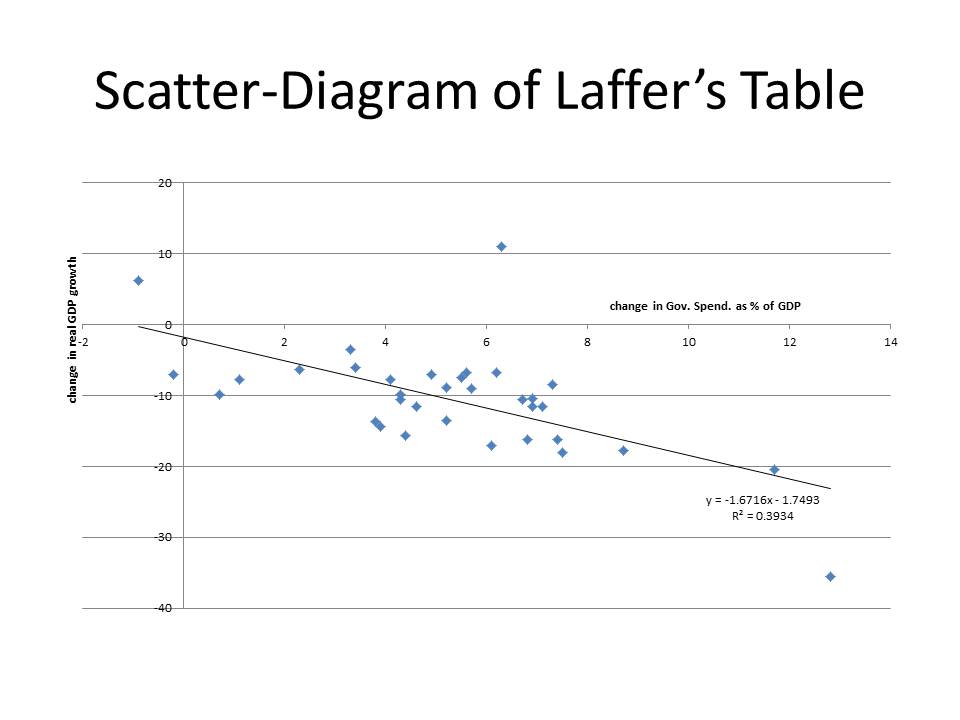
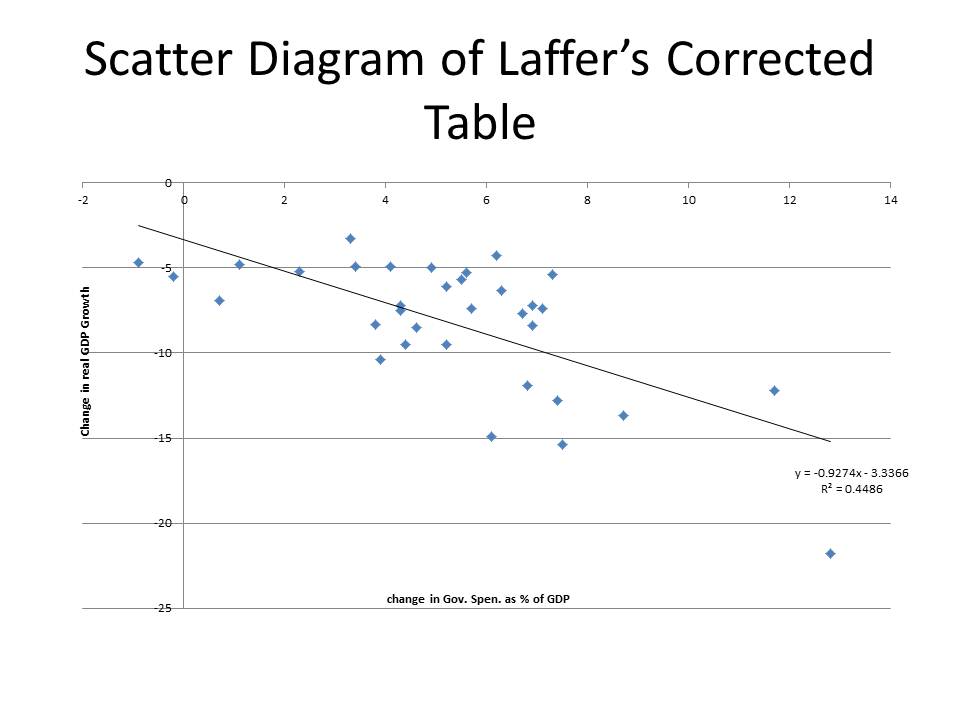
JR, a diligent commenter to my post, kindly provided me with the source for Laffer’s numbers on the IMF website, confirming that the numbers Laffer used for the change in government spending as a percentage of GDP did indeed reflect the underlying data reported by the IMF. JR was unable to reproduce Laffer’s numbers for the change in real GDP growth, and neither could I. But when I calculated the changes and replaced them in Laffer’s table, I found a similar negative relationship and a better fit (higher r-squared) than shown in Laffer’s table. In either case, the main reason for the negative correlation is that a decrease in real GDP growth is, by definition, correlated with an increase in government spending as a percentage of GDP. So Laffer’s result is pre-ordained by his choice of variables.
To show what is going on, I provide below two scatter diagrams of Laffer’s table with his numbers and my corrections of the numbers. You can see that the downward slope of the regression line is steeper using his original numbers, but there is less variation around the regression line with the corrected numbers.
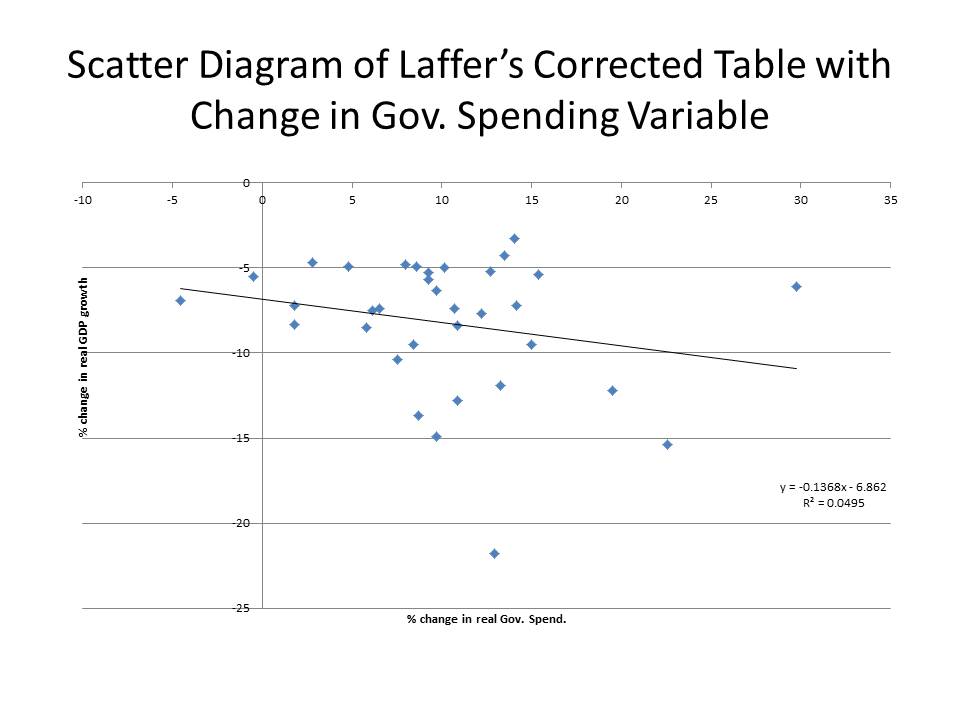
To see what happens when you eliminate the inherent negative correlation between the change in government spending as a percentage of GDP and the rate of growth of GDP, I recalculated the government spending variable as the real percentage change in GDP between 2007 and 2009. Substituting that redefined variable which is definitionally independent of changes in GDP gives me the following scatter diagram. The slope is still negative, but it is an order of magnitude less than the slope of the regression line implied by Laffer’s numbers.
I then tried on further variation which was to replace the change in the growth rate of real GDP between 2007 and 2009 with the change in real GDP between 2007 and 2009. Here is the scatter diagram for corresponding to that change in variables.
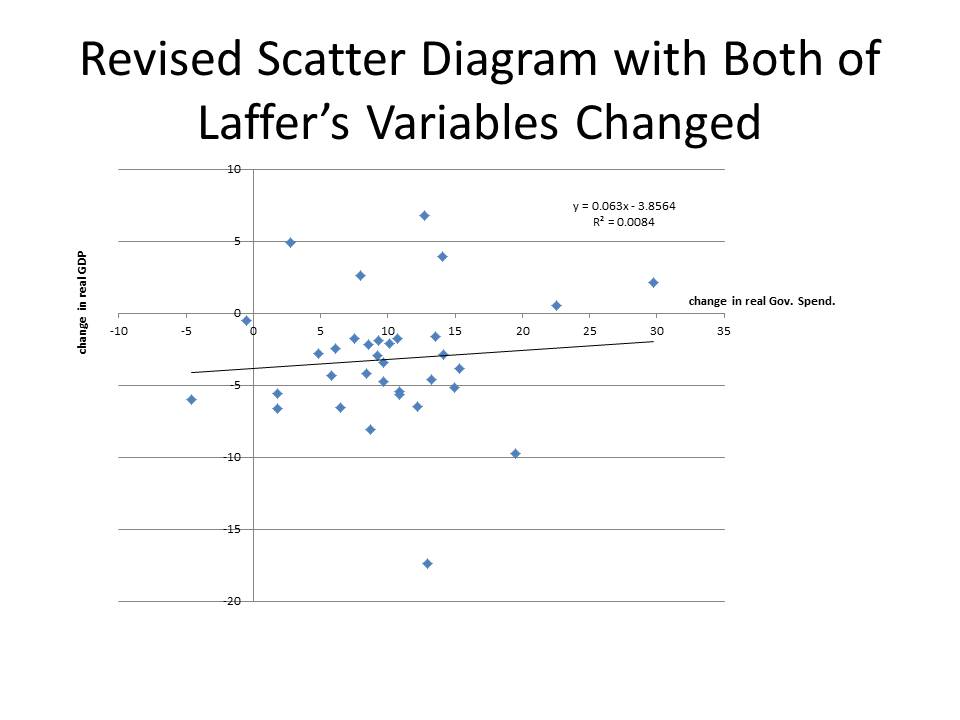
As you can see, the regression line now has a positive slope, though it is probably statistically insignificant given the very low value of the r-squared. But in view of the simultaneity issues, I mentioned in my previous post, that is hardly surprising.
Some readers are probably wondering why I bothered posting all this. I am asking myself the same question, but I just couldn’t help trying to figure out what Professor Laffer was up to. Perhaps this makes it all a bit clearer.
Someone Out There Is a Flat-Earther, But Who Is It?
Published July 16, 2012 Uncategorized 32 CommentsSince Stephen Williamson posted his criticism of NGDP-targeting last week, a series of responses (here and here) and counter-responses have taken the discussion beyond the mere discussion of a criterion or rule for monetary policy, transforming it into a deep discussion of nothing less than alternative world-views. The catalyst for this shift in the nature of the discussion was Williamson’s use in his first post of the Hodrick-Prescott filter to detrend quarterly GDP data since 1947. Scott Sumner noted in his initial reply to Williamson that the Hodrick-Prescott filter necessarily interprets a downturn occurring at the end of the time series as a shift in, rather than a deviation from, the trend, thereby imposing a particular view of the nature of the recent downturn that might or might not be correct. In my comment on the initial Williamson-Sumner exchange, I noted Scott’s point, and added that an eminent time-series econometrician, Andrew Harvey, had warned about the possibility of spurious results from application of the HP filter, though he did not reject its use as necessarily inappropriate. Brad Delong and Tim Duy picked up on my warnings about the potential for HP filtering to result in spurious results with what seemed like blanket condemnations of the HP filter. This is when Paul Krugman joined the fray, warning that the HP filter could be used to show that the Great Depression reflected not a huge departure from the economy’s potential output and employment levels, but a shift in those levels.
[T]he methodology of using the HP filter basically assumes that such things don’t happen. Instead, any protracted slump gets interpreted as a decline in potential output! Here’s the chart I made way back in 1998 for the 1930s:
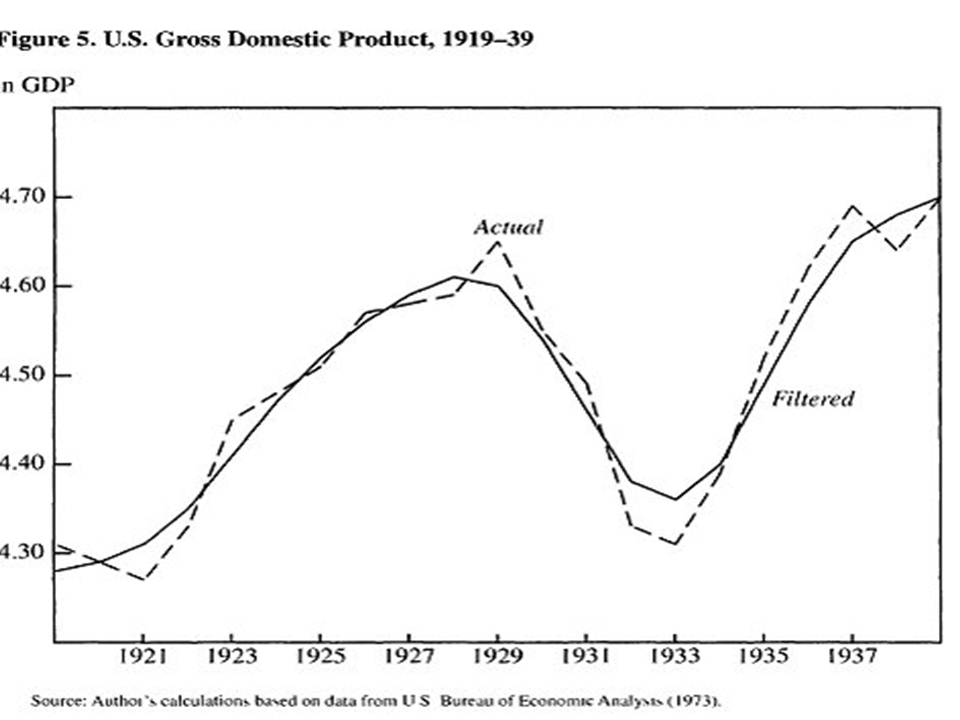
Yep: the HP filter “decided” that the US economy was back at potential by 1935. Why? Because it automatically interpreted the Great Depression as a sustained decline in potential, because by assumption the filter incorporated such slumps into its estimate of the economy’s potential. Strange to say, however, it turned out that there was in fact a huge amount of excess capacity in America, needing only an increase in demand to be put back into operation.
It seems totally obvious to me that people who are now using HP filters to argue that we’re already at full employment are making exactly the same mistake. They have in effect, without realizing it, assumed their answer — using a statistical technique that only works if prolonged slumps below potential GDP can’t happen.
As always, statistical techniques are only as good as the economic assumptions behind them. And in this case the assumptions are just wrong.
This attack by Krugman predictably elicited a response from Williamson. The response might have simply noted that applying the HP filter requires the investigator to make assumptions about the frequency of changes in the underlying trend, and that such assumptions ought in some sense to be reasonable. The particular assumption underlying Krugman’s figure was not necessarily reasonable — it didn’t smooth enough — and probably would not be accepted as such by those who like to use the HP filter. Williamson made this point, but he went beyond it, discussing how the HP filter is used within the larger theoretical paradigm known as modern real-business-cycle theory.
I won’t attempt to summarize Williamson’s discussion, but this is the point that I would like to focus on. Real-business cycle theory posits that observed fluctuations in economic time series, like real GDP and employment, can be understood as responses by economic agents to underlying changes in real underlying economic conditions, e.g., changes in labor productivity. Persistent changes in GDP must therefore reflect changes in the underlying real economic conditions, i.e., changes in the trend, while short-term fluctuations around the trend correspond to what we refer to as business cycles. The HP filter smoothes, but does not eliminate, fluctuations in the trend corresponding to persistent changes in the time series. When the time-series show persistent movements, as growth in GDP has shown since the middle of the last decade, even before 2008, real-business-cycle theory assumes that underlying real economic conditions are responsible for a downward change in the underlying trend. There may be transitory changes in the observed time series about the trend, but the trend itself is assumed to have changed. If the trend itself has changed, there is not necessarily any room for policy to make things any better than they are.
It is that view of the world that informs the following statement by Jeffrey Lacker, President of the Richmond Fed, quoted by Williamson:
Given what’s happened to this economy, I think we’re pretty close to maximum employment right now.
Williamson adds:
The “dual mandate” the Fed operates under includes language to the effect that the Fed should try to achieve maximum employment. Lacker says we’re there, and I’m inclined to agree with him.
Noah Smith wrote a splendid post today about Williamson’s post in which he gave the following description of Ned Prescott’s strategy for modeling real business cycles:
- Chose how big of a “business cycle” he wanted to model. [By an appropriate parameter choice in the HP filter]
- Built a model of business cycles that produced fluctuations of about the size he chose in step A, and
- Claimed to have explained the business cycle.
The reason that this is not an entirely circular exercise is that although “the amount of smoothing in the HP filter is a free parameter . . . , if you choose it too big or too small, people will be skeptical. After all, we have other measures of recessions, like the NBER recessions.”
The situation described by Williamson and Smith (who, I should note, is not really a fan of real-business-cycle theory) reminds me of the situation at the time of Galileo, when Galileo was trying to explain to people why they should disregard their common-sense notion that the earth is stationary and flat, and that the sun revolves around the earth. In his famous book, The Structure of Scientific Revolutions, Thomas Kuhn called the clash between Galileo and scientific establishment of his time a clash of paradigms and of world views. Kuhn made the controversial claim that, based on the available evidence at the time, the received Ptolomeic paradigm was empirically better supported the than revolutionary Copernican-Galilean paradigm. Nevertheless, the Copernican-Galilean world view fairly quickly won out, producing a paradigm shift even before Newton provided more powerful evidence than Galileo for the heliocentric paradigm. Each paradigm could still interpret evidence apparently in conflict with its predictions by reinterpreting the evidence. Evidence was interpreted not in some purely objective, neutral way – there is no Olympian perspective from which facts can be objectively determined — but from the perspective of the paradigm that either side was trying to uphold.
Similarly today we are watching a clash between two competing paradigms of business cycles. The received paradigm of business cycles holds that persistent deviations of observed real GDP growth and employment from long-run stable trends are problematic and call for policy responses to eliminate or reduce those deviations. Real-business-cycle theorists reject that understanding of business cycles. If there are persistent deviations of observed real GDP and employment from their long-run trends, it is the trends that must have changed. This difference in world views has, on occasion, been described, misleadingly in my view, as a conflict between Keynesian economics and common sense, and in a post that I wrote almost a year ago, I cited Galileo to show that our common-sense notions are not always infallible.
There is a strong temptation to dismiss real-business-cycle theory simply on the grounds that it seems to fly in the face of our common-sense view that in recessions and depressions, people who would like to work can’t find employment. I think that real-business cycle theory should be dismissed, but to do so will require better reasons than a conflict with our common sense. Remember it was the flat-earthers who were upholding common sense against Galileo. We need more sophisticated arguments than appeals to common sense to dispose of annoying modern real-business-cycle theory.

 Uneasy Money