Michael Woodford’s paper for the Jackson Hole Symposium on Monetary Policy wasn’t the only important paper on monetary economics to be posted on the internet last month. David Laidler, perhaps the world’s greatest expert on the history of monetary theory and macroeconomics since the time of Adam Smith, has written an important paper with the somewhat cryptic title, “Two Crises, Two Ideas, and One Question.” Most people will figure out pretty quickly which two crises Laidler is referring to, but you will have to read the paper in order to figure out which two ideas and which question, Laidler has on his mind. Actually, you won’t have to read the paper if you keep reading this post, because I am about to tell you. The two ideas are what Laidler calls the “Fisher relation” between real and nominal interest rates, and the idea of a lender of last resort. The question is whether a market economy is inherently stable or unstable.
How does one weave these threads into a coherent narrative? Well, to really understand that you really will just have to read Laidler’s paper, but this snippet from the introduction will give you some sense of what he is up to.
These two particular ideas are especially interesting, because in the 1960s and ’70s, between our two crises, they feature prominently in the Monetarist reassessment of the Great Depression, which helped to establish the dominance in macroeconomic thought of the view that, far from being a manifestation of deep flaws in the very structure of the market economy, as it had at first been taken to be, this crisis was the consequence of serious policy errors visited upon an otherwise robustly self-stabilizing system. The crisis that began in 2007 has re-opened this question.
The Monetarist counterargument to the Keynesian view that the market economy is inherently subject to wide fluctuations and has no strong tendency toward full employment was that the Great Depression was caused primarily by a policy shock, the failure of the Fed to fulfill its duty to act as a lender of last resort during the US financial crisis of 1930-31. Originally, the Fisher relation did not figure prominently in this argument, but it eventually came to dominate Monetarism and the post-Monetarist/New Keynesian orthodoxy in which the job of monetary policy was viewed as setting a nominal interest rate (via a Taylor rule) that would be consistent with expectations of an almost negligible rate of inflation of about 2%.
This comfortable state of affairs – Monetarism without money is how Laidler describes it — in which an inherently stable economy would glide along its long-run growth path with low inflation, only rarely interrupted by short, shallow recessions, was unpleasantly overturned by the housing bubble and the subsequent financial crisis, producing the steepest downturn since 1937-38. That downturn has posed a challenge to Monetarist orthodoxy inasmuch as the sudden collapse, more or less out of nowhere in 2008, seemed to suggest that the market economy is indeed subject to a profound instability, as the Keynesians of old used to maintain. In the Great Depression, Monetarists could argue, it was all, or almost all, the fault of the Federal Reserve for not taking prompt action to save failing banks and for not expanding the money supply sufficiently to avoid deflation. But in 2008, the Fed provided massive support to banks, and even to non-banks like AIG, to prevent a financial meltdown, and then embarked on an aggressive program of open-market purchases that prevented an incipient deflation from taking hold.
As a result, self-identifying Monetarists have split into two camps. I will call one camp the Market Monetarists, with whom I identify even though I am much less of a fan of Milton Friedman, the father of Monetarism, than most Market Monetarists, and, borrowing terminology adopted in the last twenty years or so by political conservatives in the US to distinguish between old-fashioned conservatives and neoconservatives, I will call the old-style Monetarists, paleo-Monetarists. The paelo-Monetarists are those like Alan Meltzer, the late Anna Schwartz, Thomas Humphrey, and John Taylor (a late-comer to Monetarism who has learned quite well how to talk to the Monetarist talk). For the paleo-Monetarists, in the absence of deflation, the extension of Fed support to non-banking institutions and the massive expansion of the Fed’s balance sheet cannot be justified. But this poses a dilemma for them. If there is no deflation, why is an inherently stable economy not recovering? It seems to me that it is this conundrum which has led paleo-Monetarists into taking the dubious position that the extreme weakness of the economic recovery is a consequence of fiscal and monetary-policy uncertainty, the passage of interventionist legislation like the Affordable Health Care Act and the Dodd-Frank Bill, and the imposition of various other forms of interventionist regulations by the Obama administration.
Market Monetarists, on the other hand, have all along looked to monetary policy as the ultimate cause of both the downturn in 2008 and the lack of a recovery subsequently. So, on this interpretation, what separates paleo-Monetarists from Market Monetarists is whether you need outright deflation in order to precipitate a serious malfunction in a market economy, or whether something less drastic can suffice. Paleo-Monetarists agree that Japan in the 1990s and even early in the 2000s was suffering from a deflationary monetary policy, a policy requiring extraordinary measures to counteract. But the annual rate of deflation in Japan was never more than about 1% a year, a far cry from the 10% annual rate of deflation in the US between late 1929 and early 1933. Paleo-Monetarists must therefore explain why there is a radical difference between 1% inflation and 1% deflation. Market Monetarists also have a problem in explaining why a positive rate of inflation, albeit less than the 2% rate that is generally preferred, is not adequate to sustain a real recovery from starting more than four years after the original downturn. Or, if you prefer, the question could be restated as why a 3 to 4% rate of increase in NGDP is not adequate to sustain a real recovery, especially given the assumption, shared by paleo-Monetarists and Market Monetarists, that a market economy is generally stable and tends to move toward a full-employment equilibrium.
Here is where I think Laidler’s focus on the Fisher relation is critically important, though Laidler doesn’t explicitly address the argument that I am about to make. This argument, which I originally made in my paper “The Fisher Effect under Deflationary Expectations,” and have repeated in several subsequent blog posts (e.g., here) is that there is no specific rate of deflation that necessarily results in a contracting economy. There is plenty of historical experience, as George Selgin and others have demonstrated, that deflation is consistent with strong economic growth and full employment. In a certain sense, deflation can be a healthy manifestation of growth, allowing that growth, i.e., increasing productivity of some or all factors of production, to be translated into falling output prices. However, deflation is only healthy in an economy that is growing because of productivity gains. If productivity is flagging, there is no space for healthy (productivity-driven) deflation.
The Fisher relation between the nominal interest rate, the real interest rate and the expected rate of deflation basically tells us how much room there is for healthy deflation. If we take the real interest rate as given, that rate constitutes the upper bound on healthy deflation. Why, because deflation greater than real rate of interest implies a nominal rate of interest less than zero. But the nominal rate of interest has a lower bound at zero. So what happens if the expected rate of deflation is greater than the real rate of interest? Fisher doesn’t tell us, because in equilibrium it isn’t possible for the rate of deflation to exceed the real rate of interest. But that doesn’t mean that there can’t be a disequilibrium in which the expected rate of deflation is greater than the real rate of interest. We (or I) can’t exactly model that disequilibrium process, but whatever it is, it’s ugly. Really ugly. Most investment stops, the rate of return on cash (i.e., expected rate of deflation) being greater than the rate of return on real capital. Because the expected yield on holding cash exceeds the expected yield on holding real capital, holders of real capital try to sell their assets for cash. The only problem is that no one wants to buy real capital with cash. The result is a collapse of asset values. At some point, asset values having fallen, and the stock of real capital having worn out without being replaced, a new equilibrium may be reached at which the real rate will again exceed the expected rate of deflation. But that is an optimistic scenario, because the adjustment process of falling asset values and a declining stock of real capital may itself feed pessimistic expectations about the future value of real capital so that there literally might not be a floor to the downward spiral, at least not unless there is some exogenous force that can reverse the downward spiral, e.g., by changing price-level expectations. Given the riskiness of allowing the rate of deflation to come too close to the real interest rate, it seems prudent to keep deflation below the real rate of interest by a couple of points, so that the nominal interest rate doesn’t fall below 2%.
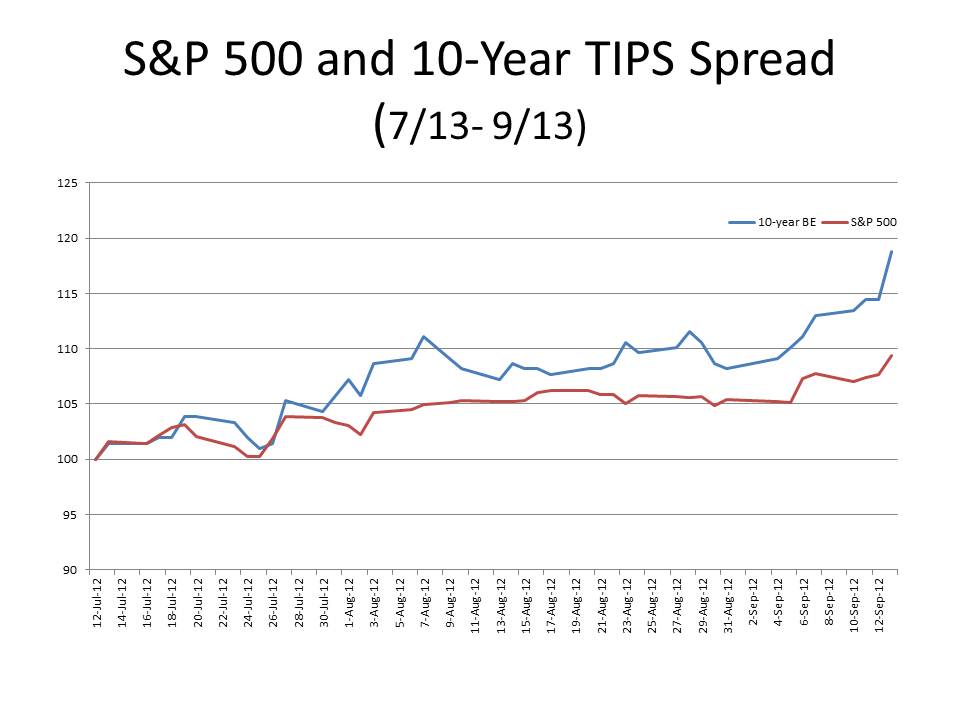
But notice that this cumulative downward process doesn’t really require actual deflation. The same process could take place even if the expected rate of inflation were positive in an economy with a negative real interest rate. Real interest rates have been steadily falling for over a year, and are now negative even at maturities up to 10 years. What that suggests is that ceiling on tolerable deflation is negative. Negative deflation is the same as inflation, which means that there is a lower bound to tolerable inflation. When the economy is operating in an environment of very low or negative real rates of interest, the economy can’t recover unless the rate of inflation is above the lower bound of tolerable inflation. We are not in the critical situation that we were in four years ago, when the expected yield on cash was greater than the expected yield on real capital, but it is a close call. Why are businesses, despite high earnings, holding so much cash rather than using it to purchase real capital assets? My interpretation is that with real interest rates negative, businesses do not see a sufficient number of profitable investment projects to invest in. Raising the expected price level would increase the number of investment projects that appear profitable, thereby inducing additional investment spending, finally inducing businesses to draw down, rather than add to, their cash holdings.
So it seems to me that paleo-Monetarists have been misled by a false criterion, one not implied by the Fisher relation that has become central to Monetarist and Post-Monetarist policy orthodoxy. The mere fact that we have not had deflation since 2009 does not mean that monetary policy has not been contractionary, or, at any rate, insufficiently expansionary. So someone committed to the proposition that a market economy is inherently stable is not obliged, as the paleo-Monetarists seem to think, to take the position that monetary policy could not have been responsible for the failure of the feeble recovery since 2009 to bring us back to full employment. Whether it even makes sense to think about an economy as being inherently stable or unstable is a whole other question that I will leave for another day.
HT: Lars Christensen



 Uneasy Money