Archive for the 'inflation' Category


Inflation Expectations Are Falling; Run for Cover

The S&P 500 fell today by more than 1 percent, continuing the downward trend began last month when the euro crisis, thought by some commentators to have been surmounted last November thanks to the consummate statesmanship of Mrs. Merkel, resurfaced once again, even more acute than in previous episodes. The S&P 500, having reached a post-crisis high of 1419.04 on April 2, a 10% increase since the end of 2011, closed today at 1338.35, almost 8% below its April 2nd peak.

What accounts for the drop in the stock market since April 2? Well, as I have explained previously on this blog (here, here, here) and in my paper “The Fisher Effect under Deflationary Expectations,” when expected yield on holding cash is greater or even close to the expected yield on real capital, there is insufficient incentive for business to invest in real capital and for households to purchase consumer durables. Real interest rates have been consistently negative since early 2008, except in periods of acute financial distress (e.g., October 2008 to March 2009) when real interest rates, reflecting not the yield on capital, but a dearth of liquidity, were abnormally high. Thus, unless expected inflation is high enough to discourage hoarding, holding money becomes more attractive than investing in real capital. That is why ever since 2008, movements in stock prices have been positively correlated with expected inflation, a correlation neither implied by conventional models of stock-market valuation nor evident in the data under normal conditions.

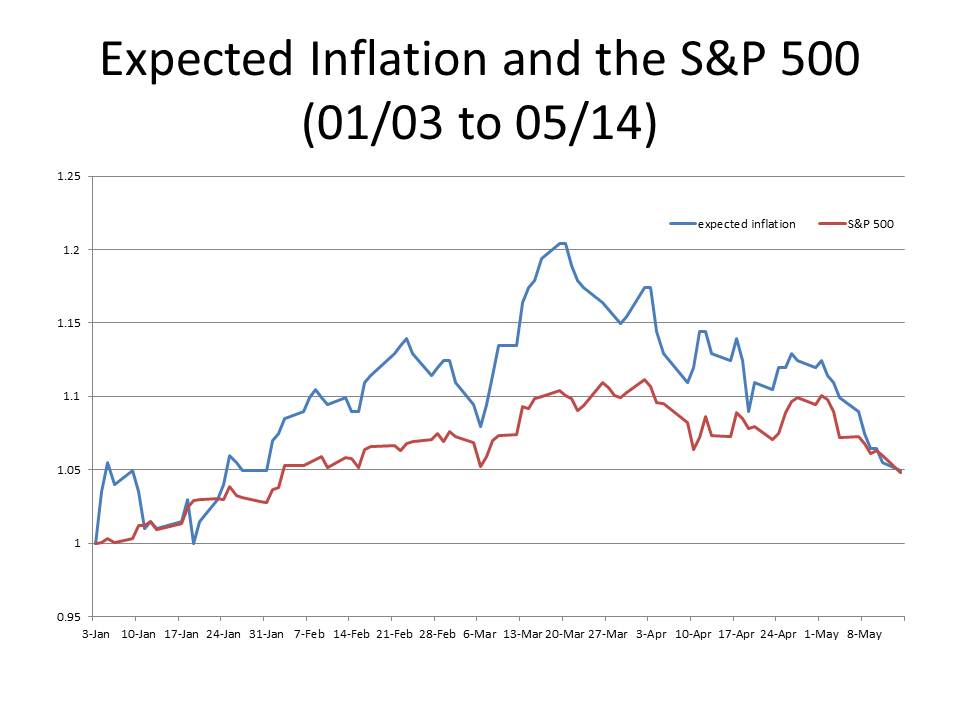
As the euro crisis has worsened, the dollar has been appreciating relative to the euro, dampening expectations for US inflation, which have anyway been receding after last year’s temporary supply-driven uptick, and after the ambiguous signals about monetary policy emanating from Chairman Bernanke and the FOMC. The correspondence between inflation expectations, as reflected in the breakeven spread between the 10-year fixed maturity Treasury note and 10-year fixed maturity TIPS, and the S&P 500 is strikingly evident in the chart below showing the relative movements in inflation expectations and the S&P 500 (both normalized to 1.0 at the start of 2012.

With the euro crisis showing no signs of movement toward a satisfactory resolution, with news from China also indicating a deteriorating economy and possible deflation, the Fed’s current ineffectual monetary policy will not prevent a further slowing of inflation and a further perpetuation of our national agony. If inflation and expected inflation keep falling, the hopeful signs of recovery that we saw during the winter and early spring will, once again, turn out to have been nothing more than a mirage

Why NGDP Targeting?

Last week, David Andolfatto challenged proponents of NGDP targeting to provide the reasons for their belief that targeting NGDP, or to be more precise the time path of NGDP, as opposed to just a particular rate of growth of NGDP, is superior to any alternative nominal target. I am probably the wrong person to offer an explanation (and anyway Scott Sumner and Nick Rowe have already responded, probably more ably than I can), because I am on record (here and here) advocating targeting the average wage level.  Moreover, at this stage of my life, I am skeptical that we know enough about the consequence of any particular rule to commit ourselves irrevocably to it come what may.  Following rules is a good thing; we all know that.  Ask any five-year old. But no rule is perfect, and even though one of the purposes of a rule is to make life more predictable, sometimes following a rule designed for, or relevant to, very different circumstances from those in which we may eventually find ourselves can produce really bad results, making our lives and our interactions with others less, not more, predictable.

So with that disclaimer, here is my response to Andolfatto’s challenge by way of comparing NGDP level targeting with inflation targeting. My point is that if we want the monetary authority to be committed to a specific nominal target, the level of NGDP seems to be a much better choice than the inflation rate.

As I mentioned, Scott Sumner and Nick Rowe have already provided a bunch of good reasons for preferring targeting the time path of NGDP to targeting either the level (or time path) of the price level or the inflation rate. The point that I want to discuss may have been touched on in their discussions, but I don’t think its implications were fully worked out.

Let me start by noting that there is a curious gap in contemporary discussions of inflation targeting; which is that despite the apparent rigor of contemporary macro models of the RBC or DSGE variety, supposedly derived from deep microfoundations, the models don’t seem to have much to say about what the optimal inflation target ought to be. The inflation target, so far as I can tell – and I admit that I am not really up to date on these models – is generally left up to the free choice of the monetary authority. That strikes me as curious, because there is a literature dating back to the late 1960s on the optimal rate of inflation. That literature, whose most notable contribution was Friedman’s 1969 essay “The Optimal Quantity of Money,” came to the conclusion that the optimal quantity of money corresponded to a rate of inflation equal to the negative of the equilibrium (or natural) real rate of interest in an economy operating at full employment.

So, Friedman’s result implies that the optimal rate of inflation ought to fluctuate as the real equilibrium (natural) rate of interest fluctuates, fluctuations to which Friedman devoted little, if any, attention in his essay. But from our perspective there is an even more serious shortcoming with Friedman’s discussion, namely, his assumption of perpetual full employment, so that the real interest rate could be identified with the equilibrium (or natural) rate of interest. Nevertheless, although Friedman seemed content with a steady-state analysis in which a unique equilibrium (natural) real interest rate defined a unique optimal rate of deflation (given a positive equilibrium real interest rate) over time, thereby allowing Friedman to achieve a partial reconciliation between the optimal-inflation analysis and his x-percent rule for steady growth in the money supply (despite the mismatch between his theoretical analysis of the rate of inflation in terms of the monetary base and his x-percent rule in terms of M1 or M2), Friedman’s analysis provided only a starting point for a discussion of optimal inflation targeting over time. But the discussion, to my knowledge, has never taken place. A Taylor rule takes into account some of these considerations, but only in an ad hoc fashion, certainly not in the spirit of the deep microfoundations on which modern macrotheory is supposedly based.

In my paper “The Fisher Effect under Deflationary Expectations,” I tried to explain and illustrate why the optimal rate of inflation is very sensitive to the real rate of interest, providing empirical evidence that the financial crisis of 2008 was a manifestation of a pathological situation in which the expected rate of deflation was greater than the real rate of interest, a disequilibrium phenomenon triggering a collapse of asset prices. I showed that, even before asset prices collapsed in the last quarter of 2008, there was an unusual positive correlation between changes in expected inflation and changes in the S&P 500, a correlation that has continued ever since as a result of the persistently negative real interest rates very close to, if not exceeding, expected inflation. In such circumstances, expected rates of inflation (consistently less than 2% even since the start of the “recovery”) have clearly been too low.

Targeting nominal GDP, at least in qualitative terms, would adjust the rate of inflation and expected inflation in a manner consistent with the implications of Friedman’s analysis and with my discussion of the Fisher effect. If the monetary authority kept nominal GDP increasing at a 5% annual rate, the rate of inflation would automatically rise in recessions, just when the real interest rate would be falling and the optimal inflation rate rising. And in a recovery, with nominal GDP increasing at a 5% annual rate, the rate of inflation would automatically fall, just when the real rate of interest would be rising and the optimal inflation rate falling.  Viewed from this perspective, the presumption now governing contemporary central banking that the rate of inflation should be held forever constant, regardless of underlying economic conditions, seems, well, almost absurd.

Benjamin Cole Sets James Pethokoukis Straight

In the January issue of Commentary magazine, financial journalist James Pethokoukis wrote an article attacking the idea of NGDP targeting. The article was a bundle of silly arguments whose common thread was that NGDP targeting would lead us down the road to inflation and currency debasement. For example, Pethokoukis warned that targeting 5% nominal GDP growth would cause consumers and businesses to worry that inflation would get out of control, thereby undoing the “30 years of startlingly low inflation due to the visionary anti-Keynesian efforts of Paul Volcker in 1981 and 1982.”

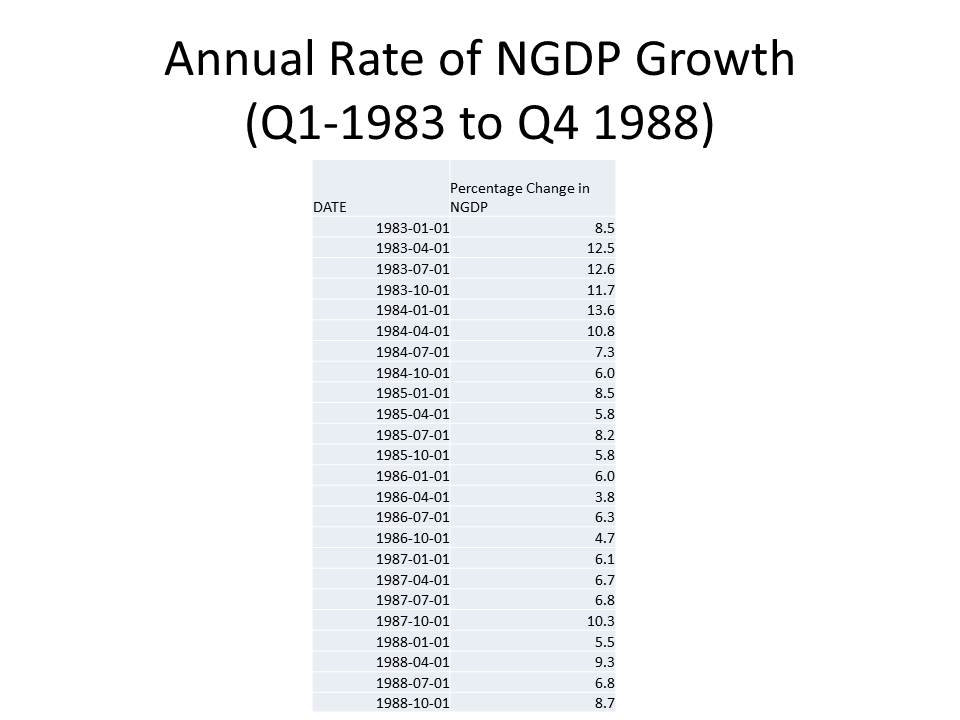
How interesting.  The inflation record of Paul Volcker was about 3.5% a year measured in terms of the CPI, once the recovery from the 1981-82 recession got under way. From Q1 1983 through Q2 1987 when Volcker was replaced by Alan Greenspan as Fed Chairman there were only two quarters (Q1 1986 and Q3 1986) when nominal GDP grew at less than a 5% annual rate. For five consecutive quarters, from Q2 1983 through Q2 1984, nominal GDP increased at more than a 10% annual rate. And Mr. Pethokoukis is horrified at the prospect of allowing nominal GDP to grow at a 5% annual rate?

On his blog, David Beckworth responded to Pethokoukis’s article, having been singled out for special attention by Pethokoukis for a piece he wrote with Ramesh Ponnuru in the New Republic advocating NGDP targeting.

I received the April issue of Commentary in the mail yesterday and I was pleased to find a letter to the editor sent by none other than our very own Benjamin Cole commenting on Pethokoukis’s article. Here’s what Benjamin had to say about the article.

James Pethokoukis worries that allowing a bit of inflation could easily “get out of hand,” thereby harming economic growth. But keeping inflation low doesn’t seem to be doing any good, either, which undermines the fear of inflation to which Mr. Pethokoukis subscribes. According to the Federal Reserve Bank of Cleveland, “its latest estimate of 10-year expected inflation is 1.34 percent. In other words, the public currently expects the inflation rate to be less than 2 percent on average the next decade.” And whata is this low-inflation-as-far-as-they-eye-can-see forecast doing for growth?

Inflation is not the problem. Inflation is dead. And judging from Japan, inflation is not likely to be a problem.

Growth is the problem — or, rather, lack thereof. The Fed should get aggressive (and not through fiscal stimulus). Really, would not five years of 5 percent real growth and 5 percent inflation do wonder for the economy. Is a slavish and peevish devotion to fighting inflation worth sacrificing prosperity?

Here’s Pethokoukis’s response.

Benjamin Cole makes a point with which I agree. Growth is the real problem. And it has been for a long time. That’s why the United States needs policies that create a fertile environment for stronger long-term growth via more innovation and productivity. Stable prices are a key part of that formula. Higher inflation makes investment less rewarding and creates massive uncertainty. There’s no doubt inflation is low today. Good. Let’s check that box and get to work on reforming the tax code and creating an education system that prepares Americans for the careers of tomorrow. I have a lot more faith in that working to create sustainable growth than in the ability of Ben Bernanke or his successors to precisely dial inflation up or down on command.

Well, the three months since Mr. Pethokoukis published his piece have evidently passed with little sign of any improvement in the ability of Mr. Pethotoukis to formulate a coherent argument. Is it too much to expect that a financial journalist writing in one of the premier opinion magazines in the US be able to distinguish between a strategy for speeding up a cyclical recovery, about which we have a fair amount of economic knowledge, and a strategy for increasing the long-term trend rate of growth of an advanced economy, about which we unfortunately have not much knowledge at all? And how on earth did a policy of stabilizing the rate of nominal GDP growth at 5 percent get transformed into having “Ben Bernanke or his successors . . . precisely dial inflation up or down on command?” Good grief.

Rising Inflation Expectations Work Their Magic

The S&P 500 rose by almost 2% today, closing at 1395.95, the highest level since June 2008, driven by an increase of 6 basis points in the breakeven TIPS spread on 10-year Treasuries, the spread rising to 2.34%. According to the Cleveland Federal Reserve Bank, which has developed a sophisticated method of extracting the implicit inflation expectations from the relationship between conventional Treasuries and TIPS, the breakeven TIPS spread overstates the expected inflation rate, so even at a 10-year time horizon, the market expectation of inflation is still well under 2%. The yield on 10-year Treasuries rose by 10 basis points, suggesting an increase of 4 basis points in the real 10-year interest rate.

Since the beginning of 2012, the S&P 500 has risen by almost 10%, while expected inflation, as measured by the TIPS spread on 10-year Treasuries, has risen by 33 basis points. The increase in inflation expectations was at first associated with falling real rates, the implied real rate on 10-year TIPS falling from -0.04% on January 3 to -0.32% on February 27. Real rates seem to have begun recovering slightly, rising to -0.20% today, suggesting that profit expectations are improving. The rise in real interest rates provides further evidence that the way to get out of the abnormally low interest-rate environment in which we have been stuck for over three years is through increased inflation expectations. Under current abnormal conditions, expectations of increasing prices and increasing demand would be self-fulfilling, causing both nominal and real interest rates to rise along with asset values. As I showed in this paper, there is no theoretical basis for a close empirical correlation between inflation expectations and stock prices under normal conditions. The empirical relationship emerged only in the spring of 2008 when the economy was already starting the downturn that culminated in the financial panic of September and October 2008. That the powerful relationship between inflation expectations and stock prices remains so strikingly evident suggests that further increases in expected inflation would help, not hurt, the economy.  Don’t stop now.

Hawtrey on Competitive Devaluation: Bring It On

In a comment on my previous post about Ralph Hawtrey’s discussion of the explosive, but short-lived, recovery triggered by FDR’s 1933 suspension of the gold standard and devaluation of the dollar, Greg Ransom queried me as follows:

Is this supposed to be a lesson in international monetary economics . . . or a lesson in closed economy macroeconomics?

To which I responded:

I don’t understand your question. The two are not mutually exclusive; it could be a lesson in either.

To which Greg replied:

I’m pushing you David to make a clearer and cleaner claim about what sort of monetary disequilibrium you are asserting existed in the 1929-1933 period, is this a domestic disequilibrium or an international disequilibrium — or are these temprary effects any nation could achieve via competitive devaluations of the currency, i.e. improving the terms of international trade via unsustainable temporary monetary policy.

Or are a ping pong of competitive devaluations among nations a pure free lunch?

And if so, why?

You can read my response to Greg in the comment section of my post, but I also mentioned that Hawtrey had addressed the issue of competitive devaluation in Trade Depression and the Way Out, hinting that another post discussing Hawtrey’s views on the subject might be in the offing. So let me turn the floor over to Mr. R. G. Hawtrey.

When Great Britain left the gold standard, deflationary measure were everywhere resorted to. Not only did the Bank of England raise its rate, but the tremendous withdrawals of gold from the United States involved an increase of rediscounts and a rise of rates there, and the gold that reached Europe was immobilized or hoarded. . . .

The consequence was that the fall in the price level continued. The British price level rose in the first few weeks after the suspension of the gold standard, but then accompanied the gold price level in its downward trend. This fall of prices calls for no other explanation than the deflationary measures which had been imposed. Indeed what does demand explanation is the moderation of the fall, which was on the whole not so steep after September 1931 as before.

Yet when the commercial and financial world saw that gold prices were falling rather than sterling prices rising, they evolved the purely empirical conclusion that a depreciation of the pound had no effect in raising the price level, but that it caused the price level in terms of gold and of those currencies in relation to which the pound depreciated to fall.

For any such conclusion there was no foundation. Whenever the gold price level tended to fall, the tendency would make itself felt in a fall in the pound concurrently with the fall in commodities. But it would be quite unwarrantable to infer that the fall in the pound was the cause of the fall in commodities.

On the other hand, there is no doubt that the depreciation of any currency, by reducing the cost of manufacture in the country concerned in terms of gold, tends to lower the gold prices of manufactured goods. . . .

But that is quite a different thing from lowering the price level. For the fall in manufacturing costs results in a greater demand for manufactured goods, and therefore the derivative demand for primary products is increased. While the prices of finished goods fall, the prices of primary products rise. Whether the price level as a whole would rise or fall it is not possible to say a priori, but the tendency is toward correcting the disparity between the price levels of finished products and primary products. That is a step towards equilibrium. And there is on the whole an increase of productive activity. The competition of the country which depreciates its currency will result in some reduction of output from the manufacturing industry of other countries. But this reduction will be less than the increase in the country’s output, for if there were no net increase in the world’s output there would be no fall of prices.

In consequence of the competitive advantage gained by a country’s manufacturers from a depreciation of its currency, any such depreciation is only too likely to meet with recriminations and even retaliation from its competitors. . . . Fears are even expressed that if one country starts depreciation, and others follow suit, there may result “a competitive depreciation” to which no end can be seen.

This competitive depreciation is an entirely imaginary danger. The benefit that a country derives from the depreciation of its currency is in the rise of its price level relative to its wage level, and does not depend on its competitive advantage. If other countries depreciate their currencies, its competitive advantage is destroyed, but the advantage of the price level remains both to it and to them. They in turn may carry the depreciation further, and gain a competitive advantage. But this race in depreciation reaches a natural limit when the fall in wages and in the prices of manufactured goods in terms of gold has gone so far in all the countries concerned as to regain the normal relation with the prices of primary products. When that occurs, the depression is over, and industry is everywhere remunerative and fully employed. Any countries that lag behind in the race will suffer from unemployment in their manufacturing industry. But the remedy lies in their own hands; all they have to do is to depreciate their currencies to the extent necessary to make the price level remunerative to their industry. Their tardiness does not benefit their competitors, once these latter are employed up to capacity. Indeed, if the countries that hang back are an important part of the world’s economic system, the result must be to leave the disparity of price levels partly uncorrected, with undesirable consequences to everybody. . . .

The picture of an endless competition in currency depreciation is completely misleading. The race of depreciation is towards a definite goal; it is a competitive return to equilibrium. The situation is like that of a fishing fleet threatened with a storm; no harm is done if their return to a harbor of refuge is “competitive.” Let them race; the sooner they get there the better. (pp. 154-57)

So yes, Greg, competitive devaluation is a free lunch. Bring it on.

Hawtrey on the Short but Sweet 1933 Recovery

Here’s another little gem (pp. 65-66) from Ralph Hawtrey’s Trade Depression and the Way Out. He discusses the amazing revival of business in the depth of the Great Depression triggered by FDR’s suspension of the gold standard in March 1933 immediately after taking office. Despite the suspension of the gold standard, there was period of uncertainty lasting over a month because it was not clear whether FDR would trigger a devaluation and the Treasury Department was issuing licenses to export gold preventing the dollar from depreciating in the foreign exchange markets. It was not until April 19 that the Secretary of the Treasury declined to issue any more licenses.

A license was a device for sustaining the value of the dollar. It was an instrument of torture designed to inflict further distress on a suffering nation. The pen refused to write the signature. No licenses were to be granted.

At once the dollar fell. The discount soon exceeded 10%. The suspension of the gold standard had become a reality.

The impulse given towards the revival of industry was instantaneous. It was like the magic change of spirit that seized the Allied line at Waterloo late in the afternoon, when there passed through the French ranks the terrible murmur “the Guard is giving way,” and the cohesion of their onset was at last loosened. . . . The eagles (258 grains, nine-tenths fine) were in full retreat.

Manufacturers pressed forward to fulfill a stream of orders such as they had not known for years. Wheat and corn, cotton, silk and wool, non-ferrous metals, rubber, almost every primary product found increased sales at higher prices. The steel industry, which at one time in March had been working at 15% of capacity rose in three months to 59%. The consumption of rubber in June exceeded the highest monthly totals of 1929. The index of manufacturing production, which relapsed from 66 in September 1932 to 57 in March 1933, advanced to 99 in July 1933, the highest since May 1930. The index of factory employment rose from 56.6 in March to 70.1 in July, and that of factory payrolls from 36.9 to 49.9. The Department of Labour Price Index rose from 59.8 in February 1933 to 69.7 on the 22nd July, the Farm Products group rising in the same period from 40.9 to 62.7.

This revival was a close parallel to that which occurred in Great Britain after the suspension of the gold standard in September 1931. On that occasion bank rate was put up to 6%, and renewed deflation and depression followed. In the United States, on the other hand, not only was cheap money continued (the 3% rediscount rate in New York being completely ineffective), but wide and unprecedented powers were conferred on the President with a view to a policy of inflation being carried out. . . .

For a month the depreciation of the dollar had no other source than in the minds of the market. The Administration quite clearly and certainly intended the dollar to fall, and every one dealing in the market was bound to take account of that intention. Towards the end of May the Federal Reserve Banks began to buy securities. By the end of June they had increased their holding of Government securities from $1,837,000,000 to $1,998,000,000, and the dollar was at a discount of more than 20%. The New York rediscount rate was reduced from 3% to 2.5% on the 26th May, and even the lower rate remained completely ineffective.

In July, however, the open market purchases slackened off. And other circumstances contributed to check the progress of depreciation. . . . Above all, on the 20th July, a plan for applying the minimum wages and maximum hours of the National Industrial Recovery Act throughout the whole range of American industry and trade without delay was put forward by the Administration. Profits were threatened.

The discount on the dollar had reached 30% on the 10th July, but, from the 20th July, it met with a rapid and serious reaction. There were fluctuations, but the discount did not again touch 30% till the middle of September. And the recovery of business was likewise interrupted.

There was some tendency to regard the policy of minimum wages and maximum hours as an alternative to monetary depreciation as a remedy for the depression.

It’s instructive to compare Hawtrey’s account of the effects of the devaluation of April 1933 with the treatment by Friedman and Schwartz in their Monetary History of the US (pp. 462-69) which treats the devaluation as a minor event. A subsequent discussion pp. 493-98 fails to draw attention to the remarkable recovery triggered over night by the devaluation of the dollar, and inexplicably singles out a second-order effect – increased production in anticipation of cost increases imposed by the anticipated enactment of the National Industrial Recovery Act – while ignoring the direct effect of enhanced profitability resulting from the depreciation of the dollar.

The revival was initially erratic and uneven. Reopening of the banks was followed by a rapid spurt in personal income and industrial production (see Chart 37). The spurt was intensified by production in anticipation of the codes to be established under the National Industrial Recovery Act (passed June 16, 1933), which were expected to raise wage rates and prices, and did. A relapse in the second half of 1933 was followed by another spurt in early 1934 and then a further relapse. A sustained and reasonably continuous rise in income and production did not get under way until late 1934.

This is an example of how Friedman’s obsession with the quantity theory, meaning that the quantity of money was always the relevant policy variable blinded him from recognizing that devaluation of the dollar in and of itself could raise the price level and provide the stimulus to profits and economic activity necessary to lift the economy from the depths of a depression.  The name Hawtrey appears only once in the Monetary History in a footnote on p. 99 citing Hawtrey’s A Century of Bank Rate in connection with the use of Bank rate by the Bank of England to manage its reserve position.  Cassel is not cited once.  To my knowledge, Friedman did not cite Hawtrey in any of his works on the Great Depression.

Lars Christensen on the Eurozone Crisis RIP

UPDATE:  In my enthusiasm and haste to plug Lars Chritensen’s post on the possible end of the Eurozone crisis, I got carried away and conflated two separate effects.  The dollar’s appreciation against from July to September was associated with a steep drop in inflation expectations, the TIPS spread fallling from about 2.4% in July to about 1.7% on 10-year Treasuries.  The dollar rose against the euro from July to September from the exchange rate moving from the $1.42 to $1.45 range in early July to the $1.35 to $1.38 range in September.  From September to December, inflation expectations rose modestly, the TIPS spread on 10-year Treasuries recovering to about 1.9%.  It has only been since December that the dollar has been appreciating against the euro even as inflation expectations have risen to over 2% as reflected by the TIPS spread on 10-year Treasuries.  The actual data are thus more consistent with Lars’s take on the Eurozone crisis than suggested by my original comment  .Sorry for that slip-up on my part.

Check out this fascinating post by Lars Christensen on how the Eurozone Crisis (not to be confused with the Greek Debt Crisis) came to an end last July.  The key to understanding what happened is that on July 1 the dollar/euro exchange rate was $1.4508/euro.  Yesterday it was about $1.32/euro.  The appreciation of the dollar would have been a disaster for the US and the rest of the world, except for the fact that inflation expectations in the US have increased, not decreased, since July (even as measured inflation — both headline and core — has fallen).  Ever since 2008, US inflation expectations and the dollar/euro exchange rate have been positively correlated (i.e., increased inflation expectations in the US have been associated with a falling value of the dollar relative to the euro).  Since July US inflation expectations have increased while the dollar has appreciated against the euro.

HT:  Lars Christensen and Marcus Nunes

Charles Schwab Almost Gets It Right

No question about it Charles Schwab is a very smart man, and performed a great service by making the stock brokerage business a lot more competitive than it used to be before he came on the scene. But does that qualify him as an expert on monetary policy? Not necessarily. But I am not sure what qualifies anyone as an expert on monetary policy, so I don’t want to suggest that a lack of credentials disqualifies Mr. Schwab, or anyone else, even Ron Paul, from offering an opinion on monetary policy. But in his op-ed piece in today’s Wall Street Journal, Mr. Schwab certainly gets off to a bad start when he says:

We’re now in the 37th month of central government manipulation of the free-market system through the Federal Reserve’s near-zero interest rate policy. Is it working?

Thirty-seven months ago, the US and the world economy were in a state of crisis, with stock prices down almost 50 percent from their level six months earlier. To suggest that taking steps to alleviate that crisis constitutes government manipulation of the free-market system is clearly an ideologically loaded statement, acceptable to a tiny sliver of professional economists, lacking any grounding in widely accepted economic principles. The tiny sliver of economists who would agree with Mr. Schwab’s assessment may just be right — though I think they are wrong — but on as controversial a topic as this, it bespeaks a certain arrogance to assert as simple fact what is in fact the view of a tiny, and not especially admired, minority of the economics profession.  (I don’t mean the preceding sentence to be construed as in any way an attack on economists favoring a free-market monetary system.  I know and admire a number of economists who take that view, I am just emphasizing how unorthodox that view is considered by most of the profession.)

It’s actually a pity that Mr. Schwab chose to couch his piece in such ideological terms, because much of what he says makes a lot of sense.  For example:

Business and consumer loan demand remains modest in part because there’s no hurry to borrow at today’s super-low rates when the Fed says rates will stay low for years to come. Why take the risk of borrowing today when low-cost money will be there tomorrow?

Many of us in the Market Monetarist camp already have pointed out that the Fed’s low interest policy is a double-edged sword, because the policy, as Mr. Schwab correctly points out, tends to reinforce self-fulfilling market pessimism about future economic conditions. The problem arises because the economy now finds itself in what Ralph Hawtrey called a “credit deadlock.” In a credit deadlock, pessimistic expectations on the part of traders, consumers and bankers is so great that reducing interest rates does little to stimulate investment spending by businesses, consumer spending by households, and lending by banks. While recognizing the obstacles to the effectiveness of monetary policy conducted in terms of the bank rate, Hawtrey argued that there are alternative instruments at the disposal of the monetary authorities by which to promote recovery.

Mr. Schwab goes on to provide a good description of the symptoms of a credit-deadlock except that he attributes the cause of the deadlock entirely to Fed actions rather than to an underlying pessimism that preceded them.

The Fed policy has resulted in a huge infusion of capital into the system, creating a massive rise in liquidity but negligible movement of that money. It is sitting there, in banks all across America, unused. The multiplier effect that normally comes with a boost in liquidity remains at rock bottom. Sufficient capital is in the system to spur growth—it simply isn’t being put to work fast enough.

He makes a further astute observation about the ambiguous effects of the Fed’s announcement that it is planning to keep interest rates at current levels through 2014.

The Fed’s Jan. 25 statement that it would keep short-term interest rates near zero until at least late 2014 is sending a signal of crisis, not confidence. To any potential borrower, the Fed’s policy is saying, in effect, the economy is still in critical condition, if not on its deathbed. You can’t keep a patient on life support and expect people to believe he’s gotten better.

Mr. Schwab then argues that all that is required to cure the credit deadlock is for the Fed to declare victory and begin a strategic withdrawal from the field of battle.

This is what investors, business people and everyday Americans should hope to hear from Mr. Bernanke after the next Federal Open Market Committee meeting:

The Federal Reserve used its emergency powers effectively and appropriately when the financial crisis began, but it is very clear that the economy is on the mend and that the benefit of inserting massive liquidity into the economy has passed. We will let interest rates move where natural markets take them. Our experiment with market manipulation will stop beginning today. Effective immediately, we will begin to move Fed rate policy toward its natural longer-term equilibrium. With the extremes of the financial crisis of 2008 and 2009 long behind us, free markets are the best means to create stable growth. Our objective is now to let the system work on its own. It is now healthy enough to do just that. We hope today’s announcement does two things immediately: first, that it highlights our confidence—supported by the data—that the U.S. economy is out of its emergency state and in the process of mending, and second, that it reflects our belief that the Federal Reserve’s role in economic policy is limited.

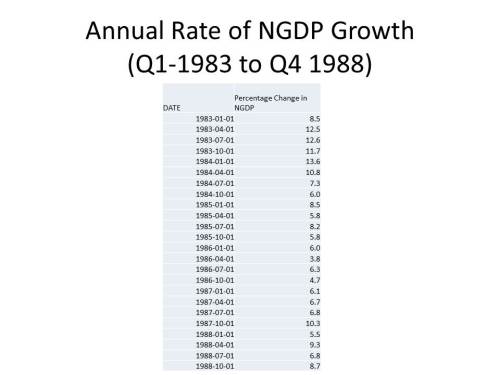
What Mr. Schwab fails to note is that the value of money (its purchasing power at any moment) and the rate of inflation cannot be determined in a free market. That is the job of the monetary authority. Aside from the tiny sliver of the economics profession that believes that the value of money ought to be determined by some sort of free-market process, that responsibility is now taken for granted. The problem at present is that the expected future price level (or the expected rate of growth in nominal GDP) is below the level consistent with full employment. The problem with Fed policy is not that it is keeping rates too low, but that it is content to allow expectations of inflation (or expectations of future growth in nominal GDP) to remain below levels necessary for a strong recovery. The Reagan recovery, as I noted recently, is hailed as a model for the Obama administration and the Fed by conservative economists like John Taylor, and the Wall Street Journal editorial page, and presumably by Mr. Charles Schwab himself. The salient difference between our anemic pseudo recovery and the Reagan recovery is that inflation averaged 3.5 to 4 percent and nominal GDP growth in the Reagan recovery exceeded 10 percent for 5 consecutive quarters (from the second quarter of 1983 to the second quarter of 1984).  The table below shows the rate of NGDP growth during the last six years of the Reagan administration from 1983 through 1988.  This is why, as I have explained many times on this blog (e.g., here and here)and in this paper, since the early days of the Little Depression in 2008, the stock market has loved inflation.
Here’s how Hawtrey put it in his classic A Century of Bank Rate:

The adequacy of these small changes of Bank rate, however, depends upon psychological reactions. The vicious circle of expansion or contraction is partly, but not exclusively, a psychological phenomenon. It is the expectation of expanding demand that leads to a creation of credit and so causes demand to expand; and it is the expectation of flagging demand that deters borrowers and so causes demand to flag. . . . The vicious circle may in either case have any degree of persistence and force within wide limits; it may be so mild as to be easily counteracted, or it may be so violent as to require heroic measures. (p. 275)

Therefore the monetary authorities of a country which has been cut loose from any metallic or international standard find themselves compelled to some degree to regulate the foreign exchanges, either by buying and selling foreign currencies or gold, or (deplorable alternative) by applying exchange control. Thus at any moment the problem of monetary policy presents itself as a choice between a modification of the rate of exchange credit an adjustment of the credit system through Bank rate. And if the modification of the rate of exchange is such as to favour stable activity, the need for a change in Bank rate may be all the less. When a credit deadlock has thrown Bank rate out of action, modification of rates of exchange may be found to be the most valuable and effective instruments of monetary policy. (p. 277)

There is thus no doubt that the Fed could achieve (within reasonable margins of error) any desired price level or rate of growth in nominal GDP by announcing its target and expressing its willingness to drive down the dollar exchange rate in terms of one or several currencies until its price level or NGDP target were met. That, not abdication of its responsibility, is the way the Fed can strengthen the ever so faint signs of a budding recovery (remember those green shoots?).
Inflation? What Inflation?

Today’s announcement of the prelminary estimate of GDP for the fourth quarter of 2011 showed a modest improvement over the anemic growth rates earlier in the year, confirming the general impression that things have stopped getting worse. But we are barely at the long-run trend rate of growth, which means that there is still no recovery, in the sense of actually making up the ground lost relative to the long-run trend line since the Little Depression started.

The other striking result of the GDP report is that NGDP growth actually fell in the fourth quarter to a 3.2% annual rate, implying that inflation as measured by the GDP price deflator was only at a 0.4% annual rate, a sharp decline from the 2.6-2.7% rates of the previous three quarters. The decline reflects a possible tightening of monetary policy after QE2 was allowed to expire (though as long as the Fed is paying 0.25% interest on reserves, it is difficult to assess the stance of monetary policy) as well as the passing of the supply-side disturbances of last winter that fueled a rise in energy and commodity prices. So we now seem to be back at our new trend inflation rate, a rate clearly well under the 2% target that the FOMC has nominally adopted.

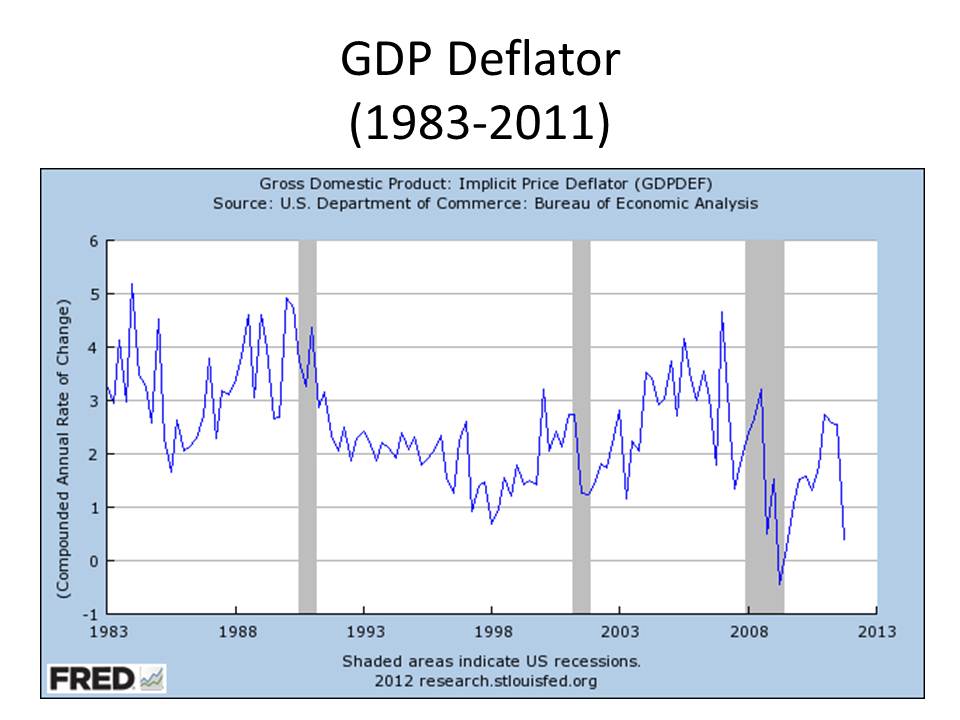
Despite the continuing cries about currency debasement and the danger of hyperinflation from all the usual suspects, current rates of inflation remain at historically  low levels.  The first of the two accompanying charts tracks the GDP price deflator since 1983. The deflator is clearly well below the rates that have prevailed since 1983 when the recovery to the 1981-82 recession started under the sainted Ronald Reagan of blessed memory.  The divergence between inflation in the Reagan era and the Obama era is striking.  Inflation under the radical Barack Obama is well below inflation under that quintessential conservative, Ronald Reagan.  Go figure!

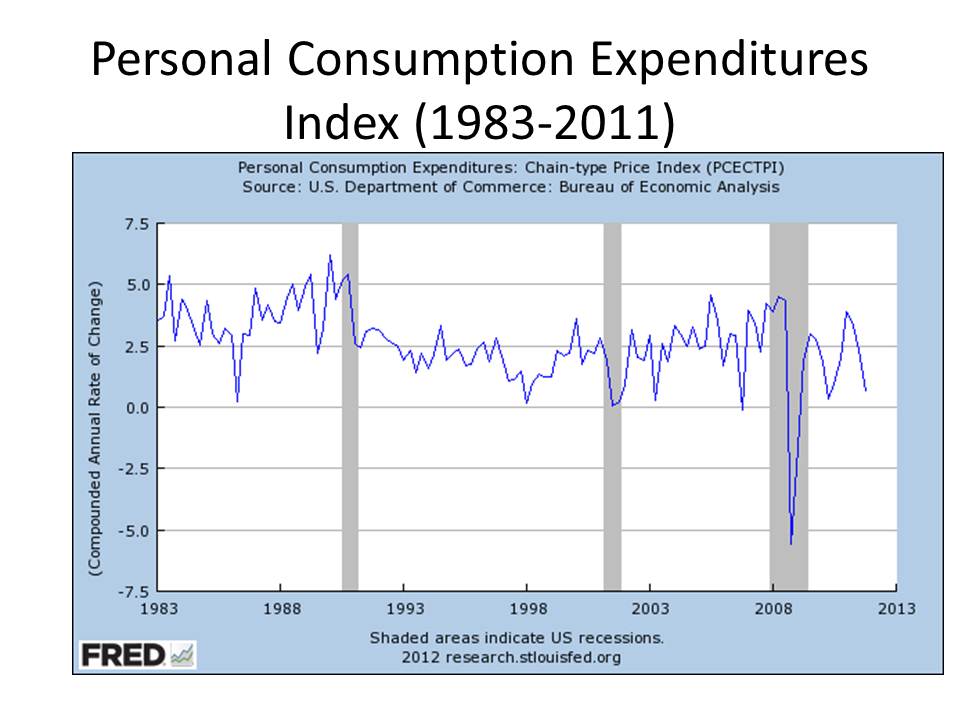
The companion chart tracks the Personal Consumption Price index over the same period. The PCE index is similar to the CPI, and shows a similar (but even sharper) decline in the fourth quarter compared to the higher rates earlier in the year, owing to the importance of food and energy prices in the PCE index.  Again the contrast between inflation under Reagan and under Obama is clear.

In his press conference on Wednesday, Bernanke signaled, to the apparent dismay of the Wall Street Journal editorial board, that he will push for a monetary policy that adjusts as needed to keep the inflation rate from falling below 2% and might even tolerate some overshooting while unemployment remains unusually high. That signal apparently caused an immediate increase in inflation expectations as measured by the TIPS spread. The increase in inflation expecations was accompanied by a further decline in real interest rates, now -1% on 5-year TIPS and -0.16% on 10-year TIPS. With real interest rates that low, perhaps we will see a further increase in investment and a further increase in household purchases of consumer durables.  Perhaps some small reason for optimism amid all the reasons to be depressed.

The Fog of Inflation

Blogger Jonathan Catalan seems like a pretty pleasant and sensible fellow, and he is certainly persistent. But I think he is a bit too much attached to the Austrian story of inflation in which inflation is the product of banks reducing their lending rates thereby inducing borrowers to undertake projects at interest rates below the “natural rate of interest.” In the Austrian view of inflation, the problem with inflation is not so much that the value of money is reduced (though Austrians are perfectly happy to throw populist red meat to the masses by inveighing against currency debasement and the expropriation of savings), but that the newly created money distorts relative prices misleading entrepreneurs and workers into activities and investments that will turn out to be unprofitable when interest rates are inevitably raised, leading to liquidation and abandonment, causing a waste of resources and unemployment of labor complementary to no longer usable fixed capital.

That story has just enough truth in it to be plausible; it may even be relevant in explaining particular business-cycle episodes. But despite the characteristic (and really annoying) Austrian posturing and hyperbole about the apodictic certainty of its a priori praxeological theorems (non-Austrian translation:  assertions and conjectures), to the exclusion of every other explanation of inflation and business cycles, Austrian business cycle theory simply offers a theoretically possible account of how banks might simultaneously cause an increase in prices generally and a particular kind of distortion in relative prices. In fact, not every inflation and not every business cycle expansion has to conform to the Austrian paradigm, and Austrian assertions that they possess the only valid account of inflation and business cycles are pure self-promotion, which is why most of the reputable economists that ever subscribed to ABCT (partial list:  Gottfried Haberler, Fritz Machlup, Lionel Robbins, J. R. Hicks, Abba Lerner, Nicholas Kaldor, G. L. S. Shackle, Ludwig Lachmann, and F. A. Hayek) eventually renounced it entirely or acknowledged its less than complete generality as an explanation of business cycles.

So when in a recent post, I chided Jon Hilsenrath, a reporter for the Wall Street Journal, for making a blatant logical error in asserting that inflation necessarily entails a reduction in real income, Catalan responded, a tad defensively I thought, by claiming that inflation does indeed necessarily reduce the real income of some people. Inasmuch as I did not deny that there can be gainers and losers from inflation, it has been difficult for Catalan to articulate the exact point on which he is taking issue with me, but I suspect that the reason he feels uncomfortable with my formulation is that I rather self-consciously and deliberately formulated my characterization of the effects of inflation in a way that left open the possibility that inflation would not conform to the Austrian inflation paradigm, without, by the way, denying that inflation might conform to that paradigm.

In his latest attempt to explain why my account of inflation is wrong, Catalan writes that all inflation must occur over a finite period of time and that some prices must rise before others, presumably meaning that those raising their prices earlier gain at the expense of those who raise their prices later. I don’t think that that is a useful way to think about inflation, because, as I have already explained, if inflation is a process that takes place through time, it is arbitrary to single out a particular time as the starting point for measuring its effects. Catalan now tries to make his point using the following example.

[If] Glasner were correct then it would not make sense to reduce the value of currency to stimulate exports.  If the intertemporal aspect of the money circulation was absent, then exchange ratios between different currencies (all suffering from continuous tempering) would remain constant.  This is not the case, though: a continuous devaluation of currency is necessary to continuously artificially stimulate exports, because at some point relative prices (the price of one currency to another) fall back into place —, reality is the exact opposite of what Glasner proposes.  The example is imperfect and very simple (it does not have anything to do with the prices between different goods amongst different international markets), but I think it illustrates my point convincingly.

Actually, devaluations frequently do not stimulate exports. When they do stimulate exports, it is usually because real wages in the devaluing country are too high, making the tradable goods sector of the country uncompetitive, and it is easier to reduce real wages via inflation and devaluation than through forcing workers to accept nominal wage cuts. This was precisely the argument against England rejoining the gold standard in 1925 at the prewar dollar/sterling parity, an argument accepted by von Mises and Hayek. Under these circumstances does inflation reduce real wages? Yes. But the reason that it does so is not that inflation necessarily entails a reduction in real wages; the reason is that in those particular instances the real wage was too high (i.e., the actual real wage was above the equilibrium real wage) and devaluation (inflation) was the mechanism by which an equilibrating reduction in real wages could be most easily achieved. In this regard I would refer readers to the classic study of the proposition that inflation necessarily reduces real wages, the paper by Kessel and Alchian “The Meaning and Validity of the Inflation-Induced Lag of Wages Behind Prices” reprinted in The Collected Works of Armen A. Alchian.

Whether inflation reduces or increases real wages, either in general or in particular instances, depends on too many factors to allow one to reach any unambiguous conclusion. The real world is actually more complicated than Austrian business cycle theory seems prepared to admit. Funny that Austrians would have to be reminded of that by neo-classical economists.


About Me

David Glasner
Washington, DC

I am an economist in the Washington DC area. My research and writing has been mostly on monetary economics and policy and the history of economics. In my book Free Banking and Monetary Reform, I argued for a non-Monetarist non-Keynesian approach to monetary policy, based on a theory of a competitive supply of money. Over the years, I have become increasingly impressed by the similarities between my approach and that of R. G. Hawtrey and hope to bring Hawtrey’s unduly neglected contributions to the attention of a wider audience.

My new book Studies in the History of Monetary Theory: Controversies and Clarifications has been published by Palgrave Macmillan

Follow me on Twitter @david_glasner

Archives

Enter your email address to follow this blog and receive notifications of new posts by email.

Join 665 other subscribers
Follow Uneasy Money on WordPress.com