Archive for the 'Hawtrey' Category


Am I Being Unfair to the Gold Standard?

Kurt Schuler takes me (among others) to task in a thoughtful post on the Free-Banking blog for being too harsh in my criticisms of the gold standard, in particular in blaming the gold standard for the Great Depression, when it was really the misguided policies of central banks that were at fault.

Well, I must say that Kurt is a persuasive guy, and he makes a strong case for the gold standard. And, you know, the gold standard really wasn’t fatally flawed, and if the central banks at the time had followed better policies, the gold standard might not have imploded in the way that it did in the early 1930s. So, I have to admit that Kurt is right; the Great Depression was not the inevitable result of the gold standard. If the world’s central banks had not acted so unwisely – in other words, if they had followed the advice of Hawtrey and Cassel about limiting the monetary demand for gold — if the Bank of France had not gone insane, if Benjamin Strong, Governor of the New York Federal Reserve Bank, then the de facto policy-making head of the entire Federal Reserve System, had not taken ill in 1928 and been replaced by the ineffectual George L. Harrison, the Great Depression might very well have been avoided.

So was I being unfair to the gold standard? OK, yes, I admit it, I was being unfair. Gold standard, you really weren’t as bad as I said you were. The Great Depression was really not all your fault. There, I’m sorry if I hurt your feelings. But, do I want to see you restored? No way! At least not while the people backing you are precisely those who, like Hayek, in his 1932 lament for the gold standard defending the insane Bank of France against accusations that it caused the Great Depression, hold Hawtrey and Cassel responsible for the policies that caused the Great Depression. If those are the ideas motivating your backers to want to restore you as a monetary standard, I find the prospect of your restoration pretty scary — as in terrifying.

Now, Kurt suggests that people Ron Paul are not so scary, because all Ron Paul means when he says he wants to restore the gold standard is that the Federal Reserve System be abolished. With no central bank, it will be left up to the market to determine what will serve as money. Here is how Kurt describes what would happen.

If people want the standard to be gold, that’s what free banks will offer to attract their business. But if people want the standard to be silver, copper, a commodity basket, seashells, or cellphone minutes, that’s what free banks will offer. Or if they want several standards side by side, the way that multiple computer operating systems exist side by side, appealing to different niches, that’s what free banks will offer. A pure free banking system would also give people the opportunity to change standards at any time. Historically, though, many free banking systems have used the gold standard, and it is quite possible that gold would re-emerge against other competitors as the generally preferred standard.

Now that’s pretty scary – as in terrifying – too. As I suggested in arecent post, the reason that people in some places, like London, for instance, seem to agree readily on what constitutes money, even without the operation of legal tender laws, is that there are huge advantages to standardization. Economists call these advantages network effects, or network externalities. The demand to use a certain currency increases as other people use it, just as the demand to use a computer operating system or a web browser increases as the number of people already using it increases. Abolishing the dollar as we know it, which is what Kurt’s scenario sounds like to me, would annihilate the huge network effects associated with using the dollar, thereby forcing us to go through an uncertain process of indefinite length to recapture those network effects without knowing how or where the process would end up.  If we did actually embark on such a process, there is indeed some chance, perhaps a good chance, that it would lead in the end to a gold standard.

Would a gold standard associated with a system of free banking — without the disruptive interference of central banks — work well? There are strong reasons to doubt that it would. For starters, we have no way of knowing what the demand of such banks to hold gold reserves would be. We also have no way of knowing what would happen to the gold holdings of the US government if the Federal Reserve were abolished. Would the US continue to hold gold reserves if it went out of the money creation business?  I have no idea.  Thus, the future value of gold in a free-banking system is thus completely unpredictable. What we do know is that under a fractional reserve system, the demand for reserves by the banking system tends to be countercyclical, going up in recessions and going down in expansions. But what tends to cause recessions is an increase in the demand of the public to hold money.  So the natural cyclical path of a free-banking system under a gold standard would be an increasing demand for money in recessions, associated with an increasing monetary demand for gold by banks as reserves, causing an increase in the value of gold and a fall in prices. Recessions are generally characterized by declining real interest rates produced by depressed profit expectations. Declining real interest rates increase the demand for an asset like gold under the gold standard with a fixed nominal value, so both the real and the monetary demand for gold would increase in recessions, causing recessions to be deflationary. Recessions with falling asset prices and rising unemployment and, very likely, an increasing number of non-performing loans would impair the profitability and liquidity of banks, perhaps threatening the solvency of at least some banks as well, thereby inducing holders of bank notes and bank deposits to try to shift from holding bank notes and bank deposits to holding gold.

A free-banking system based on a gold standard is thus likely to be subject to a shift in demand from holding bank money to holding gold, when it is least able to accommodate such a shift, making a free-banking system based on a gold standard potentially vulnerable to a the sort of vicious deflationary cycle that characterized the Great Depression. The only way out of such a cycle would be to suspend convertibility. Such suspensions might or might not be tolerated, but it is not at all clear whether or how a mechanism to trigger such a suspension could be created. Insofar as such suspensions were expected, the mere anticipation of a liquidity problem might be sufficient to trigger a shift in demand away from holding bank money toward holding gold, thereby forcing a suspension of convertibility.  Chronic suspensions of convertibility would tend to undermine convertibility.

In short, there is a really serious problem inherent in any banking system in which the standard is itself a medium of exchange. The very fact that gold is money means that, in any fractional reserve system based on gold, there is an inherent tendency for the system to implode when there is a loss of confidence in bank money that causes a shift in demand from bank money to gold. In principle, what would be most desirable is a system in which the monetary standard is not itself money.  Alternatively, the monetary standard could be an asset whose supply may be increased without limit to meet an increase in demand, an asset like, you guessed it, Federal Reserve notes and reserves. But that very defect is precisely what makes the Ron Pauls of this world think that the gold standard is such a wonderful idea.  And that is a scary — as in terrifying — thought.
Ludwig von Mises and the Great Depression

Many thanks to gliberty who just flagged for me a piece by Mark Spitznagel in today’s (where else?) Wall Street Journal about how Ludwig von Mises, alone among the economists of his day, foresaw the coming of the Great Depression, refusing the offer of a high executive position at the Kredit-Anstalt, Austria’s most important bank, in the summer of 1929, because, as he put it to his fiancée (whom he did not marry till 1938 just before escaping the Nazis), “a great crash is coming, and I don’t want my name in any way connected with it.”  Just how going to work for the Kredit Anstalt would have led to Mises’s name being associated with the crash (the result, in Mises’s view, of the inflationary policy of the US Federal Reserve) is left unclear.  But it’s such a nice story.

Ludwig von Mises was an extremely well-read and diligent economist, who had some extraordinary insights into economics and business and politics.  As a result he made some important contributions to economics, most important the discovery that idea of a fully centrally planned economy is not just an impossibility, it is incoherent.   He made other contributions to economics as well, but that insight, perhaps also perceived by Max Weber, was first spelled out and explained by Mises in his book Socialism. That contribution alone is enough to ensure Mises an honorable place in the history of economic thought.

Mises also perceived how the monetary theory of Knut Wicksell, based on a distinction between a market and a natural rate of interest, could be combined with the Austrian theory of capital, developed by his teacher Eugen von Bohm-Bawerk into a theory of business cycles.  Von Mises is therefore justly credited with being the father of Austrian business-cycle theory.  His own development of the theory was somewhat sketchy, and it was his student F. A. Hayek, who made the great intellectual effort of trying to work out the detailed steps in the argument by which monetary expansion would alter the structure of capital and production, leading to a crisis when the monetary expansion was halted or reversed.

Relying on their newly developed theory of business cycles, Mises and Hayek warned in the late 1920s that the decision of the Federal Reserve to reduce interest rates in 1927, when it appeared that the US economy could be heading into a recession, would distort the structure of production and lead eventually to an even worse downturn than the one the Fed avoided in 1927.  That was the basis for Mises’s “prediction” of a “crash” ahead of the Great Depression.

Of course, as I have pointed out previously, Mises and Hayek were not the only ones to have predicted that there could be a downturn.  R.G. Hawtrey and Gustav Cassel had been warning about that danger since 1919, should an international return to the gold standard not be managed properly, failing to prevent a rapid deflationary increase in the international monetary demand for gold.  When the insane Bank of France began accumulating gold at a breathtaking rate in 1928, and the US reversed its monetary stance in late 1928 and itself began accumulating gold, Hawtrey and Cassel recognized the potential for disaster and warned of the disastrous consequences of the change in Federal Reserve policy.

So Mises and Hayek were not alone in their prediction of a crash; Hawtrey and Cassel were also warning of a looming disaster, and were doing so on the basis of a theory that was both more obvious and more relevant to the situation than theory with which Mises and Hayek were working, a theory that, even giving it the benefit of every doubt, could not possibly have predicted a downturn even remotely approaching the severity of the 1929-31 downturn.  Indeed, as I have also pointed out, the irrelevance of the Mises and Hayek “explanation” of the Great Depression is perfectly illustrated by Hayek’s 1932 defense of the insane Bank of France, showing a complete misunderstanding of the international adjustment mechanism and the disastrous consequences of the gold accumulation policy of the insane Bank of France.

Mr. Spitznagel laments that the economics profession somehow ignored Ludwig von Mises.  Actually, they didn’t.  Some of the greatest economists of the twentieth century were lapsed believers in the Austrian business-cycle theory.  A partial list would include, Mises’s own students, Gottfried Haberler and Fritz Machlup; it would include  Hayek’s dear friend and colleague, Lionel Robbins who wrote a book on the Great Depression eloquently explaining it in terms of the Austrian theory in a way that even Mises might have approved, a book that Robbins later repudiated and refused to allow to be reprinted in his lifetime (but you can order a new edition here); it would include  Hayek’s students, Nobel Laureate J.R. Hicks, Nicholas Kaldor, Abba Lerner, G.L.S. Shackle, and Ludwig Lachmann (who sought a third way incorporating elements of Keynesian and Austrian theory).  Hayek himself modified his early views in important ways and admitted that he had given bad policy advice in the 1930s.  The only holdout was Mises himself, joined in later years after his arrival in America by a group of more doctrinaire (with at least one notable exception) disciples than Mises had found in Vienna in the 1920s and 1930s.  The notion that Austrian theory was ignored by the economics profession and has only lately been rediscovered is just the sort of revisionist history that one tends to find on a lot of wacko Austro-libertarian websites like Lewrockwell.org.  Apparently the Wall Street Journal editorial page is providing another, marginally more respectable, venue for such nonsense.  Rupert, you’re doing a heckuva job.

Charles Schwab Almost Gets It Right

No question about it Charles Schwab is a very smart man, and performed a great service by making the stock brokerage business a lot more competitive than it used to be before he came on the scene. But does that qualify him as an expert on monetary policy? Not necessarily. But I am not sure what qualifies anyone as an expert on monetary policy, so I don’t want to suggest that a lack of credentials disqualifies Mr. Schwab, or anyone else, even Ron Paul, from offering an opinion on monetary policy. But in his op-ed piece in today’s Wall Street Journal, Mr. Schwab certainly gets off to a bad start when he says:

We’re now in the 37th month of central government manipulation of the free-market system through the Federal Reserve’s near-zero interest rate policy. Is it working?

Thirty-seven months ago, the US and the world economy were in a state of crisis, with stock prices down almost 50 percent from their level six months earlier. To suggest that taking steps to alleviate that crisis constitutes government manipulation of the free-market system is clearly an ideologically loaded statement, acceptable to a tiny sliver of professional economists, lacking any grounding in widely accepted economic principles. The tiny sliver of economists who would agree with Mr. Schwab’s assessment may just be right — though I think they are wrong — but on as controversial a topic as this, it bespeaks a certain arrogance to assert as simple fact what is in fact the view of a tiny, and not especially admired, minority of the economics profession.  (I don’t mean the preceding sentence to be construed as in any way an attack on economists favoring a free-market monetary system.  I know and admire a number of economists who take that view, I am just emphasizing how unorthodox that view is considered by most of the profession.)

It’s actually a pity that Mr. Schwab chose to couch his piece in such ideological terms, because much of what he says makes a lot of sense.  For example:

Business and consumer loan demand remains modest in part because there’s no hurry to borrow at today’s super-low rates when the Fed says rates will stay low for years to come. Why take the risk of borrowing today when low-cost money will be there tomorrow?

Many of us in the Market Monetarist camp already have pointed out that the Fed’s low interest policy is a double-edged sword, because the policy, as Mr. Schwab correctly points out, tends to reinforce self-fulfilling market pessimism about future economic conditions. The problem arises because the economy now finds itself in what Ralph Hawtrey called a “credit deadlock.” In a credit deadlock, pessimistic expectations on the part of traders, consumers and bankers is so great that reducing interest rates does little to stimulate investment spending by businesses, consumer spending by households, and lending by banks. While recognizing the obstacles to the effectiveness of monetary policy conducted in terms of the bank rate, Hawtrey argued that there are alternative instruments at the disposal of the monetary authorities by which to promote recovery.

Mr. Schwab goes on to provide a good description of the symptoms of a credit-deadlock except that he attributes the cause of the deadlock entirely to Fed actions rather than to an underlying pessimism that preceded them.

The Fed policy has resulted in a huge infusion of capital into the system, creating a massive rise in liquidity but negligible movement of that money. It is sitting there, in banks all across America, unused. The multiplier effect that normally comes with a boost in liquidity remains at rock bottom. Sufficient capital is in the system to spur growth—it simply isn’t being put to work fast enough.

He makes a further astute observation about the ambiguous effects of the Fed’s announcement that it is planning to keep interest rates at current levels through 2014.

The Fed’s Jan. 25 statement that it would keep short-term interest rates near zero until at least late 2014 is sending a signal of crisis, not confidence. To any potential borrower, the Fed’s policy is saying, in effect, the economy is still in critical condition, if not on its deathbed. You can’t keep a patient on life support and expect people to believe he’s gotten better.

Mr. Schwab then argues that all that is required to cure the credit deadlock is for the Fed to declare victory and begin a strategic withdrawal from the field of battle.

This is what investors, business people and everyday Americans should hope to hear from Mr. Bernanke after the next Federal Open Market Committee meeting:

The Federal Reserve used its emergency powers effectively and appropriately when the financial crisis began, but it is very clear that the economy is on the mend and that the benefit of inserting massive liquidity into the economy has passed. We will let interest rates move where natural markets take them. Our experiment with market manipulation will stop beginning today. Effective immediately, we will begin to move Fed rate policy toward its natural longer-term equilibrium. With the extremes of the financial crisis of 2008 and 2009 long behind us, free markets are the best means to create stable growth. Our objective is now to let the system work on its own. It is now healthy enough to do just that. We hope today’s announcement does two things immediately: first, that it highlights our confidence—supported by the data—that the U.S. economy is out of its emergency state and in the process of mending, and second, that it reflects our belief that the Federal Reserve’s role in economic policy is limited.

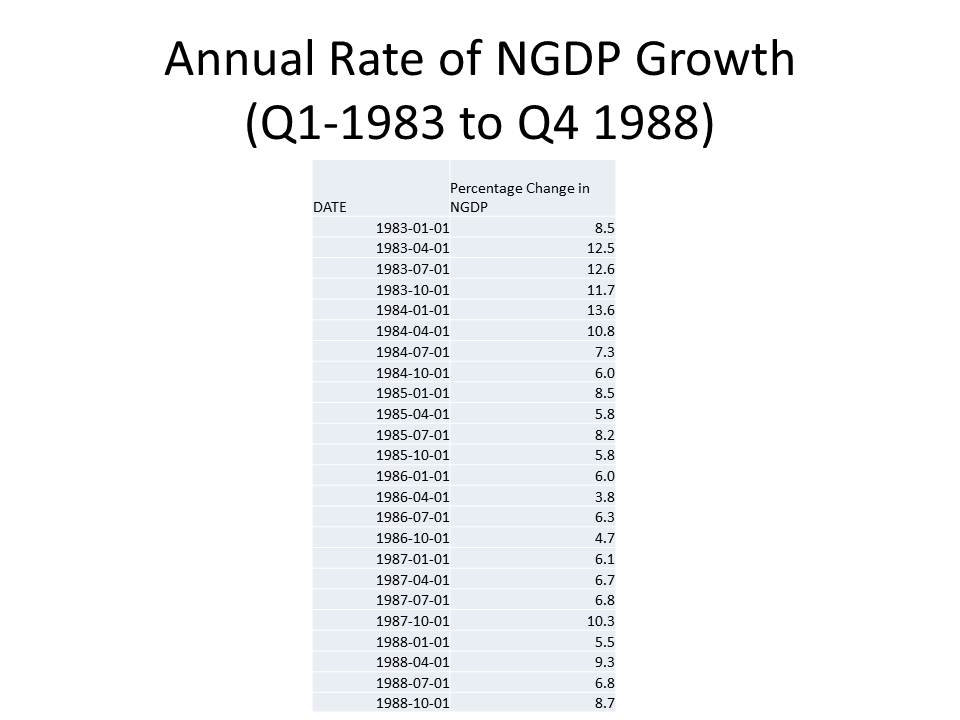
What Mr. Schwab fails to note is that the value of money (its purchasing power at any moment) and the rate of inflation cannot be determined in a free market. That is the job of the monetary authority. Aside from the tiny sliver of the economics profession that believes that the value of money ought to be determined by some sort of free-market process, that responsibility is now taken for granted. The problem at present is that the expected future price level (or the expected rate of growth in nominal GDP) is below the level consistent with full employment. The problem with Fed policy is not that it is keeping rates too low, but that it is content to allow expectations of inflation (or expectations of future growth in nominal GDP) to remain below levels necessary for a strong recovery. The Reagan recovery, as I noted recently, is hailed as a model for the Obama administration and the Fed by conservative economists like John Taylor, and the Wall Street Journal editorial page, and presumably by Mr. Charles Schwab himself. The salient difference between our anemic pseudo recovery and the Reagan recovery is that inflation averaged 3.5 to 4 percent and nominal GDP growth in the Reagan recovery exceeded 10 percent for 5 consecutive quarters (from the second quarter of 1983 to the second quarter of 1984).  The table below shows the rate of NGDP growth during the last six years of the Reagan administration from 1983 through 1988.  This is why, as I have explained many times on this blog (e.g., here and here)and in this paper, since the early days of the Little Depression in 2008, the stock market has loved inflation.

Here’s how Hawtrey put it in his classic A Century of Bank Rate:

The adequacy of these small changes of Bank rate, however, depends upon psychological reactions. The vicious circle of expansion or contraction is partly, but not exclusively, a psychological phenomenon. It is the expectation of expanding demand that leads to a creation of credit and so causes demand to expand; and it is the expectation of flagging demand that deters borrowers and so causes demand to flag. . . . The vicious circle may in either case have any degree of persistence and force within wide limits; it may be so mild as to be easily counteracted, or it may be so violent as to require heroic measures. (p. 275)

Therefore the monetary authorities of a country which has been cut loose from any metallic or international standard find themselves compelled to some degree to regulate the foreign exchanges, either by buying and selling foreign currencies or gold, or (deplorable alternative) by applying exchange control. Thus at any moment the problem of monetary policy presents itself as a choice between a modification of the rate of exchange credit an adjustment of the credit system through Bank rate. And if the modification of the rate of exchange is such as to favour stable activity, the need for a change in Bank rate may be all the less. When a credit deadlock has thrown Bank rate out of action, modification of rates of exchange may be found to be the most valuable and effective instruments of monetary policy. (p. 277)

There is thus no doubt that the Fed could achieve (within reasonable margins of error) any desired price level or rate of growth in nominal GDP by announcing its target and expressing its willingness to drive down the dollar exchange rate in terms of one or several currencies until its price level or NGDP target were met. That, not abdication of its responsibility, is the way the Fed can strengthen the ever so faint signs of a budding recovery (remember those green shoots?).

Hayek’s 1932 Defense of the Insane Bank of France

In my post last Monday, I suggseted that Hayek’s attachment to the gold standard led him to recommend a policy of deflation during the Great Depression even though his own neutral-money policy criterion of stabilizing aggregate monetary expenditure would have implied aggressive monetary expansion during the Great Depression. Forced to choose between two conflicting principles, Hayek made the wrong choice, opting for defense of the gold standard rather than for stabilizing nominal GDP. He later changed his views, disavowing support for the gold standard as early as 1943 in a paper (“A Commodity Reserve Currency”) in the Economic Journal (reprinted as chapter 10 of Individualism and Economic Order) and reaffirming his opposition to the gold standard in The Constitution of Liberty (p. 335). I cited his 1932 paper “the Fate of the Gold Standard” translated from the original German and republished in his collected works and quoted his opening paragraph lamenting that Britain had abandoned the gold standard because (in September 1931 as the Great Depression was rapidly spiraling downward) Britain found the discipline of the gold standard “irksome.”

I also referred to Hayek’s defense of what I called “the insane French policy of gold accumulation.” I did not want to burden readers of an already long post with further quotations from Hayek’s article, so I just left it there without giving another quotation. But I think it may be worth analyzing what Hayek wrote, not because I want to make Hayek look bad, but because his defense of the Bank of France betrays a basic misunderstanding of the theory of international monetary adjustment and how the gold standard worked that is characteristic of many discussions of the gold standard.

Here is what Hayek wrote (F. A. Hayek, The Collected Works of F. A. Hayek, Good Money, Part 1, p. 160).

The accusation that France systematically hoarded gold seems at first sight to be more likely to be correct [than the charge that the US Federal Reserve had been hoarding gold, an accusation dismissed in the previous paragraph]. France did pursue an extremely cautious foreign policy after the franc stabilized at a level which considerably undervalued it with respect to its domestic purchasing power, and prevented an expansion of credit proportional to the amount of gold coming in. Nevertheless, France did not prevent her monetary circulation from increasing by the very same amount as that of the gold inflow – and this alone is necessary for the gold standard to function.

Hayek made a fundamental error here, assuming that a small open economy (which France could be considered to have been in the late 1920s) had control over its money supply and its price level under the gold standard. The French price level, once France pegged the franc to the dollar in 1926 at $0.0392/franc, was no longer under the control of French monetary authorities, commodity arbitrage requiring commodity prices quoted in francs to equal commodity prices quoted in dollars adjusted for the fixed dollar/franc parity. The equalization was not perfect, because not all commodities enter into international trade and because there are differences between similar products sold in different countries that preclude full price equalization. But there are strict limits on how much national price levels could diverge under a gold standard. Similarly, the money supply in a country on the gold standard could not be controlled by the monetary authority of that country, because if people in that country wanted to hold more money than the monetary authority made available, they could increase their holdings of money by increasing exports or decreasing imports, thereby generating an inflow of gold, which could be converted into banknotes or deposits.

So Hayek’s observation that France did not prevent her monetary circulation from increasing by the very same amount as that of the gold inflow means only that the Bank of France refused to increase the French money supply at all (or even attempted to decrease it), forcing the French to increase their holdings of cash by acquiring gold through an export surplus. Hayek’s statement thus betrays a total misunderstanding of what “is necessary for the gold standard to function.” All that was necessary was that France maintain a fixed parity between the dollar and the franc, not that the Bank of France achieve a particular change in the money supply governed by the amount that its holdings of gold had changed. Hayek wrongly assumed that the French monetary authorities had control over the French money supply and that the inflow of gold was somehow determined by real forces independent of French monetary conditions. But it was just the opposite. The French money supply increased because the French wanted to increase the amount of cash balances they were holding. The only question was whether the French banking system would be allowed by the Bank of France to accommodate the French demand for money by increasing the French money supply, or whether the desired increase in the money supply would be permitted only through gold imports generated by an export surplus. Refusing to allow the French money supply to increase except through the importation of gold meant that the increase in the French demand for money was transformed into an equivalent increase in French (and, hence, the world) demand for gold, thereby driving up the value of gold, the proximate source of the deflation that produced the Great Depression.

As I said, this misconception of money supply adjustment under the gold standard was not unique to Hayek.  In some ways it is characteristic of many orthodox treatments of the gold standard and it can be traced back at least to the British Currency School of the 1830 and 1840s, if not even further back to David Hume in the 18th century.  Milton Friedman was similarly misguided in many of his discussions of the gold standard and international adjustment, especially in his discussion of the Great Depression in his Monetary History of the United States.  Ralph Hawtrey, as usual, got it right.  But the analysis was much later articulated in more conventional model by Harry Johnson and his associates in their development of the monetary approach to the balance of payments.

Keynes v. Hayek: Enough Already

First, it was the Keynes v. Hayek rap video, and then came the even more vulgar and tasteless Keynes v. Hayek sequel video reducing the two hyperintellectuals to prize fighters. (The accuracy of the representations signaled in its portrayal of Hayek as bald and Keynes with a full head of hair when in real life it was the other way around.) Then came a debate broadcast by the BBC at the London School of Economics, and then another sponsored by Reuters with a Nobel Prize winning economist on the program arguing for the Hayek side. Now comes a new book by Nicholas Wapshott Keynes Hayek, offering an extended account of the fraught relationship between two giants of twentieth century economics who eventually came to a sort of intellectual détente toward the end of Keynes’s life, a decade or more after a few years of really intense, even brutal, but very high level, polemical exchanges between them (and some of their surrogates) in the pages of England’s leading economics journals. Tyler Cowen has just reviewed Wapshott’s book in the National Review (see Marcus Nunes’s blog).

As I observed in September after watching the first Keynes-Hayek debate, we can still learn a lot by going back to Keynes’s and Hayek’s own writings, but all this Keynes versus Hayek hype creates the terribly misleading impression that the truth must lie with only one side or the other, that one side represents truth and enlightenment and the other represents falsehood and darkness, one side represents pure disinterested motives and the other is shilling for sinister forces lurking in the wings seeking to advance their own illegitimate interests, in short that one side can be trusted and the other cannot. All this attention on Keynes and Hayek, two charismatic personalities who have become figureheads or totems for ideological movements that they might not have endorsed at all — and certainly not endorsed unconditionally — encourages an increasingly polarized discussion in which people choose sides based on pre-existing ideological commitments rather than on a reasoned assessment of the arguments and the evidence.

In part, this framing of arguments in ideological terms simply reflects existing trends that have been encouraging an increasingly ideological approach to politics, law, and public policy. For an example of this approach, see Naomi Klein’s recent musings about global warming and the necessity for acknowledging that combating global warming requires the very social transformation that makes right-wingers oppose, on ideological principle, any measure to counter global warming.  Those are just the terms of debate that Naomi Klein wants.  Thus, both sides have come to see global warming not as a problem to be addressed or mitigated, but as a weapon to be used in the context of a comprehensive ideological struggle. Those who want to address the problem in a pragmatic, non-ideological, way are losing control of the conversation.

The amazing thing about the original Keynes-Hayek debate is not only that both misunderstood the sources of the Great Depression for which they were confidently offering policy advice, but that Ralph Hawtrey and Gustav Cassel had explained what was happening ten years before the downturn started in the summer of 1929. Both Hawtrey and Cassel understood that restoring the gold standard after the demonetization of gold that took place during World War I would have hugely deflationary implications if, when the gold standard was reinstated, the world’s monetary demand for gold would increase back to the pre-World War I level (as a result of restoring gold coinage and the replenishment of the gold reserves held in central bank coffers). That is why both Hawtrey and Cassel called for measures to limit the world’s monetary demand for gold (measures agreed upon in the international monetary conference in Genoa in 1922 of which Hawtrey was the guiding spirit). The measures agreed upon at the Genoa Conference prevented the monetary demand for gold from increasing faster than the stock of gold was increasing so that the world price level in terms of gold was roughly stable from about 1922 through 1928. But in 1928, French demand for gold started to increase rapidly just as the Federal Reserve began tightening monetary policy in a tragically misguided effort to squelch a supposed stock-price bubble on Wall Street, causing an inflow of gold into the US while the French embarked on a frenzied drive to add to their gold holdings, and other countries rejoining the gold standard were increasing their gold holdings as well, though with a less fanatical determination than the French. The Great Depression was therefore entirely the product of monetary causes, a world-wide increase in gold demand causing its value to increase, an increase manifesting itself, under the gold standard, in deflation.

Hayek, along with his mentor Ludwig von Mises, could also claim to have predicted the 1929 downturn, having criticized the Fed in 1927, when the US was in danger of falling into a recession, for reducing interest rates to 3.5%, by historical standards far from a dangerously expansionary rate, as Hawtrey demonstrated in his exhaustive book on the subject A Century of Bank Rate. But it has never been even remotely plausible that a 3.5% discount rate at the Fed for a little over a year was the trigger for the worst economic catastrophe since the Black Death of the 14th century. Nor could Keynes offer a persuasive explanation for why the world suddenly went into a catastrophic downward spiral in late 1929. References to animal spirits and the inherent instability of entrepreneurial expectations are all well and good, but they provide not so much an explanation of the downturn as a way of talking about it or describing it. Beyond that, the Hawtrey-Cassel account of the Great Depression also accounts for the relative severity of the Depression and for the sequence of recovery in different counties, there being an almost exact correlation between the severity of the Depression in a country and the existence and duration of the gold standard in the country. In no country did recovery start until after the gold standard was abandoned, and in no country was there a substantial lag between leaving the gold standard and the start of the recovery.

So not only did Hawtrey and Cassel predict the Great Depression, specifying in advance the conditions that would, and did, bring it about, they identified the unerring prescription – something provided by no other explanation — for a country to start recovering from the Great Depression. Hayek, on the other hand, along with von Mises, not only advocated precisely the wrong policy, namely, tightening money, in effect increasing the monetary demand for gold, he accepted, if not welcomed, deflation as the necessary price for maintaining the gold standard. (This by the way is what explains the puzzle (raised by Larry White in his paper “Did Hayek and Robbins Deepen the Great Depression?”) of Hayek’s failure to follow his own criterion for a neutral monetary policy, stated explicitly in chapter 4 of Prices and Production: stabilization of nominal expenditure (NGDP). However, a policy of stabilizing nominal expenditure was inconsistent with staying on the gold standard when the value of gold was rising by 5 to 10% a year. Faced with a conflict between maintaining the gold standard and following his own criterion for neutral money, Hayek, along with his friend and colleague Lionel Robbins in his patently Austrian book The Great Depression, both opted for maintaining the gold standard.)

Not only did Hayek make the wrong call about the gold standard, he actually defended the insane French policy of gold accumulation in his lament for the gold standard after Britain wisely disregarded his advice and left the gold standard in 1931. In his paper “The Fate of the Gold Standard” (originally Das Schicksal der Goldwahrung) reprinted in The Collected Works of F. A. Hayek: Good Money, Part 1, Hayek mourned the impending demise of the gold standard after Britain tardily did the right thing. The tone of Hayek’s lament is struck in his opening paragraph (p. 153).

There has been much talk about the breakdown of the gold standard, particularly in Britain where, to the astonishment of every foreign observer, the abandonment of the gold standard was very widely welcomed as a release from an irksome constraint. However, it can scarcely be doubted that the renewed monetary problems of almost the whole world have nothing to do with the tendencies inherent in the gold standard, but on the contrary stem from the persistent and continuous attempts from many sides over a number of years to prevent the gold standard from functioning whenever it began to reveal tendencies which were not desired by the country in question. Hence it was by no means the economically strong countries such as America and France whose measures rendered the gold standard inoperative, as is frequently assumed, but the countries in a relatively weak position, at the head of which was Britain, who eventually paid for their transgression of the “rules of the game” by the breakdown of their gold standard.

So what do we learn from this depressing tale? Hawtrey and Cassel did everything right. They identified the danger to the world economy a decade in advance. They specified exactly the correct policy for avoiding the danger. Their policy was a huge success for about nine years until the Americans and the French between them drove the world economy into the Great Depression, just as Hawtrey and Cassel warned would happen if the monetary demand for gold was not held in check. Within a year and a half, both Hawtrey and Cassel concluded that recovery was no longer possible under the gold standard. And as countries, one by one, abandoned the gold standard, they began to recover just as Hawtrey and Cassel predicted. So one would have thought that Hawtrey and Cassel would have been acclaimed and celebrated far and wide as the most insightful, the most farsighted, the wisest, economists in the world. Yep, that’s what one would have thought. Did it happen? Not a chance. Instead, it was Keynes who was credited with figuring out how to end the Great Depression, even though there was almost nothing in the General Theory about the gold standard and a 30% deflation as the cause of the Great Depression, despite his having vilified Churchill in 1925 for rejoining the gold standard at the prewar parity when that decision was expected to cause a mere 10% deflation.

But amazingly enough, even when economists began looking for alternative ways to Keynesianism of thinking about macroeconomics, Austrian economics still being considered too toxic to handle, almost no one bothered to go back to revisit what Hawtrey and Cassel had said about the Great Depression. So Milton Friedman was considered to have been daring and original for suggesting a monetary explanation for the Great Depression and finding historical and statistical support for that explanation. Yet, on the key elements of the historical explanation, Hawtrey and Cassel either anticipated Friedman, or on the numerous issues on which Friedman did not follow Hawtrey and Cassel — in particular the international gold market as the transmitter of deflation and depression across all countries on the gold standard, the key role of the Bank of France (which Friedman denied in the Monetary History and for years afterwards only to concede the point in the mid to late 1990s), the absence of an explanation for the 1929 downturn, the misplaced emphasis on the contraction of the US money stock and the role of U.S. bank failures as a critical factor in explaining the severity of the Great Depression — Hawtrey and Cassel got it right and Friedman got it wrong.

So what matters in the success in the marketplace of ideas seems to be not just the quality or the truth of a theory, but also (or instead) the publicity machine that can be deployed in support of a theory to generate interest in it and to attract followers who can expect to advance their own careers in the process of developing, testing, or otherwise propagating, the theory. Keynes, Friedman, and eventually Hayek, all had powerful ideologically driven publicity machines working on their behalf. And guess what? It’s the theories that attract the support of a hard core of ideologically motivated followers that tend to outperform those without a cadre of ideological followers.

That’s why it was very interesting, important, and encouraging that Tyler Cowen, in his discussion of the Keynes-Hayek story, felt the need to mention how Scott Sumner has shifted the debate over the past two years away from the tired old Keynes vs. Hayek routine. Of course Tyler, about as well read an economist as there is, slipped up when he said that Scott is reviving the Friedman Monetarist tradition. No, Scott is reviving the Hawtrey-Cassel pre-Monetarist tradition, of which Friedman’s is a decidedly inferior, and obsolete, version. It just goes to show that one person sometimes really can make a difference, even without an ideologically driven publicity machine working on his behalf. Just imagine what Hawtrey and Cassel could have accomplished if they had been bloggers.

In Praise of Gustav Cassel

When I started this blog almost 5 months ago, I decided to highlight my intellectual debt to Ralph Hawtrey by emblazoning his picture (to the annoyance of some – sorry, but deal with it) on the border of the blog and giving the blog an alias (hawtreyblog.com) to go along with its primary name. I came to realize Hawtrey’s importance when, sometime after being exposed as a graduate student to Earl Thompson’s monetary, but anti-Monetarist (in the Friedmanian sense), theory of the Great Depression, according to which the Depression was caused by a big increase in the world’s monetary demand for gold in the late 1920s when many countries, especially France, almost simultaneously rejoined the gold standard, driving down the international price level, causing ruinous deflation. Thompson developed his theory independently, and I assumed that his insight was unprecedented, so it was a surprise when (I can’t remember exactly how or when) I discovered that Ralph Hawtrey (by the 1970s a semi-forgotten fugure in the history of monetary thought) had developed Thompson’s theory years earlier. Not only that, but I found that Hawtrey had developed the theory before the fact, and had predicted almost immediately after World War I exactly what would happen if restoration of the gold standard (effectively suspended during World War I) was mismanaged, producing a large increase in the international monetary demand for gold.  It dawned on me that there was a major intellectual puzzle, how was it that Hawtrey’s theory of the Great Depression had been so thoroughly forgotten (or ignored) by the entire economics profession.

A few years later, in a conversation with my old graduate school buddy, Ron Batchelder, also a student of Thompson, I mentioned to him that Earl’s theory of the Great Depression had actually been anticipated right after World War I by Ralph Hawtrey. Batchelder then told me that he had discovered that Earl’s theory had also been anticipated by the great Swedish economist, Gustav Cassel, who also had been warning during the 1920s that a depression could result from an increased monetary demand for gold. That was the genesis of the paper that Ron and I wrote many years ago, “Pre-Keynesian Monetary Theories of the Great Depression: Whatever Happened to Hawtrey and Cassel?” Ron and I wrote the paper in 1991, but always planning to do one more revision, we have submitted it for publication. I am hoping finally to do another revision in the next month or so and then submit it. An early draft is still available as a UCLA working paper, and I will post the revised version on the SSRN website. Scott Sumner wrote a blog post about the paper almost two years ago.

At any rate, when I started the blog, I had a bit of a guilty conscience for not giving Cassel his due as well as Hawtrey. I suppose that I prefer Hawtrey’s theoretical formulations, emphasizing the law of one price rather than the price-specie-flow mechanism, and the endogeneity of the money supply to Cassel’s formulations which are closer to the standard quantity theory than I feel comfortable with. But the substantive differences between Hawtrey and Cassel were almost nil, and both of these estimable scholars and gentlemen are deserving of all the posthumous glory that can be bestowed on them, and then some.

So, with that lengthy introduction, I am happy to give a shout-out to Doug Irwin who has just written a paper “Anticipating the Great Depression? Gustav Cassel’s Analysis of the Interwar Gold Standard.” Doug provides detailed documentation of Cassel’s many warnings before the fact about the potentially disastrous consequences of not effectively controlling the international demand for gold during the 1920s as countries returned to the gold standard, of his identification as they were taking place of the misguided policies adopted by the Bank of France and the Federal Reserve Board that guaranteed that the world would be plunged into a catastrophic depression, and his brave and lonely battle to persuade the international community to abandon the gold standard as the indispensable prerequisite for recovery.

Here is a quotation from Cassel on p. 19 Doug’s paper:

All sorts of disturbances and maladjustments have contributed to the present crisis. But it is difficult to see why they should have brought about a fall of the general level of commodity prices. . . . A restriction of the means of payment has caused a fall of the general level of commodity prices – a deflation has taken place. But people shut their eyes to what is going on in the monetary sphere and pay attention only to the other disturbances.

Another quote from Cassel appears in footnote 21 (pp. 31-32). Here is the entire footnote:

Before accepting the view that monetary policy was impotent, Cassel insisted that “we should make sure that the necessary measures have been applied with sufficient resoluteness. A central bank ought not to stop its purchases of Government securities just at the moment when such purchases could be expected to exercise a direct influence on the volume of active purchasing power. If it is stated in advance that [the?]central bank intends to go on supplying means of payment until a certain rise in the general level of prices has been brought about, the result will doubtless be much easier to attain.”

On top of all that, the paper is a pleasure to read, providing many interesting bits of personal and historical information as well as a number of valuable observations on Cassel’s relationships with Keynes and Hayek. In other words, it’s a must read.

Rules v. Discretion

I gave a talk this afternoon at a panel on the Heritage of Monetary Economics and Macroeconomics at the meetings of the Southern Economic Association in Washington. The panel was brought together to commemorate a confluence of significant anniversaries this year: the 300th anniversary of David Hume’s birth, the 200th anniversary of the publication of the Bullion Report to the British Parliament, the 100th anniversary of the publication of Irving Fisher’s Purchasing Power of Money, the 75th anniversary of the publication of Keynes’s General Theory, and the 50th anniversary of the publication of John Muth’s paper on rational expectations. I spoke about the Bullion Report and the contributions of classical monetary theory. At some point, I may post the entire paper on SSRN, but I thought that the section of my paper on rules versus discretion in monetary policy might be of interest to readers of the blog, so here is an abridged version of that section of my paper.

The Bullion Report, whose 200th anniversary we are observing, is an appropriate point from which to start a discussion of the classical contribution to the perpetual debate over rules versus discretion in the conduct of monetary policy. The Bullion Report contained an extended discussion of several important theoretical issues, but its official purpose was to recommend an early resumption of convertibility (suspended since 1797) of Bank of England banknotes, to make them redeemable again at a fixed parity in terms of gold. In other words, the Bullion Report called for a rapid return to the gold standard, then regarded as a safe and workable rule for the conduct of monetary policy.

Despite the rejection by Parliament of the Report’s recommendation to quickly restore the gold standard, the general argument of the Bullion Report for the gold standard undoubtedly influenced the ultimate decision to restore the gold standard after the Napoleonic Wars. But full restoration of gold standard in 1821 did not produce the promised monetary stability, with ongoing disturbances punctuated by financial crises every 10 years or so, in 1825, 1836, 1847, 1857 and 1866. The result of the early disturbances was the adoption of new rules motivated by the idea that monetary disturbances were symptomatic of the failure of a mixed (gold and paper) currency to fluctuate exactly as a purely metallic currency would have.

These new rules seem to me to have been altogether misguided and pernicious, but their adoption reflected a fear that the simple rule embodying the gold standard, the requirement that banknotes be convertible into gold, would not ensure monetary stability unless supplemented by further rules limiting the creation of banknotes by the banks. The rules had to be tightened and spelled out in increasing detail to effectively limit the discretion of the bankers and prevent them from engaging in the destabilizing behavior that they would otherwise engage in.

Thus, over the course of the nineteenth century, there evolved a conception of the rules of the game governing the behavior of the monetary authorities under gold standard. However, the historical record is far from clear on the extent to which the rules of the game were actually observed. The record of equivocal adherence by the monetary authorities under the gold standard to the rules of the game can be interpreted to mean either that the rules of the game were unworkable or irrelevant — in which case following the rules would have been destabilizing — or that it was the failure to follow the rules of the game that caused the instabilities observed even in the heyday of the international gold standard (1880-1914).

The outbreak of World War I led quickly to the effective suspension of the international gold. The prestige of the gold standard was such that hardly anyone questioned the objective of restoring it after the war.  However, there was an increasing understanding that the assumption that the gold standard was the simplest and most effective arrangement by which to achieve price-level stability was unlikely to be valid in the post-war environment. Ralph Hawtrey and Gustav Cassel were especially emphatic after the war about the deflationary dangers associated with restoring the international gold standard unless measures were taken to reduce the monetary demand for gold as countries went back on the gold standard. As a result, the 1920s literature on monetary policy contain frequent derogatory references by supporters of the orthodox gold standard to supporters of managed money, i.e., to advocates of using monetary policy to stabilize prices rather than accept whatever price level was generated by allowing the gold standard to operate according to the rules of the game.

Advocates of price-level stabilization, especially Hawtrey and Cassel, attributed the Great Depression to a failure to manage the gold standard in a way that prevented a sharp increase in the worldwide monetary demand for gold after France, followed by a number of other countries, rejoined the gold standard in 1928 and began redeeming foreign exchange holdings for gold. It was at just this point that the Federal Reserve, having followed a somewhat accommodative policy since 1925, shifted to a tighter policy in late 1928 out of concern with stock-market speculation supposedly fueling a bubble in stock prices. Supporters of the traditional gold standard blamed the crisis on the “inflationary” policies of the Federal Reserve which prevented the “natural” deflation that would otherwise have started in 1927.

Supporters of the traditional gold standard thought that they were upholding the classical tradition of a monetary policy governed by rules not discretion. But Hawtrey and Cassel were not advocates of unlimited policy discretion; they believed that the gold standard ought to be managed by the leading central banks with an understanding of how their policies jointly would determine the international price level and that they should therefore do what was necessary to avoid the deflation to which the world economy was dangerously susceptible because of the rapidly increasing monetary demand for gold.

The Keynesian Revolution after the Great Depression provided a rationale for not allowing policy rules (e.g., keeping the government’s budget balanced, or keeping an exchange rate or an internal price level constant) to preclude taking fiscal or monetary actions designed to increase employment. Achieving full employment by controlling aggregate spending by manipulating fiscal and monetary instruments became the explicit goal of economic policy for the first time. The gold standard having been effectively discredited, opponents of discretionary policies had to search for an alternative rule in terms of which they could take a principled stand against discretionary Keynesian policies. A natural rule to specify would have been to stabilize a price index, as Irving Fisher had proposed after World War I, with his plan for a compensated dollar based on adjusting the price of gold at which the dollar would be made convertible as necessary to keep the price level constant. But Fisher’s plan was too complicated for laymen to understand, and Milton Friedman, the dominant anti-Keynesian of the 1950s and 1960s, preferred to formulate a monetary rule in terms of the quantity of money, perhaps reflecting the Currency School bias for quantitative rules he inherited from his teacher at Chicago Lloyd Mints. A quantitative rule, Friedman argued, imposes a tighter, more direct, constraint on the actions of the central bank than a price-level rule.

The attempt by the Federal Reserve under Paul Volcker to implement a strict Monetarist control over the growth of the money aggregates proved unsuccessful even though the Fed succeeded in its ultimate goal of reducing inflation. Friedman himself, observing the rapid growth of the monetary aggregates, after inflation had been brought down, predicted that inflation would soon rise again to near double-digit rates. That error marked the end of Monetarism as a serious guide to conducting monetary policy.

However, traditional Keynesian prescriptions were, by then, no longer fashionable either, and we entered a two-decade period in which monetary policy aimed at a gradually declining inflation target, falling from 3.5% in the late 1980s to about 2% at present. The instrument used to achieve the inflation target was the traditional pre-Keynesian instrument of the bank rate. John Taylor suggested a rule for setting the bank rate based on the target inflation rate and the gap between actual and potential output that seemed consistent with the recent behavior of the Fed and other central banks. Everything seemed to be going well, and central banks basked in a glow of general approval and gratitude for achieving what was called the Great Moderation. But, perhaps because the Fed didn’t follow the Taylor rule for a few years after the dot-com bubble and the 9/11 attack, there was a housing bubble and then a recession and then a financial crisis, and we now find ourselves mired in the worst recession – actually a Little Depression — since the Great Depression.

The classical monetary theorists, with very few exceptions, believed in some sort of monetary rule, for the most part, either a simple gold standard governed only by the obligation to maintain convertibility or a gold standard hedged in by a variety of rules specifying the appropriate adjustments. Only a few classical economists had other ideas about a monetary regime, and of these they were also rule-based systems such as bimetallism or some form of a tabular standard. The idea of a purely discretionary regime unconstrained by any rule was generally beyond their comprehension.

The problem, for which we as yet have no solution, is that it is dangerous to formulate a rule governing monetary policy if one doesn’t have a fully adequate model of the economy and of the monetary system for which the rule is supposed to determine policy. Ever since the nineteenth century, monetary reformers have been proposing rules to govern policy whose effects they have grossly misunderstood. The Currency School erroneously believed that monetary and financial crises were caused by the failure of a mixed currency to fluctuate in exactly the same way as a purely metallic currency would have. The attempt to impose such a rule simply aggravated the crises to which any gold standard was naturally subject as a result of more or less random fluctuations in the value of gold. The Great Depression was caused by a misguided attempt to recreate the prewar gold standard without taking into account the effect that restoring the gold standard would have on the value of gold. A Monetarist rule to control the rate of growth of the money supply was nearly impossible to implement, because Monetarists stubbornly believed that the demand for money was extremely stable and almost unaffected by the rate of interest so that a steady rate of growth in the money supply was a necessary and sufficient condition for achieving the maximum degree of macroeconomic stability monetary policy was capable of.

After those failures, it was thought that a policy of inflation targeting would achieve macroeconomic stability. But there are two problems with inflation targeting. First, it calls for a perverse response to supply shocks, adding stimulus when a positive productivity shock speeds economic growth and reduces inflation, and reducing aggregate demand when a negative supply shock reduces economic growth and increases inflation. Thus, in one of the greatest monetary policy mistakes since the Great Depression, the FOMC stubbornly tightened policy for most of 2008, because negative supply shocks were driving up commodities prices, causing fears that inflation expectations would become unanchored. The result was an accelerating downturn in the summer of 2008, producing deflationary expectations that precipitated a financial panic and a crash in asset prices.

Second, even without a specific supply shock, if profit expectations worsen sufficiently, causing equilibrium real short-term interest rates to go negative, the only way to avoid a financial crisis is for the rate of inflation to increase sufficiently to allow the real short term interest rate to drop to the equilibrium level. If inflation doesn’t increase sufficiently to allow the real interest rate to drop to its equilibrium level, the expected rate of return on holding cash will exceed the expected return from holding capital causing a crash in asset prices, just what happened in October 2008.

Some of us are hoping that targeting nominal GDP may be an improvement over the rules that have been followed to date.  But the historical record, at any rate, does not offer much comfort to anyone who believes that adopting a following a simple rule is the answer to our monetary ills.

The Economic Consequences of Mrs. Merkel

Winston Churchill, in 1925 Chancellor of the Exchequer in the Conservative government headed by Stanley Baldwin, was pressed by the Governor of the Bank of England, Montagu Norman, to restore the British pound to its pre-war parity of $4.86, thereby re-establishing the gold standard in Britain, paving the way for a general restoration of the international gold standard, one of the first casualties of war in August 1914. Having accumulated an enormous stockpile of gold in exchange for supplies it provided to the belligerents, US restored convertibility into gold soon after the end of hostilities, but sterling had depreciated against the dollar by about 25 percent after the war, so Britain could not achieve its goal of restoring the convertibility into gold at the prewar parity without a tight monetary policy aimed at raising the external value of the pound from about $4 to $4.86.

In 1925, sterling had risen to within about 10% of the old parity, making restoration of the pre-war dollar parity seem attainable, thus increasing the pressure from the London and the international financial communities to take the final steps toward the magic $4.86 level. Churchill understood that such a momentous step was both politically and economically dangerous and sought advice from a wide range of opinion, pro and con, both inside and outside government. The most persuasive advice he received was undoubtedly from J. M. Keynes, who, having served as a Treasury economist during World War I and then serving on the British delegation to the Versailles Peace Conference, became world famous after resigning from the Treasury to write The Economic Consequences of the Peace, his devastating critique of the Treaty of Versailles, protesting the overly harsh and economically untenable reparations obligations imposed on Germany. Keynes advised Churchill that the supposedly minimal 10% appreciation of sterling against the dollar would impose an intolerable burden on British workers, who had suffered from exceptionally high unemployment since the 1920-21 postwar deflation.

Despite Keynes’s powerful arguments, Churchill in the end followed the advice of the Bank of England and other members of the British financial establishment. Perhaps one argument that helped persuade him to follow the orthodox advice was that of another Treasury economist, the great Ralph Hawtrey, who submitted a paper analyzing the effects of restoring the prewar dollar parity. Hawtrey argued that Britain and the world would benefit from the restoration of an international gold standard, provided that the restoration was managed in a way that avoided the deflationary tendencies associated a remonetization of gold. Hawtrey suggested that there was reason to think that the institution that mattered most, the U.S. Federal Reserve, with its huge stockpile of gold, would follow a mildly inflationary policy allowing Britain to maintain the prewar parity without additional deflationary pressure. However, Hawtrey warned that if the US did not follow an accommodative policy, it would be a mistake and futile for Britain to defend the parity by deflating.

Keynes, who never suffered from a lack of self-confidence, undoubtedly thought that he had gotten the better of his opponents in presenting the case against restoring the prewar dollar parity to Churchill. When the decision went against him, he vented his outrage at the decision, and perhaps his own personal frustration, by writing a short pamphlet, The Economic Consequences of Mr. Churchill, a withering rhetorical assault on Churchill and the decision to restore the pre-war dollar parity. However, the consequences of the decision to restore the prewar parity were, at least initially, less devastating than Keynes predicted. Contrary to Keynes’s prediction, unemployment in Britain actually declined slightly in 1926 and 1927, falling below 10% for the first time in the 1920s. Hawtrey’s conjecture that the Federal Reserve, then led by the head of the New York Federal Reserve Bank, Benjamin Strong, would follow a mildly accommodative policy, alleviating the deflationary pressure on Britain, turned out to be correct. However, ill health forced Strong to resign in 1928 only months before his untimely death. His accommodative policy was reversed just as the Bank of France started accumulating gold, unleashing deflationary forces that had been contained since the deflation of 1920-21.

Fast forward some four score years to today’s tragic re-enactment of the deflationary dynamics that nearly destroyed European civilization in the 1930s. But what a role reversal! In 1930 it was Germany that was desperately seeking to avoid defaulting on its obligations by engaging in round after round of futile austerity measures and deflationary wage cuts, causing the collapse of one major European financial institution after another in the annus horribilis of 1931, finally (at least a year after too late) forcing Britain off the gold standard in September 1931. Eighty years ago it was France, accumulating huge quantities of gold, in Midas-like self-satisfaction despite the economic wreckage it was inflicting on the rest of Europe and ultimately itself, whose monetary policy was decisive for the international value of gold and the downward course of the international economy. Now, it is Germany, the economic powerhouse of Europe dominating the European Central Bank, which effectively controls the value of the euro. And just as deflation under the gold standard made it impossible for Germany (and its state and local governments) not to default on its obligations in 1931, the policy of the European Central Bank, self-righteously dictated by Germany, has made default by Greece and now Italy and at least three other members of the Eurozone inevitable.

The only way to have saved the gold standard in 1930 would have been for France and the US to have radically changed their monetary policy to encourage an outflow of gold, driving down the international value of gold and reversing the deflation. Such a policy reversal, though advocated by Hawtrey and the great Swedish economist Gustav Cassel, was beyond the limited imagination of the world’s central bankers and monetary authorities at the time. But once started, the deflationary downward spiral did not stop until France, finally having had enough, abandoned gold in 1935. If the European central bank does not soon – and I mean really soon – grasp that there is no exit from the debt crisis without a reversal of monetary policy sufficient to enable nominal incomes in all the economies in the Eurozone to grow more rapidly than does their indebtedness, the downward spiral will overtake even the stronger European economies. (I pointed out three months ago that the European crisis is a NGDP crisis not a debt crisis.) As the weakest countries choose to ditch the euro and revert back to their own national currencies, the euro is likely to start to appreciate as it comes to resemble ever more closely the old deutschmark. At some point the deflationary pressures of a rising euro will cause even the Germans, like the French in 1935, to relent. But one shudders at the economic damage that will be inflicted until the Germans come to their senses. Only then will we be able to assess the full economic consequences of Mrs. Merkel.

Do What Is Right Though the World Should Perish

An ancient debate among economists is whether the monetary authority should be subject to and constrained by an explicit operating rule or should be allowed discretion to act as it sees fit.  The debate goes back to the Bullion Debates in Britain after the British government, in the early stages of the Napoleonic Wars, suspended the obligation of the Bank of England to convert their banknotes into gold at the legally prescribed value of the pound.  One side in the debate, the Bullionists, argued that the Bank of England, enjoying special legal privileges that made it the center of the British monetary system, should be bound by a fixed rule, the absolute duty to convert Bank of England notes, on demand, into a fixed quantity of gold.  The other side, the Anti-Bullionists, maintained that there was no need for the Bank of England to be bound by the obligation to convert.

Over 20 years of intermittent exchanges between opponents and supporters of the suspension, producing some of the most important contributions to monetary thought of the nineteenth century, the Bullion Debates led to a general (though not unanimous) acceptance of the need for convertibility into gold as a stabilizing anchor for a money and banking system in which private banks produce a large share of all the money in circulation.  Despite the resumption of convertibility in 1821, Great Britain experienced damaging financial disturbances in 1825 and 1836, leading to the passage of Bank Charter Act in 1844, imposing a fixed limit on the total amount of banknotes issued by the Bank of England and by other private banks, requiring 100% gold cover for any banknotes issued beyond that fixed limit.

Hopes that, by mimicking the fluctuation of a purely gold currency in response to gold inflows and outflows, the reformed monetary system would avoid future crises were soon disappointed, Britain suffering financial crises in 1847, 1857, and 1866.  Each time the government was forced to grant immunity to the directors of the Bank of England for violating the Bank Charter Act and issuing banknotes in excess of the legal maximum in order to calm commercial panics triggered by fears that the Bank of England would be prevented by the Bank Charter Act from satisfying the demand for credit.  Once temporary suspension of the Act was announced, the panic subsided, the knowledge that credit could be obtained if needed sufficing to moderate the precautionary demand for credit.

By the last two decades of the nineteenth century, the Bank of England, the key institution managing what had become an international gold standard, seemed to have figured out how to do its job reasonably well, and the period of 1880 to 1913 is still looked upon as a golden age of economic stability, growth and prosperity.  But the gold standard couldn’t withstand the pressures of World War I, effectively being suspended in substance in almost all countries.  The attempt to recreate the gold standard in the 1920s led to the Great Depression, because the way the gold standard worked before World War I was not well enough understood for the system to be recreated, more or less from scratch, under the new postwar conditions.  Attempting to follow a misguided conception of how a gold standard ought to work, countries, especially France, redesigned their monetary institutions in ways that inordinately increased the total world demand for gold, producing a world-wide deflation that began in the summer of 1929.

The two economists who really understood the nature of the pathology overtaking the international economy in 1929 were Ralph Hawtrey and Gustav Cassel, having warned of just the potential for a deflationary increase in the demand for gold as a consequence of a simultaneous restoration of the gold standard by many countries, but their warnings went largely unheeded.  Instead, the focus of most economists, central bankers, governments, and practitioners of la haute finance, was to preserve the gold standard at all costs, because to tamper with the gold standard was to allow the unbridled exercise of discretion, to make monetary policy unpredictable, to sanction runaway inflation and monetary anarchy.  But runaway inflation was not the danger — in Hawtrey’s immortal analogy to warn of inflation was like crying “fire, fire” in Noah’s flood – it was runaway deflation.  But rules are rules, and one must always follow the rules.  That the rules had been broken, or at least suspended, in the nineteenth century didn’t seem to matter, because as the old maxim teaches, we must do what is right though the world should perish.

The Great Depression came to an end mainly because the rules were not only broken, they were tossed out the window.  The gold standard was junked.  First, Britain gave up in September 1931, and a recovery started within a few months.  The US held out till March 1933, but when Franklin Roosevelt became President, understanding that prices had to rise before a recovery could start, he suspended the gold standard, devalued the dollar, thereby igniting the fastest expansion of industrial output in any 4-month period (57%) in American history while the Dow Jones average nearly doubled.

In our own Little Depression, we have become attached – I would say dysfunctionally attached – to an inflation target of 2% or less.  The inflation target is to the Little Depression what the gold standard was to the Great Depression.  The consequences this time are less horrific than they were last time, but they are plenty bad.  And the justification is equally spurious.  I would not go so far as to say that rules are made to be broken.  Some rules should not be broken under almost any circumstances, and almost any rule may have to be broken under some very extreme circumstances.  But not every rule — certainly not a rule that says that inflation may never exceed 2% — is entitled to such deference.

The European union and the common European currency are now on the verge of disaster because the European Central Bank, dominated by a German aversion to inflation, refused to provide enough monetary expansion to allow the weaker members of the Eurozone to generate enough nominal income to service the interest obligations on their debt.  In the Great Depression, it was Germany that was overindebted and unable to service its obligations.  Attempting to play under the dysfunctional rules of the gold standard, Germany imposed draconian austerity measures in the form of tax increases and public expenditure reductions and wage cuts.  But all such measures were doomed from the start.  All that was accomplished was to pave Hitler’s path to power.  And now, in a historic role reversal, it is Germany that is paving the way for consequences which we may not yet even be able to imagine.  But evidently as long as the European Central Bank can achieve its inflation target, it will be worth it, because, as the old maxim teaches, one must do what is right even if the world should perish.

Keynes v. Hayek: Advantage Hawtrey

On Labor Day, I finally got around to watching the Keynes v. Hayek debate at  the London School of Economics on August 3 between Robert Skidelsky and Duncan Weldon on behalf of Keynes and George Selgin and Jamie Whyte on behalf of Hayek.  Inspired by the Hayek-Keynes rap videos, the debate, it seems to me, did not rise very far above the intellectual level of the rap videos, with both sides preferring to caricature the other side rather than engage in a debate on the merits.  The format of the debate, emphasizing short declaratory statements and sound bites, invites such tactics.

Thus, Robert Skidelsky began the proceedings by lambasting Hayek for being a liquidationist in the manner of Andrew Mellon (as rather invidiously described by his boss, Herbert Hoover, in the latter’s quest in his memoirs for self-exculpation), even though Skidelsky surely is aware that Hayek later disavowed his early policy recommendations in favor of allowing deflation to continue with no countermeasures.  Skidelsky credited FDR’s adoption of moderate Keynesian fiscal stimulus as the key to a gradual recovery from the Great Depression until massive spending on World War II brought about the Depression to a decisive conclusion.

Jamie Whyte responded with a notably extreme attack on Keynesian policies, denying that Keynesian policies, or apparently any policy other than pure laissez-faire, could lead to a “sustainable” recovery rather than just sow the seeds of the next downturn, embracing, in other words, the very caricature that Skidelsky had just unfairly used in his portrayal of Hayek as an out-of-touch ideologue.  George Selgin was therefore left with the awkward task of defending Hayek against both Skidelsky and his own colleague.

Selgin contended that it was only in the 1929-31 period that Hayek argued for deflation as a way out of depression, but later came to recognize that a contraction of total spending, associated with an increasing demand by the public to hold cash, ought, in principle, to be offset by a corresponding increase in the money supply to stabilize the aggregate flow of expenditure.   Larry White has documented the shift in Hayek’s views in a recent paper, but the argument is a tad disingenuous, because, despite having conceded this point in principle in some papers in the early to mid-1930s, Hayek remained skeptical that it could be implemented in practice, as Selgin has shown himself to be here.  It was not until years later that Hayek expressed regret for his earlier stance and took an outspoken and unequivocal stand against deflation and a contraction in aggregate expenditure.

I happen to think that one can learn a lot form both Hayek and Keynes.  Both were profound thinkers who had deep insights into economics and the workings of market economies.  Emotionally, I have always been drawn more to Hayek, whom I knew personally and under whom I studied when he visited UCLA in my junior year, than to Keynes.  But Hayek’s best work verged on the philosophical, and his philosophical and scholarly bent did not suit him for providing practical advice on policy.  Hayek, himself, admitted to having been dazzled by Keynes’s intellect, but Keynes could be too clever by a half, and was inclined to be nasty and unprincipled when engaged in scholarly or policy disputes, the list of his victims including not only Hayek, but A. C. Pigou and D. H. Robertson, among others.

So if we are looking for a guide from the past to help us understand the nature of our present difficulties, someone who had a grasp of what went wrong in the Great Depression, why it happened and why it took so long to recover from, our go-to guy should not be Keynes or Hayek, but the eminent British economist, to whose memory this blog is dedicated, Ralph Hawtrey.  (For further elaboration see my paper “Where Keynes Went Wrong.”)  It was Hawtrey who, before anyone else, except possibly Gustav Cassel, recognized the deflationary danger inherent in restoring a gold standard after it had been disrupted and largely abandoned during World War I.  It was Hawtrey, more emphatically than Keynes, who warned of the potential for a deflationary debacle as a result of a scramble for gold by countries seeking to restore the gold standard, a scramble that began in earnest in 1928 when the Bank of France began cashing in its foreign exchange reserves for gold bullion, a  move coinciding with the attempt of the Federal Reserve System to check what it regarded as a stock-market bubble by raising interest rates, attracting an inflow of gold into the United States just when the Bank of France and other central banks were increasing their own demands for gold.  It was the confluence of those policies in 1928-29, not a supposed inflationary boom that existed only in the imagination of Mises and Hayek and their followers that triggered the start of a downturn in the summer of 1929 and the stock-market crash of October 1929.   Once the downturn and the deflation took hold, the dynamics of the gold standard transmitted a rapid appreciation in the real value of gold across the entire world from which the only escape was to abandon the gold standard.

Leaving the gold standard, thereby escaping the deflation associated with a rising value of gold, was the one sure method of bringing about recovery.  Fiscal policy may have helped — certainly a slavish devotion to balancing the budget and reducing public debt – could do only harm, but monetary policy was the key.  FDR, influenced by George Warren and Frank Pearson, two Cornell economists, grasped both the importance of stopping deflation and the role of the gold standard in producing and propagating deflation.  So, despite the opposition of some of his closest advisers and the conventional wisdom of the international financial establishment, he followed the advice of Warren and Pearson and suspended the gold standard shortly after taking office, raising the gold price in stages from $20.67 an ounce to $35 an ounce.  Almost at once, a recovery started, the fastest recovery over any 4-month period (from April through July 1933) in American history.

Had Roosevelt left well enough alone, the Great Depression might have been over within another year, or two at the most, but FDR could not keep himself from trying another hare-brained scheme, and forced the National Industrial Recovery Act through Congress in July 1933.  Real and money wages jumped by 20% overnight; government sponsored cartels perversely cut back output to raise prices.  As a result, the recovery slowed to a crawl, not picking up speed again till 1935 when the NRA was ruled unconstitutional by the Supreme Court.  Thus, whatever recovery there was under FDR owed at least as much to monetary policy as to fiscal policy.  Remember also that World War II was a period of rapid inflation and monetary expansion along with an increase in government spending for the war.  In addition, the relapse into depression in 1937-38 was at least as much the result of monetary as of fiscal tightening.

I would never say forget about Keynes or Hayek, but really the true master– the man whom Keynes called his “grandparent in the paths of errancy” — was Ralph G. Hawtrey.


About Me

David Glasner
Washington, DC

I am an economist in the Washington DC area. My research and writing has been mostly on monetary economics and policy and the history of economics. In my book Free Banking and Monetary Reform, I argued for a non-Monetarist non-Keynesian approach to monetary policy, based on a theory of a competitive supply of money. Over the years, I have become increasingly impressed by the similarities between my approach and that of R. G. Hawtrey and hope to bring Hawtrey’s unduly neglected contributions to the attention of a wider audience.

My new book Studies in the History of Monetary Theory: Controversies and Clarifications has been published by Palgrave Macmillan

Follow me on Twitter @david_glasner

Archives

Enter your email address to follow this blog and receive notifications of new posts by email.

Join 665 other subscribers
Follow Uneasy Money on WordPress.com