Archive for the 'gold standard' Category


More on Currency Manipulation

My previous post on currency manipulation elicited some excellent comments and responses, helping me, I hope, to gain a better understanding of the subject than I started with. What seemed to me the most important point to emerge from the comments was that the Chinese central bank (PBC) imposes high reserve requirements on banks creating deposits. Thus, the creation of deposits by the Chinese banking system implies a derived demand for reserves that must be held with the PBC either to satisfy the legal reserve requirement or to satisfy the banks’ own liquidity demand for reserves. Focusing directly on the derived demand of the banking system to hold reserves is a better way to think about whether the Chinese are engaging in currency manipulation and sterilization than the simple framework of my previous post. Let me try to explain why.

In my previous post, I argued that currency manipulation is tantamount to the sterilization of foreign cash inflows triggered by the export surplus associated with an undervalued currency. Thanks to an undervalued yuan, Chinese exporters enjoy a competitive advantage in international markets, the resulting export surplus inducing an inflow of foreign cash to finance that surplus. But neither that surplus, nor the undervaluation of the yuan that underlies it, is sustainable unless the inflow of foreign cash is sterilized. Otherwise, the cash inflow, causing a corresponding increase in the Chinese money supply, would raise the Chinese price level until the competitive advantage of Chinese exporters was eroded. Sterilization, usually conceived of as open-market sales of domestic assets held by the central bank, counteracts the automatic increase in the domestic money supply and in the domestic price level caused by the exchange of domestic for foreign currency. But this argument implies (or, at least, so I argued) that sterilization is not occurring unless the central bank is running down its holdings of domestic assets to offset the increase in its holdings of foreign exchange. So I suggested that, unless the Chinese central holdings of domestic assets had been falling, it appeared that the PBC was not actually engaging in sterilization. Looking at balance sheets of the PBC since 1999, I found that 2009 was the only year in which the holdings of domestic assets by the PBC actually declined. So I tentatively concluded that there seemed to be no evidence that, despite its prodigious accumulation of foreign exchange reserves, the PBC had been sterilizing inflows of foreign cash triggered by persistent Chinese export surpluses.

Somehow this did not seem right, and I now think that I understand why not. The answer is that reserve requirements imposed by the PBC increase the demand for reserves by the Chinese banking system. (See here.) The Chinese reserve requirements on the largest banks were until recently as high as 21.5% of deposits (apparently the percentage is the same for both time deposits and demand deposits). The required reserve ratio is the highest in the world. Thus, if Chinese banks create 1 million yuan in deposits, they are required to hold approximately 200,000 yuan in reserves at the PBC. That 200,000 increase in reserves must come from somewhere. If the PBC does not create those reserves from domestic credit, the only way that they can be obtained by the banks (in the aggregate) is by obtaining foreign exchange with which to satisfy their requirement. So given a 20% reserve requirement, unless the PBC undertakes net purchases of domestic assets equal to at least 200,000 yuan, it is effectively sterilizing the inflows of foreign exchange. So in my previous post, using the wrong criterion for determining whether sterilization was taking place, I had it backwards. The criterion for whether sterilization has occurred is whether bank reserves have increased over time by a significantly greater percentage than the increase in the domestic asset holdings of the PBC, not, as I had thought, whether those holdings of the PBC have declined.

In fact it is even more complicated than that, because the required-reserve ratio has fluctuated over time, the required-reserve ratio having roughly tripled between 2001 and 2010, so that the domestic asset holdings of the PBC would have had to increase more than proportionately to the increase in reserves to avoid effective sterilization. Given that the reserves held by banking system with the PBC at the end of 2010 were almost 8 times as large as they had been at the end of 2001, while the required reserve ratio over the period roughly tripled, the domestic asset holdings of the PBC should have increased more than twice as fast as bank reserves over the same period, an increase of, say, 20-fold, if not more. In the event, the domestic asset holdings of the PBC at the end of 2010 were just 2.2 times greater than they were at the end of 2001, so the inference of effective sterilization seems all but inescapable.

Why does the existence of reserve requirements mean that, unless the domestic asset holdings of the central bank increase at least as fast as reserves, sterilization is taking place? The answer is that the existence of a reserve requirement means that an increase in deposits implies a roughly equal percentage increase in reserves. If the additional reserves are not forthcoming from domestic sources, the domestic asset holdings of the central bank not having increased as fast as did required reserves, the needed reserves can be obtained from abroad only by way of an export surplus. Thus, an increase in the demand of the public to hold deposits cannot be accommodated unless the required reserves can be obtained from some source. If the central bank does not make the reserves available by purchasing domestic assets, then the only other mechanism by which the increased demand for deposits can be accommodated is through an export surplus, the surplus being achieved by restricting domestic spending, thereby increasing exports and reducing imports. The economic consequences of the central bank not purchasing domestic assets when required reserves increase are the same as if the central bank sold some of its holdings of domestic assets when required reserves were unchanged.

The more general point is that one cannot assume that the inflow of foreign exchange corresponding to an export surplus is determined solely by the magnitude of domestic currency undervaluation. It is also a function of monetary policy. The tighter is monetary policy, the larger the export surplus, the export surplus serving as the mechanism by which the public increases their holdings of cash. Unfortunately, most discussions treat the export surplus as if it were determined solely by the exchange rate, making it seem as if an easier monetary policy would have little or no effect on the export surplus.

The point is similar to one I made almost a year ago when I criticized F. A. Hayek’s 1932 defense of the monetary policy of the insane Bank of France. Hayek acknowledged that the gold holdings of the Bank of France had increased by a huge amount in the late 1920s and early 1930s, but, nevertheless, absolved the Bank of France of any blame for the Great Depression, because the quantity of money in France had increased by as much as the increase in gold reserves of the Bank of France.  To Hayek this meant that the Bank of France had done “all that was necessary for the gold standard to function.” This was a complete misunderstanding on Hayek’s part of how the gold standard operated, because what the Bank of France had done was to block every mechanism for increasing the quantity of money in France except the importation of gold. If the Bank of France had not embarked on its insane policy of gold accumulation, the quantity of money in France would have been more or less the same as it turned out to be, but France would have imported less gold, alleviating the upward pressure being applied to the real value of gold, or stated equivalently alleviating the downward pressure on the prices of everything else, a pressure largely caused by insane French policy of gold accumulation.

The consequences of the Chinese sterilization policy for the world economy are not nearly as disastrous as those of the French gold accumulation from 1928 to 1932, because the Chinese policy does not thereby impose deflation on any other country. The effects of Chinese sterilization and currency manipulation are more complex than those of French gold accumulation. I’ll try to at least make a start on analyzing those effects in an upcoming post addressing the comments of Scott Sumner on my previous post.
On the Unsustainability of Austrian Business-Cycle Theory, Or How I Discovered that Ludwig von Mises Actually Rejected His Own Theory

Robert Murphy, a clever fellow with an excessive, but, to his credit, not entirely uncritical (see here and here), devotion to Austrian Business Cycle Theory (ABCT), criticized my previous post about ABCT. Murphy’s criticism focuses on my alleged misreading or misrepresentation of Mises’s original version of ABCT in his The Theory of Money and Credit. (Note, however, that we are both dealing with the 1934 translation of the revised 1924 edition, not the original 1912 German text.)

Murphy quotes the following passage from my post focusing especially on the part in bold print.

[T]he notion of unsustainability [in Austrian business cycle theory] is itself unsustainable, or at the very least greatly exaggerated and misleading. Why must the credit expansion that produced the interest-rate distortion or the price bubble come to an end? Well, if one goes back to the original sources for the Austrian theory, namely Mises’s 1912 book The Theory of Money and Credit and Hayek’s 1929 book Monetary Theory and the Trade Cycle, one finds that the effective cause of the contraction of credit is not a physical constraint on the availability of resources with which to complete the investments and support lengthened production processes, but the willingness of the central bank to tolerate a decline in its gold holdings. It is quite a stretch to equate the demand of the central bank for a certain level of gold reserves with a barrier that renders the completion of investment projects and the operation of lengthened production processes impossible, which is how Austrian writers, fond of telling stories about what happens when someone tries to build a house without having the materials required for its completion, try to explain what “unsustainability” means.

The original Austrian theory of the business cycle was thus a theory specific to the historical conditions associated with classical gold standard.

Murphy then chastises me for not having read or having forgotten the following statement by von Mises.

Painful consideration of the question whether fiduciary media really could be indefinitely augmented without awakening the mistrust of the public would be not only supererogatory, but otiose.

Now it’s true that I did not recall this particular passage when writing my post, but the passage is not inconsistent with the point I was making. If you look at the passage from section 4 of chapter 5 of Part III of The Theory of Money and Credit (p. 357 of the 1934 edition), you will see that the context in which the statement is written is a hypothetical example in which banks can engage in an unlimited credit expansion without the constraints of an internal or external drain on their balance sheets. So while it is true that Mises anticipated in The Theory of Money and Credit the question whether a banking system not constrained by any internal or external drains could engage in an unlimited credit expansion, Mises was engaged in a hypothetical exercise, not the analysis of any business cycle ever encountered.

Murphy provides two longer quotations from a bit later in the same chapter in which Mises tried to explain why an unlimited credit expansion would be unsustainable:

The situation is as follows: despite the fact that there has been no increase of intermediate products and there is no possibility of lengthening the average period of production, a rate of interest is established in the loan market which corresponds to a longer period of production; and so, although it is in the last resort inadmissible and impracticable, a lengthening of the period of production promises for the time to be profitable. But there cannot be the slightest doubt as to where this will lead. A time must necessarily come when the means of subsistence available for consumption are all used up although the capital goods employed in production have not yet been transformed into consumption goods. This time must come all the more quickly inasmuch as the fall in the rate of interest weakens the motive for saving and so slows up the rate of accumulation of capital. The means of subsistence will prove insufficient to maintain the labourers during the whole period of the process of production that has been entered upon. Since production and consumption are continuous, so that every day new processes of production are started upon and others completed, this situation does not imperil human existence by suddenly manifesting itself as a complete lack of consumption goods; it is merely expressed in a reduction of the quantity of goods available for consumption and a consequent restriction of consumption. The market prices of consumption goods rise and those of production goods fall. (p. 362)

And

If our doctrine of crises is to be applied to more recent history, then it must be observed that the banks have never gone as far as they might in extending credit and expanding the issue of fiduciary media. They have always left off long before reaching this limit, whether because of growing uneasiness on their own part and on the part of all those who had not forgotten the earlier crises, or whether because they had to defer to legislative regulations concerning the maximum circulation of fiduciary media. And so the crises broke out before they need have broken out. It is only in this sense that we can interpret the statement that it is apparently true after all to say that restriction of loans is the cause of economic crises, or at least their immediate impulse; that if the banks would only go on reducing the rate of interest on loans they could continue to postpone the collapse of the market. If the stress is laid upon the word postpone, then this line of argument can be assented to without more ado. Certainly, the banks would be able to postpone the collapse; but nevertheless, as has been shown, the moment must eventually come when no further extension of the circulation of fiduciary media is possible. Then the catastrophe occurs, and its consequences are the worse. (p. 365)

The latter quotation actually confirms my assertion that Mises’s theory of business cycles as a historical phenomenon was a theory of the effects a credit expansion brought to a close by an external constraint imposed on the banks by the gold standard or perhaps by some artificial legal constraint on the reserve holdings of the banks. It is true that Mises hypothesized that a credit expansion by a completely unconstrained banking system was inevitably destined to be unsustainable, but this is a purely theoretical argument disconnected from historical experience.

But that is just what I said in my post:

[D]espite their antipathy to proposals for easing the constraints of the gold standard on individual central banks, Mises and Hayek never succeeded in explaining why a central-bank expansion necessarily had to be stopped. Rather than provide such an explanation they instead made a different argument, which was that the stimulative effect of a central-bank expansion would wear off once economic agents became aware of its effects and began to anticipate its continuation. This was a fine argument, anticipating the argument of Milton Friedman and Edward Phelps in the late 1960s by about 30 or 40 years. But that was an argument that the effects of central-bank expansion would tend to diminish over time as its effects were anticipated. It was not an argument that the expansion was unsustainable.

So let’s go back to what Mises said in the middle quotation above, where he tries to do the heavy lifting.

[D]espite the fact that there has been no increase of intermediate products and there is no possibility of lengthening the average period of production, a rate of interest is established in the loan market which corresponds to a longer period of production; and so, although it is in the last resort inadmissible and impracticable, a lengthening of the period of production promises for the time to be profitable.

I don’t understand why there has been no increase in intermediate products. The initial monetary expansion causes output to increase temporarily, allowing the amount of intermediate products to increase, and the average period of production to lengthen.

But there cannot be the slightest doubt as to where this will lead.

Note the characteristic Misesian rhetorical strategy: proof by assertion. There cannot be the slightest doubt that I am right and you are wrong. QED. Praxeology in action!

A time must necessarily come when the means of subsistence available for consumption are all used up although the capital goods employed in production have not yet been transformed into consumption goods.

Are the means of subsistence a common property resource? When property rights don’t exist over resources, those resources run out. The means of subsistence are owned and they are sold, not given away or taken at will. As their supply dwindles, their prices rise and consumption is restricted.

This time must come all the more quickly inasmuch as the fall in the rate of interest weakens the motive for saving and so slows up the rate of accumulation of capital.

But the whole point is that monetary expansion is raising the prices of consumption goods thereby imposing forced saving on households to accommodate the additional investment.

The means of subsistence will prove insufficient to maintain the labourers during the whole period of the process of production that has been entered upon.

What does this mean? Are workers dying of starvation? Is Mises working with a Ricardian subsistence theory of wages? But wait; let’s read on.

Since production and consumption are continuous, so that every day new processes of production are started upon and others completed, this situation does not imperil human existence by suddenly manifesting itself as a complete lack of consumption goods; it is merely expressed in a reduction of the quantity of goods available for consumption and a consequent restriction of consumption. The market prices of consumption goods rise and those of production goods fall.

OK, so what is the point? What is unsustainable about this?

Now I am really confused.  But wait!  Look at the preceding paragraph, and read the following:

Now it is true that an increase of fiduciary media brings about a redistribution of wealth in the course of its effects on the objective exchange value of money which may well lead to increased saving and a reduction of the standard of living. A depreciation of money, when metallic money is employed, may also lead directly to an increase in the stock of goods in that it entails a diversion of some metal from monetary to industrial uses. So far as these factors enter into consideration, an increase of fiduciary media does cause a diminution of even the natural rate of interest, as we could show if it were necessary. But the case that we have to investigate is a different one. We are not concerned with a reduction in the natural rate of interest brought about by an increase in the issue of fiduciary media, but with a reduction below this rate in the money rate charged by the banks, inaugurated by the credit-issuing banks and necessarily followed by the rest of the loan market. The power of the banks to do such a thing has already been demonstrated. (pp. 361-62)

So von Mises actually conceded that monetary expansion by the banks could reduce the real rate of interest via the imposition of forced savings caused by a steady rate of inflation. Unsustainability results only when the central bank reduces the rate of interest below the natural rate and succeeds in keeping it permanently below the natural rate. The result is hyperinflation, which almost everyone agrees is unsustainable. We don’t need ABCT to teach us that!  But the question that I and most non-Austrian economists are interested in is whether there is anything unsustainable about a steady rate of monetary expansion associated with a steady rate of growth in NGDP.  Answer: not obviously. And, evidently, even the great Ludwig von Mises, himself, admitted that a steady monetary expansion is indeed sustainable.  You can look it up.

Two Problems with Austrian Business-Cycle Theory

Even though he has written that he no longer considers himself an Austrian economist, George Selgin remains sympathetic to the Austrian theory of business cycles, and, in accord with the Austrian theory, still views recessions and depressions as more or less inevitable outcomes of distortions originating in the preceding, credit-induced, expansions. In a recent post, George argues that the 2002-06 housing bubble conforms to the Austrian pattern in which a central-bank lending rate held below the “appropriate,” or “natural” rate causes a real misallocation of resources reflecting the overvaluation of long-lived capital assets (like houses) induced by the low-interest rate policy. For Selgin, it was the Fed’s distortion of real interest rates from around 2003 to 2005 that induced a housing bubble even though the rate of increase in nominal GDP during the housing bubble was only slightly higher than the 5% rate of increase in nominal GDP during most of the Great Moderation.

Consequently, responses by Marcus Nunes, Bill Woolsey and Scott Sumner to Selgin, questioning whether he used an appropriate benchmark against which to gauge nominal GDP growth in the 2003 to 2006 period, don’t seem to me to address the core of Selgin’s argument. Selgin is arguing that the real distortion caused by the low-interest-rate policy of the Fed was more damaging to the economy than one would gather simply by looking at a supposedly excessive rate of nominal GDP growth, which means that the rate of growth of nominal GDP in that time period does not provide all the relevant information about the effects of monetary policy.

So to counter Selgin’s argument – which is to say, the central argument of Austrian Business-Cycle Theory – one has to take a step back and ask why a price bubble, or a distortion of interest rates, caused by central-bank policy should have any macroeconomic significance. In any conceivable real-world economy, entrepreneurial error is a fact of life. Malinvestments occur all the time; resources are, as a consequence, constantly being reallocated when new information makes clear that some resources were misallocated owing to mistaken expectations. To be sure, the rate of interest is a comprehensive price potentially affecting how all resources are allocated. But that doesn’t mean that a temporary disequilibrium in the rate of interest would trigger a major economy-wide breakdown, causing the growth of real output and income to fall substantially below their historical trend, perhaps even falling sharply in absolute terms.

The Austrian explanation for this system-wide breakdown is that the price bubble or the interest-rate misallocation leads to the adoption of investments projects and of production processes that “unsustainable.” The classic Austrian formulation is that the interest-rate distortion causes excessively roundabout production processes to be undertaken. For a time, these investment projects and production processes can be sustained by way of credit expansion that shifts resources from consumption to investment, what is sometimes called “forced saving.” At a certain point, the credit expansion must cease, and at that point, the unsustainability of the incomplete investment projects or even the completed, but excessively roundabout, production processes becomes clear, and the investments and production processes are abandoned. The capital embodied in those investment projects and production processes is revealed to have been worthless, and all or most of the cooperating factors of production, especially workers, are rendered unemployable in their former occupations.

Although it is not without merit, that story is far from compelling. There are two basic problems with it. First, the notion of unsustainability is itself unsustainable, or at the very least greatly exaggerated and misleading. Why must the credit expansion that produced the interest-rate distortion or the price bubble come to an end? Well, if one goes back to the original sources for the Austrian theory, namely Mises’s 1912 book The Theory of Money and Credit and Hayek’s 1929 book Monetary Theory and the Trade Cycle, one finds that the effective cause of the contraction of credit is not a physical constraint on the availability of resources with which to complete the investments and support lengthened production processes, but the willingness of the central bank to tolerate a decline in its gold holdings. It is quite a stretch to equate the demand of the central bank for a certain level of gold reserves with a barrier that renders the completion of investment projects and the operation of lengthened production processes impossible, which is how Austrian writers, fond of telling stories about what happens when someone tries to build a house without having the materials required for its completion, try to explain what “unsustainability” means.

The original Austrian theory of the business cycle was thus a theory specific to the historical conditions associated with classical gold standard. Hawtrey, whose theory of the business cycle, depended on a transmission mechanism similar to, but much simpler than, the mechanism driving the Austrian theory, realized that there was nothing absolute about the gold standard constraint on monetary expansion. He therefore believed that the trade cycle could be ameliorated by cooperation among the central banks to avoid the sharp credit contractions imposed by central banks when they feared that their gold reserves were falling below levels that they felt comfortable with. Mises and Hayek in the 1920s (along with most French economists) greatly mistrusted such ideas about central bank cooperation and economizing the use of gold as a threat to monetary stability and sound money.

However, despite their antipathy to proposals for easing the constraints of the gold standard on individual central banks, Mises and Hayek never succeeded in explaining why a central-bank expansion necessarily had to be stopped. Rather than provide such an explanation they instead made a different argument, which was that the stimulative effect of a central-bank expansion would wear off once economic agents became aware of its effects and began to anticipate its continuation. This was a fine argument, anticipating the argument of Milton Friedman and Edward Phelps in the late 1960s by about 30 or 40 years. But that was an argument that the effects of central-bank expansion would tend to diminish over time as its effects were anticipated. It was not an argument that the expansion was unsustainable. Just because total income and employment are not permanently increased by the monetary expansion that induces an increase in investment and an elongation of the production process does not mean that the investments financed by, and the production processes undertaken as a result of, the monetary expansion must be abandoned. The monetary expansion may cause a permanent shift in the economy’s structure of production in the same way that tax on consumption, whose proceeds were used to finance investment projects that would otherwise not have been undertaken, might be carried on indefinitely. So the Austrian theory has never proven that forced saving induced by monetary expansion, in the absence of a gold-standard constraint, is necessarily unsustainable, inevitably being reversed because of physical constraints preventing the completion of the projects financed by the credit expansion. That’s the first problem.

The second problem is even more serious, and it goes straight to the argument that Selgin makes against Market Monetarists. The whole idea of unsustainability involves a paradox. The paradox is that unsustainability results from some physical constraint on the completion of investment projects or the viability of newly adopted production processes, because the consumer demand is driving up the costs of resources to levels making it unprofitable to complete the investment projects or operate new production processes.  But this argument presumes that all the incomplete investment projects and all the new production processes become unprofitable more or less simultaneously, leading to their rapid abandonment. But the consequence is that all the incomplete investment projects and all the newly adopted production processes are scuttled, producing massive unemployment and redundant resources. But why doesn’t that drop in resource prices restore the profitability of all the investment projects and production processes just abandoned?

It therefore seems that the Austrian vision is of a completely brittle economy in which price adjustments continue without inducing any substitutions to ease the resource bottlenecks. Demands and supplies are highly inelastic, and adjustments cannot be made until prices can no longer even cover variable costs. At that point prices collapse, implying that resource bottlenecks are eliminated overnight, without restoring profitability to any of the abandoned projects or processes.  Actually the most amazing thing about such a vision may be how closely it resembles the vision of an economy espoused by Hayek’s old nemesis Piero Sraffa in his late work The Production of Commodities by Means of Commodities, a vision based on fixed factor proportions in production, thus excluding the possibility of resource substitution in production in response to relative price changes.

A more realistic vision, it seems to me, would be for resource bottlenecks to induce substitution away from the relatively scarce resources allowing production processes to continue in operation even though the value of many fixed assets would have to be written down substantially. Those write downs would allow existing or new owners to maintain output as long as total demand is not curtailed as a result of a monetary policy that either deliberately seeks or inadvertently allows monetary contraction. Real distortions inherited from the past can be accommodated and adjusted to by a market economy as long as that economy is not required at the same time to undergo a contraction, in total spending. But once a sharp contraction in total spending does occur, a recovery may require a temporary boost in total spending above the long-term trend that would have sufficed under normal conditions.

Where Does Paul Ryan Go When He Thinks About Monetary Policy?

If you don’t already know the answer to that question, you haven’t been paying attention since Mitt Romney chose Ryan to be his running mate on the GOP ticket. But I have. Well, not really, but I did stumble across a piece by David Wiegel today in Slate. My jaw is still out of position after that experience.

Just by way of background, since Congressman Ryan became a major figure a couple of years ago, it became common knowledge that he was something of a devote of Ayn Rand, the well-known lunatic, psychopathic, and megalomaniacal author of really bad books like The Fountainhead and Atlas Shrugged read by millions of adolescents and juveniles of all ages around the world, and the author of a not very well-known, unfinished and unpublished novel, The Little Street inspired by someone possibly even more monstrous than she, the murderer William Edward Hickman. While Rand has a cult following among certain strains of extreme right-wing zealotry, conservative Christians tend to take offense at Rand’s hysterical anti-religious bigotry. Right-wing criticism of Rand’s militant atheism combined with liberal Catholic criticism of Ryan’s budget proposals as based on the principles and teachings of Ayn Rand forced Congressman Ryan to disavow Rand in an interview with National Review. Beyond disassociating himself from Rand, Ryan called the widely circulated story that that he required members of his staff to read The Fountainhead and Atlas Shrugged as an “urban legend.” Unfortunately for Mr. Ryan, there is a recording of a 2005 speech that he gave to the Atlas Society in which he himself stated:

I grew up reading Ayn Rand and it taught me quite a bit about who I am and what my value systems are, and what my beliefs are. It’s inspired me so much that it’s required reading in my office for all my interns and my staff. We start with Atlas Shrugged. People tell me I need to start with The Fountainhead then go to Atlas Shrugged [laughter]. There’s a big debate about that. We go to Fountainhead, but then we move on, and we require Mises and Hayek as well.

Congressman Ryan apparently does not know that although Rand admired Mises, she loathed and detested Hayek as a compromiser.

David Wiegel delved into Ryan’s speech to the Atlas Society and found this mind-boggling passage (which I quote in slightly more detail than Wiegel).

It’s so important that we go back to our roots to look at Ayn Rand‘s vision, her writings, to see what our girding, under-grounding [sic] principles are. I always go back to, you know, Francisco d’Anconia’s speech (at Bill Taggart’s wedding) on money when I think about monetary policy. And then I go to the 64-page John Galt speech, you know, on the radio at the end, and go back to a lot of other things that she did, to try and make sure that I can check my premises so that I know that what I’m believing and doing and advancing are square with the key principles of individualism…

I now quote from Wiegel’s piece:

The Galt speech is fairly famous, but the d’Anconia speech is more obscure. So: In the novel, Francisco Domingo Carlos Andres Sebastian d’Anconia is the heir to a copper mining fortune who slowly dismantles it by purposefully giving in to the demands of “looters.” He admits this to Dagny Taggart, the heroine (and his former love), fairly early on. He spent $8 million, for example, on a “housing settlement” that the Mexican government demanded he build at one of the mines. It’ll all fall apart soon, he admits, except for the miners’ new church — “they’ll need it,” he says contemptuously. “Whether I did it on purpose, or through neglect, or through stupidity, don’t you understand that that doesn’t make any difference? The same element was missing.”

In early chapters, d’Anconia pretends to be a Bruce Wayne-esque reckless playboy. He occasionally slips, because he’s a Rand character. Thus, “Bill Taggart’s wedding speech,” when d’Anconia goes to the party of a businessman using state connections to make money. A left-wing magazine writer tells him that “money is the root of all evil.” That sets off d’Anconia, who launches rant about money that runs to 23 paragraphs. “When you accept money in payment for your effort,” he says, “you do so only on the conviction that you will exchange it for the product of the effort of others. It is not the moochers or the looters who give value to money. Not an ocean of tears nor all the guns in the world can transform those pieces of paper in your wallet into the bread you will need to survive tomorrow. Those pieces of paper, which should have been gold, are a token of honor – your claim upon the energy of the men who produce.”

The problem, says d’Anconia, is that statists — looters and moochers — see dollar signs and think they can, must redistribute them. “Whenever destroyers appear among men,” he says, “they start by destroying money, for money is men’s protection and the base of a moral existence. Destroyers seize gold and leave to its owners a counterfeit pile of paper. This kills all objective standards and delivers men into the arbitrary power of an arbitrary setter of values. Gold was an objective value, an equivalent of wealth produced. Paper is a mortgage on wealth that does not exist, backed by a gun aimed at those who are expected to produce it. Paper is a check drawn by legal looters upon an account which is not theirs: upon the virtue of the victims. Watch for the day when it becomes, marked: ‘Account overdrawn.'”

So there you have it; this is where Paul Ryan goes to think about monetary policy. Let’s read it again:  “Destroyers seize gold and leave to its owners a counterfeit pile of paper. . . . Gold was an objective value, an equivalent of wealth produced. Paper is a mortgage on wealth that does not exist, backed by a gun aimed at those who are expected to produce it. Paper is a check drawn by legal looters upon an account which is not theirs.” OMG!

Jack Kemp, for whom Paul Ryan worked when he started his career, had what, at the time, seemed like a merely eccentric obsession with gold, expending a great deal of his considerable political energy and capital in futile attempts over at least two decades to stir up interest in restoring the gold standard. Apparently he was also an admirer of Ayn Rand. Thanks to David Weigel, we now know that the inspiration for a fetishistic obsession with gold may just be Francisco d’Anconia’s speech at Bill Taggart’s wedding in Atlas Shrugged.  Paul Ryan has been somewhat more circumspect than his mentor, Jack Kemp, in prostelytizing on behalf of the gold standard.  But now we know where his head is.  And we know the source — the fountainhead — for his “thinking” on monetary policy.  He said so himself.  Thank you, Congressman Ryan, for sharing.

Thompson’s Reformulation of Macroeconomic Theory, Part III: Solving the FF-LM Model

In my two previous installments on Earl Thompson’s reformulation of macroeconomic theory (here and here), I have described the paradigm shift from the Keynesian model to Thompson’s reformulation — the explicit modeling of the second factor of production needed to account for a declining marginal product of labor, and the substitution of a factor-market equilibrium condition for equality between savings and investment to solve the model. I have also explained how the Hicksian concept of temporary equilibrium could be used to reconcile market clearing with involuntary Keynesian unemployment by way of incorrect expectations of future wages by workers occasioned by incorrect expectations of the current (unobservable) price level.

In this installment I provide details of how Thompson solved his macroeconomic model in terms of equilibrium in two factor markets instead of equality between savings and investment. The model consists of four markets: a market for output (C – a capital/consumption good), labor (L), capital services (K), and money (M). Each market has its own price: the price of output is P; the price of labor services is W; the price of capital services is R; the price of money, which serves as numeraire, is unity. Walras’s Law allows exclusion of one of these markets, and in the neoclassical spirit of the model, the excluded market is the one for output, i.e., the market characterized by the Keynesian expenditure functions. The model is solved by setting three excess demand functions equal to zero: the excess demand for capital services, XK, the excess demand for labor services, XL, and the excess demand for money, XM. The excess demands all depend on W, P, and R, so the solution determines an equilibrium wage rate, an equilibrium rental rate for capital services, and an equilibrium price level for output.

In contrast, the standard Keynesian model includes a bond market instead of a market for capital services. The excluded market is the bond market, with equilibrium determined by setting the excess demands for labor services, for output, and for money equal to zero. The market for output is analyzed in terms of the Keynesian expenditure functions for household consumption and business investment, reflected in the savings-equals-investment equilibrium condition.

Thompson’s model is solved by applying the simple logic of the neoclassical theory of production, without reliance on the Keynesian speculations about household and business spending functions. Given perfect competition, and an aggregate production function, F(K, L), with the standard positive first derivatives and negative second derivatives, the excess demand for capital services can be represented by the condition that the rental rate for capital equal the value of the marginal product of capital (MPK) given the fixed endowment of capital, K*, inherited from the last period, i.e.,

R = P times MPK.

The excess demand for labor can similarly be represented by the condition that the reservation wage at which workers are willing to accept employment equals the value of the marginal product of labor given the inherited stock of capital K*. As I explained in the previous installment, this condition allows for the possibility of Keynesian involuntary unemployment when wage expectations by workers are overly optimistic.

The market rate of interest, r, satisfies the following version of the Fisher equation:

r = R/P + (Pe – P)/P), where Pe is the expected price level in the next period.

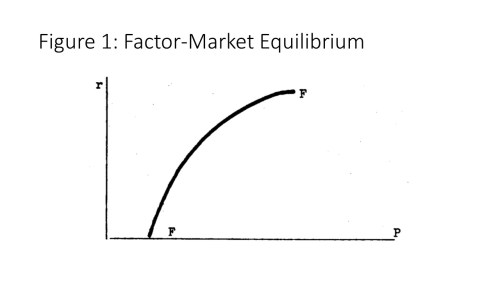
Because K* is assumed to be fully employed with a positive marginal product, a given value of P determines a unique corresponding equilibrium value of L, the supply of labor services being upward-sloping, but relatively elastic with respect to the nominal wage for given wage expectations by workers. That value of L in turn determines an equilibrium value of R for the given value of P. If we assume that inflation expectations are constant (i.e., that Pe varies in proportion to P), then a given value of P must correspond to a unique value of r. Because simultaneous equilibrium in the markets for capital services and labor services can be represented by unique combinations of P and r, a factor-market equilibrium condition can be represented by a locus of points labeled the FF curve in Figure 1 below.

Thompson_Figure1

The FF curve must be upward-sloping, because a linear homogenous production function of two scarce factors (i.e., doubling inputs always doubles output) displaying diminishing marginal products in both factors implies that the factors are complementary (i.e., adding more of one factor increases the marginal productivity of the other factor). Because an increase in P increases employment, the marginal product of capital increases, owing to complementarity between the factors, implying that R must increase by more than P. An increase in the price level, P, is therefore associated with an increase in the market interest rate r.

Beyond the positive slope of the FF curve, Thompson makes a further argument about the position of the FF curve, trying to establish that the FF curve must intersect the horizontal (P) axis at a positive price level as the nominal interest rate goes to 0. The point of establishing that the FF curve intersects the horizontal axis at a positive value of r is to set up a further argument about the stability of the model’s equilibrium. I find that argument problematic. But discussion of stability issues are better left for a future post.

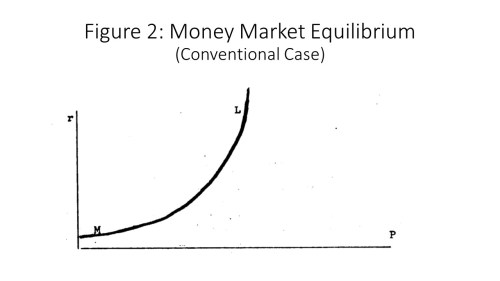
Corresponding to the FF curve, it is straightforward to derive another curve, closely analogous to the Keynesian LM curve, with which to complete a graphical solution of the model. The two LM curves are not the same, Thompson’s LM curve being constructed in terms of the nominal interest rate and the price level rather than in terms of nominal interest rate and nominal income, as is the Keynesian LM curve. The switch in axes allows Thompson to construct two versions of his LM curve. In the conventional case, a fixed nominal quantity of non-interest-bearing money being determined exogenously by the monetary authority, increasing price levels imply a corresponding increase in the nominal demand for money. Thus, with a fixed nominal quantity of money, as the price level rises the nominal interest rate must rise to reduce the quantity of money demanded to match the nominal quantity exogenously determined. This version of the LM curve is shown in Figure 2.

Thompson_Figure2

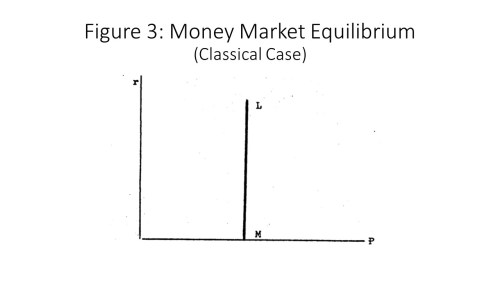
A second version of the LM curve can be constructed corresponding to Thompson’s characterization of the classical model of a competitively supplied interest-bearing money supply convertible into commodities at a fixed exchange rate (i.e., a gold standard except that with only one output money is convertible into output in general not one of many commodities). The quantity of money competitively supplied by the banking system would equal the quantity of money demanded at the price level determined by convertibility between money and output. Because money in the classical model pays competitive interest, changes in the nominal rate of interest do not affect the quantity of money demanded. Thus, the LM curve in the classical case is a vertical line corresponding to the price level determined by the convertibility of money into output. The classical LM curve is shown in Figure 3.

Thompson_Figure3

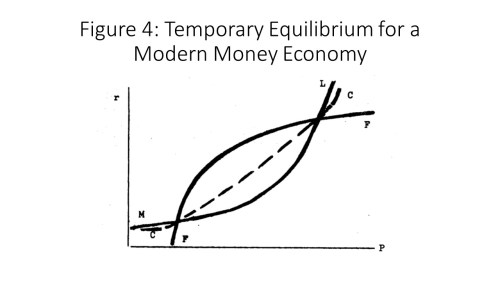
The full solution of the model (in the conventional case) is represented graphically by the intersection of the FF curve with the LM curve in Figure 4.

Thompson_Figure4

Note that by applying Walras’s Law, one could draw a CC curve representing equilibrium in the market for commodities (an analogue to the Keynesian IS curve) in the space between the FF and the LM curves and intersecting the two curves precisely at their point of intersection. Thus, Thompson’s reformulation supports Nick Rowe’s conjecture that the IS curve, contrary to the usual derivation, is really upward-sloping.

The Money Multiplier, RIP?

In case you haven’t heard, Simon Wren-Lewis tried to kill the money multiplier earlier this week. And if he succeeded, and the money multiplier stays killed, if it has indeed been well and truly buried, I for one shall not mourn its long overdue passing. Over the course of my almost thirteen months of blogging I have argued on a number of occasions that, contrary to the money multiplier, bank deposits are endogenous, that they are not so many hot potatoes that, once created, must be held, never to be destroyed. This view has brought me into sharp, but friendly, disagreement with some pretty smart guys whom I usually agree with, like Nick Rowe and Bill Wolsey, but I’m not backing down.

My view of bank deposits has also put me in the same camp — or at least created the appearance that I am in the same camp — with the endogenous money group, Post-Keynesians, Modern Monetary Theorists and the like, whose views I only dimly understand. But it seems that they deny that even the monetary base (i.e., currency plus bank reserves) is under the control of the monetary authority. This group seems to think that banks create deposits in the process of lending, lending is undertaken by banks in response to the demands of the public (businesses and households) for bank loans, and reserves are created by the monetary authority to support whatever level of reserves the banks desire, given the amount of lending that they have undertaken. The money multiplier is wrong, in their view, because it implies that reserves are prior to deposits and, indeed, are the raw material from which deposits are created, when in fact reserves are created to support deposits.

So let me try to explain how I view the money multiplier. I agree with the endogenous money people that reserves are not the stuff out of which deposits are created. However, there is a sense in which base money is logically prior to deposits. Every deposit is a promise to pay the bearer something else outside the control of the creator of the deposit. That something is base money. Under a fiat money system, it is a promise to pay currency. Under a gold standard, it was a promise to pay gold, coin or bullion. This distinction is captured by the distinction between inside money (deposits) and outside money (currency).

It is my position that the quantity of inside money produced or created in an economy is endogenously determined by the real demand of the public to hold inside money and the costs banks incur in creating inside money. Because banks legally commit themselves to convert inside money into outside money on demand, arbitrage usually prevents any significant, or even insignificant, deviation between the value of inside and that of outside money. Because inside money and outside money are fairly close substitutes, the value of outside money is determined simultaneously in the markets for inside and outside money, just as the value of butter is determined simultaneously in the markets for butter and margarine. But heuristically, it is convenient to view the value of money as being determined by the supply of and the demand for base money, which then determines the value of inside money via the arbitrage opportunities created by the convertibility of inside into outside money.  Given the equality in the values of inside and outside money, we can then view the supply of inside money and the demand for inside money as determining the quantity of deposits and the interest rate paid on deposits. Under competitive conditions, the interest paid on deposits must equal the bank lending rate (the gross revenue from creating a deposit) minus the cost of creating a deposit, so that the net revenue (the lending rate minus the deposit rate) equals the cost of creating deposits.

What determines the value of base money? The monetary authorities (central bank plus the Treasury) jointly determine the amount of currency and reserves made available. The public (banks plus households plus businesses) have demands to hold currency when tax payments are due, demands to hold currency for transactions purposes when taxes are not due, and demands to hold currency as a store of value, those demands depending as well on the expected future value of currency and on the yields of alternative assets including inside money. The total demand for currency versus the total stock in existence determines a value at which the public is just willing to hold the amount currency (base or outside money) in existence.

This theoretical setup is analogous to that which determines the value of money under a gold standard. Under a gold standard the amount of gold in existence is endogenously determined as the sum of all the gold ever mined from time period 0 until the present. But in the present period the total stock can be treated as an exogenously fixed amount. The total demand is the sum of the monetary plus non-monetary demands for gold. The value of gold is whatever value is just sufficient to induce the public to hold the amount in existence in the current period. Given that all prices are quoted in gold, the price level is determined by the conversion rate of money into gold times the gold value of every commodity corresponding to the equilibrium real value of gold. The amount of inside money in existence is whatever amount of convertible claims into gold the public wishes to hold given the yields on alternative assets and expectations of the future value of gold.

The operation of a gold standard requires no legal reserves of gold to be held. Legal reserve requirements were an add-on to the gold standard – in my view an unnecessary and dysfunctional add-on – imposed by legislation enacted by various national governments for their own, often misguided, reasons. That is not to say that it would not be prudent for monetary authorities to hold some reserves of gold, but the decision how much reserves to hold has no intrinsic connection to the operation of the gold standard.

Thus, the notion that there is any fixed relationship between the quantity of gold and the amount of convertible banknotes or bank deposits created by the banking system under the gold standard is a logical fallacy. The amount of banknotes and deposits created corresponded to the amount of banknotes and deposits the public wanted to hold, and was in no way logically connected to the amount of gold in existence. Similarly, under a fiat money system, there is no logical connection between the amount of base money and the amount of inside money. The money multiplier is simply a reduced-form, not a structural, equation. Treating it as a structural equation in which the total stock of money (currency plus demand deposits) in existence could be juxtaposed with the total demand to hold money is logically incoherent, because the money multiplier (as a reduced form) is itself determined in part by the demand to hold currency and the demand to hold deposits.

So it’s about time that we got rid of the money multiplier, and I wish Simon Wren-Lewis all the luck in the world in trying to drive a stake into its heart, but somehow I am not all that confident that we have yet seen the last of that pesky creature.

PS I hope, circumstances permitting, tomorrow to continue with my series on Earl Thompson’s reformulation of macroeconomics. This post can perhaps serve as introduction to a future post in the series on alternative versions of the LM curve corresponding to different monetary regimes.

Earl Thompson

Sunday, July 29, will be the second anniversary of the sudden passing of Earl Thompson, one of the truly original and creative minds that the economics profession has ever produced. For some personal recollections of Earl, see the webpage devoted to him on the UCLA website, where a list of his publications and working papers, most of which are downloadable, is available. Some appreciations and recollections of Earl are available on the web (e.g, from Tyler Cowen, Scott Sumner, Josh Wright, and Thomas Lifson).  I attach a picture of Earl taken by a department secretary, Lorraine Grams, in 1974, when Earl was about 35 years old.

I first met Earl when I was an undergraduate at UCLA in the late 1960s, his reputation for brilliant, inconclastic, eccentricity already well established. My interactions with Earl as undergraduate were minimal, his other reputation as a disorganized and difficult-to-follow lecturer having deterred me, as a callow sophomore, from enrolling in his intermediate micro class. Subsequently as a first-year graduate student, I had the choice of taking either Axel Leijonhufvud’s macro-theory sequence or Earl’s. Having enjoyed Axel’s intermediate macro course, I never even considered not taking the graduate sequence from Axel, who had just achieved academic stardom with the publication of his wonderful book On Keynesian Economics and the Economics of Keynes. However, little by little over the years, I had started reading some of Earl’s papers on money, especially an early version of his paper “The Theory of Money and Income Consistent with Orthodox Value Theory,” which, containing an explicit model of a competitive supply of money, a notion that I had been exposed to when taking Ben Klein’s undergraduate money and banking course and his graduate monetary theory course, became enormously influential on my own thinking, providing the foundation for my paper, “A Reinterpretation of Classical Monetary Theory” and for much of my book Free Banking and Monetary Reform, and most of my subsequent work in monetary economics. So as a second-year grad student, I decided to attend Earl’s weekly 3-hour graduate macro theory lecture. Actually I think at least half of us in the class may have been there just to listen to Earl, not to take the class for credit. Despite his reputation as a disorganized and hard to follow lecturer, each lecture, which was just Earl at the blackboard with a piece of chalk drawing various supply and demand curves, and occasionally something more complicated, plus some math notation, but hardly ever any complicated math or formal proofs, and just explaining the basic economic intuition of whatever concept he was discussing. By this time he had already worked out just about all of the concepts, and he was not just making it up as he was going along, which he could also do when confronted with a question about something he hadn’t yet thought through. But by then, Earl had thought through the elements of his monetary theory so thoroughly and for so long, that everything just fit into place beautifully. And when you challenged him about some point, he almost always had already anticipated your objection and proceeded to explain why your objection wasn’t a problem or even supported his own position.

I didn’t take detailed notes of his lectures, preferring just to try to understand how Earl was thinking about the topics that he was discussing, so I don’t have a clear memory of the overall course outline.  However his paper “A Reformulation of Macroeconomic Theory,” of which he had just produced an early draft, provides the outline of what he was covering. He started with a discussion of general equilibrium and its meaning, using Hicksian temporary equilibrium as his theoretical framework.  Perhaps without realizing it, he developed many of the ideas in Hayek’s Economics and Knowledge paper, which may, in turn, have influenced Hicks, who was for a short time Hayek’s student and colleague at LSE — in particular the idea that intertemporal equilibrium means consistency of plans so that economic agents are able to execute their plans as intended and therefore do not regret their decisions ex post. From there I think he developed a search-theoretic explanation of involuntary unemployment in which mistaken worker expectations of wages, resulting from an inability to distinguish between sector-specific and economy-wide shocks, causes labor-supply curves to be highly elastic at the currently expected wage, implying large fluctuations in employment, in response to economy-wide shocks, rather than rapid adjustments in nominal wages . With this theoretical background, Earl constructed a simple aggregative model as an alternative to the Keynesian model, the difference being that Earl dispensed with the Keynesian expenditure functions and the savings equals investment equilibrium condition, replacing them with a capital-market equilibrium condition derived from neo-classical production theory — an inspired modeling choice.

Thus, in one fell swoop, Earl created a model fully consistent with individual optimizing behavior, market equilibrium and Keynesian unemployment. Doing so involved replacing the traditional downward-sloping IS curve with an upward-sloping, factor-market equilibrium curve. At this point, the model could be closed either with a traditional LM curve corresponding to an exogenously produced money supply or with a vertical LM curve associated with a competitively produced money supply. That discussion in turn led to a deep excursion into the foundations of monetary theory, the historical gold standard, fiat money, and a comparison of the static and dynamic efficiency of alternative monetary institutions, combined with a historical perspective on the Great Depression, and the evolution of modern monetary institutions. It was a terrific intellectual tour de force, and a highlight of my graduate training at UCLA.

Unfortunately, “A Reformulation of Macroeconomic Theory” has never been published, though a revised version of the paper (dated 1977) is available on Earl’s webpage. The paper is difficult to read, at least for me, because Earl was much too terse in his exposition – many propositions are just stated with insufficient motivation or explanation — with readers often left scratching their heads about the justification for what they have read or why they should care.  So over the next week or so, I am going to write a series of posts summarizing the main points of the paper, and discussing why I think the argument is important, problems I have with his argument or ways in which the argument needs further elaboration or what not. I hope the discussions will lead people to read the original paper, as well as Earl’s other papers.

Krugman v. Friedman

Regular readers of this blog will not be surprised to learn that I am not one of Milton Friedman’s greatest fans. He was really, really smart, and a brilliant debater; he had a great intuitive grasp of price theory (aka microeconomics), which helped him derive interesting, and often testable, implications from his analysis, a skill he put to effective use in his empirical work in many areas especially in monetary economics. But he was intolerant of views he didn’t agree with and, when it suited him, he could, despite his libertarianism, be a bit of a bully. Of course, there are lots of academics like that, including Karl Popper, the quintessential anti-totalitarian, whose most famous book The Open Society and Its Enemies was retitled “The Open Society and its Enemy Karl Popper” by one of Popper’s abused and exasperated students. Friedman was also sloppy in his scholarship, completely mischaracterizing the state of pre-Keynesian monetary economics, more or less inventing a non-existent Chicago oral tradition as carrier of the torch of non-Keynesian monetary economics during the dark days of the Keynesian Revolution, while re-packaging a diluted version of the Keynesian IS-LM model as a restatement of that oral tradition. Invoking a largely invented monetary tradition to provide a respectable non-Keynesian pedigree for the ideas that he was promoting, Friedman simply ignored, largely I think out of ignorance, the important work of non-Keynesian monetary theorists like R. G. Hawtrey and Gustav Cassel, making no mention of their monetary explanation of the Great Depression in any of works, especially in the epochal Monetary History of the United States.

It would be one thing if Friedman had provided a better explanation for the Great Depression than Hawtrey and Cassel did, but in every important respect his explanation was inferior to that of Hawtrey and Cassel (see my paper with Ron Batchelder on Hawtrey and Cassel). Friedman’s explanation was partial, providing little if any insight into the causes of the 1929 downturn, treating it as a severe, but otherwise typical, business-cycle downturn. It was also misleading, because Friedman almost entirely ignored the international dimensions and causes of the downturn, causes that directly followed from the manner in which the international community attempted to recreate the international gold standard after its collapse during World War I. Instead, Friedman, argued that the source, whatever it was, of the Great Depression lay in the US, the trigger for its degeneration into a worldwide catastrophe being the failure of the Federal Reserve Board to prevent the collapse of the unfortunately named Bank of United States in early 1931, thereby setting off a contagion of bank failures and a contraction of the US money supply. In doing so, Friedman mistook a symptom for the cause. As Hawtrey and Cassel understood, the contraction of the US money supply was the result of a deflation associated with a rising value of gold, an appreciation resulting mainly from the policy of the insane Bank of France in 1928-29 and an incompetent Fed stupidly trying to curb stock-market speculation by raising interest rates. Bank failures exacerbated this deflationary dynamic, but were not its cause. Once it started, the increase in the monetary demand for gold became self-reinforcing, fueling a downward deflationary spiral; bank failures were merely one of the ways in which increase in the monetary demand for gold fed on itself.

So if Paul Krugman had asked me (an obviously fanciful hypothesis) whether to criticize Friedman’s work on the Great Depression, I certainly would not have discouraged him from doing so. But his criticism of Friedman on his blog yesterday was misguided, largely accepting the historical validity of Friedman’s account of the Great Depression, and criticizing Friedman for tendentiously drawing political conclusions that did not follow from his analysis.

When wearing his professional economist hat, what Friedman really argued was that the Fed could easily have prevented the Great Depression with policy activism; if only it had acted to prevent a big fall in broad monetary aggregates all would have been well. Since the big decline in M2 took place despite rising monetary base, however, this would have required that the Fed “print” lots of money.

This claim now looks wrong. Even big expansions in the monetary base, whether in Japan after 2000 or here after 2008, do little if the economy is up against the zero lower bound. The Fed could and should do more — but it’s a much harder job than Friedman and Schwartz suggested.

Krugman is mischaracterizing Friedman’s argument. Friedman said that the money supply contracted because the Fed didn’t act as a lender of last resort to save the Bank of United States from insolvency setting off a contagion of bank runs. So Friedman would have said that the Fed could have prevented M2 from falling in the first place if it had acted aggressively as a lender of last resort, precisely what the Fed was created to do in the wake of the panic of 1907. The problem with Friedman’s argument is that he ignored the worldwide deflationary spiral that, independently of the bank failures, was already under way. The bank failures added to the increase in demand for gold, but were not its source. To have stopped the Depression the Fed would have had to flood the rest of the world with gold out of the massive hoards that had been accumulated in World War I and which, perversely, were still growing in 1928-31. Moreover, leaving the gold standard or devaluation was clearly effective in stopping deflation and promoting recovery, so monetary policy even at the zero lower bound was certainly not ineffective when the right instrument was chosen.

Krugman then makes a further charge against Friedman:

Beyond that, however, Friedman in his role as political advocate committed a serious sin; he consistently misrepresented his own economic work. What he had really shown, or thought he had shown, was that the Fed could have prevented the Depression; but he transmuted this into a claim that the Fed caused the Depression.

Not so fast. Friedman claimed that the Fed converted a serious recession in 1929-30 into the Great Depression by not faithfully discharging its lender of last resort responsibility. I don’t say that Friedman never applied any spin to the results of his positive analysis when engaging in political advocacy. But in Friedman’s discussions of the Great Depression, the real problem was not the political spin that he put on his historical analysis; it was that his historical analysis was faulty on some basic issues. The correct historical analysis of the Great Depression – the one provided by Hawtrey and Cassel – would have been at least as supportive of Friedman’s political views as the partial and inadequate account presented in the Monetary History.

PS  Judging from some of the reactions that I have seen to this post, I suspect that my comments about Friedman came across somewhat more harshly than I intended.  My feelings about Friedman are indeed ambivalent, so I now want to emphasize that there is a great deal to admire in his work.  And even though he may have been intolerant of opposing views when he encountered them from those he regarded as his inferiors, he was often willing to rethink his ideas in the face of criticism.  My main criticism of his work on monetary theory in general and the Great Depression in particular is that he was not well enough versed in the history of thought on the subject, and, as a result, did not properly characterize earlier work that he referred to or simply ignored earlier work that was relevant.   I am very critical of Friedman for having completely ignored the work of Hawtrey and Cassel on the Great Depression, work that I regard as superior to Friedman’s on the Great Depression, but that doesn’t mean that what Friedman had to say on the subject is invalid.

Nick Rowe’s Gold Standard, and Mine

One of my regular commenters J. P. Koning recently drew my attention to this post by Nick Rowe about the “identity” (to use a somewhat loaded term) between the gold standard and the CPI standard (aka inflation targeting). Nick poses the following question:

Is there any fundamental theoretical difference between how monetary policy worked under the gold standard and how monetary policy works today for a modern inflation-targeting central bank?

I will just note parenthetically that being a Canadian and therefore likely having been spared from listening to seemingly endless soundbites of Newt Gingrich pontificating about “fundamental this” and “fundamental that,” and “fundamentally this” and “fundamentally that,” Nick obviously has not developed the sort of allergic reaction to the mere sound or appearance of that now hopelessly hackneyed word with which many of his neighbors to the south are now incurably afflicted.

To attack the question, Nick starts with the most extreme version of the gold standard in which central bank notes are nothing but receipts for an equivalent amount of gold (given the official and unchangeable legal conversion rate between bank notes and gold. He then proceeds to relax the assumptions underlying the extreme version of the gold standard from which he starts, allowing central bank reserves to be less than its liabilities, then allowing reserves to be zero, but still maintaining a fixed conversion rate between central bank notes and gold. (Over 25 years ago, Fischer Black developed a theoretical model of a gold standard with (near) zero reserves. See his paper “The Gold Standard with Double Feedback and Near Zero Reserves” published as chapter 5 of his book Business Cycles and Equilibrium. Whether anyone else has explored the idea of a gold standard with zero reserves I don’t know. But I don’t dispute that a gold standard could function with zero reserves, but I think there may be doubt about the robustness of such a gold standard to various possible shocks.) From here Nick further relaxes the underlying assumptions to allow a continuous adjustment of the legal conversion rate between central bank notes and gold at say a 2% annual rate. Then he allows the actual conversion rate to fluctuate within a range of 1% above to 1% below the official rate. And then he allows the base to be changed while keeping any changes in the base unbiased so the expectation is always that the conversion rate will continue to rise at a 2% annual rate. Having reached this point, Nick starts to relax the assumption that gold is the sole standard, first adding silver to get a symmetallic standard, and then many goods and services to get a broad based standard from which a little addition and subtraction and appropriate weighting bring us to the CPI standard.

Having gone through this lengthy step-by-step transformation, Nick seems to think that he has shown an identity between the gold standard and a modern inflation-targeting central bank. To which my response is: not so fast, Nick.

What Nick seems to be missing is that a central bank under a gold standard is operating passively unless it changes its stock of gold reserves, and even if it does change its stock of gold reserves, the central bank is still effectively passive unless, by changing its holdings of reserves, it can alter the real value of gold. On the other hand, I don’t see how one could characterize an inflation-targeting central bank as acting passively unless there was a direct market mechanism by which the public forced the central bank to achieve its inflation target. If a central bank did not maintain the legal conversion rate between its bank notes and gold, it would be violating a precise legal obligation to engage in a specific set of transactions. Instead of buying and selling gold at $20.67 an ounce, it would be buying and selling at some other price. If an inflation-targeting central bank does not meet its inflation target, can anyone specify the specific transactions that it was obligated to make that it refused to make when called upon to do so by a member of the public? And this is aside from the fact that no one even knows whether an inflation targeting central bank is achieving or not achieving its target at the time that it is conducting whatever transactions it is conducting in pursuit of whatever goal it is pursuing.

In short, an inflation-targeting central bank cannot be said to be operating under the same or an analogous set of constraints as a central bank operating under a gold standard, at least not under any gold standard that I would recognize as such.

Edmund Phelps Should Read Hawtrey and Cassel

Marcus Nunes follows Karl Smith and Russ Roberts in wondering what Edmund Phelps was talking about in his remarks in the second Hayek v. Keynes debate.  I have already explained why I find all the Hayek versus Keynes brouhaha pretty annoying, so, relax, I am not going there again.  But Marcus did point out that in the first paragraph of Phelps’s remarks, he actually came close to offering the correct diagnosis of the causes of the Great Depression, an increase in the value of gold.  Unfortunately, he didn’t quite get the point, the diagnosis independently provided 10 years before the Great Depression by both Ralph Hawtrey and Gustave Cassel.  Here’s Phelps:

Keynes was a close observer of the British and American economies in an era in which their depressions were wholly or largely monetary in origin – Britain’s slump in the late 1920s after the price of the British currency was raised in terms of gold, and America’s Great Depression of the 1930s, when the world was not getting growth in the stock of gold to keep pace with productivity growth.  In both cases, there was a huge fall of the price level.  Major deflation is a telltale symptom of a monetary problem.

What Phelps unfortunately missed was that from 1925 to mid-1929, Great Britain was not in a slump, at least not in his terminology.  Unemployment was high, a carryover from the deep recession of 1920-21, and there were some serious structural problems, especially in the labor market.  But the overvaluation of the pound that Phelps blames for a non-existent (under his terminology) slump caused only mild deflation.  Deflation was mild, because the Federal Reserve, under the direction of the great Benjamin Strong, was aiming at a roughly stable US (and therefore, world) price level.  Although there was still deflationary pressure on Britain, the pound being overvalued compared to the dollar, the accommodative Fed policy (condemned by von Mises and Hayek as intolerably inflationary) allowed a gradual diminution of the relative overvaluation of sterling with only mild British deflation.   So from 1925 to 1929, the British economy actually grew steadily, while unemployment fell from over 11% in 1925 to just under 10% in 1929.

The problem that caused the Great Depression in America and the rest of the world (or at least that portion of the world that had gone back on the gold standard) was not that the world stock of gold was not growing as fast as productivity was growing – that was a separate long-run problem that Cassel had warned about that had almost nothing to do with the sudden onset of the Great Depression in 1929.  The problem was that in 1928 the insane Bank of France started converting its holdings of foreign exchange into gold.  As a result, a tsunami of gold, drawn mostly from other central banks, inundated the vaults of the Bank of France, forcing other central banks throughout the world to raise interest rates and to cash in their foreign exchange holdings for gold in a futile effort to stem the tide of gold headed for the vaults of the IBOF.

One central bank, the Federal Reserve, might have prevented the catastrophe, but, the illustrious Benjamin Strong tragically having been incapacitated by illness in early 1928, the incompetent crew replacing Strong kept raising the discount rate in a frenzied attempt to curb stock-market speculation on Wall Street.  Instead of accommodating the world demand for gold by allowing an outflow of gold from its swollen reserves — over 40% of total gold reserves held by central banks, the Fed actually was inducing an inflow of gold into the US in 1929.

That Phelps agrees that the 1925-29 period in Britain was characterized by  a deficiency of effective demand because the price level was falling slightly, while denying that there is now any deficiency of aggregate demand in the US because prices are rising slightly, though at the slowest rate in 50 years, misses an important distinction, which is that when real interest rates are negative as they are now, an equilibrium with negative inflation is impossible.  Forcing down inflation lower than it is now would trigger another financial panic.  With positive real interest rates in the late 1920s, the British economy was able to tolerate deflation without imploding.  It was only when deflation fell substantially below 1% a year that the British economy, like most of the rest of the world, started to implode.

If Phelps wants to brush up on his Hawtrey and Cassel, a good place to start would be here.


About Me

David Glasner
Washington, DC

I am an economist in the Washington DC area. My research and writing has been mostly on monetary economics and policy and the history of economics. In my book Free Banking and Monetary Reform, I argued for a non-Monetarist non-Keynesian approach to monetary policy, based on a theory of a competitive supply of money. Over the years, I have become increasingly impressed by the similarities between my approach and that of R. G. Hawtrey and hope to bring Hawtrey’s unduly neglected contributions to the attention of a wider audience.

My new book Studies in the History of Monetary Theory: Controversies and Clarifications has been published by Palgrave Macmillan

Follow me on Twitter @david_glasner

Archives

Enter your email address to follow this blog and receive notifications of new posts by email.

Join 665 other subscribers
Follow Uneasy Money on WordPress.com