Archive Page 64


Sraffa v. Hayek

While writing up my post on the Keynes-Hayek debate at LSE, I visited a couple of blogs to gauge the reaction in the blogosphere to the debate.  One of those was the very interesting Social Democracy for the 21st Century:  A Post-Keynesian Perspective.  In his post on the debate, the blogger, AKA Lord Keynes, had some interesting observations about the famous (well, maybe among Austrians and Keynesians – especially post-Keynesians — with an inordinate interest in the history of economic thought) exchange in the Economic Journal between Piero Sraffa, reviewing Hayek’s Prices and Production, a short book containing his remarkably successful LSE lectures on the nascent Austrian theory of business cycles, Hayek’s response and Sraffa’s rejoinder.  The general consensus about the debate is that Sraffa got the better of Hayek in the exchange, indeed, that the debate marked the peak in Hayek’s influence, having risen steadily after Hayek’s LSE lectures and his lengthy and damaging review of Keynes’s Treatise on Money and Keynes’s ill-tempered reply.  Though Hayek continued working and writing tirelessly, the decline in his influence and reputation eventually led him away from technical economics into the more philosophical writings on which his lasting reputation was built, though he received some belated recognition for his early contributions when he was awarded the 1974 Nobel Memorial Prize in economics.

Sraffa attacked Hayek’s exposition of the Austrian business cycle theory on two fronts.  First, Hayek argued that monetary expansion necessarily produces a distorting and unsustainable effect on the capital structure of production, ultimately  causing a costly readjustment back to the earlier capital structure.  Sraffa observed that the distortion identified by Hayek was not caused by monetary expansion per se, but by a change in the distribution of money, but a distributionally neutral expansion would have no such distorting effect.   Sraffa also observed that it was entirely possible that the addition to the capital structure induced by what Hayek called forced saving might actually turn out to be sustainable inasmuch as the augmented capital stock might itself imply a reduced natural rate of interest rate corresponding to the reduced money rate achieved through monetary expansion.

Sraffa’s second, and perhaps more damaging, line of attack was on the very concept of a natural rate of interest, borrowed by Hayek from the Swedish economist Knut Wicksell, though transforming it in the process.  According to Hayek, the natural rate corresponds to the interest rate in a pure barter equilibrium undisturbed by the influence of money.  The goal of monetary policy should therefore be to ensure that the money rate of interest equaled the natural rate, thus neutralizing the effect of money and facilitating an intertemporal equilibrium in which money is not a distorting factor, i.e., in monetary expansion by banks to finance investments in excess of voluntary savings does not drive the money rate of interest below the natural rate, a state of affairs that could never obtain in a barter equilibrium.

Sraffa, however, argued that Hayek’s use of the natural rate of interest as a benchmark for monetary policy was incoherent, because there would be no unique natural interest rate in a growing barter economy with net investment in capital goods of the kind Hayek wished to use as a benchmark for monetary policy in a growing, money-using, economy.  In the barter economy, interest rates would correspond to the price ratios over time (own rates of interest, i.e., ratios of spot to forward prices) between durable or storable commodities.   But these own rates would fluctuate in response to the changing demands characterizing a growing economy, implying that there is no single natural rate of interest, but a collection of natural own rates of interest.  Only if Hayek were willing to follow Wicksell in defining a price level in terms of some average of prices would Hayek have been able to define a natural rate of interest as some average of own rates.  But Hayek explicitly rejected the use of statistical price levels.  Hayek’s reply was ineffective, leaving Sraffa the clear winner in that exchange.

However, a quarter of a century later, Hayek’s student Ludwig Lachmann in his book Capital and its Structure elegantly explained the critical point that neither Sraffa nor Hayek had quite comprehended.  The natural interest rate in a barter economy has a perfectly clear meaning, independent of any statistical average, in an intertemporal equilibrium setting, because equilibrium requires that the expected return from holding all durable or storable assets be the same.  The weakness of the natural-rate concept is not that it necessarily pertains to a monetary rather than to a barter economy, as Hayek supposed, but that it could only be given meaning in the context of a full intertemporal equilibrium.

In his discussion of Sraffa and Hayek on his blog, Lord Keynes insists that Sraffa got it right.

However, Piero Sraffa had already demonstrated in 1932 that outside of a static equilibrium there is no single natural rate of interest in a barter or money-using economy, and Hayek never really addressed this problem for his trade cycle theory.

Sraffa did demonstrated that there was no single natural rate of interest in a disequilibrium, but he did not do so for an intertemporal equilibrium in which price changes are correctly foreseen.  Hayek actually had developed the concept of an intertemporal equilibrium in a paper originally published in German in 1929, eight years before providing a truly classic articulation of the concept in his wonderful 1937 paper “Economics and Knowledge,” so it is odd that he was unable to respond effectively to Sraffa’s critique of the natural rate in 1932.

Lord Keynes, who is aware of Lachmann’s contribution on the Sraffa-Hayek exchange, cites as authority for dismissing Lachmann, a paper by another blogger, an ardent, but surprisingly reasonable, Austrian business cycle theory supporter Robert Murphy, who has written a paper that addresses the Sraffa-Hayek debate.   Lord Keynes quotes the following passage from Murphy’s paper.

Lachmann’s demonstration—that once we pick a numéraire, entrepreneurship will tend to ensure that the rate of return must be equal no matter the commodity in which we invest—does not establish what Lachmann thinks it does. The rate of return (in intertemporal equilibrium) on all commodities must indeed be equal once we define a numéraire, but there is no reason to suppose that those rates will be equal regardless of the numéraire. As such, there is still no way to examine a barter economy, even one in intertemporal equilibrium, and point to ‘the’ real rate of interest.”

Murphy is almost right in that Lachmann demonstrates that the rate of return is equalized across all investment opportunities (allowing for the usual sources of difference in rates of return) in an intertemporal equilibrium.  It is not clear what he means by saying that the choice of a numeraire matters.  It doesn’t matter for any real property of the intertemporal equilibrium, i.e., a real quantity or a relative price; it matters only for nominal quantities and absolute prices.  But nominal quantities, by definition, depend on the choice of a numeraire and even in a static equilibrium there is no unique nominal rate of return just as there is no unique level of absolute prices.  The “real” rate of interest is determined in an intertemporal equilibrium; the nominal rate is not determined.  This is precisely the distinction between the real rate and the nominal rate identified in the Fisher equation.  And every kindergartener knows that the natural rate is a real rate not a nominal rate.

Perhaps Murphy is made uncomfortable by the fact that Lachmann’s point shows that a Hayekian intertemporal equilibrium could be consistent with any rate of inflation as long as the nominal rate reflected the equilibrium expected rate of inflation and inflation would have no effect on relative prices.  That indeed is a problem for a fundamentalist version of Austrian business cycle theory and would deny that as a matter of pure theory there cannot be an intertemporal equilibrium with inflation.  But that form of Austrian fundamentalism is simply inconsistent with the basic properties of an intertemporal equilibrium and with the non-uniqueness of absolute prices in either a static or intertemporal equilibrium.  So Austrians just need suck it up on that (not very important) point and move on.

Finally, to come back to Sraffa.  It is worth noting that the real Keynes in the General Theory said this about the natural rate of interest.

In my Treatise on Money I defined what purported to be a unique rate of interest, which I called the natural rate of interest — namely, the rate of interest which . . . preserved equality between the rate of saving . . . and the rate of investment. . . .

I had, however, overlooked the fact that in any given society there is, on this definition, a different natural rate of interest for each hypothetical level of employment.  And, similarly, for every rate of interest there is a level of employment for which that rate is the “natural” rate, in the sense that the system will be in equilibrium with that rate of interest and that level of employment.  Thus it was a mistake to speak of the natural rate of interest or to suggest that the above definition would yield a unique value fo rthe rate of interest irrespective of the level of employment.

So Keynes, like Sraffa, clearly had rejected the notion of a unique natural rate of interest.  But Keynes’s reasons for doing so are very different from Sraffa’s.  Keynes’ makes no mention of multiple natural rates corresponding to the different commodity own rates of interest that Sraffa had introduced in his attack on Hayek’s use of the natural rate.  (Keynes, of course, as editor of the Economic Journal, had selected Sraffa to write a review of Prices and Production, presumably knowing what to expect, so he knew exactly what Sraffa had said about the natural rate of interest.)

Indeed Keynes goes through Sraffa’s analysis in chapter 17 of the General Theory, “The Essential Properties of Interest and Money.”  It is one of my favorite chapters, especially because its analysis of portfolio choice is so acute.  I just quote one long paragraph (pp. 227-28).

To determine the relationships between the expected returns on different types of assets which are consistent with equilibrium, we must also know what the changes in relative values during the year are expected to be.  Taking money (which need only be a money of account for this purpose, and we could equally well take wheat) as our standard of measurement, let the expected percentage appreciation (or depreciation) of houses be a1 and of wheat a2q1, –c2 and l3 we have called own-rates of interest of houses, wheat and money in terms of themselves as the standard of value; i.e., q1 is the house-rate of interest in terms of houses, –c2 is the wheat-rate of interest in terms of wheat, and l3 is the money rate of interest in terms of money.  It will also be useful to call a1 + q1, a2c2 and l3, which stand for the same quantities reduced to money as the standard of value, the house-rate of money-interest, the wheat-rate of money-interest and the money-rate of money-interest respectively.  With this notation it is easy to see that the demand of wealth-owners will be directed to houses, to wheat or to money, according as a1 + q1 or a2c2 or l3 is greatest.  Thus in equilibrium the demand-prices of houses and wheat in terms of money will be such that there is nothing to choose in the way of advantage between alternatives; i.e, a1 + q1, a2c2 and l3 will be equal.  The choice of the standard of value will make no difference to this result because a shift from one standard to another will change all the terms equally, i.e. by an amount equal to the expected rate of appreciation (or depreciation) of the new standard in terms of the old.

In this particular post, I am happy to give Keynes the last word.
The Journal Gets It Right — for a Change

As many bloggers (Marcus Nunes, David Beckworth, Scott Sumner, and  Scott Sumner, among others) have pointed out, the Swiss National Bank, in pledging not to tolerate a Swiss franc-euro exchange rate below SF1.20,  showed this week how much a central bank can accomplish in a very short time by acting decisively and with determination, qualities sadly lacking in the decision-making of the Federal Reserve Board, and, in particular the Federal Open Market Committee (FOMC).    Even The Wall Street Journal (to the evident consternation of the lunatic mainstream of the commenters populating its website) applauded the move by the Swiss central bank.

The Swiss National Bank’s announcement Tuesday that it would buy “unlimited quantities” of euros to keep the franc-euro exchange rate above 1.20 is a dramatic and helpful move amid the continuing euro crisis.

Acknowledging that the action taken by the Swiss central bank would benefit Swiss exporters, the Journal properly cautioned:

But throwing a bone to exporters is not the most important reason for the central bank to intervene. Central banks are the monopoly suppliers of the commodity known as money. When a currency like the Swiss franc appreciates rapidly, the market is sending a signal that not enough francs are being printed to meet demand.

In contrast to what central banks usually do when they conduct exchange-rate intervention, the Swiss central bank is saying that its monetary policy is subordinated to the peg.  The quantity of francs issued by the central bank will be whatever amount the public wants to hold at the peg (the peg, in this case, being one-sided, the franc-euro exchange rate  not permitted to fall felow SF1.20).

The Journal concludes with the following observation:

Since the collapse of the Bretton Woods exchange-rate system in the 1970s, policy makers have grown fond of saying that markets should set exchange rates. But markets can’t set the value of a commodity whose sole supplier is the central bank, and this pseudo-laissez-faire is an abdication of central banks’ duty to control the supply of their currency, both internally and externally.

Markets can’t set the value of a commodity whose sole supplier the central bank?!  What does the Journal editorialist think happens every day in the foreign exchange markets?  Who else but the market is setting the value of these monopolistically supplied commodities?  Didn’t the Journal editorialist just observe “when a currency like the Swiss franc appreciates rapidly, the market is sending a signal that not enough francs are being printed to meet demand”?

The point that the Journal editorialist was trying to make, albeit clumsily if not incoherently, is that it makes sense for a monopolist — even a monopolistic central bank — to take into account the signals about the demand for its product reflected in rapid changes in the market price of the product that it supplies.  A sudden sharp increase in the exchange rate of a currency signals that the demand for the currency is increasing.  Not responding to such an increase and just letting the increase in demand force up the price doesn’t make sense for the monopolist, and it surely makes no sense for a central bank.  Not increasing the supply of a rapidly appreciating currency can have all sorts of unpleasant consequences (e.g., deflation and a recession) for the country with a rising currency.  That’s why the Journal wasn’t wrong to label a policy of ignoring fluctuations in the exchange rate in the name of non-intervention as “pseduo-laissez-faire.”

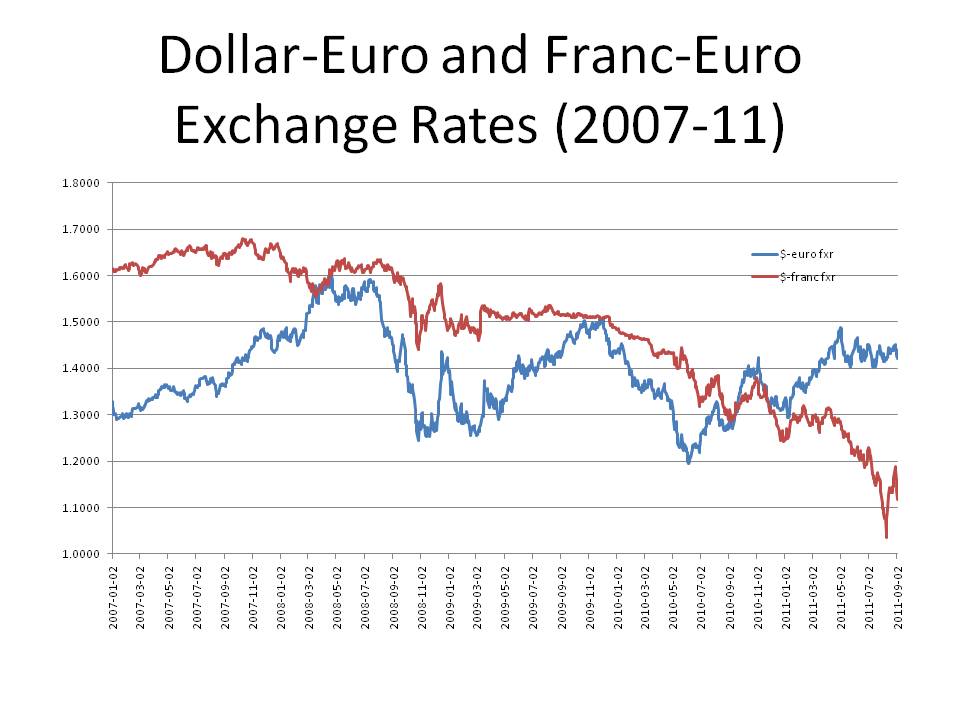
But while the Journal endorses the decision of the Swiss central bank to halt the demand-driven appreciation of the franc, the Journal has shown less concern over the past three years with appreciations of a similar magnitude in the dollar relative to the euro.  The nearby graph shows how both the dollar and the Swiss franc have fluctuated against the euro since January 2007.

A recession beginning in December 2007, triggered by the bursting of the housing bubble, led to a gradual depreciation of the dollar relative to the euro from about $1.45 to just over $1.60 in April 2008, with the dollar fluctuating in a narrow range between $1.55 and $1.60 till the end of July.  From August 1 to August 31, the dollar rose from $1.5567 to $1.4669 against the euro.  On the Friday before Lehman collapsed (three years ago on September 5, 2008), the dollar stood at $1.4273, falling to $1.3939 on September 11, then falling to $1.4737 on September 23 and was still at $1.46 as late as Friday September 26.   On Monday September 29, the dollar rose sharply to $1.4381 and by the end of  October the dollar had risen to $1,26, nearly 30% higher than its value at the beginning of August.   From November to March, the dollar remained in the $1.25 to $1.30 range against the euro, except for a blip from mid-December to mid-January when the dollar fell to about $1.40 before quickly recovering.  Did the Journal ever once call for a reversal of this devastating appreciation of the dollar against the euro in the fall?

From March through December 2009, during QE1, the dollar fell gradually from about $1.25 to about $1.50 as a recovery of sorts began, the economy growing 3.8% in the fourth quarter.  The dollar then rose from $1.50 in early December to about $1.20 in June, remaining in the $1.20 to $1.30 range till the end of August, when, fearing the onset of deflation, Chairman Bernanke announced that QE2 would be tried.  The dollar quickly fell from $1.27 at the end of August to $1.40 in November and, with only occasional movements outside the range, has remained between $1.40 and $1.48 against the euro throughout 2011.  Yet the Journal and its regular columnists constantly complain about the dollar debasement caused by the Fed, even though dollar-euro exchange rate is roughly the same as it was in December 2007 when the downturn started.

The Journal properly defends the decision of the Swiss central bank to reduce the value of the franc after having risen by about 20-25% against euro since April.  Yet the Journal never misses an opportunity to castigate the Fed for reversing two episodes of dollar appreciation of at least as large as that of the franc against the euro, accusing the Fed of deliberate dollar debasement even though inflation over the last three years has been at the lowest level in half a century.  Anyone care to guess why the Journal is more understanding of the Swiss central bank than it is of the US central bank?

Keynes v. Hayek: Advantage Hawtrey

On Labor Day, I finally got around to watching the Keynes v. Hayek debate at  the London School of Economics on August 3 between Robert Skidelsky and Duncan Weldon on behalf of Keynes and George Selgin and Jamie Whyte on behalf of Hayek.  Inspired by the Hayek-Keynes rap videos, the debate, it seems to me, did not rise very far above the intellectual level of the rap videos, with both sides preferring to caricature the other side rather than engage in a debate on the merits.  The format of the debate, emphasizing short declaratory statements and sound bites, invites such tactics.

Thus, Robert Skidelsky began the proceedings by lambasting Hayek for being a liquidationist in the manner of Andrew Mellon (as rather invidiously described by his boss, Herbert Hoover, in the latter’s quest in his memoirs for self-exculpation), even though Skidelsky surely is aware that Hayek later disavowed his early policy recommendations in favor of allowing deflation to continue with no countermeasures.  Skidelsky credited FDR’s adoption of moderate Keynesian fiscal stimulus as the key to a gradual recovery from the Great Depression until massive spending on World War II brought about the Depression to a decisive conclusion.

Jamie Whyte responded with a notably extreme attack on Keynesian policies, denying that Keynesian policies, or apparently any policy other than pure laissez-faire, could lead to a “sustainable” recovery rather than just sow the seeds of the next downturn, embracing, in other words, the very caricature that Skidelsky had just unfairly used in his portrayal of Hayek as an out-of-touch ideologue.  George Selgin was therefore left with the awkward task of defending Hayek against both Skidelsky and his own colleague.

Selgin contended that it was only in the 1929-31 period that Hayek argued for deflation as a way out of depression, but later came to recognize that a contraction of total spending, associated with an increasing demand by the public to hold cash, ought, in principle, to be offset by a corresponding increase in the money supply to stabilize the aggregate flow of expenditure.   Larry White has documented the shift in Hayek’s views in a recent paper, but the argument is a tad disingenuous, because, despite having conceded this point in principle in some papers in the early to mid-1930s, Hayek remained skeptical that it could be implemented in practice, as Selgin has shown himself to be here.  It was not until years later that Hayek expressed regret for his earlier stance and took an outspoken and unequivocal stand against deflation and a contraction in aggregate expenditure.

I happen to think that one can learn a lot form both Hayek and Keynes.  Both were profound thinkers who had deep insights into economics and the workings of market economies.  Emotionally, I have always been drawn more to Hayek, whom I knew personally and under whom I studied when he visited UCLA in my junior year, than to Keynes.  But Hayek’s best work verged on the philosophical, and his philosophical and scholarly bent did not suit him for providing practical advice on policy.  Hayek, himself, admitted to having been dazzled by Keynes’s intellect, but Keynes could be too clever by a half, and was inclined to be nasty and unprincipled when engaged in scholarly or policy disputes, the list of his victims including not only Hayek, but A. C. Pigou and D. H. Robertson, among others.

So if we are looking for a guide from the past to help us understand the nature of our present difficulties, someone who had a grasp of what went wrong in the Great Depression, why it happened and why it took so long to recover from, our go-to guy should not be Keynes or Hayek, but the eminent British economist, to whose memory this blog is dedicated, Ralph Hawtrey.  (For further elaboration see my paper “Where Keynes Went Wrong.”)  It was Hawtrey who, before anyone else, except possibly Gustav Cassel, recognized the deflationary danger inherent in restoring a gold standard after it had been disrupted and largely abandoned during World War I.  It was Hawtrey, more emphatically than Keynes, who warned of the potential for a deflationary debacle as a result of a scramble for gold by countries seeking to restore the gold standard, a scramble that began in earnest in 1928 when the Bank of France began cashing in its foreign exchange reserves for gold bullion, a  move coinciding with the attempt of the Federal Reserve System to check what it regarded as a stock-market bubble by raising interest rates, attracting an inflow of gold into the United States just when the Bank of France and other central banks were increasing their own demands for gold.  It was the confluence of those policies in 1928-29, not a supposed inflationary boom that existed only in the imagination of Mises and Hayek and their followers that triggered the start of a downturn in the summer of 1929 and the stock-market crash of October 1929.   Once the downturn and the deflation took hold, the dynamics of the gold standard transmitted a rapid appreciation in the real value of gold across the entire world from which the only escape was to abandon the gold standard.

Leaving the gold standard, thereby escaping the deflation associated with a rising value of gold, was the one sure method of bringing about recovery.  Fiscal policy may have helped — certainly a slavish devotion to balancing the budget and reducing public debt – could do only harm, but monetary policy was the key.  FDR, influenced by George Warren and Frank Pearson, two Cornell economists, grasped both the importance of stopping deflation and the role of the gold standard in producing and propagating deflation.  So, despite the opposition of some of his closest advisers and the conventional wisdom of the international financial establishment, he followed the advice of Warren and Pearson and suspended the gold standard shortly after taking office, raising the gold price in stages from $20.67 an ounce to $35 an ounce.  Almost at once, a recovery started, the fastest recovery over any 4-month period (from April through July 1933) in American history.

Had Roosevelt left well enough alone, the Great Depression might have been over within another year, or two at the most, but FDR could not keep himself from trying another hare-brained scheme, and forced the National Industrial Recovery Act through Congress in July 1933.  Real and money wages jumped by 20% overnight; government sponsored cartels perversely cut back output to raise prices.  As a result, the recovery slowed to a crawl, not picking up speed again till 1935 when the NRA was ruled unconstitutional by the Supreme Court.  Thus, whatever recovery there was under FDR owed at least as much to monetary policy as to fiscal policy.  Remember also that World War II was a period of rapid inflation and monetary expansion along with an increase in government spending for the war.  In addition, the relapse into depression in 1937-38 was at least as much the result of monetary as of fiscal tightening.

I would never say forget about Keynes or Hayek, but really the true master– the man whom Keynes called his “grandparent in the paths of errancy” — was Ralph G. Hawtrey.

Switzerland Teaches Us a Lesson

The Swiss National Bank announced today that it was committing itself to keep the euro-franc exchange rate above 1.20 francs per euro. Here is the opening of the Bloomberg story.

The Swiss central bank imposed a ceiling on the franc’s exchange rate for the first time in more than three decades and pledged to defend the target with the “utmost determination.” The Swiss National Bank is “aiming for a substantial and sustained weakening of the franc,” the Zurich-based bank said in an e-mailed statement today. “With immediate effect, it will no longer tolerate a euro-franc exchange rate below the minimum rate of 1.20 francs” and “is prepared to buy foreign currency in unlimited quantities.”

The euro had fallen to 1.11 francs per euro on Friday. Citing the deflationary threat to the Swiss economy of a massively overvalued franc, the Swiss central bank pledged to buy euros in unlimited quantities to meet its exchange rate target.

The euro is now trading at just over 1.2 francs per euro. The dollar has appreciated against both the euro and the franc, the dollar rising from $.787 on Friday to $.857 today.

The two-fold lesson that the Swiss are teaching us — not that it hasn’t been taught before, e.g., by FDR in 1933 – is simply this:

1) A country adopting a meaningful exchange rate peg against another currency surrenders control over its domestic money supply and its domestic price level to the monetary authority (or in case of a gold standard to the international gold market) controlling the currency against which the peg is established.

2) However, if a country wishes to increase (decrease) its domestic money supply and price level from their current levels, it can do so by pegging its exchange rate against another currency at a rate significantly below (above) the current exchange rate against the targeted currency.

It is therefore simply wrong to assert that the US or any country could not achieve any desired price-level target, because the US monetary authorities (i.e., the Fed and Treasury) could announce that they would peg the dollar to another currency at a rate significantly different from the current exchange rate. By making such an announcement in a credible fashion (as the Swiss have done) there is nothing to stop the US from achieving any desired level of prices (corresponding to a particular exchange rate peg). Monetary policy is never ineffectual except by the choice of the monetary authorities .

HT:  Lars Christensen

Update:  Marcus Nunes has an excellent post on the Swiss National Bank announcement

Hayek on the Meaning of “Planning”

As promised, here is a passage from Hayek’s Road to Serfdom (pp. 34-35) elucidating the meaning of “planning.”  It is only by ignoring or misconstruing Hayek’s discussion of the different significations that the word “planning” can have that central banking can be confused with central planning.

‘Planning’ owes its popularity largely to the fact that everybody desires, of course, that we should handle our common problems as rationally as possible and that, in so doing, we should use as much foresight as we can command.  In this sense everybody who is not a complete fatalist is a planner, every political act is (or ought to be) an act of planning, and there can be differences only between good and bad, between wise and foresighted and foolish and shortsighted planning.  An economist, whose whole task is the study of how men actually do and how they might plan their affairs, is the last person who could object to planning in the general sense.  But it is not in this sense that our enthusiasts for a planned society now employ this term, nor merely in this sense that we must plan if we want the distribution of income or wealth to conform to some particular standard.  According to the modrn planners, and for their purpsoses, it is not sufficient to design the most rational permanent framework within which to the various activities would be conducted by differeent persons according to their individual plans.  This liberal plan, according to them, is no plan — and it is indeed, not a plan designed to satisfy particular views about who should have what.  What our planners demand is a central direction of all economic activity according to a single plan [my emphasis], laying down how the resources of society should be ‘consciously directed’ to serve particular ends in a definite way [my emphasis].

The dispute between the modern planners and their opponents is, therefore, not a dispute on whether we ought to choose intelligently between the various possible organizations of society; it is not a dispute on whether we ought to employ foresight and systematic thinking in planning our common affairs.  It is a dispute about what is the best way of so doing.  The question is whether for this purpose it is better that the holder of coercive power should confine himself in general to creating conditions under which the knowledge and initiative of individuals are given the best scope so that they [Hayek’s emphasis] can plan most successfully; or whether a rational utilization of our resources requires central [Hayek’s emphasis] direction and organization of all our activities according some consciously constructed ‘blueprint‘ [my emphasis].   The socialists of all parties have appropriated the term ‘planning’ for planning of the latter type, and it is now generally accepted in this sense.  But though this is meant to suggest that this is the onlyrational way of handling our affairs, it does not, of course, prove this.  It remains the point on which the planners and the liberals disagree.

Central Banking and Central Planning, Again

In the last few weeks I wrote two posts arguing that, despite the attempts of some to identify them, central banking is not the same as central planning.  In my first post, I explained that central planning originally referred to attempts to allocate the resources available to society in accord with a pre-determined unitary “rational” plan rather than allow resources to be allocated according to the decisions of individuals advancing their own self-interest through market transactions.  In my second, I showed that Hayek in both The Road to Serfdom andThe Constitution of Liberty explicitly denied that central banking was a form of central planning.

Central planning in this sense is much different from what a central banker, even under the most expansive view of his responsibilities, is trying to do.  Obviously a central banker is engaged in planning, in the sense that a central banker is trying to act in a rational way calculated to achieve his purposes.  The ambiguity in the meaning of planning has long been recognized, and dismissed by critics of central planning.  Only planning designed to override the voluntary decisions and plans of private individuals and business, compelling them to conform to the central plan rather than to their own preferred courses of action, is planning of the objectionable type.  So just because a central banker has a centralized role in the banking system, and seeks to achieve his goals in a rational, planned, non-random way, does not establish ipso facto that his planning is necessarily objectionable in the same way that planning by a central planner is objectionable, inasmuch as central bankers typically do not aim to achieve any particular allocation of society’s resources.  Rather the goal of the central banker is to create the macroeconomic conditions in which people can succeed in executing their own economic plans to buy and sell, save and invest, produce and consume.

As usual, Hayek made the point about as well as it can be made.  Rather than clutter up this post which is already too long with that quote, I am going to put an extended quotation from The Road to Serfdom in a follow-up post to this one.

Obviously, there can be disputes about whether central banks adopt policies likely to achieve their stated goals generally summarized as a stable general level of prices and a high level of economic activity and employment.  But it is an abuse of language to say that by trying to create those conditions, conditions that increase the chances that individuals and businesses can fulfill their own plans for economic activity, central banks are doing anything even comparable to what central planners were trying to do.

My earlier posts elicited some lively comments on this blog and on some other blogs.  For example, Kurt Schuler at freebanking.org, believes that it is self-evident that central banking is a form of central planning, despite acknowledging that the nexus between central planning and central banking was not identified until the contributions of Larry White (1984) and George Selgin (1988), a remarkable statement inasmuch as the two seminal figures, Mises and Hayek, in the debates about central planning in the 1920s and 1930s, were both monetary theorists of note who supposedly missed the obvious connection between central banking and the theory of central planning that they had developed.  That huge historical gap is elided when Schuler asks rhetorically:

Central planning failed as a comprehensive economic system; why should we expect central planning limited to particular fields of economic activity to do better?

This question is less devastating to central banking than Schuler imagines;  most economists, including most of those accepting the general argument against central planning, concede that there may be times when markets do not function as efficiently as they normally do, say, because property rights to scarce resources cannot be defined or enforced, or because of informational asymmetries, or because some markets are inherently uncompetitive.  In such cases, the informational shortcomings of central direction are offset by market imperfections, so that it is at least possible for regulation or intervention to improve the outcome.  One may agree or disagree whether intervention does indeed improve the outcome, but the case for intervention cannot be dismissed simply by invoking the argument against central planning. 

But even to frame it in this way mischaracterizes the argument against central planning, for what that argument says is that the very attempt to allocate resources by way of a central plan is irrational, the central planner lacking any rational basis for comparing the costs and benefits of the alternative allocations of resources that he is considering.  With no functioning price system to provide a way of evaluating the resources used in those alternatives, the planner is unable to make a rational choice between alternatives.  On the other hand, when there is a functioning — even an imperfectly functioning — price system, the valuations reflected in those prices provide at least some basis, however imperfect, for choosing between alternative uses of resources for competing ends and alternatives means of achieving the same end.  But the more that central planning supplants market decisions, the more tenuous the connection between “prices” and valuations and costs. 

So even though there is an argument that central direction of a single sector in a functioning market economy is inefficient, the argument is an order of magnitude weaker than the argument against central planning of the whole economy.  The argument about a single sector is at least potentially rebuttable in the face of a strong reason to suspect market failure.  The argument against central direction of the entire economy is not rebuttable even in the presence of market failure.  And it is a clear conceptual error to treat the two sorts of arguments as if they were equivalent.

Schuler goes on to assert: 

Central banks are government monopolies that consciously try to steer the economy. If that is not central planning, nothing is.

Central banks are government monopolies, but their monopoly power is not unlimited inasmuch as the vast majority of all money in the economy is created by private banks in the form of deposits.  Now it is true that banks have to make their deposits convertible into government money, but in the US reserve requirements are now very low, so the government is now extracting only a very modest rent from its monopoly.  As for steering the economy, the Fed does indeed try to do so, but only in the sense that it tries (not always successfully) to create stable economic conditions.  It does not aim to achieve any particular allocation of resources.  The Fed tries to steer the economy in the way that a captain tries to steer his boat toward a destination chosen not by him, but by the passengers.  The objective of the captain is to choose a route that is safe, economical, pleasant, and speedy.  His decisions may not always be correct, but his objective is not to override the wishes of his passengers but to find the most satisfying route for their journey. 

Finally, Schuler, referring to my post quoting from both The Road to Serfdom and The Constitution of Liberty documenting that Hayek held that the conduct of monetary policy by a central bank was not planning in a sense incompatible with a market economy, concludes with this statement:

And by the way, it will not do to cite the younger Hayek in support of central banking when the older Hayek in Denationalisation of Money wrote about “the obvious corollary that the abolition of the government issue of money should involve also the disappearance of central banks as we know them” [page 105].

I will just note in passing that “the younger Hayek” was 62 years old when he published The Constitution of Liberty from which I quoted, so his remarks can hardly be dismissed as an intemperate youthful outburst.  But leave that point aside.  Schuler omits the rest of the passage from Denationalization of Money in which Hayek wrote the following:

The need for such an institution [i.e., a central bank] is, however, entirely due to the commercial banks incurring liabilities payable on demand in a unit of currency which some other bank has the sole right to issue, thus in effect creating money redeemable in terms of another money.  This, as we shall have still to consider, is indeed the chief cause of the instability of the existing credit system, and through it of the wide fluctuations in all economic activity.  Without the central bank’s (or the government’s) monopoly of issuing money, and the legal tender provisions of the law, there would be no justification whatever for the banks to rely for their solvency on the cash to be provided by another body.  The ‘one reserve system’, as Walter Bagehot called it, is an inseparable accompaniment of the monopoly of issue but unnecessary and undesirable without it.

So Hayek’s dismissal of central banking was crucially and explicitly dependent on an argument that private competitive banks would issue their own currencies defined in terms of units of their choosing not redeemable in terms of any outside asset not under the control of the issuing bank.  In my book, Free Banking and Monetary Reform (p. 176), I explained that Hayek’s argument overlooked the network effects (though I didn’t use the term, which was then only just beginning to be used by economists) associated with using a money denominated in a unit already widely accepted as money.  This implies that there are powerful market forces leading banks not to try to compete by offering a different monetary standard from that already in use, but to make their monies “compatible” with the existing monetary standard by making their own monies convertible into a money already widely accepted as such.  To my knowledge, most advocates of free banking have not followed Hayek in supposing that, under a free-banking regime, banks would compete by issuing inconvertible monies defined in terms of some standard of their own choosing.  So unless Schuler wants to defend the older Hayek’s dubious premise in Denationalization of Money, he can hardly rely on the authority of the older Hayek to dismiss the younger Hayek’s acceptance of central banking as being fully consistent with a market economy.

Are Recessions Efficient?

Stephen Williamson weighed in recently on Keynesian Economics versus Regular Economics in his New Monetarist Economics blog.  Responding to Paul Krugman’s post citing my criticism of Robert Barro’s column in the Wall Street Journal contrasting Keynesian economics and regular economics, Williamson took Krugman to task for not acknowledging that old-style Keynesian economics has actually been replaced by a newer version (New Keynesian economics) that actually tries to deduce standard Keynesian results from regular economics.

Although Williamson aimed his criticism at Krugman, not me, he did criticize this passage of Krugman’s blog in which I was mentioned

As Glasner says, there’s something deeply weird about asking “where’s the market failure?” in the face of massive unemployment, huge unused capacity, an economy producing less than it did and a half years ago despite population growth and advancing technology. Of course there’s some kind of market failure, which means that there’s nothing at all odd about asserting that better policy can yield free lunches.

Williamson comments:

We cannot observe a market failure. To deduce that a market failure exists, one needs a model. Given that we cannot observe market failure by looking at the state of the economy, we also can’t say what a “better policy” is. Again, for that we need a model.

Fair enough; we do need a model.  But it is not clear what kind of model Williamson thinks is needed to infer the existence of a market failure.  The standard model used in regular economics posits a process of price adjustment in which unsatisfied demanders bid up the price or frustrated suppliers drive it down until a price is established that clears the market, i.e., transactors can execute their offers to buy or sell as planned.  In recessions and depressions, as opposed to “normal” periods, the standard model of price adjustment doesn’t seem to work.  So there seems to be a prima facie case for saying that recessions and depressions involve some sort of market failure.  The case may be rebuttable, but Williamson seems to acknowledge in responding to a comment 0n a subsequent post that at least one rationalization for cyclical unemployment is unacceptably implausible.

In the later post Williamson sends us to an essay published by the Richmond Fed in which Kartik B. Athreya and Renee Courtois argue that the first theorem of welfare economics teaches us that to justify intervention into the private market economy, it is necessary to establish that the array of existing markets is incomplete or not fully competitive.  This is a remarkable assertion inasmuch as I am unaware that anyone ever asserted that the set of markets in existence is anywhere near the set required to satisfy the completeness conditions of the first theorem of welfare economics.  (But maybe I am ill-informed).  So what exactly must be shown to establish what is self-evidently true:  that the necessary conditions specified by the first theorem of welfare economics do not obtain in the real world?

Here is how Athreya and Courtois characterize the practical implication of the first theorem of welfare economics for macroeconomic policy. 

The preceding result implies that in a well-functioning market system [i.e., a perfectly competitive economy with a complete set of markets, a theoretical requirement with no real-world analogue], the adjustments made by individual and firms in response to a shock in fundamentals, even when they are contractionary, will be efficient.  If something bad has happened to the ability of firms to produce output (say, a shock to the financial sector that hinders the allocation of labor and capital to their best uses), then each hour of labor becomes less productive.  In this case, it make little sense for firms to continue producing, or for workers to work, at previous levels.  After a storm, for example, a fisherman may find that each hour spent in the boat produces less fish; an efficient response is for him to spend less time fishing (hire less labor) and more  hours consuming leisure (or, perhaps working on boat maintenance and repair), given that the cost of leisure or other activities, measure in terms of fish foregone, has fallen.

This example is meant to show that even if there is a shock causing a decline in output and employment, it does not follow that the adjustment – reduced output and employment — to the shock was inefficient.  This is a basic proposition of real-business-cycle theory, regarded by some as quintessential regular economics.  Negative productivity shocks imply reduced output and employment, so who is to say that observed output and employment reductions in business-cycle downturns are not characteristic of an optimal adjustment path?

Athreya and Courtois acknowledge that “frictions” can cause responses to a negative productivity shock to be inefficient, e.g., frictions in capital and labor markets, and in insurance markets.  But in discussing inefficiencies in capital markets, they merely refer to banks’ difficulties in discovering good investment projects.  Their discussion of labor-market inefficiencies is no more helpful, referring to problems of matching workers and employers, which can cause the search process to be long and drawn out.  But just because matching workers and employers is costly and time-consuming doesn’t tell us how much search is optimal or whether the actual amount of search in response to a recessionary shock is optimal. 

They do provide a somewhat more helpful discussion about the process of reducing labor input, suggesting that there is an inefficiency in laying off workers rather than evenly reducing hours across the entire work force.  But this too is problematic, because, as they acknowledge, there are various reasons why letting some workers go and keeping the rest fully employed rather than cutting hours is less costly for employers than trying to reduce hours worked equally across their employees.  The hardship is concentrated on a subset of workers rather than shared by all workers.  But is there an inefficiency?  We aren’t given a model from which to draw an inference. 

Finally, there is the absence of a private market for unemployment insurance.  In the absence of such a market, and because most of the reduction in labor hours is concentrated on a subset of workers, workers respond to the increased probability of losing their jobs by increasing precautionary saving.  Athreya and Courtois admit that they cannot demonstrate any inefficiency in the increase in precautionary saving except insofar as it is related to frictions  in labor and insurance markets, but they provide no proof of such inefficiencies, leaving the impression that the inefficiencies are not that significant.  That impression is reinforced by the following remark.

The preceding suggests there may be a role for policy.  However, it also suggests that productive policies will likely be those which directly address the specific frictions in capital, labor, and insurance markets that make the observed decline in aggregate consumption inefficiently large.

We are not told exactly what the specific inefficiencies are, but, presumably, if we can find them, then it’s fine to do something about them.  But there is little if any justification for trying to increase aggregate demand through fiscal (or monetary?) policy.

[C]urrent spending-based stimulus, while it may marginally increase the probability of a laid-off worker regaining employment, will also likely draw employed workers away from other productive uses – further hindering efficient resource allocation.

Their most explicit recommendation is actually somewhat surprising (what would Robert Barro say?): 

We think a more fruitful approach would be to leverage the existing unemployment insurance and social safety net infrastructure to better insure the unemployed while more strictly monitoring their job search efforts.

What amazes me about the real-business-cycle approach exemplified by this paper, apparently much to Williamson’s liking, is that it ignores any transmission mechanism amplifying a shock as its effects spread through the economy.  Such transmission effects are completely suppressed in the representative-agent model, a characteristic real-business model seeking to deduce all the relevant properties of a business cycle from the analysis of a single agent supposedly representing everything that one needs to know about how an economy behaves.  This is not just a retrogression from Keynesian economics, it is a retrogression from pre-Keynesian classical and neo-classical economics. 

Despite Keynes’s misguided attack on Say’s Law, the notion that supply creates its own demand, an idea Keynes misconstrued to mean that classical economics held that there could be no lapses from full employment, or if there were, that they would be temporary and quickly rectified, Say’s Law actually explains precisely how shocks are transmitted and amplified as they spread through an economy.  If supply creates its own demand, then a failure to supply entails a failure of demand.  So a technology shock that causes some workers to lose their jobs, by preventing them and complementary factors of production from supplying their productive services, necessarily forces those workers, as well as owners of complementary factors unable to supply their services, to reduce their demands for products.  That is precisely the idea of the Keynesian multiplier, except that Say’s Law views it from the supply side and the multiplier views it from the demand side.  At bottom, these two supposedly contradictory ideas correspond to the same phenomenon, viewed from opposite angles.  But the phenomenon is completely suppressed in the representative-agent model.

But where is there any inefficiency?  Well, as we have just seen, it is really — I mean really – hard to find an inefficiency if you try to understand what happens in a recession in terms of a representative-agent model.  In a representative-agent model, the entire analysis collapses to finding the equilibrium of the single representative agent.  You have necessarily assumed that social and private costs are equal, because you have collapsed all of society into the representative agent.  Private and social costs are not only equal they are identical, because that is how you set up your model.   You have taken regular economics to its outer limit, and you have annihilated the multiplier.  Good job!

But if you think of economics as the study of interactions between independent decision-makers rather than the study of a single decision-maker in isolation, and if you recognize that production and exchange between individuals may not just transmit, but amplify, disturbances across individuals, you may prefer to think of an economy as a network of mutually interdependent transactors whose decisions about how much to supply and demand reverberate back and forth across the network.  Because it is so highly interconnected, private and social costs in the network need not be equal; indeed externalities are a characteristic feature of networks.  The pervasiveness of externalities is well understood in payments networks in which the insolvency of a systemically important transactor can cause the entire network to collapse.  The looser interconnections of the real economic network of production and exchange is less brittle than a specialized payments network, but that doesn’t mean that the former network is not also pervaded with externalities, a point beautifully articulated by the eminent Cambridge economist Frederick Lavington when, when referring to an economy at the bottom of a recession, he wrote in his book The Trade Cycle, “the inactivity of all is the cause of the inactivity of each.”

So is there any inefficiency in a recession?  Of course.  And is there an economic model that identifies the inefficiency?  Absolutely.

Reynolds on the Fed and the Recovery

I was hoping to take it easy today and prepare for Hurricane Irene as it makes its way toward the East Coast, but Alan Reynolds, a very good economist (UCLA undergrad) whom I have known and liked for a long time, got in the way.  Alan somehow has gotten the idea that monetary policy cannot stimulate a recovery, thus adopting the doctrine that kept the US from recovering from the Great Depression for over three years until FDR courageously devalued the dollar and took US off the gold standard.  I thought that Alan understood this, especially because he read the manuscript of my book Free Banking and Monetary Reform as I was writing it, and seemed to have understood and accepted the argument I made about the monetary (i.e., the gold standard) cause and the monetary cure of the Great Depression.  Alas, either I did not succeed as well in enlightening him as I had thought, or he subsequently reverted to some old mistakes, our interactions having become increasingly less frequent.  So I take no pleasure in criticizing Alan, but, hey, a blogger’s gotta do what a blogger’s gotta do.

Alan, the creme de la creme of contributors to The Wall Street Journal editorial page, wrote an op-ed today accusing the Fed of having slowed down the recovery by adopting its program of monetary easing (QE2) last fall.  This is a remarkable and, on its face, counter-intuitive claim.  Nor does Alan provide much in the way of a theoretical explanation for why monetary expansion would would have slowed this recovery down, in contrast to other recoveries in which it hastened recovery, he suggests that by causing the dollar to depreciate, monetary expansion fueled a commodity price boom, thereby driving up costs and reducing the profitability of US businesses.

I don’t think that is a very plausible theoretical argument about how QE2 affected the economy.  On the other hand, even Ben Bernanke has been unable to give a proper explanation for how monetary expansion would cause an economic recovery.  Bernanke argues that monetary expansion reduces interest rates, already close to zero at the short end of the  yield curve, at the long end of the yield curve.  But Reynolds has no problem showing that long-term interest rates rose almost from the get go.  To Alan this suggests that there was no stimulus, but on the contrary what the rise in long-term interest rates shows is how effective the stimulus was in improving expectations of future cash flows.  The improving expectations of future cash flows fueled the rise in stock-market values starting in September (after a miserable August 2010 in which stocks fell by about 8 to 10%).  (The S&P 500 rose from 1047.22 on August 26, 2010 to 1343.01 on February 18, 2011.)  In my paper, “The Fisher Effect under Deflationary Expectations,” I provided evidence that the stock market, in contrast to what one would expect under normal conditions, has since 2008 gone up and down in close correlation with changes in inflation expectations.  I discussed this phenomenon in a previous post.

Alan thinks that because the dollar fell against the euro from $1.27/euro to over $1.40/euro, and because commodity prices rose fairly sharply (perhaps by 25% in the six months after QE2 was announced) that there was no benefit from monetary expansion.  Again, Alan has a bit of an excuse for his misunderstanding because those explaining the program, e.g., Christina Romer, Obama’s chief economist at the time (and a good one at that who should have known better), explained that a declining dollar would make US exports more competitive in world markets, failing to point out that there is a countervailing tendency.  Alan correctly points out that a weaker dollar also makes imported products more expensive, so that the dollar cost of imported raw materials and capital equipment rises, diminishing the gain from a cheaper dollar to US exporters.  However, US wages don’t rise (at least not without a very long lag) as a result of a falling dollar.  And since, for most businesses, wages are the largest cost item, the falling dollar did in fact help to increase the profitability of US exporters, something Alan himself confirms when, in a different context, he reports that the operating earnings per share of S&P 500 companies were $24.86 on June 30, 2011 compared to just $20.40 a year earlier.

It is the increased profitability associated with increasing the prices of output faster than cost that is the primary (but not the only) explanation of how QE2 was supposed to stimulate a recovery.  It was partially successful, as attested to by the increase in stock prices from September 2010 to February 2011.  However, the recovery was stalled by a string of one-off events that disrupted and partially reversed the increase in production that was getting under way:  a severe winter, a big runup in oil prices in February as a result of the shutdown of Libyan oil production, and the earthquake and Tsunami in Japan in March [update August 28, I failed to mention the effect of the European debt crisis which also began to worsen again at about that time].

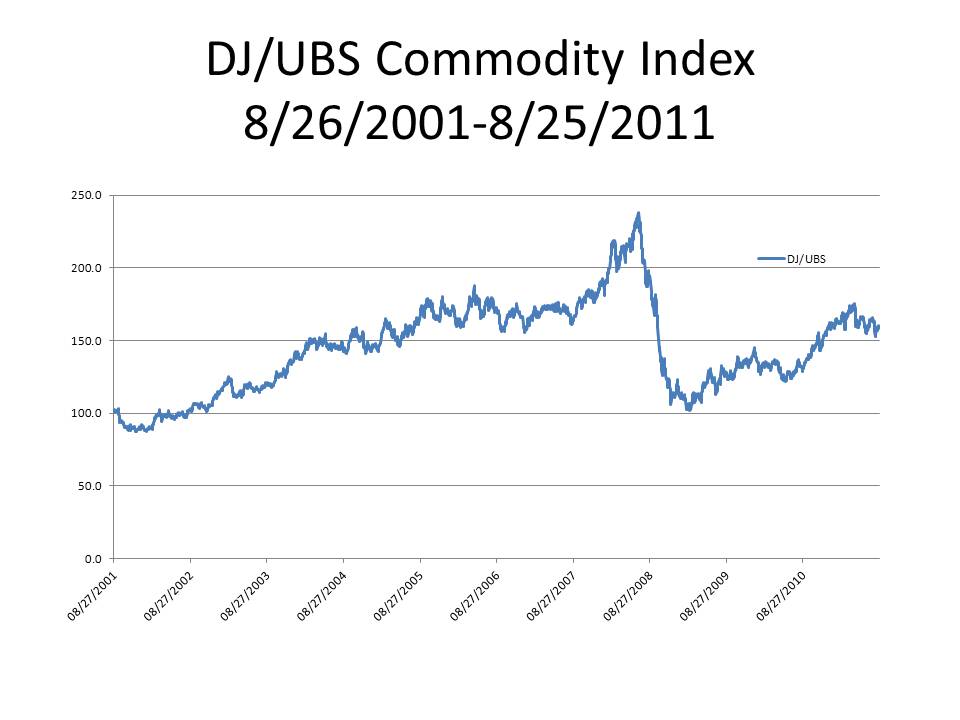
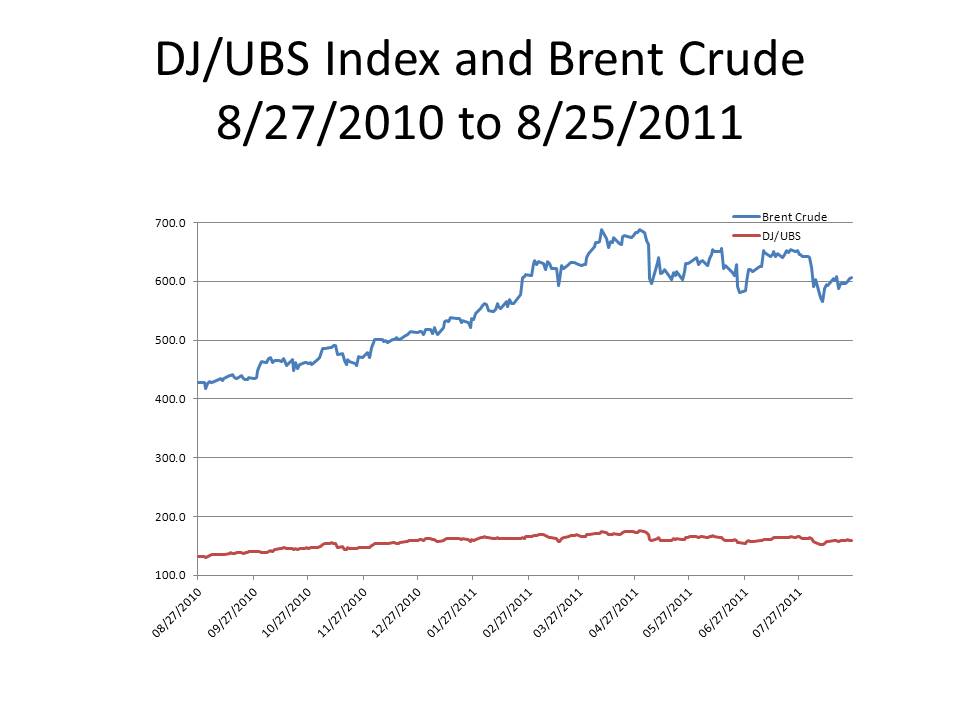
I am sorry to say that Alan fudges a bit in discussing the increase in commodity prices in general and oil prices in particular.  He attributes the entire increase in oil prices to quantitative easing.  In fact between September and February oil prices rose about 20-25%, reflecting the increasing optimism of traders that a recovery was gaining traction.  That increase in oil prices was in line with the increase in other commodities.  The Dow Jones/UBS commodity price index increased about 30% between September 2010 and February 2011.  Since commodity prices, including oil, had dropped sharply after the 2008 crisis, it is not surprising that an anticipated recovery would have caused a significant rebound in the prices of commodities in general, and especially oil demand for which is highly sensitive to overall economic activity.  However, from February to April, crude oil prices increased another 20%, coinciding in the US with the spring changeover to higher ethanol requirements, driving gasoline prices to all-time records, thus dealing a blow to consumer confidence.

The first of the two charts below shows that although commodity prices increased sharply over the past year, they are still well below the levels reached in the summer of 2008 and about where they were in 2005.   Concerns about commodity price inflation seem greatly overblown

The next chart shows a comparison between the movements over the past year in the entire DJ/UBS index and in the index of the Brent Crude benchmark.  One can see that the DJ/UBS index increased between August and February and then leveled off, while Brent Crude increased sharply just when the broader index peaked.  Only in May did oil prices moderate somewhat before falling sharply over the past month when markets began to take fright at the prospect of deteriorating economic conditions and policy paralysis.  [Update August 28:  a further fall in oil prices induced I think by the sudden success of the Libyan rebels, raising hopes of a restoration of Libyan oil production is particularly significant and I hope to follow up with a post on Libyan developments later this week.]

In short, my old friend Alan Reynolds blames everything bad that has happened over the last year on monetary causes, but can’t provide a coherent explanation for why monetary expansion would not stimulate the economy, something even Robert Barro was willing to concede as recently as January 22, 2009 in the Wall Street Journal editorial page.

Barro on Keynesian Economics vs. Regular Economics

Readers of this blog may have guessed by now that I am not a fan of The Wall Street Journal editorial page.  (Actually that is not entirely true.  The Journal editorial page is my go-to source of material whenever I am looking for something to write about on the blog.  So the truth is that I am deeply indebted and eternally grateful to the Journal.)  But I have to admit that even I was not quite prepared for Robert Barro’s  offering in today’s Journal.  You don’t have to be a Keynesian economist – and I have never counted myself as one – to find Barro’s piece, well, let’s just say, strange.

Barro is certainly more sophisticated than Stephen Moore who, having discovered, 75 years after Keynes wrote the General Theory, that Keynesian economics defies common sense, tried and failed to apply the coup de grace to Keynesian economics.  Employing a variation on Moore’s theme, Barro, with a good deal more sophistication than Moore, draws the contrast not between Keynesian economics and common sense but between Keynesian economics and regular economics.

Regular economics is the economics of scarcity and tradeoffs in which there is no such thing as a free lunch, in which to get something you have to give up something else.   Keynesian economics on the other hand is the economics of the multiplier in which government spending not only doesn’t come at the expense of private sector spending, amazingly it increases private sector spending.  Barro throws up his hands in astonishment:

If [the Keynesian multiplier were] valid, this result would be truly miraculous.  The recipients of food stamps get, say, $1 billion but they are not the only ones who benefit.  Another $1 billion appears that can make the rest of society better off.  Unlike the trade-off in regular economics, that extra $1 billion is the ultimate free lunch.

Quickly composing himself, Barro continues:

How can it be right?  Where was the market failure that allowed the government to improve things just by borrowing money and giving it to people?  Keynes in his “General Theory” (1936), was not so good at explaining why this worked, and subsequent generations of Keynesian economists (including my own youthful efforts) have not been more successful.

Nice rhetorical touch, that bit of faux self-deprecation, referring to his own fruitless youthful efforts.  But the real message is:  “I’m older and wiser now, so trust me, the multiplier is a scam.”

But wait a second.  What does Barro mean by his query:  “Where was the market failure that allowed the government to improve things just by borrowing money and giving it to people?”  Where is the market failure?  Hello.  Real GDP is at least 10% below its long-run growth trend, the unemployment rate has been hovering between 9 and 10% for over two years, and Professor Barro can’t identify any market failure?  Or does Professor Barro, like many real-business cycle theorists (say, Charles Plosser, for instance?), believe that fluctuations in output and employment are optimal adjustments to productivity shocks involving intertemporal substitution of leisure for labor during periods of relatively low productivity?

Perhaps that is what Barro thinks now, which would be interesting to know if it were the case, but about two and a half years ago, writing another op-ed piece for the Journal, Barro had a slightly different take on what is going on during a depression.

[A] simple Keynesian macroeconomic model implicitly assumes that the government is better than the private market at marshalling idle resources to produce useful stuff.  Unemployed labor and capital can be utilized at essentially zero social cost, but the private market is somehow unable to figure any of this out.  In other words, there is something wrong with the price system.

John Maynard Keynes thought that the problem lay with wages and prices that were stuck at excessive levels.  But this problem could be readily fixed by expansionary  monetary policy, enough of which will mean that wages and prices do not have to fall.

So in January 2009, Barro was at least willing to entertain the possibility that some kind of obstacle to necessary price and wage reductions might be responsible for the failure of markets to generate a spontaneous recovery from a recession, so that a sufficient monetary expansion could provide a cure for this problem by making wage-and-price reductions unnecessary.  But if that is what Barro believed (and perhaps still believes), it would be interesting to know if he thinks that monetary expansion, which, after all, can be accomplished at very little cost in terms of resources or foregone output is not somehow inconsistent with his conception of regular economics.  I mean you print up worthless peices of paper and, poof, all of a sudden all that output that private markets couldn’t produce gets produced, and all those workers that private markets couldn’t employ get employed.  In Professor Barro’s own words, How can that be right?

But let us assume that Professor Barro, obviously a very, very clever fellow, has an answer to that question, so that trying to increase output and employment by printing up and distributing worthless pieces of paper is not at odds with regular economics, while trying to do so by government spending – quintessential Keynesian economics – must therefore contradict regular economics.  Well, then, let’s ask ourselves how is it that monetary expansion works according to regular economics?  People get additional pieces of paper;  they have already been holding pieces of paper, and don’t want to hold any more paper.  Instead they start spending to get rid of the the extra pieces of paper, but what one person spends another person receives, so in the aggregate they cannot reduce their holdings of paper as intended until the total amount of spending has increased sufficiently to raise prices or incomes to the point where everyone is content to hold the amount of paper in existence.  So the mechanism by which monetary expansion works is by creating an excess supply of money over the demand.

Well, let’s now think about how government spending works.  What happens when the government spends money in a depression?  It borrows money from people who are holding a lot money but are willing to part with it for a bond promising a very low interest rate.  When the interest rate is that low, people with a lot cash are essentially indifferent between holding cash and holding government bonds.  The government turns around and spends the money buying stuff from or just giving it to people.  As opposed to the people from whom the government borrowed the money, a lot of the people who now receive the money will not want to just hold the money.  So the government borrowing and spending can be thought of as a way to take cash from people who were willing to hold all the money that they held (or more) giving the money to people already holding as much money as they want and would spend any additional money that they received.  In other words, i.e., in terms of the demand to hold money versus the supply of money, the government is cleverly shifting money away from people who are indifferent between holding money and bonds and giving the money to people who are already holding as much money as they want to.  So without actually printing additional money, the government is creating an excess supply of money, thereby increasing spending, a process that continues until income and spending rise to a level at which the public is once again willing to hold the amount of money in existence.

Now I am not saying that the two approaches, monetary expansion via printing money and government spending by borrowing, are exactly equivalent. But I am saying that they are close enough so that if restoring full employment by printing money does not contradict regular economics, I have trouble seeing why restoring full employment by borrowing and government spending does contradict regular economics.  But I am sure that Professor Barro, very, very clever fellow that he is, will clear all this up for us in due course, perhaps in a future op-ed in my go-to paper.

The Perverse Effects of Inflation or Price-Level Targeting

I used to think that the most important objective for monetary policy was to stabilize the price level, and that it mattered less which particular price level was stabilized than that some price level be stabilized.  I thought that really bad things happen when there is inflation or deflation, but if the price level — any reasonably broad price level — could be stabilized, whatever fluctuations occurred would be of a second order of magnitude compared to the high inflation or substantial deflation liable to occur without an explicit commitment to price-level stabilization.  I also thought, having learned  Friedman’s lesson of  the natural rate of unemployment a little too well, that aiming for price-level stability would made it unnecessary to worry about preventing unemployment, because high and long-lasting unemployment could not occur without falling prices.  That seemed to imply that if you could just ensure that monetary policy would keep prices broadly stable, unemployment would take care of itself.  In other words, deliberately trying to reduce unemployment would only get you a temporary reduction in unemployment at the cost of a permanent increase in inflation; a bad bargain, or so, at any rate, it seemed to me.

That was one of the main messages of my book Free Banking and Monetary Reform in which I advocated stabilizing the expected wage level (via a mechanism invented by Earl Thompson).  Although I pointed out that stabilizing an output price index could have undesirable effects in case of a supply shock that raised input prices, in retrospect I don’t think that I took that contingency as seriously as I should have.  If you try to keep the level of prices constant in the face of such a supply shock, you will succeed only if you can force down nominal wages or the return on investment.  Either one is a recipe for a major recession.  If you allow output prices to rise to reflect the increased cost of inputs, real wages will fall without a reduction in nominal wages, avoiding the costly adjustment (i.e., reduced output and employment) associated with trying to effect a reduction in nominal wages.

But the problem goes even deeper than that.  Suppose you have a central bank that is credibly committed to stabilizing the price level or to stabilizing the rate of inflation at some target level, say, just to pick a number at random, about 2% a year or slightly below that.  Then suppose that there is a supply shock, so that the central bank has basically two choices.

The first would be for the central bank to allow the supply shock to work its way through the system, enabling producers to pass through their increased input costs to consumers by providing enough monetary expansion to allow increased input costs to be added to output prices without forcing any other inputs to absorb a nominal reduction in their nominal incomes.  Thus to avoid a recession, you would probably need a slightly higher rate of NGDP growth than the rate corresponding to to the one that would have met the inflation target had there been no supply shock.  In other words, I am suggesting, though I could be wrong about this, and I invite others to weigh in on this point, that accommodating the supply shock requires a slight loosening of monetary policy relative to what it was before the shock.  But if the central bank accommodates the supply shock, it will overshoot its inflation target, undermining its precious inflation-fighting credibility.

The second option of course is to resist the supply shock in order to maintain the precious inflation-fighting credibility of the central bank.  But this requires the central bank to tighten its policy, because unless policy is tightened some part of the unexpected increase in input prices will get passed forward into the price of output, forcing the realized rate of inflation to rise above the target rate.  The tightening of policy therefore necessarily results in reduced nominal incomes to other inputs (i.e., labor and capital) causing a decline in real output and employment.

At least in broad outline (though I (or we) perhaps have to do some more work on the details), there is nothing really new in this discussion.  But I think that there is something else going on here that is not so well understood.  The part that is not so well understood is that if the public understands that the central bank cares more about its precious inflation-fighting credibility than about causing a recession, the public will anticipate that the central bank will tighten monetary policy, which means that the public will immediately increase its precautionary demand for money, which means a spontaneous demand-induced tightening of monetary policy even before the central bank lifts a finger.

I have no doubt that something like this was going on in the spring and summer of 2008 when the FOMC kept making periodic and downright scarry statements about how increases in headline inflation caused by rising commodity prices (Oh, Lord, protect us from those rising commodity prices!) were threatening to cause inflation expectations from becoming unanchored even as the economy was rapidly going down the tubes long before the Lehman debacle (and don’t forget that it took the FOMC three whole weeks after Lehman collapsed — during which time there was an already scheduled FOMC meeting at which the status quo was reaffirmed! — to reduce the federal funds rate to 1.5% from the 2% rate at which it had been held since March).

And I also believe that something like this has been going on over the past few weeks as inflation and money-printing hysteria has increased, fueled, among other things, by an unexpected 0.5% increase in the July CPI.  I am suggesting that the 0.5% increase in the CPI caused the markets to attach an increased probability to a tightening of monetary policy, causing an increased precautionary demand for money.

In chapter 10 of my book (pp. 218-21) in the section “the lessons of the Monetarist experiment 1979-82,” I described the perverse expectational reactions triggered by the Fed’s attempt to follow the Monetarist prescription for targeting the growth rates of the monetary aggregates.  I introduced that section with the following prescient quotation from Hayek’s Denationalization of Money.

As regards Professor Friedman’s proposal of a legal limit on the rate at which a monopolistic issuer of money was to be allowed to increase the quantity in circulation, I can only say that I would not like to see what would happen if under such a provision it ever became known that the amount of cash in circulation was approaching the upper limit and therefore a need for increased liquidity could not be met

The perverse response under inflation targeting when there is a supply shock is, I think, more or less analogous to the one so clearly foreseen by Hayek, which I documented in my book for the 1979-82 period (with intermittent recurrences in 1983-84 as well).  Who says history never repeats itself?


About Me

David Glasner
Washington, DC

I am an economist in the Washington DC area. My research and writing has been mostly on monetary economics and policy and the history of economics. In my book Free Banking and Monetary Reform, I argued for a non-Monetarist non-Keynesian approach to monetary policy, based on a theory of a competitive supply of money. Over the years, I have become increasingly impressed by the similarities between my approach and that of R. G. Hawtrey and hope to bring Hawtrey’s unduly neglected contributions to the attention of a wider audience.

My new book Studies in the History of Monetary Theory: Controversies and Clarifications has been published by Palgrave Macmillan

Follow me on Twitter @david_glasner

Archives

Enter your email address to follow this blog and receive notifications of new posts by email.

Join 665 other subscribers
Follow Uneasy Money on WordPress.com