Jeffrey Lacker, President of the Richmond Federal Reserve Bank, is joining the Federal Open Market Committee (FOMC), the body within the Federal Reserve with the final say on monetary policy. The presidents of the 12 regional banks occupy five of the seats on the FOMC on a rotating basis (except that the President of the New York Fed is always on the FOMC), Presidents of the Richmond, Philadelphia, and Boston Banks occupying one of the seats on the FOMC, each president serving every third year. Dr. Lacker is replacing Dr. Charles Plosser, President of the Philadelphia Fed, for the 2012 calendar year.
Among Lacker’s duties as President of Richmond Federal Reserve Bank is writing a message in the bank’s quarterly publication Region Focus, the third quarter edition of which I found in my mailbox yesterday. Knowing that Lacker has just become one of the most important people on the planet, I was curious to find out his thoughts at the start of his year on the FOMC. My reading of Lacker’s message in the second quarter Region Focus was not exactly an uplifting experience (see this post from October), but I try to look for glimmers of hope wherever I can find them. Sadly, Dr. Lacker’s message, entitled “Is Joblessness Now a Skills Problem?” offers nothing hopeful.
Lacker begins by painting a bleak picture of the plight of the long-term unemployed.
Today long-term unemployment – that is, unemployment lasting six months or longer – is at a record high. The share of unemployed Americans whose job searches have lasted this agonizingly long is 43.1 percent, a figure that is unprecedented since the Bureau of Labor Statistics began keeping records in 1948.
His explanation?
A growing number of observers have argued that this state of affairs is caused in significant part by a mismatch between available jobs and available workers, especially a mismatch in skills.
I agree that the long-term component of unemployment has structural origins, including a substantial degree of skills mismatch. I hear a fair number of stories from around our District of hard-to-fill job vacancies in certain specialties. Looking at the world around us, it is reasonable to assume that employers need higher skill levels from their workers today, on average, than they did a generation ago. . . . Economic research indicates that the relationship between unemployment and the job vacancy rate changed during the recession; we’re seeing more unemployment for a given rate of job vacancies – which suggests matching problems.
Lacker acknowledges that the skill-mismatch story has been criticized because the empirical evidence suggests that skill-mismatch accounts for only 0.6 to 1.7 percentage points of current unemployment. In turn, Lacker doubts the relevance of the data on which critics of the skill-mismatch story calculate its contribution to current high rates of unemployment. And even if the critics are right, “a percentage point, or 1.5 percentage points, is significant even within the context of today’s unemployment rate of roughly 9 percent.” Lacker concludes:
In short, I think it is quite plausible that skills mismatch is an important factor holding back improvements in the labor market. The question is how important – and that’s an issue that economists are working to answer as precisely as possible.
OK, so what does this all mean for policy? First, Lacker goes out on a limb and announces that he is actually in favor of – hold on to your hats – job training!
Finally, Lacker gets to the point, monetary policy:
Another, more immediate, implication is the extent to which monetary policy can make a difference in getting more Americans into jobs. To the extent that skills mismatch is identified as a significant portion of the long-term unemployment problem, monetary policy will have difficulty making meaningful inroads into the jobs problem without increasing inflation. Monetary policy, after all, doesn’t train people.
This is hugely depressing. Lacker is telling us that because, on the basis of some stories he has heard from around his district (Maryland, Virginia, West Virginia, North Carolina, South Carolina), and because the ratio of unemployed workers to job vacancies has been increasing, he thinks that our unemployment problem is largely the result of skills mismatches, mismatches impervious to monetary policy.
I won’t even bother asking how all these skills matches suddenly appeared out of nowhere in 2008, so let’s just assume that some percentage of the currently unemployed are unemployed because they don’t have the skills to take the jobs that employers are trying so hard to fill, but can’t. But if there is this huge unsatisfied demand for workers out there (of which Lacker claims to have, if not direct personal knowledge, at least hearsay evidence), wouldn’t one expect to observe employers bidding up wages for those desirable employees with those coveted skills?
I mean Lacker can’t have it both ways. Either there are lot of unfilled vacancies that employers are trying to fill, and wages are being bid up to attract the highly prized workers that can fill them, or there are not that many unfilled vacancies and wages are not being driven up by desperate employers trying to fill those vacancies. If Lacker is right about the magnitude of unsatisfied demand for labor, there should be some evidence for it showing up in the wages actually being paid.
So what do the data show? Well, the Bureau Labor Statistics has published since 2001 an employment cost index of wages and salaries for workers in private industry. The chart below shows the quarterly year-on-year change in the index since 2002. As you can see the year-on-year change has come down steadily since 2002, bottoming out at a rate of increase well below anything observed in the 2002-2008 period. If Lacker is right that job mismatch accounts for a significant fraction of currently observed unemployment, why is the rate of wage inflation nearly a percentage point below the lowest observed rate of wage inflation in the 2002 to 2008 period?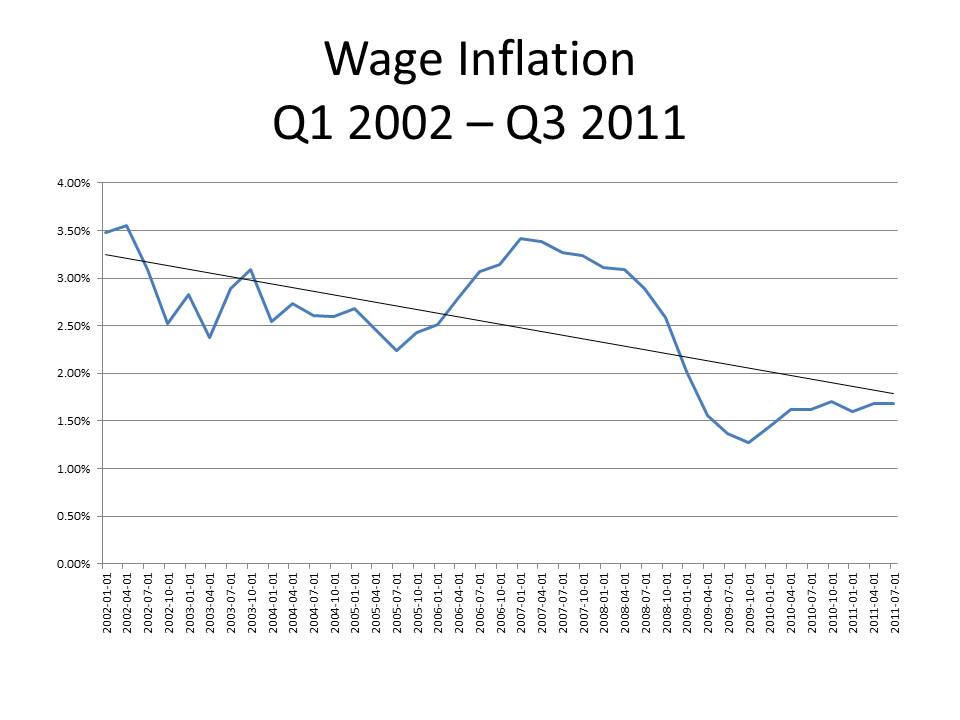
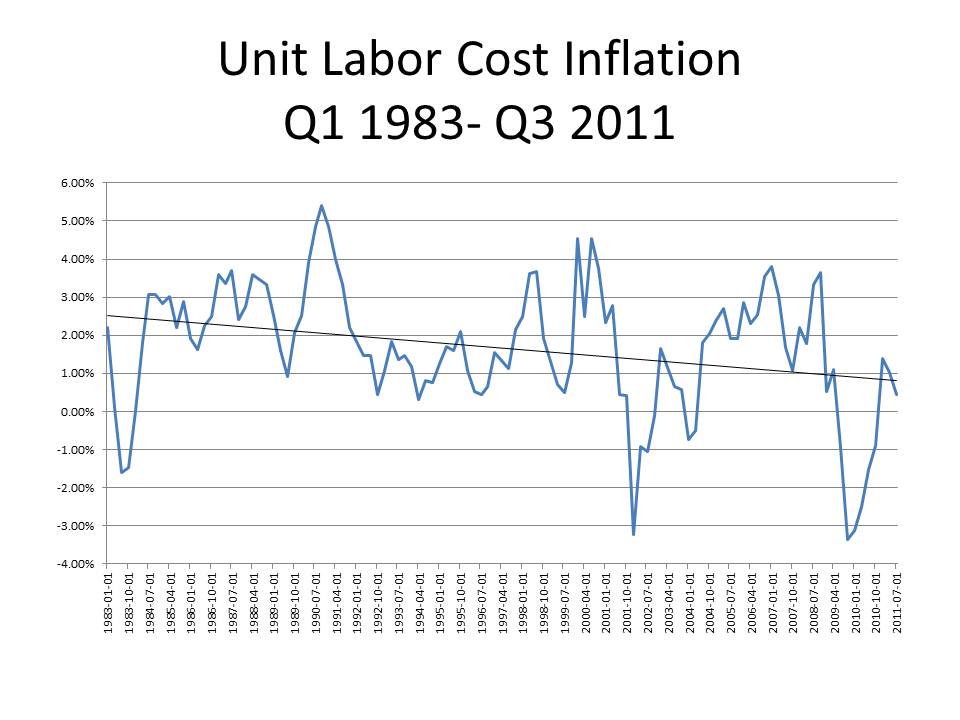
Of course, some people regard the 2002-2008 period as one of wild inflationary excess. So I also looked at a similar, but slightly different, index that goes back further than the employment cost index, the labor cost index which takes into account changes in both wages and productivity. The next chart shows the quarterly year on year change in unit labor costs since 1983 (the beginning of the recovery from the 1981-82 recession). The rate of increase in unit labor costs since 2008 is clearly well below the rates of increase for almost the entire period.
And, at the armchair level of analysis at which Lacker is comfortably operating in making his assessments about the role of skills mismatch in the labor market, it is not at all clear that skill deficiencies are the only, or chief, reason for the increasing number of unemployed per vacancy. It would be at least as plausible to suggest that employers are becoming increasingly choosy in selecting job applicants for the few available vacancies that they are trying to fill. Because they are not trying hard to increase output, employers can afford to wait a little longer to find the perfect employee than they would wait if they were trying to expand output. There are two sides to every matching problem, and Lacker seems interested in just one side.
Finally, it is just astonishing that, at a time when inflation is at its lowest rate in a half century, Lacker could offer as an implied rationale for his opposition to using monetary policy to reduce unemployment: “monetary policy will have difficulty making meaningful inroads into the job problem without increasing inflation,” as if any policy option that would increase inflation above its current historically low rate is not even worthy of consideration.

 Uneasy Money