Archive Page 57


Inflation? What Inflation?

Today’s announcement of the prelminary estimate of GDP for the fourth quarter of 2011 showed a modest improvement over the anemic growth rates earlier in the year, confirming the general impression that things have stopped getting worse. But we are barely at the long-run trend rate of growth, which means that there is still no recovery, in the sense of actually making up the ground lost relative to the long-run trend line since the Little Depression started.

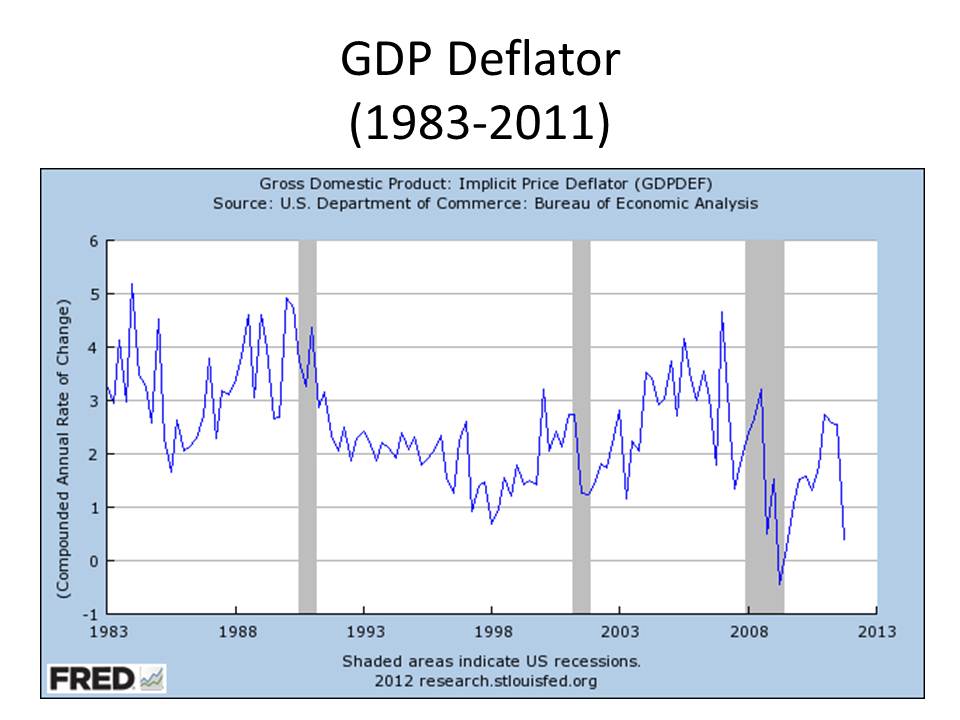
The other striking result of the GDP report is that NGDP growth actually fell in the fourth quarter to a 3.2% annual rate, implying that inflation as measured by the GDP price deflator was only at a 0.4% annual rate, a sharp decline from the 2.6-2.7% rates of the previous three quarters. The decline reflects a possible tightening of monetary policy after QE2 was allowed to expire (though as long as the Fed is paying 0.25% interest on reserves, it is difficult to assess the stance of monetary policy) as well as the passing of the supply-side disturbances of last winter that fueled a rise in energy and commodity prices. So we now seem to be back at our new trend inflation rate, a rate clearly well under the 2% target that the FOMC has nominally adopted.

Despite the continuing cries about currency debasement and the danger of hyperinflation from all the usual suspects, current rates of inflation remain at historically  low levels.  The first of the two accompanying charts tracks the GDP price deflator since 1983. The deflator is clearly well below the rates that have prevailed since 1983 when the recovery to the 1981-82 recession started under the sainted Ronald Reagan of blessed memory.  The divergence between inflation in the Reagan era and the Obama era is striking.  Inflation under the radical Barack Obama is well below inflation under that quintessential conservative, Ronald Reagan.  Go figure!

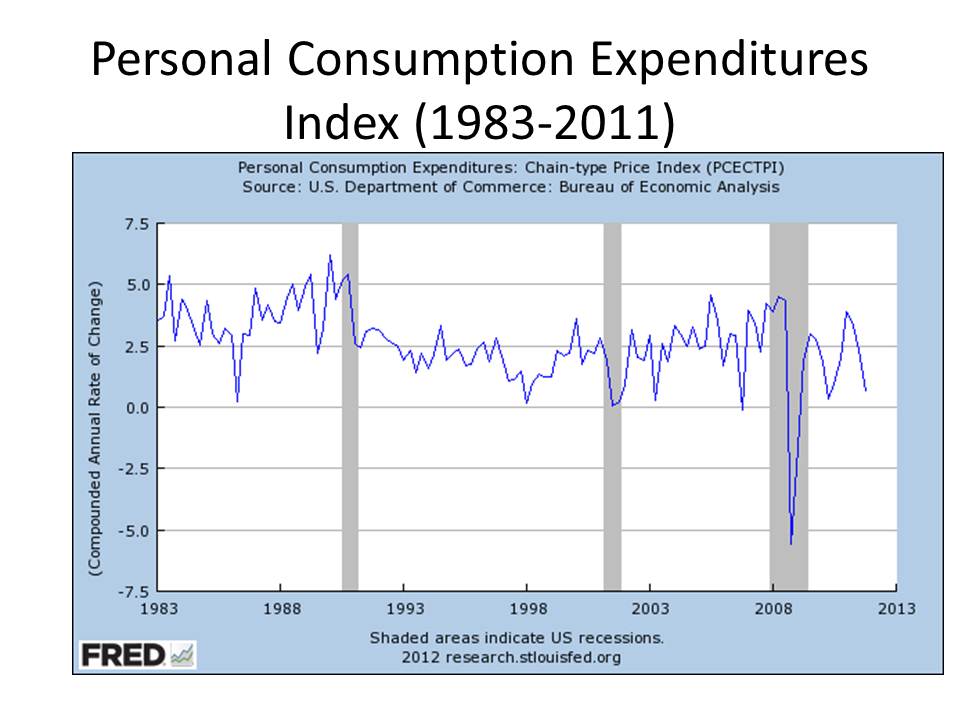
The companion chart tracks the Personal Consumption Price index over the same period. The PCE index is similar to the CPI, and shows a similar (but even sharper) decline in the fourth quarter compared to the higher rates earlier in the year, owing to the importance of food and energy prices in the PCE index.  Again the contrast between inflation under Reagan and under Obama is clear.

In his press conference on Wednesday, Bernanke signaled, to the apparent dismay of the Wall Street Journal editorial board, that he will push for a monetary policy that adjusts as needed to keep the inflation rate from falling below 2% and might even tolerate some overshooting while unemployment remains unusually high. That signal apparently caused an immediate increase in inflation expectations as measured by the TIPS spread. The increase in inflation expecations was accompanied by a further decline in real interest rates, now -1% on 5-year TIPS and -0.16% on 10-year TIPS. With real interest rates that low, perhaps we will see a further increase in investment and a further increase in household purchases of consumer durables.  Perhaps some small reason for optimism amid all the reasons to be depressed.

Let’s Try Again

The point is to keep trying until you get it right.  I am sorry to say that I got it wrong last time, so I’m taking another shot at it.

Let’s consider, as does Simon Wren-Lewis a two-period model. The first period is in underemployment equilibrium. Let’s say that consumption in period 1 is given by the equation

C0 = 100 + bY0,

where b represents the marginal propensity to consume out of income.

Let’s say that investment is a fixed amount:

I0 = 100.

The expenditure (aggregate demand) equation is thus

E0 = 200 + bY0.

The equilibrium is determined by applying the equilibrium condition E0 = Y0, which gives us

Y0 = 200/(1-b).

Now the case that I posited in my previous post involved b = 0, reflecting income smoothing. This is tricky, because we have to make an assumption about what households expect their income to be in the next period, which can be assumed to be long relative to the initial period, though for simplicity I’m going to let the two periods be equal in length.  If households expect income in the next period to reflect full employment, presumably they would try to increase their consumption now, spending more and increasing equilibrium income now, so there is an inherent inconsistency in the model which needs to be resolved, but I am not going to worry about that either. Let’s just take the model at face value.

In this equilibrium, note that consumption, C0, is 100, investment, I0, is 100, and saving, S0, is also 100.

What happens if the government immediately tries to intervene to raise income by increasing government spending, G0, from 0 to 100, and imposes taxes, T0, of 100 to finance its spending?  The increased spending is only for this period and the taxation is only for this period, not the next one; in period 1, government spending and taxation go back to zero. What this does is to cause the consumption function to be revised as households choose a uniform level of consumption to be maintained for both periods, reflecting the liability to pay taxes this period, but no obligation to pay taxes next period.

Expecting income next period of 200, households would have chosen to consume 100 this period and 100 next period. But with a tax liability of 100 this period, households will choose, instead of consuming zero this period and 100 next period, to consume 50 this period and 50 next period. They have to borrow 50 this period to be able to pay their tax liability in order to have 50 left over for consumption. Next period, they will have to repay the loan of 50, and will have only 50 left over for consumption (income remaining at 200 with consumption equal to 50 and investment equal to 50, the loan repayment of 50 corresponding, it seems to me, to exports to shipped to foreigners). So the new consumption equation is

C’0 = 50 + bY0, where b is again equal to 0.

Now adding government spending and taxes, we have G = 100 and T = 100, so our new expenditure equation becomes

E’0 = 250 + b(Y’0 – 100).

But since b = 0, this reduces to

E’0 = 250 = Y’0.

We still have I0 = S0 = 100. Since b = MPC = 0, (1-b) = MPS = 1. The increase in income from 200 to 250 is just enough to generate another 50 in savings to offset the 50 in borrowing required to keep consumption level at 50 in period 0 and period 1.

The increase in government spending and taxes of 100 in period 0 raises the period-0 equilibrium (as compared with the case with no government spending and taxes) is 50, so the multiplier is .5.

Of course, this is not a full-equilibrium solution.  A full equilibrium should have Y1 also equal to 250 instead of 200, which means that consumption could have been increased by 25 in both periods, but I haven’t worked that solution out yet.

The reason why in this post I arrive at a result different from the result in my previous post is that I made a simple flunk-the-quiz mistake in the previous post, reducing the expenditure curve by 100 to reflect the reduction in disposable income from taxes as if it were a permanent reduction in disposable income rather than a one-period reduction in disposable income. So instead of assuming the MPC was 0 as I wanted to do, I was assuming, for purposes of the effect of taxes on consumption, an MPC of 1.  Yikes!  My assertion that everything depended on a positive MPC was entirely wrong.  In a simple Keynesian model, you get a balanced-budget multiplier of 1 provided that the MPC is less than 1.  That was a pretty bad blunder on my part, and I apologize. Scott, himself, seemed to perceive that something was amiss in a comment on the previous post, so I hope that we are now converging toward a solution.

Again my apologies for hastily posting my previous post without checking my work more carefully.  I had better get some rest now.

It All Depends on the MPC

UPDATE (01/25/12):  This post is erroneous and none of its conclusions should be relied upon.

OK, so it has come down to this.  I just asserted that the way to translate Lucas and Cochrane into the Keynesian model is to set the mpc equal to zero.  In that case, any increase in government spending that is offset by taxes causes no net increase in income, because as, Lucas puts it, the increase in government spending is exactly offset by a decrease in consumption of an equal amount thanks to the reduction in after-tax income.  This exercise is predicated on the assumption that the equal increase in government spending and taxes is permanent.  But in the exercise proposed by Wren-Lewis, the increase in government spending is temporary and the increase in taxes is also temporary.  How does the transitory nature of the increase in government spending and taxes alter the analysis under a Lucasian version of the Keynesian model?

Wren-Lewis claimed that you get a stimulative effect.  The increase in government spending is concentrated in the present, but the reduction in spending is spread out over the future, leaving a net positive effect in the current period.

Thanks to Scott Sumner’s comment on my previous post (which I too confidently pronounced definitive), I now see where Wren-Lewis and the rest of us went wrong.  The stimulative effect of the government spending is depends on the existence of a simple multiplier greater than 1 (i.e., an mpc greater than 0) [This is in error, a stimulative effect is present for any value of the MPC less than 1 for which a unique equilibrium exists in the simple Keynesian model.].  So to say that government spending must be stimulative, even if offset by taxation, begs the question whether government spending generates any increase in income beyond the amount of initial spending.  If you assume fully rational maximizing on the part of households (Ricardian equivalence), their mpc is equal to 0 (though that may perhaps be subject to some quibble, in which case there would still be room for argument on the effect of tax-financed government spending).  [The balanced budget multiplier is 1 in the simple Keynesian model even if the MPC equals 0.]

But if you are willing to grant for the sake of argument that the mpc is equal to 0, then it does seem that even a temporary increase in government spending would imply no net increase in income because of the absence of multiplier effects.  The increase in government spending would be offset by an equal decrease in consumption spending caused either by 1) increased taxes today or 2) by increased saving today in the expectation of future tax payments.  (I am now a bit troubled that this doesn’t seem to accord with Nick Rowe’s analysis, but I will  have to live with that until he weighs in again on the subject.)  [I should have realized that I was confused at this point and started over.]

Note that I didn’t need to say anything about accounting identities to get to this result.  (Gotta find that silver lining somewhere.)  But Scott can still feel good about having convinced me that his basic intuition was right.  The should teach us all to remember the old maxim, “Don’t Mess with Scott.”

PS At this stage, I am fully prepared to be proven wrong yet again, so I will be reading your comments very carefully to find the next surprise lying in store for me.

Time to Move On – But Not Before I Explain (Definitively) What it all Means

Update:  Continue reading, but then go to my next post to find out how it all turns out in the end.

Signs of fatigue are clearly evident and multiplying rapidly, so we had all better figure out and start executing our exit strategies from this convoluted, and at times acrimonious, debate about consumption smoothing. Things got started (two whole weeks ago!) when Simon Wren-Lewis picked on Robert Lucas for the following statement:

But, if we do build the bridge by taking tax money away from somebody else, and using that to pay the bridge builder — the guys who work on the bridge — then it’s just a wash.  It has no first-starter effect.  There’s no reason to expect any stimulation.  And, in some sense, there’s nothing to apply a multiplier to.  (Laughs.)  You apply a multiplier to the bridge builders, then you’ve got to apply the same multiplier with a minus sign to the people you taxed to build the bridge.

and on John Cochrane for this statement:

Before we spend a trillion dollars or so, it’s important to understand how it’s supposed to work.  Spending supported by taxes pretty obviously won’t work:  If the government taxes A by $1 and gives the money to B, B can spend $1 more. But A spends $1 less and we are not collectively any better off.

Wren-Lewis made the following accusation:

Imagine a Nobel Prize winner in physics, who in public debate makes elementary errors that would embarrass a good undergraduate. Now imagine other academic colleagues, from one of the best faculties in the world, making the same errors. It could not happen. However that is exactly what has happened in macro over the last few years.

Paul Krugman followed up with a blast of his own at both Cochrane and Lucas, and John Cochrane weighed in, defending himself and Lucas.  The battles among the principals were accompanied by various interventions on either (or neither) side by Brad DeLong, Scott Sumner, Nick Rowe, Karl Smith (to name just a few) and by responses and rejoinders by Cochrane, Wren-Lewis and Krugman. I got involved mainly because I was upset that my friend Scott Sumner seemed to be making arguments invoking accounting identities in ways that I thought were illegitimate and even nonsensical. Scott, though apparently intervening on the side of Lucas and Cochrane, denied that he was supporting their substantive position, a denial that I, though apparently intervening on the side of Wren-Lewis and Krugman, also made.

I am not going to repeat my previous arguments against Scott, which mostly involved denials that any useful implication can be inferred from an accounting identity. I will merely reiterate that I hate – despise — all accounting identities, and deny that they can ever have any substantive implications about anything, serving only one function, namely, to force us to obey the laws of arithmetic. OK, I got that out of my system, and now I feel well enough to go on.

The key passage that we have all been arguing was this one from Wren-Lewis’s original post:

Both make the same simple error. If you spend X at time t to build a bridge, aggregate demand increases by X at time t. If you raise taxes by X at time t, consumers will smooth this effect over time, so their spending at time t will fall by much less than X. Put the two together and aggregate demand rises.

But surely very clever people cannot make simple errors of this kind? Perhaps there is some way to re-interpret such statements so that they make sense. They would make sense, for example, if the extra government spending was permanent. The only trouble is that both statements were made about a temporary fiscal stimulus package.

My next step is a bit tricky because I am going to have to refer to Scott’s criticism of Wren-Lewis, which, I must admit, I still do not fully understand. But the gist of at least part of what Scott was trying to say — and he, as well as Karl Smith, has repeated it in responding to me several times — is that Wren-Lewis was trying to force Lucas and Cochrane to accept the validity of the Keynesian model, when they simply don’t accept the model. My basic response to that has been that you can’t have a discussion about the effects of a policy unless you have some (at least implicit) model from which you are deriving your conclusions. It is not enough to invoke an accounting identity from which no conclusions (as Scott agrees) can be deduced. My first attempt to specify some model from which we could deduce the position adopted by Lucas and Cochrane was not too successful. I suggested that what they had in mind was some sort of crowding-out effect, the increase in government spending and taxes causing private investment to fall. I then combined this effect with a consumption-smoothing effect to produce a small short-term increase in Y as a result of building the bridge. This was unsatisfactory, because it was ad hoc, and because, as commenter John Hall pointed out, the change in consumption ought to (and could) have been derived rather than just assumed as I had done.

But I realized when responding to Scott’s comment on my previous post, that there is a simple way to reconcile what Lucas and Cochrane are saying with the basic Keynesian model, which, after all, is just a tool of analysis compatible with a variety of substantive assertions about the real world. So it is not correct to say that it is an unfair imposition on Lucas and Cochrane to require their position to be expressed in terms of a Keynesian model that they obviously reject. The Keynesian model is pretty flexible, and, by appropriate assumptions, you can get almost any substantive implication you want. So how does one interpret Lucas and Cochrane? Simple. They believe that households are rational maximizers basin their consumption decisions on their expected future income stream and expected future tax liabilities. They therefore engage in consumption smoothing, so that current consumption is fixed and independent of variations in current income, such variations being capitalized into their expected future income streams. Thus, the MPC out of current income in such a model is 0.

In terms of the Keynesian cross, you have an aggregate expenditure line that is horizontal (reflecting a 0 MPC). The multiplier with respect to a change in autonomous expenditure is one. However, since all government spending must be financed eventually by taxes, Ricardian equivalence implies that the increase in G is offset by an equal reduction in C, reflecting the effect on consumption of expected future taxes. That is precisely what Lucas and Cochrane were saying in the quotations above. Wren-Lewis, in his criticism, accepted that position. His point was that if the increase in government spending is temporary, the increase in government spending in the current period will rise by more than the fall in consumption this period due to the effect of expected future taxes (or borrowing this period to pay part of the current tax bill). This is not necessarily the end of the story (though, with a bit of luck, perhaps it will be), but this is the framework within which the argument must be carried out. It has nothing to do with accounting identities.

PS By the way Nick Rowe apparently had this all figured out almost two weeks ago. He could have saved us all this agony. But the truth is we loved every minute of it.

Advice to Scott: Avoid Accounting Identities at ALL Costs

It must have been a good feeling when Scott Sumner saw Karl Smith’s blog post last Thursday announcing that he had proved that Scott was right in asserting that Simon Wren-Lewis had committed a logical blunder in his demonstration that Robert Lucas and John Cochrane made a logical blunder in denying, on the basis of Ricardian equivalence, that government spending to build a bridge would be stimulative. I don’t begrudge Scott such innocent pleasures, and I feel slightly guilty for depriving him of that good feeling, but, you know the old saying: a blogger’s gotta do what a blogger’s gotta do. For any new readers who haven’t been following this twisted tale of claim and counterclaim, charge and countercharge, response and rejoinder, see my three previous posts (here, here, and here, and the far from comprehensive array of links in them to other posts on the topic).

My main problem with Scott’s argument against Wren-Lewis was that, at a crucial stage in his argument, he relied on the national income accounts identity that savings equals investment. Now in the General Theory, Keynes himself also asserted that savings and investment were identically equal and made a rather strange argument that the identity between savings and investment had a deep economic significance because there had to be an economic mechanism operating to ensure the ultimate satisfaction of the identity. That was a nonsense statement by Keynes, as pointed out by Robertson, Haberler, Hawtrey, Lutz and others, because if two magnitudes are identically equal, there is no possible state of the world in which the two magnitudes would not be equal, so there obviously is no mechanism required (or possible) to ensure equality between the magnitudes. The equality is simply a consequence of how we have defined the terms we are using, not a statement about what can or cannot happen in the world. The nonsense statement by Keynes did not invalidate his theory, it merely meant that Keynes was confused about how to interpret his theory.

I cannot resist observing that this is just one example of many showing that the notion that the original intent of the Framers of the Constitution has any special authority in Constitutional interpretation and adjudication is totally wrong, based on the misconception that the original inventor, discoverer, or articulator of a concept has any power to control its meaning and interpretation. Keynes, let us posit, invented the income-expenditure theory. But his understanding of the savings-equals-investment equilibrium condition of the theory was obviously wrong and defective. The Framers of the Constitution may have invented or may have first articulated any number of concepts mentioned in the Constitution, e.g., the prohibition against cruel and unusual punishment, due process of law, the right to bear arms, equal protection. That they invented or articulated those terms first does not give the Framers ownership over the meaning of those terms in the sense that their understanding of the meaning of those terms cannot establish an immutable understanding of what the terms mean any more than Keynes could impose the notion that savings is identically equal to investment simply because he provided the first articulation of a model that hinged on the equality of savings and investment. Sorry for that digression, but I just couldn’t help myself.

Now back to Scott. Based on the presumed identity between savings and investment, Scott asserted that the reduction in savings by which households would seek to smooth their consumption in response to a temporary increase in taxes would necessarily imply a reduction in spending on capital goods (i.e., a reduction in investment). But savings and investment are not identical; their equality is a condition of equilibrium. If savings fall, there has to be an economic mechanism (perhaps, but not necessarily, the one posited by the Keynesian model) that restores equality between saving and investment. The equality cannot be established by invoking an identity between savings and investment that is purely conventional and is the result of a special definition that ensures the equality of savings and investment in every conceivable state of the world, a definition that drains the identity of any and all empirical content.

Here’s what Karl Smith had to say on the subject on his blog:

Scott says

In a perfect world I’d lay out a concise logical proof that Simon Wren-Lewis and Paul Krugman are wrong.  And number each point.  They’d respond saying which of my points were wrong, and why.  Then I’d reply. . . .

Perhaps I can help.

Wren-Lewis said:

DY = DC + DS + DT = DC + DS + DG Λ DG > 0 Λ  -DC <  DT  ==> DY > 0

Karl’s notation is a bit cryptic. This is how I understand it:

DY = change in Y (income)

DC = change in C (consumption)

DS = change in S (saving)

DT= change in T (taxes)

DG = change in G (government spending)

The first equation says that a change in income can be decomposed into a change in consumption plus a change in savings plus a change in tax payments. This is derived from the definition of income in the income-expenditure model, namely that income is disposed of either by spending it on consumption, paying taxes or saving it. There is nothing else (in the model) that one can do with his income.

The next equation simply makes the substitution of G for T, which in the example under consideration were assumed to change by equal amounts.

The symbol “Λ” means something like “and furthermore,” so that we are supposed to assume that DG > 0, i.e., that government spending has increased. Then we are given another assumption, -DC < DT, which means that, because of consumption smoothing, the temporary increase in taxes is not financed entirely by a reduction in consumption, but partly by a reduction in consumption and partly by a reduction in savings, so that the reduction in consumption is less than the increase in taxes. This is Karl’s rendition of Simon Wren-Lewis’s argument that a temporary increase in taxes to finance the construction of a bridge would imply an increase in Y because G will increase by more than C falls. Karl continues:

Which is false.

Proof by example:

Let DG = DT = 2, DC =  -1, and DS = –1

Here Karl is saying let us assume that G and T both increase by 2. That part is fine. The problem is what comes next. He assumes that to finance the increase in taxes, consumption goes down by 1 and savings goes down by 1. Why is that a problem? Because he is reasoning in terms of an accounting identity rather than in terms of an economic model. Wren-Lewis was making an argument in terms of the implications of the income-expenditure model which consists of (yes!) definitions, causal or empirical functions (consumption, investment, etc.) and an equilibrium condition. The change in income cannot be derived from a simple definition, it is derived from the solution of the model. The model has a solution. You can solve for Y by taking the initial conditions and the empirical functions and applying the equilibrium condition. You can also express the equilibrium value of Y in a single equation as a reduced form in terms of all the parameters and initial conditions. If you want to solve for DY in terms of a change in one of the other initial conditions, like G and T or consumption function, you have to do so in terms of the reduced-form equation for Y, not in terms of the definition of Y. Doing that leads to the nonsense result that, I am sorry to say, Karl arrives at below.

Then both inequalities are satisfied and by the first equation.

DY = –1 –1 + 2 = 0

Which is what we were required to show.

It’s a nonsense result, because his solution does not correspond to the equilibrium condition of the model, which is either savings equals investment or expenditure equals income. In Karl’s nonsense result, savings is not equal to investment (because investment has not changed while savings has fallen by 1) and expenditure is not equal to income (because DC + DG + DI > DC + DS + DT). This is just the ABCs of comparative-statics analysis.

Now in a subsequent post, Karl seems to have retracted his “proof,” admitting:

S = –1 is not allowed [because investment has not changed].

Karl actually has interesting things to say about how to think about the effects of an increase in government spending and taxes in terms of a neo-classical analysis which is worth reading and thinking about. But the point is that to make any statement about the consequences of a change in the initial conditions or parameters of a model, one must reason in terms of the equilibrium solution of the model, not in terms of the definitions within the model, and certainly not in accounting identities that are completely separate from the model.

Finally, just one comment about Lucas and Cochrane. As Karl points out in his more recent post, Lucas and Cochrane offered reasons for rejecting the stimulative effect of building a bridge that were themselves couched in the very terms of the Keynesian income-expenditure model that they were criticizing. Thus, Lucas offered as his explanation for why building the bridge would have no stimulative effect that the increase in spending associated with building the bridge would be offset by a reduction in consumption associated with the taxes needed to finance the bridge as if that were an obvious internal contradiction within the model. Karl suggests a better response that Lucas and Cochrane might have given, but their response was simply an attempt to show that there was some gap in the logic of the model. That is why they invited such a brutal counter-attack from the Keynesians.

PS Have a look as well at Brad DeLong who has a new post quoting Paul Krugman quoting Noah Smith on the dangers of accounting identities, and also quoting moi.

PPS  Just to be clear, as Scott notes in a comment below, Noah did not mention Scott in his post.

Why Am I Arguing with Scott Sumner?

This is going to be my third consecutive post about Scott Sumner (well, not only about Scott), and we seem to be arguing about something, but it may not be exactly clear what the argument is about. Some people, based on comments on this and other blogs, apparently think that I am defending the Keynesian model against Scott’s attacks. Others even accuse me of advocating – horrors! – tax and spend policies as the way to stimulate the economy. In fact, Scott himself seems to think that what I am trying to do is defend what he calls the hydraulic Keynesian model. That’s a misunderstanding; I am simply trying to enforce some basic standards of good grammar in arguing about economic models, in this case the hydraulic Keynesian model. I am not a fan of the hydraulic Keynesian model, but most economists, even anti-Keynesians like Hayek (see here), have acknowledged that in a severe recession or depression, when there is substantial unemployment of nearly all factors of production, the model does provide some insight. I have also explained (here and here) that it is possible to translate the simple Keynesian model of a depression and a liquidity trap into the language of the supply of and demand for money. So at some level of generality, the propositions of the Keynesian model can be treated as fairly trivial and non-controversial.

So what do I mean when I say that I am just trying to enforce basic standards of good grammar? I mean that good grammar is not about what you choose to say; it is about how you say it. Using good grammar doesn’t prevent you from saying anything you want to; it just prevents you from saying it in certain not very comprehensible ways. If you use good grammar, you enhance your chances of saying what you want to say coherently and avoiding needless confusion. Sure some grammatical rules are purely conventional or nitpicks, but good writers and speakers know which grammatical rules can be safely ignored and which can’t. Using bad grammar leads you make statements that are confusing or ambiguous or otherwise incoherent even though the point that you are trying to make may be perfectly clear to you. Making the point clear to someone else requires you to follow certain semantic rules that help others to follow what you are saying. It is also possible that when you make an ungrammatical statement, you are disguising (and at the same time revealing) some confusion that you yourself may not be aware of, and had you made the statement grammatically you might have become aware that you had not fully thought through what you were trying to say. So in a discussion about the Keynesian model, I regard myself as a neutral observer; I don’t care if you are making a statement for or against the model. But I want you to make the statement grammatically.

That’s right; my problem with Scott is that he is using bad grammar. When Scott says he can derive a substantive result about the magnitude of the balanced-budget multiplier from an accounting identity between savings and investment, he is making a theoretically ungrammatical statement. My problem is not with whatever value he wants to assign to the balanced-budget multiplier. My problem is that he thinks that he can draw any empirically meaningful conclusion — about anything — from an accounting identity. Scott defends himself by citing Mankiw and Krugman and others who assert that savings and investment are identically equal. I don’t have a copy of any of Krugman’s textbooks, so I don’t know what he says about savings and investment being identically equal, but I was able to find the statement in Mankiw’s text. And yes, he does say it, and he was speaking incoherently when he said it. Now, it is one thing to make a nonsense statement, which Mankiw obviously did, and it is another to use it as a step – in fact a critical step — in a logical proof, which is what Scott did.

The unfortunate fact is that the vast majority of economics textbooks starting with Samuelson’s classic text (though not until the fourth edition) have been infected by this identity virus, even including the greatest economics textbook ever written. The virus was introduced into economics by none other than Keynes himself in his General Theory. He was properly chastised for doing so by Robertson, Hawtrey, Haberler, and Lutz among others. Perhaps because the identity between savings and investment in the national income accounts reinforced the misunderstanding and misconception that the Keynesian model is somehow based on an accounting identity between investment and savings, the virus withstood apparently conclusive refutation and has clearly become highly entrenched as a feature of the Keynesian model.

The confusion was exacerbated because, in the most common form of the Keynesian model, the timeless, lagless form with the instantaneous multiplier, the model has meaning only in equilibrium for which the equality of savings and investment is a necessary and sufficient condition. This misunderstanding has led to completely illegitimate attempts to identify points on the Keynesian cross diagram away from the point of intersection as disequilibria characterized by a difference between planned (ex ante) and realized (ex post) savings or planned and realized investment. It is legitimate to refer to the equality of savings and investment in equilibrium, but you can’t extrapolate from a change in one or the other to determine how the equilibrium changes as a result of the specified change in savings or investment, which is what Scott tried to do. So, yes, the mistaken identification of savings and investment is distressingly widespread, but unfortunately Scott has compounded the confusion, taking it to an even higher level. Let me again cite as the key source identifying and tracking down all the confusions and misconceptions associated with treating savings and investment (or expenditure and income) as identically equal the classic paper by Richard Lipsey, “The Foundations of the Theory of National Income,” originally published in 1972 in Essays in Honour of Lord Robbins and reprinted in Lipsey Macroeconomic Theory and Policy: The Selected Essays of Richard G. Lipsey, vol. 2.

That’s all for now. I still need to respond to some of Scott’s arguments in detail, clear up a mistake in my previous post and say some more about the savings is identically equal to investment virus.

I Figured Out What Scott Sumner Is Talking About

I won’t bother with another encomium to Scott Sumner. But how many other bloggers are there who could touch off the sort of cyberspace fireworks triggered by his series of posts (this, this, this, this, this and this) about Paul Krugman and Simon Wren-Lewis and their criticism of Bob Lucas and John Cochrane? In my previous post, after heaping well-deserved, not at all overstated, praise upon Scott, I registered my own perplexity at what Scott was saying. Thanks to an email from Scott replying to my post (owing to some technical difficulties about which I am clueless, his comment, and possibly others, to that post weren’t being accepted last Friday) and, after reading more of the back and forth between Scott and Wren-Lewis, I now think that I finally understand what Scott was trying to say. Unfortunately, I’m still not happy with him.

Excuse me for reviewing this complicated multi-sided debate, but I don’t know how else to get started. It all began with assertions by Lucas and Cochrane that that old mainstay of the Keynesian model, the balanced-budget multiplier theorem, is an absurd result because increased government spending financed by taxes simply transfers spending from the private sector to the public sector, without increasing spending in total. Lucas and Cochrane supported their assertions by invoking the principle of Ricardian equivalence, the notion that the effect of taxation on present consumption is independent of when the taxes are actually collected, because the expectation of future tax liability reduces consumption immediately (consumption smoothing). Paul Krugman and Simon Wren-Lewis pounced on this assertion, arguing that Ricardian equivalence actually reinforces the stimulative effect of government spending financed by taxes, because consumption smoothing implies that a temporary increase in taxation would cause current consumption to fall by less than would a permanent increase in taxation. Thus, the full stimulative effect of a temporary increase in government spending is felt right away, but the contractionary effect of a temporary increase in taxes is partially deferred to the future, implying that a temporary increase in both government spending and taxes has a net positive immediate effect.

[See update below] Now this response by Krugman and Wren-Lewis was just a bit opportunistic and disingenuous, the standard explanation for a balanced-budget multiplier equal to one having nothing to do with the deferred effect of temporary taxation. Rather, it seems to me that Krugman and Wren-Lewis were trying to show that they could turn Ricardian equivalence to their own advantage. It’s always nice to turn a favorite argument of your opponent against him and show that it really supports your position not his. But in this case the gambit seems too clever by a half.

Enter Scott Sumner. Responding to Krugman and Wren-Lewis, Scott tried to show that the consumption-smoothing argument is wrong, and the attempt to turn Ricardian equivalence into a Keynesian argument a failure. I don’t know about others, but it did not occur to me on first reading that Scott’s criticism of Krugman and Wren-Lewis was so narrowly focused. The other problem that I had with Scott’s criticism was that he was also deploying some very strange arguments about the alleged significance of accounting identities, which led me in my previous post to make some controversial assertions of my own denying Scott’s assertion that savings and investment are identically equal as well as the equivalent one that income and expenditure are identically equal.

So what Scott was trying to do was to show that consumption smoothing cannot be an independent explanation of why an equal temporary increase in government spending and in taxes increases equilibrium income.  Krugman and Wren-Lewis were suggesting that it is precisely the consumption-smoothing effect that produces the balanced-budget multiplier. Here’s Wren-Lewis:

Both make the same simple error. If you spend X at time t to build a bridge, aggregate demand increases by X at time t. If you raise taxes by X at time t, consumers will smooth this effect over time, so their spending at time t will fall by much less than X. Put the two together and aggregate demand rises.

This is not your parent’s proof of the balanced-budget multiplier, in which consumption decisions are based only on current income without consideration of future income or expected tax liability. It’s a new proof. And it drove Scott bonkers. So what he did was to say, let’s see if Wren-Lewis’s proof can work on its own. In other words, let’s assume that the standard argument for the balanced-budget theorem — that all government spending on goods and services is spent, but part of a tax cut is spent and part is saved, so that an equal increase in government spending and taxes generates a net increase in expenditure, leading in turn to a corresponding increase in income — is somehow false.  Could consumption smoothing rescue an otherwise disabled balanced-budget multiplier

This was a clever idea on Scott’s part. But implementing it is not so simple, because if you are working with the simple Keynesian model, you can’t help but get the balanced-budget multiplier automatically. (A balanced-budget multiplier of 1 is implied by the Keynesian cross. In the world of IS-LM, you must be in a liquidity trap to get a multiplier of 1. Otherwise the multiplier is between 0 and 1.) At this point, the way to proceed would have been for Scott to say, well, let’s assume that something in the Keynesian model changes simultaneously along with the temporary increase in both government spending and taxes that exactly offsets the expansionary effect of the increase in spending and taxes, so that in the new equilibrium, income is exactly where is started. So, let’s say that initially Y = 400, and G and T then increase by 100. The balanced-budget multiplier says that Y would rise to 500. But let’s say that something else also changed, so that the two changes together just offset one another, resulting in a new equilibrium with Y = 400, just as it was previously. At this point, Scott could have introduced consumption smoothing and determined how consumption smoothing would alter the equilibrium.

But that is not what Scott did.  Instead, he relied on arguments from irrelevant accounting identities, as if an accounting identity can be used to predict (even conditionally) the response of an economic variable to an exogenous parameter change. Let’s now go back to a more recent restatement of his argument against Wren-Lewis (a restatement with the really bad title “It’s tough to argue against an identity”). Here’s Scott responding to Paul Krugman’s jab that Lucas and Cochrane had committed “simple fail-an-undergraduate-level-quiz errors.”

First recall that C + I + G  = AD = GDP = gross income in a closed economy.  Because the problem involves a tax-financed increase in G, we can assume that any changes in after-tax income and C + I are identical.

By after-tax income, Scott means C + S, because in equilibrium, E (expenditure) ≡ C + I + G = Y (income) ≡ C + S + T. So if G = T, then C + S = C + I. Scott continues:

Suppose that because of consumption smoothing, any reduction in after-tax income causes C to fall by 20% of the fall in after-tax income.  Then by definition saving must fall by 80% of the decline in after-tax income.  So far nothing controversial; just basic national income accounting.

It is not clear what accounting identity Scott is referring to; the accounting identities of national income accounting do not match up with the equilibrium conditions of the Keynesian model. But the argument is getting confused, because there are two equilibria that Scott is talking about (the equilibrium without consumption smoothing and the one with smoothing), and he doesn’t keep track of the difference between them. In the equilibrium without consumption smoothing, Y is unchanged from the initial equilibrium. Because after-tax income must be less in the new equilibrium than in the old one, taxes having risen with no change in Y, private consumption must be less in the new equilibrium than the old one. By how much consumption fell Scott doesn’t say; it would depend on the assumptions of the model. But he assumes that in the equilibrium with consumption smoothing, consumption falls by 20%. Presumably, without consumption smoothing, consumption would have fallen by more than 20%. But here’s the problem. Instead of analyzing the implications of consumption smoothing for an increase in government spending and taxes that would otherwise fail to increase equilibrium income, while reducing disposable income by the amount of taxes, Scott simply assumes that consumption smoothing leaves Y unchanged. Let’s follow Scott to the next step.

Now let’s suppose the tax-financed bridge cost $100 million.  If taxes reduced disposable income by $100 million, then Wren-Lewis is arguing that consumption would only fall by $20 million; the rest of the fall in after-tax income would show up as less saving.  I agree.

Again, Scott is assuming a solution to a model without paying attention to what the model implies. The solution of a model must be derived, not assumed. The only assumption that Scott can legitimately make is that Wren-Lewis would agree that without consumption smoothing the $100 million bridge financed by $100 million in taxes would not change Y. The effect on Y (and implicitly on C and S) of consumption smoothing must be derived, not assumed. Next step.

But Wren-Lewis seems to forget that saving is the same thing as spending on capital goods.

I interrupt here to protest emphatically. There is simply no basis for saying that saving is the same thing as spending on capital goods, just as there is no basis for saying that eggs are chickens, or that chickens are eggs. Eggs give rise to chickens, and chickens give rise to eggs, but eggs are not the same as chickens. Even I can tell the difference between an egg and a chicken, and I venture to say that Scott Sumner can, too. Now back to Scott:

Thus the public might spend $20 million less on consumer goods and $80 million less on new houses.  In that case private aggregate demand falls by exactly the same amount as G increases, even though we saw exactly the sort of consumption smoothing that Wren-Lewis assumed. But Wren-Lewis seems to forget that saving is the same thing as spending on capital goods.  Thus the public might spend $20 million less on consumer goods and $80 million less on new houses.  In that case private aggregate demand falls by exactly the same amount as G increases, even though we saw exactly the sort of consumption smoothing that Wren-Lewis assumed.

Scott has illegitimately assumed a solution to a model after introducing a change in the consumption function to accommodate consumption smoothing, rather than derive the solution from the model. His numerical assumptions are therefore irrelevant even for illustrative purposes. Even worse, by illegitimately asserting an identity where none exists, he infers a reduction in investment that contradicts the assumptions of the very model he purports to analyze. To say “in that case private aggregate demand falls by exactly the same amount as G increases, even though we saw exactly the sort of consumption smoothing that Wren-Lewis assumed” is simply wrong. It is wrong precisely because saving is not “the same thing as spending on capital goods.” I know this is painful, but let’s keep going.

Those readers who agree with Brad DeLong’s assertion that Krugman is never wrong must be scratching their heads.  He would never endorse such a simple error.  Perhaps investment was implicitly assumed fixed; after all, it is sometimes treated as being autonomous in the Keynesian model.  So maybe C fell by $20 million and investment was unchanged.  Yeah, that could happen, but in that case private after-tax income fell by only $20 million and there was no consumption smoothing at all.

What Scott is saying is that if you were to assume that savings is not the same as investment, so that investment remains at its original level, then C + I goes down by only $20. Then in equilibrium, given that G = T, C + S, private after-tax income also went down by $20 million, in which case consumption accounted for the entire reduction in Y, which, if I understand Scott’s point correctly, contradicts the very idea of consumption smoothing. But the problem with Scott’s discussion is that he is just picking numbers out of thin air without showing the numbers to be consistent with the solution of a well-specified model.

Let’s now go through the exercise the way it should have been done. Start with our initial equilibrium with no government spending or taxes. Let C (consumption) = .5Y and let I (investment) = 200.

Equilibrium is a situation in which expenditure (E) equals income (Y).  Thus, E ≡ C + I = .5Y + 200 = Y. The condition is satisfied when E = Y = 400. Solving for C, we find that consumption equals 200. Income is disposed of by households either by spending on consumption or by saving (additional holdings of cash or bonds). Thus, Y ≡ C + S. Solving for S, we find that savings equals 200. Call this Equilibrium 1.

Now let’s add government spending (G) = 100 and taxes (T) = 100. Consumption is now given by C = .5(Y – T) = .5(Y – 100). Our equilibrium condition can be rewritten E ≡ C + I + G = .5(Y – 100) + 200 + 100 = .5Y + 250 = Y. The equilibrium condition is satisfied when E = Y = 500. So an increase in government spending and taxes of 100 generates an increase in Y of 100. The balanced budget multiplier is 1. Consumption and saving are unchanged at 200. Call this Equilibrium 2.

Now to carry out Scott’s thought experiment in which the balanced-budget multiplier is 0, we have to assume that something else is going on to keep income and expenditure from rising to 500, but to be held at 400 instead. What could be happening? Perhaps the increase in government spending causes businesses to reduce their planned investment spending either because the government spending somehow reduces the expected profits of business, by reducing business expectations of future sales. At any rate to reduce equilibrium income by 100 from the level it would otherwise have reached after the increase in G and T, private investment would have to fall by 50. Thus in our revised model we have E ≡ C + I + G = .5(Y – 100) + 150 + 100 = .5Y + 200 = Y. The equilibrium condition is satisfied when E = Y = 400. The increase in government spending and in taxes of 100 causes a reduction in investment of 50, and therefore generates no increase in Y. The balanced budget multiplier is 0. Consumption and savings both fall by 50 to 150. Call this Equilibrium 2′.

Now we can evaluate the effect of consumption smoothing. Let’s assume that households, expecting the tax to expire in the future, borrow money (or draw down their accumulated holdings of cash or bonds) by 10 to finance consumption expenditures, planning to replenish their assets or repay the loans in the future after the tax expires. The new consumption function can be written as C = 10 + .5(Y – T). The revised model can now be solved in terms of the following equilibrium condition: E ≡ C + I + G = 10 + .5(Y – 100) + 150 + 100 = .5Y + 210 = Y. The equilibrium condition is satisfied when E = Y = 420.  Call this equilibrium 3.  Relative to equilibrium 1, consumption and savings in equilibrium 3 fall by 30 to 170, and the balanced budget multiplier is .2.  The difference between equilibrium 2′ with a zero multiplier and equilibrium 3 witha multiplier of .2 is entirely attributable to the effect of consumption smoothing.  However, the multiplier is well under the traditional Keynesian balanced-budget multiplier of 1.

Scott could have avoided all this confusion if he had followed his own good advice: never reason from a price change. In this situation, we’re not dealing with a price change, but we are dealing with a change in some variable in a model. You can’t just assume that a variable in a model changes. If it changes, it’s because some parameter in the model has changed, which means that other variables of the model have probably changed. Reasoning in terms of accounting identities just won’t do.

Update (1/17/12):  Brad DeLong emailed me last night, pointing out that I was misreading what Krugman and Wren-Lewis were trying to do, which was pretty much what I was trying to do, namely to assume that for whatever reason the balanced-budget multiplier without consumption smoothing is zero, so that an equal increase in G and T leads to a new equilibrium in which Y is unchanged, and then introduce consumption smoothing.  Consumption smoothing leads to an increase in Y relative to both the original equilibrium and the equilibrium after G and T increase by an equal amount.  So I withdraw my (I thought) mild rebuke of Krugman and Wren-Lewis for being slightly opportunistic and disingenuous in their debating tactics.  I see that Krugman also chastises me in his blog today for not checking my facts first.  My apologies for casting unwarranted aspersions, though my rebuke was meant to be more facetious than condemnatory.
Scott Sumner Goes Too Far

As I have said many times, Scott Sumner is the world’s greatest economics blogger. What makes him such a great blogger is not just that he is smart and witty, a terrific writer and a superb economist, but he is totally passionate about economics and is driven to explain to anyone who will listen why our economy unnecessarily fell into the deepest downturn since 1937 and has been needlessly stuck in the weakest recovery from any downturn on record. Scott loves economics so much, you might even think that he studied economics at UCLA. So the reason Scott is the greatest economics blogger in the world is that no one puts more thought, more effort, more of everything that he’s got into his blog than Scott does. So, Scott, for your sake, I hope that you get a life; for our sake, I hope that you don’t.

The only downside from our point of view about Scott’s obsession with blogging is that sometimes his enthusiasm gets the better of him. One of the more recent ideas that he has been obsessing about is the insight that fiscal policy is useless, because the Fed is committed to keeping inflation under 2%, which means that any fiscal stimulus would be offset by a monetary tightening if the stimulus raised the rate of inflation above 2%, as it would certainly do if it were effective. This insight about the interaction between fiscal and monetary policy allows Scott to conclude that the fiscal multiplier is zero, thereby allowing him to tweak Keynesians of all stripes, and especially his nemesis and role model, Paul Krugman, by demonstrating that fiscal policy is useless even at the dreaded zero lower bound. Scott’s insight is both clever and profound, and if Kydland and Prescott could win a Nobel Prize for writing a paper on time inconsistency, it’s not that big of a stretch to imagine that a few years down the road Scott could be in the running for the Nobel.

Okay, so having said all these nice things about Scott, why am I about to criticize him? Just this: it’s fine to say that the Fed has adopted a policy which renders the fiscal multiplier zero; it’s also correct to make a further point, which is that any estimate of the fiscal multiplier must be conditional on an (explicit or implicit) assumption about the stance of monetary policy or about the monetary authority’s reaction function to changes in fiscal policy. However, Scott in a post today has gone further, accusing Keynesians of confusion about how fiscal policy works unless they accept that all fiscal policy is monetary policy. Not only that, but Scott does this in a post in which he defends (in a manner of speaking) Bob Lucas and John Cochrane against a charge of economic illiteracy for believing that fiscal stimulus is never effective notwithstanding the results of the simple Keynesian model. Scott correctly says that it is possible to make a coherent argument that the fiscal multiplier implied by the Keynesian model will turn out to be zero in practice. But Scott then goes on to say that the textbook understanding of the Keynesian model is incoherent, and the only way to derive a positive fiscal multiplier is to assume that monetary policy is operating to make it so. Sorry, Scott, but that’s going too far.

For those of you who haven’t been paying attention, this whole dust-up started when Paul Krugman approvingly quoted Simon Wren-Lewis’s attempt to refute Bob Lucas and John Cochrane for denying that fiscal stimulus would be effective. Scott provides a reasonable defense of Lucas and Cochrane against the charge that they are economically illiterate, a defense I have no problem with. Here’s where Scott gets into trouble:

Wren-Lewis seems to be . . . making a simple logical error (which is common among Keynesians.)  He equates “spending” with “consumption.”  But the part of income not “spent” is saved, which means it’s spent on investment projects.  Remember that S=I, indeed saving is defined as the resources put into investment projects.  So the tax on consumers will reduce their ability to save and invest.

Scott, where is savings “defined as the resources put into investment projects?”  Savings is not identically equal to investment, the equality of savings and investment is an equilibrium condition. Savings is defined as that portion of income not consumed. Investment is that portion of expenditure not consumed. Income and expenditure are not identically equal to each other; they are equal in equilibrium. One way to see this is to recognize that there is a lag between income and expenditure.  A tax on consumers causes their saving to fall, because they finance their tax payments by reducing consumption and their savings. Investments are undertaken by businesses and are not immediately affected by the tax payments imposed on consumers. Scott continues:

So now let’s consider two possibilities.  In the first, the fiscal stimulus fails, and the increase in G is offset by a fall of $100 in after-tax income and private spending.  In that case, consumption might fall by $10 and saving would have to fall by about $90.  That’s just accounting.  But since S=I, the fall in saving will reduce investment by $100 $90.  So the Wren-Lewis’s example would be wrong, the $100 in taxes would reduce private spending by exactly $100.

Consider what Scott is saying here: assume that Wren-Lewis is wrong about the fiscal stimulus, so that the fiscal stimulus fails. Given that assumption, Scott is able to prove the very surprising result that “Wren-Lewis’s example would be wrong.” Amazing! If we assume that Wren-Lewis is wrong, then he is wrong. Now back to Scott:

I’m pretty sure my Keynesian readers won’t like the previous example.

What’s not to like?

So let’s assume the bridge building is a success, and national income rises by $100.  In that case private after-tax income will be unchanged.  But in that case with [we?] have a “free lunch” where the private sector would not reduce consumption at all.

I don’t know what this means. Does calling the increase in national income a free lunch qualify as a refutation?

Either way Wren-Lewis’s example is wrong.

There is no “either way.” If you assume that the example is wrong, there is no way for it not to be wrong.

If viewed as accounting it’s wrong because he ignores saving and investment.  If viewed as a behavioral explanation it’s wrong because he assumes consumption will fall, but that’s only true if the fiscal stimulus failed.

Viewing anything as accounting doesn’t allow you to prove anything. Accounting is just a system of definitions with no explanatory power, regardless of whether saving and investment are ignored or taken into account. As for the behavioral explanation, the assumption that consumption falls is made with respect to the pre-stimulus income. When the stimulus raises income enough to make post-stimulus disposable income equal to pre-stimulus disposable income, post-stimulus consumption is equal to pre-stimulus consumption.

Scott continues with only a trace of condescension:

Now that doesn’t mean the balanced budget multiplier is necessarily zero.  Here’s the criticism that Wren-Lewis should have made:

Cochrane ignores the fact that tax-financed bridge building will reduce private saving and hence boost interest rates.  This will increase the velocity of circulation, which will boost AD.

Scott may be right about this assertion, but he is not talking about the standard Keynesian model. Scott doesn’t like it when Keynesians insist that non-Keynesians accept their reasoning or be dismissed as ignoramuses, why does Scott insist that Keynesians accept his view of the world or be dismissed as not “even know[ing] how to defend their own model?”

It does no good to “refute” Cochrane with an example that implicitly accepts the crude Keynesian assumption that savings simply disappear down a rat-hole, and cause the economy to shrink.

The Keynesian assumption is that there is absolute liquidity preference, so the savings going down the rate hole is pure hoarding. As I pointed out in my post criticizing Robert Barro for his over the top dichotomy in a Wall Street Journal op-ed between Keynesian economics and regular economics, Keynesian fiscal stimulus works by transferring idle money balances in exchange for bonds at liquidity trap interest rate and using the proceeds to finance expenditure that goes into the pockets of people with finite (rather than infinite) money demand.  In that sense, Scott is right that there is a deep connection between the monetary side and the fiscal side in the Keynesian model, but it’s different from the one he stipulates.

The point of all this is not to be critical of Scott. Why would I want to be critical of one of my heroes and a potential Nobel laureate? The point is just that sometimes it pays to take a deep breath before flying off the handle, even if the target is Paul Krugman.

The Fog of Inflation

Blogger Jonathan Catalan seems like a pretty pleasant and sensible fellow, and he is certainly persistent. But I think he is a bit too much attached to the Austrian story of inflation in which inflation is the product of banks reducing their lending rates thereby inducing borrowers to undertake projects at interest rates below the “natural rate of interest.” In the Austrian view of inflation, the problem with inflation is not so much that the value of money is reduced (though Austrians are perfectly happy to throw populist red meat to the masses by inveighing against currency debasement and the expropriation of savings), but that the newly created money distorts relative prices misleading entrepreneurs and workers into activities and investments that will turn out to be unprofitable when interest rates are inevitably raised, leading to liquidation and abandonment, causing a waste of resources and unemployment of labor complementary to no longer usable fixed capital.

That story has just enough truth in it to be plausible; it may even be relevant in explaining particular business-cycle episodes. But despite the characteristic (and really annoying) Austrian posturing and hyperbole about the apodictic certainty of its a priori praxeological theorems (non-Austrian translation:  assertions and conjectures), to the exclusion of every other explanation of inflation and business cycles, Austrian business cycle theory simply offers a theoretically possible account of how banks might simultaneously cause an increase in prices generally and a particular kind of distortion in relative prices. In fact, not every inflation and not every business cycle expansion has to conform to the Austrian paradigm, and Austrian assertions that they possess the only valid account of inflation and business cycles are pure self-promotion, which is why most of the reputable economists that ever subscribed to ABCT (partial list:  Gottfried Haberler, Fritz Machlup, Lionel Robbins, J. R. Hicks, Abba Lerner, Nicholas Kaldor, G. L. S. Shackle, Ludwig Lachmann, and F. A. Hayek) eventually renounced it entirely or acknowledged its less than complete generality as an explanation of business cycles.

So when in a recent post, I chided Jon Hilsenrath, a reporter for the Wall Street Journal, for making a blatant logical error in asserting that inflation necessarily entails a reduction in real income, Catalan responded, a tad defensively I thought, by claiming that inflation does indeed necessarily reduce the real income of some people. Inasmuch as I did not deny that there can be gainers and losers from inflation, it has been difficult for Catalan to articulate the exact point on which he is taking issue with me, but I suspect that the reason he feels uncomfortable with my formulation is that I rather self-consciously and deliberately formulated my characterization of the effects of inflation in a way that left open the possibility that inflation would not conform to the Austrian inflation paradigm, without, by the way, denying that inflation might conform to that paradigm.

In his latest attempt to explain why my account of inflation is wrong, Catalan writes that all inflation must occur over a finite period of time and that some prices must rise before others, presumably meaning that those raising their prices earlier gain at the expense of those who raise their prices later. I don’t think that that is a useful way to think about inflation, because, as I have already explained, if inflation is a process that takes place through time, it is arbitrary to single out a particular time as the starting point for measuring its effects. Catalan now tries to make his point using the following example.

[If] Glasner were correct then it would not make sense to reduce the value of currency to stimulate exports.  If the intertemporal aspect of the money circulation was absent, then exchange ratios between different currencies (all suffering from continuous tempering) would remain constant.  This is not the case, though: a continuous devaluation of currency is necessary to continuously artificially stimulate exports, because at some point relative prices (the price of one currency to another) fall back into place —, reality is the exact opposite of what Glasner proposes.  The example is imperfect and very simple (it does not have anything to do with the prices between different goods amongst different international markets), but I think it illustrates my point convincingly.

Actually, devaluations frequently do not stimulate exports. When they do stimulate exports, it is usually because real wages in the devaluing country are too high, making the tradable goods sector of the country uncompetitive, and it is easier to reduce real wages via inflation and devaluation than through forcing workers to accept nominal wage cuts. This was precisely the argument against England rejoining the gold standard in 1925 at the prewar dollar/sterling parity, an argument accepted by von Mises and Hayek. Under these circumstances does inflation reduce real wages? Yes. But the reason that it does so is not that inflation necessarily entails a reduction in real wages; the reason is that in those particular instances the real wage was too high (i.e., the actual real wage was above the equilibrium real wage) and devaluation (inflation) was the mechanism by which an equilibrating reduction in real wages could be most easily achieved. In this regard I would refer readers to the classic study of the proposition that inflation necessarily reduces real wages, the paper by Kessel and Alchian “The Meaning and Validity of the Inflation-Induced Lag of Wages Behind Prices” reprinted in The Collected Works of Armen A. Alchian.

Whether inflation reduces or increases real wages, either in general or in particular instances, depends on too many factors to allow one to reach any unambiguous conclusion. The real world is actually more complicated than Austrian business cycle theory seems prepared to admit. Funny that Austrians would have to be reminded of that by neo-classical economists.

Just How Scary Is the Gold Standard?

With at least one upper-tier Republican candidate for President openly advocating the gold standard and pledging to re-establish it if he is elected President, more and more people are trying to figure out what going back on a gold standard would mean.

Tyler Cowen wrote about the gold standard on his blog the week before last, explaining why restoring the gold standard is a dangerous idea.

The most fundamental argument against a gold standard is that when the relative price of gold is go up, that creates deflationary pressures on the general price level, thereby harming output and employment.  There is also the potential for radically high inflation through gold, though today that seems like less a problem than it was in the seventeenth century.

Why put your economy at the mercy of these essentially random forces?  I believe the 19th century was a relatively good time to have had a gold standard, but the last twenty years, with their rising commodity prices, would have been an especially bad time.  When it comes to the next twenty years, who knows?

Whether or not there is “enough gold,” and there always will be at some price, the transition to a gold standard still involves the likelihood of major price level shocks, if only because the transition itself involves a repricing of gold.  A gold standard, by the way, is still compatible with plenty of state intervention.

Tyler’s short comment seems basically right to me, but some commenters were very critical.

Lars Christensen, commenting favorably on Tyler’s criticism of the gold standard, opened up his blog to a debate about the merits of the gold standard, and Blake Johnson, who registered sharp disagreement with Tyler’s take on the gold standard in a comment on Tyler’s post, submitted a more detailed criticism which Lars posted on his blog. Johnson makes some interesting arguments against Tyler, showing considerably more sophistication than your average gold bug, so I thought that it would be worthwhile to analyze Blake’s defense of the gold standard.

Blake begins by quibbling with Tyler’s statement that if the relative price of gold rises under a gold standard, the appreciation of gold is expressed in falling prices, reducing output and employment. Johnson points out that when prices are falling in proportion to increases in productivity deflation is not necessarily bad. That’s valid (but not necessarily conclusive) point, but I suspect that that is not the scenario that Tyler had in mind when he made his comment, as Johnson himself recognizes:

Cowen’s claim likely refers to the deflation that turned what may have been a very mild recession in the late 1920’s into the Great Depression. The question then is whether or not this deflation was a necessary result of the gold standard. Douglas Irwin’s recent paper “Did France cause the Great Depression” suggests that the deflation from 1928-1932 was largely the result of the actions of the US and French central banks, namely that they sterilized gold inflows and allowed their cover ratios to balloon to ludicrous levels. Thus, central bankers were not “playing by the rules” of the gold standard.

The plot thickens. The problem with Johnson’s comment is that he is presuming that there ever were any clearly articulated rules of the gold standard. The most ardent supporters of the gold standard at the time, people like von Mises and Hayek, Lionel Robbins, Jacques Rueff and Charles Rist in France, Benjamin Anderson in America, were all defending the Bank of France against criticism for its actions. (See this post about Hayek’s defense of the Bank of France.)  I don’t think that they were correct in their interpretation of what the rules of the gold standard required, but it is clearly not possible to look up the relevant rules of how to play the gold-standard game, as one could look up, say, the rules of playing baseball. Central bankers were not playing by the rules of the gold standard, because the existence of such rules was a convenient myth, covering up the fact that central banks, especially the Bank of England, ran the gold standard in the late 19th and early 20th centuries and exercised considerable discretion in doing so. The gold standard was never a fully automatic self-regulating system.

Johnson continues:

Personally, I see this more as an indictment of central bank policy than of the gold standard. Peter Temin has claimed that the asymmetry in the ability of central banks to interfere with the price specie flow mechanism was the fundamental flaw in the inter-war gold standard. Central banks that wanted to inflate were eventually constrained by the process of adverse clearings when they attempted to cause the supply of their particular currency [to] exceed the demand for that currency. However, because they were funded via taxpayer money, they were insulated from the profit motive that generally caused private banks to economize on gold reserves, and refrain from the kind of deflation that would result from allowing your cover ratio to increase as drastically as the US and French central banks did.

Unfortunately, I cannot make any sense out of this. “Central banks that wanted to inflate” presumably refers to central banks keeping their lending rate at a level below the rates in other countries, thereby issuing an excess supply of banknotes that financed a balance of payments deficit and causing an outflow of gold (adverse clearings). Somehow Johnson transitions from the assumption of inflationary bias to the opposite one of deflationary bias in which, “funded via taxpayer money,” central banks were insulated from the profit motive that generally caused private banks to economize on gold reserves, thus refraining from the kind of deflation that would result from allowing your cover ratio to increase as drastically as the US and French central banks did. Sorry, but I don’t see how we get from point A to point B.

At any rate, Johnson seems to be suggesting — though this is just a guess – that central banks are more likely than private banks to hoard gold reserves. That may perhaps be true, but it might not be true if there are significant economies of scale in holding reserves. Under a gold standard with no central banks and no lender of last resort, the precautionary demand for gold reserves by individual banks might be so great that the aggregate monetary demand for gold by the banking system could be greater than the monetary demand of central banks for gold. We just don’t know. And the only way to find out is to make ourselves guinea pigs and see how a gold standard would work itself out with or without central banks. I personally am curious to see how it would turn out, but not curious enough to actually want to live through the experiment.

Johnson goes on:

I would further point out that if you believe Scott Sumner’s claim that the Fed has failed to supply enough currency, and that there is a monetary disequilibrium at the root of the Great Recession, it seems even more clear that central bankers don’t need the gold standard to help them fail to reach a state of monetary equilibrium. While we obviously haven’t seen anything like the kind of deflation that occurred in the Great Depression, this is partially due to the drastically different inflation expectations between the 1920’s and the 2000’s. The Fed still allowed NGDP to fall well below trend, which I firmly believe has exacerbated the current crisis.

What Johnson fails to consider is that inflation expectations are not totally arbitrary; inflation expectations in the 1930s plunged, because people understood that gold was appreciating toward its pre-World War I level. The only way to avoid that result for an individual country on the gold standard was to get off the gold standard, because the price level of any country on the gold standard is determined by the value of gold. That’s why FDR was able to initiate a recovery in March 1933 with the stroke of a pen by suspending the convertibility of the dollar into gold, allowing the dollar to depreciate against gold and gold-standard currencies, causing prices in dollar terms to start rising, thereby stimulating increased output and employment practically over night. The critical difference that Johnson is ignoring is that no country under a gold standard could stop deflating until it got off the gold standard. The FOMC is doing a terrible job, but all they have to do is figure out what needs to be done. They don’t have to get permission to do what is right from anyone else.

So how scary is the gold standard? Scarier than you think.


About Me

David Glasner
Washington, DC

I am an economist in the Washington DC area. My research and writing has been mostly on monetary economics and policy and the history of economics. In my book Free Banking and Monetary Reform, I argued for a non-Monetarist non-Keynesian approach to monetary policy, based on a theory of a competitive supply of money. Over the years, I have become increasingly impressed by the similarities between my approach and that of R. G. Hawtrey and hope to bring Hawtrey’s unduly neglected contributions to the attention of a wider audience.

My new book Studies in the History of Monetary Theory: Controversies and Clarifications has been published by Palgrave Macmillan

Follow me on Twitter @david_glasner

Archives

Enter your email address to follow this blog and receive notifications of new posts by email.

Join 665 other subscribers
Follow Uneasy Money on WordPress.com