Archive Page 56


Lars Christensen on the Eurozone Crisis RIP

UPDATE:  In my enthusiasm and haste to plug Lars Chritensen’s post on the possible end of the Eurozone crisis, I got carried away and conflated two separate effects.  The dollar’s appreciation against from July to September was associated with a steep drop in inflation expectations, the TIPS spread fallling from about 2.4% in July to about 1.7% on 10-year Treasuries.  The dollar rose against the euro from July to September from the exchange rate moving from the $1.42 to $1.45 range in early July to the $1.35 to $1.38 range in September.  From September to December, inflation expectations rose modestly, the TIPS spread on 10-year Treasuries recovering to about 1.9%.  It has only been since December that the dollar has been appreciating against the euro even as inflation expectations have risen to over 2% as reflected by the TIPS spread on 10-year Treasuries.  The actual data are thus more consistent with Lars’s take on the Eurozone crisis than suggested by my original comment  .Sorry for that slip-up on my part.

Check out this fascinating post by Lars Christensen on how the Eurozone Crisis (not to be confused with the Greek Debt Crisis) came to an end last July.  The key to understanding what happened is that on July 1 the dollar/euro exchange rate was $1.4508/euro.  Yesterday it was about $1.32/euro.  The appreciation of the dollar would have been a disaster for the US and the rest of the world, except for the fact that inflation expectations in the US have increased, not decreased, since July (even as measured inflation — both headline and core — has fallen).  Ever since 2008, US inflation expectations and the dollar/euro exchange rate have been positively correlated (i.e., increased inflation expectations in the US have been associated with a falling value of the dollar relative to the euro).  Since July US inflation expectations have increased while the dollar has appreciated against the euro.

HT:  Lars Christensen and Marcus Nunes

Counterfeiting and American Monetary History

In the November 10, 2011 issue of the New York Review of Books, Gordon Wood, professor emeritus of history at Brown University, reviews a new book by Ben Tarnoff Moneymakers: The Wicked Lives and Surprising Adventures of Three Notorious Counterfeiters. I found the second paragraph of Wood’s essay, especially arresting.

Almost from the beginning of American history Americans have relied on paper money. Indeed, the Massachusetts Bay Colony in 1690 was the first government in the Western world to print paper currency in order to pay its debts. Although this paper money was not redeemable in specie, the Massachusetts government did accept it in payment for taxes. Because Americans were always severely short of gold and silver, the commercial benefits of such paper soon became obvious. Not only the thirteen British colonies, but following the Revolution the new states and the Continental Congress all came to rely on the printing of paper money to pay most of their bills. By the early nineteenth century hundreds of banks throughout the country were issuing notes that passed as money. No place in the world had more paper money flying about than did America. By the time the federal government began regulating the money supply during the Civil War, there were more than ten thousand different kinds of notes circulating in the United States.

Note the explicit reference to the role of making paper money acceptable in payment for taxes as condition for the success of the paper money printed by the Massachusetts government even though the money was not redeemable in specie.

Wood goes on to recount the important role that counterfeiters played in American history focusing on the stories of the three “heroes” of Tarnoff’s book to illustrate the ways in which counterfeiters actually served the public interest by providing access to paper money that banks were not willing or able to provide, an observation that will resonate deeply with our own esteemed Benjamin Cole, who has loudly proclaimed the benefits of monetary expansion, even if accomplished by counterfeiting.

Another important point that I found extremely interesting comes toward the end of Wood’s piece.

The golden age of American counterfeiting came to an end during the Civil War. In 1862 the United States made paper money printed by the national government legal tender. This “bold expansion of federal sovereignty,” says Tarnoff, “represented nothing less than a revolution in American finance.” The National Currency Act of 1863 followed, and a tax on the notes of state banks put them out of business. The United States had become a new nation. “The war produced something unimaginable: a federal monopoly on paper currency. . . .Never before in American history,” says Tarnoff, “had the power to make paper money been held by a single authority.”

Counterfeiter felt the effects immediately. With a single national currency people no longer had to sift through thousands of different bills trying to distinguish the genuine from the fake. But an agency to detect and arrest counterfeiters was still needed, and in 1865 the Treasury Department created the US Secret Service, which soon severely cut down the number of counterfeiters and counterfeit notes. At the time of the Civil War one third or more of the paper money in circulation had been fraudulent; by the time the Federal Reserve System was established in 1913, counterfeit bills made up less than on thousandth of one percent of the paper money supply.

Obviously, centralizing the issue of bank notes greatly increases the incentive of the monopoly issuer to enforce its property rights and eliminate counterfeiting. With a decentralized supply of bank notes, individual banks have relatively little incentive to seek or undertake enforcement action against counterfeiters who are more likely to counterfeit someone else’s notes than their own. In his first great book on monetary theory, Good and Bad Trade, Ralph Hawtrey cited the reduced costs of identifying counterfeit notes as the principal advantage in suppressing free competition in the issue of banknotes.

Wood closes by noting that most of the $900 billion of Federal Reserve Notes in circulation in 2010 (now well over $1 trillion) are thought to be held outside the US. The amount of gold held in bullion or coins by private citizens is estimated to be 16% of the total of gold in existence in2008. The current stock of gold in all forms is about 170,000 metric tons. So about 25,000 metric tons of gold may now be privately held. At $1700 an ounce, private gold holdings are thus worth about $1.3 trillion. I don’t know how much of this is held outside the US, but I suspect it is much more than a half. Let’s assume it’s a round number like $1 trillion. Then the amount of privately held gold outside the US is about twice the amount of privately held Federal Reserve notes. However, holding Federal Reserve Notes is not the only way that people can hold dollars abroad. They can also hold euro dollar accounts, which are time deposits denominated in dollars held in offshore (outside the US) banks. No one knows what the volume of such accounts is, because it is basically an unregulated market outside the reach of US regulatory authority and pretty much left unregulated by foreign governments. But estimates of the size of euro dollar accounts (which may be denominated in other currencies, but are overwhelmingly denominate in dollars) are probably far more than $1 trillion. So based on the revealed preferences of legally unconstrained choices, the dollar seems to be way, way more popular than gold.

Japan’s 2-Decade Experiment with Fiscal Austerity (or Stimulus) and -0.3% Annual NGDP Growth

UPDATE:  Thanks to Scott Sumner who alerted me in his comment below that I had not properly checked the data for Japanese GDP on the St. Louis Fed website.  There was one series covering real GDP annually from 1960 to 2010 and another quarterly series from 1994 to 2011, which is what I used.  The second series was listed as GDP, so I assumed that it meant nominal GDP.  But when I checked after reading Scott’s comment, I found that indeed it was real GDP as well.  Then using a separate series for the GDP deflator I calculated nominal GDP.  I make corrections in the post below and have modified the title of the post accordingly.

Peter Tasker has an excellent op-ed (“Europe can learn from Japan’s austerity endgame”) in Monday’s Financial Times, pointing out that Japan for the last two decades has been pursuing the kind of fiscal austerity program now being urged on Europe to combat their debt crisis.

When Japan’s bubble economy imploded in the early 1990s, public finances were in surplus and government debt was a mere 20 percent of gross domestic product. Twenty years on, the government is running a yawning deficit and gross public debt as swollen to a sumo-sized 200 percent of GDP.

Fiscal austerity did not begin immediately, but “Japan’s experiment with Keynesian-style public works programmes” ended in 1997. The public works programs did not promote a significant recovery, but in the six years from 1992 to 1997, real GDP at least managed to grow at a feeble 1.3% annual rate. But in the two years after austerity began — public works spending being cut back and the consumption tax raised, real GDP fell by 2.1% (1998) and 0.1% (1999). Despite fiscal austerity after 1997, the budgetary situation steadily deteriorated, government outlays rising as percentage of GDP while tax revenues are 5% lower as a percentage of GDP than in 1988 when the consumption tax was introduced.

Tasker also asserts observes that Japan’s nominal GDP is now lower than it was in 1992. The data on the St. Louis Fed website do not seem to bear out that claim. According to the St. Louis Fed data, nominal real GDP in the third quarter of 2011 was 13.1% higher than in the first quarter of 1994, which is the starting point for the St. Louis Fed data series of Japanese nominal GDP.  Nominal GDP over the same period fell by 5.2%.  Thus, over the 17.5 years for which the St. Louis Fed reports Japanese NGDP, the average annual rate of growth of NGDP has been 0.74 -0.3%. That is the future the Eurozone countries are looking at unless the European Central Bank is willing to take aggressive steps to ensure that nominal GDP growth is at least 5% a year for the foreseeable future. An increase in Japanese NGDP growth wouldn’t be such a bad idea either.  As I have observed before (also here and here), the European debt crisis is really an NGDP crisis.

Am I Being Unfair to the Gold Standard?

Kurt Schuler takes me (among others) to task in a thoughtful post on the Free-Banking blog for being too harsh in my criticisms of the gold standard, in particular in blaming the gold standard for the Great Depression, when it was really the misguided policies of central banks that were at fault.

Well, I must say that Kurt is a persuasive guy, and he makes a strong case for the gold standard. And, you know, the gold standard really wasn’t fatally flawed, and if the central banks at the time had followed better policies, the gold standard might not have imploded in the way that it did in the early 1930s. So, I have to admit that Kurt is right; the Great Depression was not the inevitable result of the gold standard. If the world’s central banks had not acted so unwisely – in other words, if they had followed the advice of Hawtrey and Cassel about limiting the monetary demand for gold — if the Bank of France had not gone insane, if Benjamin Strong, Governor of the New York Federal Reserve Bank, then the de facto policy-making head of the entire Federal Reserve System, had not taken ill in 1928 and been replaced by the ineffectual George L. Harrison, the Great Depression might very well have been avoided.

So was I being unfair to the gold standard? OK, yes, I admit it, I was being unfair. Gold standard, you really weren’t as bad as I said you were. The Great Depression was really not all your fault. There, I’m sorry if I hurt your feelings. But, do I want to see you restored? No way! At least not while the people backing you are precisely those who, like Hayek, in his 1932 lament for the gold standard defending the insane Bank of France against accusations that it caused the Great Depression, hold Hawtrey and Cassel responsible for the policies that caused the Great Depression. If those are the ideas motivating your backers to want to restore you as a monetary standard, I find the prospect of your restoration pretty scary — as in terrifying.

Now, Kurt suggests that people Ron Paul are not so scary, because all Ron Paul means when he says he wants to restore the gold standard is that the Federal Reserve System be abolished. With no central bank, it will be left up to the market to determine what will serve as money. Here is how Kurt describes what would happen.

If people want the standard to be gold, that’s what free banks will offer to attract their business. But if people want the standard to be silver, copper, a commodity basket, seashells, or cellphone minutes, that’s what free banks will offer. Or if they want several standards side by side, the way that multiple computer operating systems exist side by side, appealing to different niches, that’s what free banks will offer. A pure free banking system would also give people the opportunity to change standards at any time. Historically, though, many free banking systems have used the gold standard, and it is quite possible that gold would re-emerge against other competitors as the generally preferred standard.

Now that’s pretty scary – as in terrifying – too. As I suggested in arecent post, the reason that people in some places, like London, for instance, seem to agree readily on what constitutes money, even without the operation of legal tender laws, is that there are huge advantages to standardization. Economists call these advantages network effects, or network externalities. The demand to use a certain currency increases as other people use it, just as the demand to use a computer operating system or a web browser increases as the number of people already using it increases. Abolishing the dollar as we know it, which is what Kurt’s scenario sounds like to me, would annihilate the huge network effects associated with using the dollar, thereby forcing us to go through an uncertain process of indefinite length to recapture those network effects without knowing how or where the process would end up.  If we did actually embark on such a process, there is indeed some chance, perhaps a good chance, that it would lead in the end to a gold standard.

Would a gold standard associated with a system of free banking — without the disruptive interference of central banks — work well? There are strong reasons to doubt that it would. For starters, we have no way of knowing what the demand of such banks to hold gold reserves would be. We also have no way of knowing what would happen to the gold holdings of the US government if the Federal Reserve were abolished. Would the US continue to hold gold reserves if it went out of the money creation business?  I have no idea.  Thus, the future value of gold in a free-banking system is thus completely unpredictable. What we do know is that under a fractional reserve system, the demand for reserves by the banking system tends to be countercyclical, going up in recessions and going down in expansions. But what tends to cause recessions is an increase in the demand of the public to hold money.  So the natural cyclical path of a free-banking system under a gold standard would be an increasing demand for money in recessions, associated with an increasing monetary demand for gold by banks as reserves, causing an increase in the value of gold and a fall in prices. Recessions are generally characterized by declining real interest rates produced by depressed profit expectations. Declining real interest rates increase the demand for an asset like gold under the gold standard with a fixed nominal value, so both the real and the monetary demand for gold would increase in recessions, causing recessions to be deflationary. Recessions with falling asset prices and rising unemployment and, very likely, an increasing number of non-performing loans would impair the profitability and liquidity of banks, perhaps threatening the solvency of at least some banks as well, thereby inducing holders of bank notes and bank deposits to try to shift from holding bank notes and bank deposits to holding gold.

A free-banking system based on a gold standard is thus likely to be subject to a shift in demand from holding bank money to holding gold, when it is least able to accommodate such a shift, making a free-banking system based on a gold standard potentially vulnerable to a the sort of vicious deflationary cycle that characterized the Great Depression. The only way out of such a cycle would be to suspend convertibility. Such suspensions might or might not be tolerated, but it is not at all clear whether or how a mechanism to trigger such a suspension could be created. Insofar as such suspensions were expected, the mere anticipation of a liquidity problem might be sufficient to trigger a shift in demand away from holding bank money toward holding gold, thereby forcing a suspension of convertibility.  Chronic suspensions of convertibility would tend to undermine convertibility.

In short, there is a really serious problem inherent in any banking system in which the standard is itself a medium of exchange. The very fact that gold is money means that, in any fractional reserve system based on gold, there is an inherent tendency for the system to implode when there is a loss of confidence in bank money that causes a shift in demand from bank money to gold. In principle, what would be most desirable is a system in which the monetary standard is not itself money.  Alternatively, the monetary standard could be an asset whose supply may be increased without limit to meet an increase in demand, an asset like, you guessed it, Federal Reserve notes and reserves. But that very defect is precisely what makes the Ron Pauls of this world think that the gold standard is such a wonderful idea.  And that is a scary — as in terrifying — thought.

Ludwig von Mises and the Great Depression

Many thanks to gliberty who just flagged for me a piece by Mark Spitznagel in today’s (where else?) Wall Street Journal about how Ludwig von Mises, alone among the economists of his day, foresaw the coming of the Great Depression, refusing the offer of a high executive position at the Kredit-Anstalt, Austria’s most important bank, in the summer of 1929, because, as he put it to his fiancée (whom he did not marry till 1938 just before escaping the Nazis), “a great crash is coming, and I don’t want my name in any way connected with it.”  Just how going to work for the Kredit Anstalt would have led to Mises’s name being associated with the crash (the result, in Mises’s view, of the inflationary policy of the US Federal Reserve) is left unclear.  But it’s such a nice story.

Ludwig von Mises was an extremely well-read and diligent economist, who had some extraordinary insights into economics and business and politics.  As a result he made some important contributions to economics, most important the discovery that idea of a fully centrally planned economy is not just an impossibility, it is incoherent.   He made other contributions to economics as well, but that insight, perhaps also perceived by Max Weber, was first spelled out and explained by Mises in his book Socialism. That contribution alone is enough to ensure Mises an honorable place in the history of economic thought.

Mises also perceived how the monetary theory of Knut Wicksell, based on a distinction between a market and a natural rate of interest, could be combined with the Austrian theory of capital, developed by his teacher Eugen von Bohm-Bawerk into a theory of business cycles.  Von Mises is therefore justly credited with being the father of Austrian business-cycle theory.  His own development of the theory was somewhat sketchy, and it was his student F. A. Hayek, who made the great intellectual effort of trying to work out the detailed steps in the argument by which monetary expansion would alter the structure of capital and production, leading to a crisis when the monetary expansion was halted or reversed.

Relying on their newly developed theory of business cycles, Mises and Hayek warned in the late 1920s that the decision of the Federal Reserve to reduce interest rates in 1927, when it appeared that the US economy could be heading into a recession, would distort the structure of production and lead eventually to an even worse downturn than the one the Fed avoided in 1927.  That was the basis for Mises’s “prediction” of a “crash” ahead of the Great Depression.

Of course, as I have pointed out previously, Mises and Hayek were not the only ones to have predicted that there could be a downturn.  R.G. Hawtrey and Gustav Cassel had been warning about that danger since 1919, should an international return to the gold standard not be managed properly, failing to prevent a rapid deflationary increase in the international monetary demand for gold.  When the insane Bank of France began accumulating gold at a breathtaking rate in 1928, and the US reversed its monetary stance in late 1928 and itself began accumulating gold, Hawtrey and Cassel recognized the potential for disaster and warned of the disastrous consequences of the change in Federal Reserve policy.

So Mises and Hayek were not alone in their prediction of a crash; Hawtrey and Cassel were also warning of a looming disaster, and were doing so on the basis of a theory that was both more obvious and more relevant to the situation than theory with which Mises and Hayek were working, a theory that, even giving it the benefit of every doubt, could not possibly have predicted a downturn even remotely approaching the severity of the 1929-31 downturn.  Indeed, as I have also pointed out, the irrelevance of the Mises and Hayek “explanation” of the Great Depression is perfectly illustrated by Hayek’s 1932 defense of the insane Bank of France, showing a complete misunderstanding of the international adjustment mechanism and the disastrous consequences of the gold accumulation policy of the insane Bank of France.

Mr. Spitznagel laments that the economics profession somehow ignored Ludwig von Mises.  Actually, they didn’t.  Some of the greatest economists of the twentieth century were lapsed believers in the Austrian business-cycle theory.  A partial list would include, Mises’s own students, Gottfried Haberler and Fritz Machlup; it would include  Hayek’s dear friend and colleague, Lionel Robbins who wrote a book on the Great Depression eloquently explaining it in terms of the Austrian theory in a way that even Mises might have approved, a book that Robbins later repudiated and refused to allow to be reprinted in his lifetime (but you can order a new edition here); it would include  Hayek’s students, Nobel Laureate J.R. Hicks, Nicholas Kaldor, Abba Lerner, G.L.S. Shackle, and Ludwig Lachmann (who sought a third way incorporating elements of Keynesian and Austrian theory).  Hayek himself modified his early views in important ways and admitted that he had given bad policy advice in the 1930s.  The only holdout was Mises himself, joined in later years after his arrival in America by a group of more doctrinaire (with at least one notable exception) disciples than Mises had found in Vienna in the 1920s and 1930s.  The notion that Austrian theory was ignored by the economics profession and has only lately been rediscovered is just the sort of revisionist history that one tends to find on a lot of wacko Austro-libertarian websites like Lewrockwell.org.  Apparently the Wall Street Journal editorial page is providing another, marginally more respectable, venue for such nonsense.  Rupert, you’re doing a heckuva job.

John Kay Puts Legal Tender in its Place

In today’s Financial Times, the always interesting John Kay discusses how it is that Scottish banknotes are accepted as payment for goods and services in London even though, unlike Bank of England notes, the Scottish banknotes are not legal tender in England. And in fitting reciprocity, Bank of England notes are not legal tender in Scotland, but will serve you just as well in Edinburgh as they would in London. Legal tender laws, Kay concludes, are meaningless and irrelevant. What matters, he argues, is convention. When people agree (formally, or, more often, informally by habit and custom) to accept something as money, it is money; when they don’t, it’s not. And legal tender has nothing to do with it. He concludes:

I tip in restaurants or cabs, but not post offices or doctors’ surgeries. Often there is some underlying reason for these practices, although I cannot think of one that applies to the custom of tie-wearing. But in any event it is custom, not reason, that leads me to do it. The Scottish pound is accepted where it is accepted, and not where it is not. There is really no more to it than that.

That paradoxical, and mildly nihilistic, conclusion is, in my view, not quite right. But it contains an important kernel of truth that disposes of the metaphysical delusions of the gold bugs that anything other than gold is not REAL money, and that the only thing that keeps gold from being universally recognized as the one and only true money is the existence of blasphemous legal tender laws. For more on the paradoxical nature of money, see this post from last July.

Charles Schwab Almost Gets It Right

No question about it Charles Schwab is a very smart man, and performed a great service by making the stock brokerage business a lot more competitive than it used to be before he came on the scene. But does that qualify him as an expert on monetary policy? Not necessarily. But I am not sure what qualifies anyone as an expert on monetary policy, so I don’t want to suggest that a lack of credentials disqualifies Mr. Schwab, or anyone else, even Ron Paul, from offering an opinion on monetary policy. But in his op-ed piece in today’s Wall Street Journal, Mr. Schwab certainly gets off to a bad start when he says:

We’re now in the 37th month of central government manipulation of the free-market system through the Federal Reserve’s near-zero interest rate policy. Is it working?

Thirty-seven months ago, the US and the world economy were in a state of crisis, with stock prices down almost 50 percent from their level six months earlier. To suggest that taking steps to alleviate that crisis constitutes government manipulation of the free-market system is clearly an ideologically loaded statement, acceptable to a tiny sliver of professional economists, lacking any grounding in widely accepted economic principles. The tiny sliver of economists who would agree with Mr. Schwab’s assessment may just be right — though I think they are wrong — but on as controversial a topic as this, it bespeaks a certain arrogance to assert as simple fact what is in fact the view of a tiny, and not especially admired, minority of the economics profession.  (I don’t mean the preceding sentence to be construed as in any way an attack on economists favoring a free-market monetary system.  I know and admire a number of economists who take that view, I am just emphasizing how unorthodox that view is considered by most of the profession.)

It’s actually a pity that Mr. Schwab chose to couch his piece in such ideological terms, because much of what he says makes a lot of sense.  For example:

Business and consumer loan demand remains modest in part because there’s no hurry to borrow at today’s super-low rates when the Fed says rates will stay low for years to come. Why take the risk of borrowing today when low-cost money will be there tomorrow?

Many of us in the Market Monetarist camp already have pointed out that the Fed’s low interest policy is a double-edged sword, because the policy, as Mr. Schwab correctly points out, tends to reinforce self-fulfilling market pessimism about future economic conditions. The problem arises because the economy now finds itself in what Ralph Hawtrey called a “credit deadlock.” In a credit deadlock, pessimistic expectations on the part of traders, consumers and bankers is so great that reducing interest rates does little to stimulate investment spending by businesses, consumer spending by households, and lending by banks. While recognizing the obstacles to the effectiveness of monetary policy conducted in terms of the bank rate, Hawtrey argued that there are alternative instruments at the disposal of the monetary authorities by which to promote recovery.

Mr. Schwab goes on to provide a good description of the symptoms of a credit-deadlock except that he attributes the cause of the deadlock entirely to Fed actions rather than to an underlying pessimism that preceded them.

The Fed policy has resulted in a huge infusion of capital into the system, creating a massive rise in liquidity but negligible movement of that money. It is sitting there, in banks all across America, unused. The multiplier effect that normally comes with a boost in liquidity remains at rock bottom. Sufficient capital is in the system to spur growth—it simply isn’t being put to work fast enough.

He makes a further astute observation about the ambiguous effects of the Fed’s announcement that it is planning to keep interest rates at current levels through 2014.

The Fed’s Jan. 25 statement that it would keep short-term interest rates near zero until at least late 2014 is sending a signal of crisis, not confidence. To any potential borrower, the Fed’s policy is saying, in effect, the economy is still in critical condition, if not on its deathbed. You can’t keep a patient on life support and expect people to believe he’s gotten better.

Mr. Schwab then argues that all that is required to cure the credit deadlock is for the Fed to declare victory and begin a strategic withdrawal from the field of battle.

This is what investors, business people and everyday Americans should hope to hear from Mr. Bernanke after the next Federal Open Market Committee meeting:

The Federal Reserve used its emergency powers effectively and appropriately when the financial crisis began, but it is very clear that the economy is on the mend and that the benefit of inserting massive liquidity into the economy has passed. We will let interest rates move where natural markets take them. Our experiment with market manipulation will stop beginning today. Effective immediately, we will begin to move Fed rate policy toward its natural longer-term equilibrium. With the extremes of the financial crisis of 2008 and 2009 long behind us, free markets are the best means to create stable growth. Our objective is now to let the system work on its own. It is now healthy enough to do just that. We hope today’s announcement does two things immediately: first, that it highlights our confidence—supported by the data—that the U.S. economy is out of its emergency state and in the process of mending, and second, that it reflects our belief that the Federal Reserve’s role in economic policy is limited.

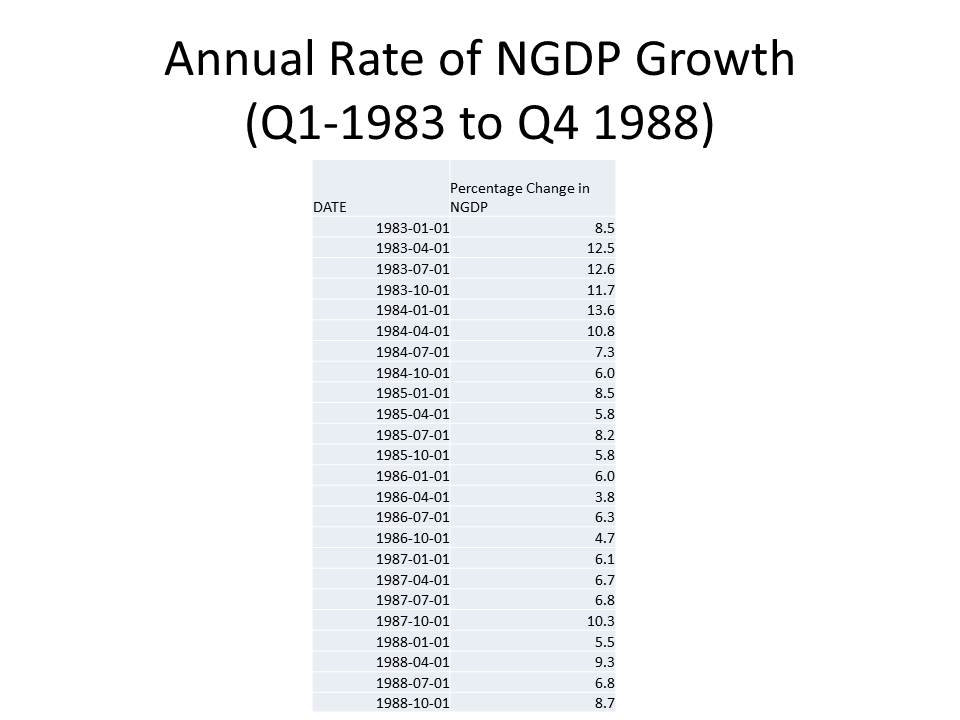
What Mr. Schwab fails to note is that the value of money (its purchasing power at any moment) and the rate of inflation cannot be determined in a free market. That is the job of the monetary authority. Aside from the tiny sliver of the economics profession that believes that the value of money ought to be determined by some sort of free-market process, that responsibility is now taken for granted. The problem at present is that the expected future price level (or the expected rate of growth in nominal GDP) is below the level consistent with full employment. The problem with Fed policy is not that it is keeping rates too low, but that it is content to allow expectations of inflation (or expectations of future growth in nominal GDP) to remain below levels necessary for a strong recovery. The Reagan recovery, as I noted recently, is hailed as a model for the Obama administration and the Fed by conservative economists like John Taylor, and the Wall Street Journal editorial page, and presumably by Mr. Charles Schwab himself. The salient difference between our anemic pseudo recovery and the Reagan recovery is that inflation averaged 3.5 to 4 percent and nominal GDP growth in the Reagan recovery exceeded 10 percent for 5 consecutive quarters (from the second quarter of 1983 to the second quarter of 1984).  The table below shows the rate of NGDP growth during the last six years of the Reagan administration from 1983 through 1988.  This is why, as I have explained many times on this blog (e.g., here and here)and in this paper, since the early days of the Little Depression in 2008, the stock market has loved inflation.

Here’s how Hawtrey put it in his classic A Century of Bank Rate:

The adequacy of these small changes of Bank rate, however, depends upon psychological reactions. The vicious circle of expansion or contraction is partly, but not exclusively, a psychological phenomenon. It is the expectation of expanding demand that leads to a creation of credit and so causes demand to expand; and it is the expectation of flagging demand that deters borrowers and so causes demand to flag. . . . The vicious circle may in either case have any degree of persistence and force within wide limits; it may be so mild as to be easily counteracted, or it may be so violent as to require heroic measures. (p. 275)

Therefore the monetary authorities of a country which has been cut loose from any metallic or international standard find themselves compelled to some degree to regulate the foreign exchanges, either by buying and selling foreign currencies or gold, or (deplorable alternative) by applying exchange control. Thus at any moment the problem of monetary policy presents itself as a choice between a modification of the rate of exchange credit an adjustment of the credit system through Bank rate. And if the modification of the rate of exchange is such as to favour stable activity, the need for a change in Bank rate may be all the less. When a credit deadlock has thrown Bank rate out of action, modification of rates of exchange may be found to be the most valuable and effective instruments of monetary policy. (p. 277)

There is thus no doubt that the Fed could achieve (within reasonable margins of error) any desired price level or rate of growth in nominal GDP by announcing its target and expressing its willingness to drive down the dollar exchange rate in terms of one or several currencies until its price level or NGDP target were met. That, not abdication of its responsibility, is the way the Fed can strengthen the ever so faint signs of a budding recovery (remember those green shoots?).

Daniel Kuehn Explains the Dearly Beloved Depression of 1920-21

In the folklore of modern Austrian Business Cycle Theory, the Depression of 1920-21 occupies a special place. It is this depression that supposedly proves that all depressions are caused by government excesses and that, if left unattended, with no government fiscal or monetary stimulus, would work themselves out, without great difficulty, just as happened in 1920-21. In other words, government is the problem, not the solution, and the free market is the solution, not the problem. If only (the crypto-socialist) Herbert Hoover and (the not-so-crypto) FDR had followed the wholesome example of the great Warren G. Harding, cut spending to the bone and cut taxes, the Great Depression would have been over in 18 months or less, just as the 1920-21 Depression was. And if Bush and Obama had followed the Harding example, our own Little Depression would have surely long since have been a distant memory.

In two recent papers (“A Critique of the Austrian School Interpretation of the 1920-21 Depression“, “A note on America’s 1920-21 depression as an argument for austerity“), fellow blogger Daniel Kuehn provides some historical background and context for the 1920-21 Depression, showing that the 1920-21 Depression was the product of a deliberately deflationary fiscal and monetary policy aimed at undoing (at least in part) the very rapid inflation that occurred in the final stages and the aftermath of World War I. In that sense, the 1920-21 Depression really is very much unlike the kind of overinvestment/malinvestment episodes envisioned by the Austrian theory.

The other really big difference between the 1920-21 Depression and the Great Depression is that there was effectively no gold standard operating in 1920-21. True the US had restored convertibility between the dollar and gold by 1920, but almost no other currencies in the world were then tied to gold. The US held 40 percent of the world’s reserves of gold, so the US was determining the value of gold rather than gold determining the value of the dollar. The Federal Reserve had as much control over the US price level as any issuer of fiat currency could ever desire. By 1929, there was a world market for gold in which many other central banks were exerting — and none more than the insane Bank of France — a powerful influence, almost exclusively on the side of deflation. Thus, immediately following a wartime inflation — historically almost always a time for deflation — it was relatively easy to unwind the inflationary increases in wages and prices of the preceding few years. When the Fed signaled in 1921, by reducing its discount rate, that it was no longer aiming for deflation, the deflation quickly came to an end. But in the Great Depression, notwithstanding the characteristically exaggerated, if not delusional, Austrian rhetoric about the inflationary excesses 1920s, there was in fact no previous inflation to unwind.  As long as a country remained on the gold standard, there was no escape from deflation caused by an increasing real value of gold.

On at least one occasion, no less an authority on Austrian Business Cycle theory than Murray Rothbard, himself, actually admitted that the 1920-21 Depression was indeed a purely monetary episode, in contrast to the Great Depression in which real factors played a major role. In the late 1960s, when I was an undergrad in economics at UCLA, Rothbard gave a talk at UCLA about the Great Depression. All I really remember is that he spent most of the talk berating Herbert Hoover for being just as bad as FDR. Most people were surprised to find out that Hoover was such an interventionist, though anyone who had read Ronald Coase’s classic article on the FCC would have already known that Hoover was very far from being a free market ideologue. I had just started getting interested in Austrian economics – while my contemporaries were experimenting with drugs, I was experimenting with Austrian economics; go figure! I sure hope no permanent damage was done – and was curious to hear what Rothbard had to say. But it was all about Herbert Hoover. Later, I asked Axel Leijonhufvud, who had also attended the talk, what he thought. Axel said that Rothbard was a scholar, but didn’t elaborate except to say that he had chatted with Rothbard after the talk asking Rothbard if there had ever been a purely monetary depression and that Rothbard had said that the 1920-21 Depression had been purely monetary. So there you have it, Rothbard, on at least one occasion, admitted that the 1920-21 Depression was a purely monetary phenomenon.

Krugman on Mistaken Identities

Last week I wrote a series of posts (starting with this and ending with this) that were mainly motivated by a single objective: to show how taking the accounting identity between savings and investment seriously can get someone, even a very fine economist, into serious trouble. That, I suggested, is what happened to Scott Sumner when, in a post about whether a temporary increase in government spending and taxes would increase GDP, he relied on the accounting identity between savings and investment to conclude that a reduction in savings necessarily leads to a reduction in investment. Trying to trace Scott’s mistake to misuse of an accounting identity led me a little further than I anticipated into the substance of the argument about how a temporary increase in government spending and taxes affects GDP, an argument that I am still not quite satisfied with, but which – you can relax — I am not going to discuss in this post. My aim in this post is merely to respond to one of Scott’s rejoinders to me, which is that he was just relying on a proposition – the identity of savings and investment – that is taught in just about every macro textbook, including textbooks by Paul Krugman and Greg Mankiw, two of the current heavyweights of the profession. If so, Scott observed, my argument is not really with him, but with the entire profession.

No doubt about it, Scott has a point, though I think that most textbooks and most economists have an intuitive understanding that the accounting identity is basically a fudge, and therefore, unlike Scott, generally do not rely on it for any substantive conclusions. The way that most textbooks try to handle the identity is to say that the identity really just refers to realized (ex post) saving and investment which must be equal, while planned (ex ante) investment and planned (ex ante) saving may not be equal, with the difference between planned investment and planned saving corresponding to unplanned investment (accumulation) of inventories. Equilibrium is determined by the equality of planned investment and planned saving, and any disequilibrium (corresponding to a divergence between planned saving and planned investment) is reflected in unplanned inventory accumulation (either positive or negative) which ensures that the identity between realized investment and realized saving is always satisfied.  The usual fudge distinguishing between planned and realized investment and saving and postulating that unplanned inventory investment is what accounts for any difference between planned investment and saving is itself problematic, but it at least puts one on notice that there is a difference between an equilibrium condition and an accounting identity, while nevertheless erroneously suggesting that the accounting identity has some economic significance.

Not entirely coincidentally, Scott having got started on this topic by responding to a post by Paul Krugman, Krugman himself weighed in on the subject of accounting identities last week, enthusiastically citing a post by Noah Smith warning about the misuse of accounting identities in arguments about economics. Now the truth is that there is not too much in Krugman’s post that I disagree with, but there are certain verbal slips or misstatements that betray the confusion between accounting identities and equilibrium conditions that I am trying to get people to recognize and to stay away from. While avoiding any substantive error, Krugman perpetuates the confusion, thus contributing unwittingly to the very problem that motivated his post. Thus, his confusion is not just annoying to compulsive grammarians like me; it is also unnecessary and easily avoidable, and creates the potential for more serious mistakes by the unwary. So there is really no excuse for continuing to pay lip service to the supposed identity between savings and investment, regardless of how deeply entrenched it has become as the result of many decades of unthinking, rote repetition on the part of textbook writers.

Here’s Krugman:

Via Mark Thoma, Noah Smith has a terrific piece on how to argue with economists. All the points are good, but I’d like to focus on Principle 4, “Argument by accounting identity almost never works.”

What he’s referring to, I assume, is arguments like “since savings equals investment, fiscal stimulus can’t affect overall spending”, or “since the current account balance is equal to the difference between domestic saving and domestic investment, exchange rates can’t affect trade”. The first argument is, more or less, Say’s Law and/or the Treasury view. The second argument is what John Williamson called the doctrine of immaculate transfer.

This is pretty straightforward, though I don’t care for the examples that Krugman gives, displaying a conventional misunderstanding of Say’s Law. But Say’s Law is a whole topic unto itself. Nor can the Treasury view be dismissed as nothing more than the misapplication of an accounting identity. So I’m just going to ignore those two specific examples for purposes of this discussion. Back to Krugman.

Why are such arguments so misleading? Noah doesn’t fully explain, so let me put in a further word. As I see it, economic explanations pretty much always have to involve micromotives and macrobehavior (the title of a book by Tom Schelling). That is, when we tell economic stories, they normally involve describing how the actions of individuals, driven by individual motives (and maybe, though not necessarily, by rational self-interest), add up to interesting behavior at the aggregate level.

Again, nothing to argue with there, though the verb “add up” has just faintest whiff of an identity insinuating itself into the discussion.

And the key point is that individuals in general [as opposed to those strange creatures called economists who do care about “aggregate accounting identities?] neither know nor care about aggregate accounting identities.

Ok, now we are starting to have a problem. Individuals in general neither know nor care about aggregate accounting identities. Does that mean that those strange creatures called economist should know or care about aggregate accounting identities? I have yet to hear any cogent reason why they should.

Take the doctrine of immaculate transfer: if you want to claim that a rise in savings translates directly into a fall in the trade deficit, without any depreciation of the currency, you have to tell me how that rise in savings induces domestic consumers to buy fewer foreign goods, or foreign consumers to buy more domestic goods. Don’t tell me about how the identity must hold, tell me about the mechanism that induces the individual decisions that make it hold.

Here is where Krugman, after skating on the edge, finally slips up and begins to talk nonsense — very subtle nonsense, but nonsense nonetheless. What does it mean to say that an identity must hold? It means that, by the very meaning of the terms that one is using, the identity of which one is speaking must be true. It is inconceivable that an identity would not hold. If the difference between investment and savings (in an open economy) is defined to be identitically equal to the trade deficit, then talking about a mechanism that induces individual decisions to make it hold makes as much sense as saying that there must be a mechanism that induces individual decisions to make 2 + 2 equal 4. If, by the very meaning of the terms that I am using, the difference between investment and savings must equal the trade deficit (which, to repeat, is what it means to say that there is an identity between those magnitudes) there is no conceivable set of circumstances in which the two magnitudes would not be equal. If, in the very nature of things, two magnitudes could never possibly be different, it is nonsense to say that there is a mechanism of any kind (much less one describable in terms of the decisions of individual human beings) that operates to bring it about that the equality actually holds.

And once you do that, you realize that something else has to be happening — a slump in the economy, a depreciation of the real exchange rate, it depends on the circumstances, but it can’t be immaculate, with nothing moving to enforce the identity.

No, no! A thousand times no! If we are really talking about an identity, nothing has to be happening to enforce the identity. Identities don’t have to be enforced. Something that could not conceivably be otherwise requires nothing to prevent the inconceivable from happening.

When it comes to confusions about the macro implications of S=I, again the question is how the identity gets reflected in individual motives — is it via the interest rate, via changes in GDP, or what?

There are no macro implications of an identity; an identity has no empirical implications of any kind — period, full stop. If S necessarily equals I, because they have been defined in such a way that they could not possibly be unequal, then there is no conceivable state of the world in which they are unequal. Obviously, if S and I are equal in every conceivable state of the world, the necessary identity between them cannot rule out any conceivable state of the world. That means that the identity between S and I has no empirical implications. It says nothing about what can or cannot be observed in the real world at either the micro or the macro level.

Accounting identities are important; in fact, they’re the law. But they should inform your stories about how people behave, not act as a substitute for behavioral analysis.

I don’t know what law Krugman is referring to, but usually laws of nature tell us that some conceivable observations are not possible. Accounting identities don’t tell us anything of the sort. They are merely express certain conventional meanings that we are assigning to specific terms that we are using. How an accounting identity that could not be inconsistent with any conceivable state of the world can inform anything is a mystery, but I heartily agree that an accounting identity cannot be “a substitute for behavioral analysis.”

I have been rather (perhaps overly) harsh in my criticism on Krugman, but not to show that I am smarter than he is, which I certainly am not, but to show how easily habitual ways of speaking about macro lead to (easily rectifiable) nonsense statements. The problem is not any real misunderstanding on his part. Indeed, I would be surprised if, should he ever read this, he did not immediately realize that he had been expressing himself sloppily. The point is that macroeconomists have gotten into a lot of bad habits in describing their models and in failing to distinguish properly between accounting identities, which are theoretically unimportant, and equilibrium conditions, which are essential. Everything that Krugman said would have made sense if he had properly distinguished between accounting identities and equilibrium conditions rather than mix them up as he did, and as textbooks have been doing for three generations.

Savings and investment are equal in equilibrium, because that equality is a necessary and sufficient condition for the existence of an equilibrium. If so, being out of equilibrium means that savings and investment are not equal. So if we think that a real economy is ever out of equilibrium, one way to test for the existence of disequilibrium would be to see if actual savings and actual investment are unequal, notwithstanding the presumed accounting identity between savings and investment. That accounting identity is a product of the special definitions assigned to savings and investment by national income accounting practices, not by the meaning that our theory of national income assigns to those terms.

PS I will once again mention (having done so in previous posts on accounting identities) that all the essential points I am making in this post are derived from the really outstanding and unfortunately not very widely known paper by Richard G. Lipsey, “The Foundations of the Theory of National Income” originally published in Essays in Honour of Lord Robbins and reprinted in Macroeconomic Theory and Policy:  Selected Essays of Richard G. Lipsey.
How Ronald Reagan (Not to Mention Republicans, Conservatives and the Wall Street Journal Editorial Board) Learned to Stop Worrying and Love Moderate Inflation

In my previous post, I pointed out that inflation (measured by both the GDP price deflator and the Personal Consumption Price Index) in the fourth quarter has fallen back to a level well below the Fed’s 2% target.  Indeed, it is running at nearly the lowest rate since the end of World War II. Later, when reading this post by Noah Smith commenting on this post by John Taylor’s (also see Taylor’s op-ed in the Wall Street Journal), it occurred to me that, viewed from the perspective of the current rhetoric about sound money and proposals to eliminate the dual mandate of the Fed and impose on the Fed a single unambiguous mandate of maintaining price stability, it is hard to understand why some people are so harshly critical of Mr. Obama’s record as President. If price stability is really the alpha and omega of monetary policy, then, based on his success in keeping inflation low, shouldn’t Mr. Obama be rated the most economically successful President in living memory?

If, despite President Obama’s stellar record in suppressing inflation – either directly or through his re-appointment of Ben Bernanke as Fed Chairman — is not enough to mollify the critics who loudly assert that the only macroeconomic objective of the Federal Reserve Board should be to ensure price stability, doesn’t that suggest that they actually care about more than price stability and that calls for the Fed to stop paying attention to anything but the rate of inflation are perhaps less than 100% sincere?  After all, inflation is lower now than it was during the administration of Ronald Reagan, and aside from his reputation as the quintessential Conservative, Reagan is also viewed as the slayer of inflation and the very paragon on a sound money man.  So I thought that it might be useful to go back and see what the Reagan administration itself had to say about inflation while it was in office.

So herewith I provide a few excerpts from the  Annual Reports of the Council of Economic Advisers published in the Economic Report of the President during the Reagan Presidency.

Economic Report of the President 1984

The tendency toward a slight increase in inflation over the year was also registered by the producer price index. Over the 6 months ending June, the index for total finished goods fell at annual rate of 0.9 percent,but over the second half of the year this index rose at 2.0 percent annual rate. Even so, inflation by this measure was lower than that in the recession phase of the cycle. The GNP implicit price deflator, the broadest measure of inflation, rose by 4.0 percent over the four quarters of the year. (p. 190)

The gradual reduction in inflation assumed by the Administration does not depend on a policy assumption that such a result will be “forced” by deliberate actions to choke off economic growth whenever there is any sign of a rise in inflation. Rather, the decline in inflation is the anticipated outcome of the assumed steady and predictable monetary and fiscal policies. As with real growth, it is expected that inflation may sometimes be higher and sometimes lower than the Administration assumption, but that the trend will be downward as indicated. (p. 199)

Economic Report of the President 1985

Although it is common for inflation to fall somewhat during the early stages of business cycle recoveries, few observers anticipated that the inflation rate would remain so low during a recovery as rapid as that experience in 1983-84. The inflation rate rose slightly in the second half of 1983 and early 1984, but there was no apparent tendency for the rate to rise further. Indeed, over the course of 1984 the inflation rate declined somewhat. However, inflation is still higher than desireable, and it worth noting that the services component of the CPI in 1984 showed some signs of slightly rising inflation. (p. 44)

The inflation outlook for 1985 is good. With moderate expansion in the money aggregates and continuing real growth, the inflation rate, as measured by the GNP deflator, is expected to average 4.3 percent over the four quarters of 1985. (p. 62)

Economic Report of the President 1986

After being lower than expected in 1985, the inflation rate, as measure by the GNP deflator, is expected to rise somewhat in 1986. Rapid monetary growth throughout 1985 as well as the depreciation of the dollar are expected to place upward pressure on prices. The projected rise in near-term inflation, however, is expected to be temporary, provided that a policy of gradual money-growth reduction is pursued. (p. 23)

The unsatisfactory economic performance associated with the rise of inflation and the adjustment problems that arise during disinflation provide a clear lesson: reacceleration of inflation must prevented. The surest way to avoid the costs of both inflation and disinflation is to avoid the policies that lead to an acceleration of inflation. Moreover, the experience of the past 3 years has indicated that substantial economic growth can occur without rekindling inflation. (p. 70)

Economic Report of the President 1987

More than 4 years of economic expansion, with the inflation rate remaining near or below 4 percent and interest rates declining to their lowest levels in 9 years, have laid te foundation for sustainable real growth with moderate inflation. (p. 19)

The inflation rate is 1987 is forecast to return to the 3.5 to 4 percent range of recent years, before the decline in oil prices temporarily depressed the inflation rate in 1986. Specifically the GNP deflator is forecast to rise at a 3.6 percent annual rate during 1987, after a 2.2 percent rate of increase during 1986. (p. 58)

Economic Report of the President 1988

Higher oil prices and higher import prices increased the 1987 inflation rate (as measured by the CPI) above the very low rate recorded in 1986. Higher import prices also are expected to contribute to consumer price inflation in 1988. However, after a year of slow growth of monetary aggregates, and in view of the expected slowing of real economic growth, acceleration of inflation is not seen as a likely danger in 1988. On a fourth-quarter to fourth-quarter basis, the CPI is forecast to rise 4.3 percent in 1988, a small decline from the rise in 1987. The GNP deflator, which is not affected directly by import prices, is forecast to rise 3.9 percent in 1988. (pp. 48-49)

Economic Report of the President 1989

An important legacy of this Administration is the refocusing of economic policy. The Administration deemphasized short-run stabilization policies; worked to provide a stable policy environment with market-based incentives for productive behavior, including low inflation; and attempted to extricate private markets from burdensome regulations. The strength and durability of the current expansion bear testimony to the soundness of these policies. In December 1988, the current economic expansion entered its seventh year, making it the longest peacetime expansion and the third longest on record. Most impressively, the inflation rate has not risen during this expansion, but has remained in the neighborhood of 3 to 4 percent. (pp. 258-59)

So it seems that President Reagan and his economic advisers thought that they were doing well to keep inflation at 4 percent a year.  Sure, they would have liked to get the inflation rate down a  bit, but they weren’t prepared to risk even a slowdown in the rate of decrease in unemployment to reduce inflation, much less tolerate any increase in the unemployment rate.  Promised reductions in the rate of inflation below the steady 3.5-4% rate that prevailed for the most part after the recovery started in 1983 just kept getting deferred further and further into the future.  Is that a record that John Taylor would like the next President of the United States to emulate?


About Me

David Glasner
Washington, DC

I am an economist in the Washington DC area. My research and writing has been mostly on monetary economics and policy and the history of economics. In my book Free Banking and Monetary Reform, I argued for a non-Monetarist non-Keynesian approach to monetary policy, based on a theory of a competitive supply of money. Over the years, I have become increasingly impressed by the similarities between my approach and that of R. G. Hawtrey and hope to bring Hawtrey’s unduly neglected contributions to the attention of a wider audience.

My new book Studies in the History of Monetary Theory: Controversies and Clarifications has been published by Palgrave Macmillan

Follow me on Twitter @david_glasner

Archives

Enter your email address to follow this blog and receive notifications of new posts by email.

Join 665 other subscribers
Follow Uneasy Money on WordPress.com