Archive Page 52


Expected Inflation and the S&P 500 Redux

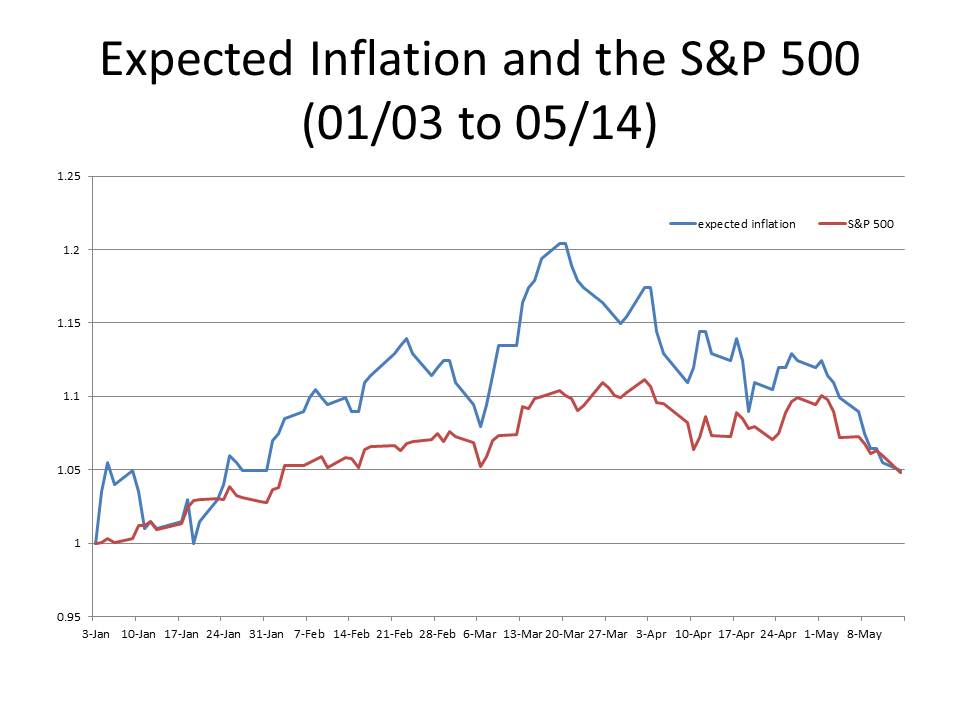
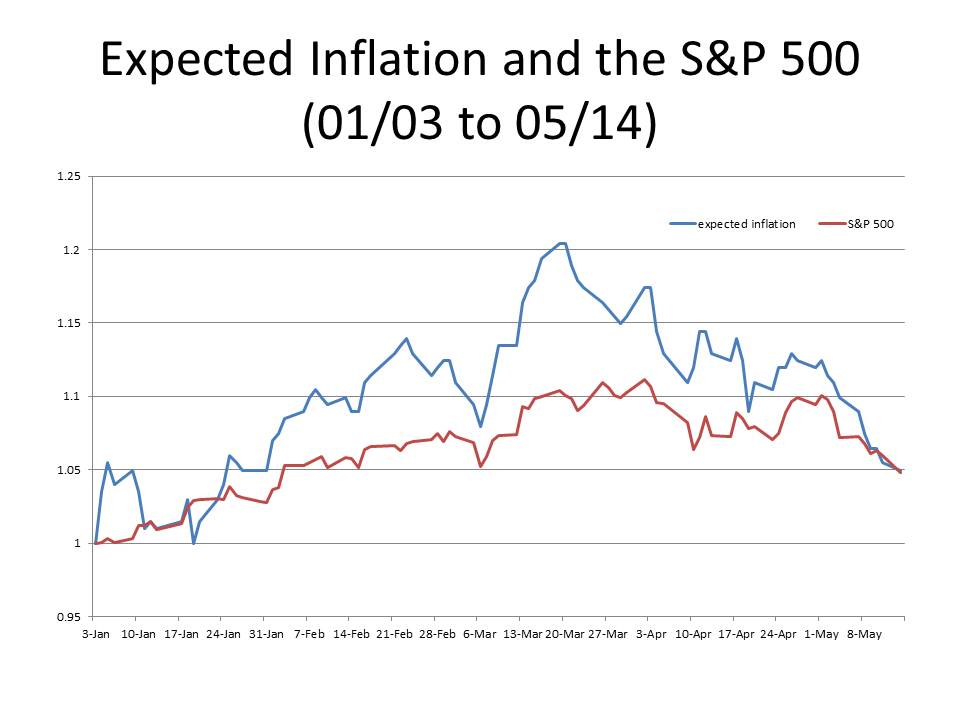
On Monday I wrote a post with the chart below showing the close correlation since January of this year between the S&P 500 and expected inflation as (approximately) reflected in the spread between the constant maturity 10-year Treasury note and the constant maturity 10-year TIPS.  A number of other bloggers noticed the post and the chart.  One of those was Matthew Yglesias who coupled my chart with a somewhat similar one posted by Marcus Nunes on his blog on the same day as mine.

One commenter (“Fact Checker”) on Matthew’s blog criticized my chart accusing me of cherry picking.

The second graph is meaningless, as it does not work through time.

Here it is from 1990: http://research.stlouisfed.org/fredgraph.png?g=7gX
Again from 2000: http://research.stlouisfed.org/fredgraph.png?g=7gY
From 2005: http://research.stlouisfed.org/fredgraph.png?g=7gZ
From 2009: http://research.stlouisfed.org/fredgraph.png?g=7h0

And in another comment:

The S&P + inflation chart is reproduced below, with longer windows. And as you suggest there is no correlation in any time frame but the very short window cherry picked by MY.

Two points to make about his comment.  First, if Fact Checker had read Yglesias’s post carefully, or, better yet, actually read my post (let alone the original paper on which the post was based), he would have realized that my whole point is that the close correlation between expected inflation and stock prices is generally not observed, and that one would expect to observe the correlation only when deflation exceeds the real rate of interest (as it does now when slightly positive expected inflation exceeds the negative real real rate of interest).  So the fact that the correlation doesn’t work through time was precisely the point of my post.  Second, the graphs to which Fact Checker links use survey data by the University of Michigan of the inflation expectations of households.  I do not totally discount such data, but I regard survey estimates of expected inflation as much less reliable than the implicit market expectations of inflation reflected in the TIPS spread.

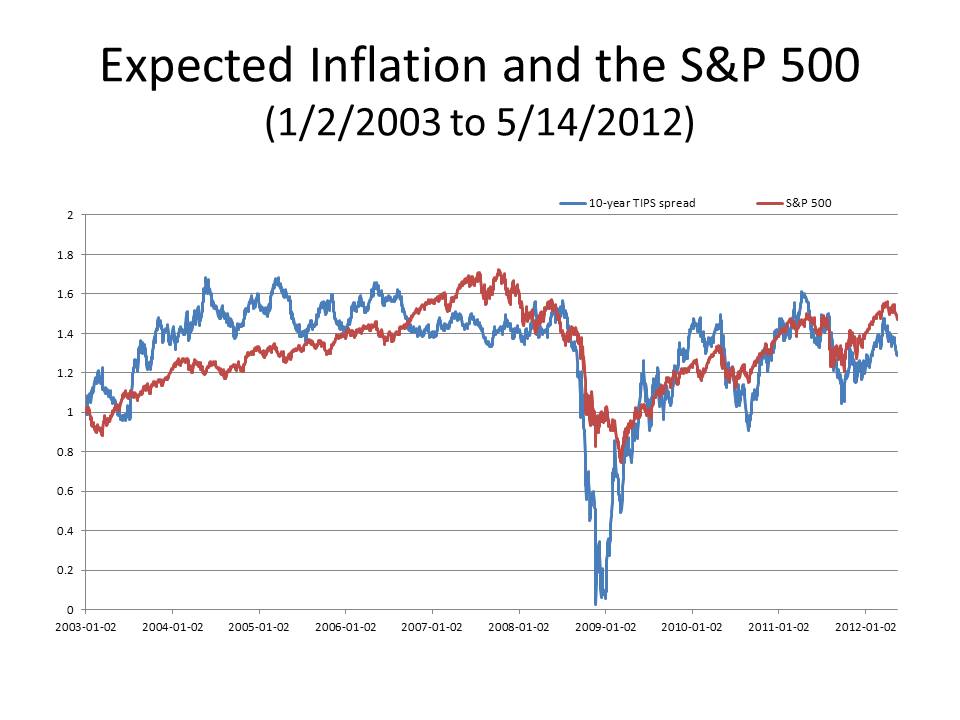
To show that the correlation I have found is reflected in the data since approximately the beginning of the downturn at the very end of 2007, but not before, here is a graph similar to the one I posted on Monday covering the entire period since 2003 for which I have data on the 10-year TIPS spread.

Before the beginning of 2008, there is plainly no correlation at all between inflation expectations and stock prices.  It is only at some point early in 2008 that the correlation begins to be observed, and it has persisted ever since.  We will know that we are out of this Little Depression when the correlation vanishes.

John Kay on Central Bank Credibility

Few, if any, newspaper columnists are as consistently insightful and challenging as John Kay of the Financial Times.  In his column today (“The dogma of ‘credibility’ now endangers stability”), Kay brilliantly demolishes the modern obsession with central-bank credibility, the notion that failing to meet an arbitrary inflation target will cause inflation expectations to become “unanchored,” thereby setting us on the road to hyper-inflation of Zimbabwean dimensions.  (Talk about a slippery slope!  If only central bankers and Austrians Business Cycle Theorists realized how much they had in common, they would become best friends.)

Here’s Kay:

The elevation of credibility into a central economic has turned a sensible point — that policy stability is good for both business and households — into a dogma that endangers economic stability.  The credibility the models describe is impossible in a democracy.  Worse, the attempt to achieve it threatens democracy.  Pasok, the established party of the Greek left, lost votes to the moderate Democratic Left and more extreme Syriza party because it committed to seeing austerity measures through.  Now the Democratic Left cannot commit to that package because it would lose to Syriza if it did.  The UK’s Liberal Democrats, by making such a deal, have suffered electoral disaster.  The more comprehensive the coalition supporting unpalatable policies, the more votes will go to extremists who reject them.

We got into this mess in 2008, because the FOMC, focused almost exclusively on rising oil and food prices that were driving up the CPI in the spring and summer of 2008, ignored signs of a badly weakening economy, fearing that rises in the CPI would cause inflation expectations to become “unanchored.”  The result was an effective tightening of monetary policy DURING a recession, which led to an unanchoring of inflation expectations all right, but in precisely the other direction!

Now, the ECB, having similarly focused on CPI inflation in Europe for the last two years, is in the process of causing inflation expectations to become unanchored in precisely the other direction.  Why is it that central bankers, like the Bourbons, seem to learn nothing and forget nothing?  Don’t they see that central bank credibility cannot be achieved by mindlessly following a single rule?  That sort of credibility is a will o the wisp.

News Flash: Cleveland Fed Reports that Inflation Expectations Fell in April

From a news release issued by the Federal Reserve Bank of Cleveland after the BLS reported that the CPI was unchanged in April.

The Federal Reserve Bank of Cleveland reports that its latest estimate of 10-year expected inflation is 1.38 percent. In other words, the public currently expects the inflation rate to be less than 2 percent on average over the next decade.

The Cleveland Fed’s estimate of inflation expectations is based on a model that combines information from a number of sources to address the shortcomings of other, commonly used measures, such as the “break-even” rate derived from Treasury inflation protected securities (TIPS) or survey-based estimates. The Cleveland Fed model can produce estimates for many time horizons, and it isolates not only inflation expectations, but several other interesting variables, such as the real interest rate and the inflation risk premium.

The Cleveland Fed’s estimate of expected inflation was 1.47 percent, so expected inflation dropped by .09 basis point in April.  It undoubtedly has continued falling in May.  The lowest monthly estimate of expected inflation over a 10-year time horizon ever made by the Cleveland Fed was 1.34% in February of this year, so we may now already be stuck with the lowest inflation expectations ever.  Is anyone at the FOMC paying attention?

Bruce Bartlett on the Triumph of Ron Paul

If I had a twitter account, I might have just tweeted this, but since I don’t, I will write a quick post instead.  In the Economix blog at the New York Times website, Bruce Bartlett writes a post today with the somewhat misleading title “What Rule Should the Fed Follow?” about how Austrian Business Cycle Theory has come to dominate the thinking of right-wing economics, displacing the Monetarism of Milton Friedman.  As some commenters point out, that is a bit of an exaggeration on Bartlett’s part.  At the upper levels of right-wing economic policy-making, there are still very few, if any, Austrians to be found.  However, mainstream types like John Taylor and Alan Meltzer have managed to make the necessary adjustments to the zeitgeist.

All in all, a worthwhile and enlightening discussion, but I couldn’t help wondering . . . whatever happened to Hawtrey and Cassel?

Inflation Expectations Are Falling; Run for Cover

The S&P 500 fell today by more than 1 percent, continuing the downward trend began last month when the euro crisis, thought by some commentators to have been surmounted last November thanks to the consummate statesmanship of Mrs. Merkel, resurfaced once again, even more acute than in previous episodes. The S&P 500, having reached a post-crisis high of 1419.04 on April 2, a 10% increase since the end of 2011, closed today at 1338.35, almost 8% below its April 2nd peak.

What accounts for the drop in the stock market since April 2? Well, as I have explained previously on this blog (here, here, here) and in my paper “The Fisher Effect under Deflationary Expectations,” when expected yield on holding cash is greater or even close to the expected yield on real capital, there is insufficient incentive for business to invest in real capital and for households to purchase consumer durables. Real interest rates have been consistently negative since early 2008, except in periods of acute financial distress (e.g., October 2008 to March 2009) when real interest rates, reflecting not the yield on capital, but a dearth of liquidity, were abnormally high. Thus, unless expected inflation is high enough to discourage hoarding, holding money becomes more attractive than investing in real capital. That is why ever since 2008, movements in stock prices have been positively correlated with expected inflation, a correlation neither implied by conventional models of stock-market valuation nor evident in the data under normal conditions.

As the euro crisis has worsened, the dollar has been appreciating relative to the euro, dampening expectations for US inflation, which have anyway been receding after last year’s temporary supply-driven uptick, and after the ambiguous signals about monetary policy emanating from Chairman Bernanke and the FOMC. The correspondence between inflation expectations, as reflected in the breakeven spread between the 10-year fixed maturity Treasury note and 10-year fixed maturity TIPS, and the S&P 500 is strikingly evident in the chart below showing the relative movements in inflation expectations and the S&P 500 (both normalized to 1.0 at the start of 2012.

With the euro crisis showing no signs of movement toward a satisfactory resolution, with news from China also indicating a deteriorating economy and possible deflation, the Fed’s current ineffectual monetary policy will not prevent a further slowing of inflation and a further perpetuation of our national agony. If inflation and expected inflation keep falling, the hopeful signs of recovery that we saw during the winter and early spring will, once again, turn out to have been nothing more than a mirage

Yeager v. Tobin

In some recent posts (here, here, and here), I have expressed my admiration for James Tobin’s wonderful paper “Commercial Banks as Creators of Money.” Although the logic of the paper seems utterly compelling to me, it was, and evidently remains, controversial, because it advances the idea that the distinction between what is and what is not money is not a hard and fast one, but depends on the institutional and regulatory arrangements under which banks and other financial institutions operate.

The context in which I have been discussing Tobin is whether bank deposits created by commercial banks, unlike the liabilities created by other financial institutions, are “hot potatoes” in the sense that any individual can get rid of “unwanted” bank deposits (“unwanted” meaning that the individual’s deposit holdings exceed the amount that he would like to hold relative to his current income and wealth), but can do so only by giving those deposits to another individual in exchange for something else that the first individual would rather have instead. Thus, according to the “hot potato” view of the world, the total amount of bank deposits held by the community as a whole cannot be changed; the community is stuck with whatever amount of deposits that the banks, in the process of making loans, have created. What this means is that it is up to the monetary authority, through its control of reserves, reserve requirements, and the overnight rate on interbank loans (or its lending rate to the banks), to create the right amount of bank deposits.

Tobin argued that the “hot potato” view of bank deposits is incorrect, because the creation of bank deposits by commercial banks is not a mechanical process, as implied by the conventional money-multiplier analysis, in which bank deposits automatically come in to existence as a result of, and in proportion to, the amount of reserves provided to the banking system. Rather, profit-maximizing banks, like other profit-maximizing financial intermediaries, make an economic decision about how much of their liabilities to create (and on what terms to make them available) based on the public’s demand to hold those liabilities and the banks’ costs of backing those liabilities, inasmuch as any financial intermediary issuing a liability must make that liability sufficiently attractive to be willingly held by some member of the public. Like any financial intermediary, banks seeking to lend to the public can lend only if they obtain the funds to be lent from some source: either the equity of the owners or funds provided to the bank by lenders. If a bank cannot induce people to hold an amount deposits created in the process of making loans equal to the amount of loans it has made, it must find another source of capital to finance those loans.  Otherwise, the bank will be unable to sustain the scale of lending it has undertaken.

The amount of lending that banks undertake is governed by strict profit-loss calculations, just as the scale of operations of any profit-making enterprise is governed by a profit-loss calculation.  A bank makes a profit if the spread between its borrowing and lending rates is sufficient to cover its other costs of intermediation. And the scale of its lending depends on the demand of the public to hold its liabilities (which affects how much interest a bank must pay on those liabilities, e.g., demand deposits) and the interest rates that borrowers are willing to pay on the loans they obtain from the bank. Subject to essentially the same constraints on expansion as other financial intermediaries, banks do not simply lend without considering what costs they are incurring or what contribution to profits their loans are making at the margin. Because in equilibrium, the marginal revenue to a bank generated by an incremental loan just equals the marginal cost of making the loan, so that banks can decide to decrease their lending just as easily as they can decide to increase their lending, it makes no sense to think that bank-created money is, like central-bank currency, a hot potato. (Aside to Mike Sproul: Sorry, I know the previous sentence sounds like a nail scratching on a blackboard to you, but only one argument at a time.) As Tobin puts it:

The community cannot get rid of its currency supply; the economy must adjust until it is willingly absorbed. The “hot potato” analogy truly applies. For bank-created money, however, there is an economic mechanism of extinction as well as creation, contraction as well as expansion. If bank deposits are excessive relative to public preferences, they will tend to decline; otherwise banks will lose income. The burden of adaptation is not placed on the rest of the economy.

To me this seems so straightforward that I cannot understand why anyone would disagree. But some very smart people – I am thinking especially of Nick Rowe — are as convinced that it is wrong as I am that it is right. In earlier exchanges we have had about this, Nick has invoked the authority of Leland Yeager in arguing against Tobin, and Lee Kelly, in a comment on my recent post citing the favorable evaluation of Tobin’s paper given by Milton Friedman and Anna Schwartz in their Monetary Statistics of the US:  Estimates, Sources and Methods, a companion volume to their Monetary History of the US, specifically asked for my opinion of Leland Yeager’s paper “What Are Banks?”, a paper devoted entirely to criticism of Tobin’s paper.

I just re-read Yeager’s paper, and I still find it unpersuasive. There are too many problems with it to cover in a single blog post. But I will note in passing that in the discussion of definitions of money by Friedman and Schwartz that I mentioned in the previous paragraph, Friedman and Schwartz, while indicating agreement with the gist of Tobin’s argument, also criticized Yeager’s approach in his paper “The Essential Properties of a Medium of Exchange,” which foreshadowed much of the discussion in “What Are Banks?” So it is complicated. But I think that the key point is that, by failing to make explicit how he conceived that the price level and nominal income were determined, Tobin left his analysis incomplete, thereby allowing critics to charge that he had left the price level and nominal income undetermined or specified, in Keynesian style, by some ad hoc assumption. This misunderstanding is evident when Yeager makes the following criticism of Tobin and his followers:

Proponents of this view [Tobin et al.] are evidently not attributing “the natural economic limit” to limitation of base money and to a finite money multiplier, for that would be old stuff and not a new view. Those familiar limitations operate on the supply-of-money side, while the New Viewers emphasize limitations on the demand side. They deny crucial differences (to be explained below) between banking and NFI (non-bank financial institutions) systems regarding limits to the scales of their operations.

This paragraph is hopelessly, if not deliberately, confused. Arguing like a lawyer, Yeager attributes an absurd position to Tobin based on the label (New View) that Tobin et al. chose to describe their approach to analyzing the banking system, an approach based on economic incentives rather than the mindless mechanics of the money multiplier. Having thereby attributed an absurd position to Tobin, Yeager proceeds to discredit that absurd position, even though the quotation above in which Tobin distinguishes between currency and “bank-created money” demonstrates that he explicitly rejected the position attributed to him. And contrary to Yeager’s assertion, rejection of the money-multiplier as an analytical tool certainly was a New View, a view that Yeager spends most of his paper arguing against. The money multiplier is a reduced form embodying both demand (for reserves, by the banking system, and for currency, by the public) and supply; it is not a description of the profit-maximizing choices of banks to supply deposits at alternative prices, which is what we normally think of as a supply curve. To treat it as a conventional supply curve or as an analogue to a supply curve is just incoherent. And then, apparently oblivious to the mutual inconsistency of his criticisms, Yeager, in the paragraph’s final sentence, criticizes the New View for denying “crucial differences” between banks and non-bank financial institutions “regarding limits to the scales of their operations,” a denial completely independent of what New Viewers think about base money.

A few paragraphs later, Yeager launches into a diatribe against the New View based on the following thought experiment:

Suppose, then, that a cut in reserve requirements or expansion of the monetary base or shift of the public’s preferences from currency to deposits initially gives the banks more excess reserves.

To Yeager it seems obvious that this thought experiment demonstrates that the banks, flush with excess reserves, start lending and expand the money supply, raising nominal income and prices rise and thereby increasing the demand for money until the demand to hold money eventually equals the enlarged stock of nominal money stock. Yeager somehow thinks that this thought experiment proves that it is the banking system that has generated the inflationary process.

Even applied to the banking system as a whole, something is wrong with the idea that a decline in yields obtainable will check expansion of loans and investments and deposits. That idea overlooks Knut Wicksell’s cumulative process. As money expansion raises nominal incomes and prices, the dollar volume of loans demanded rises also, even at given interest rates. The proposition that the supply of money creates its own demand thus applies not only to cash balances . . . but also to money being newly supplied and demanded on loan. An unconstrained cumulative process can even lead to embodiment of inflationary expectations in interest rates as described by Irving Fisher. The great inflations of history discredit any notion of expansion being limited as marginal revenues fall in relation to marginal costs. The notion rests not only on an illegitimate imputation of a systemwide viewpoint to the individual banker, but also on a more or less tacit assumption of rigid prices.

The obvious point to make is that Yeager’s thought experiment postulates either an increase in the monetary base or a reduction in the demand (via a reduction in reserve requirements or via a shift in the public’s demand from holding currency to holding deposits) for the monetary base. Thus, according to the New View (or an appropriately modified New View), the equilibrium price level and level of nominal income must rise. The rise is the consequence of an excess supply of currency (monetary base) which Tobin explicitly acknowledges is a hot potato. End of story. Yeager’s outraged remonstrations about Wicksellian cumulative processes, inflationary expectations and the lessons of the great inflations of history are simply beside the point. Throughout the paper, Yeager accuses Tobin of being confused about the difference between the incentives for the banking system as a whole and those of the individual banker, but confusion here is Yeager’s.

One might say that the approach that I follow:  to determine the price level in terms of the demand for currency and the stock of currency, while allowing the quantity of bank money and its yield (i.e. the interest rate paid by banks to depositors) to be determined in terms of the demand for deposits and the cost of supplying deposits, leads to exactly the same conclusion one reaches via the traditional money multiplier analysis: the price level and nominal income go up and the quantity of bank deposits increases. But actually there are some subtle differences. According to Yeager, it is the increase in the quantity of bank deposits that generates the increase in prices and nominal income. That would seem to imply that the quantity of bank money should be rising more rapidly than the quantity of liabilities produced by non-bank financial institutions. The money-multiplier analysis also implies no change in interest rates paid to depositors, while, if inflation leads to increased inflationary expectations and increased nominal interest rates, the New View predicts that the interest paid on deposits would rise as well. According to the New View, there would be no change in the relative quantities of bank and non-bank deposit liabilities; according to the money-multiplier analysis, the amount of bank deposits should rise faster than the amount of non-bank deposit liabilities even though non-banks would be increasing the rate of interest paid on their deposit liabilities while banks did not increase the interest paid on their deposit liabilities.

In connection with the “more or less tacit assumption of rigid prices” that he attributes to Tobin, Yeager adds the following footnote:

Basil Moore, who wavers between the new and traditional views, recognizes that if all prices were perfectly and instantly flexible, an unregulated banking system could not reach a stable equilibrium.

This is just wrong; a stable equilibrium is assured by fixing the nominal quantity of currency even with a completely unregulated banking system. What can possibly be meant by “perfect and instant price flexibility” is simply a mystery to me. The only meaning that I can possibly attach to it is that full equilibrium is continuously maintained, with no trading at disequilibrium prices. Why an equilibrium with a fiat currency and a determinate price level is inconsistent with an unregulated banking system is not explained, nor could it be.

The same confusion emerges again in Yeager’s discussion of how the supply of money creates its own demand. Yeager writes:

This process that reconciles the demand for money with the supply is the theme of what J. M. Keynes called “the fundamental proposition of monetary theory” and Milton Friedman called “the most important proposition in monetary theory.” Briefly, everyone can individually hold as much or as little money as he effectively demands, even though the total of all holdings may be exogenously set; for the total flow of spending adjusts in such a way that the demand for nominal money becomes equal to the exogenous supply.

Of course, the adjustment process can work perfectly well for currency and be irrelevant for bank money; currency is a hot potato, while bank money is not, so that the nominal supply of bank money, unlike the nominal stock of currency, adjusts to the nominal demand.

In a footnote to the above passage, Yeager invokes the authority of Harry Johnson:

Harry Johnson has charged opponents of monetarism with confusion over how nominal and real quantities of money are determined and with “a tendency to discuss monetary problems as if nominal and real money balances are the same thing, and as if ordinary value theory could be applied to the behaviour of money.” The Yale theorists [i.e., Tobin et al.] “are . . . alert to this confusion but by-pass it either by assuming stable prices and confining their analysis to the financial sector, or by building models based on the fictional construction of a money whose purchasing power is fixed in real terms, thereby avoiding confusion in the analysis at the expense of creating it with respect to the applicability of the results.

Any confusion Johnson may have detected could be eliminated simply distinguishing between the price-level analysis carried out in terms of the demand for, and the stock of, currency on the one hand, and the analysis, given the price level determined by the demand for and stock of currency, of the quantity (in both real and nominal terms) of bank money and the competitive interest paid by banks on deposits. In his subsequent work on the monetary approach to the balance of payments, Johnson showed himself to be perfectly content to decompose the analysis in this fashion.

There is more to say about Yeager’s paper; perhaps I will come back to it on another occasion. But any further comments are unlikely to be much more favorable than those above.
Herr Weidmann Doesn’t Get the Message

In a leader (“Message to the Bundesbank”) in this week’s Economist, the editors gently encouraged the Bundesbank president, Jens Weidmann, to be reasonable for a change, and to tolerate marginally higher inflation than the Bundesbank has thus far been inclined to do. Some relaxation of anti-inflation fervor, the Economist counseled, will be necessary if the common European currency is to survive. Given Germany’s cost advantage, equilibrium within the Eurozone requires that wages and prices in the so-called periphery (everybody but Germany and some of its closest neighbors) fall relative to those in Germany. If the policy of the Bundesbank and its client, the European Central Bank, is to ensure that German inflation is held at near zero, wages and prices in the periphery will have to fall. That is a prescription for disaster, and for a breakup of the euro, an outcome, however desirable compared to the alternative, that no one has quite figured out a practical way to achieve.  The Economist, adopting a diffident, almost deferential tone, practically begged Herr Weidmann to be reasonable.

[T]he ECB should loosen monetary conditions by cutting interest rates and, if necessary, printing money to buy bonds—even if German prices are rising faster than 2%. Instead of fighting against such easing, the Bundesbank’s proper role is to welcome this outcome. Mr Weidmann should vote for looser policy at the ECB, and then focus on minimising the fallout from higher inflation at home. . . .

[Mr. Weidmann] must be firm about the Bundesbank’s commitment to price stability, but make clear that the relevant measure is price stability in the euro zone as a whole. He should put Germany’s inflation in context: higher wages, after years of stagnation, are a good thing. And he must squash alarmist talk about asset bubbles. Yes, German property prices have started to rise, but it is hardly a bubble when house prices, relative to incomes and rents, are around 20% undervalued.

The absence of bubbles is also a reason for Mr Weidmann not to deploy macroprudential tools too soon. With no obvious financial excesses, there is little need to rein in Germany’s banks, particularly since any restrictions on them would make the euro zone’s problems harder by cutting lending to the periphery faster. If the ECB’s monetary policy stays loose for years, Germany will at some point have to worry about bubbles. But that point is a long way off. Central bankers are supposed to take the punchbowl away from the party. But not before the party has even begun.

However, in his own op-ed piece (Monetary policy is no panacea for Europe’s ills”) in Tuesday’s Financial Times, Herr Weidmann made it quite clear that he did not get (or, more likely, did not pay any attention to) the message that the Economist sent him.  (If the title of Herr Weidmann’s op-ed piece sounds a bit familiar to you have a look here.  Warning:  it could be really, really scary.)

To overcome the crisis, short-term measures have to be consistent with the long-term stability we all strive to achieve. Overburdening monetary policy with crisis management upsets this balancing act.

In other words, don’t look to the Bundesbank of the ECB for any relief. in best central tradition, Herr Weidmann adds cryptically (i.e., incomprehensibly)

Monetary policy in the eurozone is geared towards monetary union as a whole; a very expansionary stance for Germany therefore has to be dealt with by other, national instruments.

But Herr Weidmann’s final message is anything but cryptic.

However, this also implies that concerns about the impact of a less expansionary monetary policy on the periphery must not prevent monetary policy makers taking the necessary action once upside risks for eurozone inflation increase. Delivering on its primary goal to maintain price stability is the prerequisite for safeguarding the most precious resource a central bank can command: credibility.

In other words, don’t imagine for a second that the Bundesbank and its client, the ECB, will provide any monetary easing to ease the pain and suffering inflicted on the periphery by the overriding goal of safeguarding central bankers’ credibility.

James Tobin Got It Right

Over at the Money View at the INET website, Daniel Neilson recently wrote a critique of one my all-time favorite papers, “Commercial Banks as Creators of Money,” a paper that I have previously praised and written about (here and here). The paper is not universally popular; old-style Monetarists, like Leland Yeager and Karl Brunner, seem especially critical of it. But as I pointed out here, Milton Friedman and Anna Schwartz wrote about it very favorably. So when I saw Neilson’s criticism of Tobin at the Money View, which features both Neilson and Perry Mehrling, I paid close attention. I don’t know Neilson, but I do know Perry Mehrling, and he is a very interesting and knowledgeable economist, whose book on Fischer Black is just outstanding. Since it seems to me that Black’s view of money is very much in the spirit of, if not directly influenced by, Tobin’s paper, I was a bit surprised to find Mehrling’s co-blogger writing critically about Tobin’s paper, though obviously Neilson isn’t obligated to agree with Fischer Black, much less James Tobin, just because Perry Mehrling wrote a biography of Black.

At any rate, Neilson makes some good points, so it is worth following his argument to see if he really does prove Tobin wrong.

Neilson starts by acknowledging an important point made by Tobin, while registering a strong reservation:

I agree wholeheartedly with Tobin’s dismissal of the

mystique of “money”—the tradition of distinguishing sharply between those assets which are and those which are not “money,” and accordingly between those institutions which emit “money” and those whose liabilities are not “money,”

but rather than enclosing the difficult word in quotes, I prefer to try to understand it. By all means let us not draw an arbitrary line between money and non-money. But Tobin is wrong to conclude that there is nothing special about money at all.

Neilson continues:

Moneyness should, moreover, be viewed as a property which can be possessed in degrees. No arbitrary line should be drawn, but some things are more like money than others: federal funds are very money-like, T-bills less so, equity shares not so much at all. The degree depends on how deeply the liquidity of each type of claim is supported by the banking system.

Asking whether the fact that their liabilities are monetary means that banks have privileged access to funds, Tobin finds that

[t]his advantage of checking accounts does not give banks absolute immunity from the competition of savings banks; it is a limited advantage that can be, at least in some part for many depositors, overcome by differences in yield.

Tobin imagines banks raising funds by issuing various kinds of securities—checking deposits, savings deposits, bonds, shares—and competing on yield with other issuers to raise funds. But the differences among those liabilities are not to be found only in yields. They possess moneyness to varying degrees, and when the need is for liquidity, no yield is high enough to entice lenders. Yield and liquidity are not commensurate, especially in a crisis.

A fair point, but in some circumstances, the liquidity offered by some assets may be enough to satisfy those seeking liquidity and in other situations even the liquidity offered by a commercial bank may not suffice, as is obviously the case during a bank run. Few people before September 2008 had any doubts about the moneyness of money market mutual fund shares which were guaranteed to be redeemable at par. But having invested in commercial paper issued by firms that had invested heavily in mortgage backed securities, the very money market securities that seemed completely liquid were no longer considered to be absolutely liquid. It is not necessarily the precise definition of the institution issuing a liability that determines its liquidity in a particular set of circumstances.

But here is where Neilson comes to the key point of Tobin’s argument.

Asking whether, in aggregate, an expansion of bank lending necessarily entails an expansion of deposits, he says that

[i]t depends on whether somewhere in the chain of transactions initiated by the borrower’s outlays are found depositors who wish to hold new deposits equal in amount to the new loan.

That is, Tobin says, the deposit that a bank creates for its borrower is soon spent, and so this deposit cannot be said to fund the loan for that bank. Moreover, it can neither be said to fund the loan for the banking system as a whole, because deposits will be held only if someone wishes to hold them.

In other words, what Tobin is saying is that banks can’t just arbitrarily issue money that must inevitably be held by the public forever and ever, independent of economic conditions. There is a certain ambiguity here about what it means to say that banks have the power to force the public to hold money. Could banks physically maintain in circulation a stock of money greater than the pubic wished to hold. Perhaps they could. But that doesn’t seem to me to be the relevant question. The relevant question is whether banks would have an economic incentive to maintain a greater quantity of money in circulation than the amount that the public wanted to hold. And that is what Tobin meant when he said that there must be depositors willing to hold the new deposits created by the banking system.

But Neilson doesn’t see it that way.

On this point Tobin is simply wrong. He neglects to consider who has the initiative in deposit creation and destruction. A bank’s role in the payment system, and the very reason that its deposit liabilities serve as money, is that they guarantee conversion of bank deposits at par, conversion into cash or conversion into deposits elsewhere in the system, at the initiative of the depositor.

A borrower can exit a position in bank deposits in two ways—by selling them to a non-bank, for example by buying real goods, or by selling them to a bank, for example by buying bank bonds. The former does not destroy aggregate bank deposits, it just moves them from one bank’s balance sheet to another’s. The latter does destroy aggregate bank deposits, but only if some bank is willing to sell bonds. Thus deposit destruction can happen only at a bank’s initiative.

The distinction about who has the initiative in deposit creation and destruction doesn’t seem to me to be the relevant one for this analysis. Sure banks commit to convert their liabilities at par — a dollar of currency in exchange for a dollar of deposits, and vice versa. What Neilson loses sight of is that, while banks are making new loans, the public is also repaying old loans, and whether the total quantity of deposits is increasing or decreasing depends on whether banks create new deposits as they make new loans faster than the public is paying back its loans to the banks. And how fast the banks are creating new deposits depends on the economic incentives for creating deposits reflected in the structure of yields on alternative assets and liabilities, and on the costs banks expect to incur in financing their creation of deposits. If banks expect that the public will hold additional deposits, it will be more profitable to create additional deposits than if the banks have to borrow reserves in order to meet an increased deficit in interbank clearings. The quantity of loans being made and the quantity of deposits being created are the result of the interaction of economic decisions being made by banks and the public reflected in the entire spectrum of yields on the full range of assets and liabilities purchased and sold by banks.

Money (bank deposits) may have special features, but the decision-making process that determines the amount of money in existence at any moment of time is not essentially different from the process by which the amount of other financial instruments created by other financial other intermediaries is determined.

Krugman v. Friedman

Regular readers of this blog will not be surprised to learn that I am not one of Milton Friedman’s greatest fans. He was really, really smart, and a brilliant debater; he had a great intuitive grasp of price theory (aka microeconomics), which helped him derive interesting, and often testable, implications from his analysis, a skill he put to effective use in his empirical work in many areas especially in monetary economics. But he was intolerant of views he didn’t agree with and, when it suited him, he could, despite his libertarianism, be a bit of a bully. Of course, there are lots of academics like that, including Karl Popper, the quintessential anti-totalitarian, whose most famous book The Open Society and Its Enemies was retitled “The Open Society and its Enemy Karl Popper” by one of Popper’s abused and exasperated students. Friedman was also sloppy in his scholarship, completely mischaracterizing the state of pre-Keynesian monetary economics, more or less inventing a non-existent Chicago oral tradition as carrier of the torch of non-Keynesian monetary economics during the dark days of the Keynesian Revolution, while re-packaging a diluted version of the Keynesian IS-LM model as a restatement of that oral tradition. Invoking a largely invented monetary tradition to provide a respectable non-Keynesian pedigree for the ideas that he was promoting, Friedman simply ignored, largely I think out of ignorance, the important work of non-Keynesian monetary theorists like R. G. Hawtrey and Gustav Cassel, making no mention of their monetary explanation of the Great Depression in any of works, especially in the epochal Monetary History of the United States.

It would be one thing if Friedman had provided a better explanation for the Great Depression than Hawtrey and Cassel did, but in every important respect his explanation was inferior to that of Hawtrey and Cassel (see my paper with Ron Batchelder on Hawtrey and Cassel). Friedman’s explanation was partial, providing little if any insight into the causes of the 1929 downturn, treating it as a severe, but otherwise typical, business-cycle downturn. It was also misleading, because Friedman almost entirely ignored the international dimensions and causes of the downturn, causes that directly followed from the manner in which the international community attempted to recreate the international gold standard after its collapse during World War I. Instead, Friedman, argued that the source, whatever it was, of the Great Depression lay in the US, the trigger for its degeneration into a worldwide catastrophe being the failure of the Federal Reserve Board to prevent the collapse of the unfortunately named Bank of United States in early 1931, thereby setting off a contagion of bank failures and a contraction of the US money supply. In doing so, Friedman mistook a symptom for the cause. As Hawtrey and Cassel understood, the contraction of the US money supply was the result of a deflation associated with a rising value of gold, an appreciation resulting mainly from the policy of the insane Bank of France in 1928-29 and an incompetent Fed stupidly trying to curb stock-market speculation by raising interest rates. Bank failures exacerbated this deflationary dynamic, but were not its cause. Once it started, the increase in the monetary demand for gold became self-reinforcing, fueling a downward deflationary spiral; bank failures were merely one of the ways in which increase in the monetary demand for gold fed on itself.

So if Paul Krugman had asked me (an obviously fanciful hypothesis) whether to criticize Friedman’s work on the Great Depression, I certainly would not have discouraged him from doing so. But his criticism of Friedman on his blog yesterday was misguided, largely accepting the historical validity of Friedman’s account of the Great Depression, and criticizing Friedman for tendentiously drawing political conclusions that did not follow from his analysis.

When wearing his professional economist hat, what Friedman really argued was that the Fed could easily have prevented the Great Depression with policy activism; if only it had acted to prevent a big fall in broad monetary aggregates all would have been well. Since the big decline in M2 took place despite rising monetary base, however, this would have required that the Fed “print” lots of money.

This claim now looks wrong. Even big expansions in the monetary base, whether in Japan after 2000 or here after 2008, do little if the economy is up against the zero lower bound. The Fed could and should do more — but it’s a much harder job than Friedman and Schwartz suggested.

Krugman is mischaracterizing Friedman’s argument. Friedman said that the money supply contracted because the Fed didn’t act as a lender of last resort to save the Bank of United States from insolvency setting off a contagion of bank runs. So Friedman would have said that the Fed could have prevented M2 from falling in the first place if it had acted aggressively as a lender of last resort, precisely what the Fed was created to do in the wake of the panic of 1907. The problem with Friedman’s argument is that he ignored the worldwide deflationary spiral that, independently of the bank failures, was already under way. The bank failures added to the increase in demand for gold, but were not its source. To have stopped the Depression the Fed would have had to flood the rest of the world with gold out of the massive hoards that had been accumulated in World War I and which, perversely, were still growing in 1928-31. Moreover, leaving the gold standard or devaluation was clearly effective in stopping deflation and promoting recovery, so monetary policy even at the zero lower bound was certainly not ineffective when the right instrument was chosen.

Krugman then makes a further charge against Friedman:

Beyond that, however, Friedman in his role as political advocate committed a serious sin; he consistently misrepresented his own economic work. What he had really shown, or thought he had shown, was that the Fed could have prevented the Depression; but he transmuted this into a claim that the Fed caused the Depression.

Not so fast. Friedman claimed that the Fed converted a serious recession in 1929-30 into the Great Depression by not faithfully discharging its lender of last resort responsibility. I don’t say that Friedman never applied any spin to the results of his positive analysis when engaging in political advocacy. But in Friedman’s discussions of the Great Depression, the real problem was not the political spin that he put on his historical analysis; it was that his historical analysis was faulty on some basic issues. The correct historical analysis of the Great Depression – the one provided by Hawtrey and Cassel – would have been at least as supportive of Friedman’s political views as the partial and inadequate account presented in the Monetary History.

PS  Judging from some of the reactions that I have seen to this post, I suspect that my comments about Friedman came across somewhat more harshly than I intended.  My feelings about Friedman are indeed ambivalent, so I now want to emphasize that there is a great deal to admire in his work.  And even though he may have been intolerant of opposing views when he encountered them from those he regarded as his inferiors, he was often willing to rethink his ideas in the face of criticism.  My main criticism of his work on monetary theory in general and the Great Depression in particular is that he was not well enough versed in the history of thought on the subject, and, as a result, did not properly characterize earlier work that he referred to or simply ignored earlier work that was relevant.   I am very critical of Friedman for having completely ignored the work of Hawtrey and Cassel on the Great Depression, work that I regard as superior to Friedman’s on the Great Depression, but that doesn’t mean that what Friedman had to say on the subject is invalid.

No Alternative to Austerity?

In today’s Financial Times, Gideon Rachman proclaims, without even a hint of irony (OK perhaps I am a bit tone deaf, but in this case, I don’t think so) that there is no alternative to austerity in the Eurozone.  Rachman notes further that despite the rhetorical objections to austerity now being raised by the likely winner of the French Presidential election next Sunday, the socialist Francois Hollande, even Mr. Hollande will be unable to do more than tinker around the edges of a tight fiscal policy that is being imposed by circumstances on the bloated European welfare states now comprising the European Union. Mr. Rachman is a clever fellow, and he has a way with words, and makes several good points. For example,

If building great roads and trains were the route to lasting prosperity, Greece and Spain would be booming. The past 30 years have seen a huge splurge in infrastructure spending, often funded by the EU. The Athens metro is excellent. The AVE fast-trains in Spain are a marvel. But this kind of spending has done very little to change the fundamental problems that now plague both Greece and Spain – in particular, youth unemployment. . . .

But warming to his subject, he starts to get a bit confused.

As for Italy and Spain, they are not cutting their budgets out of some crazed desire to drive their own economies into the ground. Their austerity drives were a reaction to the fact that markets were demanding unsustainably high interest rates to lend to them. There is no reason to believe that the markets are now suddenly prepared to fund wider deficits in southern Europe. The “end austerity now” crowd respond that it is the responsibility of Europe’s dwindling band of triple A rated countries to go on a consumption binge and so pull their neighbours out of the mire. But the assumption of unlimited Dutch and German creditworthiness is unconvincing – as the market reaction to the Dutch failure to agree a budget, last week, illustrated.

Mr. Rachman, like most supposedly knowledgeable commentators can’t seem to get the difference between a debt crisis (which is what Greece had) and a nominal GDP crisis (which is what Spain and Italy are having). Markets are demanding high interest rates from some countries because of a risk of default caused not by overspending, which has been going on for years without causing the bond markets to panic, but because in Spain and Italy public debt is now growing faster than nominal income (which is actually contracting). The Dutch failure to agree on a budget is itself attributable, at least in part, to the fact that nominal income began contracting in the Netherlands in the last quarter of 2011 as did nominal income in the Eurozone as a whole. And if that continues long enough, then Mr. Rachman is indeed right that not even German creditworthiness can forever be taken for granted.

Mr. Rachman then widens his discussion to France:

Even in France, the centre of the revolt against austerity, it is hard to argue that the problem is that the state is not doing enough. This is a country where the state already consumes 56 per cent of gross domestic product, which has not balanced a budget since the mid-1970s, and which has some of the highest taxes in the world.

Mr Hollande, who is not an idiot, knows all this. That is why, behind all the feel-good rhetoric about ending austerity, the small print is less exciting. In fact, all the Socialist candidate is promising to do is to take a year longer than President Nicolas Sarkozy to balance France’s budget.

Mr. Rachman is no idiot either, and he is right that most European countries would probably benefit economically from shrinking rather than expanding their public sectors, allowing increased scope for the private sector to create wealth. But that long-term problem is not the source of the current crisis. What Rachman seems not to have grasped is that the address for a solution to the real crisis in the Eurozone — the nominal GDP crisis — is in Frankfurt — by some random coincidence the seat of the European Central Bank.

The ECB, seemingly in thrall to the whims of Mrs. Merkel and German inflation-phobia, is stubbornly refusing to ease monetary policy, a step that would do more than anything else to solve the Eurozone nominal GDP crisis, aka the debt crisis. In the 1930s the way out of the Great Depression was to leave the gold standard, and in every country that had sense enough to escape from the golden fetters that were imprisoning them in the Depression, a recovery started almost immediately. Escaping from the euro is now much, much harder than leaving the gold standard was in the 1930s, so it is only the ECB that can provide an escape from this crisis. But Mrs. Merkel refuses to allow the ECB to do so, and today the clever Mr. Rachman, whether intentionally or not, provides her and the ECB with a useful tactical diversion, distracting everyone from their responsibility for the ongoing tragedy now playing itself out in Europe.


About Me

David Glasner
Washington, DC

I am an economist in the Washington DC area. My research and writing has been mostly on monetary economics and policy and the history of economics. In my book Free Banking and Monetary Reform, I argued for a non-Monetarist non-Keynesian approach to monetary policy, based on a theory of a competitive supply of money. Over the years, I have become increasingly impressed by the similarities between my approach and that of R. G. Hawtrey and hope to bring Hawtrey’s unduly neglected contributions to the attention of a wider audience.

My new book Studies in the History of Monetary Theory: Controversies and Clarifications has been published by Palgrave Macmillan

Follow me on Twitter @david_glasner

Archives

Enter your email address to follow this blog and receive notifications of new posts by email.

Join 665 other subscribers
Follow Uneasy Money on WordPress.com