Archive Page 51


More on Inflation Expectations and Stock Prices

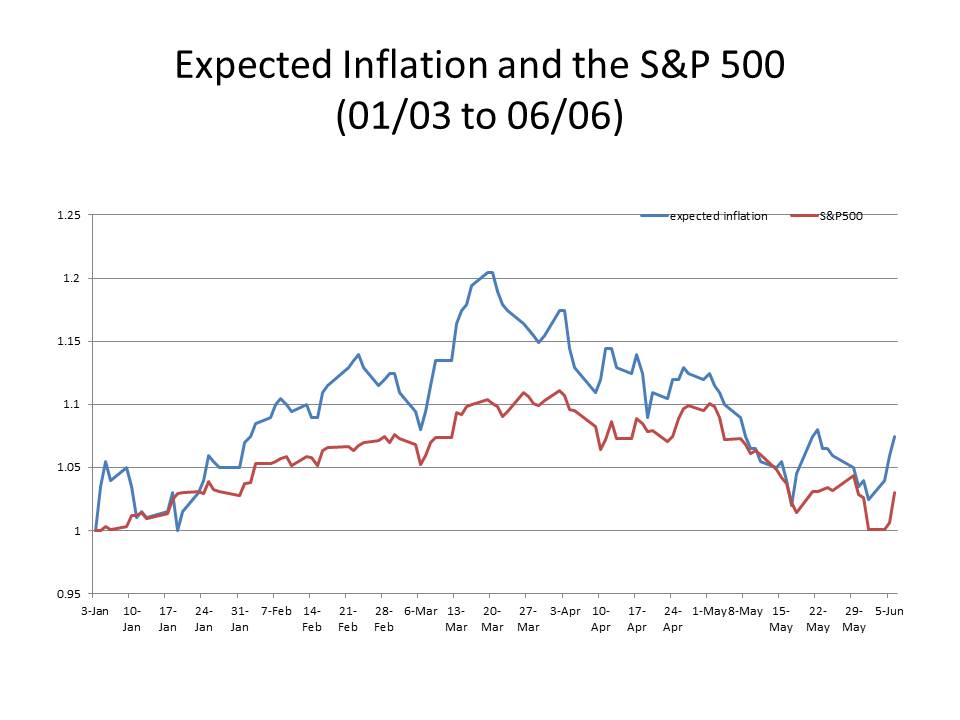
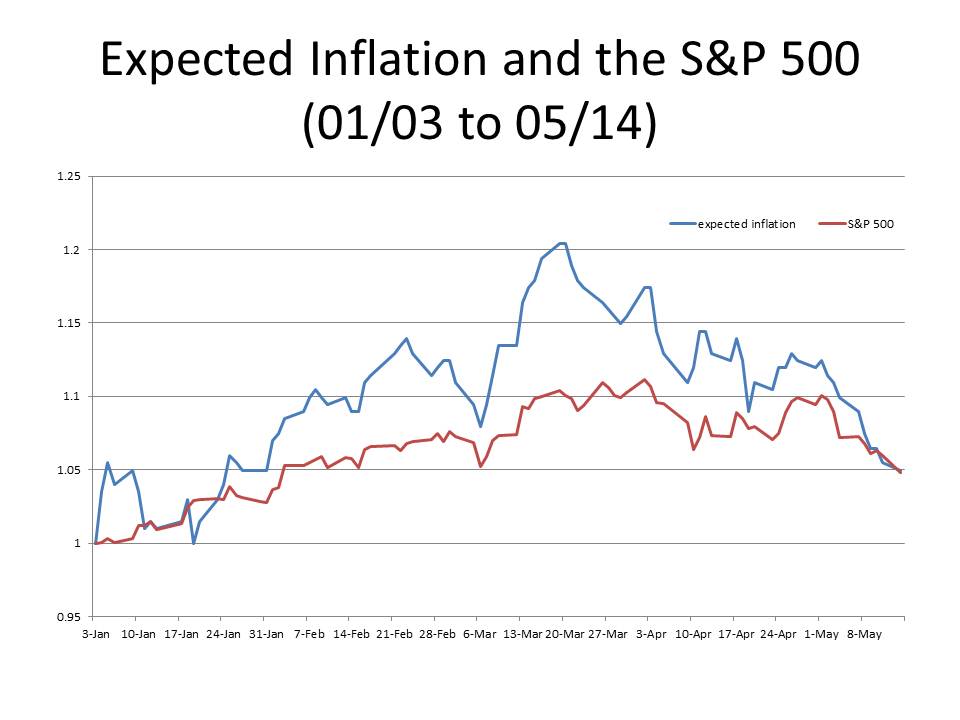
It was three and a half weeks ago (May 14) that I wrote a post “Inflation Expectations Are Falling; Run for Cover” in which I called attention to the fact that inflation expectations, which had been rising since early in 2012, had begun to fall, and that the shift had coincided with falling stock prices. I included in that post the chart below showing the close correlation between inflation expectations (approximated by the breakeven TIPS spread on 10-year constant-maturity Treasuries and 10-year constant-maturity TIPS).

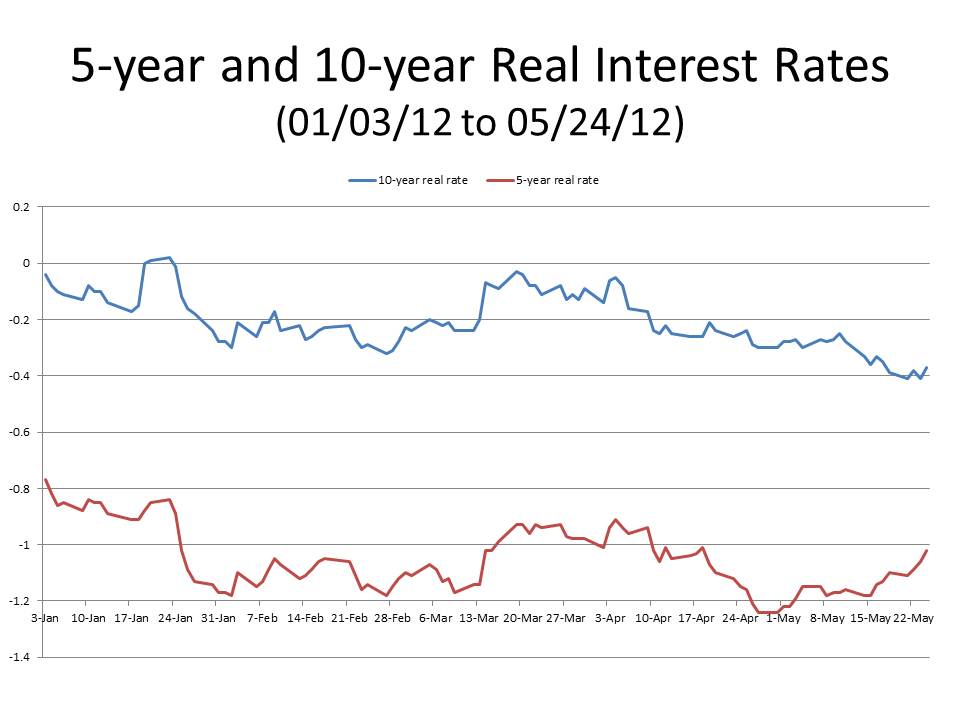
Then I noted in two posts (May 24 and May 30) that since early in May, I had detected an anomaly in the usual close correlation between short-term and long-term real interest rates, longer-term real interest rates having fallen more sharply than shorter-term real interest rates since the start of May. That was shown in the chart below.

I thought it would now be useful to look at my chart from May 14 with the additional observations from the past three weeks included. The new version of the May 14 chart is shown below.

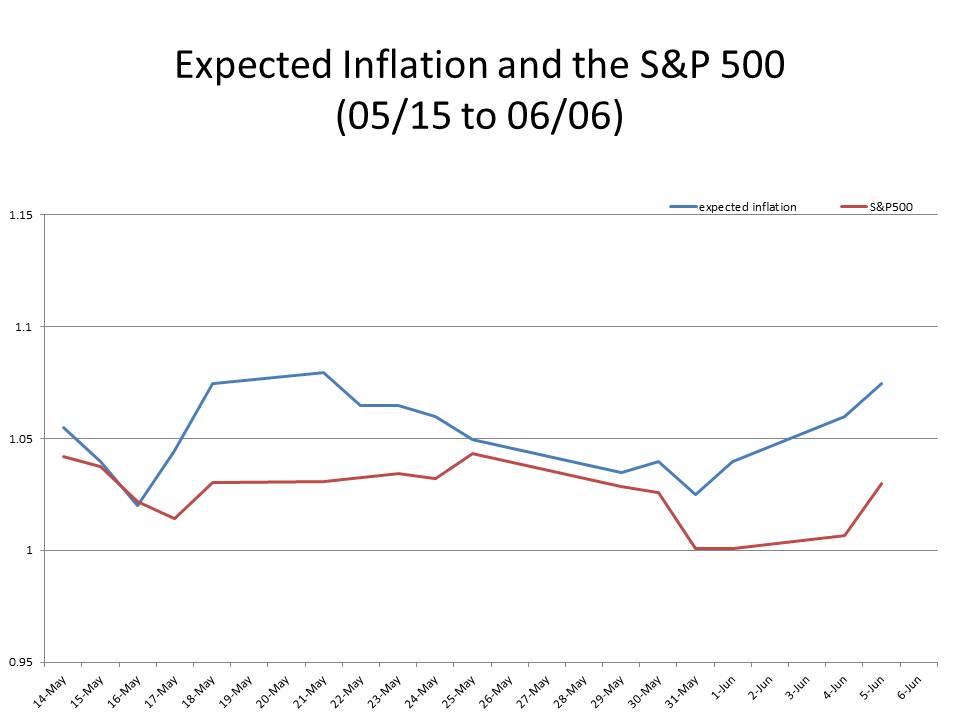
What does it teach us? There still seems to be a correlation between inflation expectations and stock prices, but it is not as close as it was until three weeks ago. I confirmed this by computing the correlation coefficient between inflation expectations and the S&P 500 from January 3 to May 14. The correlation was .9. Since May 14, the correlation is only .4. That is a relatively weak correlation, but one should note that there are other three-week periods between January 3 and May 14 in which the correlation between inflation expectations and stock prices is even lower than .4. Still, one can’t exclude the possibility that the last three weeks involve some change in circumstances that has altered the relationship between inflation expectations and stock prices. The chart below plots the movement in inflation expectations and stock prices for just the last three weeks.

One other point bears mentioning: the sharp increase in stock prices yesterday was accompanied by increases in nominal and real interest rates, for all durations. That is not an anomalous result; it has been the typical relationship since the early stages of the Little Depression.  Expected inflation implies increased nominal rates and increased borrowing costs.  Moreover, expected inflation has generally been positively correlated with real interest rates, expectations of increased inflation being correlated with expectation of increased real returns on investment.  So the conventional textbook theory that loose monetary policy increases stock prices and economic activity by reducing borrowing costs is simply not reflected in the data since the start of the Little Depression.

Do I See a Patch of Blue?

It’s June, and I’m in Washington DC; the sky is blue, and the temperature outside is in the low 70s. Oh, and stock markets around the world are soaring. This is as good as it gets.

With Europe on the brink of the abyss, and all the gloom and doom of the past month, is there really cause for optimism? I don’t know, but Scott Sumner got all excited yesterday about signs that people are finally starting to get it, especially this piece by Matthew O’Brien posted on the Atlantic website.  Optimism seems to be catching, at least on the stock market.

There does seem to be a growing understanding that the conventional way of thinking about how monetary policy works – increasing the quantity of money causes interest rates to fall, inducing increased spending by business and households – is misleading, especially when interest rates are already close to zero. Instead, the way to think about the money supply is that the monetary authority ties its creation of money to a price or spending target. But for monetary policy to work in this way, the monetary authority has to announce, or at least make clear, that its policy is subordinate to the target it is aiming at, so that the public can revise its expectations accordingly. When the public’s expectations change in the appropriate direction, the battle is more than half won; the rest is a mopping up operation.

Also worthy of mention (a huge understatement BTW) are three recent posts by the precocious Evan Soltas (on monetary policy in Switzerland here and here and on monetary policy in Israel) which beautifully illustrate points that Scott and others have been making with little effect (on policy) since 2009. The voices crying out for a different approach to monetary policy are no longer lonely, and no longer in the wilderness. (And while handing out plaudits, I’ll just mention my own post about Switzerland back in September).

And here’s what one story (“Dow Surges on Stimulus Expectations”) says about the world-wide rise in stock markets today:

U.S. stocks were soaring Wednesday morning as investors rushed in from the sidelines on hopes the Federal Reserve could soon signal it’s open to additional stimulus measures.

The Dow Jones Industrial Average was rising 178 points, or 1.5%, at 12,306. The move puts the blue-chip index back in positive territory for the year.

The S&P 500 was up 20 points, or 1.6%, at 1305. The Nasdaq was surging 50 points, or 1.8%, at 2828.

All 30 Dow components were in positive territory, with Bank of America(BAC_), JPMorgan Chase(JPM_) and Hewlett-Packard(HPQ_) leading the gains.

Within the S&P 500, 95% of components were on the rise.

Gainers were outpacing decliners by a 7-to-1 ratio on the New York Stock Exchange and 4-to-1 on the Nasdaq. The leading sectors were basic materials, capital goods and energy.

The European Central Bank said Wednesday that it was keeping its benchmark interest rate at 1%. However, the markets continued to look for clues that the central bank would show an openness to lowering rates by July in the face of growing signs of recession on the continent and Spain’s troubled banking system.

“There is a necessity for them to show their cards when conditions turn urgent,” said Geoffrey Yu, analyst at UBS.

After the meeting, ECB President Mario Draghi indicated that short-term liquidity measures would continue but withheld clues on more aggressive plans to tackle the debt crisis.

“Today, we have decided to continue conducting our main refinancing operations as fixed rate tender procedures with full allotment for as long as necessary, and at least until … January,” Draghi said at a press briefing.

Federal Reserve Chairman Ben Bernanke testifies before Congress on Thursday, and it will be his first opportunity to comment on the weak jobs report last Friday. Given that the benchmark interest rate in the U.S. is already at a record low, the market will look for clues that the central bank could embark on a third round of quantitative easing.

The FTSE in London was rising 1.9% and the DAX in Germany was gaining 1.6%.

Maybe things really are darkest just before the dawn. We may be in for a long hot summer in Washington, but today I will enjoy the good weather and blue sky while it lasts. I sure hope Bernanke doesn’t spoil it all tomorrow.

Why Not Arbitrage TIPS and Treasuries?

Larry Summers has a really interesting piece in today’s Financial Times (“Look beyond interest rates to get out of the gloom”), advocating that safe-haven governments (like the US, Germany and the UK) which are now able to borrow at close to zero rates of interest, which adjusted for expected inflation, amount to negative rates. Given such low borrowing costs, Summers argues, governments should be borrowing like crazy to finance any investment that promises even a marginally positive real return, even apart from Keynesian stimulative effects. This is not a new idea, countercyclical public works spending has often been advocated even by orthodox anti-Keynesians as nothing more than sensible budgetary policy, borrowing when the cost of borrowing is cheap and hiring factors of production in excess supply at discounted prices, to finance long-term investment projects. If there is a Keynesian effect on top of that, so much the better, but the rationale for doing so doesn’t depend on the existence of a positive multiplier effect.

But Summers’s argument takes this argument a step further, because as he presents it, the case for doing so is almost akin to engaging in an arbitrage transaction.

As my fellow Harvard economist Martin Feldstein has pointed out, this principle applies to accelerating replacement cycles for military supplies. Similarly, government decisions to issue debt and then buy space that is currently being leased will improve the government’s financial position. That is, as long as the interest rate on debt is less than the ratio of rents to building values, a condition almost certain to be met in a world of government borrowing rates of less than 2 per cent.

These examples are the place to begin because they involve what is in effect an arbitrage, whereby the government uses its credit to deliver essentially the same bundle of services at a lower cost. It would be amazing if there were not many public investment projects with certain equivalent real returns well above zero. Consider a $1 project that yielded even a permanent 4 cents a year in real terms increment to GDP by expanding the economy’s capacity or its ability to innovate. Depending on where it was undertaken, this project would yield at least 1 cent a year in government revenue. At any real interest rate below 1 per cent, the project pays for itself even before taking into account any Keynesian effects.

Now one blogger (Tea With FT) commenting on Summers’s piece found grounds to quibble about whether the rates governments pay on their debt are “free market rates,” because banking regulations allow banks to reduce their capital requirements by holding government debt but must increase their capital requirements as they increase their holdings of private debt.

Lawrence Summers is just another economist fooled by looking only at the nominal low interest rates for government debt of some “infallible” sovereigns, “Look beyond the interest rates to get out of the gloom“. Those interest rates do not reflect real free market rates, but the rates after the subsidies given to much government borrowing implicit in requiring the banks to have much less capital for that than for other type of lending.

If the capital requirements for banks when lending to a small business or an entrepreneurs was the same as when lending to the government… then we could talk about market rates. As is, to the cost of government debt, we need to add all the opportunity cost of all bank lending that does not occur because of the subsidy… and those could be immense.

I’m not going to get in that discussion here, but the point seems well-taken. But leaving that aside, I want to ask the following question: As long as the interest rate on TIPS is negative, why is the US government not selling massive amount of TIPS, using the proceeds to retire conventional Treasuries while earning a profit on each exchange of a TIPS for a Treasury?  That would be true arbitrage whatever the merits of Tea With FT’s argument.  Are there statutory limits on the amount of TIPS that can be sold?

The issue also seems to bear on the discussion that Steve Williamson and Miles Kimball have been having (here, here, and here, and also see Noah Smith’s take) about whether the Modigliani-Miller theorem applies to the Fed’s balance sheet. If there are arbitrage profits available exchanging conventional Treasuries for TIPS, what does that say about whether the Modigliani-Miller theorem holds for the Fed?

My next question is: if there are arbitrage profits to be made from such an exchange of assets, what is the mechanism by which the arbitrage profits would be eliminated? Why would exchanging Treasuries for TIPS alter real interest rates or inflation expectations in such a way as to eliminate the discrepancy in yields? Maybe there is something obvious going on that I’m not getting. What is it?  And if the reason is not obvious, I’ld like to know it, too.

UPDATE:  Thanks to Cantillonblog and Foosion for explaining the obvious to me.  In my haste, I wasn’t thinking clearly.  Given the expectation of inflation, the negative yield on TIPS will have to be supplemented by a further payment to compensate for the loss of principle due to inflation, so the cash flows associated with either a conventional Treasury or a TIPS are equal if inflation matches the implicit expectation of inflation corresponding to the TIPS spread.  But suppose the Treasury did issue more TIPS relative to conventional Treasuries, wouldn’t the additional Treasuries be sold to people who had slightly higher expectations of inflation than those who were already holding them?  Or alternatively, wouldn’t the very fact that the government was trying to sell more TIPS and fewer conventional Treasuries cause the public to revise their expectations of inflation upwards?  That’s not exactly the conventional channel by which either monetary policy or fiscal policy affects inflation expectations, but it does suggest that the policy authorities have some traction in trying to affect inflation expectations.  In addition, since interest rates fell close to zero after the financial panic of 2008, inflation expectations have responded in the expected direction to changes in the stance of monetary policy, rising after the announcment of QE1 and QE2 and falling when they were terminated.

UPDATE 2:  I am posting too fast today.  If the Treasury increased the quantity of TIPS being offered, it would drive down the price of the TIPS, increasing the real inflation adjusted yield.  An increased real yield, at a given nominal rate, would imply a reduced break even TIPS spread, or reduced inflation expectations.  Thus, increasing the proportion of TIPS relative to conventional Treasuries would induce savers with relatively lower inflation expectations than those previously holding them to begin holding them as well.  Alternatively, increasing the proportion of TIPS outstanding would encourage individuals to revise their expectations of inflation downward because the Treasury would be increasing its exposure to inflation.  But the point about the applicability of the MM theorem still applies with the appropriate adjustments.  At least until further notice.

OMG! John Taylor REALLY Misunderstands Hayek

Since Friday’s post about John Taylor’s misunderstanding of Hayek, I watched the 57-minute video of John Taylor’s Hayek Prize Lecture. I will not offer an extended critique of the lecture, which was little more than a collection of talking points based on little empirical evidence and no serious analysis or argument. If that description sounds like a critique, so be it, but the lecture was more in the way of a ritual invocation of shared beliefs and values than an attempt to make a substantive case for a definite policy or set of policies. Whether those present at the lecture were appropriately reinforced in their shared beliefs by Taylor’s low-key remarks and placid delivery, I have no idea, but he obviously was not trying to break any new intellectual ground.

Though I found Taylor’s remarks generally boring, I did perk up about 33-34 minutes through the lecture when Taylor observed that Hayek had himself, on occasion, deviated from his own principles. How does Taylor know this? He knows this (or thinks he does, at any rate), because, as a fellow of the Hoover Institution at Stanford University, he has access to Hayek’s correspondence, which contains Keynes’s famous letter to Hayek praising The Road to Serfdom, a letter Taylor quotes from just before he gets to his point about Hayek’s “deviation,” and access to a letter that Milton Friedman wrote to Hayek complaining about Hayek’s criticism of his 3-percent rule for growth in the stock of money. Hayek made the criticism in a 1975 lecture entitled, “Inflation, the Misdirection of Labour, and Unemployment,” which was published in a 52-page pamphlet called Full Employment at any Price? (of which I own a copy) along with Hayek’s Nobel Lecture and some additional Hayek had written about inflation and unemployment.

Here is what Hayek said about Friedman’s rule:

I wish I could share the confidence of my friend Milton Friedman who thinks that one could deprive the monetary authorities, in order to prevent the abuse of their powers for political purposes, of all discretionary powers by prescribing the amount of money they may and should add to circulation in any one year. It seems to me that he regards this as practicable because he has become used for statistical purposes to draw a sharp distinction between what is to be regarded as money and what is not. This distinction does not exist in the real world. I believe that, to ensure the convertibility of all kinds of near-money into real money, which is necessary if we are to avoid severe liquidity crises or panics, the monetary authorities must be given some discretion. But I agree with Friedman that we will have to try and get back to a more or less automatic system for regulating the quantity of money in ordinary times. The necessity of “suspending” Sir Robert Peel’s Bank Act of 1844 three times within 25 years after it was passed ought to have taught us this once and for all.

A polite, but stern, rebuke to Friedman. Friedman, not well disposed to being rebuked, even by his elders and betters, wrote back an outraged response to Hayek accusing him of condoning the discretionary behavior of central bankers, as if unaware that Hayek had already explained 15 years earlier in chapter 21 of The Constitution of Liberty why central bank discretion was not a violation of the rule of law.

Somehow or other, Professor Taylor must have come across Friedman’s letter to Hayek, and thought that it would be edifying to mention it in his Hayek Prize lecture. Bad idea!

The following is my rough transcription of Taylor’s remarks, starting at about 33:50 of the Manhattan Institute video, just after Taylor quoted from Keynes’s letter to Hayek about The Road to Serfdom and Friedman’s comment about the letter that Keynes had obviously not read the chapter of The Road to Serfdom entitled “Why the Worst Get on Top.”

Now there’s always pressure for even the best-intentioned people to move away from the principles of economic freedom. And just to show you how this can happen, Hayek, himself, deviated, at least in his writings. There’s a book he wrote called Full Employment at Any Price [no intonation indicating the question market in the title], written in the middle of the 1970s mess of high inflation, rising unemployment. So people, you know, just really said, we gotta get – he wanted, of course, to get back to the rule of law and rules-based policy, but what about – well, we gotta do something else in the meantime. Well, once again, Milton Friedman, his compatriot in his cause — and it’s good to have compatriots by the way, very good to have friends in his cause. He wrote in another letter to Hayek – Hoover Archives – “I hate to see you come out, as you do here, for what I believe to be one of the most fundamental violations of the rule of law that we have, namely, discretionary activities of central bankers.”

So, hopefully, that was enough to get everybody back on track. Actually, this episode – I certainly, obviously, don’t mean to suggest, as some people might, that Hayek changed his message, which, of course, he was consistent on everywhere else.

Well, this is embarrassing. Obviously not well-versed in Hayek’s writings, Taylor mistakes the Institute of Economic Affairs, Occasional Paper 45, Full Employment at any Price? for a book, while also overlooking the question mark in the title. That would be bad enough, but Taylor apparently infers that the title (without the question mark) represented Hayek’s position in the pamphlet, i.e., that Hayek was arguing that the chief goal of policy in the 1970s ought to be full employment, in other words, exactly the opposite of the position for which Hayek was arguing in the pamphlet that Taylor was misidentifying and in everything else Hayek ever wrote about inflation and unemployment policy.  Hayek was trying to explain that the single-minded pursuit of full employment by monetary policy-makers, regardless of the consequences, would be self-defeating and self-destructive. But, ignorant of Hayek’s writings, Taylor could not figure out from reading Friedman’s letter that all Friedman was responding to was Hayek’s devastating criticism of Friedman’s 3-percent rule, a rule that Taylor, for some inexplicable reason, still seems to find attractive, even though just about everyone else realized long ago that it was at best unworkable, and, in the unfortunate event that it could be made to work, would be disastrous. As a result, Taylor thoughtlessly decided to show that even the great Hayek wasn’t totally consistent and needed the guidance of (the presumably even greater) Milton Friedman to keep him on the straight and narrow. And this from the winner of the Hayek Prize in his Hayek Prize Lecture, no less.

Just by way of sequel, here is how well Hayek learned from Friedman to stay on the straight and narrow. In Denationalization of Money, published in 1976 and a revised edition in 1978, Hayek again commented (p. 81) on the Friedman 3-percent rule.

As regards Professor Friedman’s proposal of a legal limit on the rate at which a monopolistic issuer of money was to be allowed to increase the quantity in circulation, I can only say that I would not like to see what would happen if it ever became known that the amount of cash in circulation was approaching the upper limit and that therefore a need for increased liquidity could not be met.

And then in a footnote, Hayek added the following:

To such a situation the classic account of Walter Bagehot . . . would apply: “In a sensitive state of the English money market the near approach to the legal limit of reserve would be a sure incentive to panic; if one-third were fixed by law, the moment the banks were close to one-third, alarm would begin and would run like magic.

So much for Friedman getting Hayek back on track.  The idea!
John Taylor Misunderstands Hayek

In an op-ed piece in today’s Wall Street Journal, John Taylor, seeking to provide some philosophical heft for his shallow arguments for “rules-based fiscal, monetary, and regulatory policies” and his implausible claim that “unpredictable economic policy . . . is the main cause of persistent high unemployment and our feeble recovery from the recession,” invokes the considerable authority of F. A. Hayek. Taylor’s op-ed, based on his Hayek Prize Lecture to the Manhattan Institute on the occasion of receiving the Institute’s Hayek Prize for his new book First Principles: Five Keys to Restoring America’s Prosperity, shows little sign of careful reading of or serious thought about what Hayek had to say on the subject of rules.

Perhaps I shouldn’t take it too personally, but I can’t help but observe that just about six months ago, I wrote a post entitled “John Taylor’s Obsession with Rules” in which I quoted liberally from Hayek’s writings on monetary policy, especially from Hayek’s Constitution of Liberty. My earlier post was prompted by a critique of NGDP targeting that Taylor posted on his blog in which he compared NGDP targeting unfavorably with Milton Friedman’s 3-per cent rule for growth in the money supply. Taylor criticized NGDP targeting, because, unlike the Friedman rule, it allowed the Fed to exercise discretion in achieving its target, evidently not grasping the obvious fact that the Fed has no more control over M2 than it does over NGDP.

I cited Hayek’s views about monetary policy to make two basic points: 1) inasmuch as monetary authorities exercise no coercive power over individuals, the liberal principle that government action be undertaken only in strict conformity with known rules of general applicability does not apply to central banks, and 2) the nature of monetary policy unavoidably requires a central bank to employ some discretion in discharging its duties. Thus, the strict Friedmanian 3-percent rule, considered by Taylor to be the epitome of rules-based monetary policy, had no basis either in Hayek’s understanding of liberalism or in his understanding of the requirements of monetary policy. Indeed, Hayek on a number of occasions explicitly repudiated the 3-percent rule. After quoting several passages from Hayek explaining these points, I concluded with the following advice: “Professor Taylor, forget Friedman, and study Hayek.”

Well, I’m not sure what to make of Taylor’s invocation of Hayek in his op-ed. I guess if you are awarded the Hayek Prize, it’s only fitting to say something nice about the old sage, and at least feign some interest in what he had to say. But if Taylor did made a substantial investment in studying what Hayek wrote about following rules in the conduct of monetary policy, I see no evidence of it in his op-ed.

Let’s compare what Taylor with what Hayek said. Here’s Taylor:

Hayek argued that the case for rules-based policy goes beyond economics and should appeal to all those concerned about assaults on freedom. He wrote in his classic 1944 book, “The Road to Serfdom,” that “nothing distinguishes more clearly conditions in a free country from those in a country under arbitrary government than the observance in the former of the great principles known as the Rule of Law.”

Hayek added, “Stripped of all technicalities, this means that government in all its actions is bound by rules fixed and announced beforehand—rules which make it possible to foresee with fair certainty how the authority will use its coercive powers in given circumstances and to plan one’s individual affairs on the basis of this knowledge.”

Now Hayek (from Chapter 21 of The Constitution of Liberty):

[T]he case against discretion in monetary policy is not quite the same as that against discretion in the use of the coercive powers of government. Even if the control of money is in the hands of a monopoly, its exercise does not necessarily involve coercion of private individuals. The argument against discretion in monetary policy rests on the view that monetary policy and its effects should be as predictable as possible. The validity of the argument depends, therefore, on whether we can devise an automatic mechanism which will make the effective supply of money change in a more predictable and less disturbing manner than will any discretionary measures likely to be adopted. The answer is not certain. (p. 334)

Taylor also mentions the point that a rules-based monetary policy enhances the predictability of monetary policy, which presumably results in increased predictability of the economic environment in which economic agents make their decisions.

Rules for monetary policy do not mean that the central bank does not change the instruments of policy (interest rates or the money supply) in response to events, or provide loans in the case of a bank run. Rather they mean that they take such actions in a predictable manner.

But in Chapter 21 of the CoL, Hayek went on to explain why a central bank could not effectively conduct policy by mechanically applying rules in a fully predictable fashion. (This conclusion might have to be revised if the monetary regime had a mechanism for targeting the expectations, but that possibility raises too many complicated issues to pursue here.) Back to Hayek:

There is one basic dilemma, which all central banks face, which makes it inevitable that their policy must involve much discretion. A central bank can exercise only an indirect and therefore limited control over all the circulating media. Its power is based chiefly on the threat of not supplying cash when it is needed. Yet at the same time it is considered to be its duty never to refuse to supply this case at a price when needed. It is this problem, rather than the general effects of policy on prices or the value of money, that necessarily preoccupies the central banker in his day-to-day actions. It is a task which makes it necessary for the central bank constantly to forestall or counteract development in the realm of credit, for which no simple rules can provide sufficient guidance.

The same is nearly as true of the measures intended to affect prices and employment. They must be directed more at forestalling changes before they occur than at correcting them after they have occurred. If a central bank always waited until rule or mechanism forced it to take action, the resulting fluctuations would be much greater than they need be. . . .

[U]nder present conditions we have little choice but to limit monetary policy by prescribing its goals rather than its specific actions. The concrete issue today is whether it ought to keep stable some level of employment or some level of prices. Reasonably interpreted and with due allowance made for the inevitability of minor fluctuations around a given level, these two aims are not necessarily in conflict, provided that the requirements for monetary stability are given first place and the rest of economic policy is adapted to them. A conflict arises, however, if “full employment” is made the chief objective and this is interpreted, as it sometimes is, as that maximum of employment which can be produced by monetary means in the short run. That way lies progressive inflation. (pp. 336-37)

So my advice of six months ago, “Professor Taylor, forget Friedman, and study Hayek” is still good advice.  I hope, but am not confident, that Professor Taylor will follow it.

More on the Recent Anomaly in the Real Term Structure of Interest Rates

In a post last week, I pointed out that there was a highly unusual inverse correlation between the 5- and 10-year real interest rates as approximately reflected in constant maturity 5- and 10-year TIPS. (On the meaning of the term “constant maturity” see the very valuable and informative post in J.P. Koning’s excellent blog summarizing discussions in the many blogs that he follows and comments on) about the various blogs Since early May the correlation coefficient between the yields on constant maturity 5- and 10-year TIPS was about -.72 (as of today it’s -.77), while the correlation coefficient between the two yields since the start of 2012 was .86.  It occurred to me after writing the post (I added an update to make the point) that one reason for the inverse correlation might be an increased in the expected likelihood of a financial crisis, in which case real short-term interest rates would rise during the crisis as people expecting to be short of cash bid up real rates trying to get their hands on cash ahead of the crisis, while also selling off assets (either fixed capital or inventories).

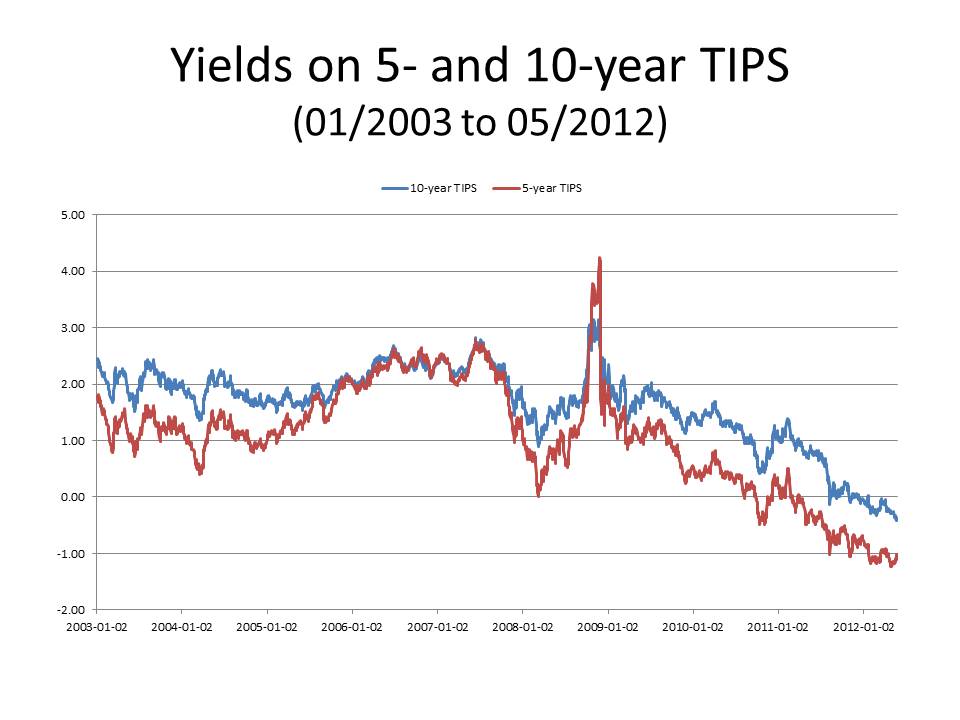
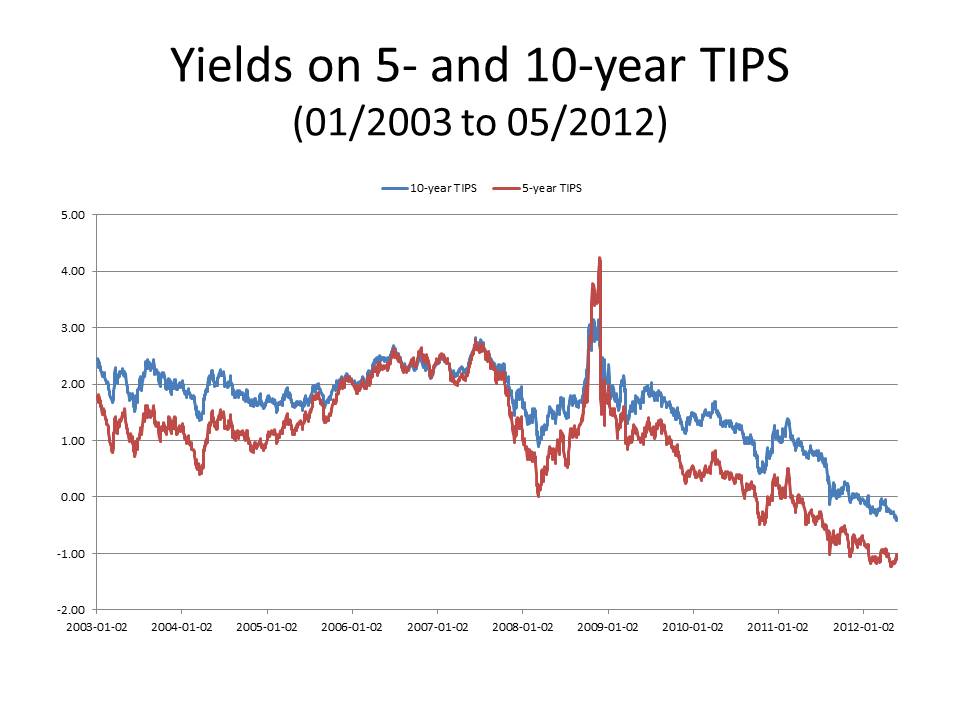
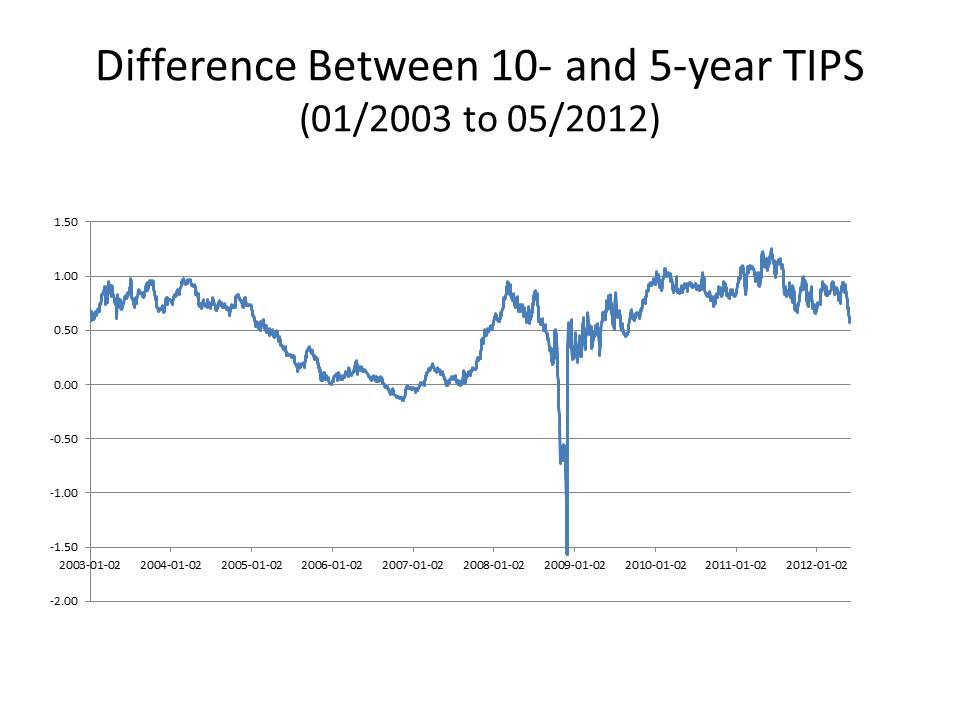
This week, I was able to do a little further work, looking at data since 2003, on the correlation between interest rates at the 5- and 10-year time horizons. Since 2003, the correlation between real 5- and 10-year interest rates is about .96. I computed monthly correlations, which are usually over .8 and regularly over .9. Only very rarely was there a (barely) negative monthly correlation, certainly nothing close to the -.77 correlation during the first 30 days of this month. However, as I computed the correlations, I found that a more meaningful measure of the relationship between the 5- and 10-year yields on TIPS is the absolute difference between them. The graph below plots the yields on 5- and 10-year constant maturity TIPS since 2003. The most striking period is clearly in October and November of 2008, when the yield on 5-year TIPS soared above the yield on 10-year TIPS, because of the desperate scramble for liquidity at the height of the financial crisis. A few other periods of financial stress, associated I think with the first signs of the bursting of the housing bubble, were also associated with yields on the 5-year TIPS slightly exceeding the yield on the 10-year TIPS.

A second graph displaying the difference between the yields on the 10-year and the 5-year TIPS is also useful, clearly showing the effect of the spike in short-term real interest rates at the height of the financial crisis.

In this context what is striking about the recent anomaly in the real term structure of interest rates is the steepness with which the difference between the yields on the 10- and the 5-year TIPS has been falling. The drop seems steeper than any but the one that started around October 6, 2008, three weeks after the failure of Lehman Brothers, but the day on which the Fed announced that it would begin paying interest on reserves. By the end of October, the difference between the yields on the 10-year and 5-year TIPS had fallen by over a percentage point. Since May 3, the difference between the yields on the 10-year and 5-year TIPS have fallen 37 basis points, so we are clearly not in a panic. But the signs are disturbing.

“This Behavior Is Totally Unacceptable in Germany”

Reading a review, not long ago, by John Lanchester of Michael Lewis’s book Boomerang: Travels in the New Third World in the New York Review of Books, I was struck by the following quotation of an unnamed German official explaining why there was no credit boom in Germany.

“There was no credit boom in Germany,” an official told Lewis. “Real estate prices were completely flat. There was no borrowing for consumption. Because this behavior is totally unacceptable in Germany.”

For a generation or two after World War II, the rest of the world was thankfully spared such expressions of insufferable German self-satisfaction. But as memories of the second World War gradually fade, and the victims of German megalomania are rapidly disappearing, it is apparently again acceptable in Germany to make statements as unbearably self-congratulatory as the horrendous quotation recorded above.  And lest I be misunderstood, I am in no way suggesting that it is only Germans that are capable of the barbarities committed in World War II by the Nazi regime. “It can’t happen here” is a conceit too often refuted by bitter experience for anyone to feel very confident about his country’s (or his own) conduct in extreme situations.

There would be no point in highlighting an absurd statement by a tone-deaf German official if the statement did not reflect the views of many Germans, and none more so than the German Chancellor, Mrs. Merkel, though she is surely far too adroit a politician ever to express such a view within earshot of a journalist. But clearly the smug conviction in the utter rectitude of Germany’s anti-inflation posture and of the German insistence that the burden of discharging the sovereign debts incurred by the debtor countries fall entirely on the individual countries, and not on the Eurozone as a whole (i.e., not on Germany), stems from the moral certainty that the debtor countries are asking to be forgiven for “behavior that is totally unacceptable in Germany.” What self-respecting German could possibly agree to absolve those countries from the consequences of actions that no German would ever dream of undertaking?

That is the hubristic mindset that impels Mrs. Merkel and her countrymen to lead the European Union into the abyss. The whole point of the European Union was somehow to embed and contain Germany within the democratic framework of a larger union in which Germany might play an important, but never a dominant, role. For almost 60 years, the Federal Republic of Germany was in almost every way an admirable modern European state, playing a cooperative and constructive role in both European and world affairs. But especially after reunification, Germany has gradually assumed an increasingly preeminent role in Europe, and now the fate of Europe, and perhaps of the world, again lies in the hands of a German Chancellor, a leader perfectly attuned to the sentiments and intuitions of her people, and utterly oblivious to the consequences of what she is about to do. What we are witnessing is not a Greek tragedy, but a German one. But, I greatly fear that we shall all suffer the consequences of her misplaced confidence in the uprightness of her position and in her flawed understanding of Germany’s national self-interest.

A Recent Anomaly in the Real Term Structure of Interest Rates

Regular readers of this blog know that I track the break-even TIPS spread to follow changes in inflation expectations. Doing so also provides an implicit (and imperfect) estimate of changes in the real interest rate.  (For an explanation of why the break-even TIPS spread is an imperfect estimate of inflation expectations and the real interest rate, see the Cleveland Federal Reserve Bank website.)  Since early in May, the data show a fairly striking anomaly in real interest rates: real interest rates over a 5-year time horizon have been rising (though still negative) while real interest rates over a 10-year horizon have been falling.

Why is this anomalous? Because real interest rates at the 5-year and 10-year time horizons are generally closely correlated. The chart below shows fluctuations in real interest rates at constant 5- and 10-year maturities since the beginning of 2012. The two lines track each other closely until the beginning of May when the 5-year real interest rate begins to rise while the 10-year real interest rate continues to fall. The coefficient between the 5-year and 10-year real interest rates from January 3 to May 24 is slightly over .8.  From January 3 to May 3, the correlation coefficient is almost .86; the correlation coefficient since May 3 is -.72.

I have no explanation for this anomaly. Anybody out there like to take a crack at it?

UPDATE:  It just occurred to me that the increase in short term real rates is reflecting a liquidity premium associated with an increasing perceived likelihood of a financial crisis associated with a breakdown of the euro.  Not a very happy thought as I prepare to call it a night.

Hayek on How Attempts to “Correct” the Market Lead to its Destruction

In my post yesterday, I partially exonerated Henry Farrell for defending Tony Judt’s over-the-top statement that F. A. Hayek was explicit that:

if you begin with welfare policies of any sort — directing individuals, taxing for social ends, engineering the outcomes of market relationships — you will end up with Hitler.

This seems over the top, because we know that Hayek, unlike many more extreme libertarians — Hayek was not really a libertarian – of either Austrian or Continue reading ‘Hayek on How Attempts to “Correct” the Market Lead to its Destruction’

Was Hayek a (Welfare) Statist?

There’s been a little flurry in the blogosphere of late about what F. A. Hayek thought about the welfare state, apparently touched off by a remark made by the late Tony Judt in a newly published book, the result of a collaboration between the late Tony Judt and Timothy Snyder Thinking the Twentieth Century. Judt makes the following charge.

Hayek is quite explicit on this count: if you begin with welfare policies of any sort — directing individuals, taxing for social ends, engineering the outcomes of market relationships — you will end up with Hitler.

Tyler Cowen, in a generally favorable and admiring take on the book and Judt’s writings, observed that Judt was being unfair to Hayek.

Then, Henry Farrell weighed in on Judt’s side and cited the discussion between Andrew Farrant and Edward McPhail who contend that Hayek wrongly held that any form of welfare statism would lead to totalitarianism while Caldwell denied that this was Hayek’s argument in The Road to Serfdom, maintaining that Hayek’s subsequent criticism of the welfare state was more subtle and less categorical than the argument of The Road to Serfdom against full scale planning. Farrell criticizes Cowen and Caldwell for defending Hayek, even while acknowledging a bit of sloppiness on Judt’s part in not making clear that Hayek did distinguish between the provision of some forms of social insurance from welfare-state policies. To support his case against Hayek, Farrell quotes from Hayek’s introduction to the 1956 American edition of The Road to Serfdom in which Hayek cited the experience of England under the post-war Labour government in warning that the statist policies of the Labour government would cause an adverse change in public attitudes that would eventually erode even the English pubic’s attachment to liberal principles.

However, even if Hayek qualifies his claims in the first paragraph quoted, he’s changed his tune towards the end. He very explicitly claims that the paternalist welfare state is creating the conditions under which (unless the policy is changed or reversed) totalitarianism will blossom, reducing the populace (as described in the bit of Tocqueville that Hayek quotes) into a “flock of timid and industrial animals, of which government is the shepherd,” which will surely sooner or later come under the control of “any group of ruffians.” More tersely: Welfare Statism=Inevitable Long Term Moral Decline=Hilter! ! ! !

Hayek surely had his moments of brilliant insight, but this wasn’t one of them – for all his protestations of anti-conservatism it’s a fundamentally conservative, and rather idiotic claim. I don’t think that Judt was being unfair at all.

Responding to Judt’s attack on Hayek as reinforced by Farrell, Kevin Vallier tried to shift the conversation toward an understanding of what Hayek actually thought about the welfare state, offering a conceptual distinction — of whose relevance I am somewhat skeptical — between a welfare state of law and a welfare state of administration, the former referring to a welfare state in which benefits are administered in a uniform fashion according to legally prescribed rules and a welfare state in which the benefits are distributed by officials at their own discretion.

In reply, Farrell dismisses the point that Hayek was not opposed to the provision of a safety net and various forms of social insurance. Farrell regards this as an irrelevant detail.

This is, in fact, agreed to by all parties – hence my suggestion in the original post that “Hayek clearly believes that there are non-statist, non-paternalist ways of achieving some (if not all) of the same ends.” But the reason why Hayek sees this as allowable, as Vallier acknowledges in his own defense of Hayek, is that it is not statist – it involves coercion, but does not have the statist logic that Hayek views as pernicious.

Now if you find this a bit confusing, I can’t blame you, because it is. But the confusion is not all Farrell’s. It is also Hayek’s. He did try to get more mileage out of his argument in The Road to Serfdom than it could sustain, and to do so he had to resort to sociological intuition, hand-waving and rhetoric, in contrast to the comparatively rigorous argument of The Road to Serfdom. Nevertheless, the avowedly socialist postwar Labour government nationalized many industries, and tried to implement central planning, so Hayek’s concerns about the consequences of the Labour government must be considered in a wider context than just expansion of the welfare state.

What was unfair about Tony Judt’s comment was a failure to distinguish between the different levels of the argument that Hayek was making. The arguments may have been related, but they were not the same. The argument of The Road to Serfdom was an argument about the logical implications of central planning. The argument about the welfare state was an argument about a slippery slope. Those are very different arguments, and not to acknowledge the difference is unfair, even (or, perhaps, especially) if Hayek’s argument about the welfare state was less than compelling.

HT:  David Levey


About Me

David Glasner
Washington, DC

I am an economist in the Washington DC area. My research and writing has been mostly on monetary economics and policy and the history of economics. In my book Free Banking and Monetary Reform, I argued for a non-Monetarist non-Keynesian approach to monetary policy, based on a theory of a competitive supply of money. Over the years, I have become increasingly impressed by the similarities between my approach and that of R. G. Hawtrey and hope to bring Hawtrey’s unduly neglected contributions to the attention of a wider audience.

My new book Studies in the History of Monetary Theory: Controversies and Clarifications has been published by Palgrave Macmillan

Follow me on Twitter @david_glasner

Archives

Enter your email address to follow this blog and receive notifications of new posts by email.

Join 665 other subscribers
Follow Uneasy Money on WordPress.com