Since Stephen Williamson posted his criticism of NGDP-targeting last week, a series of responses (here and here) and counter-responses have taken the discussion beyond the mere discussion of a criterion or rule for monetary policy, transforming it into a deep discussion of nothing less than alternative world-views. The catalyst for this shift in the nature of the discussion was Williamson’s use in his first post of the Hodrick-Prescott filter to detrend quarterly GDP data since 1947. Scott Sumner noted in his initial reply to Williamson that the Hodrick-Prescott filter necessarily interprets a downturn occurring at the end of the time series as a shift in, rather than a deviation from, the trend, thereby imposing a particular view of the nature of the recent downturn that might or might not be correct. In my comment on the initial Williamson-Sumner exchange, I noted Scott’s point, and added that an eminent time-series econometrician, Andrew Harvey, had warned about the possibility of spurious results from application of the HP filter, though he did not reject its use as necessarily inappropriate. Brad Delong and Tim Duy picked up on my warnings about the potential for HP filtering to result in spurious results with what seemed like blanket condemnations of the HP filter. This is when Paul Krugman joined the fray, warning that the HP filter could be used to show that the Great Depression reflected not a huge departure from the economy’s potential output and employment levels, but a shift in those levels.
[T]he methodology of using the HP filter basically assumes that such things don’t happen. Instead, any protracted slump gets interpreted as a decline in potential output! Here’s the chart I made way back in 1998 for the 1930s:
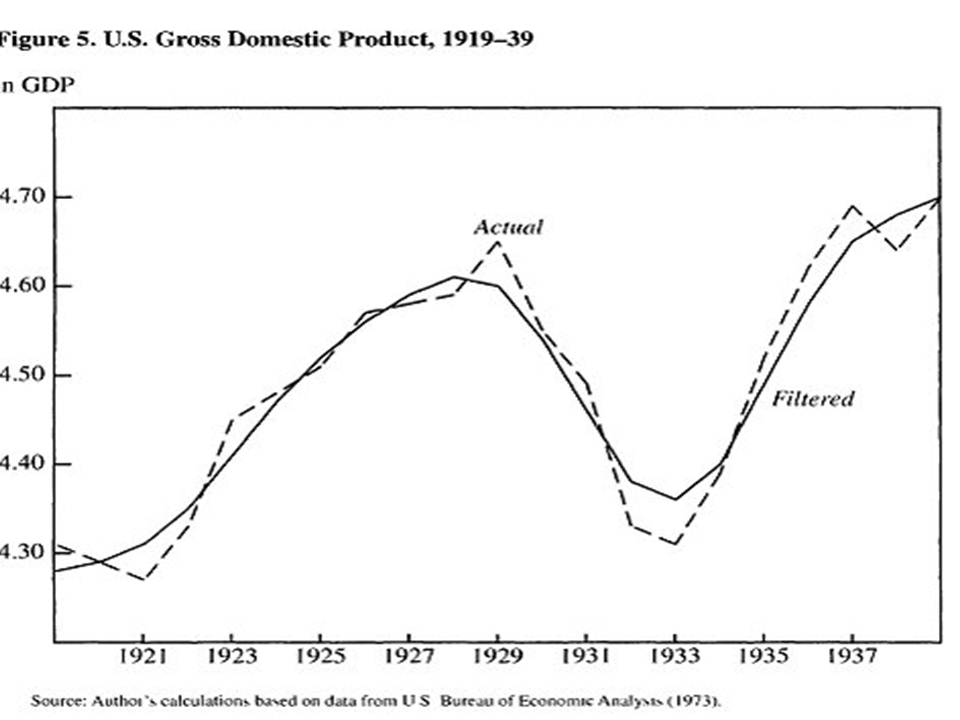
Yep: the HP filter “decided” that the US economy was back at potential by 1935. Why? Because it automatically interpreted the Great Depression as a sustained decline in potential, because by assumption the filter incorporated such slumps into its estimate of the economy’s potential. Strange to say, however, it turned out that there was in fact a huge amount of excess capacity in America, needing only an increase in demand to be put back into operation.
It seems totally obvious to me that people who are now using HP filters to argue that we’re already at full employment are making exactly the same mistake. They have in effect, without realizing it, assumed their answer — using a statistical technique that only works if prolonged slumps below potential GDP can’t happen.
As always, statistical techniques are only as good as the economic assumptions behind them. And in this case the assumptions are just wrong.
This attack by Krugman predictably elicited a response from Williamson. The response might have simply noted that applying the HP filter requires the investigator to make assumptions about the frequency of changes in the underlying trend, and that such assumptions ought in some sense to be reasonable. The particular assumption underlying Krugman’s figure was not necessarily reasonable — it didn’t smooth enough — and probably would not be accepted as such by those who like to use the HP filter. Williamson made this point, but he went beyond it, discussing how the HP filter is used within the larger theoretical paradigm known as modern real-business-cycle theory.
I won’t attempt to summarize Williamson’s discussion, but this is the point that I would like to focus on. Real-business cycle theory posits that observed fluctuations in economic time series, like real GDP and employment, can be understood as responses by economic agents to underlying changes in real underlying economic conditions, e.g., changes in labor productivity. Persistent changes in GDP must therefore reflect changes in the underlying real economic conditions, i.e., changes in the trend, while short-term fluctuations around the trend correspond to what we refer to as business cycles. The HP filter smoothes, but does not eliminate, fluctuations in the trend corresponding to persistent changes in the time series. When the time-series show persistent movements, as growth in GDP has shown since the middle of the last decade, even before 2008, real-business-cycle theory assumes that underlying real economic conditions are responsible for a downward change in the underlying trend. There may be transitory changes in the observed time series about the trend, but the trend itself is assumed to have changed. If the trend itself has changed, there is not necessarily any room for policy to make things any better than they are.
It is that view of the world that informs the following statement by Jeffrey Lacker, President of the Richmond Fed, quoted by Williamson:
Given what’s happened to this economy, I think we’re pretty close to maximum employment right now.
Williamson adds:
The “dual mandate” the Fed operates under includes language to the effect that the Fed should try to achieve maximum employment. Lacker says we’re there, and I’m inclined to agree with him.
Noah Smith wrote a splendid post today about Williamson’s post in which he gave the following description of Ned Prescott’s strategy for modeling real business cycles:
- Chose how big of a “business cycle” he wanted to model. [By an appropriate parameter choice in the HP filter]
- Built a model of business cycles that produced fluctuations of about the size he chose in step A, and
- Claimed to have explained the business cycle.
The reason that this is not an entirely circular exercise is that although “the amount of smoothing in the HP filter is a free parameter . . . , if you choose it too big or too small, people will be skeptical. After all, we have other measures of recessions, like the NBER recessions.”
The situation described by Williamson and Smith (who, I should note, is not really a fan of real-business-cycle theory) reminds me of the situation at the time of Galileo, when Galileo was trying to explain to people why they should disregard their common-sense notion that the earth is stationary and flat, and that the sun revolves around the earth. In his famous book, The Structure of Scientific Revolutions, Thomas Kuhn called the clash between Galileo and scientific establishment of his time a clash of paradigms and of world views. Kuhn made the controversial claim that, based on the available evidence at the time, the received Ptolomeic paradigm was empirically better supported the than revolutionary Copernican-Galilean paradigm. Nevertheless, the Copernican-Galilean world view fairly quickly won out, producing a paradigm shift even before Newton provided more powerful evidence than Galileo for the heliocentric paradigm. Each paradigm could still interpret evidence apparently in conflict with its predictions by reinterpreting the evidence. Evidence was interpreted not in some purely objective, neutral way – there is no Olympian perspective from which facts can be objectively determined — but from the perspective of the paradigm that either side was trying to uphold.
Similarly today we are watching a clash between two competing paradigms of business cycles. The received paradigm of business cycles holds that persistent deviations of observed real GDP growth and employment from long-run stable trends are problematic and call for policy responses to eliminate or reduce those deviations. Real-business-cycle theorists reject that understanding of business cycles. If there are persistent deviations of observed real GDP and employment from their long-run trends, it is the trends that must have changed. This difference in world views has, on occasion, been described, misleadingly in my view, as a conflict between Keynesian economics and common sense, and in a post that I wrote almost a year ago, I cited Galileo to show that our common-sense notions are not always infallible.
There is a strong temptation to dismiss real-business-cycle theory simply on the grounds that it seems to fly in the face of our common-sense view that in recessions and depressions, people who would like to work can’t find employment. I think that real-business cycle theory should be dismissed, but to do so will require better reasons than a conflict with our common sense. Remember it was the flat-earthers who were upholding common sense against Galileo. We need more sophisticated arguments than appeals to common sense to dispose of annoying modern real-business-cycle theory.