I have mentioned a couple of times in previous posts that I was working on a comparison of the anemic recovery from our Little Depression to recoveries from previous post-World War II recessions. The comparison actually involved getting my hands dirty with some data, doing some actual, but low-level, empirical work. My results seem interesting enough to share, even if they are not exactly the sort of thing that one would publish in an econ journal. The exposition may be slightly more technical than is customary for blogs, but I hope that some readers may be willing to at least skim through to the end to get a sense of what I have done. So here it goes.
About two weeks ago while I was in the final stages of talking myself into starting this blog, I saw a short piece (in the weekend (June 24) edition of the Wall Street Journal) by editorial writer Stephen Moore, touting a report (“Uncharted Depths”) of the Republican staff of the Congressional Joint Economic Committee, purporting to show that, on every metric, this recovery is by far the weakest recovery since World War II.
Disdaining any pretense of objectivity, Mr. Moore, in his second paragraph, highlighted the finding of the JEC report that employment is still 5 percent below what it was at the start of the downturn 38 months ago. “This,” Moore continued, “compares to an average rise in employment of 3.7% over the same period in prior post-WWII recessions.” But the latest downturn was both deeper and longer-lasting than any post-WWII recession. So for Mr. Moore et al. to compare, on the one hand, employment 38 months ago at the start of the downturn with employment now, and on the other hand, employment at the start of previous recessions with employment 38 months later, is to bias the comparison of the recoveries from the get-go. Obviously, if one downturn is deeper and longer-lasting than another, the ratio of employment (or any other cyclical variable) in the bigger downturn a given length of time after it began relative to employment when the downturn started will be less than the same ratio in the smaller downturn even if, once underway, the recoveries are equally strong. But, obviously, the point of the exercise for Mr. Moore and the authors of the JEC report was not to perform a fair and balanced comparison; it was to inflict damage in a political battle.
Nevertheless, their bias notwithstanding, Mr. Moore et al. had the germ of an interesting idea. So I decided to try to redo their comparison of recoveries from post-WWII downturns, while also taking into account the length and severity of the downturn preceding the recoveries. So for each of the 10 stand-alone downturns (i.e., excluding the 1980 recession, overtaken a year and a half after it began by the steep 1981-82 recession), I took the peak quarterly real GDP at or before the downturn and real GDP 13 quarters after the downturn started. (After the 1957-58 downturn, another recession started 11 quarters later, so I compared the peak quarterly GDP before the downturn with peak GDP 11 quarters later.) I also calculated the difference between the peak quarterly GDP before the downturn and the lowest quarterly GDP after the downturn, as well as the percentage of months in which the economy was in recovery for each (with the above-mentioned exception) 14-quarter downturn-recovery cycle.
So I amassed data for the following 10 post-WWII downturns and subsequent recoveries: 1948-49, 1953, 1957-58, 1960-61, 1969-70, 1973-75, 1981-82, 1993, 2001, 2007-09. The data consisted in the percentage increase in real GDP 13 quarters after the start of each downturn over the peak GDP at or before the downturn, the percentage decline in real GDP at the depth of the downturn from peak GDP at or before the downturn, and the percentage of each downturn-recovery cycle (measured in terms of months) in which the economy was recovering.
With these data, I performed a simple statistical analysis, an ordinary least-squares regression, dropping the constant term from the regression (thereby greatly improving its fit). Ordinary least squares estimation produced the following equation:
% increase in RGDP = .95 X (% fall in RGDP) + 16.18 X (% of cycle in expansion)
The equation says that the percentage change in real GDP 13 quarters after the start of the downturn relative to peak real GDP at or before the downturn can be broken down into two components. The first component equals .95 of the percentage reduction in real GDP during the downturn (measuring the depth of the downturn). (This means that reducing the fall of real GDP during the downturn was associated with an increase in the growth of GDP over the 13 quarters following the downturn of about 0.95%.) The second component is 16.18 times the percentage of the 14-quarter cycle in which the economy was recovering (measuring the length of the downturn). (This means that a 10-percentage point increase in the percentage of the cycle in which the economy was expanding was associated with an increase in the growth of GDP over the 14-quarter cycle of about 1.62%.)
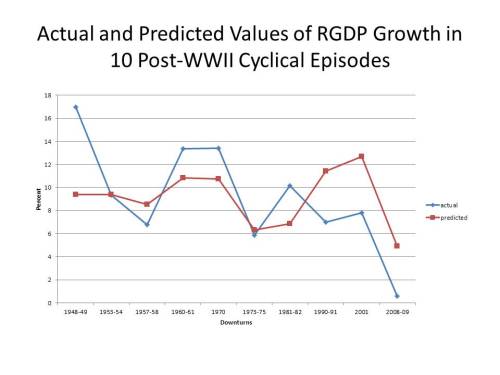
The r-squared of the regression, measuring how much of the variation in the increase in real GDP is accounted for by the regression, is .855, which is not too bad, actually. Using the regression coefficients, I calculated the implied increase in GDP 13 quarters after the start of each of the 10 recessions and plotted those predicted values against the actual values in following chart. What is noteworthy about the chart is that although the current recovery is obviously the weakest of the 10 post-WWII recoveries, it is not, contrary to Mr. Moore and associates, the worst post-WWII under-achiever. Relative to the depth and duration of the earlier recession, the current recovery is no worse, perhaps even slightly better, than the recoveries from the 1990-91 and 2001 recessions. The other under-achiever, as one might have guessed, is the truncated recovery to the 1957-58 downturn.
Now it also occurred to me that some other factors might also help account for the variations in the strength of the recoveries to post-WWII downturns. The most plausible or most interesting ones that I could think of were the rate of inflation (of course) and the tax rate. There are multiple ways to measure these variables, but, for purposes of this exercise, the GDP price deflator and the top marginal tax rate seemed the most informative and relevant.
But a moment’s reflection is enough to make it obvious that it isn’t even worth trying to estimate a regression with the top marginal tax rate as a variable; the top marginal tax rate, having started at about 90% percent in the late 1940s, falling to 70% in the 1964 and to 50% in 1982, 39.6% in 1993 and 35% in 2003, clearly tends to be positively correlated with the strength of a recovery, the weakest recoveries having all been registered when the top marginal rate was lowest and the strongest recovery (to the 1948-49 downturn) when the top marginal rate was at its maximum. Hardly anyone would believe that there is a causal link between high tax rates and strong recoveries, so the observed correlation is, somehow or other, either purely random or coincidental, with some other, as yet unspecified, variable. Nevertheless, the strong apparent correlation between high marginal tax rates and strong recoveries ought to suggest to those who argue that low taxes will solve any problem, that they may be overstating the miracle-working powers of low marginal tax rates, at least as a method of promoting cyclical recoveries. Even the powerful recovery from the 1981-82 recession, when that famous tax-cutter Ronald Reagan was President, coincided with a top marginal rate of 50%, a rate that would now trigger howls of outrage from Reagan’s present-day acolytes.
But it did seem worthwhile to reestimate a regression including a variable for inflation. In each downturn-recovery cycle, I compared the GDP price deflator in the last quarter of the downturn with the GDP deflator 13 quarters after the downturn started. Doing so isolates inflation in the recovery, because I want to know if greater inflation is associated with a stronger recovery. Taking the overall increase in the GDP deflator during the recovery, I calculated the implied annual rate of inflation over the entire recovery and estimated the regression using the natural logarithm of the average annual rate of inflation during the recovery. I used the logarithm, because additional doses of inflation might well have a declining stimulative power, implying that the logarithm of the inflation rate would give a better fit than the inflation rate itself. In fact, estimating the regression both ways, I found that, as expected, the logarithm of inflation gave a better fit than did inflation itself.
Here is the regression equation that I estimated:
%increase in RGDP = .94 X (%fall in RGDP) + 12.77 X (% of cycle in expansion) + 2.75 X (log of inflation)
The equation says that the percentage increase over the whole cyclical episode can be broken down into three components. The first two are as they were previously, but with somewhat reduced coefficients. The third component is 2.75 times the logarithm of the rate of inflation, which implies that a 1% increase in inflation was associated with an increased real GDP growth over the cycle of somewhat more than 1%.
The r-squared of the new regression is .881. The adjusted r-squared, which takes into account the number of variables, rises from .82 with no inflation variable to .83 with an inflation variable. Not spectacular, but still respectable.
As before, I also calculated the predicted values for real GDP growth in each cycle and plotted them against the actual values. Those plots are in the chart below.
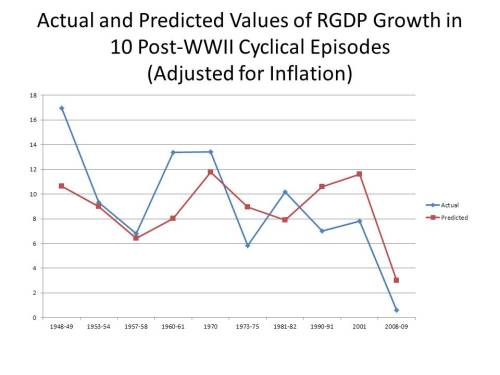
It is apparent that adjusting for the rate of inflation makes the current recovery seem a bit less of an under-achiever than when no account was taken of inflation. In the previous chart, the current recovery performed only slightly less well relative to the prediction than did the recoveries after the 1990-91 and 2001 recessions. In this chart, it does noticeably, though not very much, better than did the two previous recoveries, and also better than the 1973-75 recession (which makes sense inasmuch as inflation in that recession was driven largely by supply-side, not demand-side, factors).
What is the point of all this? Well, with only 10 observations, one would hardly want to put much reliance on any statistical result, so the main lesson is negative. Although the current recovery is certainly very weak, in the sort of naïve comparison that Stephen Moore and associates were performing, the current recovery is actually less of an under-achiever, given the length and depth of the preceding downturn and the very low rate of inflation, than either of the previous two recoveries.
To put a slightly finer point on it, if the rate of inflation in the current recovery had been equal to the rate of inflation in the recovery from the 1981-82 recession when Ronald Reagan was President, the corresponding increase in the predicted rate of growth would have been 3%. According to Okun’s Law, adding 3% to real GDP would reduce the unemployment rate by 1%. Do the data prove that that is what would have happened? By no means. Correlation is not causation. But perhaps Mr. Moore and associates, so quick to draw conclusions from a simplistic, if not simple-minded, comparison of this recovery with earlier recoveries, should entertain the possibility that the data, apparently so compelling, may be telling a different story from the one they thought they were hearing.
HT: Marcus Nunes

 Uneasy Money