Archive for the 'monetary theory' Category


Why Am I Arguing with Scott Sumner?

This is going to be my third consecutive post about Scott Sumner (well, not only about Scott), and we seem to be arguing about something, but it may not be exactly clear what the argument is about. Some people, based on comments on this and other blogs, apparently think that I am defending the Keynesian model against Scott’s attacks. Others even accuse me of advocating – horrors! – tax and spend policies as the way to stimulate the economy. In fact, Scott himself seems to think that what I am trying to do is defend what he calls the hydraulic Keynesian model. That’s a misunderstanding; I am simply trying to enforce some basic standards of good grammar in arguing about economic models, in this case the hydraulic Keynesian model. I am not a fan of the hydraulic Keynesian model, but most economists, even anti-Keynesians like Hayek (see here), have acknowledged that in a severe recession or depression, when there is substantial unemployment of nearly all factors of production, the model does provide some insight. I have also explained (here and here) that it is possible to translate the simple Keynesian model of a depression and a liquidity trap into the language of the supply of and demand for money. So at some level of generality, the propositions of the Keynesian model can be treated as fairly trivial and non-controversial.

So what do I mean when I say that I am just trying to enforce basic standards of good grammar? I mean that good grammar is not about what you choose to say; it is about how you say it. Using good grammar doesn’t prevent you from saying anything you want to; it just prevents you from saying it in certain not very comprehensible ways. If you use good grammar, you enhance your chances of saying what you want to say coherently and avoiding needless confusion. Sure some grammatical rules are purely conventional or nitpicks, but good writers and speakers know which grammatical rules can be safely ignored and which can’t. Using bad grammar leads you make statements that are confusing or ambiguous or otherwise incoherent even though the point that you are trying to make may be perfectly clear to you. Making the point clear to someone else requires you to follow certain semantic rules that help others to follow what you are saying. It is also possible that when you make an ungrammatical statement, you are disguising (and at the same time revealing) some confusion that you yourself may not be aware of, and had you made the statement grammatically you might have become aware that you had not fully thought through what you were trying to say. So in a discussion about the Keynesian model, I regard myself as a neutral observer; I don’t care if you are making a statement for or against the model. But I want you to make the statement grammatically.

That’s right; my problem with Scott is that he is using bad grammar. When Scott says he can derive a substantive result about the magnitude of the balanced-budget multiplier from an accounting identity between savings and investment, he is making a theoretically ungrammatical statement. My problem is not with whatever value he wants to assign to the balanced-budget multiplier. My problem is that he thinks that he can draw any empirically meaningful conclusion — about anything — from an accounting identity. Scott defends himself by citing Mankiw and Krugman and others who assert that savings and investment are identically equal. I don’t have a copy of any of Krugman’s textbooks, so I don’t know what he says about savings and investment being identically equal, but I was able to find the statement in Mankiw’s text. And yes, he does say it, and he was speaking incoherently when he said it. Now, it is one thing to make a nonsense statement, which Mankiw obviously did, and it is another to use it as a step – in fact a critical step — in a logical proof, which is what Scott did.

The unfortunate fact is that the vast majority of economics textbooks starting with Samuelson’s classic text (though not until the fourth edition) have been infected by this identity virus, even including the greatest economics textbook ever written. The virus was introduced into economics by none other than Keynes himself in his General Theory. He was properly chastised for doing so by Robertson, Hawtrey, Haberler, and Lutz among others. Perhaps because the identity between savings and investment in the national income accounts reinforced the misunderstanding and misconception that the Keynesian model is somehow based on an accounting identity between investment and savings, the virus withstood apparently conclusive refutation and has clearly become highly entrenched as a feature of the Keynesian model.

The confusion was exacerbated because, in the most common form of the Keynesian model, the timeless, lagless form with the instantaneous multiplier, the model has meaning only in equilibrium for which the equality of savings and investment is a necessary and sufficient condition. This misunderstanding has led to completely illegitimate attempts to identify points on the Keynesian cross diagram away from the point of intersection as disequilibria characterized by a difference between planned (ex ante) and realized (ex post) savings or planned and realized investment. It is legitimate to refer to the equality of savings and investment in equilibrium, but you can’t extrapolate from a change in one or the other to determine how the equilibrium changes as a result of the specified change in savings or investment, which is what Scott tried to do. So, yes, the mistaken identification of savings and investment is distressingly widespread, but unfortunately Scott has compounded the confusion, taking it to an even higher level. Let me again cite as the key source identifying and tracking down all the confusions and misconceptions associated with treating savings and investment (or expenditure and income) as identically equal the classic paper by Richard Lipsey, “The Foundations of the Theory of National Income,” originally published in 1972 in Essays in Honour of Lord Robbins and reprinted in Lipsey Macroeconomic Theory and Policy: The Selected Essays of Richard G. Lipsey, vol. 2.

That’s all for now. I still need to respond to some of Scott’s arguments in detail, clear up a mistake in my previous post and say some more about the savings is identically equal to investment virus.

Scott Sumner Goes Too Far

As I have said many times, Scott Sumner is the world’s greatest economics blogger. What makes him such a great blogger is not just that he is smart and witty, a terrific writer and a superb economist, but he is totally passionate about economics and is driven to explain to anyone who will listen why our economy unnecessarily fell into the deepest downturn since 1937 and has been needlessly stuck in the weakest recovery from any downturn on record. Scott loves economics so much, you might even think that he studied economics at UCLA. So the reason Scott is the greatest economics blogger in the world is that no one puts more thought, more effort, more of everything that he’s got into his blog than Scott does. So, Scott, for your sake, I hope that you get a life; for our sake, I hope that you don’t.

The only downside from our point of view about Scott’s obsession with blogging is that sometimes his enthusiasm gets the better of him. One of the more recent ideas that he has been obsessing about is the insight that fiscal policy is useless, because the Fed is committed to keeping inflation under 2%, which means that any fiscal stimulus would be offset by a monetary tightening if the stimulus raised the rate of inflation above 2%, as it would certainly do if it were effective. This insight about the interaction between fiscal and monetary policy allows Scott to conclude that the fiscal multiplier is zero, thereby allowing him to tweak Keynesians of all stripes, and especially his nemesis and role model, Paul Krugman, by demonstrating that fiscal policy is useless even at the dreaded zero lower bound. Scott’s insight is both clever and profound, and if Kydland and Prescott could win a Nobel Prize for writing a paper on time inconsistency, it’s not that big of a stretch to imagine that a few years down the road Scott could be in the running for the Nobel.

Okay, so having said all these nice things about Scott, why am I about to criticize him? Just this: it’s fine to say that the Fed has adopted a policy which renders the fiscal multiplier zero; it’s also correct to make a further point, which is that any estimate of the fiscal multiplier must be conditional on an (explicit or implicit) assumption about the stance of monetary policy or about the monetary authority’s reaction function to changes in fiscal policy. However, Scott in a post today has gone further, accusing Keynesians of confusion about how fiscal policy works unless they accept that all fiscal policy is monetary policy. Not only that, but Scott does this in a post in which he defends (in a manner of speaking) Bob Lucas and John Cochrane against a charge of economic illiteracy for believing that fiscal stimulus is never effective notwithstanding the results of the simple Keynesian model. Scott correctly says that it is possible to make a coherent argument that the fiscal multiplier implied by the Keynesian model will turn out to be zero in practice. But Scott then goes on to say that the textbook understanding of the Keynesian model is incoherent, and the only way to derive a positive fiscal multiplier is to assume that monetary policy is operating to make it so. Sorry, Scott, but that’s going too far.

For those of you who haven’t been paying attention, this whole dust-up started when Paul Krugman approvingly quoted Simon Wren-Lewis’s attempt to refute Bob Lucas and John Cochrane for denying that fiscal stimulus would be effective. Scott provides a reasonable defense of Lucas and Cochrane against the charge that they are economically illiterate, a defense I have no problem with. Here’s where Scott gets into trouble:

Wren-Lewis seems to be . . . making a simple logical error (which is common among Keynesians.)  He equates “spending” with “consumption.”  But the part of income not “spent” is saved, which means it’s spent on investment projects.  Remember that S=I, indeed saving is defined as the resources put into investment projects.  So the tax on consumers will reduce their ability to save and invest.

Scott, where is savings “defined as the resources put into investment projects?”  Savings is not identically equal to investment, the equality of savings and investment is an equilibrium condition. Savings is defined as that portion of income not consumed. Investment is that portion of expenditure not consumed. Income and expenditure are not identically equal to each other; they are equal in equilibrium. One way to see this is to recognize that there is a lag between income and expenditure.  A tax on consumers causes their saving to fall, because they finance their tax payments by reducing consumption and their savings. Investments are undertaken by businesses and are not immediately affected by the tax payments imposed on consumers. Scott continues:

So now let’s consider two possibilities.  In the first, the fiscal stimulus fails, and the increase in G is offset by a fall of $100 in after-tax income and private spending.  In that case, consumption might fall by $10 and saving would have to fall by about $90.  That’s just accounting.  But since S=I, the fall in saving will reduce investment by $100 $90.  So the Wren-Lewis’s example would be wrong, the $100 in taxes would reduce private spending by exactly $100.

Consider what Scott is saying here: assume that Wren-Lewis is wrong about the fiscal stimulus, so that the fiscal stimulus fails. Given that assumption, Scott is able to prove the very surprising result that “Wren-Lewis’s example would be wrong.” Amazing! If we assume that Wren-Lewis is wrong, then he is wrong. Now back to Scott:

I’m pretty sure my Keynesian readers won’t like the previous example.

What’s not to like?

So let’s assume the bridge building is a success, and national income rises by $100.  In that case private after-tax income will be unchanged.  But in that case with [we?] have a “free lunch” where the private sector would not reduce consumption at all.

I don’t know what this means. Does calling the increase in national income a free lunch qualify as a refutation?

Either way Wren-Lewis’s example is wrong.

There is no “either way.” If you assume that the example is wrong, there is no way for it not to be wrong.

If viewed as accounting it’s wrong because he ignores saving and investment.  If viewed as a behavioral explanation it’s wrong because he assumes consumption will fall, but that’s only true if the fiscal stimulus failed.

Viewing anything as accounting doesn’t allow you to prove anything. Accounting is just a system of definitions with no explanatory power, regardless of whether saving and investment are ignored or taken into account. As for the behavioral explanation, the assumption that consumption falls is made with respect to the pre-stimulus income. When the stimulus raises income enough to make post-stimulus disposable income equal to pre-stimulus disposable income, post-stimulus consumption is equal to pre-stimulus consumption.

Scott continues with only a trace of condescension:

Now that doesn’t mean the balanced budget multiplier is necessarily zero.  Here’s the criticism that Wren-Lewis should have made:

Cochrane ignores the fact that tax-financed bridge building will reduce private saving and hence boost interest rates.  This will increase the velocity of circulation, which will boost AD.

Scott may be right about this assertion, but he is not talking about the standard Keynesian model. Scott doesn’t like it when Keynesians insist that non-Keynesians accept their reasoning or be dismissed as ignoramuses, why does Scott insist that Keynesians accept his view of the world or be dismissed as not “even know[ing] how to defend their own model?”

It does no good to “refute” Cochrane with an example that implicitly accepts the crude Keynesian assumption that savings simply disappear down a rat-hole, and cause the economy to shrink.

The Keynesian assumption is that there is absolute liquidity preference, so the savings going down the rate hole is pure hoarding. As I pointed out in my post criticizing Robert Barro for his over the top dichotomy in a Wall Street Journal op-ed between Keynesian economics and regular economics, Keynesian fiscal stimulus works by transferring idle money balances in exchange for bonds at liquidity trap interest rate and using the proceeds to finance expenditure that goes into the pockets of people with finite (rather than infinite) money demand.  In that sense, Scott is right that there is a deep connection between the monetary side and the fiscal side in the Keynesian model, but it’s different from the one he stipulates.

The point of all this is not to be critical of Scott. Why would I want to be critical of one of my heroes and a potential Nobel laureate? The point is just that sometimes it pays to take a deep breath before flying off the handle, even if the target is Paul Krugman.

The Fog of Inflation

Blogger Jonathan Catalan seems like a pretty pleasant and sensible fellow, and he is certainly persistent. But I think he is a bit too much attached to the Austrian story of inflation in which inflation is the product of banks reducing their lending rates thereby inducing borrowers to undertake projects at interest rates below the “natural rate of interest.” In the Austrian view of inflation, the problem with inflation is not so much that the value of money is reduced (though Austrians are perfectly happy to throw populist red meat to the masses by inveighing against currency debasement and the expropriation of savings), but that the newly created money distorts relative prices misleading entrepreneurs and workers into activities and investments that will turn out to be unprofitable when interest rates are inevitably raised, leading to liquidation and abandonment, causing a waste of resources and unemployment of labor complementary to no longer usable fixed capital.

That story has just enough truth in it to be plausible; it may even be relevant in explaining particular business-cycle episodes. But despite the characteristic (and really annoying) Austrian posturing and hyperbole about the apodictic certainty of its a priori praxeological theorems (non-Austrian translation:  assertions and conjectures), to the exclusion of every other explanation of inflation and business cycles, Austrian business cycle theory simply offers a theoretically possible account of how banks might simultaneously cause an increase in prices generally and a particular kind of distortion in relative prices. In fact, not every inflation and not every business cycle expansion has to conform to the Austrian paradigm, and Austrian assertions that they possess the only valid account of inflation and business cycles are pure self-promotion, which is why most of the reputable economists that ever subscribed to ABCT (partial list:  Gottfried Haberler, Fritz Machlup, Lionel Robbins, J. R. Hicks, Abba Lerner, Nicholas Kaldor, G. L. S. Shackle, Ludwig Lachmann, and F. A. Hayek) eventually renounced it entirely or acknowledged its less than complete generality as an explanation of business cycles.

So when in a recent post, I chided Jon Hilsenrath, a reporter for the Wall Street Journal, for making a blatant logical error in asserting that inflation necessarily entails a reduction in real income, Catalan responded, a tad defensively I thought, by claiming that inflation does indeed necessarily reduce the real income of some people. Inasmuch as I did not deny that there can be gainers and losers from inflation, it has been difficult for Catalan to articulate the exact point on which he is taking issue with me, but I suspect that the reason he feels uncomfortable with my formulation is that I rather self-consciously and deliberately formulated my characterization of the effects of inflation in a way that left open the possibility that inflation would not conform to the Austrian inflation paradigm, without, by the way, denying that inflation might conform to that paradigm.

In his latest attempt to explain why my account of inflation is wrong, Catalan writes that all inflation must occur over a finite period of time and that some prices must rise before others, presumably meaning that those raising their prices earlier gain at the expense of those who raise their prices later. I don’t think that that is a useful way to think about inflation, because, as I have already explained, if inflation is a process that takes place through time, it is arbitrary to single out a particular time as the starting point for measuring its effects. Catalan now tries to make his point using the following example.

[If] Glasner were correct then it would not make sense to reduce the value of currency to stimulate exports.  If the intertemporal aspect of the money circulation was absent, then exchange ratios between different currencies (all suffering from continuous tempering) would remain constant.  This is not the case, though: a continuous devaluation of currency is necessary to continuously artificially stimulate exports, because at some point relative prices (the price of one currency to another) fall back into place —, reality is the exact opposite of what Glasner proposes.  The example is imperfect and very simple (it does not have anything to do with the prices between different goods amongst different international markets), but I think it illustrates my point convincingly.

Actually, devaluations frequently do not stimulate exports. When they do stimulate exports, it is usually because real wages in the devaluing country are too high, making the tradable goods sector of the country uncompetitive, and it is easier to reduce real wages via inflation and devaluation than through forcing workers to accept nominal wage cuts. This was precisely the argument against England rejoining the gold standard in 1925 at the prewar dollar/sterling parity, an argument accepted by von Mises and Hayek. Under these circumstances does inflation reduce real wages? Yes. But the reason that it does so is not that inflation necessarily entails a reduction in real wages; the reason is that in those particular instances the real wage was too high (i.e., the actual real wage was above the equilibrium real wage) and devaluation (inflation) was the mechanism by which an equilibrating reduction in real wages could be most easily achieved. In this regard I would refer readers to the classic study of the proposition that inflation necessarily reduces real wages, the paper by Kessel and Alchian “The Meaning and Validity of the Inflation-Induced Lag of Wages Behind Prices” reprinted in The Collected Works of Armen A. Alchian.

Whether inflation reduces or increases real wages, either in general or in particular instances, depends on too many factors to allow one to reach any unambiguous conclusion. The real world is actually more complicated than Austrian business cycle theory seems prepared to admit. Funny that Austrians would have to be reminded of that by neo-classical economists.

On Multipliers, Ricardian Equivalence and Functioning Well

In my post yesterday, I explained why if one believes, as do Robert Lucas and Robert Barro, that monetary policy can stimulate an economy in an economic downturn, it is easy to construct an argument that fiscal policy would do so as well. I hope that my post won’t cause anyone to conclude that real-business-cycle theory must be right that monetary policy is no more effective than fiscal policy. I suppose that there is that risk, but I can’t worry about every weird idea floating around in the blogosphere. Instead, I want to think out loud a bit about fiscal multipliers and Ricardian equivalence.

I am inspired to do so by something that John Cochrane wrote on his blog defending Robert Lucas from Paul Krugman’s charge that Lucas didn’t understand Ricardian equivalence. Here’s what Cochrane, explaining what Ricardian equivalence means, had to say:

So, according to Paul [Krugman], “Ricardian Equivalence,” which is the theorem that stimulus does not work in a well-functioning economy, fails, because it predicts that a family who takes out a mortgage to buy a $100,000 house would reduce consumption by $100,000 in that very year.

Cochrane was a little careless in defining Ricardian equivalance as a theorem about stimulus, when it’s really a theorem about the equivalence of the effects of present and future taxes on spending. But that’s just a minor slip. What I found striking about Cochrane’s statement was something else: that little qualifying phrase “in a well-functioning economy,” which Cochrane seems to have inserted as a kind of throat-clearing remark, the sort of aside that people are just supposed to hear but not really pay much attention to, that sometimes can be quite revealing, usually unintentionally, in its own way.

What is so striking about those five little words “in a well-functioning economy?” Well, just this. Why, in a well-functioning economy, would anyone care whether a stimulus works or not? A well-functioning economy doesn’t need any stimulus, so why would you even care whether it works or not, much less prove a theorem to show that it doesn’t? (I apologize for the implicit Philistinism of that rhetorical question, I’m just engaging in a little rhetorical excess to make my point a little bit more colorfully.)

So if a well-functioning economy doesn’t require any stimulus, and if a stimulus wouldn’t work in a well-functioning economy, what does that tell us about whether a stimulus works (or would work) in an economy that is not functioning well? Not a whole lot. Thus, the bread and butter models that economists use, models of how an economy functions when there are no frictions, expectations are rational, and markets clear, are guaranteed to imply that there are no multipliers and that Ricardian equivalence holds. This is the world of a single, unique, and stable equilibrium. If you exogenously change any variable in the system, the system will snap back to a new equilibrium in which all variables have optimally adjusted to whatever exogenous change you have subjected the system to. All conventional economic analysis, comparative statics or dynamic adjustment, are built on the assumption of a unique and stable equilibrium to which all economic variables inevitably return when subjected to any exogenous shock. This is the indispensable core of economic theory, but it is not the whole of economic theory.

Keynes had a vision of what could go wrong with an economy: entrepreneurial pessimism — a dampening of animal spirits — would cause investment to flag; the rate of interest would not (or could not) fall enough to revive investment; people would try to shift out of assets into cash, causing a cumulative contraction of income, expenditure and output. In such circumstances, spending by government could replace the investment spending no longer being undertaken by discouraged entrepreneurs, at least until entrepreneurial expectations recovered. This is a vision not of a well-functioning economy, but of a dysfunctional one, but Keynes was able to describe it in terms of a simplified model, essentially what has come down to us as the Keynesian cross. In this little model, you can easily calculate a multiplier as the reciprocal of the marginal propensity to save out of disposable income.

But packaging Keynes’s larger vision into the four corners of the Keynesian cross diagram, or even the slightly more realistic IS-LM diagram, misses the essence of Keynes’s vision — the volatility of entrepreneurial expectations and their susceptibility to unpredictable mood swings that overwhelm any conceivable equilibrating movements in interest rates. A numerical calculation of the multiplier in the simplified Keynesian models is not particularly relevant, because the real goal is not to reach an equilibrium within a system of depressed entrepreneurial expectations, but to create conditions in which entrepreneurial expectations bounce back from their depressed state. As I like to say, expectations are fundamental.

Unlike a well-functioning economy with a unique equilibrium, a not-so-well functioning economy may have multiple equilibria corresponding to different sets of expectations. The point of increased government spending is then not to increase the size of government, but to restore entrepreneurial confidence by providing assurance that if they increase production, they will have customers willing and able to buy the output at prices sufficient to cover their costs.

Ricardian equivalence assumes that expectations of future income are independent of tax and spending decisions in the present, because, in a well-functioning economy, there is but one equilibrium path for future output and income. But if, because the economy not functioning well, expectations of future income, and therefore actual future income, may depend on current decisions about spending and taxation. No matter what Ricardian equivalence says, a stimulus may work by shifting the economy to a different higher path of future output and income than the one it now happens to be on, in which case present taxes may not be equivalent to future taxes, after all.

Krugman v. Lucas on Fiscal Stimulus

The blogosphere has been buzzing recently over the recent confrontation between Nobelists Paul Krugman and Robert Lucas, Krugman charging Lucas with not understanding Ricardian equivalence. The controversy has already gone on too long with too many contributions from too many sources to even attempt to summarize it, so if you have been asleep for the last week and haven’t yet heard about this minor internet conflagration, I suggest that you do a google search on Krugman + Lucas + Ricardian equivalence.

I am not even going to try to comment on Krugman’s criticism of Lucas or on criticisms of Krugman’s criticism by Andolfatto and Williamson and Cochrane. But I do want to go back to the statement that Lucas made in his talk that got Krugman all bent out of shape, because it reminded me of a piece that Robert Barro wrote a while back in the Wall Street Journal, a piece I commented on here. First, here’s what Lucas said in his talk.

We had some lively sessions this morning about fiscal stimulus.  Now, would a fiscal stimulus somehow get us out of this bind, or add another weapon that would help in this problem?  I’ve already said I think what the Fed is now doing is going to be enough to get a reasonably quick recovery committed.  But, could we do even better with fiscal stimulus?

I just don’t see this at all.  If the government builds a bridge, and then the Fed prints up some money to pay the bridge builders, that’s just a monetary policy.  We don’t need the bridge to do that.  We can print up the same amount of money and buy anything with it.  So, the only part of the stimulus package that’s stimulating is the monetary part.

So Lucas remains enough of a Monetarist to agree that printing money can provide a stimulus to an ailing economy. However, he denies that government spending can provide any stimulus if there is no money printing.

Last August, Robert Barro had a take similar to Lucas on the ineffectiveness of fiscal policy.

If [the Keynesian multiplier were] valid, this result would be truly miraculous.  The recipients of food stamps get, say, $1 billion but they are not the only ones who benefit.  Another $1 billion appears that can make the rest of society better off.  Unlike the trade-off in regular economics, that extra $1 billion is the ultimate free lunch.

How can it be right?  Where was the market failure that allowed the government to improve things just by borrowing money and giving it to people?  Keynes in his “General Theory” (1936), was not so good at explaining why this worked, and subsequent generations of Keynesian economists (including my own youthful efforts) have not been more successful.

I also pointed out that Barro had written an earlier piece in the Journal in which he explicitly stated that a business downturn and high unemployment could be prevented by monetary expansion (printing money).

[A] simple Keynesian macroeconomic model implicitly assumes that the government is better than the private market at marshalling idle resources to produce useful stuff.  Unemployed labor and capital can be utilized at essentially zero social cost, but the private market is somehow unable to figure any of this out.  In other words, there is something wrong with the price system.

John Maynard Keynes thought that the problem lay with wages and prices that were stuck at excessive levels.  But this problem could be readily fixed by expansionary monetary policy, enough of which will mean that wages and prices do not have to fall.

I then suggested that if monetary policy is indeed effective in providing stimulus to an economy in recession, it is not that hard to construct an argument that fiscal policy can also be effective in providing stimulus, fiscal stimulus being a method of transferring cash from those indifferent between holding cash and holding bonds to those who would spend cash.

[H]ow is it that monetary expansion works according to regular economics?  People get additional pieces of paper;  they have already been holding pieces of paper, and don’t want to hold any more paper.  Instead they start spending to get rid of the the extra pieces of paper, but what one person spends another person receives, so in the aggregate they cannot reduce their holdings of paper as intended until the total amount of spending has increased sufficiently to raise prices or incomes to the point where everyone is content to hold the amount of paper in existence.  So the mechanism by which monetary expansion works is by creating an excess supply of money over the demand.

Well, let’s now think about how government spending works.  What happens when the government spends money in a depression?  It borrows money from people who are holding a lot money but are willing to part with it for a bond promising a very low interest rate.  When the interest rate is that low, people with a lot cash are essentially indifferent between holding cash and holding government bonds.  The government turns around and spends the money buying stuff from or just giving it to people.  As opposed to the people from whom the government borrowed the money, a lot of the people who now receive the money will not want to just hold the money.  So the government borrowing and spending can be thought of as a way to take cash from people who were willing to hold all the money that they held (or more) giving the money to people already holding as much money as they want and would spend any additional money that they received.  In other words, i.e., in terms of the demand to hold money versus the supply of money, the government is cleverly shifting money away from people who are indifferent between holding money and bonds and giving the money to people who are already holding as much money as they want to.  So without actually printing additional money, the government is creating an excess supply of money, thereby increasing spending, a process that continues until income and spending rise to a level at which the public is once again willing to hold the amount of money in existence.

Now I happen to think that there are solid reasons to prefer monetary over fiscal policy as a method of stimulus, but there is no reason to treat this issue as if some deep principle of economic theory depended on it. But that seems to be the way it is treated by Lucas and Barro. And, just to show that I can be even-handed in my assessments, many Keynesians, including Paul Krugman himself, like to argue that in a Depression only fiscal policy can work because of the liquidity trap.  However, at least Krugman displays the unfairly maligned virtue of inconsistency.

Some Fallacies in the Interpretation of Inflation

In a post earlier this week I took reporter Jon Hilsenrath of the Wall Street Journal to task for asserting that the recent reduction in inflation was good news, because it meant that more money would be left in people’s pockets than if inflation hadn’t come down.

The real problem with that sentence is the unstated assumption that the number of dollars people have in their pockets has nothing to do with how much inflation there is. I do not expect Mr. Hilsenrath to accept my theoretical position that, under current conditions, inflation would contribute to a speedup in the rate of growth in real income, but it is inexcusable to ignore the truism that rising prices necessarily put more dollars in people’s pockets and simultaneously assert, as if it were a truism, that rising prices reduce real income.

Blogger Jonathan Catalan in turn took me to task in this post.

What Glasner seems to be arguing, though, is that because inflation amongst consumers’ goods necessarily requires rising nominal expenditure (by consumers) real wages remain the same.  That is, prices rise proportionally to the increase in consumer spending.  In order for Glasner’s proposition to be true all consumers’ nominal wages would have to increase proportionally, and the change in prices of individual goods would have to occur in such a way that the value of money in relation to all consumer goods remains the same.  We can deduce right away that such a set of prerequisites is impossible to fulfill.

Actually Catalan is reading more into that quotation than I put into it. All I meant to say was that the existence of inflation is predicated on an increase in total spending compared to an alternative world in which there was no inflation. I am not saying that inflation raises all prices proportionally, I am just saying that if prices in general have risen, total spending, and therefore total income, must also have risen. This not a matter of diagnosing the cause or effects of inflation, it is just simple bookkeeping. Thus, Catalan is aiming at a strawman in his next paragraph, not at me.

Right away, we know that not all consumers’ have had their nominal incomes grow proportionally.  A little over eight percent of the United States’ labor force is unemployed; to that, we can add a large quantity of discouraged workers.  These are consumers who are not earning an income, besides any unemployment or welfare benefits they are receiving (benefits that follow inflation trends, if even that).  The employed labor force are all working for wages set by their employers (based on the demand for specific/unspecific labor and supply of adequate laborers) — I do not think that anybody is assuming that all wages are rising proportionally and simultaneously. [DG:  Just wondering, does Catalan think that wages rise only when employers feel like raising them?]

I didn’t say that all wages were rising proportionally. What I said was that with nominal income rising along with prices, the gains in nominal income as a result of those price increases had to accrue to someone. Thus, insofar as some people were made worse off by inflation, others were made better off. There are of course theories asserting that inflation has either good effects – and others asserting that inflation has bad effects — on the economy, but, for purposes of this discussion, I am not taking sides for or against those theories. In his next paragraph, Catalan repeats the same point, suggesting erroneously that I argued that no one can be made worse off by inflation. But at the most naïve level, i.e., not trying to figure out the indirect and long-term effects of inflation, the losses of some are offset by the gains of others.

Catalan continues, and here he gets himself into trouble.

But, if wages are not rising simultaneously and proportionally for all consumers, then some must suffer from a reduction of the real purchasing power of the dollar.  Abstracting sufficiently, we can pool individuals into those who receive newly created dollars and those who do not.  Those who receive money first will be able to bid new currency towards consumers’ goods at their prices of the immediate past, causing prices to increase.  Those who do not receive this money will have to suffer from an increase in the prices of consumers’ goods.

What is wrong with this statement? Well, first, it’s not clear if new currency is injected into the economy in just one dose, or if injections are ongoing. If the injection is a one-time dose, then Catalan is correct that the sequence in which the new money reaches individuals has some transitory significance on the distribution of gains and losses from transitory inflation. People who get the money first may have some fleeting advantage over people who receive the money only after it has already gone through many hands before reaching them (although even this proposition is subject to any number of potential qualifications). However, if money is being injected continuously or periodically, Catalan’s statement is erroneous, because once the cycle of injection and dispersal is repeated, it is no longer meaningful to identify a particular point of entry as prior to any other point in a continuing cycle. What matters is not the temporal sequence in which the new funds are spent, but whether the injection of new money alters the overall distribution of spending.

Catalan concludes:

Glasner’s mistake — unless I terribly misinterpreted his point — is an over-reliance on the mechanical quantity theory of money and prices.  Yes, inflation is a monetary phenomenon.  That does not mean that inflation actually takes place simultaneously and proportionally amongst the prices of all economic goods and wages.  Instead, prices change relative to each other; some lose and some win.  It was this lack of focus on relative prices that Friedrich Hayek warned about in Prices and Production (although, he was referring to relative prices amongst goods of different stages in the structure of production and this would lead him to his elucidation of intertemporal discoordination).

In a sense, Catalan and I are not that far apart. We agree that monetary expansion can raise prices, and that as it raises prices, newly injected money may also affect relative prices. However, I don’t think that it’s possible to say much about how injections of money affect relative prices unless the monetary authorities are deliberately aiming to put money into the pockets of specific groups of people. But that’s not really how new money is injected into the economy, so I don’t think that trying to find the relative-price effects associated with inflation is very useful way of analyzing the effects of inflation. And that is why Hayek was unable to make a positive contribution to the analysis of business cycles beyond articulating some very general (but nonetheless important) principles about the conditions necessary for intertemporal equilibrium, the importance of stabilizing nominal income over the business cycle, and the ineffectiveness (in most circumstances) of anticipated inflation in increasing employment.

So to come back to the specific point that Catalan took me to task for, although I did not argue that inflation does not affect real wages, I do think that it is far from obvious that inflation has reduced real wages, i.e., that inflation has caused prices to rise faster than wages. Surely some wages have risen less rapidly than prices, but some wages have gone up more rapidly than prices. And as a general proposition, we have little way of determining whether recent changes in relative prices (and wages) were caused by real forces affecting relative prices and wages or by the forces affecting inflation. Given our ignorance of what is causing individual prices to change, there is no obvious basis for suggesting that anyone’s real income has been affected by inflation. If you want to make that claim, be my guest. But there is no inherent property of inflation that justifies it. If you want to make the claim, it’s your burden to come up with an argument to make the claim credible. Good luck.

PS  It looks like this will be my last post for 2011.  Best wishes for 2012.  May it be an improvement on 2011!

Which Fed Policy Is Boosting Stocks?

In yesterday’s (December 27, 2011) Wall Street Journal, Cynthia Lin (“Fed Policy Delivers a Tonic for Stocks”) informs us that the Fed’s Operation Twist program “has been a boon for investors during the year’s final quarter.”

The program, which has its final sale of short-dated debt for the year on Wednesday, pushed up a volatile U.S. stock market over the past few months and helped lower mortgage rates, breathing some life into the otherwise struggling U.S. housing sector, they said. Last week, Freddie Mac showed a variety of loan rates notching or matching record lows; the 30-year fixed rate fell to 3.91%, a record low.

In Operation Twist, the Fed sells short-dated paper and buys longer-dated securities. The program’s aim is to push down longer-term yields making Treasurys less attractive and giving investors more reason to buy riskier bonds and stocks. While share prices have risen considerably since then, Treasury yields have barely budged from their historic lows. Fear about the euro zone has caused an overwhelming number of investors to seek safety in Treasury debt. . . .

The Fed’s stimulus plan is the central bank’s third definitive attempt to aid the U.S.’s patchy economy since 2008. As expectations grew that the Fed would act in the weeks leading up to the bank’s actual announcement, which came Sept. 21, 10-year yields dropped nearly 0.30 percentage point. Since the Fed’s official statement, yields have risen modestly, to 2.026% on Friday, from 1.95% on Sept. 20. Fed Chairman Ben Bernanke said in October that rejiggering the bank’s balance sheet with Operation Twist would bring longer-term rates down 0.20 percentage points.

Sounds as if we should credit Chairman Bernanke with yet another brilliant monetary policy move. There have been so many that it’s getting hard to keep track of all his many successes. Just one little problem. On September 1, around the time that expectations that the Fed would embark on Operation Twist were starting to become widespread, the yield on the 10-year Treasury stood at 2.15% and the S&P 500 closed at 1204.42. Three weeks later on September 22, the 10-year Treasury stood at 1.72%, but the S&P 500, dropped to 1129.56. Well, since then the S&P 500 has bounced back, rising about 10% to 1265.43 at yesterday’s close. But, guess what? So did the yield on the 10-year Treasury, rising to 2.02%. So, the S&P 500 may have been risen since Operation Twist began, but it would be hard to argue that the reason that stocks rose was that the yield on longer-term Treasuries was falling. On the contrary, it seems that stocks rise when yields on long-term Treasuries rise and fall when yields on long-term Treasuries fall.

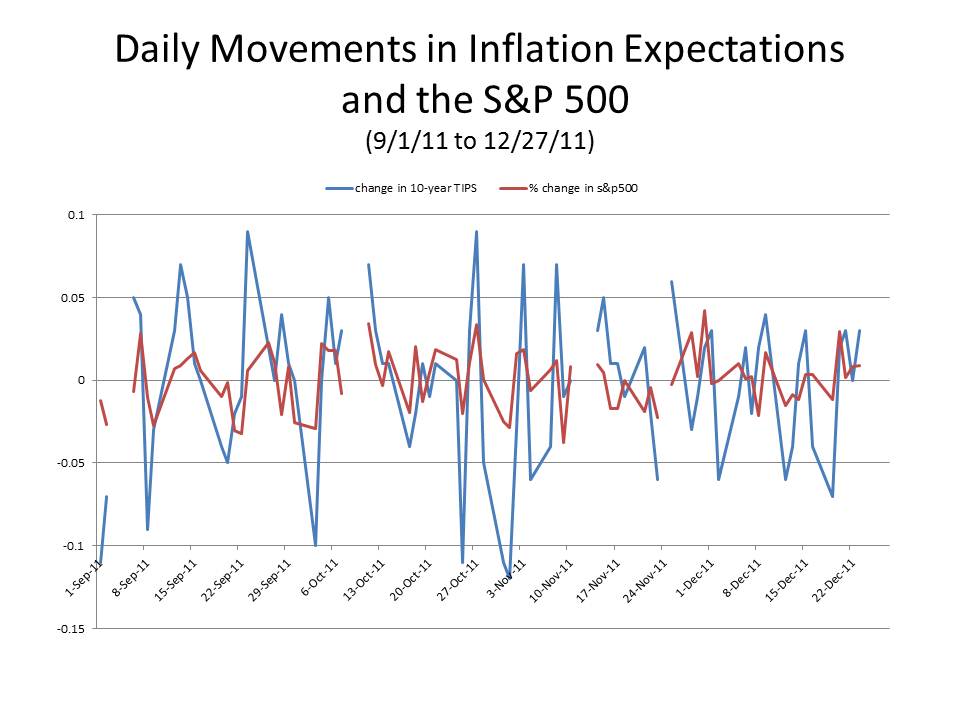
Regular readers of this blog already know that I have a different explanation for movements in the stock market. As I argued in my paper “The Fisher Effect Under Deflationary Expectations,” movements in asset prices since the spring of 2008 have been dominated by movements (up or down) in inflation expectations. That is very unusual. Aside from tax effects, there is little reason to expect stocks to be affected by inflation expectations, but when expected deflation exceeds the expected yield on real capital, asset holders want to sell their assets to hold cash instead, thereby causing asset prices to crash until some sort of equilibrium between the expected yields on cash and on real assets is restored. Ever since the end of the end of the financial crisis in early 2009, there has been an unstable equilibrium between very low expected inflation and low expected yields on real assets. In this environment small changes in expected inflation cause substantial movements into and out of assets, which is why movements in the S&P 500 have been dominated by changes in expected inflation.  And this unhealthy dependence will not be broken until either expected inflation or the expected yield on real assets increases substantially.

The close relationship between changes in expected inflation (as measured by the breakeven TIPS spread for 10-year Treasuries) and changes in the S&P 500 from September 1 through December 27 is shown in the chart below.

In my paper on the Fisher effect, I estimated a simple regression equation in which the dependent variable was the daily percentage change in the S&P 500 and the independent variables were the daily change in the TIPS yield (an imperfect estimate of the expected yield on real capital), the daily change in the TIPS spread and the percentage change in the dollar/euro exchange rate (higher values signifying a lower exchange value of the dollar, thus providing an additional measure of inflation expectations or possibly a measure of the real exchange rate). Before the spring of 2008, this equation showed almost no explanatory power, from 2008 till the end of 2010, the equation showed remarkable explanatory power in accounting for movements in the S&P 500. My regression results for the various subperiods between January 2003 till the end of 2010 are presented in the paper.

I estimated the same regression for the period from September 1, 2011 to December 27, 2011. The results were startlingly good. With a sample of 79 observations, the adjusted R-squared was .636. The coefficients on both the TIPS and the TIPS spread variables were positive and statistically significant at over a 99.9% level. An increase of .1 in the real interest rate was associated with a 1.2% increase in the S&P and an increase of .1 in expected inflation was associated with a 1.7% increase in the S&P 500. A 1% increase the number of euros per dollar (i.e., a fall in the value of the dollar in terms of euros) was associated with a 0.57% increase in the S&P 500. I also introduced a variable defined as the daily change in the ratio of the yield on a 10-year Treasury to the yield on a 2-year Treasury, calculating this ratio for each day in my sample. Adding the variable to the regression slightly improved the fit of the regression, the adjusted R-squared rising from .636 to .641. However, the coefficient on the variable was positive and not statistically significant. If the supposed rationale of Operation Twist had been responsible for the increase in the S&P 500, the coefficient on this variable would have been negative, not positive. So, contrary to the story in yesterday’s Journal, Operation Twist has almost certainly not been responsible for the rise in stock prices since it was implemented.

Why has the stock market been rising? I’m not sure, but most likely market pessimism about the sway of the inflation hawks on the FOMC was a bit overdone during the summer when the inflation expectations and the S&P 500 both were dropping rapidly. The mere fact that Chairman Bernanke was able to implement Operation Twist may have convinced the market that the three horseman of the apocalypse on the FOMC (Plosser, Kocherlakota, and Fisher) had not gained an absolute veto over monetary policy, so that the doomsday scenario the market may have been anticipating was less likely to be realized than had been feared. I suppose that we should be thankful even for small favors.

No Monetary Policy Is Not Just Another Name for Fiscal Policy

I just read John Cochrane’s essay “Inflation and Debt” in the Fall 2011 issue of National Affairs. On his webpage, Cochrane gives this brief summary of what the paper is about.

An essay summarizing the threat of inflation from large debt and deficits. The danger is best described as a “run on the dollar.” Future deficits can lead to inflation today, which the Fed cannot control. I also talk about the conventional Keynesian (Fed) and monetarist views of inflation, and why they are not equipped to deal with the threat of deficits. This essay complements the academic (equations) “Understanding Policy” article (see below) and the Why the 2025 budget matters today WSJ oped (see below).

And here’s the abstract to his “Understanding Policy in the Great Recession” article:

I use the valuation equation of government debt to understand fiscal and monetary policy in and following the great recession of 2008-2009. I also examine fiscal and monetary policy alternatives to avoid deflation, and how fiscal pressures might lead to inflation. I conclude that the central bank might be almost powerless to avoid inflation or deflation; that an eventual fiscal inflation can come well before fiscal deficits or monetization are realized, and that it is likely to come with stagnation rather than a boom.

The crux of Cochrane’s argument is that government currency is a form of debt so that inflation is typically the result of a perception by bondholders and potential purchasers of government debt that the government will not be able to raise enough revenues to cover its expenditures and repay its debt obligations, implying an implicit default through inflation. However, the expectation of future inflation because of an anticipated future fiscal crisis may suddenly — when an expectational tipping point is reached — trigger a “run” on the currency well before the crisis, a run manifesting itself in rapidly rising nominal interest rates and rising inflation even before the onset of a large fiscal deficit.

This is certainly an important, though hardly original, insight, and provides due cause for concern about our long-term fiscal outlook. The puzzle is why Cochrane thinks the possibility of a run on the dollar because of an anticipated future fiscal crisis is at all relevant to an understanding of why we are stuck in a lingering Little Depression. Cochrane is obviously very pleased with his fiscal theory of inflations, believing it to have great explanatory power.  But that explanatory power, as far as I can tell, doesn’t quite extend to explaining the origins of, or the cure for, the crisis in which we now find ourselves.

Cochrane’s recent comments on a panel discussion at the Hoover Institution give the flavor of his not very systematic ideas about the causes of the Little Depression, and the disconnect between those ideas and his fiscal theory of inflation.

Why are we stagnating? I don’t know. I don’t think anyone knows, really. That’s why we’re here at this fascinating conference.

Nothing on the conventional macro policy agenda reflects a clue why we’re stagnating. Score policy by whether its implicit diagnosis of the problem makes any sense.

The “jobs” bill. Even if there were a ghost of a chance of building new roads and schools in less than two years, do we have 9% unemployment because we stopped spending on roads & schools? No. Do we have 9% unemployment because we fired lots of state workers? No.

Taxing the rich is the new hot idea. But do we have 9% unemployment-of anything but tax lawyers and lobbyists–because the capital gains rate is too low? Besides, in this room we know that total marginal rates matter, not just average Federal income taxes of Warren Buffet. Greg Mankiw figured his marginal tax rate at 93% including Federal, state, local, and estate taxes. And even he forgot about sales, excise, and corporate taxes. Is 93% too low, and the cause of unemployment?

The Fed is debating QE3. Or is it 5? And promising zero interest rates all the way to the third year of the Malia Obama administration. All to lower long rates 10 basis points through some segmented-market magic. But do we really have 9% unemployment because 3% mortgages with 3% inflation are strangling the economy from lack of credit? Or because the market is screaming for 3 year bonds, but Treasury issued at 10 years instead? Or because $1.5 trillion of excess reserves aren’t enough to mediate transactons?

I posed this question to a somewhat dovish Federal Reserve bank president recently. He answered succinctly, “Aggregate demand is inadequate. We fill it. ” Really? That’s at least coherent. I read the same model as an undergraduate. But as a diagnosis, it seems an awfully simplistic uni-causal, uni-dimensional view of prosperity. Medieval doctors had three humors, not just one.

Of course in some sense we are still suffering the impact of the 2008 financial crisis. Reinhart and Rogoff are endlessly quoted that recessions following financial crises are longer. But why? That observation could just mean that policy responses to financial crises are particularly wrongheaded.

In sum, the patient is having a heart attack. The doctors debating whether to give him a double espresso vs. a nip of brandy. And most likely, the espresso is decaf and the brandy watered.

So what if this really is not a “macro” problem? What if this is Lee Ohanian’s 1937-not about money, short term interest rates, taxes, inadequately stimulating (!) deficits, but a disease of tax rates, social programs that pay people not to work, and a “war on business.” Perhaps this is the beginning of eurosclerosis. (See Bob Lucas’s brilliant Millman lecture for a chilling exposition of this view).

If so , the problem is heart disease. If so, macro tools cannot help. If so, the answer is “Get out of the way.”

Cochrane seems content to take the most naïve Keynesian model as the only possible macro explanation of the current slump, and, after cavalierly dismissing it, concludes that there is no macroeconomic explanation for the slump, leaving “get out of the way” as the default solution. That’s because he seems convinced that all that you need to know about money is that expected future fiscal deficits can cause inflation now, because the expectation triggers a “run” on the currency. This is an important point to recognize, but it does not exhaust all that we know or should know about monetary theory and monetary policy. It is like trying to account for the price level under the gold standard by only taking into account the real demand for gold (i.e., the private demand for gold for industrial and ornamental purposes) and ignoring the monetary demand for gold (i.e., the demand by banks and central banks to hold gold as reserves or for coinage). If you looked only at the private demand for gold, you couldn’t possibly account for the Great Depression.

PS I also have to register my amazement that Cochrane could bring himself to describe Lucas’s Millman lecture as brilliant. It would be more accurate to describe the lecture as an embarrassment.

HT:  David Levey

Hayek’s 1932 Defense of the Insane Bank of France

In my post last Monday, I suggseted that Hayek’s attachment to the gold standard led him to recommend a policy of deflation during the Great Depression even though his own neutral-money policy criterion of stabilizing aggregate monetary expenditure would have implied aggressive monetary expansion during the Great Depression. Forced to choose between two conflicting principles, Hayek made the wrong choice, opting for defense of the gold standard rather than for stabilizing nominal GDP. He later changed his views, disavowing support for the gold standard as early as 1943 in a paper (“A Commodity Reserve Currency”) in the Economic Journal (reprinted as chapter 10 of Individualism and Economic Order) and reaffirming his opposition to the gold standard in The Constitution of Liberty (p. 335). I cited his 1932 paper “the Fate of the Gold Standard” translated from the original German and republished in his collected works and quoted his opening paragraph lamenting that Britain had abandoned the gold standard because (in September 1931 as the Great Depression was rapidly spiraling downward) Britain found the discipline of the gold standard “irksome.”

I also referred to Hayek’s defense of what I called “the insane French policy of gold accumulation.” I did not want to burden readers of an already long post with further quotations from Hayek’s article, so I just left it there without giving another quotation. But I think it may be worth analyzing what Hayek wrote, not because I want to make Hayek look bad, but because his defense of the Bank of France betrays a basic misunderstanding of the theory of international monetary adjustment and how the gold standard worked that is characteristic of many discussions of the gold standard.

Here is what Hayek wrote (F. A. Hayek, The Collected Works of F. A. Hayek, Good Money, Part 1, p. 160).

The accusation that France systematically hoarded gold seems at first sight to be more likely to be correct [than the charge that the US Federal Reserve had been hoarding gold, an accusation dismissed in the previous paragraph]. France did pursue an extremely cautious foreign policy after the franc stabilized at a level which considerably undervalued it with respect to its domestic purchasing power, and prevented an expansion of credit proportional to the amount of gold coming in. Nevertheless, France did not prevent her monetary circulation from increasing by the very same amount as that of the gold inflow – and this alone is necessary for the gold standard to function.

Hayek made a fundamental error here, assuming that a small open economy (which France could be considered to have been in the late 1920s) had control over its money supply and its price level under the gold standard. The French price level, once France pegged the franc to the dollar in 1926 at $0.0392/franc, was no longer under the control of French monetary authorities, commodity arbitrage requiring commodity prices quoted in francs to equal commodity prices quoted in dollars adjusted for the fixed dollar/franc parity. The equalization was not perfect, because not all commodities enter into international trade and because there are differences between similar products sold in different countries that preclude full price equalization. But there are strict limits on how much national price levels could diverge under a gold standard. Similarly, the money supply in a country on the gold standard could not be controlled by the monetary authority of that country, because if people in that country wanted to hold more money than the monetary authority made available, they could increase their holdings of money by increasing exports or decreasing imports, thereby generating an inflow of gold, which could be converted into banknotes or deposits.

So Hayek’s observation that France did not prevent her monetary circulation from increasing by the very same amount as that of the gold inflow means only that the Bank of France refused to increase the French money supply at all (or even attempted to decrease it), forcing the French to increase their holdings of cash by acquiring gold through an export surplus. Hayek’s statement thus betrays a total misunderstanding of what “is necessary for the gold standard to function.” All that was necessary was that France maintain a fixed parity between the dollar and the franc, not that the Bank of France achieve a particular change in the money supply governed by the amount that its holdings of gold had changed. Hayek wrongly assumed that the French monetary authorities had control over the French money supply and that the inflow of gold was somehow determined by real forces independent of French monetary conditions. But it was just the opposite. The French money supply increased because the French wanted to increase the amount of cash balances they were holding. The only question was whether the French banking system would be allowed by the Bank of France to accommodate the French demand for money by increasing the French money supply, or whether the desired increase in the money supply would be permitted only through gold imports generated by an export surplus. Refusing to allow the French money supply to increase except through the importation of gold meant that the increase in the French demand for money was transformed into an equivalent increase in French (and, hence, the world) demand for gold, thereby driving up the value of gold, the proximate source of the deflation that produced the Great Depression.

As I said, this misconception of money supply adjustment under the gold standard was not unique to Hayek.  In some ways it is characteristic of many orthodox treatments of the gold standard and it can be traced back at least to the British Currency School of the 1830 and 1840s, if not even further back to David Hume in the 18th century.  Milton Friedman was similarly misguided in many of his discussions of the gold standard and international adjustment, especially in his discussion of the Great Depression in his Monetary History of the United States.  Ralph Hawtrey, as usual, got it right.  But the analysis was much later articulated in more conventional model by Harry Johnson and his associates in their development of the monetary approach to the balance of payments.

Keynes v. Hayek: Enough Already

First, it was the Keynes v. Hayek rap video, and then came the even more vulgar and tasteless Keynes v. Hayek sequel video reducing the two hyperintellectuals to prize fighters. (The accuracy of the representations signaled in its portrayal of Hayek as bald and Keynes with a full head of hair when in real life it was the other way around.) Then came a debate broadcast by the BBC at the London School of Economics, and then another sponsored by Reuters with a Nobel Prize winning economist on the program arguing for the Hayek side. Now comes a new book by Nicholas Wapshott Keynes Hayek, offering an extended account of the fraught relationship between two giants of twentieth century economics who eventually came to a sort of intellectual détente toward the end of Keynes’s life, a decade or more after a few years of really intense, even brutal, but very high level, polemical exchanges between them (and some of their surrogates) in the pages of England’s leading economics journals. Tyler Cowen has just reviewed Wapshott’s book in the National Review (see Marcus Nunes’s blog).

As I observed in September after watching the first Keynes-Hayek debate, we can still learn a lot by going back to Keynes’s and Hayek’s own writings, but all this Keynes versus Hayek hype creates the terribly misleading impression that the truth must lie with only one side or the other, that one side represents truth and enlightenment and the other represents falsehood and darkness, one side represents pure disinterested motives and the other is shilling for sinister forces lurking in the wings seeking to advance their own illegitimate interests, in short that one side can be trusted and the other cannot. All this attention on Keynes and Hayek, two charismatic personalities who have become figureheads or totems for ideological movements that they might not have endorsed at all — and certainly not endorsed unconditionally — encourages an increasingly polarized discussion in which people choose sides based on pre-existing ideological commitments rather than on a reasoned assessment of the arguments and the evidence.

In part, this framing of arguments in ideological terms simply reflects existing trends that have been encouraging an increasingly ideological approach to politics, law, and public policy. For an example of this approach, see Naomi Klein’s recent musings about global warming and the necessity for acknowledging that combating global warming requires the very social transformation that makes right-wingers oppose, on ideological principle, any measure to counter global warming.  Those are just the terms of debate that Naomi Klein wants.  Thus, both sides have come to see global warming not as a problem to be addressed or mitigated, but as a weapon to be used in the context of a comprehensive ideological struggle. Those who want to address the problem in a pragmatic, non-ideological, way are losing control of the conversation.

The amazing thing about the original Keynes-Hayek debate is not only that both misunderstood the sources of the Great Depression for which they were confidently offering policy advice, but that Ralph Hawtrey and Gustav Cassel had explained what was happening ten years before the downturn started in the summer of 1929. Both Hawtrey and Cassel understood that restoring the gold standard after the demonetization of gold that took place during World War I would have hugely deflationary implications if, when the gold standard was reinstated, the world’s monetary demand for gold would increase back to the pre-World War I level (as a result of restoring gold coinage and the replenishment of the gold reserves held in central bank coffers). That is why both Hawtrey and Cassel called for measures to limit the world’s monetary demand for gold (measures agreed upon in the international monetary conference in Genoa in 1922 of which Hawtrey was the guiding spirit). The measures agreed upon at the Genoa Conference prevented the monetary demand for gold from increasing faster than the stock of gold was increasing so that the world price level in terms of gold was roughly stable from about 1922 through 1928. But in 1928, French demand for gold started to increase rapidly just as the Federal Reserve began tightening monetary policy in a tragically misguided effort to squelch a supposed stock-price bubble on Wall Street, causing an inflow of gold into the US while the French embarked on a frenzied drive to add to their gold holdings, and other countries rejoining the gold standard were increasing their gold holdings as well, though with a less fanatical determination than the French. The Great Depression was therefore entirely the product of monetary causes, a world-wide increase in gold demand causing its value to increase, an increase manifesting itself, under the gold standard, in deflation.

Hayek, along with his mentor Ludwig von Mises, could also claim to have predicted the 1929 downturn, having criticized the Fed in 1927, when the US was in danger of falling into a recession, for reducing interest rates to 3.5%, by historical standards far from a dangerously expansionary rate, as Hawtrey demonstrated in his exhaustive book on the subject A Century of Bank Rate. But it has never been even remotely plausible that a 3.5% discount rate at the Fed for a little over a year was the trigger for the worst economic catastrophe since the Black Death of the 14th century. Nor could Keynes offer a persuasive explanation for why the world suddenly went into a catastrophic downward spiral in late 1929. References to animal spirits and the inherent instability of entrepreneurial expectations are all well and good, but they provide not so much an explanation of the downturn as a way of talking about it or describing it. Beyond that, the Hawtrey-Cassel account of the Great Depression also accounts for the relative severity of the Depression and for the sequence of recovery in different counties, there being an almost exact correlation between the severity of the Depression in a country and the existence and duration of the gold standard in the country. In no country did recovery start until after the gold standard was abandoned, and in no country was there a substantial lag between leaving the gold standard and the start of the recovery.

So not only did Hawtrey and Cassel predict the Great Depression, specifying in advance the conditions that would, and did, bring it about, they identified the unerring prescription – something provided by no other explanation — for a country to start recovering from the Great Depression. Hayek, on the other hand, along with von Mises, not only advocated precisely the wrong policy, namely, tightening money, in effect increasing the monetary demand for gold, he accepted, if not welcomed, deflation as the necessary price for maintaining the gold standard. (This by the way is what explains the puzzle (raised by Larry White in his paper “Did Hayek and Robbins Deepen the Great Depression?”) of Hayek’s failure to follow his own criterion for a neutral monetary policy, stated explicitly in chapter 4 of Prices and Production: stabilization of nominal expenditure (NGDP). However, a policy of stabilizing nominal expenditure was inconsistent with staying on the gold standard when the value of gold was rising by 5 to 10% a year. Faced with a conflict between maintaining the gold standard and following his own criterion for neutral money, Hayek, along with his friend and colleague Lionel Robbins in his patently Austrian book The Great Depression, both opted for maintaining the gold standard.)

Not only did Hayek make the wrong call about the gold standard, he actually defended the insane French policy of gold accumulation in his lament for the gold standard after Britain wisely disregarded his advice and left the gold standard in 1931. In his paper “The Fate of the Gold Standard” (originally Das Schicksal der Goldwahrung) reprinted in The Collected Works of F. A. Hayek: Good Money, Part 1, Hayek mourned the impending demise of the gold standard after Britain tardily did the right thing. The tone of Hayek’s lament is struck in his opening paragraph (p. 153).

There has been much talk about the breakdown of the gold standard, particularly in Britain where, to the astonishment of every foreign observer, the abandonment of the gold standard was very widely welcomed as a release from an irksome constraint. However, it can scarcely be doubted that the renewed monetary problems of almost the whole world have nothing to do with the tendencies inherent in the gold standard, but on the contrary stem from the persistent and continuous attempts from many sides over a number of years to prevent the gold standard from functioning whenever it began to reveal tendencies which were not desired by the country in question. Hence it was by no means the economically strong countries such as America and France whose measures rendered the gold standard inoperative, as is frequently assumed, but the countries in a relatively weak position, at the head of which was Britain, who eventually paid for their transgression of the “rules of the game” by the breakdown of their gold standard.

So what do we learn from this depressing tale? Hawtrey and Cassel did everything right. They identified the danger to the world economy a decade in advance. They specified exactly the correct policy for avoiding the danger. Their policy was a huge success for about nine years until the Americans and the French between them drove the world economy into the Great Depression, just as Hawtrey and Cassel warned would happen if the monetary demand for gold was not held in check. Within a year and a half, both Hawtrey and Cassel concluded that recovery was no longer possible under the gold standard. And as countries, one by one, abandoned the gold standard, they began to recover just as Hawtrey and Cassel predicted. So one would have thought that Hawtrey and Cassel would have been acclaimed and celebrated far and wide as the most insightful, the most farsighted, the wisest, economists in the world. Yep, that’s what one would have thought. Did it happen? Not a chance. Instead, it was Keynes who was credited with figuring out how to end the Great Depression, even though there was almost nothing in the General Theory about the gold standard and a 30% deflation as the cause of the Great Depression, despite his having vilified Churchill in 1925 for rejoining the gold standard at the prewar parity when that decision was expected to cause a mere 10% deflation.

But amazingly enough, even when economists began looking for alternative ways to Keynesianism of thinking about macroeconomics, Austrian economics still being considered too toxic to handle, almost no one bothered to go back to revisit what Hawtrey and Cassel had said about the Great Depression. So Milton Friedman was considered to have been daring and original for suggesting a monetary explanation for the Great Depression and finding historical and statistical support for that explanation. Yet, on the key elements of the historical explanation, Hawtrey and Cassel either anticipated Friedman, or on the numerous issues on which Friedman did not follow Hawtrey and Cassel — in particular the international gold market as the transmitter of deflation and depression across all countries on the gold standard, the key role of the Bank of France (which Friedman denied in the Monetary History and for years afterwards only to concede the point in the mid to late 1990s), the absence of an explanation for the 1929 downturn, the misplaced emphasis on the contraction of the US money stock and the role of U.S. bank failures as a critical factor in explaining the severity of the Great Depression — Hawtrey and Cassel got it right and Friedman got it wrong.

So what matters in the success in the marketplace of ideas seems to be not just the quality or the truth of a theory, but also (or instead) the publicity machine that can be deployed in support of a theory to generate interest in it and to attract followers who can expect to advance their own careers in the process of developing, testing, or otherwise propagating, the theory. Keynes, Friedman, and eventually Hayek, all had powerful ideologically driven publicity machines working on their behalf. And guess what? It’s the theories that attract the support of a hard core of ideologically motivated followers that tend to outperform those without a cadre of ideological followers.

That’s why it was very interesting, important, and encouraging that Tyler Cowen, in his discussion of the Keynes-Hayek story, felt the need to mention how Scott Sumner has shifted the debate over the past two years away from the tired old Keynes vs. Hayek routine. Of course Tyler, about as well read an economist as there is, slipped up when he said that Scott is reviving the Friedman Monetarist tradition. No, Scott is reviving the Hawtrey-Cassel pre-Monetarist tradition, of which Friedman’s is a decidedly inferior, and obsolete, version. It just goes to show that one person sometimes really can make a difference, even without an ideologically driven publicity machine working on his behalf. Just imagine what Hawtrey and Cassel could have accomplished if they had been bloggers.

About Me

David Glasner
Washington, DC

I am an economist in the Washington DC area. My research and writing has been mostly on monetary economics and policy and the history of economics. In my book Free Banking and Monetary Reform, I argued for a non-Monetarist non-Keynesian approach to monetary policy, based on a theory of a competitive supply of money. Over the years, I have become increasingly impressed by the similarities between my approach and that of R. G. Hawtrey and hope to bring Hawtrey’s unduly neglected contributions to the attention of a wider audience.

My new book Studies in the History of Monetary Theory: Controversies and Clarifications has been published by Palgrave Macmillan

Follow me on Twitter @david_glasner

Archives

Enter your email address to follow this blog and receive notifications of new posts by email.

Join 665 other subscribers
Follow Uneasy Money on WordPress.com