Archive for the 'monetary theory' Category


Why Not Arbitrage TIPS and Treasuries?

Larry Summers has a really interesting piece in today’s Financial Times (“Look beyond interest rates to get out of the gloom”), advocating that safe-haven governments (like the US, Germany and the UK) which are now able to borrow at close to zero rates of interest, which adjusted for expected inflation, amount to negative rates. Given such low borrowing costs, Summers argues, governments should be borrowing like crazy to finance any investment that promises even a marginally positive real return, even apart from Keynesian stimulative effects. This is not a new idea, countercyclical public works spending has often been advocated even by orthodox anti-Keynesians as nothing more than sensible budgetary policy, borrowing when the cost of borrowing is cheap and hiring factors of production in excess supply at discounted prices, to finance long-term investment projects. If there is a Keynesian effect on top of that, so much the better, but the rationale for doing so doesn’t depend on the existence of a positive multiplier effect.

But Summers’s argument takes this argument a step further, because as he presents it, the case for doing so is almost akin to engaging in an arbitrage transaction.

As my fellow Harvard economist Martin Feldstein has pointed out, this principle applies to accelerating replacement cycles for military supplies. Similarly, government decisions to issue debt and then buy space that is currently being leased will improve the government’s financial position. That is, as long as the interest rate on debt is less than the ratio of rents to building values, a condition almost certain to be met in a world of government borrowing rates of less than 2 per cent.

These examples are the place to begin because they involve what is in effect an arbitrage, whereby the government uses its credit to deliver essentially the same bundle of services at a lower cost. It would be amazing if there were not many public investment projects with certain equivalent real returns well above zero. Consider a $1 project that yielded even a permanent 4 cents a year in real terms increment to GDP by expanding the economy’s capacity or its ability to innovate. Depending on where it was undertaken, this project would yield at least 1 cent a year in government revenue. At any real interest rate below 1 per cent, the project pays for itself even before taking into account any Keynesian effects.

Now one blogger (Tea With FT) commenting on Summers’s piece found grounds to quibble about whether the rates governments pay on their debt are “free market rates,” because banking regulations allow banks to reduce their capital requirements by holding government debt but must increase their capital requirements as they increase their holdings of private debt.

Lawrence Summers is just another economist fooled by looking only at the nominal low interest rates for government debt of some “infallible” sovereigns, “Look beyond the interest rates to get out of the gloom“. Those interest rates do not reflect real free market rates, but the rates after the subsidies given to much government borrowing implicit in requiring the banks to have much less capital for that than for other type of lending.

If the capital requirements for banks when lending to a small business or an entrepreneurs was the same as when lending to the government… then we could talk about market rates. As is, to the cost of government debt, we need to add all the opportunity cost of all bank lending that does not occur because of the subsidy… and those could be immense.

I’m not going to get in that discussion here, but the point seems well-taken. But leaving that aside, I want to ask the following question: As long as the interest rate on TIPS is negative, why is the US government not selling massive amount of TIPS, using the proceeds to retire conventional Treasuries while earning a profit on each exchange of a TIPS for a Treasury?  That would be true arbitrage whatever the merits of Tea With FT’s argument.  Are there statutory limits on the amount of TIPS that can be sold?

The issue also seems to bear on the discussion that Steve Williamson and Miles Kimball have been having (here, here, and here, and also see Noah Smith’s take) about whether the Modigliani-Miller theorem applies to the Fed’s balance sheet. If there are arbitrage profits available exchanging conventional Treasuries for TIPS, what does that say about whether the Modigliani-Miller theorem holds for the Fed?

My next question is: if there are arbitrage profits to be made from such an exchange of assets, what is the mechanism by which the arbitrage profits would be eliminated? Why would exchanging Treasuries for TIPS alter real interest rates or inflation expectations in such a way as to eliminate the discrepancy in yields? Maybe there is something obvious going on that I’m not getting. What is it?  And if the reason is not obvious, I’ld like to know it, too.

UPDATE:  Thanks to Cantillonblog and Foosion for explaining the obvious to me.  In my haste, I wasn’t thinking clearly.  Given the expectation of inflation, the negative yield on TIPS will have to be supplemented by a further payment to compensate for the loss of principle due to inflation, so the cash flows associated with either a conventional Treasury or a TIPS are equal if inflation matches the implicit expectation of inflation corresponding to the TIPS spread.  But suppose the Treasury did issue more TIPS relative to conventional Treasuries, wouldn’t the additional Treasuries be sold to people who had slightly higher expectations of inflation than those who were already holding them?  Or alternatively, wouldn’t the very fact that the government was trying to sell more TIPS and fewer conventional Treasuries cause the public to revise their expectations of inflation upwards?  That’s not exactly the conventional channel by which either monetary policy or fiscal policy affects inflation expectations, but it does suggest that the policy authorities have some traction in trying to affect inflation expectations.  In addition, since interest rates fell close to zero after the financial panic of 2008, inflation expectations have responded in the expected direction to changes in the stance of monetary policy, rising after the announcment of QE1 and QE2 and falling when they were terminated.

UPDATE 2:  I am posting too fast today.  If the Treasury increased the quantity of TIPS being offered, it would drive down the price of the TIPS, increasing the real inflation adjusted yield.  An increased real yield, at a given nominal rate, would imply a reduced break even TIPS spread, or reduced inflation expectations.  Thus, increasing the proportion of TIPS relative to conventional Treasuries would induce savers with relatively lower inflation expectations than those previously holding them to begin holding them as well.  Alternatively, increasing the proportion of TIPS outstanding would encourage individuals to revise their expectations of inflation downward because the Treasury would be increasing its exposure to inflation.  But the point about the applicability of the MM theorem still applies with the appropriate adjustments.  At least until further notice.

Inflation Expectations Are Falling; Run for Cover

The S&P 500 fell today by more than 1 percent, continuing the downward trend began last month when the euro crisis, thought by some commentators to have been surmounted last November thanks to the consummate statesmanship of Mrs. Merkel, resurfaced once again, even more acute than in previous episodes. The S&P 500, having reached a post-crisis high of 1419.04 on April 2, a 10% increase since the end of 2011, closed today at 1338.35, almost 8% below its April 2nd peak.

What accounts for the drop in the stock market since April 2? Well, as I have explained previously on this blog (here, here, here) and in my paper “The Fisher Effect under Deflationary Expectations,” when expected yield on holding cash is greater or even close to the expected yield on real capital, there is insufficient incentive for business to invest in real capital and for households to purchase consumer durables. Real interest rates have been consistently negative since early 2008, except in periods of acute financial distress (e.g., October 2008 to March 2009) when real interest rates, reflecting not the yield on capital, but a dearth of liquidity, were abnormally high. Thus, unless expected inflation is high enough to discourage hoarding, holding money becomes more attractive than investing in real capital. That is why ever since 2008, movements in stock prices have been positively correlated with expected inflation, a correlation neither implied by conventional models of stock-market valuation nor evident in the data under normal conditions.

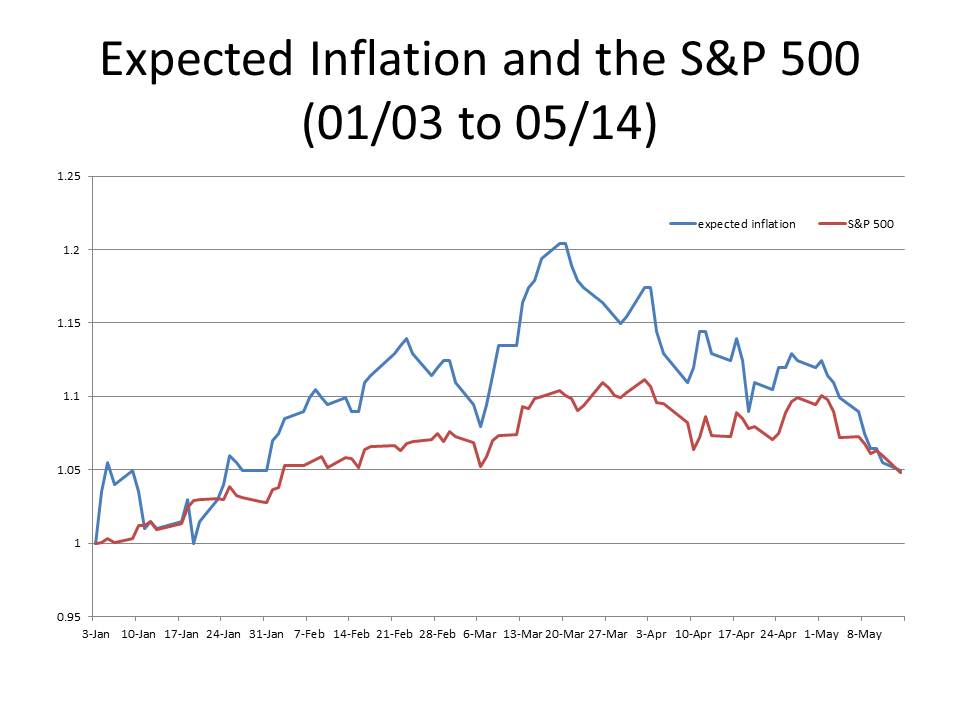
As the euro crisis has worsened, the dollar has been appreciating relative to the euro, dampening expectations for US inflation, which have anyway been receding after last year’s temporary supply-driven uptick, and after the ambiguous signals about monetary policy emanating from Chairman Bernanke and the FOMC. The correspondence between inflation expectations, as reflected in the breakeven spread between the 10-year fixed maturity Treasury note and 10-year fixed maturity TIPS, and the S&P 500 is strikingly evident in the chart below showing the relative movements in inflation expectations and the S&P 500 (both normalized to 1.0 at the start of 2012.

With the euro crisis showing no signs of movement toward a satisfactory resolution, with news from China also indicating a deteriorating economy and possible deflation, the Fed’s current ineffectual monetary policy will not prevent a further slowing of inflation and a further perpetuation of our national agony. If inflation and expected inflation keep falling, the hopeful signs of recovery that we saw during the winter and early spring will, once again, turn out to have been nothing more than a mirage

Yeager v. Tobin

In some recent posts (here, here, and here), I have expressed my admiration for James Tobin’s wonderful paper “Commercial Banks as Creators of Money.” Although the logic of the paper seems utterly compelling to me, it was, and evidently remains, controversial, because it advances the idea that the distinction between what is and what is not money is not a hard and fast one, but depends on the institutional and regulatory arrangements under which banks and other financial institutions operate.

The context in which I have been discussing Tobin is whether bank deposits created by commercial banks, unlike the liabilities created by other financial institutions, are “hot potatoes” in the sense that any individual can get rid of “unwanted” bank deposits (“unwanted” meaning that the individual’s deposit holdings exceed the amount that he would like to hold relative to his current income and wealth), but can do so only by giving those deposits to another individual in exchange for something else that the first individual would rather have instead. Thus, according to the “hot potato” view of the world, the total amount of bank deposits held by the community as a whole cannot be changed; the community is stuck with whatever amount of deposits that the banks, in the process of making loans, have created. What this means is that it is up to the monetary authority, through its control of reserves, reserve requirements, and the overnight rate on interbank loans (or its lending rate to the banks), to create the right amount of bank deposits.

Tobin argued that the “hot potato” view of bank deposits is incorrect, because the creation of bank deposits by commercial banks is not a mechanical process, as implied by the conventional money-multiplier analysis, in which bank deposits automatically come in to existence as a result of, and in proportion to, the amount of reserves provided to the banking system. Rather, profit-maximizing banks, like other profit-maximizing financial intermediaries, make an economic decision about how much of their liabilities to create (and on what terms to make them available) based on the public’s demand to hold those liabilities and the banks’ costs of backing those liabilities, inasmuch as any financial intermediary issuing a liability must make that liability sufficiently attractive to be willingly held by some member of the public. Like any financial intermediary, banks seeking to lend to the public can lend only if they obtain the funds to be lent from some source: either the equity of the owners or funds provided to the bank by lenders. If a bank cannot induce people to hold an amount deposits created in the process of making loans equal to the amount of loans it has made, it must find another source of capital to finance those loans.  Otherwise, the bank will be unable to sustain the scale of lending it has undertaken.

The amount of lending that banks undertake is governed by strict profit-loss calculations, just as the scale of operations of any profit-making enterprise is governed by a profit-loss calculation.  A bank makes a profit if the spread between its borrowing and lending rates is sufficient to cover its other costs of intermediation. And the scale of its lending depends on the demand of the public to hold its liabilities (which affects how much interest a bank must pay on those liabilities, e.g., demand deposits) and the interest rates that borrowers are willing to pay on the loans they obtain from the bank. Subject to essentially the same constraints on expansion as other financial intermediaries, banks do not simply lend without considering what costs they are incurring or what contribution to profits their loans are making at the margin. Because in equilibrium, the marginal revenue to a bank generated by an incremental loan just equals the marginal cost of making the loan, so that banks can decide to decrease their lending just as easily as they can decide to increase their lending, it makes no sense to think that bank-created money is, like central-bank currency, a hot potato. (Aside to Mike Sproul: Sorry, I know the previous sentence sounds like a nail scratching on a blackboard to you, but only one argument at a time.) As Tobin puts it:

The community cannot get rid of its currency supply; the economy must adjust until it is willingly absorbed. The “hot potato” analogy truly applies. For bank-created money, however, there is an economic mechanism of extinction as well as creation, contraction as well as expansion. If bank deposits are excessive relative to public preferences, they will tend to decline; otherwise banks will lose income. The burden of adaptation is not placed on the rest of the economy.

To me this seems so straightforward that I cannot understand why anyone would disagree. But some very smart people – I am thinking especially of Nick Rowe — are as convinced that it is wrong as I am that it is right. In earlier exchanges we have had about this, Nick has invoked the authority of Leland Yeager in arguing against Tobin, and Lee Kelly, in a comment on my recent post citing the favorable evaluation of Tobin’s paper given by Milton Friedman and Anna Schwartz in their Monetary Statistics of the US:  Estimates, Sources and Methods, a companion volume to their Monetary History of the US, specifically asked for my opinion of Leland Yeager’s paper “What Are Banks?”, a paper devoted entirely to criticism of Tobin’s paper.

I just re-read Yeager’s paper, and I still find it unpersuasive. There are too many problems with it to cover in a single blog post. But I will note in passing that in the discussion of definitions of money by Friedman and Schwartz that I mentioned in the previous paragraph, Friedman and Schwartz, while indicating agreement with the gist of Tobin’s argument, also criticized Yeager’s approach in his paper “The Essential Properties of a Medium of Exchange,” which foreshadowed much of the discussion in “What Are Banks?” So it is complicated. But I think that the key point is that, by failing to make explicit how he conceived that the price level and nominal income were determined, Tobin left his analysis incomplete, thereby allowing critics to charge that he had left the price level and nominal income undetermined or specified, in Keynesian style, by some ad hoc assumption. This misunderstanding is evident when Yeager makes the following criticism of Tobin and his followers:

Proponents of this view [Tobin et al.] are evidently not attributing “the natural economic limit” to limitation of base money and to a finite money multiplier, for that would be old stuff and not a new view. Those familiar limitations operate on the supply-of-money side, while the New Viewers emphasize limitations on the demand side. They deny crucial differences (to be explained below) between banking and NFI (non-bank financial institutions) systems regarding limits to the scales of their operations.

This paragraph is hopelessly, if not deliberately, confused. Arguing like a lawyer, Yeager attributes an absurd position to Tobin based on the label (New View) that Tobin et al. chose to describe their approach to analyzing the banking system, an approach based on economic incentives rather than the mindless mechanics of the money multiplier. Having thereby attributed an absurd position to Tobin, Yeager proceeds to discredit that absurd position, even though the quotation above in which Tobin distinguishes between currency and “bank-created money” demonstrates that he explicitly rejected the position attributed to him. And contrary to Yeager’s assertion, rejection of the money-multiplier as an analytical tool certainly was a New View, a view that Yeager spends most of his paper arguing against. The money multiplier is a reduced form embodying both demand (for reserves, by the banking system, and for currency, by the public) and supply; it is not a description of the profit-maximizing choices of banks to supply deposits at alternative prices, which is what we normally think of as a supply curve. To treat it as a conventional supply curve or as an analogue to a supply curve is just incoherent. And then, apparently oblivious to the mutual inconsistency of his criticisms, Yeager, in the paragraph’s final sentence, criticizes the New View for denying “crucial differences” between banks and non-bank financial institutions “regarding limits to the scales of their operations,” a denial completely independent of what New Viewers think about base money.

A few paragraphs later, Yeager launches into a diatribe against the New View based on the following thought experiment:

Suppose, then, that a cut in reserve requirements or expansion of the monetary base or shift of the public’s preferences from currency to deposits initially gives the banks more excess reserves.

To Yeager it seems obvious that this thought experiment demonstrates that the banks, flush with excess reserves, start lending and expand the money supply, raising nominal income and prices rise and thereby increasing the demand for money until the demand to hold money eventually equals the enlarged stock of nominal money stock. Yeager somehow thinks that this thought experiment proves that it is the banking system that has generated the inflationary process.

Even applied to the banking system as a whole, something is wrong with the idea that a decline in yields obtainable will check expansion of loans and investments and deposits. That idea overlooks Knut Wicksell’s cumulative process. As money expansion raises nominal incomes and prices, the dollar volume of loans demanded rises also, even at given interest rates. The proposition that the supply of money creates its own demand thus applies not only to cash balances . . . but also to money being newly supplied and demanded on loan. An unconstrained cumulative process can even lead to embodiment of inflationary expectations in interest rates as described by Irving Fisher. The great inflations of history discredit any notion of expansion being limited as marginal revenues fall in relation to marginal costs. The notion rests not only on an illegitimate imputation of a systemwide viewpoint to the individual banker, but also on a more or less tacit assumption of rigid prices.

The obvious point to make is that Yeager’s thought experiment postulates either an increase in the monetary base or a reduction in the demand (via a reduction in reserve requirements or via a shift in the public’s demand from holding currency to holding deposits) for the monetary base. Thus, according to the New View (or an appropriately modified New View), the equilibrium price level and level of nominal income must rise. The rise is the consequence of an excess supply of currency (monetary base) which Tobin explicitly acknowledges is a hot potato. End of story. Yeager’s outraged remonstrations about Wicksellian cumulative processes, inflationary expectations and the lessons of the great inflations of history are simply beside the point. Throughout the paper, Yeager accuses Tobin of being confused about the difference between the incentives for the banking system as a whole and those of the individual banker, but confusion here is Yeager’s.

One might say that the approach that I follow:  to determine the price level in terms of the demand for currency and the stock of currency, while allowing the quantity of bank money and its yield (i.e. the interest rate paid by banks to depositors) to be determined in terms of the demand for deposits and the cost of supplying deposits, leads to exactly the same conclusion one reaches via the traditional money multiplier analysis: the price level and nominal income go up and the quantity of bank deposits increases. But actually there are some subtle differences. According to Yeager, it is the increase in the quantity of bank deposits that generates the increase in prices and nominal income. That would seem to imply that the quantity of bank money should be rising more rapidly than the quantity of liabilities produced by non-bank financial institutions. The money-multiplier analysis also implies no change in interest rates paid to depositors, while, if inflation leads to increased inflationary expectations and increased nominal interest rates, the New View predicts that the interest paid on deposits would rise as well. According to the New View, there would be no change in the relative quantities of bank and non-bank deposit liabilities; according to the money-multiplier analysis, the amount of bank deposits should rise faster than the amount of non-bank deposit liabilities even though non-banks would be increasing the rate of interest paid on their deposit liabilities while banks did not increase the interest paid on their deposit liabilities.

In connection with the “more or less tacit assumption of rigid prices” that he attributes to Tobin, Yeager adds the following footnote:

Basil Moore, who wavers between the new and traditional views, recognizes that if all prices were perfectly and instantly flexible, an unregulated banking system could not reach a stable equilibrium.

This is just wrong; a stable equilibrium is assured by fixing the nominal quantity of currency even with a completely unregulated banking system. What can possibly be meant by “perfect and instant price flexibility” is simply a mystery to me. The only meaning that I can possibly attach to it is that full equilibrium is continuously maintained, with no trading at disequilibrium prices. Why an equilibrium with a fiat currency and a determinate price level is inconsistent with an unregulated banking system is not explained, nor could it be.

The same confusion emerges again in Yeager’s discussion of how the supply of money creates its own demand. Yeager writes:

This process that reconciles the demand for money with the supply is the theme of what J. M. Keynes called “the fundamental proposition of monetary theory” and Milton Friedman called “the most important proposition in monetary theory.” Briefly, everyone can individually hold as much or as little money as he effectively demands, even though the total of all holdings may be exogenously set; for the total flow of spending adjusts in such a way that the demand for nominal money becomes equal to the exogenous supply.

Of course, the adjustment process can work perfectly well for currency and be irrelevant for bank money; currency is a hot potato, while bank money is not, so that the nominal supply of bank money, unlike the nominal stock of currency, adjusts to the nominal demand.

In a footnote to the above passage, Yeager invokes the authority of Harry Johnson:

Harry Johnson has charged opponents of monetarism with confusion over how nominal and real quantities of money are determined and with “a tendency to discuss monetary problems as if nominal and real money balances are the same thing, and as if ordinary value theory could be applied to the behaviour of money.” The Yale theorists [i.e., Tobin et al.] “are . . . alert to this confusion but by-pass it either by assuming stable prices and confining their analysis to the financial sector, or by building models based on the fictional construction of a money whose purchasing power is fixed in real terms, thereby avoiding confusion in the analysis at the expense of creating it with respect to the applicability of the results.

Any confusion Johnson may have detected could be eliminated simply distinguishing between the price-level analysis carried out in terms of the demand for, and the stock of, currency on the one hand, and the analysis, given the price level determined by the demand for and stock of currency, of the quantity (in both real and nominal terms) of bank money and the competitive interest paid by banks on deposits. In his subsequent work on the monetary approach to the balance of payments, Johnson showed himself to be perfectly content to decompose the analysis in this fashion.

There is more to say about Yeager’s paper; perhaps I will come back to it on another occasion. But any further comments are unlikely to be much more favorable than those above.
James Tobin Got It Right

Over at the Money View at the INET website, Daniel Neilson recently wrote a critique of one my all-time favorite papers, “Commercial Banks as Creators of Money,” a paper that I have previously praised and written about (here and here). The paper is not universally popular; old-style Monetarists, like Leland Yeager and Karl Brunner, seem especially critical of it. But as I pointed out here, Milton Friedman and Anna Schwartz wrote about it very favorably. So when I saw Neilson’s criticism of Tobin at the Money View, which features both Neilson and Perry Mehrling, I paid close attention. I don’t know Neilson, but I do know Perry Mehrling, and he is a very interesting and knowledgeable economist, whose book on Fischer Black is just outstanding. Since it seems to me that Black’s view of money is very much in the spirit of, if not directly influenced by, Tobin’s paper, I was a bit surprised to find Mehrling’s co-blogger writing critically about Tobin’s paper, though obviously Neilson isn’t obligated to agree with Fischer Black, much less James Tobin, just because Perry Mehrling wrote a biography of Black.

At any rate, Neilson makes some good points, so it is worth following his argument to see if he really does prove Tobin wrong.

Neilson starts by acknowledging an important point made by Tobin, while registering a strong reservation:

I agree wholeheartedly with Tobin’s dismissal of the

mystique of “money”—the tradition of distinguishing sharply between those assets which are and those which are not “money,” and accordingly between those institutions which emit “money” and those whose liabilities are not “money,”

but rather than enclosing the difficult word in quotes, I prefer to try to understand it. By all means let us not draw an arbitrary line between money and non-money. But Tobin is wrong to conclude that there is nothing special about money at all.

Neilson continues:

Moneyness should, moreover, be viewed as a property which can be possessed in degrees. No arbitrary line should be drawn, but some things are more like money than others: federal funds are very money-like, T-bills less so, equity shares not so much at all. The degree depends on how deeply the liquidity of each type of claim is supported by the banking system.

Asking whether the fact that their liabilities are monetary means that banks have privileged access to funds, Tobin finds that

[t]his advantage of checking accounts does not give banks absolute immunity from the competition of savings banks; it is a limited advantage that can be, at least in some part for many depositors, overcome by differences in yield.

Tobin imagines banks raising funds by issuing various kinds of securities—checking deposits, savings deposits, bonds, shares—and competing on yield with other issuers to raise funds. But the differences among those liabilities are not to be found only in yields. They possess moneyness to varying degrees, and when the need is for liquidity, no yield is high enough to entice lenders. Yield and liquidity are not commensurate, especially in a crisis.

A fair point, but in some circumstances, the liquidity offered by some assets may be enough to satisfy those seeking liquidity and in other situations even the liquidity offered by a commercial bank may not suffice, as is obviously the case during a bank run. Few people before September 2008 had any doubts about the moneyness of money market mutual fund shares which were guaranteed to be redeemable at par. But having invested in commercial paper issued by firms that had invested heavily in mortgage backed securities, the very money market securities that seemed completely liquid were no longer considered to be absolutely liquid. It is not necessarily the precise definition of the institution issuing a liability that determines its liquidity in a particular set of circumstances.

But here is where Neilson comes to the key point of Tobin’s argument.

Asking whether, in aggregate, an expansion of bank lending necessarily entails an expansion of deposits, he says that

[i]t depends on whether somewhere in the chain of transactions initiated by the borrower’s outlays are found depositors who wish to hold new deposits equal in amount to the new loan.

That is, Tobin says, the deposit that a bank creates for its borrower is soon spent, and so this deposit cannot be said to fund the loan for that bank. Moreover, it can neither be said to fund the loan for the banking system as a whole, because deposits will be held only if someone wishes to hold them.

In other words, what Tobin is saying is that banks can’t just arbitrarily issue money that must inevitably be held by the public forever and ever, independent of economic conditions. There is a certain ambiguity here about what it means to say that banks have the power to force the public to hold money. Could banks physically maintain in circulation a stock of money greater than the pubic wished to hold. Perhaps they could. But that doesn’t seem to me to be the relevant question. The relevant question is whether banks would have an economic incentive to maintain a greater quantity of money in circulation than the amount that the public wanted to hold. And that is what Tobin meant when he said that there must be depositors willing to hold the new deposits created by the banking system.

But Neilson doesn’t see it that way.

On this point Tobin is simply wrong. He neglects to consider who has the initiative in deposit creation and destruction. A bank’s role in the payment system, and the very reason that its deposit liabilities serve as money, is that they guarantee conversion of bank deposits at par, conversion into cash or conversion into deposits elsewhere in the system, at the initiative of the depositor.

A borrower can exit a position in bank deposits in two ways—by selling them to a non-bank, for example by buying real goods, or by selling them to a bank, for example by buying bank bonds. The former does not destroy aggregate bank deposits, it just moves them from one bank’s balance sheet to another’s. The latter does destroy aggregate bank deposits, but only if some bank is willing to sell bonds. Thus deposit destruction can happen only at a bank’s initiative.

The distinction about who has the initiative in deposit creation and destruction doesn’t seem to me to be the relevant one for this analysis. Sure banks commit to convert their liabilities at par — a dollar of currency in exchange for a dollar of deposits, and vice versa. What Neilson loses sight of is that, while banks are making new loans, the public is also repaying old loans, and whether the total quantity of deposits is increasing or decreasing depends on whether banks create new deposits as they make new loans faster than the public is paying back its loans to the banks. And how fast the banks are creating new deposits depends on the economic incentives for creating deposits reflected in the structure of yields on alternative assets and liabilities, and on the costs banks expect to incur in financing their creation of deposits. If banks expect that the public will hold additional deposits, it will be more profitable to create additional deposits than if the banks have to borrow reserves in order to meet an increased deficit in interbank clearings. The quantity of loans being made and the quantity of deposits being created are the result of the interaction of economic decisions being made by banks and the public reflected in the entire spectrum of yields on the full range of assets and liabilities purchased and sold by banks.

Money (bank deposits) may have special features, but the decision-making process that determines the amount of money in existence at any moment of time is not essentially different from the process by which the amount of other financial instruments created by other financial other intermediaries is determined.

Why NGDP Targeting?

Last week, David Andolfatto challenged proponents of NGDP targeting to provide the reasons for their belief that targeting NGDP, or to be more precise the time path of NGDP, as opposed to just a particular rate of growth of NGDP, is superior to any alternative nominal target. I am probably the wrong person to offer an explanation (and anyway Scott Sumner and Nick Rowe have already responded, probably more ably than I can), because I am on record (here and here) advocating targeting the average wage level.  Moreover, at this stage of my life, I am skeptical that we know enough about the consequence of any particular rule to commit ourselves irrevocably to it come what may.  Following rules is a good thing; we all know that.  Ask any five-year old. But no rule is perfect, and even though one of the purposes of a rule is to make life more predictable, sometimes following a rule designed for, or relevant to, very different circumstances from those in which we may eventually find ourselves can produce really bad results, making our lives and our interactions with others less, not more, predictable.

So with that disclaimer, here is my response to Andolfatto’s challenge by way of comparing NGDP level targeting with inflation targeting. My point is that if we want the monetary authority to be committed to a specific nominal target, the level of NGDP seems to be a much better choice than the inflation rate.

As I mentioned, Scott Sumner and Nick Rowe have already provided a bunch of good reasons for preferring targeting the time path of NGDP to targeting either the level (or time path) of the price level or the inflation rate. The point that I want to discuss may have been touched on in their discussions, but I don’t think its implications were fully worked out.

Let me start by noting that there is a curious gap in contemporary discussions of inflation targeting; which is that despite the apparent rigor of contemporary macro models of the RBC or DSGE variety, supposedly derived from deep microfoundations, the models don’t seem to have much to say about what the optimal inflation target ought to be. The inflation target, so far as I can tell – and I admit that I am not really up to date on these models – is generally left up to the free choice of the monetary authority. That strikes me as curious, because there is a literature dating back to the late 1960s on the optimal rate of inflation. That literature, whose most notable contribution was Friedman’s 1969 essay “The Optimal Quantity of Money,” came to the conclusion that the optimal quantity of money corresponded to a rate of inflation equal to the negative of the equilibrium (or natural) real rate of interest in an economy operating at full employment.

So, Friedman’s result implies that the optimal rate of inflation ought to fluctuate as the real equilibrium (natural) rate of interest fluctuates, fluctuations to which Friedman devoted little, if any, attention in his essay. But from our perspective there is an even more serious shortcoming with Friedman’s discussion, namely, his assumption of perpetual full employment, so that the real interest rate could be identified with the equilibrium (or natural) rate of interest. Nevertheless, although Friedman seemed content with a steady-state analysis in which a unique equilibrium (natural) real interest rate defined a unique optimal rate of deflation (given a positive equilibrium real interest rate) over time, thereby allowing Friedman to achieve a partial reconciliation between the optimal-inflation analysis and his x-percent rule for steady growth in the money supply (despite the mismatch between his theoretical analysis of the rate of inflation in terms of the monetary base and his x-percent rule in terms of M1 or M2), Friedman’s analysis provided only a starting point for a discussion of optimal inflation targeting over time. But the discussion, to my knowledge, has never taken place. A Taylor rule takes into account some of these considerations, but only in an ad hoc fashion, certainly not in the spirit of the deep microfoundations on which modern macrotheory is supposedly based.

In my paper “The Fisher Effect under Deflationary Expectations,” I tried to explain and illustrate why the optimal rate of inflation is very sensitive to the real rate of interest, providing empirical evidence that the financial crisis of 2008 was a manifestation of a pathological situation in which the expected rate of deflation was greater than the real rate of interest, a disequilibrium phenomenon triggering a collapse of asset prices. I showed that, even before asset prices collapsed in the last quarter of 2008, there was an unusual positive correlation between changes in expected inflation and changes in the S&P 500, a correlation that has continued ever since as a result of the persistently negative real interest rates very close to, if not exceeding, expected inflation. In such circumstances, expected rates of inflation (consistently less than 2% even since the start of the “recovery”) have clearly been too low.

Targeting nominal GDP, at least in qualitative terms, would adjust the rate of inflation and expected inflation in a manner consistent with the implications of Friedman’s analysis and with my discussion of the Fisher effect. If the monetary authority kept nominal GDP increasing at a 5% annual rate, the rate of inflation would automatically rise in recessions, just when the real interest rate would be falling and the optimal inflation rate rising. And in a recovery, with nominal GDP increasing at a 5% annual rate, the rate of inflation would automatically fall, just when the real rate of interest would be rising and the optimal inflation rate falling.  Viewed from this perspective, the presumption now governing contemporary central banking that the rate of inflation should be held forever constant, regardless of underlying economic conditions, seems, well, almost absurd.

Wicksteed on the Value of Paper Money

P. H. Wicksteed has a strong claim to having been the greatest amateur economist in the history of our subject.  By profession, he was a Unitarian minister, theologian, classicist, medievalist, perhaps the foremost Dante scholar of his time, translator of the Inferno, who was inspired to the study of economics and later mathematics by his reading of Henry George which led him to study William Stanley Jevons’s Theory of Political Economy.  Wicksteed’s claim to having been the greatest economist in the history of our subject is somewhat weaker, but only somewhat.  Wicksteed was the first economic imperialist, the first economist to take seriously the notion that economic theory in the form of marginal utility analysis could explain supposedly non-economic behavior, providing a coherent statement of the idea that all rational goal-oriented action could be anlayzed using economic theory, thereby giving a very different interpretation to the term “homo economicus” from the way it had previously been understood.  In that sense, Wicksteed anticipated the ideas of both Ludwig von Mises and Gary Becker.

What is less well known is that Wicksteed discovered and stated the Coase Theorem, or at least the key lemma required to prove the Coase Theorem 46 years before Coase first published the theorem in his 1959 article on the Federal Communications Commission.  Wicksteed’s anticipation of the Coase Theorem appeared in a celebrated essay “The Scope and Method of Political Economy in the Light of the “Marginal” Theory of Value and Distribution.”  The proposition that Wicksteed proved is well known:  that there is no supply curve.

But what about the “supply curve” that usually figures as a determinant of price, co-ordinate with the demand curve?  I will say it boldly and baldly:  There is no such thing.

What does this have to do with the Coase Theorem?  Read on.

For it will be found on a careful analysis that the construction of a diagram of intersecting demand and “supply” curves always involves, but never reveals, a definite assumption as to the amount of the total supply possessed by the supposed buyers and sellers taken together as a single homogenous body,and that if this total is changed the emerging price changes too; whereas a change in its initial distribution (if the collective curve is unaffected, while the component or intersecting curves change) will have no effect on the market, or equilibrating price itself, which will come out exactly the same.  Naturally, for neither the one curve nor the one quantity which determine the price has been changed.

There you  have the Coase Theorem: a competitive equilibrium is independent of the initial allocation (given, as Wicksteed implicitly assumed, zero transactions costs).  What Coase added was the insight that what is being traded when people engage in exchange is not physical commodities but rights to those commodities, so that the our conception of the process of exchange should be expanded to include the exchange of rights to engage in certain kinds of action, say, the emission of smoke or other nuisances.

All this is by way of introduction to the following lengthy excerpt from Book II, Chapter 7 of Wicksteed’s magnum opus, The Common Sense of Political Economy in which Wicksteed analyzed the role of the government in conferring value on so-called fiat money.  Although Wicksteed was through and through a neo-classical economist, he provided the most elegant and comprehensive statement of the theory, nowadays generally associated with Modern Monetary Theorists and usually traced back to Georg Friedrich Knapp’s State Theory of Money.  Nick Rowe mentioned Wicksteed in a post yesterday as the source for the theory that acceptability as payment for taxes is what allows fiat money to have value, but didn’t provide a source.  Although the quotation is rather long, it is such a powerful piece of analysis that I thought that it deserves to be quoted in full.

If we now turn to paper currencies, again, we shall remodel the statement thus: It is not true that a government can confer on pieces of paper, or other intrinsically worthless articles, the collective power of doing the business of the country, but it can within certain limits confer a defined power of doing business on certain pieces of printed paper. For the government, as general guardian of contracts and of property, has the power to enforce or to decline to enforce any contracts, and as guardian of the rights of property it can determine whose property anything shall be. It is possible, then, for a Government at any time to say: “There are in this country a number of persons under legal obligation to pay fixed rents for premises, fixed interest on capital, fixed salaries for services, over such periods as their several contracts cover. There are also a number of persons under definite obligations to pay such and such gold, at such and such dates, once for all. Now we, the Government, can, if we like, issue stamped papers bearing various face denominations of one, ten, a hundred, etc., units of gold currency, and we can decree that any one who possesses himself of such papers, to the face value of his debts, and hands them over to his creditor shall be held to have discharged his debt, and we will henceforth defend his property against his late creditor and declare that he has, in the eye of the law, paid the sum of gold which he owed.” It is obvious that these pieces of paper will thereby acquire definite values to all persons who are under obligation to discharge debts or to pay salaries or rents or other sums due under contract; for to command one of these pieces of paper will be, for certain of their purposes, exactly equivalent to commanding a sovereign. As these persons constitute a large and easily accessible portion of the community, there will at first be no difficulty whatever in circulating the notes, for those who have no direct use for them themselves will know that there are plenty of people who have, and a certain number of these certificates can, in this way, be floated. Each will be able to transact business to the same extent as a piece of gold of its face value. But as the contracts gradually expire and the debts are gradually discharged, the original force that gave currency to the Government’s paper will become exhausted. At first the holder of such a bond will from time to time come across men who will say: “Oh, yes, I was just looking out for paper in order to discharge my debt or pay my rent”; and if there were the smallest tendency to depreciation, competition would instantly rise amongst these persons who would be glad to get, at any reduction whatever, these things which their creditors would be compelled to receive at full value. If people chose to go on making fresh contracts and giving fresh credit, without specifying that the payment should be in gold, and thus went on perpetually bringing themselves under legal obligation to receive paper in full payment, the process might go on for a certain time, by its own impetus, but there would be nothing to compel any one to enter into such a contract; and if at any time, for any reason, there were a slight preference for making contracts in gold, so that there was a dearth of people of whom it could be definitely asserted that for their own immediate purposes, independent of the general understanding, the paper was worth the gold, there would obviously be no firm basis for the structure, and every one would become nervous and would want to make some allowance for the risk of not finding any one who would take the paper at or near the face value.

II.7.61

The Government has, however, a further resource. It has the means of maintaining a perpetual recurrence of persons thus desiring money at its face value, for the Government itself has more or less defined powers of taking the possessions of its subjects for public purposes, that is to say, enforcing them to contribute thereto by paying taxes. Ultimately it requires food, clothing, shelter, and a certain amount of amusement and indulgence for its soldiers and all its officials; and it requires fire-arms, ammunition, and the like. And in proportion to its advance in civilization it may have other and humaner purposes to fulfil. Now, as long as gold has any application in the arts and sciences it exchanges at a certain rate with other commodities, just as oxen exchange at a certain rate against potatoes, pig-iron, or the privilege of listening, in a certain kind of seat, to a prima donna at a concert. The Government, then, levying taxes upon the community, may say: “I shall take from you, in proportion to your resources, as a tribute to public expenses, the value of so much gold. You may pay it to me in actual metallic gold or you may pay it to me in anything which I choose to accept in lieu of the gold. If you do not give it me I shall take it from you, in gold or any other such articles as I can find, and which would serve my purpose, to the value of the gold. But if you can give me a piece of paper, of my own issue, to the face value of the gold that I am entitled to claim of you, I will accept that in payment.” Now, as these demands of the Government are recurrent, there will always be a set of persons to whom the Government paper stamped with a unit weight of gold is actually equivalent to that weight of gold itself, because it will secure immunity from requisitions to the exact extent to which the gold would secure it. This gives to the piece of paper an actual power of doing the work that gold to its face value could do, in the way of effecting exchanges; and therefore the Government will find that the persons of whom it has made purchases, or whom it has to pay for their services, will not only be obliged to accept the paper in lieu of payments already due, and which it chooses to say that these papers discharge, but will also be willing to enter into fresh bargains with it, to supply services or to surrender things for the paper, exactly as if it were gold; as long as it is easy to find persons who, being themselves under obligation to the Government, actually find the Government promise to relinquish their claim for gold as valuable as the gold itself. The persons who pay taxes constitute a very large portion of the community and the taxes they have to pay form a very appreciable fraction of their total expenditure, and consequently a very large number of easily accessible persons actually value the paper as much as the gold up to a certain determined point, the point, to wit, of their obligations to the Government. Thus it is that a limited demand for paper, at its face value in gold, constitutes a permanent market, and furnishes a basis on which a certain amount of other transactions will be entered into. The Government, in fact, is in a position very analogous to that of an issuing bank. An issuing bank promises to pay gold to any one who presents its notes, and to a certain extent that promise performs the functions of the gold itself, and a certain volume of notes can be floated as long as the credit of the bank is good. Because bank promises to pay are found to be convenient, as a means of conducting exchanges. After this number has been floated the notes begin to be presented at the bank, and presently it has to redeem its promises as quickly as it issues them. The limit then has been reached and the operation cannot be repeated. After this people will decline to accept the promises of the bank in lieu of the money, or, which is the same thing, they will instantly present the promise and require its fulfillment. The amount of notes in circulation may be maintained, but it cannot be increased. The issuing Government does not, without qualification, say that it will pay gold to any one who presents the note, but, in accepting its own notes instead of gold, it says, in effect, that it will give gold for its own notes to any of its own debtors; and as long as there is a sufficient body of these debtors to vivify the circulating fluid the Government can get its promises accepted at par. Any Government which, even for a short time, insists on paying in paper and receiving in gold, that is to say, any Government that does not honour its own issue when presented by its debtors, will find that its subjects decline to enter into voluntary contracts with it except on the gold basis; and if its paper still retains any value whatever, it will only be because of an expectation of a different state of things hereafter that gives a certain speculative value to the promise. In fact a Government which refuses to take its own money at par has no vivifying sources to rely on except the very disreputable and rapidly exhausted one of proclaiming to debtors, and persons under contract to pay periodic sums, that they need not do so if they hold a certificate of immunity from the Government. Such immunity will be purchased at a price determined, like all other market prices, by the stock available (qualified by the anticipations of the stock likely to be available presently) and the nature of the services it can render. The power, then, of Governments to make their issues do exchange work depends on their power to make a note of a certain face value do a definite amount of exchange work; and this they can effect by giving it a definite primary value to certain persons, and then keeping the issue within the corresponding limits. It does not consist in an anomalous, and, in fact, inconceivable, power of enabling an indefinite issue to perform a definite work, and arriving at the value of each individual unit by a division sum.

II.7.62

Indeed, this division sum is impossible in any case to make; for the proposed divisor is arrived at by multiplying the number of units in the face value of the issue by the rate at which, on an average, they circulate. Now the Government can undoubtedly regulate the amount of the issue, but it cannot regulate the average rate at which the units will circulate. Nor indeed can it rely on the dividend, namely the amount of business which the circulating medium shall perform, remaining constant. For it is a matter of convenience how much of the business of a country shall be carried on by the aid of a circulating medium and how much without it; and as a matter of fact, at periods when there is a dearth of small change in a country a great amount of retail business is conducted on account, and balances are more often settled in kind. Thus business which would ordinarily have been carried on by the circulating medium is carried on without it, because of its rarity. In Italy, for instance, when coppers were rare the exchange value of a copper did not rise because a smaller number had to do a greater amount of work, but each unit did as much business as it could, and the rest of the business was done without them. Again, the history of paper money abounds in instances of sudden changes, within the country itself, in the value of paper money, caused by reports unfavourable to the Government’s credit. The value of the currency was lowered in these cases by a doubt as to whether the Government would be permanently stable and would be in a position to honour its drafts, that is to say, whether, this day three months, the persons who have the power to take my goods for public purposes will accept a draft of the present Government in lieu of payment. It is not easy to see how, on the theory of the quantity law, such a report could affect very rapidly the magnitudes on which the value of a note is supposed to depend, viz. the quantity of business to be transacted and the amount of the currency. Nor is it easy to see why we should suppose that the frequency with which the notes pass from hand to hand is independently fixed. On the other hand, the quantity of business done by the notes, as distinct from the quantity of business done altogether, and the rapidity of the circulation of the notes may obviously be affected by sinister rumours. Two of the quantities, then, supposed to determine the value of the unit of circulation are themselves liable to be determined by it.

Finally, I’ll just mention that in the Wealth of Nations Adam Smith off-handedly mentioned acceptability in payment of taxes as a condition for inconvertible money not to be worthless.  So the lineage of the idea, despite its somewhat disreputable and unorthodox associations, is really quite impeccable.

Nick Rowe’s Gold Standard, and Mine

One of my regular commenters J. P. Koning recently drew my attention to this post by Nick Rowe about the “identity” (to use a somewhat loaded term) between the gold standard and the CPI standard (aka inflation targeting). Nick poses the following question:

Is there any fundamental theoretical difference between how monetary policy worked under the gold standard and how monetary policy works today for a modern inflation-targeting central bank?

I will just note parenthetically that being a Canadian and therefore likely having been spared from listening to seemingly endless soundbites of Newt Gingrich pontificating about “fundamental this” and “fundamental that,” and “fundamentally this” and “fundamentally that,” Nick obviously has not developed the sort of allergic reaction to the mere sound or appearance of that now hopelessly hackneyed word with which many of his neighbors to the south are now incurably afflicted.

To attack the question, Nick starts with the most extreme version of the gold standard in which central bank notes are nothing but receipts for an equivalent amount of gold (given the official and unchangeable legal conversion rate between bank notes and gold. He then proceeds to relax the assumptions underlying the extreme version of the gold standard from which he starts, allowing central bank reserves to be less than its liabilities, then allowing reserves to be zero, but still maintaining a fixed conversion rate between central bank notes and gold. (Over 25 years ago, Fischer Black developed a theoretical model of a gold standard with (near) zero reserves. See his paper “The Gold Standard with Double Feedback and Near Zero Reserves” published as chapter 5 of his book Business Cycles and Equilibrium. Whether anyone else has explored the idea of a gold standard with zero reserves I don’t know. But I don’t dispute that a gold standard could function with zero reserves, but I think there may be doubt about the robustness of such a gold standard to various possible shocks.) From here Nick further relaxes the underlying assumptions to allow a continuous adjustment of the legal conversion rate between central bank notes and gold at say a 2% annual rate. Then he allows the actual conversion rate to fluctuate within a range of 1% above to 1% below the official rate. And then he allows the base to be changed while keeping any changes in the base unbiased so the expectation is always that the conversion rate will continue to rise at a 2% annual rate. Having reached this point, Nick starts to relax the assumption that gold is the sole standard, first adding silver to get a symmetallic standard, and then many goods and services to get a broad based standard from which a little addition and subtraction and appropriate weighting bring us to the CPI standard.

Having gone through this lengthy step-by-step transformation, Nick seems to think that he has shown an identity between the gold standard and a modern inflation-targeting central bank. To which my response is: not so fast, Nick.

What Nick seems to be missing is that a central bank under a gold standard is operating passively unless it changes its stock of gold reserves, and even if it does change its stock of gold reserves, the central bank is still effectively passive unless, by changing its holdings of reserves, it can alter the real value of gold. On the other hand, I don’t see how one could characterize an inflation-targeting central bank as acting passively unless there was a direct market mechanism by which the public forced the central bank to achieve its inflation target. If a central bank did not maintain the legal conversion rate between its bank notes and gold, it would be violating a precise legal obligation to engage in a specific set of transactions. Instead of buying and selling gold at $20.67 an ounce, it would be buying and selling at some other price. If an inflation-targeting central bank does not meet its inflation target, can anyone specify the specific transactions that it was obligated to make that it refused to make when called upon to do so by a member of the public? And this is aside from the fact that no one even knows whether an inflation targeting central bank is achieving or not achieving its target at the time that it is conducting whatever transactions it is conducting in pursuit of whatever goal it is pursuing.

In short, an inflation-targeting central bank cannot be said to be operating under the same or an analogous set of constraints as a central bank operating under a gold standard, at least not under any gold standard that I would recognize as such.

Friedman and Schwartz on James Tobin

Nick Rowe and I, with some valuable commentary from Bill Woolsey, Mike Sproul and Scott Sumner, and perhaps others whom I am not now remembering, have been having an intermittent and (I hope) friendly argument for the past six months or so about the “hot potato” theory of money to which Nick subscribes, and which I deny, at least when it comes to privately produced bank money as opposed to government issued “fiat” money. Our differences were put on display once again in the discussion following my previous post on endogenous money. As I have mentioned many times, my view of how banks operate is derived from one of the best papers I have ever read, James Tobin’s classic 1963 paper “Commercial Banks as Creators of Money,” a paper that in my estimation would, on its own, have amply entitled Tobin to be awarded the Nobel Prize. If you haven’t read the paper, you should not deny yourself that pleasure and profit any longer.

A few months ago, I stumbled across the PDF version of one of the relatively obscure follow-up volumes to the Monetary History of the US that Friedman and Schwartz wrote: Monetary Statistics of the US: Estimates, Sources, Methods. Part one of the book is an extended discussion about the definition of money, presenting various historical definitions of money and approaches to defining money. I think that I read parts of it when I was in graduate school, perhaps when I took Ben Klein’s graduate class monetary theory. As one might expect, Friedman and Schwartz spent a lot of time on discussing a priori versus pragmatic or empirical definitions of money, arguing that definitions based on concepts like “the essential properties of the medium of exchange” (title of a paper written by Leland Yeager) inevitably lead to dead ends, preferring instead definitions, like M2, that turn out to be empirically useful, even if only for a certain period of time, under a certain set of monetary institutions and practices. In rereading a number of sections of part one, I was repeatedly struck by how good and insightful an economist Friedman was. Since I am far from being an unqualified admirer of Friedman’s, it was good to be reminded again that despite his faults, he was a true master of the subject.

At any rate, on pp. 123-24, there is a discussion of definitions based on a concept of “market equilibrium.”

Gramley and Chase, in a highly formal analysis of monetary adjustments in the shortest of short periods (Marshall’s market equilibrium contrasted with his short-run and long-run equilibriua), discuss the definition of money only incidentally. Yet their analysis qualifies for consideration along with the analyses of Pesek and Saving, Newlyn, and Yeager because, like the others, Gramley and Chase believe that far-reaching substantive conclusions about monetary analysis can be derived from rather simple abstract considerations and like, Newlyn and Yeager, they put great stress on whether the decisions of the public can or do affect monetary totals. That “the stock of money” is “an exogenous variable set by central bank policy,” they regard as one of the “time-honored doctrines of traditional monetary analysis.” They contrast this “more conventional view” with the “new view” that “open market operations alter the stock of money balances if, and only if, they alter the quantity of money demanded by the public.

In a footnote to this passage, Friedman and Schwartz add the following comment (p. 124).

In this respect [Gramley and Chase] follow James Tobin, “Commercial Banks as Creators of ‘Money.'” . . . Tobin presents a lucid exposition of commercial banks as financial intermediaries with which we agree fully and which we find most illuminating. His analysis, like that of Pesek and Saving, Newlyn, and Yeager, and as we shall note, Gramley and Chase, demonstrates that emphasis on supply considerations leads to a distinction between high-powered money and other assets but not between any broader total and other assets. Unlike Gramley and Chase, Tobin explicitly eschews drawing any far-reaching conclusions for policy and analysis from his quantitative analysis.

Then on p. 135, Friedman and Schwartz in a critical discussion of the New View, of which Tobin’s paper was a key contribution, observed:

This approach is an appropriate theoretical counterpart to an analysis of changes in income and expenditure along Keynesian lines. That analysis takes the price level as an institutional datum and therefore minimizes the distinction between nominal and real magnitudes. It takes interest rates as essentially the only market variable that reconciles the structure of assets supplied with the structure demanded.

In a footnote to this passage, Friedman and Schwartz add this comment.

It is instructive that economists who adopt this general view write as if the monetary authorities could determine the real and not merely the nominal quantity of high-powered money. For example, William C. Brainard and James Tobin in setting up a financial model to illustrate pitfalls in the building of such models use “the replacement value of . . . physical assets . . . as the numeraire of the system,” yet regard “the supply of reserves” as “one of the quantities the central bank directly controls (“Pitfalls in Financial Model-Building,” AER, May 1968, pp. 101-02). If the nominal level of prices is regarded as an endogenous variable, this is clearly wrong. Hence the writers must be assuming this nominal level of prices to be fixed outsider their system. Keynes’ “wage unit” serves the same role in his analysis and leads him and his followers also to treat the monetary authorities as directly controlling real and not nominal variables.

But there is no logical necessity that requires the New View so elegantly formulated by Tobin to be deployed within a Keynesian framework rather than in a non-Keynesian framework in which some monetary aggregate, like the stock of currency or the monetary base, rather than M1 or M2, is what determines the price level. The stock of currency (or the monetary base) can function as the hot potato that determines (in conjunction with all the other variables affecting the demand for currency or the monetary base) the price level. Denying that bank money is a hot potato doesn’t require you to treat the price level “as an institutional datum.” Friedman, almost, but not quite, figured that one out.

Endogenous Money

During my little vacation recently from writing about monetary policy, it seems that there has been quite a dust-up about endogenous money in econo-blogosphere. It all started with a post by Steve Keen, an Australian economist of the post-Keynesian persuasion, in which he expounded at length the greatness of Hyman Minsky, the irrelevance of equilibrium to macroeconomic problems, the endogeneity of the money supply, and the critical importance of debt in explaining macroeconomic fluctuations. In making his argument, Keen used as a foil a paper by Krugman and Eggerston “Debt, Delevereging, and the Liquidity Trap: A Fisher-Minsky-Koo Approach,” which he ridiculed for its excessive attachment to wrong-headed neoclassicism, as exemplified in the DSGE model in which Krugman and Eggerston conducted their analysis. I can’t help but note parenthetically that I was astounded by the following sentence in Keen’s post.

There are so many ways in which neoclassical economists misinterpret non-neoclassical thinkers like Fisher and Minsky that I could write a book on the topic.

No doubt that it would be a fascinating book, but what would be even more fascinating would be an, explanation of how Irving Fisher – yes, that Irving Fisher – could possibly be considered as anything other than a neo-classical economist.

At any rate, this assault did not go unnoticed by Dr. Krugman, who responded with evident annoyance on his blog, focusing in particular on the question whether a useful macroeconomic model requires an explicit model of the banking system, as Keen asserted, or whether a simple assumption that the monetary authority can exercise sufficient control over the banking system makes an explicit model of the banking sector unnecessary, as Krugman, following the analysis of the General Theory, asserted. Sorry, but I can’t resist making another parenthetical observation. Post-Keynesians, following Joan Robinson, rarely miss an opportunity to dismiss the IS-LM model as an inauthentic and misleading transformation of the richer analysis of the General Theory. Yet, the IS-LM model’s assumption of a fixed nominal quantity of money determined by the monetary authority was taken straight from the General Theory, a point made by, among others, Jacques Rueff in his 1948 critique of the General Theory and the liquidity-preference theory of interest, and by G.L.S. Shackle in his writings on Keynes, e.g., The Years of High Theory. Thus, in arguing for an endogenous model of the money supply, it is the anti-IS-LM post-Keynesians who are departing from Keynes’s analysis in the GT.

Krugman’s dismissive response to Keen, focusing on the endogeneity issue, elicited a stinging rejoinder, followed by several further rounds of heated argument. In the meantime, Nick Rowe joined the fray, writing at least three posts on the subject (1, 2, 3) generally siding with Krugman, as did Scott Fullwiler and Randall Wray, two leading lights of what has come to be known as Modern Monetary Theory (MMT), siding with Keen. Further discussion and commentary was provided by Steve Randy Waldman and Scott Sumner, and summaries by Edward Harrison, John Carney, Unlearning Economics, and Business Insider.

In reading through the voluminous posts, I found myself pulled in both directions. Some readers may recall that I got into a bit of a controversy with Nick Rowe some months back over the endogeneity issue, when Nick asserted that any increase in the quantity of bank money is a hot potato. Thus, if banks create more money than the public want to hold, the disequilibrium cannot be eliminated by a withdrawal of the excess money, rather the money must be passed from hand to hand, generating additional money income until the resulting increase in the demand to hold money eliminates the disequilibrium between the demand for money and the amount in existence. I argued that Nick had this all wrong, because banks can destroy, as well as create, money. Citing James Tobin’s classic article “Commercial Banks as Creators of Money,” I argued that responding to the interest-rate spreads between various lending and deposit rates, profit-maximizing banks have economic incentives to create only as much money as the public is willing to hold, no more and no less. Any disequilibrium between the amount of money in existence and the amount the public wants to hold can be eliminated either by a change (positive or negative) in the quantity of money or by a change in the deposit rates necessary to induce the pubic to hold the amount of money in existence.

The idea stressed by Keen, Fullwiler and Wray, that banks don’t lend out deposits and hold reserves against their deposits, but create deposits in the course of lending and hold reserves only insofar as reserves offer some pecuniary or non-pecuniary yield is an idea to which I fully subscribe. They think that the money multiplier is a nonsensical concept, and so do I. I was actually encouraged to see that Nick Rowe now appears willing to accept that this is the right way to think about how banks operate, and that because banks are committed to convert their liabilities into currency on demand, they cannot create more liabilities than the public is willing to hold unless they are prepared to suffer losses as a consequence.

But Keen, Fullwiler and Wray go a step further, which is to say that, since banks can create money out of thin air, there is no limit to their ability to create money. I don’t understand this point. Do they mean that banks are in a perpetual state of disequilibrium? I understand that they are uncomfortable with any notion of equilibrium, but all other profit-maximizing firms can be said to be subject to some limit, not necessarily a physical or quantitative limit, but an economic limit to their expansion. Tobin, in his classic article, was very clear that banks do not have an incentive to create unlimited quantities of deposits. At any moment, a bank must perceive that there is a point beyond which it would be unprofitable to expand (by making additional loans and creating additional deposits) its balance sheet further.

Fullwiler argues at length that it makes no sense to speak about reserves or currency as setting any sort of constraint on the expansion of the banking system, ridiculing the notion that any bank is prevented from expanding by an inability to obtain additional reserves or additional currency should it want to do so. But banks are not constrained by any quantitative limit; they are constrained by the economic environment in which they operate and the incentives associated with the goal of maximizing profit. And that goal depends critically on the current and expected future price level, and on current lending and deposit rates. The current and expected future price level are controlled (or, at least, one may coherently hypothesize that they are controlled) by the central bank which controls the quantity of currency and the monetary base. Fullwiler denies that the central bank can control the quantity of currency or the monetary base, because the central bank is obligated to accommodate any demand for currency and to provide sufficient reserves to ensure that the payment system does not break down. But in any highly organized, efficiently managed market, transactors are able to buy and sell as much as they want to at the prevailing market price.  So the mere fact that there are no frustrated demands for currency or reserves cannot prove that the central bank does not have the power to affect the value of currency. That would be like saying that the government could not affect the value of a domestically produced, internationally traded, commodity by applying a tariff on imports, but could do so only by imposing an import quota. Applying a tariff and imposing a quota are, in principle (with full knowledge of the relevant supply and demand curves), equivalent methods of raising the price of a commodity. However, in the absence of the requisite knowledge, if fluctuations in price would be more disruptive than fluctuations in quantity, the tariff is a better way to raise the price of the commodity than a numerical quota on imports.

So while I think that bank money is endogenous, I don’t believe that the quantity of base money or currency is endogenous in the sense that the central bank is powerless to control the price level. The central bank may not be trying to target a particular quantity of currency or of the monetary base, but it can target a price level by varying its lending rate or by taking steps to vary the interbank overnight rate on bank reserves. This, it seems to me, is not very different from trying to control the domestic value of an imported commodity by setting a tariff on imports rather than controlling the quantity of imports directly.  Endogeneity of bank money does not necessarily mean that a central bank cannot control the price level.  If it can, I am not so sure that the post-Keynesian, MMT critique of more conventional macroeconomics is quite as powerful as they seem to think.

A New Version of My Paper (With Ron Batchelder) on Hawtrey and Cassel Is Available on SSRN

It’s now over twenty years since my old UCLA buddy (and student of Earl Thompson) Ron Batchelder and I started writing our paper on Ralph Hawtrey and Gustav Cassel entitled “Pre-Keynesian Monetary Theories of the Great Depression:  Whatever Happened to Hawtrey and Cassel?”  I presented it many years ago at the annual meeting of the History of Economics Society and Ron has presented it over the years at a number of academic workshops.  Almost everyone who has commented on it has really liked it.  Scott Sumner plugged it on his blog two years ago.  Scott’s own very important work on the Great Depression has been a great inspiration for me to continue working on the paper.  Doug Irwin has also written an outstanding paper on Gustav Cassel and his early anticipation of the deflationary threat that eventually turned into the Great Depression.

Unfortunately, Ron and I have still not done that last revision to make it the almost-perfect paper that we want it to be.  But I have finally made another set of revisions, and I am turning the paper back to Ron for his revisions before we submit it to a journal for publication.  In  the meantime, I thought that we should make an up-to-date version of the paper available on SSRN as the current version (UCLA working paper #626) on the web dates back to (yikes!) 1991.

Here’s the abstract.

A strictly monetary theory of the Great Depression is generally thought to have originated with Milton Friedman.  Designed to counter the Keynesian notion that the Great Depression resulted from instabilities inherent in modern capitalist economies, Friedman’s explanation identified the culprit as an inept Federal Reserve Board.  More recent work on the Great Depression suggests that the causes of the Great Depression, rooted in the attempt to restore an international gold standard that had been suspended after World War I started, were more international in scope than Friedman believed.  We document that current views about the causes of the Great Depression were anticipated in the 1920s by Ralph Hawtrey and Gustav Cassel who warned that restoring the gold standard risked causing a disastrous deflation unless an increasing international demand for gold could be kept within strict limits.  Although their early warnings of potential disaster were validated, and their policy advice after the Depression started was consistently correct, their contributions were later ignored and forgotten.  We offer some possible reasons for the remarkable disregard by later economists of the Hawtrey-Cassel monetary explanation of the Great Depression.


About Me

David Glasner
Washington, DC

I am an economist in the Washington DC area. My research and writing has been mostly on monetary economics and policy and the history of economics. In my book Free Banking and Monetary Reform, I argued for a non-Monetarist non-Keynesian approach to monetary policy, based on a theory of a competitive supply of money. Over the years, I have become increasingly impressed by the similarities between my approach and that of R. G. Hawtrey and hope to bring Hawtrey’s unduly neglected contributions to the attention of a wider audience.

My new book Studies in the History of Monetary Theory: Controversies and Clarifications has been published by Palgrave Macmillan

Follow me on Twitter @david_glasner

Archives

Enter your email address to follow this blog and receive notifications of new posts by email.

Join 665 other subscribers
Follow Uneasy Money on WordPress.com