Archive for the 'monetary theory' Category


Thompson’s Reformulation of Macroeconomic Theory, Part III: Solving the FF-LM Model

In my two previous installments on Earl Thompson’s reformulation of macroeconomic theory (here and here), I have described the paradigm shift from the Keynesian model to Thompson’s reformulation — the explicit modeling of the second factor of production needed to account for a declining marginal product of labor, and the substitution of a factor-market equilibrium condition for equality between savings and investment to solve the model. I have also explained how the Hicksian concept of temporary equilibrium could be used to reconcile market clearing with involuntary Keynesian unemployment by way of incorrect expectations of future wages by workers occasioned by incorrect expectations of the current (unobservable) price level.

In this installment I provide details of how Thompson solved his macroeconomic model in terms of equilibrium in two factor markets instead of equality between savings and investment. The model consists of four markets: a market for output (C – a capital/consumption good), labor (L), capital services (K), and money (M). Each market has its own price: the price of output is P; the price of labor services is W; the price of capital services is R; the price of money, which serves as numeraire, is unity. Walras’s Law allows exclusion of one of these markets, and in the neoclassical spirit of the model, the excluded market is the one for output, i.e., the market characterized by the Keynesian expenditure functions. The model is solved by setting three excess demand functions equal to zero: the excess demand for capital services, XK, the excess demand for labor services, XL, and the excess demand for money, XM. The excess demands all depend on W, P, and R, so the solution determines an equilibrium wage rate, an equilibrium rental rate for capital services, and an equilibrium price level for output.

In contrast, the standard Keynesian model includes a bond market instead of a market for capital services. The excluded market is the bond market, with equilibrium determined by setting the excess demands for labor services, for output, and for money equal to zero. The market for output is analyzed in terms of the Keynesian expenditure functions for household consumption and business investment, reflected in the savings-equals-investment equilibrium condition.

Thompson’s model is solved by applying the simple logic of the neoclassical theory of production, without reliance on the Keynesian speculations about household and business spending functions. Given perfect competition, and an aggregate production function, F(K, L), with the standard positive first derivatives and negative second derivatives, the excess demand for capital services can be represented by the condition that the rental rate for capital equal the value of the marginal product of capital (MPK) given the fixed endowment of capital, K*, inherited from the last period, i.e.,

R = P times MPK.

The excess demand for labor can similarly be represented by the condition that the reservation wage at which workers are willing to accept employment equals the value of the marginal product of labor given the inherited stock of capital K*. As I explained in the previous installment, this condition allows for the possibility of Keynesian involuntary unemployment when wage expectations by workers are overly optimistic.

The market rate of interest, r, satisfies the following version of the Fisher equation:

r = R/P + (Pe – P)/P), where Pe is the expected price level in the next period.

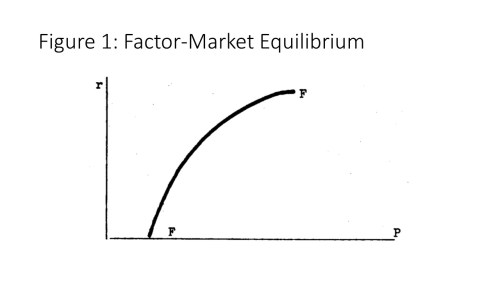
Because K* is assumed to be fully employed with a positive marginal product, a given value of P determines a unique corresponding equilibrium value of L, the supply of labor services being upward-sloping, but relatively elastic with respect to the nominal wage for given wage expectations by workers. That value of L in turn determines an equilibrium value of R for the given value of P. If we assume that inflation expectations are constant (i.e., that Pe varies in proportion to P), then a given value of P must correspond to a unique value of r. Because simultaneous equilibrium in the markets for capital services and labor services can be represented by unique combinations of P and r, a factor-market equilibrium condition can be represented by a locus of points labeled the FF curve in Figure 1 below.

Thompson_Figure1

The FF curve must be upward-sloping, because a linear homogenous production function of two scarce factors (i.e., doubling inputs always doubles output) displaying diminishing marginal products in both factors implies that the factors are complementary (i.e., adding more of one factor increases the marginal productivity of the other factor). Because an increase in P increases employment, the marginal product of capital increases, owing to complementarity between the factors, implying that R must increase by more than P. An increase in the price level, P, is therefore associated with an increase in the market interest rate r.

Beyond the positive slope of the FF curve, Thompson makes a further argument about the position of the FF curve, trying to establish that the FF curve must intersect the horizontal (P) axis at a positive price level as the nominal interest rate goes to 0. The point of establishing that the FF curve intersects the horizontal axis at a positive value of r is to set up a further argument about the stability of the model’s equilibrium. I find that argument problematic. But discussion of stability issues are better left for a future post.

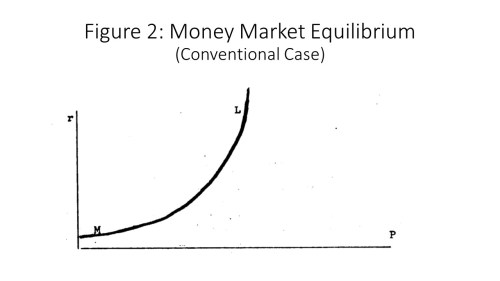
Corresponding to the FF curve, it is straightforward to derive another curve, closely analogous to the Keynesian LM curve, with which to complete a graphical solution of the model. The two LM curves are not the same, Thompson’s LM curve being constructed in terms of the nominal interest rate and the price level rather than in terms of nominal interest rate and nominal income, as is the Keynesian LM curve. The switch in axes allows Thompson to construct two versions of his LM curve. In the conventional case, a fixed nominal quantity of non-interest-bearing money being determined exogenously by the monetary authority, increasing price levels imply a corresponding increase in the nominal demand for money. Thus, with a fixed nominal quantity of money, as the price level rises the nominal interest rate must rise to reduce the quantity of money demanded to match the nominal quantity exogenously determined. This version of the LM curve is shown in Figure 2.

Thompson_Figure2

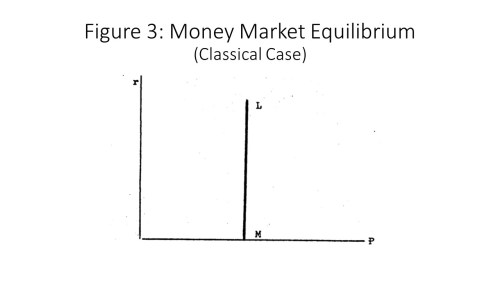
A second version of the LM curve can be constructed corresponding to Thompson’s characterization of the classical model of a competitively supplied interest-bearing money supply convertible into commodities at a fixed exchange rate (i.e., a gold standard except that with only one output money is convertible into output in general not one of many commodities). The quantity of money competitively supplied by the banking system would equal the quantity of money demanded at the price level determined by convertibility between money and output. Because money in the classical model pays competitive interest, changes in the nominal rate of interest do not affect the quantity of money demanded. Thus, the LM curve in the classical case is a vertical line corresponding to the price level determined by the convertibility of money into output. The classical LM curve is shown in Figure 3.

Thompson_Figure3

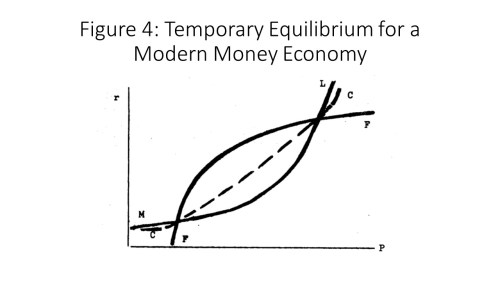
The full solution of the model (in the conventional case) is represented graphically by the intersection of the FF curve with the LM curve in Figure 4.

Thompson_Figure4

Note that by applying Walras’s Law, one could draw a CC curve representing equilibrium in the market for commodities (an analogue to the Keynesian IS curve) in the space between the FF and the LM curves and intersecting the two curves precisely at their point of intersection. Thus, Thompson’s reformulation supports Nick Rowe’s conjecture that the IS curve, contrary to the usual derivation, is really upward-sloping.

The Money Multiplier, RIP?

In case you haven’t heard, Simon Wren-Lewis tried to kill the money multiplier earlier this week. And if he succeeded, and the money multiplier stays killed, if it has indeed been well and truly buried, I for one shall not mourn its long overdue passing. Over the course of my almost thirteen months of blogging I have argued on a number of occasions that, contrary to the money multiplier, bank deposits are endogenous, that they are not so many hot potatoes that, once created, must be held, never to be destroyed. This view has brought me into sharp, but friendly, disagreement with some pretty smart guys whom I usually agree with, like Nick Rowe and Bill Wolsey, but I’m not backing down.

My view of bank deposits has also put me in the same camp — or at least created the appearance that I am in the same camp — with the endogenous money group, Post-Keynesians, Modern Monetary Theorists and the like, whose views I only dimly understand. But it seems that they deny that even the monetary base (i.e., currency plus bank reserves) is under the control of the monetary authority. This group seems to think that banks create deposits in the process of lending, lending is undertaken by banks in response to the demands of the public (businesses and households) for bank loans, and reserves are created by the monetary authority to support whatever level of reserves the banks desire, given the amount of lending that they have undertaken. The money multiplier is wrong, in their view, because it implies that reserves are prior to deposits and, indeed, are the raw material from which deposits are created, when in fact reserves are created to support deposits.

So let me try to explain how I view the money multiplier. I agree with the endogenous money people that reserves are not the stuff out of which deposits are created. However, there is a sense in which base money is logically prior to deposits. Every deposit is a promise to pay the bearer something else outside the control of the creator of the deposit. That something is base money. Under a fiat money system, it is a promise to pay currency. Under a gold standard, it was a promise to pay gold, coin or bullion. This distinction is captured by the distinction between inside money (deposits) and outside money (currency).

It is my position that the quantity of inside money produced or created in an economy is endogenously determined by the real demand of the public to hold inside money and the costs banks incur in creating inside money. Because banks legally commit themselves to convert inside money into outside money on demand, arbitrage usually prevents any significant, or even insignificant, deviation between the value of inside and that of outside money. Because inside money and outside money are fairly close substitutes, the value of outside money is determined simultaneously in the markets for inside and outside money, just as the value of butter is determined simultaneously in the markets for butter and margarine. But heuristically, it is convenient to view the value of money as being determined by the supply of and the demand for base money, which then determines the value of inside money via the arbitrage opportunities created by the convertibility of inside into outside money.  Given the equality in the values of inside and outside money, we can then view the supply of inside money and the demand for inside money as determining the quantity of deposits and the interest rate paid on deposits. Under competitive conditions, the interest paid on deposits must equal the bank lending rate (the gross revenue from creating a deposit) minus the cost of creating a deposit, so that the net revenue (the lending rate minus the deposit rate) equals the cost of creating deposits.

What determines the value of base money? The monetary authorities (central bank plus the Treasury) jointly determine the amount of currency and reserves made available. The public (banks plus households plus businesses) have demands to hold currency when tax payments are due, demands to hold currency for transactions purposes when taxes are not due, and demands to hold currency as a store of value, those demands depending as well on the expected future value of currency and on the yields of alternative assets including inside money. The total demand for currency versus the total stock in existence determines a value at which the public is just willing to hold the amount currency (base or outside money) in existence.

This theoretical setup is analogous to that which determines the value of money under a gold standard. Under a gold standard the amount of gold in existence is endogenously determined as the sum of all the gold ever mined from time period 0 until the present. But in the present period the total stock can be treated as an exogenously fixed amount. The total demand is the sum of the monetary plus non-monetary demands for gold. The value of gold is whatever value is just sufficient to induce the public to hold the amount in existence in the current period. Given that all prices are quoted in gold, the price level is determined by the conversion rate of money into gold times the gold value of every commodity corresponding to the equilibrium real value of gold. The amount of inside money in existence is whatever amount of convertible claims into gold the public wishes to hold given the yields on alternative assets and expectations of the future value of gold.

The operation of a gold standard requires no legal reserves of gold to be held. Legal reserve requirements were an add-on to the gold standard – in my view an unnecessary and dysfunctional add-on – imposed by legislation enacted by various national governments for their own, often misguided, reasons. That is not to say that it would not be prudent for monetary authorities to hold some reserves of gold, but the decision how much reserves to hold has no intrinsic connection to the operation of the gold standard.

Thus, the notion that there is any fixed relationship between the quantity of gold and the amount of convertible banknotes or bank deposits created by the banking system under the gold standard is a logical fallacy. The amount of banknotes and deposits created corresponded to the amount of banknotes and deposits the public wanted to hold, and was in no way logically connected to the amount of gold in existence. Similarly, under a fiat money system, there is no logical connection between the amount of base money and the amount of inside money. The money multiplier is simply a reduced-form, not a structural, equation. Treating it as a structural equation in which the total stock of money (currency plus demand deposits) in existence could be juxtaposed with the total demand to hold money is logically incoherent, because the money multiplier (as a reduced form) is itself determined in part by the demand to hold currency and the demand to hold deposits.

So it’s about time that we got rid of the money multiplier, and I wish Simon Wren-Lewis all the luck in the world in trying to drive a stake into its heart, but somehow I am not all that confident that we have yet seen the last of that pesky creature.

PS I hope, circumstances permitting, tomorrow to continue with my series on Earl Thompson’s reformulation of macroeconomics. This post can perhaps serve as introduction to a future post in the series on alternative versions of the LM curve corresponding to different monetary regimes.

Thompson’s Reformulation of Macroeconomic Theory, Part I: Two Basic Problems with IS-LM

As promised in my previous post, I am going to begin providing a restatement or paraphrase of, plus some commentary on, Earl Thompson’s important, but unpublished, paper “A Reformulation of Macroeconomic Theory.” It will take a number of posts to cover the main points in the paper, and I will probably intersperse posts on Earl’s paper with some posts on other topics. The posts are not written yet, so it remains to be seen how long it takes to go through it together.

The paper begins by identifying “four basic difficulties in received [i.e., Keynesian] theory.” In this post, I will discuss only the first two of the four that are listed, the two that undermine the theoretical foundations of the IS-LM model. The other two problems involve what Earl considered to be inconsistencies between the implications of the IS-LM model and some basic stylized facts of macroeconomics and business cycles, which seem to me less fundamental and less compelling than the two flaws he identified in the conceptual foundations of IS-LM.G

The first difficulty is that the Keynesian model assumes both that the marginal product of labor declines as workers are added and that every worker receives a real wage equal to his marginal product. Those two assumptions logically entail the existence of a second scarce factor of production – call it capital – to absorb the residual between total output and total wages. But even though investment as a category of expenditure is a critical variable in the Keynesian model, the status of capital as a factor of production is unacknowledged, while the rate of interest is determined independently of the market for capital goods by a theory of liquidity preference and the equality between savings and investment. A market for bonds is implicitly acknowledged, but, inasmuch as Walras’s Law allows one market to be disregarded, the bond market is not modeled explicitly. The anomaly of an interest rate in a static, one-period model has been noted, but the inconsistency between the conventional Keynesian model IS-LM model with the basic neoclassical theory of production and factor pricing has been glossed over by the irrelevant observation that Walras’s Law allows the bond market to be excluded, as if the bond market were a proxy for a market for real capital services.

How can the inconsistency between the Keynesian model and the neoclassical theory of production and distribution be reconciled? The simplest way to do so is to treat the single output as both a consumption good and a factor of production. This amounts to treating the single output as a Knightian crusonia plant. If used as a consumption good, the plant is purchased and consumed; if used as a factor of production, it is hired (implicitly or explicitly) at a rental price equal to its marginal product. The ratio of the marginal product of a unit of capital to its price is the real interest rate, and that ratio plus the expected percentage appreciation of the money price of the capital good from the current period to the next is the nominal interest rate. This is a basic property of intertemporal equilibrium. The theory of liquidity preference cannot contradict, but must be in accord with, this condition, something that Keynes himself recognized in chapter 17 of the General Theory and again in his 1937 paper “The General Theory of Employment.”

It is worth quoting from the latter paper at length, as Duncan Foley and Miguel Sidrauski did in their important 1970 article “Portfolio Choice, Investment, and Growth,” cited by Thompson as an important precursor to his own paper. Here is Keynes:

The owner of wealth, who has been induced not to hold wealth in the shape of hoarded money, still has two alternatives between which to choose. He can lend his money at the current rate of money-interest or he can purchase some kind of capital asset. Clearly in equilibrium these two alternatives must offer an equal advantage to the marginal investor in each of them. This is brought about by shifts in the money prices of capital assets relative to money loans. The prices of capital assets move until, having regard to their prospective yield and account being taken of all those elements of doubt and uncertainty interested and disinterested advice, fashion, convention, and what else you will, which affect the mind of the investor who is wavering between one kind of investment and another. . . .

Capital assets are capable, in general, of being newly produced. The scale on which they are produced depends, of course, on the relation between their costs of production and the prices which they are expected to realize in the market. Thus if the level of the rate of interest taken in conjunction with opinions about their prospective yield raise the price of capital assets, the volume of current investment (meaning by this the value of the output of newly produced capital assets) will be increased; while if, on the other hand, these influences reduce the prices of capital assets, the volume of current investment will be diminished.

Thus, Keynes clearly recognized that the volume of investment could be analyzed as the solution of a stock-flow problem with a given cost of producing capital assets in relation to the current and expected future price of capital assets. The solution of such a problem involves an equilibrium in which the money rate of interest must equal the real rental rate of capital services plus the expected rate of appreciation of capital assets. But nothing in the IS-LM model constrains the rate of interest to satisfy this condition.

Earl sums up this discussion compressed into a single paragraph at the beginning of his paper as follows:

An inconsistency thus appears within the received [i.e., IS-LM] theory once we recognize the necessity of a market for the services of a non-labor input, a recognition which amounts to adding an independent equilibrium equation without adding a corresponding variable.

In other words, the IS-LM model implies one interest rate, and the neoclassical theory of production and distribution implies another, and there is no new variable defined that could account for the discrepancy. Earl goes on to elaborate in a long footnote.

Numerous authors have pointed out the inconsistency of Keynesian interest theory with neoclassical marginal productivity theory. But they have not seen the need for the extra equation describing equilibrium in the capital services market, and thus they have not regarded the inconsistency as a direct logical threat to Keynesian models. Rather, they have unfortunately been satisfied, at least since the classic paper of Lerner, with a conjecture that the difference in interest rates vanishes when there are increasing costs of producing capital relative to consumption goods. The error in this conjecture, an error first suggested by Stockfish and fully exposed very recently by Floyd and Hynes, is simply that increasing costs of producing investment goods will not generally permit the interest rate determined by marginal productivity theory to vary in a Keynesian fashion.

In other words, the negative-sloping IS curve will be replaced by a corresponding (FF) curve, representing equilibria in the labor and capital-services markets, that is upward-sloping in terms of interest rates and price levels. The footnote continues:

A legitimate way to account for the difference in interest rates would be to follow Patinkin in assuming the presence of “bonds” which receive the “rate of interest” referred to in the standard theory, a rate of interest which differs from the money rate of return on real capital because of positive transactions costs in the process of lending to owners of capital. But received macroeconomic theory would still be inconsistent with marginal productivity theory because of arbitrage between the two interest rates, where the transactions costs in the process of lending to owners of capital will determine the relationship between the rates. This arbitrage would provide a constraint on the behavior of the bond rate which . . . is generally not satisfied in standard formulations.

The point here is that the interest rate on bonds is not determined in a vacuum. The interest rate on bonds is an epiphenomenon reflecting the deeper forces that determine the rate of return on real capital. Without an underlying market for real capital, the rate of interest on bonds would be indeterminate. Once the real rate of return of capital is determined, the rate of return on bonds can vary only within the limits allowed by the transactions costs of lending and borrowing by financial intermediaries. The footnote concludes with this observation:

Finally, there would be no difference in interest rates, and no extra equation, if the implicit market excluded with Walras’ law in a Keynesian model were simply a capital services market. However, this interpretation of a Keynesian model is inconsistent with the rest of the model.

What Thompson means here is that suppose we had a complete theoretical description of an economy consistent with the neoclassical theory of production and distribution, and we also had a complete description of the Keynesian expenditure functions for consumption and investment. It would then be legitimate, in accordance with Walras’s Law, to exclude the market for capital services, rather than, as Thompson proposes to do, to exclude the expenditure functions. If so, what is all the fuss about? And Earl’s answer is that in order to render the Keynesian income-expenditure model consistent with the excluded market for capital services, we would have to modify the Keynesian income-expenditure model into a two-period framework with an explicit solution for the current and expected future price level of output, implying that the expected rate of inflation would become an equilibrating variable determined as part of the solution of model. Obviously that would not be the Keynesian IS-LM model with which we are all familiar.

I hope this post will serve as a helpful introduction to how Thompson approached macroeconomics.  The next post in this series (but not necessarily the next post on this blog) will discuss the concept of temporary equilibrium and Keynesian unemployment.

Earl Thompson

Sunday, July 29, will be the second anniversary of the sudden passing of Earl Thompson, one of the truly original and creative minds that the economics profession has ever produced. For some personal recollections of Earl, see the webpage devoted to him on the UCLA website, where a list of his publications and working papers, most of which are downloadable, is available. Some appreciations and recollections of Earl are available on the web (e.g, from Tyler Cowen, Scott Sumner, Josh Wright, and Thomas Lifson).  I attach a picture of Earl taken by a department secretary, Lorraine Grams, in 1974, when Earl was about 35 years old.

I first met Earl when I was an undergraduate at UCLA in the late 1960s, his reputation for brilliant, inconclastic, eccentricity already well established. My interactions with Earl as undergraduate were minimal, his other reputation as a disorganized and difficult-to-follow lecturer having deterred me, as a callow sophomore, from enrolling in his intermediate micro class. Subsequently as a first-year graduate student, I had the choice of taking either Axel Leijonhufvud’s macro-theory sequence or Earl’s. Having enjoyed Axel’s intermediate macro course, I never even considered not taking the graduate sequence from Axel, who had just achieved academic stardom with the publication of his wonderful book On Keynesian Economics and the Economics of Keynes. However, little by little over the years, I had started reading some of Earl’s papers on money, especially an early version of his paper “The Theory of Money and Income Consistent with Orthodox Value Theory,” which, containing an explicit model of a competitive supply of money, a notion that I had been exposed to when taking Ben Klein’s undergraduate money and banking course and his graduate monetary theory course, became enormously influential on my own thinking, providing the foundation for my paper, “A Reinterpretation of Classical Monetary Theory” and for much of my book Free Banking and Monetary Reform, and most of my subsequent work in monetary economics. So as a second-year grad student, I decided to attend Earl’s weekly 3-hour graduate macro theory lecture. Actually I think at least half of us in the class may have been there just to listen to Earl, not to take the class for credit. Despite his reputation as a disorganized and hard to follow lecturer, each lecture, which was just Earl at the blackboard with a piece of chalk drawing various supply and demand curves, and occasionally something more complicated, plus some math notation, but hardly ever any complicated math or formal proofs, and just explaining the basic economic intuition of whatever concept he was discussing. By this time he had already worked out just about all of the concepts, and he was not just making it up as he was going along, which he could also do when confronted with a question about something he hadn’t yet thought through. But by then, Earl had thought through the elements of his monetary theory so thoroughly and for so long, that everything just fit into place beautifully. And when you challenged him about some point, he almost always had already anticipated your objection and proceeded to explain why your objection wasn’t a problem or even supported his own position.

I didn’t take detailed notes of his lectures, preferring just to try to understand how Earl was thinking about the topics that he was discussing, so I don’t have a clear memory of the overall course outline.  However his paper “A Reformulation of Macroeconomic Theory,” of which he had just produced an early draft, provides the outline of what he was covering. He started with a discussion of general equilibrium and its meaning, using Hicksian temporary equilibrium as his theoretical framework.  Perhaps without realizing it, he developed many of the ideas in Hayek’s Economics and Knowledge paper, which may, in turn, have influenced Hicks, who was for a short time Hayek’s student and colleague at LSE — in particular the idea that intertemporal equilibrium means consistency of plans so that economic agents are able to execute their plans as intended and therefore do not regret their decisions ex post. From there I think he developed a search-theoretic explanation of involuntary unemployment in which mistaken worker expectations of wages, resulting from an inability to distinguish between sector-specific and economy-wide shocks, causes labor-supply curves to be highly elastic at the currently expected wage, implying large fluctuations in employment, in response to economy-wide shocks, rather than rapid adjustments in nominal wages . With this theoretical background, Earl constructed a simple aggregative model as an alternative to the Keynesian model, the difference being that Earl dispensed with the Keynesian expenditure functions and the savings equals investment equilibrium condition, replacing them with a capital-market equilibrium condition derived from neo-classical production theory — an inspired modeling choice.

Thus, in one fell swoop, Earl created a model fully consistent with individual optimizing behavior, market equilibrium and Keynesian unemployment. Doing so involved replacing the traditional downward-sloping IS curve with an upward-sloping, factor-market equilibrium curve. At this point, the model could be closed either with a traditional LM curve corresponding to an exogenously produced money supply or with a vertical LM curve associated with a competitively produced money supply. That discussion in turn led to a deep excursion into the foundations of monetary theory, the historical gold standard, fiat money, and a comparison of the static and dynamic efficiency of alternative monetary institutions, combined with a historical perspective on the Great Depression, and the evolution of modern monetary institutions. It was a terrific intellectual tour de force, and a highlight of my graduate training at UCLA.

Unfortunately, “A Reformulation of Macroeconomic Theory” has never been published, though a revised version of the paper (dated 1977) is available on Earl’s webpage. The paper is difficult to read, at least for me, because Earl was much too terse in his exposition – many propositions are just stated with insufficient motivation or explanation — with readers often left scratching their heads about the justification for what they have read or why they should care.  So over the next week or so, I am going to write a series of posts summarizing the main points of the paper, and discussing why I think the argument is important, problems I have with his argument or ways in which the argument needs further elaboration or what not. I hope the discussions will lead people to read the original paper, as well as Earl’s other papers.

George Selgin Asks a Question

I first met George Selgin almost 30 years ago at NYU where I was a visiting assistant professor in 1981, and he was a graduate student. I used to attend the weekly Austrian colloquium headed by Israel Kirzner, which included Mario Rizzo, Gerry O’Driscoll, and Larry White, and a group of very smart graduate students like George, Roger Koppl, Sandy Ikeda, Allanah Orrison, and others that I am not recalling. Ludwig Lachmann was also visiting NYU for part of the year, and meeting him was a wonderful experience, as he was very encouraging about an early draft of my paper “A Reinterpretation of Classical Monetary Theory,” which I was then struggling to get into publishable form. A few years later, while I was writing my book Free Banking and Monetary Reform, I found out (I can’t remember how, but perhaps through Anna Schwartz who was on George’s doctoral committee) that he was also writing a book on free banking based on his doctoral dissertation. His book, The Theory of Free Banking, came out before mine, and he kindly shared his manuscript with me as I was writing my book. Although we agreed on many things, our conceptions of free banking and our interpretations of monetary history and policy were often not in sync.

Despite these differences, I watched with admiration as George developed into a prolific economist with a long and impressive list of publications and accomplishments to his credit. I also admire his willingness to challenge his own beliefs and to revise his views about economic theory and policy when that seems to be called for, for example, recently observing in a post on the Free Banking blog that he no longer describes himself as an Austrian economist, and admires that Austrian bete noire, Milton Friedman, though he has hardly renounced his Hayekian leanings.

In one of his periodic postings (“A Question to Market Monetarists“) on the Free Banking blog, George recently discussed NGDP targeting, and raised a question to supporters of nominal GDP targeting, a challenging question to be sure, but a question not posed in a polemical spirit, but out of genuine curiosity. George begins by noting that his previous work in arguing for the price level to vary inversely with factor productivity bears a family resemblance to proposals for NGDP targeting, the difference being whether, in a benchmark case with no change in factor productivity and no change in factor supplies, the price level would be constant or would rise at some specified rate, presumably to overcome nominal rigidities. In NGDP targeting with an upward price trend (Scott Sumner’s proposal) or in NGDP targeting with a stationary price trend (George’s proposal), any productivity increase would correspond to price increases below the underlying price trend and productivity declines would correspond to price increases above underlying the price trend.

However, despite that resemblance, George is reluctant to endorse the Market Monetarist proposal for rapid monetary expansion to promote recovery. George gives three reasons for his skepticism about increasing the rate of monetary expansion to promote recovery, but my concern in this post is with his third, which is the most interesting from his point of view and the one that prompts the question that he poses. George suggests that given the 4.5-5.0% rate of growth in NGDP in the US since the economy hit bottom in the second quarter of 2009, it is not clear why, according to the Market Monetarists, the economy should not, by now, have returned to roughly its long-run real growth trend. (I note here a slight quibble with George’s 4.5-5.0% estimate of recent NGDP growth.  In my calculations, NGDP has grown at just 4.00% since the second quarter of 2009, and at 3.82% since the second quarter of 2010.)

Here’s how George characterizes the problem.

My third reason stems from pondering the sort of nominal rigidities that would have to be at play to keep an economy in a state of persistent monetary shortage, with consequent unemployment, for several years following a temporary collapse of the level of NGDP, and despite the return of the NGDP growth rate to something like its long-run trend.

Apart from some die-hard New Classical economists, and the odd Rothbardian, everyone appreciates the difficulty of achieving such downward absolute cuts in nominal wage rates as may be called for to restore employment following an absolute decline in NGDP. Most of us (myself included) will also readily agree that, if equilibrium money wage rates have been increasing at an annual rate of, say, 4 percent (as was approximately true of U.S. average earnings around 2006), then an unexpected decline in that growth rate to another still positive rate can also lead to unemployment. But you don’t have to be a die-hard New Classicist or Rothbardian to also suppose that, so long as equilibrium money wage rates are rising, as they presumably are whenever there is a robust rate of NGDP growth, wage demands should eventually “catch down” to reality, with employees reducing their wage demands, and employers offering smaller raises, until full employment is reestablished. The difficulty of achieving a reduction in the rate of wage increases ought, in short, to be considerably less than that of achieving absolute cuts.

U.S. NGDP was restored to its pre-crisis level over two years ago. Since then both its actual and its forecast growth rate have been hovering relatively steadily around 5 percent, or about two percentage points below the pre-crisis rate.The growth rate of U.S. average hourly (money) earnings has, on the other hand, declined persistently and substantially from its boom-era peak of around 4 percent, to a rate of just 1.5 percent.** At some point, surely, these adjustments should have sufficed to eliminate unemployment in so far as such unemployment might be attributed to a mere lack of spending. How can this be?

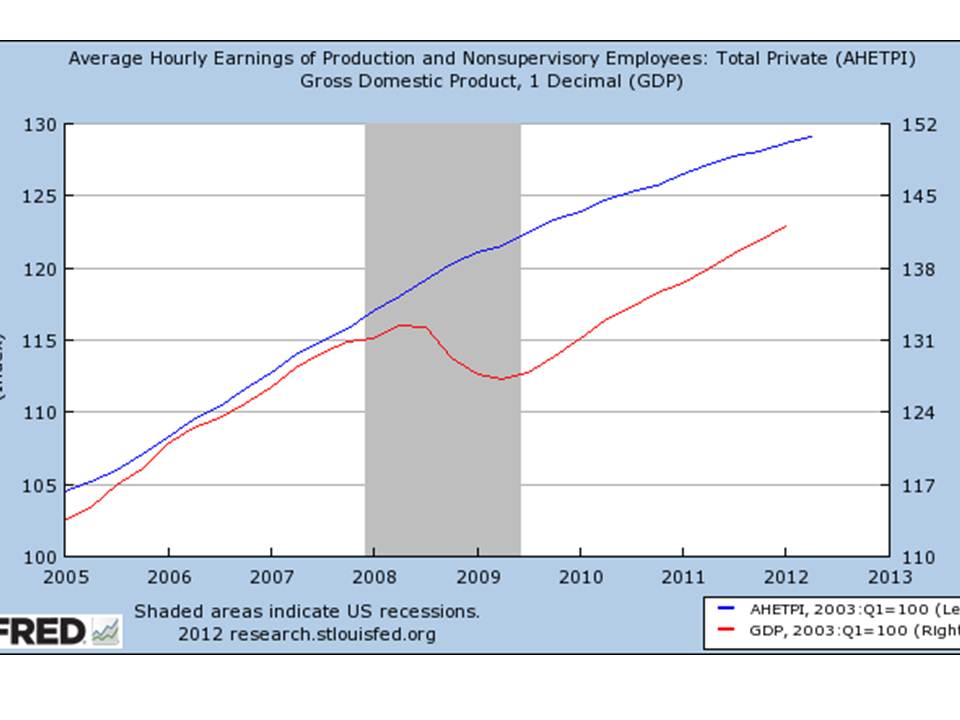
There have been a number of responses to George. Among them, Scott Sumner, Bill Woolsey and Lars Christensen. George, himself, offered a response to his own question, in terms of this graph plotting the time path of GDP versus the time path of nominal wages before and since the 2007-09 downturn.

Here’s George’s take on the graph:

Here one can clearly see how, while NGDP plummeted, hourly wages kept right on increasing, albeit at an ever declining rate. Allowing for compounding, this difference sufficed to create a gap between wage and NGDP levels far exceeding its pre-bust counterpart, and large enough to have been only slightly reduced by subsequent, reasonably robust NGDP growth, notwithstanding the slowed growth of wages.

The puzzle is, of course, why wages have kept on rising at all, despite high unemployment. Had they stopped increasing altogether at the onset of the NGDP crunch, wages and total spending might have recovered their old relative positions about two years ago. That, presumably, would have been too much to hope for. But if it is unreasonable to expect wage inflation to stop on a dime, is it not equally perplexing that it should lunge ahead like an ocean liner might, despite having its engines put to a full stop?

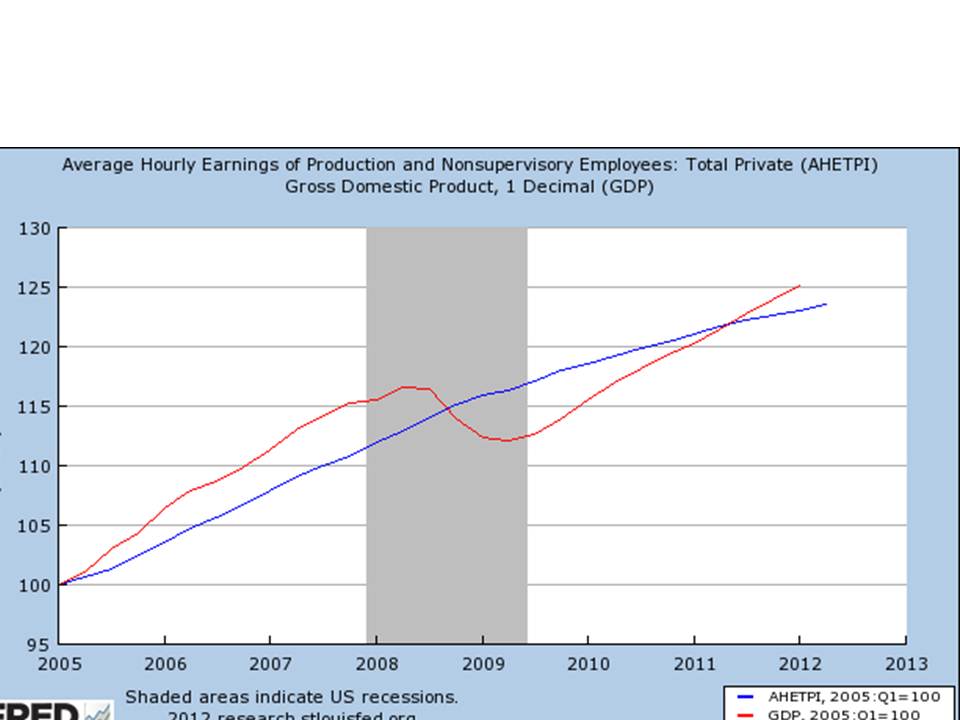
However, after some further tinkering, George decided that the appropriate scaling of the graph implied that the relationship between the two time paths was that displayed in the graph below.

As a result of that rescaling, George withdrew, or at least qualified, his earlier comment. So, it’s obviously getting complicated. But Marcus Nunes, a terrific blogger and an ingenious graph maker, properly observes that George’s argument should be unaffected by any rescaling of his graph. The important feature of the time path of nominal GDP is that it dipped sharply and then resumed its growth at a somewhat slower rate than before the dip while the time path of nominal wages has continued along its previous trend, with just a gentle flattening of the gradient, but without any dip as occurred in the NGDP time path.  The relative position of the two curves on the graph should not matter.

By coincidence George’s first post appeared the day before I published my post about W. H. Hutt on Say’s Law and the Keynesian multiplier in which I argued that money-wage adjustments — even very substantial money-wage adjustments — would not necessarily restore full employment. The notion that money-wage adjustments must restore full employment is a mistaken inference from a model in which trading occurs only at equilibrium prices.  But that is not the world that we inhabit. Trading takes place at prices that the parties agree on, whether or not those prices are equilibrium prices. The quantity adjustments envisaged by Keynes and also by Hutt in his brilliant interpretation of Say’s Law, can prevent price-and-wage adjustments, even very large price-and-wage adjustments, from restoring a full-employment equilibrium. Hutt thought otherwise, but made no effective argument to prove his case, relying simply on a presumption that market forces will always put everything right in the end. But he was clearly mistaken on that point, as no less an authority that F. A. Hayek, in his 1937 article, “Economics and Knowledge,” clearly understood. For sufficiently large shocks, there is no guarantee that wage-and-price adjustments on their own will restore full employment.

In a comment on Scott’s blog, I made the following observation.

[T]he point [George] raises about the behavior of wages is one that I have also been wondering about. I mentioned it in passing in a recent post on W. H. Hutt and Say’s Law and the Keynesian multiplier. I suggested the possibility that we have settled into something like a pessimistic expectations equilibrium with anemic growth and widespread unemployment that is only very slowly, if at all, trending downwards. To get out of such a pessimistic expectations equilibrium you would need either a drastic downward revision of expected wages or a drastic increase in inflationary expectations sufficient to cause a self-sustaining expansion in output and employment. Just because the level of wages currently seems about right relative to a full employment equilibrium doesn’t mean that level of wages needed to trigger an expansion would not need to be substantially lower than the current level in the transitional period to an optimistic-expectations equilibrium. This is only speculation on my part, but I think it is potentially consistent with the story about inflationary expectations causing the stock market to rise in the current economic climate.

George later replied on Scott’s blog as follows:

David Glasner suggests “the possibility that we have settled into something like a pessimistic expectations equilibrium with anemic growth and widespread unemployment…To get out of such a pessimistic expectations equilibrium you would need either a drastic downward revision of expected wages or a drastic increase in inflationary expectations.”

The rub, if you ask me, is that of reconciling “pessimistic expectations” with what appears, on the face of things, to be an overly optimistic positioning of expected wages.

I am not sure why George thinks there is a problem of reconciliation. As Hayek showed in his 1937 article, a sufficient condition for disequilibrium is that expectations be divergent. If expectations diverge, then the plans constructed on those plans cannot be mutually consistent, so that some, perhaps all, plans will not be executed, and some, possibly all, economic agents will regret some prior decisions that they took. Especially after a large shock, I see no reason to be surprised that expectations diverge or even that, as a group, workers are slower to change expectations than employers. I may have been somewhat imprecise in referring to a “pessimistic-expectations” equilibrium, because what I am thinking of is an inconsistency between the pessimism of entrepreneurs about future prices and the expectations of workers about wages, not a situation in which all agents are equally pessimistic. If everyone were equally pessimistic, economic activity might be at a low level, but we wouldn’t necessarily observe any disappointed buyers or sellers. But what qualifies as disappointment might not be so easy to interpret. But we likely would observe a reduction in output. So a true “pessimistic-expectations” equilibrium is a bit tricky to think about. But in practice, there seems nothing inherently surprising about workers’ expectations of future wages not adjusting downward as rapidly as employers’ expectations do. It may also be the case that it is the workers with relatively pessimistic expectations who are dropping out of the labor force, while those with more optimistic expectations continue to search for employment.

I don’t say that the slow recovery poses not difficult issues for advocates of monetary stimulus to address.  The situation today is not exactly the same as it was in 1932, but I don’t agree that it can be taken as axiomatic that a market economy will recover from a large shock on its own.  It certainly may recover, but it may not.  And there is no apodictically true demonstration in the whole corpus of economic or praxeological theory that such a recovery must necessarily occur.

W. H. Hutt on Say’s Law and the Keynesian Multiplier

In a post a few months ago, I referred to W. H. Hutt as an “unjustly underrated” and “all but forgotten economist” and “as an admirable human being,” who wrote an important book in 1939, The Theory of Idle Resources, seeking to counter Keynes’s theory of involuntary unemployment. In responding to a comment on a more recent post, I pointed out that Armen Alchian relied on one of Hutt’s explanations for unemployment to provide a microeconomic basis for Keynes’s rather convoluted definition of involuntary unemployment, so that Hutt unintentionally provided support for the very Keynesian theory that he was tried to disprove. In this post, I want to explore Hutt’s very important and valuable book ARehabilitation of Say’s Law, even though, following Alchian, I would interpret what Hutt wrote in a way that is at least potentially supportive of Keynes, while also showing that Hutt’s understanding of Say’s Law allows us to view Says Law and the Keynesian multiplier as two (almost?) identical ways of describing the same phenomenon.

But before I discuss Hutt’s understanding of Say’s Law, a few words about why I think Hutt was an admirable human being are in order. Born in 1899 into a working class English family (his father was a printer), Hutt attended the London School of Economics in the early 1920s, coming under the influence of Edwin Cannan, whose writings Hutt often referred to. After gaining his bachelor’s degree, Hutt, though working full-time, continued taking courses at LSE, even publishing several articles before taking a position at the University of Capetown in 1930, despite having no advanced degree in economics. Hutt remained in South Africa until the late 1960s or early 1970s, becoming an outspoken critic of legal discrimination against non-whites and later of the apartheid regime instituted in 1948. In his book, The Economics of the Colour Bar, Hutt traced the racial policies of the South African regime not just to white racism, but to the interest of white labor unions in excluding competition by non-whites. Hutt’s hostility to labor unions for their exclusionary and protectionist policies was evident in much of his work, beginning at least with his Theory of Collective Bargaining, his Strike-Threat System, and his many critiques of Keynesian economics. However, he was opposed not to labor unions as such, just to the legal recognition of the right of some workers to coerce others into a collusive agreement to withhold their services unless their joint demand for a stipulated money wage was acceded to by employers, a right that in most other contexts would be both legally and morally unacceptable. Whether or not Hutt took his moral opposition to collective bargaining to extremes, he certainly was not motivated by any venal motives. Certainly his public opposition to apartheid, inviting retribution by the South African regime, was totally disinterested, and his opposition to collective bargaining was no less sincere, even If less widely admired, than his opposition to apartheid, and no more motivated by any expectation of personal gain.

In the General Theory, launching an attack on what he carelessly called “classical economics,” Keynes devoted special attention to the doctrine he described as Say’s Law, a doctrine that had been extensively and inconclusively debated in the nineteenth century after Say formulated what he had called the Law of the Markets in his Treatise on Political Economy in 1803. The exact meaning of the Law of the Markets was never entirely clear, so that, in arguing about Say’s Law, one can never be quite sure that one knows what one is talking about. At any rate, Keynes paraphrased Say’s Law in the following way: supply creates its own demand. In other words, “if you make it, they will buy it, or at least buy something else, because the capacity to demand is derived from the capacity to supply.”

Here is Keynes at p. 18 of the General Theory:

From the time of Say and Ricardo the classical economists have taught that supply creates its own demand; — meaning by this in some significant, but not clearly defined, sense that the whole of the costs of production must necessarily be spent in the aggregate, directly or indirectly, on purchasing the product.

In J. S. Mill’s Principles of Political Economy the doctrine is expressly set forth:

What constitutes the means of payment for commodities. Each person’s means of paying for the productions of other people consist of those which he himself possesses. All sellers are inevitably, and by the meaning of the word, buyers. Could we suddenly double the productive powers of the country, we should double the supply of commodities in every market; but we should, by the same stroke, double the purchasing power. Everybody would bring a double demand as well as supply; everybody would be able to buy twice as much, because every one would have twice as much to offer in exchange.

Then, again at p. 26, Keynes restates Say’s Law in his own terminology:

In the previous chapter we have given a definition of full employment in terms of the behavior of labour. An alternative, though equivalent, criterion is that at which we have now arrived, namely, a situation in which aggregate employment is inelastic in response to an increase in effective demand for its output. Thus Say’s Law, that the aggregate demand price of output as a whole is equal ot its aggregate supply price for all volumes of output [“could we suddenly double the productive powers of the country . . . we should . . . double the purchasing power”], is equivalent the proposition that there is no obstacle to full employment. If, however, this is not the true law relating the aggregate demand and supply functions, there is a vitally important chapter of economic theory which remains to be written and without which all discussions concerning the volume of aggregate employment are futile.

Keynes restated the same point in terms of his doctrine that macroeconomic equilibrium, the condition for which being that savings equal investment, could occur at a level of output and income corresponding to less than full employment. How could this happen? Keynes believed that if the amount that households desired to save at the full employment level of income were greater than the amount that businesses would invest at that income level, expenditure and income would decline until desired (and actual) savings equaled investment. If Say’s Law held, then whatever households chose not to spend would get transformed into investment by business, but Keynes denied that there was any mechanism by which this transformation would occur. Keynes proposed his theory of liquidity preference to explain why savings by households would not necessarily find their way into increased investment by businesses, liquidity preference preventing the rate of interest from adjusting to induce as much investment as required to generate the full-employment level of output and income.

Now the challenge for Keynes was to explain why, if there is less than full employment, wages would not fall to induce businesses to hire the unemployed workers. From Keynes’s point of view it wasn’t enough to assert that wages are sticky, because a classical believer in Say’s Law could have given that answer just as well.  If you prevent prices from adjusting, the result will be a disequilibrium.  From Keynes’s standpoint, positing price or wage inflexibility was not an acceptable explanation for unemployment.  So Keynes had to argue that, even if wages were perfectly flexible, falling wages would not induce an increase in employment. That was the point of Keynes’s definition of involuntary unemployment as a situation in which an increased price level, but not a fall in money wages, would increase employment. It was in chapter 19 of the General Theory that Keynes provided his explanation for why falling money wages would not induce an increase in output and employment.

Hutt’s insight was to interpret Say’s Law differently from the way in which most previous writers, including Keynes, had interpreted it, by focusing on “supply failures” rather than “demand failures” as the cause of total output and income falling short of the full-employment level. Every failure of supply, in other words every failure to achieve market equilibrium, means that the total effective supply in that market is less than it would have been had the market cleared. So a failure of supply (a failure to reach the maximum output of a particular product or service, given the outputs of all other products and services) implies a restriction of demand, because all the factors engaged in producing the product whose effective supply is less than its market-clearing level are generating less demand for other products than if they were producing the market-clearing level of output for that product. Similarly, if workers don’t accept employment at market-clearing wages, their failure to supply involves a failure to demand other products. Thus, failures to supply can be cumulative, because any failure of supply induces corresponding failures of demand, which, unless there are further pricing adjustments to clear other affected markets, trigger further failures of demand. And clearly the price adjustments required to clear any given market will be greater when other markets are not clearing than when those other markets are clearing.

So, with this interpretation, Hutt was able to deploy Say’s Law in a way that sheds important light on the cumulative processes of contraction and expansion characterizing business-cycle downturns and recoveries. In his modesty, Hutt disclaimed originality in using Say’s Law as a key to understanding those cumulative processes, citing various isolated statements by older economists (in particular a remark of the Cambridge economist Frederick Lavington in his 1921 book The Trade Cycle: “The inactivity of all is the cause of the inactivity of each”) that vaguely suggest, but don’t spell out, the process that Hutt describes in meticulous detail. If Hutt’s analysis was anticipated in any important way, it was by Clower and Leijonhufvud in their paper “Say’s Principle, What it Means and Doesn’t Mean,” (reprinted here and here), which introduced a somewhat artificial distinction between Say’s Law, as Keynes conceived of it, and Say’s Principle, which is closer to how Hutt thought about it.  But to Clower and Leijonhufvud, Say’s Principle was an essential part of the explanation of the Keynesian multiplier.  The connection between them is simple, effective supply is identical to effective demand because every purchase is also a sale.  A cumulative process can be viewed as either a supply-side process (Say’s Law) or a demand-side process (the Keynesian multiplier), but they are really just two sides of the same coin.

So if you have followed me this far, you may be asking yourself, did Hutt really rehabilitate Say’s Law, as he claimed to have done? And if so, did he refute Keynes, as he also claimed to have done? My answer to the first question is a qualified yes. And my answer to the second question is a qualified no. I will not try to justify my qualification to my answer to the first question, except to note that the qualification depends on the assumptions made about how money is supplied in the relevant model of the economy. In a model in which money is endogenously supplied by private banks, Say’s Law holds; in a model in which the supply of money is fixed exogenously, Say’s Law does not hold. For more on this, see my paper, “A Reinterpretation of Classical Monetary Theory,” or my book Free Banking and Monetary Reform (pp. 62-66).

But if Hutt was right about Say’s Law, how can Keynes be right that cutting money wages is not a good way (but in Hutt’s view the best way) to cure a depression that is itself caused by the mispricing of assets and factors of production? The answer is that, for all the care Hutt exercised in working out his analysis, he was careless in making explicit his assumptions about the expectations of workers about future wages (i.e., the wages at which they would be able to gain employment). The key point is that if workers expect to be able to find employment at higher wages than they will in fact be offered, the aggregate supply curve of labor will intersect the aggregate demand curve for labor at a wage rate that is higher, and a quantity that is lower, than would be the case in an equilibrium in which workers’ expectations about future wages were correct. From the point of view of Hutt, there is a supply failure because the aggregate supply of labor is less than the hypothetical equilibrium supply under correct wage expectations. But there is no restriction on market pricing, just incorrect expectations of future wages. Expectations need not be rigid, but in a cumulative process, wage expectations may not adjust as fast as wages are falling. Though Keynes, himself, did not discuss the possibility explicitly, it is also possible that there could be multiple equilibria corresponding to different sets of expectations (e.g., optimistic or pessimistic). If the economy settles into a pessimistic equilibrium, unemployment could stabilize at levels that are permanently higher than those that would have prevailed under an optimistic set of expectations. Perhaps we are now stuck in (or approaching) such a pessimistic equilibrium.

Be that as it may, Hutt simply assumes that allowing all prices to be determined freely in unfettered markets must result in the quick restoration of a full-employment equilibrium. This is a reasonable position to take, but there is no way of proving it logically. Proofs that free-market adjustment leads to an equilibrium are based on some sort of tatonnement or recontracting process in which trading does not occur at disequilibrium prices. In the real world, there is no restriction on trading at disequilibrium process, so there is no logical argument that shows that the Say’s Law dynamic described by Hutt cannot go on indefinitely without reaching equilibrium. F. A. Hayek, himself, explained this point in his classic 1937 paper “Economics and Knowledge.”

In the light of our analysis of the meaning of a state of equilibrium it should be easy to say what is the real content of the assertion that a tendency toward equilibrium exists. It can hardly mean anything but that, under certain conditions, the knowledge and intentions of the different members of society are supposed to come more and more into agreement or, to put the same thing in less general and less exact but more concrete terms, that the expectations of the people and particularly of the entrepreneurs will become more and more correct. In this form the assertion of the existence of a tendency toward equilibrium is clearly an empirical proposition, that is, an assertion about what happens in the real world which ought, at least in principle, to be capable of verification. And it gives our somewhat abstract statement a rather plausible common-sense meaning. The only trouble is that we are still pretty much in the dark about (a) the conditionsunder which this tendency is supposed to exist and (b) the nature of the process by which individual knowledge is changed.

In the usual presentations of equilibrium analysis it is generally made to appear as if these questions of how the equilibrium comes about were solved. But, if we look closer, it soon becomes evident that these apparent demonstrations amount to no more than the apparent proof of what is already assumed[11] . The device generally adopted for this purpose is the assumption of a perfect market where every event becomes known instantaneously to every member. It is necessary to remember here that the perfect market which is required to satisfy the assumptions of equilibrium analysis must not be confined to the particular markets of all the individual commodities; the whole economic system must be assumed to be one perfect market in which everybody knows everything. The assumption of a perfect market, then, means nothing less than that all the members of the community even if they are not supposed to be strictly omniscient, are at least supposed to know automatically all that is relevant for their decisions. It seems that that skeleton in our cupboard, the “economic man,” whom we have exorcised with prayer and fasting, has returned through the back door in the form of a quasi-omniscient individual.
Both Sraffa and Hayek Were Right and Wrong About the Natural Rate of Interest

Last September, after Robert Murphy and Lord Keynes wrote about the Sraffa-Hayek debate of 1932 about the natural rate of interest, I wrote a post about that controversy in which I took an intermediate position defending Hayek against Sraffa’s charge that his use of the natural-rate concept was incoherent, while observing as well that the natural rate of interest in nominal terms is not unique, because any real intertemporal equilibrium is consistent with any choice of price level and any rate of inflation. The condition for a real intertemporal equilibrium with money is simply that the level and rate of change of prices be foreseen correctly.  In such an equilibrium, own rates could differ, but by no more than necessary to compensate for different real service flows and different costs of storage associated with different assets, inasmuch as the expected net real return from holding every asset must be equal in equilibrium. But while expected real returns from holding assets must be equal, that unique real return is consistent with any nominal return reflecting any arbitrary rate of price change.  It is not by choosing a particular nominal rate of interest — a rate that equals the natural rate — that the monetary authority brings about intertemporal equilibrium.  Rather, it is the consistency between whatever nominal interest rate the monetary authority has chosen and the expectations by economic agents of future prices that is the necessary and sufficient condition for intertemporal equilibrium. Any nominal interest rate can become the natural rate if it is supported by an equilibrium set of price expectations. Hayek almost, but not quite, understood this point. His incomplete understanding seems to have prevented him from responding effectively to Sraffa’s charge that his concept of a natural rate of interest was incoherent based on the potential existence of many different own rates of interest in a barter equilibrium.

As a result of last September’s post about Sraffa and Hayek, my colleague Paul Zimmerman and I wrote a paper about the Sraffa-Hayek debate and Keynes’s role in the debate and his later discussion of own rates in chapter 17 of the General Theory. I gave a talk about this paper at Brock University in St. Catherines, Ontario on Sunday at the annual meeting of the History of Economics Society. At some point in the near future, I hope the paper will be ready to circulate on the internet and to submit for publication. When it is I will provide a link to it on the blog. So it was an interesting coincidence that two days after the conference, the Sraffa-Hayek debate about the natural rate and about own rates was the subject of renewed interest in the blogosphere.

The latest round was started by Andrew Laiton who wrote about multiple own rates of interest. Laiton apparently thinks that there could be multiple real own rates, but seems to me to overlook the market forces that tend to equalize own rates, market forces wonderfully described by Keynes in chapter 17. Nick Rowe followed up with a post in which he seems to accept that real own rates could differ across commodities, but doesn’t think that that matters. All that matters is that the monetary authority choose a particular own rate and sets its nominal rate to match the chosen own rate. (Daniel Kuehn agrees with Nick here.)

Nick is right that there is no natural rate that can be defined apart from a particular choice of a nominal price path for at least one commodity over time. But in an economy with n commodities and t time periods, there are nt possible choices (actually many more possible choices if we take into account all possible baskets of commodities and all possible rates of price change). The job of the monetary authority is to pin down a path of nominal prices.  Given that nominal choice, the natural rate consistent with intertemporal equilibrium would find expression in a particular nominal term structure of interest rates consistent with the equilibrium price expectations of agents. Hayek himself proposed constant NGDP as a possible monetary rule. What Hayek failed to see is that it was the choice of a particular value or time path of nominal GDP that would determine a particular nominal value of the natural rate, not, as Hayek believed, that by choosing a nominal interest rate equal to the natural rate, the monetary authority would ensure that NGDP remained constant over time.

Money Wages and Money Illusion

A couple of weeks ago, in the first of three posts about Armen Alchian’s discussion of the microeconomic underpinnings for Keynesian involuntary unemployment, I quoted the following passage from a footnote in Alchian’s classic paper, “Information Costs, Pricing, and Resource Unemployment.”

[C]onsider the following question: Why would a cut in money wages provoke a different response than if the price level rose relative to wages – when both would amount to the same change in relative prices, but differ only in the money price level? Almost everyone thought Keynes presumed a money wage illusion. However, an answer more respectful of Keynes is available. The price level rise conveys different information: Money wages everywhere have fallen relative to prices. On the other hand, a cut in one’s own wage money wage does not imply options elsewhere have fallen. A cut only in one’s present job is revealed. The money versus real wage distinction is not the relevant comparison; the wage in the present job versus the wage in all other jobs is the relevant comparison. This rationalizes Keynes’ definition of involuntary unemployment in terms of price-level changes. If wages were cut everywhere else, and if employees knew it, they would not choose unemployment – but they would if they believed wages were cut just in their current job. When one employer cuts wages, this does not signify cuts elsewhere. His employees rightly think wages are not reduced elsewhere. On the other hand, with a rise in the price level, employees have less reason to think their current real wages are lower than they are elsewhere. So they do not immediately refuse a lower real wage induced by a higher price level, whereas they would refuse an equal money wage cut in their present job. It is the revelation of information about prospects elsewhere that makes the difference.

Saturos made the following comment on that post:

“The price level rise conveys different information: Money wages everywhere have fallen relative to prices. On the other hand, a cut in one’s own wage money wage does not imply options elsewhere have fallen.”

But that is money illusion. If my money wage rises by less than inflation, that says nothing about whether other money wages have risen by less than inflation. There is no explanation for a separate behavioral response to a cut in one’s observed real wage through nominal wages or prices – unless workers are observing their nominal wages instead of their real wages, i.e. money illusion.

I gave only a cursory response to Saturos’s comment, though I did come back to it in the third of my series of posts on Alchian’s discussion of Keynesian unemployment. But my focus was primarily on Alchian’s discussion of the validity of the inflation-induced-wage-lag hypothesis, a hypothesis disputed by Alchian and attributed by him to Keynes. I discussed my own reservations about Alchian’s position on the wage lag in that post, but here I want to go back and discuss Saturos’s objection directly. My claim is that there is a difference between the assumption that workers observe only nominal, not real, wages, in the process of making decisions about whether to accept or reject wage offers and the assumption of money illusion.

Here is how to think about the difference. In any period, some workers are searching for employment, and presumably they (or at least some of them) can search more efficiently (i.e., collect more wage offers) while unemployed than employed.  In obtaining wage offers, workers can only observe a nominal wage offer for their services; they can’t observe a real wage, because it is too costly and time-consuming for any individual to collect observations for all the goods and services that enter into a reasonably comprehensive price index, and then compute a price level from those price observations. However, based on experience and other sources of information, workers, like other economic agents, form expectations about what prices they will observe (i.e., the prices that will clear markets). In any period, workers’ wage expectations are determined, in part, by their expectations of movements in the general price level. The higher the expected rate of inflation, the higher the expected wage. The absence of money illusion means that workers change their expectations of wage offers (given expectations about changes in real wages) in line with their expectations of inflation. However, within any period, workers’ expectations are fixed. (Actually, the period can be defined as the length of time during which expectations are held fixed.) This is simply the temporary-equilibrium construct introduced by Hicks in Value and Capital and again in Capital and Growth.

With expectations fixed during a given period, workers, observing wage offers, either accept or reject those offers by comparing a given nominal nominal wage offer with the nominal reservation wage settled upon at the beginning of the period, a reservation wage conditional on the expectation of inflation for that period formed at the beginning of the period. Thus, the distinction made by Alchian between the information conveyed by a nominal-wage cut at a constant price level versus the information conveyed by a constant money wage at an unexpectedly high price level is perfectly valid, and entails no money illusion. The only assumption is that, over some finite period of time, inflation or price-level expectations are held constant instead of being revised continuously and instantaneously. Another way of saying this is that the actual rate of inflation does not always equal the expected rate of inflation. But to repeat, there is no assumption of money illusion. I am pretty sure that I heard Earl Thompson explain this in his graduate macrotheory class at UCLA around 1972-73, but I had to work through the argument again for myself before remembering that I had heard it all from Earl about 40 years earlier.

Anna Schwartz, RIP

Last Thursday night, I was in Niagra Falls en route to the History of Economics Society Conference at Brock University in St. Catharines, Ontario to present a paper on the Sraffa-Hayek debate (co-authored with my FTC colleague Paul Zimmerman) when I saw the news that Anna Schwartz had passed away a few hours earlier. The news brought back memories of how I first got to know Anna in 1985, thanks to our mutual friend Harvey Segal, formerly chief economist at Citibank, who had recently joined the Manhattan Institute where I was a Senior Fellow and had just started writing my book Free Banking and Monetary Reform. When Harvey suggested that it would be a good idea for me to meet and get to know Anna, I was not so sure that it was such a good idea, because I knew that I was going to be writing critically about Friedman and Monetarism, and about the explanation for the Great Depression given by Friedman and Schwartz in their Monetary History of the US. Nevertheless, Harvey was insistent, dismissing my misgivings and assuring me that Anna was not only a great scholar, but a wonderful and kind-hearted person, and that she would not take offense at a sincerely held difference of opinion. Taking Harvey’s word, I went to visit Anna at her office at the NBER on the NYU campus at Washington Square, but not without some residual trepidation at what was in store for me. But when I arrived at her office, I was immediately put at ease by her genuine warmth and interest in my work, based on what Harvey had told her about me and what I was doing. About a year later when my first draft was complete and submitted to Cambridge University Press, I was truly gratified when I received the report that Anna had written to the editors at Cambridge about my manuscript, praising the book as an important contribution to monetary economics even while registering her own disagreement with certain positions I had taken that were at odds with what she and Friedman had written.

Over the next couple of years Anna and I actually became even closer when, after finishing Free Banking and Monetary Reform, I accepted an offer to edit a proposed encyclopedia of business cycles and depressions, an assignment that I later bitterly regretted accepting when the enormity of the project that I had undertaken became all too clear to me.  After taking the assignment, I think that Anna was probably the first person that I contacted, and she agreed to serve as a consulting editor, and immediately put me in touch with two of her colleagues at the National Bureau, Victor Zarnowitz, and Geoffrey Moore. During my decade-long struggle to plan, execute, and see to conclusion this project, it was in no small part thanks to the generous and unstinting assistance of my three original consulting editors, Anna, Victor Zarnowitz, and Geof Moore. Over time, they were soon joined by other distinguished economists (Tom Cooley, Barry Eichengreen, Harald Hagemann, Phil Klein, Roger Kormendi, David Laidler, Phil Mirowski, Ed Nell, Lionello Punzo and Alesandro Vercelli) whose interest in and enthusiasm for the project kept me going when I wanted nothing more than to rid myself of this troublesome project. But without the help I received at the very start from Anna, and from Victor Zarnowitz and Geof Moore, the project would have never gotten off the ground. Sadly, with Anna gone, none of my original three consulting editors is still with us. Nor is another dear friend, Harvey Segal. I shall miss, but will not forget, them.

In a small tribute to Anna’s memory, I reproduce below (in part) the entry, written by Michael Bordo, on Anna Jacobsen Schwartz (1915 – 2012), from Business Cycles and Depressions: An Encyclopedia.

Anna Schwartz has contributed significantly to our understanding of the role of money in propagating and exacerbating business-cycle disturbances. Schwartz’s collaboration with Milton Friedman in the highly acclaimed money and business-cycle project of the National Bureau of Economic Research (NBER) helped establish the modern quantity theory of money (or Monetarism) as a dominant explanation for macroeconomic instability. Her contributions lie in the four related areas of monetary statistics, monetary history, monetary theory and policy, and international arrangements.

Born in New York City, she received a B. A. from Barnard College in 1934, an M.A. from Columbia in 1936, and a Ph.D. from Columbia in 1964. Most of Schwartz’s career has been spent in active research. After a year at the United States Department of Agriculture in 1936, she spent five years at Columbia University’s Social Science Research Council. She joined the NBER in 1941, where she has remained ever since. In 1981-82, Schwartz served as staff director of the United States Gold Commission and was responsible for writing the Gold Commission Report.

Schwartz’s early research was focused mainly on economic history and statistics. A collaboration with A. D. Gayer and W. W. Rostow from 1936 to 1941 produced a massive and important study of cycles and trends in the British economy during the Industrial Revolution, The Growth and Fluctuation of the British Economy, 1790-1850. The authors adopted NBER techniques to isolate cycles and trends in key time series of economic performance. Historical analysis was then interwoven with descriptive statistics to present an anatomy of the development of the British economy in this important period.

Schwartz collaborated with Milton Friedman on the NBER’s money and business-cycle project over a period of thirty years. This research resulted in three volumes: A Monetary History of the United States, 1867-1960, Monetary Statistics of the United States, and Monetary Trends in the United States and the United Kingdom, 1875-1975. . . .

The overwhelming historical evidence gathered by Schwartz linking economic instability to erratic monetary behavior, in turn a product of discretionary monetary policy, has convinced her of the desirability of stable money brought about through a constant money-growth rule. The evidence of particular interest to the student of cyclical phenomena is the banking panics in the United States between 1873 and 1933, especially from 1930 to 1933. Banking panics were a key ingredient in virtually every severe cyclical downturn and were critical in converting a serious, but not unusual, downturn beginning in 19329 into the “Great Contraction.” According to Schwartz’s research, each of the panics could have been allayed by timely and appropriate lender-of-last-resort intervention by the monetary authorities. Moreover, the likelihood of panics ever occurring would be remote in a stable monetary environment.

Money Is Always* and Everywhere* Non-Neutral

Via Scott Sumner I found another of Nick Rowe’s remarkably thoughtful and thought-provoking posts about the foundations of monetary theory. The object – at least as I read him – of Nick’s post is to explain how and why money can (or must) be neutral. And Nick performs this little (or maybe not so little) feat by juxtaposing two giants in the history of monetary theory, David Hume from the eighteenth century and Don Patinkin from the twentieth. Both, it seems, were convinced of the theoretical, indeed logical, necessity of monetary neutrality, but both felt constrained by observational experience to acknowledge that money has real effects, which is just another of saying that money is not (or at least not always) neutral.

I am not going to discuss Nick’s post in detail. Instead, I want to question what I take to be an underlying premise of his post, that there is a theoretical presumption that money is neutral, at least in the long run. In questioning the neutrality of money, I do not mean that one cannot easily write down a model in which it is possible to derive the conclusion that a change in the quantity of money changes the equilibrium in that model by changing all money prices proportionately, leaving all relative prices and all real quantities of goods produced and consumed unchanged. What I assert is that the real world conditions under which this result would obtain do not exist, with the possible exception of a currency reform in which a new currency unit is introduced to replace the old unit at a defined rate between the new and old units. In such a case, but only in such a case, it is likely that the results of the change would be confined to money prices, with no effect on real quantities. (It is because of this trivial exception that I inserted asterisks after “always” and “everywhere” in the title of this post.)

Let me give a few, certainly not all, of the reasons why money is never neutral. First, most agree as David Hume explained over 250 years ago that changes in the quantity of money do have short-term real effects. The neutrality of money is thus usually presented as a proposition valid only in the long-run. But there is clearly no compelling reason to think that it is valid in the long run either, because, as Keynes recognized, the long run is a succession of short runs. But each short-run involves a variety of irreversible investments and irrevocable commitments, so that any deviation from the long-run equilibrium path one might have embarked on at time 0 will render it practically impossible to ever revert back to the long-run path from which one started. If money has real short-term effects, in an economy characterized by path dependence, money must have long-term effects. Real irreversible investments are just one example of such path dependencies. There are also path dependencies associated with investments in human capital or employment decisions. Indeed, path dependencies are inherent in any economy in which trading is allowed at disequilibrium prices, which is to say every economy that exists or ever existed.

If workers’ chances of being employed depend on their previous employment history, short-term increases in employment necessarily have long-term effects on the future employability of workers. Chronic high employment now degrades the quality of the labor force in the future. If arguments that potential GDP has fallen since 2008 have any validity, a powerful reason why potential GDP has fallen is surely the increase in chronic unemployment since 2008.

Another way to make this point is that the proposition of long-run neutrality presupposes that there is one and only one equilibrium time path for the economy. The economy is in equilibrium if and only if it is on that unique time path. Under long-run neutrality, you can deviate from that equilibrium time path for a while, but sooner or later you must get back on it. When you’re back on it, monetary neutrality has been restored. But if there is no single equilibrium time path, there is no presumption of neutrality in the short run or the long run.

Let me also mention another reason besides time dependence and irreversibility why it is a mistake to conceive of an economy as having a unique equilibrium time path. As I have observed in previous posts on this blog, every economic equilibrium is dependent on the expectations held by the agents. A change in expectations changes the equilibrium. Or, as I have expressed it previously, expectations are fundamental. If a change in monetary policy induces, or is associated with, a change in expectations, the economic equilibrium changes. So money can’t be neutral. Ever.

PS Let me just mention that I have drawn in this post on an unpublished paper by Richard Lipsey “The Neutrality of Money,” which he was kind enough to share with me. Lipsey particularly emphasized path dependence as a reason why money, as he put, “is an artifact of economic models,” not a universally correct prediction about the world. Lipsey developed the idea of path dependence more fully in another much longer paper co-athored with Kenneth Carlaw that he shared with me, “Does History Matter? Empirical Analysis of Evolutionary versus New Classical Views of the Economy” forthcoming in the Journal of Evolutionary Economics. Perhaps in a future post, I will discuss the Carlaw Lipsey paper at greater length.


About Me

David Glasner
Washington, DC

I am an economist in the Washington DC area. My research and writing has been mostly on monetary economics and policy and the history of economics. In my book Free Banking and Monetary Reform, I argued for a non-Monetarist non-Keynesian approach to monetary policy, based on a theory of a competitive supply of money. Over the years, I have become increasingly impressed by the similarities between my approach and that of R. G. Hawtrey and hope to bring Hawtrey’s unduly neglected contributions to the attention of a wider audience.

My new book Studies in the History of Monetary Theory: Controversies and Clarifications has been published by Palgrave Macmillan

Follow me on Twitter @david_glasner

Archives

Enter your email address to follow this blog and receive notifications of new posts by email.

Join 665 other subscribers
Follow Uneasy Money on WordPress.com