Archive for the 'monetary policy' Category


Scott Sumner Goes Too Far

As I have said many times, Scott Sumner is the world’s greatest economics blogger. What makes him such a great blogger is not just that he is smart and witty, a terrific writer and a superb economist, but he is totally passionate about economics and is driven to explain to anyone who will listen why our economy unnecessarily fell into the deepest downturn since 1937 and has been needlessly stuck in the weakest recovery from any downturn on record. Scott loves economics so much, you might even think that he studied economics at UCLA. So the reason Scott is the greatest economics blogger in the world is that no one puts more thought, more effort, more of everything that he’s got into his blog than Scott does. So, Scott, for your sake, I hope that you get a life; for our sake, I hope that you don’t.

The only downside from our point of view about Scott’s obsession with blogging is that sometimes his enthusiasm gets the better of him. One of the more recent ideas that he has been obsessing about is the insight that fiscal policy is useless, because the Fed is committed to keeping inflation under 2%, which means that any fiscal stimulus would be offset by a monetary tightening if the stimulus raised the rate of inflation above 2%, as it would certainly do if it were effective. This insight about the interaction between fiscal and monetary policy allows Scott to conclude that the fiscal multiplier is zero, thereby allowing him to tweak Keynesians of all stripes, and especially his nemesis and role model, Paul Krugman, by demonstrating that fiscal policy is useless even at the dreaded zero lower bound. Scott’s insight is both clever and profound, and if Kydland and Prescott could win a Nobel Prize for writing a paper on time inconsistency, it’s not that big of a stretch to imagine that a few years down the road Scott could be in the running for the Nobel.

Okay, so having said all these nice things about Scott, why am I about to criticize him? Just this: it’s fine to say that the Fed has adopted a policy which renders the fiscal multiplier zero; it’s also correct to make a further point, which is that any estimate of the fiscal multiplier must be conditional on an (explicit or implicit) assumption about the stance of monetary policy or about the monetary authority’s reaction function to changes in fiscal policy. However, Scott in a post today has gone further, accusing Keynesians of confusion about how fiscal policy works unless they accept that all fiscal policy is monetary policy. Not only that, but Scott does this in a post in which he defends (in a manner of speaking) Bob Lucas and John Cochrane against a charge of economic illiteracy for believing that fiscal stimulus is never effective notwithstanding the results of the simple Keynesian model. Scott correctly says that it is possible to make a coherent argument that the fiscal multiplier implied by the Keynesian model will turn out to be zero in practice. But Scott then goes on to say that the textbook understanding of the Keynesian model is incoherent, and the only way to derive a positive fiscal multiplier is to assume that monetary policy is operating to make it so. Sorry, Scott, but that’s going too far.

For those of you who haven’t been paying attention, this whole dust-up started when Paul Krugman approvingly quoted Simon Wren-Lewis’s attempt to refute Bob Lucas and John Cochrane for denying that fiscal stimulus would be effective. Scott provides a reasonable defense of Lucas and Cochrane against the charge that they are economically illiterate, a defense I have no problem with. Here’s where Scott gets into trouble:

Wren-Lewis seems to be . . . making a simple logical error (which is common among Keynesians.)  He equates “spending” with “consumption.”  But the part of income not “spent” is saved, which means it’s spent on investment projects.  Remember that S=I, indeed saving is defined as the resources put into investment projects.  So the tax on consumers will reduce their ability to save and invest.

Scott, where is savings “defined as the resources put into investment projects?”  Savings is not identically equal to investment, the equality of savings and investment is an equilibrium condition. Savings is defined as that portion of income not consumed. Investment is that portion of expenditure not consumed. Income and expenditure are not identically equal to each other; they are equal in equilibrium. One way to see this is to recognize that there is a lag between income and expenditure.  A tax on consumers causes their saving to fall, because they finance their tax payments by reducing consumption and their savings. Investments are undertaken by businesses and are not immediately affected by the tax payments imposed on consumers. Scott continues:

So now let’s consider two possibilities.  In the first, the fiscal stimulus fails, and the increase in G is offset by a fall of $100 in after-tax income and private spending.  In that case, consumption might fall by $10 and saving would have to fall by about $90.  That’s just accounting.  But since S=I, the fall in saving will reduce investment by $100 $90.  So the Wren-Lewis’s example would be wrong, the $100 in taxes would reduce private spending by exactly $100.

Consider what Scott is saying here: assume that Wren-Lewis is wrong about the fiscal stimulus, so that the fiscal stimulus fails. Given that assumption, Scott is able to prove the very surprising result that “Wren-Lewis’s example would be wrong.” Amazing! If we assume that Wren-Lewis is wrong, then he is wrong. Now back to Scott:

I’m pretty sure my Keynesian readers won’t like the previous example.

What’s not to like?

So let’s assume the bridge building is a success, and national income rises by $100.  In that case private after-tax income will be unchanged.  But in that case with [we?] have a “free lunch” where the private sector would not reduce consumption at all.

I don’t know what this means. Does calling the increase in national income a free lunch qualify as a refutation?

Either way Wren-Lewis’s example is wrong.

There is no “either way.” If you assume that the example is wrong, there is no way for it not to be wrong.

If viewed as accounting it’s wrong because he ignores saving and investment.  If viewed as a behavioral explanation it’s wrong because he assumes consumption will fall, but that’s only true if the fiscal stimulus failed.

Viewing anything as accounting doesn’t allow you to prove anything. Accounting is just a system of definitions with no explanatory power, regardless of whether saving and investment are ignored or taken into account. As for the behavioral explanation, the assumption that consumption falls is made with respect to the pre-stimulus income. When the stimulus raises income enough to make post-stimulus disposable income equal to pre-stimulus disposable income, post-stimulus consumption is equal to pre-stimulus consumption.

Scott continues with only a trace of condescension:

Now that doesn’t mean the balanced budget multiplier is necessarily zero.  Here’s the criticism that Wren-Lewis should have made:

Cochrane ignores the fact that tax-financed bridge building will reduce private saving and hence boost interest rates.  This will increase the velocity of circulation, which will boost AD.

Scott may be right about this assertion, but he is not talking about the standard Keynesian model. Scott doesn’t like it when Keynesians insist that non-Keynesians accept their reasoning or be dismissed as ignoramuses, why does Scott insist that Keynesians accept his view of the world or be dismissed as not “even know[ing] how to defend their own model?”

It does no good to “refute” Cochrane with an example that implicitly accepts the crude Keynesian assumption that savings simply disappear down a rat-hole, and cause the economy to shrink.

The Keynesian assumption is that there is absolute liquidity preference, so the savings going down the rate hole is pure hoarding. As I pointed out in my post criticizing Robert Barro for his over the top dichotomy in a Wall Street Journal op-ed between Keynesian economics and regular economics, Keynesian fiscal stimulus works by transferring idle money balances in exchange for bonds at liquidity trap interest rate and using the proceeds to finance expenditure that goes into the pockets of people with finite (rather than infinite) money demand.  In that sense, Scott is right that there is a deep connection between the monetary side and the fiscal side in the Keynesian model, but it’s different from the one he stipulates.

The point of all this is not to be critical of Scott. Why would I want to be critical of one of my heroes and a potential Nobel laureate? The point is just that sometimes it pays to take a deep breath before flying off the handle, even if the target is Paul Krugman.
Just How Scary Is the Gold Standard?

With at least one upper-tier Republican candidate for President openly advocating the gold standard and pledging to re-establish it if he is elected President, more and more people are trying to figure out what going back on a gold standard would mean.

Tyler Cowen wrote about the gold standard on his blog the week before last, explaining why restoring the gold standard is a dangerous idea.

The most fundamental argument against a gold standard is that when the relative price of gold is go up, that creates deflationary pressures on the general price level, thereby harming output and employment.  There is also the potential for radically high inflation through gold, though today that seems like less a problem than it was in the seventeenth century.

Why put your economy at the mercy of these essentially random forces?  I believe the 19th century was a relatively good time to have had a gold standard, but the last twenty years, with their rising commodity prices, would have been an especially bad time.  When it comes to the next twenty years, who knows?

Whether or not there is “enough gold,” and there always will be at some price, the transition to a gold standard still involves the likelihood of major price level shocks, if only because the transition itself involves a repricing of gold.  A gold standard, by the way, is still compatible with plenty of state intervention.

Tyler’s short comment seems basically right to me, but some commenters were very critical.

Lars Christensen, commenting favorably on Tyler’s criticism of the gold standard, opened up his blog to a debate about the merits of the gold standard, and Blake Johnson, who registered sharp disagreement with Tyler’s take on the gold standard in a comment on Tyler’s post, submitted a more detailed criticism which Lars posted on his blog. Johnson makes some interesting arguments against Tyler, showing considerably more sophistication than your average gold bug, so I thought that it would be worthwhile to analyze Blake’s defense of the gold standard.

Blake begins by quibbling with Tyler’s statement that if the relative price of gold rises under a gold standard, the appreciation of gold is expressed in falling prices, reducing output and employment. Johnson points out that when prices are falling in proportion to increases in productivity deflation is not necessarily bad. That’s valid (but not necessarily conclusive) point, but I suspect that that is not the scenario that Tyler had in mind when he made his comment, as Johnson himself recognizes:

Cowen’s claim likely refers to the deflation that turned what may have been a very mild recession in the late 1920’s into the Great Depression. The question then is whether or not this deflation was a necessary result of the gold standard. Douglas Irwin’s recent paper “Did France cause the Great Depression” suggests that the deflation from 1928-1932 was largely the result of the actions of the US and French central banks, namely that they sterilized gold inflows and allowed their cover ratios to balloon to ludicrous levels. Thus, central bankers were not “playing by the rules” of the gold standard.

The plot thickens. The problem with Johnson’s comment is that he is presuming that there ever were any clearly articulated rules of the gold standard. The most ardent supporters of the gold standard at the time, people like von Mises and Hayek, Lionel Robbins, Jacques Rueff and Charles Rist in France, Benjamin Anderson in America, were all defending the Bank of France against criticism for its actions. (See this post about Hayek’s defense of the Bank of France.)  I don’t think that they were correct in their interpretation of what the rules of the gold standard required, but it is clearly not possible to look up the relevant rules of how to play the gold-standard game, as one could look up, say, the rules of playing baseball. Central bankers were not playing by the rules of the gold standard, because the existence of such rules was a convenient myth, covering up the fact that central banks, especially the Bank of England, ran the gold standard in the late 19th and early 20th centuries and exercised considerable discretion in doing so. The gold standard was never a fully automatic self-regulating system.

Johnson continues:

Personally, I see this more as an indictment of central bank policy than of the gold standard. Peter Temin has claimed that the asymmetry in the ability of central banks to interfere with the price specie flow mechanism was the fundamental flaw in the inter-war gold standard. Central banks that wanted to inflate were eventually constrained by the process of adverse clearings when they attempted to cause the supply of their particular currency [to] exceed the demand for that currency. However, because they were funded via taxpayer money, they were insulated from the profit motive that generally caused private banks to economize on gold reserves, and refrain from the kind of deflation that would result from allowing your cover ratio to increase as drastically as the US and French central banks did.

Unfortunately, I cannot make any sense out of this. “Central banks that wanted to inflate” presumably refers to central banks keeping their lending rate at a level below the rates in other countries, thereby issuing an excess supply of banknotes that financed a balance of payments deficit and causing an outflow of gold (adverse clearings). Somehow Johnson transitions from the assumption of inflationary bias to the opposite one of deflationary bias in which, “funded via taxpayer money,” central banks were insulated from the profit motive that generally caused private banks to economize on gold reserves, thus refraining from the kind of deflation that would result from allowing your cover ratio to increase as drastically as the US and French central banks did. Sorry, but I don’t see how we get from point A to point B.

At any rate, Johnson seems to be suggesting — though this is just a guess – that central banks are more likely than private banks to hoard gold reserves. That may perhaps be true, but it might not be true if there are significant economies of scale in holding reserves. Under a gold standard with no central banks and no lender of last resort, the precautionary demand for gold reserves by individual banks might be so great that the aggregate monetary demand for gold by the banking system could be greater than the monetary demand of central banks for gold. We just don’t know. And the only way to find out is to make ourselves guinea pigs and see how a gold standard would work itself out with or without central banks. I personally am curious to see how it would turn out, but not curious enough to actually want to live through the experiment.

Johnson goes on:

I would further point out that if you believe Scott Sumner’s claim that the Fed has failed to supply enough currency, and that there is a monetary disequilibrium at the root of the Great Recession, it seems even more clear that central bankers don’t need the gold standard to help them fail to reach a state of monetary equilibrium. While we obviously haven’t seen anything like the kind of deflation that occurred in the Great Depression, this is partially due to the drastically different inflation expectations between the 1920’s and the 2000’s. The Fed still allowed NGDP to fall well below trend, which I firmly believe has exacerbated the current crisis.

What Johnson fails to consider is that inflation expectations are not totally arbitrary; inflation expectations in the 1930s plunged, because people understood that gold was appreciating toward its pre-World War I level. The only way to avoid that result for an individual country on the gold standard was to get off the gold standard, because the price level of any country on the gold standard is determined by the value of gold. That’s why FDR was able to initiate a recovery in March 1933 with the stroke of a pen by suspending the convertibility of the dollar into gold, allowing the dollar to depreciate against gold and gold-standard currencies, causing prices in dollar terms to start rising, thereby stimulating increased output and employment practically over night. The critical difference that Johnson is ignoring is that no country under a gold standard could stop deflating until it got off the gold standard. The FOMC is doing a terrible job, but all they have to do is figure out what needs to be done. They don’t have to get permission to do what is right from anyone else.

So how scary is the gold standard? Scarier than you think.

Is Joblessness a Skills Problem or an FOMC Problem?

Jeffrey Lacker, President of the Richmond Federal Reserve Bank, is joining the Federal Open Market Committee (FOMC), the body within the Federal Reserve with the final say on monetary policy. The presidents of the 12 regional banks occupy five of the seats on the FOMC on a rotating basis (except that the President of the New York Fed is always on the FOMC), Presidents of the Richmond, Philadelphia, and Boston Banks occupying one of the seats on the FOMC, each president serving every third year. Dr. Lacker is replacing Dr. Charles Plosser, President of the Philadelphia Fed, for the 2012 calendar year.

Among Lacker’s duties as President of Richmond Federal Reserve Bank is writing a message in the bank’s quarterly publication Region Focus, the third quarter edition of which I found in my mailbox yesterday. Knowing that Lacker has just become one of the most important people on the planet, I was curious to find out his thoughts at the start of his year on the FOMC. My reading of Lacker’s message in the second quarter Region Focus was not exactly an uplifting experience (see this post from October), but I try to look for glimmers of hope wherever I can find them. Sadly, Dr. Lacker’s message, entitled “Is Joblessness Now a Skills Problem?” offers nothing hopeful.

Lacker begins by painting a bleak picture of the plight of the long-term unemployed.

Today long-term unemployment – that is, unemployment lasting six months or longer – is at a record high. The share of unemployed Americans whose job searches have lasted this agonizingly long is 43.1 percent, a figure that is unprecedented since the Bureau of Labor Statistics began keeping records in 1948.

His explanation?

A growing number of observers have argued that this state of affairs is caused in significant part by a mismatch between available jobs and available workers, especially a mismatch in skills.

I agree that the long-term component of unemployment has structural origins, including a substantial degree of skills mismatch. I hear a fair number of stories from around our District of hard-to-fill job vacancies in certain specialties. Looking at the world around us, it is reasonable to assume that employers need higher skill levels from their workers today, on average, than they did a generation ago. . . . Economic research indicates that the relationship between unemployment and the job vacancy rate changed during the recession; we’re seeing more unemployment for a given rate of job vacancies – which suggests matching problems.

Lacker acknowledges that the skill-mismatch story has been criticized because the empirical evidence suggests that skill-mismatch accounts for only 0.6 to 1.7 percentage points of current unemployment. In turn, Lacker doubts the relevance of the data on which critics of the skill-mismatch story calculate its contribution to current high rates of unemployment. And even if the critics are right, “a percentage point, or 1.5 percentage points, is significant even within the context of today’s unemployment rate of roughly 9 percent.” Lacker concludes:

In short, I think it is quite plausible that skills mismatch is an important factor holding back improvements in the labor market. The question is how important – and that’s an issue that economists are working to answer as precisely as possible.

OK, so what does this all mean for policy? First, Lacker goes out on a limb and announces that he is actually in favor of – hold on to your hats – job training!

Finally, Lacker gets to the point, monetary policy:

Another, more immediate, implication is the extent to which monetary policy can make a difference in getting more Americans into jobs. To the extent that skills mismatch is identified as a significant portion of the long-term unemployment problem, monetary policy will have difficulty making meaningful inroads into the jobs problem without increasing inflation. Monetary policy, after all, doesn’t train people.

This is hugely depressing. Lacker is telling us that because, on the basis of some stories he has heard from around his district (Maryland, Virginia, West Virginia, North Carolina, South Carolina), and because the ratio of unemployed workers to job vacancies has been increasing, he thinks that our unemployment problem is largely the result of skills mismatches, mismatches impervious to monetary policy.

I won’t even bother asking how all these skills matches suddenly appeared out of nowhere in 2008, so let’s just assume that some percentage of the currently unemployed are unemployed because they don’t have the skills to take the jobs that employers are trying so hard to fill, but can’t. But if there is this huge unsatisfied demand for workers out there (of which Lacker claims to have, if not direct personal knowledge, at least hearsay evidence), wouldn’t one expect to observe employers bidding up wages for those desirable employees with those coveted skills?

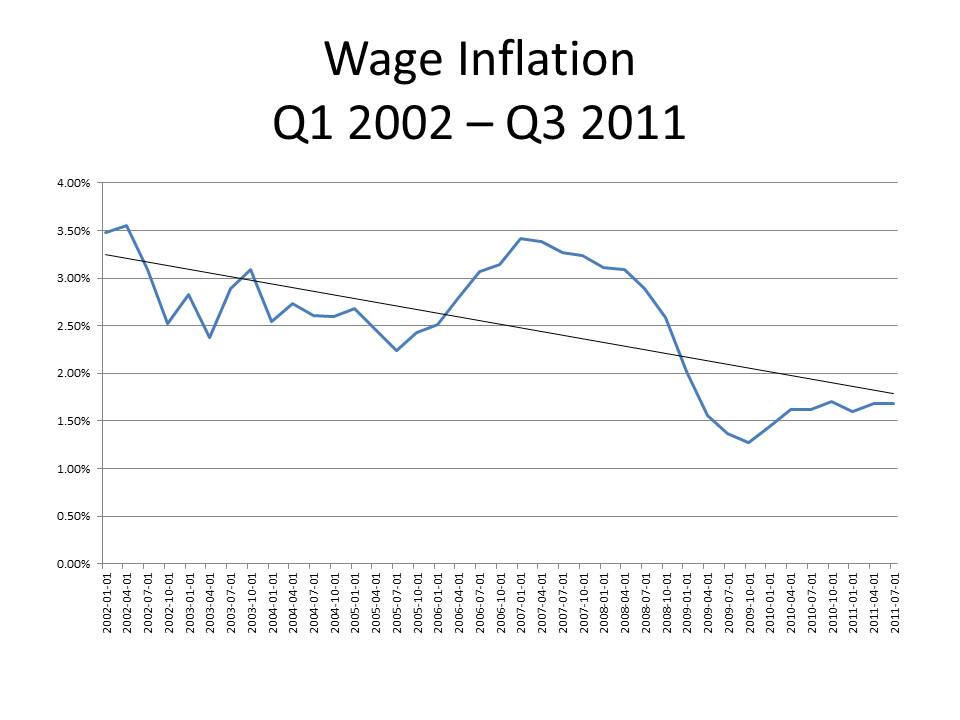
I mean Lacker can’t have it both ways. Either there are lot of unfilled vacancies that employers are trying to fill, and wages are being bid up to attract the highly prized workers that can fill them, or there are not that many unfilled vacancies and wages are not being driven up by desperate employers trying to fill those vacancies. If Lacker is right about the magnitude of unsatisfied demand for labor, there should be some evidence for it showing up in the wages actually being paid.

So what do the data show? Well, the Bureau Labor Statistics has published since 2001 an employment cost index of wages and salaries for workers in private industry. The chart below shows the quarterly year-on-year change in the index since 2002. As you can see the year-on-year change has come down steadily since 2002, bottoming out at a rate of increase well below anything observed in the 2002-2008 period. If Lacker is right that job mismatch accounts for a significant fraction of currently observed unemployment, why is the rate of wage inflation nearly a percentage point below the lowest observed rate of wage inflation in the 2002 to 2008 period?

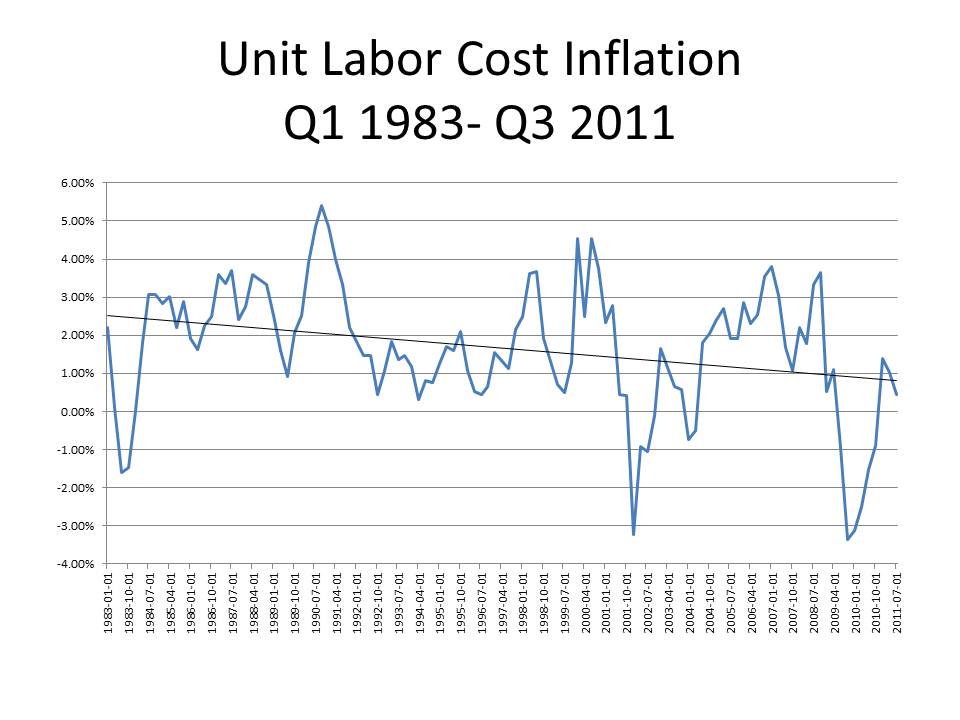
Of course, some people regard the 2002-2008 period as one of wild inflationary excess. So I also looked at a similar, but slightly different, index that goes back further than the employment cost index, the labor cost index which takes into account changes in both wages and productivity. The next chart shows the quarterly year on year change in unit labor costs since 1983 (the beginning of the recovery from the 1981-82 recession). The rate of increase in unit labor costs since 2008 is clearly well below the rates of increase for almost the entire period.

And, at the armchair level of analysis at which Lacker is comfortably operating in making his assessments about the role of skills mismatch in the labor market, it is not at all clear that skill deficiencies are the only, or chief, reason for the increasing number of unemployed per vacancy. It would be at least as plausible to suggest that employers are becoming increasingly choosy in selecting job applicants for the few available vacancies that they are trying to fill. Because they are not trying hard to increase output, employers can afford to wait a little longer to find the perfect employee than they would wait if they were trying to expand output. There are two sides to every matching problem, and Lacker seems interested in just one side.

Finally, it is just astonishing that, at a time when inflation is at its lowest rate in a half century, Lacker could offer as an implied rationale for his opposition to using monetary policy to reduce unemployment: “monetary policy will have difficulty making meaningful inroads into the job problem without increasing inflation,” as if any policy option that would increase inflation above its current historically low rate is not even worthy of consideration.

On Multipliers, Ricardian Equivalence and Functioning Well

In my post yesterday, I explained why if one believes, as do Robert Lucas and Robert Barro, that monetary policy can stimulate an economy in an economic downturn, it is easy to construct an argument that fiscal policy would do so as well. I hope that my post won’t cause anyone to conclude that real-business-cycle theory must be right that monetary policy is no more effective than fiscal policy. I suppose that there is that risk, but I can’t worry about every weird idea floating around in the blogosphere. Instead, I want to think out loud a bit about fiscal multipliers and Ricardian equivalence.

I am inspired to do so by something that John Cochrane wrote on his blog defending Robert Lucas from Paul Krugman’s charge that Lucas didn’t understand Ricardian equivalence. Here’s what Cochrane, explaining what Ricardian equivalence means, had to say:

So, according to Paul [Krugman], “Ricardian Equivalence,” which is the theorem that stimulus does not work in a well-functioning economy, fails, because it predicts that a family who takes out a mortgage to buy a $100,000 house would reduce consumption by $100,000 in that very year.

Cochrane was a little careless in defining Ricardian equivalance as a theorem about stimulus, when it’s really a theorem about the equivalence of the effects of present and future taxes on spending. But that’s just a minor slip. What I found striking about Cochrane’s statement was something else: that little qualifying phrase “in a well-functioning economy,” which Cochrane seems to have inserted as a kind of throat-clearing remark, the sort of aside that people are just supposed to hear but not really pay much attention to, that sometimes can be quite revealing, usually unintentionally, in its own way.

What is so striking about those five little words “in a well-functioning economy?” Well, just this. Why, in a well-functioning economy, would anyone care whether a stimulus works or not? A well-functioning economy doesn’t need any stimulus, so why would you even care whether it works or not, much less prove a theorem to show that it doesn’t? (I apologize for the implicit Philistinism of that rhetorical question, I’m just engaging in a little rhetorical excess to make my point a little bit more colorfully.)

So if a well-functioning economy doesn’t require any stimulus, and if a stimulus wouldn’t work in a well-functioning economy, what does that tell us about whether a stimulus works (or would work) in an economy that is not functioning well? Not a whole lot. Thus, the bread and butter models that economists use, models of how an economy functions when there are no frictions, expectations are rational, and markets clear, are guaranteed to imply that there are no multipliers and that Ricardian equivalence holds. This is the world of a single, unique, and stable equilibrium. If you exogenously change any variable in the system, the system will snap back to a new equilibrium in which all variables have optimally adjusted to whatever exogenous change you have subjected the system to. All conventional economic analysis, comparative statics or dynamic adjustment, are built on the assumption of a unique and stable equilibrium to which all economic variables inevitably return when subjected to any exogenous shock. This is the indispensable core of economic theory, but it is not the whole of economic theory.

Keynes had a vision of what could go wrong with an economy: entrepreneurial pessimism — a dampening of animal spirits — would cause investment to flag; the rate of interest would not (or could not) fall enough to revive investment; people would try to shift out of assets into cash, causing a cumulative contraction of income, expenditure and output. In such circumstances, spending by government could replace the investment spending no longer being undertaken by discouraged entrepreneurs, at least until entrepreneurial expectations recovered. This is a vision not of a well-functioning economy, but of a dysfunctional one, but Keynes was able to describe it in terms of a simplified model, essentially what has come down to us as the Keynesian cross. In this little model, you can easily calculate a multiplier as the reciprocal of the marginal propensity to save out of disposable income.

But packaging Keynes’s larger vision into the four corners of the Keynesian cross diagram, or even the slightly more realistic IS-LM diagram, misses the essence of Keynes’s vision — the volatility of entrepreneurial expectations and their susceptibility to unpredictable mood swings that overwhelm any conceivable equilibrating movements in interest rates. A numerical calculation of the multiplier in the simplified Keynesian models is not particularly relevant, because the real goal is not to reach an equilibrium within a system of depressed entrepreneurial expectations, but to create conditions in which entrepreneurial expectations bounce back from their depressed state. As I like to say, expectations are fundamental.

Unlike a well-functioning economy with a unique equilibrium, a not-so-well functioning economy may have multiple equilibria corresponding to different sets of expectations. The point of increased government spending is then not to increase the size of government, but to restore entrepreneurial confidence by providing assurance that if they increase production, they will have customers willing and able to buy the output at prices sufficient to cover their costs.

Ricardian equivalence assumes that expectations of future income are independent of tax and spending decisions in the present, because, in a well-functioning economy, there is but one equilibrium path for future output and income. But if, because the economy not functioning well, expectations of future income, and therefore actual future income, may depend on current decisions about spending and taxation. No matter what Ricardian equivalence says, a stimulus may work by shifting the economy to a different higher path of future output and income than the one it now happens to be on, in which case present taxes may not be equivalent to future taxes, after all.

Krugman v. Lucas on Fiscal Stimulus

The blogosphere has been buzzing recently over the recent confrontation between Nobelists Paul Krugman and Robert Lucas, Krugman charging Lucas with not understanding Ricardian equivalence. The controversy has already gone on too long with too many contributions from too many sources to even attempt to summarize it, so if you have been asleep for the last week and haven’t yet heard about this minor internet conflagration, I suggest that you do a google search on Krugman + Lucas + Ricardian equivalence.

I am not even going to try to comment on Krugman’s criticism of Lucas or on criticisms of Krugman’s criticism by Andolfatto and Williamson and Cochrane. But I do want to go back to the statement that Lucas made in his talk that got Krugman all bent out of shape, because it reminded me of a piece that Robert Barro wrote a while back in the Wall Street Journal, a piece I commented on here. First, here’s what Lucas said in his talk.

We had some lively sessions this morning about fiscal stimulus.  Now, would a fiscal stimulus somehow get us out of this bind, or add another weapon that would help in this problem?  I’ve already said I think what the Fed is now doing is going to be enough to get a reasonably quick recovery committed.  But, could we do even better with fiscal stimulus?

I just don’t see this at all.  If the government builds a bridge, and then the Fed prints up some money to pay the bridge builders, that’s just a monetary policy.  We don’t need the bridge to do that.  We can print up the same amount of money and buy anything with it.  So, the only part of the stimulus package that’s stimulating is the monetary part.

So Lucas remains enough of a Monetarist to agree that printing money can provide a stimulus to an ailing economy. However, he denies that government spending can provide any stimulus if there is no money printing.

Last August, Robert Barro had a take similar to Lucas on the ineffectiveness of fiscal policy.

If [the Keynesian multiplier were] valid, this result would be truly miraculous.  The recipients of food stamps get, say, $1 billion but they are not the only ones who benefit.  Another $1 billion appears that can make the rest of society better off.  Unlike the trade-off in regular economics, that extra $1 billion is the ultimate free lunch.

How can it be right?  Where was the market failure that allowed the government to improve things just by borrowing money and giving it to people?  Keynes in his “General Theory” (1936), was not so good at explaining why this worked, and subsequent generations of Keynesian economists (including my own youthful efforts) have not been more successful.

I also pointed out that Barro had written an earlier piece in the Journal in which he explicitly stated that a business downturn and high unemployment could be prevented by monetary expansion (printing money).

[A] simple Keynesian macroeconomic model implicitly assumes that the government is better than the private market at marshalling idle resources to produce useful stuff.  Unemployed labor and capital can be utilized at essentially zero social cost, but the private market is somehow unable to figure any of this out.  In other words, there is something wrong with the price system.

John Maynard Keynes thought that the problem lay with wages and prices that were stuck at excessive levels.  But this problem could be readily fixed by expansionary monetary policy, enough of which will mean that wages and prices do not have to fall.

I then suggested that if monetary policy is indeed effective in providing stimulus to an economy in recession, it is not that hard to construct an argument that fiscal policy can also be effective in providing stimulus, fiscal stimulus being a method of transferring cash from those indifferent between holding cash and holding bonds to those who would spend cash.

[H]ow is it that monetary expansion works according to regular economics?  People get additional pieces of paper;  they have already been holding pieces of paper, and don’t want to hold any more paper.  Instead they start spending to get rid of the the extra pieces of paper, but what one person spends another person receives, so in the aggregate they cannot reduce their holdings of paper as intended until the total amount of spending has increased sufficiently to raise prices or incomes to the point where everyone is content to hold the amount of paper in existence.  So the mechanism by which monetary expansion works is by creating an excess supply of money over the demand.

Well, let’s now think about how government spending works.  What happens when the government spends money in a depression?  It borrows money from people who are holding a lot money but are willing to part with it for a bond promising a very low interest rate.  When the interest rate is that low, people with a lot cash are essentially indifferent between holding cash and holding government bonds.  The government turns around and spends the money buying stuff from or just giving it to people.  As opposed to the people from whom the government borrowed the money, a lot of the people who now receive the money will not want to just hold the money.  So the government borrowing and spending can be thought of as a way to take cash from people who were willing to hold all the money that they held (or more) giving the money to people already holding as much money as they want and would spend any additional money that they received.  In other words, i.e., in terms of the demand to hold money versus the supply of money, the government is cleverly shifting money away from people who are indifferent between holding money and bonds and giving the money to people who are already holding as much money as they want to.  So without actually printing additional money, the government is creating an excess supply of money, thereby increasing spending, a process that continues until income and spending rise to a level at which the public is once again willing to hold the amount of money in existence.

Now I happen to think that there are solid reasons to prefer monetary over fiscal policy as a method of stimulus, but there is no reason to treat this issue as if some deep principle of economic theory depended on it. But that seems to be the way it is treated by Lucas and Barro. And, just to show that I can be even-handed in my assessments, many Keynesians, including Paul Krugman himself, like to argue that in a Depression only fiscal policy can work because of the liquidity trap.  However, at least Krugman displays the unfairly maligned virtue of inconsistency.

Which Fed Policy Is Boosting Stocks?

In yesterday’s (December 27, 2011) Wall Street Journal, Cynthia Lin (“Fed Policy Delivers a Tonic for Stocks”) informs us that the Fed’s Operation Twist program “has been a boon for investors during the year’s final quarter.”

The program, which has its final sale of short-dated debt for the year on Wednesday, pushed up a volatile U.S. stock market over the past few months and helped lower mortgage rates, breathing some life into the otherwise struggling U.S. housing sector, they said. Last week, Freddie Mac showed a variety of loan rates notching or matching record lows; the 30-year fixed rate fell to 3.91%, a record low.

In Operation Twist, the Fed sells short-dated paper and buys longer-dated securities. The program’s aim is to push down longer-term yields making Treasurys less attractive and giving investors more reason to buy riskier bonds and stocks. While share prices have risen considerably since then, Treasury yields have barely budged from their historic lows. Fear about the euro zone has caused an overwhelming number of investors to seek safety in Treasury debt. . . .

The Fed’s stimulus plan is the central bank’s third definitive attempt to aid the U.S.’s patchy economy since 2008. As expectations grew that the Fed would act in the weeks leading up to the bank’s actual announcement, which came Sept. 21, 10-year yields dropped nearly 0.30 percentage point. Since the Fed’s official statement, yields have risen modestly, to 2.026% on Friday, from 1.95% on Sept. 20. Fed Chairman Ben Bernanke said in October that rejiggering the bank’s balance sheet with Operation Twist would bring longer-term rates down 0.20 percentage points.

Sounds as if we should credit Chairman Bernanke with yet another brilliant monetary policy move. There have been so many that it’s getting hard to keep track of all his many successes. Just one little problem. On September 1, around the time that expectations that the Fed would embark on Operation Twist were starting to become widespread, the yield on the 10-year Treasury stood at 2.15% and the S&P 500 closed at 1204.42. Three weeks later on September 22, the 10-year Treasury stood at 1.72%, but the S&P 500, dropped to 1129.56. Well, since then the S&P 500 has bounced back, rising about 10% to 1265.43 at yesterday’s close. But, guess what? So did the yield on the 10-year Treasury, rising to 2.02%. So, the S&P 500 may have been risen since Operation Twist began, but it would be hard to argue that the reason that stocks rose was that the yield on longer-term Treasuries was falling. On the contrary, it seems that stocks rise when yields on long-term Treasuries rise and fall when yields on long-term Treasuries fall.

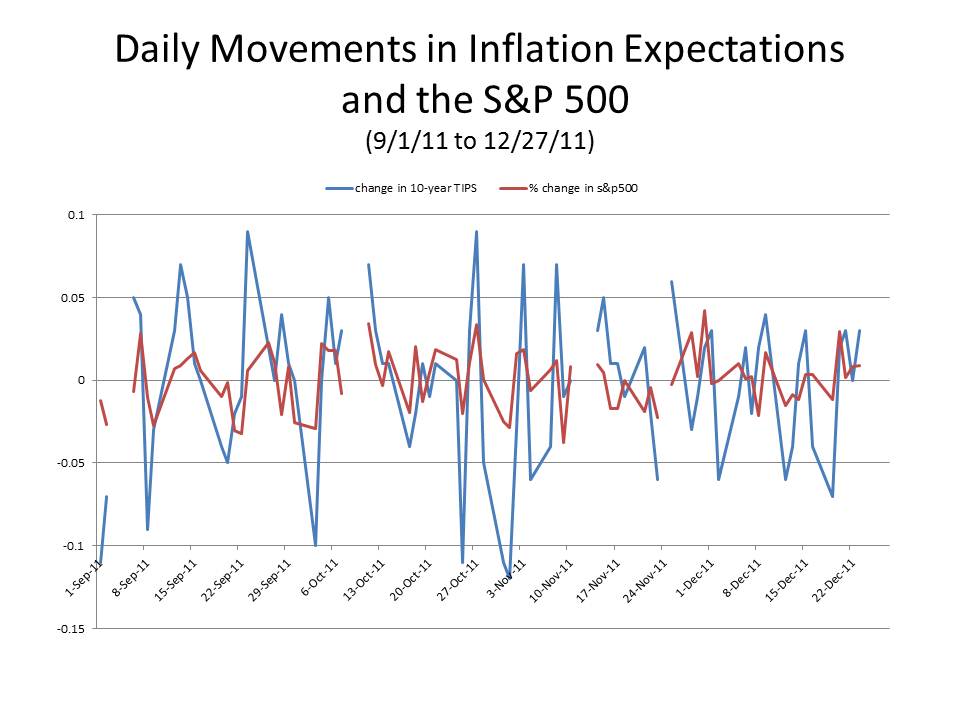
Regular readers of this blog already know that I have a different explanation for movements in the stock market. As I argued in my paper “The Fisher Effect Under Deflationary Expectations,” movements in asset prices since the spring of 2008 have been dominated by movements (up or down) in inflation expectations. That is very unusual. Aside from tax effects, there is little reason to expect stocks to be affected by inflation expectations, but when expected deflation exceeds the expected yield on real capital, asset holders want to sell their assets to hold cash instead, thereby causing asset prices to crash until some sort of equilibrium between the expected yields on cash and on real assets is restored. Ever since the end of the end of the financial crisis in early 2009, there has been an unstable equilibrium between very low expected inflation and low expected yields on real assets. In this environment small changes in expected inflation cause substantial movements into and out of assets, which is why movements in the S&P 500 have been dominated by changes in expected inflation.  And this unhealthy dependence will not be broken until either expected inflation or the expected yield on real assets increases substantially.

The close relationship between changes in expected inflation (as measured by the breakeven TIPS spread for 10-year Treasuries) and changes in the S&P 500 from September 1 through December 27 is shown in the chart below.

In my paper on the Fisher effect, I estimated a simple regression equation in which the dependent variable was the daily percentage change in the S&P 500 and the independent variables were the daily change in the TIPS yield (an imperfect estimate of the expected yield on real capital), the daily change in the TIPS spread and the percentage change in the dollar/euro exchange rate (higher values signifying a lower exchange value of the dollar, thus providing an additional measure of inflation expectations or possibly a measure of the real exchange rate). Before the spring of 2008, this equation showed almost no explanatory power, from 2008 till the end of 2010, the equation showed remarkable explanatory power in accounting for movements in the S&P 500. My regression results for the various subperiods between January 2003 till the end of 2010 are presented in the paper.

I estimated the same regression for the period from September 1, 2011 to December 27, 2011. The results were startlingly good. With a sample of 79 observations, the adjusted R-squared was .636. The coefficients on both the TIPS and the TIPS spread variables were positive and statistically significant at over a 99.9% level. An increase of .1 in the real interest rate was associated with a 1.2% increase in the S&P and an increase of .1 in expected inflation was associated with a 1.7% increase in the S&P 500. A 1% increase the number of euros per dollar (i.e., a fall in the value of the dollar in terms of euros) was associated with a 0.57% increase in the S&P 500. I also introduced a variable defined as the daily change in the ratio of the yield on a 10-year Treasury to the yield on a 2-year Treasury, calculating this ratio for each day in my sample. Adding the variable to the regression slightly improved the fit of the regression, the adjusted R-squared rising from .636 to .641. However, the coefficient on the variable was positive and not statistically significant. If the supposed rationale of Operation Twist had been responsible for the increase in the S&P 500, the coefficient on this variable would have been negative, not positive. So, contrary to the story in yesterday’s Journal, Operation Twist has almost certainly not been responsible for the rise in stock prices since it was implemented.

Why has the stock market been rising? I’m not sure, but most likely market pessimism about the sway of the inflation hawks on the FOMC was a bit overdone during the summer when the inflation expectations and the S&P 500 both were dropping rapidly. The mere fact that Chairman Bernanke was able to implement Operation Twist may have convinced the market that the three horseman of the apocalypse on the FOMC (Plosser, Kocherlakota, and Fisher) had not gained an absolute veto over monetary policy, so that the doomsday scenario the market may have been anticipating was less likely to be realized than had been feared. I suppose that we should be thankful even for small favors.

Surprise! Inflation Is Falling

The Wall Street Journal, in an article by Jon Hilsenrath, reports today (December 27, 2011) that recent reductions in the rate of inflation improve the chances that the Fed will decide to ease monetary policy.

U.S. inflation is slowing after a surge early in the year.

Some surge. From about 1.5% to 4% in the CPI and from about 1.5% to 3% in the PCE index. The GDP deflator barely moved staying roughly at 2.5%.

This is good news for Americans, as it means the money in their pockets goes further.

Well not quite, because inflation is still running above zero. But let’s not quibble about arithmetic. The real problem with that sentence is the unstated assumption that the number of dollars people have in their pockets has nothing to do with how much inflation there is. I do not expect Mr. Hilsenrath to accept my theoretical position that, under current conditions, inflation would contribute to a speedup in the rate of growth in real income, but it is inexcusable to ignore the truism that rising prices necessarily put more dollars in people’s pockets and simultaneously assert, as if it were a truism, that rising prices reduce real income.

It also is welcome at the Federal Reserve, which has been counting on an inflation slowdown. It gives the Fed some maneuvering room in 2012 if central-bank officials want to take steps to bolster economic growth.

Well now, we are switching theories, aren’t we? According to that assessment of the Fed’s options, falling inflation means that the Fed could ease monetary policy, thereby helping the economy grow more rapidly than it is now growing. How, one wonders, could the Fed do that? Um, maybe by preventing the rate of inflation from falling even faster? In other words, maybe inflation would drop down to zero or even to a negative rate, i.e., deflation. Don’t want that. But if falling inflation is good news, then, really, why not let inflation keep falling? In fact, why not go for deflation? How does falling inflation turn suddenly from being good to being bad?

The answer is that whether inflation is good or bad depends on the circumstances. Sometimes inflation can be too high; sometimes it can be too low.  But we are operating under a monetary regime in which the rate of inflation is always supposed to be 2% or a bit lower.  Anything above is too high; anything below is too low.  There is just one problem:  there is no single rate of inflation that is optimal under all circumstances. And the corollary of the idea that there is a unique optimal rate of inflation — the notion that the only concern of monetary policy is to keep the rate of inflation at that target rate, regardless of what is happening to the economy in general is not, as far as I can tell, grounded either in economic theory or in economic history. And please spare me any comparisons to the stagflation of the 1970s, which resulted from two severe supply shocks within five years sandwiched by two periods of rapid monetary expansion aimed at reducing unemployment below any reasonable estimate of what the natural rate of unemployment would have been at the time.

No Monetary Policy Is Not Just Another Name for Fiscal Policy

I just read John Cochrane’s essay “Inflation and Debt” in the Fall 2011 issue of National Affairs. On his webpage, Cochrane gives this brief summary of what the paper is about.

An essay summarizing the threat of inflation from large debt and deficits. The danger is best described as a “run on the dollar.” Future deficits can lead to inflation today, which the Fed cannot control. I also talk about the conventional Keynesian (Fed) and monetarist views of inflation, and why they are not equipped to deal with the threat of deficits. This essay complements the academic (equations) “Understanding Policy” article (see below) and the Why the 2025 budget matters today WSJ oped (see below).

And here’s the abstract to his “Understanding Policy in the Great Recession” article:

I use the valuation equation of government debt to understand fiscal and monetary policy in and following the great recession of 2008-2009. I also examine fiscal and monetary policy alternatives to avoid deflation, and how fiscal pressures might lead to inflation. I conclude that the central bank might be almost powerless to avoid inflation or deflation; that an eventual fiscal inflation can come well before fiscal deficits or monetization are realized, and that it is likely to come with stagnation rather than a boom.

The crux of Cochrane’s argument is that government currency is a form of debt so that inflation is typically the result of a perception by bondholders and potential purchasers of government debt that the government will not be able to raise enough revenues to cover its expenditures and repay its debt obligations, implying an implicit default through inflation. However, the expectation of future inflation because of an anticipated future fiscal crisis may suddenly — when an expectational tipping point is reached — trigger a “run” on the currency well before the crisis, a run manifesting itself in rapidly rising nominal interest rates and rising inflation even before the onset of a large fiscal deficit.

This is certainly an important, though hardly original, insight, and provides due cause for concern about our long-term fiscal outlook. The puzzle is why Cochrane thinks the possibility of a run on the dollar because of an anticipated future fiscal crisis is at all relevant to an understanding of why we are stuck in a lingering Little Depression. Cochrane is obviously very pleased with his fiscal theory of inflations, believing it to have great explanatory power.  But that explanatory power, as far as I can tell, doesn’t quite extend to explaining the origins of, or the cure for, the crisis in which we now find ourselves.

Cochrane’s recent comments on a panel discussion at the Hoover Institution give the flavor of his not very systematic ideas about the causes of the Little Depression, and the disconnect between those ideas and his fiscal theory of inflation.

Why are we stagnating? I don’t know. I don’t think anyone knows, really. That’s why we’re here at this fascinating conference.

Nothing on the conventional macro policy agenda reflects a clue why we’re stagnating. Score policy by whether its implicit diagnosis of the problem makes any sense.

The “jobs” bill. Even if there were a ghost of a chance of building new roads and schools in less than two years, do we have 9% unemployment because we stopped spending on roads & schools? No. Do we have 9% unemployment because we fired lots of state workers? No.

Taxing the rich is the new hot idea. But do we have 9% unemployment-of anything but tax lawyers and lobbyists–because the capital gains rate is too low? Besides, in this room we know that total marginal rates matter, not just average Federal income taxes of Warren Buffet. Greg Mankiw figured his marginal tax rate at 93% including Federal, state, local, and estate taxes. And even he forgot about sales, excise, and corporate taxes. Is 93% too low, and the cause of unemployment?

The Fed is debating QE3. Or is it 5? And promising zero interest rates all the way to the third year of the Malia Obama administration. All to lower long rates 10 basis points through some segmented-market magic. But do we really have 9% unemployment because 3% mortgages with 3% inflation are strangling the economy from lack of credit? Or because the market is screaming for 3 year bonds, but Treasury issued at 10 years instead? Or because $1.5 trillion of excess reserves aren’t enough to mediate transactons?

I posed this question to a somewhat dovish Federal Reserve bank president recently. He answered succinctly, “Aggregate demand is inadequate. We fill it. ” Really? That’s at least coherent. I read the same model as an undergraduate. But as a diagnosis, it seems an awfully simplistic uni-causal, uni-dimensional view of prosperity. Medieval doctors had three humors, not just one.

Of course in some sense we are still suffering the impact of the 2008 financial crisis. Reinhart and Rogoff are endlessly quoted that recessions following financial crises are longer. But why? That observation could just mean that policy responses to financial crises are particularly wrongheaded.

In sum, the patient is having a heart attack. The doctors debating whether to give him a double espresso vs. a nip of brandy. And most likely, the espresso is decaf and the brandy watered.

So what if this really is not a “macro” problem? What if this is Lee Ohanian’s 1937-not about money, short term interest rates, taxes, inadequately stimulating (!) deficits, but a disease of tax rates, social programs that pay people not to work, and a “war on business.” Perhaps this is the beginning of eurosclerosis. (See Bob Lucas’s brilliant Millman lecture for a chilling exposition of this view).

If so , the problem is heart disease. If so, macro tools cannot help. If so, the answer is “Get out of the way.”

Cochrane seems content to take the most naïve Keynesian model as the only possible macro explanation of the current slump, and, after cavalierly dismissing it, concludes that there is no macroeconomic explanation for the slump, leaving “get out of the way” as the default solution. That’s because he seems convinced that all that you need to know about money is that expected future fiscal deficits can cause inflation now, because the expectation triggers a “run” on the currency. This is an important point to recognize, but it does not exhaust all that we know or should know about monetary theory and monetary policy. It is like trying to account for the price level under the gold standard by only taking into account the real demand for gold (i.e., the private demand for gold for industrial and ornamental purposes) and ignoring the monetary demand for gold (i.e., the demand by banks and central banks to hold gold as reserves or for coinage). If you looked only at the private demand for gold, you couldn’t possibly account for the Great Depression.

PS I also have to register my amazement that Cochrane could bring himself to describe Lucas’s Millman lecture as brilliant. It would be more accurate to describe the lecture as an embarrassment.

HT:  David Levey

Bill Gross Doesn’t Get It

In today’s Financial Times, the famed investor Bill Gross tries to explain why low interest rates are harming the economy (“The ugly side of ultra-cheap money”). The interesting thing about his piece is that much, if not most, of what he says is totally correct.  But he just can’t quite seem to put all the pieces together and make sense out of them. What seems to be Mr. Gross’s problem?

Well, first let’s see what Mr. Gross gets right. The first thing that he gets right is that banks and other financial intermediaries make their profits off of the spread between their cost of funds, their borrowing rates, and their lending rates. When the interest rates at which banks and financial intermediaries can lend have been depressed by monetary policy — supposedly in the interest of spurring investment — banks and financial intermediaries can’t function profitably. Money dries up, because banks can’t earn a profit unless their lending rates exceed their borrowing rates by more than, say, 100 basis points, while current spreads are between 20 and 90 basis points. “It is no coincidence” Mr. Gross observes, “that tens of thousands of layoffs are occurring in the banking industry, and that branch expansion is reversing industry wide.”

This is one of many troubling features of the Little Depression in which we now find ourselves. But Mr. Gross mistakenly blames it on a monetary policy that is trying to stimulate the economy by keeping interest rates low.

Historically, central banks have comfortably relied on a model which dictates that lower and lower yields will stimulate aggregate demand and, in the case of financial markets, drive asset purchases outward on the risk spectrum as investors seek to maintain higher returns. Near zero policy rates and a series of “quantitative easings” have temporarily succeeded in keeping asset markets and real economies afloat in the US, Europe and even Japan. Now, with policy rates at or approaching zero yields and QE facing political limits in almost all developed economics, it is appropriate not only to question the effectiveness of historical conceptual models but to entertain the possibility that they may, counterintuitively, be hazardous to an economy’s health.

But Mr. Gross needs to ask himself why it is that banks, which would certainly like to lend at profitable rates, can’t seem to do so. It is no answer to say that the Fed has forced banks’ lending rates down; the Fed has done no such thing. The Fed’s policy rate is the rate at which banks can borrow reserves; it is not the rate at which banks can lend to customers. One might say that the Fed, through quantitative easing, has forced down the interest rates on government debt to very low levels as well. Yes, but banks are not lending to the government, they are lending to businesses. And if banks can’t lend to businesses at interest rates high enough to earn a profit, it is because businesses just aren’t willing to borrow at interest rates that high, not because the central bank policy rate is so low. Why won’t businesses pay a higher interest rate on bank loans?  What businesses are willing to pay for bank loans simply reflects their depressed demand for financing, which in turn reflects their rather pessimistic expectations about the profitability of future investment and the sizable quantity of cash they have on hand, not the effect of quantitative easing. If central banks raised interest rates, i.e., the interest banks must pay for reserves, it would not make banks more profitable; it would just reduce further the amount of funds businesses wanted to borrow from banks. Current low interest rates reflect the depressed state of the economy, not a ceiling on bank lending rates imposed by the Fed.

So Mr. Gross has it backwards, current low interest rates are not being imposed on the economy by the central bank, low interest rates are a symptom of an economy in a state of severe and chronic depression. Now it is true that banks and financial intermediaries are unable to operate normally when the spread between their borrowing and lending rates is as narrow as it is now. But there is a solution to that problem: raise inflation expectations, thereby raising lending rates and the spread between bank borrowing and lending rates. The Fed knows how to do that; it just needs to make up its mind that that is what it wants to do.  That’s just what Market Monetarists have been pleading for the Fed to do. Mr. Gross, isn’t it time for you to get with the program?

Update:  I see that Paul Krugman also wrote about Bill Gross today on his blog.  As the recipient of four shout-outs from Krugman since this blog started, I guess that it’s only fair that I return the favor.  I’m sure that he will appreciate the added traffic on his blog.

Straight Talk from Benjamin Cole

Our very own Benjamin Cole (actually he’s not our very own because the peripatetic Mr. Cole shows up all over the blogosphere, but he’s like family) has recently written a guest post for another frequent commentator on this blog Lars Christensen whose blog is a must read. Working in the private sector, Lars has an entrepreneurial eye for what will appeal to the market, and so he is always ready and willing to open up his own blog to guest bloggers with something interesting and worthwhile to say. One more reason to always keep Lars’s blog on your radar screen.

Regular readers of this and other blogs know that Benjamin is a no-nonsense guy who is interested in results not idle chatter. So everyone could expect that when Benjamin got the opportunity to give us all a piece of his mind, he would get right to the point and talk about how to implement Market Monetarism with a sophisticated understanding of the issues and in simple and direct terms that ordinary people can follow. And that’s just what he did.

Benjamin makes a strong case that adopting a simple and transparent policy that the public can understand can monitor. So he recommends that the Fed commit to buy $100 billion of securities a month for up to 5 years in order to achieve a target annual growth rate of NGDP of 7.5% over the next 5 years.

The recommended concrete sum of $100 billion a month in QE is not an amount rendered after consultation with esoteric, complex and often fragile econometric models.  Quite the opposite—it is sum admittedly only roughly right, but more importantly a sum that sends a clear signal to the market.  It is a sum that can be tracked every month by all market players.  It has the supreme attributes of resolve, clarity and conviction. The sum states the Fed will beat the recession, that is the Fed’s goal, and that the Fed is bringing the big guns to bear until it does, no ifs, ands, or buts.

Now every so often I have recommended that the Fed and Treasury announce that they would target the dollar/euro exchange at a level 20% below the current dollar/euro exchange rate (something like $1.50 or $1.60 per euro), through open market operations and unsterilized purchases of euros in foreign-exchange markets  and would continue to do so until a suitably defined price level rose by 20 percent. This would mean that the only way for the Europeans to avoid an increase in the euro’s value against the dollar would be for them to inflate at nearly the same rate as the dollar was inflating. But once the new higher price level was achieved, the policy of driving down the dollar’s exchange rate against the euro would be terminated. Benjamin’s proposal is similar in the sense that is easily articulated and easily monitored, and therefore, credible. If the policy is credible, the public will believe in it and adjust their expectations accordingly, thereby ensuring its ultimate success.

Just to show that I am not a complete pushover, let me just mention a couple of points on which I don’t entirely agree with Benjamin. Benjamin opposes further extensions in the duration of unemployment insurance, but I am not so sure. Theoretically, the effects cut in both directions, so it is doubtful whether limiting unemployment insurance would do very much to reduce unemployment. Perhaps a better approach would be to scale back the benefit when extending unemployment insurance rather than terminate it altogether. Nor do I think that reducing federal expenditures to 18% of GDP, as Benjamin proposes, is a realistic goal given the increasing age of the population, meaning that the government will be paying more and more for the medical bills of an aging population. Discretionary non-defense spending has already been reduced as a percentage of GDP to historically low levels. So I think people are kidding themselves if they think that spending can be cut just by picking a number like 18% out of thin air. If you want to cut the budget, Benjamin, tell us what you want to cut.


About Me

David Glasner
Washington, DC

I am an economist in the Washington DC area. My research and writing has been mostly on monetary economics and policy and the history of economics. In my book Free Banking and Monetary Reform, I argued for a non-Monetarist non-Keynesian approach to monetary policy, based on a theory of a competitive supply of money. Over the years, I have become increasingly impressed by the similarities between my approach and that of R. G. Hawtrey and hope to bring Hawtrey’s unduly neglected contributions to the attention of a wider audience.

My new book Studies in the History of Monetary Theory: Controversies and Clarifications has been published by Palgrave Macmillan

Follow me on Twitter @david_glasner

Archives

Enter your email address to follow this blog and receive notifications of new posts by email.

Join 665 other subscribers
Follow Uneasy Money on WordPress.com